




Abstract
This article proposes an access-point and channel selection method for Internet of Things environments. Recently, the number of wireless nodes has increased with the growth of Internet of Things technologies. In order to accommodate traffic generated by the wireless nodes, we need to utilize densely placed wireless access-points. This article introduces a joint optimization problem of access-point and channel selection for such an environment. The proposed method deals with the optimization problem, using Markov approximation which adapts to dynamic changes in network conditions. Markov approximation is a distributed optimization framework, where a network is optimized by individual behavior of users forming a time-reversible continuous-time Markov chain. The proposed method searches optimal solution for the access-point and channel selection problem on the time-reversible continuous-time Markov chain. Simulation experiments demonstrate the effectiveness of the proposed method.
Keywords
Introduction
Recently, a huge number of network devices have connected to the Internet, which leads to the realization of Internet of Things (IoT).1–5 The number of network devices will further increase with the growth of IoT technologies. In IoT environments, many wireless nodes and access-points are assumed to be densely distributed, and they construct wireless local area networks. 6 In fact, the number of access-points has increased rapidly in public spaces such as train stations and airports. When there are some access-points in a given area, wireless nodes can select an access-point from among them. Each access-point selects a channel to communicate and then communicates with wireless nodes on the channel. The quality of the communications strongly depends on the selected access-points and channels. Therefore, access-point and channel selection has become an important technical issue.7–10
Under current IEEE 802.11 specifications, wireless nodes select the access-point with the highest received signal strength indicator (RSSI). In this RSSI-based selection, traffic loads among access-points are often uneven. Some access-points have many wireless nodes, whereas others have relatively few wireless nodes. When many wireless nodes connect to an access-point, the throughput drastically decreases because of traffic congestion. To alleviate this traffic congestion, some wireless nodes should switch to access-points that have lower loads but somewhat lower RSSIs. Moreover, RSSI-based selection causes another problem in terms of frequency resource utilization of access-points because the RSSI values are independent of channels of access-points. In cases where neighboring access-points use the same channel, we should avoid simultaneously using the access-points even if those RSSIs are high. Frequency resources can be effectively used by selecting an access-point that has a lower RSSI and uses a different channel.
In the past, several access-point selection methods have been considered.7–9 Most of those methods use techniques such as mathematical programming and heuristic algorithms to select the optimal access-point based on the number of wireless nodes and RSSI levels at a given time. 7 These methods must conduct the optimization process in a centralized manner each time the number of users changes or any RSSI value is updated. Hence, they are not suitable for access-point selection in situations where network conditions change dynamically. In public spaces such as train stations and airports, network conditions frequently change. Typically, users stay in public spaces for a short period, and most users briefly connect to particular access-points. Especially, in IoT environments, namely, densely deployed wireless networks, network conditions more frequently change because there are a lot of access-points and wireless nodes in a small area. Therefore, an access-point and channel selection method that can flexibly accommodate such dynamic situations is needed for IoT environments.
To effectively select access-points and/or channels in IoT environments, some methods have been proposed in the literature.10–15 Karimi et al. 12 have proposed an access-point and channel selection method. In this method, multiple access-points collaborate with each other in order to accommodate users’ traffic. The authors have formulated the proposed method as a mathematical programming and maximized the throughput of the users. However, this method is centralized optimization and does not consider dynamic situations. Wu et al.13,14 have proposed channel selection and access scheduling methods for wireless mesh networks and sensor networks. These methods select a channel for each wireless node and schedule packet transmission among wireless nodes based on Latin squares. Although these methods enhance the throughput of wireless nodes, they also do not consider dynamic situations. Zhu et al. 15 have proposed a channel selection method for sensor networks in IoT environments, which utilizes the multi-armed bandit model. This method assumes dynamic situations, but does not consider an access-point selection problem. Bai et al. 11 have proposed an access-point selection for enterprise wireless local area networks (WLANs), which collects information on networks and selects access-point based on stochastic dominance tools. Xu et al. 10 have proposed an online access-point selection method named SmartAssoc that aims at maximizing the minimum throughput among users. SmartAssoc considers dynamic situations. When a new user arrives, the user connects to an access-point based on p-norm of current loads for access-points. Although these access-point selection methods work under dynamic situations, they do not consider a channel selection problem.
In this article, we deal with a joint optimization problem of access-point and channel selection for IoT environments, considering dynamic situations. We first introduce a mixed-integer programming (MIP) for the joint optimization problem of access-point and channel selection. The MIP represents ideal performance, but it is difficult to apply the MIP to large-scale problems in dynamic situations. We then propose a new access-point and channel selection method using Markov approximation in order to adapt to dynamic changes in network conditions. Markov approximation is a distributed optimization framework 16 and provides approximate solution for optimization problems. In Markov approximation, a network system is designed in such a way that it follows a time-reversible continuous-time Markov chain, where its states correspond to network conditions. The sojourn time in each state depends on the utility value of the network system. By doing so, the time average of the utility value approaches the optimal value. The proposed method searches approximate solution for the joint optimization problem of access-point and channel selection on the time-reversible continuous-time Markov chain, aiming at maximizing the minimum throughput of wireless nodes. To do so, the proposed method represents combinations of access-points selected by wireless nodes and channels selected by access-points as states of the Markov chain.
The motivation for this article is as follows. Markov approximation optimizes the network configurations by adaptively changing independent behaviors of users (i.e. wireless nodes) with time based on minimum necessary information. It flexibly responds to dynamic characteristics of the network conditions caused by arrival and departure of wireless nodes because the network configurations are optimized by just the behaviors of the mobile users without network operators. Therefore, it is suitable for situations where network conditions frequently change. In IoT environments, network conditions often change in a given area. In such environments, as mentioned above, conventional optimization techniques used in access-point and channel selection methods do not work well. They are done in centralized control by resolving optimization problems according to a network condition at a certain time. In these methods, network operators collect information on the network, and they optimize and configure the whole network, which has large overhead, every time the network condition is updated. Therefore, they are not suitable for IoT environments. To overcome this difficulty, we apply Markov approximation to the access-point and channel selection problem.
Note that the previous works about Markov approximation assumed static situations where the network condition do not change despite the characteristic of Markov approximation, which is suitable for IoT environments. In this article, we focus on the adaptability of Markov approximation to dynamic situations. The proposed method applies Markov approximation to the access-point and channel selection problem so as to adapt to the dynamic characteristic of the IoT environments and we reveal the impact of the proposed method through simulation experiments.
This article is an extended version of our conference paper. The conference paper introduced the main idea of our proposed method and showed its fundamental performance. In this article, we modify the proposed method in order to improve not only total throughput of users but also throughput fairness of users by changing the definition of the objective function of the optimization problem. Furthermore, this article provides the MIP for the optimization problem to obtain its optimal solution. We also add the results of simulation experiments in several scenarios for depicting the performance of the proposed method in detail.
The rest of this article is organized as follows. We first describe the system model and access-point selection problem. We then introduce the MIP for the problem and provide the proposed dynamic selection method using Markov approximation. We present experimental results to evaluate the performance of our proposed method. Finally, we conclude this article.
System model and access-point selection problem
System model
We assume that there are multiple users (wireless nodes) and multiple access-points in a given area, as shown in Figure 1. Let
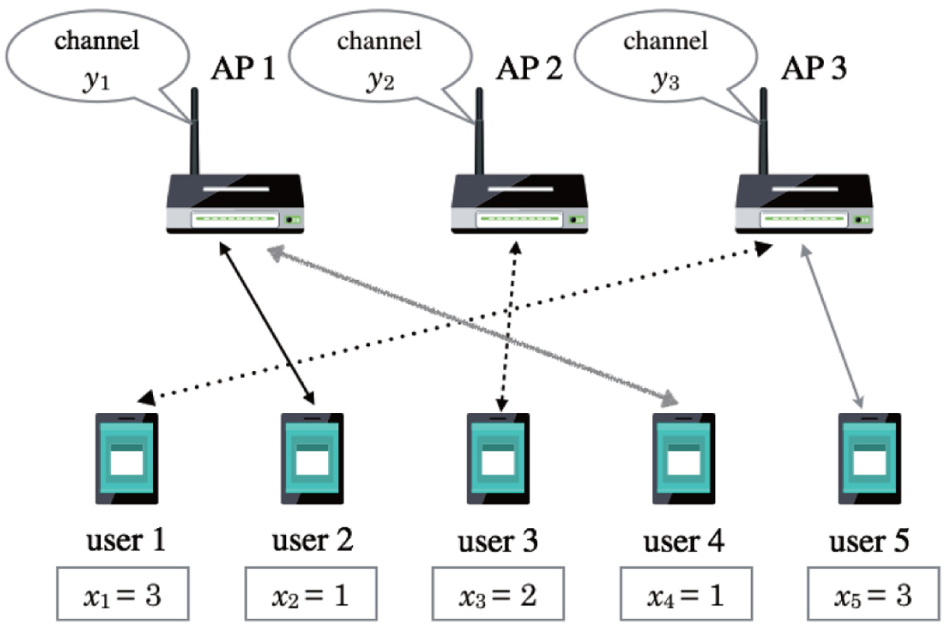
System model
The system state is represented by combinations of channels selected by access-points and access-points selected by users. We define the

In this article, we refer to
Let
Access-point and channel selection problem
This article deals with a problem that maximizes the minimum throughput of users at a given time

Equation (1) is a combinatorial optimization problem which is known to be non-deterministic polynomial-time (NP)-hard. Therefore, a brute-force search is the only way to correctly obtain the optimal solution. However, even if the numbers of users and access-points are small, the total number of strategies
MIP
Before we explain the proposed access-point and channel selection method, we introduce the following MIP that maximizes the minimum throughput of users at a given time
List of symbols in MIP.

Maximize

subject to







Equation (2) is the objective function, which indicates the minimum throughput of users. Equation (3) means that user
Although the MIP provides the optimal solution, it is not suitable for large-scale problems and dynamic situations because the MIP is NP-hard. Therefore, the proposed access-point and channel selection method aims to obtain approximation solution, using Markov approximation.
Dynamic selection using Markov approximation
This section first gives an overview of Markov approximation and then describes the proposed access-point selection method that uses Markov approximation under dynamic situations.
Markov approximation
Under static situations, equation (1) is equivalent to16,17

where
Markov approximation obtains approximate solution to an optimization problem using the following relation

where

When we define

we have the following approximation

From the above, we can see that the accuracy of the approximation depends on
Owing to the fact that the LSE function is a closed and convex function, we obtain the following approximation for equation (11) from equation (12) 16
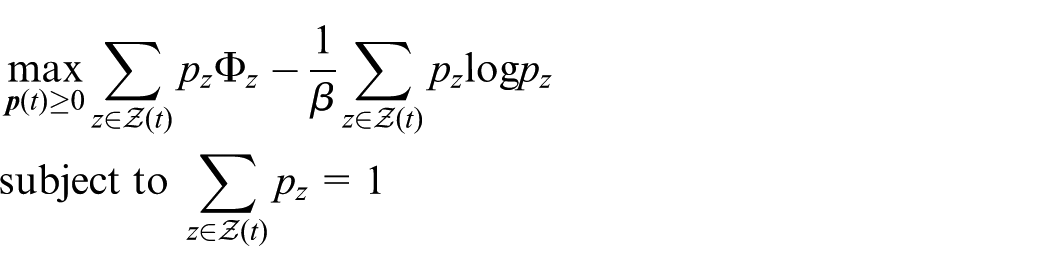
This is a nonlinear programming problem, and thus, we can obtain an optimal solution

where

With

As
We now consider a time-reversible continuous-time Markov chain, where states are elements in

where

where
Proposed method
In our proposed method, each access-point selects a channel and each user selects an access-point according to a time-reversible continuous-time Markov chain on

and for users,


Player operation.
Note that each player knows the current utility by exchanging information on its current throughput. After setting
When the counter
When the number of users changes, all players are also notified of the change in the utility. Specifically, when a new user arrives, the new user sends a notification to participate. Moreover, when a user departs, it sends a notification immediately before the departure. Players receiving these notifications halt their countdowns and then reset their counters to random value according to the exponential distribution with the parameter
In our proposed method, we define

where

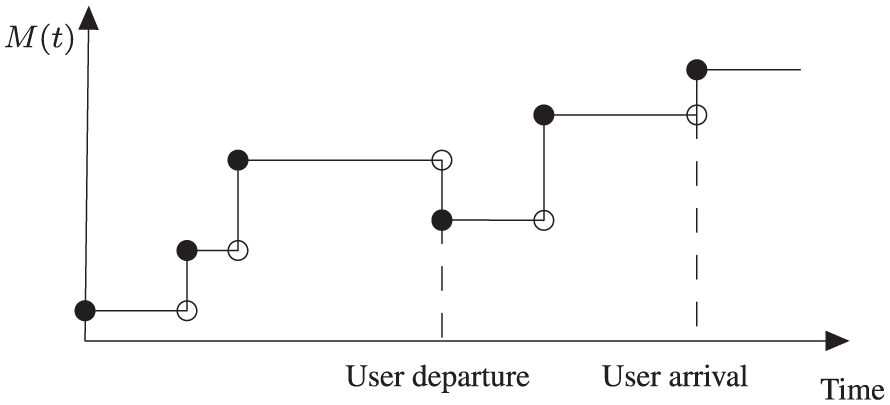
Example of change in

Feasible transitions from strategy z.
When
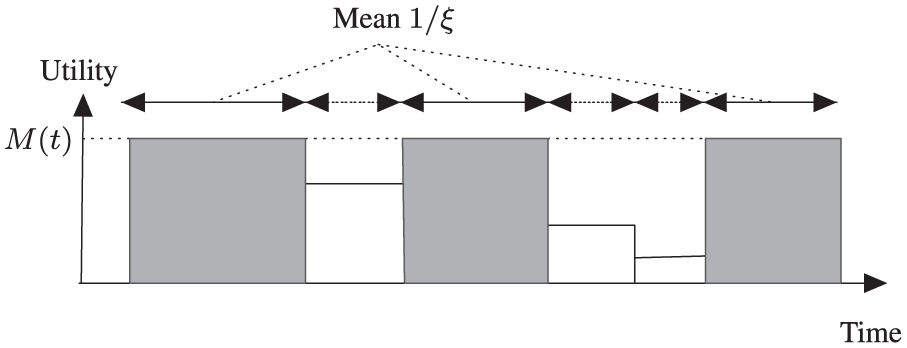
Strategy changes in our proposed method.
Performance evaluation
Evaluation model
We evaluate our proposed method through simulation experiments. We consider two scenarios with different values for maximum throughput
We assume that immediately after the strategy of a player changes, other players can know the change. We set the number
We use three indices as performance metrics: the mean utility, the mean number of iterations, and the mean total throughput. The mean utility is the time average of the utility value normalized by
For the sake of comparison, we show the results of the RSSI-based method, the simulated annealing method, SmartAssoc method, 10 and the proposed method, the objective function of which is maximizing the total throughput (abbreviated as the throughput-based method). 18
The RSSI-based method
A player is randomly chosen among
The simulated annealing method
The optimization problem equation (1) is solved by the simulated annealing algorithm,
19
which is one of the most widely used optimization techniques. This algorithm simulates the cooling process by gradually decreasing the temperature until the temperature is sufficiently low. The initial state

If the solution
SmartAssoc
SmartAssoc is an online access-point selection method for maximizing throughput fairness.
10
When a user arrives, it selects an access-point according to the following procedure. Let
The throughput-based method
The objective function equation (1) is substituted by the normalized total throughput, that is,
Evaluation results
To evaluate the basic performance of our proposed method, we first consider static situations where the number of users is fixed. Figure 6 shows the mean utility value as a function of the parameter
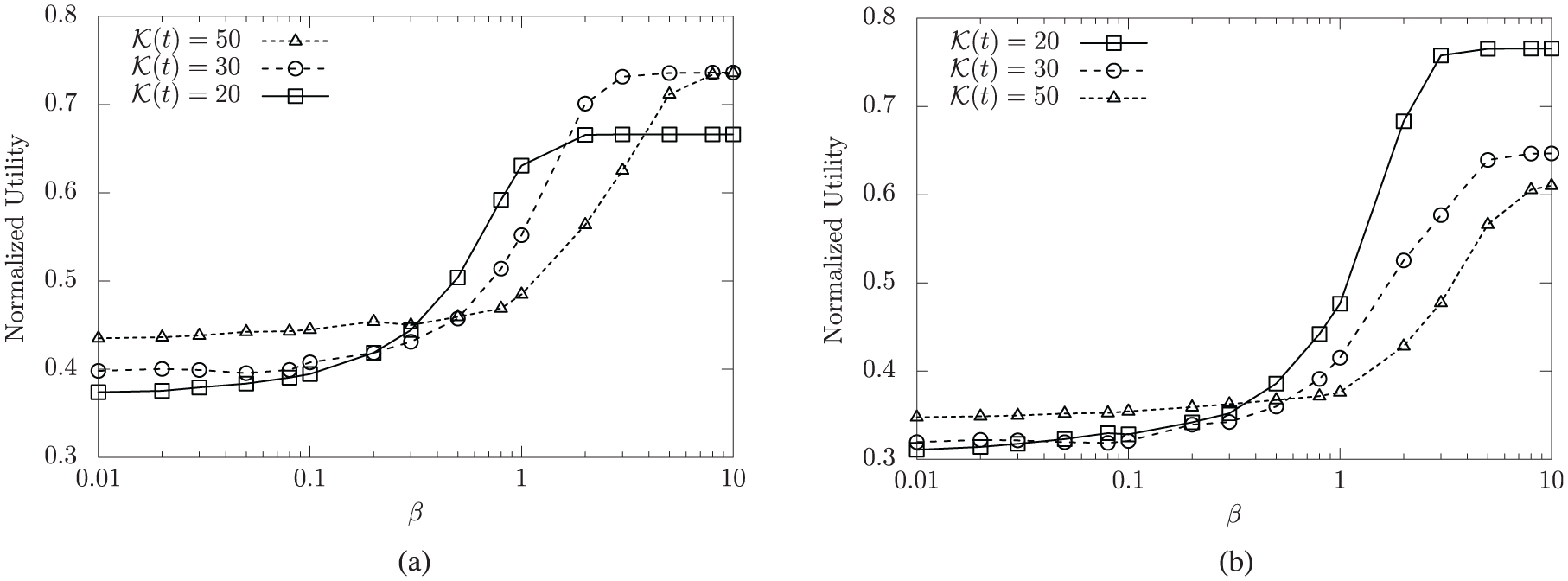
Mean utility value: (a) homogeneous scenario and (b) heterogeneous scenario.
Figure 7 shows the mean number of iterations as a function of

Mean number of iterations: (a) homogeneous scenario and (b) heterogeneous scenario.
Figure 8 shows the normalized utility value as a function of elapsed time

Changes in utility value with elapsed time
We then compare the proposed method with the RSSI-based method, the simulated annealing method and the throughput-based method. Figure 9 shows the mean utility value and the mean total throughput as a function of

Performance comparison
To demonstrate that our proposed method is effective under the dynamic situations where the number of users changes dynamically with time, we consider the following situation:
Figure 10 shows the normalized utility value as a function of elapsed time

Changes in utility with elapsed time
Conclusion
We have proposed a new method for selecting access-points and channels using Markov approximation. Through simulation experiments, we showed that our proposed method can obtain the high mean utility value under static situations. Therefore, our proposed method is effective at improving the throughput fairness of users. We also showed that our proposed method adapts to dynamic changes in the number of users. In this article, we assumed instantaneous notification of strategy changes throughout the network. In practice, however, there is some latency in the exchange of information. We thus will consider the effects of latency in the future work.
Footnotes
Handling Editor: Sang-Woon Jeon
Declaration of conflicting interests
The author(s) declared no potential conflicts of interest with respect to the research, authorship, and/or publication of this article.
Funding
The author(s) received no financial support for the research, authorship, and/or publication of this article.