




Abstract
Currently, the standardization of fifth-generation mobile communication system (5G), which realizes 10 Gbps transmission, is in progress. In mobile communications, it is generally difficult to perform high-capacity transmission because of channel fading. Therefore, an adaptive resource allocation scheme based on users’ channel conditions is adopted to enhance the system capacity. Recently, it has been shown that a non-orthogonal multiple access scheme can achieve a higher system capacity than orthogonal multiple access scheme. However, anticipating a continuous increase in mobile traffic, it is desired to further enhance the throughput of non-orthogonal multiple access scheme. Therefore, we propose an application of code division multiplexing to non-orthogonal multiple access scheme using successive interference canceler to improve the throughput performance. The improved performance is demonstrated through numerical simulations.
Keywords
Introduction
Recently, the mobile traffic has increased 3.5 times in 3 years from 2012 to 2015. 1 This increase in mobile traffic is expected to continue and is expected to reach more than 1000 times in 2020 compared to 2010. In addition, the word Internet of Things (IoT) penetrates recently, and it is expected that everything around us will communicate in the future. Thus, the standardization of fifth-generation mobile communication system (5G), which accommodates this expanding traffic, is in progress. Figure 1 shows the performance index of 5G wireless access network. 2 For comparison, the performance index of 4G (IMT-Advanced) is also shown. 3 It is supposed that the 5G accommodates a great variety of communication systems, and it is necessary to improve the performance such as peak data rate, mobility, capacity, number of connected device per cell, latency, and energy saving compared to 4G. To achieve these performance indexes, it is necessary to improve frequency utilization efficiency and develop high-frequency band by advancing the existing technologies and combining there. Generally, the technology to use limited frequency resources for communication is an important factor to realize 5G. 3.9 and fourth-generation mobile communication systems, named as long-term evolution (LTE) and LTE-Advanced, respectively, use orthogonal frequency division multiple access (OFDMA) as the downlink multiple access scheme. 4 Because the OFDMA scheme uses subcarriers that are orthogonal to each other for the transmitted data, there are no interferences between the subcarriers, and OFDMA has a tolerance for frequency-selective fading because of multicarrier transmission. However, there is a need for further improvement of multiple access scheme in order to realize mobile communication system that accommodates mobile traffic expected in near future. Hence, non-orthogonal multiple access (NOMA) scheme is considered as a promising candidate for new multiple access schemes.5,6 In orthogonal multiple access (OMA) scheme such as OFDMA, there are no interferences between users because base station (BS) allocates one user for each subcarrier. However, in the NOMA scheme, multiple users are multiplexed in the power domain for one subcarrier. This leads to interferences between multiplexed users. Figure 2 shows the principle of the NOMA scheme. In the figure, the BS allocates more than one user in each subcarrier in downlink. In the allocation, the users who have different channel gains are selected, for example, near user and far user. The user having low channel gain (far user) is allocated with higher levels of transmission power than the user having high channel gain (near user). The BS then transmits the superimposed signal. At the receiver side, a successive near user first decodes the far user data, subtracts it from the received signal, and then decodes his or her own data. 7 In contrast, at the far user, the near user signal in the received superimposed signal is sufficiently attenuated because of the lower allocated power and low channel gain, and thus, the far user can just decode his or her own data. It is known that the system throughput can be increased using the NOMA scheme instead of the OMA scheme.

Performance index of 5G wireless access network.

Principle of NOMA.
Other than the power-domain NOMA described above, there are some techniques realizing NOMA, that is, spreading-domain, code-domain, and interlearver-domain NOMA schemes. 8 In code-domain NOMA, low-density signature (LDS) 9 and pattern division multiple access (PDMA) 10 have been proposed. However, a sensitive design of spreading matrix is needed in these schemes. As a combination of power-domain and code-domain NOMA, power-domain sparse code multiple access (PSMA) has been proposed for throughput enhancement. 11 However, a complex design of code matrix is still needed and the decoding complexity increases in PSMA.
Fuwa et al. 12 have proposed a code division multiplexing (CDM)-OFDMA in which the frequency diversity effect is obtained for the allocated subcarriers by code-spreading in the frequency domain. Adopting this principle, we proposed an application CDM to the NOMA-SIC scheme for throughput performance improvement in Kitagawa and Okamoto, 13 and it was shown that the throughput enhancement was obtained compared to the conventional NOMA scheme. This NOMA-CDM-SIC uses a simple spreading matrix such as Walsh code matrix, and no additional structure other than spreading/despreading operations is required in scheduling and decoding. However, the scheduling algorithm in Kitagawa and Okamoto 13 was rather simple and more performance improvement was expected. In addition, the user fairness was not considered. Therefore, in this article, we propose a NOMA-CDM-SIC scheme with improved scheduling algorithm to further enhance the performance of NOMA in terms of throughput and user fairness, and show its performance by numerical simulation.
This article is organized as follows. Section “Downlink NOMA system” describes the downlink NOMA system with successive interference cancelation (SIC). The details of the proposed NOMA scheme with CDM is described in section “Proposed NOMA scheme using CDM,” and the numerical results are shown in section “Numerical results.” Section “Further improvement of scheduling algorithm” describes about the advancement of scheduling algorithm for NOMA scheme. Finally, section “Conclusion” presents the conclusion.
Downlink NOMA system
Figure 3 shows the concept of downlink NOMA system. In the downlink from the BS to user equipment (UE), BS allocates users in each subcarrier while taking into account the proportional fairness (PF). In the NOMA scheme, more than two users can be allocated in one subcarrier, while allowing interference with each other. In the example of Figure 3, UE1 and UE5 are superposed in subcarrier 1, and UE2 and UE4 are superposed in subcarrier 3. Throughout this article, we assume a multiple-input-multiple-output (MIMO) spatial multiplexing transmission, in which the number of transmit antennae in the BS and receiver antennas in UE are

where

where

where

It is assumed that the BS knows the channel matrix

where

Downlink NOMA system.

UE receiver structure for two-user NOMA-SIC, where channel gain of UE1 is larger than UE5.
It is assumed that the near user can correctly decode and eliminate far user signals at the receiver side. The achievable rate of user

Furthermore, the user set

where

where

Equation (7) provides a high-capacity allocation while taking into account the PF. In the NOMA scheme, because the user signals are superimposed in the power domain, the power allocation to each user significantly affects the system throughput. As described above, to make SIC work effectively, more power should be allocated to far user and less power should be allocated to near user. As one of its allocation schemes, fractional transmit power control (FTPC)
12
is adopted in this study. In FTPC, the transmit power of user

where the parameter
Proposed NOMA scheme using CDM
CDM is a technique in which multiplexed transmission is realized by multiplying spreading code to the transmitted signals. In multicarrier transmission, when the code-spreading is carried out in the frequency domain, the frequency diversity effect is obtained. In this study, we use the orthogonal Walsh code, often used in code division multiple access (CDMA) as the spreading code. The Walsh code is iteratively calculated by the following equation
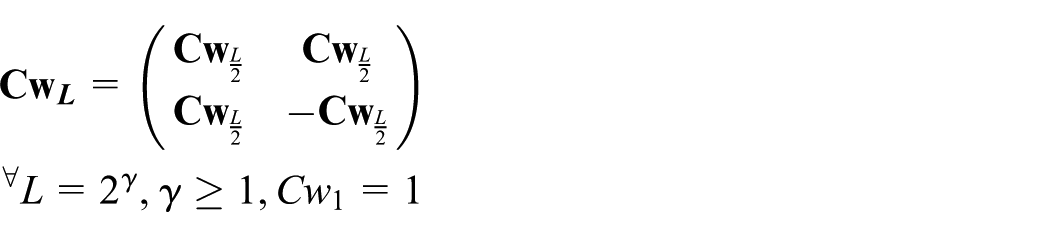
The NOMA transmit signal before spreading is denoted as

The desired signal is obtained in the receiver after despreading using the same
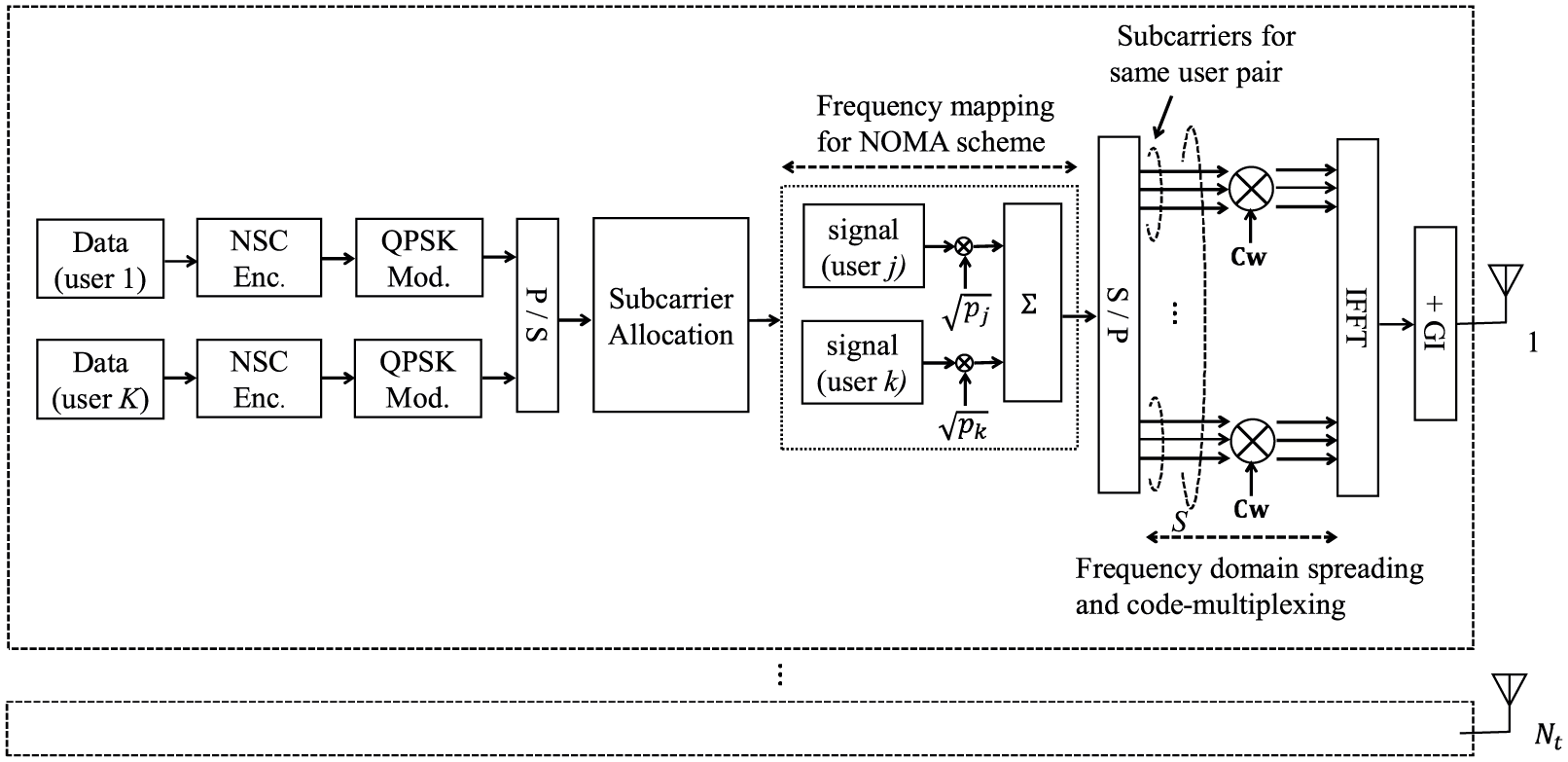
System block diagram of transmitter for the proposed NOMA with CDM.

System block diagram of receiver for the proposed NOMA with CDM.
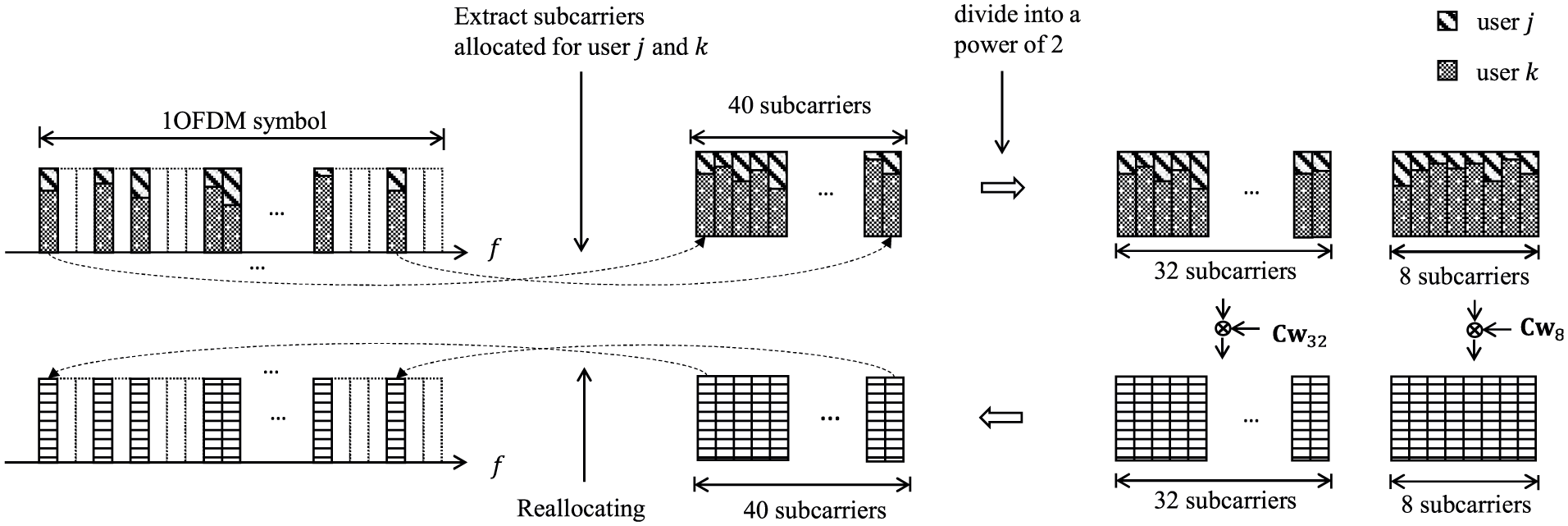
Example of code-spreading in the proposed NOMA with CDM.

SIC in proposed NOMA with CDM.
Numerical results
We evaluate the performance of the proposed scheme through numerical simulations. As the performance criterion, the average user throughput is calculated. Table 1 shows the simulation conditions. A non-sectorized hexagonal 19-cell model is used, and the users in the center target cell receive an interference signal from the adjacent 18-cell BSs, which have the same transmit power as the target BS. We assume that the cell radius is 500 m. It is assumed that the channel state information of the users in the target cell and the interference channel coefficients to each user from adjacent BSs are perfectly known to the target BS. The number of sub-bands

Simulation conditions.

FFT: fast Fourier transform; BS: base station; UE: user equipment; SNR: signal-to-noise ratio; SIC: successive interference cancelation; QPSK: quadrature phase shift keying; SLIC: symbol-level interference cancelation.
and the receiver noise density is –169 dBm/Hz, which are the typical values in 4G systems. The link budget parameters are also shown in Table 1. The carrier frequency is 2 GHz band, and the transmit power of BS is 37 dBm. The bandwidth is 5 MHz, and the average received signal-to-noise ratio (SNR) at the cell edge becomes 20 dB. In the simulation, the users were randomly distributed within the target cell, and the capacity was calculated based on 100 times channel generations. The user distribution was then iteratively changed to 800 times. The number of antennas is 2 × 2 MIMO, and SLIC is used for SIC in the receiver.
In addition, to suppress the performance degradation of SLIC, we introduce a parameter

Average user throughput versus
To evaluate the fairness among users in terms of allocated resources, we used Jain’s fairness index (JFI) 17 in this article. JFI is a value between 0 and 1, and is closer to 1 when the difference in the capacity of each user channel is small, that is, fairness is achieved. JFI is calculated by the following equation

where
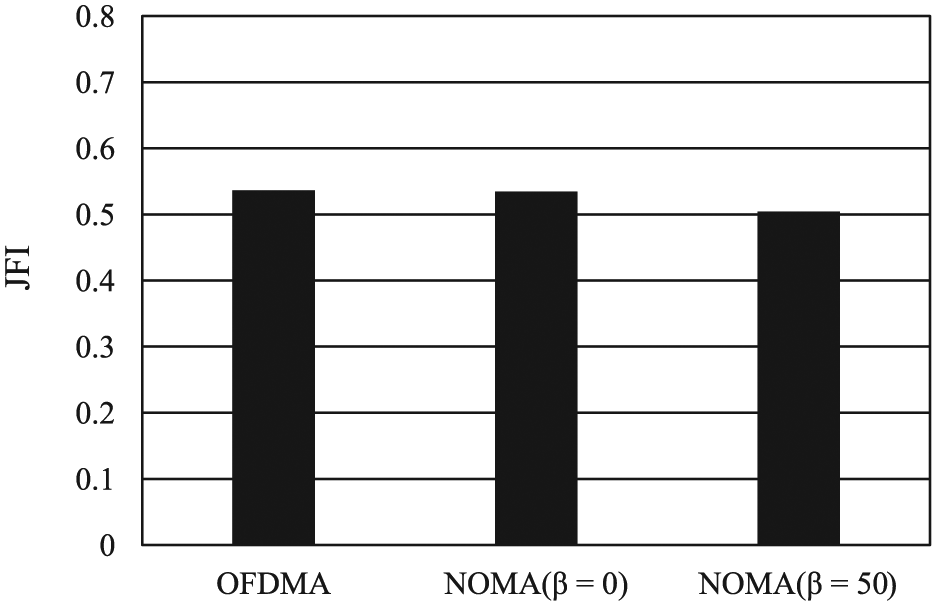
Comparison of Jain’s fairness index.
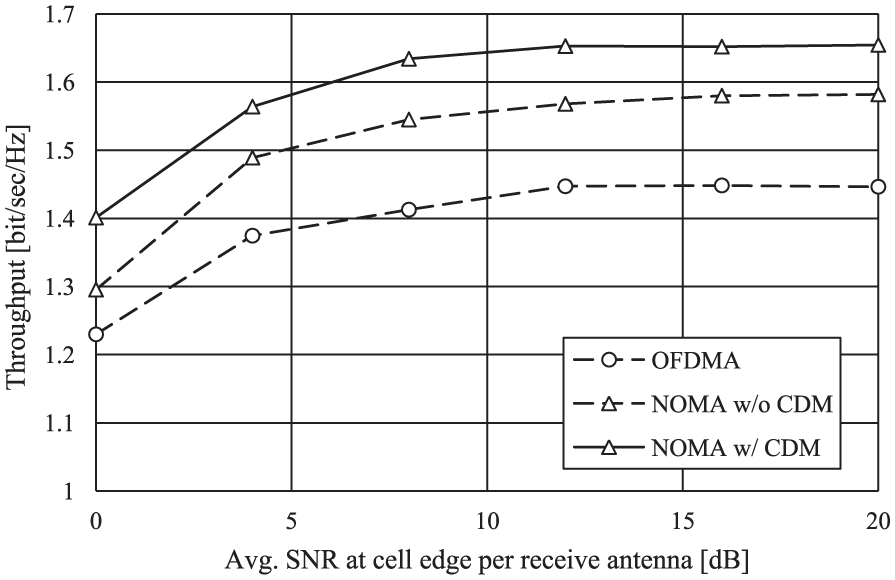
Average user throughput versus average SNR at the cell edge when
Further improvement of scheduling algorithm
In conventional scheduling algorithm,

where
User

is selected from
The subcarrier
For subcarrier
First, in step 1, the initial average throughput of all users is calculated. Next, in step 2, user
We evaluate the performance of the proposed scheme. Simulation conditions are equal to Table 1. Figure 12 shows JFI of each scheduling algorithm, where the schemes of equations (7) and (14) are labeled as “ascending order method” and “sequential update method,” respectively. From the result, it can be seen that the proposed scheme can improve the fairness index compared to the conventional scheme. This improvement of JFI is due to sequential update.

Comparison of Jain’s fairness index for different scheduling algorithms.
Figure 13 shows the average user throughput versus SNR at the cell edge of the proposed scheme and the conventional scheme. The proposed scheme is shown to have a slightly better performance. This is because the probability of users with a small resource allocation decreased using equation (14). It should be noted that the throughput is basically in a tradeoff with the user fairness index, and in this regard, the proposed sequential update method that improves both is effective even though the throughput enhancement is not large.
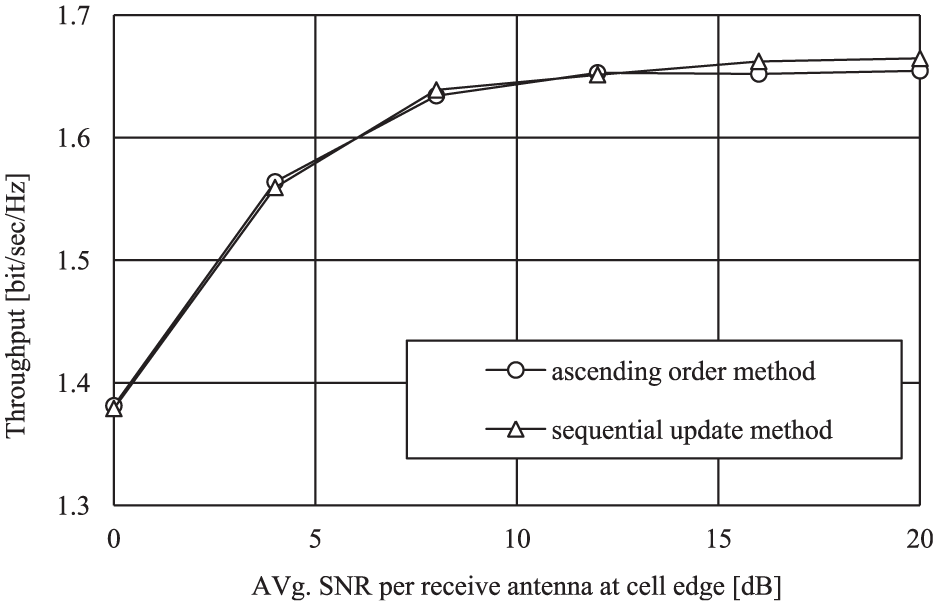
Average user throughput versus average SNR at the cell edge for different scheduling algorithms.
From Figures 12 and 13, we show that the proposed scheme can achieve higher performance in terms of both the average user throughput and the fairness index compared to the conventional scheme.
Conclusion
In this article, we proposed a new NOMA scheme utilizing CDM for downlink cellular systems. After PF-based scheduling, the subcarriers of the same user set are extracted, code-spread, and reallocated. In the receiver, CDM-based SIC is conducted. Numerical results show that an improved average user throughput was obtained because of the frequency diversity effect, particularly when the channel gains of the two superimposed users are significantly different.
In addition, we proposed an improved scheduling scheme, in which both the average user throughput and the fairness index were improved allowing a slight increase in the calculation complexity.
Future studies will consider the user-scheduling scheme for CDM and the application of CWIC.
Footnotes
Handling Editor: Sang-Woon Jeon
Declaration of conflicting interests
The author(s) declared no potential conflicts of interest with respect to the research, authorship, and/or publication of this article.
Funding
The author(s) received no financial support for the research, authorship, and/or publication of this article.