




Abstract
In order to improve the localization accuracy of distance vector-Hop algorithm under the random topology network scenarios, a novel algorithm named coordinates correction-distance vector-Hop is proposed. Coordinates correction-distance vector-Hop defines the pseudo-range error factor to improve the accuracy of average hop distance. In order to improve the localization accuracy, the unknown node uses distances to part of anchor nodes to locate. Furthermore, anchor nodes are treated as unknown when obtaining their coordinate correction values which are used to correct the localization results of unknown nodes. The simulation results show that each step of coordinates correction-distance vector-Hop can increase the localization accuracy effectively; coordinates correction-distance vector-Hop is better than the traditional distance vector-Hop and some existing improved algorithms both in localization accuracy and in localization stability.
Keywords
Introduction
Wireless sensor networks (WSNs) are composed of plenty of sensor nodes deployed in the monitoring field. A multi-hop self-configured network can be further formed by means of wireless communication. 1 The sensor nodes with perception, processing, and communication ability need to locate themselves not only for reporting events but also for the target tracking in many applications. Examples include environmental monitoring, medical care, and military target tracking services. Sensory data will make no significance without the position information in many applications. Hence, node localization is a key issue of WSNs, and accurate and stable localization algorithm is essential for WSNs.
Currently, many localization algorithms have been proposed to calculate the position of individual nodes. Based on the criteria whether it requires to measure the actual distances between nodes, the localization algorithms of WSNs can be classified into two categories, that is, range-based and range-free schemes. The range-based algorithms, such as time difference of arrival (TDOA), 2 received signal strength (RSS), 3 angle of arrival (AOA), 4 and time of arrival (TOA), 5 need to use the distance or angle information between neighbors to locate, and some of them may even need precise clock synchronization. These algorithms present very accurate results. However, the specialized hardware required makes them expensive in large networks, and in some applications, these algorithms are greatly influenced by the surrounding environment, which has limited the application of such methods to some extent. Due to the limitations of hardware and restrictions on high power consumption of the range-based algorithms, the rang-free algorithms, such as centroid algorithm, 6 approximate point-in-triangulation (APIT), 7 distance vector-Hop (DV-Hop), 8 and multidimensional scaling-map (MDS-MAP), 9 are recommended as they use the estimated distance instead of the metrical distance to locate. In terms of accuracy, the range-free algorithms are not as good as those based on range, but they can still satisfy a number of applications’ requirements. With the advantages of relatively simple implementation, low power consumption, and low cost, rang-free algorithms are being pursued as a feasible alternative to the range-based algorithms in large-scale practical applications.
The DV-Hop algorithm, as a range-free localization algorithm, aims to use the connectivity information to compute the shortest paths and the average hop distance (AHD) applied by the unknown nodes to obtain the estimated distances to anchors. 10 Then, those estimated distances and anchor locations are used as inputs in trilateration to locate unknown nodes. Since actual locations of the anchors are known, the major source of localization error comes from the AHD calculation. If the distribution of nodes across the network is uniform, DV-Hop can obtain a reasonable AHD, so as to achieve the appropriate positioning accuracy. 11 On contrary, as the networks where the nodes are disposed stochastically, the AHD is always bigger than the actual due to the shortest paths may be not straight-line between anchor nodes and unknown nodes. 12 In such cases, using the hopping distance to replace the straight-line distance will cause a larger error and unsatisfactory positioning accuracy. Hence, an efficient way to improve the calculation accuracy of AHD has a crucial impact on distance estimated and localization accuracy.
In this article, we propose an improved DV-Hop algorithm named coordinates correction-DV-Hop (CC-DV-Hop). First, the pseudo-range error factor is defined to remove anchor nodes which may cause a larger calculation error of the AHD, through this way to improve the calculation accuracy of AHD, as well as to reduce the influence of random topology. Second, the anchor node broadcasts the corrected AHD together with its corrected coordinate values calculated by trilateral or multilateral measurement with the premise of being treated as the unknown node. Finally, the coordinates of each unknown node are corrected through the weighted average value of the coordinate correction values which are received from the corresponding anchors. We also present the simulations to demonstrate the effectiveness of CC-DV-Hop.
The rest of this article is organized as follows. Section “Related work” gives a survey of the related works. Section “DV-Hop localization algorithm” describes the original DV-Hop algorithm. Section “CC-DV-Hop algorithm” presents the derivation of the proposed improved algorithm—CC-DV-Hop. In section “Simulation results and discussion,” simulation results are shown and localization performances are discussed. In section “Conclusion,” conclusions are presented.
Related work
Since the AHD and the hop-count between the destination and the anchor nodes have essential impact on the localization accuracy of traditional DV-Hop algorithm, a number of approaches have been studied to improve the accuracy of AHD and hop-count.
It is often considered that algorithms increase the accuracy of the AHD based on the selection of anchor nodes. Gui et al. 13 checked out DV-Hop algorithm and proposed the selective three-anchor DV-Hop algorithm. In this algorithm, the normal node first selects any three anchors to form a three-anchor group; then, it calculates the candidate position based on each three-anchor group; finally, according to the relation between candidate positions and the minimum hop anchor nodes, the normal node chooses the best candidate position. Wang et al. 14 calculated and optimized the coordinates of the unknown node that was set as the anchor node to increase the anchor node density, so as to improve the localization accuracy of DV-Hop. Xia et al. 15 proposed an improved algorithm based on regional division of hop-count. The received signal strength indication (RSSI) location technology and the hop-limitation mechanism are introduced to optimize the combination of anchor nodes to determine the coordinates of unknown nodes.
Some previous works improve the accuracy of the AHD by weighting method. Hu and Li 16 used a hop threshold M that limits the unknown nodes to receive the beacon nodes with M hops. Then, the AHD is calculated using the weighting method, and the distances between nodes are also calculated to improve the localization precision under the limitation of M hops. Zhang et al. 17 introduced the weighted mean method to calculate the AHD. Instead of trilateration method, the centroid method is used to calculate the coordinate. Hou et al. 18 proposed differential DV-Hop (DDV-Hop) algorithm to improve the AHD applied by each locating node for estimating its own location through weighting the N received AHD from anchor nodes. The results show that DDV-Hop algorithm has higher localization accuracy compared with DV-Hop algorithm and Hop-count algorithm.
However, some studies have been made on the correction of hop-count. Zhang et al. 19 proposed RSSI and average hopping distance modifying DV-Hop (RADV-Hop) algorithm through using RSSI to subdivide one hop into several grades and modify AHD to reduce the locating error. Wen et al. 20 subdivided the first hop into several grades based on RSSI. The rest hops are modified to achieve higher location precision than traditional DV-Hop algorithm with the distance ratio of adjacent nodes which is transformed into the corresponding relationship of RSSI. Xiao and Liu 21 refined and made sure the hops between anchor nodes were not only integer but also decimal between all anchor nodes and unknown nodes. Simulation results show that it has obviously better localization performance in positioning accuracy than the traditional DV-Hop algorithm.
Recently, considering the need of high localization accuracy along with energy consumptions has become a research hotspot. Kumar and Lobiyal 22 proposed a power-efficient range-free localization algorithm (PERLA) for WSNs. In PERLA, the anchor node floods packet just once, and one complete communication is eliminated to reduce the energy consumption. To improve the localization results of unknown nodes, PERLA adopts a new procedure to reduce error propagation. Simulation results show that PERLA is more computationally efficient and localization performance is superior to the traditional DV-Hop algorithm. Li 23 proposed an improved DV-Hop localization algorithm based on energy-saving non-ranging optimization. In this algorithm, only one anchor node broadcasts its position coordinate information to other node, thus reducing the energy consumption. To improve the localization accuracy, non-ranging energy-saving optimization algorithm is used to locate unknown nodes and the ratio of position is used to reduce the localization error. Simulation results show that compared with the traditional DV-Hop, the proposed algorithm has better results in localization accuracy and energy-solving performance. Liu et al. 24 restricted the hop-counts between unknown nodes and anchors to reduce the energy consumption. Moreover, they use the scheme of upgrading positioned nodes and a new weighted average one-hop distance processing method to guarantee the localization accuracy. Simulation and analysis results show that the new algorithm can effectively decrease the positioning error and total localization rounds to take account of both the energy consumption and the localization accuracy.
DV-Hop localization algorithm
The original DV-Hop algorithm is a distributed, hop-by-hop localization algorithm. The algorithm implementation is composed of three non-overlapping stages.
In the first phase, each anchor node broadcasts a message to be flooded throughout the network which contains its location information and a hop-count parameter initialized to zero. Each receiving node maintains a table
In the second phase, once an anchor

where
Once the

where
In the third phase, each unknown node location can be estimated by the polygon method. Let

The system is solved to use a standard least-squares approach by the following formula



CC-DV-Hop algorithm
In this section, we use the traditional DV-Hop algorithm to calculate the initial AHD of each anchor node and propose to use the following additional steps added in order to improve localization accuracy, thus forming CC-DV-Hop algorithm.
Correction of AHD
Under the premise of DV-Hop idea, the number of hops among nodes is generally fixed. In order to obtain the minimum error between the estimated distance and the actual distance, CC-DV-Hop manages to adjust the AHD. According to the second phase of DV-Hop introduced in section “DV-Hop localization algorithm,” there will be a big error that each anchor node selects all the other anchors as the reference nodes to estimate an AHD, because some of them may produce a large error especially in the random topology networks. Therefore, CC-DV-Hop provides an approach to remove the reference anchors which may produce a large error through this way to improve the calculation accuracy of AHD.
First, we define pseudo-range error factor of each anchor node to its reference nodes. For example, anchor

where

where
The smaller the value of

Calculation of the coordinate correction value of anchor nodes
Supposing anchor

Since true location of

where
In the example in Figure 1, we assume that all nodes are deployed randomly across the network.
After the first step of DV-Hop, anchor 1 calculates its AHD
We sort the pseudo-range error factors in ascending order and select the top
Anchor 1 adopts equation (9) to acquire the corrected AHD

The concept of sections “Correction of AHD” and “Calculation of the coordinate correction value of anchor nodes.”
Optimization of the coordinates of unknown nodes
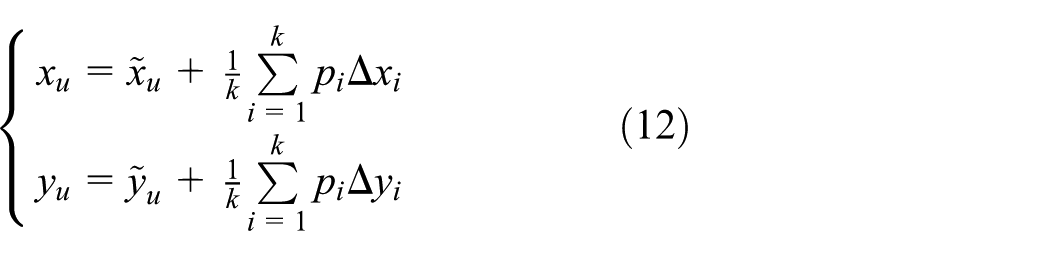
As what we have introduced above, in DV-Hop, unknown nodes take the nearest anchor’s AHD as their own, so do they in CC-DV-Hop. However, different from DV-Hop, an unknown node uses the distances to each reference node among its nearest anchor node’s
In WSNs, the nodes in close proximity have very similar physical environment (e.g. the electromagnetic environment, the multi-path effect, and interference noise) and topological structure. Therefore, if each unknown node and its nearest anchor node use the same
Continue the example in Figure 1 and the example in Figure 2, suppose that we need to estimate the position of unknown node U. We assume that anchor node 1 is the nearest anchor node of unknown node U.
Unknown node U receives message package from anchor node 1. Then, U uses ranges between U and each anchor node among OGAs1,5 to calculate the estimated coordinates U1 (shown in Figure 2(a)).
Finally, the coordinates of U1 and the coordinate correct values of OGAs1,5 are used as inputs in equation (12) to acquire the localization result U2 (shown in Figure 2(b)).

The concept of correcting estimated coordinates: (a) locating unknown node U and (b) correcting U’s estimated position.
Simulation results and discussion
Assuming nodes with the same communication radius are randomly distributed in the square region area with the fixed size of 150 × 150 m2, and we use Matlab2013a as the simulator to evaluate the performance of algorithm. The metric for comparison in evaluating localization algorithms is the average location error, which is shown as follows

where
Validation of the improved effect in each step
In this section, two new algorithms named CC-DV-Hop_1 and CC-DV-Hop_2 were proposed. For CC-DV-Hop_1 algorithm, only use the method in section “Correction of AHD” to correct the AHD and then use the procedure same as DV-Hop to locate unknown node. For CC-DV-Hop_2 algorithm, different with CC-DV-Hop, the last step (uses the coordinate correction values of anchor nodes to correct the coordinates of unknown nodes) of CC-DV-Hop is not employed. Compared to the localization results of the traditional DV-Hop with CC-DV-Hop_1, CC-DV-Hop_2, and CC-DV-Hop, we can learn the improved effect in each step of CC-DV-Hop. And the simulation results are given as follows.
Figure 3 shows the comparison of the average localization errors in four algorithms. As shown in Figure 3(a), with the increase in ratio of anchors, the average localization accuracy of CC-DV-Hop_1 is about 10% lower than DV-Hop, that of CC-DV-Hop_2 is about 20% lower than DV-Hop, and that of CC-DV-Hop is about 5% lower than CC-DV-Hop_2; as shown in Figure 3(b), with the increase in node number, the average localization accuracy of CC-DV-Hop_1 is about 15% lower than DV-Hop, that of CC-DV-Hop_2 is about 17% lower than DV-Hop, and that of CC-DV-Hop is about 5% lower than CC-DV-Hop_2; as shown in Figure 3(c), with the increase in communication radius of anchor node, the average localization accuracy of CC-DV-Hop_1 is about 13% lower than DV-Hop, that of CC-DV-Hop_2 is about 15% lower than DV-Hop, and that of CC-DV-Hop is about 3% lower than CC-DV-Hop_2. It is obvious that CC-DV-Hop_1 can improve the localization accuracy of traditional DV-Hop, CC-DV-Hop_2 can do it better than CC-DV-Hop_1, and CC-DV-Hop can achieve the best localization accuracy. We can conclude that each step (e.g. correct the AHD and locate unknown node by nearest anchor’s

Localization error of DV-Hop, CC-DV-Hop_1, CC-DV-Hop_2, and CC-DV-Hop in different networks: (a) comparison with different ratios of anchor (300 nodes, R = 20 m), (b) comparison with different node numbers (ratio of anchor = 30%, R = 20 m), and (c) comparison with different anchor node communication radii (200 nodes, ratio of anchor = 30%).
Analysis of localization accuracy
In this section, CC-DV-Hop is compared with the traditional DV-Hop, the algorithm in Xiao and Liu,
21
and DDV-Hop in Hou et al.
18
We set
Varying the ratio of anchors
In this scenario, 200 nodes (including anchor nodes) are randomly distributed in the sensor area. Vary the ratio of anchors from 0.05 to 0.45 and set the communication radius of each node as 20 m.
Figure 4 shows the comparison of the average localization errors in four algorithms. We can see that the average localization errors of these four algorithms above tend to decline gradually when the anchor is in 5%–25% ratio and become stable when the anchor ratio is greater than 25%. Under the same condition, the average localization error of CC-DV-Hop is about 24% lower than that of the traditional DV-Hop, about 4% lower than that of DDV-Hop, and about 10% lower than that of literature
21
algorithm. The reason is that the growth of the ratio of anchor nodes will reduce the distance between unknown nodes and the anchor nodes, decrease the information loss, and lead to a relatively high accuracy. Moreover, with the increase in anchor ratio, each anchor node has more reference nodes to choose to form more precise

Comparison with different ratios of anchor.
Varying node number
In this scenario, the anchor ratio is set as 30% and communication radius is set as 20 m, and the node number is increased from 100 to 400.
Figure 5 shows the contrast of four algorithms with different node numbers. To a certain extent, we observe that DDV-Hop and the algorithm in Xiao and Liu
21
improve the accuracy of the DV-Hop, while the CC-DV-Hop improves the accuracy on a much larger scale. The accuracy improvement of CC-DV-Hop is about 5% over than that of DDV-Hop, about 6% over than that of the algorithm in Xiao and Liu,
21
and about 24% over than that of the traditional DV-Hop. We can conclude that CC-DV-Hop has better localization precision than the other three and is more stable for its fluctuation range smaller than the other three algorithms with the variety of node numbers. The reason is that the increase in node number will change the network topology which may affect the localization accuracy of DV-Hop. However, CC-DV-Hop only selects

Comparison with different node numbers.
Varying communication radius
In this scenario, the ratio of anchor nodes is set as 30%, node number is set as 300, and the communication radius of anchor node is increased 5 m every time.
Figure 6 shows that the average localization error of CC-DV-Hop is approximately 22% lower than that of the DV-Hop, approximately 4% lower than that of DDV-Hop, and approximately 3% lower than that of the algorithm in Xiao and Liu. 21 It is worth mentioning that the algorithm in Xiao and Liu 21 has better accuracy than DDV-Hop when the communication radius is larger than 35 m; however, CC-DV-Hop performs better in those environments. We conclude that the change in communication radius has minimal impact on CC-DV-Hop, which means CC-DV-Hop has better stability. The reason is that the AHD is always bigger than the actual distance, especially under random network. Normally, the greater the number of hops is, the greater accumulative error in the AHD calculation is and the bigger pseudo-range error factors are according to equation (2). The node’s communication radius will change the network connectivity, so as to influence hops between nodes and the AHD calculation. CC-DV-Hop removes some reference nodes with bigger pseudo-range error factor to reduce the accumulative errors in the distance estimated through this way to increase the accuracy of AHD calculation. Furthermore, fewer nodes participating in the AHD recalculation would reduce the computational complexity as well.

Comparison with different anchor node communication radii.
Discussion about the value of k
In CC-DV-Hop, the value of
Figure 7 shows the effect of value of k on localizaiton accuracy. We can see that as a whole, when

Effect of the value of k on localization accuracy.
Discussion about performance
For communication cost, the proposed CC-DV-Hop algorithm does not change the positioning process of the DV-Hop, and sense node does not require additional communication cost. Therefore, the communication cost of CC-DV-Hop is nearly the same as DV-Hop, the algorithm in Xiao and Liu, 21 and DDV-Hop. For the computational complexity, in CC-DV-Hop, anchor nodes only use the information of anchor nodes in the DV-Hop to calculate the corrected AHD and the coordinate correction values without additional hardware support, which will increase the computational complexity. However, less anchor nodes involved in the location of unknown node will decrease the computational complexity of CC-DV-Hop. Although the computational complexity of CC-DV-Hop is slightly higher than DV-Hop, it greatly improves positioning accuracy (about 25%–35%) and stability of DV-Hop. Compared with the algorithm in Xiao and Liu 21 and DDV-Hop, CC-DV-Hop improves the localization accuracy about 8% and 5% in the case of almost the same complexity.
Conclusion
In this article, CC-DV-Hop has been presented to enhance the positioning accuracy of DV-Hop under the random topology network scenarios. Simulation results show that the localization precision and stability of CC-DV-Hop are better than the traditional DV-Hop, DDV-Hop, and the improved algorithm in Xiao and Liu.
21
Moreover, when
Future directions for this work may include reducing computational complexity for CC-DV-Hop which is the main downside of that algorithm and find the balance between localization accuracy and energy consumption.
Footnotes
Handling Editor: Roberto Casas
Declaration of conflicting interests
The author(s) declared no potential conflicts of interest with respect to the research, authorship, and/or publication of this article.
Funding
The author(s) disclosed receipt of the following financial support for the research, authorship, and/or publication of this article: This work was supported by the National Natural Science Foundation of China (No. 41101426).