




Abstract
In this article, the joint relay assignment and power allocation for full-duplex two-way relaying in wireless sensor networks is considered. We investigated the weighted sum rate maximization problem under relay assignment constraints and total power constraints on each cooperative link, which turns out to be a mixed integer nonlinear programming problem. To tackle the challenging problem, we propose a distributed relay assignment and power allocation scheme by separating the original problem into two subproblems: relay assignment and power allocation. The relay assignment subproblem is solved by a stable matching approach based on Gale–Shapley algorithm, while the power allocation of each cooperative link is solved by sequential convex approximation method. Simulation results indicate the advantages of our proposed scheme.
Introduction
Wireless sensor networks (WSNs) are employed over a wide range of applications, such as smart grid, intelligent agriculture, and health care.1–3 The computation and energy limits of sensors bring some challenges for improving the spectrum efficiency in WSN. Relay is a widely adopted technology in Long-Term Evolution (LTE) which could significantly improve spectrum efficiency. Various types of relay have been investigated, including one-way relay and two-way relay. Two-way relay, which is based on physical layer network coding, enables two nodes exchanging signals via two time slots. 4
However, full-duplex technology is another promising method in the next generation wireless system (5G) to enrich spectrum efficiency.5–7 By alleviating self-interference efficiently, a full-duplex node can receive and transmit signals at the same time over the same frequency band. Various kinds of interference cancellation techniques include antenna separation, analog and digital cancellation, spatial domain cancellation, and time-domain cancelation. 6
Combining full-duplex technology and two-way relaying, full-duplex two-way relaying is a kind of relaying which can accomplish information exchange between two nodes within only one time slots, while one-way half-duplex relaying, two-way half relaying, one-way full-duplex relaying requires four time slots, two time slots, and two time slots, respectively. 7
Efficient wireless resource allocation can provide significant benefit for various kinds of relay system, including power allocation8–9 and spectrum allocation.10–11 Optimal power allocation (OPA) is investigated for full-duplex one-way amplify-and-forward (AF) relay 8 and full-duplex two-way AF relay 9 , respectively, consisting of single user pair and single relay node. Resource allocation in full-duplex relaying system is investigated in Rodriguez et al. 10 to optimize network level energy-efficiency, considering residual self-interference. Joint subcarriers and power allocation under individual power constraints is investigated in Yang et al. 11 to maximize throughput of full-duplex two-way relay networks.
In a relay network with multiple relays, efficient relay selection can effectively enhance the system performance.12–14 In Liu et al., 12 a relay selection for full-duplex relaying was proposed under Nakagami-m fading channels, considering direct link between source and destination. And, the outage performance was analyzed. In Li et al., 13 relay selection method in full-duplex two-way relay system based on best-worst-channel was proposed, and the close-form expressions of bit error ration, outage probability, and ergodic capacity were analyzed under the proposed relay selection method.
For a multi-user relay network with multiple relays, efficient relay assignment among users should be implemented to avoid different users selecting same relay, meanwhile to improve the system performance. In Cui et al., 15 OPA and relay assignment for multi-user full-duplex one-way relay network with multiple relays were discussed to maximize the weighted sum rate.
Based on the analysis above, although the full-duplex relay system has been investigated by many researchers, the distributed resource allocation of full-duplex two-way relaying in WSNs has rarely been addressed. Moreover, most of the methods presented above assume that global channel state information (CSI) can be derived and a centralized algorithm can be implemented in one central controller. In this article, we consider a distributed relay assignment and power allocation (DRAPA) in a WSN with multiple full-duplex two-way relays to maximize the weighted sum rate of the WSN under total power and relay assignment constraints. The main contributions of this article are summarized as follows:
We focus on relay assignment and power allocation for full-duplex two-way relaying in WSN, aiming to maximize weighted sum rate under total power constraint, considering the impact of the residual self-interference (RSI).
We propose a DRAPA, by solving relay assignment and power allocation separately. The relay assignment is transferred into a bipartite matching problem and solved by a distributed algorithm based on Gale–Shapley algorithm, which is easily carried out in a distributed manner. The power allocation is solved by sequential convex approximation method.
The rest of this article is organized as follows. Section “System model and problem formulation” describes the system model and problem formulation. In section “Solution of optimization problem,” the scheme of power allocation and relay assignment is described in detail. The performance analysis of the proposed scheme is described in section “Performance analysis.” Simulation results are shown in section “Simulation results.” Finally, we conclude this article in section “Conclusion.”
System model and problem formulation
System model
We consider a WSN, including M pairs of sensors, each of which wishes to change data with its partner, and N full-duplex two-way relays, as shown in Figure 1. We denote the sets of sensor nodes and relay nodes as

Wireless sensor network with multiple full-duplex two-way relays.
The channel coefficient between Am and Rn is represented by
Assume sensors Am and Bm exchange signals with cooperation of full-duplex two-way relay Rn. Denote the signal that transmitted by sensor Am and Bm to Rn at time slot i as

where
Meanwhile, relay Rn broadcasts another signal

where
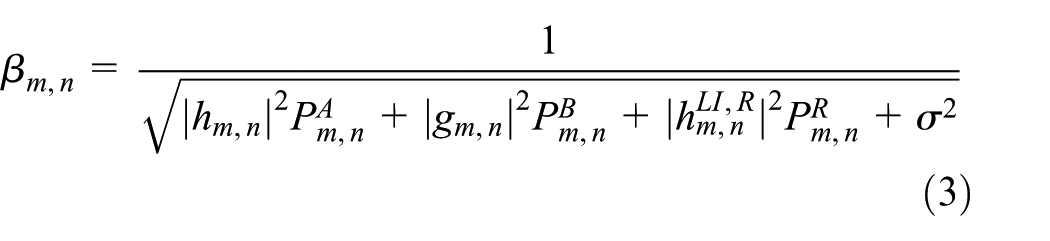
Then, the signal received by node Am and Bm from relay Rn at the ith time slot can be, respectively, expressed as

and
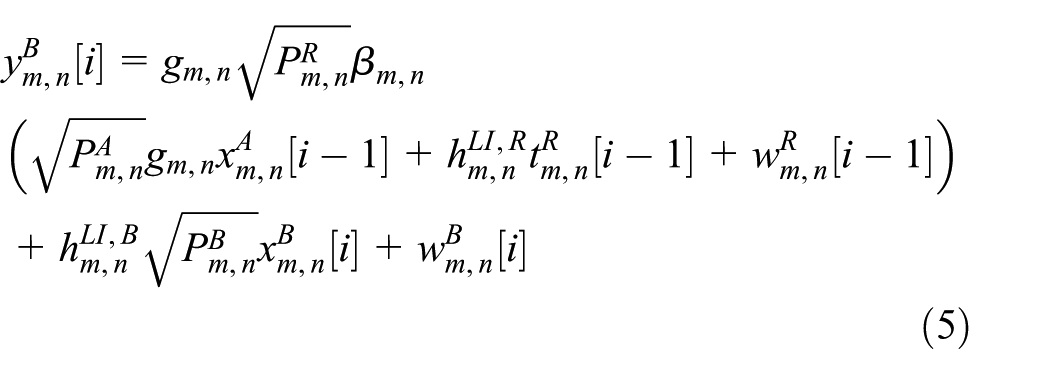
where

and

where
Thus, the achievable rate of the mth sensor pair with the nth relay can be derived as

Problem formulation
In this article, we aim to maximize the weighted sum rate in the WSN by relay assignment on each sensor pair and the transmit power optimization on each node. We define

In the total power constraint scenario, each cooperative link has its power limit. Thus, the power constraint should be

where
Assume each sensor pair can only select one relay for data exchange and each relay can be assigned at most one sensor pair in order to avoid conflict of relay assignment. Therefore, the optimization problem of the power allocation and relay assignment to maximize the weighted sum rate can be formulated as






where
Solution of optimization problem
Optimization problem P1 is a mixed integer nonlinear programming, which can be solved by exhaustive searching over all variables, but the calculation is too complicated.16–20 To reduce the computational complexity, we decompose the optimization problem into two subproblems: relay assignment and power allocation problem. Then, we propose distributed solutions to these two subproblems separately. Such decomposition method is widely used in resource allocation researches. 11 After decomposition, the relay assignment subproblem is considered with the maximum weighted sum rate of every possible sensor-relay pair. In power allocation subproblem, the optimal power allocated on each node is derived with any sensor-relay pair and the maximum weighted sum rate of every sensor-relay pair can be obtained.
Relay assignment
We first consider the relay assignment problem with fixed transmit power on each node. Considering the relay assignment constraints in equation (11), the relay assignment problem can be formulated as a 0–1 integer programming problem as follows



The constraints of problem P2 indicate a one-to-one matching between sensor pairs set and relay node set, which can be transformed into a maximum weighted bipartite matching problem in a weighted bipartite graph. The two parts of weighted bipartite graph refer to sensor pair set and relay set in WSN, and the weighted edges refer to the achievable rate of each link.
For relay assignment in WSN, we construct a weighted bipartite graph

Weighted bipartite graph of sensor pairs and relays.
Denote

In the weighted bipartite graph, our goal is to match all vertices in the sensor pairs set and those in the relays set to maximize the sum of the weights of the matching. Each vertex in the sensor pairs set
In this section, we proposed a distributed relay assignment method based on one-to-one stable matching approach. A stable matching is defined as a matching in which there are no blocking pairs. A blocking pair denotes a partnership formed by a sensor pair and a relay that are not matched with each other but prefer each other to be its partner. In the assignment, each sensor pair and each relay maintain a preference list. A preference list is defined as a list of partners ranged in descending order.
Inspired by Gale–Shapley algorithm,22,23 we propose a distributed relay assignment method as follows:
Each sensor pair establishes its preference list based on the edge weight between itself and each relay. Also, each relay establishes its preference list based on the edge weight between itself and each sensor pair.
Each unmatched sensor pair proposes to its most preferred relay in its preference list.
Relays which receive one or more proposals accept its most preferred sensor pair as its candidate and reject other sensor pair.
Any sensor pair that has been previously rejected removes the relay that has rejected it from its preference list and proposes to its most preferred relays that have not rejected it yet.
The matching process would end when every sensor pair has already been matched with a relay or has been rejected by all relays in its preference list. When the sensor pair m matches the relay n,
Power allocation
After channel assignment, we optimize the power allocation on each cooperative link in this section. Supposing relay Rn is assigned to sensor Am and Bm, the OPA in cooperative link Am-Rn-Bm under total power constraints is formulated as
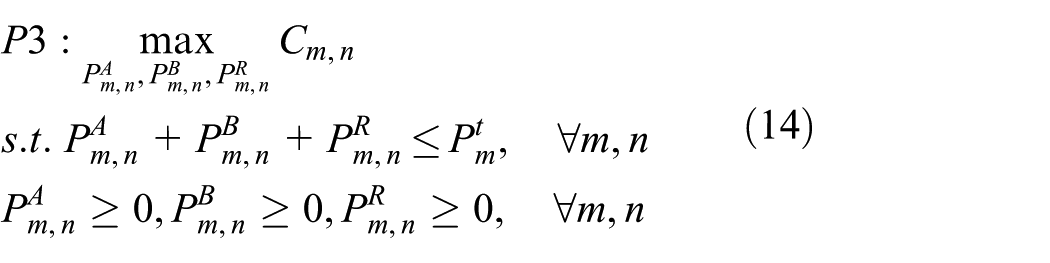
The problem P3 is a non-convex programming problem duo to the non-convexity of objective function. To transform P3 into a convex problem, we introduce Lemma 1.
Lemma 1
A very tight lower bound of


where z0 is a positive value. At

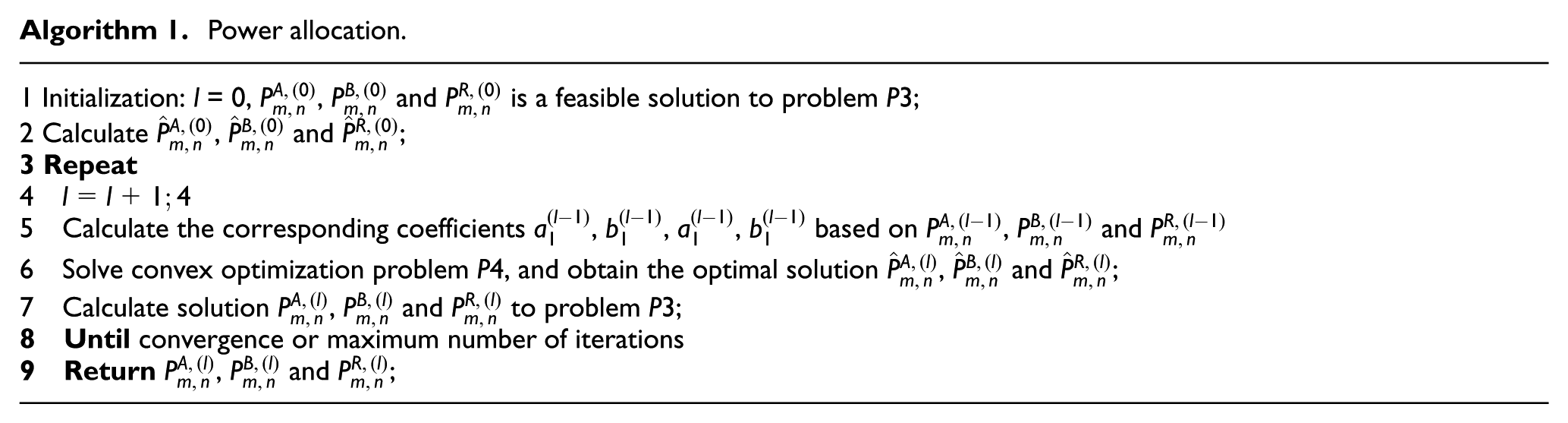
where a1, b1, a2, and b2 are the corresponding lower-bound coefficients based on a initial SINR. To solve problem P3, we first consider the following optimization problem

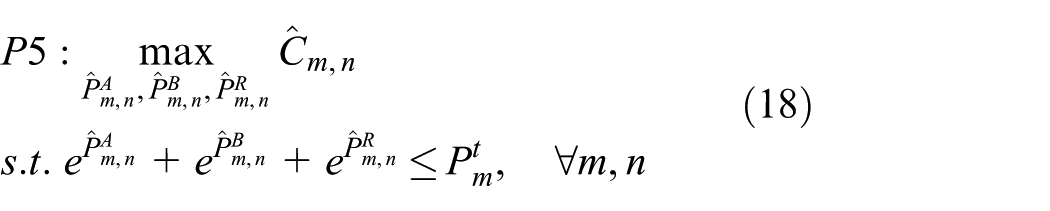
In order to solve the optimization problem P4, we implement variable replacement as follows:
where
Optimization problem P5 is an equivalent transformation of problem P4, thus the solution of P4 can be obtained by solving P5. Problem P5 is a convex problem due to concavity of objective function and convexity of constraint.19–20 We can solve problem P5 by interior point method using convex solving tools such as CVX. Since the objective function of problem P4 is a lower bound of objective function of problem P3, we develop an iterative algorithm for optimization problem P2 based on sequential convex approximation (SCA) method. The algorithm is summarized in Algorithm 1.
DRAPA scheme
After proposing solution for relay assignment and power allocation separately, we propose a DRAPA scheme, in which relay assignment under fixed power allocation is solved based on Gale–Shapley algorithm, then power optimization for each cooperative link is conducted among matched sensor pairs and relay nodes.
The main step of DRAPA scheme is described as follows: first, the sensors and relay nodes are pre-allocated with equal power under total power constraints. Let
Then, the transmit power for sensors and relay nodes of M cooperative links will be optimized. During the power allocation, we get M subproblems and each subproblem can be formulated as P3 solved by Algorithm 1. The weighted sum rate of the system can be derived by substituting the OPA and relay assignment into equation (9). To make it more clear, details of DRAPA scheme are presented in Algorithm 2.

Performance analysis
Complexity analysis
The computational complexity of the proposed DRAPA scheme will be analyzed in this subsection. For the Gale–Shapley algorithm used to solve the relay assignment problem, the complexity of the algorithm is
Distributed implementation
Before relay assignment and power allocation, the channel gains need to be acquired at each node first. Since the self-interference channel on each node relies on the self-interference technology the node employs, we assume that each node knows the channel gain of its self-interference channel. In order to acquire the channel gains between sensors and relays, all sensors (Am and Bm, m = 1,…, M) send pilot signals sequentially. Specifically, the channel gain of its self-interference channel is included in the pilot signals. Relay Rn receives the pilot signal from sensors Am and Bm, then
After all relays broadcast their achievable rates, the preference list of sensor pair (Am, Bm) can be established on sensor Am, or Bm. Similarly, the preference list of each sensor pair may only include part of relays. During the matching process, each sensor pair proposes to its most preferred relay according to its preference list, which is a kind of local information on each node. Similarly, the relay decides to accept or reject the proposal it received according to its preference list. From the analysis above, we can notice that the proposed matching scheme for relay assignment can be easily implemented in a distributed manner.
In power allocation step, since relay Rn can obtain the channel state information between Rn and any sensor (Am and Bm, m = 1, …, M), the OPA
The effect of weight
In the WSN, we assume that sensors are with different priorities and assign each sensor pair a weight according to its priority. The result of matching in relay assignment will be affected by the weight of each sensor pair. Sensor pair with larger weight will be more preferred by each relay and is more likely to match a better relay. For example, suppose the mth sensor pair is a sensor for real-time applications and the weight parameter
Simulation results
In this section, the simulation results are provided to evaluate the DRAPA schemes proposed. During all simulations, the variances of all noise are assumed to be 1,
Figure 3 illustrates the weighted sum rate performance of different schemes versus total power

Weighted sum rate versus total transmit power.
Figure 4 shows the weighted sum rate performance of different schemes versus number of relays with M = 5, Pt = 5 dB. The number of relays changes from 5 to 30. From the simulation results, the weighted sum rate of DRAPA and DRA-EPA is gradually increased with the increase in the number of relays, while for RRA-OPA and RRA-EPA schemes, the weighted sum rate almost remains the same. This is due to that with the increase in the N, each sensor pair can match a better of relay for cooperative communication by relay assignment. However, relays are randomly matched to transmit signals in RRA-OPA and RRA-EPA, and the redundant relay cannot improve the weighted sum rate of the system. In addition, compared with DRAPA and DRA-EPA schemes, the performance improved approximation is 9.7% by OPA. The weighted sum rate achieved by the proposed DRAPA scheme is 1–3 times larger than RRA-OPA scheme by relay assignment.
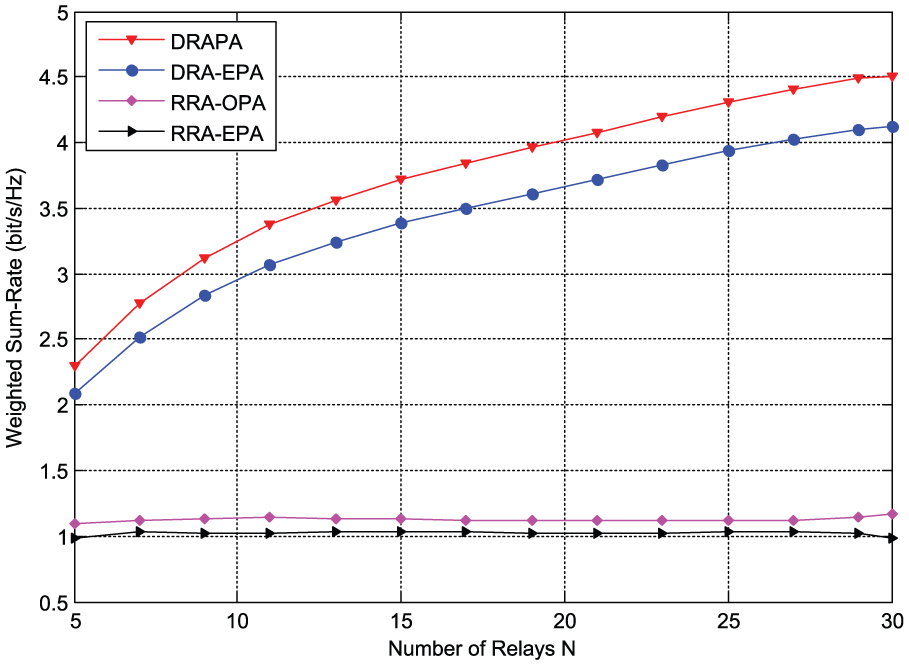
Weighted sum rate versus number of relays.
Figure 5 presents the weighted sum rate performance of different schemes versus number of sensor pairs with N = 30, Pt = 5 dB. The number of sensor pairs changes from 5 to 30. It is clear that the weighted sum rate of all schemes gradually increases with the increase in the number of sensor pairs. Specifically, with the increase in the number of sensor pairs, the performance of DRAPA and DRA-EPA schemes is growing faster than that of RRA-OPA and RRA-EPA schemes. Simulation results show that the DRAPA scheme always maintains the highest performance due to the optimization of relay assignment and power allocation. The weighted sum rate of the proposed DRAPA scheme is 1–2 times larger than that of RRA-OPA scheme by relay assignment, and the performance improvement of DRAPA scheme over DRA-EPA scheme is about 7.2% by power allocation.

Weighted sum rate versus number of sensor pairs.
Figure 6 illustrates the effect of residual self-interference on the weighted sum rate under different schemes, in which the x-axis denotes the variance of RSI. The figure reveals that the weighted sum rates of all schemes are gradually decreased with the increase in the RSI variance. The performance of the DRAPA scheme is rapidly decreased when the variance of RSI is larger than 1 dB.

Weight sum rate versus residual self-interference.
The sensor pairs’ achievable rate versus total power

Sensor pairs’ achievable rate with different weights.
Conclusion
In this article, the joint relay assignment and power allocation problem for full-duplex two-way relay in WSNs is investigated, aiming to maximize the weighted sum rate of the system with the total power constraint. The problem is formulated as a mixed integer nonlinear optimization problem. We propose a distribute solution DRAPA by optimizing transmit power for each node and assigning optimal relay to sensor pairs for cooperative communication separately. Simulation results show that DRAPA scheme can achieve great performance gains comparing with other algorithms.
Footnotes
Academic Editor: Shi-Jinn Horng
Declaration of conflicting interests
The author(s) declared no potential conflicts of interest with respect to the research, authorship, and/or publication of this article.
Funding
The author(s) disclosed receipt of the following financial support for the research, authorship, and/or publication of this article: This work was supported by Fundamental Research Funds for the Central Universities (under grant no. 2014QNB46).