The routing decisions of information data are important to many intelligent systems, such as transporting system. The quality of experience in the routing decisions has drawn attention in recent works. This article studies the quality of experience–oriented routing decision problem using the vacillating fuzzy analysis approach. The integration operators and multiple attribute routing decision method based on multiple unsure information are studied. The experimental results show that the proposed approach solves the personal experience–oriented routing decision problem by improving the qualification of experience under the unsure and uncompleted information conditions.
Space information networks have drawn much attention recently,1–5 along with the rapid development of the Internet of Things. Space information networks can support the universal connection of things on the global scale. Mukherjee and Ramamurthy5 made a research review on the technologies and architectures for space information networks. In the Internet of Things, sensor systems play an important role and can obtain huge amounts information to support information exchange. Celandroni et al.4 studied architectures in satellite-based wireless sensor networks, and Kawamoto et al.6 studied effective data collection via satellite-routed sensor systems (SRSS) to realize the global-scaled Internet of Things.
In space information networks or SRSS, the routing decisions are important. In literature,7–13 authors studied the routing problem in a space information network, among which some architectures, protocols, and algorithms were proposed for improving routing effectiveness. Bayhan et al.,7 Zhou et al.,8 and Yin et al.10 proposed some routing protocols in satellite IP networks. Akyildiz et al.,9 Liu and Wu,11 and Gao et al.13 proposed routing algorithms in space information networks.
Recently, the quality of experience (QoE) in routing decisions has drawn increased attention. With personal experience–oriented routing decisions, the traditional sole factor or sole standard is not sufficient. The multiple attribute routing decision method has been the main focus. In addition, routing decisions under an unsure and uncompleted information environment are practical but hard for proper routing decisions. In view of routing decision methods, the need for considering multiple attributes and the combining approach of multiple QoE values bring about many challenges. It is important to make optimal decisions based on multiple experience information from multiple attributes and need to be studied further.
Decisions based on fuzzy analysis14 are important to solve the above problem. The advantage of fuzzy analysis–based decisions is that the method could take multiple factors into consideration, in spite of the unsure and incomplete environments. Specially, fuzzy analysis–based decisions could well consider the psychological factors of personal experience when making the decision, which are important for experience-oriented routing decision-making.
In this article, the vacillating fuzzy analysis method is applied to solve the experience-oriented sensor data routing decision problem in SRSS. The integration operators are proposed to help the routing decision in unsure and uncompleted information environments. The effectiveness of the proposed approach has been verified by the experimental result, which shows that the experience-oriented routing decision problem could be solved through the proposed approach. The main contributions of this article are as follows.
First, an experience-oriented multiple attributes routing decision model is proposed and compared with existing research focusing on various specific attributes, for example, time delay.
Second, QoE is used to evaluate routing attributes rather than using traditional quality of service (QoS), and vacillating fuzzy integration operators were proposed to combine multiple QoE values into a comprehensive evaluation of different routes.
Related work
The architectures for space information networks and satellite-based wireless sensor networks were studied in Celandroni et al.,4 Mukherjee and Ramamurthy,5 and Kawamoto et al.6 Using routing research in the space information networks or satellite systems, various architectures, protocols, and algorithms were proposed in the literature.7–13 Bayhan et al.7 proposed the adaptive routing protocol for QoS in two-layered satellite IP networks. A hierarchical and distributed QoS routing protocol for two-layered satellite networks was proposed in. Zhou et al.8 In Yin et al.,10 the QoS-aware multicast routing protocol for a triple-layered low-earth orbit/highly elliptical orbit/geo-stationary-earth orbit (LEO/HEO/GEO) satellite IP network was proposed. Akyildiz et al.9 proposed a novel routing algorithm for multi-layered satellite IP networks. Practical routing in a Cyclic MobiSpace was studied in Liu and Wu.11 A novel optimized routing algorithm for LEO satellite IP networks was proposed in Gao et al.13
With the fuzzy analysis approach, many fuzzy sets (FSs) used for fuzzy analyses have been proposed in Torra and Narukawa.14 Zhou et al.15 defined the pair vacillating fuzzy set (PVFS), where PVFS can support a more flexible approach when the decision-makers provide judgments.
The goal of multiple attribute decision-making is to find the most proper choice among a set of feasible alternatives based on the preferences.16 Information integration is a process that combines the preferences of individual experts into an overall process using a proper integration technique. Integration operators are the most widely used tool for combining individual preference information into overall preference information and deriving collective preference values for each alternative. Yager17 proposed the ordered weighted averaging operator. In literature,18–22 authors proposed several geometric integration operators, such as the intuitionistic fuzzy (IF) weighted geometric operator, the IF ordered weighted geometric operator, and the IF hybrid geometric operator. The integration functions for classical FSs were proposed in Beliakov et al.23 Xia et al.24 proposed other operations on IF sets and studied their properties and relationships. Several series of integration operators for vacillating fuzzy information were proposed in Xu et al.25
In contrast with the above aggregation, Yager26 developed a power mean (PM) operator and a power ordered weighted mean (POWM) operator to provide integration tools. Furthermore, Xu and Yager27 proposed a power geometric (PG) operator and a power ordered weighted operator. Xu and Cai28 proposed the uncertain PM operators for aggregating interval fuzzy preference relations. Zho et al.29 proposed an uncertain generalized PM operator and its weighted form and an uncertain generalized POWM operator to aggregate the input arguments taking the form of interval of numerical values. Wan30 proposed PM operators of trapezoidal IF numbers involving the PM operator, the weighted PM operator, and the POWM operator.
System model
A routing decision problem is described in Figure 1. Multiple routes exist from the source node “S” to the destination node “D,” and the routing decision will choose the most proper route. The basic problem is the evaluation technique of any two routes including route 1 (denoted as ) and route 2 (denoted as ). Most existing works consider a specific attribute that effects routing decisions, such as the time delay and the number of hops. However, the routing decision should be a comprehensive decision considering multiple attributes from multiple aspects. The time delay, the number of hops, the cost, and other attributes should be considered at the same time. For example, the time delay would be important in some cases, but the probability of success may be more important in other cases. The most important characteristic of the proposed model is that not only one attribute is considered, which effects the routing decision. In addition, the QoE is used to evaluate the route attributes rather than the traditional QoS. Then, it is important to determine how to combine multiple QoE values into a comprehensive evaluation of different routes.
System model of QoE-oriented multiple attributes routing decisions.
As shown in Figure 1, the following four attributes are considered at the same time: path length, fluency, success probability, and price. The QoE evaluation of each route includes these four attributes. Multiple history experiences are also examined, that is, the history QoE evaluation, to obtain the expected QoE evaluation of each route . Then, the most proper choice is made based on the historical experience, considering multiple attributes. The main goal is to propose the QoE-oriented multiple attribute combination approach F as follows
This model is distinguished from most existing works with two main features. First, multiple attributes are considered at the same time when making the routing decision. Second, the proposed approach combines multiple QoE evaluations.
Proposed fuzzy analysis
The proposed fuzzy analysis is used to solve the QoE-oriented multiple attributes routing decision. Basic related definitions (Definitions 1–8) on fuzzy analysis are discussed from existing works.15,26,27,31,32 To improve the presentation of this article, the definitions are shown in Appendix 1. Then, based on these definitions, operations regarding pair vacillating fuzzy element (PVFE) are proposed as follows.
Definition 9
Let X be a fixed set, and , of two PVFEs. Then
If
Definition 14
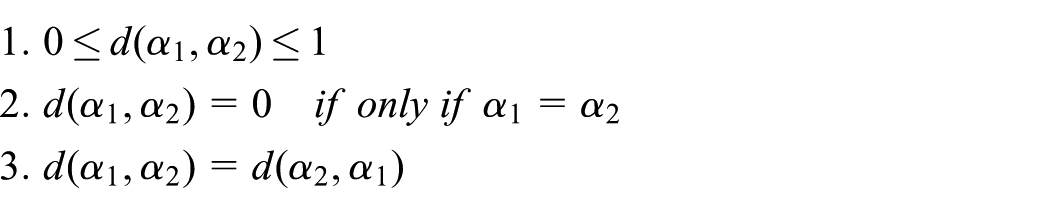
For two PVFSs (PVFEs) and , the distance between , denoted as , should satisfy the following properties
It is noted that the number of values in different PVFEs may be different, so let be the number of values in and let be the number of values in , . Let two PVFEs and , in most cases, , that is, and . For convenience, let , where and . The best way to extend the shorter definition is to add the same value to it several times. The selection of this value mainly depends on the risk preferences of the decision-makers. Optimists anticipate desirable outcomes and may add the maximum value, while pessimists expect unfavorable outcomes and may add the minimum value. For example, let and . To operate correctly, the optimist may extend to , and the pessimist may extend it as . Suppose that two PVFEs have the same length . For PVFE , let be a permutation satisfying ; .
Definition 15
Let two PVFEs Then
is called the generalized pair vacillating distance between .
If , is reduced to the following pair vacillating Hamming distance
If , then is reduced to the following pair vacillating Euclidean distance
If , then is reduced to the following pair vacillating Hamming–Hausdorff distance
Then, the power integration operators in pair vacillating fuzzy environments are investigated and a series of pair vacillating fuzzy power integration operators are developed.
Definition 16
Let be a collection of PVFEs, and a pair vacillating fuzzy power mean (PVFPM) operators and a pair vacillating fuzzy power geometric (PVFPG) operators are defined by the following equations
where
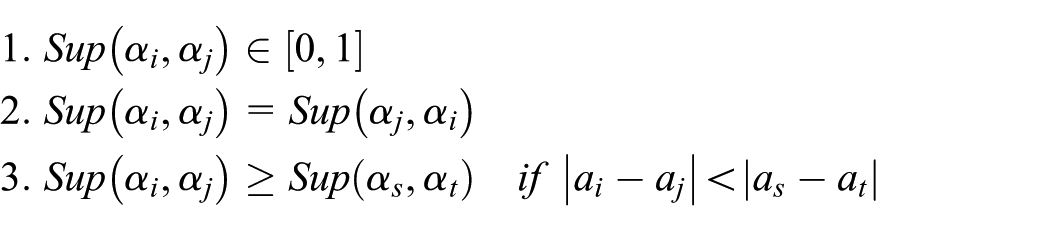
and is the support for from . The support satisfies the following three properties
Clearly, the PVFPM and PVFPG operators are two nonlinear weighted integration tools, and the weight of argument depends on all of the input arguments and allows the argument values to support each other in the integration process.
The support measure is essentially a similarity measure, and the similarity measure involves both similarity and dissimilarity. Furthermore, based on Definitions 14 and 15, . The higher the similarity, the smaller the distance between the two PVFEs and the more they support each other.
Theorem 1
Let be a collection of PVFEs. The aggregated value using the PVFPM or PVFPG operator is also a PVFE, and
Let be a collection of PVFEs. If any permutation of , then
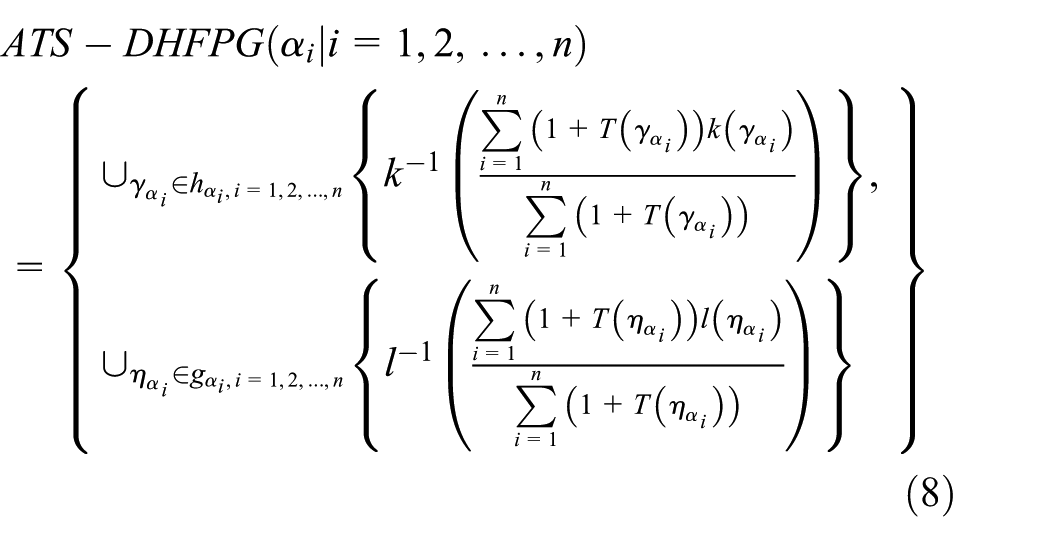
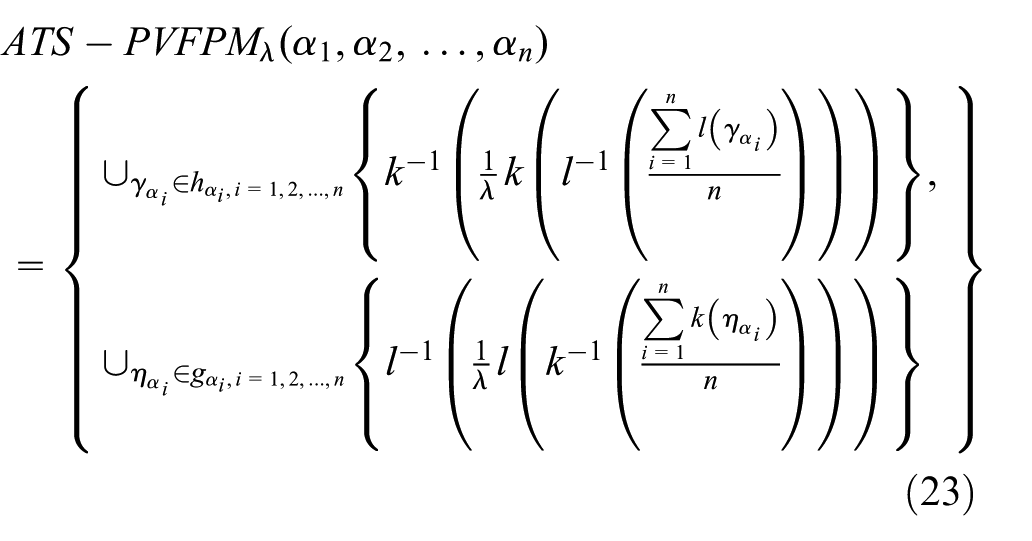
However, the ATS-PVFPM and ATS-PVFPG operators are neither idempotent, bounded, nor monotonic, as illustrated by the following example.
Example. Let , , , and be four PVFEs. Assume that is the pair vacillating Hamming distance between ,
According to Definition 4, , Therefore, , which implies that the PVFPM operator is not idempotent. Furthermore, because , the PVFPM operator is not bounded.
Finally, because and , and .
Therefore, the PVFPM operator is not monotonic. Then, desirable properties of the ATS-PVFPM and ATS-PVFPG operator are examined using different k and l.
Case 1
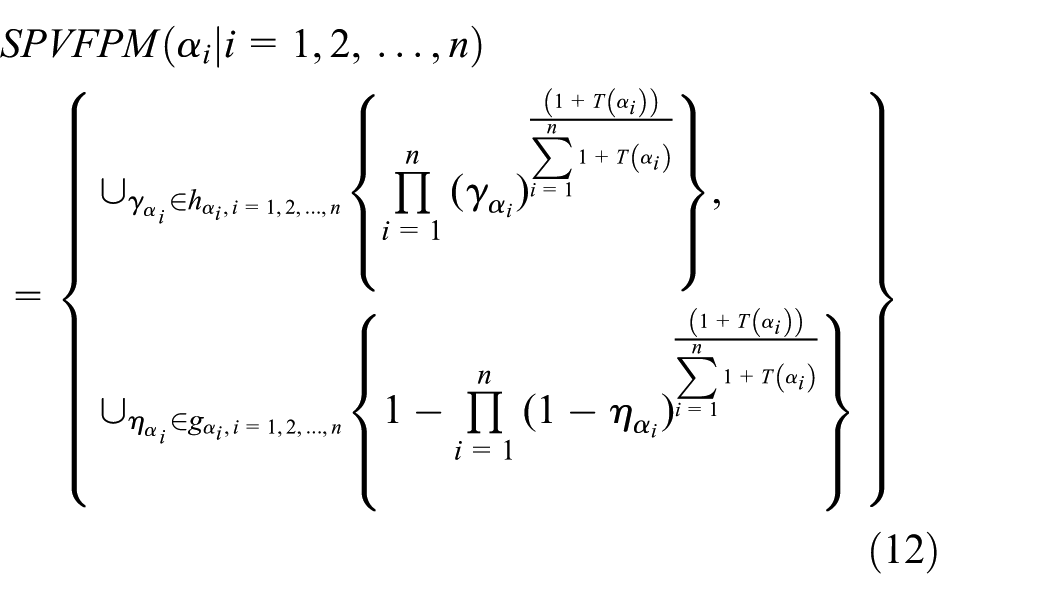
If , then ATS-PVFA and ATS-PVFPG operators are reduced to the following
Case 2
If , then ATS-PVFA and ATS-PVFPG operators reduce to the following
which are called the Einstein pair vacillating fuzzy power mean (EPVFPM) operator and the Einstein pair vacillating fuzzy power geometric (EPVFPG) operator, respectively.
Case 3
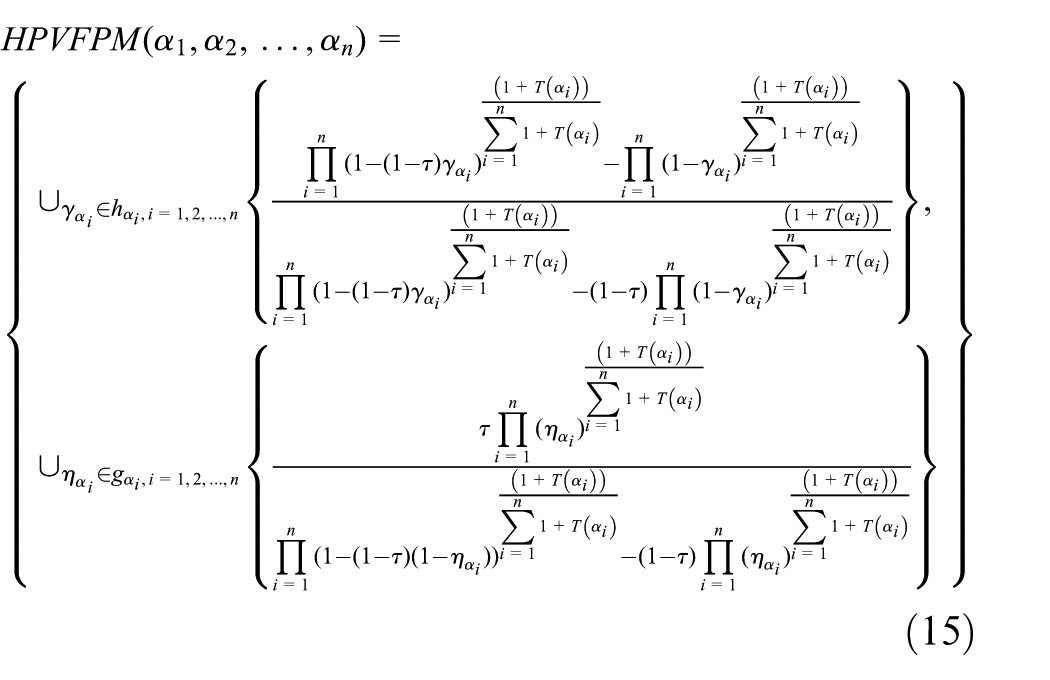
If , , the ATS-PVFA and ATS-PVFPG operators are reduced to the following
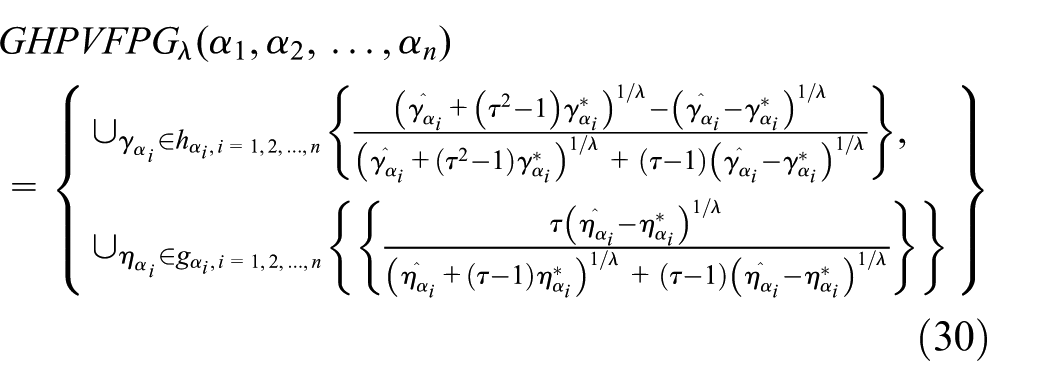
which are called the Hammer pair vacillating fuzzy power mean (HPVFPM) operator and the Hammer pair vacillating fuzzy power geometric (HPVFPG) operator, respectively. If , the HPVFPM and HPVFPG operator reduces to the SPVFPM and SPVFPG operators, respectively; if , the HPVFPM and HPVFPG operators reduce to the EPVFPM and EPVFPG operators, respectively.
Case 4
If , , the ATS-PVFA and ATS-PVFPG operators reduce to the following
which are called the Frank pair vacillating fuzzy power mean (FPVFPM) operator and the Frank pair vacillating fuzzy power geometric (FPVFPG) operator, respectively. If , the FPVFPM operator reduces to the SPVFPM operator and the FPVFPG operator reduces to the SPVFPG operator.
A generalization of the PVFPM and PVFPG operator is provided by combining it with the generalized mean operator, and the generalized pair vacillating fuzzy power mean (GPVFPM) operator and generalized pair vacillating fuzzy power geometric (GPVFPG) operator are obtained, which are defined as follows.
Definition 17
Let be a collection of PVFEs, a GPVFPM operator and a GPVFPG operator are defined by the following equations
where satisfies condition (6). Equations (19) and (20) can be transformed into the following forms
If reduces to the , and reduces to the . More specifically, when all of the supports are the same, that is, , . The ATS-GPVFPM operator reduces to the following form
Similarly, it can be proven that the ATS-GPVFPM and ATS-GPVFPG operators also satisfy the properties that the ATS-PVFPM and ATS-PVFPG operators have, and they will not be repeated.
Then, some desirable properties of the and operators can be investigated using different values of k and l.
Case 1
If , the and operators reduce to the following
Case 2
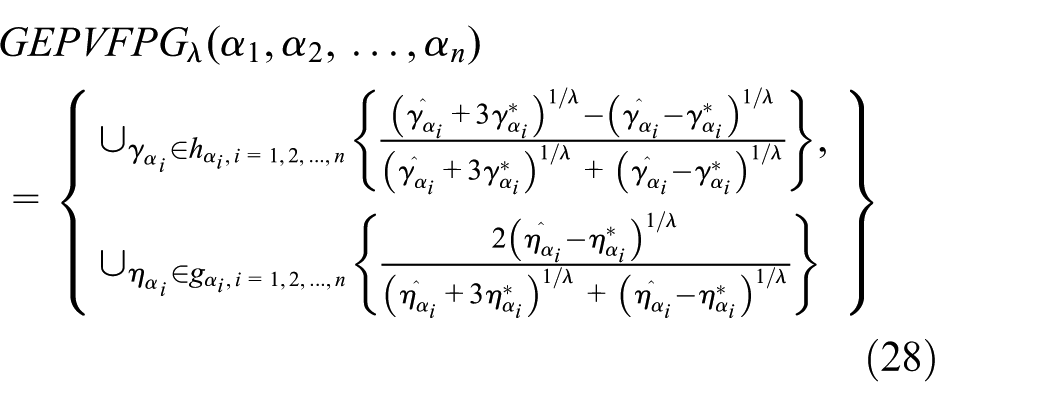
If , the and operators reduce to the following
where
which are called the generalized Einstein pair vacillating fuzzy power mean (GEPVFPM) and generalized Einstein pair vacillating fuzzy power geometric (GEPVFPG) operators.
Case 3
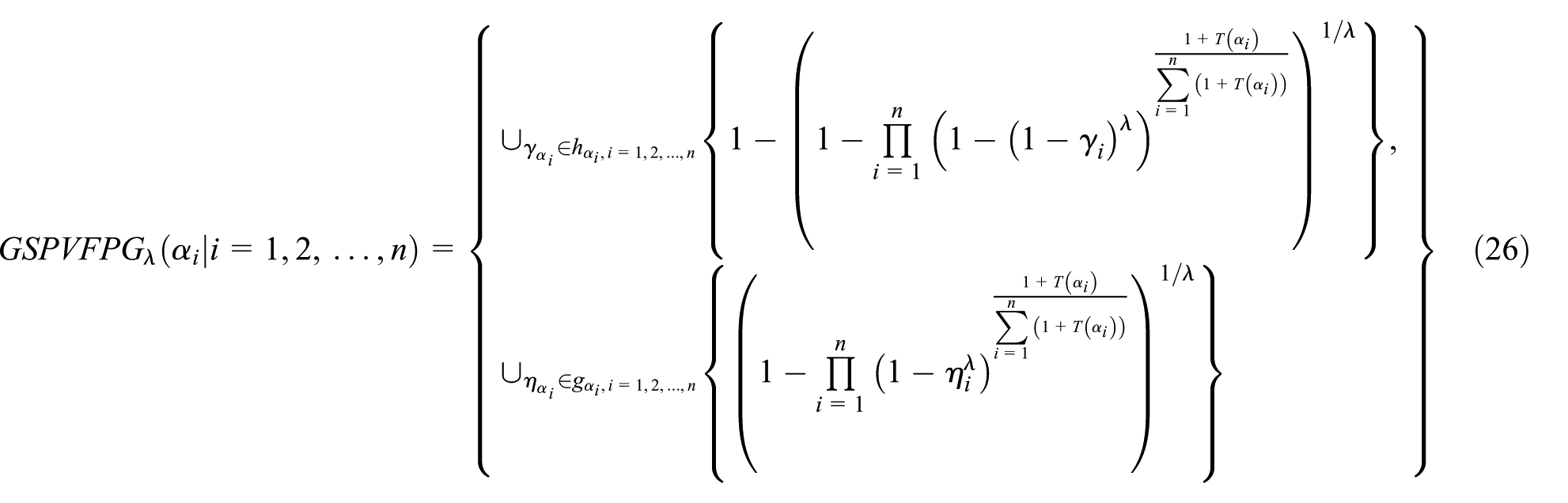
If , , the and operators reduce to the following
where
which are called the generalized Hammer pair vacillating fuzzy power mean (GHPVFPM) and generalized Hammer pair vacillating fuzzy power geometric (GHPVFPG) operators, respectively. If , the GHPVFPM operator reduces to the GSPVFPM operator and the GHPVFPG operator reduces to the GSPVFPG operator. If , the GHPVFPM operator reduces to the GEPVFPM operator and the ATS-GHPVFPG operator reduces to the GEPVFPG operator.
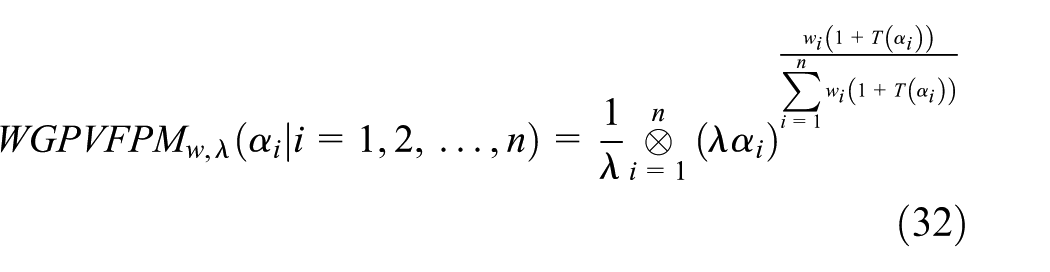
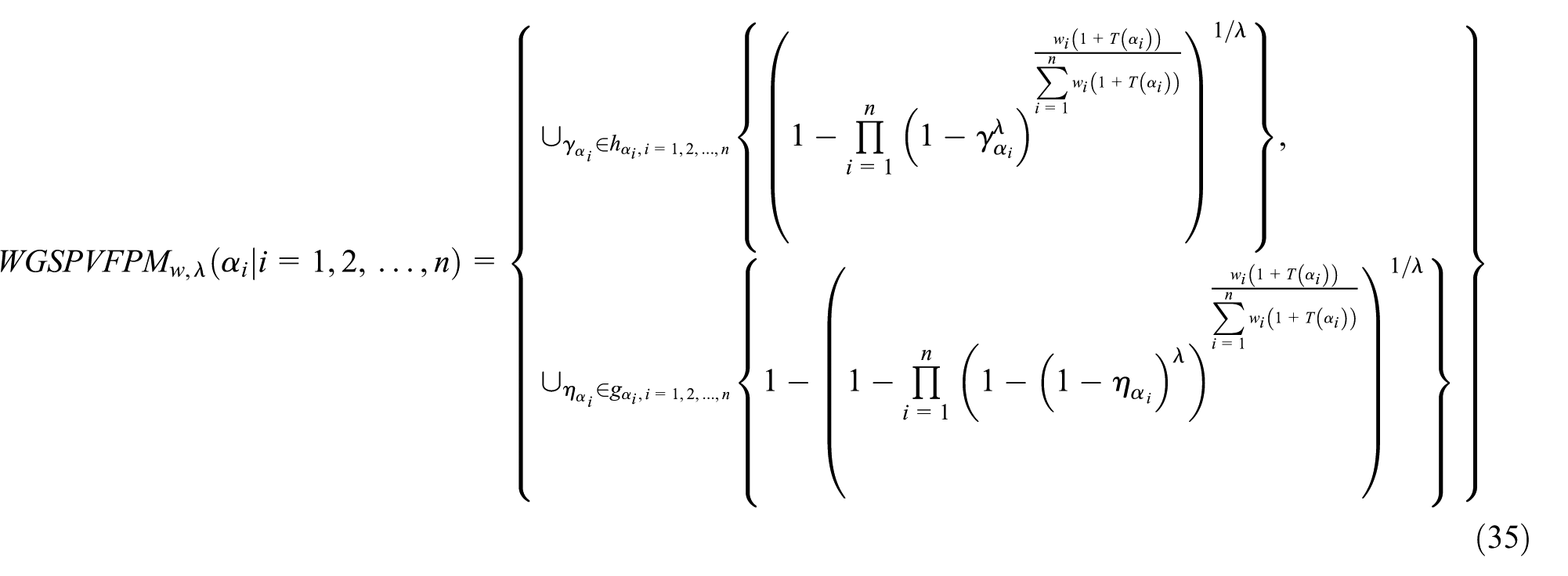
In the GPVFPM and GPVFPG operators, all aggregated arguments are of equal importance. When considering the weights of the arguments, a weighted generalized pair vacillating fuzzy power mean (WGPVFPM) operator and a weighted generalized pair vacillating fuzzy power geometric (WGPVFPG) operator can be developed as follows.
Definition 18
Let be a collection of PVFEs, WGPVFPM and WGPVFPG operators are defined by the following equations
where is a collection of arguments and
with the conditions that
Then, some desirable properties of the and operators can be investigated using different values of k and l.
Case 1
If , the and operators reduce to the following
Case 2
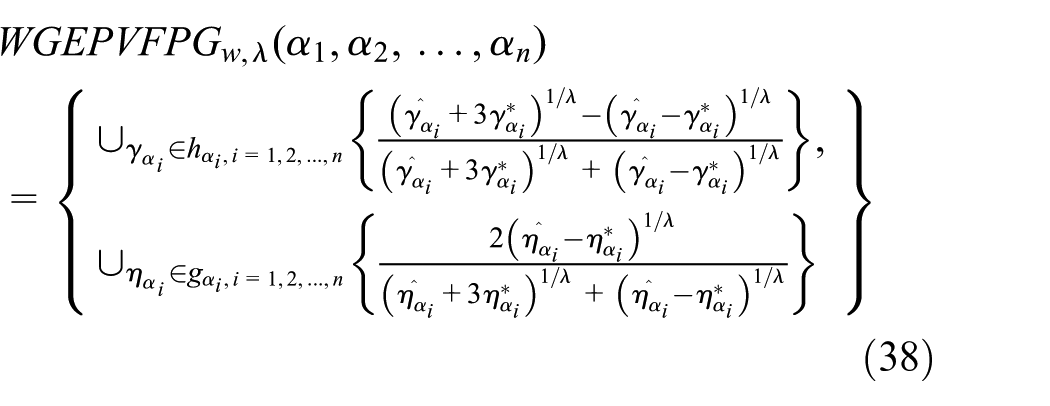
If , the and operators reduce to the following
where
which are called the weighted generalized Einstein pair vacillating fuzzy power mean (WGEPVFPM) and the weighted generalized Einstein pair vacillating fuzzy power geometric (WGEPVFPG) operators, respectively.
Case 3
If , , the and operator reduces to the following
where
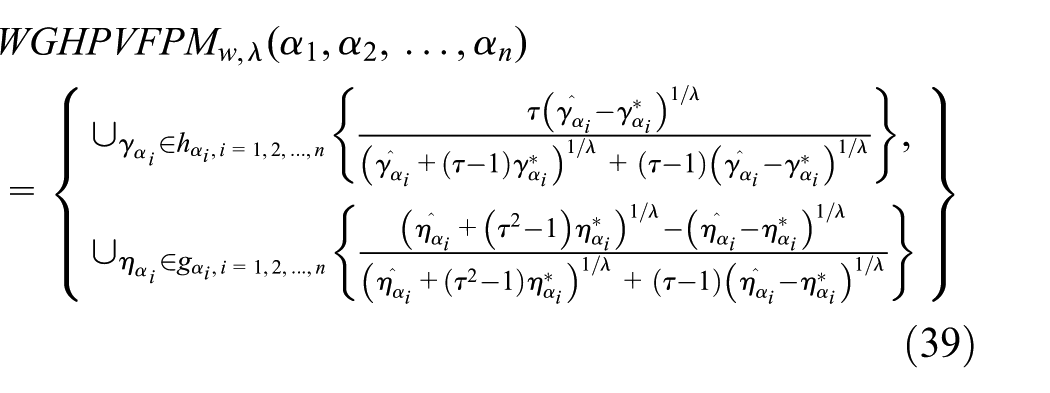
which are called the weighted generalized Hammer pair vacillating fuzzy power mean (WGHPVFPM) and weighted generalized Hammer pair vacillating fuzzy power geometric (WGHPVFPG) operators, respectively.
Based on the POWM and PVFPM operators, a pair vacillating fuzzy power ordered weighted mean (PVFPOWM) operator and pair vacillating fuzzy power ordered weighted geometric (PVFPOWG) operator are defined as follows.
Definition 19
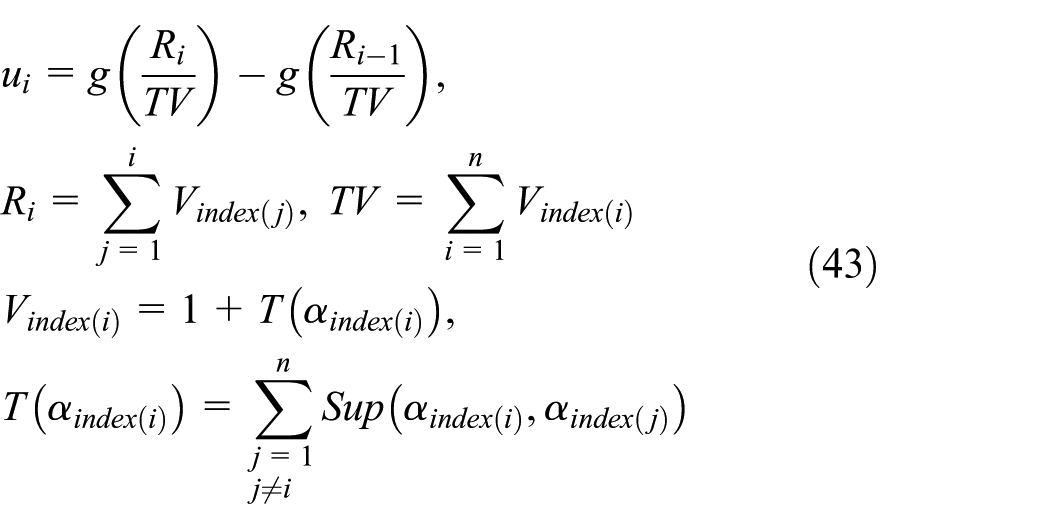
Let be a collection of PVFEs, PVFPOWM and PVFPOWG operators are defined by the following equations
where
In Definition 19, is the largest PVFE among all of the PVFEs, ; denotes the support of the largest PVFE by all of the other PVFEs; denotes the support of the largest PVFE for the largest PVFE, and Yager defined a basic unit-interval monotonic (BUM) function , with the following properties: and
Then, the desirable properties of the and operators can be investigated using different values of k and l.
Case 1
If , the and operators reduce to the following
Case 2
If , the and operators reduce to the following
which are called the Einstein pair vacillating fuzzy power ordered weighted mean (EPVFPOWM) operator and the Einstein pair vacillating fuzzy power ordered weighted geometric (EPVFPOWG) operator.
Case 3
If , , the and operators reduce to the following
which are called the Hammer pair vacillating fuzzy power ordered weighted mean (HPVFPOWM) and the Hammer pair vacillating fuzzy power ordered weighted geometric (HPVFPOWG) operators, respectively. If , the HPVFPOWM operator reduces to the SPVFPOWM operator, and the HPVFPOWG operator reduces to the SPVFPOWG operator; if , the HPVFPOWM operator reduces to the EPVFPOWM operator, and the HPVFPOWG operator reduces to the EPVFPOWG operator.
Case 4
If , , the and operators reduce to the following
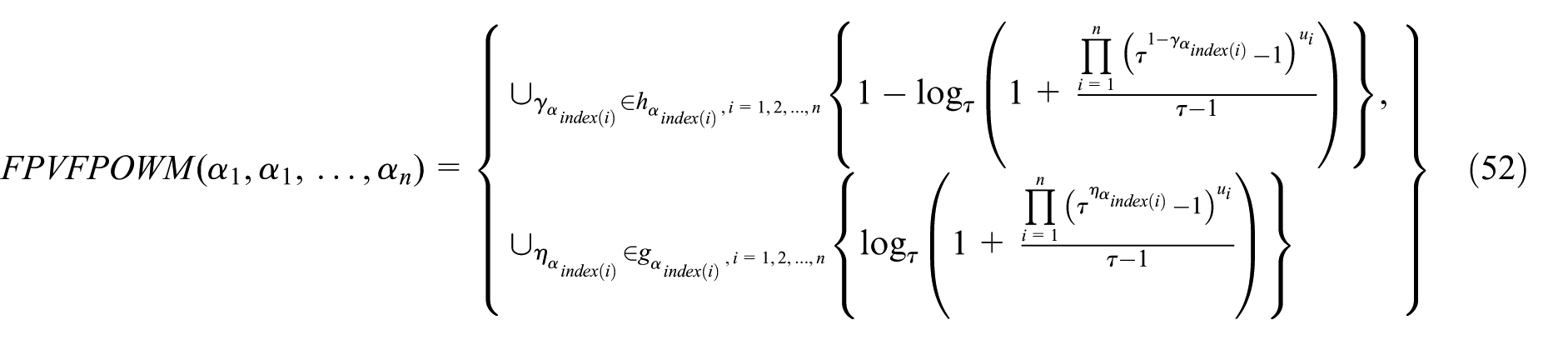
which are called the Frank pair vacillating fuzzy power ordered weighted mean (FPVFPOWM) and the Frank pair vacillating fuzzy power ordered weighted geometric (FPVFPOWG) operators, respectively. If , the FPVFPOWM operator reduces to the SPVFPOWM operator, and the FPVFPOWG operator reduces to the SPVFPOWG operator.
Definition 20
Let be a collection of PVFEs, a generalized pair vacillating fuzzy power ordered weighted mean (GPVFPOWM) and generalized pair vacillating fuzzy power ordered weighted geometric (GPVFPOWG) operators are defined by the following equations
Then, the desirable properties can be evaluated using different values of k and l.
Case 1
If , the and operators reduce to the following
Case 2
If , the and operators reduce to the following
where
which are called the generalized Einstein pair vacillating fuzzy power ordered weighted mean (GEPVFPOWM) and the generalized Einstein pair vacillating fuzzy power ordered weighted geometric (GEPVFPOWG) operators, respectively.
Case 3
If , , the and operators reduce to the following
where
which are called the generalized Hammer pair vacillating fuzzy power ordered weighted mean (GHPVFPOWM) and the generalized Hammer pair vacillating fuzzy power ordered weighted geometric (GHPVFPOWG) operators, respectively. If , the GHPVFPOWM operator reduces to the GSPVFPOWM operator, and the GHPVFPOWG operator reduces to the GSPVFPOWG operator; if , then the GHPVFPOWM operator reduces to the GEPVFPOWM operator, and the GHPVFPOWG operator reduces to the GEPVFPOWG operator.
The proposed pair vacillating fuzzy power integration operators are used to develop an approach to multiple attribute decision-making with the following pair vacillating fuzzy information.
For a multiple attribute group decision-making problem with pair vacillating fuzzy information, let be a set of n alternatives, and let be a set of m attributes whose weight vector is , with . Let be a set of s decision-makers whose weight vector is , with . Let be a pair vacillating fuzzy decision matrix where is an attribute value provided by the decision-maker , denoted by a PVFE, where indicates all of the possible degree that the alternative satisfies the attribute . indicates all of the possible degrees that the alternative does not satisfy attribute . When all alternative performances are provided, the pair vacillating fuzzy decision matrix can be constructed.
Approach
Step 1. Transform the pair vacillating fuzzy decision matrix into the normalized pair vacillating fuzzy decision matrix where
Step 2. Calculate the supports
which satisfy support conditions (6).
Step 3. Utilize the weights of the decision-makers to calculate the weighted support of PVFE by the other PVFEs
Step 4. Utilize the WGPVFPM operator to obtain the vacillating fuzzy elements for the alternatives
or the WGPVFPG operator to obtain the vacillating fuzzy elements for the alternatives
to aggregate all of the individual pair vacillating fuzzy decision matrices into the collective pair vacillating fuzzy decision matrix .
Step 5. Calculate the score function of each attribute for the alternatives
Step 6. Utilize the weights of attributes to calculate total score for all alternatives as following
Step 8. Rank the in descending order using Definition 4.
Step 9. Rank all alternatives and then select the best alternative in accordance with the collective overall preference values .
Experiment and result analysis
In the experiment, a routing decision problem is considered. The experience qualification of some history routes vary according to the demand and cost. For example, time delay would be important in some cases, but the probability of success may be more important in other cases. A experiment is conducted to show that with the proposed approach, the most proper choice can be made based on the history experience, considering multiple attributes.
The standard for evaluating the route is defined as follows: path length, fluency, success probability, and price. While demands change, the proper route decision may also vary. Suppose there are four candidate routes . Three history experiences are used to support the current routing decision, whose weight vector is . The following four attributes are considered: (1) path length, such that the shorter the path length, the more desirable and valuable it is. Grades run from “D” to “X”. (2) Fluency measures the smoothness and ease of the route, that is, the fluctuation of the delay . (3) Success probability measures the possibility of the successful routing service . (4) Price refers to the cost of the route. The higher the price, the more expensive it is . The weight vector of the attributes is . The history experiences evaluate the routes with respect to the attributes and construct the vacillating fuzzy decision matrices (see Tables 1–3). The could be transformed into (see Tables 4–6).
The pair vacillating fuzzy decision matrix A1.
G1
G2
G3
G4
x1
{{0.4,0.2},{0.5,0.4,0.3}}
{{0.3,0.2,0.1},{0.6,0.5}}
{{0.6,0.4,0.3},{0.4,0.2,0.1}}
{{0.6},{0.4}}
x2
{{0.2,0.1},{0.8,0.7,0.6}}
{{0.3,0.2,0.1},{0.7,0.6}}
{{0.7,0.6,0.5},{0.3,0.2,0.1}}
{{0.7},{0.2}}
x3
{{0.1,0.0},{0.9,0.8,0.7}}
{{0.2,0.1,0.0},{0.8,0.7}}
{{0.8,0.7,0.6},{0.2,0.1,0.0}}
{{0.9},{0.1}}
x4
{{0.6,0.5},{0.4,0.3,0.1}}
{{0.4,0.2,0.1},{0.6,0.5}}
{{0.6,0.5,0.4},{0.3,0.2,0.1}}
{{0.3},{0.6}}
The pair vacillating fuzzy decision matrix A2.
G1
G2
G3
G4
x1
{{0.4,0.3},{0.6,0.4,0.3}}
{{0.3,0.2,0.1},{0.7,0.5}}
{{0.5,0.4,0.2},{0.5,0.4,0.2}}
{{0.7},{0.3}}
x2
{{0.2,0},{0.7,0.6,0.5}}
{{0.2,0.1,0.0},{0.8,0.6}}
{{0.7,0.6,0.5},{0.3,0.2,0.1}}
{{0.6},{0.3}}
x3
{{0.2,0.1},{0.8,0.7,0.6}}
{{0.2,0.1,0.0},{0.8,0.5}}
{{0.7,0.6,0.5},{0.3,0.2,0.1}}
{{0.9},{0.1}}
x4
{{0.6,0.5},{0.4,0.3,0.1}}
{{0.3,0.2,0.1},{0.6,0.5}}
{{0.7,0.5,0.4},{0.3,0.2,0.0}
{{0.3},{0.7}}
The pair vacillating fuzzy decision matrix A3.
G1
G2
G3
G4
x1
{{0.4,0.3},{0.4,0.3,0.2}}
{{0.4,0.3,0.2},{0.6,0.5}}
{{0.5,0.4,0.3},{0.5,0.4,0.3}}
{{0.6},{0.4}}
x2
{{0.2,0.1},{0.8,0.7,0.5}}
{{0.3,0.2,0.1},{0.6,0.5}}
{{0.7,0.6,0.5},{0.3,0.2,0.0}}
{{0.7},{0.1}}
x3
{{0.2,0.0},{0.8,0.7,0.5}}
{{0.2,0.1,0.0},{0.8,0.6}}
{{0.7,0.6,0.5},{0.3,0.2,0.1}}
{{0.8},{0.1}}
x4
{{0.6,0.4},{0.4,0.3,0.2}}
{{0.3,0.2,0.1},{0.7,0.6}}
{{0.6,0.5,0.3},{0.3,0.2,0.0}}
{{0.2},{0.6}}
The pair vacillating fuzzy decision matrix R1.
G1
G2
G3
G4
x1
{{0.5,0.4,0.3},{0.4,0.2}}
{{0.6,0.5},{0.3,0.2,0.1}}
{{0.6,0.4,0.3},{0.4,0.2,0.1}}
{{0.6},{0.4}}
x2
{{0.8,0.7,0.6},{0.2,0.1}}
{{0.7,0.6},{0.3,0.2,0.2}}
{{0.7,0.6,0.5},{0.3,0.2,0.1}}
{{0.7},{0.1}}
x3
{{0.9,0.8,0.7},{0.1,0.0}}
{{0.8,0.7},{0.2,0.1,0.0}}
{{0.8,0.7,0.6},{0.2,0.1,0.0}}
{{0.9},{0.1}}
x4
{{0.4,0.3,0.1},{0.6,0.5}}
{{0.6,0.5},{0.4,0.2,0.1}}
{{0.6,0.5,0.4},{0.3,0.2,0.1}}
{{0.3},{0.6}}
The pair vacillating fuzzy decision matrix R2.
G1
G2
G3
G4
x1
{{0.6,0.4,0.3},{0.4,0.3}}
{{0.7,0.5},{0.3,0.2,0.1}}
{{0.5,0.4,0.2},{0.5,0.4,0.2}}
{{0.7},{0.3}}
x2
{{0.7,0.6,0.5},{0.2,0}}
{{0.8,0.6},{0.2,0.1,0.0}}
{{0.7,0.6,0.5},{0.3,0.2,0.1}}
{{0.6},{0.3}}
x3
{{0.8,0.7,0.6},{0.2,0.1}}
{{0.8,0.5},{0.2,0.1,0.0}}
{{0.7,0.6,0.5},{0.3,0.2,0.1}}
{{0.9},{0.1}}
x4
{{0.4,0.3,0.1},{0.6,0.5}}
{{0.6,0.5},{0.3,0.2,0.1}}
{{0.7,0.5,0.4},{0.3,0.2,0.0}}
{{0.3},{0.7}}
The pair vacillating fuzzy decision matrix R3.
G1
G2
G3
G4
x1
{{0.4,0.3,0.2},{0.4,0.3}}
{{0.6,0.5},{0.4,0.3,0.2}}
{{0.5,0.4,0.3},{0.5,0.4,0.3}}
{{0.6},{0.4}}
x2
{{0.8,0.7,0.5},{0.2,0.0}}
{{0.6,0.5},{0.3,0.2,0.1}}
{{0.7,0.6,0.5},{0.3,0.2,0.0}}
{{0.7},{0.1}}
x3
{{0.8,0.7,0.5},{0.2,0.0}}
{{0.8,0.6},{0.2,0.1,0.0}}
{{0.7,0.6,0.5},{0.3,0.2,0.1}}
{{0.8},{0.1}}
x4
{{0.4,0.3,0.2},{0.6,0.4}}
{{0.7,0.6},{0.3,0.2,0.1}}
{{0.6,0.5,0.3},{0.3,0.2,0.0}}
{{0.2},{0.6}}
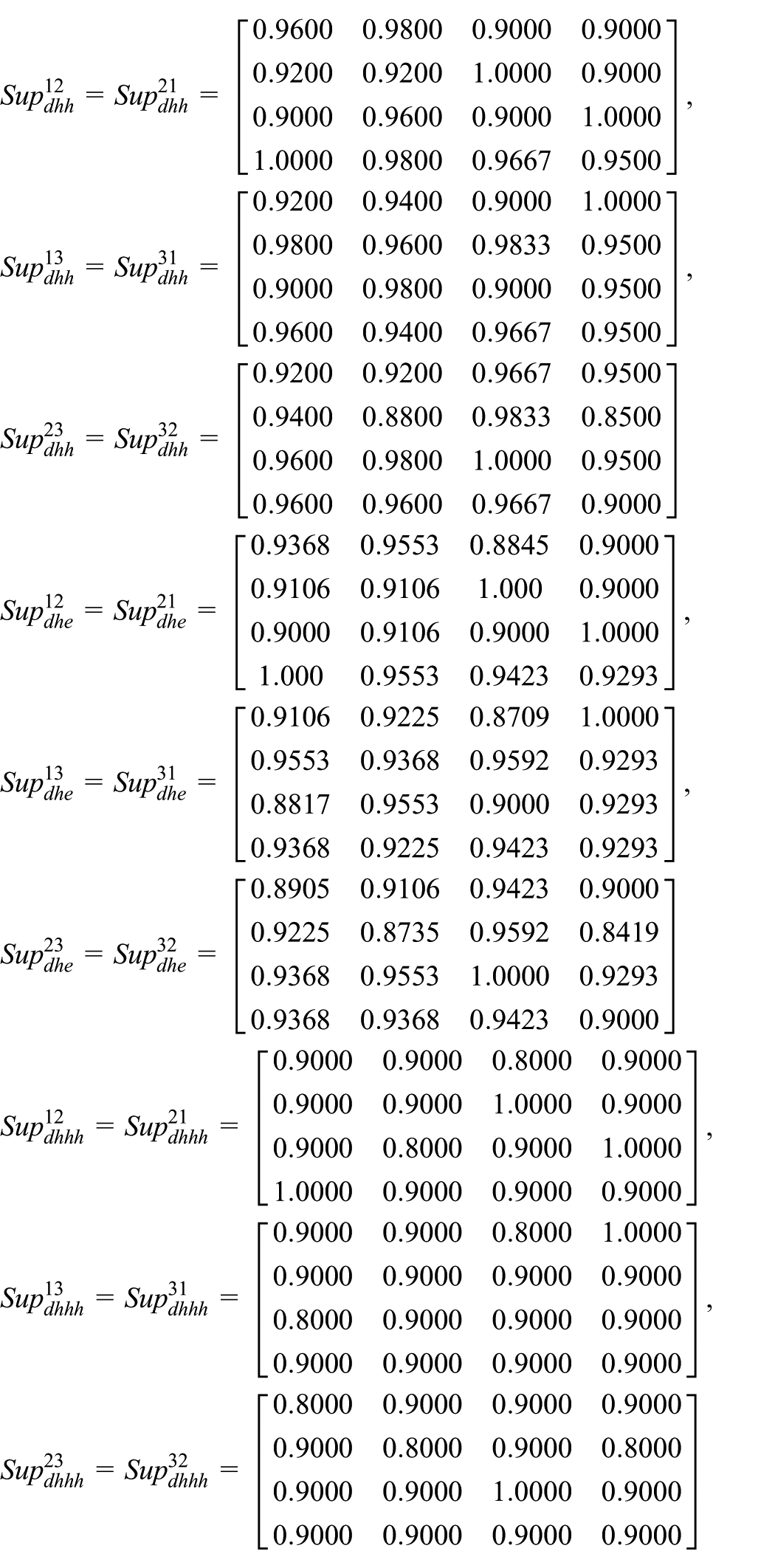
First, the supports are calculated as follows
Denote by , which refers to the following supports
Second, the weighted support of PVFE is computed as . Denote by
Third, the weights of PVFE are computed. Denote in the following
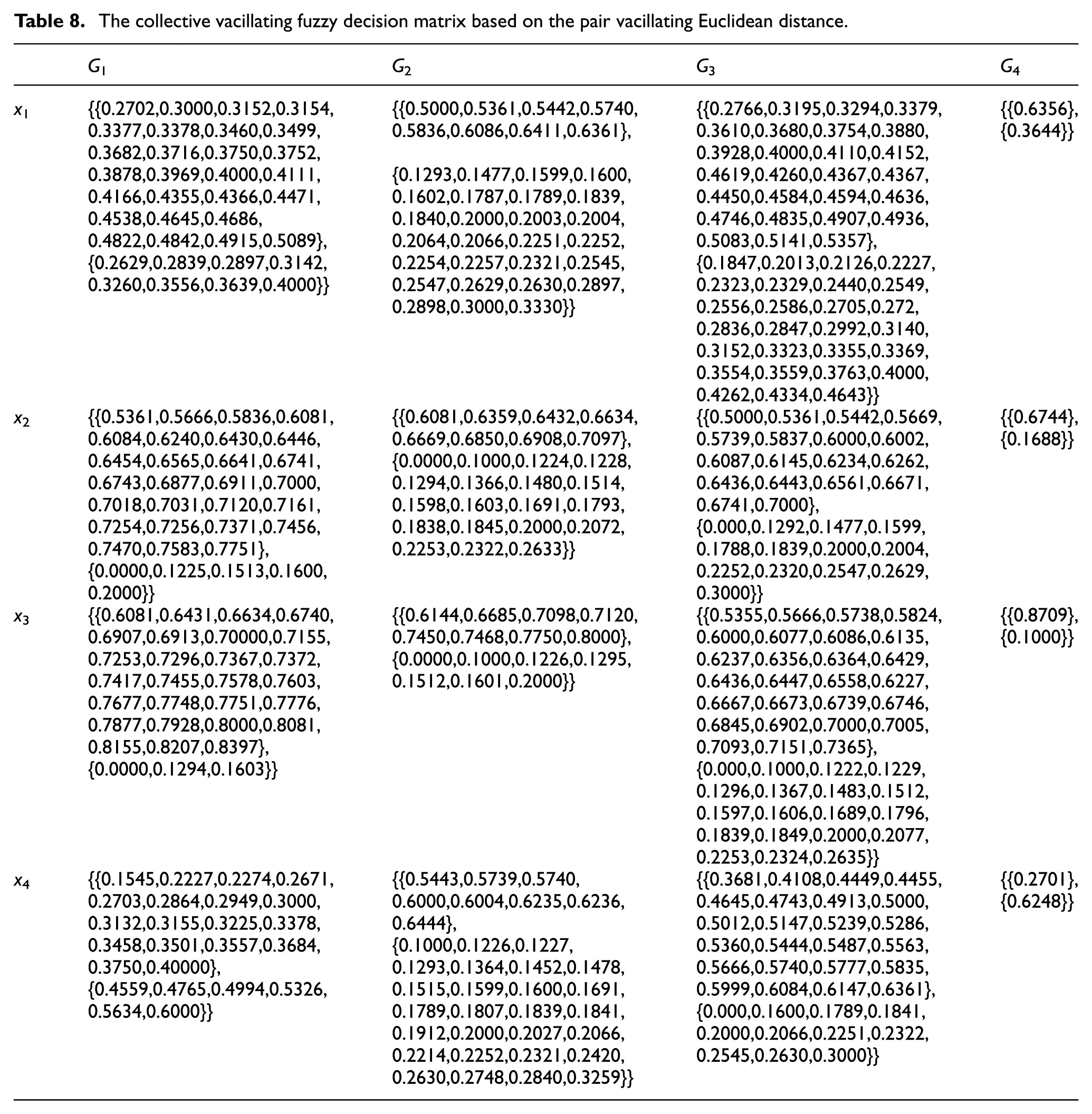
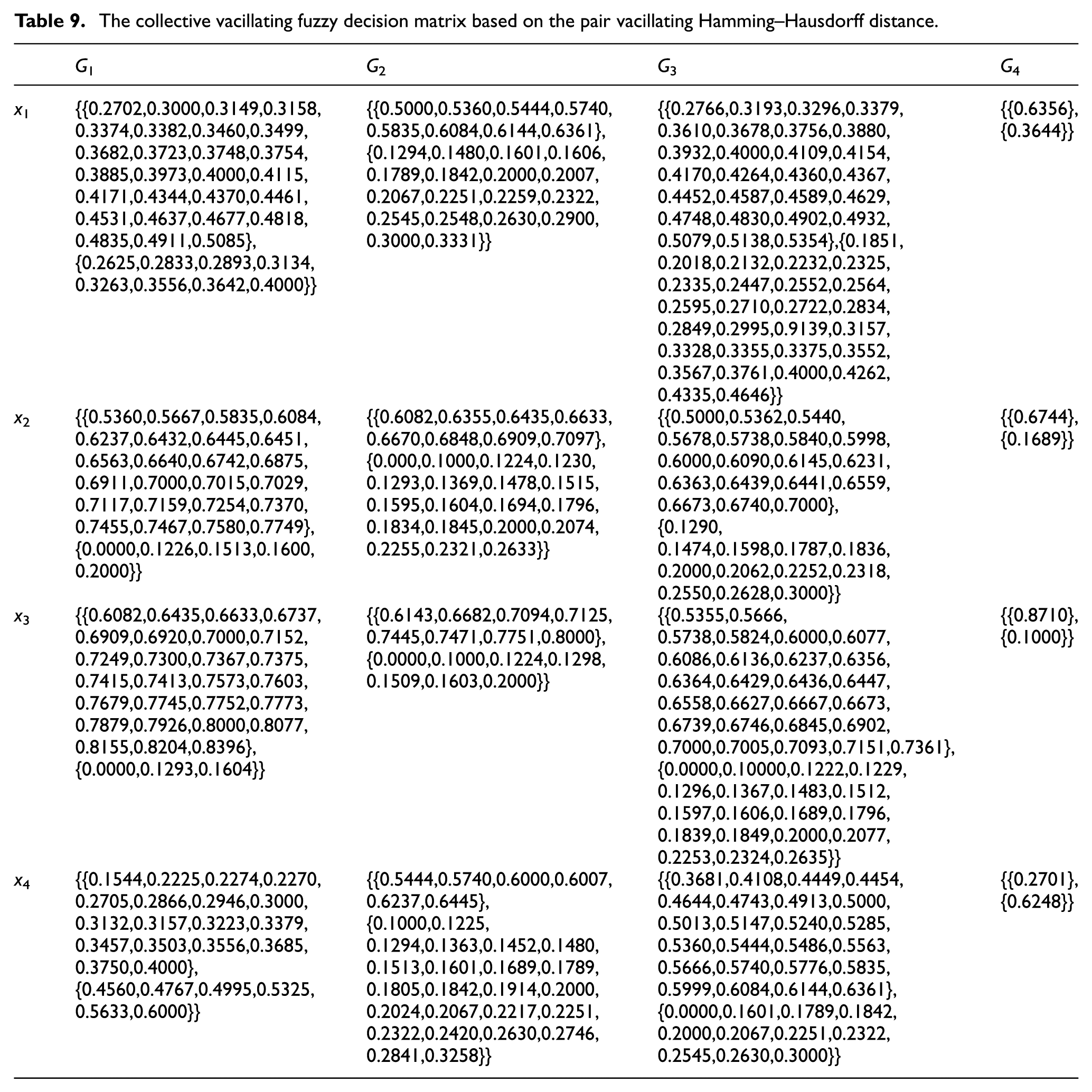
Fourth, the WGPVFPM operator is applied to aggregate the individual into the comprehensive decision matrix (See Tables 7–9).
The collective Pair vacillating fuzzy decision matrix R based on the pair vacillating Hamming distance.
Fifth, the score function of is computed and the score functions are aggregated (see Tables 10–12).
Score function matrix based on the pair vacillating Hamming distance.
G1
G2
G3
G4
Total score value
x1
0.0805
0.357
0.1209
0.2712
0.23
x2
0.5494
0.5009
0.4187
0.5058
0.494
x3
0.647
0.5981
0.4844
0.7708
0.6604
x4
−0.2153
0.4076
0.3252
0.3545
−0.0453
Score function matrix based on the pair vacillating Euclidean distance.
G1
G2
G3
G4
Total score value
x1
0.0735
0.357
0.1209
0.2712
0.2286
x2
0.5494
0.501
0.4188
0.5057
0.4939
x3
0.6471
0.5981
0.4844
0.7709
0.6605
x4
−0.2153
0.4076
0.3252
−0.3546
−0.0453
Score function matrix based on the pair vacillating Hamming–Hausdorff distance.
G1
G2
G3
G4
Total score value
x1
0.0736
0.3553
0.1204
0.2712
0.2286
x2
0.55
0.501
0.4189
0.5055
0.494
x3
0.6471
0.5981
0.4844
0.771
0.6605
x4
−0.2154
0.4031
0.3251
−0.3548
−0.0463
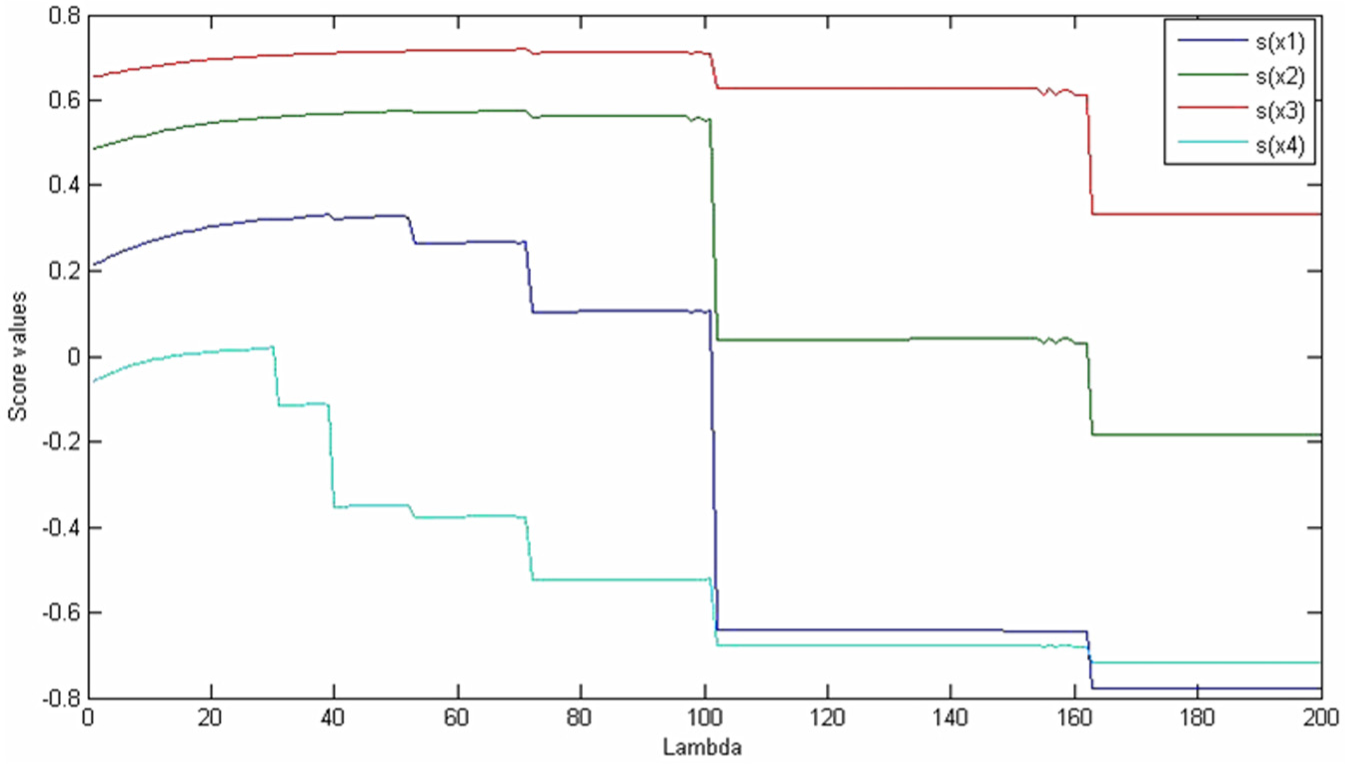
From the Tables 10–12, , the result shows that the most proper decision is route 3. When parameter is changed, different results are obtained (Tables 13–15).
Score values obtained by ATS-WGPVF PA operator based on the Hamming distance.
0.05
0.1
1
10
100
200
x1
0.2115
0.2118
0.2169
0.2695
0.1048
−0.7762
x2
0.4832
0.4834
0.4864
0.5206
0.553
−0.1849
x3
0.6527
0.6528
0.6551
0.6783
0.7081
0.3343
x4
−0.0615
−0.0648
−0.0592
−0.0107
−0.5216
−0.7167
Score values obtained by ATS-WGPVF PA operator based on the Euclidean distance.
0.05
0.1
1
10
100
200
x1
0.2107
0.211
0.216
0.2682
0.1048
−0.7762
x2
0.4831
0.4833
0.4864
0.5206
0.553
−0.1849
x3
0.6527
0.6529
0.6551
0.6783
0.7081
0.3343
x4
−0.0651
−0.06483
−0.0593
−0.0107
−0.5216
−0.7167
Score values obtained by ATS-WGPVF PA operator based on the Hamming–Hausdorff distance.
0.05
0.1
1
10
100
200
x1
0.2104
0.2107
0.2157
0.2675
0.1032
−0.791
x2
0.4831
0.4833
0.4864
0.5207
0.553
−0.1849
x3
0.6528
0.6529
0.6551
0.6784
0.7081
0.3343
x4
−0.0661
−0.0658
−0.0604
−0.0115
−0.5224
−0.7241
The following figure shows that the evaluation score values vary with parameter λ. However, the analysis result remains (see Figure 2).
Evaluation result with different values of λ.
Conclusion
In view of routing decision methods, the need to consider multiple attributes and the combined approach of multiple QoE values bring challenges. In this article, a vacillating fuzzy analysis method was applied to solve the experience-oriented routing decision problem. The integration operators help the routing decision considering multiple attributes by combining the approach of multiple QoE values. The effectiveness of the proposed approach was verified by the experimental results, which show that the experience-oriented routing decision problem could be solved through the proposed method by improving the qualification of experience.
Future work
The dynamic network topology problem and the unbalanced traffic distribution problem are very important in routing decisions, but they are not solved concurrently in this article. In this article, the comprehensive QoE evaluation of different routes is examined by combining multiple history experience data. The dynamic network topology problem and the unbalanced traffic distribution problem will be studied in the future work.
Footnotes
Appendix 1
To facilitate analysis, the related definitions in existing works are listed as follows.
Appendix 2
Appendix 3
Appendix 4
Academic Editor: Haibo Zhou
Declaration of conflicting interests
The author(s) declared no potential conflicts of interest with respect to the research, authorship, and/or publication of this article.
Funding
The author(s) received no financial support for the research, authorship, and/or publication of this article.
References
1.
JiangCWangXWangJet al. Security in space information networks. IEEE Commun Mag2015; 53(8): 82–88.
2.
FangRJiulunF.An adaptive distributed certificate management scheme for space information network. IET Inform Secur2013; 7(4): 318–326.
3.
KawamotoYNishiyamaHKatoNet al. A traffic distribution technique to minimize packet delivery delay in multilayered satellite networks. IEEE T Veh Technol2013; 62(7): 3315–3324.
4.
CelandroniNFerroEGottaAet al. A survey of architectures and scenarios in satellite-based wireless sensor networks: system design aspects. Int J Satell Comm N2013; 31: 1–38.
5.
MukherjeeJRamamurthyB.Communication technologies and architectures for space network and interplanetary internet. IEEE Commun Surv Tut2013; 15: 881–897.
6.
KawamotoYNishiyamaHFadlullahZet al. Effective data collection via satellite-routed sensor system (SRSS) to realize global-scaled Internet of Things. IEEE Sens J2013; 13(10): 3645–3654.
7.
BayhanSGurGAlagozF. Adaptive routing protocol for QoS in two-layered satellite IP networks. In: Proceedings of the international workshop on satellite and space communications, Madrid, 14–15 September 2006, pp.63–67. New York: IEEE.
8.
ZhouYSunFZhangB. A hierarchical and distributed QoS routing protocol for two-layered satellite networks. In: Proceedings of the multiconference on computational engineering in systems applications, Beijing, China, 4–6 October 2006, pp.739–745. New York: IEEE.
9.
AkyildizIFEkiciEBenderM.MLSR: a novel routing algorithm for multilayered satellite IP networks. IEEE ACM T Network2002; 10(3): 411–424.
10.
YinZZhangLZhouXet al. QoS-aware multicast routing protocol for triple-layered LEO/HEO/GEO satellite IP network. In: Proceedings of the IEEE global mobile congress, Shanghai, China, 18–19 October 2010, pp.1–6. New York: IEEE.
11.
LiuCWuJ.Practical routing in a cyclic mobispace. IEEE ACM T Network2011; 19(2): 369–382.
12.
FischerDBasinDEcksteinKet al. Predictable mobile routing for spacecraft networks. IEEE T Mobile Comput2013; 12(6): 1174–1187.
13.
GaoZGuoQNaZ.Novel optimized routing algorithm for LEO satellite IP networks. J Syst Eng Electron2011; 22(6): 917–925.
14.
TorraVNarukawaY. On vacillating fuzzy sets and decision. In: Proceedings of the 18th IEEE international conference on fuzzy systems, Jeju Island, Korea, 20–24 August 2009, pp.1378–1382. New York: IEEE.
15.
ZhouLChenHLiuJ.Generalized power aggregation operators and their applications in group decision making. Comput Ind Eng2012; 62: 989–999.
16.
Herrera-ViedmaEAlonsoSHerreraFet al. A consensus model for group decision making with incomplete fuzzy preference relations. IEEE T Fuzzy Syst2007; 15(5): 863–877.
17.
YagerRR.On ordered weighted averaging aggregation operators in multicriteria decisionmaking. IEEE T Syst Man Cyb B1988; 18: 183–190.
18.
XuZSYagerRR.Some geometric aggregation operators based on intuitionistic fuzzy sets. Int J Gen Syst2006; 35417–433.
19.
XuZS.Multi-person multi-attribute decision making models under intuitionistic fuzzy environment. Fuzzy Optim Decis Ma2007; 6: 221–236.
20.
WeiGW.Some geometric aggregation functions and their application to dynamic multiple attribute decision making in the intuitionistic fuzzy setting. Int J Unc Fuzz Knowl Based Syst2009; 17(2): 179–196.
21.
XuYJWangHM.The induced generalized aggregation operators for intuitionistic fuzzy sets and their application in group decision making. Appl Soft Comput2012; 12(3): 1168–1179.
22.
WeiGWZhaoXF.Some induced correlated aggregating operators with intuitionistic fuzzy information and their application to multiple attribute group decision making. Expert Syst Appl2012; 39(2): 2026–2034.
23.
BeliakovGPraderaACalvoT.Aggregation functions: a guide for practitioners. Heidelberg, Berlin; New York: Springer, 2007.
24.
XiaMXuZZhuB.Some issues on intuitionistic fuzzy aggregation operators based on Archimedean t-conorm and t-norm. Knowl Based Syst2012; 31: 78–88.
25.
XuZSXiaMChenN.Some hesitant fuzzy aggregation operators with their application in group decision making. Group Decis Negot2013; 22(2): 259–279.
26.
YagerRR.The power average operator. IEEE T Syst Man Cy A2001; 31: 724–731.
27.
XuZSYagerRR.Power-geometric operators and their use in group decision making. IEEE T Fuzzy Syst2010; 18: 1894–105.
28.
XuZSCaiXQ.Uncertain power average operators for aggregating interval fuzzy preference relations. Group Decis Negot2010; 21(3): 381–397.
29.
ZhouLChenHLiuJ.Generalized power integration operators and their applications in group decision making. Comput Ind Eng2012; 62(4): 989–999.
30.
WanSP.Power average operators of trapezoidal intuitionistic fuzzy numbers and application to multi-attribute group decision making. Appl Math Model2013; 37: 4112–4126.
31.
KlirGYuanB.Fuzzy sets and fuzzy logic: theory and applications. Upper Saddle River, NJ: Prentice Hall, 1995.
32.
NguyenHTWalkerEA.A first course in fuzzy logic. Boca Raton, FL: CRC Press, 1997.
33.
BeliakovGBustinceHGoswamiDPet al. On averaging operators for Atanassov’s intuitionistic fuzzy sets. Inform Sciences2011; 181: 1116–1124.