




Abstract
Space–ground integrated network, a strategic, driving, and irreplaceable infrastructure, guarantees the development of economic and national security. However, its natures of limited resources, frequent handovers, and intermittently connected links significantly reduce the quality of service. To address this issue, a quality-of-service-aware dynamic evolution model is proposed based on complex network theory. On one hand, a quality-of-service-aware strategy is adopted in the model. During evolution phases of growth and handovers, links are established or deleted according to the quality-of-service-aware preferential attachment following the rule of better quality of service getting richer and worse quality of service getting poor or to die. On the other hand, dynamic handover of nodes and intermittent connection of links are taken into account and introduced into the model. Meanwhile, node heterogeneity is analyzed and heterogeneous nodes are endowed with discriminate interactions. Theoretical analysis and simulations are utilized to explore the degree distribution and its characteristics. Results reveal that this model is a scale-free model with drift power-law distribution, fat-tail and small-world effect, and drift character of degree distribution results from dynamic handover. Furthermore, this model exerts well fault tolerance and attack resistance compared to signal-strength-based strategy. In addition, node heterogeneity and quality-of-service-aware strategy improve the attack resistance and overall quality of service of space–ground integrated network.
Keywords
Introduction
Space–ground integrated network (SGIN)1,2 is a highly heterogeneous complex network which adopts satellite network as backbone network and consists of deep-space network, near-space network, and terrestrial network. It has received increasing attentions1,2 for its potential in achieving all-round development of strategic information services in fields such as national security, aerospace engineering, and military. However, its natures of limited resources, frequent handovers, and intermittently connected links greatly reduce quality of service (QoS) of SGIN. What’s more, limitation of costs and technologies aggravates the challenges in investigating practical SGIN. Thus, it is of great significance to build a SGIN evolution model in order to optimize its topology and address the QoS issue.
Complex network theory, a useful tool for exploring the macroscopic statistical characteristics, microcosmic evolution mechanism, and dynamic features of complex systems, provides a new idea for optimizing QoS of SGIN. Barabási and Albert 3 successfully constructed a scale-free network model with power-law distribution considering the growth and preferential attachment of practical network in 1999. Later, considerable studies focus on the generation mechanism of vertexes, preferential attachment, and robustness of complex network. In terms of node generation mechanism, a linear growth evolution model (LGEM) and an accelerated growth evolution model (AGEM) are proposed for wireless sensor networks (WSNs) by Zheng et al. 4 Considering that the time of nodes entering the network are not uniform, a Poisson dynamics of WSNs is explored by Jiang et al. 5 Luo et al. 6 take the potential extinction of nodes into account in its evolution model. Wen et al. 7 investigated the dynamical behaviors of a class of weighted local-world evolving networks with aging nodes. Feng et al. 8 proposed three novel models based on the homogeneous Poisson, nonhomogeneous Poisson, and birth death processes, revealing the influence of generation mechanisms. Master equations for evolution model with birth and death are analyzed by Alvarez-Martínez et al. 9 As for preferential attachment, popular strategies include fitness model,10,11 attractiveness model,12,13 energy-aware model,6,14–16 and threshold preferential attachment model. 17 Moreover, Jin et al. 18 proposed a survival topology evolution model in consideration of node survivability. A local-world model based on random walk and policy attachment is presented by Jiang. 19 Newly added nodes are connected to existing nodes through strength-age preferential attachment by Wen et al. 7 Spatial positions of nodes are taken into account by Jacob and Peter, 20 and a spatial preferential attachment model is proposed. From the perspective of network architecture, evolution model of hierarchical network, 21 peer-to-peer (P2P) network, 22 and hypernetworks23,24 are investigated respectively.
Although existing evolution models provide great references for topology research, there are several drawbacks. First, most evolution models focus on energy and survivability, QoS requirements are ignored, especially for SGIN with frequent handovers. Second, node heterogeneity, dynamic handover, and intermittent connection which pose significant effects on topology are overlooked in previous researches. Moreover, most models consider variable such as generation rates of vertices and number of connections as constants.
To address these issues, a QoS-aware dynamic evolution (QoSa) model is proposed. QoSa introduces evolution phases of dynamic handover and intermittently connecting, and endows heterogeneous nodes with different interactions considering nodes’ heterogeneity. During the evolution, a local world is constructed based on coverage signal intensity (CSI) and a QoS-aware strategy is adopted while selecting nodes to establish or delete links in evolution phases. Meanwhile, QoSa employs Poisson process to mimic the generation and extinction of vertices, and adopts general distribution to produce the number of nodes for connection, disconnection, and handover. Mean field theory and simulations are utilized to analyze the degree distribution and topology features. Results suggest that QoSa is a scale-free model with drift power-law distribution and heavy tail, and drift phenomenon is positively related to handover frequency. Meanwhile, QoSa possesses a small-world character and excellent robustness under attacks. Furthermore, compared to signal-strength preferential attachment, QoS-aware preferential attachment and node heterogeneity promote the attack resistance and network performance.
QoSa evolution model for SGIN
Node heterogeneity and generation mechanism
Topology of SGIN can be formularized as graph

where
Thus, heterogeneity is taken into account to mimic different interactions of nodes. To simplify the problem, only differences in node type and network domain are considered in heterogeneity, because they are the key factors leading to heterogeneity. Then, heterogeneous nodes are endowed with different interactions. For instance, if node
So far, most network models overlook the degeneration of vertices, but these phenomena do exist in SGIN and significantly influence network topology. Therefore, QoSa takes both the generation of vertices and their extinctions into consideration. What’s more, given the randomness of nodes’ entering or leaving SGIN, Poisson process 8 is adopted to mimic the generation and extinctions of vertices.
QoS-aware strategy for preferential attachment
In our model QoSa, the QoS-aware-strategy-based preferential attachment is proposed for establishing links and disconnecting links. The QoS-aware strategy can be described as the rule of “better QoS getting richer and worse QoS getting poorer.” In other words, QoS-aware strategy includes two parts: nodes with better QoS are more likely to be linked with, and nodes with poorer QoS are more likely to delete a link or perform handover or die.
When a newly added node connects to existing nodes, it can only observe a subset of the whole nodes in SGIN due to the limitation of situation perception. A local world where newly added nodes decide to connect with should be constructed. QoSa introduces CSI to be the criteria to generate such a local world.
Definition 1
CSI denotes the signal strength of nodes in a given position. Thus, if signal strength of node

where
Local world is generated based on CSI using algorithm GenLocalWorld as follows:
Get alternative nodes set. Let
Remove nodes out of coverage. Calculate CSI of nodes in alternative node set at
Generate local world. Select M nodes with highest CSI from alternative node set as local world
Assuming
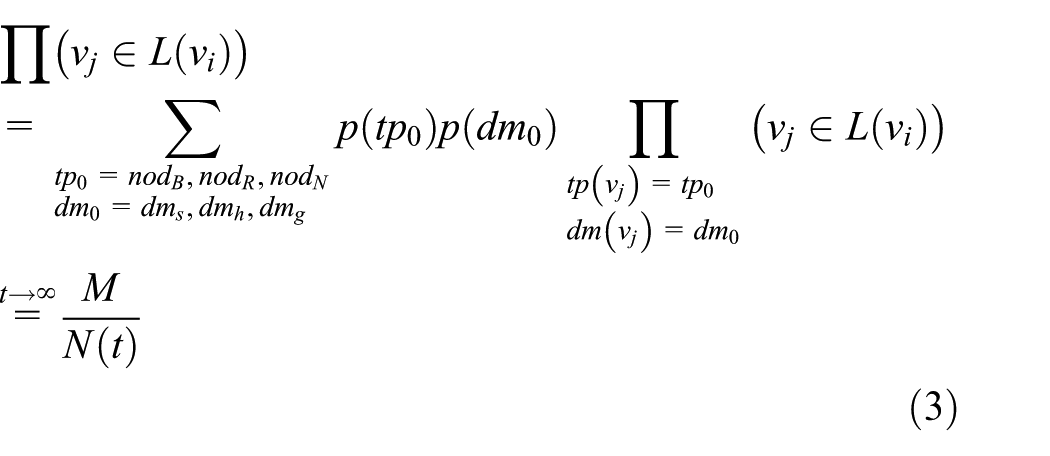
where values of
Given the features of highly exposed links and limited computing and communication resources, the QoS can be significantly influenced by the environment of links and limited resources of nodes. If the number of links is more, it would cost many node resources such as channels, CPUs, memories, and storage. As the number of links increases, all nodes linked will experience poor QoS. Meanwhile, when the distance is far from each other, then nodes will receive poor CSI, which leads to bad quality of links and data transmission services. Therefore, in our model QoSa, only CSI and limited resources of nodes are considered as shown in equation (4), and factors such as network traffic and routing strategies are ignored to simplify the problem.
Definition 2
QoS
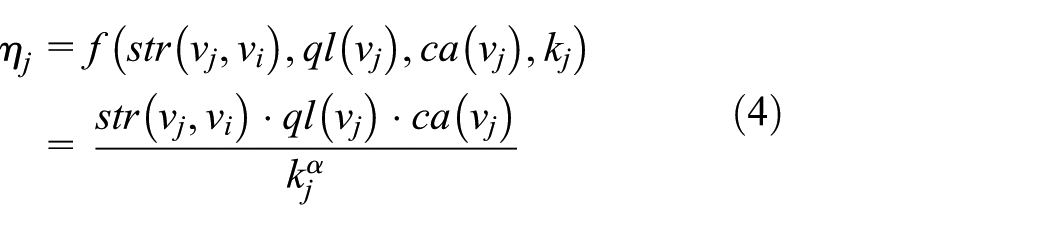
where
When establishing a link to node

While deleting links, the probability that

Evolution process of QoSa
In QoSa, evolution phases of dynamic handover and intermittent connection are introduced on the basis of Barabási–Albert (BA) model, which have a significant influence on network topology and are often overlooked in most evolution models. Handover of nodes is mainly caused by QoS of existing links getting worse due to their high-speed movement. A handover process includes two steps: first, a node is selected to move to a new location obeying Lévy flight theory 25 and its links are deleted; then, this node reconstructs its links according to preferential attachment, which can be regarded as a newly added node.
Meanwhile, a BA scale-free network obtains permanent m edges for each vertex added in, but in real situation, connections of different types of vertices are not the same and m is correspondently set to be
The QoSa evolves from an initial configuration consisting of
Growth and extinction. QoSa performs growth and extinction with probability at
Local preferential attachment. For each new vertex
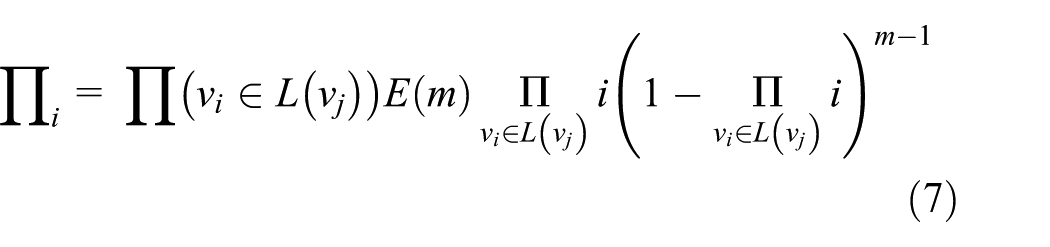
where
Dynamic handover. At time t, handover occurs with probability at
Connecting and disconnecting. Connecting and disconnecting happens with probability at
Termination. If time reaches T, algorithm terminates and the network is output.
Theoretical analysis and proof
Degree distribution
Degree distribution is an important statistical characteristic of complex network. The mean field theory 26 is utilized to prove the degree distribution of QoSa.
Lemma 1
Given fixed growth rate
Lemma 2
Given fixed growth rate
Proof
Let

Considering that the total number of degree is twice that of links, and the number of links is independent of that of nodes. Thus, expectation of total number of vertices’ degrees is
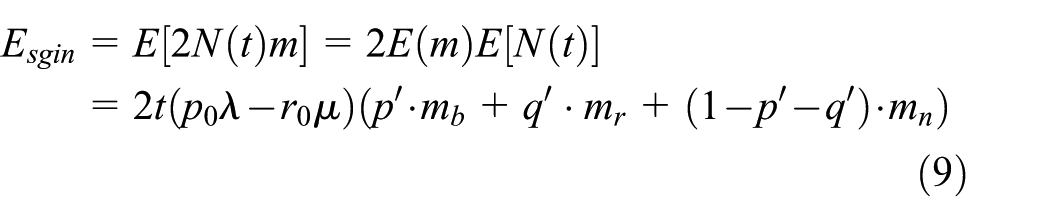
The result follows.
Lemma 3
Given fixed interaction parameters
Theorem 1
Degree distribution of QoSa follows a power-law distribution and is independent of time t.
Proof
Suppose degree of node
We can find that changes of
Situation 1
Let

where

According to continuous field theory,

where

Situation 2
Select
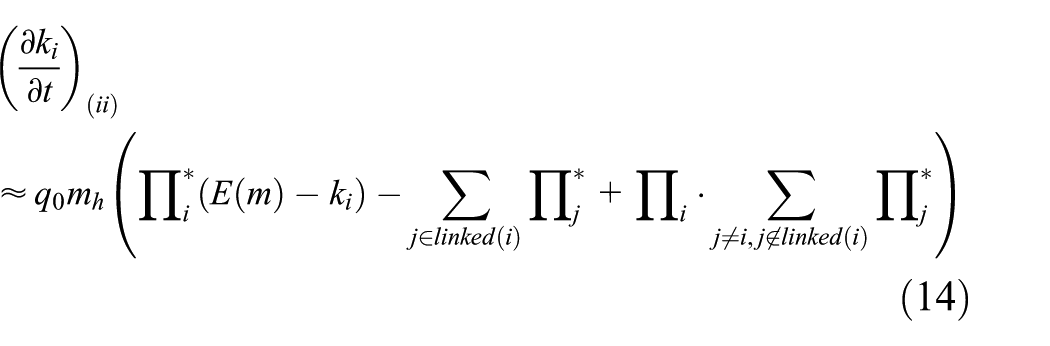
Handover phase includes three cases: (1)
Take

Situation 3
Establishing
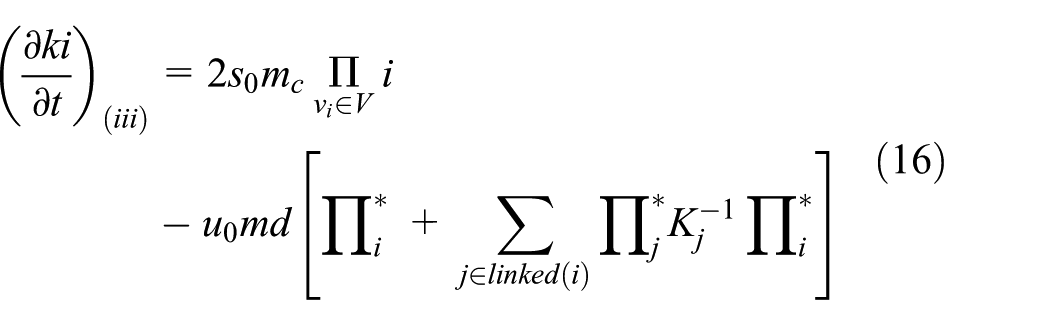
where
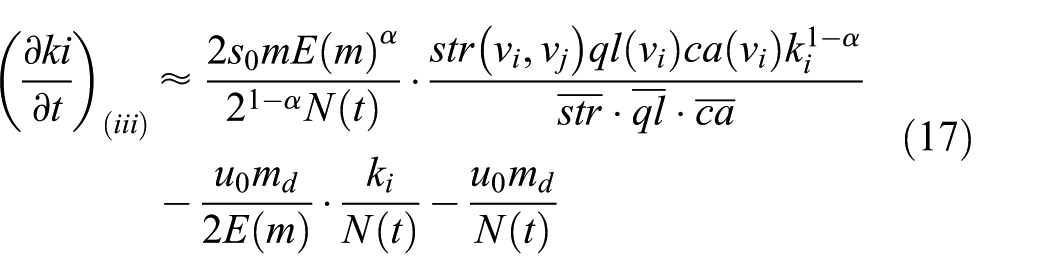
Combining the above three situations,

Case 1.
As

where

As the growth and extinction process is a Poisson process with

where
Then, existence of stable average degree distribution is proved below
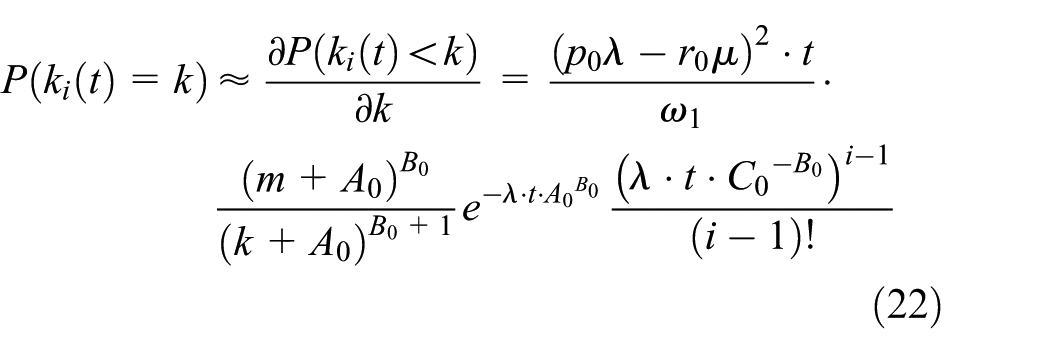
where

Thus, QoSa is a scale-free network with drift power-law distribution. The exponent

With assumptions that

With the growth characteristic,
Case 2.
Let

where

Thus, QoSa is a scale-free network with drift power-law distribution. The exponent

Due to
In summary, the QoSa model is a scale-free network with power-law character, and power exponent
The result follows.
Inference 1
The QoSa model equals BA model in some degree.
According to equation (23), set

Assume that nodes are homogeneous and set
The result follows.
Average path length
Definition 3
Average path length is defined as the average number of steps along the shortest paths for all possible pairs of network nodes, namely

where
Theorem 2
The QoSa possesses the small-world characteristic.
Proof
Assuming that the average path lengths of the giant component of space network, near-space network, and terrestrial network are, respectively,
Without losing generality, suppose that

Therefore, the average path length L satisfies the following equation

According to the evolution model, any connected subgraphs of SGIN can be approximated as BA model with average path length
This is the end of proof.
Simulations and discussion
Simulations are conducted to verify the degree distribution and vulnerabilities of QoSa under conditions of variable node heterogeneity, growth and extinction mechanism, and preferential attachment. Global parameters in simulations are set as follows. Let end time
Degree distribution
Figure 1(a) plots the degree distribution of QoSa under the conditions

(a) Degree distribution of SGIN and a power-law fitting with γ = 2.1 (λ = 6, μ = 4) and (b) degree distribution with different preferential attachment strategies (λ = 8, μ = 6).
Figure 1(b) displays the influence of different preferential attachment on degree distribution with
Figure 2(a) explores the degree distribution with different growth rate

(a) Degree distribution of SGIN with different birth and death mechanisms and (b) degree distribution of SGIN with different nodes type (λ = 8, μ = 6).
Figure 2(b) draws the degree distribution with different proportion of node type which reflects nodes’ heterogeneity and different network model. Actually, the closer the proportion, the more heterogeneous the model. Meanwhile, if
Figure 3 plots the degree distribution with different coefficient
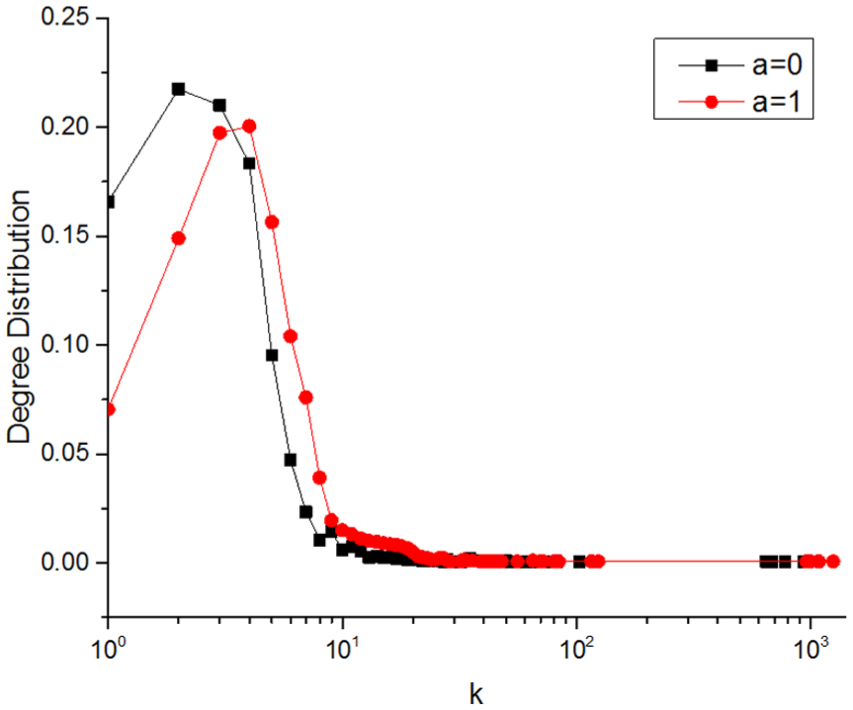
Degree distribution of SGIN with different coefficient α.
Connectivity and vulnerability
Average path length and the giant component are the key metrics to measure connectivity and vulnerability of complex network. The influences of nodes’ generation mechanism, preferential attachment strategy, and node heterogeneity on the average path length and giant component are investigated in this section.
Figure 4(a) plots the average path length with different growth rate

(a) Average path length of SGIN with different birth and death mechanisms and (b) average path length of SGIN with different nodes type (λ = 8, μ = 6).
Figure 4(b) plots the trend of average path length as of network size increases with different node type. From Figure 4(b), it can be found that the more heterogeneous the nodes, the shorter the average path length and the faster the data are transmitted. Furthermore, as
Definition 4
Connection robustness is defined as the ability to keep links connected while attacks or faults occur. Criterion of connection robustness R is defined as follows

where N is the size of initial network,
The trend of scale of giant component under random faults and deliberate attack with different growth rate

Connection robustness with different birth and death mechanisms: (a) size of giant component under random attack with different ratios to networks and (b) size of giant component under deliberate attack with different ratios to networks.
Figure 6 uncovers the trend of size of giant component with different node types under random attack and deliberate attack. From Figure 6(a), it can be found that the more heterogeneous the nodes, the more rapidly the size of giant component decreases. Thus, the node’s heterogeneity reduces the robustness of the network under random attacks. However, in Figure 6(b), the more heterogeneous the nodes, the less rapidly the size of giant component decreases, which means that node heterogeneity improves the robustness of network under deliberate attacks. The reason is that nodes’ heterogeneity balances the degree distribution of nodes and weakens the importance of the hub node.

Connection robustness with different node types (λ = 8, μ = 6): (a) size of giant component under random attack with different ratios to networks and (b) size of giant component under deliberate attack with different ratios to networks.
Figure 7 reveals the trend of size of giant component with different preferential attachment under random attack and deliberate attack. From Figure 7(a), it can be spotted that as the attack ratio of random attack increases, the size of giant component of QoS-aware strategy is smaller and decreases faster than that of signal-strength-aware preferential attachment. From Figure 7(b), QoS-aware strategy is lager and decreases slower than that of signal-strength-aware preferential attachment. Therefore, QoS-aware strategy performs better under deliberate attack.
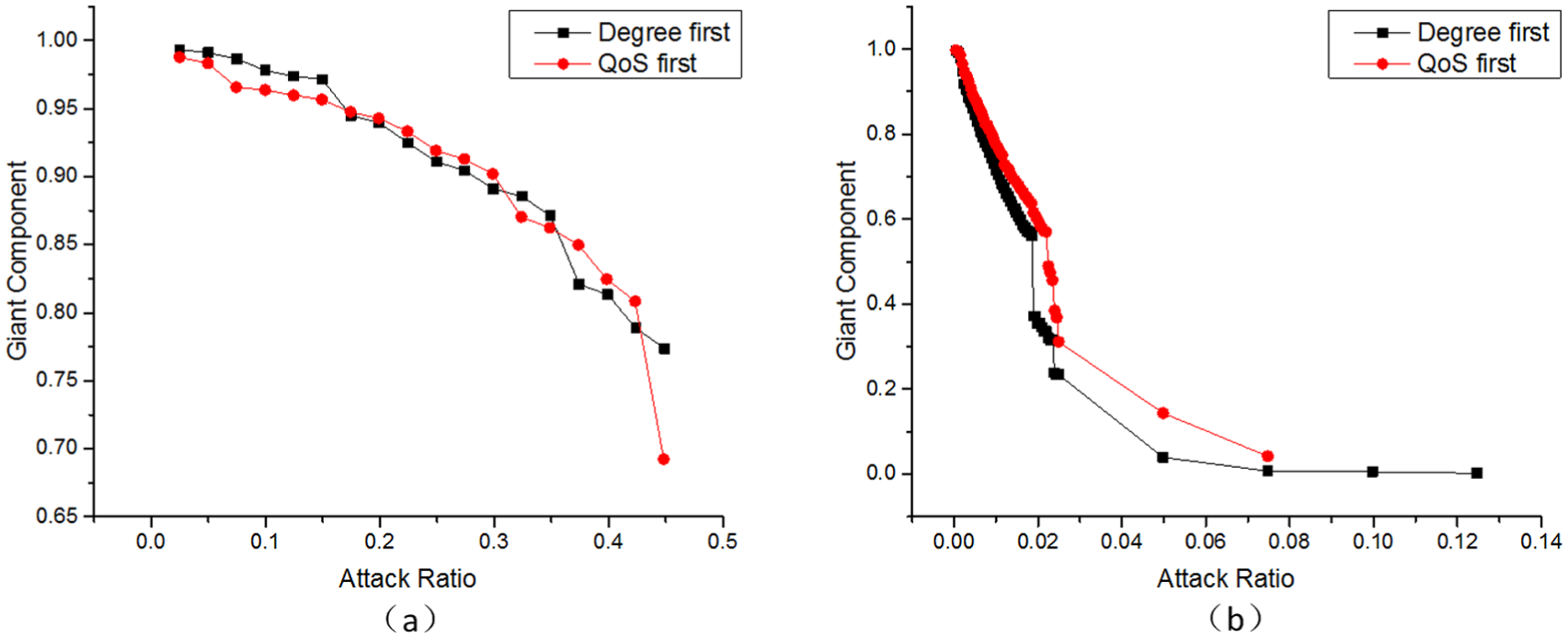
Connection robustness with different preferential attachment (λ = 8, μ = 6): (a) size of giant component under random attack with different ratios to networks and (b) size of giant component under deliberate attack with different ratios to networks.
Figure 8 plots the trend of size of giant component with different coefficient
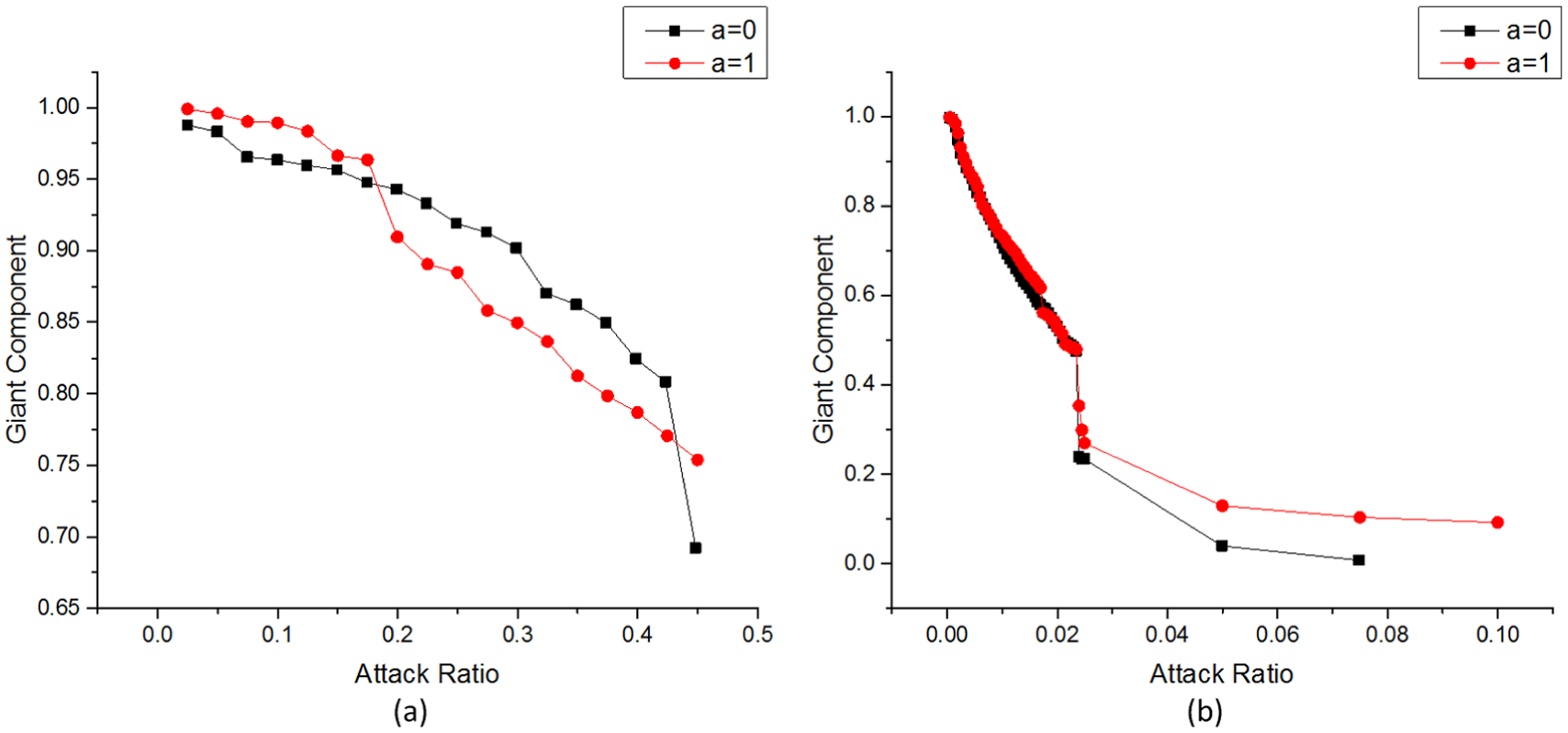
Connection robustness with different coefficient α (λ = 8, μ = 6): (a) size of giant component under random attack with different ratios to networks and (b) size of giant component under deliberate attack with different ratios to networks.
Conclusion
In order to improve QoS of SGIN, a QoS-aware evolution model is proposed. A QoS-aware strategy of nodes with better QoS getting richer and nodes with worse QoS getting poorer is adopted when establishing and deleting links in order to optimize network QoS. To mimic the natures of SGIN, QoSa introduces dynamic handover and intermittent connection into the evolution process. Heterogeneity in types and layers of nodes is taken into account, and heterogeneous nodes are endowed with discriminating interaction behaviors. Theoretical analysis and simulations are conducted to demonstrate the degree distribution and verify the influences of heterogeneity, dynamic handover, and generation mechanism of nodes on the topology characteristics.
This article reveals that SGIN generated by QoSa is a scale-free network, the degree distribution of which possesses drift power-law distribution and heavy tail, and its power exponent is lower than 3 which varies with the heterogeneity and generation mechanism of nodes and parameters such as number of links and handover nodes, but is independent of time. And the drift power-law distribution results from frequent handovers. Meanwhile, QoSa enjoys a small-world character and efficient data transmission. Its average path length is positively related to nodes’ heterogeneity and has little to do with node generation mechanism. In addition, QoSa has high fault tolerance and attack resistance. Specifically, its fault tolerance is negatively related to nodes’ heterogeneity, but its attack resistance is positively related to nodes’ heterogeneity. What’s more, QoS-aware strategy balances the degree distribution and promotes the attack resistance of QoSa at the same time of improving QoS.
Compared to existing scale-free evolution models, QoSa focuses mainly on improving network QoS. To mimic SGIN more accurately, it not only takes nodes’ heterogeneity, dynamic handover, and intermittent connection into account during evolution but also adopts Poisson process and Lévy flight to simulate generation mechanism and handover. This article provides strong reference for access and networking, topology optimization, and security protection of SGIN. Results of this article can also be expanded to WSNs and IoVs.
Footnotes
Appendix 1
Acknowledgements
The authors would like to thank the Associate Editor and all the anonymous reviewers for their insightful comments and constructive suggestions.
Academic Editor: Haibo Zhou
Declaration of conflicting interests
The author(s) declared no potential conflicts of interest with respect to the research, authorship, and/or publication of this article.
Funding
The author(s) disclosed receipt of the following financial support for the research, authorship, and/or publication of this article: This work was supported by the National Natural Science Foundation of China (grant nos 61502531, 61403400 and 61773399) and Industry Academia Research Project of Henan Province (grant no. 152107000026).