




Abstract
This article proposes distributed decision-making algorithms for reliable operation in cloud-assisted social network architectures. The considered architecture consists of three types of units: a cloud platform, access units, and mobile units (MUs). For reliable operations in such architectures, two distributed decision-making algorithms are proposed: (1) decision-making for fair connection at MUs and (2) decision-making for dynamic buffering at access units. For the decision-making in fair connection at MUs, the deployed MUs find their new access units to be associated with them when currently associated access units are out of order. The proposed algorithm works considering buffer backlog in access units, achievable rates with access units, and the number of associated MUs in access units. For the decision-making in dynamic buffering at access units, the buffers in access units are dynamically controlled for time-average expected power consumption minimization (i.e. energy-efficiency maximization) subjected to buffer stability.
Introduction
Social networks have emerged recently to be one of the most popular distributed computing paradigms, 1 making the social network service (SNS) platform as one of the most essential networking architectures.2–5 Since the SNS data are stored in cloud-based centralized storage, the corresponding wireless text, image, and video data flow management from SNS mobile units (MUs) to a cloud platform (CP) storage is of great interest. In addition, to deliver data from the SNS MUs to a CP, intermediate access units (AUs) are required. Since millimeter-wave (mmWave) wireless backhaul and access communications have been widely studied, 6 the connections between (1) AUs and a CP and (2) AUs and MUs should be established over mmWave wireless channels.
In this given network architecture, which includes a CP, AUs, and MUs, each AU is associated with multiple MUs with various scheduling policies. In addition, backhaul links between AUs and a CP generally utilize a 60-GHz channel. 6 Furthermore, access links between AUs and MUs generally use 28 or 38 GHz channels which have been studied for the 5G cellular network architectures.7–9 For reliable operations in this cloud-assisted SNS platform, two distributed decision-making algorithms are proposed in this article: (1) decision-making for fair connection in each MU and (2) decision-making for dynamic buffering in each AU. In this article, the definition of reliability is used as an equivalent to buffer stability, mainly because a system would become unstable if it starts to lose information by queue overflow. In fair connection, we consider the fairness among the buffers in order to avoid overflow. In addition to this contribution, a novel dynamic buffering algorithm is introduced in this article, this avoiding buffer overflow.
For designing a fair connection decision-making algorithm in each MU, this article considers the cases where (1) some AUs have unexpectedly failed (i.e. out of service; equivalent to churn out) or (2) new MUs join the network at some point during the operation of the network. With traditional connection (or association) algorithms, each MU finds its own new access point (AP) which is able to provide the highest received signal strength (RSS). 10 However, considering only RSS is not enough for fair connection. In particular, the proposed fair algorithm considers additional factors, such as (1) the buffer backlog in each AU to avoid overflows, (2) the number of associated MUs in each AU to consider scheduling impacts, and (3) bandwidth in 28 and 38 GHz channels.
For designing a dynamic buffering decision-making algorithm in each AU, this article determines transmit power allocation in each AU to send data from each AU to its associated CP. Note that the transmit power allocation is associated with buffer backlog in each AU. If the transmit power in each AU is static and too small, the number of transmitted bits from the AU becomes small, that is, the AU has higher buffer-overflow probability. However, if the transmit power in each AU is static and possibly too big, the buffer can be stable, although it is energy-inefficient. Therefore, a dynamic buffering algorithm is designed based on the buffer backlog in each AU over 60 GHz links.
Organization
The rest of this article is organized as follows. Section “Preliminaries” reviews the preliminaries of this work. Section “Reliable decision-making” presents the proposed distributed algorithms for reliable cloud-assisted SNS platforms. Section “Performance evaluation” evaluates the performance of the proposed algorithms. Section “Concluding remarks and future work” draws concluding remarks.
Preliminaries
This section reviews the preliminaries of this work, including a reference network model (section “Reference SNS CPs”), wireless propagation characteristics (section “Propagation characteristics”), motivation of this work (section “Motivation”), and a review of the related work (section “Related work”).
Reference SNS CPs
As shown in Figure 1, the SNS CP considered in this study consists of a CP, AUs, and MUs, where the CP is connected to all deployed AUs via 60 GHz backhaul links.
6
Each MU uploads its data to a CP via its associated AU for SNS data sharing. When the data are uploaded, the CP stores the data and shares them with the MU’s SNS neighbors or friends via World Wide Web (WWW). Therefore, the CP works as centralized controller which manages packet flows in the entire networks.11–13 In addition, each MU is associated with only one AU under the assumption that each MU has one antenna due to its hardware limitations. Each AU can be associated with multiple MUs with scheduling policies. Each AU
i
also broadcasts the information of the number of associated MUs,

A reference social network cloud platform: each MU (a social network user) uploads its own data to a CP and the CP shares the data to the MU’s neighbors via World Wide Web.
Suppose that there exist the number of AUs in reference cloud-assisted SNS platforms,

where

where
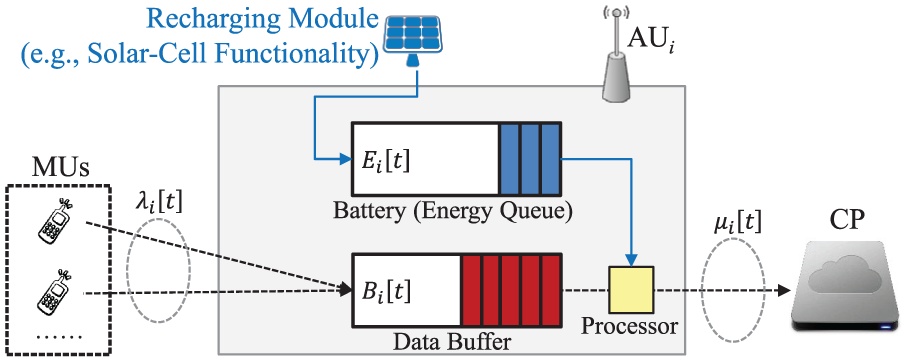
Illustration of the buffer dynamics in an AU
i
where
Each AU
i
, where

where
Propagation characteristics
Nowadays, mmWave channels are actively considered for next-generation high-capacity wireless links including 28, 38, and 60 GHz. In this article, 60 GHz channels are used for backhaul links, whereas 28 or 38 GHz channels are used for access links. For backhaul links, 60 GHz channels are used because they have the widest wireless channel bandwidth, that is, 2.16 GHz. 14 For access links, 38 or 28 GHz channels are used because they have been studied and show that they are suitable for the next-generation cellular systems. 14
60 GHz backhaul links
The 60-GHz path-loss

where
Based on equation (4), the received signal power at a CP from AU i can be calculated as follows


where

where
38 or 28 GHz access links
The 38- and 28-GHz path-loss models

where

Motivation
In the reference cloud-assisted SNS platform, there are two potential issues that may affect the robust network operations: (1) the potential of AU breaking down and (2) buffer management in each AU, which affects its stability. In the following, both issues are discussed, which are the motivation of this work.
If an AU breaks down, its associated MUs should find new AUs. In traditional association algorithms, MUs select their own AUs which can provide the highest RSS to increase channel capacity. 10 However, this can introduce a scenario where all MUs will be associated with only one AU with the highest transmit power (resulting in association problem). This, in turn, will cause the buffer within the AU to increase dramatically and become unstable. Therefore, it is needed to design a new association algorithm with fair connection to resolve this association problem. In such design, if the buffer backlog in an AP is almost full, it should avoid additional MU association to avoid buffer overflow. In addition, it is essential to consider different channel bandwidth parameters, since system considered in this work uses two different carrier frequencies: 28 and 38 GHz. Last but not least, if one AU serves many MUs, then the wireless spectrum should be shared by the MUs. Thus, the number of MUs should be taken into account as a design criterion. Based on all of these factors, it is required to design a fair connection algorithm in each MU (c.f. section “Decision-making for fair connection”).
As illustrated in Figure 1, each AU has its own buffer. If there are a lot of bits arriving into the buffer, more transmit power is needed to process them for stabilization. Otherwise, it requires less transmit power for energy-efficiency. Thus, stochastic buffer control is needed in each AU which aims at energy-efficiency subjected to buffer stabilization (c.f. section “Decision-making for dynamic buffering”).
Related work
The dynamic buffering algorithms have been studied in the literature, as presented in Kim and colleagues. 15,17,18 This section reviews such work focusing on the differences between it and this work.
The proposed algorithm in Hong and Kim 17 is for joint coding and uplink transmission in cloud radio access networks (CRANs). The CRAN 17 is different from the network model in this article in the sense that all MUs are connected to all AUs, and the CP does the joint processing for decoding signals from MUs. 17 Therefore, CRAN does not have connection selection issues (thus, no association problem as in this work). Moreover, the algorithm in Hong and Kim 17 is for the tradeoff between coding rates and delays, whereas this article is concerned with the tradeoff between energy-efficiency and delays. The proposed algorithm in Kim and Lee 18 is for the uplink transmission in medical platforms. However, the proposed algorithm in Kim and Lee 18 uses max-weight scheduling which makes scheduling decisions in each unit time. Such approach is a burden in WiFi networks due to handoff delays. In addition, association mechanisms are not defined in Kim and Lee. 18 Moreover, the recharging mechanism is not considered either. Finally, the connection between APs and centralized storage in Kim and Lee 18 is wireline (Ethernet), whereas the link is wireless in this article. The proposed algorithm in Kim 15 is for downlink transmission, whereas this article considers the uplink transmission. Similar to the algorithm in Kim and Lee, 18 the algorithm proposed in Kim 15 does not consider recharging functionality which is essential in mobile devices. Finally, the connection between APs and centralized storage in Kim 15 is wireline (Ethernet), whereas the link is wireless in this article. Thus, the considering network architecture is totally different.
Reliable decision-making
To this end, this article proposes two distributed decision-making algorithms for reliable SNS CPs: (1) fair connection at MUs (section “Decision-making for fair connection”) and (2) dynamic buffering at AUs (section “Decision-making for dynamic buffering”).
Decision-making for fair connection
As shown in Figure 3(a), deployed AUs might be broken down and thus its corresponding fault-tolerable operation is required in each MU. Therefore, the associated MUs with the broken AU should be re-associated as shown in Figure 3(b). In addition, fair connection is required when new MUs join into the network. In general, each MU j can find its new AU which provides the maximum received signal to the MU j . 10 However, this approach is not suitable for heterogeneous 28 and 38 GHz networks because the highest RSS cannot guarantee maximum achievable rates due to bandwidth differences. Due to Shannon’s equation, the achievable rates from MU j to AU i are given as

where


Illustration for fault-tolerant fair connection: (a) before and (b) after.
The pseudo-code of this algorithmic procedure is presented in Algorithm 1. Based on Algorithm 1, the computational complexity can be calculated. As can be seen in the pseudo-code, equation (10) is computed if the conditions of churning in and out (i.e. AU breaking down and new MU joining) are satisfied. Therefore, it is a sequential calculation of one closed-form equation, that is, the complexity can be presented as
Fair connection at MU j

Decision-making for dynamic buffering
This section discusses the stable data transmission from AUs to a CP. If each AU transmits data with a static rate, it may introduce overflow when the rate is too small. Otherwise, if the rate is too high, the buffer may be stable but it consumes transmit power inefficiently. Therefore, dynamic buffering is required for energy-efficient and stable buffer management.
The model in equation (2) can be simplified as follows—because only 60 GHz radio is used for backhaul

In equation (1),

where
This section states the minimization of sum of the time-average expected power consumption of AUs as

and the corresponding two constraints are as follows: (1)

and (2) the transmit power in AU
i
at

because
Let

where
Power control for dynamic buffering at AU i
The proposed algorithm minimizes a bound on the

where

As shown in equation (18), it is obvious that the equation is separable, that is, if each AU minimizes its own objective function, that is

By equation (6), this can be further represented as follows

where

and thus the optimum solution of

After obtaining the solution

where
By conducting this dynamic buffering, time-average expected power consumption minimization (alternatively, energy-efficiency maximization) subjected to buffer stability can be guaranteed based on the theory of Lyapunov optimization and control. 15
Finally, the pseudo-code of this algorithmic procedure is presented in Algorithm 2. Based on Algorithm 2, the computational complexity can be calculated as follows. As can be seen in the pseudo-code, the closed-form in equation (22) is computed in each unit time. Therefore, it is a sequential calculation of one closed-form equation, that is, the complexity can be presented as

Performance evaluation
This section evaluates the performance of the proposed algorithms. For this evaluation, the performance results are presented in terms of fair connection and dynamic buffering.
The performance evaluation in this article is simulation-based. In this simulation, following settings are used. Suppose that the size of the simulation network is 1000 m × 1000 m and the network contains
In order to run the simulation, the background noise

where
Parameters.

In addition, Table 2 shows the parameter settings for transmit power, transmit antenna gain, receive antenna gain, and channel bandwidth in each carrier frequency.
Performance of fair connection
For performance comparison, a received signal strength indicator (RSSI)-based association algorithm is also simulated along with the proposed fair connection. With the RSSI-based association algorithm, each MU finds its AU which can provide the maximum RSS. In each unit time, one MU is added and the MU performs the connection procedures as follows: (1) RSSI-based algorithm and (2) the proposed fair algorithm. Eventually, 100 MUs will be deployed into the network. With this given setting, the simulation runs as follows. For each unit time (from

Simulation results of fair association.
In Figure 4, the x-axis and y-axis stand for the number of iterations and standard deviation values for each iteration, respectively. As shown in Figure 4, the proposed fair association has the lower standard deviation distribution compared to the RSSI-based association. This means that the proposed algorithm shows better performance with respect to fairness. Even when both algorithms have the worst fairness, the proposed fair association shows 11.57% better performance than the RSSI-based association based on the following calculation

Performance of dynamic buffering
To verify the performance of the proposed dynamic buffering, simulations are performed with two different tradeoff coefficients, that is,
With the given four algorithms, run-time simulations are conducted during 2500 unit times. While doing the simulations, the summation of buffer-backlog sizes of all deployed AUs is observed. As a result, Figure 5 presents the corresponding simulation results with these given buffering algorithms where x-axis and y-axis stand for the running time of simulations and the summation of buffer-backlog sizes of all AUs, respectively.

Simulation results of dynamic buffering.
As presented in Figure 5, max-power buffering shows the most stable behavior because it always processes a lot of bits from the buffers of AUs. However, min-power buffering shows the most unstable behavior. Between the two behavior curves, two dynamic buffering algorithms are located. As formulated, dynamic buffering is much more conservative in terms of buffer occupancy when it has higher
Concluding remarks and future work
In this article, two reliable algorithms are proposed in cloud-assisted SNS platforms: a fair connection in each MU and a dynamic buffering in each AU. For fair connection in each MU, a novel re-association algorithm is proposed that works based on (1) the buffer-backlog sizes in each AU to avoid overflows, (2) the number of associated MUs in each AU, and (3) different bandwidths. For dynamic buffering in each AU, a stochastic algorithm is designed that works based on the buffer backlog in each AU over 60 GHz links while preserving buffer stability. The simulation results present the proposed two algorithms achieve desired performance. In terms of fair association, the proposed algorithm shows 11.57% performance improvements in the aspects of standard deviation of buffer backlogs in each AU. In terms of dynamic buffering, the proposed algorithm shows desired performance improvements compared to static buffering algorithms.
As a future work, we will explore the following directions:
We will look into the response time of each mobile unit, incorporate it into our algorithms, and look into how much it can introduce of a communication overhead.
We will conduct further simulation results in other settings, including large-scale simulation networks which would potentially result in more interest observations.
Footnotes
Academic Editor: Myungsik Yoo
Declaration of conflicting interests
The author(s) declared no potential conflicts of interest with respect to the research, authorship, and/or publication of this article.
Funding
The author(s) disclosed receipt of the following financial support for the research, authorship, and/or publication of this article: This research was supported by Chung-Ang University Research Grant (2017) and partially supported by National Research Foundation of Korea (Grant No. 2016R1C1B1015406).