




Abstract
Mobile satellite communication systems play an important role in space information networks. They mostly operate at the L or S band and have multiple beams efficiently reusing the limited spectrum. Advanced technologies, such as beamforming, are used to generate numerous beams through multiple feeders, and each beam’s power allocation is correlated and constrained. Frequency reuse among multiple beams results in co-channel interference issue, which makes bandwidth allocation among multiple beams coupled. It is a challenging topic to optimize the resource allocation in the real-time service traffic. In this article, a new multi-objective programming scheme is used to solve the dynamic resource allocation problem, guaranteeing high quality-of-service for multiple services of different priorities. Since the dynamic resource allocation problem is formulated as NP-hard, a new traffic-aware dynamic resource allocation (TADRA) algorithm is proposed. This algorithm is proved to be optimal in terms of the Pareto-front under constraints of co-channel interference and onboard transmit power. Simulation results show that the trade-off is well balanced between the call completion ratio in high priority and the throughput for video and data services in medium and low priorities. Additionally, it is shown that the new multi-objective programming scheme, based on the traffic-awareness dynamic resource allocation algorithm, can rapidly achieve the Pareto-front solutions and reduce the computing complexity to a large extent.
Keywords
Introduction
Mobile satellite communication systems (MSCSs) play an important role in space information networks, as they can establish a reliable wide-range mobile communication network under various scenarios, for example, remote areas, emergency situations, maritime, and aviation transportations. It is developed to connect remote terrestrial networks, direct network access, Internet services, and interactive voice and video using mobile terminals. 1 The satellite’s ubiquitous coverage can be used to extend the emerging fifth-generation (5G) networks. 2 Most of current MSCSs operate at the L or S band and have multiple (even up to several hundreds) beams, efficiently reusing the limited spectrum to support different users and different service traffics. In order to provide users with a good quality of service (QoS), efficient resource allocation schemes (RASs) should be studied for multi-beam MSCSs. 3
The RAS in satellite communication systems has been discussed in previous studies. To increase the system capacity in multi-beam satellite communications, Lim and Kim 4 investigated the orthogonal radio resource allocation for downlink signals, and an optimal radio resource allocation for packet transmission in the synchronous multi-beam system was presented. Du et al. 5 proposed a multiple access and bandwidth RAS for geostationary Earth orbit relay and a timeslot allocation strategy according to the slotted time-division multiple access. Based on data traffic demands and channel conditions, Choi and Chan 6 showed that a modest number of active parallel beams were sufficient to cover numerous cells efficiently by coupling the power allocation with multi-beam scheduling. To maximize the capacity under the upward transmission power constraint, Mokari et al. 7 integrated attractive techniques including multiple-input-multiple-output (MIMO), orthogonal frequency-division multiple (OFDM) access, and adaptive coding and modulation (ACM). It indicated that increasing the number of antennas could enhance the overall transmission efficiency. In cognitive satellite communications, Lagunas et al. 8 and Liu et al. 9 investigated the RAS for a cognitive spectrum scenario where the satellite system aimed at exploiting the spectrum allocated to terrestrial networks (i.e. the incumbent users) without imposing harmful interference on them. Based on the game theory, Markov modeling techniques, and discrete stochastic programming, Petraki et al. 10 and Davoli et al. 11 presented a distributed call admission control algorithm which exploited the predictability of the satellite channel to guarantee QoS; a novel approach, based on the gradient of cost function determined from the relaxed continuous extension of the discrete constraint set, was also given in their study. Park et al. 12 divided RAS into the resource calculation and the resource allocation. Anastasopoulos et al. 13 gave a priority-based call admission control scheme for two service classes under the rain fading. Higher priority is assigned to real-time users compared to non-real-time users, that is, the real-time traffic is restricted to use up to a certain proportion of the resources.
Previous studies have investigated the power-based RAS.14–17 Using a stochastic model for rain attenuation prediction and a greedy approach, Srivastava and Chaturvedi 14 proposed a dynamic power allocation for an increased number of users compared to the static technique. Using adaptive modulation, for different QoS constraints and various channel conditions, Vassaki et al. 15 analytically solved the optimization problem for the power allocation of a downlink mobile satellite system. The effective capacity is given by a set of closed-form expressions, which corresponds to the optimal power allocation. Destounis and Panagopoulos 16 presented a simple propagation-based algorithm for the dynamic power allocation using a physical–mathematical model for rain attenuation prediction. Neely et al. 17 developed a power allocation policy which stabilized the system whenever the rate vector lies within the capacity region. In multi-beam satellite-switched time-division multiple access (SS-TDMA) systems and high-throughput satellite systems, Kyrgiazos and colleagues18,19 proposed an architecture and a framework based on the assignment of a number of time slots; each gateway uplink connected to a user beam allowed a match to the user demands with the offered capacity of the gateways. A resource allocation policy is designed for video tasks based on the traffic prediction, which is obtained by learning and training the traffic characteristics. 20 In literature,7,10,21,22 delay-based RAS was investigated. Novel cross-layer packet scheduling scheme to balance the priority, fairness among QoS-differentiated traffic flows, and physical channel data rate factor was proposed by Fan et al. 21 The one-objective (e.g. power, loss, capacity, delay or frequency)-based RAS has been studied in Lim and Kim 4 and Lee. 22 However, these objectives are sometimes in contrast and coupled and hence multi-objective optimization is needed.
Relatively, only a few authors investigated the RAS with multi-objective programming (MOP) theory in multi-beam MSCSs. Bisio and Marchese 23 formalized the bandwidth allocation as an MOP where the objectives were the power and loss. Aravanis et al. 24 proposed a two-stage MOP approach to minimize the power and unmet system capacity (USC). Some studies gave an in-depth investigation of terrestrial wireless networks based on MOP. 25 In wireless sensor networks (WSNs), Shahzad et al. 26 formulated the multi-objective optimization functions to minimize the sensor localization errors and the number of transmission during the localization phase. Yaakob et al. 27 mitigated congestion by selectively discarding some of the least important packets to transmit important packets. They defined criteria (e.g. duplicate packets, number of hops traversed, and packets lifetime) to maintain the WSN performance. In cellular networks, literatures28–31 investigated a paradigm called green communication using a joint optimization of multiple criteria. 32 proposed an RAS called multi-objective distributed power and rate control for the multiple-objective (power, outage, and throughput) optimization problem.
It is challenging to balance the trade-offs among various conflicting optimization criteria. Using the technique of MOP, numerous studies investigated the terrestrial wireless networks. This study guarantees high call completion ratio of voice service and high throughput of non-voice services (which are conflicting criteria under limited resources), while optimizing the resource allocation in the real-time service traffic. The main contributions of this article are highlighted as follows.
First, a dynamic RAS based on multi-objective optimization is proposed, considering multiple services with different priorities.
Second, a low-complexity traffic-awareness dynamic resource allocation (TADRA) algorithm is proposed, which is more efficient than previous algorithms and likely to achieve optimal performance in terms of the Pareto-front.
Third, the average traffic estimation of each service can be more accurate due to the low calculation burden of the proposed algorithm. Hence, the resource allocation achieves a good dynamic match in the real-time traffic. The proposed algorithm’s low complexity indicates that this method can be applicable to more service traffics and more beams under the same hardware constraint.
System model
A multi-beam MSCS composed of a geostationary satellite, multiple gateway stations, and a lot of mobile user terminals as shown in Figure 1. In this system, the satellite has

Multi-beam MSCS model.
It is assumed that a frequency reuse factor of 7 (called seven-color) is used to improve the spectrum efficiency in the whole system. Specifically, the

MF-TDMA and frequency–time resource blocks (under beam
A satellite communication system should support multiple services, and voice, video, and data are considered in this article. Voice is rate-fixed and delay-sensitive information, and it is assigned with the highest priority. Video is a delay-sensitive service and its information rate can be selected from several pre-determined levels; it is assigned with the medium priority. Data is a best-effort service and the information rate and delay are not guaranteed; it is assigned with the lowest priority. Based on these traffic constraints, voice is a circuit-switch domain service and the concerned target is the call completion ratio, while video and data are packet-switch domain services and the concerned target is the total throughput.
Problem formulation
The services, supported by multi-beam satellite communication system, are considered with voice, video, and data. The user number in the beam

where
For data services, variable

where
When the resource is allocated to different services, two kinds of processing methods can be chosen. One is to accept it, and the other is to refuse it. A service-adopt-indicator


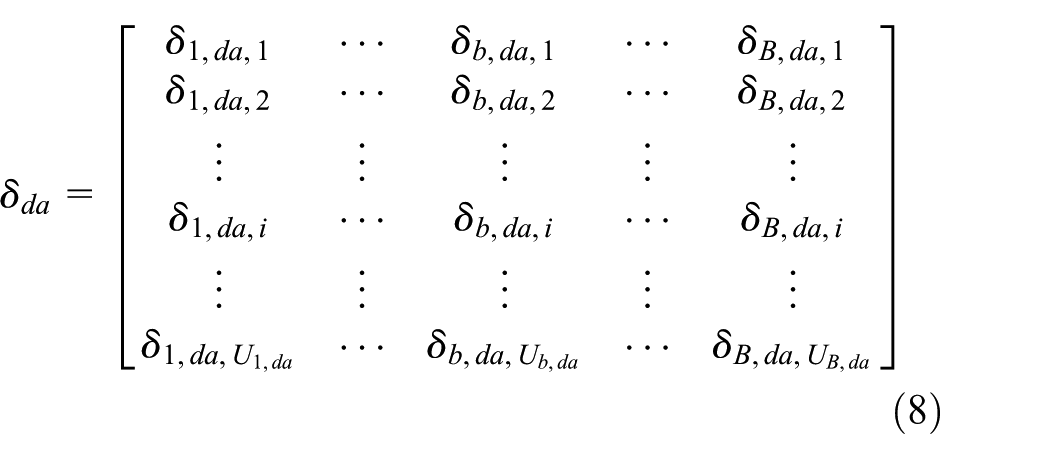
For users in the system, the call completion ratio of voice service and total throughput of non-voice service (video and data) are concerned. The call completion ratio of voice in this system can represent the performance of the real-time services in high priority. Most of the non-voice services require more resources to improve the efficiency for ensuring the accuracy of the transmission, and the throughput is usually used to evaluate the system efficiency. Some studies concentrate on the resource allocation problem for increasing the call completion ratio of voice, while some works proposed resource optimization approaches to improve the throughput of non-voice services. To the best of our knowledge, there is no such a study which considers the two performances as the optimization objectives simultaneously. The single-objective optimization can approach the optimal bounds of the system; however, the other objective will be deteriorated when a single objective is solely improved. These two performances are conflicting to each other. Improving the call completion ratio of voice means an enhancement of the allocated proportion of users for the voice service; whereas, improving throughput of non-voice services indicates that more resources need to be allocated to users for the non-voice service. When the real-time service traffic of the voice and non-voice varies in a large margin, the challenge will be quite distinct. Hence, it is meaningful to find the trade-off between these two conflicting objectives. In this article, these two conflicting objectives are considered as optimization objectives under multiple constraints presented previously. The optimization problem is formulated as equations (9) and (10), where
Complexity analysis
Investigating the complexity of the MOP problem formulated previously is important from both the academic perspective and practical perspective since it is necessary to find out whether optimal solutions to the problem can be obtained within feasible computational time. When the number of computing steps required determining the optimal solution to a problem is a polynomial function of the size of the input problem variables, that is, when a polynomial amount of computational time is required, the problem can be solved in feasible computational time. In such cases, it is very important to find an effective approach to decrease the computing complexity especially for a complex system such as the multi-beam


satellite communication system. Hence, before selecting the proper scheme to solve the MOP problem, a complexity investigation for the problem is necessary.
Non-deterministic polynomial hardness and optimization
An optimization problem can be divided into the polynomial (P) problems and the non-deterministic polynomial (NP) problems, depending on whether it can be solved within a polynomial time.
33
The number of computing steps required for the P problem determining the optimal solution is equal to or less than a polynomial function, for example,
Problem (9, 10) is a dynamic MOP problem whose complexity needs to be investigated to design the appropriate algorithm. Actually, the problem in equation (5) can be treated as a two-dimensional bin-packing problem (2D-BPP), 34 and the total resource of the multi-beam mobile satellite system is a container to store RBs and power allocated to users and services.
For given

Taking
From previous analysis, it is known that the MOP problem is an NP-hard problem whose optimal solutions cannot be determined within feasible time. The MOP is more challenging than the single-objective optimization as the multiple objectives are usually in contradictions and there is no global optimal solution. Considering Problem (9, 10), for given available RBs and power resource, if more resource is allocated to voice users, then
Due to the NP hardness and infeasibility of deriving analytical solutions, an iteration algorithm is required to accomplish the Pareto optimization. The iteration algorithm should have three characteristics. 36 First, a reasonable initial solutions generation algorithm is required to acquire solutions with wide and uniform distributions in the solution space. Second, an efficient searching (iterating) direction is needed to change the state for acquiring non-dominated solutions with a low expenditure of time. Third, a scientific selecting method needs to be designed to reject the dominated solutions and retain the non-dominated solutions.
Multiple coupled constraints to optimization
The MOP problem in this system becomes more complex due to (1) the NP hardness and requirement of Pareto optimization and (2) multiple coupled constraints to the optimization. These constraints are related with the cross-beam and interrelated MSCSs, especially in multi-beam MSCSs. According to the system model stated previously, three kinds of constraints to the MOP problem are analyzed in the system, comprising the timeslot-frequency resource constraint, the reuse time constraint, and the output power constraint. These constraints should be considered during the optimization and highly enhance the complexity of the problem.
Timeslot-frequency resource constraint
For a multi-beam MSCS, its allocated resources include frequency–time RBs

Reuse time constraint
As stated before, the total reuse amount of each carrier allocated to users should be no more than a designed value in order to control CCI. This restriction can be illustrated by relation (13), where

Output power constraint
In multi-beam MSCSs, the downlink power is combined by

Assuming

which satisfies
According to the saturation of each power amplifier, resource allocation should satisfy formula (16), where

Algorithm statement
From analysis of the problem formulated previously, it is found that two objectives of the problem are conflicting to each other. The goal of the optimization problem is to find the Pareto-front of the two objectives, whose analytical solutions cannot be derived. The Pareto-front consists of a set of Pareto optimal solutions, which are known as non-dominated solutions. Some works have been done for solving the Pareto optimization problem; some intelligence algorithms, such as simulated annealing (SA) algorithm and genetic algorithm (GA), have been developed to search the Pareto-front solutions. Non-dominated sorting genetic algorithm II (NSGA-II) 37 is used to find the non-dominated solutions of Pareto optimization problem by introducing the non-dominated sorting operator. The NSGA-II includes operators shown as follows.
Population initialization operator. It initializes the candidate solutions (populations) which are based on the domain of definition and limited by constraints. The candidate populations are denoted by

where
Non-dominated sorting operator. This operator sorts the candidate populations based on non-dominations, and the non-dominated serial numbers of each population for selecting solutions to next iteration and output can be obtained. Deb and Agarwal 38 proposed a fast sorting operator, which improved the original NSGA. The operator is denoted by

where
Crowding distance calculation operator. The distribution of the candidate solutions in each iteration determines the convergence rate of the algorithm. To obtain candidate solutions with an uniform and wide distribution, a crowding distance calculation operator is needed, and it can be formulated as the algorithm description in Li et al. 35
Crossover and mutation operator. It can increase the diversity of the candidate solutions, which helps to approach the Pareto-front. The simulated binary crossover operator and polynomial mutation operator in Bansal et al. 34 are efficient to reduce the complexity, and it can be used to find the non-dominated solutions.
Selecting and updating operator. This operator selects and updates the candidate solutions for the next iteration or output.
The NSGA-II presented above can be used for the Pareto optimization problem in this article. However, how to decrease the calculation complexity and reduce computation time is the main problem when using the NSGA-II algorithm to solve the Pareto optimization problem. The NSGA-II algorithm includes three kinds of modules, that is, initialization module, searching module, and selecting module. In order to restrain the computation time and make the calculation complexity stay the same for every iteration, the number of solutions must be the same for NSGA-II. The selecting module selects the non-dominated solutions with the uniform distribution for next iteration. Hence, after multiple iterations, there are some non-dominated solutions being rejected by selecting module, which might decrease the convergence rate. If we store non-dominated solutions of each iterations, some of the non-dominated solutions which might be Pareto-front solutions will not be rejected and the convergence rate of the algorithm will be improved further. As we know, the calculation complexity of the algorithm is associated with the number of populations and the dimension of solutions (user number in this article). Observing the problem, it is found that there is always a non-dominated solution for each feasible solution of
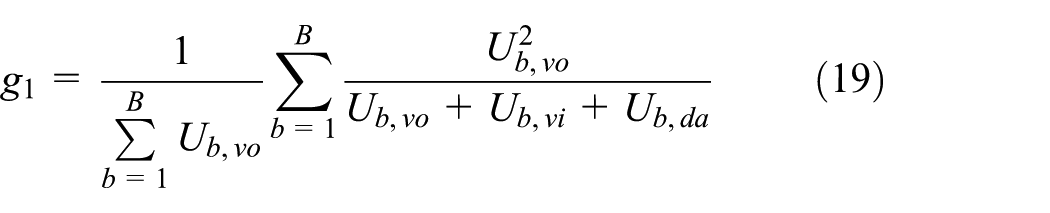
Then, the single-objective problem is given as formula (20)
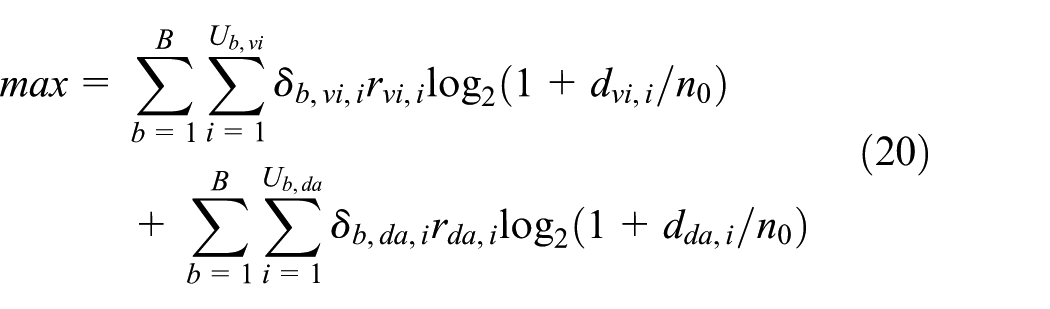

We can obtain one non-dominated solution by optimizing the problem above. The optimal solutions of the problem satisfy that the RBs are allocated to the users with the highest rate. This non-dominated solution can be used as initial seed for approaching the Pareto-front. Based on this, we design a TADRA algorithm based on the improved NSGA algorithm (NSGA-II algorithm) to solve the Pareto optimization problem, and the TADRA algorithm is shown in Table 1.
Description of algorithm.

The Pareto-front approached by TADRA algorithm is a set of feasible solutions under certain traffic states and arriving models. The service ratio and the average users in each beam have some influence on the distribution of the Pareto solutions, that is, for a specific arriving model, the solution space is known, based on the traffic state. Some optimized results obtained from the Pareto-front are empirical results that can be used for similar traffic conditions. In this section, we propose the traffic-awareness RB allocation method. The flowchart of the method is shown in Figure 3. At the beginning of the allocation, we estimate the traffic and inquire the database to find if there is any similar pattern that can be used for the allocation. If no feasible allocation is found, the TADRA algorithm is activated to find the Pareto-front. Then, some feasible solutions are obtained based on some parameters and constraints and are stored into the database. This method can learn the allocated pattern and accomplish the allocation based on the traffic adaptively, and it is meaningful for multi-beam MSCSs with constantly changing traffic models and multiple constrains.

Adaptive traffic-awareness resource block allocation method.
As shown in Table 1, the TADRA algorithm has three advantages compared with the NSGA-II.
First, the Pareto solution obtained from the single-objective optimization is introduced as an initial seed which is used as the start point to approach the Pareto-front. With a small clone ratio, an additional crossover and mutation operation, we can obtain a set of initial solutions closer to the Pareto-front compared with the NSGA-II, which can narrow the gap between initial solutions and the Pareto-front and reduce the searching time.
Second, the algorithm complexity is mainly related to the iteration times and the number of populations (alternative solution). With the initial seed close to the Pareto-front, we can only use population for iteration, which is far smaller than population used for NSGA-II. This will be verified in the next section.
Third, different form NSGA-II, the database we used to store the Pareto optimization solution for different traffic pattern is also used to store non-dominated solutions of each iteration. Some of the non-dominated solutions might be Pareto-front solutions, and without rejecting some of them, the TADRA algorithm can improve the convergence rate further.
Finally, in order to ensure the final solutions being globally Pareto optimal, additional non-dominated sorting and updating can reject some dominated solutions to improve the correctness.
As a matter of fact, almost all the heuristic algorithms are similar to each other, such as ant colony optimization and artificial immune algorithms, and they all include three modules, that is, initialization module, searching module, and selecting module. To restrain the computation time and ensure the complexity being same for every iteration, the number of the solutions has to be the same. The selecting module selects the non-dominated solutions obeying the uniform distribution for next iteration. Hence, after multiple iterations, there are some non-dominated solutions rejected by the selecting module, which may decrease the convergence rate. The essential idea of the heuristic algorithms applied for the Pareto algorithm is to find the searching direction for approaching the Pareto-front. When one cannot derive the analytical solutions for the Pareto optimization problem, these classical heuristic algorithms presented previously can be utilized to determine the Pareto-front. However, when one can obtain some of the Pareto solutions with low calculation complexity, the search time (computation complexity) can be reduced by introducing the obtained Pareto solutions as initial solutions. This framework of the improved NSGA-II can be extended into any heuristic algorithms with three aforementioned modules. Because of using one Pareto solution and the database, the complexity is only related to the clonal ratio and the numbers of the arriving service requests, which is far lower than that of all classical heuristic algorithms. Moreover, the convergence rate is quicker than the classical heuristic algorithms, and this will be proved in the next section with simulation results.
Simulation results and analysis
After we have described the TADRA algorithm for solving the MOP we proposed, we simulate the algorithm under different conditions. First of all, we compared the performances of NSGA-II and the TADRA algorithm. The simulation parameters are shown in Table 2. It is assumed that the service arrival queues of satellites satisfy the Poisson arrival, and the average user numbers of voice, video, and data services are 1000, 100, and 100, respectively. For the NSGA-II and the TADRA algorithm, simulation parameters are shown in Table 2. The simulation results are shown in Figure 4. As we can see from the Figure 4, the Pareto-fronts of the two different algorithms are similar. With the same iteration, TADRA algorithm can find more Pareto-front solutions compared with the NSGA-II. It means that the convergence rate of the TADRA algorithm is quicker than NSGA-II. Since the initial seed for the TADRA algorithm is one Pareto-front solution, this algorithm can narrow the searching space for optimized Pareto-fronts. At the meantime, the complexity in every step of the TADRA algorithm is lower than the traditional NSGA-II. There are
Simulation parameters of the system and the TADRA algorithm.

TADRA: traffic-awareness dynamic resource allocation; NSGA II: non-dominated sorting genetic algorithm II.

Algorithm performance simulations.
We also analyze the Pareto-front solutions under different conditions. We compared the Pareto-front of the system states with different service ratios under different arriving models. The service ratio is the proportion of the voice service in the whole system, and it can be denoted by

Two kinds of arriving models are considered: the average user number being 1200/beam and the average use number being 2000/beam. The first one is the same as parameters in Table 2, and

Pareto-fronts for various service ratios with different average users.
In order to further understand the significance of the TADRA algorithm we proposed and the Pareto-front solutions we obtained, we compare the performance of different allocation criterion with some results come from the Pareto-front under the same system model. We consider the RB allocation for single beam. The average arriving rates

where

Different allocation criteria comparison for single beam: (a) average arriving rate of different types of users, (b) average traffic of different types of users, (c) allocated capacity of different types of users under different allocation criterion, and (d) service completion of different types of users under different allocation criterion.
As a matter of fact, the allocation result is a Pareto-front solution as long as all resources are allocated to users. At the situation, in Figure 6, all results of different allocated criteria are Pareto optimal. Figure 7 shows the achieved traffic

Traffic comparison of different allocation criterion under different video services arriving rate.

Call completion ratio of proportional fairness under different video and voice services arriving rate.
Conclusion
Resources, comprising frequency–time RBs and output power onboard the multi-beam mobile satellite system, need to be properly allocated to different services and different users to achieve high QoS and match variable real-time service traffic. After proving the NP hardness and analyzing the complexity of Pareto optimization, multiple coupled constraints to the optimization, this article studies multiple resource allocation in multi-beam satellite systems proposing a multi-objective optimization scheme. Employing a TADRA algorithm proposed in this article, the proposed multi-objective optimization scheme has been shown to obtain the Pareto-front rapidly, matched the variable real-time service traffic, and reduces the computing complexity by 95% compared to NSGA II algorithm. Moreover, the proposed scheme sets a general framework to highly reduce the complexity of the MOP algorithms based on populations by employing traffic awareness to decrease the necessary number of populations to only one, making feasible the practical implementation of the proposed RAS.
Footnotes
Academic Editor: Bo Liu
Declaration of conflicting interests
The author(s) declared no potential conflicts of interest with respect to the research, authorship, and/or publication of this article.
Funding
The author(s) disclosed receipt of the following financial support for the research, authorship, and/or publication of this article: This work was supported by the National Science Foundation of China (Grant No. 61231011).