




Abstract
Shipbrokers play a key role in maritime industry by acting as intermediates between shipping companies and the market. They undertake various chartering, buying or selling operations. In this paper, we propose a mathematical programming approach for the evaluation and selection of shipbrokers. Specifically, the score of each ship broker is a composite measure that is derived by aggregating a set of performance criteria, e.g., reputation, etc. The developed mathematical programming models enable the aggregation and weighting of the criteria. We employ three optimization models to explore the effect of different weighting schemes on the scores and ranking of the shipbrokers. The models that provide a common set of weights for all the shipbrokers establish the appropriate ground for comparisons among them. Also, our models facilitate the incorporation of user priorities over the criteria in the form of weight restrictions. The proposed approach is illustrated by assessing seven shipbroker offers for selling a dry-bulk ship using four criteria, namely revenue, brokerage fee, brokerage time and terms & conditions.
Introduction
During the ships’ operational phase, several decisions are made regarding environmental and economic aspects, such as to fulfill legislation directives (emission reduction, optimization of fuel consumption and energy efficiency), to reduce operational costs or increase revenues through chartering operations, etc. [1, 2]. In this context, the role of shipbrokers is important as they bridge supply and demand in the maritime industry [3]. They act as intermediates by supporting deals between ship companies and charterers. Specifically, they search for the best opportunities and provide tailored solutions to their clients by facilitating the charter transactions and the sales/purchases of ships [4, 5]. Their relationship with the maritime industry enables them to be aware of the availability of ships and to possess in-depth expertise in freight rates, shipping market trends, etc.
The shipbroker selection problem consists of choosing the best among the competing ones based on certain criteria that depend on the specific case of chartering, buying or selling. To aid the selection process several types of criteria may be employed. The trustworthiness and reputation of the shipbroking company, the knowledge of the market, the level of expertise depending on the problem, the ability to find lower freight rates in chartering transactions, the access to sources of information to detect suitable vessels in due time, the general negotiation and communication skills are classified as the most important in [6]. In practice, economic criteria such as brokerage fee, should be also considered. Obviously, the shipbroker selection is a complex problem that involve many criteria. Multicriteria decision making (MCDM) methods are used to deal with multi-dimensional problems that occur in the maritime industry [7]. The intense competition of the shipbroker market and the economic and operational consequences of making a selection, dictates the use of reliable methodological approaches. However, limited research has been conducted on this topic.
The shipbrokers evaluation involves the identification of the criteria and their aggregation to a single measure (score) to enable comparisons and the selection of the best one. The adoption of the calculation method for the score is a subject that has attracted the research interest in the context of assessing a set of entities using composite measures [8, 9]. A well-known method applied to determine the aggregation weights [10, 11] is based on Data Envelopment Analysis (DEA) [12] and multi-objective programming (MOP). This DEA-like approach has been already employed in great extent for the calculation of various composite indicators, e.g., the Technology Achievement Index [13] and the Digital Economy & Society Index [14, 15]. However, it allows each entity to choose its own weights to achieve the highest possible score. This issue is mainly addressed by combining DEA with MOP [16, 17] to identify a common weighting scheme for all the evaluated entities [18].
In this paper, the shipbrokers are considered as service providers and the formulation of their selection process is performed via mathematical programming. Specifically, for each shipbroker we form a composite measure by aggregating additively a set of performance criteria using weights that derive through optimization. These composite measures are the shipbrokers scores from which their ranking is derived. For the calculation of these scores, we employ three different mathematical programming models to explore their discrimination power and identify the most suitable for the shipbrokers assessment. In addition, we introduce the priorities of the analysts into our models in the form of weight restrictions.
The paper is structured as follows. Section 2 presents the mathematical programming models developed for the evaluation of shipbrokers. Section 3 illustrates the proposed approach by assessing seven shipbroker offers for selling a dry-bulk ship. Finally, conclusions are drawn.
Methodology
Our approach aims to estimate a performance score for each evaluated shipbroker, which then will be used for ranking. This score is calculated by aggregating criteria that reflect different dimensions of performance such as company size, negotiation effectiveness, knowledge of the shipping market, economic issues, contract agreement issues, etc. This problem is similar to the construction of composite indicators problem, in which several types of aggregation methods are explored [19]. In this study, we employ the additive aggregation method using the weighted sum of the criteria. The weights are interpreted as importance parameters [20] and considered as unknown variables that derive through optimization process. For the shipbroker
Maximum attained score and cross-performance
The means to calculate the scores of the shipbrokers is mathematical programming. Model (1) below, is solved for each shipbroker to find a set of optimal weights that maximize its score [10, 11]. In model (1), shipbrokers’ scores are bounded from above by the parameter
As model (1) is solved for one shipbroker at a time the optimal weights may vary among the different solutions. Also, this allows each shipbroker to achieve the highest possible score. Therefore, the different weighting systems should be considered when comparisons are conducted, and the most beneficial shipbroker should be selected through ranking. A review of ranking methods used for post-evaluation, in DEA context, is carried out in [21]. Among them a popular method, which is based on the different optimal weighting schemes of the peers, is the cross-performance evaluation developed in [22]. The basic concept is to calculate the score of each shipbroker in the light of every other peer, i.e., using the optimal weights derived from model (1) for every shipbroker. In this way, a cross-performance matrix is formed, in which the leading diagonal contains the shipbroker score calculated by its own weighting scheme. The other entries in each row of the matrix contain the scores where a particular shipbroker is rated by another.
Cross-performance matrix
The average cross-performance (peer-appraisal) for the shipbroker
The shipbrokers can be ranked based on their average cross-performance scores. However, for each shipbroker the different weighting schemes obtained from model (1) are considered in calculating the average performance (2) ex-post, thus there is not any guarantee that the score (
A basis for well-grounded comparisons and ranking can be formed by calculating the scores of shipbrokers using a common set of weights, which is collectively identified by solving one optimization model for all of them. For this purpose, we formulate the shipbrokers evaluation as a multiple objective programming model. The performance of each shipbroker is treated as a separate objective function in MOP (3) below:
Model (3) is a multi-goal formulation aiming to maximize simultaneously the performance of all shipbrokers. The ideal solution for MOP (3) is identified by model (1) since, as noticed, it allows each shipbroker to achieve the highest possible score (
Shipbrokers should be treated equally, i.e., without giving priority to any objective in MOP (3). The method of global criterion belongs to the class of no-preference methods [23], in which all objectives have equal importance, thus is employed to scalarize MOP (3) to model (4). The distance between a reference point and the feasible objective region is minimized by model (4). We utilize as reference point the ideal point that comprises the highest possible scores (
In program (4), the metric for measuring the distances from the reference point should be selected by the analyst. In the context of shipbrokers assessment, we choose the
A common weighting scheme is identified by program (5), which is solved only once for all shipbrokers. The optimal solution of model (5) is Pareto optimal to model (3) [23]. However, a weakness of model (5) is the possible existence of multiple optimal solutions.
An alternative scalarizing formulation that identifies a unique Pareto optimal to MOP (3) is the weighted max-min method [24, 25] implemented in model (6):
Conceptually, model (6) aims to maximize the minimum weighted achievement, minimum shipbrokers score in our case, from a given reference point. Usually, the nadir point, which consists of the minimum achievable scores of MOP (3), is employed for this purpose [23, 25]. However, difficulties are observed on calculating the nadir point for MOP problems with more than two objectives [26]. In model (6), we use the reference point
Prior to apply the proposed models, the data used in the evaluation are normalized to the same scale based on the maximum observed value of each criterion. This is achieved by Eq. (8). In case criteria are used for which lower levels are advantageous for the shipping companies, then their data are converted to adhere to the score maximization purposes of our models and normalized by applying the transformation (9). In Eqs (8) and (9)
We illustrate our approach by evaluating the offers of seven shipbrokers, who have undertaken from a shipping company the sale of a dry-bulk ship on the second-hand market. We assess the shipbrokers based on the criteria Revenue, Brokerage Fee, Brokerage Time and Terms & Conditions:
Revenue: the total revenue that the shipbroking company has in the last five years, measured in million dollars. It serves as an indicator of the shipbroker company size and reputation in the market. Brokerage Fee: the commission demanded as a percent of the total sale price of the ship. Brokerage Time: the expected time agreed to conduct the selling of the ship, measured in months. Terms & Conditions: the terms and conditions of the partnership, expressed as a score ranging from 1 to 10, with 10 indicating the most beneficial agreement.
The data of the seven shipbroker offers based on the four criteria are presented in Table 2.
Data of seven shipbroker offers
For the criteria Revenue and Terms & Conditions, the data of the seven shipbrokers are normalized to the same scale by employing Eq. (8). For the criteria Brokerage Fee and Brokerage Time lower levels are advantageous for the shipping company obviously. Therefore, their data are transformed to such that higher levels are desired and normalized by applying the transformation (9). Table 3 exhibits the normalized data used in our models.
Normalized data of seven shipbroker offers
Information about the significance of the criteria and analysts’ views about them can be incorporated into the above presented models in the form of weight restrictions [28, 29]. Many studies on the field impose restrictions on the weights in the evaluation models, e.g., the public opinion is translated into constraints [30, 31].
In the context of shipbrokers assessment, we impose restrictions on the weights of the four criteria to represent the priorities of experts. The set of these weight restrictions is incorporated into our models and denoted
In this section, we present the results obtained by applying models (1), (2) and (7), with the weight restrictions
Cross-performance matrix
Cross-performance matrix
Scores and rankings of shipbrokers derived from models (1), (5), (7) with the restrictions
Average scores of models (1), (5), (7) with 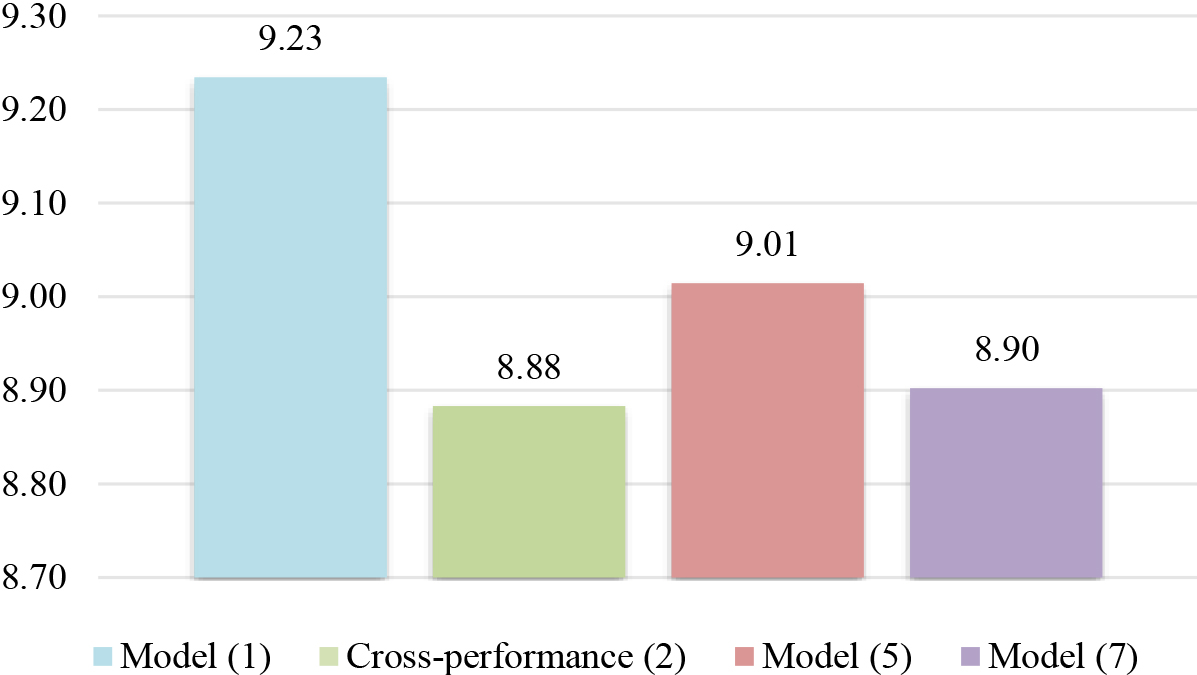
Performance analysis per criterion using max-min model (7) with 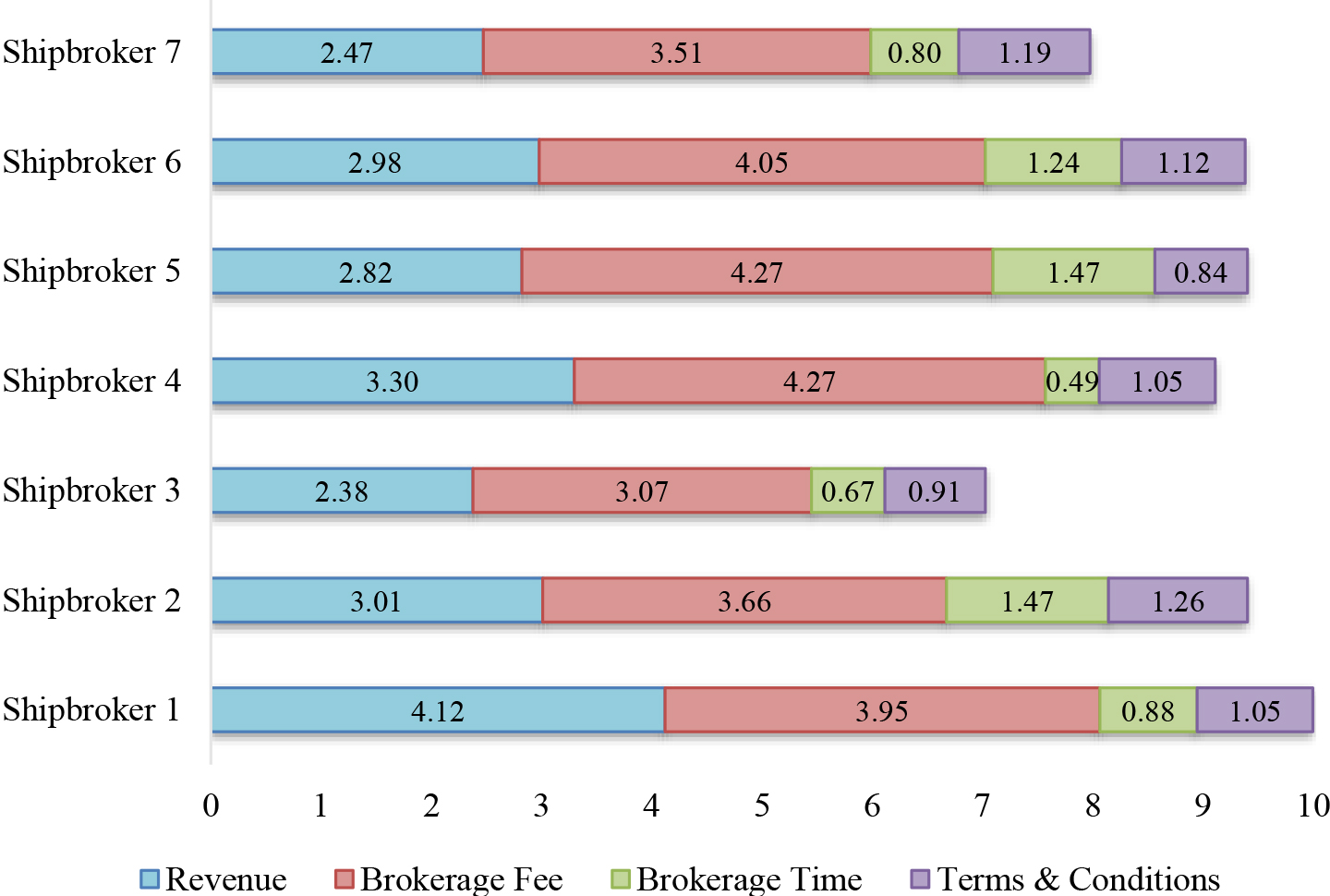
The highest score (
The scores shown in Table 5 reveal that model (1) identifies more shipbrokers at the first rank, specifically three, than the rest models. As expected, the scores obtained from this model are on average higher than the ones obtained from the other models and equation (2), see Fig. 1. Also, model (5) identifies two shipbrokers (Shipbroker 1 and 2) at the first rank, while model (7) only one, namely Shipbroker 1. The scores provided by model (5) are higher on average compared to the ones by model (7), see Fig. 1. Therefore, model (7) has better discrimination power than model (5) and is more suitable for the evaluation of the shipbrokers and the identification of the best one.
The contribution of each criterion to the calculation of the score of each shipbroker employing the max-min model (7) with
In this paper, we introduced a mathematical programming approach for the shipbrokers assessment. We considered the score of each shipbroker as a composite measure of a set of performance criteria. For the calculation of the score of each shipbroker, we aggregated additively the criteria using weights that derive through optimization. In particular, we employed three different mathematical programming models, and we discussed their characteristics. Also, we incorporated into the models the views of the analysts, in the form of weight restrictions, to guide the search for the optimal weights. We demonstrated the proposed approach by evaluating seven shipbroker offers for selling a dry-bulk ship. Four criteria are employed, namely revenue, brokerage fee, brokerage time and terms & conditions, however other criteria can be also included in the evaluation. We showed that the models which identify a common set of weights for all the shipbrokers provide the appropriate ground for comparisons among them. In addition, we illustrated that the employed max-min model has greater discrimination power, which renders it more suitable than the other models for the shipbrokers assessment.
We note that our models are generic and flexible to be applied for the evaluation of different type of alternatives, e.g., actions in the context of ship’s Life Cycle Assessment [34], bids of service providers for public organizations [35] or operational scenarios for industrial processes [36], among others. Topics for future research would be to extend the current study by investigating the effects of other criteria on shipbrokers evaluation as well as by incorporating into the analysis criteria that include uncertainty. Possibly, this could be addressed by extending our models to be applicable to data measured on an ordinal scale. Finally, a future study would employ other multi-objective programming methods, such as goal programming in which the analyst specifies targets to be achieved.
Footnotes
Acknowledgments
This study is supported by the OptiShip project (optiship.eu), implemented within the framework of the National Recovery Plan and Resilience “Greece 2.0” and funded by the European Union – NextGenera tionEU programme.