




Abstract
This article examines the literature surrounding bionano sensors, its anticipated applications and biological risks associated with their use. Despite being largely unfamiliar with bionano technology, existing research indicates that individuals are optimistic about bionano technologies and are seemingly nonchalant about their potential risks. This would suggest individuals may hold significant positive trust beliefs in bionano sensors, contrary to the predictions of technology trust theory. This article draws on McKnight et al.’s technology trust model and generalised expectancies of technology (perceived functionality, reliability and effectiveness). Using experimental procedure, this article confirms that individuals perceive bionano sensors to be a trustworthy technology and seeks to understand this ‘emerging technology trust paradox’.
Keywords
Introduction
Bionano technologies are in a state of rapid of development and are consequently generating a high level of interest in both industrial and academic circles. With continued advances in the field of biotechnologies and nanotechnologies, this is an area that is provoking interest as the benefits of potential applications continue to climb. One such application includes bionano sensors. Google Scholar generated over 25,000 search results for articles relating to bionano sensor technology published in 2016 alone on widely varied topics, including their design, development, possible applications, public perceptions, toxicity and safety. Bionano sensors are nanotechnologies with a sensor capability which can identify and analyse biological particles, substances and interactions, for example, proteins, antibodies and enzymes.1,2 Once a material has been identified and analysed, bionano sensors will either generate electrical information which it communicates with a receiver technology or otherwise acts upon directly. Bionano sensor benefits are most apparent in the field of medicine with more efficient medical imaging, rapid drug delivery, more accurate medical diagnostics and DNA sequencing.1–7 They also offer environmental benefits in their capacity to detect polluted water and air molecules for subsequent cleansing and pollution reversal.3,6,7
Notwithstanding their benefits, recent research also indicates that bionano technology poses considerable risk to health and safety.3,5,7–13 Studies show that the public may hold rose-tinted perceptions of bionano technologies and are surprisingly nonchalant regarding their very tangible risks. They suggest people are too ready to trust the new technology and too willing to accept its risks.9,10,14 The current trust literature theorises that risky technology should negatively affect consumer trust, yet consumer perceptions seem to be contrary, suggesting that a trust paradox exists with regard to bionano sensor technology. We believe this paradox is not restricted solely to bionano sensor technologies but is common to all emerging technologies for which people have no prior knowledge or experience of. Accordingly, we name this the ‘emerging technology trust paradox’.
Using the technology trust model by McKnight et al. 15 and generalised expectancy theory by Bandura 16 and Rotter, 17 this article seeks to identify what technology characteristics of bionano sensors elicit trusting beliefs. These include beliefs regarding their functionality, effectiveness and reliability. An experimental method is used to establish whether bionano sensors are perceived as trustworthy, by comparison to another, relatively new and developing technology, autonomous cars, and which factors affect their perceived trustworthiness. For the sake of internal control and reliability, autonomous cars serve as a comparison technology because they also rely on sensing technology and exude an element of risk towards personal safety. The results are then discussed with reference to studies relating to the public perception of bionano technology, their apparent trustworthiness and the role of generalised expectancies in the formation of initial trust. Therefore, this article seeks to address the following research question:
RQ1. Do individuals trust bionano technologies, even though their risks may outweigh their benefits?
Consequentially, this article is organised as follows. It will first examine the literature on technology trust and bionano sensor technology then describe its methodology and results. It will conclude with a discussion of the results, key contributions and limitations.
Literature review
Bionano technologies
Nanoscience is an interdisciplinary field with research spanning across the domains of chemistry, physics, biology, medicine, engineering and electronics. 6 Nanotechnology offers unique opportunities in the field of biology and medicine. It can enable greater scientific understanding and more effective manipulation and control of biological interactions and activities at the nanoscale – the equivalent of one-billionth of a metre. 4 Bionano technologies offer numerous potential applications with considerable benefits to health and the environment. Their emerging impacts are anticipated to reshape civil society permanently. 8 These include renewable energy production, food and processing, water purification, pollution reduction, specialised drug delivery, transdermal patches, tissue regeneration, point of care diagnostics, bionano material prosthetics, DNA engineering, medical imaging and cancer treatment.3,6,8,18 This list is not exhaustive and only broadly illustrates its scope of impact. It is the miniaturisation of sophisticated medical and environmental equipment which give bionano technologies such unique benefits. For instance, they are anticipated to be able to rebuild neurons damaged by Alzheimer’s and Parkinson’s disease, a feat which would otherwise be difficult and costly, if not impossible. 8
However, bionano technologies do not come without significant risks. Research indicates that nanomaterials interact with the body in a unique way and with potentially greater toxicity as compared to larger particles and may cause greater biological reactivity.3,7,8,13 One reported incident involved a 26-year-old chemist who had a reaction from handling nanoparticles involving nickel, which had never occurred with larger nickel particles. This affirmed that preventive measures are necessary. However, it is still uncertain whether toxicity risks relate to the chemical or physical state of the nanomaterial or its interactions with the body. 13 Research has also identified that some nanomaterials can induce neurodegenerative disease. 9 Surprisingly, in a 2014 study involving over 10,000 publications, it would seem true toxicity studies are not being carried out reliability with regard to nano safety research. 19 This is likely to be a consequence of not having any formal requirements for nano safety or toxicity reporting for nano-related products or research. 9
More concerning to the scientific community is the uncontrollable movement of bionano materials in the body or environment. Due to their size, bionano materials can travel through the body and penetrate defensive cell membranes, tissues and membranes, potentially lodging in unwanted places and triggering biological responses such as inflammation.3,5–8,12,13,19,20 More specifically, they have been found to move through the blood–brain barrier, through placentas into foetuses and go to places in the body that other compounds cannot cross. 12 The size of nanotechnologies means their mobility is subject to their environment and the forces around them, presenting added risk to their effectiveness and the level of control that may be exerted over them.6,7 In addition, device failure must be recognised as a certain eventuality. 11 The size and mobility of bionano technologies in the body or environment will make later identification and retrieval nearly impossible. Yet, leaving them in the body or ecosystem to decay risks uncertain interactions and consequences. 6 Moreover, there is a risk of unintended or uncontrollable nanoparticle uptake, with the potential for bionano technologies to cross dermal barriers, tissues, cell membranes and to be accidently inhaled or enter intestinal tracts.1,6,7,19,20 Despite this, a 2015 consumer survey on nanotechnology perceptions only found approximately 30% of participants were aware of any potential risks associated with their use. 9
Bionano technologies also pose a privacy risk for individuals. Pycroft et al. 11 noted most medical devices store personally identifiable information, including the patient’s name, health number and diagnosis, their physician’s details and information regarding its functional parameters and recorded diagnostics. In their research, Pycroft et al. 11 found two different implantable medical devices, an insulin pump and cardiac defibrillator, had recently been publicly exploited. One of these used a relatively cheap consumer processor to bypass the device’s security controls, and the other occurred remotely without any prior knowledge of the device’s serial number. They also reported at least one murder had occurred from the unauthorised access of a medical implant.
In summary, bionano technologies offer a variety of benefits and also pose significant risks to health, safety and privacy. Bionano technologies are emerging, and therefore very few people have had the opportunity to cultivate first-hand experience with them, but there is enough information available for people to form initial perceptions about them.
Trust
Trust is a dynamic phenomenon which depends on many contextual factors and is innately personal.21,22 It is most widely accepted as the willingness to be vulnerable and accept risks, irrespective of the ability to control the situation or outcome. 23 However, it can also be defined as the expectancy that another individual, group or thing can be relied upon, based on generalisations of previous similar experiences. 17
Knowledge-based trust
Knowledge-based trust theory states that the less knowledge individuals possess about a trust object, primarily through first-hand experiences, the greater uncertainty and risk they will perceive regarding a technology, therefore causing lower levels of knowledge-based trust.15,24,25 Given that bionano technologies are yet to be commercialised, very few individuals will have first-hand knowledge regarding their functionality, effectiveness, reliability and risks to use as a basis for forming reliable initial trust beliefs. Theoretically, this would predict most people will have low trust levels towards bionano technologies.
However, there is sufficient second-hand information available in the popular media and culture at large about the possible risks to privacy, health and safety posed by bionano technologies.5,6,9,13 This information is readily available online for anyone seeking greater second-hand knowledge about bionano technologies and to develop more reliable expectancies regarding their use. Information is well-dispersed and can be found in academic journals, industry reports and current event news articles. They are also consistent in their content. In particular, they are all clear in communicating that the lack of toxicity research, potential toxicity risks and lack of industry standards for bionano technologies are a key concern of the scientific community. Even for individuals who have no first-hand experience with bionano technologies, according to current trust theories, this second-hand information should also result in lower technology trust levels towards bionano technologies, or at the best, a healthy scepticism towards their usage.
Technology trust
Technology trust research is invaluable because of its relevance to technology adoption15,26–31 and is unique from people-related or institutional-related trust.15,31,32 Unlike people or institutions, technology is restricted by its limited capabilities and presents unique user risks and uncertainties regarding user control. 15 It is unclear how people ‘trust’ inanimate technologies since trust is usually defined in the context of interpersonal relations. Do people anthropomorphise technology, do they really trust the intentions of the people who designed and manage the technology or is it something else altogether? In an era where individuals are increasingly dependent on technology, and with technologies becoming ever more radical and revolutionary, technology trust research is important for understanding the factors affecting human perception and attitudes towards technology.
Existing research has proposed mechanisms for technology trust. In one of the predominant models, McKnight et al. 15 found three unique dimensions of technology trust relating to a technology’s perceived functionality, effectiveness and reliability. Functionality is defined as the belief that a technology has the capabilities to perform a task or achieve an outcome. 15 Because technologies are unable to be designed to complete an infinite number of tasks for all types of situations, functionality is generally very limited in scope and purpose. Effectiveness is defined as the belief that a technology has the ability to perform and operate when needed. 15 This is distinct from perceived functionality because it focuses on the quality of perceived outcomes when using the technology rather than the latent ability to perform certain tasks. This might be a response of user command or pre-programmed settings for autonomous operation. Reliability is defined as the ability to operate consistently without failing. 15 This reflects on user expectations regarding quality and durability that will ensure whether a technology will be able to perform when required. Context and anticipated user demand are important in determining how a technology is expected to perform over a period of time.
In the framework of McKnight et al., 15 beliefs and perceptions about functionality, reliability and effectiveness are all formed by first-hand knowledge or experience with the technology. It is unclear how technology trust should operate in the context of emerging technologies, such as bionano technologies, where people have no prior knowledge or experience. In the case of second-hand information, such as that available through popular media, culture or academic research, the question must be asked about whether people are trusting the technology or trusting the source of the second-hand information. This poses a problem for the theoretical conceptualisation of technology-based trust in the context of emerging technologies.
Bionano sensors
Bionano sensors are an anticipated application of bionano technology.1–4,6,7,18 Malik 1 defined bionano sensors as a nano-sized sensing device or system designed to measure a material or biological interaction at the nano level, before transforming this information into a readable form using transduction and electromechanical interpretations. Biosensors can analyse biological enzymes, antibodies, tissue, organelles, proteins, immunological molecules and micro-organisms1,2 using optical, electrochemical, acoustic, mechanical or electronic signals. 2 Bionano sensors are both a standalone technology and a component of several other anticipated bionano technologies which depend on a sensing element to execute its intended functionality. This includes drug delivery, DNA engineering and pollutant cleansing nanotechnology. Their main technology components include a bioreceptor to identify biological elements, a transducer to convert signals into information, a detector to receive signals and an amplifier to convey signals to a receiving system. 1 To date, they have been utilised in the context of public health, environmental monitoring, public security and food safety. 2
In theory, since bionano sensors are a sub-class of bionano technologies, they should inherit the theorised lack of trust because of the relative scarcity of knowledge and experience about them. However, there seems to be high levels of initial trust in bionano sensors among the general public,4,9,10,14,33,34 which makes their usage an instance of the emerging technology trust paradox. The emerging technology trust paradox asks why do people trust and use technologies when either their prior knowledge or experience should contradict their behaviour? The existence of this paradox suggests that prevailing theories of technology trust simply do not apply in the context of trust in emerging technologies.
Generalised expectancies
A generalised expectancy is defined as an expectation based on the outcomes of a previous similar situation or experience, 16 which in the case of emerging technologies would include previous experience with a similar technology or similar technological environment.16,17 As such, generalised expectancies become increasingly more important as situations become more complex, novel, ambiguous or unfamiliar.16,17 Conversely, if an emerging technology is too familiar, lacking in novelty or relatively simple and non-complex, then individuals do not have to generalise from previous familiar technologies in order to understand how an emerging technology will operate, and their effect will be diminished. Thus, generalised expectancies provide a means to understand why people might trust a technology even though they have no prior experience or knowledge with it, and at the same time, base their trust in real first-hand experience and knowledge with similar technology.
Generalised expectancies bridge the gap between the lack of first-hand knowledge about an emerging technology and knowledge about a similar existing technology. In other words, the predominant model of technology trust operates when there is first-hand experience or knowledge of functionality, reliability and effectiveness but generalised expectancies operate when there is no first-hand experience or knowledge of the technology, as is the case for emerging technologies. Individuals will trust an emerging technology according to the range of functionality they expect with regard to a specific purpose or context, based on their experience with previous similar technology.15,16 Individuals will trust an emerging technology’s effectiveness based on their generalised expectancies of its responsiveness and ability to act as directed when required.15,16 This may be with or without user command, to reduce the uncertainty regarding user control and achieving desired outcomes and as compared to their previous experiences with similar technologies. The extent to which individuals expect an emerging technology to be reliable is likewise based on their prior experience with similar technologies’ ability to operate consistently without failing.15,16 Following the positive perceptions of bionano technology found among the public,4,9,10,14,33,34 it is therefore hypothesised:
H1. Bionano sensors are perceived as being trustworthy when compared to other emerging technologies.
H1a. Bionano sensors are perceived as having greater expectancies of functionality compared to other emerging technologies.
H1b. Bionano sensors are perceived as having greater expectancies of reliability compared to other emerging technologies.
H1c. Bionano sensors are perceived as having greater expectancies of effectiveness compared to other emerging technologies.
Because bionano sensors are still relatively new and unknown, they are subject to people’s generalised expectancies. If people have experience with other similar technologies or have lived and worked in similar technological environments previously, these experiences will shape their generalised expectancies in bionano sensors. Positive past experiences with technology would also predict greater levels of trust in an emerging technology. However, the more familiar people become with a specific technology, its potential uses and risks, the less they will need to rely on generalised expectancies. Therefore, greater familiarity and knowledge of a technology might predict lesser levels of technology trust, as predicted by current trust theory. This is because of the greater sensitivity to perceived, and known, risks. Therefore, we hypothesise the following:
H2. People’s generalised expectancies will affect their trust in bionano sensors.
H2a. People’s previous experience with similar technologies will positively co-vary with their trust in bionano sensors.
H2b. People’s familiarity with known risks posed by bionano sensors will negatively co-vary with their trust in bionano sensors.
Methodology
This research employed a controlled post-test experiment with randomised treatments and multivariate analysis of variance (MANOVA) procedures to test hypotheses H1a–H1c and multivariate analysis of covariance (MANCOVA) to test H2a and H2b. The purpose of this was to support the goals of the research to determine whether bionano technologies, as operationalised by bionano sensors, were perceived to have relatively greater technology trust expectancies compared to other emerging and developing technologies. This was to determine whether bionano technologies are in fact perceived to have more positive technology expectancies compared to other new and developing technologies, as suggested in recent public perception studies.4,9,10,14
For this experiment, autonomous cars were designated as the control group. Like bionano sensors, they heavily rely upon sensing technology and pose risks to both safety and information privacy,35,36 thus controlling for various other sources of variance between the two technologies. Previously, we discussed the various risks that are posed by emerging technologies, and we refer the reader back to that discussion for the details. Here, we will discuss the specific characteristics of autonomous cars that may pose risks. We will also discuss exactly which characteristics of autonomous cars operationalise which specific risks in our subsequent analysis.
Autonomous cars are vehicles with at least some safety-critical control function which can occur without driver input, for example, steering, braking or throttle. 37 They depend on sensing technologies to sense their environment and make navigation decisions using artificial intelligence. 38 Autonomous cars use a wide range of sensors, including radar, light detection and ranging (LIDAR), computer vision, global positioning system (GPS), sonar, cameras, speed, onboard sensors and sophisticated vision algorithms, to interpret real-time environments.37,38 Like bionano technology, they are designed with human health and safety and the environment in mind. Their purpose is to reduce vehicle crashes and fatalities and enable more efficient fuel consumption.37,38 They also offer valuable time for entertainment, relaxation, socialisation or work during driving times. Thus, autonomous cars offer significant benefits. However, concerns have been raised regarding their threat to personal privacy because of their access to wireless technologies and the internet.35,36 The implications of software malfunctions and system crashes also pose a risk to human safety, especially where manual overdrive is not available.36,38 The potential lack of control over autonomous cars, and their threats to privacy, draw parallels with the risks posed by bionano sensors. Furthermore, since most people’s prior experience with cars will be very similar to their anticipated experience with autonomous cars, they will not have to generalise their expectancies as much as they will for bionano sensors. These considerations make autonomous cars an effective control group for experimental purposes.
Instruments
The dependent variables are the technology trust dimensions for functionality, effectiveness and reliability, as theorised by McKnight et al., 15 and theorised characteristics of bionano sensors and autonomous cars are the independent variables. Technology trust beliefs for functionality, effectiveness and reliability were operationalised with scales developed by Vance et al. 39 The independent variables are operationalised with experimental treatments. All scale items were measured using a 7-point Likert scale with 1 = Strongly Disagree, 3 = Disasgree, 4 = Neutral, 5 = Agree and 7 = Strongly Agree.
Generalised expectancies are operationalised with measurements of familiarity or knowledge of a given technology and the availability of relevant, previous similar experiences. 16 Subjects’ pre-existing familiarity with bionano sensors is measured by an instrument – a measured behavioural scale – that was developed to indicate individual familiarity with the information provided in the treatments. Subjects’ previous experience and disposition to technology trust are measured with instruments previously developed and validated by McKnight et al. 15 A list of instruments adapted for this research can be found in Appendix 1.
Treatments
The treatments consisted of information sourced from online news articles on the grounds that they were readily accessible and publicly available. Thus, these are reliable sources of second-hand knowledge that could be obtained naturally by individuals which would increase the realism of the experiment. 40 Using various news article extracts, the treatments were made to include (in order) a general description about each technology, potential applications, networking and sensing capabilities and benefits and risks. Several news extracts were edited for conciseness and to remove any information which may introduce framing bias. The experimental treatments are reported in Appendix 2. Treatments were given to subjects after measuring their generalised expectancies for technologies and before measuring their trust levels for bionano sensors or autonomous cars in response to the treatments.
Procedure
Subjects were given a handout including the treatment and questionnaires for generalised expectancies and technology trust. They were briefly introduced to the experiment and were asked to consider to what extent they would want to use a particular technology for the first part of the experiment, the treatment section. The randomised treatment of technologies was not immediately identifiable from the cover of the handout, so as to protect the internal reliability of generalised expectancies results and preventing subjects contextualising their responses for a specific emerging technology. Subjects were asked not to communicate with other subjects for the duration of the experiment or to check what technology they had received until they reached the relevant section of the handout.
The subjects were first required to answer a series of control questions relating to their previous experiences with technology, to account for generalised expectancies. Next, the treatment was administered before measuring the dependent variables and included information that operationalised the theoretical constructs in the hypotheses. Subjects were then asked to indicate to what extent they were already aware of the information provided in the treatments, as an additional control for generalised expectancy. Finally, subjects completed the technology trust questionnaire to measure the dependent variables.
Subjects
The subjects for this research were students from the University of Canterbury in a 100-level core commerce class. Although experiments do not require a representative sample of the population, 40 this subject pool was appropriate on its own merits. Students are commonplace technology users and are usually familiar with a broad range of technologies, with some anticipation for emerging technologies. They also have the requisite knowledge and education to evaluate risks and their potential consequences, and make informed decisions. Furthermore, previous research suggests that using students in trust-related experiments produce results that are similar to experiments using more representative and generalisable subject pools. 17 Choosing a relatively homogeneous group of subjects also implements de facto controls for a variety of variables that might affect the dependent variables. Demographic statistics of the experimental subjects are reported in Table 1.
Demographics.

Pilot study
A pilot study was conducted on a 200-level information systems class at the University of Canterbury with 15 subjects. The full experimental procedure and initial version of instrumentation were tested with the goal of perfecting the experimental procedure and ensuring the adequacy of the instructions and instrumentation. The treatment took approximately 10 min. A preliminary data analysis provided evidence to justify the continuation and eventual success of the experiment, including at least partial confirmation of the hypotheses. Minor changes were made based on the preliminary results obtained, including shortening the length of the treatments, and randomising the order of items on the instrument, so as to control for response bias. Treatments were shortened to eliminate irrelevant information and to make news extracts more concise and understandable. No more than a few sentences were eliminated for each treatment.
Validity and reliability of instrumentation
Manipulation validity
Manipulation validity refers to whether or not the experimental subjects did in fact receive the treatment and whether or not they perceived the treatment to be a fair representation of the constructs of interest. In this case, the construct of interest is whether the technology treatments accurately demonstrate their hypothesised risks and benefits. Two measures were used to assess manipulation validity. The first measure asked subjects to indicate whether they had read the entire treatment. Subjects who had not read the entire treatment were removed from the dataset. The second measure tested subjects about the information included in the treatment, to determine whether they were aware of the information that operationalised the theoretical constructs. Subjects who failed this test were removed from the dataset. Based on the results of these tests, there is a very low probability of threats posed by manipulation validity.
Reliability
Cronbach’s alpha was used to assess the reliability between-subjects and between-items, as recommended by Straub et al. 41 All theoretical constructs demonstrated adequate reliability and were therefore retained for further analysis. Instrument items were also randomised both to support reliability and to prevent systematic variance in the data. All the results were above α = 0.70, indicating sufficient internal consistency using Nunnally’s rule of thumb for scale reliability. 41 Table 2 reports the standard information for scale reliability as recommended by previous research 41 : the n, mean, standard deviation and Cronbach’s alpha for each measured scale.
Descriptive statistics and Cronbach’s alpha.

Construct validity
All of the dependant variables were adapted from instrumentation validated by existing technology trust research which had demonstrated high construct reliability and validity. To minimise threats to construct reliability and validity, all items were developed as close as possible to their definitions and conceptualisations in the literature and re-tested for this experiment. A factor analysis using varimax rotation confirmed all item loadings were higher within-construct than between-construct, indicating sufficient convergent and discriminant validity for the primary experimental procedure with loadings above 0.55. 42 Factor loadings are reported in Table 3.
Exploratory factor analysis. a

Only factor loadings of 0.55 and above reported, as per Hair et al. 42
The scale items for functionality and reliability converged, suggesting the instrument items may be measuring the same construct. This may have been a consequence of using instruments from two different sources. Alternatively, it may be because the generalised expectancies of functionality and reliability for both technologies were similar, thus making their distinction unclear. In both cases, the generalised contexts in which both technologies could be expected to be used are time-sensitive (a theoretical component of reliability), potentially placing extra reliance on both technologies to perform consistently within an acceptable time frame, without failing. Bionano sensors may be depended on to monitor and deliver time-sensitive biochemical diagnostics, and autonomous cars may be depended upon to transport individuals to meetings and events at certain times and within a certain period. Thus, sufficient reliability may be a dimension of functionality. Therefore, for the remaining analyses, perceived reliability (H1b) will be excluded on the basis that it may be an attribute of functionality.
Statistical conclusion validity
SPSS is a widely used and trusted as a reliable statistical software and was therefore selected to perform all the statistical procedures for this experiment. A minimum significance level of 0.05 was adopted for all procedures. In addition, an appropriately large subject pool was used to ensure sufficient data existed for a reliable MANOVA to be performed.
Results
The experiment was conducted with 116 voluntary subjects. The treatment was randomly assigned with 57 subjects in the bionano technology group, as operationalised with bionano sensors, and 59 subjects in the other emerging and developing technologies group, as operationalised by autonomous cars. Subjects were aged between 18 and 50 years with a mean age of 19.8 years old. Table 4 reports descriptive statistics by experimental group, for each dependent variable.
Descriptive statistics by group, by dependent variable. a

Likert scale: 1 = Strongly Disagree, 3 = Disagree, 4 = Neutral, 5 = Agree and 7 = Strongly Agree.
Reliability variable was removed from the study due to insufficient discriminant validity.
MANOVA results
A MANOVA procedure was used to analyse the experiment data and determine whether bionano sensors are perceived to be relatively trustworthy as compared to autonomous cars.
Box’s M test is p > 0.05, and Wilk’s Lambda, Pillai’s Trace and Hotelling’s Trace all being significant at p < 0.05, therefore indicating that characteristics of individual technologies had a significant influence on generalised technology trust expectancies with F = 1901.25 and p < 0.01, thus indicating the presence of at least one significant effect. 42 A test of between-subject effects reported p < 0.01 for functionality and effectiveness, indicating technology type had a significant effect on the technology trust results. However, effectiveness had p = 0.38 which suggests generalised expectancies regarding effectiveness may not change across technologies at a significant level. Levene’s test also produced p > 0.05 for all technology trust expectancies, thus satisfying the assumption of homogeneous variance for the MANOVA procedure. Table 5 and Figure 1 report the results for the tests of H1a and H1c.
MANOVA pairwise t-tests for H1a and H1c.

MANOVA: multivariate analysis of variance.
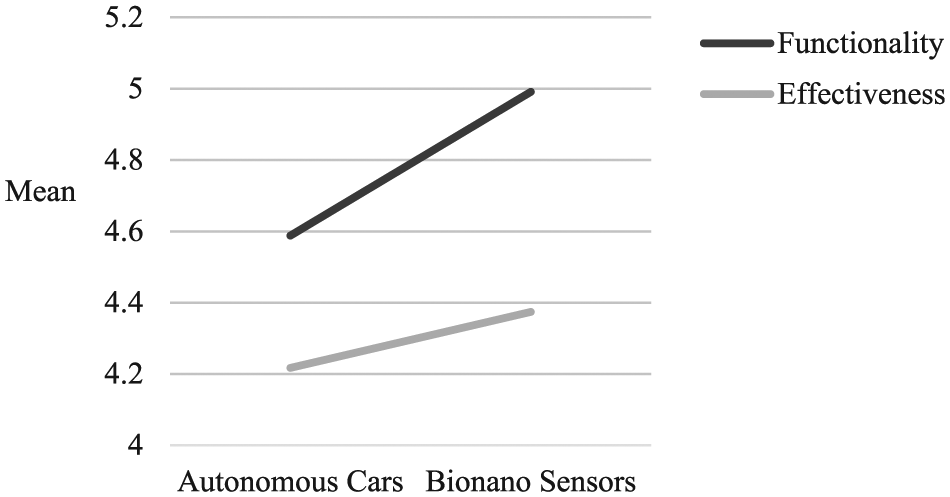
Technology trust – by level of functionality and effectiveness.
Hypothesis 1 is partially supported. Although bionano sensors were significantly more trustworthy than autonomous cars for the functionality dimension of technology trust (p < 0.01), there was no significant difference between bionano sensors and autonomous cars for effectiveness. As mentioned previously, H1b was removed from further consideration because the reliability dimension of technology trust failed to discriminate with functionality. Table 6 reports the results of the hypothesis tests for the experimental treatments.
Hypothesis findings, experimental treatments.

MANCOVA results
Hypothesis 2 predicts that the two limbs of generalised expectancies, previous similar experiences and familiarity with the emerging technology, will co-vary with technology trust levels. Previous similar experiences are hypothesised to positively co-vary with trust, while familiarity is hypothesised to negatively co-vary with trust. However, since previous experiences and familiarity are by definition uncontrollable experimentally, they were tested by entering them as covariates in a MANCOVA model. Table 7 and Figure 2 report the descriptive statistics for the MANCOVA procedure.
Descriptive statistics, MANCOVA.

MANCOVA: multivariate analysis of covariance.
Likert scale: 1 = Strongly Disagree, 3 = Disagree, 4 = Neutral, 5 = Agree and 7 = Strongly Agree.

Generalised expectancies – by level of similar experiences and familiarity.
Levene’s test of equality of variance indicated that error variances across both groups were equal for functionality, reliability and effectiveness with p values of 0.62 and 0.69, respectively. Box’s M test (p > 0.05), Wilk’s Lambda, Pillai’s Trace and Hotelling’s Trace all indicate that previous experience with similar technology has a significant influence (p < 0.05) on the combined dependent variables of functionality and effectiveness. Although the effect of familiarity with the technology on the combined dependent variables of functionality and effectivenes was in the hypothesised direction (negative), the p value (p = 0.14) is only marginally significant. The statistical test for familiarity additionally has a low power, which suggests that more data, or a more precise experiment would likely support a small, but significant effect as hypothesised (Table 8).
MANCOVA test of between-subject effects for covariates.

MANCOVA: multivariate analysis of covariance.
Therefore, hypothesis 2 is partially supported. Table 9 reports the findings of H2 about the effects of the covariates for generalised expectancies.
Hypothesis findings for covariates.

Discussion
The experiment confirmed H1, that bionano sensors are perceived to be more trustworthy than autonomous cars due to higher functionality beliefs (H1a). This indicates bionano technologies are perceived to be relatively less risky compared to other emerging technologies which rely on wireless and sensing technology. This is consistent with existing research which suggests that bionano technologies are held in an overly positive light.4,8–10,14,33,43 In these studies, participants indicated that they were mostly unfamiliar with nanotechnologies, with little knowledge about their risks to humans and the environment.9,14,34 This was consistent with our results, with subjects indicating low levels of familiarity with bionano technology and their sensor applications. However, the perceived trustworthiness of bionano sensors is contrary to technology trust theory, creating a trust paradox. Trust theory would predict that a lack of knowledge would contribute to heightened perceived risks, more scepticism over the technology’s ability to meet the demands of their generalised technology expectancies and generate lower levels of technology trust.15,24,27 One reason for this optimistic outlook may be because nanotechnologies tend to be framed positively in the media, especially in regard to medicine and economics, without critical opposition. 44 This is consistent with research that identified when low levels of knowledge about nanotechnology exists, coupled with the absence of related risk events, attitudes towards nanotechnologies tend to be positive. 10 This may explain why bionano sensors were perceived to be relatively trustworthy despite the experimental treatments including descriptions of potential risks.
Bionano sensors were perceived as having significantly greater functionality than autonomous cars. This means they are perceived to have a greater range of ability to meet the demands of the generalised context in which they may be used.15,16 The key messages of existing research and news media would be expected to erode the perceived functionality of bionano sensors because of their ability to move uncontrollably through the body, penetrate cell membranes, damage tissues and organs.6,7,12,13 Consequentially, this would suggest people will not perceive bionano sensors as being able to perform as anticipated because of their inability to position themselves in the body where they are needed. This could be for glucose monitoring, drug delivery or medical imaging. Therefore, they should generate lower levels of trust.
However, bionano sensors offer a solution to 21st century problems: cleaning polluted water and ecosystems; removing cancers; accurate, adaptive and minimally invasive specialised diagnostics; and biomedical devices.3,4,7,8,18 Individuals often perceive trusting situations as a rational choice, weighing potential costs and benefits.15,22,24,45 Consistent with conjectures from existing research, it would seem individuals are more concerned about the potential benefits attainable from the functionality of bionano sensors and how these frame risk perceptions.4,14,20,43 It is likely that this is a consequence of naivety. With few major events recorded to give substance to the speculative risks and dangers of bionano technologies, they are not considered a serious threat to functionality. 44 Additionally, because bionano sensors are anticipated to be utilised in fields of medicine or the environmental science, it is possible that trusting beliefs in the scientific and medical communities have been imputed onto bionano sensors. In both of these fields, ethical governance and device testing is stringent and rigorous, promising lower user risk as a consequence of poor performance, design or functionality scope.
Because sufficient discriminant validity could not be established, perceptions of reliability were unable to be tested. Scale items for reliability loaded with perceived functionality in an exploratory factor analysis. This may be because the scales were adopted from two different sources. However, it is also possible that reliability was perceived to be an attribute of functionality, perhaps, because the contexts in which bionano sensors and autonomous cars could be used are very time-sensitive, thus blurring the distinction between the two. Little trust research has been conducted with regard to specific technology applications so it is difficult to determine whether these findings are a unique event or whether the relationship between functionality and reliability should be reconsidered, although existing findings suggest that perceived functionality and reliability are independent of one another.15,27
Because of the cross loading in the factor analysis, in our research, reliability was considered as an attribute of functionality in the context of bionano sensors. Therefore, the belief that bionano sensors hold significant levels of functionality would suggest that individuals also have strong beliefs in their reliability. While this could not be tested on its own, this would not be intuitive nor consistent with trust theory if this is the case. Another possible explanation is that reliability fails to discriminate from functionality only in the context of emerging technologies, since a person’s beliefs about reliability require first-hand knowledge or experience with the technology. In other words, people may discriminate between reliability and functionality only when they have direct experience or first-hand knowledge of a technology, neither of which is the case for emerging technologies.
Failure is an aspect of both reliability and functionality that exists for almost all technology, and design constraints would necessitate trade-offs between functionality and durability, especially considering the microscopic size of bionano sensors. 11 The difficulty in identifying and retrieving bionano sensors would also make maintenance problematic and complicated compared to other technologies. Unauthorised access to bionano sensors poses a risk to their ability to operate without failing and reduces expectations of their functionality. For example, incidents have been reported where biomedical devices have been breached, which creates a risk that bionano technologies may be controlled by entities with potentially malicious intents towards the user. 11 This could have very grave consequences. For instance, a bionano device regulating drug delivery may harm patients if the parameters of the sensing component are changed, by not delivering enough drugs or delivering them to the wrong location. This would constitute an operating failure. In addition, the potentially uncontrollable and unpredictable biological and chemical reactions caused by bionano technologies could also trigger device failure. People’s trust beliefs in bionano sensors’ functionality are paradoxical, perhaps, because individuals’ generalise their expectancies from other potential product issues, such as ethics and fair distribution, instead of functionality and reliability.4,8,10
Bionano sensors were not perceived as having significantly higher levels of effectiveness than autonomous cars. This finding is consistent with what trust literature would theorise. This means that people believe they are just as likely to be able to perform, or not to perform as the case may be, when required. It was anticipated that individuals might perceive bionano sensors as being effective, and thus trustworthy, because of their wireless accessibility and technological sophistication. Moreover, bionano sensors are considered to be an adaptive technology, capable of biological mimicry, 4 which would suggest that they are able to act in a timely manner in response to environmental changes as well as user command or predetermined autonomous settings. Instead, the experiment indicated that bionano sensors are not perceived as being more effective than other technologies and therefore not relatively more trustworthy in this regard. One possible explanation for this may be that even if bionano sensors act as designed for the users intended, the ability for bionano sensors to move uncontrollably through the body increases the risk they will be triggered to act in the wrong place and time,3,5–8,12,13,19,20 since nanoparticle uptake can be uncontrollable, unintentionally entering the body through the skin, intestinal tracts or inhalation.1,6,7,19,20
Generalised expectancies positively affect initial trust in an emerging technology, which is contrary to the predictions of current trust theory. Since, by definition, people can have no prior knowledge of an emerging technology, current trust theory would predict a lower level of trust, yet that is not what we observe experimentally. Experimental subjects reported more positive previous similar experiences for bionano sensors (m = 5.36) than for autonomous cars (m = 5.03) (1 = Strongly Disagree, 3 = Disagree, 4 = Neutral, 5 = Agree, 7 = Strongly Agree) and relatively small standard deviations of s = 0.69 and s = 0.67, respectively. Consistent with generalised expectancy theory, these positive experiences with other technologies were reflected in correspondingly greater levels of generalised expectancies for bionano sensors.16,17 As a result, positive previous experiences with similar technologies mitigated the perceived riskiness associated with the ambiguity and uncertainty of bionano sensors. In other words, people expect technologies to be generally functional and effective and likely to lead to positive outcomes because of previous positive experiences with similar technologies.
Both groups indicated low levels of familiarity with the anticipated applications, benefits and risks for both autonomous cars and bionano sensors. The autonomous cars group had a higher mean score of 3.13 compared to bionano sensors group with 2.59. This could be expected given the greater publicity around autonomous cars recently. According to current trust theory, the lack of familiarity with the risks of bionano technology should result in greater uncertainty and ambiguity and thus predict lower trust levels because of the need to rely on generalised expectancies rather than direct first-hand experience.16,17 Although the effect of familiarity was in the right direction (negative), the results were unable to support whether familiarity had a significant effect on technology trust. Since the range of responses for familiarity was centred on the low end of the scale, additional data that include responses at the high end of the scale might demonstrate a significant effect. Furthermore, since there is a low power associated with the statistical test for familiarity, it is likely that a more precise experiment with more data will support a small but significant effect. It is also unclear whether the insignificant effect of familiarity may be specific to the technology or if people place greater reliance in their past experiences with similar technologies when they have little familiarity with a specific technology. Thus, they form initial trust based on generalised expectancies. In other words, generalised expectancies would explain a negative relationship between familiarity and trust beliefs in bionano sensors, whereas current trust theory would not.
Technological innovation creates paradoxes, including the privacy paradox, the productivity paradox and the technology transfer paradox. The privacy paradox considers why individuals seem willing engage in activities that knowingly compromise their personal privacy, and yet they are adamant in their desire to protect their personal information.46–49 The productivity paradox considers why technology does not seem to significantly increase productivity, when its sole purpose and functionality is designed to increase efficiency.50–52 The technology transfer paradox considers why the transfer of competitive technologies to competitors may increase competitive advantage of its former user.53,54 Our research identifies one more paradox to be added to this growing and perplexing list. Technology trust is not as rational or calculative as we might have theorised and, like the paradoxes before, it is likely to be complex, illogical and desultory.
Contributions
Existing literature has suggested that individuals have positive expectations and beliefs in bionano sensors, as discussed in the literature review. This research confirms with experimental procedures that, contrary to trust theory, bionano sensors are perceived to be a trustworthy technology. It is anticipated that this research will provide insight for academics and practitioners about why this may be the case.
The developmental state of bionano technologies makes this research relevant and timely given its widespread anticipated applications and impending commercialisation. Thus, it may be useful for technology adoption research. This research also recognises the many risks associated with bionano technologies, suggesting the danger of allowing overly positive beliefs to continue without proper justification and regulatory measures to minimise potential risks.
Our research also has implications for innovators and developers of emerging technologies. Since generalised expectancies is a mechanism for initial trust in an emerging technology, the design and innovation of new technology may rely on people’s experiences with similar technologies rather than first-hand experience. First, our methods may be used to identify specific aspects and features of technologies that are perceived to be risky and predict the effects of perceived risks on the technology’s perceived functionality and effectiveness. Second, the perceived riskiness of new technologies may be mitigated if they are designed to resemble familiar technologies that are not perceived to be risky. Third, a lack of previous experience with an emerging technology may not negatively affect trust, as long as the technology has features which are ‘familiar’ to the person. If the goal is to design a technology that invokes caution on the part of users, then its design should not resemble other technologies so as not to initiate the formation of generalised expectancies which lead to initial trust. However, these applications also raise the possibility that very dangerous technologies may be developed yet whose dangers are not apparent because they are cloaked in a veil of familiarity and generalised expectancy and therefore we caution innovators and developers to be mindful of this.
Finally, this research builds on existing technology trust research by examining a technology trust object that has not been studied previously, bionano sensors. The inconsistency of findings to what trust theory would predict provides an opportunity for future trust research and further development of technology trust theories.
Limitations and assumptions
Several key limitations exist as a consequence of the methodology adopted in this research. Experiments lack external validity and are unable to determine the extent to which relationships are, or are not, truly significant. The experiment was conducted on university students. Although experiments require neither representative samples nor external validity, 40 it is nonetheless a limitation of experimental research. This research also assumed all individuals are technology users and using all technologies is optional. That is, the use of bionano sensors and autonomous cars are not necessitated for survival, forced or controlled and other alternatives exist. Finally, trust is an intangible, human construct. This makes it difficult to measure objectively or reliability, even when relying on tried and true trust instruments.
Summary and conclusion
Using the technology trust model by McKnight et al. 15 and experimental procedures, this research confirmed that bionano sensors evoke positive technology trust beliefs and are considered trustworthy relative to autonomous cars. This is consistent with existing research on the perceptions of nanotechnologies but contrary to what trust literature would predict and is otherwise not intuitive; in other words, it is an ‘emerging technology trust paradox’. Our research demonstrates that for emerging technologies like bionano sensors, generalised expectancies predict technology trust as manifested in its functionality and effectiveness. This article offered possible explanations for why this may be the case in an attempt to shed light on this trust paradox by considering existing research on the risk perceptions of nanotechnologies and the rationale behind which potential risks may dismissed.
Footnotes
Appendix 1
Appendix 2
Academic Editor: Fei Yu
Declaration of conflicting interests
The author(s) declared no potential conflicts of interest with respect to the research, authorship, and/or publication of this article.
Funding
The author(s) received no financial support for the research, authorship, and/or publication of this article.