




Abstract
Wireless sensor networks have continuously evolved to provide better services and satisfy user demands. Through this, the number of wireless sensors and the amount of mobile traffic are exponentially growing every year. Long-term evolution technology can effectively resolve the problems caused by traffic growth; however, there are still limitations. Licensed-assisted access using long-term evolution technology has greatly improved the performance of existing long-term evolution heterogeneous networks with carrier aggregation. However, the existing wireless local area network sensor nodes remain a challenge. The licensed-assisted access using long-term evolution access point should efficiently handle the problem of monopolizing spectrum resources used by existing wireless local area network sensor nodes. In this article, we investigate an optimized time slot allocation technique for the coexistence of wireless local area network and licensed-assisted access using long-term evolution sensor nodes. In order to maximize the throughput of each wireless local area network and licensed-assisted access using long-term evolution sensor node in the proposed algorithm, we designed an objective function based on the number of wireless local area network/licensed-assisted access using long-term evolution sensor nodes and the queue size of each sensor, after which we developed the optimal parameters using Karush–Kuhn–Tucker conditions. Through extensive simulations, we show that the proposed scheme can significantly outperform the other existing techniques with respect to the throughput, channel utilization, delay, and transmission fairness.
Keywords
Introduction
Recently, wireless sensor networks (WSNs) have been very popular for their realization of the Internet of Things (IoT)/Big Data era.1,2 The WSNs have continuously evolved to provide people with better services and to better satisfy user desire. The applications of WSNs are diverse, as shown in Table 1. As WSNs evolve, the number of wireless sensors deployed in everyday life and the amount of mobile traffic are growing exponentially every year. 3 Long-term evolution (LTE) technology can be one of the key technologies to efficiently handle this growing traffic. However, current LTE technology alone cannot cope with such exponentially growing traffic, which requires additional spectrum resources. Therefore, to use additional spectrum resources, some technologies have used carrier aggregation (CA) which is shown in Figure 1 or considered LTE heterogeneous networks (HetNets) to improve LTE data rates.4,5 However, these techniques have various interference problems and cannot handle the traffic growth. For this reason, some studies have proposed schemes that use unlicensed bands in LTE and apply interference management to the LTE HetNet to ensure higher data rates. Therefore, in LTE Release 13, licensed-assisted access (LAA) and LTE WiFi link aggregation (LWA) technologies,4,6–12 also known as LTE-U and LTE-H, respectively, have been adopted for use with unlicensed bands for LTE and mitigating inter-cell interference. In addition, enhanced inter-cell interference coordination (eICIC) has been proposed to coordinate the interference problems with LTE HetNets in LTE Release 10. 13
The applications of wireless sensor networks.

WSN: wireless sensor network.

The concept of carrier aggregation.
In order to improve the throughput of LTE, in the LAA, the licensed band is defined by the primary cell (PCell) and the unlicensed band is defined by the secondary cell (SCell). However, it is difficult to use the LAA as an unlicensed band without modifying some portion of the existing backhaul. 14 Existing LTE devices should consider coexistence with other various wireless communication devices operating in the LBT (listen before talk) protocols such as WiFi, Bluetooth, and Zigbee. 15 The LWA uses the unlicensed band as the secondary cell, but does not use the CA of the licensed band. With the LWA scheme, the LTE access point (AP) transmits data over the licensed and unlicensed bands, and only data transmitted over the unlicensed band use the LBT protocol. However, these schemes still have limitations. In particular, the LTE-LAA AP should efficiently handle the problem of monopolizing the frequency resources used by existing wireless local area network (WLAN) sensor nodes.
In this article, we propose coexistence schemes for WLAN devices that compete with channel access using carrier-sense multiple access with collision avoidance (CSMA/CA) and LTE-LAA sensor nodes that use the CA technique. The proposed scheme assumes an environment where LTE-LAA APs are deployed and compete with WiFi devices in non-licensed areas. Additionally, the goal of the proposed scheme is to maximize the throughput between WLAN devices and sensor devices using LTE-LAA without compromising the channel contention method used by existing WLAN devices. The proposed scheme can mitigate the interference between the WLAN device and the LTE-LAA sensor by efficiently distributing frequency resources in the unlicensed band.
The remainder of this article is organized as follows. We survey the existing related work in section “Related work.” In section “Coexistence scheme of LTE-LAA and WLAN,” we describe the proposed scheme in detail and present the Lagrangian functions and Karush–Kuhn–Tucker (KKT) conditions used for small cell network analysis. Section “Performance evaluation” evaluates the performance of the proposed scheme compared with existing schemes. Finally, we draw conclusions and suggest future directions in section “Conclusion.”
Related work
As shown in Figure 2, in the LTE-LAA and LTE-U environments, it is assumed that the WLAN AP and the small cell base station coexist. However, the coexistence and CA of LTE and WLAN are different in LTE-U and LTE-LAA. The biggest difference between LTE-U and LTE-LAA is whether to use an LBT mechanism. The LBT mechanism is a piece of equipment that applies a clear channel assessment (CCA) check before transmission on the channel.16,17 In a network environment including the LAA, the LBT mechanism is essential for the coexistence of LTE-LAA with WLAN. However, LTE-U does not include an LBT mechanism and instead uses alternatives.1,18–21

An exemplary topology of LTE-LAA system.
In the work by Hamidouche et al., 18 a new game theoretic approach, called the multi-game framework, is proposed to solve the resource allocation problem in LTE-U. Since the Base Stations (BSs), Wireless Access Pointers (WAPs), LTE users, or WLAN users request the strategy that maximizes a utility function for resource allocation, the authors defined two classes of algorithms, multi-game stability and multi-game Nash equilibrium algorithms. In the work by Chen et al., 19 a novel hyper access point (HAP) framework, which can serve as both an LTE-U BS and WLAN AP in one node, focuses on contention period (CP) allocation and user association so that LTE-U and WLAN networks can coexist fairly and effectively. The optimal CP length and allocation that consider network utility maximization are derived by considering the Nash bargaining solution (NBS).
In the work by Zhang et al., 20 the authors present an appropriate solution for both resource scheduling and fairness-based channel access problems for the coexistence between LTE-U and WLANs. The fairness-based channel access probability is formulated using binary exponential back-off (BEB) and random back-off based on a Markov chain model. To guarantee spectrum efficiency and network throughput, a novel scheduling approach employing a linear programming resource scheduling model maximizes the utility function, in turn which quantifies the benefit of various resource allocations.
In the work by Galanopoulos et al., 22 the authors modeled four main functionalities for the efficient coexistence of LTE with WLAN. First, a component carrier, which has the lowest activity, is selected for LAA transmissions. Second, a novel LBT procedure, which consists of adaptive frame-based equipment, checks before using the channel for LAA transmissions. Third, a discontinuous transmission (DTX) procedure decides the limited maximum transmission duration. Finally, the authors define the transmit power control (TPC) process for LTE and WiFi interference control and transmissions. The medium access control (MAC) protocol to ensure the coexistence of LTE-LAA and WLAN has also been proposed using the existing cognitive radio (CR) MAC protocol. 23 The LTE-LAA MAC protocol based on CR-CSMA considers LTE-LAA which maximizes the transmission time to maintain good WLAN services and average packet delay. Commonly, the existing CR networks can transmit only when the channel is considered as idle. However, the LTE-LAA MAC protocol is extended to grab the channel for packet transmission in the next frame. In the work by Fodor et al., 24 the authors define several LBT frameworks for the channel access opportunity of LAA and the coexistence of LTE-LAA with WLAN. Since the LBT mechanism checks the channel state before transmission via an energy detection (ED), it is important to obtain an optimal ED threshold. Moreover, to improve the channel access opportunity, a freeze period is adopted in the LBT procedure as well as extensions of the LBT to ensure multiple unlicensed channels are present.
Coexistence scheme of LTE-LAA and WLAN
System model and basic assumption
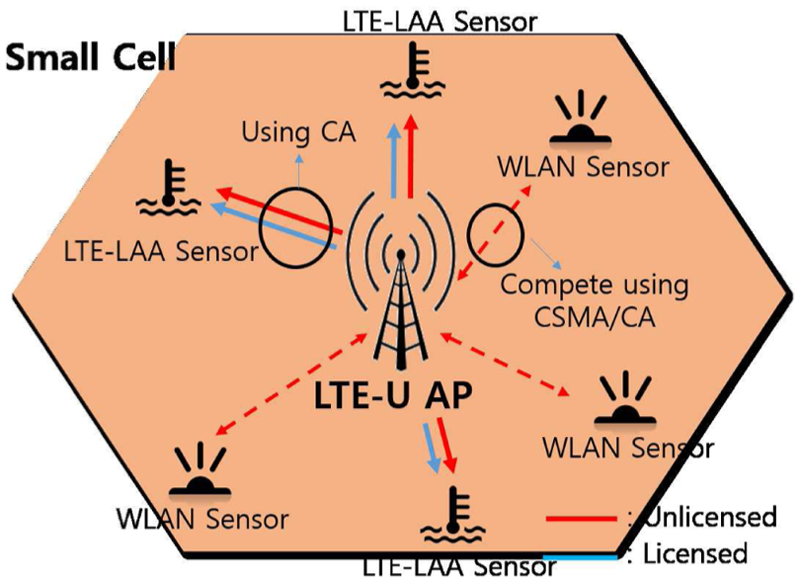
In this article, we assume that one LTE-LAA AP and
LTE-LAA sensors are randomly deployed in the picocell coverage without consideration of the interference among sensors. Therefore, some LTE-LAA sensors may suffer from interference, and such interference may occur in both licensed and unlicensed bands. It is assumed that the LTE-LAA AP can provide up to
The overall system model is shown in Figure 3, and using the model, we divide it into several cases based on how to allocate the whole time slots. The LTE-LAA AP and WLAN sensors can share all of the time slots by competing with each other, and they can also divide the total number of time slots into two independent parts. Moreover, either LTE-LAA AP or WLAN sensors can solely use all of the time slots. All cases are handled in our analysis in the next section.
System model.
Analysis of a small cell network
To apply our proposed algorithm and evaluate its performance in a variety of topologies, we first analyze the small cell network according to the resource allocation between the LTE-LAA AP and WLAN sensors. For small cell network analysis, we designed an optimization problem to find the maximum throughput of the small cell network.
The approach taken for this optimization problem is to compute two weight parameters
The important parameters for the optimization problem are defined in Table 2, and the method used to set the parameter, the optimization constraints, and the definition of the optimization problem will be explained.
Parameters of the model.

LTE: long-term evolution; LAA: licensed-assisted access; AP: access point; WLAN: wireless local area network.
Weight parameters
To fairly allocate time slots to the LTE-LAA AP and WLAN sensors, two weight parameters

where
Similarly,

3.2.2 Time slot
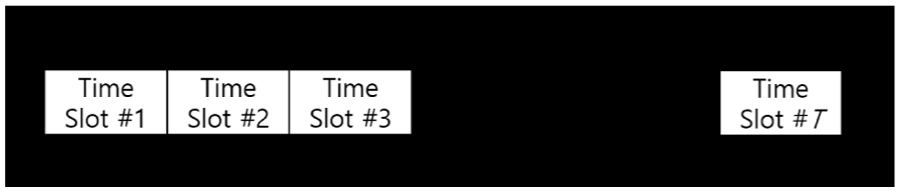
This subsection describes the concept of time slots. In this article, a sufficiently long time is divided into time slots as shown in Figure 4. However, in an unlicensed band, the sensor nodes occupy the channel through the contention-based CSMA/CA. Thus, in this article, we explain concept of how many time slots are used for the entire time, rather than how the sensor node uses the time slot of the corresponding time.
The concept of the time slots of this article.
After setting two weight parameters


In equation (3),
Data rate
Using two time slot parameters


respectively.
Time slot constraints
The number of time slots is limited. Thus, the sum of the number of allocated time slots to LTE-LAA AP and WLAN sensors should be less than or equal to the total number of time slots

To maximize the network throughput, we assume that no time slot loss occurs that is caused by external factors such as the channel environment. Therefore, we can write equation (5) as

Data rate constraints
Using the allocated numbers of time slots


respectively.
Both data rates have the same range, which is greater than or equal to 0 and less than or equal to the maximum data rate of the unlicensed band.
Now, we can rewrite equation (7) in terms of the weight functions


Utility function
We set our utility function as the sum of the received data rates for all sensors. By increasing each sensor experience, we can maximize the total network data rates

Optimization problem
With the above constraints (6) and (8) and the utility function (9), the optimization problem can be formulated as

subject to


Lagrangian function
To solve our optimization problem, a Lagrangian function is adopted with the data rate constraints defined in equation (8). In this case, however, we do not consider equation (6) (the time slot constraint) because equation (6) is automatically considered using (3). Therefore, the Lagrangian function for our optimization problem can be defined as
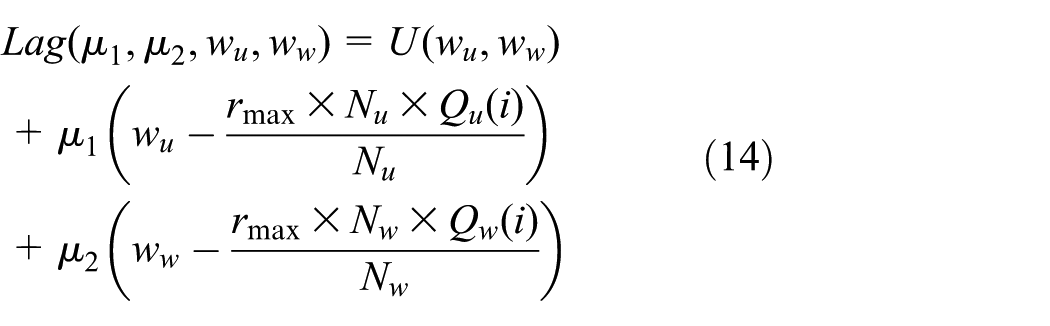
Moreover, the data rate constraints (8) are defined as inequalities. The Lagrangian function can be easily solved with equality constraints, but it is difficult to solve with inequality constraints. Accordingly, we also adopted the KKT conditions to solve our Lagrangian function defined in equation (14). The following equations express the KKT conditions for our Lagrangian function



Models based on the KKT conditions
Using the KKT conditions, we can divide a small cell network topology according to the value of the KKT condition parameters
Case 1.

Case 2.

Case 3.


The model cases for KKT analysis.
The difference in data rates for the LTE-LAA AP and WLAN sensors determines
Case 4.
After finding the optimal

Additionally, we can find the optimal achievable data rate as follows

The general model of LTE-LAA, that is, Case 3, does not necessarily consider interference because all sensors perform an LBT mechanism, and the other two models also do not consider the interference among the sensors.
Parameter-based LAA scheme
This section describes how LTE-LAA APs compete with WLAN sensor nodes using the optimal parameter values
Algorithm 1 shows the pseudocode for the proposed algorithm. Let
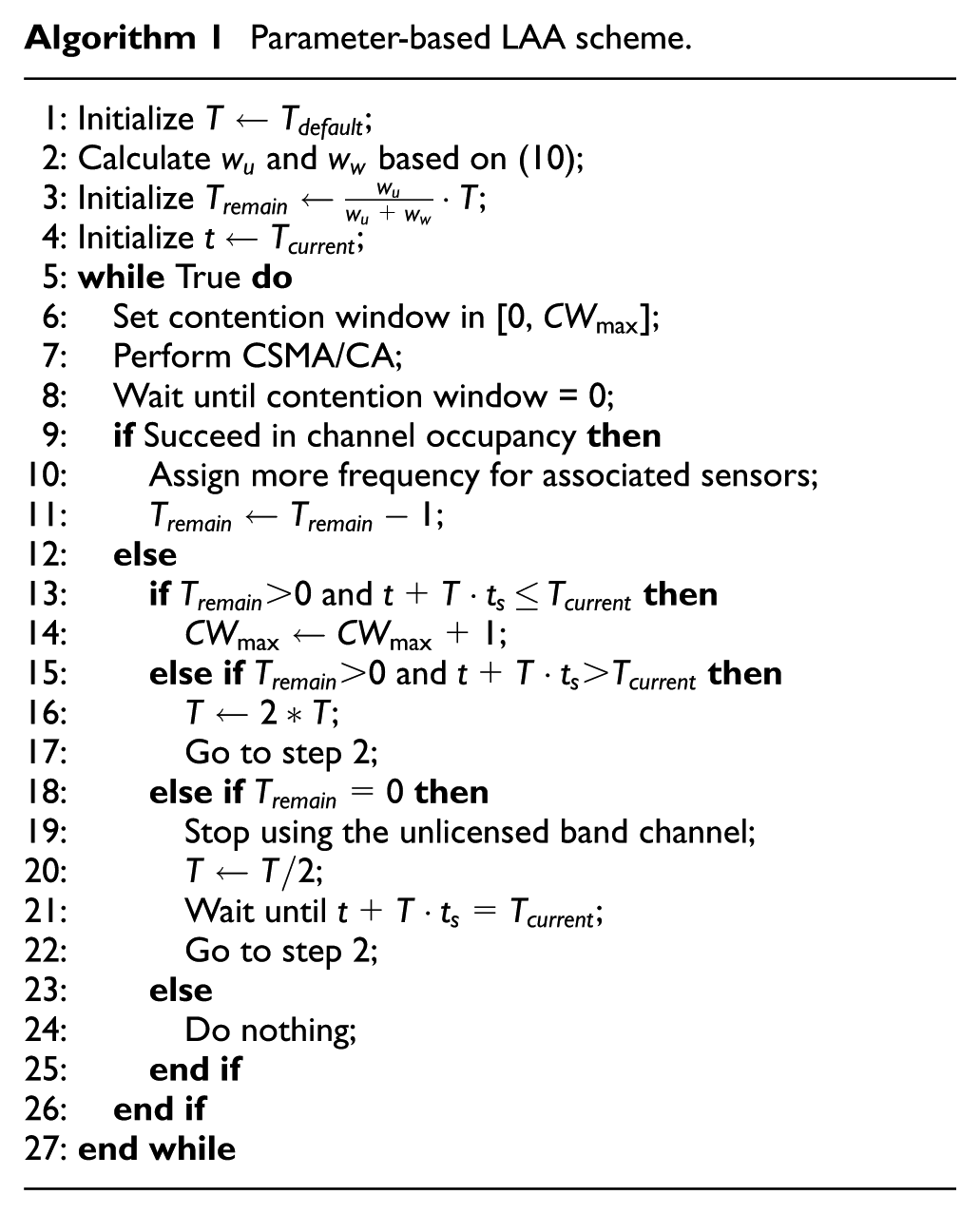
If the competition fails, it is divided into three cases. (1) If there is a time slot that needs to be allocated to the LTE-LAA sensor and the current time is less than

The time table of the proposed scheme: two WLAN sensor nodes and the LTE-LAA AP compete with each other to occupy the channel. In (a), WLAN sensor #1 occupies the channel and other nodes set as NAV. In (b), LTE-LAA AP occupies the channel (
Performance evaluation
In this section, we conduct an analysis to verify our proposed algorithm. For the performance evaluation, we use a MATLAB tool. In this analysis, we use the Bianchi 26 model and compare the results with the network allocation vector (NAV) based LTE-LAA technique, that the LTE-LAA AP adjusts NAV values based on associated sensors. 24 All of the sensors are randomly deployed in the coverage of small cells. Some parameter values are fixed, such as the transmission power, and we do not consider sensor mobility.
The details for configuration of the analysis parameters are shown in Table 3. To measure the effectiveness of the proposed scheme, we evaluate the following performance metrics:
Aggregate throughput of secondary nodes (Mbps). Total data traffic of all sensor nodes in bits transferred successfully from all sensor nodes divided by time.
Channel utilization (%). The ratio of time that a channel is occupied by all sensor nodes to the entire time.
Jain’s fairness index. The square of the average
Average delay. The average delay of sensor nodes.
Analysis parameters.

Figure 7 shows the aggregate throughput versus the number of LTE-LAA sensors. As shown in the figure, the aggregate throughput for LTE-LAA sensors increases as the number of LTE-LAA sensors increases for all schemes. However, the throughput of the WLAN sensors decreases as the number of LTE-LAA sensors increases. This is because the number of nodes in the LTE-LAA has increased and thus a higher

The aggregate throughput versus the number of LTE-LAA sensors (the number of WLAN sensors = 10).
Figure 8 shows the aggregate throughput versus the number of WLAN sensors. As shown in the figure, the result is similar to Figure 7 for the proposed scheme. However, in the NAV-based scheme, the throughput shows almost the same slope regardless of the number of WLAN sensor nodes. This is because the LTE-LAA AP sets the NAV value of its associated sensor node when it wins the competition.

The aggregate throughput versus the number of WLAN sensors (the number of LTE-LAA sensors = 10).
Figures 9 and 10 show the channel utilization versus the number of LTE-LAA sensors and WLAN sensors, respectively. As shown in the figures, the proposed technique sets the weight based on how many LTE-LAA and WLAN sensor nodes are arranged, so that both sensors use the channel fairly. However, since NAV-based coexistence technology sets a large NAV value based on the number of associated sensors when the LTE-LAA AP wins the competition, the WLAN sensor nodes cannot use the channel at that time.

Channel utilization versus the number of LTE-LAA sensors.

Channel utilization versus the number of WLAN sensors.
Figure 11 shows the average delay of the sensor nodes versus the number of LTE-LAA sensors. As can be seen in the figure, the delay of LTE-LAA sensors is very small, 1–5 ms in both of the schemes. However, for WLAN sensors in the NAV-based scheme, the delay sharply increases for numbers of LTE-LAA sensor nodes larger than six. This is because APs cannot transmit WLAN nodes by allocating a large NAV value as in the previous case.
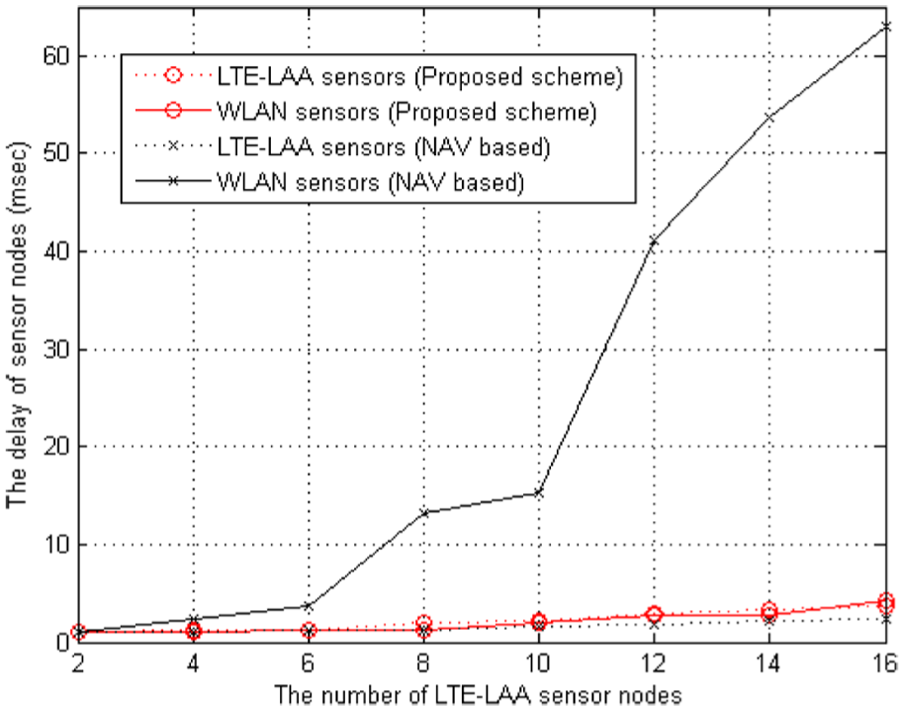
The average delay versus the number of LTE-LAA sensors.
Figure 12 shows the Jain’s fairness index versus the number of LTE-LAA sensors. As can be seen in the figure, the fairness index decreases as the number of LTE-LAA sensors increases. As the number of LTE-LAA sensors increases, more WLAN nodes receive less opportunity because they allocate more resources to the nodes. In addition, the fairness index is rapidly reduced in the NAV-based technology. However, the proposed technique considers the queue backlog size and thus the sensor has a high possibility of transmission compared to the other sensor nodes by providing more opportunities to the nodes that have not previously transmitted data.
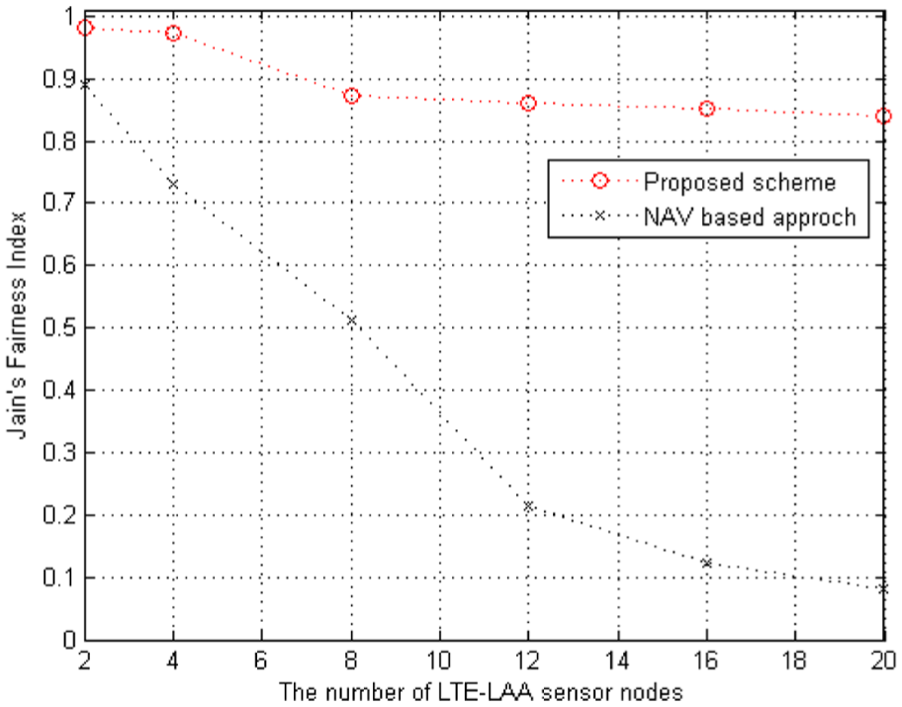
The Jain’s fairness index versus the number of LTE-LAA sensors.
Conclusion
WSNs have continuously evolved to provide better services and better satisfy user demands. Through this evolution, the number of wireless sensors and the amount of mobile traffic have been exponentially growing every year. LTE technology can effectively resolve problems caused by traffic growth; however, there are still limitations. In recent years, LTE-LAA technology utilizing unlicensed spectrum with CA technology has become popular. These technologies have greatly improved the performance of existing LTE HetNets. However, coexistence technologies with existing WLAN sensor nodes remain a challenge. In particular, the LTE-LAA AP should efficiently handle the problem of monopolizing the frequency resources used by existing WLAN sensor nodes. In this article, we investigate an optimized time slot allocation technique for the coexistence of WLAN and LTE-LAA sensor nodes. In order to maximize the throughput of each WLAN sensor and LTE-LAA sensor node in the proposed algorithm, we designed an objective function based on the number of WLAN and LTE-LAA sensor nodes as well as the queue size of each sensor. We then found optimal parameters by considering KKT conditions. Through extensive simulations, we showed that the proposed scheme can significantly outperform the other existing techniques in terms of the throughput, channel utilization, delay, and transmission fairness.
Footnotes
Academic Editor: Chunming Qiao
Declaration of conflicting interests
The author(s) declared no potential conflicts of interest with respect to the research, authorship, and/or publication of this article.
Funding
The author(s) disclosed receipt of the following financial support for the research, authorship, and/or publication of this article: This research was supported by the Chung-Ang University Graduate Research Scholarship in 2015 and National Research Foundation of Korea (NRF) funded by the Ministry of Education (NRF-2016R1D1A1A09919249).