




Abstract
For the relay cooperation systems or networks, in some scenarios, the relay is deployed in the hard-to-reach areas, such as on the remote mountains or in the sea. It is impractical for the relay to be powered by grid energy. And if the relay is powered by battery, it is difficult and high cost to replace the depleted battery. To overcome the power dependence of the relay, this article proposes the network-coding-based two-way relay cooperation with energy harvesting, where the relay is equipped with multiple antennas for information decoding and energy harvesting. Network coding is adopted at the relay to reduce the time slots, and low-density parity check codes are employed at the sources to improve the reliability. We introduce a maximal ratio combining–based decoding algorithm for the proposed system to achieve coding gain and diversity gain. Furthermore, we analyze the outage probability and bit error rate of the system when the optimal antenna selection algorithm is adopted at the relay to transmit data. Theoretical analysis and numerical simulation results show that the proposed system outperforms the corresponding point-to-point system under the same condition. The result also demonstrates that the relay should be deployed closer to the user whose outage probability is required to be lower.
Keywords
Introduction
Energy harvesting from ambient environment can potentially reduce the dependence on the supply of battery or grid energy. Recently, energy-harvesting communications and networks1–5 have attracted great attention from both academic and industrial communities. Based on the energy-harvesting technology, the communication nodes can benefit the energy saving and lower the carbon footprint. What is more important, because the nodes are powered by harvested energy, their lifetime is not limited by the battery or grid energy, and they can be deployed in hard-to-reach areas to enlarge the coverage and reduce the communication blind zones. Traditional energy-harvesting techniques rely on natural energy sources such as solar or wind. The energy harvested level is influenced by many factors, such as the time of the sunshine and the seasonal weather patterns. Since ambient radio frequency (RF) signals are widely available in the world, a promising harvesting technology is to use the RF energy. RF-based energy-harvesting communications can realize simultaneous information and power transfer (SWIPT),6–8 which generates great interest in the research of this area.
RF-based energy harvesting is extensively investigated in various communication scenarios, such as multiple-input multiple-output (MIMO) systems,9,10 cognitive radio networks,11,12 and relay cooperation.13–15 Relay cooperation16,17 enables single-antenna nodes to share the use of their antennas to form a virtual MIMO, which exploits the spatial diversity and improve the performance of wireless communication systems. Hence, relay cooperation with energy harvesting can not only achieve high performance but also break through the power limitation. Li et al. 4 considered a cooperative communication in sensor networks with energy harvesting. In order to maximize the long-term utility of the network, energy efficient scheduling strategies are developed by a Markov decision process (MDP). Ku et al. 18 investigated a cooperative system where one source transmits data to one destination with the assistance of an energy-harvesting decode-and-forward relay. The average symbol error rate performance is minimized through the MDP framework. Minasian et al. 19 studied an energy-harvesting amplify-and-forward relay cooperative network. In offline and online settings, optimal policies for transmission are obtained via maximizing the throughput.
Some researchers extended the one-way cooperative systems or networks with energy harvesting 4,18,19 to two-way relay cooperation scenarios. For a non-regenerative two-way multi-antenna relay network with energy harvesting, Li et al. 20 considered a non-convex energy-harvesting-constrained relay beam-forming optimization problem. Based on semi-definite programming and rank-one decomposition theorem, an iterative algorithm is proposed to find the global optimal solution. Shah et al. 21 proposed a two-way multiplicative relay with energy harvesting, where the relay node uses power splitting–based relaying protocol for energy harvesting and information processing. Du et al. 22 presented a time switching–based network-coding relaying (TSNCR) protocol for the two-way relay system with energy harvesting. The outage probability for the proposed TSNCR protocol is derived and further minimized by a genetic optimization algorithm. All the scenarios considered in Li et al., 20 Shah et al., 21 and Du et al. 22 ignore the direct link between the sources which may be blocked due to obstacles. However, when there are no obstacles between the sources, the direct link should be taken into account.
In this article, we investigate the network-coding-based two-way relay cooperation with energy harvesting. There are direct links between the sources and the relay is equipped with multiple antennas which are able to harvest energy. The main contributions of this article are summarized as follows:
Network-coding-based two-way relay cooperation with energy harvesting is proposed. At the sources, low-density parity check (LDPC) codes are employed to improve the reliability, and at the relay, network coding is adopted to reduce the time slots and improve the average throughput.
Maximal ratio combining (MRC)-based decoding algorithm for the network-coding-based two-way relay cooperation is introduced, via which coding gain and diversity gain are achieved.
When the relay adopts the optimal antenna selection algorithm to transmit data, the outage probability and bit error rate (BER) of the network-coding-based two-way relay cooperation with energy harvesting are studied by theoretical analysis and numerical simulations.
The rest of this article is organized as follows. In section “System description,” the system description of the network-coding-based two-way relay cooperation with energy harvesting is presented. Section “MRC-based decoding algorithm for the proposed system” introduces the MRC-based decoding algorithm for the proposed system. Section “Performance analysis of the proposed system” analyzes the outage probability of the system. Simulation results are provided in section “Simulation results.” Finally, in section “Conclusion,” we conclude the whole paper.
System description
Network-coding-based two-way relay cooperation with energy harvesting is described as follows. Two users S1 and S2 exchange information with the help of relay R. S1 and S2 are equipped with single antenna with battery or grid power supply. The relay R is equipped with K antennas without external power supply, and it is powered by the energy harvested from the RF signals from S1 and S2. At the relay, some antennas are used to decode the incoming signal, and the rest antennas are used to harvest energy, which is used to broadcast the information to the users. To further improve the reliability of the system, LDPC codes 23 are adopted at S1 and S2.
Figure 1 shows the three time slots of the network-coding-based two-way relay cooperation with energy harvesting, which is designed as follows:
In time slot 1, the information bits at S1 are encoded into a codeword
In time slot 2, the information bits at S2 are encoded into a codeword
At the relay R, some antennas are used to decode the signals, and the rest antennas are used to harvest energy from the RF signals from S1 and S2. The relay combines the recovered


Network-coding-based two-way relay cooperation with energy harvesting.
In time slot 3, R broadcasts
If the relay transmits the recovered
MRC-based decoding algorithm for the proposed system
An MRC-based decoding algorithm for the network-coding-based two-way relay cooperation with energy harvesting is introduced. Because S1 and S2 are reciprocal, here, we just describe the decoding algorithm for S1. Binary phase-shift keying (BPSK) modulation is adopted. According to equation (1), the relationship between
Relationship between
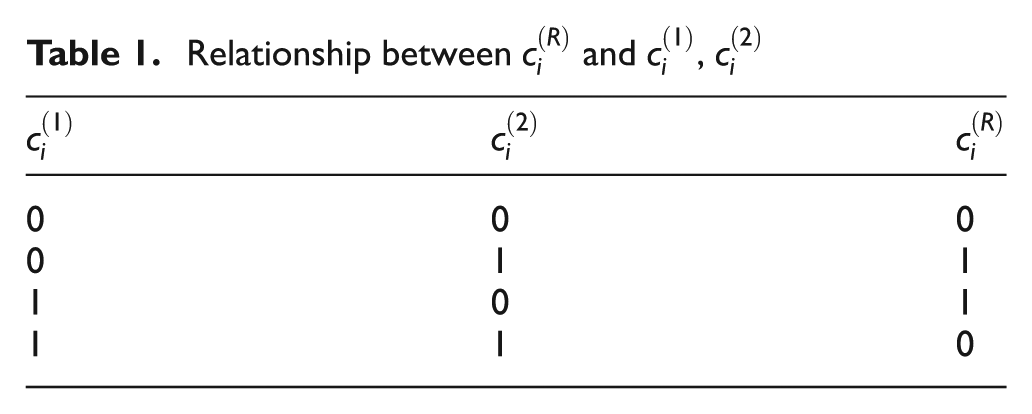
At S1, there are two received signals:
However,

where
We assume

Based on
Because
Performance analysis of the proposed system
In this section, we investigate the outage probability performance of the network-coding-based two-way relay cooperation with energy harvesting. Suppose
Energy harvested at the relay
At the relay, for the RF signals from S1, the number of energy-harvesting antennas is

For the RF signals from S2, the number of energy-harvesting antennas is

Assuming the energy utilization ratio at the relay is

Signals received at the sources
We investigate only the outage probability of S1 due to the reciprocal of S1 and S2.
At S1, the received signals from S2 is

where
Assume the optimal antenna selection algorithm
25
is adopted at the relay to select the optimal antenna

where
At S1, the received signals from R is

where

According to equation (3), we achieve

By MRC combination, we have
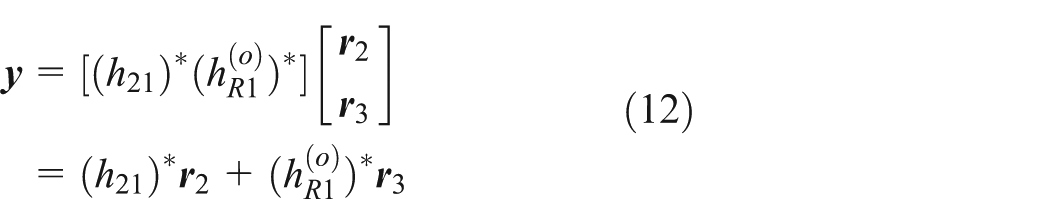
where
Outage probability of the sources
An outage event occurs when the instantaneous channel capacity falls below the data transmission rate. The probability of the outage event occurring is defined as the outage probability. 17
At S1, the instantaneous channel capacity is

where

Hence, the outage probability can be calculated as

where

The density function of

The outage probability will be further analyzed by simulations.
Simulation results
In this section, we investigate the outage probability and BER performance of the network-coding-based two-way relay cooperation with energy harvesting by numerical simulations. S1-R, S2-R, S2-S1, and R-S1 are Rayleigh block fading channels with perfect channel state information. The average SNRs per bit per antenna of the signals are defined as the ratio of transmission power P and the noise power
Outage probability comparison of the proposed system and the point-to-point system
In this part, we present the outage probability performance of the proposed system with various numbers of antennas at the relay. Assume that the numbers of antennas K = 2 or 3, where the number of information decoding antennas is 1, and the number of energy-harvesting antennas K1 = K2 = 1 or 2. The energy utilization ratio at the relay
Figure 2 compares the outage probabilities of the proposed system and the point-to-point system. It is shown that the outage probability of the proposed system is much lower than that of the point-to-point system, and the diversity order is higher. This states that the proposed system can improve the performance without increasing the total power consumption. It is also demonstrated that the outage probability performance of the proposed system with K = 3 clearly outperforms that of the system with K = 2 under the same conditions. This can be contributed to the following fact: the more the antennas are equipped at the relay, the more the energy is harvested and the higher diversity gain is achieved with the optimal antenna selection algorithm. Figure 2 also depicts that the higher the energy utilization ratio

Outage probability comparison of the proposed system with two or three antennas and various energy utilization ratios at the relay.
Outage probability of the proposed system with various
,
We investigate the effect of the relay location on the outage probability of the proposed system. Assume K = 3, K1 = K2 = 2,
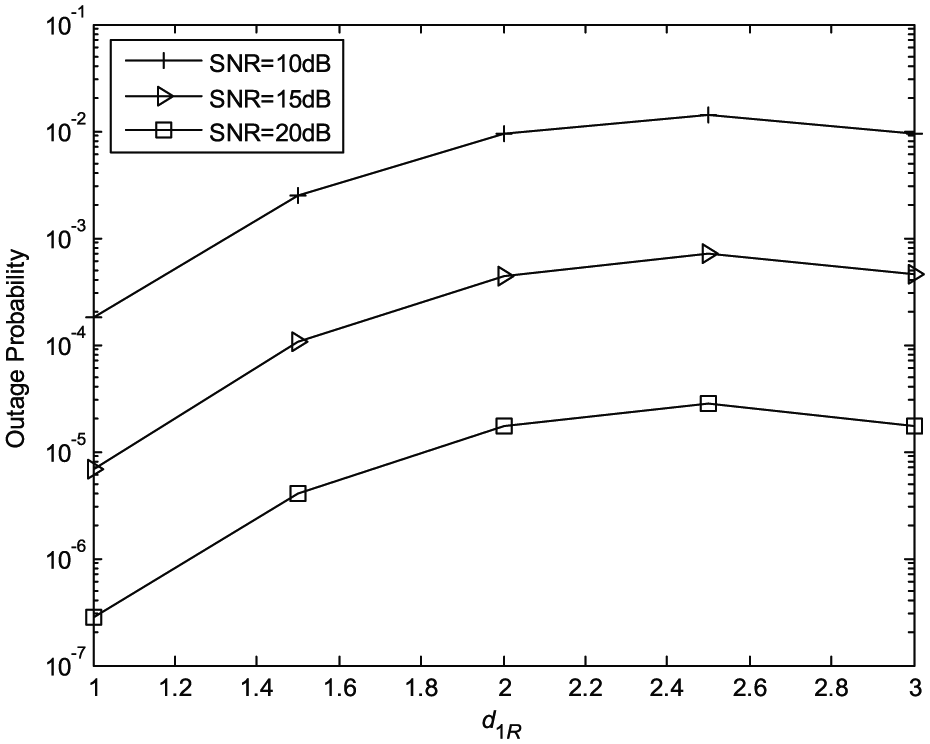
Outage probability of the proposed system versus
Outage probability of the proposed system with various antenna selection algorithms
Assuming K = 3, K1 = K2 = 2, and

Outage probability of the proposed system with the optimal antenna selection, equal power allocation algorithm, or random antenna selection algorithm at the relay.
BER of the proposed system with LDPC codes at the sources
In this part, we investigate the BER performance of the proposed system with LDPC codes. Assume K = 2 or 3, K1 = K2 = 1 or 2, and

BER performance of the proposed system with LDPC codes, where two or three antennas are deployed at the relay, and one or ten decoding iterations are implemented at the user.
Comparison of the proposed system and the power splitting–based system
In the proposed system, the relay adopts the antenna switching–based protocol for information decoding and energy harvesting, where some antennas are used to decode the incoming signal, and the rest antennas are used to harvest energy. In this part, we compare it with the system where the power splitting–based protocol is adopted by the relay as described in Ding et al. 8 Random LDPC codes employed by S1 and S2 are the same as given in section “BER of the proposed system with LDPC codes at the sources.” Assume K = 2 and K1 = K2 = 1. For a fair comparison, because half of the antennas are used to harvested energy in the proposed system, we assume that half of the power for each antenna is used to harvested energy in the power splitting–based system.
Figure 6 compares the BER of the proposed system with that of the power splitting–based system with various energy utilization ratios

BER comparison of the proposed system and the power splitting–based system with various energy utilization ratios
Conclusion
In this article, we have studied the network-coding-based two-way relay cooperation with energy harvesting, which combines coded cooperation, network coding, and energy-harvesting technologies. It can achieve high diversity and coding gain, reduce the time slots, and overcome the dependence on the supply of battery or grid energy. An MRC-based decoding algorithm is introduced for the proposed system to combine signals from independent channels and combat the fading. When the optimal antenna selection algorithm is adopted at the relay to transmit data, the outage probability and BER of the proposed system are investigated by theoretical analysis and numerical simulations. The results show the superiority of the proposed system compared with the point-to-point system. For the relay, simulation result also shows that the performance of the scheme employing the optimal antenna selection algorithm is better than that of the random antenna selection algorithm or equal power allocation algorithm.
Footnotes
Academic Editor: Danilo De Donno
Declaration of conflicting interests
The author(s) declared no potential conflicts of interest with respect to the research, authorship, and/or publication of this article.
Funding
The author(s) disclosed receipt of the following financial support for the research, authorship, and/or publication of this article: This work was supported by the National Natural Science Foundation of China (nos 61501256, 61271234, and 61302102), the Natural Science Foundation of Jiangsu Province (no. BK20150857), the China Postdoctoral Science Foundation (no. 2014M561694), and NUPTSF (no. 214007).