




Abstract
Body area network is a new miniature wireless sensor network technology, which has found increasing applications, especially in medicine, healthcare, and entertainment. However, each sensor in a body area network has its own awaking and sleeping time due to its heterogeneous nature, which causes the phenomenon of communication conflict. Carrier sense multiple access with collision avoidance method could not be adopted because body area network needs real-time data transmissions, especially emergency situations. In this article, first, a body area network system with hardware, software, and network administration is designed using ZigBee technologies, which includes network structure, sensor nodes, data collection, communication with upper computer, and so on. Second, the reason caused communication conflict in the body area network is analyzed, and accordingly a method to solve the conflict problem is proposed. Finally, the feasibility and effectiveness of the proposed method is evaluated through simulation analysis and system testing.
Keywords
Introduction
Body area network (BAN) typically consists of a number of sensor nodes which can be placed in, on, or around the body, so that it can monitor human body functions and characteristics from surrounding environment. These nodes generally compose a star-topology network, where the central coordinator communicates with sensor nodes directly. The central coordinator then forwards human physiological information to remote server to monitor human health state. In this way, BAN has been used in early detection of disease and patient’s recovery.
The precursor of BAN, which is personal area networks (PAN), drew attention in the field of E-consumer and scientific research immediately after it was put forward in 1996. 1 With the development of PAN and short-distance wireless communication, some limitations of PAN emerged. Specifically, IEEE802.15 sets up body area network standard group (SG-BAN) and the sixth task group (TG6) for standard discussion, drafting and sharing under this circumstance. Finally, the IEEE802.15.6 standards were released in February 2012. 2
It is well known that saving energy in an energy-constraint network is extremely important. Major efforts have been made to explore high energy efficiency solutions in BAN. A data fusion technique has been proposed for the BAN with biomedical signals. This proposed method can be of much lower complexity in comparison with conventional techniques, and consequently, power consumption in the BAN can be significantly reduced. 3 A novel distributed coding reconstruction algorithm based on the compressed sensing theory is presented for solving the problem of energy efficiency in BAN. 4 The energy consumption has been reduced by changing routing ways in Li et al. 5 The same goal has been achieved through maximizing nodes sleep time. 6 Medical and non-medical applications of context awareness in wireless body area network (WBAN) have been introduced in Tobón et al. 7 A context-aware media access control (MAC) protocol has been designed by Liu et al. 8 A new, adaptive, and energy-efficient MAC protocol is proposed based on multi-channel communication and aims to prolong the network lifetime by effectively employing (1) a collision prevention mechanism, (2) wireless coordinator node (WCN) selection algorithm, and (3) a transmission power adjustment approach in I Kirbas et al. 9 To reduce the system power consumption of BAN, a joint sparse model-JSM-2 and the reconstruction algorithm are presented in Hu et al. 10
A new task scheduling of fork-join tasks with serial communication (TSFJSC) method to map the fork-join tasks on multi-core processors is proposed in Liu et al. 11 Busy-window is introduced to avoid the communication conflict. In EW Chandler, 12 a technique that places redundant system-support time slots in the time-division multiple access (TDMA) frame is described and analyzed, which can avoid time-slot conflict effectively. A joint optimization problem over the set of transmitting devices and the packet combinations with a conflict-free graph model, which contains both coding conflict and transmission conflict, is proposed in Zhan and Gao. 13 An exhaustive mathematical framework for three-dimensional (3D) conflict detection is explored in I Mahjri et al., 14 and a novel distributed conflict detection algorithm is proposed. The optimal packet size for various communication scenarios in WBAN is determined for two distinct Ack policies: IAck and BAck in KS Deepak and AV Babu. 15 Also, a QoS-driven scheduling approach is proposed to address delivery probability and data rate which are time varying and energy efficiency in Yan et al. 16
However, BAN is a network which contains a variety of sensors to monitor physiological parameters of human body timely. These sensors collect data and then transmit sensing data to the access point (AP). Some of the transmission processes happen simultaneously. Also, due to the heterogeneous nature of the BAN, each sensor has its own awaking and sleeping time, which causes communication conflict among different nodes in a BAN. Communication conflict causes serious influences on network throughput, data transmission delay, and user experience. Some research on solving communication conflict in wireless communication network has been performed. But there are few references that explore communication conflict in BAN.
To address this problem, an approach for solving communication conflict is proposed in this article. The hardware, software, and network’s administration in a BAN is first designed using ZigBee technologies. The communication conflict among different nodes in the BAN is then investigated and the reason caused conflict is analyzed. Based on the analysis, a method to solve communication conflict is proposed and its feasibility and effectiveness is evaluated. As a result, the BAN system we design shows good performance on human physiological information collection.
The rest of this article is organized as follows. In section “BAN system design,” the BAN design is presented in detail. Following that, communication conflict among sensor nodes in the BAN and a novel method for solving the conflict are discussed. The simulation analysis and system testing are given in section “System testing.” Finally, the concluding remarks are given in section “Conclusion.”
BAN system design
BAN structure and system design
Figure 1(a) shows the structure of a BAN system that can be divided into three parts, that is, sensor nodes, central coordinator, and upper computer:
Sensor nodes. This part is composed of body temperature sensor nodes, heart rate sensor nodes, and blood pressure sensor nodes. These sensor nodes are used to collect the body’s physiological parameters that after analog-to-digital (AD) conversion are transmitted through a ZigBee network via wireless communication.
Central coordinator. Central coordinator is the connection between sensor nodes and upper computer. It is used to deal with network information and also carry out communication with upper computer in real time as well. Central coordinator has two main functions: first, initializing the BAN network and maintaining the network connection status; second, collecting data from sensor nodes in a polling way and then sending the data to upper computer through a serial port or Bluetooth.
Upper computer. Upper computer could be a computer or terminal equipment, such as cell phone and personal digital assistant (PDA). The terminal equipment must have a serial port or Bluetooth adapter to collect data from central coordinator and then deposit them in the database or uploaded them to the network after processing.

(a) BAN system chart and (b) BAN system flow.
The system design flowchart is shown in Figure 1(b).
Sensor nodes and central coordinator start to work after initialization. The central coordinator establishes BAN as shown in Figure 1(b), which broadcasts the network beacon for sensor nodes to join in the network. Sensor nodes then send request after receipt of the network beacon containing join information. After receipt of the requested information, the central coordinator determines whether or not allowing the corresponding sensor nodes to join. If sensor node is allowed to join in the network, the data will wait to be sent.
The central coordinator requests sensor nodes to collect information such as temperature, heart rate, blood pressure, and other physiological parameters, in a polling way. If a node captures data successfully, it will send the data according to the predefined frame format; if in the case of failure or during data collection, the corresponding information will be transmitted to the coordinator. The central coordinator encapsulates the collected data and sends via Bluetooth to the upper computer in a fixed form. After that, the upper computer receives the data with error detection and saves them in the database or uploads them to the specified network. The above process describes one round of data collection in a BAN system.
BAN system hardware design
The structure of sensor nodes is shown in Figure 2. It mainly consists of collection part, controller part, wireless transmission part, debugging part, and battery part.

Structure of sensor nodes.
The function of the collection part is to collect and process physiological signals including body temperature and heart rate. The sensor used here for taking heart rate is SC0073, which is a type of sensor with high performance and low-cost small piezoelectric pressure.
The control part is used to transform analog signals into digital signals and then evaluate the correctness of signals by checking whether the measured values are within the correct ranges. The control chip used here is CC2530, which has a 14-bit AD converter, an 8051 core, and a ZigBee wireless module. It can realize AD conversion, controller, and wireless transceiver as well.
Wireless transmission part, debugging part, and battery part are used for transmitting data, debugging program, and supporting energy.
The structure of central coordinator is shown in Figure 3. It mainly consists of serial port part, controller part, wireless transmission part, debugging part, and battery part. Most parts of the central coordinator when using CC2530 are same as sensor nodes and the only difference between them is that the collection part in sensor nodes is replaced by the serial port in central coordinator.

Central coordinator structure.
Analysis and solution for communication conflict
Because of the low-power characteristic of sensor nodes in BAN, it can be implanted in human body. However, communication conflict may result in intolerant power consumption. To address this, we will analyze the communication conflict among sensor nodes in BAN first and propose an effective solution in this section. Before we start this section, we first draw a clear distinction among the terms of sampling interval, sampling time, and sampling instant as follows:
Sampling interval is the time period between two borders upon sampling;
Sampling time is the duration of sampling;
Sampling instant means the beginning time of sampling.
Theoretical analysis
Assume that there are

where
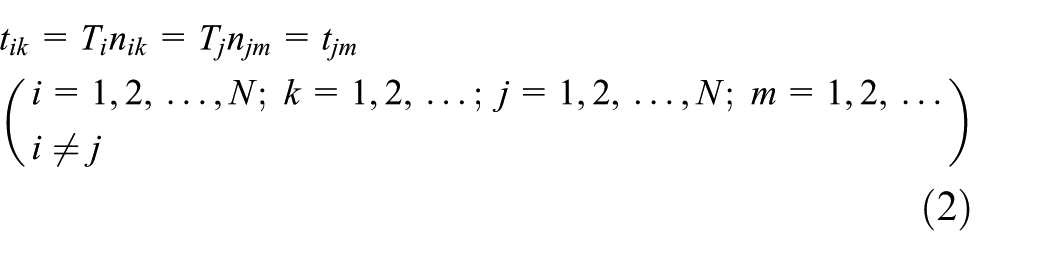
Equation (2) shows that conflict occurs between sensor node
Solving communication conflict
Theoretical analysis indicates that conflict is unavoidable, it is therefore necessary to find a method to solve it. In this sub-section, a novel method will be proposed, which is elaborated below.
Before preparing for communicating with one node, the central coordinator obtains the sampling interval, sampling time, and current sampling instant according to the index of its serial number. Afterward, the central coordinator calculates the next sampling instant based on the above information and compares it with the others’ next sampling instant. The time value subtracts current sensor node’s sampling time to get a new value, if it is coincident. The central coordinator compares the new value with the others’ once again. However, if not coincident, the sensor node transmits data to central coordinator directly. The process is shown in Figure 4.

Process in solving communication conflict.
Example
To illustrate our method, two examples are considered as follows in this section.
Example 1
Assume that there are three nodes P, Q, and R in BAN and their sampling interval are

where

(a) Sampling instant without solving conflicts and (b) sampling instant with solving conflicts.
We can find that conflict occurs between P and Q at time
Example 2
To show the effectiveness of the proposed method, an example with three nodes as well, named as A, B, and C is illustrated in this example. The simulation is conducted in MATLAB. The parameter settings are shown in Table 1.
Parameter settings of nodes A, B, and C.
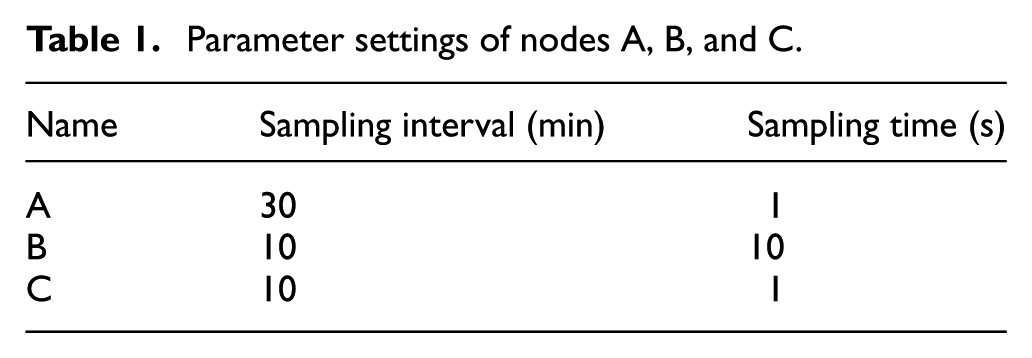
The sampling instants of the three nodes are shown in Figure 6, without using the proposed conflict mechanism. The horizontal axis shows the times of data collection for different sensor nodes and the vertical axis is the corresponding sampling instants. When the system works normally, we draw a straight line which is parallel to the horizontal axis and the line can go through one point at most. It is because the central coordinator can only communicate with one sensor node at each time. It can be observed from the figure that both nodes of A and B have the same sampling instant at identical abscissa. This result indicates that the sampling instant of sensor node A conflicts with B. Moreover, there will be conflicts between sensor nodes A, B, and C at 30 min and 60 min. It is obvious that the system cannot work normally when such conflict occurs.

Sampling instants without solving conflicts.
The simulation result by solving conflicts using the proposed method is shown in Figure 7. From this figure, we can see that the sampling instant of A and B has changed and the conflict between them has been avoided. At the points of 30 and 60 min, the sampling instant of sensor nodes A, B, and C is close rather than overlapping, which means that no conflict occurs.

Sampling instants with solving conflicts.
In order to verify the stability of the proposed method, the system is tested after running a long time. We observe the period from 200 to 300 min. The simulation results are shown in Figure 8, from which we can find that although the distribution of the sampling instants of the nodes is relatively close, the system can work normally without occurrence of conflict.

Sampling instant simulation with solving conflicts after working for a long time.
System testing
In this section, the test of BAN system is divided into two parts. The first part, which is used for testing the correctness of system protocol, program, and data, is the operation test of BAN system. The second part is to test the conflict solution, where we check whether the system work normally after a new node joints into.
Operation test of BAN system
Figure 9 shows how to wear the sensor nodes. The experimental environment is as follows:
A healthy man as the experimental target;
Heart rate sensor is worn on the right hand wrist as sensor node A;
Blood pressure sensor is placed in the right hand of the elbow as sensor node B;
Temperature sensor is placed in the left armpit as sensor node C.

Way for wearing sensor nodes.
Test duration is an hour and the data that upper computer received are listed in Table 2. Note that the data of temperature and blood pressure are shown by hexadecimal and heart rate by decimalism.
Data received by upper computer after 60 min.
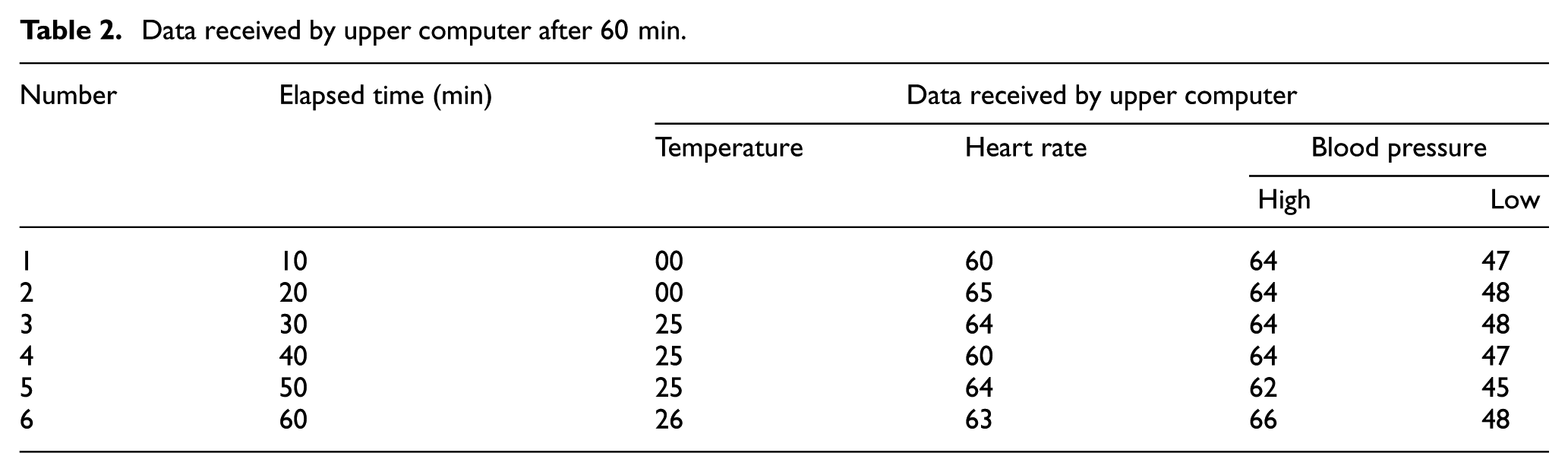
After the system has worked for 10 min, the data collected contain heart rate and blood pressure, which are shown in Table 2. It can be seen that the temperature value is zero. This is because the temperature sensor comes into working after the system has worked for 30 min. The temperature value changes after 30 min and it is not zero any more. Based on our long-term observation, the system can work normally without any breakdown.
Test of conflict solution
To test our proposed conflict solution, we define a new node denoted as E, which is used to transmit a fixed data. The parameter settings of E are shown in Table 3.
Parameter settings of node E.

We let E join into this system and theoretically there should be conflict without applying any conflict solution. Table 4 shows the data received in the upper computer after E joining. We could see that E does not send data to the central coordinator at the beginning of the first 10 min. The data sent by E changes only after system has worked for 20 min. This indicates that E join into this system successfully without conflict. In long-term observation, the system can run normally without any conflict, which indicates that our proposed conflict solution is effective.
Data received by upper computer after E joining.

Conclusion
In this article, we present the design of the BAN system using ZigBee technologies with hardware, software, and network’s administration, which includes net’s build, nodes’ join, data collection, delivery to the upper computer, and so on. The reason of communication conflicts in nodes of the BAN is analyzed and an effective solution for solving conflict by scheduling the sampling instant is proposed. The feasibility and validity of the proposed method are demonstrated through theoretical evidence, simulation analysis, and system test. It can be shown from the simulation results that the BAN system designed using our method is feasible and efficacious without communication conflicts.
Footnotes
Acknowledgements
F.H. put forward the theoretical framework, analyzed the reason that caused communication conflict in the BAN, and accordingly proposed the method to solve the conflict problem. W.X. designed the BAN system with hardware, software, and network administration using ZigBee technologies. M.S. and T.X. evaluated the feasibility and effectiveness of the proposed method through simulation analysis and system testing. F.H. and W.X. wrote the paper. M.S. and T.X. reviewed and edited the manuscript. All authors read and approved the manuscript.
Academic Editor: Joel Rodrigues
Declaration of conflicting interests
The author(s) declared no potential conflicts of interest with respect to the research, authorship, and/or publication of this article.
Funding
The author(s) disclosed receipt of the following financial support for the research, authorship, and/or publication of this article: This research was supported by the National Natural Science Foundation of China under Grant Nos 61074165 and 61273064.