




Abstract
Mesh clients in hybrid wireless mesh networks can perform the routing functionality, as well as provide end-user applications that are more suitable for tunnels, to improve the connectivity of backbone networks. In this article, based on the diversity of data and limited power supply of mesh clients in hybrid wireless mesh networks in underground mines, we propose a multi-criteria routing metric to support data-differentiated service. This routing metric divides data into two types: urgent and non-urgent. End-to-end delay is calculated when transmitting urgent data, and hop count and link load are measured when transmitting non-urgent data. In order to optimize the utilization of mesh clients and to prolong the network lifetime, mesh clients and mesh routers are given different weights in the calculation of hop count. Based on the QualNet7.1 simulation platform, the performance of the proposed routing metric in transmitting urgent and non-urgent data is evaluated through numerous simulations. Simulation results indicate that the routes selected using the proposed routing metric can effectively reduce the average end-to-end delay when transmitting urgent data and reduce the utilization rate of mesh clients while simultaneously guaranteeing the capability of the network when transmitting non-urgent data. This finding satisfies the differentiated service requirements of data of different types for hybrid wireless mesh networks in coal mines.
Introduction
Coal mines are harsh working environments that have complex geological structures. Due to coal mining and tunnel excavation, coal and tunnel faces are constantly moving. Thus, wired communication networks cannot completely cover these special regions, and limited monitoring spots cannot fully monitor all areas. There are blind areas in the wired communication and monitoring systems in underground mines. 1 Therefore, it is urgent to construct a new wireless communication system adapted to the special underground working environment, particularly to solve the “last kilometer” problem.
Wireless mesh networks (WMNs), which are characterized by rapid deployment, strong reliability, good scalability, large capacity, and fast transmission rate, could solve the problems that exist in wired networks or traditional wireless networks in underground mines. 2 Compared with the existing networks, the above advantages make WMNs particularly suitable for the implementation of broadband wireless access and coverage networks in the last kilometer of underground mines with complex situations and narrow tunnels. 3
The possible architectures of WMNs can be classified into three types, depending on the function of the nodes. 4 Infrastructure WMNs: in this architecture, mesh routers (MRs) form an infrastructure for mesh clients (MCs). MCs cannot directly communicate with each other; therefore, they must connect to their MRs first. Client WMNs: in this architecture, MCs constitute the actual network to perform routing and configuration functionalities, as well as providing end-user applications to customers. Hybrid WMNs: this architecture is a combination of infrastructure WMNs and client WMNs. In this architecture, MCs can access the network through MRs or by directly meshing with other MCs. MCs in hybrid WMNs can perform the routing functionality, so the prime advantage of hybrid WMNs is the high-level network connectivity. If a hybrid WMN is used in an underground mine, the network will achieve higher robustness and wider coverage than wired networks or traditional wireless networks.
Hybrid WMNs in coal mines are mainly comprised of mesh portals (MPs), MRs, and MCs. An MP provides a gateway function for connecting with the broadband backbone network in a coal mine. Similarly, MRs have both routing and terminal accessing functions. MCs are enhanced terminals which can perform routing and terminal applications. Hybrid WMNs cover the underground MCs through terminal accessing or self-organization via MRs. Hybrid WMNs are more suitable for constructing wireless networks in coal mines, especially in narrow tunnels, due to their flexibility, robustness, and low cost. However, there have been no efficient and dedicated routing protocols for hybrid WMNs. Existing protocols, such as Ad hoc On-demand Distance Vector (AODV), Dynamic Source Routing (DSR), and Destination Sequenced Distance Vector (DSDV), are designed for Ad hoc networks, which are not suitable for the special environment of the underground mine.5–7
The existing routing protocols did not consider the characteristics of underground coal mines when they were designed. For example, the underground network is more prone to failure than the commons because of its long-chain topology and dynamic workplace. This requires the routing protocol to identify the node types and allow MCs to participate in networking and routing and then improve network robustness. Meanwhile, different types of nodes have different power supply modes. MCs are powered by batteries which will be consumed fast if used frequently. So, the utilization of MCs should be optimized by routing protocol to prolong the network lifetime. In addition, various types of data in coal mine networks have different transmission requirements. The urgent data, which need to be transmitted as soon as possible, require the shortest delay, and the non-urgent data require high throughput. Therefore, routing protocols of underground network should provide different services for different data to meet their different needs.
The focus of this study is to design targeted and easily implemented network protocols for hybrid WMNs in coal mines. The routing metric, as the measure of network performance and link quality, is the basis of network protocol design. 8 Based on the above features of hybrid WMNs in coal mines, the routing metric of link quality is analyzed in this article and then a multi-criteria routing metric (MRM) is proposed, which measures the link quality by considering end-to-end delay, hop count, and link load.
The remainder of this article is organized as follows. Section “Related work” reviews the related work. Section “Hybrid WMNs in coal mines” presents the characteristics of hybrid WMNs in coal mines. Section “MRM for hybrid WMNs in coal mines” proposes the MRM, which supports data-differentiated service for hybrid WMNs in coal mines, and describes it in detail. Section “Simulation experiment and performance evaluation” presents the results of the simulation experiments and analyzes the performance of the proposed routing metric. Finally, the study’s conclusions are presented in section “Conclusion.”
Related work
Routing protocol is used to search the path with minimum cost from source node to destination node. The weight of the cost is defined as a routing metric to measure the quality of the routing path, which is the standard by which to evaluate or select a path by routing protocol. Therefore, the routing metric plays an important role in the design of routing protocol and has a great effect on the performance of the network.
In early routing protocol designs for WMNs, most routing metrics were based on the number of hops. However, a routing metric based on hop count is not efficient because it does not consider the link quality, transmission rate, packet loss, and interference in WMNs. The generated route is not the optimal route when the link quality is poor or the network is congested. 9 For example, AODV protocol, which is easy to implement, uses the minimum hop count as its routing metric. 10 The routing metric of AODV only considers the hop count, so the selected path is the shortest path. The shortest path will be used to transmit data frequently, as the result, it is easy to cause the nodes on the path with heavy load and fast consumption of energy.
The node in hybrid WMNs with long-chain topology in coal mine has less neighbor nodes and MCs are powered by batteries, which are difficult to be replaced if the energy is exhausted. So, it is necessary to balance nodes’ load and optimize the energy consumption of MCs when the route is constructed. Different types of data in coal mine networks have different transmission requirements. The urgent data, which should be transmitted as soon as possible, require the shortest delay, and the non-urgent data require high throughput. Besides considering hop counts, the MRM should also consider the link load, data type, node type, and residual energy, to satisfy different transmission requirements.
A number of improved routing metrics have emerged, including Expected Transmission Count (ETX), Expected Transmission Time (ETT), and Weighted Cumulative Expected Transmission Time (WCETT).11,12 The link quality is measured by these routing metrics from different points of view. ETX and ETT use the method of transmitting broadcast packets to detect the link quality, thus the estimate of link state is more accurate than hop count. However, the estimated result is not the real link state in most cases because of the differences between broadcast packets and real data packets in packet size or transmission rate.
WCETT was designed based on the channel diversity of path, which is defined as follows

where Xj represents the transmission time of channel j, max Xj indicates the transmission time of the bottleneck channel, and β is an adjustable parameter that ranges from 0 to 1. The first term in equation (1) expresses the time delay of path, and the second term represents the throughput. WCETT reflects the balance between delay and throughput. Compared with ETT, WCETT provides a more comprehensive estimation of link quality due to the intra-flow interference. Nonetheless, this routing metric does not completely reflect inter-flow interference.
Recently, improved routing metrics have been put forward for WMNs. Link quality, channel diversity, and channel load are considered in WCETT with Load Balancing (WCETT_LB). 13 Metric of Interference and Channel-switching (MIC) is designed to improve the WCETT by capturing more information on the inter-flow interference. 14 The physical interference model is used by the interference aware routing metric (iAWARE), which measures the link interference through the intensity of signal, and uses an adjustable parameter to balance the intra-flow and inter-flow interferences. 15 Flow Load Multicast Metric (FLMM) aims to find a multicast route which is better for reducing both intra-flow and inter-flow interferences and exploits channel diversity to improve network throughput. 16 Load and Interference-Aware Transmission Time (LIATT) uses the length of the buffer queue at the node to evaluate link load and uses the average load of neighbors to measure the interference. 17 Adaptive Load-Aware Routing Metric (ALARM) is computed using the number of packets that waited at each interface. ALARM offers accurate values of traffic load, link quality, interference, and noise levels. 18
With the wide application of WMNs, data types are becoming increasingly complex. It is difficult to design a routing metric that is both suitable and efficient for any application scenario. The routing metric should be designed for hybrid WMNs in underground mines according to the realistic network environment. Based on the characteristics of long-chain topologies and different requirements for the network speed and throughput, an MRM was designed to support data-differentiated service for communication in underground mines.
Hybrid WMNs in coal mines
Long-chain and multi-hop topology
There are many criss-crossed tunnels in an underground mine. With coal mining and tunnel excavation, the tunnels extend gradually and form a long-strip structure with a length of hundreds of, or even a thousand, meters. In order to adapt to the long-strip structure of the tunnels, hybrid WMNs in underground mines have the long-chain topologies rather than the common square or circular mesh topologies used on the ground. Therefore, hybrid WMNs in coal mines can only transfer information through multiple hops, as shown in Figure 1. This means that MCs need to communicate with MPs via multiple MRs or MCs to deliver data to the wired broadband networks.

Hybrid WMNs in a coal mine.
For the long-strip structure of the tunnels, the terminal node in traditional wireless networks can only be linked to a wireless router, so the node would be unable to communicate with the gateway if the router was broken. Therefore, the traditional wireless networks have poor robustness and repair capacity in underground mines. 19 MCs in hybrid WMNs can communicate with each other directly; thus, they can transmit data without MRs, as shown in Figure 2. Hybrid WMNs have higher reliability than traditional wireless networks for underground mines.

Link repair of hybrid WMNs in a coal mine.
Node type
In the underground mine, all electrical equipments need to meet the requirements for being an intrinsically safe power supply or explosion proof. A power supply is intrinsically safe if, under the conditions of intrinsically safe circuit standards, any electrical discharge or thermal effect produced by electric equipment cannot ignite the prescribed explosive gas. Different from the ground, the power supply of nodes in an underground mine is limited, which affects the transmission power and shortens the transmission distance. MRs use the cable power supply, while MCs use battery. The limited capacity of battery will constrain the running time of MCs and then affect the network lifetime. 20 In addition, the problem of energy constraints in hybrid WMNs is more prominent for underground emergency rescue. 21 Therefore, considering the characteristics of the energy supply of nodes, the utilization of MRs and MCs should be optimized to extend the lifetime of hybrid WMNs in a coal mine.
Data type
To ensure the safety of mining, monitoring data on complex environmental conditions, such as gas concentration, smoke concentration, wind speed, temperature, pressure, water level, and running state of feed system, should be collected and transmitted up to the ground. 22 Coal mine safety monitoring system needs to collect various information. For example, KJ90NA system has 1024 inputs, and if each input takes up 1 byte, then the total packets can occupy 1 KB. Many of these information are non-urgent data which should be transmitted just within the specified time if there is no sharp change in a short time. But urgent data, such as warnings about transfinite gas, power failure, abnormal feed, and other urgent data about emergent events, should be transmitted in real time, which require short network delay. The largest urgent data packet is only dozens of bytes.
Advanced coal mine safety monitoring system is connected with the video telephone, moving object recognition device, that is, which needs to use more network resources to transfer information. If non-urgent data are transmitted in the same way with urgent data, it is very likely to cause network congestion. If we use a dedicated path to transmit urgent data, the path is vulnerable to failure due to the complex and dynamic environment. Moreover, it is difficult to find an alternative route to repair the path quickly because of the long-chain topology of coal mine, as shown in Figure 2. Therefore, it is necessary to classify the data and then select the path dynamically according to the data type. In this way, a balance can be achieved between delay and throughput when implementing the data-differentiated service.
In summary, hybrid WMNs in coal mines have long-chain and multi-hop topologies. MCs and MRs have different energy supply modes. In addition, different data require different network performances. Considering these characteristics, an MRM for hybrid WMNs in coal mines is proposed in this article. This routing metric supports data-differentiated service and adjusts the parameters adaptively, in order to realize the optimal transmission for multi-media. At the same time, in order to reduce the energy consumption of MCs, a self-adaptive adjustment based on the node type is used in the routing metric. Consequently, the energy utilization of MCs will be reduced, and the network lifetime will be prolonged.
MRM for hybrid WMNs in coal mines
Hybrid WMNs in underground mines transmit data such as environmental monitoring data, voice, and video. Data with different types require different network performances. Warning on transfinite gas, audio, and other urgent data should be transmitted in real time. The environmental monitoring data, video, and other non-urgent data require high network throughput. Based on these characteristics, an MRM for hybrid WMNs in coal mines is proposed.
Routing metric model
According to the emergency level, the data are divided into two categories. Urgent data, such as warnings on transfinite gas and emergency voice data, require real-time service. Non-urgent data, such as environmental monitoring data and video, require high-throughput service. For urgent data, the transmission time is used to measure the path delay. For non-urgent data, hop count and link load are used to measure the path quality. In order to reduce the energy consumption and optimize the utilization of nodes, MRs and MCs are given different weights in the calculation of the hop count of the path.
We add the DataType and NodeWeight fields into the Route Request (RREQ) packet to identify the data type and node type, respectively. The MRM field is used to store path cost. The structure of RREQ is shown in Figure 3.
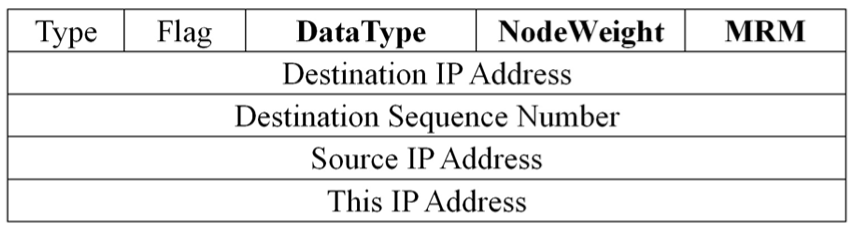
Route Request packet.
Differentiated service for urgent data
If the source node broadcasts an RREQ packet with DataType = 0, it indicates that urgent data will be sent. In order to transmit the data as soon as possible, MRM would select the path with minimum delay. Path delay is measured by the transmission time of the RREQ packet, and the path which returns the Route Reply (RREP) packet first will be selected as the routing path. MRM is calculated as follows


where pi is a path from source node to destination node, n is the number of nodes in pi, and ΔTj represents the transmission time of RREQ from node j − 1 to node j in path pi.
Differentiated service for non-urgent data
If the source node broadcasts an RREQ packet with DataType = 1, it indicates that non-urgent data will be sent. Non-urgent data only need to be transmitted within the stipulated time, and there is no mandatory requirement for transmission time. However, non-urgent data with large size require high network throughput, and data transmission will consume a large amount of node energy. In this article, MRM will consider network throughput and energy consumption when transmitting non-urgent data.
Hop count
According to the long-strip structure of the tunnels, hybrid WMNs in underground mines have long-chain topologies. Data transmitted from MCs to MPs will pass through more than a dozen or even dozens of hops. Therefore, the hop count of the path should be calculated by the routing metric.
In underground mines, MCs are powered by batteries with limited energy. Furthermore, the energy consumption of MCs is more significant in mobile monitoring and emergency rescue communication. MRM takes full account of the node residual energy when calculating the hop count. In order to optimize the utilization of the nodes and prolong the network lifetime, MRM takes the NodeWeight in the RREQ packet as a parameter, and nodes with different residual energy are given different weights to calculate the hop count. The corresponding relationship is as follows

where

Link load
In order to avoid network congestion, the routing metric should measure the link load. MRM uses the cumulative waiting time of buffered packets in the path to evaluate the load. Link Load (LL) is calculated as follows


where
MRM
MRM adjusts the parameters depending on the type of data to implement the optimization of the balance between delay and throughput. MRM is calculated as follows to support data-differentiated service for hybrid WMNs in coal mines

where DT represents DataType. DT is set to 0 and 1 when transmitting urgent data and non-urgent data, respectively. β is used to adjust the ratio of hop count to link load.
In equation (8), HCs(pi) and LLs(pi) are the standardizations of HC(pi) and LL(pi), respectively. HCs(pi) is calculated as follows

where max(HC) and min(HC) represent the maximum hop count and minimum hop count of all paths, respectively. Similarly, the standardized link load LLs(pi) is calculated as follows

Routing table creation
Routing table contains four important fields: Destination IP Address, DataType, NextHop, and MRM_rt (MRM for routing table). Route creation process is as follows.
When the source node s wants to send data packets, it initializes the DataType, NodeWeight, and MRM fields in RREQ packet according to the situation of itself and then node s broadcasts RREQ to its neighbors. MRM is a structure variable including members of T(s) (Time of s), NW(s) (Node Weight of s), NL(s) (Node Load of s), and MRM_rq (MRM for route request).
When neighbor node j has received the RREQ, it sends a RREP to node s if there is an available path to the destination node in its routing table. If there is no available path, node j will calculate the one-hop path cost from s to j according to formula (8) and add the one-hop path cost to MRM_rq, which is the member of MRM in RREQ. Then, node j updates the other members of MRM in RREQ according to the situation of itself, such as T(j) (Time of j), NW(j) (Node Weight of j), and NL(j) (Node Load of j) and then continues broadcasting the RREQ.
In the process of finding the destination node, intermediate nodes need to modify the reverse routing path from destination node to source node according to RREQ. If the value of MRM_rq in RREQ is less than the value of MRM_rt in the existing routing table, then intermediate nodes update their routing tables.
The destination node sends RREP to the source node when it receives a RREQ, and intermediate nodes establish the routing path from source node to destination node according to RREP. If the source node receives more than one RREP, then it selects the path with the minimum MRM to send data packets.
We set the Destination Sequence Number field in RREQ to avoid confusion caused by multiple RREQs which are sent by the same source to the same destination at different times. RREP is treated with the similar strategy.
Example of an MRM
An example is given to illustrate the execution process of MRM, which is shown in Figure 4. Parameters of nodes are shown in Table 1.
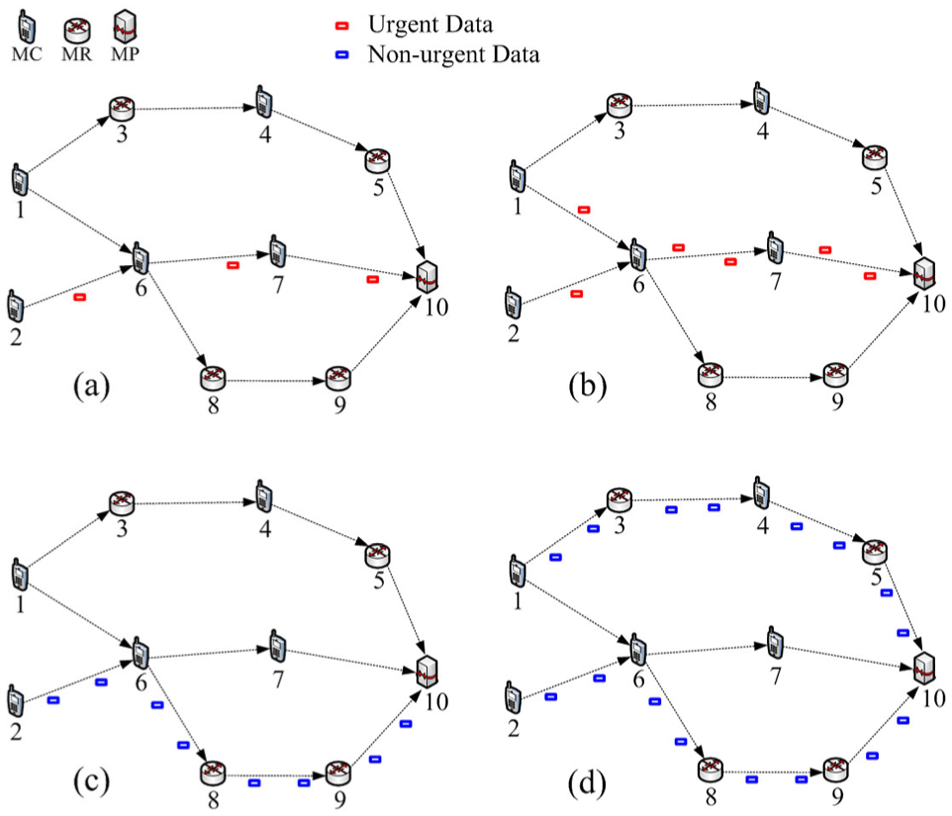
Example of MRM: (a) one urgent data flow, (b) two urgent data flows, (c) one non-urgent data flow, and (d) two non-urgent data flows.
Parameters of nodes.

Node 1 and node 2 are source nodes and node 10 is the destination node. Suppose node 2 is sending urgent data to node 10 via the path 2→6→7→10, as shown in Figure 4(a). Meanwhile, node 1 also needs to send urgent data to node 10. There are three options for the path: P1: 1→3→4→5→10, P2: 1→6→7→10, and P3: 1→6→8→9→10. MRM(pi) is calculated using equation (8) and β is set to 0.6. The results are as follows.
When transmitting urgent data, path P2 will be selected to serve node 1, as shown in Figure 4(b) because MRM(p2) is the minimum value and MRM will choose the fastest path to transmit urgent data as soon as possible. Suppose node 2 is sending non-urgent data to node 10 via the path 2→6→8→9→10, as shown in Figure 4(c). At the same time, node 1 needs to send non-urgent data to node 10. There are also three optional paths, and their routing metrics are shown in Table 2. For the transmission of non-urgent data, although path P2 has the shortest delay, it will not be selected because all of its nodes are MCs. MRM will void path P2 to reduce the energy consumption of the MCs. Path P1 and path P3 have the same hop count, but there are buffered packets at nodes 6, 8, and 9. According to Table 2, we obtain MRM(p1) MRM(p3) when transmitting non-urgent data. Finally, P1 will be selected for transmitting non-urgent data, as shown in Figure 4(d).
Results of MRM(pi).

Simulation experiment and performance evaluation
Simulation environment
Based on the QualNet7.1, simulation experiments are performed to evaluate the performance of MRM, and the results of MRM are compared with those of AODV, Load Balancing Weighted Cumulative Expected Transmission Time (LB_WCETT), 23 and Optimized Link State Routing (OLSR). 24 The parameters of the simulation network are listed in Table 3.
Simulation parameters.

MPs: mesh portals; MRs: mesh routers; MCs: mesh clients; CBR: constant bit rate; UDP: User Datagram Protocol.
MRM supports data-differentiated service, so the simulation experiments are divided into two parts: urgent data and non-urgent data. The size of the urgent data packet is 32 bytes; and the size of the non-urgent data packet is 1 KB in these experiments. The number of constant bit rate (CBR) flows in the simulation network is increased from 1 to 5 gradually.
Urgent data
Urgent data, such as transfinite gas warnings and emergency voice data, which require real-time service should be transmitted as soon as possible. Due to the demand for short delay when transmitting urgent data, the average end-to-end delay and the delivery ratio are analyzed. The results are as follows.
Average end-to-end delay
In Figure 5, the average end-to-end delays of MRM and OLSR are shorter, and those of AODV and LB_WCETT are longer. This is because MRM only considers the delay when sending urgent data and chooses the path that first received the RREP packet to transmit data packets. Therefore, the average end-to-end delay of MRM is the shortest. OLSR, as a proactive routing method, has already established the routing path before the source node initiates the routing request. The nodes maintain routing information at regular intervals instead of beginning to build a path when needed. So, OLSR has lower delay than MRM when the amount of network data is small (such as CBR = 2). But the routing maintenance of OLSR will cause additional network overhead. Its delay becomes longer than MRM with an increase in CBR flows. It is possible to choose a path with congestion because AODV only calculates the hop count without considering transmission time, which will lead to a longer delay. LB_WCETT chiefly considers the link load, rather than the transmission time; therefore, its delay is longer.

Average end-to-end delay.
Delivery ratio
Delivery ratio is counted using application layer statistics as follows

Figure 6 shows that the delivery ratios of MRM and AODV are close to 100% when the number of CBR flows is less than three because each link can satisfy the transmission demand when the data quantity is small. Starting from four CBR flows, the delivery ratio of MRM is gradually reduced because MRM is designed for urgent data, which are small in size. If the link load is heavy, MRM will not automatically adjust the routing, which will result in packet loss. The OLSR has the lowest delivery ratio because of the Multiple Point Relaying (MPR). The effect of MPR on the delivery ratio is closely related to the neighboring nodes, but the number of neighbors is smaller in underground mine networks than in general networks, so the delivery ratio of OLSR is negatively influenced.

Delivery ratio.
The urgent data need to be served as soon as possible; therefore, only the delay is considered to send urgent data in MRM, and its delay is much shorter than others, which is shown in Figure 5. In practical application, the quantity of urgent data is small, which is simulated by CBR flows in the range from 1 to 3 in Figure 6, and the delivery ratio of MRM is high. When CBR flows have increased to 4 or 5, AODV shows better performance in delivery ratio than MRM. The link load is not considered by MRM when transmitting urgent data, so the selected path with low delay and heavy load will lead to packet loss and reduction of delivery ratio. Transmissions with large number of data are more likely to occur when transmitting non-urgent data. Therefore, the link load is considered when transmitting non-urgent data, which is shown in formula (6). In MRM, the link load is estimated by the number of buffered data packets, and the path with lightweight load will be selected when transmitting non-urgent data to reduce the possibility of congestion. The simulation results when transmitting non-urgent data are analyzed in the following section.
Non-urgent data
The goal of MRM in the transmission of non-urgent data, such as environmental monitoring data and video, is to reduce the energy consumption of MCs without prolonging the delay and reducing the throughput. Therefore, the average end-to-end delay, throughput, delivery ratio, and utilization rate of MCs will be compared.
In order to determine the value of β in formula (8), a set of simulations is performed. The parameters of the simulation network are listed in Table 3. At the beginning of this experiment, there are three CBR flows which are generated randomly, and these CBR flows do not change with an increase in β. The value of β changes from 0 to 1 with the step set as 0.1. As the non-urgent data require high network throughput, throughput is the main standard used to evaluate the performance of MRM. When β equals 0.6, the network throughput achieves the highest value, as shown in Figure 7. So, the value of β is set to 0.6 in the following experiments.
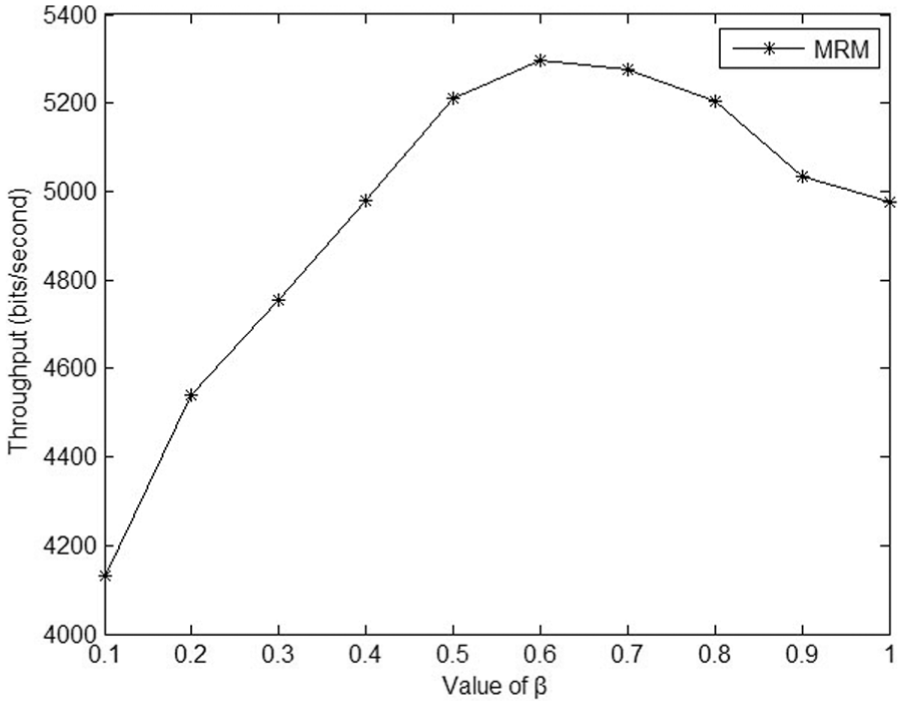
Throughput at different β.
Average end-to-end delay
In Figure 8, the average end-to-end delay of OLSR is the shortest in most cases because the link state information is generated by the nodes that are selected as relay nodes instead of by every node, and this mechanism can reduce the transmission time. MRM will select the path with the most MRs to reduce the energy consumption of MCs, so the hop count of the path may increase and then MRM will have a longer delay than OLSR. MRM uses the cumulative waiting time of buffered packets in the path to evaluate link load. If a path has many buffered packets, it will select another path to reduce waiting time. So, MRM has the shortest end-to-end delay when the number of CBR flows is five. AODV measures the path quality only through hop count, which does not enable it to avoid paths with congestion, so it has longer delay with the large amounts of data. The delay of LB_WCETT is the longest because the loads of neighboring nodes are considered when calculating the link quality. With increasing CBR flows, the communication between neighbors becomes more frequent, which will extend the end-to-end delay.

Average end-to-end delay.
Throughput and delivery ratio
As shown in Figure 9, there is no significant difference in throughput between the four routing metrics. The delivery ratios of MRM, AODV, and LB_WCETT are close to 100%, which is shown in Figure 10. The above results indicate that MRM can meet the demands for network throughput and delivery ratio when transmitting non-urgent data. The delivery ratio of OLSR is relatively low and fluctuant because of the MPR, which is mainly affected by the topology of neighboring nodes, and the number of neighbors is limited in underground mine networks, so the delivery ratio of OLSR is low.
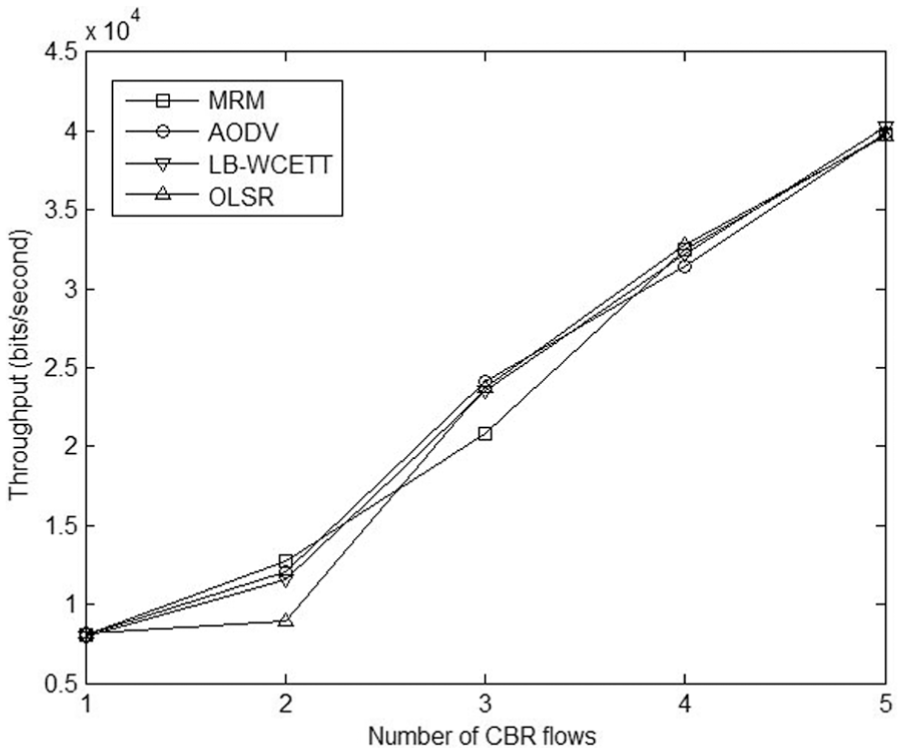
Throughput.

Delivery ratio.
Utilization rate of MCs
Compared with AODV, LB_WCETT, and OLSR, MRM obviously has the lowest utilization rate of MCs, which is shown in Figure 11. In order to select a path with fewer MCs, MRM distinguishes between the different node types when transmitting non-urgent data and sets different weights for different nodes to calculate hop count. The utilization rate of MCs is reduced and the network lifetime is prolonged. In addition, the utilization rates of MCs among AODV, LB_WCETT, and OLSR are close because these methods do not consider the types of nodes. In particular, with increasing CBR flows, LB_WCETT will use more MRs to balance the link load; therefore, the utilization rate of MCs will be gradually reduced but still higher than that of MRM.

Utilization rate of MCs.
Route repair time and throughput
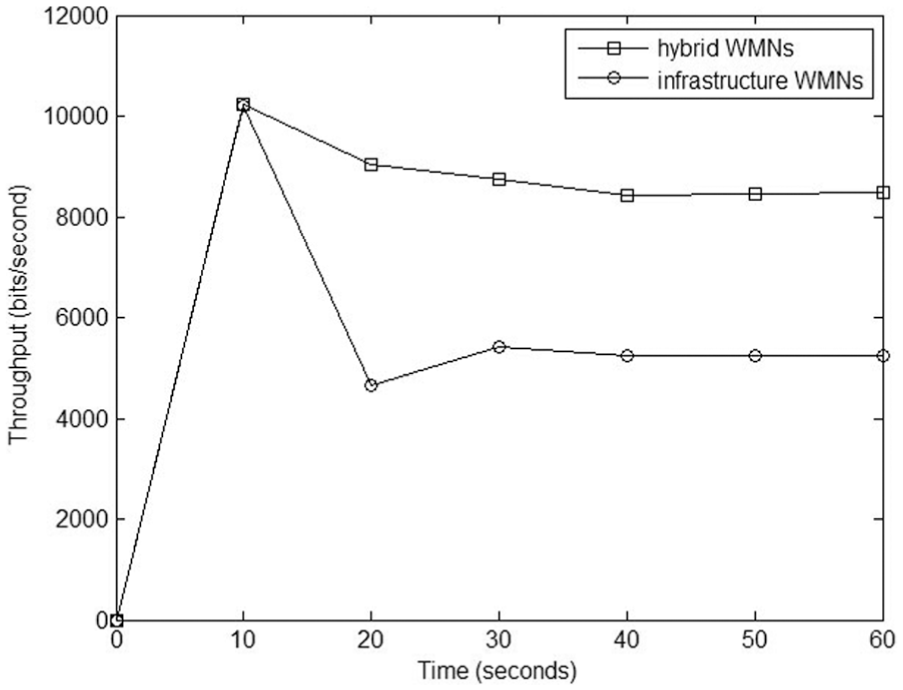
MCs in hybrid WMNs can perform the routing functionality, as well as provide end-user applications. So, the robustness of hybrid WMNs is higher than the infrastructure WMNs. The following experiments will compare the route repair time and the throughput of hybrid WMNs with infrastructure WMNs, when one MR node is failure.
Figure 12 shows that the route repair time of hybrid WMNs is shorter than infrastructure WMNs because MCs in hybrid WMNs have the function of routing, which means more redundant MRs, so the backup nodes are more and the time to repair the route is shorter than infrastructure WMNs. The changes of throughput in the simulation are shown in Figure 13. It shows that the fluctuation of throughput in hybrid WMNs is smaller than infrastructure WMNs, when one MR fails. Therefore, the robustness of hybrid WMNs is better, and its network performance is more stable than infrastructure WMNs.

Route repair time.
Throughput.
Conclusion
Hybrid WMNs in coal mines have long-chain and multi-hop topologies. MCs and MRs have different energy supply modes. In addition, different data require different network performances. This article proposed MRM for hybrid WMNs in underground mines to support data-differentiated service. MRM divides the data into urgent and non-urgent data and adjusts the parameters adaptively to optimize the transmission of multi-media. At the same time, in order to reduce the energy consumption of MCs, self-adaptive adjustment based on the node type is performed in MRM. Simulation results based on the QualNet7.1 platform show that, compared with AODV, LB_WCETT, and OLSR, MRM can effectively reduce the average end-to-end delay when transmitting urgent data. Furthermore, MRM has the lowest utilization rate of MCs, which guarantees the capability of the network for transmitting non-urgent data. This satisfies the differentiated service requirements of data of different types for hybrid WMNs in coal mines.
Most of nodes in underground mines are static, but there are also mobile nodes, such as the terminals for the personnel positioning system and the wireless sensors on the transport facilities. If some nodes on the path move out of the communication area, the source node will construct route again after receiving the error report. In the future, we will pay more attention to node mobility and design routing metrics to predict the movement trend of nodes.
Footnotes
Academic Editor: Kyoung-Don Kang
Declaration of conflicting interests
The author(s) declared no potential conflicts of interest with respect to the research, authorship, and/or publication of this article.
Funding
The author(s) disclosed receipt of the following financial support for the research, authorship, and/or publication of this article: The financial support for this work was provided by the Fundamental Research Funds for the Central Universities (no. 2014QNB22) and the Natural Science Foundation of Jiangsu Province (no. BK20140202).