




Abstract
The multi-mesh distributed and open structure of cloud computing is more weak and vulnerable to security threats. Intrusion detection system should be incorporated in cloud infrastructure to monitor cloud resources against security attacks. In this article, the interaction between rational cloud resource defender and the potential malicious user in the cloud as a differential game is investigated. The feedback Nash equilibrium of the game is reviewed and a complex decision-making process and interactions between the cloud resource defender and a malicious user of cloud are also analyzed. The system results support a theoretical foundation in detecting the malicious attack, which can help cloud intrusion detection system make the optimal dynamic strategies to improve the defensive ability.
Introduction
Cloud computing has fundamentally revolutionized the way of business services in many industries with its services provisioning infrastructure, more efficient computing resources deployment, less cost, high scalability, and rapid accessibility. According to International Data Corporation (IDC)’s latest guide, worldwide spending on public IT cloud services will grow to more than US$141 billion in 2019, representing a compound annual growth rate (CAGR) of 19.4%. 1 Cloud computing is not an independent phenomenon in the IT industry, but it has impacted the software and hardware industry.
Security and privacy issues have become an urgent problem for cloud computing. The multi-mesh distributed and open structure of cloud computing is more weak and vulnerable to security threats. This multi-user and multi-domain platform has become a target for potential attackers. Cloud computing suffers from various attacks such as IP spoofing, flooding, denial of service (DoS), and distributed denial of service (DDoS). 2 A strong defense system is needed to protect cloud users and data. As an essential component of defensive measure, intrusion detection system (IDS) can provide active and dynamic defense for network and computer system against various attacks. 3 IDS is an important part of traditional network security defense system. By analyzing the anomalies such as unusual determines when the network is under attack. However, no matter in detection capability, response time, or system scale, there are many security system limitations for traditional IDS, which make it unable to meet the requirements of the cloud detection. Consequently, a cloud IDS decision issue arises and needs to be optimized.
In dynamic cloud environment, the attack/defensive behaviors or state variables cannot be separated. The previous optimal decisions may no longer be the best, even be the worst in the next moment. Policymakers of IDS in cloud need to develop appropriate countermeasures in time according to the environment changes. Recently, game theory has been used extensively to model and analyze network security issues. It provides a formal analytical and mathematical framework to model rational decision-making or strategies of multiple players having different objectives interacting with each other. 4 To detect intrusions, this article uses differential game theory to solve the problem of cloud IDS. Differential game derives from game theory and optimal control theory, which belongs to one of the most practical and complex branch of game theory, proposed by Dixit 5 and Isaacs. 6 It can be used to solve dynamic problem which depends on the players’ profit function and the relationships (cooperative or non-cooperative) between the players. 7
We have recently investigated a game theoretic model to cloud security where the interaction between the IDS and malicious attackers is modeled using a two-player static game in Li and Liu. 8 In this article, we consider a dynamic extension of this game theoretic framework. After introducing the differential game model, the behavior of IDS as a defender and malicious user as an attacker is modeled, and the complex decision-making processes and interactions between the cloud resource defender and a malicious user of cloud are also analyzed. Considering the detection rate and false alarm rate, an optimal decision of cloud computing intrusion detection based on differential game is proposed, which ensures the security of cloud computing and reduces energy consumption at the same time. The IDS security strategy is formulated in which the defender and the attacker can adjust their resources according to the workload. It is investigated that this model in the defender role and the malicious attacker role can update their strategies until they reach a Nash equilibrium. Through simulations, we study the properties of the resulting equilibrium. The results show that the formula is feasible.
The remainder of this article is organized as follows: section “Related work” explains the related work. In section “Problem formulation,” the payoff matrix of cloud IDS and the differential game are constructed. The feedback Nash equilibrium solution to the proposed game is derived in section “Equations.” The simulation results are presented and discussed in section “Numerical simulation and analysis.” Finally, conclusions of the work are drawn in section “Conclusion.”
Related work
As an essential component of security measure, IDS provides the ability to monitor the network activities for internal or external malicious attacks or policy violations. 9 In recent years, several research works which focus on intrusion detection solutions for cloud computing have been proposed. 10 To handle large-scale network access traffic and administrative control of data and application in the cloud, Gul and Hussain 3 proposed a multi-threaded distributed cloud IDS model, which can deal with large flows of data packets and generate reports effectively. Facing the coordinated attack, Zhou et al. 11 proposed a collaborative IDS, which improves the efficiency of intrusion detection. Claudio et al. 12 proposed a kind of lightweight network IDS; through a series of defending rules, the intrusive behavior can be determined. This system has a high detection rate in detecting external attacks. Ficco 13 presented a cloud intrusion detection approach using event correlation. Using complex event processing to identify the cause of the incident, the captured events were analyzed. Attack detection by correlating the casual events was also described with the consideration of time and other constraints
Game theory provides a set of mathematical tools to analyze the conflict of interest between IDS and the attacker. By weighting the cost of different strategies based on the limited resource, it can increase the efficiency of IDS. In fact, a variety of game approaches are used to study intrusion detection in different network environment, such as the wireless network14,15 and grid computing. 16 Shahaboddin et al. 17 proposed a three-player cooperative game, which improved the existing machine learning methods, and increased the successful defense rate. In Lin and Leneutre, 18 the interaction between the jammer and the victim network was modeled as a non-cooperative game. The proposed defense strategy can eliminate the undesirable equilibrium and increase the jammer’s energy consumption. To address the attacker and IDS behavior within a sensor network, the two-player non-cooperative game has also been studied in Alpcan and Basar 19 and Agah et al. 20 In the proposed model, the game is assumed to have a complete information and each player’s optimal strategy depends only on the payoff function of the opponent. A Bayesian game theoretic solution for wireless ad hoc networks that model the interactions between pairs of attacking/defending nodes is discussed in Liu et al. 21 In this article, Lui et al. analyzed the obtainable Nash equilibrium for the attacker/defender game in both static and dynamic settings. Since the dynamic approach allows the defender to consistently update his belief about the maliciousness of the opponent player as the game evolves, it is a more realistic model which produces energy-efficient monitoring strategies for the defender, while improving the overall hybrid detection power. For economic deployment of intrusion detection agent, Chen et al. 22 proposed a framework that applies two different game theoretic schemes. The interaction behaviors between the attacker and intrusion detection agent within a non-cooperative game are modeled and analyzed in the first scheme model. The security risk value is then derived from the Nash equilibrium solution. With this security risk value, the Shapley value of the intrusion detection agent is computed in the second scheme. With this two-stage game theoretic model, the network administrator can quantitatively evaluate the security risk of each IDS agent and easily select the most critical and effective IDS agent deployment to meet the various threat levels to the network. In Bayu et al., 23 multi-stage Bayesian game was studied for IDS strategy in the context of a local cloud platform, which can help the defender to converge its belief even quicker.
In summary, most of these non-game theories based on IDS schemes above are subject to a problem that they continuously use additional resources for monitoring, which lead to more power consumption. On the other hand, most of the game theory–based IDS schemes above are static in nature where the strategies and utilities of players are fixed and repeated over a period of time. These approaches fail in cloud environment where players adopt different strategies at various stages of the game. Differential game is one of the most complex and useful branches of game theory. It originated from game theory and optimal control theory, but more universal. Differential game can be used to solve dynamic system, in which the strategy each player used is dynamic and evolving over time. 24 From this perspective, the differential game is of great practical value on cloud computing security issues.
Problem formulation
In this section, a cloud computing system with a fixed number of nodes is considered. It is assumed that any cloud node, acting as a defender, is equipped with an IDS. Depending on the capability of the IDS, the cloud node can detect any attacker in the cloud network.
Definition 1
The differential IDS game for cloud computing G is defended as
The players of the game are the IDS and the potential malicious users, denoted by the defender PD and the attacker PA, respectively. We make an implicit assumption that both players are rational and their main objective is to maximize their own payoffs. In our model, the IDS, as the defender PD, is always trying to ensure the cloud services with minimal resource by monitoring the network against the malicious attack. On the other hand, the potential malicious user, as the attacker PA, will always try to use minimal energy to attack the cloud computing network and maximize its damage.
Both the players will select their own action from the action spaces at each time slot. We abstract the action of the participants in the game model as
Each defender has a set of resources
We define
Let
Parameters’ table.

IDS: intrusion detection system.
The payoff matrix of IDS PD.

The payoff matrix of malicious users PA.

In this study, let
Figure 1 shows the extensive form of the differential game in Definition 1. According to the figure, the profit functions


Extensive form of the differential game.
Based on the above definitions, the optimization overall payoffs of PD and PA with dynamic game can be modeled as follows 7


where
The time interval of the game is assumed as
When

Equations
In this section, the feedback Nash equilibrium solution to the differential game will be discussed. A feedback Nash equilibrium for the differential games (3), (4), and (5) can be characterized by Theorem 1, which was developed by Yeung 7 and Nash. 25
Theorem 1
A set of strategies


where
Proof
See the proof of Theorem 2.1.1 in Yeung and Petrosjan. 7
In this case, x defines the state, and t denotes the time.

Then we have

where

where
We can get the Nash equilibrium to the control problem (9) as follows

Similar to the defender, for the cloud malicious user

where
And we have

By formulas (9) and (12), we can get


where
For defender


Substituting equations (11) and (16) into equation (9), we have

Solving formulas (16) and (18), we have


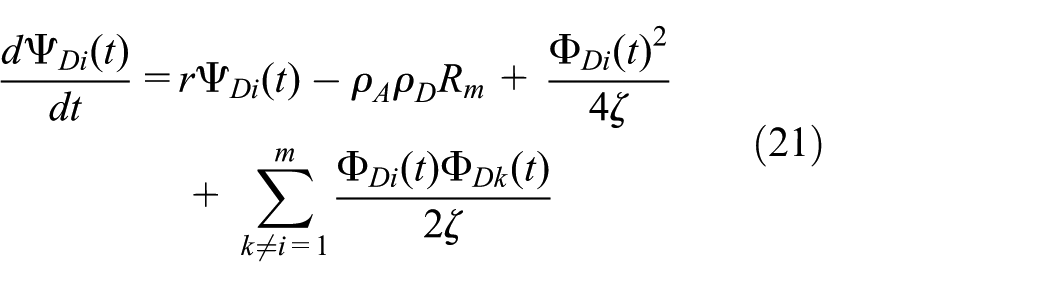

Similarly, for attacker


Upon substituting the relevant partial derivatives of


Substituting equations (14) and (15) into equation (5), we also can get formula (29)

where
Numerical simulation and analysis
In this section, the numerical analysis was presented to help understand the concepts of proposed cloud IDS game model. The study simulates the proposed scheme based on the MATLAB software simulation environment. Table 4 reports a pseudo-code for the proposed scheduler. The parameters’ set for simulations is shown in Table 5.
IDS differential game model algorithm.

IDS: intrusion detection system.
The setting of simulation parameters.

According to the feedback Nash equilibrium solution proposed above, the variations in parameters


Figures 4 and 5 show the relationship between the optimal strategy

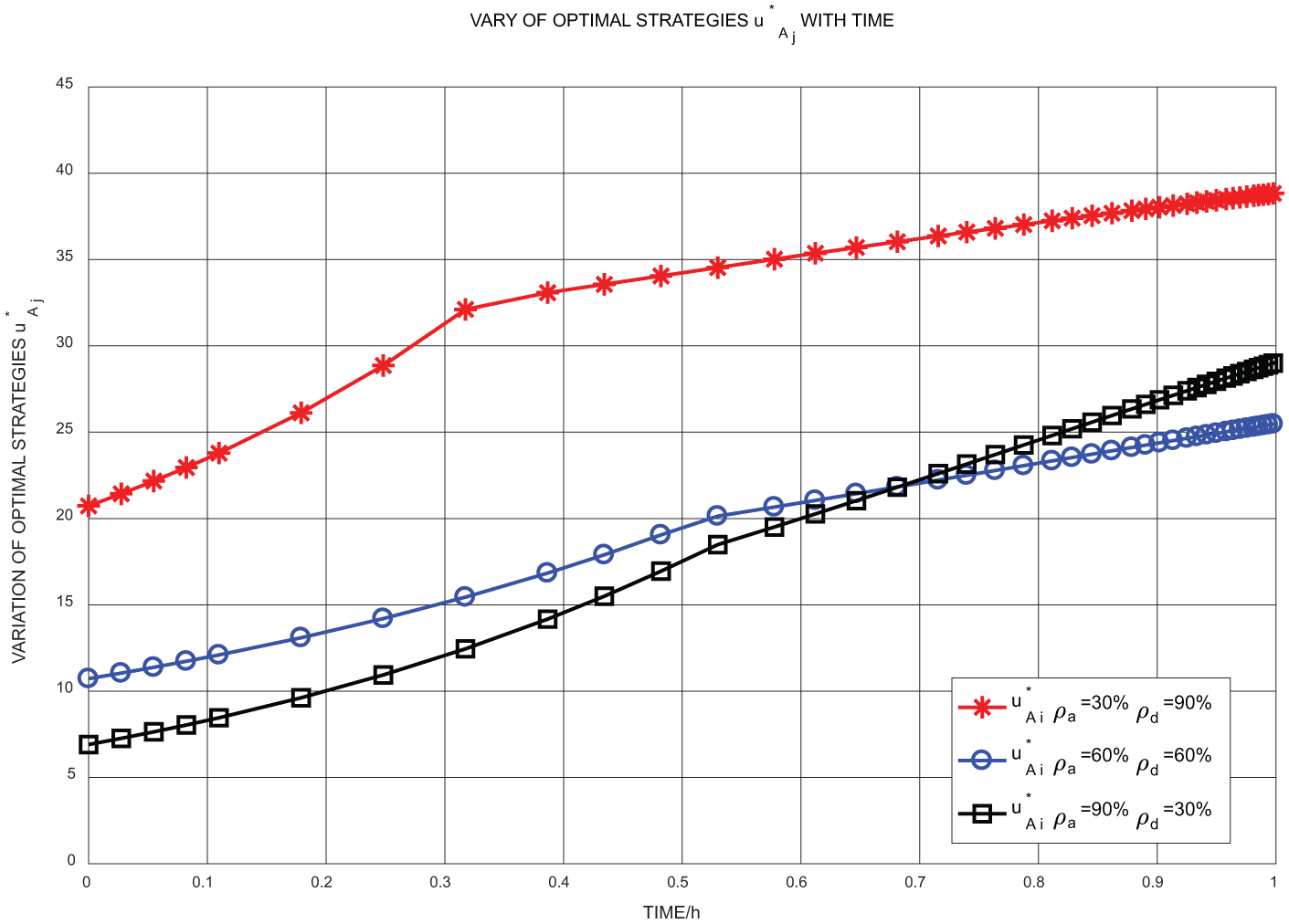
We then observe how the IDS dynamically changes the capability of security to maximizing its profit. According to the algorithm in Table 4, the optimal dynamic controls for cloud IDS are depicted in Figure 6. In the beginning, IDS needs to have a strong defense capability to protect the security of network. However, over time, it is not necessary for IDS to always keep this strong ability. After a short time,

We also compare the profit of IDS between static and dynamic optimal strategies with different monitoring and attack probabilities. In the static strategies, we let

The profit of IDS: static strategies versus optimal strategies.
Finally, the energy consumed by the optimal strategy compared to the static strategy is studied. Figure 8 provides the comparison under the different monitoring and attack probabilities throughout the simulation runtime. Since the strategy is static which means that the
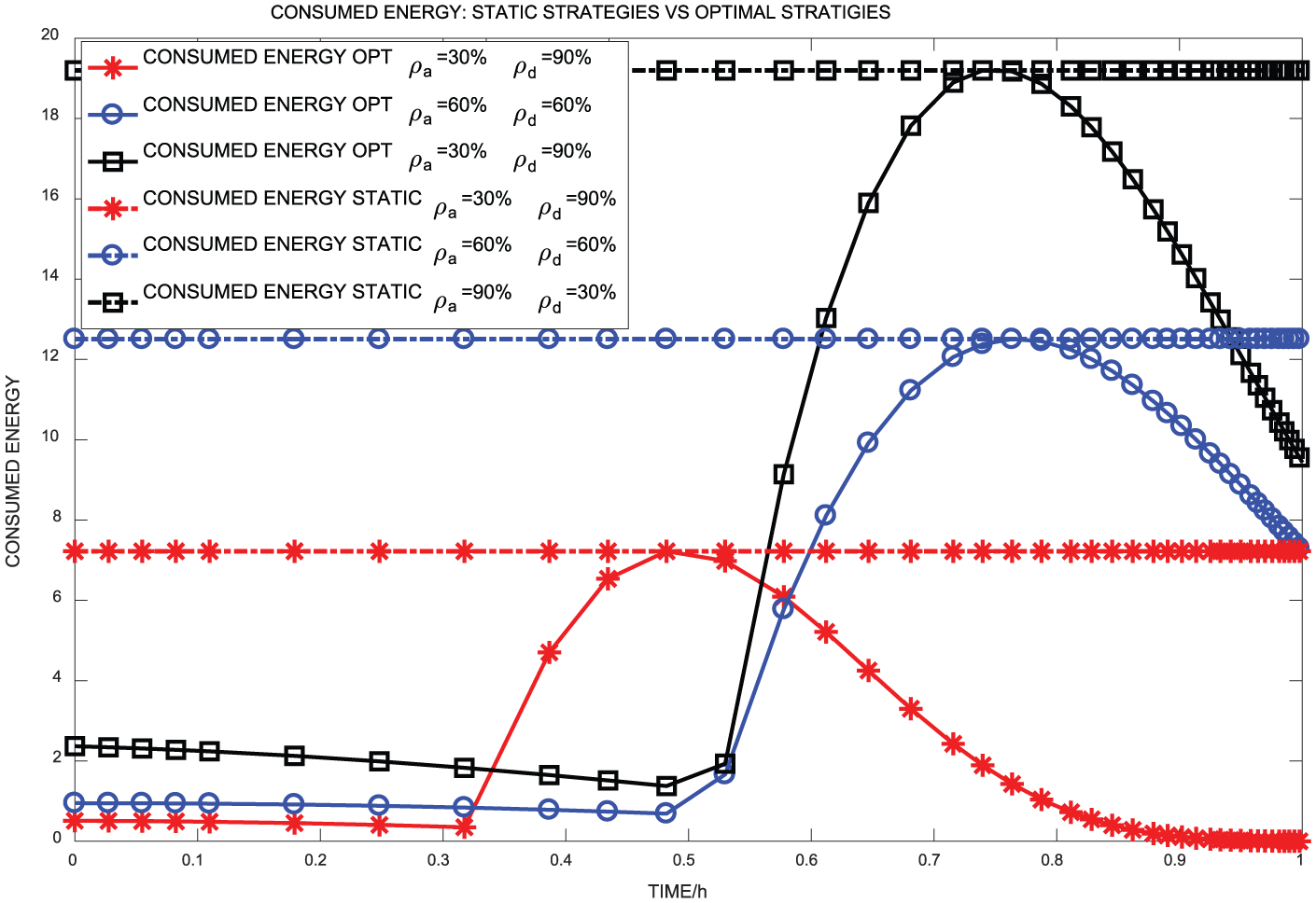
The energy consumption of IDS: static strategies versus optimal strategies.
Conclusion
In this article, a game theoretic framework for intrusion detection in cloud computing was proposed. We formulated the IDS problem as a differential game mode, in which the detection rate and false alarm rate of the IDS were considered. The feedback Nash equilibrium for each stage game was presented, and the optimal amount of resource
Footnotes
Declaration of conflicting interests
The author(s) declared no potential conflicts of interest with respect to the research, authorship, and/or publication of this article.
Funding
The author(s) disclosed receipt of the following financial support for the research, authorship, and/or publication of this article: This work was supported by the National Science Foundation Project of P. R. China (No. 61501026), and Fundamental Research Funds for the Central Universities (No. FRF-TP-15-032A1).