As we know, the degree of freedom approximates the capacity of a network. To improve the achievable degree of freedom in the K-user interference network, we propose a rank minimization interference minimization algorithm. Unlike the existing methods concentrating on the promotion of degree of freedom, our rank optimization method works directly with the interference matrix rather than its projection using the receive beamformers. Moreover, we put the trace constraint of the square root of desired matrix into the rank optimization to prevent the received signal-to-interference-plus-noise ratio from reduction. The decoders are designed through a weight interference leakage minimization method. Considering that the practical obtainable signal-to-noise ratio may be limited, we improve the design of decoders in rank minimization interference minimization, and propose the rank minimization rate maximization. Rank minimization rate maximization aims to reduce the impact of interference on undesired users as much as possible while improving the desired data rate. Simulation results show that rank minimization interference minimization algorithm can provide more interference-free dimensions for desired signals than other rank minimization methods. Rank minimization rate maximization outperforms rank minimization interference minimization at low-to-moderate signal-to-noise ratios, and its performance gets closer to rank minimization interference minimization with the increase in signal-to-noise ratio. Furthermore, in an improper system, rank minimization rate maximization still performs well.
Interference is regarded as the principle limitation to wireless communication networks. An increasing number of researchers join to study the interference elimination for wireless networks. At present, the most commonly used interference suppression scheme is orthogonal resource allocation. However, when K users share the resources, each user only achieves 1/K of the total resources by orthogonal schemes. As an advanced technique, the concept of interference alignment (IA) has been proposed in Cadambe and Jafar’s1 paper. The core feature of IA is to divide the received signal space into two subspaces. One is for desired signals and the other is for interfering signals. At the initial stage of research, IA schemes were presented in the closed form expressions such as Cadambe and Jafar,1 Kim and Torlak,2 Tresch et al.,3 and Xu et al.4 However, these closed form solutions were only achieved in certain cases. Besides, it was a tough job to calculate the precoding matrices with the user number increasing.
To overcome this difficulty, researchers provided some iterative methods to solve the aligned problem.5–20 In Gomadam et al.,12 an iterative algorithm called interference leakage minimization was presented for the multi-input, multi-output (MIMO) interference channel (IC), which aimed to minimize the sum of interference power at each receiver. This algorithm was extended to MIMO cellular networks in Zhuang et al.13 According to Jafar,15 the degree of freedom (DoF) was based on a high signal-to-noise ratio (SNR) approximation of the network performance. Hence, the promotion of DoF is vital to improve the system performance at high-SNR region. Papailiopoulos and Alexandros,16 Du and Ratnarajah,17 Du et al.,18 Rihan et al.,19 and Sridharan and Yu20 all tried hard to enhance the system DoF. The authors proposed a rank constrained rank minimization (RCRM) scheme in apailiopoulos and Alexandros.16 RCRM minimized the rank of the interfering signals with full rank constraint on the desired signals. As the nuclear norm is the convex envelope of rank,21 RCRM introduced the nuclear norm heuristic as convex approximation to obtain the convex solution of optimization problem. Using the same framework, Du and Ratnarajah,17 Du et al.,18 Rihan et al.,19 and Sridharan and Yu20 further improved RCRM. A reweighted version of nuclear norm minimization for finding the optimal encoders was presented in Du et al.18 Compared with RCRM, the literature19 reduced the running time per iteration. The literature20 studied the application of RCRM in multi-antenna cellular network. It can be seen that these schemes all take the rank of the interfering signals as the cost function despite that the approximation methods are different. Nevertheless, it is absolutely impossible to realize the perfect IA; thereby, there exists leaked interference at each receiver and the receiver may be severely influenced by this high interference power. Apart from the above schemes, the literature22 analyzed the achievable DoF over space, time, and frequency. An IA scheme was proposed in Vahdani and Falahati,23 which attained higher multiplexing gain using a lot lower number of channel extension.
In this article, we first present the rank minimization interference minimization (RMIM) algorithm. Unlike the methods proposed in Jafar,15 Papailiopoulos and Alexandros16, Du and Ratnarajah,17 and Recht et al.,21 we design the precoders to minimize the sum of the ranks of the interference mapping matrix, where the interference mapping matrix denotes the interference matrix without projection by the decoders. Although the precoders designed by rank optimization methods can largely depress the interference at each undesired receiver, this selfless way cannot guarantee the final interference subspace is far enough from the desired subspace, which could lead to the reduction in signal-to-interference-plus-noise ratio (SINR) at the desired receiver. To alleviate this drawback, we put the desired projection modulus constraint into the rank optimization, where the desired projection modulus is the Frobenius norm of the desired matrix projected into the decoding space. Since the Frobenius norm is convex, we choose the trace of the matrix square root of desired matrix as the final constraint under the restriction of the Hermitian positive definite desired signal matrices. For the decoders’ design in RMIM, we first calculate the decoders using the interference leakage minimization scheme. Since this method does not take the noise statistics into account, we multiply each decoder with a weighted factor, where the weighted factor is a non-negative weight parameter that is determined empirically based on SNR. As the RMIM scheme aims to maximize DoF, it may not be favorable in the low-to-moderate SNR region. Considering the practical obtainable SNR, we improve the RMIM and propose the rank minimization rate maximization (RMRM) approach. The decoders in RMRM are designed to reduce the impact of interference on undesired users as much as possible while improving the desired data rate. As it can be proved that the cost function in RMRM is unitarily invariant in decoders, we utilize the steepest descent method on the Grassmann manifold to find the optimal decoders. To further improve the performance of RMRM in low SNR region, the initial iteration point is chosen to maximize the received SINR. In the simulation, we validate the effectiveness of RMIM that maximizes the achievable DoF. Compared with literature,16,18,19 RMIM compresses the dimensions occupied by interfering signals and provides more interference-free dimensions for the desired signals. RMRM improves the performance of RMIM in low-to-moderate SNR region, and with the increase in SNR, the system sum rate achieved by RMRM gets closer to RMIM. Simulation results also show that for an improper system, the average sum rate achieved by RMRM does not degrade compared to that of reweighted rank constrained rank minimization (RRCRM).
The rest of this article is organized as follows. Section “System model” introduces the system model. The methods of RMIM and RMRM are described in section “RMIM and RMRM,” respectively. Section “Simulation results and analysis” provides the results of simulation analysis. Finally, we conclude the article in section “Conclusion.”
System model
Consider a static flat-fading K-user MIMO interference system, where all the transmitters send their data synchronously. Each transmitter is equipped with antennas, and each receiver is equipped with antennas. Figure 1 shows the system model of K-user IA, and the solid line and the dotted line represent the signal transmission under the original channel and the reciprocal channel, respectively.
System model of K-user interference alignment.
The received signal at receiver k is given by
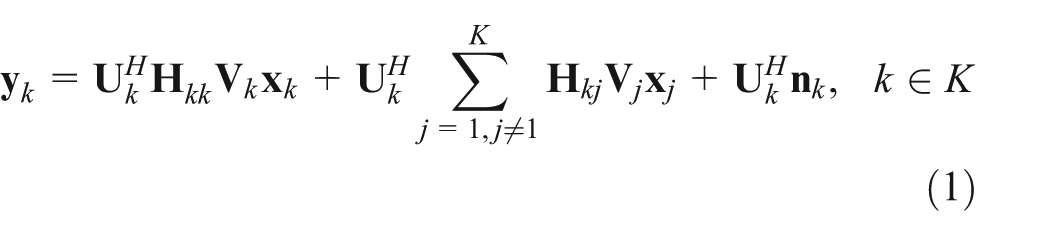
where and stand for the precoding matrix and the decoding matrix, respectively, whose columns are the orthonormal basis of the signal spaces; denotes the Hermitian transposition of the complex matrix; is the channel gain between the transmitter j and the receiver k; and is the complex additive white Gaussian noise (AWGN) with covariance . We assume that each user, say , sends , and is independently identically distributed (i.i.d) with power constraint , where is the transmit power. For simplification, all the sources are supposed to share the same transmit power. According to Yetis et al.,24 for certain proper system, the achievable DoF d needs to be satisfied
On the reciprocal channel, we assume that and denote the precoding matrix and the interference suppression filter (decoders), respectively. We set and . is the channel gain between transmitter j and receiver k, and .
RMIM and RMRM
Precoding matrix design
For simplification, we define

Figure 2 shows the perfect IA. Ideally, all the interfering signals can be aligned in the same subspace and the decoding space is the space orthogonal to the interfering subspace. However, as seen in Figure 3, not all the interfering signals can be aligned with in practice. There may exist leakage interference power at each receiver even if the interfering signals have been processed by the interference suppression filter, such as in the diagram. Thus, once the interference power is too high, the received desired signal might be severely affected. In this article, we first minimize the sum of the rank of the interference mapping matrix to compress the dimensions of interference subspaces, where the interference mapping matrix denotes the interference matrix without projection by the decoders.
Perfect interference alignment.
Practical interference alignment.
We define as the interference mapping matrix from the transmitter j to the receiver k. The column space of the interfering mapping matrices at the receiver k is
The rank of a matrix can describe its column space dimensions, in order to compress the dimensions occupied by interference signals. The precoders design should be based on minimizing the rank of . We consider the sum of the rank of the interference mapping matrix as the cost function
As the nuclear norm is the convex envelope of rank, the cost function is equivalent to
After the optimal solution is obtained, the distances between different interference subspaces are sufficiently small, that is, all the interference subspaces almost overlap in the same subspace. Although the precoders designed by the above method can largely depress the interference at each desired receiver, this selfless way cannot guarantee the final interference subspace is far enough from the desired subspace, which could lead to the reduction of SINR at the desired receiver. In order to resolve this problem, we put the desired projection modulus constraint in the rank optimization, where desired projection modulus is the Frobenius norm of the desired matrix projected into the decoding space. The constraint can be expressed as
where denotes the Frobenius norm of , and is the minimum desired projection modulus requirement. Since the Frobenius norm is convex, we need to substitute a concave function for the Frobenius norm in equation (7). Fortunately, we have known the trace of the matrix square root of a positive semidefinite matrix is concave.25 Thus, without loss of generality, we constrain the desired signal matrices to be Hermitian positive definite and replace the Frobenius norm constraint in equation (7) with the trace of the matrix square root of desired signal matrices (the detailed proof is in Appendix 1). We reformulate the precoding matrix optimization problem to a constrained one
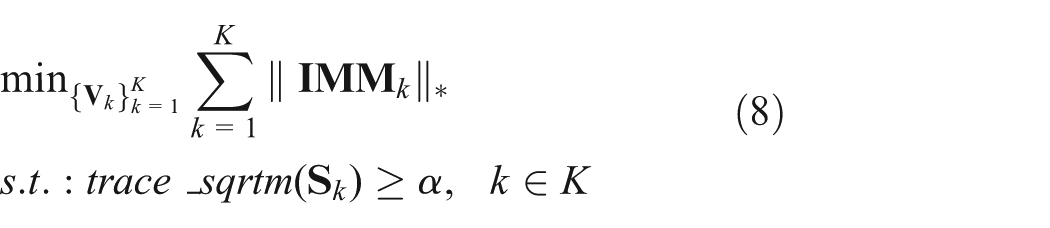
where the desired signal matrix is denoted as , where , and is the minimum requirement of the trace of the matrix square root of .
Receive filter design
The receive filter design of RMIM
Obviously, when all the interfering signals align to the same subspace, the decoding space meeting the leakage interference power minimum is the space orthogonal to the aligned space. Thus, we can adopt the interference leakage minimization method12 to devise the decoders. The leakage interference power can be denoted as

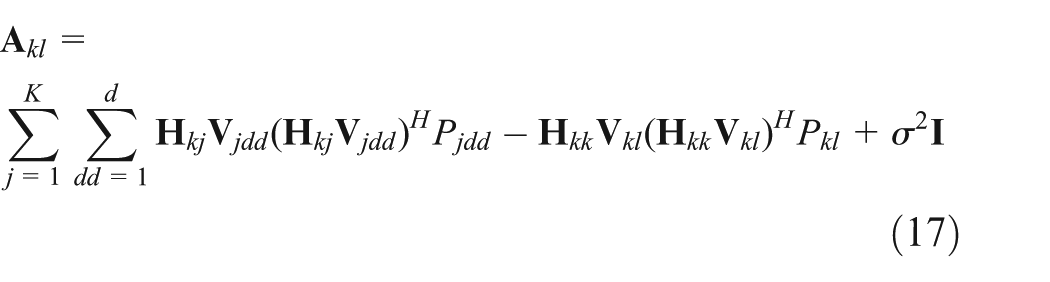
Let denote the interference covariance matrix at the receiver k. As the d dimensional received interfering, space containing the least interference is the space spanned by the eigenvectors corresponding to the d smallest eigenvalues of . Thus, the lth column of the kth decoder matrix is equal to the eigenvector corresponding to the lth smallest eigenvalue of the interference covariance matrix. However, as the above method does not take noise statistics into account, we come up with a weighting scheme. We multiply each decoder with a weighted factor , where is a non-negative weight parameter that is determined empirically based on SNR
where , and is the eigenvector corresponding to the lth smallest eigenvalue of interference covariance matrix.
The receive filter design of RMRM
Since the precoders and decoders in RMIM are designed to maximize the available DoF, RMIM can guarantee the high data rate in the high-SNR region. Nevertheless, in some scenarios, the practical SNR may be limited. With this in mind, RMRM improves the decoders’ design of RMIM and performs the design procedure under the reciprocal channel. As seen from Figure 1, the signal sent from the transmitter j is useful to the receiver j and useless to receiver . Suppose each transmit channel is independent, we define the desired rate and the sum-interfering rate at the source j as and

Algorithm 1: RMIM algorithm.
Initialization: Start with arbitrary ;
Step 1. Set , orthogonalize and normalize interference suppression matrices;
Step 2. Calculate the precoding matrices
where denotes the minimum requirement in RMIM.
Step 3. Compute the interference covariance matrix shown in equation (10);
Step 4. The mth column of the interference suppression matrix is the eigenvector corresponding to the mth smallest eigenvalue of the interference covariance matrix;
Step 5. Multiply each decoder with the weighted factor;
Step 6. Orthogonalize and normalize interference suppression matrices, and ;
Step 7. Repeat steps 2–6 until
Algorithm 2: RMRM algorithm.
Initialization: Start with arbitrary ;
Step 1. Set , orthogonalize and normalize interference suppression matrices;
Step 2. Calculate the precoding matrices
where denotes the minimum requirement in RMRM.
Step 3. Compute the unit vector according to equation (16);
Step 4. Reverse the communication direction, set . Compute the derivative of the objective function with respect to according to equation (18);
Step 5. Calculate the tangent vector on the Grassmann manifold and its singular value decomposition of ;
Step 6. Move the independent variable along the iteration trajectory to obtain the new decoder according to equation (21), and ;
Step 7. Repeat steps 2–6 until
To maximize the single-user data rate at each receiver, we propose a win-win solution. At each transmitter, the win-win scheme is expected to reduce the impact of interference on undesired users as much as possible while improving the desired data rate. Thus, we define the cost function as
where the determinant of matrix is denoted by . As we have proved the cost function is unitarily invariant in (the detailed proof is in Appendix 2), the objective function can be reorganized on the Grassmann manifold. The new optimization problem is
As RMRM resorts to performing the design of decoders on the Grassmann manifold, it is necessary to choose a suitable initial point in case that the initialization point influences the eventual outcome. Considering that the data rate actually depends on the received SINR at low-to-moderate SNR, we take the to maximize the received SINR as the initialization dot on our iterative computing method. Note that this step is calculated in the original channel. The unit vector to maximize the SINR of the lth stream of the kth destination is computed as
where
where denotes the transmission power of the lth stream of the kth source, and denotes the transmission power of the ddth stream of the jth source.12
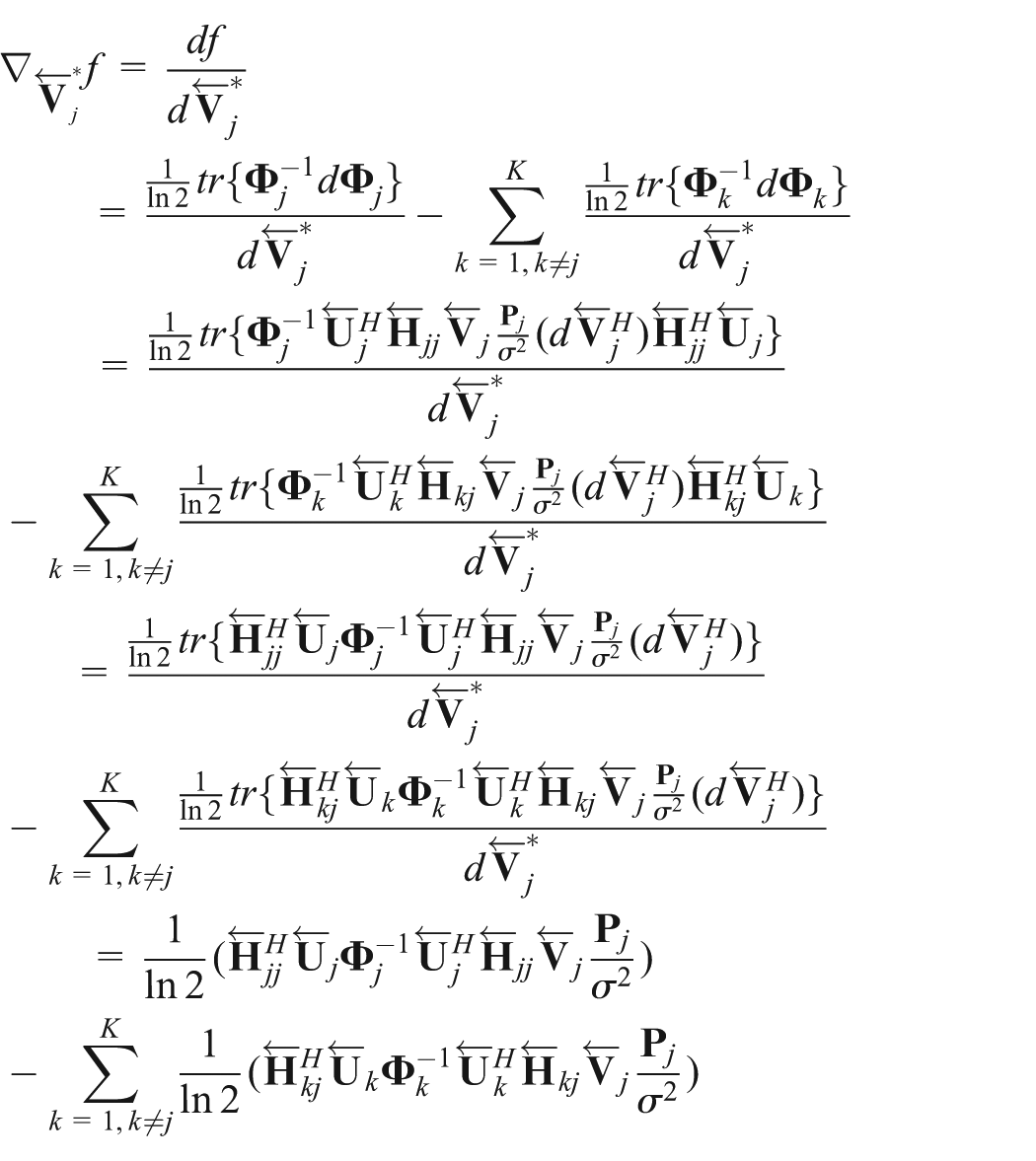
Next, we perform the design of on the Grassmann manifold. From and , the derivative of in equation (15) with respect to is given by
Then, we have
Where
The tangent vector on the Grassmann manifold is denoted as , where . Suppose the step size for each iteration is t, the iteration trajectory of the independent variable is expressed as
where denote the left and right singular vectors of , respectively. is the singular matrix.
Simulation results and analysis
We consider a three-user IC where each user wishes to achieve d DoF. The system is expressed as . Simulation results are averaged over 500 channels and all the systems can be realized, that is, , where is the upper bound of IC.24 We investigate the performance of RMIM, RMRM, RCRM,16 RRCRM,18 iterative reweighted least squares (IRLS),19 and maxSINR.12 is equal to . The available space dimension is the number of singular value that is greater than . We define that the interference-free dimension (DoF) is the difference between the available space dimensions of desired signal and the available space dimensions of interference signal. According to the literature,26 should be set as a large value in the low-to-moderate SNR and small in the high SNR. We simulate range from 0.1 to 100, and find that is the optimum selection. As it requires more space to present the selection of , we do not put the simulation results in the article. The sum rate is computed as
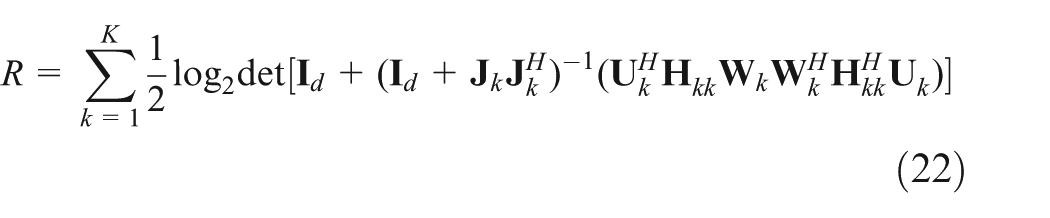
where
We calculate the interference-free dimensions from 0 to 60 dB and then plot the average interference-free dimensions’ results of the seven runs in Figures 4–7. In the four pictures, is equal to 10 and the weight vector corresponding to SNR values [0, 10, 20, 30, 40, 50, 60] is [0.8, 0.8, 0.8, 0.1, 0.1, 0.05, 0.05]. Obviously, the average DoF of RMIM is about 0.2 higher than that of RRCRM. RRCRM and IRLS obtain approximate DoF for the single user. The available interference-free dimensions of RCRM are the least. The theoretical DoF in and is 3, but the practical achievable DoF in is almost 2 times more than that in . Thus, we can deduce that the rank minimization method has a better performance in the asymmetric antenna system in comparison with symmetric antenna system. As can be seen in the figure, all the algorithms spend some of the available dimensions to eliminate interference and our approach can align the interference signal into a smaller space compared with the others.
System .
System .
System .
System .
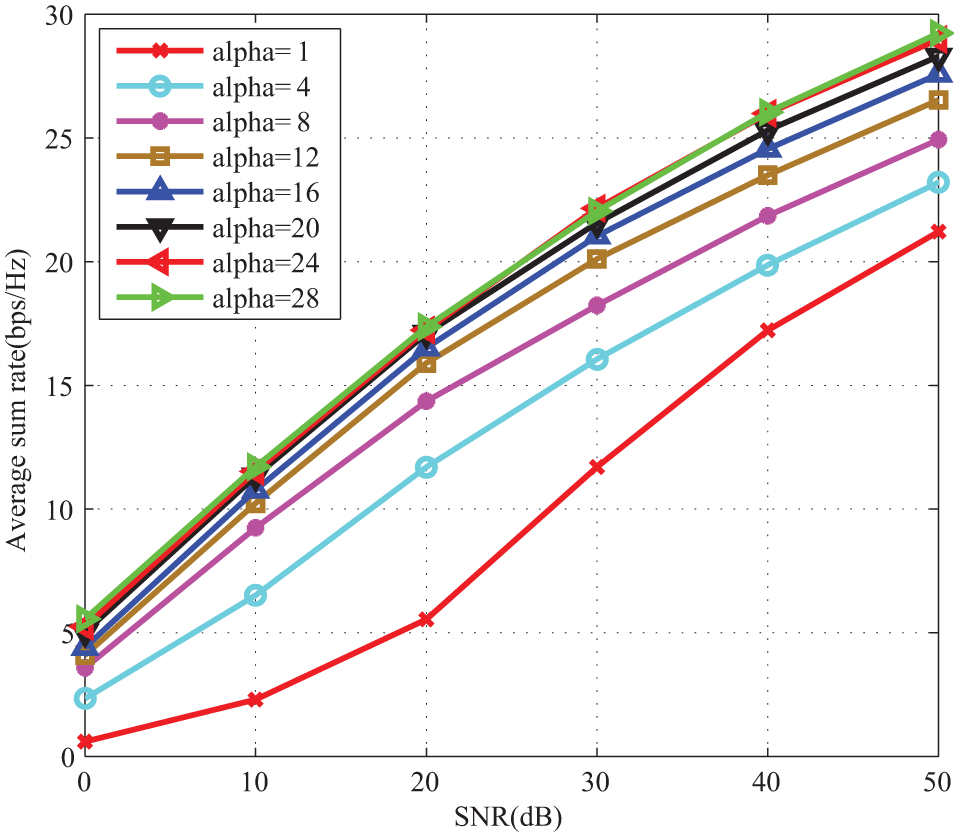
Figures 8 and 9 show the influence of in RMRM. As seen from the figures, the sum rate increases with the increase in . When is greater than 20, the achievable sum rate is almost unchanged. In particular, the system obtains the same sum rate when is equal to 24 or 28. We can conclude that the introduction of constraint on the rank optimization obviously improves the performance of RMRM. However, cannot be infinitely large, this result comes from the fact that the original intention of the constraint is to decrease the distance between the desired subspace and the decoding subspace; if is chosen aggressively, the effect of the rank minimization may decline. Although the received desired signal power has been enhanced, the interference power also increases, which leads to no improvement in the received SINR. Thus, in the following simulation, is equal to 24 in and .
Comparison of the average sum rate under different in system.
Figure 10 shows the average sum rate for , which is a proper system. As shown in Figure 10, the system sum rate growth of RMIM is faster than the other three rank minimization methods, particularly when SNRs are above 30 dB. RRCRM and IRLS have a matched performance for SNRs that are lower than 30 dB. When SNR gets higher, the sum rate achieved by RRCRM is about 2 bps/Hz higher than IRLS and 4 bps/Hz higher than RCRM. Although RRCRM and IRLS choose better convex approximation methods for the rank function, they lack effective mechanisms to enhance the performance of RCRM. As a result, RRCRM and IRLS fail to achieve significant improvement. It is apparent that RMRM outperforms other schemes and significantly improves the performance of RMIM. Generally, the average sum rate of RMRM is almost 7 bps/Hz higher than RCRM for all SNRs. As can be seen from Figure 10, the RMRM scheme benefits from the advantage of higher sum rate in comparison with the maxSINR approach, particularly for high-SNR scenarios. RMRM is 2 bps/Hz higher than that of maxSINR algorithm when SNR is lower than 30 dB, and RMRM achieves more obvious advantage with the increase in SNR. Note that the average sum rate of maxSINR increases rapidly at low-to-moderate SNRs but slowly in high-SNR region, this is because maxSINR does not take DoF into consideration during the development of the algorithm.
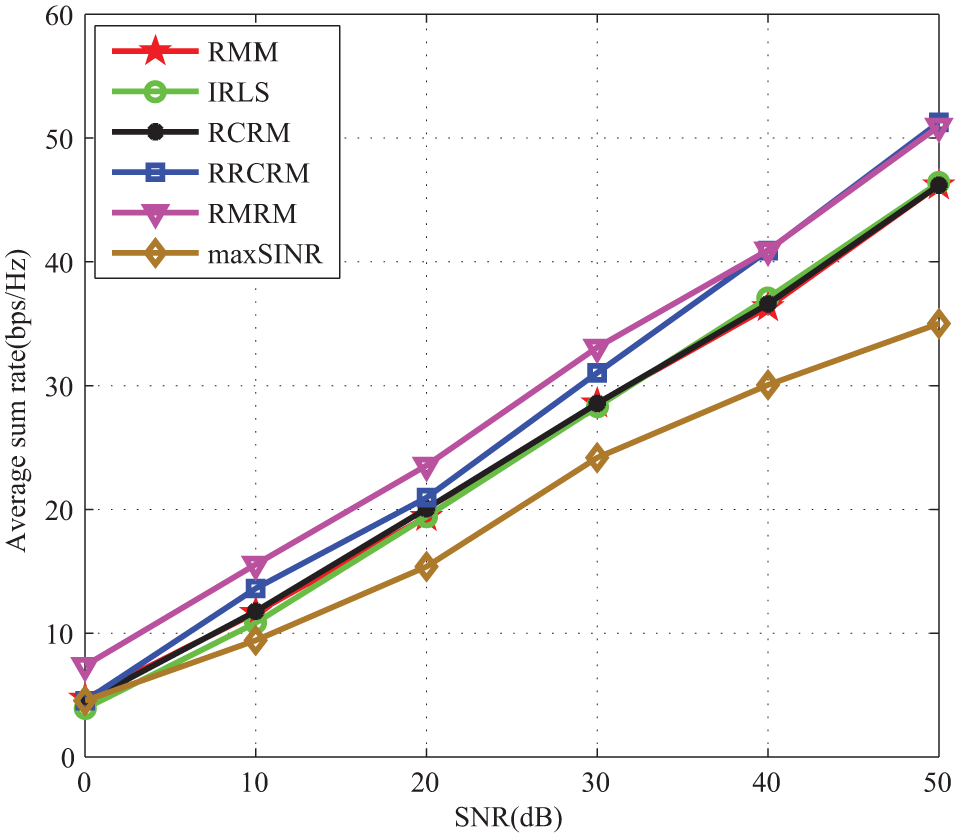
Average sum rate versus SNRs for .
Figure 11 illustrates the performance of the average sum rate for . From the simulation results, we can see that the average sum rates achieved by RMIM, IRLS, and RCRM are almost the same, which are less than the sum rate obtained by RRCRM. According to equation (2), the system is an improper system, that is, the perfect IA is not feasible. We have known that the nuclear norm is equivalent to the sum of the magnitudes of the singular values rather than the number of the non-zero singular values; thus, it is not a tight approximation to the rank function. When the system is improper, the influence of the magnitude on the nuclear norm function might become remarkable. As RRCRM assigns different weights to neutralize the influence, it can eliminate interference effectively. It can be observed that although the precoder design in RMRM adopts the nuclear norm approximation, RMRM can still achieve high system capacity due to the win-win solution. From the figure, RMRM is about 2 bps/Hz higher than RRCRM for SNRs that are lower than 40 dB. When SNR gets higher, RMRM and RRCRM obtain similar sum rate. It is clear that maxSINR does not have obvious ascendancy in dealing with multi-user interference under the improper system.
Average sum rate versus SNRs for .
The previous figures show the results of performance comparison. One may be concerned by the computational complexity of RMIM and RMRM. To investigate this concern, we present Figure 12, in which the convergence of different schemes versus different iteration numbers is shown. The system is considered with SNR = 40 dB. In this article, we define that is the difference of the objective function between two adjacent iterations, where denotes the cost function after the ith iteration, and abs denotes the absolute value of a number. In order to display the results clearly, we set for the vertical coordinate. Obviously, the convergence speed of IRLS is the fastest. RMIM accomplishes convergence by no more than eight iterations. Due to the win-win solution of RMRM, the cost function remains approximately constant after 11 iterations. According to Du et al.,18 as there are two loops in RRCRM algorithm, it is hard to describe the convergence in one figure. Thus, the convergence result of RRCRM is not shown in Figure 12. In view of the fact that the number of iteration of maxSINR is much more than 15, the simulation result is also not shown in Figure 12.
Convergence of the alternating algorithms (SNR = 40 dB).
Conclusion
To conclude, in this article, we present two algorithms for IA, RMIM and RMRM. They both adopt the rank minimization method to acquire the optimal precoders. However, they are different at the design of decoders. We work directly with the interference matrix rather than its projection using the decoders which is adopted in other rank minimization methods. In order to prevent the received SINR from reduction, we put the trace constraint of the square root of desired matrix into the rank optimization. In RMIM, the decoders are designed to minimize the leakage interference power. Although RMIM guarantees the high data rate in the high-SNR region, it is not favorable in the low-to-moderate SNR region. In light of this, we improve the RMIM scheme and propose RMRM approach which aims to reduce the impact of interference on undesired users as much as possible while improving the desired data rate. RMRM takes the decoders to maximize the received SINR as the initialization dot on the iterative computing method and finds the optimal decoders utilizing the steepest descent method on the Grassmann manifold. Simulation results show that RMIM provides more interference-free dimensions for the desired signals. The simulations also indicate that RMRM improves the performance of RMIM in low-to-moderate SNR region and has a matched performance with RMIM with increasing SNRs. Moreover, for an improper system, the average sum rate achieved by RMRM does not degrade compared to that of RRCRM.
Footnotes
Appendix 1
In the following, we will prove that the Frobenius norm constraint in equation (7) can be replaced by the trace of the matrix square root of desired signal matrices.
Proof . Using the identity that ∥A∥F=tr(AAH) and tr(AB)=tr(BA), where tr(A) stands for the trace of A. We obtain
where the desired signal matrix is denoted as Sk, where Sk=UkHHkkVk; λr(SkSk) is the rth eigenvalue of SkSk; and σr(Sk) is the rth singular value of Sk. As Sk is a Hermitian positive definite matrix, its eigenvalues are all greater than zero and σr(Sk)=λr(Sk). Using Cauchy inequality, we derive
As the sum of the square roots of λ(Sk) is the same as the trace of the matrix square root of Sk, the Frobenius norm constraint can be replaced by the constraint on the trace of the matrix square root of Sk.
Appendix 2
Suppose V←j are the feasible solutions of function equation (15). For an arbitrary unitary matrix Q∈Cd×d.
The author(s) declared no potential conflicts of interest with respect to the research, authorship, and/or publication of this article.
Funding
The author(s) disclosed receipt of the following financial support for the research, authorship, and/or publication of this article: This article was funded by the National Natural Science Foundation of China (grant no. 51509049), the National key research and development program (2016YFF0102806), the Natural Science Foundation of Heilongjiang Province, China (grant no. F201345), and the Fundamental Research Funds for the Central Universities of China (grant no. GK2080260140).
References
1.
CadambeVRJafarSA.Interference alignment and degrees of freedom of the K-user interference channel. IEEE T Inform Theory2008; 54(8): 3425–3441.
2.
KimDTorlakM.Optimization of interference alignment beamforming vectors. IEEE J Sel Area Comm2010; 28(9): 1425–1434.
3.
TreschRRieglerEGuillaudM. On the achievability of interference alignment in the K-user constant MIMO interference channel. In: Proceedings of the IEEE/SP 15th workshop on statistical signal processing 2009, SSP’09, Cardiff, 31 August–3 September 2009, pp.277–280. New York: IEEE.
4.
XuBXieXMaB.An optimized cooperative interference alignment algorithm for MIMO interference channel. Signal Process2012; 28(2): 220–225.
5.
MoslehSAboueiJAghabozorgiMR.Distributed opportunistic interference alignment using threshold-based beamforming in MIMO overlay cognitive radio. IEEE T Veh Technol2014; 63(8): 3783–3793.
6.
YangJSongRFDongH.Interference alignment scheme for downlink multi-carrier MIMO cellular systems. J Comput Inf Syst2014; 10(3): 1053–1064.
7.
NtranosVMaddah-AliMACaireG.Cellular interference alignment. IEEE T Inform Theory2015; 61(3): 1194–1217.
8.
ShinWLeeNNohW. Hierarchical interference alignment for heterogeneous networks with multiple antennas. In: Proceedings of the IEEE intrnational conference on communications, Kyoto, Japan, 5–9 June 2011, pp.1–6. New York: IEEE.
9.
LertwiramNPopovskiPSakaguchiK.A study of trade-off between opportunistic resource allocation and interference alignment in femtocell scenarios. Int J IEEE Wirel Commun Lett2012; 1(4): 356–359.
10.
PantisanoFBennisMSaadW. Interference alignment for cooperative femtocell networks: a game-theoretic approach. Appl Acoust2013, 12(11): 2233–2246.
11.
YeFLiYBYangR. The user requirement based competitive price model for spectrum sharing in cognitive radio networks. Int J Distrib Sens N2013; 9(11): 1–8.
12.
GomadamKCadambeVRJafarSA.A distributed numerical approach to interference alignment and applications to wireless interference networks. IEEE T Inform Theory2011; 57(6): 3309–3322.
13.
ZhuangBBerryRAHonigML.Interference alignment in MIMO cellular networks. In: Proceedings of the IEEE international conference on acoustics, speech and signal processing (ICASSP), Prague, 22–27 May 2011, pp.3356–3359. New York: IEEE.
14.
GonzalezOLameiroCSantamariaI.A quadratically convergent method for interference alignment in MIMO interference channels. IEEE Signal Proc Let2014; 21(11): 1423–1427.
15.
JafarSA.Interference alignment: a new look at signal dimensions in a communication network. Boston, MA: Now Publishers, 2011, pp.5–80.
16.
PapailiopoulosDSAlexandrosGD.Interference alignment as a rank constrained rank minimization. IEEE T Signal Proces2012; 60(8): 4278–4288.
17.
DuHRatnarajahT. On the nuclear norm approach to interference alignment. In: Proceedings of the 2012 conference record of the forty sixth asilomar conference on signals, systems and computers (ASILOMAR), Pacific Grove, CA, 4–7 November 2012, pp.1571–1575. New York: IEEE.
18.
DuHRatnarajahTSellathuraiM. Reweighted nuclear norm approach for interference alignment. IEEE T Commun2013; 61(9): 3754–3765.
19.
RihanMElsabroutyMElnoubyS. Iterative reweighted least squares approach to interference alignment. In: Proceedings of the Wireless Days (WD), Valencia, 13–15 November 2013, pp.1–6. New York: IEEE.
20.
SridharanGYuW.Linear beamformer design for interference alignment via rank minimization. IEEE T Signal Proces2015; 63(22): 5910–5923.
21.
RechtBFazelMParriloP.Guaranteed minimum rank solutions of matrix equations via nuclear Norm minimization. SIAM Rev2010; 52: 471–501.
22.
FalahatiAAkbariM.Interference alignment in space, time and frequency: achievable DoF analysis. Electron Lett2015; 52(3): 204–206.
23.
VahdaniRFalahatiA.An interference alignment design with higher multiplexing gain by the reduced channel extension. IEEE T Veh Technol2015; PP: 1.
24.
YetisCMTiangaoGJafarSA. Feasibility conditions for interference alignment. In: Proceedings of the IEEE global communications conference (GLOBECOM), Honolulu, HI, 30 November–4 December 2009, pp.1–6. New York: IEEE.
25.
GrantMBoydS.CVX: Matlab software for disciplined convex programming (Web Page and Software), 2009, http://cvxr.com/cvx/
26.
KumarKRXueF.An iterative algorithm for joint signal and interference alignment. IEEE Int Symp Inf Theory2010; 41(3): 2293–2297.