




Abstract
With the development of wireless sensor networks, many building energy management systems are getting to adopt wireless sensor network as their communication infrastructure. However, the existing wireless sensor network protocols cannot satisfy the energy-saving demand of building energy management systems. Considering the characteristics of the building energy management system wireless sensor networks, a novel energy-efficient routing scheme is proposed called relay participated–new-type building energy management system. Nodes in the building energy management system wireless sensor networks are divided into two types: energy-limited nodes (battery powered) and energy-unlimited nodes (main powered, solar charger, or heat energy powered). Relay participated–new-type building energy management system allows energy-unlimited nodes to temporarily receive packets that are routed to a nearby energy-limited nodes. In this way, time synchronization for low-power sleep at media access control layer is no longer required, which reduces the delay and control overhead at media access control layer dramatically. Relay participated–new-type building energy management system reduces energy usage of energy-limited nodes and extend the lifetime of wireless sensor networks in new-type building energy management systems. Simulation results show that the relay participated–new-type building energy management system protocol significantly improves energy efficiency of limited energy nodes and reduces latency as compared to ad hoc on-demand distance vector–sensor medium access control and low-energy adaptive clustering hierarchy.
Keywords
Introduction
In recent years, rising energy costs, limited energy resources, increased energy demands, and global warming attract the world’s attention on the global energy conservation. The International Energy Agency statistics show that global energy consumption has raised by 49%, and carbon dioxide emissions have increased by 43% in the past 20 years. Commercial and residential building electricity consumption holds a large proportion in the overall energy consumption. The 2010 World Energy Report 1 and the 2013 US Energy Information Administration 2 data show that building energy consumption accounts for 40% of total energy consumption. This expenditure constitutes 28% energy usage in residential and 12%–13% in commercial buildings. The power consumption of residential and commercial buildings holds the largest proportion of the total energy consumption. Air conditioning and lighting system account for over 73% of the total energy consumption of buildings. However, these resources have not been fully utilized, nearly one-third is wasted. Therefore, reducing building energy consumption waste is very important to solve the global energy crisis.
In order to reduce building energy consumption, building energy management systems (BEMS) is one of the available solutions. BEMS is a distributed control system within the buildings which monitors and manages the lighting, elevator, air conditioning, heating, drainage, and other energy usage. The deployment of BEMS in buildings requires installation of a large number of sensors and actuators in the different locations of buildings. Deploying wired monitoring network requires a huge installation cost which may be much higher than the cost of the equipment, and the installation itself will have a certain degree of damage to the buildings. On the contrary, wireless sensor network (WSN) requires no cable, and the total cost of the installation can be reduced significantly.
Environmental monitoring of BEMS is to use WSNs to collect temperature, humidity, illumination and light, and other environmental variables which represent each floor, each room environment, and energy consumption state in real-time. BEMS WSN is composed of tiny wireless nodes that have environment sensing, information processing, and wireless communication ability.
These wireless nodes can sense the specific information within coverage area and transmit packets to a specified sink node in a multi-hop communication fashion. Some of these wireless nodes are battery powered, resulting in a life cycle of several months. It is unacceptable to replace the battery of thousands of WSN nodes of BEMS in a building within several months.
With the development of technologies such as energy harvesting, there is a wide variety of energy supply ways for wireless nodes. These techniques promote the emergence of a new-type building energy management systems (NTBEMS), whose feature is that energy supply ways of the BEMS’ wireless nodes are heterogeneous. There is renewable energy supply such as solar energy, heat, and vibration. However, in a typical BEMS WSN, nodes like light switches cannot be powered by renewable energy supply because of restriction of cost. Battery is the best solution. How to reduce power consumption of these nodes and prolong lifetime of them is very important.
In this article, wireless nodes of NTBEMS are divided into two types: energy-limited nodes (battery supply) and energy-unlimited nodes (main power). According to the two types of the wireless nodes, the effective lifetime of WSNs of NTBEMS depends entirely on the lifetime of the energy-limited nodes. Traditional WSN protocols regard all the wireless nodes as energy-limited nodes, which cannot meet the energy-saving demand of WSN in NTBEMS.
Based on the above observations, how to reduce energy consumption of limited energy node by using the energy-unlimited nodes in NTBEMS is a main problem to be solved in this article. In WSN of NTBEMS, energy-unlimited nodes distribute uniformly, which forms the backbone of the basic communication network. These nodes can keep working without sleep because of their negligible power consumption as compared to other electronic devices. These nodes can communicate with each other at any time. Energy-limited nodes are attached around the energy-unlimited nodes. They are in sleeping state most of the time so as to save energy consumption. As we know, nodes must be awake for communication with each other. Traditional WSNs use time synchronization to coordinate nodes sleeping, which requires additional resource and introduce more delay for packet delivery. In this article, we establish a relevance between energy-unlimited nodes and their nearby limited energy nodes, and let energy-unlimited nodes to temporarily cache packets for energy-limited nodes in the communication. Energy-limited nodes will ask its relevant energy-unlimited nodes if they have packets for themselves when wake up. This scheme takes full advantage of the wireless node heterogeneity in NTBEMS WSNs to meet the energy-limited nodes sleep mechanism which contributes to reducing the energy consumption of energy-limited nodes and prolonging the lifetime of the entire WSN of NTBEMS.
Traditional wireless network protocol cannot be suitable for WSN, and a large number of WSN protocols have been proposed for different characteristics of WSNs in network layer, such as low-energy adaptive clustering hierarchy (LEACH),3,4 sensor protocol for information via negotiation (SPIN), 5 and segmentation and reassembly (SAR), 6 and in data link layer, such as sensor media access control (S-MAC), 7 timeout media access control (T-MAC), 8 and Berkeley media access control (B-MAC). 9 The resources of the WSN are very limited, and traditional WSN using a layered architecture makes the design of each layer independent. Therefore, the optimal design of the single layer does not guarantee the optimal design of the entire network. For example, the existing media access control (MAC) protocols of WSN, S-MAC, and T-MAC need time synchronization among nodes. 10 Although B-MAC does not need time synchronization among nodes, it needs a long time to wake up before communicating. For WSN with thousands of nodes, these MAC schemes spend a lot of time and energy on time synchronization and waking up signal. Therefore, the sleep mechanism of MAC layer itself will have a negative impact on power saving. 11 How to coordinate the network layer and data link layer to share information and make full use of the network layer routing information to avoid time synchronization and waking up signal overheads of data link layer is another major consideration of this article. Carrier sense multiple access/collision avoidance (CSMA/CA) is used for channel to avoid collision and allocate wireless channel access. We use the relevance between energy-limited nodes and energy-unlimited nodes in network layer to simplify communication operation of the MAC layer, reducing a lot of control signal overhead, such as time synchronization, which can save the energy consumption of energy-limited nodes.
According to the above considerations, we propose a novel energy-efficient data transmission protocol for the NTBEMS WSNs called relay participated–new-type building energy management systems (RP-NTBEMS). RP-NTBEMS relies on the network layer routing information to avoid time synchronization at data link layer to simplify the communication operation of data link layer, which reduces power consumption and decreases the latency of WSN in NTBEMS. RP-NTBEMS allows energy-unlimited nodes temporarily to receive information instead of its relevant energy-limited nodes and uses relevant information of nodes to reduce the control signal overhead of data link layer, which satisfies periodical sleep mechanism of limited energy nodes perfectly and adapts to the traffic dynamically. RP-NTBEMS will reduce energy consumption of energy-limited nodes and extend the lifetime of WSN in NTBEMS.
Related work
The existing WSN energy-saving routing schemes are mainly based on the idea of clusters, such as LEACH, Threshold-sensitive Energy Efficient sensor Network (TEEN),12,13 Hybrid Energy Efficient Distributed (HEED), 14 and so on. In LEACH, the clustering task is rotated among the nodes based on duration. Direct communication is used by each cluster head (CH) to forward the data to the base station (BS). LEACH uses a random rotation of high-energy CH position rather than selecting in static manner, to give a chance to all sensors to act as CHs and avoid the battery depletion of an individual sensor node quickly. The operation of LEACH is divided into two phases, namely (1) a setup phase to organize the network into clusters, CH advertisement, and transmission schedule creation; and (2) a steady-state phase for data aggregation, compression, and transmission to the BS. In data transmission phase, all nodes within a cluster send data to the CH during time division multiple access (TDMA) time slots. CHs will send results to BS after data fusion. However, with the increasing network size, the TDMA operation at the MAC layer requires time synchronization calibration operation, and the time synchronous operations among the cluster nodes and CH nodes will be very difficult to expand. It will take a lot of time and energy for time synchronization, introducing increased latency. 6
The existing WSN MAC schemes are mainly based on the contention, especially IEEE802.11. 7 In these MAC schemes, all the nodes share a channel based on random competition approach. When a node has packets to send, it occupies the wireless channel by competition. On packets conflicting, it resends the data according to some retransmission strategy. S-MAC is a typical usage of competition protocol based on CSMA/CA, which adds sleep mechanisms on IEEE802.11 MAC and reduces the idle time to minimize node energy consumption. In S-MAC, time is divided into multiple frames, each frame has two states: active state and sleep state. During the active period, synchronization (SYNC) and request to send (RTS)/clear to send (CTS) control packets are transmitted based on the CSMA/CA mechanism for the purpose of synchronization and announcement for the following data packet transmission. Any two nodes exchanging RTS/CTS packets in the active period need to keep in an active state and start an actual data transmission without entering a sleep mode. Otherwise, all other nodes can enter the sleep mode so as to avoid any wasteful idle listening and overhearing problems. However, active state time slot in S-MAC is fixed, which will introduce unnecessary waste of energy. T-MAC scheme is proposed to amend insufficient S-MAC. It is also based on the competition. The difference is that a time slot timing advance (TA) is inserted into node activity slots. If nothing happens at TA time slot, nodes will fall asleep, which can reduce power consumption. Although these schemes reduce idle listening time, the complete time of synchronization operations introduce a lot of overheads. As the size of the network increases, these schemes must maintain an increasing number of schedules of surrounding nodes or incur additional plenty of overheads through repeated rounds of resynchronization. Some other MAC schemes based on competition, such as Berkeley media access control (B-MAC), eXtended-life MAC (XMAC), and Wise-MAC, 15 improve T-MAC by adding a sufficiently long wake up signal, giving the nodes time synchronization. B-MAC does not require synchronizing. When there are data to be sent, the sending node adds a leading frame, which is used to wake up the receiving node. And the leading frame to be sent and received consumes a lot of extra energy, causing energy inefficient idle listening. Furthermore, B-MAC scheme is complex to implement. It requires upper protocol cooperation and it is difficult to use in applications of heavy load traffic.
The above protocols are too complicated to implement, they require a lot of time for synchronization, resulting in additional energy waste. LEACH needs not only time synchronization within clusters but also time synchronization among CHs. With networks with hundreds or thousands of nodes, it will spend a great time on synchronization and cause excessive energy waste. For large-scale networks, S-MAC and B-MAC schemes adopt time synchronization and awakening signal, respectively, for communication, which also take a lot of time for synchronization within nodes and wake up nodes, contributing to energy consumption.
Effective WSN transmission scheme should make full use of the unique nature of WSN to achieve power efficiency. And the energy-saving of above WSN schemes are not suitable for BEMS. Based on the above observations and the characteristic of NTBEMS network, we propose a novel energy-efficient data transmission scheme RP-NTBEMS for the NTBEMS WSNs. In RP-NTBEMS, we take advantage of the node heterogeneity of NTBEMS and the distribution feature of different types of nodes to establish relevance between energy-limited nodes and energy-unlimited nodes. RP-NTBEMS allows energy-unlimited nodes temporarily to receive packets instead of its relevant energy-limited nodes and using relevance information of nodes to reduce the control signal overhead at data link layer, which satisfies energy-limited node’s periodical sleep mechanism and adapts to the traffic dynamically. RP-NTBEMS reduces energy consumption of energy-limited nodes and extend the lifetime of WSN in NTBEMS.
The rest of this article is organized as follows. In section “The proposed RP-NTBEMS protocol,” we discuss RP-NTBEMS protocol in detail. In section “Performance results,” we provide simulation results that illustrate the advantage of RP-NTBEMS scheme in WSN of NTBEMS. The conclusion is in section “Conclusion.”
The proposed RP-NTBEMS protocol
Overview
The WSN nodes of NTBEMS have a variety of energy supply manners, some wireless nodes are energy limited (such as battery powered) and some wireless nodes are energy-unlimited (such as main supply). The main characteristics of this new type of WSN in NTBEMS are as follows:
Wireless nodes are divided into two types: energy-limited nodes and energy-unlimited nodes. Energy-unlimited nodes can keep staying in working state because no energy-saving is considered and can communicate with each other at any time. In order to save energy, energy-limited nodes are in sleeping state most of the time.
Energy-unlimited nodes distribute uniformly and form the backbone of the network.
Energy-limited nodes are attached to the energy-unlimited nodes and their communication range is shorter. In order to save energy, energy-limited nodes sleep periodically, and they only communicate with the related energy-unlimited nodes in the wake state.
Reducing the energy consumption of energy-limited nodes contributes to extending the effective lifetime of the entire WSN in NTBEMS. RP-NTBEMS reduces the energy consumption of energy-limited nodes in two ways:
During routing, RP-NTBEMS establishes the relevance between energy-limited nodes and adjacent energy-unlimited nodes and allows the relevant energy-unlimited nodes to receive packets and reply ACK for energy-limited nodes. When energy-limited nodes wake up, they will ask their relevant energy-unlimited nodes whether they have packets destined for themselves. This simple scheme can reduce power consumption and delay introduced by nodes sleeping. Moreover, complex time synchronization is not necessary for such scheme, which can further reduce power consumption for energy-limited nodes.
Among the existing MAC schemes of WSN, S-MAC and T-MAC need time synchronization to complete communication among nodes. Although B-MAC does not need time synchronization, it needs a long time to wake up before communicating with other nodes. For large-scale WSN, these schemes will spend a lot of time and energy on time synchronization and waking up signal. RP-NTBEMS will use the CSMA/CA for the channel to avoid and allocate in the channel access. RP-NTBEMS uses the relevance between energy-limited nodes and energy-unlimited nodes in network layer to simplify communication operation of the MAC layer, reducing a lot of control signal overhead such as time synchronization which saves the energy of energy-limited nodes.
By the above operations, RP-NTBEMS will greatly reduce the energy consumption of energy-limited nodes and prolong the lifetime of WSN in NTBEMS. RP-NTBEMS is mainly divided into three phases: routing initialization, routing path generation, and data transmission. The details are as follows.
Messages in RP-NTBEMS protocol
There are seven types of packet defined in RP-NTBEMS protocol.
1. Route request (route) packet. In routing initialization phase, nodes broadcast the route packets used to establish routing with adjacent energy-unlimited nodes.
Route packet frame.

2. Acknowledge (ACK) packet. If the node is interested in receiving packets, it will send an ACK packet to the source node to make a reply.
ACK packet frame.

3. Route path request (req) packet. It is used to discover a route path to the destination node.
Req packet frame.

4. Route path response (res) packet. It is used to update or insert a route path between destination and source node to the routing table.
Res packet frame.

5. Data (data) packet. Sending data from the source node to the destination node.
Data packet frame.

6. Data inquiry (inquiry) packet. Energy-limited nodes broadcast inquiry packet to ask their relevant energy-unlimited nodes if they have packets for themselves when energy-limited nodes wake up.
Inquiry packet frame.

7. Relevance (rel) packet. It is used to establish the relevance between energy-limited nodes and energy-unlimited nodes.
Rel packet frame.

Table 1 gives information about different fields used in the packets of RP-NTBEMS protocol.
RP-NTBEMS protocol packet fields.

RP-NTBEMS: relay participated–new-type building energy management systems.
Routing initialization
Since the energy-unlimited nodes distribute uniformly in WSN of NTBEMS, and these nodes can keep staying in a working state and communicate with each other at any time in the routing process, energy-unlimited nodes constitute the backbone of WSN in NTBEMS. Energy-limited nodes are attached around the energy-unlimited nodes and sleep periodically so as to save energy. In consideration of the above characteristics of WSN in NTBEMS, energy-limited nodes will select several adjacent energy-unlimited nodes as relevant nodes based on received signal strength indication (RSSI) when joining the network of NTBEMS. The relevant energy-unlimited nodes are able to receive data temporarily and reply ACK for the relevant energy-limited nodes. When energy-limited nodes wake up, they will ask their relevant energy-unlimited nodes whether they have packets for them. The routing initialization phase of RP-NTBEMS is mainly divided into two parts: backbone network (energy-unlimited node) initialization and energy-limited node initialization.
The first part—backbone network
Energy-unlimited nodes mainly constitute the basic communication of WSN in NTBEMS. First, energy-unlimited nodes broadcast route packets. Adjacent energy-unlimited nodes update or set up their own routing tables and reply ACK packets to the source energy-unlimited node as soon as they receive the route packets. Second, the source energy-unlimited nodes initialize their routing tables based on received ACK packets.
As described in Figure 1, the routing table has five fields:
To addr: IDs of nodes which are reachable;
Node types: the type of destination node;
Relevance: the relevance with destination node, 0 represents relevance and 1 represents no relevance;
Next hop: the next hop of destination node;
Hop count: the number of hop count to reach the destination node by the next hop.

The routing table structure of energy-unlimited nodes.
Figure 2 and Table 2 show the initialization process of energy-unlimited node A. It broadcasts route packets, and its adjacent nodes B, C, D, and E update their routing tables with node A and reply ACK packets to node A, as soon as they receive the route packet from node A. Node A initializes its routing table based on received ACK packets.
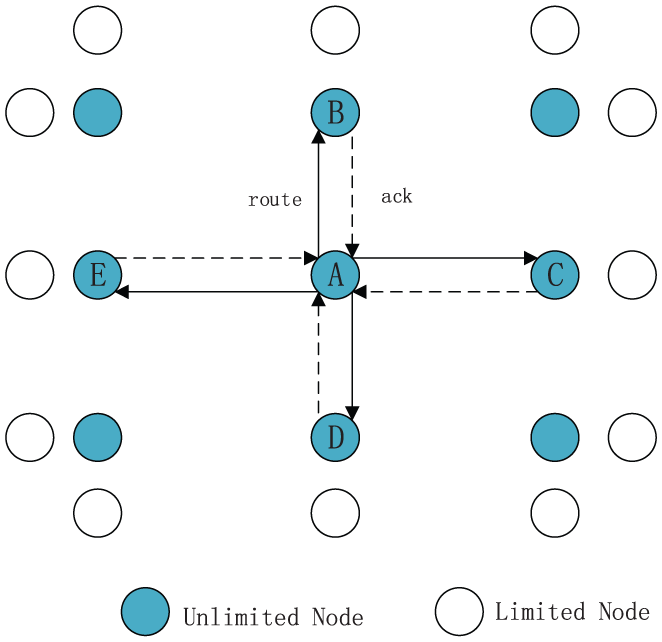
The routing initiation process of energy-unlimited node A and its routing table.
Nodes relevance in RP-NTBEMS.

RP-NTBEMS: relay participated–new-type building energy management systems.
The second part
First, energy-limited nodes broadcast route packets and initializes their routing tables based on received ACK packets. If the adjacent energy-unlimited nodes have not finished the routing initiation process, they would not reply ACK packet to energy-limited nodes. Second, energy-limited nodes select several adjacent energy-unlimited nodes as relevant nodes based on the RSSI, then update the relevance fields in their routing tables. The details are as follows:
In order to obtain stable RSSI values of adjacent energy-unlimited nodes, energy-limited node sends route packets to every energy-unlimited nodes in its routing table for 10 times. Then, 10 groups of RSSI values of each adjacent energy-unlimited node are collected and the average of which are calculated as the RSSI value of corresponding energy-unlimited node.
Energy-limited nodes select two energy-unlimited nodes with the largest RSSI value as the relevant nodes and send rel packets to the selected relevant nodes for establishing the relevance with them. As soon as the relevant nodes receive rel packet, they update the relevance field with the source limited energy node in routing table and replay ACK packet to the source energy-limited node. The energy-limited nodes receive ACK packet and update the relevance field with the corresponding energy-unlimited node in routing table


where
Figure 3 and Table 3 show the initialization process of energy-limited node A. Node A broadcasts route packets to obtain the routing information of its adjacent nodes B, C, D and initializes its routing table. Node A sends route packets 10 times to each of node B, C, D in turn to obtain the RSSI sets. According to the equation (1), node A gets the stable RSSI values of nodes B, C, D. Node A selects the two largest RSSI value energy-unlimited nodes D, B and sends rel packets to the nodes B, D for establishing the relevance with them. Node A receives ACK packets from nodes B, D and updates the relevance field with the nodes B, D in routing table.
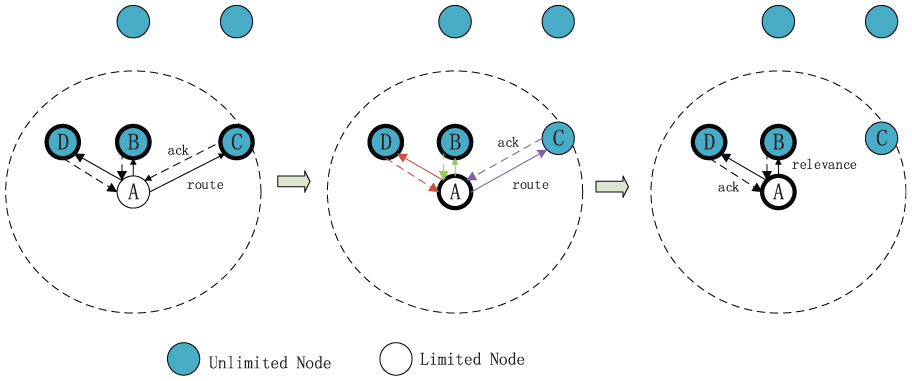
The routing initiation process of energy-limited node A and its routing table.
Nodes relevance in RP-NTBEMS.

RP-NTBEMS: relay participated–new-type building energy management systems.
Routing path generation
When the initialization phase is completed, nodes can communicate with the neighboring nodes and the routing table only has the next hop of neighboring nodes. In order to communicate with the multi-hop destination nodes, the source node needs to find a multi-hop routing path for the destination node.
When a node needs to send information to destination node which does not exists in the routing table, it will broadcast req packet to get the routing path of the destination node. Req packet stores the source node ID and destination node ID. When neighboring nodes receive req packet, they will check whether the destination node ID is equal to their ID. If yes, node sends res packet to the source node; otherwise, node looks up whether routing table has the next hop of destination node. If yes, node sends res packet to the source node; otherwise, node continues to broadcast req packet. If the source node failed to receive any res packets within the given time, it will rebroadcast the req packet. If the number of rebroadcasts of the req packet reaches a threshold, source node will abandon rebroadcasting req packet. The specific algorithm of routing path generation is as follows.

Figures 4 and 5 show the flow charts of the Routing Path Generation. The flow charts show common Routing Path Generation mechanism for all nodes in RP-NTBEMS protocol.

The flow chart of the source node in routing path generation.

The flow chart of the forwarding node in routing path generation.
In Figure 6, Node A has packets to be sent to node F, but node A’s routing table does not have the next hop of node F. So, Node A broadcasts req packet to get the routing path of node F. Node E receives req packet, and node E is the relevant node of node F. Then, node E updates routing table with node A and encapsulates the reverse routing path F → E → D → C → B → A and the type of node F into res packet and then sends res packet to node A. When node A receives the res packet, it will add the next hop of node F into its routing table. As a result, the routing path A → B → C → D → E → F generates.

The routing path generates between node A and node F.
Packets forwarding
With the help of routing table, the source node forwards or transmits packets. In the process of packets forwarding, nodes make packets forward decisions depending on the type of destination node. The details are as follows:
1. The destination node type is energy-unlimited node.
The type of node may have been in the working state because of no considering of energy-saving, which facilitates energy-unlimited nodes to communicate with each other at any time in the routing process:
If the destination ID of received packet is equal to its ID, energy-unlimited node will continue to receive packets.
If the destination ID of received packet is equal to its relevant node ID, energy-unlimited node will continue to receive packet and store it locally. It would not continue forwarding data to the next hop of the destination ID.
If the destination ID of received packets is neither its ID nor its relevant node ID, energy-unlimited node will forward the data to the next hop of the destination ID.
2. The destination node type is limited energy node.
In order to save energy, energy-limited nodes sleep periodically and the source node does not communicate with limited energy nodes at any time. So, limited energy nodes can send temporary data to their relevant nodes, and their relevant nodes reply ACK packet for the relevant energy-limited nodes. When energy-limited nodes wake up, they will ask their relevant energy-unlimited nodes whether there are any packets destined to them by broadcasting inquiry packets.
If the relevant energy-unlimited nodes have the packets for the energy-limited node locally, they will reply ACK packet to the source energy-unlimited node and establish a communication relationship with the source node. Otherwise, the relevant energy-unlimited nodes do nothing.
If the energy-unlimited nodes do not receive any ACK packet within the given time, they will adjust the sleep time of next cycle based on dynamic adaptive traffic mechanism of sleep cycle and continue sleeping.
After energy-limited nodes have established the communication relationship with their relevant energy-unlimited nodes, the relevant energy-unlimited nodes send data which match the ID of energy-limited node to the energy-limited node. As soon as energy-limited nodes receive the data, they reply ACK to their relevant nodes and fall into sleep state.
In Figure 7, node A sends data to node F, the routing path is A → B → C → D → E → F. When the data arrive at node E, it realizes that the destination node ID of the data packet is equal to its relevant node F’s ID; node E will store the data in local and reply ACK to node A instead of node F. When node F wakes up, it will ask node E whether there is any data transmission for it by broadcasting inquiry packet.
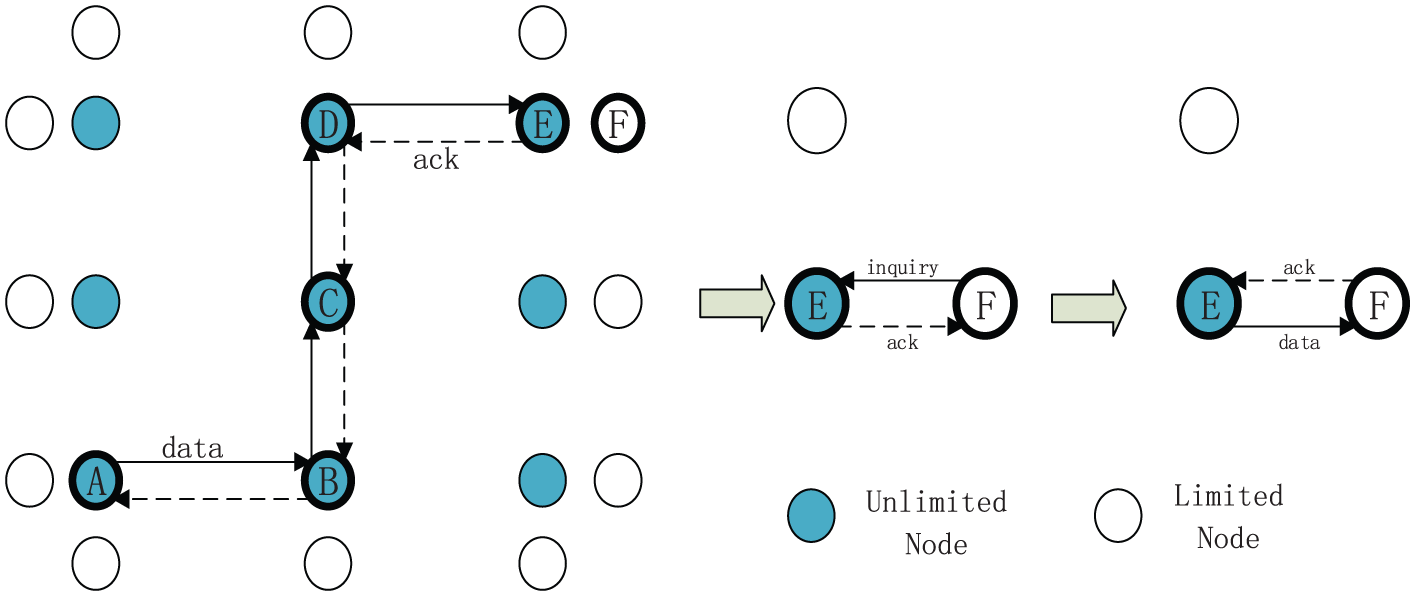
The source node A sends data to node F.
3. Dynamic adaptive traffic mechanism of sleep cycle—slow start algorithm
The data traffic in WSN of NTBEMS is related to human activity. Generally, the data traffic during the day is more than the data traffic at night. In order to adapt to the dynamic change of data traffic in the network and to achieve further energy efficiency, the sleep cycle of energy-limited nodes varies from the dynamic change of data traffic. RP-NTBEMS use the slow start algorithm to change the sleep cycle of energy-limited nodes dynamically. If the packets traffic of network in NTBEMS is a little higher, energy-limited nodes will reduce the cycle time of sleep immediately and increase the time of waking to ensure packets transmission is on time. The details of slow start algorithm are as follows.
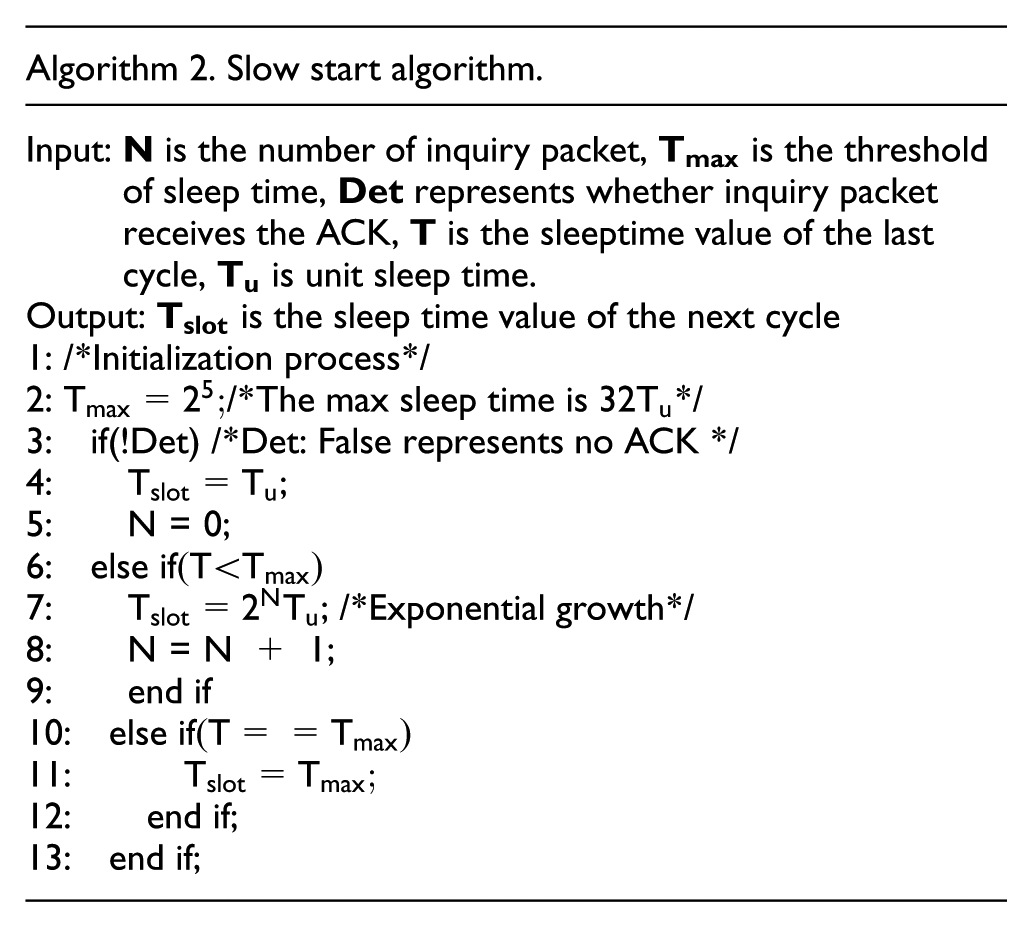
In Figure 8, an energy-limited node sends inquiry packets five times in a row and does not receive any ACK packets within the given time. The sleep cycle time of energy-limited node reaches the max threshold

Slow start algorithm of sleep cycle.
Performance results
Simulation configurations
NS-2 is a network simulation platform used for the design and research of the network protocol. The RP-NTBEMS is implemented in NS-2.30 to validate and evaluate the performance of the proposed protocol in comparison with ad hoc on-demand distance vector (AODV), 16 S-MAC, and LEACH routing protocols. The simulation environment is based on an area of 1000 × 1000 m2 and carried out with 2, 4, 9, 16, 25, 35 evenly distributed unlimited energy nodes with two limited energy nodes around each of them. The simulation time is 200 s, and the node transmission model is Two ray ground model (Table 4).
Simulation parameters.

Energy consumption
In AODV-SMAC and LEACH, the average energy consumption is the sum of data transmitting, receiving, idle listening, and sleep state of limited energy nodes. Therefore, the average energy consumption of S-MAC in AODV and TDMA in LEACH is

where
In RP-NTBEMS, due to the network layer and data link layer information sharing, which avoid the time synchronization among nodes at the data link layer, it reduces much energy consumption for time synchronization as the size of network increases. The average energy consumption of RP-NTBEMS is

where
Simulation results
According to the interval of data packets and different number of nodes in WSN of NTBEMS, we conduct simulations to evaluate average latency of the network and energy consumption of energy-limited node in AODV-SMAC, LEACH, and RP-NTBEMS.
Figures 9–11 show the average end-to-end latency with different number of energy-unlimited nodes, energy-limited nodes, and varying packets interval time. In our simulation, RP-NTBEMS has less delay and provides better performance than AODV-SMAC and LEACH. The performance of AODV and LEACH is very close. In general, they suffer from the long end-to-end delay because of time synchronization mechanism resulted in the per-hop long delay. Therefore, RP-NTBEMS relies on the network layer routing information to avoid time synchronization at the data link layer to simplify the communication at data link layer, which decreases the latency of WSN in NTBEMS.

Average latency with 9 unlimited energy nodes and 18 limited energy nodes.

Average latency with 16 unlimited energy nodes and 32 limited energy nodes.
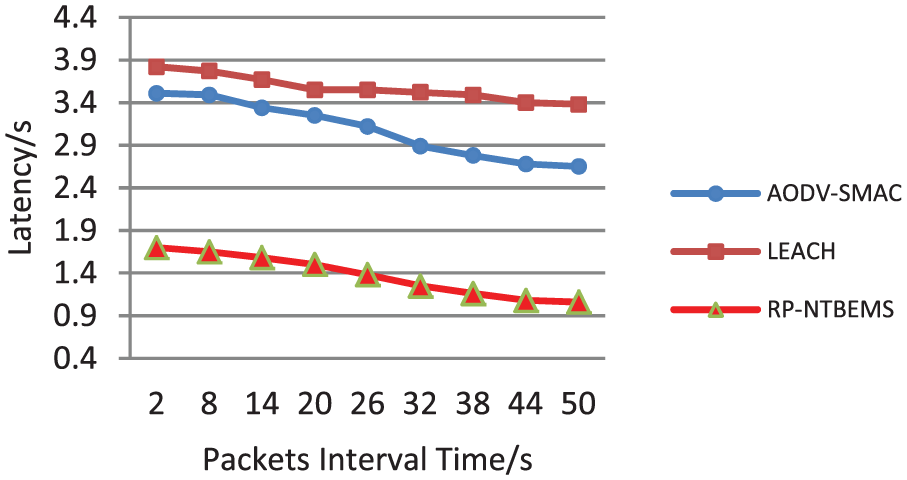
Average latency of networks with 25 energy-unlimited nodes and 50 energy-limited nodes.
In Figure 12, we change the ratio between energy-unlimited nodes and energy-limited nodes to obtain the energy consumption of energy-limited nodes. According to the simulation results, the performance of the RP-NTBEMS is better than AODV-SMAC and LEACH in the NTBEMS wireless network. As the size of network increases, RP-NTBEMS is more efficient because AODV-SMAC and LEACH spend more energy on time synchronization within nodes.
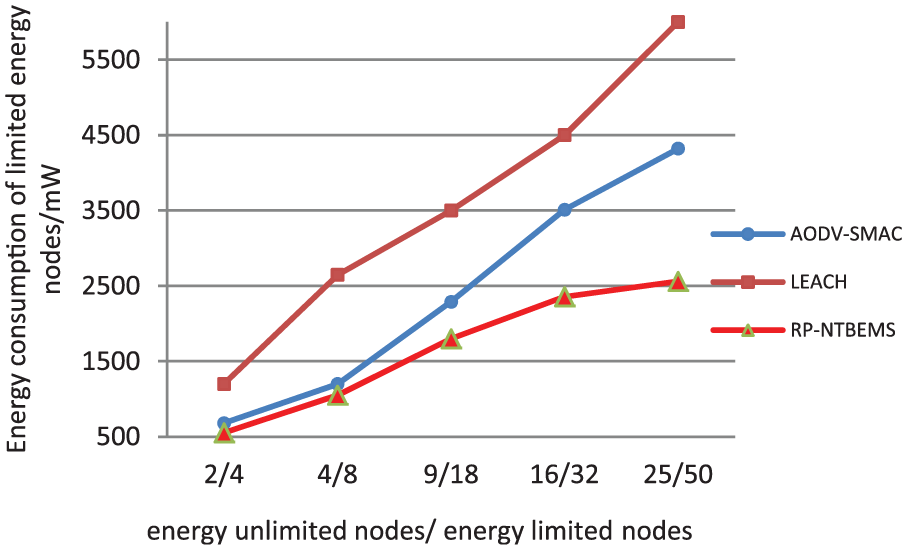
Energy consumption of limited energy nodes.
Conclusion
In this article, we propose a novel energy-efficient data transmission protocol for the NTBEMS WSNs called RP-NTBEMS. RP-NTBEMS relies on the network layer routing information to avoid time synchronization at data link layer and simplify the communication operation of MAC layer, which reduces power consumption and decreases the latency of WSN in NTBEMS. RP-NTBEMS allows energy-unlimited nodes to temporarily cache packets of its relevant energy-limited nodes and uses relevant information of nodes to reduce the control signal overhead at data link layer, which satisfies energy-limited node’s periodical sleep mechanism perfectly and adapts to the traffic dynamically. RP-NTBEMS will reduce energy usage of energy-limited nodes and extend the lifetime of WSN in NTBEMS. Simulation results show that the RP-NTBEMS scheme improves energy efficient significantly and reduce average latency as compared to AODV-SMAC and LEACH in the WSN for NTBEMS.
Footnotes
Academic Editor: Hongjian Sun
Declaration of conflicting interests
The author(s) declared no potential conflicts of interest with respect to the research, authorship, and/or publication of this article.
Funding
The author(s) received no financial support for the research, authorship, and/or publication of this article.