




Abstract
In this article, we propose two new routing protocols for wireless sensor networks. First one is AM-DisCNT (angular multi-hop distance–based clustering network transmission) protocol which uses circular deployment of sensors (nodes) for uniform energy consumption in the network. The protocol operates in such a way that nodes with maximum residual energy are selected as cluster heads for each round. Second one is iAM-DisCNT (improved AM-DisCNT) protocol which exploits both mobile and static base stations for throughput maximization. Besides the proposition of routing protocols, iAM-DisCNT is provided with three mathematical models: two linear-programming-based models for information flow maximization and packet drop rate minimization and one model for calculating energy consumption of nodes. Graphical analysis for linear-programming-based mathematical formulation is also part of this work. Simulation results show that AM-DisCNT has 32% and iAM-DisCNT has 48% improved stability period as compared to LEACH (low-energy adaptive clustering hierarchy) and DEEC (distributed energy-efficient clustering) routing protocols. Similarly, throughput of AM-DisCNT and iAM-DisCNT is improved by 16% and 80%, respectively, in comparison with the counterpart schemes.
Keywords
Introduction
Wireless sensor networks (WSNs) are composed of small, compact, and lightweight sensors called nodes. These nodes are deployed to monitor the environmental conditions (such as temperature, light, sound, and fire) and gather the information of interest. Then, following a specific routing strategy, the encoded information in the form of data messages is transmitted to base station (BS) where it is decoded. By encoded data we mean sensed data in the form of bits (information) and by decoded data we mean extracted information when the encoded data are successfully received at the sink. Figure 1 shows the WSN clustering technique, where communication between cluster head (CH) and cluster member nodes (MNs) is direct. Applications of WSNs include constant monitoring and detection of specific events such as battlefield surveillance, weather forecast, flood detection, and patient monitoring.1–4

WSN with clusters.
Methods of data delivery to BS depend on application and can be categorized into four types: continuous, query driven, event driven, and hybrid. The first method allows each node to transmit data periodically. In the second method, data are transmitted when a query is generated by BS. Similarly, event-driven transmission is triggered by occurrence(s) of specific event(s). A hybrid data delivery method utilizes two or more methods at the same time. Routing protocols are highly influenced by these data delivery methods in terms of energy consumption.5,6 Therefore, selection of proper data delivery method is one of the major challenges faced by the sensor network routing protocols.
Each node is equipped with limited energy source, usually a battery. Therefore, proper route selection for data transmission is of extreme significance.7–9 In Jin et al., 10 authors discussed the relation between hop count and energy consumption on theoretical as well as practical point of view. For example, Figure 2 shows the comparison of single-hop communication and multi-hop communication with respect to energy consumption when the distance between nodes and sink is subject to increase. As evident from the figure, direct communication penalizes nodes far away from sink, whereas multi-hop communication penalizes nodes nearer to the sink. Therefore, clustering is required to balance the energy consumption of farther as well as nearer nodes. Prior to routing, random deployment of nodes leave some regions un-monitored. So, the placement of BS should be such that it can conveniently get packets from every part of network.
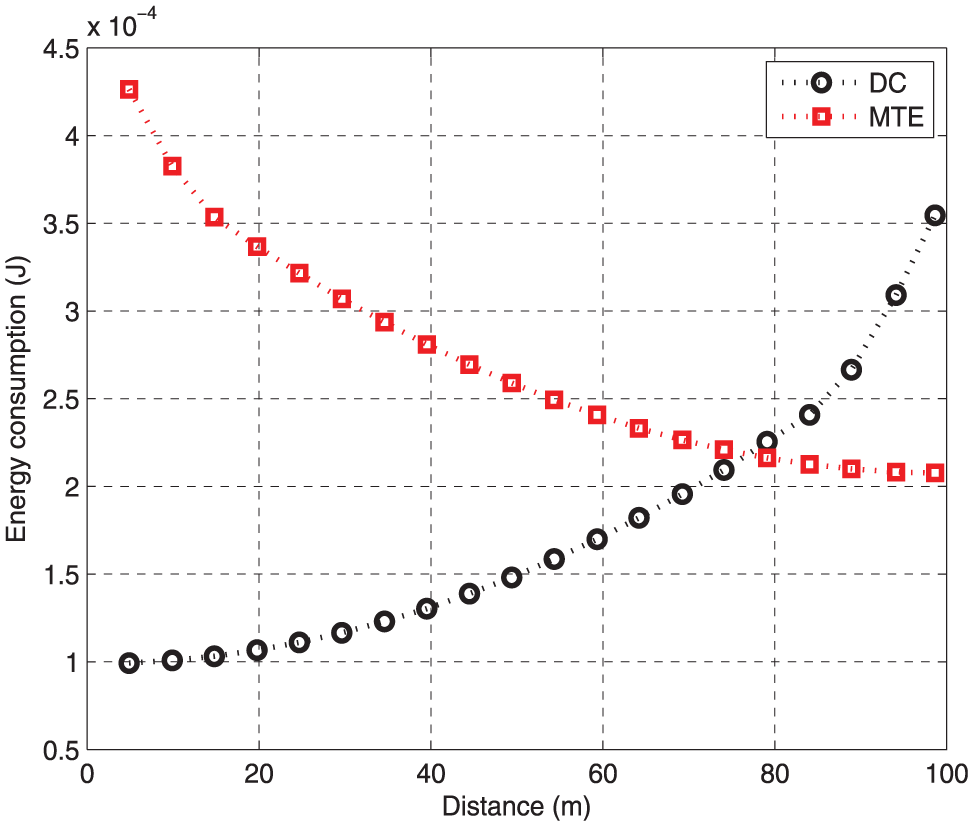
Comparison of energy consumption: direct communication (DC) versus minimum transmission energy (MTE).
Scalability is one of the major design considerations in sensor network applications. In a single-tier network, aggregator node is overloaded whenever the network density is increased. This overloading may cause latency along with high energy consumption. So, single-tier WSNs are not scalable because nodes are not capable of long-haul communication. In order to cover large network area, without degrading quality of service, clustering has been introduced as one of the very fruitful routing approaches. 5
In this article, our focus is on the network lifetime maximization and minimization of packet drop ratio. For this purpose, two cluster-formation-based routing protocols for WSNs are presented: AM-DisCNT (angular multi-hop distance–based clustering network transmission) and iAM-DisCNT (improved AM-DisCNT). In AM-DisCNT, network area is divided into circular regions such that inner circle nodes directly communicate with BS, whereas outer circle nodes form clusters in their defined areas. CHs gather data from nodes associated with them and after aggregation, send these data to BS using multi-hop technique. CHs are more penalized as compared to the MNs of clusters because they have to relay data of the MNs, and they deplete their energies soon. To overcome this issue, another scheme iAM-DisCNT is proposed that is equipped with mobile BSs. Role of CH is shifted to mobile BS. We assume that these Mobile BSs have no constraint of energy. They move in the field and gather data directly from the nodes. Moreover, iAM-DisCNT is aided with linear-programming-based mathematical models for data flow maximization and packet drop minimization. Here, it is important to mention that section “The proposed protocol: AM-DisCNT” summarizes our previous work in Rao et al. 11 and section “Extending AM-DisCNT: iAM-DisCNT” includes the improvements made to our previous work.
Rest of the article is organized as follows. Section “Related work” contains a brief review of related work. Section “The proposed protocol: AM-DisCNT” describes the motivation for the proposed protocols. Section “Extending AM-DisCNT: iAM-DisCNT” presents the details of AM-DisCNT protocol and also contains explanation about the drawback of AM-DisCNT protocol and proposition of the second routing protocol “iAM-DisCNT” along with linear-programming-based mathematical models for data flow maximization and packet drop minimization. Section “Simulation results” provides the simulation results along with discussions. Finally, section “Conclusion and future work” concludes the article and states the future work.
Related work
In this section, a brief overview of related research work is presented. Here, the focal point is hierarchical routing protocols and cluster organization based in particular.
LEACH (low-energy adaptive clustering hierarchy) 12 is a hierarchical clustering algorithm which randomly selects nodes as CHs. Basically, LEACH works in two phases: set-up phase and steady-state phase. In set-up phase, nodes are randomly deployed in network field such that each node is initially equipped with equal energy. Deployment is followed by random selection of CHs where each node generates a random number and compares it with a threshold value. If the generated random number is less than the threshold value, then that node is selected as CH for the current round. Soon after the selection of CHs, remaining nodes associate themselves with the nearest CH. In steady-state phase, time division multiple access (TDMA)-based schedules are assigned to nodes and CHs for data transmission such that each node or CH associates within its allocated time slot only. Thus, we can say that LEACH uses two modes of communication, that is, between nodes and CHs, and between CHs and BS. In LEACH, CH selection is random and non-uniform. Due to this non-uniformity, density of clusters varies in different regions causing loss of data. LEACH-C (LEACH centralized) 13 uses centralized clustering algorithm, where the information about the energy and location of nodes is sent to BS. The CH selection is random in LEACH-C. In LEACH-C, BS makes sure that node with lower energy than the network’s average energy does not become CH. However, nodes away from BS are unable to send their data to BS due to less energy, thus leading to network partition (improper coverage of the network). Moreover, selection of CHs is random like LEACH, thereby causing nodes to deplete their energy in an unbalanced manner which ultimately leads to decreased network lifetime and throughput. In multi-hop LEACH, 14 data sent by nodes are received at BS through a chain of CHs. In case of multi-hop LEACH, nodes which are not in the vicinity of any CH, send a request to near-by nodes to become their temporary CH. However, CH selection is random which leads to problem similar to that in LEACH, LEACH-C, and multi-hop LEACH. This agreement does not guarantee monitoring of the entire network. A-LEACH (advanced LEACH) 15 selects CHs on the basis of current state and random probability.
TEEN (threshold-sensitive energy-efficient sensor network protocol) 16 is the first reactive protocol for homogeneous WSNs. This protocol defines two thresholds: hard and soft. The set-up phase of TEEN is similar to that of LEACH, where CHs are randomly selected from the set of eligible nodes. Whereas, data are not transmitted until the threshold is reached in steady-state phase. That is why TEEN is not a good option for applications that require periodic data monitoring. APTEEN (adaptive threshold-sensitive energy-efficient sensor network protocol) 17 sends data periodically and also provides information on time-critical events. Main drawback of TEEN and APTEEN is the complexity of forming clusters in multiple levels implementing threshold-based functions and dealing with attribute-based naming of queries.
SEP (stable election protocol) 18 is the first heterogeneity-aware WSN protocol which uses proactive data reporting. The authors consider two levels of energy in a hierarchical network such that each node independently elects itself as a CH based on probability value. Node with more residual energy hold strong chances to be selected as CH due to biased probability weight in proportion to residual energy level. Following the same technique as that of LEACH, data scheduling and transmissions occur in SEP as well. In Aderohunmu and Deng, 19 authors propose E-SEP (enhanced-SEP) routing protocol for heterogeneous WSNs. The proposed proactive E-SEP protocol extends the concept of SEP from two-level heterogeneity to three levels.
DEEC 20 (distributed energy-efficient clustering) generalizes the concept of SEP to multi-energy levels in a homogeneous proactive environment. This protocol selects CHs on the basis of nodes’ residual energy and average energy of the network. Soon after the CHs selection, minimum distance–based association of nodes with CHs takes place. Finally, BS assigns TDMA-based schedules to nodes as well as CHs. In these schedules, data transmissions from nodes to their respective CHs and from CHs to BS occur. DEEC protocol also has variable number of clusters and their size vary indefinitely. SDEEC (stochastic distributed energy-efficient clustering) 21 introduces a balanced method for CH election. This method is more efficient than previous techniques as it uses stochastic scheme detection. SDEEC outperforms SEP and DEEC in terms of network lifetime.
In Luo and Hubaux, 22 authors investigate the joint sink mobility and routing problem. They first solve the problem by primal dual algorithm while considering single BS and then it is generalized with the consideration of multiple BSs. Behdani et al. 23 use mobile BS to maximize the lifetime of WSNs, where the BS moves with a finite speed to collect data from static nodes. In Haeyong et al., 24 authors increase the network lifetime by deploying multiple BSs where mixed integer linear programming is used to determine the position as well as traffic flow from/toward the mobile BS.
To improve the efficiency of a WSN, energy consumption should be minimized that also improves the network lifetime. Rahim et al. 25 address the issue of communication efficiency and power consumption. As nodes have limited battery, the energy efficiency is a critical issue. They give the solution by distributing traffic uniformly across the network.
A hierarchical clustering scheme, called LESCA (location energy spectral cluster algorithm) is proposed in Jorio et al. 26 This scheme calculates the total number of clusters in a network. For finding optimal number of clusters, it takes into account residual energy as well as properties of nodes. It uses K-ways algorithm in order to determine the clusters and respective CHs. For this purpose, it uses average energy and distance to BS. The simulation results show that if the network does not form optimal number of clusters, the total consumed energy increases exponentially per round.
AUV-PN (autonomous underwater vehicle visits path nodes) is proposed in Khan and Cho.
27
To gather data, an AUV is deployed in the field. By taking constant depth of AUV, that is,
Comparative analysis of the selected routing protocols.

LEACH: low-energy adaptive clustering hierarchy; LEACH-C: LEACH centralized; S-LEACH: secure LEACH; A-LEACH: advanced LEACH; TEEN: threshold-sensitive energy-efficient sensor network protocol; APTEEN: adaptive TEEN; SEP: stable election protocol; DEEC: distributed energy-efficient clustering.
The proposed protocol: AM-DisCNT
In order to cope with the problems stated in the introduction and motivation sections, we proposed a new proactive routing protocol, AM-DisCNT, for heterogeneous WSNs. The proposed protocol uses direct communication and static clustering to cope with the design constraints. Our work is based on the assumption that the network field is circular. Coverage means that sensed data from the entire network field is accessible at the BS. Rather than randomly deploying nodes in the entire network field, we randomly deploy uniform number of nodes in each sub-region to ensure full area coverage. Detailed description is provided in the upcoming subsections.
Field distribution and architecture
AM-DisCNT divides the network area into two concentric circles: inner circle with radius “
The schematic diagram of AM-DisCNT is summarized in Figure 3. N nodes are deployed randomly in two circular regions: inner circle and outer circle. The nodes are assumed to be static, that is, their position does not change after deployment. Inner circle nodes directly send sensed information to BS, whereas outer circle nodes are further organized into eight sub-regions. This logical divisioning is done for the purpose of clustering. Equal number of nodes are deployed in each region. In the outer eight regions, fixed number of nodes are randomly deployed to provide full area coverage. Outer region nodes send sensed data to their respective CHs, and the CHs then forward the data either directly to BS or through intermediate node of inner circle depending on its transmission range which is shown Figure 3.
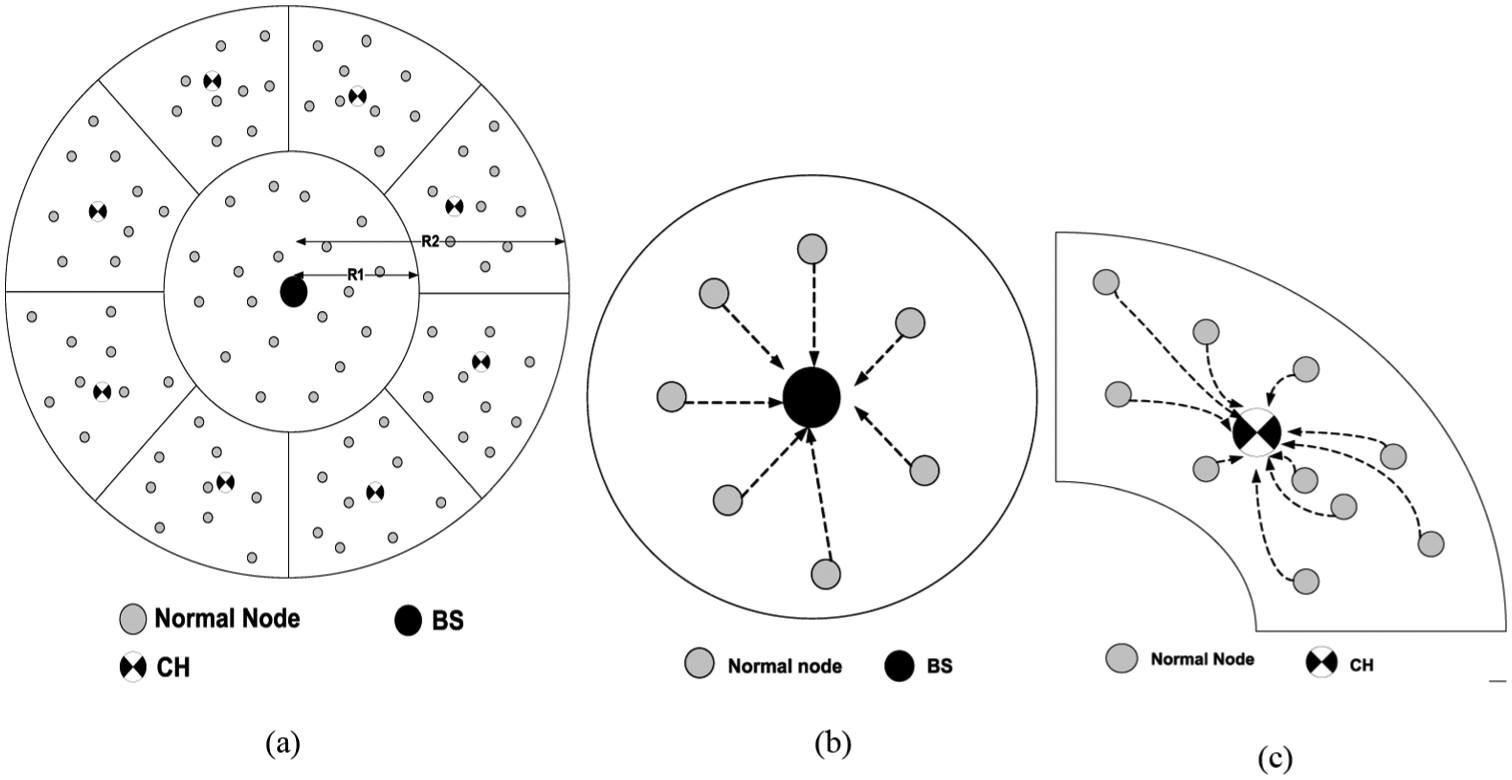
Schematic diagram of AM-DisCNT: (a) network topology, (b) inner circle: nodes to BS communication, and (c) outer region: communication of nodes with CH.
Nodes are often located far from the BS, and they always have data to transmit. Outer circle of AM-DisCNT is divided into eight equal regions. Thus, the network area consists of nine regions: a inner circular region “


where
In order to deploy the nodes, we assume the ability to detect the empty areas and then deploy nodes in those empty areas. First,

here
Selection of CHs
In each round, eight CHs are selected for outer circular region, one from each sub-region. These CHs are selected on the basis of nodes’ residual energies. CHs collect data from their own regions and after aggregation send these data to BS. CHs either transmit directly to BS or through inner circle nodes, depending on the residual energy. After the first round, energy of each node is calculated and highest energy nodes are selected as CHs. Such type of clustering ensures maximal area coverage.
AM-DisCNT considers first-order radio model for energy consumption of nodes.
20
We also consider a path loss of

where

For the reception of k-bit packet

Heterogeneity of the network
We consider a multi-level heterogeneous network in such a way that first we develop a two-level heterogeneous network model, followed by three levels, and finally, its generalization into a multi-level heterogeneous network model. Advanced nodes own

Total energy of three-level heterogeneous networks is given by

where the fraction of super nodes is denoted by
AM-DisCNT considers a wireless multi-level heterogeneous network. Energy is randomly distributed among all the nodes of the network. The energy of nodes is given by the following equation

where

Extending AM-DisCNT: iAM-DisCNT
The proposed AM-DisCNT minimizes the communication distance between nodes and BS and uses fixed number of CHs to minimize energy consumption during each round. AM-DisCNT’s performance is far better than LEACH; however, when compared to DEEC, results are not satisfactory in terms of throughput. On average, DEEC outperforms AM-DisCNT, two times out of five. This behavior of DEEC is due to the CHs’ fluctuation in each round. Greater number of CHs implies larger throughput. This problem is catered in iAM-DisCNT.
This section contains four subsections: (1) iAM-DisCNT, (2) energy-consumption calculation, (3) information flow maximization model, and (4) packet drop minimization model. Details are given in the upcoming sections.
iAM-DisCNT
iAM-DisCNT inherits all features from AM-DisCNT except the deployment and operations of BS. Thus, we only discuss placement and working of BS. Three BSs, one static and two mobile, are deployed to maximize the throughput while providing full area coverage. In iAM-DisCNT, mobile BSs are introduced in the network which replace the role of CH. Mobile BS receives data from nodes at minimum distance, minimizes their energy consumption, and prolongs the network life and stability period. CHs drain more energy (relay the data of MNs) as compared to the MNs.
Static BS. Static BS is deployed in the inner circle of the network area. So, nodes lying in
Mobile BSs. Mobile BSs provide energy-efficient data collection in WSNs.
Direct data collection. Mobile BSs collect data (during sojourn intervals) by staying at sojourn locations, directly from nodes as shown in Figure 4, where sojourn location is the location at which any of the two mobile stations stops for data receptions. The time duration for which mobile BS stays at any sojourn location within any of the sub-regions is called sojourn time. This technique reduces the communication distance between BS and nodes, thereby minimizing energy consumption.

Schematic diagram of iAM-DisCNT.
The movement energy of mobile sink is much more than the communication energy. However, we assume that the sink has sufficient energy (it has no constraint of energy) and only the sensor nodes are energy constrained. Our focus is to minimize the energy consumption of nodes to enhance the network lifetime. As far as the scope of this article is considered, we have assumed smooth deployment. iAM-DisCNT considers two mobile BSs moving in outer circle of the network area. The mobile BSs move in a circular trajectory: one in clockwise direction, whereas the other in anticlockwise direction, meanwhile collecting data from the nodes. Circular trajectory is a path that is exactly at the middle of outer circle as shown in Figure 4. Two BSs move synchronously with constant velocity during their movement. Each BS broadcasts a message while moving. After that nodes share their current status with BS telling whether these are in communication range or not. If a node receives message from two BSs, it replies with a data packet to any one of them (randomly). Nodes, which are not in communication range of any BS, switch to sleep mode. Whereas, nodes which come to communication range of any BS switch to active mode and start transmissions.
Outer BSs


For


where
From extensive simulations as well as literature review, we conclude that relatively better results are obtained when the outer circle is divided into eight sub-regions. This makes the total number of regions as nine, the inner region nodes communicating directly with the static sink. In literature,1–3 different sink mobility patterns are explored. Based on their findings and the needs of our network architecture, we have selected anticlockwise and clockwise movement directions for the BSs.
Calculation of energy consumption
We develop the following set of mathematical equations to calculate the energy consumption of nodes in each segment.
Referring Figure 4, if

and

where


where

Since the inner region nodes in both protocols, AM-DisCNT and iAM-DisCNT, consume same amount of transmit energy, we develop the following equations

where
Using similar approach, we calculate energy consumption for the outer region non-CH nodes of AM-DisCNT as follows

Transmit energy of the CHs of AM-DisCNT is calculated as follows

Energy consumption of CHs in AM-DisCNT while gathering data is calculated as

where
In iAM-DisCNT, none of the nodes are selected as CHs from the outer region. So, these nodes only consume transmission energy which is calculated as follows

From these calculations, we conclude that the energy consumption of outer region nodes of iAM-DisCNT is less than that of AM-DisCNT. However, energy consumption is minimized at the cost of mobile BSs.
Information flow maximization model
Let us consider that the WSN is a graph

where

such that


The objective function in equation (16) is to maximize the information flow “q” from node “i” to BS “k” during the current round “r” belonging to the set of rounds “R” throughout the network lifetime. This objective function depends on the link flag “l” which depends on the probability of given link “
Packet drop minimization model
In addition to the information flow maximization, our second objective is to minimize the packet drop rate such that throughput of the network is maximized. In subject to this, we develop a linear-programming-based mathematical formulation as follows

such that



The objective function,
Graphical analysis
Let


In subject to the bounds provided by equations (16d-i to 16d-iii), Figure 5 shows the intersection of five lines (

Feasible region.
Simulation results
In this section, we evaluate the performance of the proposed protocols using MATLAB for simulations. A total of 20 nodes are randomly deployed in the inner circle. Outer circle is further divided into eight regions. Each region contains 10 nodes. These nodes are randomly deployed within the defined regions. Radius of inner circle
Simulation parameters.
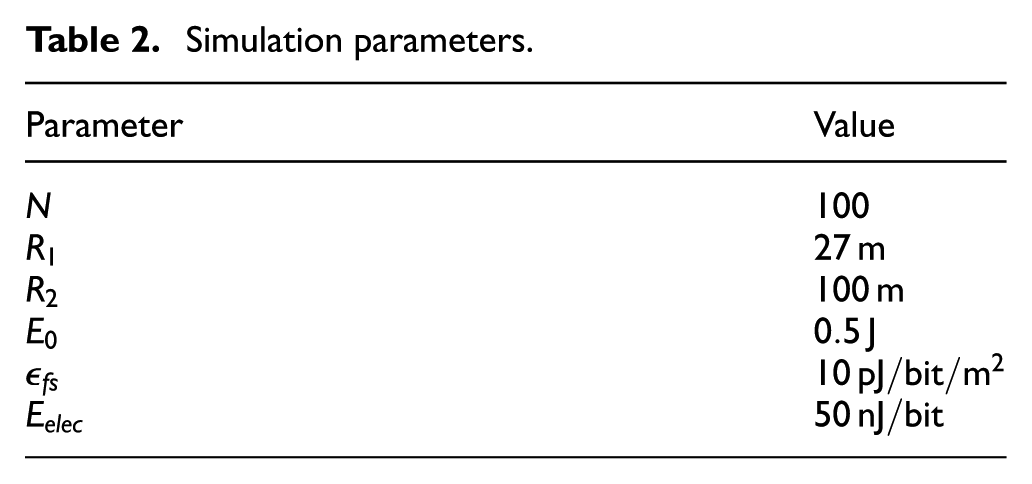
Figure 6 shows that the stability period and network lifetime of the proposed protocols are greater than the existing protocols. AM-DisCNT’s superior performance in comparison with LEACH and DEEC is due the minimization of communication distance and proper selection of CHs. iAM-DisCNT shows further improvement in stability period and network lifetime at the cost of multiple BSs (one static and two mobile). Furthermore, we can interpret that instead of variable number of CHs in LEACH and DEEC, the proposed protocols rather select fixed number of CHs per round: one CH per region in the outer circle. This type of CH selection ensures data delivery from every part of network to BS, thus ensuring full area coverage.

Network lifetime.
The rate at which CHs are selected in the proposed as well as chosen existing routing protocols is shown in Figure 7. This figure depicts that the selected CHs in LEACH routing protocol vary from 5 to 15 (per round) during initial rounds and then this rate drops to zero. Similar is the case with DEEC protocol, where the selected CHs fluctuate between 3 and 36 during initial rounds. Both of these protocols do not guarantee optimum number of CHs throughout the network lifetime. Fluctuation in CH number is due to random selection criteria of these protocols. In response, this random number of selected CHs may lead to one of the two drawbacks: (1) the selected CHs are more than the required number of CHs and (2) the selected CHs are less than the required number of CHs. Alternatively, the first drawback means surplus energy consumption and the second drawback means large cluster size. Surplus energy consumption leads to decreased network lifetime, and large cluster size leads to more load on the selected CHs. AM-DisCNT routing protocol fixes both of these drawbacks by selecting one CH per round from each of the eight outer regions. iAM-DisCNT further extends the network lifetime by introducing mobile BSs. These results show that AM-DisCNT has approximately 32% and iAM-DisCNT has approximately 48% improved stability period as compared to LEACH and DEEC routing protocols, respectively.
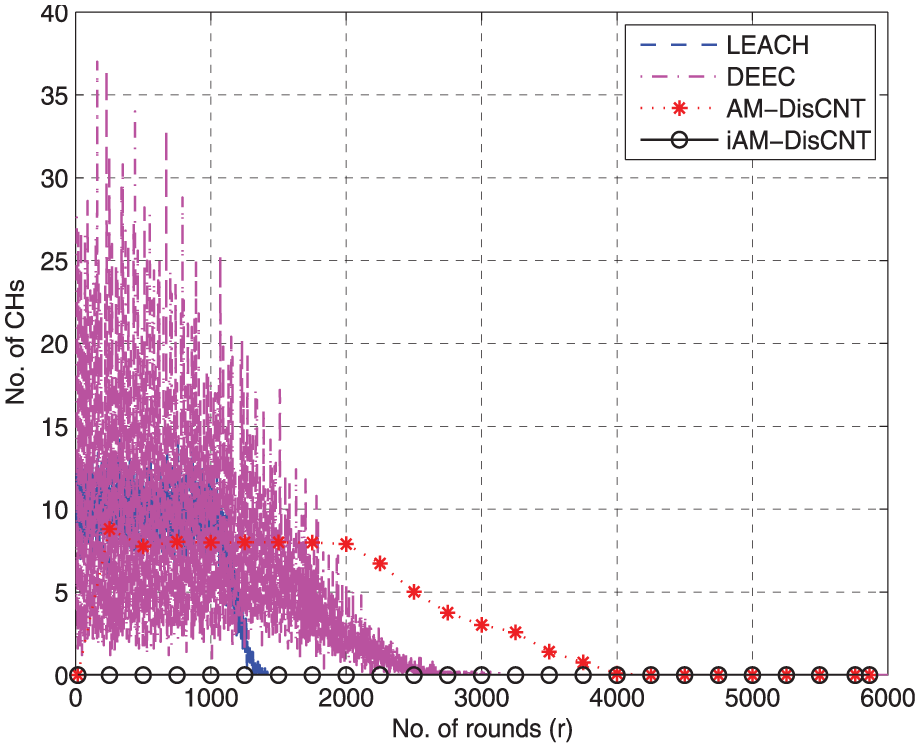
CH selection frequency.
From Figure 8, we see that LEACH sends the smallest number of packets to BS as compared to DEEC, AM-DisCNT, and iAM-DisCNT. This is due to LEACH in which all nodes are homogenous. Such assumption selects low-energy nodes as CHs instead of high-energy nodes, thereby increasing dead nodes in the network which causes the loss of useful data. DEEC performs better than LEACH because it selects CHs based on the ratio of residual energy of nodes and average energy of the network. This conserves energy and increases network lifetime, thus increasing the number of packets sent to BS. The performance of DEEC and LEACH is not satisfactory because of varying cluster sizes. Farther nodes use more energy to send the sensed data and die quickly leaving some area un-monitored. AM-DisCNT’s performance is far better than LEACH; however, when compared to DEEC, the results are not satisfactory in terms of the number of packets sent to BS. On average, DEEC outperforms AM-DisCNT, two times out of five. This behavior of DEEC is due to the fluctuation of CHs in each round. Greater number of CHs implies larger number of packets sent to BS. This problem is catered in iAM-DisCNT using one static and two mobile BSs. This approach increases the probability of direct communication between nodes and BS, and less distance between nodes and BS reduces the energy consumption of nodes leading to maximized number of packets sent to BS.

Number of packets sent to BS.
Whenever packets are sent from source to destination through wireless channel, some transmitted packets may get dropped due to bad channel conditions. In order to calculate dropped packets, we use “Random Uniformed Model.” 28 We set the probability of channel to be in bad status as 0.3 (30%). Figure 9 shows the number of successfully received packets at BS for the newly as well as selected existing routing protocols. iAM-DisCNT shows greater number of successfully received packets at BS as compared to LEACH, DEEC, and AM-DisCNT routing protocols. The throughput of AM-DisCNT and iAM-DisCNT is improved by approximately 16% and 80%, respectively, as compared to the counterpart schemes.

Number of packets received at BS.
Figure 10 shows the end-to-end delay comparison of iAM-DisCNT, AM-DisCNT, LEACH, and DEEC. Greater end-to-end delay, in case of DEEC and LEACH protocols, is due to greater queuing and processing delays. Due to distant communication between sender and receiver, LEACH and DEEC exhibit greater end-to-end delay. In AM-DisCNT, logical divisioning of the network area decreases the communication distance for the delivery of packets causing minimization of the propagation time, thereby showing least end-to-end delay among the selected routing protocols. Introduction of mobile and static BSs, in iAM-DisCNT, increases the chances of direct communication with BS which decreases the propagation delay from nodes to their respective BSs to some extent. However, data-packet delivery to final destination increases the overall propagation delay which alternatively increases the end-to-end delay.

End-to-end delay.
Performance trade-offs
In order to achieve a(some) desired objective(s), routing protocols pay its(their) cost in terms of other performance metric(s): trade-off(s). In this section, we analyze the four simulated routing protocols (LEACH, DEEC, AM-DisCNT, and iAM-DisCNT) in terms of performance trade-offs. We thus refer Figures 6, 9, and 10 and Table 3; DEEC achieves higher energy efficiency as well as throughput as compared to LEACH, however, at the cost of high end-to-end delay. A major reason for this relatively higher end-to-end delay is distant communication. AM-DisCNT logically divides the network area to minimize the end-to-end delay that also leads to increased energy efficiency. This is obvious as the local clusters are more restricted, that is, minimization of the communication distance. However, this achievement is made at the cost of restricted freedom at the time of node deployment (uniform random deployment of nodes). iAM-DisCNT further improves the network lifetime and throughput at the cost of an additional mobile sink. Moreover, this protocol also pays the cost of somewhat increased end-to-end delay as compared to AM-DisCNT. All these trade-offs are summarized in Table 4.
Comparative analysis of the selected routing protocols.

LEACH: low-energy adaptive clustering hierarchy; DEEC: distributed energy-efficient clustering; AM-DisCNT: angular multi-hop distance–based clustering network transmission; iAM-DisCNT: improved AM-DisCNT.
Comparative analysis of the selected routing protocols.

LEACH: low-energy adaptive clustering hierarchy; DEEC: distributed energy-efficient clustering; AM-DisCNT: angular multi-hop distance–based clustering network transmission; iAM-DisCNT: improved AM-DisCNT.
Conclusion and future work
In this article, we have proposed two new energy-efficient routing protocols for WSNs: AM-DisCNT and iAM-DisCNT. The leading one uses static clustering and maximum residual energy–based CH selection. The beauty of this protocol is the formation of fixed number of CHs in the defined regions per round which reduces the communication distance within clusters. However, the throughput of AM-DisCNT is not satisfactory. The lagging one, iAM-DisCNT, uses two mobile BSs and direct contact data collection technique to associate nodes with BS. Mobile BSs follow a pre-defined trajectory, minimizing the communication distance. In addition to the two newly proposed protocols, graphical analysis of the proposed linear-programming-based mathematical models provides the bounds within which the set of all possible solutions lie. Simulation results show better performance of AM-DisCNT and iAM-DisCNT as compared to LEACH and DEEC routing protocols in terms of stability period, network lifetime, and throughput. Based on these results, we have also analyzed the four simulated routing protocols in terms performance trade-offs.
In future, we are interested to exploit the work in Sun et al. 29 for the selection of CHs along with quality routing link metrics in Javaid et al. 30 Moreover, real-time experimental test bed development is also under consideration.
Footnotes
Academic Editor: Seungmin Rho
Declaration of conflicting interests
The author(s) declared no potential conflicts of interest with respect to the research, authorship, and/or publication of this article
Funding
The author(s) disclosed receipt of the following financial support for the research, authorship, and/or publication of this article: This research was funded by the Deanship of Scientific Research at King Saud University through Research Group Project no. RG#1435-051.