




Abstract
This article focuses on the direction of arrival estimation of wideband signals, and an efficient method based on test of orthogonality of frequency subspaces is proposed. Using suitable coefficient m to weight and inverse the covariance matrix, the proposed method can obtain estimated noise subspace with unknown number of signals. Unlike conventional subspace estimation with heavy complex computations, the proposed method reduces the amount of computation by real matrix multiplication, and through only half of the total angular field-of-view. It decreases the computational load of spectrum peak search to half. Moreover, compared with the existing real-valued techniques suitable for only the centro-symmetrical array, the new method can be applied to arbitrary array. The simulation and experimental data results are provided to demonstrate the effectiveness and performance of the proposed method.
Keywords
Introduction
Source localization using wideband signals has been widely studied in multiple areas with very diverse application such as radar, communication, and microphone array systems,1,2 and a variety of techniques have been proposed to handle the wideband signal localization problem. The maximum likelihood (ML) method is extended to the signals’ direction of arrival (DOA) estimation in Ye and Degroat
3
and Souza and Fortes;
4
since the ML method involves to maximize the likelihood function with highly nonlinearity, its computational complexity is very heavy. The most representative wideband DOA estimation approaches are incoherent signal subspace method (ISSM)
5
and coherent signal subspace method (CSSM).6–8 ISSM estimates sources’ DOAs separately at each frequency bin and then joins these results to get a final estimate. However, it cannot deal with coherent signals and has bad performance at low signal-to-noise ratio (SNR). CSSM is the most typical coherent wideband focus algorithm and it converts the wideband signal subspace into a predefined narrowband subspace by focusing matrices through suitable transformation matrices, and subsequently the narrowband subspace-based DOA estimation methods, for example, MUSIC can be used. CSSM is effective in low SNR cases, while it is sensitive to the initial values and poor initial values can result in bigger biased estimates. The focusing methods can reduce the estimation bias; however, their performance extremely relies on the accuracy of initial pre-estimation angles. To overcome the problem of pre-estimation angle, Yoon et al.
9
proposed test of orthogonality of projected subspaces (TOPS) algorithm which does not require focusing angles, but its performance depends on the selection of reference frequency, and when the reference frequency is unsuitable, the performance of TOPS algorithm would become worse. Zhang et al.
10
presented extended TOPS method which has better estimation performance than TOPS; however, how to choose reference frequency is still an open problem. Yu et al.
11
presented test of orthogonality of frequency subspaces (TOFS) method which exploits the information of multiple frequencies simultaneously and does not require any preprocessing for initial values. TOFS can eliminate the pseudo peak of TOPS and has better performance than TOPS method; however, it needs exhaustive spectral search which limits its practical application. In addition, there exist intrinsic limitations of the subspace decomposition approaches, that is, a priori information of incident signal number needs to be known in advance. The information theoretic criteria such as Akaike information criterion (AIC) and minimum description length (MDL)
12
and their variants13,14 are the most significant approaches for detecting the number of sources. For Qi et al.,
13
it requires that the number of sources is no bigger than half of the number of sensors, and for Huang et al.,
14
it is not available in the case of coherent signals. Qian et al.
15
proposed a MUSIC-like algorithm which does not need to know the number of signal; however, it has lower estimation accuracy because of the reconstruction of Toeplitz matrix. Reddy et al.
16
proposed a low-complexity algorithm with unknown number of sources but only limit with the use of narrowband signals. Recently, the emerging field of sparse representation of sources has attracted tremendous attention, and many researchers have shown enormous interests for its perfect resolution.17–19 Via covariance matrix sparse representation, DOA estimation can be performed where the prior information of the signal number is also not needed. Using the idea of sparse representation, wideband DOA estimation has been realized in Xu et al.
20
and Zhao et al.;
21
however, these sparse recovery algorithms need complex optimization process and spectral search. Generally, the computational complexity of spectral search is
Note that all the wideband signals’ localization methods aforementioned share a common problem, that is, their computational cost is very high. The computation of wideband DOA estimation methods based on subspace decomposition consists of two parts: one is the calculation of the estimated noise subspace and the other is the search of spectrum peak. Generally, the array covariance matrix is a complex matrix, since the complex multiplication costs four times more than that of real multiplications, and a unitary transform can convert the complex matrix into a real matrix along with their eigenvectors and thereby decreasing the amount of calculation of the estimated subspace at least by a factor of 4 without losing accuracy. 22 Haardt and Nossek 23 applied this technique to Estimation of Signal Parameters via Rotation Invariance Technique (ESPRIT) to reduce the computational burden, and Yilmazer et al. 24 extended this method into matrix pencil (MP) method to successfully decrease the computational cost. Yan et al. 25 proposed the semi-real-valued Capon method which could reduce 50% computational complexity of spectrum search and thus, significantly reduce the computation of peak search.
In this article, we propose an efficient DOA estimation method for wideband signals with unknown number of signals, which can overcome the aforementioned shortcomings of the existing algorithm. First, the proposed algorithm can obtain the real sample covariance matrix of each frequency bin through the addition of covariance matrix and its conjugate, which can reduce the computational load of matrix multiplication by about 75%. Then, we can obtain the estimated noise subspace by reversing the weighted covariance matrix through suitable coefficient m with no prior information of the source number. Finally, using symmetrical characteristics of new spectrum, just through only half of the total angular field-of-view, the proposed method can acquire wideband signals’ DOA estimation very fast.
This article is organized as follows. Section “Wideband signals’ model” provides wideband signals’ model that will be used through the article. Section “Test of orthogonality of subspaces” introduces test of the orthogonality of the subspace theory where TOPS and TOFS are described. A description of the modified TOFS (MTOFS) method is given in section “MTOFS,” followed by the numerical simulation results and discussion in section “Simulation results.” Finally, conclusions are given in section “Conclusion.”
Notation: We use boldface upper-case letters (e.g.
Wideband signals’ model
Consider a scenario where P wideband coherent signals impinge on a uniform linear array (ULA) which is composed of M sensors. The bandwidths of the wideband signals need not be identical, but there should be some frequency bandwidth

where

where c is the velocity of source propagation.
Suppose all sources could be partitioned into J non-overlapping narrowband blocks and the observation time is long enough so that the Fourier transform of the sensor output has good resolution. Via discrete-time Fourier transform (DTFT), the array output at frequency bin j can be expressed as

where

whose columns are the
For convenience, we use

where


where
Test of orthogonality of subspaces
According to the idea of TOPS in Yoon et al.,
9
the steering vector

where
Define a novel

where

where
TOPS has significant performance in DOA estimation; however, the reference frequency has serious influence on it. When the selected frequency bin is unsuitable, there would appear fake peaks. TOFS 11 constructs the searching steering vectors of every possible DOA and every frequency; thus, it can abstain the fake peaks that are often emerged in TOPS.
For a arbitrarily frequency bin

Then, a new matrix whose element is

where

in which
MTOFS
Principle of MTOFS
The TOFS method has good performance; however, it has two intrinsic limitations, one is the heavy computational cost and the other is requiring the number of signals to be known or to be exactly estimated in advance. Generally, the covariance matrix
Suppose we have obtained the prior information of the signals’ number. Then perform eigendecomposition for

where

Performing inverse operation for

where

Equation (17) testifies that the Capon method has the same performance as the MUSIC method when SNR is large, that is

Since

where

Similarly, since

Equation (21) indicates that each row of

Combining equations (20) and (22), we know

Then, we can define a new matrix

where
Since

For the value of

From equation (26), we also know

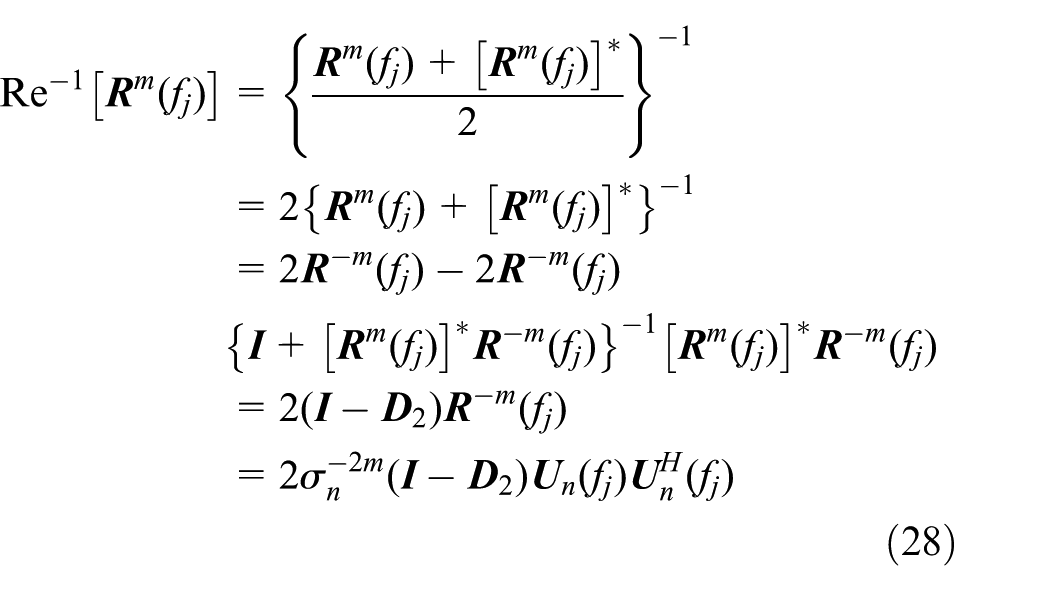
Since
where

Similarly, since

where

Combining equations (29) and (31), we know

Equation (32) indicates that using a large positive integer,
Since

This is because
We now define

where
Via judging the extent that each element approaches 0, we can acquire the DOA estimation of wideband coherent signals by the following equation

where
Description of the MTOFS
The proposed method can be implemented as follows:
Step 1: compute the array output data
Step 2: select suitable coefficient m to weight matrix
Step 3: generate
Step 4: construct spectrum function
If
If
If
Performance analysis of MTOFS
Two main advantages are expected compared with TOFS method, as follows:
Based on real-valued calculation, the new method can swiftly obtain the noise subspace, and the computational cost of subspace estimation can be reduced by 75%. Then, using
Selecting a suitable coefficient m to weight the covariance matrix, the new method can obtain estimated noise subspace without needing the number of signals.
Simulation results
In this section, to verify the performance of the new method, several simulations have been carried out. The array is a ULA with five elements. The sensor spacing is half the wavelength corresponding to the center frequency. The wideband signals are Gaussian processes with zero means and all signals have the same center frequency

in which
The root mean square error (RMSE) of the DOAs’ estimation is defined as

where
Example 1: 1D spatial spectrum
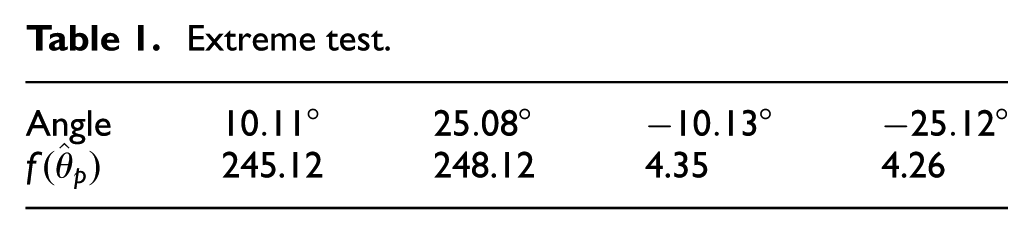
Two wideband signals are placed at
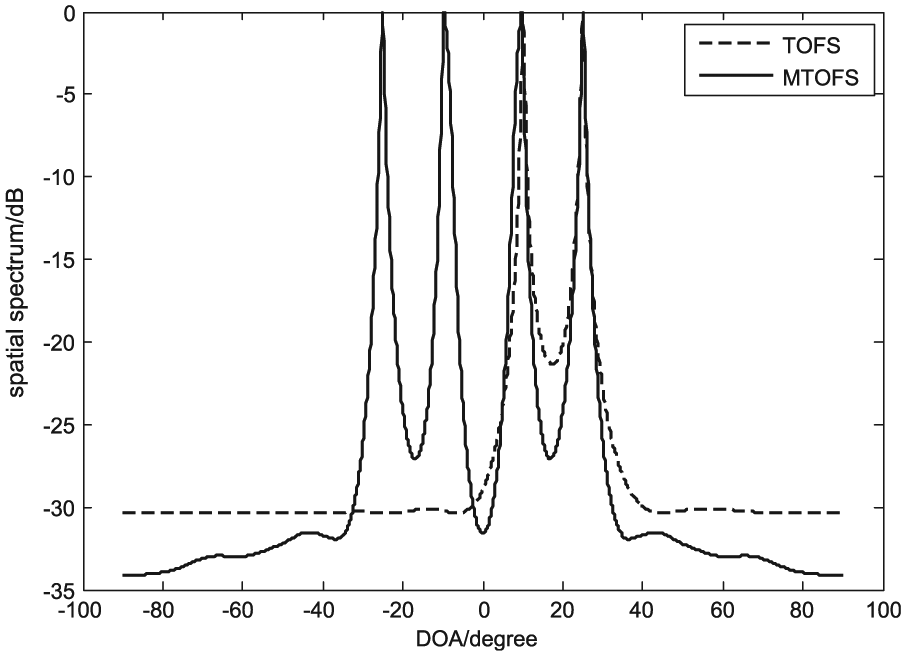
Space spectrum of TOFS and MTOFS.
Extreme test.
Computer run time

TOFS: test of orthogonality of frequency subspaces; MTOFS: modified TOFS.
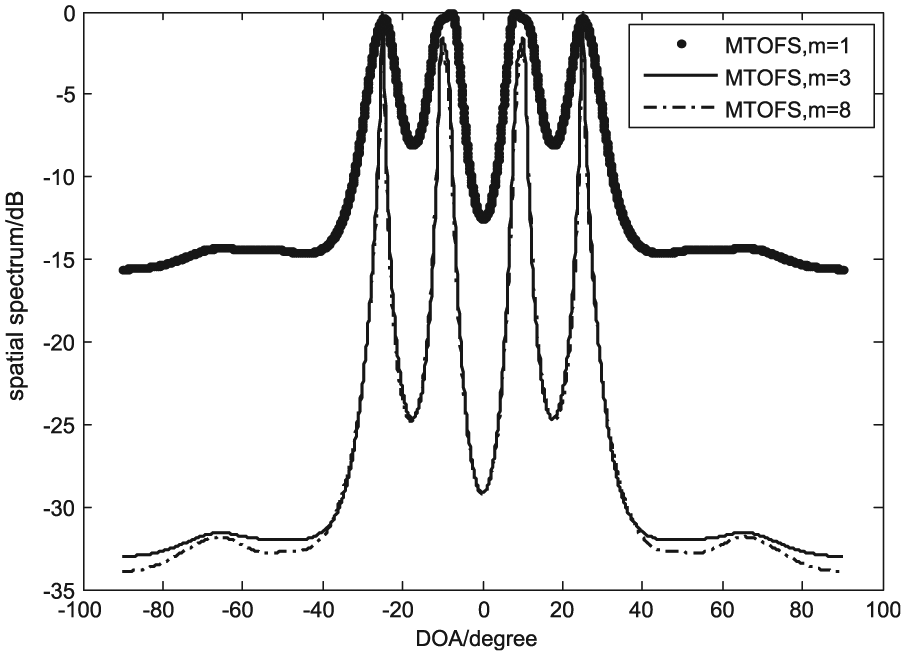
Space spectrum of MTOFS with different m.
Example 2: RMSE and probability of resolution versus SNR
In the second case, the RMSE and probability of resolution as a function of SNR are checked. We use ULA with five elements and two wideband signals are impinging from

RMSE versus SNR with TOFS and MTOFS.

RMSE versus SNR for MTOFS with different m.
We plot the detection probability of resolution curve for the MTOFS and TOFS. The SNR ranges from 0 to 15 dB, and the snapshots of each frequency are fixed at 100. Figure 5 indicates that the detection probability of DOA estimation of the proposed method is smaller than that of TOFS when SNR is lower than 4 dB, while it is almost as good as TOFS when SNR exceeds 4 dB.
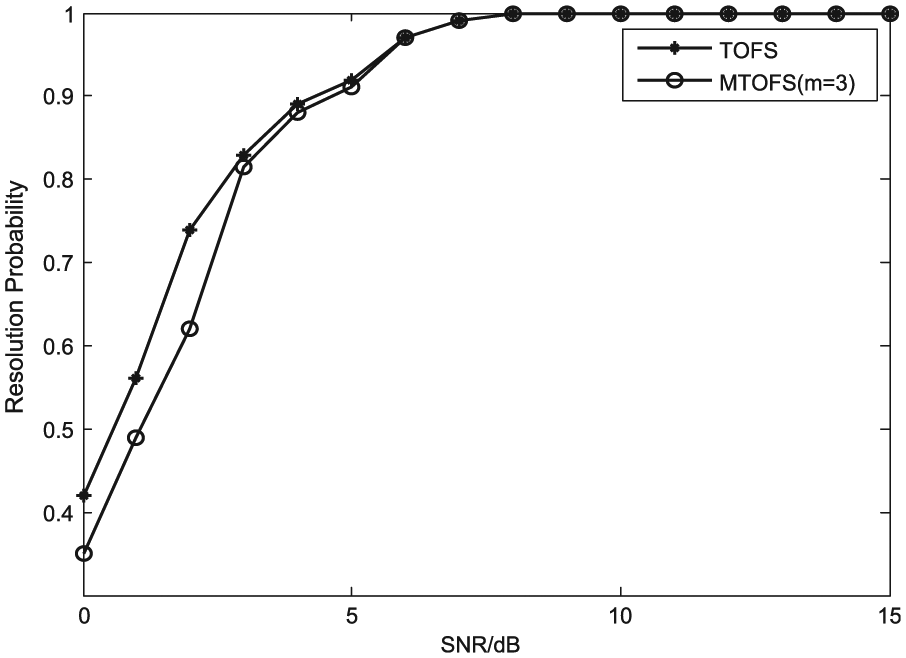
Probability of resolution versus SNR for MTOFS and TOFS.
Example 3: RMSE and probability of resolution versus snapshots
To further check the performance of the MTOFS, the RMSE of the estimated parameters versus snapshots are shown in Figure 6. The number of snapshots varies from 50 to 1000, the SNR is fixed at 10 dB, and the other conditions are similar to those in Example 2.
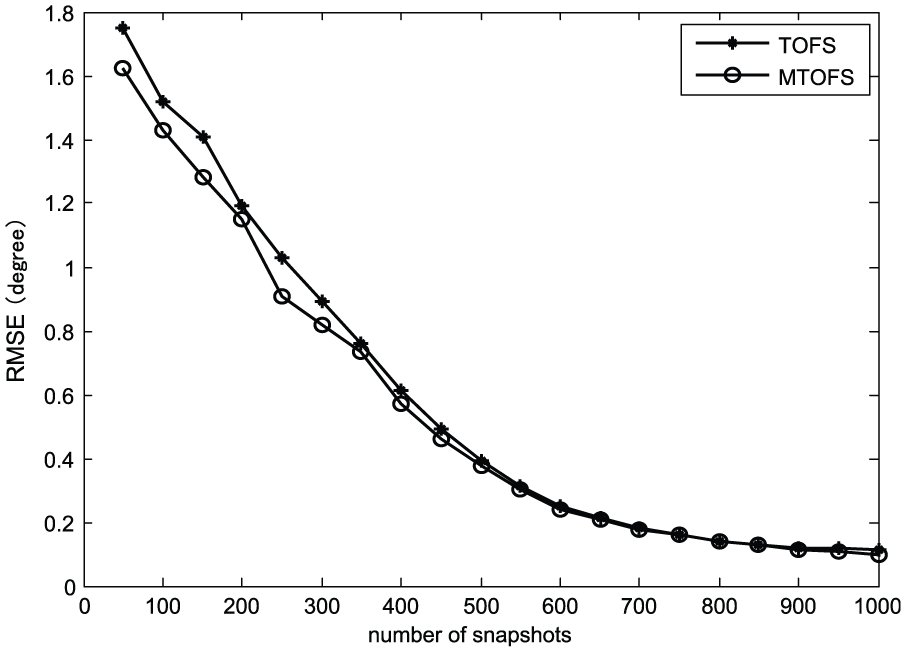
RMSE versus snapshots with MTOFS and TOFS.
The empirical RMSE of MTOFS is shown in Figure 6, and it is compared with TOFS. We can see that MTOFS is superior to the TOFS when the snapshots are small due to the fact that the rank loss of complex covariance matrix is more serious than the real covariance matrix, and with the increase in the snapshots, the difference between them is almost indistinguishable. Figure 7 confirms the effectiveness of the coefficient m, and the results are displayed in Figure 7, from which we can see that the results are similar to those in Figure 4, that is, MTOFS RMSE is less when m is larger. Figure 8 indicates that the detection probability of DOA estimation of the proposed method is a little bit inferior to the TOFS; however, with the augment of snapshots, the difference between them can be neglected.
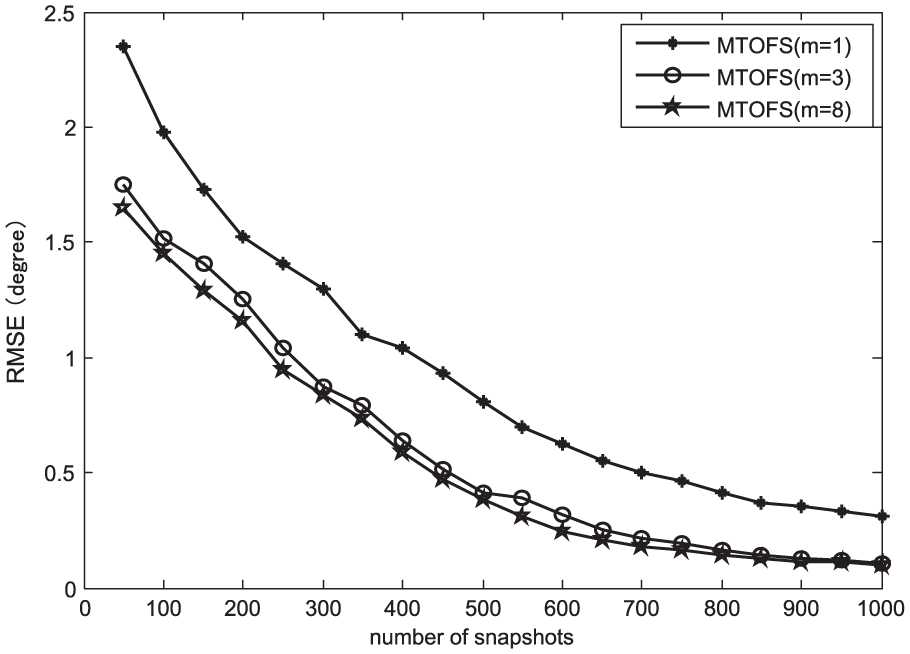
RMSE versus snapshots for MTOFS with different m.

Probability of resolution versus snapshots for MTOFS and TOFS.
Conclusion
In this article, we propose an efficient DOA estimation method for wideband signals based on ULA. The first favorable merit of the proposed algorithm is that it does not need to know the source number information, and such a merit is extremely desirable in real-world applications since the detection of source number is a highly tough task. The second merit is that the proposed method is a low computational complexity algorithm and the computational cost is far less than that of TOFS. The simulation results demonstrate that the proposed method is more valuable and effective than TOFS.
Footnotes
Academic Editor: Jianxin Wang
Declaration of conflicting interests
The author(s) declared no potential conflicts of interest with respect to the research, authorship, and/or publication of this article.
Funding
The author(s) disclosed receipt of the following financial support for the research, authorship, and/or publication of this article: This work was supported by the National Natural Science Foundation of China under grant no. 61271276 and industrial research project of Science and Technology Department of Shaanxi Province under grant no. 2015 GY013.