




Abstract
Mobile sensors need to reach consensus in many applications such as unmanned vehicles, multi-agent systems and environmental monitoring. In these scenarios, it is very important to reduce the power consumption as well as make sensors reach consensus as fast as possible. In this article, we propose a novel guaranteed convergence control algorithm to switch topologies of mobile sensors so that we can reduce power consumption in the sensor network and make the mobile sensors reach consensus with guaranteed convergence as well. The topology graphs over the mobile sensors are unconnected, directed, dynamical and switched periodically at any moment, while the joint graphs of dynamical topologies are connected in a bounded time period. The guaranteed convergence rate of consensus is derived on a method based on the variable decomposition. Some illustrative examples are provided to demonstrate the validity and effectiveness of the results.
Introduction
Mobile sensor networks have attracted much research attention in control theory field during recent years, which has been found in many applications such as industrial automation, health monitoring, environment and climate monitoring.1,2 In these sceneries, deployment, rendezvous and consensus usually are needed in certain tasks of mobile sensor networks. Consensus seeking is a very interesting problem in control of mobile sensor networks. 3 Consensus refers to the group behaviour that all of the agents asymptotically reach a certain common agreement through a local distributed protocol, 4 which plays a very useful role in information fusion, deployment and optimization of mobile sensors.5,6
The network topology of sensors plays a very important role in achieving consensus. The system’s performance and stability are affected by the communication networks. Sometimes, the network is deterministic, and sometimes it is time-dependent. Some network topology structures for consensus are investigated, in which the topology is time-varying or stochastic.7–11 On the other hand, convergence speed is also an important problem, which determines how fast consensus can be achieved. The maximum convergence speed has been conducted by designing weights associated with the edges of topology graph.12–14 The convergence rate of networked systems is derived. 15
The current studies on consensus over network topology are as follows: (1) consensus protocol design for various mobile sensor systems;5,6 (2) conditions for consensus over deterministic or dynamical topology;16–20 and (3) network topology design to optimize the system’s performance.10,11,21
Most of the above researches consider switching communication topologies. However, the energy limitation is not concerned in these researches. Due to limitation of batteries, mobile sensors have limited energy consumption in communication, computation and data processing. So it is very important for mobile sensor systems to lower the power consumption in communication topology networks of mobile sensors. To the best of our knowledge, the research, which considers both of dynamical topologies for saving energy and fast convergence speed for consensus, has not been considered yet.
In this article, we aim to investigate the control algorithm for consensus of mobile sensors with dynamical topologies and guaranteed convergence rate. In order to reduce the power in communication topologies, we make as less communication edges as possible to reduce the cost as well as to obtain the fastest convergence speed. On one hand, some directed and unconnected topologies may be chosen to make less communication links among agents at the same time. On the other hand, different topologies may be jointly connected to be a spanning tree in a finite time. Here, we consider the case that the network topology is directed and periodically connected. This is very practical in engineering application.
The remainder of this article is organized as follows. In section ‘Graph theory’, some basic notations of graph theory are introduced. Section ‘Convergence rate for periodically connected topologies’ describes the convergence rate of mobile sensor systems over switching topologies. An algorithm for calculating and maximizing the convergence speed is given in section ‘Guaranteed convergence switching control’. In section ‘Simulation examples’, some illustrative examples and simulations are provided. Finally, concluding remarks are made in section ‘Conclusion’.
Graph theory
Let

Definition 1. Periodically connected.
Let
Convergence rate for periodically connected topologies
In this section, we aim to derive the convergence rate of system (4). First, we define the dynamics of multi-agent systems and provide a different description for system (4) using the method of variable decomposition. The variable decomposition method for consensus was first presented. 22 Second, we derive the convergence rate of system (4).
Dynamics of mobile sensor systems
For simplicity, we consider switching n sensors with dynamics of single integrators

The consensus protocol is designed as follows

Here,

Here, L is the Laplacian of graph G,
Model description
Let

Let

and

Applying the property

and system (4) can be rewritten as follows

Then, considering equation (5), we have

Noting that

Here,

We note that

If

then we have
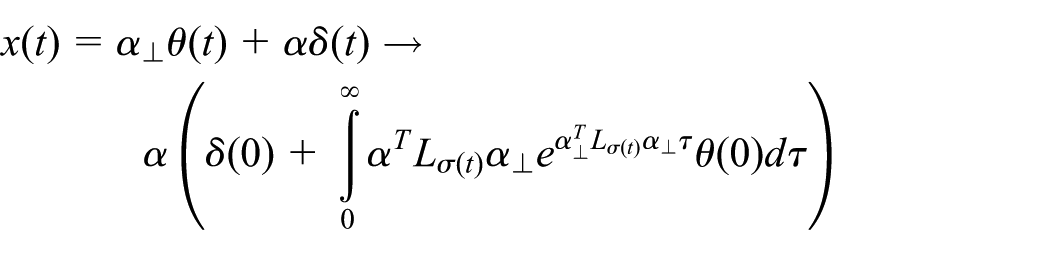
Since
Convergence rate
First, we give a description of a periodical connecting. Given a bounded time T, in this interval switching signal,

Figure 1 shows the switching diagram in each period. In Figure 1, the union of the m graphs is periodical connected. There are m switching graphs in the kth period

Switching diagram.
Note that to derive the convergence rate for consensus is equivalent to the convergence rate of equation (7). According to Figure 1 and equation (7), we get

Here,

Then

Let
Then

Noting that

Then

Utilizing

Thus, the convergence rate of system (4) for consensus is derived as follows

According to the above analysis,
Guaranteed convergence switching control
Theorem 1
Given the dynamics of a group of sensors as defined in equation (4) and the network topology graphs over the sensors are periodically connected and dynamically switched under the switching signal

Proof
The state transition matrix of system (7) is as follows

and the convergence rate is as follows

When the topology graphs over the sensors are periodically connected, which means the joint graph of
Simulation examples
In this section, we give some examples to illustrate the method of obtaining optimal switching parameters. For simplicity, four sensors are considered. In these examples, the switching signal
One-freedom case (
)
In this case, the communication topology graph over four agents is switching between graphs in the collection of


Graphs: (a)
Then, applying Theorem 1 and Algorithm 1, we can obtain the curve shown in Figure 3. It can be seen that when the switching parameters

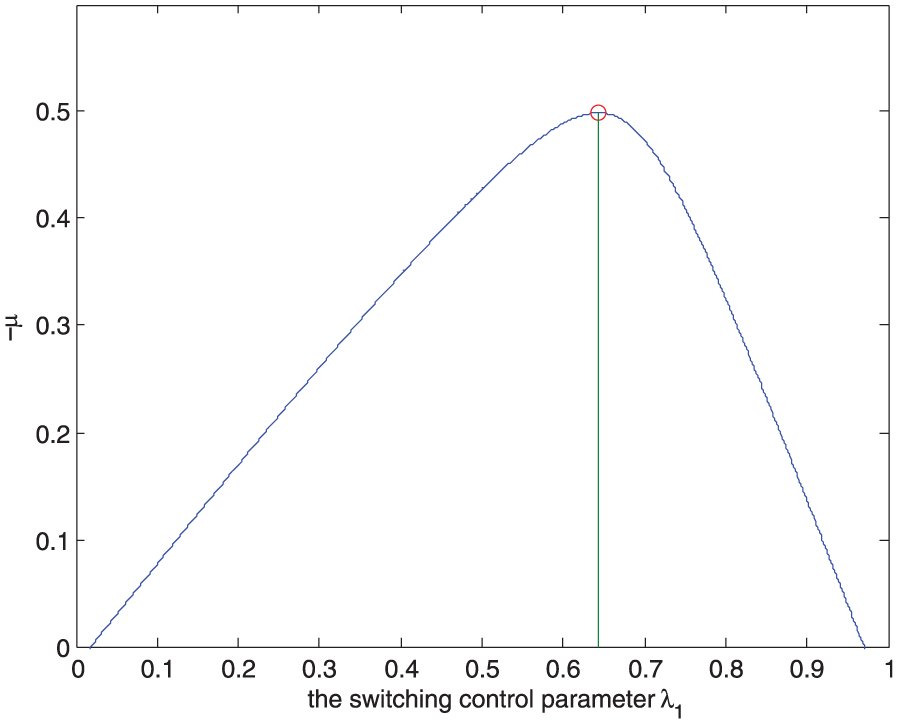
Convergence rate for consensus of four sensors (m = 2).

States response under different
Two-freedom case (
)
When the number of switching topologies among the sensors changes from two to three, the number of switching control parameters becomes two. There are three parameters

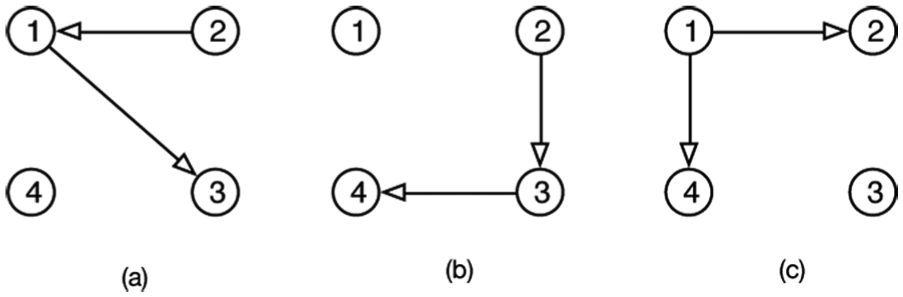
Graphs: (a)
In every switching period

Here,


The best value from calculation.

States response under different
Effects of the switching period T on convergence rate
In both Case 1 and Case 2, the switching period T is fixed to be

Conclusion
In this article, the problem of designing the switching control law for switching topologies over mobile sensor nodes has been addressed. In order to derive the consensus convergence rate of the sensors described as single-integrator nodes, a novel guaranteed convergence control method based on state variables decomposition is proposed. The system’s states are decomposed into consensus parts and non-consensus parts. When the non-consensus parts converge to zero point, the states of the whole system converge to the space spanned by
Footnotes
Academic Editor: Jose Pelegri-Sebastia
Declaration of conflicting interests
The author(s) declared no potential conflicts of interest with respect to the research, authorship, and/or publication of this article.
Funding
The author(s) disclosed receipt of the following financial support for the research, authorship, and/or publication of this article: This work was supported by the National Natural Science Foundation of China under Grant No. 61203032.