




Abstract
The serious geological hazards occurred frequently in the last few years. They have inflicted heavy casualties and property losses. Hence, it is necessary to design a geological information service system to analyze and evaluate geological hazards. With the development of computer and Internet service model, it is now possible to obtain rich data and process the data with some advanced computing techniques under network environment. Then, some technologies, including cyber-physical system, Internet of Things, and cloud computing, have been used in geological information management. Furthermore, the concept of cyber-physical-social-thinking as a broader vision of the Internet of Things was presented through the fusion of those advanced computing technologies. Motivated by it, in this article, a novel modeling and computing method for geological information service system is developed in consideration of the complex data processing requirement of geological service under dynamic environment. Specifically, some key techniques of modeling the information service system and computing geological data via cyber-physical system and Internet of Things are analyzed. Moreover, to show the efficiency of proposed method, two application cases are provided during the cyber-physical-social-thinking modeling and computing for geological information service system.
Introduction
Recently, a geological hazard as one of the most important issues presents an obstacle to the social development. It is necessary to design a geological information service system (GISS) to analyze and evaluate geological hazards. Among the available geological information service applications, a geographic information system (GIS) and its location intelligence play an important role in analyzing and visualizing geological data for the public. Furthermore, with the continuous improvement of Internet technology, the concept of cyber-physical system (CPS) gradually appears in front of everyone.1–3 CPS is a hyperspace system, in which comprehensive computing, networking, and physical environment can be integrated. Meanwhile, CPS can also achieve real-time sensing, dynamic control, and information services for large-scale engineering systems. Specifically, some techniques related to CPS, for example, Internet-service-based multi-user accessing and data service, have been developed in GISS. 4 As an effective architecture with the potential powerful capability of addressing complex issues, there are some research topics to explore along this direction for GISS. Beyond the scope of the CPS, the cyber-physical society system (CPSS) is developed. In addition to the cyber space and the physical space, it is deployed with emphasis on humans, knowledge, society, and culture. Hence, it can connect nature, cyber space, and society with certain rules. 5
With the development of computer and Internet service model, the Internet of Things (IoT) is becoming increasingly common. Under the IoT architecture, objects can be sensed and controlled remotely across existing network structure while integrating the physical world and computer-based systems.6–8 Consequently, the efficiency, accuracy, and economic benefit are all improved. Meanwhile, the cloud computing technology plays a prominent part in the IoT while making it easier for users to store and process information. Furthermore, it also improves the computing performance by making the information available over the web or other terminal ends. Hence, cloud computing is so popular in recent years due to its technical benefits of the on-demand capacity management model used to efficiently share the resources, software, and information among multiple devices. 9
More recently, through the fusion of CPS and IoT on the basis of cloud computing technology, a concept cyber-physical-social-thinking (CPST) as a broader vision of the IoT was presented by merging the thinking space into the CPS and highlighting the importance of the cognitive intelligence and social organization. 10 Generally, the paradigms of artificial intelligence and cognitive computing have been widely applied to many fields. Those emerging technologies therefore have brought new development opportunity for IoT. In this way, both the human cognition capacities and intelligent learning techniques from the society activities are integrated into the implementation of IoT. Considering it, through the extension and mergence of thinking space within the traditional CPS space, the CPST is accordingly developed to address more complex application requirements in practice. Motivated by it, in this article, a novel modeling and computing method for GISS is developed. Considering the complex data processing requirement of geological service under dynamic environment, it imposes very challenging obstacles to the implementation of GISS with the help of those current computing technologies. Hence, on the basis of some successful applications of CPS in GISS, CPST may play an important role in dealing with those difficult issues of designing an effective GIS system.
The remainder of this article is organized as follows. Section “Related works” gives a description of related works, including CPS, CPSS, CPST, IoT, and cloud computing. Sections “CPST modeling for GISS” and “CPST computing for GISS” present the CPST modeling and computing schemes for GISS, respectively, while providing some application cases. Finally, a conclusion and brief discussion regarding the open challenging science and technology issues along this research direction in GISS are discussed in section “Conclusion.”
Related works
CPS, CPSS, and CPST
CPS
CPS is a networked, component-based, real-time system that controls and monitors the physical world. 11 From the structural point of view, a CPS includes the following parts: (1) sensors designed to perceive the physical world, (2) controllers or actuators designed to operate the physical entity, (3) computing components designed to analyze and process physical information, and (4) communication network designed to integrate the above units and related information, objects, and events.
Currently, with the rise in popularity of smart phones, there is a growing interest in the mobile application for CPS. Then, mobile cyber-physical system (MCPS) as a prominent subcategory of CPS is developed, in which the physical system has inherent mobility. 12
CPSS
Generally, the society environment is considered an autonomous, living, sustainable, and intelligent variable within the CPS. As a result, the CPSS gathers and organizes resources into semantically rich forms that both machines and people can easily use. 13 Such a system includes globally distributed resources, including devices, information, and knowledge. In addition, it also includes services that could dynamically collaborate to provide some effective just-in-time services to cope with an emerging crisis.
The key issue of designing a CPSS is how to describe and integrate the interaction of physical, social, and hardware in an efficient way. Some methods are presented. To improve computational and networking contextual complexity in deploying a CPSS, a smart services framework in CPSS, called dynamic social structure of things, was developed aiming at boosting sociality and narrowing down the contextual complexity based on situational awareness. 14 In one sense, CPSS can promote the interconnection of distributed CPS.
CPST
CPST hyperspace is accordingly established through the mergence of a new dimension of thinking space into the CPS space. 10 Therefore, the wisdom along with the intelligent interactions of data, information, and knowledge are through the CPST hyperspace. Currently, the hyperworld is integrated into CPST hyperspace by coupling data, information, knowledge, and cognition-related cyber interactions, physical perceptions, social correlations, and human thinking. The CPST hyperspace has the following characteristics:
Integration. The CPST hyperspace may be a combination of different spaces.
Interconnection. The CPST hyperspace is connected with other same type or different type of spaces.
Interaction. The CPST hyperspace can exchange information through cyber spaces to achieve ubiquitous intelligence.
Cloud computing
Cloud computing is a computing style in which dynamically scalable and virtualized resources are provided as a service over the Internet. 9 Then, the traditional system architecture should be extended to meet the requirement of software development in cloud computing scheme. Under the cloud computing framework, users can employ a variety of terminal access services in any positions. The requested resources from the cloud is virtual, rather than a fixed physical entity. Then, the user may enjoy all kinds of super services through Internet. 15 Due to its automatic management feature, cloud computing is cost-effective while greatly reducing the cost for data center management.
Cloud service provides some solutions or real-time software services through Internet. Existing cloud service can be categorized into three major groups: infrastructure-as-a-service (IaaS), platform-as-a-service (PaaS), and software-as-a-service (SaaS). 16
IoT
Currently, the IoT achieves a great success with the development of wireless technology. 17 Among the available key technologies in the IoT, the radio-frequency identification (RFID) and wireless sensor network (WSN) play an important role in implementation applications. Through the use of RFID technology, there are many real-time monitoring applications in the IoT.
Meanwhile, a WSN uses spatially distributed autonomous sensors to monitor physical or environmental conditions 18 and to cooperatively pass their data through the network to a main location. Today such network is used widely in many industrial and consumer applications, such as industrial process monitoring and control, machine health monitoring. 19 Moreover, with the development of high-performance computing technologies, the IoT becomes an attractive system paradigm to realize universal interactions through the cloud computing. 20
CPST modeling for GISS
Features of geological data
In the era of big data, data are being collected to serve the purpose of making decisions in a data-driven way. Then, such big data analysis now drives nearly every aspect of society, including financial services, manufacturing, and mobile services.
Emergency data are an important resource from geological disaster emergency command system. And those data in the emergency command and management of the geological disasters include three types, that is, emergency event data, emergency service data, and emergency basic data. Here, emergency basic data include geographic information, document, knowledge, and many others. Emergency event data are the basic information of the incidents, including video, audio, and other environmental information. Emergency service data are in the process of emergency management, and it is generated after analyzing and making decision.
Recently, big data are revolutionizing all aspects of society ranging from science to government. Geological data are a typical case of big data. Geological big data include geological data produced by multi-source and multi-mode from geological survey as well as data from public service and management support. 21 Actually, geological data have three characters, that is, rich sources, wide area, and great capacity of data. 22 So, organization and management of those data are key issues while realizing GISS. Geological data are a series of important results in geological work, including geological documents, electronic data, specimens, and so on. Then, it is obtained from the geological scientific research, engineering exploration, and production process. Essentially, the geological data are considered the outcome of the wisdom of experts in geological areas. Through the use of geological data with an effective scheme during the collecting, integrating, sharing, and developing processes, the public can obtain an orderly and long-term service.
Practically, geological data are mainly composed of structured and unstructured data. And the unstructured data, including reports and files generated by word, PDF, excel, graphics, video, and PPT, are all stored in a traditional mode. It is inefficient with traditional storage mode while conducting data retrieval, data querying, statistic analysis, and data mining, thus resulting in extremely low-data service capability. 23 Hence, it is urgent that geological big data should be addressed with a new modeling scheme by integrating some of the technologies presented in the state-of-the-art analysis. And the CPST modeling scheme developed here may be a competitive choice.
System modeling
As mentioned above, GISS confronts some challenging issues, which requires the GISS to address the geological big data with a more effective mode during data acquisition, search, analysis, and visualization. Actually, although the diversity and completeness of source data are strengthened during the geological data acquisition, it makes data analysis difficult due to the huge amounts of geological data. Then, it is necessary to make a synthesis of all data through the combination of users’ requirement, geological context knowledge, and application background. During this process, it hardly achieves such object without the help of intelligent thinking and learning capabilities from human. As a result, CPST modeling scheme may be a good choice and is accordingly employed to GISS on the basis of its intelligence and social computing paradigm.
The CPST includes the cyber space, physical space, social space, and thinking space. Figure 1 shows the GISS and its key components involving the cyber, physical, social, and thinking modules described by CPST. The functions of every part are given as follows, and the main equipments and technologies are presented in Figure 2.

CPST model of geological information service system.
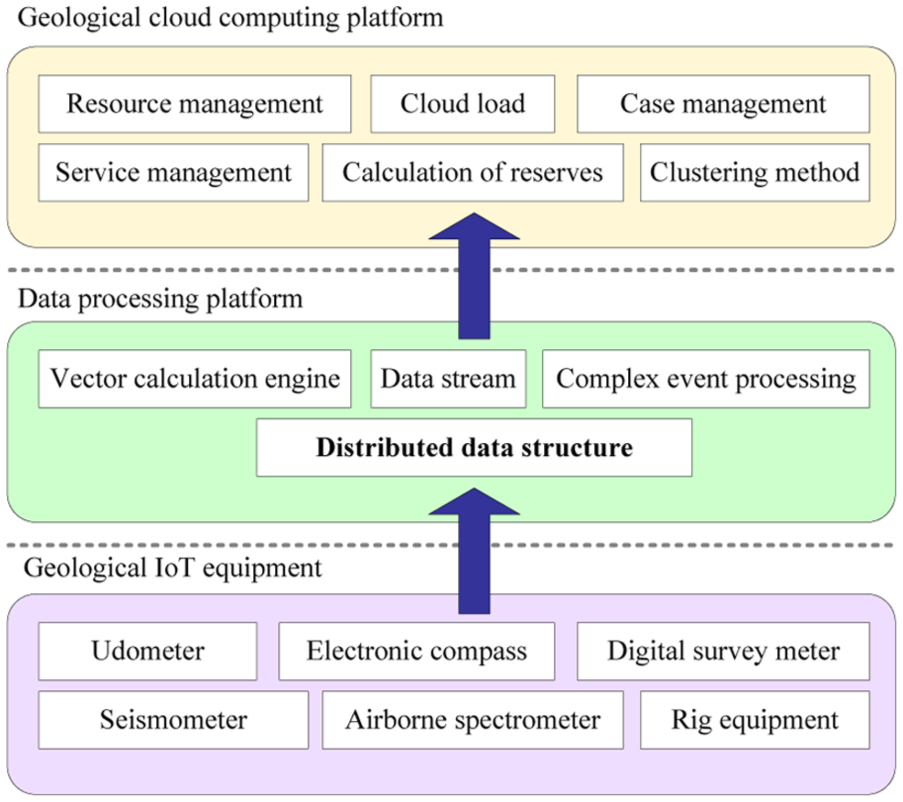
Key equipments and technologies.
Cyber space
In the cyber space, it refers to the generalized information resources, including virtual and digital abstractions to achieve interconnections among cyber entities. 10 In this space, a cognitive-information framework is designed to provide the geological data, resource, and service in an intelligent self-adaptive learning way while implementing the cyber interactions. Considering the big data characteristics in geological data, it should provide some effective data services, including holistic data management for massive geological data storage, on-demand geological resource management in virtual cloud computing environment, and online spontaneous management during distributed interactions for geological data.
Physical space
Physical space represents the real world in which geological objects are, respectively, perceived and controlled by semantic sensors or cooperative actuators to collect the real-time data to achieve interactions and remote collaboration through the use of the communication channels in context-aware networks. Here, in order to realize interconnections in the cyber space mentioned above, a geological object should be transformed into single or multiple cyber entities under virtual working framework.
Social space
Social space is designed as a logical component in CPST modeling scheme. It is responsible for collecting those social attributes and social relationships from the human beings and other geological objects or cyber entities. First, in the social space, those information are from human activities and social events, including supervision, organization, and coordination addressed by geological experts and public users. Second, the inherent relationships among the geological objects, including direct and indirect correlations, are also integrated into the social space in a semantic representation way.
Thinking space
Within CPST, the thinking space plays a special role in addressing a high-level thought or idea raised during the intellectual activities of geological experts and public users. Specifically, those thinking information can be obtained through a self-adaptive learning way, for example, analysis, synthesis, judgment, reasoning, and some computational intelligence-based learning algorithms, for example, the popular deep learning method, 24 reinforcement learning method, 25 and many other state-of-the-art techniques.
System architecture
Considering the background of geological service and complex features of geological big data, a system architecture for GISS is designed on the basis of the modeling idea of CPST. Here, the administration can use web and mobile devices in this system to collect and manage the geological data. Due to some limitations of network technology, it is not possible to connect all the devices directly to the next-generation network. Then, to make full use of geological data through some technologies of CPS and IoT, a novel information platform system framework for geological data service is shown in Figure 3.

Architecture of geological information service system.
This system architecture is composed of three layers, including application layer, network layer, and perceptual layer. Meanwhile, some specific functions are implemented within this architecture. Here, the network layer focuses on the interconnection and interoperability of equipments, and it is specialized for data transmission and resource sharing while ensuring that the next generation of network characteristics is effectively integrated in the transmission processing. The network layer aims at transmitting various real-time and un-real-time geological data for users through the special-purpose connection network. In the proposed architecture, the perceptual layer is a front-end of information collection. The application layer is the business logic layer in the integrated information platform which provides some business to meet the geological information service needs of different users.
An application case
Here, a simple case regarding the geological data analysis in thinking space is provided under the CPST framework.
Currently, there are some ways used to help us to make decisions, such as mapping knowledge domain and semantic relation analysis. Here, the term mapping knowledge domains was chosen to describe a newly evolving interdisciplinary area of science during the process of charting, mining, analyzing, sorting, and displaying knowledge. Scientists, academics, and librarians have historically worked to codify, classify, and organize knowledge, thereby making it useful and accessible. 26 In addition, perhaps even more important, the new analysis techniques that are being developed to process extremely large databases give promise of revealing implicit knowledge that is presently known only to domain experts.
Some of these techniques are now being applied, aiming to identify and organize research areas according to experts, publications, text, and figures; discover interconnections among these; establish the import of research; reveal the export of research among fields; examine dynamic changes such as speed of growth and diversification; highlight key factors in information production and dissemination; and find and map scientific and social networks. The new techniques support and complement human judgment.
Geological data are a kind of expression form of geological significance in the long history of the earth. The traditional geological data include geological map, structural map, mineral map, geological hazard map, rock phase diagram, and many others. Classification of rocks and lithofacies is an important part of it. Here, an example of a rock classification and lithofacies relationship is provided. And the user interface is demonstrated in Chinese.
First, the statistics and classification of the existing geological data text are sorted, including the size and type of data, the document number, the paragraph number, and numerical data type. Then, semantic relation analysis is conducted to identify and extract subjective information by the natural language processing (NLP), text analysis, and other machine learning methods. 27 In this example, the hidden Markov model (HMM)–Viterbi-based standard word segmentation is employed to segment the document, so that the text can be divided into different parts. Then, the TextRank algorithm is applied to filter out the those words, such as the irrelevant adverbs and adjectives behind the participle, so as to achieve the effect of keyword extraction.
The result of word segmentation is accordingly analyzed, and the relationship between words is shown through the use of a visual programming tool, which stores the structured data on the web instead of the table. Specifically, through use of Neo4j map database tool, geological information processing and retrieval are implemented. And a good semantic knowledge mapping is thus developed to show the magmatic rock classification and attribute better. A demonstration result is shown in Figure 4.

Relational mapping of geological information.
In this figure, the nodes represent entities, and the edges represent the relationships between entities. And different classes of entities are distinguished by different colors, and each one has a specific semantic meaning. Here, the semantic meaning denotes classification and attribute relationships. The former includes the shape classification (i.e. plutonic intrusive rock, hypabyssal intrusive rock, and extrusive rock) and the acidity classification (i.e. ultrabasic rock, mafic rock, intermediate rock, and acidic rock). The latter includes the color, mineral component, accessory mineral, structure, alteration, alkalinity, and SIO2 content. From Figure 4, the hierarchy result of classification for magmatic rock can be clearly found with a strong visual effect. Furthermore, it can help the user to find more accurate information, make a more comprehensive summary, and provide more depth information. Meanwhile, it can also systematically display the keywords and the related knowledge system. Complex areas of knowledge are shown through data mining, information processing, knowledge measurement, and graphics rendering. Hence, it provides a practical and valuable reference for the geological research and decision.
CPST computing for GISS
Computing technologies play an elemental role in facilitating the intelligent circumstance monitoring, semantic analysis, social behavior modeling, and insight generation. In our developed system, computing technologies include traditional data computing and the CPST computing. Specifically, the security of the system is inevitable to be considered in the computing technologies.
The computing for geological data
Management of distributed database
The management of distributed database is one of the important issues in the geological service system. To ensure the high reliability of data, distributed database often employs backup strategy to achieve fault tolerance. Therefore, when reading data, the client can concurrently read simultaneously from multiple backup server, so as to improve the speed of data access and provide higher concurrent traffic.
Data processing and analysis
Generally, the collected geological information data are abundant, and those data can be fused to analyze and evaluate geologic events. The issue on how to preprocess data to improve the data analysis quality is very important. Data processing extracts valuable information from large amounts of data. There exists many methods to process and analyze data. 12 In the practical applications, the combination of two or more methods is implemented to achieve satisfactory data processing and analysis performance. Figure 5 shows a typical distributed implementation framework for geological data processing and sharing. In this figure, it can be observed that in the cloud-based distributed computing environment, many data sources are organized to form different databases through the data sharing and exchange specification. Furthermore, the advanced data processing, exchanging, and presentation services are provided on the basis of those databases.
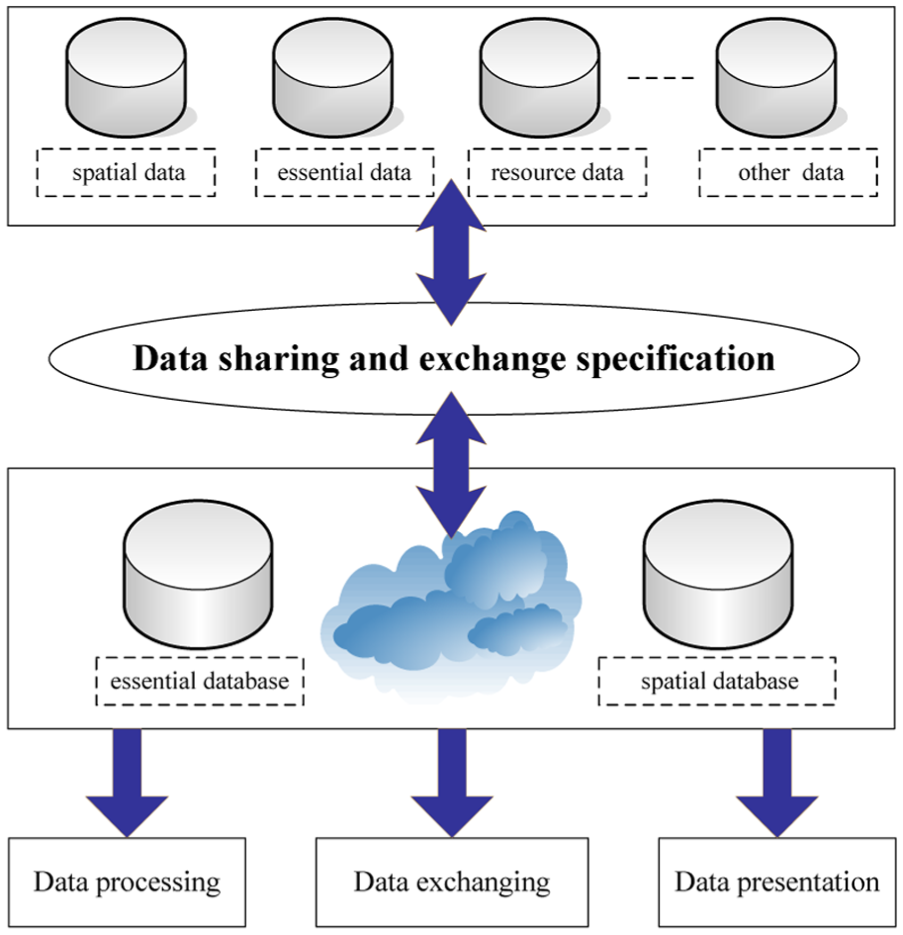
Framework of geological data sharing and processing.
The CPST computing
A multi-level computing framework
The CPS computing has been designed to support human-centric paradigms and address data and information to provide contextually relevant knowledge for human beings. 28 Moreover, the CPST computing could provide a holistic treatment of human thought and thinking to achieve supportive wisdom. Generally, the CPST computing is a multi-level computing framework.
Cyber-physical computing is an essential mechanism for abstracting physical resources while achieving CPST in the computing framework. 29 Some methods, for example, cloud computing–assisted big data analysis, can achieve this purpose. They are seen as an extension and deep application for physical infrastructure in GISS. In general, a cloud computing environment is composed of physical servers that contain resources shared by many users and applications. Within this environment, the big-data-analysis-centric computing strategy can cope with the application requirements of geological big data.
Within this framework, in addition to cyber-physical computing, the social computing in the cybermatics is a key part. More recently, it has become a focus in computing application fields. By integrating social dynamics and mining social knowledge, the social intelligence is thus highlighted in this computing mode. 30 Then, the valuable geological information and knowledge can be obtained by interacting with social networks and recommendations from geological experts while carrying out social computing.
It should be pointed out that thinking computing arisen from emotions also plays an important role in CPST computing. It is emerged to recognize, interpret, and learn human cognitive states. Consequently, it enhances self-adaptive and self-understanding performance while addressing geological data for GISS. In thinking computing, there exists many analysis techniques, including deep learning, fuzzy logic, kernel learning, brain-inspired intelligence methods.24,25,31
An application case
Here, an application case is analyzed while implementing cyber-physical computing in CPST multi-level computing framework. Aiming at the large amount of structured and unstructured geological big data, the computational performance of traditional computing approaches is not satisfactory. Considering that there are huge volume of geological data texts and the size of some texts is relatively not big, the Hadoop-based sequence file method is employed while merging a large number of small files into one big file stored with the form of key. After completing the store processing of geological texts, some big data analysis applications can be conducted. For example, the text classification prediction is expected to be implemented. A specific implementation process is shown in Figure 6.

Geological data text computing framework under Hadoop architecture.
Hadoop is known as a distributed system infrastructure. 32 It uses cluster computing and high-speed storage technologies to address huge amount of data. The key of Hadoop is MapReduce computing framework and Hadoop distributed file system (HDFS). Here, the data are stored using HDFS, and the parallel computing is implemented using MapReduce. In Figure 6, the working process of text classification is summarized in the following. First, the preprocessing for those collected geological texts is conducted, including Chinese word segmentation, deleting stop words, and deleting low-frequency words. Second, the vector representation for a collection of text is achieved using vector space model (VSM). 33 Third, within the MapReduce mechanism, the text vectors are classified using K-nearest neighbor (KNN) algorithm method. 34 Then, all of the classification results are integrated with a boosting-based weighted ensemble. Finally, the classification is evaluated by some geological experts in social computing mode.
System security
Security is one of the most concerned problems for system. Due to open network structure and service sharing scheme in cloud, it imposes very challenging obstacles to the security guarantee. In the system proposed here, through monitoring abnormal behavior of software used in network environment of clients, the cloud can intercept malicious program and Trojan. Security analysis shows that the third-party provider chosen in the proposed system could guarantee data availability to a certain degree and thus effectively enhance data confidentiality. Furthermore, data security is one of the most concerned issues for the user. Some effective protection measures for data have been developed to ensure the security of the data, such as multiple copies of data storage and encryption. 35 A cloud security policy focuses on managing users, protecting data, securing virtual machines, and specifying the infrastructure usage policies. The developed system in this article has data backup and data restore functions to ensure data security. Meanwhile, the classification strategy for modules in the system can also make the system manager effectively check access permissions on system resource and accordingly display content.
Conclusion
Currently, the complexity of geological data imposes very challenging obstacles to the traditional management service of geological information. With the rapid development of computer technologies and Internet, many software tools and solutions are developed to design a GISS to improve the application performance. Through the deep understanding of the applications of IoT in the field of geology, the construction requirement of GISS is accordingly analyzed, and the overall architecture and physical deployment of the geological things are proposed. In this article, RFID, sensors, and other things are employed to achieve the orderly and intelligent management of geological data. Specifically, based on the management and application of geological equipments, this article presents a modeling and computing scheme using CPST. Moreover, two application cases are provided to show the efficiency of using CPST modeling and computing scheme for GISS. In addition, the data security of the developed system is also analyzed. As an effective solution for GISS management using CPST, there are several interesting research topics to be explored in the future. For instance, further GISS can be developed using some advanced open-source software.
Footnotes
Declaration of conflicting interests
The author(s) declared no potential conflicts of interest with respect to the research, authorship, and/or publication of this article.
Funding
The author(s) disclosed receipt of the following financial support for the research, authorship, and/or publication of this article: This work was partially supported by the Special Funds Project for Scientific Research of Public Welfare Industry from the Ministry of Land and Resources of China under grant no. 201511079 and the National Key Technologies R&D Program of China under grant no. 2015BAK38B01.