




Abstract
In energy harvesting wireless sensor networks, energy imbalance among sensor nodes is detrimental to network performance and battery life. Particularly, nodes that are closer to a data sink or have less energy replenishment tend to exhaust the energy earlier, leading to some sub-regions of the environment being left unmonitored. Existing research efforts focus on the energy management based on the assumption that the energy harvesting process is predictable. Unfortunately, such an assumption is not practicable in real-world energy harvesting systems. With the consideration of the unpredictability of the harvestable energy, in this article, we adopt the stochastic Lyapunov optimization framework to jointly manage energy and make routing decision, which could help mitigate the energy imbalance problem. We develop two online policies: (1) Energy-balanced Backpressure Routing Algorithm for lossless networks and (2) Enhanced Energy-balanced Backpressure Routing Algorithm for time varying wireless networks with lossy links. Both Energy-balanced Backpressure Routing Algorithm and Enhanced Energy-balanced Backpressure Routing Algorithm are distributed, queuing stable, and do not require the explicit knowledge of the statistics of the energy harvesting. The simulation data show that our developed algorithms can achieve significantly higher performance in terms of energy balance than existing schemes such as Original Backpressure Algorithm and the Backpressure Collection Protocol.
Introduction
A cyber physical system (CPS) is referred to as a system that integrates the computation and physical processes to monitor and control the physical entities related to physical world. As an extremely critical component in CPS, wireless sensor networks (WSNs) have been widely used in the domain of CPS to observe and cognize the complicated physical system, by leveraging computing and network resources to enable data collection and data transmission.1,2 Nonetheless, energy supply represents one of the most challenging technological hurdles in WSNs. In traditional battery-powered WSNs, batteries are the dominant energy source and the network lifetime is limited due to the limited battery capacity. To prolong the lifetime of networks, developing completely self-powered wireless electronics has received significant interest. Harvesting energy from environment3–5 is considered a promising technique in this direction.
Although energy harvesting technologies provide numerous extra energy for nodes, they also pose challenges in balancing energy among nodes. Not only nodes closer to a data sink, but also nodes having less energy replenishment tend to run out their energy at an earlier stage. Although those nodes can be available again after harvesting enough energy from the environment, traffic congestion caused by energy exhaustion will occur, making some sub-regions of the environment being left unmonitored. One simple example of energy imbalance problem is illustrated in Figure 1. The network topology consists of five sensor nodes and a sink. Nodes N1–N5 sense the environment and deliver the sensory data to the sink. Note that if

An example of energy imbalance problem.
Existing researches6–10 mainly focused on developing energy management algorithms for energy harvesting wireless sensor networks (EHWSNs) with predictable energy. Nonetheless, a number of energy harvesting processes cannot be accurately predicted in real-world energy harvesting systems (e.g. stochastic harvesting process and partially predictable energy profile). 6 In addition, the overhead of executing an energy prediction algorithm should be taken into account in resource-limited WSNs. Although some existing works11–13 proposed energy management schemes for EHWSNs with a stochastic energy harvesting, only the network utility or throughput maximization were focused.
In this article, with the consideration of the energy profile as a stochastic process, we jointly design the energy management and routing process to mitigate the energy imbalance problem14–16 (also referred to as the hot-spots problem in Challen et al. 15 and Abdulla et al. 16 ). We tackle this problem using the Lyapunov optimization approach developed in Neely et al.17,18 The main idea of this technique is to integrate a penalty and utility information into queue backlog gradients, which decrease toward the sink. Using the information about queue backlogs, residual energy and link states, nodes can make the packet routing, power allocation, and forwarding decisions independently. Based on this idea, we first develop an online algorithm, called the Energy-balanced Backpressure Routing Algorithm (EBRA) for lossless networks. In EBRA, greedy decisions are made in every time slot based on the queue backlog and the residual energy information of one-hop neighbors. Our experimental data demonstrate that EBRA can significantly improve the performance in terms of energy balance while guaranteeing the network stability. In addition, we develop an Enhanced Energy-balanced Backpressure Routing Algorithm (EEBRA) for time varying wireless networks with lossy links (lossy networks).
The major contributions of our work are summarized as follows:
We model a queue-based network system and define reasonable penalty functions for links. We show how to incorporate the penalty minimization into the backpressure framework and overcome the energy imbalance problem.
We propose the EBRA for a lossless network. EBRA is a low-cost distributed routing algorithm based on the Lyapunov optimization framework. This algorithm tries to balance the energy among nodes meanwhile stabilizing the network.
We extend EBRA to EEBRA and adapt it for time varying wireless networks with lossy links. EEBRA does not require the knowledge of the harvestable energy process nor the channel statistics. It can be easily implemented in practical WSNs due to its low complexity.
The rest of this article is organized as follows. In section “Related work,” we conduct literature review. In section “Network model and problem formalization,” we present the network model and the problem formulation. In section “Design of energy balance routing scheme,” we present EBRA and EEBRA, respectively. In section “Analysis,” we present the analysis of EBRA and EEBRA. In section “Performance evaluation,” we show the performance evaluation and results. In section “Discussion,” we discuss issues (e.g. how our work helps achieve the management of sensor networks with a large amount of data). Finally, we conclude the article in section “Conclusion.”
Related work
In a CPS or WSN, the knowledge discovery will be helpful for deeper scientific understanding of human–physical world interaction. For example, Boukerche et al. 19 proposed a data mining technique to extract behavioral patterns about sensor nodes during the operation and the obtained behavioral patterns can help enhance the quality of service (QoS) of WSNs. Haghighi et al. 20 developed a middleware to detect changes in context. Their proposed method is lightweight and is more suitable for WSNs, which have limited computational resources. Considering that mining the interesting knowledge from the massive amount of data gathered from WSNs is a challenge, Rashid et al. 21 proposed a new type of behavioral pattern, also referred to as share-frequent sensor patterns, to improve the performance of WSNs in a resource management process.
There have been a number of research efforts on developing energy management schemes in WSNs.6–10,14,22,23 For example, Zhao et al. 14 developed a linear programming (LP)-based scheme to maximize network lifetime. Nonetheless, this method is not suitable for EHWSNs and LP requires the statistics of the energy harvesting process. Gorlatova et al. 6 developed a dynamic programming (DP)-based scheme to maximize the energy utility of a single node as well as the scheme to maximize the utility of data rates for a link. Nonetheless, DP requires the knowledge of the harvestable energy process and its computational overhead increases when the network size grows. Yang et al. 10 addressed the issue of the lexicographic max-min rate allocation problem in solar-powered WSNs and proposed an optimization framework to solve the problem in a distribute manner. Although all these schemes are well implemented in other networks, they cannot be directly used in EHWSNs with stochastic energy harvesting.
The stochastic Lyapunov optimization11–13,18,24,25 provides powerful theoretical tools to design scheduling and control algorithms in a backpressure style. A typical goal of the Lyapunov optimization is to optimize a performance objective while stabilizing the network. Because of its adaptation of dynamic systems and performance guarantees, the Lyapunov optimization has been used in both designing scheduling and routing schemes. For example, a close-to-optimal utility is achieved in Gatzianas et al. 11 and Huang and Neely. 12 Backpressure Collection Protocol (BCP) 24 incorporates the expected number of transmissions (ETX) minimization into the backpressure framework and reduces the cost per packet in the process of data transmission. Mao et al. 13 developed a scheme to maximize the long-term average sensing rate for all combinations of finite and infinite data and energy buffer sizes. Nonetheless, none of these schemes focus on the energy imbalance problem.
Close to our study, Sarkar et al. 26 developed a throughput-optimal routing and scheduling policy, which considers energy fairness and does not need to know the packet and energy arrival rates for EHWSNs. Nonetheless, their developed energy marking process can only work in the network with static links. Different from the existing research, our proposed scheme is designed for dynamic lossy networks and does not require the knowledge of packet rates, energy arrival rates, and the statistics of channel qualities.
Network model and problem formalization
A wireless multi-hop sensor network for data collection can be formalized as a directed graph
Traffic and transmission models
In this article, we consider that the time is divided into identical discrete time slots. In each slot, the network decides the number of packets to admit, which is denoted as

and

respectively. We also assume that


and

for some finite values

and

In addition,
Energy model
In this article, we assume that each node in the network has a finite energy buffer. The residual energy of node n at slot t is denoted as

The above inequality means that the energy consumed by node n must be no more than the available energy of n. Considering that

In addition, the residual energy of node n at slot

Date queue model
Denote
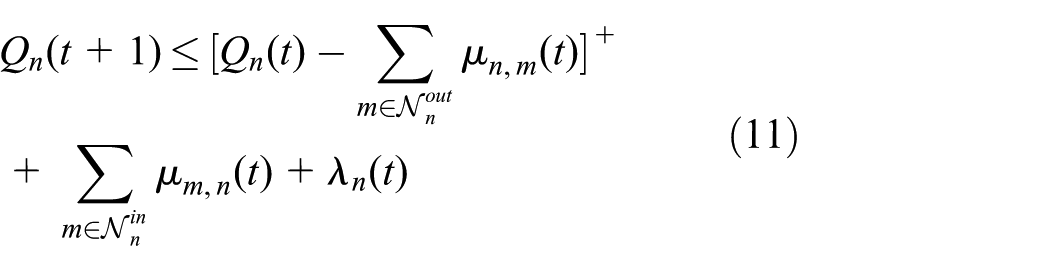
where

Problem formulation
Our design goal is to design a joint energy management and routing decision scheme so that the energy imbalance problem can be overcome. The basic idea of our approach is based on the Lyapunov optimization approach developed in Neely et al.17,18
Denote

Design of energy balance routing scheme
In this section, we first give an overview of our approaches. We then present EBRA for the energy-imbalanced problem in lossless networks. EBRA uses the energy information and queue length of one-hop neighboring nodes to make routing and forwarding decisions. (The forwarding decisions determine whether to transmit packets and how much packets should be transmitted at slot t. Those decisions can also be seemed as data admission control and power allocation decisions.) Finally, we extend EBRA to the time varying wireless networks with lossy links.
Figure 2 shows the detail of our approaches. As we can see from the figure, when a node needs to send packets, it will first check its queue backlog length and residual energy and make penalty estimations for every link based on the information collected from the network (e.g. channel states, residual energy, and queue backlog of neighbors). Note that the channel states can be obtained through mechanisms such as link metric estimation in BCP, and the energy and queue backlog information can be obtained by adding information in a packet head field for disseminating the information or by broadcasting beacons. Then, the controller will make the routing decision and the forwarding decision based on these penalty estimations. The queue backlog and energy information will also be updated after that.
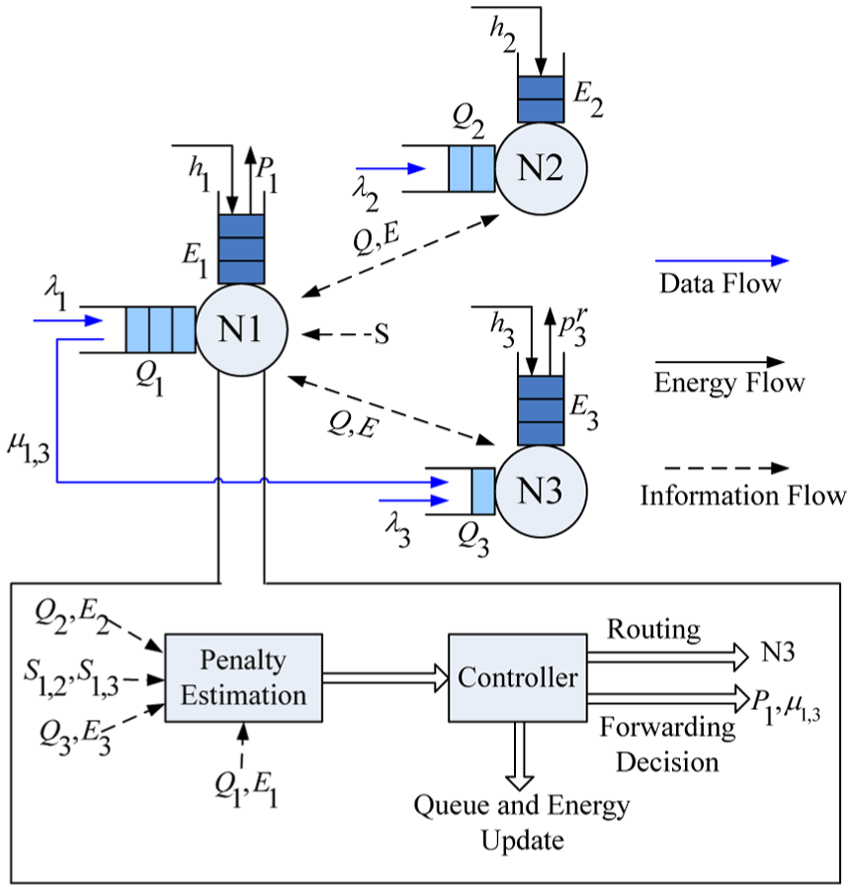
Overview of EBRA and EEBRA.
Algorithm design in lossless networks
In a lossless network, there is only one element in the channel state set
In a backpressure-based network, queue backlog gradients decrease toward the sink. This means that nodes with less queue backlog is closer (i.e. smaller geographical distance or fewer hop counts) to the sink. To balance the energy among nodes, it is better to choose neighbors with more residual energy and less queue backlog gradients. (Nodes with more residual energy are usually with better energy replenishment or lower traffic loads.) Accordingly, we use the penalty function of link

where

Note that forwarding packets to the node m with
To incorporate the penalty function minimization into the backpressure framework, we formalize the following optimization problem

Then, we define the Lyapunov function as follows

Denote

and define the one-slot conditional Lyapunov drift as follows

Then, we have following lemma:
Lemma 1
Under any routing and scheduling action and feasible power allocation that satisfies constraint (9) at slot t, we have

where

and V is a constant, which trades system queue occupancy for penalty minimization.
Proof
The proof is similar to Georgiadis et al. 27 and Alresaini et al., 28 and we omit it here for brevity.▪
Define the weight per outgoing link as follows

Then, we present the EBRA. The algorithm is to minimize the right-hand side (RHS) of equation (20) subject to constraint defined in equation (9). (To minimize the time average penalty while stabilizing the network, algorithms based on the Lyapunov optimization framework can be designed to greedily minimize a bound (i.e. RHS of equation (20)) on the drift-plus-penalty expression (i.e. right-hand side (LHS) of equation (20)) on each slot t.)
Energy-balanced Backpressure Routing Algorithm
At the beginning of every slot t, every node n observe
Routing decision. It computes weights for every neighbor m using equation (22) and finds the link
Forwarding decision. If
Queue and energy update. It updates
The routing decision maximizes
Algorithm design in lossy networks
In a lossy wireless network, the channel state is time varying and the network does not know the channel statistics because of the unreliability of wireless communication. Note that if nodes choose links with poor qualities to forward packets, data transmission will be energy inefficient according to the properties of p and
To represent link quality, we use the ETX as BCP. Assume that node n wakes up at slot t, and transmits
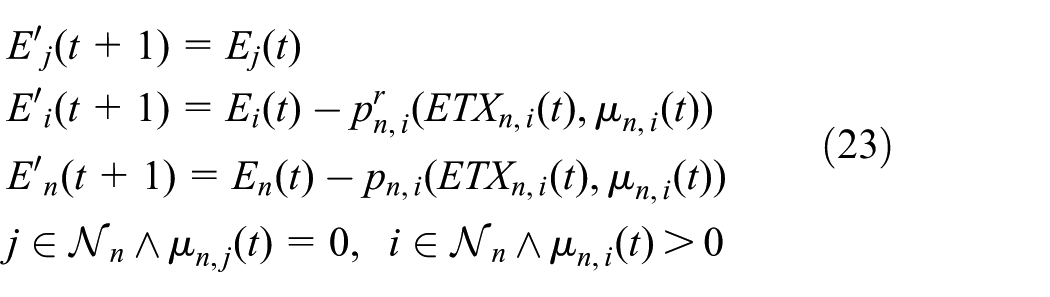
where
Considering that the energy harvesting process is unknown, we balance

To achieve the goal above, node n needs to compute the lexicographical order of
Considering that the node with the least-residual energy most likely suffers from the hot-spots problem, we first divide nodes in

The complexity of the approximate approach is only
To incorporate the approximate approach into the backpressure framework, we use the penalty function of link

where
Then, we present the EEBRA. At the beginning of every slot t, every node n observe

as the next hop if
Analysis
In this section, we show the performance analysis of EBRA and EEBRA. We assume that the channel states
Theorem 1
If there are positive constants V, B,

the network is strongly stable and the following results (a) and (b) are true.
(a) The time average backlog in lossless networks satisfies

and the time average backlog in lossy networks satisfies
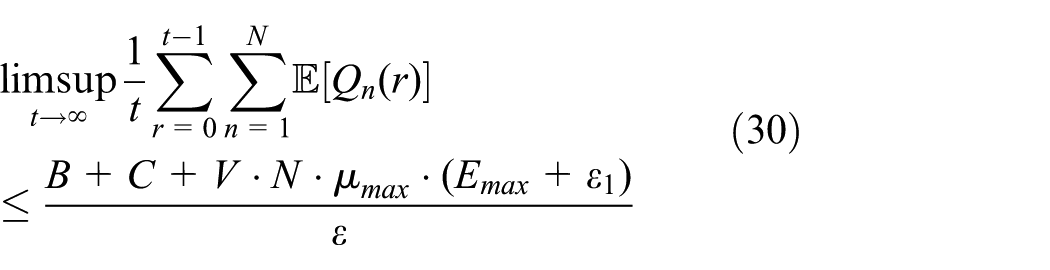
(b) The long time average penalty satisfies

Proof
The proof is similar to the proof of Lemma 1 in Neely. 25 According to Neely, 25 (b) is true and the following in equation is true:

Therefore, (a) is true according to equations (14) and (26).▪
Unlike the penalty function used in Moeller et al.
24
and the utility function used in Neely,
25
the penalty functions in our article depend on the residual energy vector
Performance evaluation
In this section, we provide simulation results of our algorithms. We consider a data collection in a wireless network, which consists of 4 × 4 nodes shown in Figure 3. All the links in the network are bidirectional. Node 1 is the sink node, while the others sense data and forward it to the sink. The energy buffer size of node 1 is set to

A 4 × 4 data collection network.
In both the lossless network scenario and the lossy network scenario, we assume that for every node n, the energy harvested at slot t, that is,
We run our EBRA and the Original Backpressure Routing Algorithm (OBRA)
29
for 2 × 10⁵ slots, respectively, under different date rates. The results are shown in Figures 4 and 5 and Table 1. Figure 4 shows the average queue length under different data collection rates with the step size 0.005. We can observe that the average queue length of both EBRA and OBRA is slightly larger than 0 when

The average queue size of OBRA and EBRA.
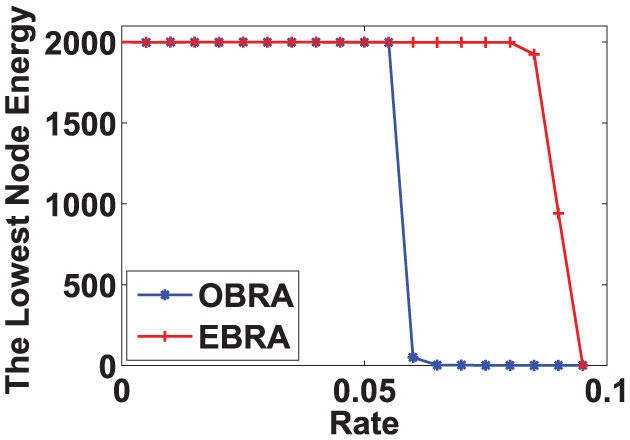
The lowest node energy of OBRA and EBRA.
The number of failed nodes in lossless networks.

OBRA: Original Backpressure Routing Algorithm; EBRA: Enhanced Energy-balanced Backpressure Routing Algorithm.
Figure 4 shows that the average queue length of EBRA is smaller than that of OBRA with the same r. (According to Huang and Neely
12
and Moeller et al.,
24
a smaller average queue size is related to a better performance of packet delay.) Figure 5 shows the simulation results of the lowest node energy, that is,
Figure 6 shows the relationship between the variable V and the average queue length. Considering that the trend of different rates is almost the same, we only plot curves for

Average queue length versus V.
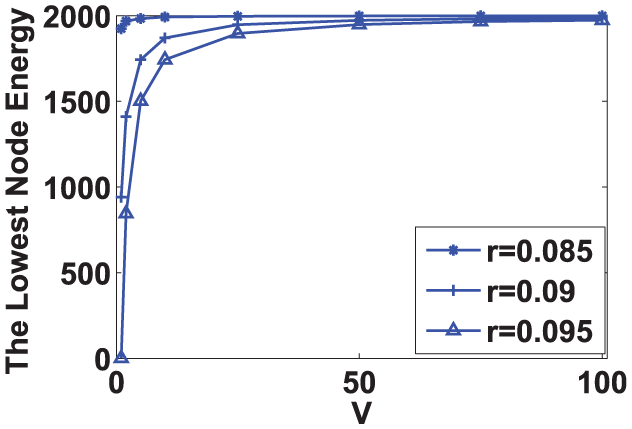
The lowest node energy versus V.
In the lossy network scenario, we run OBRA, BCP, and EEBRA for 2 × 10⁵ slots under different data rates. The variable v is set to 1 for both BCP and EEBRA. The results are shown in Figures 8 and 9 and Table 2. To be specific, Figure 8 shows the average queue length of OBRA, BCP, and EEBRA versus the data collection rates. The average queue length of OBRA is the largest among these three schemes, while EEBRA is slightly larger than BCP. This is mainly because BCP chooses the best link in every packet transmission. Figure 9 shows the simulation results of the lowest node energy under different data rates and Table 2 shows the number of failed node of these three schemes. The results demonstrate that EEBRA allows a higher data rate than both OBRA and BCP while experiencing no energy exhaustion. There are two reasons leading to the results, one is that nodes in class one will select the best downlinks to forward packets, and the other is that nodes in class two will not choose nodes in class one as the next hop if there are any other nodes on their downlinks.

Average queue length in the lossy network.

The lowest node energy in the lossy network.
The number of failed nodes in lossy networks.

OBRA: Original Backpressure Routing Algorithm; EBRA: Enhanced Energy-balanced Backpressure Routing Algorithm; BCP: Backpressure Collection Protocol.
Figure 10 shows the relationship between the variable V and the average queue length. As in EBRA, the average queue length increases as V grows. Unlike EBRA, the routing decision made by nodes in class one is irrelevant to V according to equations (22) and (26). The reason for running out of energy of the first failed node is that the energy harvested cannot afford to transmit the sensing data of its own. Therefore, increasing V contributes little to improve the energy level of the first failed node. Nonetheless, the increase in V does grow the average queue length while decreasing the energy consumed.

Average queue length versus V in the lossy network.
Discussion
In a CPS, sensor nodes obtain measurements from the physical components, process those measurements, and then send the measured data to the controller through networks. The discovery of useful knowledge from the measured data will be very helpful for conducting a deeper scientific understanding of human–physical world interaction. To this end, a number of research works have been focusing on extracting the useful knowledge from the measured data obtained by sensor nodes.
Nonetheless, sensing, transmitting, and processing the measured data takes both network and computing resources, which are limited in WSNs. How to reasonably schedule the limited resources in WSNs is challenging, especially when the measured data is massive. In this article, we focus on designing an efficient energy scheduling algorithm to balance the energy of nodes so that the network lifetime can be prolonged. To handle a large-scale data, we adopt the Lyapunov optimization framework to design our algorithms. The Lyapunov optimization framework11–13,18,24,25 has been proved to be a powerful tool to design networks with maximized throughput and our algorithms takes the advantage of the Lyapunov optimization framework (i.e. achieving a maximized network throughput). This benefit is very useful to WSNs, especially when the data collected by sensors are large.
Conclusion
In this article, we addressed the energy imbalance among sensor nodes in EHWSNs and presented the EBRA for energy balance in EHWSNs. EBRA is a distributed online algorithm and does not need to know the harvestable energy process. We show that EBRA achieves a better performance in both the time average network congestion and the energy balance than that of the OBRA while guaranteeing the network stability. We also developed the EEBRA for lossy networks. Our evaluation data show that EEBRA achieves a better performance in terms of energy balance than that of OBRA and BCP while guaranteeing the network stability.
Footnotes
Academic Editor: Jaime Lloret
Declaration of conflicting interests
The author(s) declared no potential conflicts of interest with respect to the research, authorship, and/or publication of this article.
Funding
The author(s) disclosed receipt of the following financial support for the research, authorship, and/or publication of this article: This work was sponsored by the following funds: the National Natural Science Foundation of China under grant 61502381, the Fundamental Research Funds for the Central Universities under grant xjj2015065, and the China Post Doctoral Science Foundation under grant 2015M570836.