



Abstract
This research presents the wargaming commodity course of action automated analysis method (WCCAAM) – a novel approach to assist wargame commanders in developing and analyzing courses of action (COAs) through semi-automation of the military decision making process (MDMP). MDMP is a seven-step iterative method that commanders and mission partners follow to build an operational course of action to achieve strategic objectives. MDMP requires time, resources, and coordination – all competing items the commander weighs to make the optimal decision. WCCAAM receives the MDMP’s Mission Analysis phase as input, converts the wargame into a directed graph, processes a multi-commodity flow algorithm on the nodes and edges, where the commodities represent units, and the nodes represent blue bases and red threats, and then programmatically processes the MDMP steps to output the recommended COA. To demonstrate its use, a military scenario developed in the Advanced Framework for Simulation, Integration, and Modeling (AFSIM) processes the various factors through WCCAAM and produces an optimal, minimal risk COA.
1. Introduction
Course of action (COA) Wargaming requires a commander to make a specific military decision in a time-sensitive manner, such as before a military invasion or in response to an adversary action. The paper decision-making products and full battlefield simulations that wargame planners use to analyze and recommend military action are time intensive and may yield sub-optimal results. 7 Paper methods, such as decision support matrices and decision support templates, require extensive training, are bias influenced, and do not allow for precision when dealing with large numbers of units.1,2,7 Modeling and simulation (M&S) methods that rely on physics models take longer to develop and often require massive computational resources. 7 The United Kingdom’s lead consultancy company for organizing professional wargames states, “COA Wargaming will, almost certainly, be carried out under significant time pressure; this impacts how and when it is best conducted.” 2
Commanders and their staff have traditionally applied the seven-step military decision making process (MDMP) to produce a COA response or support military action. The steps of MDMP are receipt of mission, mission analysis, COA development, COA analysis, COA comparison, COA approval, and orders production. 11 Time constraints, lack of staff member training, leadership decision bias, 2 and wargame complexity challenge the process to develop an optimal COA.1,7 Due to the complexity and resources required, the commander’s staff prioritizes post-mission analysis over COA development and analysis. 1 The result increases operational risk, putting military lives in unnecessary danger. 11
In this research, we present the wargaming commodity course of action automated analysis method (WCCAAM) to increase military wargaming effectiveness by assisting wargame commanders in developing and analyzing COAs through automating part of MDMP, specifically the COA development, analysis, and comparison steps. WCCAAM fills a gap between paper and high-fidelity simulation methods for COA analysis, minimizing operator overhead and reducing computational resources. The method relies on Gurobi’s multi-commodity flow algorithm (MCFA),3,4 and provides a simple graphical user interface (GUI) for the wargame planner. WCCAAM produces an unbiased and optimal COA for a wargame commander, minimizing risk to achieve intended operational objectives.
In this paper, Section 2 provides a background on wargaming, graph theory, multi-commodity flow algorithms, MDMP, and the statistical analysis of wargaming analysis algorithms. Section 3 details the design and analysis of WCCAAM. Section 4 shows the military scenario that is the basis of evaluation. Section 5 concludes and discusses future applications.
2. Background
This section presents background information and foundational concepts to understand the WCCAAM. A primer on military wargaming, graph theory, and MCFA provides a precursor to WCCAAM.
2.1. COA wargaming
Rand Corporation defines wargaming as serious games that involve “human players or actors making decisions in an artificial contest environment.” 7 Team commanders execute decisions for the desired effect, rules establish the scope of actions, and models determine verdicts of player and unit interactions. 7 The military relies on wargaming “to examine warfighting concepts, train and educate commanders and analysts, explore scenarios, and assess how to force plan and posture choices to affect campaign outcomes.” 7
Wargame fundamentals have changed little in the last 200 years – the colors blue, red, and white represent friendly, enemy, and adjudication forces, respectively. 8 The blue team commander has a list of goals to achieve victory or participant learning objectives. Similarly, the red team commander has a set of tasks, usually in direct conflict with the blue team goals. The white team observes interactions between the blue and red sides, enforces wargame, and determines unit engagement outcomes. 8
The primary wargame characteristics define them, specifically, the adjudication style. 7 Wargame adjudications determine the outcome of player decisions, such as the confrontation between forces. Two main philosophies exist to resolve conflicts: inductive and deductive adjudication. In inductive adjudication, the white cell members apply military judgment, experience, and discussions to estimate the outcome of unit interactions. 9 In contrast, deductive adjudication depends on stochastic methods (e.g., dice outcome, calculation tables, or computer simulations) to determine unit confrontations. 9 Personal bias is a common plague of inductive adjudication because it relies upon the white cell members’ previous experiences. 9 Deductive adjudication is more objective but has limited applicability due to a lack of automated tools. 9
Militaries typically use COA wargaming to fine-tune operational battle plans, placing the game planners and commanders under time constraints. 10 Wargame planners consider friendly and enemy forces, terrain texture, and consequences to civilians. 10 This form of wargaming requires the commander to make time-sensitive decisions to thwart adversary actions.
An essential consideration in COA wargaming is the assessment of risk levels. The US military assesses risk by the probability and severity of loss linked to hazards. 19 Risk levels come from assessing opportunities from planned events, anticipated events, unforeseen events, and chance. 19 WCCAAM minimizes every blue unit’s risk while still achieving the required mission objectives.
2.2. Weighted directed graphs
Understanding WCCAAM relies on a fundamental understanding of graphs and their applications. A graph displays relationships among a set of objects mathematically. 5 A graph G can be referenced as the sets (V, E), where V refers to the collection of nodes (i.e., objects) and E refers to the set of edges, each of which connects two nodes.
Edges connect a pair of nodes in a graph for specific reasons, indicating the nodes relate to each other. In a simple graph, the relationship between these nodes is bidirectional, whereas, in a directed graph, the edges indicate that the relationship between connected nodes occurs only in one direction. The directed graph indicates the connected nodes’ strength with an annotated edge weight. Weighted directed graphs model transportation systems, communications networks, information networks, social networks, and dependency networks. 5 Figure 1 shows an example weighted directed graph with a single weight labeled per edge.
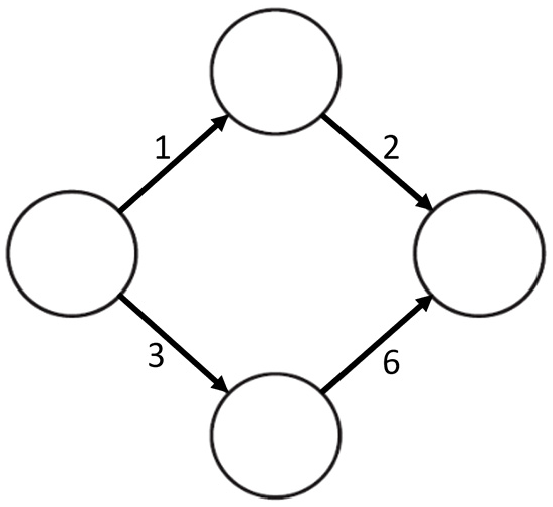
Example weighted directed graph.
WCCAAM relies on the weighted directed graph properties to model wargame decision making. It represents blue bases/red threats as nodes, unit travel paths as edges, and risk as weights between them.
2.3. Multi-commodity flow algorithm
An algorithm represents steps a computer follows to calculate results, gather information about complex problems, or automate processes for efficiency gains. 5 WCCAAM depends on a multi-commodity flow algorithm (MCFA) to process a weighted directed graph representing wargame artifacts. The output reveals the optimum flow along the edges from each node, providing insight into the complex wargame system that the weighted directed graph models.
A single-commodity flow problem represents the desire to find the optimum path to move a single resource (e.g., commodity) from source (e.g., origin) to sink (e.g., destination). A maximum flow algorithm, such as Ford-Fulkerson, computes the optimum path in polynomial runtime. 5
In the multi-commodity flow problem (MCFP), a network efficiently sends different types of commodities across a network that has a shared edge capacity. MCFP algorithms typically support transportation or scheduling problems, such as airline systems that schedule commercial flights. 23
MCFP appears to be a combination of single-commodity flow problems, but is more complicated due to interactions between the commodities. 6 The commodity costs to flow along an edge, and the supply and demand vary. Each commodity can have multiple sources and sinks.
The two primary constraints when solving an MCFP are the travel demand (TD) and the edge capacity (EC). TD is the sum of the single-commodity flow problems where all commodities reach their destinations. EC is the shared flow along an edge that cannot be exceeded and is considered by all commodities. 6 The following formulas mathematically define MCFP:




Expression (1) represents the objective function of the total cost. It states that MCFA outputs the minimum value equal to the total cost multiplied by the summation of the flow amounts over t commodities. 6 Expression (2) constrains the MCFA output such that the commodity flow sum is less than or equal to that edge’s capacity. Expression (3), the node flow equilibrium equation, 6 states that the incidence matrix B (between all nodes and edges) multiplied by the kth commodity flow amount must equal the kth commodity amount at its origin and demand nodes. 6 Expression (4) requires a non-negative number for every commodity flow. 6
The two primary algorithmic methods to solve the MCFP are column generation and Lagrangian relaxation. The column generation method breaks the graph into columns based on the number of commodities and edges, sums the columns, and produces the optimal solution. The Lagrangian relaxation method uses Lagrange multipliers to find the maxima and minima of each arc, subject equality constraints and moves towards the optimal solution step-by-step. 6 WCCAAM uses software licensed and produced by Gurobi Optimization.3,4 This solver supports either solving method but completes quicker with column generation. 6
2.4. Military decision making process
Traditionally, commanders, and their staff follow the Military Decision Making Process (MDMP) to produce a COA response to a wargame initiation. Seven steps compose MDMP (Figure 2), 11 where the outputs from each step contribute to an improved understanding of the situation. Commanders and staff typically follow each step sequentially, but they may repeat a set of steps before creating the plan or order as the battlefield situation unfolds.

Military decision making process (MDMP) flow chart with wargaming commodity course of action automated analysis method (WCCAAM). 11
Upon receipt of a wargame mission (Step 1), MDMP units conduct mission analysis (Step 2) to frame the problem space and establish potential enemy COAs based on available intelligence. As intelligence reports update the commander’s battlespace view, refreshing enemy unit placement and movement, the commander and staff revise their strategy. After establishing enemy COAs, blue team COAs are generated (Step 3) to achieve the desired end-states defined by mission parameters. The team then assesses these blue COAs against an enemy COA (Step 4) to decide if the friendly COA can be successful. Based on these analysis results, the commander compares blue COAs options (Step 5) and then approves a COA (Step 6). Finally, the commander staff disseminates the authorized COA to the friendly forces as orders (Step 7). 20
Unfortunately, this process is also slow and cumbersome. It may work well for divisions with a large staff of dedicated members but is not practical for a small inexperienced team with time-constraints. The complexity of most wargames requires developing and comparing multiple COAs to obtain the best possible solution to each problem. 21
This research aims to recreate MDMP so that a multi-commodity flow algorithm can process the initial inputs derived from the receipt of mission and mission analysis phases into the outputs traditionally generated from the COA development, COA analysis, and COA comparison phases. The result reduces the time and stress on wargame staff, making the wargame and wargamers more effective.
2.5. Wargames as analytical simulations
Analytical modeling is a quantitative data analysis technique for answering specific questions or making design decisions. Analytical models address different aspects of systems, such as changes in their performance, reliability, or mass. Users of analytical techniques need to express the models accurately to gather useful results. 12
A team from the US Naval Post-Graduate School examined the possibility of using wargames as analytical models to gain strategic military insights. 13 The researchers performed a computer-assisted wargame scenario with a human in the loop, took the resultant data, and turned it into a closed-form computer model. Using simulation, the team ran a full factorial statistical design of experiments (DOE) to generate data. 13
A full factorial DOE measures each response of the potential combination of gathered factors and levels. These responses are then analyzed to provide information about each primary effect and every primary interaction. A full factorial DOE is practical when examining five or fewer factors. 14
The primary factors measured were the ones that had the most effect on successful wargame outcomes. Following a design of experiments approach of changing one factor for each simulation, the collected data built a statistically significant model. Typically, one wargame with a single result is not statistically relevant because it could be an error or outlier. However, an analytical model of a wargame can be simulated over a full factorial to gain statistical relevance.13,15 Table 1 shows an example of a full factorial DOE model that shows digital factors associated with their human-readable format. 15
DOE full factorial design example. 15
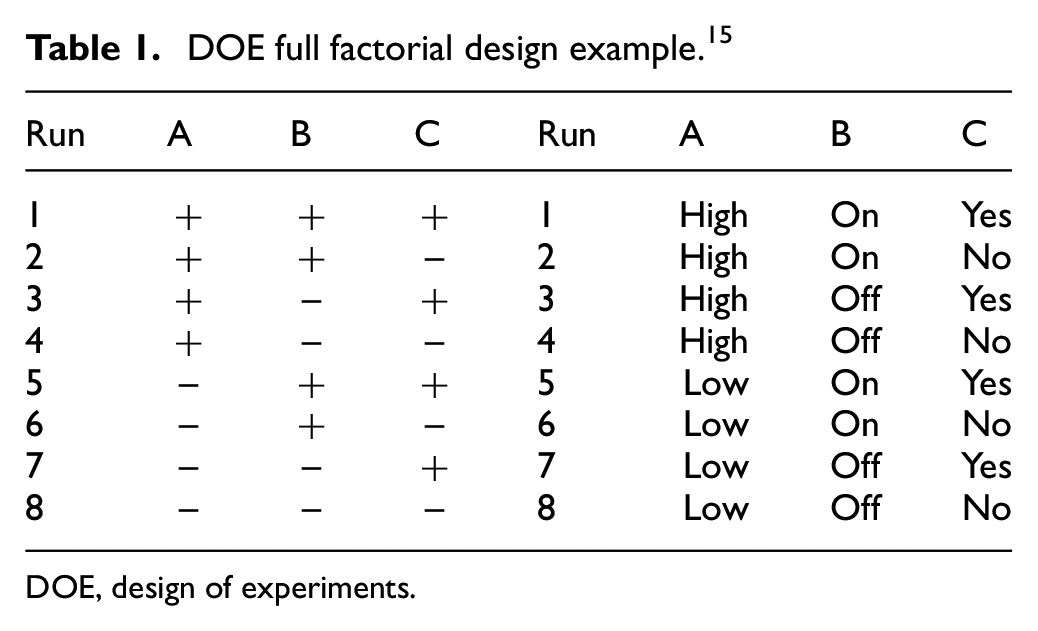
DOE, design of experiments.
When considering more than five factors or a high number of levels, fractional factorial designs are practical. Because full factorial design experiments are often time and cost-prohibitive when many factors are involved, many choose to use fractional factorial designs. These designs assess a subset of factor and level permutations. Fractional factorial designs look like full factorial designs with fewer factors. 24
The following approach evaluates the results from a DOE statistical test. Factor inputs and response outputs are plotted in a Y by X manner, 22 revealing trendlines and correlations. 22 Correlation between factors and responses occur when data points appear close to a linear trendline. 22 This result implies that inputted factors contribute to measured response levels. 22 R 2 measure correlation and is a value between zero and one. 22 An R 2 value closer to one shows a strong correlation, whereas a value near zero shows a weak correlation. 22 A successful DOE statistical test should reveal a strong correlation between factors and responses.
The analytical modeling approaches taken in these works provide the framework for verifying WCCAAM. These works demonstrate that turning computer-assisted wargames into models is a statistically appropriate analysis technique. This research utilizes a fractional factorial DOE design to evaluate WCCAAM. The primary reason was that our test scenario had 11 factors, meaning a full factorial DOE design would be infeasibly large.
2.6. Advanced framework for simulation, integration, and modeling
The Advanced Framework for Simulation, Integration, and Modeling (AFSIM) is a software simulation tool for research and development, operations analysis, and experimentation communities. 16 It is typically used to simulate specific missions, many-on-many or one-on-one engagements, and test new engineering ideas, systems, or concepts in a risk-free environment. AFSIM models air, space, surface, and sub-surface warfighting domains. Also, the simulation framework supports tactical development through concept assessments and operational evaluations. 16
The AFSIM package includes a suite of tools: Wizard, Mission, Warlock, Engage, Weapon Tools, and Sensor Plot. This research used primarily Wizard, Mission, and Warlock. Unit creation and placement occurs in Wizard, the scenario creation tool. Mission rapidly simulates engagements and supports post-execution replays. Warlock allows an operator to run scripts during simulation execution to affect results in a wargame environment.
Schwartz et al. compare a manually produced COA with one from a US Army battlefield AI simulation tool. 20 The researchers compare the results to assess the increase in friendly force strength at the end of the scenario. 20 In this way, they demonstrated their AI tool’s effectiveness. Likewise, we design and simulate a wargame in AFSIM’s Wizard and compare the results from a user-developed COA with a WCCAAM produced one.
2.7. Background summary
The concepts and tools presented in this section are the basis of WCCAAM and its capability demonstrations. WCCAAM relies on weighted directed graphs to represent wargames as analytical models so that MCFA can process them. The method’s principal task is creating a repeatable process that turns wargames into these analytical models. After modeling a wargame, WCCAAM demonstrates its capabilities through two methods. First, an AFSIM simulation establishes the basic concepts behind WCCAAM. Then, a fractional DOE statistical analysis tests WCCAAM to show model correlation and COA generation efficacy. The following section covers the steps of WCCAAM and how this method develops the graphical version of a wargame.
3. Methodology
This section details how the WCCAAM transforms a wargame into a computational model that a MCFA analyzes to produce a recommended COA. WCCAAM augments the MDMP method by ingesting the output from the MDMP mission analysis phase and produces a COA that is pushed into the MDMP COA approval phase, replacing the MDMP COA development, analysis, and comparison phases. WCAAM automates the former steps by applying an algorithmic solver, replacing time-consuming paper tools and team discussions. The three steps automated by WCCAAM are the most time-consuming and arduous tasks presented by MDMP. 25 WCCAAM replaces these with straightforward, practical solutions.
Following the eight steps of WCCAAM ensures accurate wargame conversion into an analytical model. This analytical model is a weighted directed graph presenting a multi-commodity flow problem (MCFP). Figure 3 shows the WCCAAM steps in a flow chart, where the boxes describe the primary steps, and the arrows depict the outputs as parts of the MCFP graph. The rest of this section explains the inputs, operations, and outputs of each WCCAAM step.
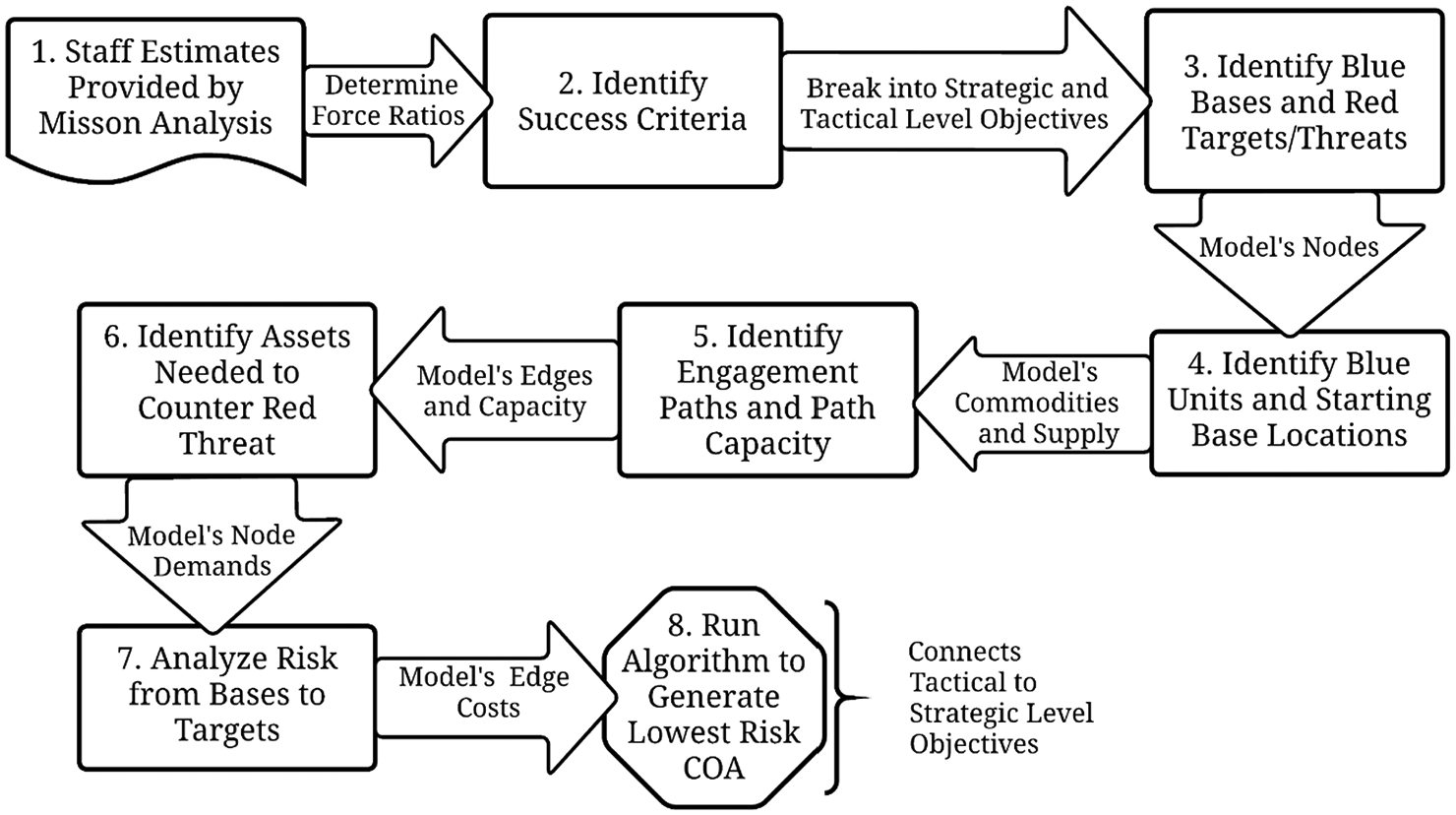
The WCCAAM flow chart.
3.1. Mission analysis staff estimates
The MDMP mission analysis phase outputs the staff estimates. These estimates are concise reports that wargame designers develop from the mission intelligence. 11 The typical list of staff estimates provided to the commander includes the Operations Estimate, Personnel Estimate, Intelligence Estimate, Logistics Estimate, Civil-Military Estimate, Signal Estimate, Information Operations Estimate, and Special Staff Estimate. 25 Each of these estimates is of varying levels of importance based upon the type of wargame. The staff estimates and the wargame map provide the information needed to convert the wargame into a graphical representation for algorithmic processing.
The first two components required by WCCAAM from these estimates are the mission strategy and red peer levels. These components determine the force exchange ratios for unit engagement adjudication. The mission strategy levels considered in WCCAAM are offensive, balanced, or defensive. Offensive tasks require 25% more units than a balanced approach, where defensive missions require 25% less. The red peer levels are peer, near-peer, and asymmetric. A red force that is a peer-level opponent needs a one-to-one force exchange ratio. A red team determined as a near-peer opponent requires 80% of blue force strength. Only 50% of blue forces are necessary to counter the red threats in an asymmetric-level peer. These calculations are based roughly upon the Lancaster Equations that approximate force ratios in historical combat. 17
3.2. Identify success criteria
The first staff action identifies the mission’s success and failure criteria. Next, the staff divides the criteria into quantifiable strategic and tactical level objectives. A strategic objective (SO) is a high-level statement that outlines what needs to be achieved, with a clearly stated goal (e.g., defend all bases or achieve air superiority over a region). 18 A tactical objective (TO) is a short-term desired result of an assigned unit mission, such as destroying a single threat or defending a base. Understanding objectives and dependent sub-objectives form the foundation form the rest of the wargame COA analysis process.
3.3. Identify blue bases and red targets/threats
The wargame commander establishes the blue bases of operation from the staff estimates, including unit locations supporting offensive or defensive missions. Examples include physical bases with troops or carrier groups with available aircraft. Next, the commander identifies red team threats and targets. Examples are red bases, an attacking tank force from a given direction, or a unique high-value target. The identified red and blue assets form the nodes of the wargame’s direct graph.
3.4. Identify blue units and starting base locations
The personnel estimate provides the blue team commander a list of assets before wargame initiation. The organization of these assets into domains and unit types is essential for proper positioning. There are two types of unit pre-positioning options that are used by wargame designers: locked and unlocked.
For wargames with locked starting locations for blue units, the commander positions units at the bases given by the personnel estimate. In the unlocked case, the commander can choose unit starting positions at any of the bases identified in step 3. The commander can also use WCCAAM to automatically pre-position blue units to optimal bases in the unlocked case. These optimal base assignments are those WCCAAM calculates the most advantageous outcome for the blue team.
If the Intelligence Estimate changes, step 4 can be repeated after step 8 to further optimize the blue COA by repositioning units before wargame turn initiation. The commodity types and supplies at the starting nodes are this step 4’s output in the wargame’s graphical representation.
3.5. Identify engagement paths and asset capacity
The blue command staff identifies the possible engagement paths from the wargame map and the staff estimates. These paths connect each blue base to the red target and identify inter-threats as nodes on the engagement path. If the blue base can send units to counter a red threat, then that path is also determined. Engagement paths vary based upon the warfighting domain. In the air domain, the capacity limitation is the number of units that the base can simultaneously support air operations. In the ground domain, the path capacity depends on map terrain. Highways or road availability contribute to a high ground troop movement capacity where uncleared forests or swamps limit movement capacity. In the graphical representation of the wargame, these factors represent the edges and associated capacities.
3.6. Identify assets needed to counter red threat
The red threats and targets identified as nodes in step 3 require a neutralizing blue opposing force. The blue commander’s assessment of the red asset list and projection of red COAs identifies the number of blue units needed to counter each red threat. Commanders need to project at least three red COAs by listing the most likely red COA, the red COA that is most harmful to blue objectives, and the red COA that is most beneficial to blue objectives. The blue staff analyzes these COAs and develops mitigation strategies. The blue staff identifies unit types and estimates totals in each threat from the mitigation strategies and the intelligence estimate. With this information present, the blue commander identifies the minimum number of units in each domain necessary to counter the red threat or destroy the red target. The commodity demand at each red node represents the required amount of force to neutralize blue units in the wargame’s graphical representation.
3.7. Analyze risk from bases to targets
The engagement paths identified in step 5 have another necessary variable: risk. WCCAAM represents risk through these levels and point totals: low (1), medium (2), and high (3). Wargame commanders assess risk levels for each unit type’s engagement path from blue bases to red threats. WCCAAM completes this process by measuring engagement paths’ distance and vulnerability to an attack. A wargame map measurement determines the engagement path distance. The commander determines the attack’s vulnerability by weighing the likelihood of a red COA that attacks units along the path. The model’s edge costs represent these numerical risk levels.
3.8. Run Algorithm to generate lowest risk COA
In this step, WCCAAM analyzes the wargame model using MCFA and outputs an employable COA that minimizes risk. The WCCAAM MCFA minimizes and aggregates the risk total of units sent along engagement paths associated with each TO and SO. The blue COA output includes:
Unit pre-turn assignments (dependent upon wargame design);
The path of each blue asset assigned from its base to a red threat or target based on minimizing total risk;
The list of multiple TOs providing their risk requirements;
The list of multiple SOs reporting their risk requirements.
3.9. Methodology summary
WCCAAM incrementally transforms a wargame into a weighted directed graph. An MCFA then analyzes this graph to produce a COA based upon the lowest total risk while completing all objectives. The inputs come from the MDMP’s mission analysis staff estimates. The outputs are read as a single COA for all units under the blue commander’s control.
4. Validation and verification
This section demonstrates the plan to verify and validate the WCCAAM. A military scenario is first designed, converted into an AFSIM simulation, and then fractional DOE statistical analysis testing is performed on the same scenario. These methods parallel the verification and validation methods employed by the US Army Combat Capabilities Development Command and US Naval Post-Graduate School.20,15
Accomplishing the following three goals validate WCCAAM:
Goal 1: The WCCAAM models wargames correctly
Goal 2: The WCCAAM produces a viable COA for a wargame commander
Goal 3: The WCCAAM offers the best COA possible from a risk reduction point of view
The following two-step approach is used to achieve these goals:
Step 1: An AFSIM COA simulation and evaluation (goals 1 and 2)
Step 2: A DOE statistical test (goals 1 and 3)
Step 1 details an approach similar to the one taken by the team from the US Army Combat Capabilities Development Command to verify their artificial intelligence wargaming tool. 20 In this case, we simulate a wargame in AFSIM with a generic COA, then AFSIM runs the same scenario with a WCCAAM generated COA. In this case, a generic COA means a user-developed COA without the assistance of WCCAAM. A results comparison shows the difference in the number of objectives completed and the total risk reduction. An increase in objective completion and a reduction in cumulative risk by WCCAAM’s COA demonstrates the first two goals.
Step 2 details an approach similar to the US Naval Post-Graduate School team’s to verify wargames expressed through statistical models. 15 In this approach, we verify WCCAAM via a fractional DOE statistical test. These test results demonstrate goals one and three through proper wargame unit correlation and significant total risk reduction.
Matthew Caffrey developed the wargame scenario used in both verification and validation steps, modeling this scenario after a former US military conflict, and including unit specifications, base locations, and clear objectives. These attributes present it as an excellent scenario to model in AFSIM and to evaluate WCCAAM.
4.1. Wargaming scenario
The Wargaming 101 scenario describes two fictitious nations, Phoenicia and Sumer, on the brink of conflict. 26 Phoenicia, a small, wealthy, free-market democracy, is a long-time ally of the US. Sumer is an aggressive, large dictatorship that desires nuclear weapons and Phoenicia’s wealth and resources. Oceans surround the area of conflict, with a neutral nation to the north.
The Wargaming 101 scenario’s geopolitical setup lends itself to a straightforward and effective conversation into a wargame with historical context. 26 This context supports AFSIM’s requirement for a real-world location to simulate wargames. The Wargaming 101 scenario directly transforms into the 1990 Gulf War. 26 The dictatorship, Sumer, with the desire to acquire weapons of mass destruction, large size, and poor economy, translates to Iraq under Saddam Hussain’s government. The role of Phoenicia translates to Kuwait, a US ally with a strong economy, a small population, and land area.
Other aspects of the geopolitical setup also fit in this scenario. Turkey, primarily neutral during the Gulf War, represents the large neutral nation to the north. The Persian Gulf surrounds these nations’ south-eastern border and allows for US Navy asset participation.
4.2. AFSIM simulation
Due to AFSIM’s Warlock tool’s limitations, the number of units decreases in the wargame from 400 to 21. The unit reduction results in nine red units (five air-to-air fighters, two bombers, and two tanks). The resulting blue force is 12 units (seven air-to-air fighters, three C-130 cargo planes, and two bombers). These unit numbers still gave the necessary amounts to model the wargame while allowing conversion into AFSIM’s complex modeling environment.
WCCAAM step 1 determines that the mission strategy level is balanced and that the opposing red force is a peer. The blue team’s success criteria are to protect all blue bases, deliver one C-130 to Base 2 and two C-130s to Base 3, and achieve air superiority. In direct conflict, the red success criteria are to destroy all blue bases and cargo planes. Step 2 of WCCAAM divides the blue objectives into tactical and strategic levels, as seen in Table 2.
Wargame test scenario tactical and strategic objectives.
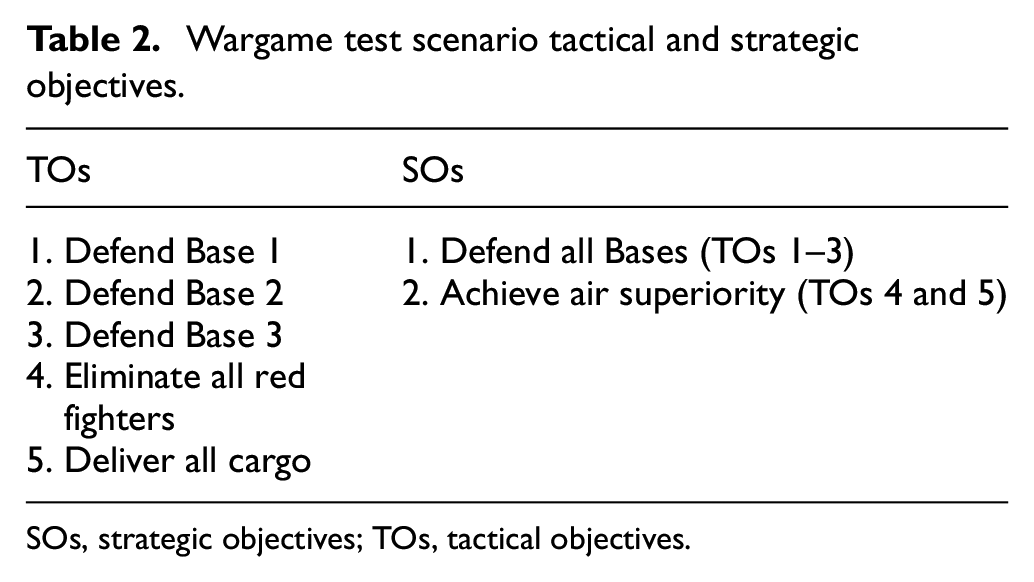
SOs, strategic objectives; TOs, tactical objectives.
For the base and unit breakdown for WCCAAM steps 3 and 4, the scenario has three friendly bases, a carrier group, and five enemy bases. At these bases, fighters, bombers, tanks, and cargo planes are combatants in the wargame. WCCAAM step 5 establishes all possible blue engagement paths that exist between the blue bases and red threats
WCCAAM step 6 concludes from the intelligence estimate that the red commander would perform one of three COAs:
Attack with all forces from Northern Base;
Attack with units split with a North and South force;
Attack with all forces from the Southern Base.
WCCAAM step 7 establishes a risk amount on each engagement path for each commodity based upon the path distance and susceptibility of attack.
Red COA 1 is the approach taken for the AFSIM simulation. For the blue response, a generic COA that does not use WCCAAM step 8 establishes a baseline response. In this generic blue COA, all three blue bases have defending units, and cargo planes take direct paths between supply and demand bases. After simulating the scenario with the generic blue COA in AFSIM, the outcome read: Lost 1 Base, Lost 1 Cargo Plane, 1 Red Fighter Survived, 4/7 Blue Fighters Survived, 2/5 TOs Met, and 0/2 SOs Met.
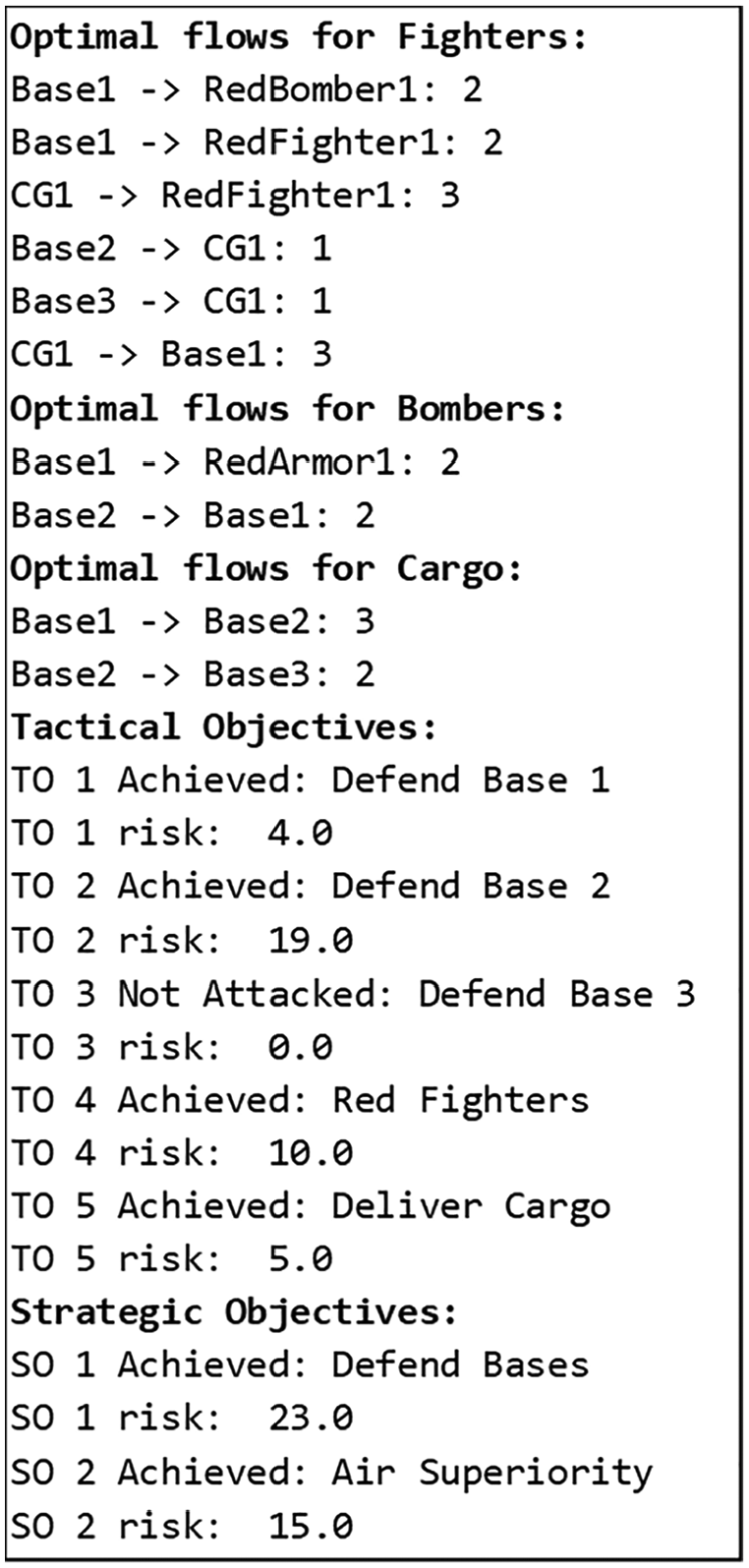
After following WCCAAM steps 1–7, Figure 5 shows the resulting weighted directed graph form of the wargame scenario. Figure 5 displays only the nodes, edges, and edge costs from Base 1 to each red threat for readability. Figure 5 does not display commodities, supplies, demands, and resulting flow amounts. WCCAAM step 8 then simulates a blue COA for this scenario, and the final output is displayed in Figure 4.
Wargame weighted directed graph.
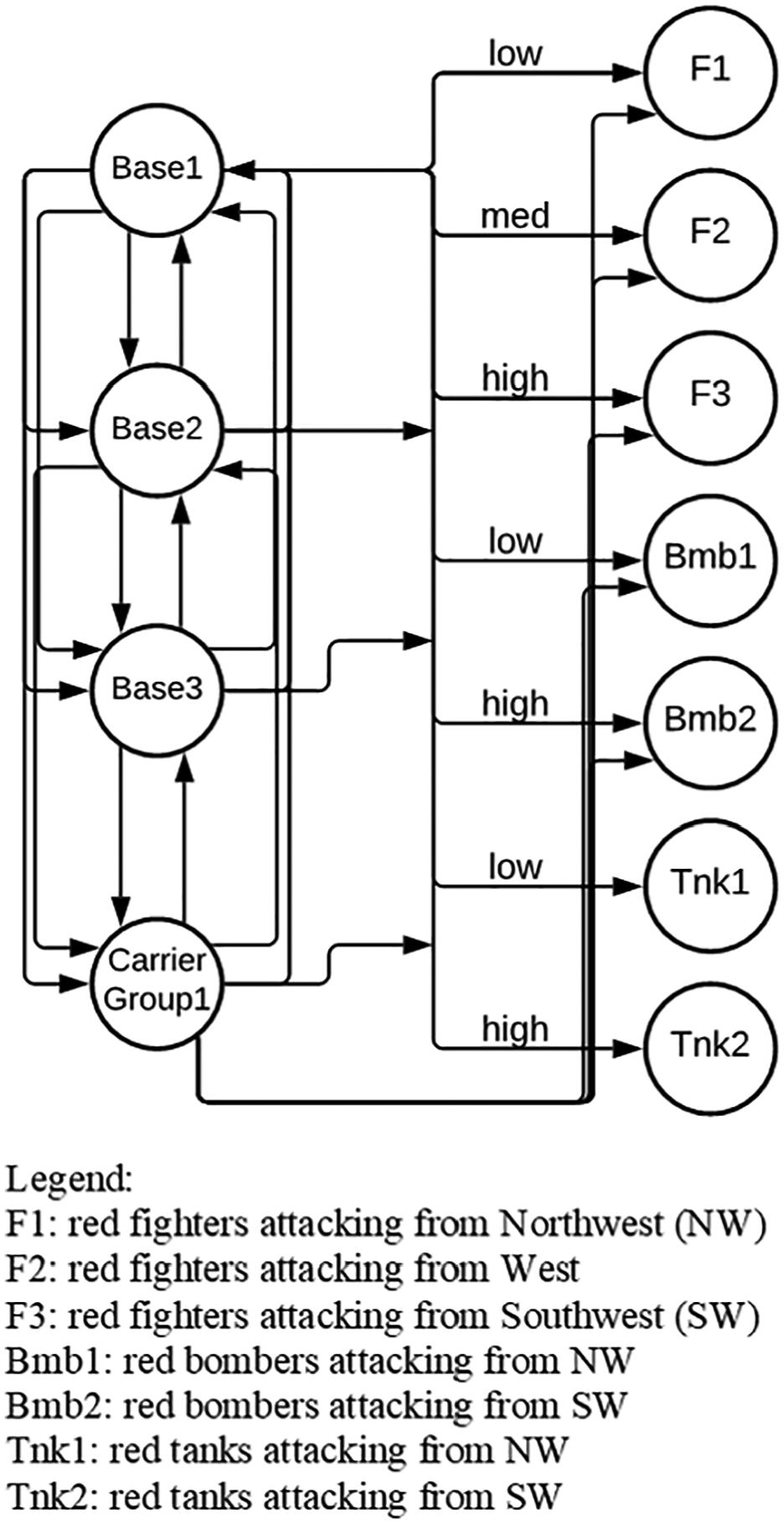
F1: red fighters attacking from Northwest (NW); F2: red fighters attacking from West; F3: red fighters attacking from Southwest (SW); Bmb1: red bombers attacking from NW; Bmb2: red bombers attacking from SW; Tnk1: red tanks attacking from NW; Tnk2: red tanks attacking from SW.
WCCAAM output in Figure 4 reads like a unique COA that assigns blue units as commodities to counter red threats. For the first blue unit type, blue fighters, WCCAAM pre-positions four at Base 1 and the remaining three at Carrier Group 1. At turn initiation, these fighters neutralize the red threats of fighters (RedFighter1) and bombers (RedBomber1) attacking from the north. For the second blue unit type, blue bombers, WCCAAM pre-positions two from Base 2 to Base 1 and orders them to attack the northern red tank threat (RedArmor1). For the third blue unit type, the cargo planes, no pre-positioning can take place. At turn initiation, the WCCAAM COA sends all three cargo planes to Base 2. The two cargo planes needed at Base 3 then continue to their destination. Finally, WCCAAM lists all mission objectives and their risk totals. AFSIM simulates the wargame scenario using the WCCAAM COA. The results read: Lost 0 Bases, Lost 0 Cargo Planes, No Red Fighters Survived, 3/7 Blue Fighters Survived, 5/5 TOs met, and 2/2 SOs Met.
As Table 3 displays, there is a clear upgrade in performance between the generic COA and the WCCAAM COA. The WCCAAM COA loses one less blue base and one less cargo plane, destroys one additional red fighter, and meets five additional objectives. The only negative result is the loss of one additional blue fighter. This result shows evidence that WCCAAM correctly models a wargame and produces a viable COA.
AFSIM results of generic COA versus WCCAAM COA.
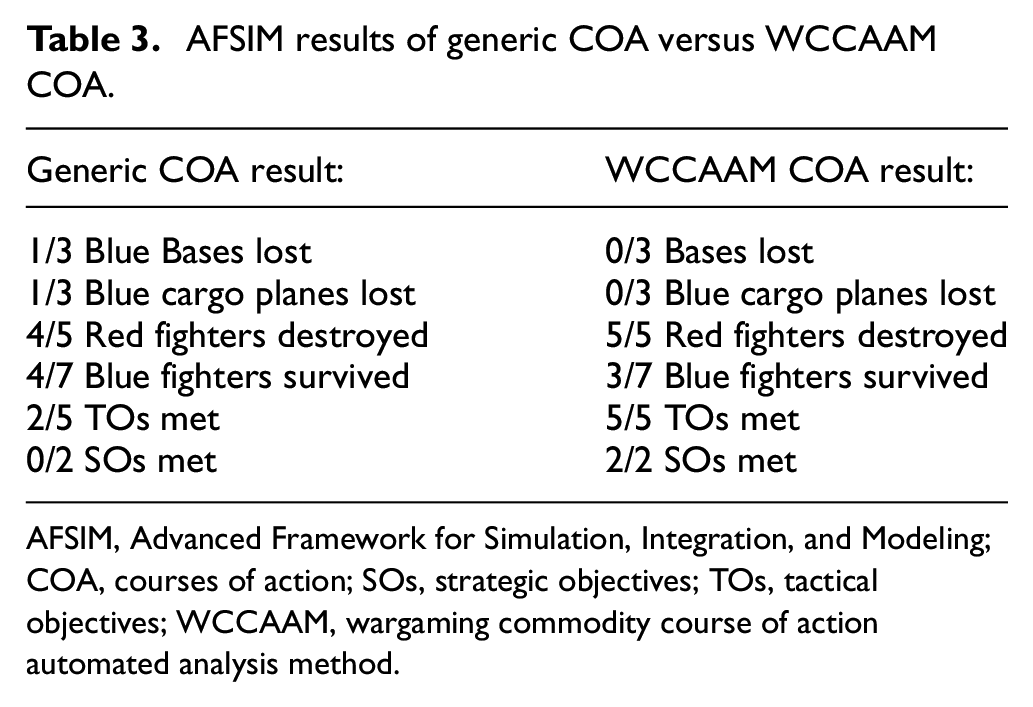
AFSIM, Advanced Framework for Simulation, Integration, and Modeling; COA, courses of action; SOs, strategic objectives; TOs, tactical objectives; WCCAAM, wargaming commodity course of action automated analysis method.
4.3. Statistical tests
Step 2 of the verification and validation process performs fraction factorial DOE statistical tests. For these tests, WCCAAM again models the Gulf War scenario. However, the unit numbers increase for this test to give results closer to the original Wargaming 101 scenario, increasing the statistical relevance. The changes add infantry and tanks to the blue commodities and infantry and Scud missile launchers to the red commodities. The last change removes cargo planes and bombers from the scenario.
The DOE test matrix’s 11 factors denote the number of each type of blue unit assigned to each base and the red COA. Each factor’s levels vary with the distribution of 450 blue infantry units, 25 blue tank units, 6 blue fighter units, and 3 red COAs. The response variables denote the risk totals for each of the five TOs and two SOs.
The DOE test matrix defines 50 runs per each of the three red COAs. The fundamental DOE principle of testing each of the 36 edge points determines this number’s minimum value. The additional 14 center points ensure model accuracy and data fit. The DOE matrix tests WCCAAM twice, resulting in 300 total tests (150 runs for each of the two tests).
Test 1 applies the DOE matrix to evaluate WCCAAM in a locked, no unit pre-assignment wargame scenario. Test 1 shows the correlation between initial unit placement and objective risk reduction. Figures 6 and 7 show the risk response to each of the three red COAs for Test 1.
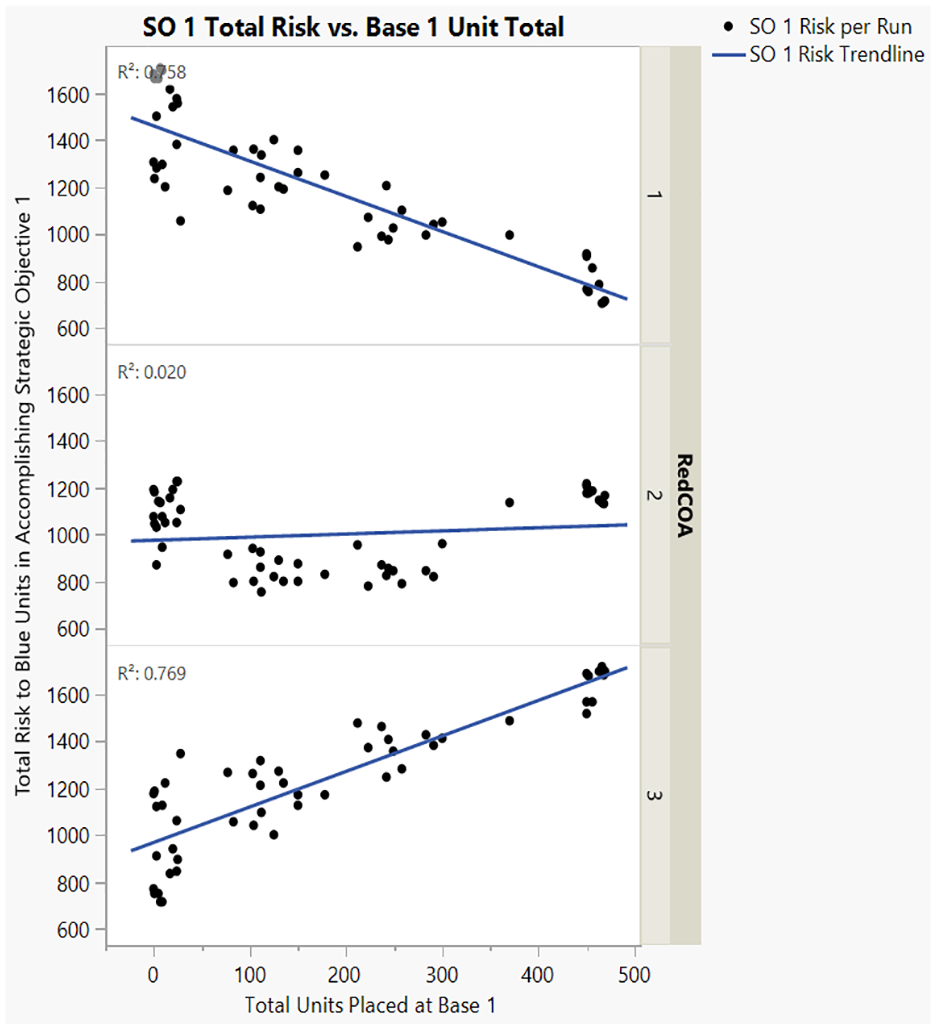
Blue risk required to achieve SO 1 versus total units placed at Base 1.
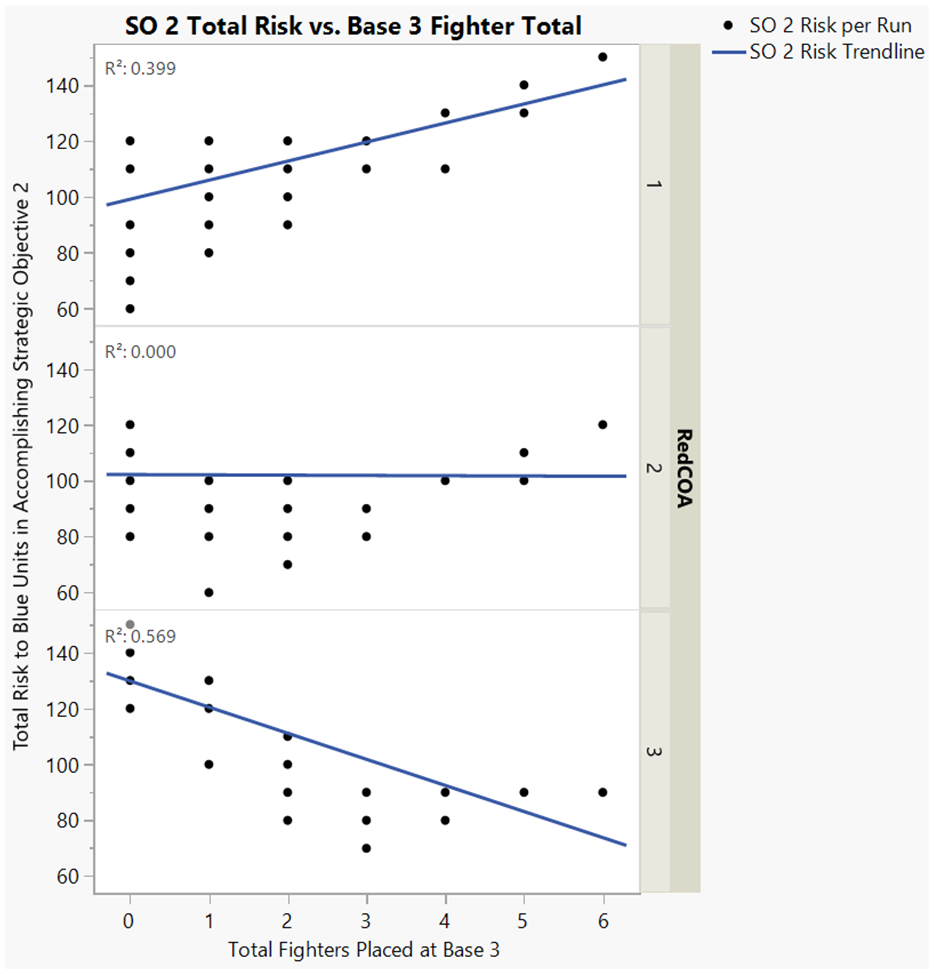
Blue risk required to achieve SO 2 versus fighters placed at Base 3.
Test 2 applies the DOE matrix to evaluate WCCAAM in an unlocked, unit pre-assignment allowed wargame scenario. Test 2 shows that WCCAAM produces the lowest possible risk COA achieved by any random unit pre-placements in DOE test one. Figures 8 and 9 show the risk response to each of the three red COAs for test two.
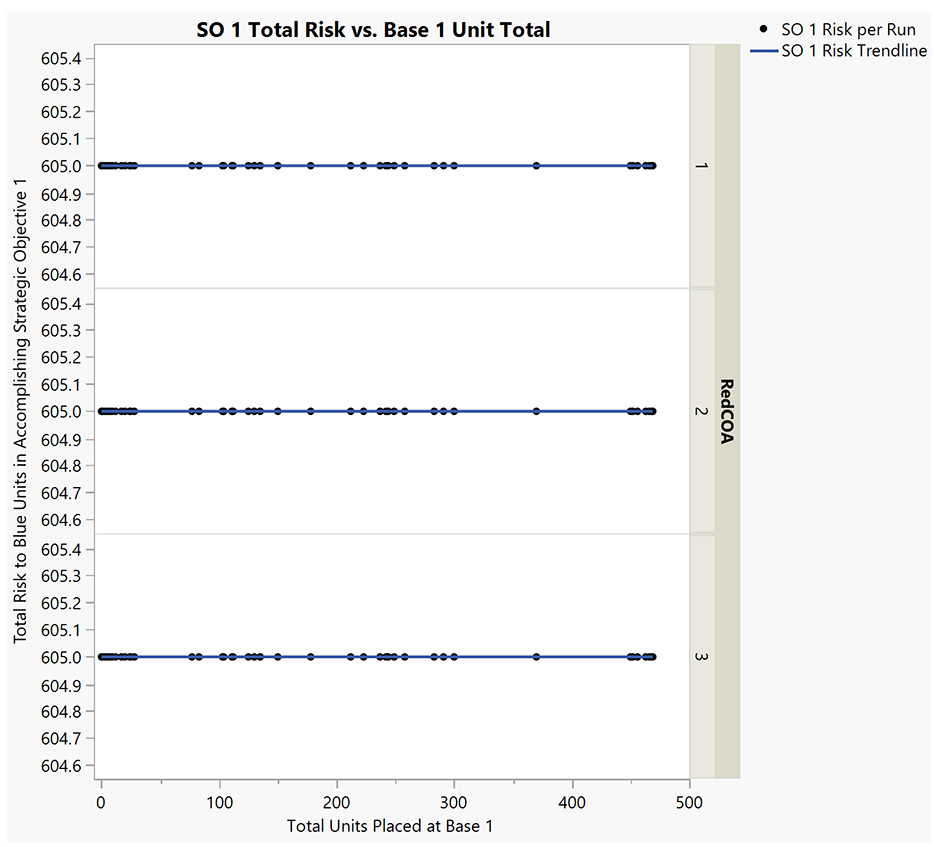
Blue risk required to achieve SO 1 versus total units placed at Base 1.
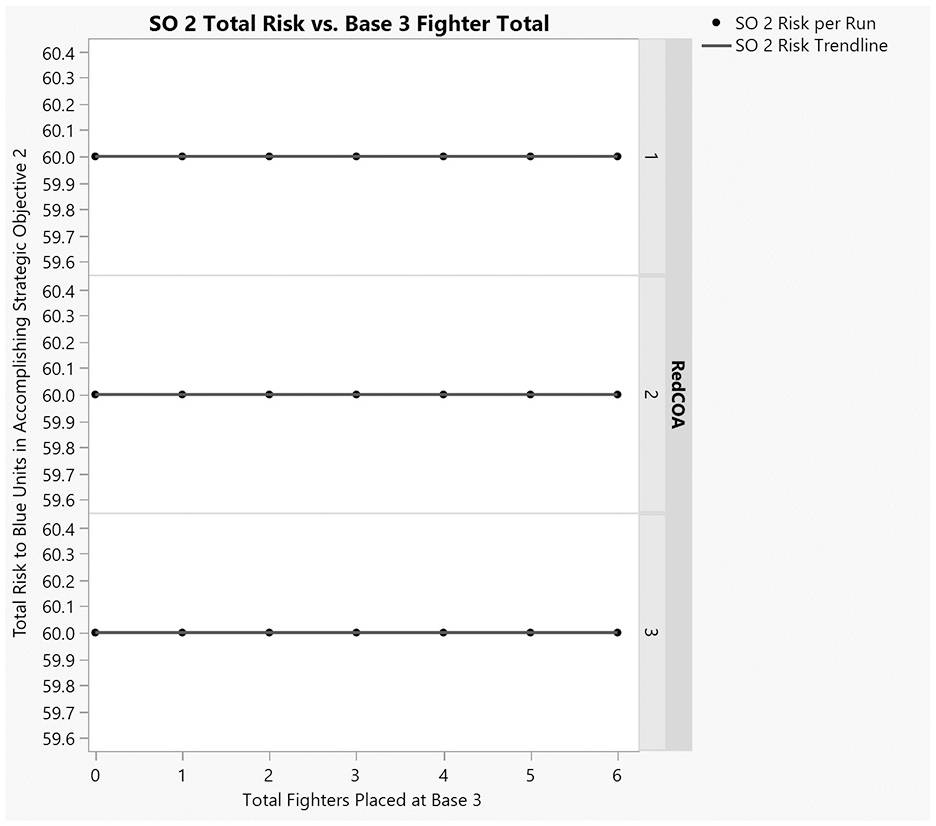
Blue risk required to achieve SO 2 versus fighters placed at Base 3.
Figure 6 reveals that, as the number of units placed at base one increases, the risk of SO 1 (defending blue bases) decreases when red employs COA 1 (red attacking from the north). The R 2 value, 0.758, shows a strong correlation. This strong correlation means that the variation in the factor, SO 1 risk, can be attributed to unit numbers’ response.
Figure 6 also shows no correlation, R 2 of 0, for red COA2 (balanced attack from North and South), and a strong correlation, R2 of 0.769, for red COA 3 (red attacking from the south). The positive correlation for red COA 3 indicates that a high number of units placed at base one (B1Total) raises the total risk of defending blue bases when red attacks from the south. Figure 7 shows in a similar layout that there is moderate correlation, R 2 of ~0.5, between the placement of fighters at base three, the red COA chosen, and the reduction in risk of SO2 (achieving air-superiority).
Figures 8 and 9 Test 2 results show that with unit pre-placement allowed, WCCAAM achieves the lowest possible risk response for each red COAs. The lowest SO1 risk achieved in Test 1 was 605, and the lowest risk for SO2 was 60. These two risk numbers were achieved every time over the 150 runs in Test 2. This result is significant because it shows a consistent lowest SO risk level achievement for each of the test matrix’s varying unit locations.
4.4. Verification and validation summary
The results from this section show WCCAAM effectively models, analyzes, and develops COAs. The AFSIM test shows a 71% increase in WCCAAM objective completion than a generic user-developed COA. Statistical testing reveals two things: that wargames in WCCAAM graph form model scenarios correctly and that WCCAAM generates COAs with minimal risk to blue units. The following section provides a conclusion and lists possible future works.
5. Conclusion and future work
Wargame commanders no longer need to choose between MDMP paper matrices or full battlefield wargame M&S solutions. The WCCAAM provides a novel solution to the problems posed by current COA development and analysis methods. The two-step WCCAAM validation and verification process demonstrates that WCCAAM produces effective and consistent COAs. The advantages of WCCAAM include a decrease in workforce requirements when compared with manual methods and a reduction of computational resource requirements when compared with full battlefield M&S solutions through automating three steps of MDMP.
There are several possibilities when it comes to future work associated with this research. One future work could introduce artificial intelligence machine learning methods to replace the mission analysis phase of MDMP to reduce further workforce requirements. The production of staff estimates could be completed by parsing the intelligence reports and eventually producing near-real-time results. Calculation of the remaining fighting strength of units by simulating combat adjudication outcomes could be another future work. These estimates could give predictions on future turn blue COAs. Final future work could link each single turn COA produced by WCCAAM into a multi-turn wargame. With these future works completed, the WCCAAM could completely replace the MDMP steps.
Footnotes
Funding
This research received no specific grant from any funding agency in the public, commercial, or not-for-profit sectors.
