



Abstract
Leaders need to consider employees both as distinct individuals and as integral members of a collective to effectively address their needs. Drawing on self-determination theory (SDT), this study examines how individual- and collective-focused leader behaviors address employees’ autonomy, relatedness, and competence need satisfaction, influencing their intentions and behaviors. We propose that individual-focused behaviors (empowering leadership) address employees’ need for autonomy, while collective-focused behaviors (identity leadership) address their need for relatedness. Moreover, we argue that combining empowering and identity leadership addresses employees’ competence need satisfaction. We pre-registered a scenario-based experiment (N = 226) and a time-lagged field study (N = 308) to test the following hypotheses: (1) empowering leadership predicts autonomy need satisfaction, reducing turnover intentions; (2) identity leadership predicts relatedness need satisfaction, increasing organizational citizenship behavior (OCB); and (3) empowering and identity leadership interact to predict competence need satisfaction, resulting in higher work effort. Results from both studies support the hypothesized effects, except for the interaction effects in the field study. Together, these findings underscore that it is important for leaders to integrate individual- and collective-focused behaviors to holistically address employees’ psychological needs and foster positive work-related outcomes.
Keywords
Introduction
A central leadership challenge is to address employees as both individuals and members of a collective (Batool et al., 2023; Wu et al., 2010). Leaders are expected to support employees’ individual growth and performance, while simultaneously focusing on the collective fostering coordination, collaboration, and shared direction within the group (Chun et al., 2016; Kunze et al., 2016). This dual demand of individual- and collective-focused leadership has become increasingly salient in contemporary work. Technological and organizational developments have expanded opportunities for individualized work design and autonomy (Parker & Grote, 2022), whereas rising task complexity often requires interdependence and effective teamwork (Mathieu et al., 2017, 2019). In practice, effective leadership therefore cannot be reduced to focusing on either individuals or collectives; it requires integrating both perspectives.
Although scholars have begun to examine leadership that combines individual- and collective-focused behaviors, two limitations constrain existing knowledge. First, research has relied on a small set of leadership conceptualizations explicitly designed to encompass both individual- and collective-focused leader behaviors (e.g., Chun et al., 2016; Kunze et al., 2016; Wang & Howell, 2010). Recent critiques suggest that these broad conceptualizations are conceptually overlapping and insufficiently distinguishable from adjacent constructs, which complicates the accumulation and comparison of evidence (Eva et al., 2025). To contribute to a more precise account of how leaders can address employees as individuals and as members of a collective, we adopt a taxonomic approach (Eva et al., 2025) that organizes leader behaviors by their primary target: the individual versus the collective. Building on these overarching categories, we examine two distinct leadership conceptualizations that clearly map onto each focus: empowering leadership, which emphasizes delegating authority and encouraging autonomous decision-making (Sharma & Kirkman, 2015), and identity leadership, which emphasizes fostering a shared sense of “we” among employees (Steffens et al., 2014).
Second, prior research has often treated collective-focused leadership primarily as a driver of team-level processes and collective performance, whereas individual-focused leadership has been emphasized as a predictor of personal well-being and individual performance (e.g., Kark & Shamir, 2002; Wang & Howell, 2010). This separation risks overlooking an important point: employees do not only strive for autonomy as individuals; they also experience a personal need to belong and to form meaningful social bonds (Baumeister & Leary, 1995). Accordingly, leader behaviors aimed at building a collective identity may be consequential not only for the group as a whole but also for each employee's individual experience, particularly with respect to relatedness. We therefore develop and test a need-based account in which both individual-focused empowering leadership and collective-focused identity leadership shape individual work-related outcomes through basic psychological need satisfaction.
We base this reasoning on self-determination theory (SDT; Deci & Ryan, 1985, 2000), which identifies autonomy, relatedness, and competence as basic psychological needs that, when satisfied, enhance employees’ motivation and well-being. The leadership challenge of integrating individual- and collective-focused leader behaviors aligns closely with SDT's emphasis on balancing autonomy and relatedness (Ryan, 1991). In organizational settings, employees thrive in environments that allow them to feel both self-directed without becoming isolated and connected without losing their sense of independence (Hodgins et al., 1996). A predominant focus on only one of these needs may leave the other unaddressed and, in turn, undermine motivation and well-being (Slemp et al., 2024; Van den Broeck et al., 2016). A combination of individual-focused empowering leadership and collective-focused identity leadership is thus argued to effectively address both needs, fostering positive work-related outcomes.
Empowering leadership, involving behaviors of delegating authority and encouraging autonomous decision-making, centers on employees’ self-direction and volition (Kirkman & Rosen, 1999). We therefore propose that empowering leadership directly addresses employees’ need for autonomy (Kirkman & Rosen, 1999; Sharma & Kirkman, 2015). Furthermore, we argue that autonomy need satisfaction, in turn, reduces turnover intentions, as employees value the freedom to shape their work independently and are motivated to retain this autonomy (Amundsen & Martinsen, 2014; Kim et al., 2018). Conversely, we argue that identity leadership addresses employees’ need for relatedness, as leader behaviors are specifically directed at creating and maintaining a collective sense of “we” that connects all employees and the leader (Haslam et al., 2025). Relatedness need satisfaction, in turn, is argued to enhance organizational citizenship behavior (OCB), as employees feel deeply connected to their team and organization, motivating them to engage in beneficial and constructive behaviors (Wörtler et al., 2020).
SDT (Deci & Ryan, 1985, 2000), moreover, holds that, along with autonomy and relatedness, competence builds a separate and equally important basic psychological need that contributes to employees’ motivation and well-being. Leaders should therefore address employees’ needs for autonomy, relatedness, and competence (Gilbert & Kelloway, 2014). We propose that leaders may address employees’ need for competence through a combination of empowering leadership and identity leadership. To begin with, empowering leadership, in terms of entrusting employees with meaningful tasks, allows employees to exercise their skills, potentially contributing to employees’ competence need satisfaction. However, experiencing extensive autonomy and self-responsibility may also burden and overstrain employees (Cheong et al., 2016). To prevent this strain, leader behaviors of fostering a collective sense of “we” (i.e., identity leadership) may help. A shared social identity facilitates the exchange of perspectives and resources among employees, expanding employees’ knowledge and providing a sense of security, which in turn contributes to satisfying their competence need. A combination of empowering and identity leadership is argued to contribute to employees’ competence need satisfaction. Furthermore, employees’ competence need satisfaction may, in turn, drive employees to exert greater effort in their work as they perceive themselves to be capable of achieving challenging goals and therefore commit higher levels of energy and engagement to their tasks (Amundsen & Martinsen, 2015; Steffens et al., 2019).
Our research makes three key contributions. First, we build on the overarching leadership challenge of addressing employees as both individuals and members of a collective (Batool et al., 2023; Wu et al., 2010) to establish two taxonomic leader behavior categories (Eva et al., 2025) and exemplarily investigate the leadership conceptualizations of empowering leadership (Kirkman & Rosen, 1999) and identity leadership (Steffens et al., 2014) as representatives of the two categories. By examining the interplay of individual- and collective-focused leadership based on the two conceptualizations, we introduce a parsimonious way of systematizing leader behaviors based on taxonomic categories and respond to calls for more integrative perspectives on leadership that help to counteract an ongoing “fragmentation in the leadership literature” (Kearney et al., 2019, p. 20). Second, grounded in self-determination theory (Deci & Ryan, 1985, 2000), we highlight that the collective-focused behaviors of identity leadership address each employee's need for relatedness. We thereby extend prior research that primarily links collective-focused leadership with beneficial team processes. This need-based perspective on collective-focused leadership contributes to a more nuanced understanding of how collective-focused leadership may benefit each employee individually. Third, by examining the interactive effect of empowering and identity leadership on employees’ competence need satisfaction, we highlight that a combination of different leader behaviors may have an effect that is bigger than the sum of its parts. In line with recent calls for a stronger consideration of interactive elements of leadership (Van Knippenberg & Dwertmann, 2022), our research demonstrates the usefulness of combining empowering leadership and identity leadership when leaders want to address all three basic psychological needs put forward by self-determination theory to foster their employees’ motivation and well-being.
Theoretical Development and Hypotheses
When leaders are responsible for leading a group of employees, they face the challenge of addressing employees as both individuals and members of a collective (Batool et al., 2023; Wu et al., 2010). This challenge is grounded in an overall “tensions between the individual and the aggregate” (Smith & Lewis, 2011, p. 384). Leadership involves directing the efforts of employees towards collective goals. However, teams are most successful when every employee can contribute their individual strengths (Mathieu et al., 2017). While many scholars acknowledge the challenge of addressing employees as both individuals and members of a collective, research on the interplay of individual- and collective-focused leadership is limited in two main ways. First, research on individual- and collective-focused leadership is dominated by the investigation of very few leader behaviors (with nearly all studies investigating dual-focused transformational leadership, e.g., Chun et al., 2016; Kunze et al., 2016; Wang & Howell, 2010). While these studies may provide a solid first step towards a better understanding of individual- and collective-focused leadership, they do not reflect conceptual developments in recent years and the breadth of diverse leadership conceptualizations.
Second, past studies ignore the role of employees’ needs in the investigation of individual- and collective-focused leadership. To date, the dominant perspective is that individual-focused leadership fosters each employee's well-being and individual performance, while collective-focused leadership improves collaboration and team performance (e.g., Dong et al., 2017; Wang & Howell, 2010). However, this perspective neglects that each employee seeks relatedness to a collective (Baumeister & Leary, 1995), making collective-focused leadership functional in addressing each employee's need for relatedness. A stronger consideration of employees’ needs within research on individual- and collective-focused leadership may broaden the previously narrow perspective and give weight to each employee's need for relatedness. We ground our reasoning in self-determination theory (Deci & Ryan, 1985, 2000) and argue that both individual- and collective-focused leadership are crucial for satisfying each employee's basic psychological needs, ultimately promoting positive work-related outcomes.
Employees’ Basic Psychological Need Satisfaction
Self-determination theory (Deci & Ryan, 1985, 2000) identifies three basic psychological needs that drive human motivation: autonomy, relatedness, and competence. Psychological needs are defined as “innate psychological nutriments that are essential for ongoing psychological growth, integrity, and well-being” (Deci & Ryan, 2000, p. 229). The need for autonomy refers to employees’ desire for freedom in making decisions and choosing their actions without external pressure. The need for relatedness comprises employees’ drive to feel connected to others, striving for meaningful relationships and a sense of belonging within groups. The need for competence entails employees’ drive to achieve mastery in their actions, aiming to feel efficacious in their work and capable of reaching their goals (Deci & Ryan, 2000). Satisfaction of each need independently contributes to autonomous motivation; however, the highest level of motivation occurs when all three needs are simultaneously satisfied (Deci et al., 2017; Deci & Ryan, 2000). Leaders play a critical role in fostering need satisfaction by creating environments that promote autonomy, relatedness, and competence. In doing so, they enhance employees’ autonomous motivation, which leads to positive outcomes, such as increased performance and well-being (Chiniara & Bentein, 2016; Deci et al., 2017).
Leadership and Employees’ Basic Psychological Need Satisfaction
Recent research has explored the relationship between leadership and employees’ basic psychological need satisfaction, demonstrating that various “positive” leadership styles are positively associated with need satisfaction and beneficial work-related outcomes (Bader et al., 2023; Brière et al., 2021; Leroy et al., 2015; Rahmadani et al., 2019). However, two critical issues characterize much of this research. First, many studies investigate broad and indistinct leadership conceptualizations, limiting insights into how specific leader behaviors address each of the three needs. Second, satisfaction of employees’ needs for autonomy, relatedness, and competence is often aggregated into a single overall need satisfaction score. This approach overlooks that the three needs are conceptualized as distinct drivers of motivation, each of which relates differently to work characteristics and outcomes (Van den Broeck et al., 2016). To address these issues, we investigate two clearly defined leadership conceptualizations and develop a more precise understanding of how specific sets of leader behaviors are associated with the satisfaction of each need and their corresponding work-related outcomes. Specifically, we investigate the joint effects of individual-focused leader behaviors, represented by empowering leadership (Kirkman & Rosen, 1999; Sharma & Kirkman, 2015) and collective-focused leader behaviors, represented by identity leadership (Steffens et al., 2014), that are argued to precisely address employees’ autonomy, relatedness, and competence need satisfaction, resulting in distinct positive outcomes. An overview of our research model is depicted in Figure 1.
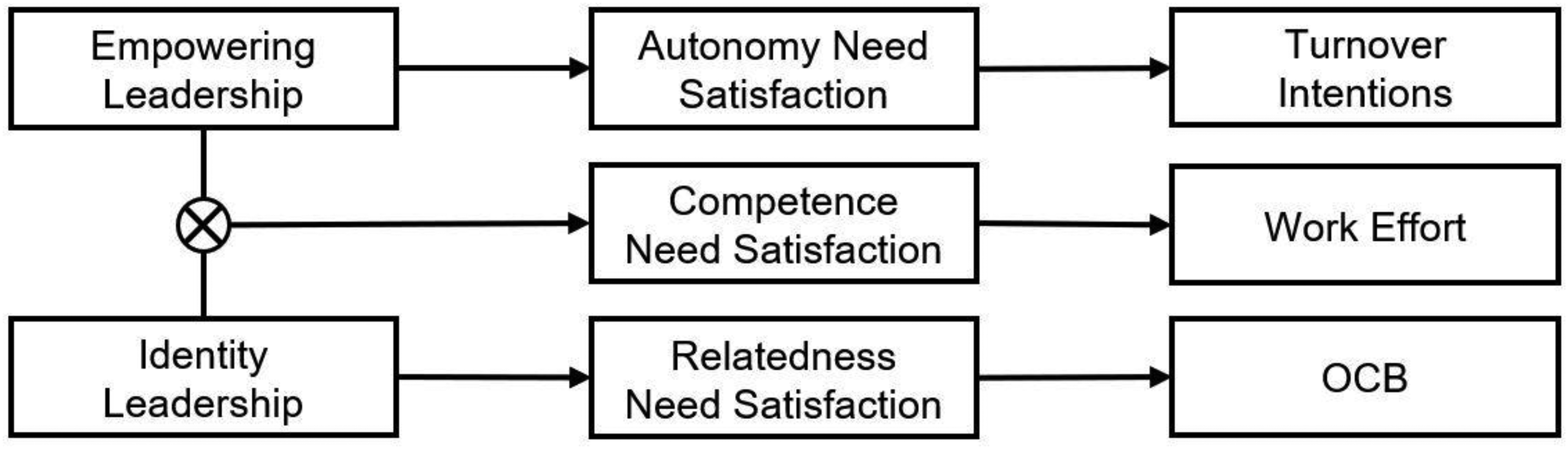
Research model.
Empowering Leadership, Identity Leadership, and Employees’ Basic Psychological Need Satisfaction
Empowering leadership comprises the individual-focused leader behaviors of sharing power with employees and supporting their autonomous decision-making (Cheong et al., 2019; Sharma & Kirkman, 2015). Empowering leaders grant freedom to employees rather than exerting control over them and promote employees’ self-management (Amundsen & Martinsen, 2014). These leader behaviors have repeatedly been found to promote beneficial processes, such as increasing employees’ motivation and fostering employees’ performance and creativity (Kim et al., 2018; Lee et al., 2018). Due to leaders’ focus on each employee's autonomy and self-direction, empowering leadership has moreover been argued to fit a changing world of work, characterized by high degrees of individualization and flattening hierarchies (Lee et al., 2018; Sharma & Kirkman, 2015). Empowering leader behaviors of delegating authority and promoting employees’ self-directed decision-making precisely match employees’ need for autonomy as defined in SDT. When employees receive important tasks from the leader and are allowed to freely decide on how to tackle these tasks, they experience autonomy and self-rule (Kirkman & Rosen, 1999; Sharma & Kirkman, 2015). We therefore hypothesize:
When leaders engage in empowering leadership, in terms of delegating authority and supporting employees’ autonomous decision-making (Kirkman & Rosen, 1999), they foster employees’ autonomy need satisfaction that may, in turn, entail beneficial consequences (Slemp et al., 2018). Research highlights that experiencing autonomy need satisfaction is particularly related to lower levels of turnover intentions (Van den Broeck et al., 2016). When employees are empowered to make self-determined decisions, they can customize parts of the work situation to individual preferences and, in turn, experience autonomy (Sharma & Kirkman, 2015). Employees can proactively adapt their work situation and reshape unsatisfactory elements, rather than developing an intention to escape the current situation by looking for another job (Marescaux et al., 2013; Van den Broeck et al., 2016). This reasoning aligns with a recent study of Stiglbauer and Penz (2025), who found that employees who experience high levels of autonomy tend to appraise work as a challenge with the opportunity for personal growth, rather than a hindrance or threat. In sum, by engaging in empowering leadership, leaders allow employees to autonomously shape their work situation, thereby satisfying employees’ need for autonomy, which in turn reduces employees’ intentions to leave their jobs. We therefore hypothesize:
In contrast to empowering leadership, identity leadership encompasses leader behaviors that are explicitly geared towards the collective. Drawing on social identity and self-categorization theory (Tajfel & Turner, 1979; Turner, 1987), identity leadership scholars argue that leaders should represent, create, advance, and embed a shared sense of “we” as a collective (Haslam et al., 2025; Steffens et al., 2014). Identity leadership comprises leader behaviors of acting as a representative of the collective (identity prototypicality), defining collective values, norms, and ideals (identity entrepreneurship), promoting the interests of the collective (identity advancement), and developing structures and activities that bring the collective together (identity impresarioship, Steffens et al., 2014; Van Dick et al., 2018). These leader behaviors have repeatedly been found to promote positive processes, such as increasing employees’ identification with a collective, and to result in beneficial consequences, such as employee well-being (Krug et al., 2021; Van Dick et al., 2018). In short, identity leadership centers on leaders’ efforts to build a collective that each employee feels attached to (Haslam et al., 2025). When employees feel attached to the collective as a whole, they also experience a stronger sense of belonging to other employees within the collective (Wann et al., 2011). As such, by fostering and maintaining a shared sense of “we” for employees, identity leaders may strengthen employees’ attachment to the collective as a whole and other employees, thereby addressing employees’ need for relatedness. We hypothesize:
Experiencing relatedness need satisfaction in response to identity leadership entails that employees are embedded in a larger collective and hold meaningful connections to colleagues (Deci et al., 2017). This experience of relatedness to others may impact how employees behave towards their colleagues and the collective as a whole. Specifically, when experiencing strong social ties, employees consider their colleagues’ benefits and the collective's welfare to be of high importance (Brewer & Gardner, 1996). They therefore tend to demonstrate collaborative and supportive behaviors, valuing their colleagues and recognizing each member's contributions to the collective's overall success (Farmer et al., 2015; Van Dick et al., 2018). Such collaborative and supportive behaviors towards colleagues and the collective are often referred to as organizational citizenship behavior (OCB, Hoffman et al., 2007). Wörtler and colleagues (2020), for example, found that employees’ relatedness need satisfaction positively relates to employees’ OCB, such as assisting colleagues with work-related problems or volunteering for extra work assignments. In sum, by engaging in identity leadership to foster employees’ attachment to a collective, leaders can foster employees’ relatedness need satisfaction, which in turn promotes employees’ engagement in OCB. We hypothesize:
While empowering leadership and identity leadership encompass very different leader behaviors, with empowering leadership stressing the individual's self-direction (Kirkman & Rosen, 1999) and identity leadership stressing the collective's connectedness (Steffens et al., 2014), both sets of leader behaviors might in fact fruitfully complement each other to address employees’ competence need satisfaction. Specifically, empowering leader behaviors of sharing power with employees and delegating authority to them may lay a foundation for employees’ competence need satisfaction. When employees are empowered and entrusted with responsibility, they may interpret this as a leader's act of showing that they have confidence in the employee's ability to succeed, making the employee feel competent (Kim & Beehr, 2017; Zhang & Bartol, 2010). However, taking on responsibility and decision-making from the leader may also overwhelm employees, especially if they feel unsupported. This may result in self-doubt, reduced confidence, and a diminished sense of competence (Cheong et al., 2016). Yet, we argue that a leader can combine empowering leadership, such as delegating responsibilities and power to each employee, with identity leadership, such as creating a strong sense of cohesion and mutual support within a group. When employees are entrusted with responsibility and, at the same time, experience security and control due to their embeddedness within a collective (Greenaway et al., 2015), they may gain confidence to tackle challenging goals and thus experience competence need satisfaction. We therefore hypothesize:
Leaders who simultaneously engage in empowering leadership and identity leadership address employees’ need for competence, as employees are entrusted with individual freedom in decision-making and, at the same time, gain security by being embedded in a collective. Experiencing competence need satisfaction entails feeling capable of reaching challenging goals and being equipped to tackle obstacles (Deci et al., 2017). Feeling competent at work may, in turn, result in positive consequences for employees and particularly boost the effort they invest at work (Van den Broeck et al., 2016). This reasoning aligns with Bandura's self-efficacy theory (1977), which holds that the expectation of personal self-efficacy determines personal effort. Employees who feel competent in their tasks at work are likely to put in more effort as they are motivated to achieve the challenging goals they know they can reach (Van Iddekinge et al., 2023). We hypothesize:
The Present Studies
We designed a scenario-based experimental study (Study 1) and a time-lagged field study (Study 2) to test our hypotheses. We opted for an experimental design to establish causality and high internal validity. We complemented this experimental study with a lagged field study involving three points of measurement to strengthen the external validity of our research. Both studies were pre-registered on AsPredicted (Study 1: https://aspredicted.org/5jwm-hy9f.pdf; Study 2: https://aspredicted.org/qdxp-s7zg.pdf) 1 .
Study 1: Method
Participants and Design
We conducted a power analysis (for details, see pre-registration link) and calculated a minimum sample size of 212 participants. We then recruited N = 227 German participants for our experimental study via university e-mail distribution lists. Participation was incentivized with 5,00 € or partial course credit. One person was excluded due to an invalid age entry. The final sample consisted of N = 226 people (178 female, 47 male, 1 other) with a mean age of 24 years (SD = 4.81). Most participants were university students (191). The experiment had a 2 (empowering leadership: low vs. high) × 2 (identity leadership: low vs. high) design.
Procedure
Participants read a scenario in which they were asked to imagine being part of a university project group, planning an event on career perspectives at their university. Four e-mails from the fictitious project group leader were designed and randomly presented to participants. The emails contained the leader's view on his role as a team leader (manipulation of empowering and identity leadership, low vs. high). After reading the scenario, participants were asked to rate the project leader's empowering and identity leadership. Next, they were asked to rate their basic psychological need satisfaction concerning their relationship with the project leader. Then, another email from the project leader was presented, inviting the participants to generate ideas for the career event 2 . After generating ideas, participants were asked to rate their intended OCB, intended work effort, and turnover intentions concerning the project group.
Empowering Leadership and Identity Leadership Manipulation
Scenarios in all four conditions were almost identical in length (210–213 words) and tone. The empowering leadership manipulation was based on scenarios from Chen and colleagues (2011). In the high empowering leadership condition, the project group leader stated that the project team members enjoy freedom in working on their tasks and that he fully trusts them. In the low empowering leadership condition, the project group leader stated that all decisions have to be approved by him and that, in his view, the students aren’t ready to work on their own yet.
The identity leadership manipulation was based on the Identity Leadership Inventory (Steffens et al., 2014) and identity leadership scenarios from Krug and colleagues (2021). In the high identity leadership condition, the project leader used collective language and invited participants to use a collaboration platform to improve cooperation. In the low identity leadership condition, the project leader used individualistic language and invited participants to discuss the issues at hand exclusively with him.
Measures
All items were answered on 5-point Likert-type scales, ranging from 1 = Strongly Disagree to 5 = Strongly Agree. If not stated differently, English items were translated into German using the back-translation method (Brislin, 1970).
Basic Psychological Need Satisfaction
Basic psychological need satisfaction was assessed using the German translation (Decker & van Quaquebeke, 2015) of the Basic Need Satisfaction in Relationship scale (La Guardia et al., 2000). The 9-item scale consists of three items for each need: autonomy (α = .86), relatedness (α = .91), and competence (α = .89). A sample item for autonomy need satisfaction is: “When dealing with my leader, I have a say in what happens and I can voice my opinion.”
Work-Related Outcomes
Turnover intentions were assessed using four items (α = .94), developed by Kelloway et al. (1999) and adapted to scenario studies by Chen et al. (2011). A sample item is “I would think about leaving this project group”. Work effort was measured using three items (α = .86) of the direction-subscale from the work effort scale (De Cooman et al., 2009), as the other subscales did not fit our scenario. The wording of the items was adapted to the scenario context to measure intended work effort. A sample item is “I would really do my best to achieve the objectives of the project group”. OCB was measured with six items (α = .84), taken from an 8-item scale, developed by Koning and van Kleef (2015). The items were developed for scenario studies, but two items were excluded, as they didn’t fit our specific scenario. A sample item is “I would voluntarily take over tasks from another member of the project group”.
Manipulation Check
To assess empowering leadership, we used the German adaptation (Kearney et al., 2019) of an 8-item scale (α = .95) from Kirkman and Rosen (1999). A sample item is “My leader shares power and responsibility with me”. To assess identity leadership, we used the German version of the 4-item identity leadership inventory short form (Steffens et al., 2014; Van Dick et al., 2018; α = .87). A sample item is: “My leader creates a sense of cohesion within the project group”.
We conducted analyses of variance tests to test our manipulations. For the empowering leadership measure, we found a significant main effect of the empowering leadership manipulation, Mhigh empowering leadership = 4.10, Mlow empowering leadership = 2.19, F(1, 222) = 385.7, p < .001, η2 = .63, and a small albeit statistically significant main effect of the identity leadership manipulation, Mhigh identity leadership = 3.26, Mlow identity leadership = 3.06, F(1, 222) = 5.88, p = .016, η2 = .01. For the identity leadership measure, we found a significant main effect of the identity leadership manipulation, Mhigh identity leadership = 3.84, Mlow identity leadership = 2.57, F(1, 222) = 141.9, p < .001, η2 = .36, and again a small albeit statistically significant main effect of the empowering leadership manipulation, Mhigh empowering leadership = 3.45, Mlow empowering leadership = 2.90, F(1, 222) = 28.79, p < .001, η2 = .07. These results provide evidence for successful manipulation of both leadership styles, as the leadership manipulations had large effects (Cohen, 1988) of η2 = .63 and η2 = .36 on the corresponding measures. Both manipulations had small, yet significant, crossover effects of η2 = .01 and η2 = .07 on the other measure. Given that we manipulated two “positive” leadership conceptualizations, these small, crossover effects seem expectable and, therefore, acceptable.
Study 1: Results
All statistical analyses were conducted in R (R Core Team, 2022). First, we ran a confirmatory factor analysis (CFA), using the Lavaan package (Rosseel, 2012), to assess the discriminant validity of our constructs. A six-factor model (autonomy need satisfaction, competence need satisfaction, relatedness need satisfaction, turnover intentions, work effort, and OCB) yielded an acceptable fit to the data (x2 (194) = 408.9; CFI = 0.94; RMSEA = 0.07; SRMR = 0.07). The six-factor model had a significantly better fit than conceivable alternative models, for example, the fit of a four-factor model in which autonomy, competence, and relatedness need satisfaction were combined as one factor (x2 (203) = 680.97; CFI = 0.87; RMSEA = 0.10; SRMR = 0.08). The results support the discriminant validity of our variables.
Hypotheses Testing
Means, standard deviations, and correlations among the study variables are presented in Table 1. In support of hypothesis 1, empowering leadership significantly and positively predicted autonomy need satisfaction (b = 1.45, SE = 0.11, ß = .67, R2 = .44, p < .001) and in support of hypothesis 3, identity leadership significantly and positively predicted relatedness need satisfaction (b = 1.11, SE = 0.13, ß = .50, R2 = .24, p < .001).
Descriptive Statistics and Correlations for Study 1 Variables.
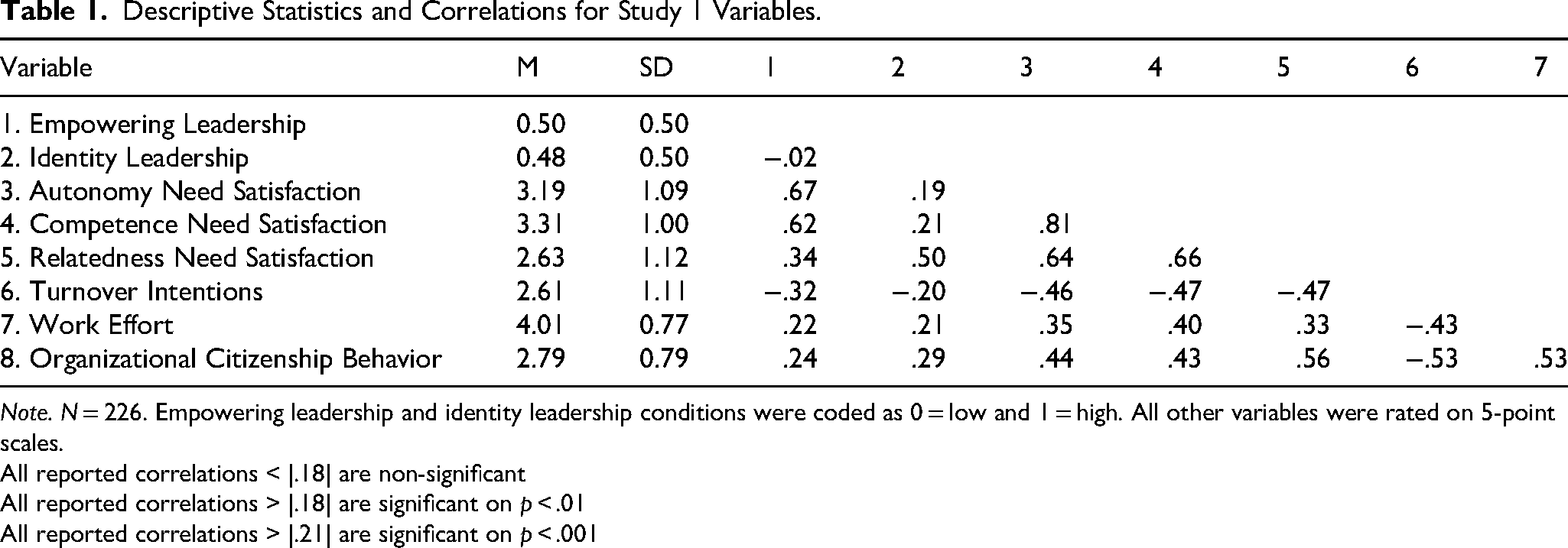
Note. N = 226. Empowering leadership and identity leadership conditions were coded as 0 = low and 1 = high. All other variables were rated on 5-point scales.
All reported correlations < |.18| are non-significant
All reported correlations > |.18| are significant on p < .01
All reported correlations > |.21| are significant on p < .001
To test hypotheses 2 and 4, mediation analyses were conducted using model 4 of the PROCESS macro for R (Hayes, 2022). In support of hypothesis 2, the indirect effect of empowering leadership on turnover intentions via autonomy need satisfaction was significant, as the bias-corrected bootstrap confidence interval did not include zero (b = −0.65, s.e. = 0.15, CI: −0.971; −0.370). In support of hypothesis 4, the indirect effect of identity leadership on OCB via relatedness need satisfaction was also significant (b = 0.43, s.e. = 0.07, CI: 0.293; 0.581) 3 .
To test hypotheses 5 and 6, model 7 of the PROCESS macro was used. In line with the approach of Kearney et al. (2019), we examined the symmetrical interaction effects of empowering leadership and identity leadership on competence need satisfaction, rather than framing one of the two as the independent variable and the other as the moderator. In support of hypothesis 5, the interaction was significant (b = 0.45, SE = 0.20, p = .028). Empowering leadership was more strongly related to competence need satisfaction when identity leadership was high (b = 1.48, SE = 0.14, p < .001), compared to low (b = 1.03, SE = 0.14, p < .001). The differences in employees’ competence need satisfaction, dependent on levels of empowering leadership and identity leadership, are illustrated in Figure 2. To test hypothesis 6, the indirect effect was estimated using bootstrapping. In support of hypothesis 6, the index of moderated mediation was significant (0.15, s.e. = 0.07), as zero was not included in the 95% bias-corrected bootstrap confidence interval (0.017; 0.286). The indirect effect of empowering leadership on work effort via competence need satisfaction was significant and more strongly positive when identity leadership was high (b = 0.49, s.e. = 0.09, CI: 0.31; 0.67), compared to low (b = 0.34, s.e. = 0.08, CI: 0.19; 0.52). Conversely, the indirect effect of identity leadership on work effort via competence need satisfaction was significant when empowering leadership was high (b = 0.19, s.e. = 0.05, CI: 0.10; 0.29) and non-significant when empowering leadership was low (b = 0.06, s.e. = 0.05, CI: −0.02; 0.15). These results are presented in Table 2.
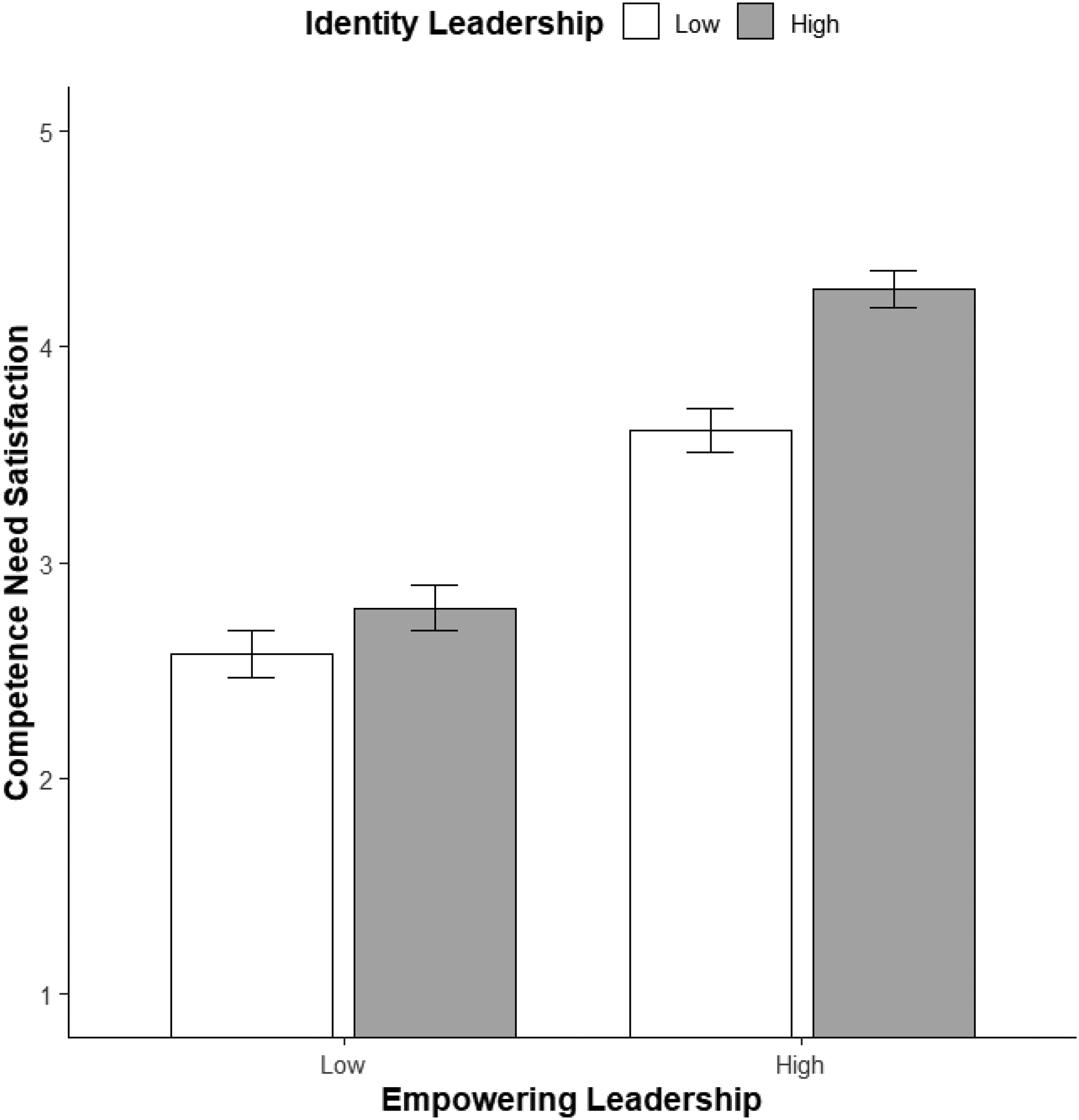
Bar chart of employees’ competence need satisfaction dependent on levels of empowering leadership and identity leadership (study 1).
Direct and Indirect Effects of Empowering Leadership (EL) and Identity Leadership (IL) on Work Effort (Study 1).
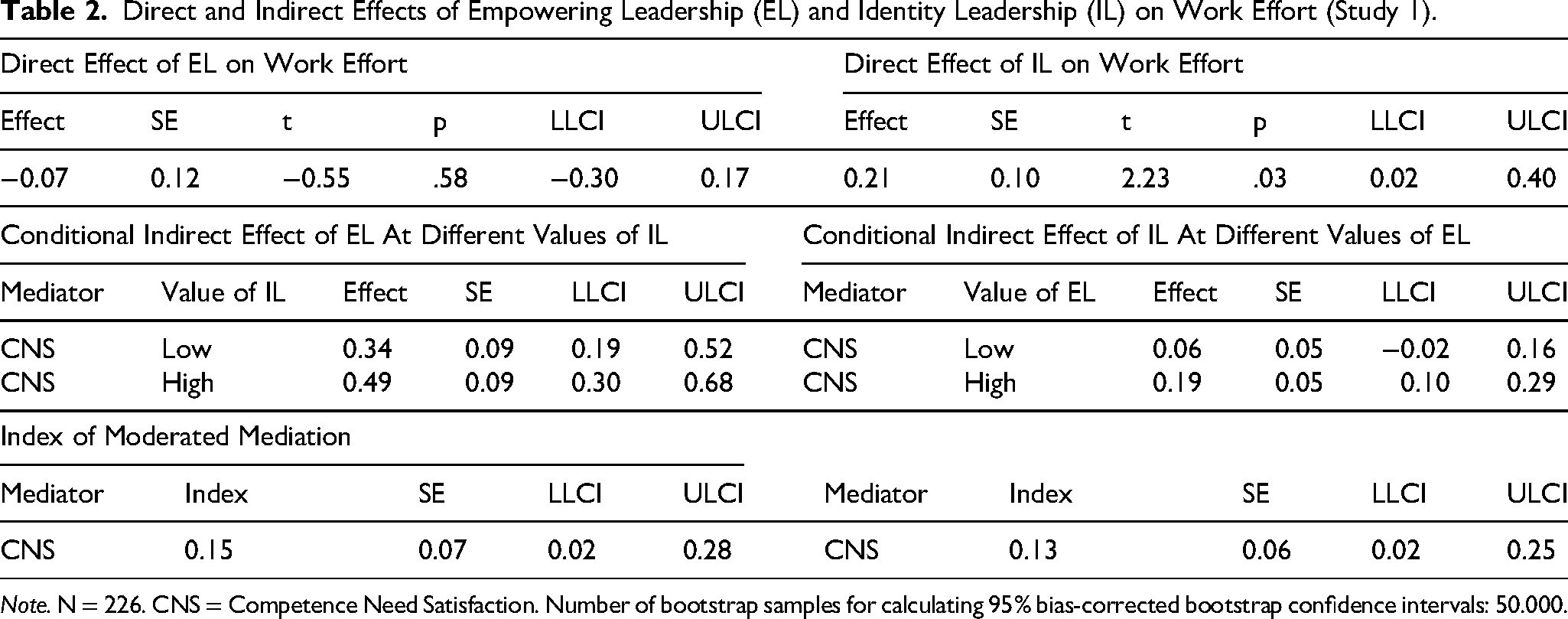
Note. N = 226. CNS = Competence Need Satisfaction. Number of bootstrap samples for calculating 95% bias-corrected bootstrap confidence intervals: 50.000.
Study 1: Discussion
The results of Study 1 support our argument that empowering leadership, identity leadership, and their interaction effectively address employees’ basic psychological needs for autonomy, relatedness, and competence, leading to specific work-related outcomes. A strength of Study 1 lies in its experimental design, which, through random assignment, supports strong internal validity and allows for causal inference. This is particularly noteworthy in leadership research, where study designs often preclude clear causal conclusions (cf. Podsakoff & Podsakoff, 2019). By experimentally manipulating empowering and identity leadership, Study 1 provides a strong test of the causal hypotheses we derived from our theoretical model. Moreover, consistent with Locke's (1986) argument that generalizability depends on correctly specified causal mechanisms rather than the research setting, the psychological processes examined here can be expected to operate across contexts. Nevertheless, Study 1 also has limitations. Since the sample primarily consisted of students, the external validity of the findings for organizational settings remains to be established. Although we expect that the underlying mechanisms are specified correctly and should, therefore, extend to organizational contexts (Locke, 1986), research is needed to substantiate these effects empirically in field settings. Moreover, we used fictitious scenarios to manipulate empowering and identity leadership. This means we manipulated the description of leader behavior rather than actual leader behavior. Consequently, within the logic of these scenarios, we measured participants’ intentions to engage in specific behaviors rather than actual behaviors. To address these limitations, we conducted a field study with a sample of working employees.
Study 2: Method
Participants and Procedure
As in Study 1, we conducted a power analysis (for details, see pre-registration link) and calculated a minimum sample size of 212 participants. We recruited 406 participants for a three-wave field study with two weeks between measurement time points via Prolific. Empowering and identity leadership were assessed at Time 1, basic psychological need satisfaction was assessed at Time 2, and turnover intentions, work effort, and OCB were assessed at Time 3. Participants were English-speaking, located in the UK, and reported to work full-time, to have a direct supervisor, and to work in a team. Participants were paid based on an hourly rate of £6.00 and got a bonus compensation of £1.60 for participating in all three surveys. Attrition between measurement time points was low (12%), resulting in a final sample of 315 employees, who participated in all three surveys (Time 1: 406, Time 2: 349, Time 3: 315). We included one attention check item at each measurement point to identify and exclude careless responses, resulting in the removal of seven participants and a final sample of 308 employees (144 female, 162 male, and 2 other). Participants’ average age was 35.7 years (SD = 9.5); they had worked on average 6.1 years (SD = 6.0) in their current job and 3.2 years (SD = 3.4) with their current direct supervisor. With regard to their highest educational qualification, 207 of the 315 participants reported having a university degree.
Measures
As in Study 1, all items were answered on 5-point Likert-type scales, ranging from 1 = Strongly Disagree to 5 = Strongly Agree.
Empowering Leadership
Empowering leadership was assessed using the same eight items from Kirkman and Rosen (1999) that were used as a manipulation check measure in Study 1 (α = .90).
Identity Leadership
Identity leadership was assessed using the 15-item Identity Leadership Inventory (ILI, Steffens et al., 2014). The ILI assesses four dimensions of identity leadership: identity prototypicality, identity advancement, identity entrepreneurship, and identity impresarioship, which were aggregated to an overall score (α = .97).
Basic Psychological Need Satisfaction
Basic psychological need satisfaction was assessed using the same 9-item scale as in Study 1 (La Guardia et al., 2000; autonomy α = .74; competence α = .81; relatedness α = .84)
Work-Related Outcomes
Turnover intentions (α = .93), work effort (α = .82), and OCB (α = .59) were assessed using the same items as in Study 1. For turnover intentions and work effort, we used the original items from Kelloway and colleagues (1999) and De Cooman and colleagues (2009), which we adapted to scenarios in Study 1. OCB items (Koning & van Kleef, 2015) were adapted for the field study, as they were originally developed for scenario studies.
Study 2: Results
As in Study 1, all statistical analyses were conducted in R (R Core Team, 2022). Using the Lavaan package (Rosseel, 2012), we ran a confirmatory factor analysis (CFA) to assess the discriminant validity of our constructs. An eight-factor model (empowering leadership, identity leadership, autonomy need satisfaction, competence need satisfaction, relatedness need satisfaction, turnover intentions, work effort, and OCB) was compared to a seven-factor model, with only one aggregated leadership factor (empowering leadership and identity leadership). The eight-factor model yielded a significantly better fit to the data (x2 (917) = 1809.9; CFI = 0.91; RMSEA = 0.06; SRMR = 0.05) than the seven-factor model (x2 (925) = 2355.8; CFI = 0.86; RMSEA = 0.07; SRMR = 0.07) and conceivable alternative models. These results support the discriminant validity of our variables.
Hypotheses Testing
To test our hypotheses, the same statistical analyses as in Study 1 were conducted. Means, standard deviations, and correlations among the study variables are presented in Table 3. In support of hypotheses 1 and 3, empowering leadership significantly and positively predicted autonomy need satisfaction (b = .69, SE = .05, ß = .63, R2 = .40, p < .001) and identity leadership significantly and positively predicted relatedness need satisfaction (b = .54, SE = .05, ß = .55, R2 = .30, p < .001).
Descriptive Statistics and Correlations for Study 2 Variables.
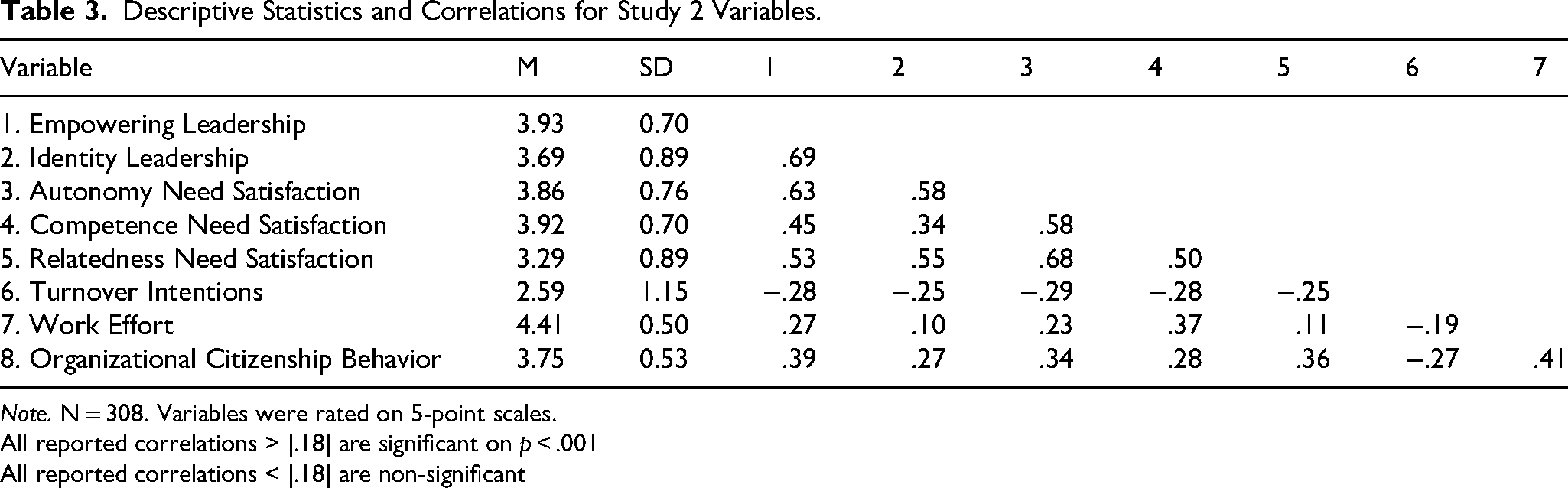
Note. N = 308. Variables were rated on 5-point scales.
All reported correlations > |.18| are significant on p < .001
All reported correlations < |.18| are non-significant
In support of hypothesis 2, the proposed indirect effect of empowering leadership on turnover intentions mediated by autonomy need satisfaction was significant, as the bias-corrected bootstrap confidence interval did not include zero (b = −0.20, s.e. = 0.08, CI: −0.353; −0.053). In support of hypothesis 4, the proposed indirect effect of identity leadership on OCB mediated by relatedness need satisfaction was also significant, as the bias-corrected bootstrap confidence interval did not include zero (b = 0.10, s.e. = 0.02, CI: 0.056; 0.146) 4 .
Checking the preconditions for conducting a moderated mediation analysis with PROCESS model 7 revealed heteroskedasticity in the data. Hence, we ran the analysis with robust standard errors (Long & Ervin, 2000). Moreover, we mean-centered predictor variables before the analysis to improve interpretability (Aiken & West, 1991). Hypothesis 5 was not supported as the interactive effect of empowering leadership and identity leadership on competence need satisfaction was non-significant (b = 0.10, SE = 0.07, p = .167) 5 . Accordingly, hypothesis 6 was not supported. The index of moderated mediation was non-significant (0.02, s.e. = 0.02), as zero was included in the 95% bias-corrected bootstrap confidence interval (−0.006; 0.060).
Additional Explorative Analyses
Since empowering leadership strongly predicted competence need satisfaction in the moderated mediation analysis, and no interactive effect of empowering leadership and identity leadership on competence need satisfaction was found, we decided to test whether empowering leadership alone addresses employees’ work effort via competence need satisfaction. A mediation analysis was conducted, using model 4 of the PROCESS macro for R (Hayes, 2022). The proposed indirect effect of empowering leadership on work effort mediated by competence need satisfaction was significant, as the bias-corrected bootstrap confidence interval did not include zero (b = 0.10, s.e. = 0.02, CI: 0.054; 0.148).
Study 2: Discussion
The aim of Study 2 was to confirm the findings from Study 1 in a field setting with a sample of working employees. The results largely support our argument that empowering leadership and identity leadership address employees’ basic psychological needs for autonomy, relatedness, and competence, leading to specific work-related outcomes. However, contrary to hypothesis 5, we could not observe an interactive effect of empowering and identity leadership on competence need satisfaction. Consequently, we were unable to test or confirm the corresponding indirect effect on work effort. Notably, empowering leadership emerged as an independent predictor of competence need satisfaction. An additional explorative mediation analysis revealed an indirect effect of empowering leadership on work effort, mediated by competence need satisfaction. These findings suggest a potential refinement of the model, with empowering leadership positioned as the primary predictor of competence need satisfaction rather than its interaction with identity leadership.
General Discussion
Building on the leadership challenge of addressing employees as both individuals and members of a collective (Batool et al., 2023; Wu et al., 2010), we applied self-determination theory (Deci & Ryan, 1985, 2000) to demonstrate that a combination of empowering leadership (Kirkman & Rosen, 1999) and identity leadership (Steffens et al., 2014) addresses employees’ basic psychological needs for autonomy, relatedness, and competence, leading to positive work-related outcomes. Specifically, empowering leadership, encompassing behaviors of sharing power and delegating authority, enhanced employees’ autonomy need satisfaction, which in turn reduced turnover intentions. Identity leadership, encompassing the use of collective language and emphasizing team cohesion, increased employees’ relatedness need satisfaction, which subsequently boosted organizational citizenship behavior (OCB). The findings regarding competence need satisfaction were less consistent. In the experimental scenario study, empowering and identity leadership interacted to predict competence need satisfaction, which led to increased work effort. By contrast, the field study found no interactive effect. Instead, empowering leadership alone predicted competence need satisfaction, which increased work effort.
Theoretical Implications
Although scholars have long emphasized exploring the interplay of individual- and collective-focused leadership, research examining this interplay remains limited. Much of the existing work relies on a few leadership conceptualizations and largely ignores employees’ needs (Dong et al., 2017; Wang & Howell, 2010). Our multi-method investigation of empowering and identity leadership sought to broaden research on individual- and collective-focused leadership by making three key contributions to the leadership literature.
First, we contribute to the leadership literature by adopting a taxonomic approach (Eva et al., 2025) that organizes leader behaviors by their primary focus on either the individual or the collective. By investigating empowering and identity leadership as representatives of the individual- and collective-focused leadership categories, we present one way of systematically bringing together different leadership conceptualizations, thereby addressing long-standing criticism of independently evolving research streams and a lack of theoretical integration and connection in the leadership literature (Gardner et al., 2020; Kearney et al., 2019; Van Knippenberg & Dwertmann, 2022). In line with this, we specifically advance research on individual- and collective-focused leadership that has so far almost exclusively relied on the concept of dual-focused transformational leadership (Dong et al., 2017; Wang & Howell, 2010). Our taxonomic leadership approach may be seen as one step in moving leadership research away from various standalone constructs that lack empirical distinctiveness and instead focus on leader behavior categories that allow integration and systematization (Eva et al., 2025).
Second, by applying SDT (Deci & Ryan, 1985, 2000), we offer a fresh perspective on the interplay of individual- and collective-focused leadership, highlighting the role of employees’ basic psychological needs. We demonstrate that a combination of the individual-focused leader behaviors of empowering leadership and the collective-focused leader behaviors of identity leadership addresses employees’ basic psychological needs, thereby highlighting that collective-focused leader behaviors not only affect team processes but also address each employee's need for relatedness individually. Leaders may profit from bearing in mind that employees not only need to experience individual autonomy at work, but also strive in environments that provide them with meaningful connections to others and a sense of belonging to a collective (Deci et al., 2017). In short, our research outlines that thinking about each individual involves thinking about their relatedness to others. Only by complementing individual-focused behaviors with collective-focused behaviors can leaders comprehensively address employees’ three basic psychological needs, resulting in multiple beneficial consequences.
Third, by investigating the interactive effect of empowering and identity leadership on employees’ competence need satisfaction, we answer previous calls for a stronger consideration of interactive elements in leadership research to better understand the complex dynamics of leadership (Van Knippenberg & Dwertmann, 2022). Our findings reveal that empowering and identity leadership bear the potential to complement each other in a way that extends beyond their individual effects. An investigation of interactive leadership effects may, therefore, better capture the complexity of actual leadership dynamics compared to an investigation of standalone leadership conceptualizations (Van Knippenberg & Dwertmann, 2022). However, as we only find the interactive effect in the experimental study, but not in the field study, the findings should be interpreted with caution.
A closer examination of the inconsistent findings suggests that the study designs and, accordingly, the context of the studies may have impacted results. In the experimental setting of Study 1, participants had to imagine being part of a project group. Therefore, they completely relied on the presented study materials (i.e., information about their project group leader's collective-focused behaviors) to create a mental picture of the project group's collaboration and cohesion. This information may have strongly impacted employees’ competence need satisfaction, as high levels of identity leadership can provide a sense of social security within a collective, equipping employees to tackle challenging tasks and making them feel competent (Fransen et al., 2020). In the field setting of Study 2, however, employees were embedded in natural work environments. In such environments, collegial relationships and felt ties towards a collective may arise beyond the leader's efforts to create and maintain a shared social identity (i.e., by engaging in identity leadership). These naturally developing relationships and ties may provide employees with a sense of security and, as such, contribute to employees’ competence need satisfaction (Ferris et al., 2009). In field settings, identity leadership may thus have a less pronounced impact on employees’ competence need satisfaction.
Instead, empowering leadership predicted employees’ competence need satisfaction across both studies, suggesting that empowering leadership may generally play a more central role in addressing employees’ need for competence than identity leadership. This interpretation aligns with previous findings linking empowering leadership to psychological empowerment (Amundsen & Martinsen, 2015; Schermuly et al., 2022; Zhang & Bartol, 2010), a construct that includes competence as a core component (Spreitzer, 1995). Leaders’ acts of sharing power and granting decision-making autonomy may signal trust and confidence in employees’ abilities (Lee et al., 2018), fostering their competence need satisfaction. However, as an interactive effect of empowering and identity leadership was found in the experimental study, future research is needed to explore how identity leadership complements naturally forming workplace groups and relationships in addressing employees’ need for competence. Potential avenues for future research are discussed below.
Practical Implications
Our findings hold strong practical relevance for leaders navigating the complexities of a rapidly developing world of work (Schwarzmüller et al., 2018). As modern organizations increasingly adopt autonomous working models alongside interdependent teamwork structures (Mathieu et al., 2019; Parker & Grote, 2022), leaders must adeptly blend individual- and collective-focused behaviors (Batool et al., 2023; Wu et al., 2010). One effective way to achieve this is by integrating empowering leadership (Kirkman & Rosen, 1999) and identity leadership (Steffens et al., 2014).
To support leaders’ engagement in these complementary behaviors, organizations can provide targeted, hands-on leadership training programs (Lacerenza et al., 2017). These programs should emphasize the importance of individual- and collective-focused leadership while offering practical guidance on behaviors associated with empowering and identity leadership. For instance, Haslam and colleagues (2017, 2023) developed the 5R Identity Leadership Development Program, which includes learning modules, team exercises, and reflection workshops to help leaders cultivate a shared team identity. Integrating components of such an identity-based training with existing empowering leadership training programs (e.g., Cougot et al., 2022; Martin et al., 2013) would offer leaders a comprehensive approach to improving both skill sets. Connected by the overarching challenge of engaging in individual- and collective-focused behaviors, trainings on empowering and identity leadership may also be integrated with existing training programs, for example, those based on dual-focused transformational leadership (Dong et al., 2017; Wang & Howell, 2010). Such an approach may help managers understand the connections between different leadership conceptualizations and offer a starting point for critical discussions on how to integrate various leader behaviors. Leaders may, for example, discuss how they can formulate a vision for their team (i.e., transformational leadership; Wang & Howell, 2010) and simultaneously build structures that allow their employees to jointly gather under this shared vision (i.e., identity leadership; Steffens et al., 2014).
Moreover, our research underscores the critical role of fulfilling employees’ basic psychological needs for autonomy, relatedness, and competence in the leadership process (Chiniara & Bentein, 2016; Deci et al., 2017). By prioritizing these needs, leaders can positively influence employees’ work-related intentions and behaviors, ultimately benefiting the entire organization (Deci et al., 2017). Given that the three basic psychological needs are fundamental drivers of employees’ motivation and well-being (Deci et al., 2017), we recommend formally establishing autonomy, relatedness, and competence need satisfaction as explicit leadership objectives (cf. Chiniara & Bentein, 2016). Such a structured approach would guide leaders in selecting effective behaviors and also generate beneficial outcomes for employees, leaders, and organizations alike.
Strengths, Limitations, and Future Directions
Like any empirical research, our work has its limitations and offers multiple avenues for further research. The following three limitations deserve attention and suggest avenues for future research. First, our research model does not account for contextual factors that may shape how empowering and identity leadership address employees’ basic psychological needs (cf. Johns, 2024). However, contextual factors, such as job and task characteristics, may impact employees’ reactions to leader behaviors (Oc, 2018). To specify, we conducted a field study with a broad, UK-based sample, recruited via Prolific. While high data quality of Prolific samples has been documented in the past (e.g., Peer et al., 2022), sample characteristics may slightly differ from conventionally recruited samples. To illustrate, our sample consisted of above-average educated participants who, despite their full-time employment, promptly participated in our surveys at each measuring time point. As such, employees presumably experience high levels of autonomy and low levels of interdependencies in their work, allowing them to assess the survey platform during working hours. These job characteristics of the sample may have impacted the results of the field study, as job characteristics, along with leader behaviors, impact employees’ basic psychological need satisfaction (van den Broeck et al., 2016). In high-autonomy and low-interdependence jobs, employees’ experience of competence need satisfaction may largely stem from a leader's empowerment of the employee. Individual-focused empowering leadership signals trust in the employee's work-related capabilities, and no collaboration is needed to be successful in the fulfillment of tasks, making the employee feel competent. By contrast, in low-autonomy and high-interdependence jobs, employees’ experience of competence need satisfaction may more strongly stem from a leader's creation and maintenance of a shared sense of “we”. Collective-focused identity leadership signals connectedness among employees, providing employees with a sense of security and mutual reliability that equips them to jointly succeed in task performance, making them feel competent. By investigating how job characteristics impact the influence of leader behaviors on employees’ basic psychological need satisfaction, future studies may take a first step towards a stronger consideration of context in leadership research (Johns, 2024). Such investigations may, in turn, be expanded with further context consideration, for example, by investigating how national and cultural differences influence leadership effects (Oc, 2018). Particularly, cultural differences in individualism-collectivism may be intertwined with different reactions to and preferences for individual- and collective-focused leadership (Den Hartog & De Hoogh, 2024), offering a promising avenue for future research.
Second, the experimental as well as the field study have some methodological limitations that may be addressed in future studies. In the experimental study, we observed a strong correlation between autonomy and competence need satisfaction that likely reflects the scenario-based leadership manipulation. Empowering leadership encompasses multiple leader behaviors, such as delegating responsibilities and expressing trust, which were manipulated jointly in the experimental scenario. This en bloc manipulation may have led employees to infer autonomy and competence need satisfaction from the same leadership cues, resulting in a stronger association between the two needs. By contrast, in real work settings, empowering leader behaviors can be enacted separately and vary across situations, allowing employees to differentiate more clearly between autonomy- and competence-related experiences. This greater differentiation may account for the lower correlation observed in the field study.
Moreover, scenarios bear the risk of appearing artificial to participants. We selected a realistic, career-related context relevant to our primarily student sample to reduce this risk. Furthermore, scenarios are commonly used in recent leadership research, and findings from scenario-based studies often align with those from field studies (e.g., Chen et al., 2011; Dennerlein & Kirkman, 2022). To broaden methodological approaches, future studies could investigate empowering and identity leadership effects using alternative experimental or quasi-experimental designs (Podsakoff & Podsakoff, 2019; Wulff et al., 2023). The field study helped enhance the external validity of our conclusions, but it relies solely on participants’ self-reports, which can introduce common-method bias (Podsakoff et al., 2003). While we used a time-lagged design that reflects the temporal order of our hypotheses to mitigate this risk (cf. Dennerlein & Kirkman, 2022), future research could incorporate additional data sources, such as supervisor or team member ratings of work effort and OCB or objective measures like turnover data, to rule out common-method bias.
Third, recent critiques of leadership research have highlighted challenges in both conceptualizing leadership and measuring leader behaviors (Carton, 2022; Fischer & Sitkin, 2023). While our study utilized two narrowly defined leadership conceptualizations with clear leadership objectives (Kirkman & Rosen, 1999; Steffens et al., 2014), we recognize that our approach might still be seen as encompassing more than just behavioral aspects of leadership. Future research should continue scrutinizing leadership constructs and focus on developing clearer, more distinct measures of leader behaviors (Eva et al., 2025).
Conclusion
Our research highlights that addressing employees both as individuals and as members of a collective is a central leadership challenge, especially in the context of a rapidly evolving world of work. Drawing on self-determination theory (Deci & Ryan, 1985, 2000), we demonstrate that leaders who engage in the individual-focused behaviors of empowering leadership and the collective-focused behaviors of identity leadership effectively satisfy employees’ needs for autonomy, relatedness, and competence. In turn, the fulfillment of these psychological needs fosters a range of positive work-related outcomes. By adopting an integrative perspective on individual- and collective-focused leadership, we underscore the value of examining distinct leader behaviors in the same research, contributing to a more nuanced and dynamic understanding of leadership processes and offering valuable insights for leadership theory and practice. Ultimately, our work emphasizes the critical role of integrative leadership strategies in addressing employees’ diverse psychological needs and promoting their well-being and performance in modern organizational contexts.
Footnotes

Ethical Approval and Informed Consent Statements
The study was conducted in accordance with the Declaration of Helsinki, and all participants provided written informed consent prior to participating. As data collection and processing were completely anonymized and studies did not involve any deception or cause any distress to participants, study approval by a review board was not required at our institution.
Funding
The authors received no financial support for the research, authorship, and/or publication of this article.
Declaration of Conflicting Interests
The authors declared no potential conflicts of interest with respect to the research, authorship, and/or publication of this article.
Data Availability Statement
The datasets generated and analyzed during the current study are available from the corresponding author on reasonable request.