




Abstract
Voice, defined as employees’ expression of ideas with an intention to improve team or organizational functioning, is often directed to their immediate leader. This makes the quality of the leader-member relationship—conceptualized as leader-member exchange (LMX)—a key predictor of voice. However, research has largely overlooked the fact that the influence of one's LMX is also shaped by the LMX relationships that others have with the same leader. Drawing on the social identity perspective, we propose two ways in which the LMX of others can shape the LMX-voice relationship: (a) LMX similarity (i.e., similar LMX quality between the focal employee and team members) emphasizes a shared collective identity, thereby motivating voice; and (b) LMX positive dissimilarity (i.e., having a better LMX relationship than others) highlights a unique relational identity with the leader, which may also motivate voice. We further argue that leader group prototypicality—the extent to which the leader is seen as embodying the team's collective identity—moderates which of these dynamics is more salient in predicting voice. These interactive effects are expected to be more pronounced for prohibitive voice (suggestions to discontinue a practice) than for promotive voice (suggestions to improve work practices), as the former entails greater social risk and thus depends more heavily on social identity considerations. Using multilevel polynomial regression and response surface analyses on field data of 321 leader-member dyads nested in 47 teams, we found support for most of our predictions.
Voice, employee expression of constructive suggestions and concerns related to work (Van Dyne et al., 2003), is conducive to improving collective functioning (Argyris & Schön, 1996; Detert et al., 2013; Edmondson, 1999). Voice is typically targeted at a focal employee's direct superior (team leader, supervisor, manager), because the leader is better positioned to act upon raised issues to effectuate the desired change (Burris, 2012; Burris et al., 2008; Detert et al., 2013). Such upward voice entails social risk, as it challenges the status quo (Van Dyne & LePine, 1998) as well as the people responsible for the issues (Morrison & Milliken, 2000). Consequently, leaders may respond negatively to employee voice (Burris, 2012). Hence, before speaking up, employees tend to “read the wind” to probe whether it is appropriate to voice within their relationship with the leader. In recognition of this, research has identified leader-member exchange (LMX), the quality of the relationship between leader and employee (Graen & Uhl-Bien, 1995; Sparrowe & Liden, 1997), as an important influence on voice—the higher LMX, the more individuals display voice (e.g., Burris et al., 2008; Chamberlin et al., 2017; Van Dyne et al., 2008).
However, most LMX studies examined an employee's LMX in isolation without accounting for the LMX relationships of other employees, which may shape how people see the value of their own LMX relationship (Henderson et al., 2009). To address this issue, LMX scholars introduced the concept of relative LMX (RLMX), defined as an individual's LMX compared to the LMX of other team members with the same leader (Henderson et al., 2008; Hu & Liden, 2013; Tse et al., 2013; Vidyarthi et al., 2010). This line of research has shown that higher RLMX—where an employee's LMX (LMX self) is better than coworkers’ LMXs (LMX others)—can positively influence work outcomes (Hu & Liden, 2013; Tse et al., 2013; Vidyarthi et al., 2010). This highlights the differentiated nature of relationships that leaders often develop with different employees and the influence of positively (as compared with negatively) distinguishing oneself from peers in terms of one's relationship with the leader (i.e., LMX positive dissimilarity). In counterpoint to this, research at the team level of analysis has also highlighted the downside of LMX differentiation (i.e., LMX dissimilarity at the team level) and shown that lower LMX differentiation—higher LMX similarity within the team is a positive influence (van Knippenberg & Dwertmann, 2022). For example, Nishii and Mayer (2009) found that lower LMX differentiation promotes inclusion within diverse teams. This suggests that both LMX similarity and LMX positive dissimilarity can motivate employee voice. Because LMX similarity and LMX positive dissimilarity cannot occur simultaneously, however, this raises the question when the one or the other is a stronger influence on voice.
To address this question, we draw on the social identity theory of leadership (Hogg, 2001; Steffens et al., 2021; van Knippenberg et al., 2004; van Knippenberg & Hogg, 2003). In line with the social identity perspective more broadly, the social identity theory of leadership holds that social identity manifests in two forms: collective identity, self-definition rooted in group membership and similarity to other group members, and relational identity, self-definition rooted in interpersonal relationships (Brewer & Gardner, 1996; Hogg et al., 2012; Sluss & Ashforth, 2007). We propose that when LMX similarity is high, it highlights the team's collective identity, motivating employee voice to contribute to the team. Conversely, when LMX positive dissimilarity is high, it highlights relational identity derived from a favorable leader-employee relationship, motivating employee voice as a way to contribute to the leader-member relationship. Thus, the question to address is when the one or the other is a stronger influence on voice.
To answer this question, we draw on the core concept in the social identity theory of leadership: leader group prototypicality. Leader group prototypicality refers to the extent to which a leader is perceived as embodying the shared group identity—that is, as being representative of the group prototype, or individuals’ mental representation of what defines the group (Hogg, 2001; van Knippenberg et al., 2024). We argue that the alignment between the social identity associated with LMX similarity or LMX positive dissimilarity on the one hand and leader group prototypicality on the other hand motivates voice, because it reduces the perceived social risk of voicing. We propose that people are more comfortable contributing to the collective the more the leader is perceived as embodying the collective, and that people are more comfortable contributing to their relationship with the leader the more the leader is perceived in terms of the interpersonal leader-follower relationship. Because LMX similarity is assumed to stimulate voice from collective identity motivation, we expect this relationship to be stronger the more the leader is perceived to embody that collective identity—with higher leader group prototypicality. LMX positive dissimilarity, in contrast, is assumed to invite voice from relational identity motivation. Accordingly, we expect this relationship to be stronger with lower leader group prototypicality, because this is more consistent with a leader-follower relationship distinct from the group.
We put the implications of this logic to a further test in the prediction that the interactive effect of LMX similarity or LMX positive dissimilarity and leader group prototypicality (as per the above) is stronger for prohibitive voice than for promotive voice because prohibitive voice is associated with greater social risk. Prohibitive voice, expression of concerns and worries to prevent potential organizational failure, is more easily perceived as negative by voice recipients (i.e., leaders) than promotive voice, expression of suggestions to improve work procedures and practice (Kakkar et al., 2016; Liang et al., 2012; Lin & Johnson, 2015; Wei et al., 2015). Prohibitive voice therefore entails more social risks (Liang et al., 2012). Accordingly, we can substantiate our rationale for the effect of the alignment of individuals’ LMX relative to LMX of others and leader group prototypicality by testing the proposition that this effect is stronger for prohibitive voice than for promotive voice.
Our study contributes to the literature in two ways. First, our study integrates the streams of research on relative LMX and LMX differentiation (i.e., LMX similarity in the terminology we propose). When these streams of research are considered in combination, they point to a need for integration. On the one hand, LMX positive dissimilarity (cf. lower LMX similarity) shows positive influences (e.g., Hu & Liden, 2013; Tse et al., 2013; Vidyarthi et al., 2010). On the other hand, LMX similarity (cf. lower LMX dissimilarity) shows positive influences too (Nishii & Mayer, 2009; van Knippenberg & Dwertmann, 2022). Our study integrates these two perspectives through the role of leader group prototypicality in moderating the influence of LMX positive dissimilarity and LMX similarity on employee voice.
Second, our research contributes to the voice literature by highlighting the differential psychological thresholds associated with prohibitive voice versus promotive voice. Our analysis of the moderated influence of LMX positive dissimilarity and LMX similarity centers on the social risk associated with voice as this is assumed to be impacted by the interplay between one's own LMX relative to others’ LMX and leader group prototypicality. Recognizing that prohibitive voice carries greater social risk than promotive voice allows us not only to develop this leadership analysis further, but also to contribute to the voice literature by showing that relational dynamics that can be understood to reflect the social risk associated with voice exert stronger influences on prohibitive voice than on promotive voice.
Theory and Hypotheses
Teams benefit from employees’ willingness to speak up, both by offering suggestions for improving work practices (promotive voice) and by raising concerns to help prevent potential problems (prohibitive voice) (Liang et al., 2012). Among the possible targets of voice, leader-directed voice is particularly important, as leaders occupy positions of authority that enable them to act upon change-oriented input (Detert et al., 2013; Detert & Burris, 2007; Tröster & van Knippenberg, 2012). However, directing voice toward leaders also entails social risk. Because voice inherently challenges the status quo (Morrison, 2011; Van Dyne & LePine, 1998), it can be interpreted as an attempt to undermine the leader's credibility (Liang et al., 2012; Tepper et al., 2004), especially given leaders’ capacity to reward or punish the voicer (Burris et al., 2008; Detert & Burris, 2007; Park et al., 2022). Thus, for employees to speak up, they must not only feel motivated to contribute to the team or organization but also perceive that the social risk of voicing is manageable (Morrison, 2011, 2014; Sherf et al., 2021). From this perspective, LMX has been identified as an important antecedent of leader-directed voice (Burris et al., 2008; Liu et al., 2013; Van Dyne et al., 2008). High-quality LMX relationships fuel voice in two ways: they motivate employees to reciprocate the leader's favorable treatment through extra-role behavior, and they reduce the perceived social risk associated with speaking up (Van Dyne et al., 2008).
These insights into the role of LMX in stimulating voice are valuable. However, they are limited by the reality that most LMX studies have not accounted for the fact that a given LMX relationship exists alongside others’ LMX relationships that the leader maintains with coworkers (Graen & Uhl-Bien, 1995; Hooper & Martin, 2008; Liu et al., 2013; Sparrowe & Liden, 1997; Vidyarthi et al., 2010). Research on RLMX addresses this by showing that the effects of LMX are shaped not only by one's own relationship with the leader, but also by how that relationship compares to those of peers reporting to the same leader. This body of work demonstrates that LMX positive dissimilarity—having a better relationship with the leader than one's coworkers—can motivate a range of outcomes (Henderson et al., 2008, 2009; Hu & Liden, 2013; Martin et al., 2018; Tse et al., 2012, 2013; Vidyarthi et al., 2010), including voice (Zhao, 2014). These findings suggest that it is not simply the existence of a high-quality relationship with the leader that drives extra-role behavior such as voice, but rather the comparative advantage of that relationship relative to others.
This emphasis on relative standing aligns with the foundational principle of LMX theory that leaders form different quality relationships with different members of their team (Dansereau et al., 1975; Graen & Uhl-Bien, 1995). Despite this foundational idea, most empirical LMX studies examine only the focal member's LMX, offering a limited view of the relational dynamics at play. Even studies of RLMX tend to focus primarily on the contrast between positive and negative dissimilarity, assuming that one must either be better or worse off than others (or at least not testing the curvilinear relationship that could identify LMX similarity as the optimal point). However, team-level research on LMX differentiation has shown that LMX similarity is also a common and meaningful configuration (Nishii & Mayer, 2009; van Knippenberg & Dwertmann, 2022). While this line of research has typically examined team-level outcomes and not individual-level voice, it underscores that negative dissimilarity is not the only alternative to positive dissimilarity. Employees may also experience similar quality relationships with the leader, and this similarity may carry its own motivational significance. This recognition that LMX research has not engaged with the potential differential influence of LMX similarity and LMX positive dissimilarity was the departure point for the current study. We sought to move beyond the dominant focus on LMX dissimilarity and explore the motivational implications of LMX similarity as well. Specifically, we developed and tested a framework in which not only LMX positive dissimilarity but also LMX similarity can encourage voice behavior—depending on the conditions under which each is more likely to do so.
LMX Positive Dissimilarity, LMX Similarity, and Voice
Traditional LMX theory has long emphasized the notion of LMX differentiation—the idea that leaders form relationships of varying quality with different team members (Dansereau et al., 1975; Graen & Uhl-Bien, 1995). While much of this emphasis has been theoretical rather than empirical, it has led to the expectation that LMX positive dissimilarity—having a better relationship with the leader than one's peers—may be more conducive to upward voice than negative dissimilarity (Henderson et al., 2008; Hu & Liden, 2013). This idea aligns with research suggesting that RLMX influences voice because favorable comparisons to coworkers make one's relationship with the leader more salient. Such salience strengthens relational identity—identity based on a valued interpersonal relationship; LMX positive dissimilarity can be understood to emphasize relational identity not just because the relationship is positive (i.e., high LMX), but also because it is more positive than the relationships of others (cf. Hogg & Martin, 2003; Sluss & Ashforth, 2007; van Knippenberg et al., 2004). Relational leader-member identity in turn motivates individuals to contribute to the relationship (Sluss & Ashforth, 2007; van Knippenberg et al., 2004; Walumbwa & Hartnell, 2011).
Recognizing the role of relational identity in the influence of LMX positive dissimilarity invites a consideration of the identity implications of LMX similarity. Because collective identity is based on similarity to other group members rather than on interpersonal relationships (Turner et al., 1987), LMX similarity may render collective identity salient. Hogg et al. (2005) argued that such similarity in relationships with the leader supports a sense of group belonging, in contrast to the individualized treatment implied by LMX dissimilarity. Thus, LMX similarity may enhance the salience of collective identity and motivate voice out of a desire to contribute to team success (Liu et al., 2010; cf. van Knippenberg, 2000). Supporting this notion, prior studies have shown that undifferentiated treatment by leaders is associated with outcomes such as greater job satisfaction and increased helping behavior (e.g., De Cremer et al., 2010; Hooper & Martin, 2008; cf. van Knippenberg & Dwertmann, 2022). Extending these findings, we argue that LMX similarity may likewise encourage employees to voice in service of the team.
In sum, both LMX positive dissimilarity and LMX similarity may motivate voice by rendering social identities salient but they differ in the social identity they can assume to cue—relational identity for LMX positive dissimilarity, collective identity for LMX similarity. Importantly, these influences cannot occur simultaneously. Higher LMX positive dissimilarity necessarily implies lower LMX similarity and vice versa. Moreover, relational identity based on LMX positive dissimilarity is rooted not only in high LMX but also in dissimilarity to other team members (i.e., who have lower-quality relationships with the leader). Collective identity based on LMX similarity, in contrast, is based on similarity among team members. Social identity research has established that when the one identity is rooted in dissimilarity to others whereas the other identity is rooted in similarity to those others, greater salience of the one reduces salience of the other (Turner et al., 1987). For that reason too, LMX (dis)similarity cannot simultaneously affect member voice through its associations with relational identity and collective identity.
This tension between the motivating potential of LMX positive dissimilarity and the motivating potential of LMX similarity thus raises a critical question: when is LMX positive dissimilarity more conducive to voice and when is LMX similarity more conducive to voice? To answer this question, we draw on the key concept in the social identity theory of leadership: leader group prototypicality.
Leader Group Prototypicality as a Moderator
The social identity theory of leadership (Hogg, 2001; Steffens et al., 2021; van Knippenberg & Hogg, 2003) explains how an individual's social identity shapes responses to leadership. Core to this perspective is the concept of leader group prototypicality—the extent to which a leader is perceived to embody the group's identity—its defining characteristics as mentally represented in a group prototype. A key notion in the theory is that the more member collective identity is salient, the more members respond positively to a leader who is perceived to embody the collective identity (i.e., high leader group prototypicality; e.g., De Cremer et al., 2010; Hains et al., 1997; Ullrich et al., 2009—as per the recent meta-analysis by Steffens et al., 2021).
The current consideration of LMX positive dissimilarity and LMX similarity invites the recognition that not only are collective identity and high leader group prototypicality aligned, but so are relational leader-follower identity and low leader group prototypicality. Relational identity implies distinctiveness of one's relationship vis-a-vis other relationships (Hogg et al., 2012). Low leader group prototypicality more than high leader group prototypicality invites the consideration of the leader as an individual separate from the group, which is more aligned with a distinctive interpersonal relationship reflected in relational identity. This recognition, we argue, is key to understanding when LMX positive dissimilarity is more strongly related to voice and when LMX similarity is more strongly related to voice.
As we outlined in the previous section, LMX similarity can be assumed to be an identity cue (Turner et al., 1987) rendering collective team identity more salient (Sluss et al., 2012), whereas LMX positive dissimilarity can be assumed to be an identity cue rendering leader-follower relational identity more salient (cf. Hogg & Martin, 2003; Sluss & Ashforth, 2007; van Knippenberg et al., 2004). What we argue here is that, as per the social identity theory of leadership, high leader group prototypicality is more aligned with the collective-oriented motivation associated with LMX similarity. Conversely, extrapolating from the social identity theory of leadership, low leader group prototypicality is more aligned with the relationship-oriented motivation associated with LMX positive dissimilarity. We propose that the degree to which leader group prototypicality aligns with the identity associated with LMX similarity or LMX positive dissimilarity reduces the perceived social risk of voice and renders the influence of LMX (dis)similarity on voice stronger as a result.
LMX similarity is associated with collective identity salience, motivating contributions to collective goals. Because the group prototype captures collective values, norms, and ambitions (Steffens et al., 2021; van Knippenberg et al., 2024), higher leader group prototypicality is associated with stronger perceptions that the leader acts in the service of collective goals (Giessner & van Knippenberg, 2008; Platow & van Knippenberg, 2001; van Knippenberg & van Knippenberg, 2005). Accordingly, team members can be expected to see lower social risk in voice in the service of the collective (as per LMX similarity) the more the leader is perceived to be motivated to serve the collective (as per higher leader group prototypicality) and thus to be more open to such voice. That is, the threshold to voice for those motivated to voice from LMX similarity can be expected to be lower with higher leader group prototypicality. Accordingly, the influence of LMX similarity on voice can be expected to be stronger with higher leader group prototypicality.
Conversely, LMX positive dissimilarity is associated with identity salience, motivating contributions to the leader-member relationship (van Knippenberg et al., 2004). Because relational identity is interpersonal rather than group-based (Hogg et al., 2012), lower leader group prototypicality, which reflects the perception of the leader as an individual distinct from the team, is more consistent with an interpersonal relationship approach to voice. This, we argue, will be associated with greater perceived openness of the leader to voice that is motivated to contribute to the leader-member relationship. That is, team members can be expected to see lower social risk in voice in the service of the leader-follower relationship (as per LMX positive dissimilarity) the more the leader is perceived to be an individual distinct from the team (as per lower leader group prototypicality). Thus, the threshold to voice for those motivated to voice from LMX positive dissimilarity can be expected to be lower with lower leader group prototypicality. Accordingly, the influence of LMX positive dissimilarity on voice can be expected to be stronger with lower leader group prototypicality.
We expect this moderating influence of leader group prototypicality in the relationships of LMX similarity and LMX positive dissimilarity with voice to hold for both prohibitive voice and promotive voice. Both forms of voice are discretionary (i.e., relying on the willingness to engage in them) and share that they are potentially socially risky behaviors (Liang et al., 2012). Accordingly, our analysis of how LMX similarity and LMX positive dissimilarity may motivate voice contingent on leader group prototypicality should apply to both prohibitive and promotive voice.
Leader group prototypicality strengthens the relationship between LMX similarity and employee voice such that LMX similarity is more positively related to leader-directed (a) prohibitive voice and (b) promotive voice when leader group prototypicality is higher.
Leader group prototypicality weakens the relationship between LMX positive dissimilarity and employee voice such that LMX positive dissimilarity is more positively related to leader-directed (a) prohibitive voice and (b) promotive voice when leader group prototypicality is lower.
Differential Effects on Prohibitive Versus Promotive Voice
Voice is widely recognized as a constructive behavior through which employees seek to bring about positive change in their teams or organizations. It involves the discretionary expression of ideas, concerns, or suggestions aimed at improving work practices, processes, or outcomes. However, as scholars have noted, voice is not always framed in a uniformly positive or agreeable manner—employees may voice either praiseworthy proposals or criticisms of existing practices (Maynes & Podsakoff, 2014). These variations are captured in the distinction between promotive voice and prohibitive voice (Liang et al., 2012).
Promotive voice involves expressing suggestions for new initiatives, improvements, or innovative approaches. It is forward-looking and framed in terms of growth and opportunity, and is thus typically perceived as constructive, lower-risk, and well-received by leaders and peers (Dutton & Ashford, 1993; Liang et al., 2012). For example, employees may engage in promotive voice when proposing a new workflow to enhance team performance or suggesting a novel idea to streamline operations. In contrast, prohibitive voice is focused on identifying and preventing potential problems. It draws attention to inefficiencies, violations, or risks that may harm the team or organization (Chamberlin et al., 2017). This form of voice is often directed at issues that need to be discontinued or avoided—such as flawed procedures, ethical lapses, or harmful behaviors (Hirschman, 1970; Miceli & Near, 1985). Because of its problem-focused and potentially critical tone, prohibitive voice is more likely to be perceived as confrontational, evoke defensiveness, and generate interpersonal tension (Chen & Treviño, 2022). As a result, it entails greater social risk than promotive voice (Chamberlin et al., 2017).
Building on these insights, we further develop our analysis of LMX positive dissimilarity and LMX similarity and the moderating role of leader group prototypicality (as per Hypothesis 1 and 2) by articulating why there is reason to expect these influences to be more pronounced for prohibitive voice than for promotive voice. The theoretical rationales for Hypotheses 1 and 2 capture how it is the combination of the motivation associated with LMX similarity (collective-oriented) and LMX positive dissimilarity (relationship-oriented) and higher versus lower leader group prototypicality that is associated with lower social risk of voice and thus with stronger influence on voice. Here, we extend that analysis drawing on the theory and evidence that prohibitive voice is inherently riskier than promotive voice, and therefore more contingent on factors that influence the social risk of voice than promotive voice. As we understand the interaction of LMX similarity and leader group prototypicality (Hypothesis 1) and the interaction of LMX positive dissimilarity and leader group prototypicality (Hypothesis 2) to concern the social risk of voice, we can thus predict that both these interactive influences are stronger for prohibitive voice than for promotive voice.
The interactive effect of LMX similarity and leader group prototypicality is stronger for prohibitive voice than for promotive voice.
The interactive effect that LMX positive dissimilarity and leader group prototypicality is stronger for prohibitive voice than for promotive voice.
Method
Data and Sample
The data were collected in 47 work groups from three companies located in Southeastern China. Those companies all engaged in the industry of infrastructure construction. More specifically, Company A engaged in consulting and supervision of bridge and railway construction, and Company B and C in bridge construction. Employees in our study were all managerial staff with expertise on bridge or railway construction/engineering. These managerial staff were not supervisors themselves but held managerial roles and reported to higher-level leaders within their organizations. As such, they were well-positioned to assess their own LMX, their perceptions of LMXs experienced by their peers (LMX others), and their leader's group prototypicality. The work groups were either project teams or functional teams. One leader headed each team. In those project teams, the main duties include: (a) giving professional advice on specific questions that would emerge during the process of bridge or railway construction, (b) monitoring the progress and practices of the construction throughout, and (c) ensuring the compliance with relevant laws and regulations. In those functional teams, employees served supporting roles, taking care of administration, logistics, and coordination that facilitates the operation within those organizations.
This sample is appropriate for studying employee voice behavior in that the tasks in which respondents were engaged provide a context where voice is of importance. For one, construction and project supervision require vigilance, accuracy, and error detection, which would potentially drive the prohibitive voice aimed at preventing potential harm. For another, it is also important that employees exhibit promotive voice; as such, they can help their teams to improve work practices or procedures. Before initiating the survey study, we had an informal interview with the contact person in each company. These contact persons gave concrete examples of voice they had heard from their employees. For example, some employees raised suggestions about how to better coordinate between different functional departments or how to expand business by exploring more opportunities for collaboration. Others raised alarm about potential safety concerns in their daily work practices or pointed out problematic conduct that should be corrected. Hence, we believe that this is a suitable research population for our study.
We distributed and collected the questionnaires on site. To guarantee confidentiality, we instructed each respondent to put the questionnaire into a sealed envelope after filling it out. In order to persuade and motivate the companies to collaborate with our survey, we promised to provide research reports on a company level. During the whole process of handing out and picking up questionnaires, human resource management staff helped remind those who had not finished or returned questionnaires in a timely manner. This contributed to high response rates. Of the 47 leader questionnaires and 362 employee questionnaires we handed out, 47 leader questionnaires (100% response rate) and 321 employee questionnaires (88.7% response rate) were returned, respectively. Specifically, 56 of 69 employees from Company A returned their questionnaires (81.2% response rate); 139 of 150 employees from Company B returned their questionnaires (92.7% response rate); 126 of 143 employees from Company C returned their questionnaires (88.1% response rate). Hence, a total of 321 leader-employee dyads constituted the final sample for our analyses. Among the employees, 35.5% were female; the mean age was 34.53 years (SD = 9.97). Among the leaders, 17.0% were female; the mean age was 42.55 years (SD = 8.72).
To guarantee that the respondents had been working together long enough to have a sense of coworkers’ relationships with their common leader, we assessed the group tenure of respondents: 16.2% of them were working together less than 1 year; 52.6% were between 1 to 5 years; 19.3% were between 6 to 10 years; 11.1% were more than 10 years. These figures reveal that the time the respondents spent together would be sufficient to give a focal respondent a sense of coworkers’ relationships with the same leader.
Measures
All items were measured on a scale ranging from 1 = strongly disagree to 7 = strongly agree. Translation/back-translation procedures (Brislin, 1986) were followed to translate items from English into Chinese. Means, standard deviations, inter-correlations and reliability coefficients of all the measures are displayed in Table 1.
Means, Standard Deviations, and Inter-Correlations among Variables.a
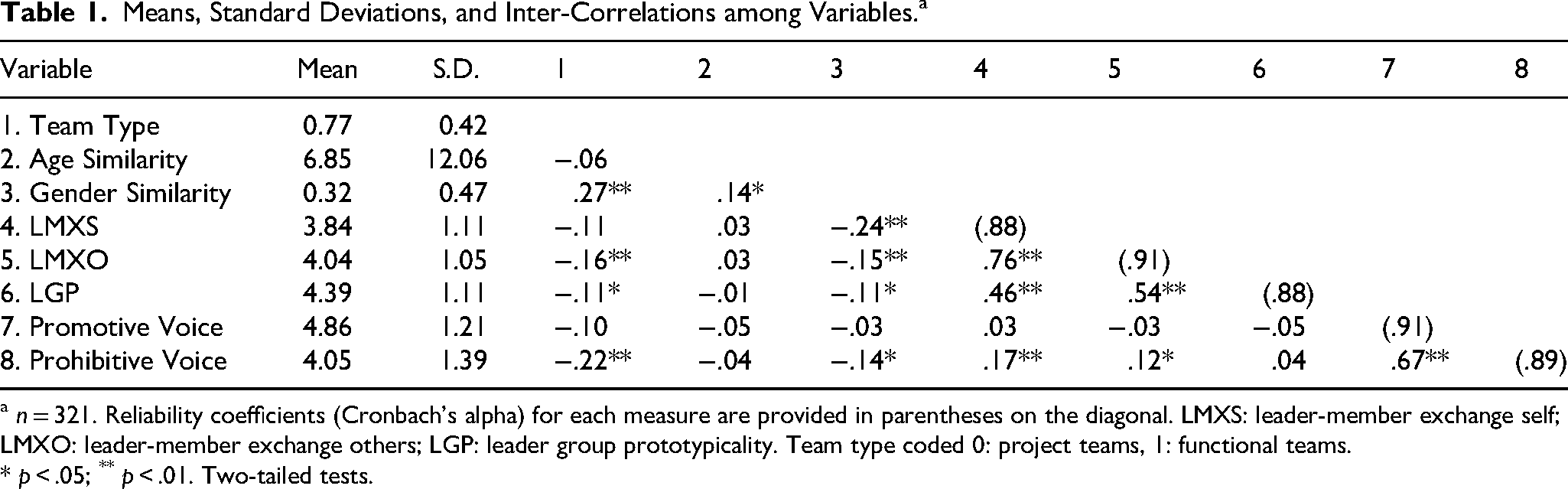
a n = 321. Reliability coefficients (Cronbach's alpha) for each measure are provided in parentheses on the diagonal. LMXS: leader-member exchange self; LMXO: leader-member exchange others; LGP: leader group prototypicality. Team type coded 0: project teams, 1: functional teams.
* p < .05; ** p < .01. Two-tailed tests.
LMX similarity and dissimilarity were captured by the combination of two component variables, LMX self and LMX others, which is tied in with the analytical method we used—polynomial regression and response surface analyses (Edwards, 2002; Edwards & Parry, 1993). More specifically, we focused on the patterns along two critical lines in the response surfaces, namely, the similarity line where LMX self = LMX others and the dissimilarity line where LMX self = −LMX others. We offered a more detailed explanation in the Analytic Strategy section to illustrate how LMX self and LMX others jointly capture the LMX similarity and dissimilarity and how to interpret the response surfaces.
Studies of RLMX are an important development in LMX research, including the study of the LMX-voice relationship. However, as noted in introducing this study, methodological practice in RLMX studies obscures the full influence of the interplay between LMX and others’ LMX in a conceptually important way. With one exception, studies captured RLMX with a difference score (own minus others’ LMX; e.g., Henderson et al., 2008; Tse et al., 2012; Vidyarthi et al., 2010; Zhao, 2014). Difference scores are problematic for several reasons (Edwards, 1993, 1994); in this case, we argue primarily that they obscure the role of LMX similarity. The one study that deviated from this common practice—Hu and Liden (2013)—focused solely on contrasting LMX positive dissimilarity with LMX negative dissimilarity and did not examine the role of LMX similarity.
LMX self was measured using the 8-item scale developed by Bernerth et al. (2007). With an emphasis on social exchange, this measure has proved to have higher content validity than any other measure on leader-member exchange relationship (Colquitt et al., 2014). Employees evaluated the extent to which they agreed with statements, such as “My team leader and I have a two-way exchange relationship” and “If I do something for my team leader, he or she will eventually repay me”. Cronbach's alpha = .88.
LMX others was assessed using the same measure of LMX self, but we adjusted the measure such that it refers to focal employee's perception of coworkers’ LMXs. Example items include: “My team leader and my team coworkers have two-way exchange relationships”, and “If my team coworkers do something for my team leader, he or she will eventually repay them”. Cronbach's alpha = .91.
Leader group prototypicality. Employees responded to a 7-item measure adapted from B. van Knippenberg and van Knippenberg (2005). Example items include “My supervisor is characteristic of who we are as a team” and “My supervisor represents what we stand for as a team”. Cronbach's alpha = .88.
Voice. Immediate supervisors evaluated the leader-directed voice behavior of their employees. Voice was measured using the scale developed by Liang et al. (2012). They distinguished voice into prohibitive voice and promotive voice. We adapted the scale by focusing the target of voice on the leader. With an eye on the overall length of the survey (i.e., because raters need to respond to the same items for multiple individuals), we selected three out of the five items with highest loadings for both types of voice. An example item of prohibitive voice is “The employee speaks up honestly to leader with problems that might cause serious loss to work unit, even when/though dissenting opinions exist” (Cronbach's alpha = .89), and an example item of promotive voice is “The employee proactively suggests new projects to the leader which are beneficial to the work unit” (Cronbach's alpha = .91). A separate data gathering effort targeted also at Chinese respondents showed that these sets of three items loaded on the same factors as the items we excluded from the Liang et al. (2012) scale for our study measurement. Details of this study can be found in Appendix A.
Control variables. It has been suggested that leader-employee similarity is associated with employee voice (e.g., Wang et al., 2012). Accordingly, we controlled for leader-employee similarity in age and gender. Similarity in age was computed as a difference score, and similarity in gender was operationalized as a dummy variable (0 = “different gender” and 1 = “same gender”). Besides, team type, a group-level variable, was also controlled for (0 = “project team” and 1 = “functional team”). This is due to the differences of tasks—in project teams employees are engaged in projects related to bridge/railway construction or project supervision, whereas in the functional teams employees are largely engaged in tasks regarding coordination, logistics, and so on. Thus, there might be more room for voice in project teams than in functional teams.
Analytic Strategy
Given the nested structure of the data (i.e., a leader was to evaluate multiple team members; mean team size was 6.83; team size ranged from 3 to 16), we first examined whether there was a clustering effect due to leaders rating multiple team members, as it could bias the standard error estimate (Jansen & Kristof-Brown, 2005). We used the leader ID as the group variable and inspected the null hierarchical models including only the dependent variable. The results showed that a meaningful proportion of variance in voice was explained by group membership (for prohibitive voice, ICC[1] = 0.38, ICC[2] = 0.82; for promotive voice, ICC[1] = 0.08, ICC[2] = 0.37). Chi-square tests also revealed that a significant proportion of variance was accounted for at the group level for both prohibitive voice (
To test the proposed hypotheses, we employed multilevel polynomial regression, i.e., incorporating the polynomial regression analysis in HLM (Jansen & Kristof-Brown, 2005; Wong & Giessner, 2018) for two reasons. First, the similarity between one's own LMX and coworkers’ LMX relationships falls in the scope of congruence issue, i.e., fit, similarity, or agreement between two components, for which the polynomial regression analysis is particularly appropriate (Edwards & Parry, 1993). Polynomial regression analysis can be used to avoid the problems resulting from difference scores (Edwards, 1994). Second, combined with the response surface method, polynomial regression allows for a closer examination and more nuanced description of the relationship between the two components studied (Edwards, 2002; Edwards & Parry, 1993), i.e., LMX self and LMX others in our study. Hence, multilevel polynomial regression and response surface methodology were employed in our analyses.
We first scale-centered (Edwards & Parry, 1993) LMX self (LMXS) and LMX others (LMXO) to minimize potential multicollinearity between the component measures and their corresponding high-order terms (Aiken & West, 1991). In order to avoid misinterpretation of the significance of the moderation polynomial terms, a four-step procedure was followed. In the beginning, we included solely control variables (i.e., age similarity, gender similarity, and team type). Then we performed polynomial regression. To simplify illustration of the procedure of polynomial regression analysis, we excluded all the control variables from the equations displayed below, though they were included in every step of our analyses. The effects of LMX similarity and dissimilarity on leader-directed voice are captured by the equation:


After polynomial regression analyses, we performed response surface analyses to assess the direction of the moderating effect by inspecting the slope and curvature along two critical lines, i.e., the similarity line (LMXS = LMXO) and dissimilarity line (LMXS = −LMXO). These two types of LMX—similarity and dissimilarity lines—are orthogonal. The linear slope at the point LMXS = 0 and curvature along the LMX similarity and dissimilarity lines were calculated by substituting values one standard deviation above and below the mean of leader group prototypicality. Figure 1 illustrates how the hypothesized surfaces for LMX similarity and LMX positive dissimilarity effects may look like. Hypothesis 1a/b predicts that when the leader is viewed as more group prototypical, an employee experiencing greater LMX similarity is more prone to voice to the leader. This hypothesis is supported if the curvature along the dissimilarity line (i.e., a4) is significantly negative when leader group prototypicality is high. When a4 is significantly negative, the surface along the dissimilarity line (LMXS = −LMXO) takes an inverted U-shape. This indicates that voice levels are higher along the dissimilarity line compared to the similarity line (LMXS = LMXO), suggesting that LMX dissimilarity is associated with greater voice than LMX similarity.
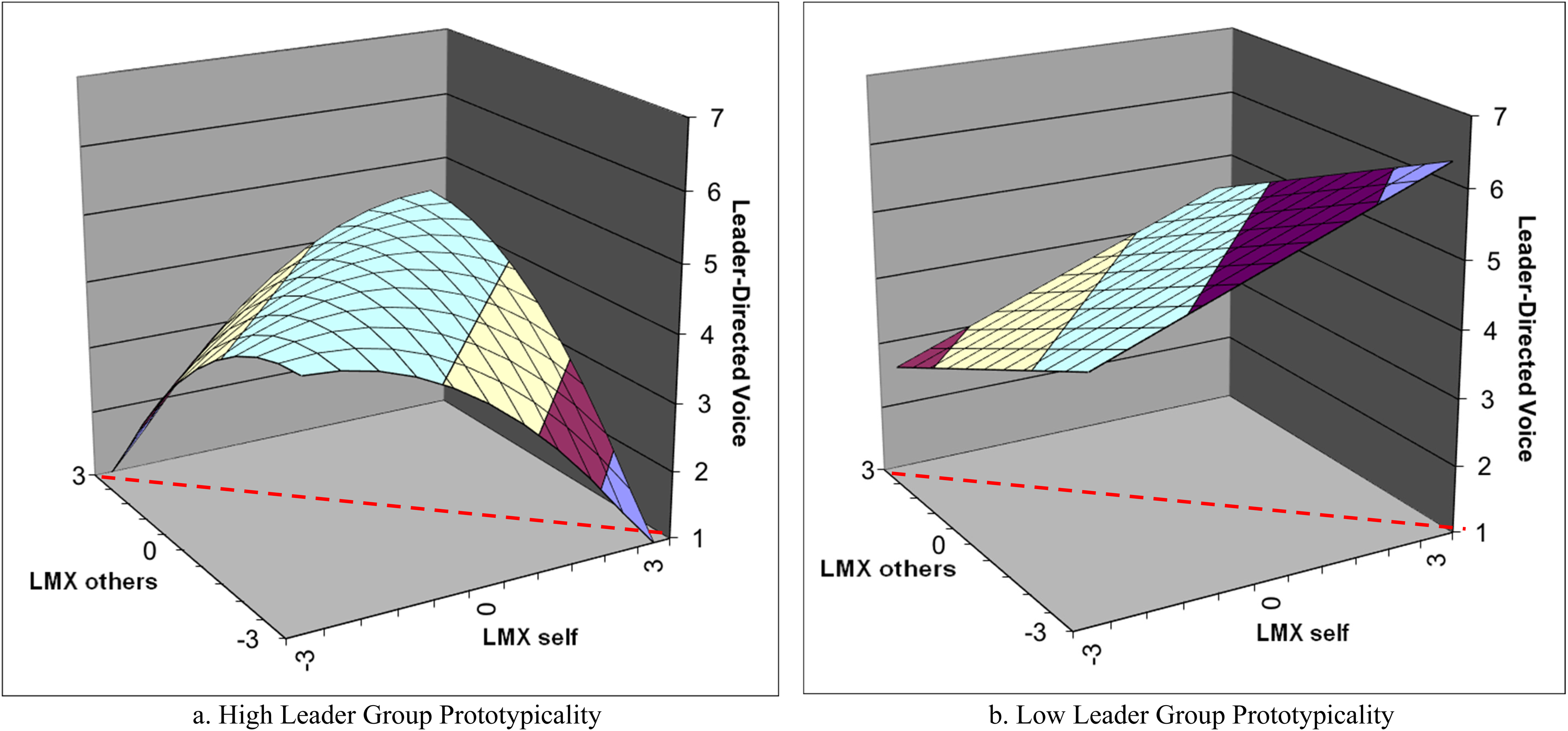
Hypothesized Surface Plots: (a) High Leader Group Prototypicality; (b) Low Leader Group Prototypicality.
Hypothesis 2a/b posits that when the leader is viewed as less group prototypical, LMX positive dissimilarity is more positively related to voice. This hypothesis is supported when the linear slope along the dissimilarity line (i.e., a3) is significantly positive when leader group prototypicality (LGP) is low. That is, there will be a linear increase in voice behavior from the left lower corner (LMXS = −3 and LMXO = 3) to the right upper corner (LMXS = 3 and LMXO = −3), and more voice is expected in the area where one's own LMX is higher than coworkers’ LMX relationships (i.e., LMXS > LMXO).
Hypotheses 3 and 4 anticipate that the proposed interactive effect of LMX (dis)similarity and leader group prototypicality on leader-directed voice is stronger for prohibitive voice than for promotive voice. To test Hypothesis 3, we use bootstrapping to compare the difference in the curvature along the dissimilarity line between the two types of voice under the condition of high leader group prototypicality. If the curvature difference is significant, i.e., the 95% confidence interval does not include zero, this hypothesis will be supported. To test Hypothesis 4, we compare the difference in linear slope along the dissimilarity line between the two types of voice under the condition of low leader group prototypicality with bootstrapping. If the slope difference is significant, i.e., the 95% confidence interval does not include zero, Hypothesis 4 will be supported.
Results
Table 1 shows the means, standard deviations, inter-correlations and reliability coefficients of the variables. Confirmatory factor analyses (CFA) were conducted to examine the discriminate validity of the constructs, especially for the ones evaluated by subordinates (i.e., LMX self, LMX others, and leader group prototypicality) and the others assessed by supervisors (i.e., promotive voice and prohibitive voice). We compared the proposed five-factor baseline model with six alternative models. As shown in Table 2, the baseline model (Model 1:
Model Fit Results of Confirmatory Factor Analyses.a
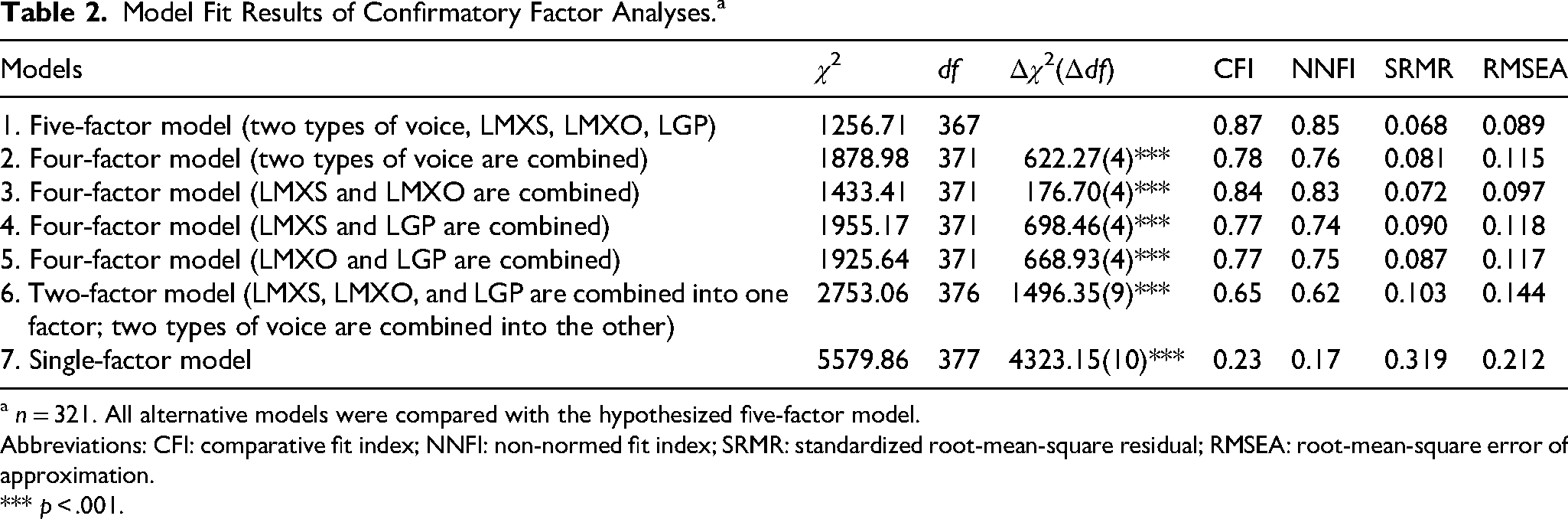
a n = 321. All alternative models were compared with the hypothesized five-factor model.
Abbreviations: CFI: comparative fit index; NNFI: non-normed fit index; SRMR: standardized root-mean-square residual; RMSEA: root-mean-square error of approximation.
*** p < .001.
We tested our hypotheses by first performing multilevel polynomial regression (Jansen & Kristof-Brown, 2005; Wong & Giessner, 2018). Results from HLM analyses, as shown in Table 3, indicated significant moderating effect of leader group prototypicality on the relation between relative LMX and prohibitive voice, as the model fit significantly improved from Model 3a to Model 4a (
Results of Multilevel Polynomial Regression on Voice Behavior.a
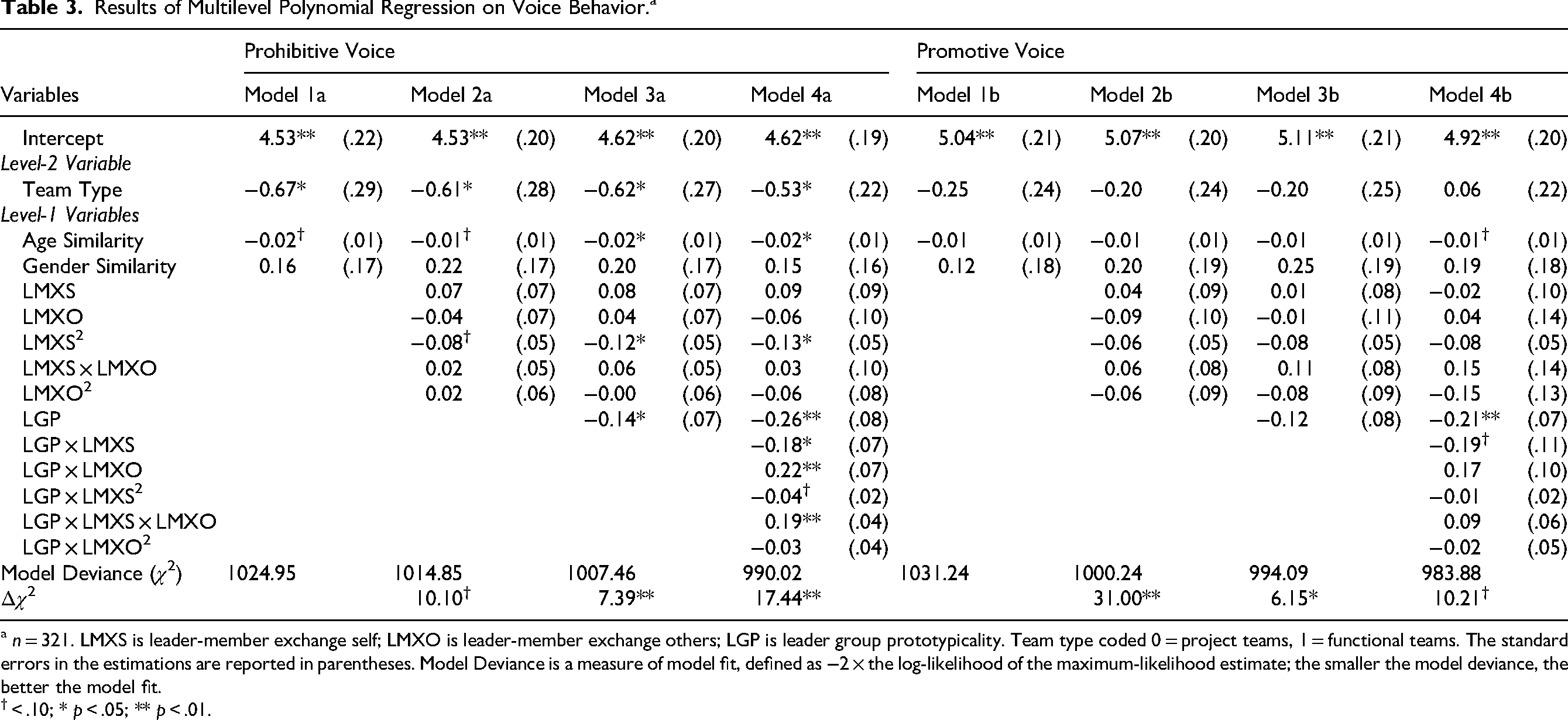
a n = 321. LMXS is leader-member exchange self; LMXO is leader-member exchange others; LGP is leader group prototypicality. Team type coded 0 = project teams, 1 = functional teams. The standard errors in the estimations are reported in parentheses. Model Deviance is a measure of model fit, defined as −2 × the log-likelihood of the maximum-likelihood estimate; the smaller the model deviance, the better the model fit.
† < .10; * p < .05; ** p < .01.
Next, we used response surface methodology to plot the patterns of the moderating effect on prohibitive voice (see Figure 2). Hypothesis 1a/b suggests that as the leader is perceived to be more group prototypical, LMX similarity is more positively related to voice. In terms of response surface (see Figure 1(a)), in the context of high leader group prototypicality, we expected an inverted U shape along the dissimilarity line (LMXS = −LMXO), which signals that voice behavior should be higher along the similarity line (LMXS = LMXO) as opposed to that along dissimilarity line as well as any other areas on the surface. The actual pattern was shown in Figure 2(a). When leader group prototypicality is high, the surface along the dissimilarity line (LMXS = −LMXO) is an inverted U shape, and the degree of prohibitive voice is higher along the similarity line (LMXS = LMXO) than along the dissimilarity line or other area on the surface. Moreover, response surface feature testing revealed that the curvature along the dissimilarity line is significantly negative (a4 = −0.50, 95% CI = [−2.22, −0.46], see Table 4). The pattern suggests that with a highly prototypical leader, as LMXS deviated from LMXO, employees exhibited decreased prohibitive voice; as LMXS was perceived to be similar to LMXO, employees engaged in more prohibitive voice. That is, LMX similarity more than LMX dissimilarity encourages prohibitive voice from employees. Thus, Hypothesis 1a was supported.
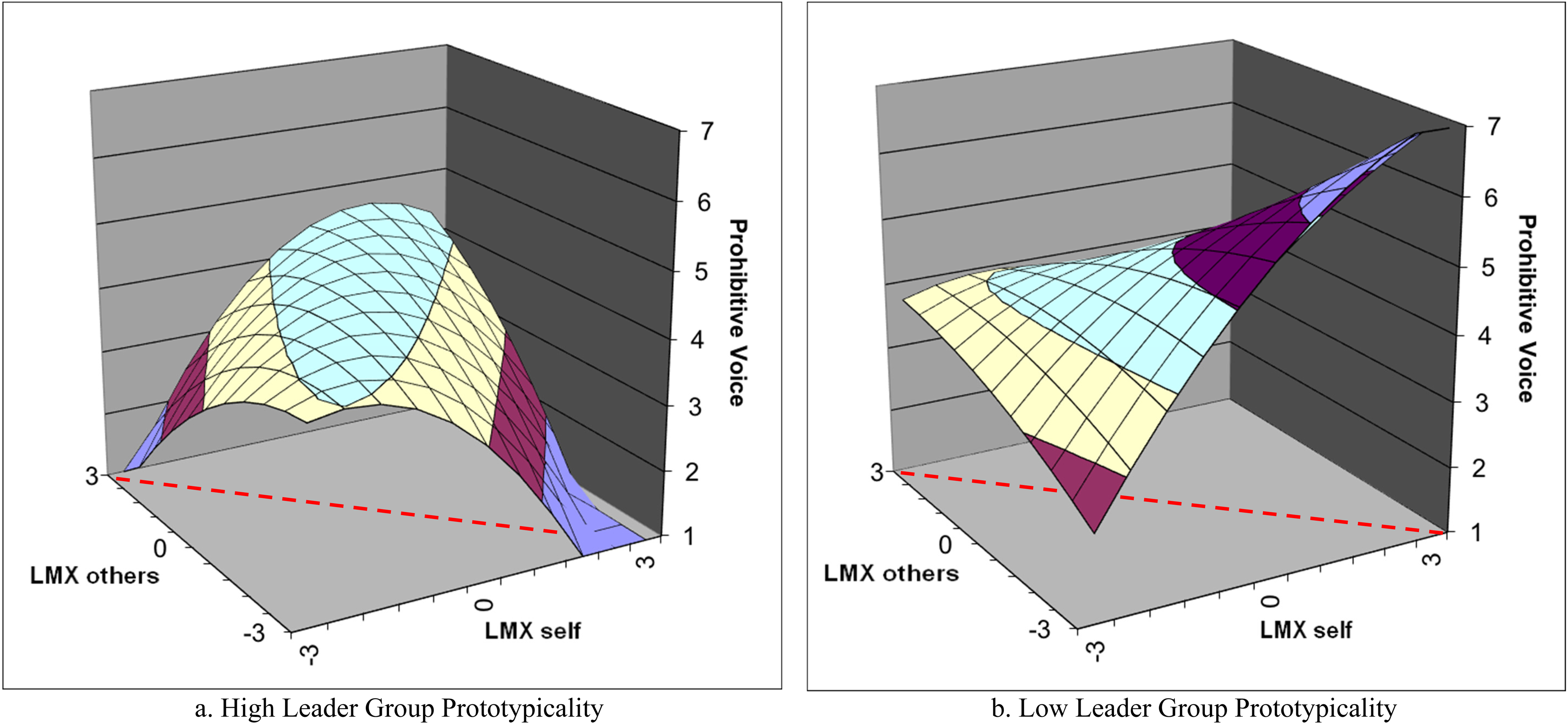
Response Surfaces of Moderating Effect of Leader Group Prototypicality on the Relation Between LMXS, LMXO, and Prohibitive Voice: (a) High Leader Group Prototypicality; (b) Low Leader Group Prototypicality.
Tests of Response Surfaces Along Similarity Line and Dissimilarity Line at High and Low Levels of Leader Group Prototypicality.a
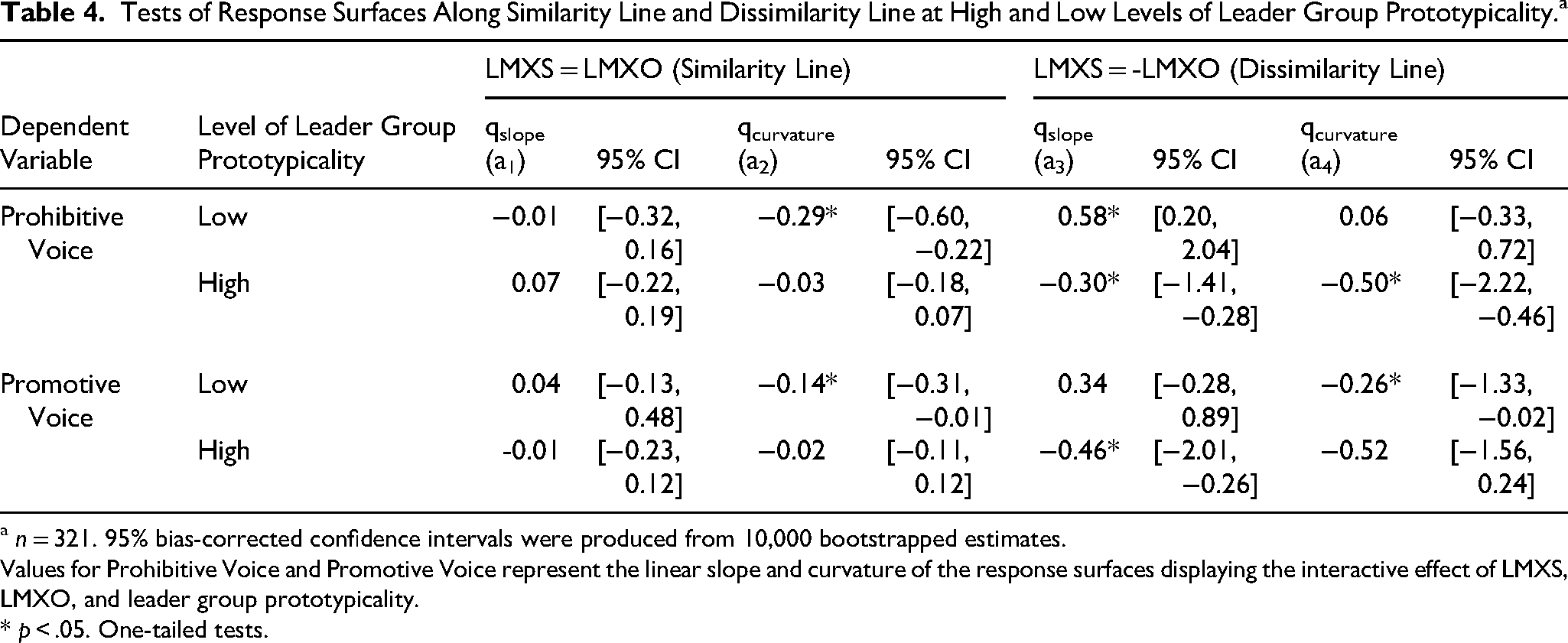
a n = 321. 95% bias-corrected confidence intervals were produced from 10,000 bootstrapped estimates.
Values for Prohibitive Voice and Promotive Voice represent the linear slope and curvature of the response surfaces displaying the interactive effect of LMXS, LMXO, and leader group prototypicality.
* p < .05. One-tailed tests.
Similarly, we plotted the response surface of the moderating effect on promotive voice (see Figure 3(a)), and tested relevant features as we did for prohibitive voice. When leader group prototypicality was high, as revealed by comparing Figure 3(a) to Figure 1(a), the pattern of promotive voice was similar to the expected pattern: The surface along the dissimilarity line (LMXS = −LMXO) was an inverted U-shaped one, and that the degree of voice behavior was higher along the LMX similarity line (LMXS = LMXO) than along the dissimilarity line and other area on the surface. However, the curvature along the dissimilarity line was not significantly negative (a4 = −0.52, 95% CI = [−1.56, 0.24], see Table 4), indicating that with a highly prototypical leader, the proposed effect of LMX similarity on promotive voice was not significant. Thus, Hypothesis 1b was not supported.
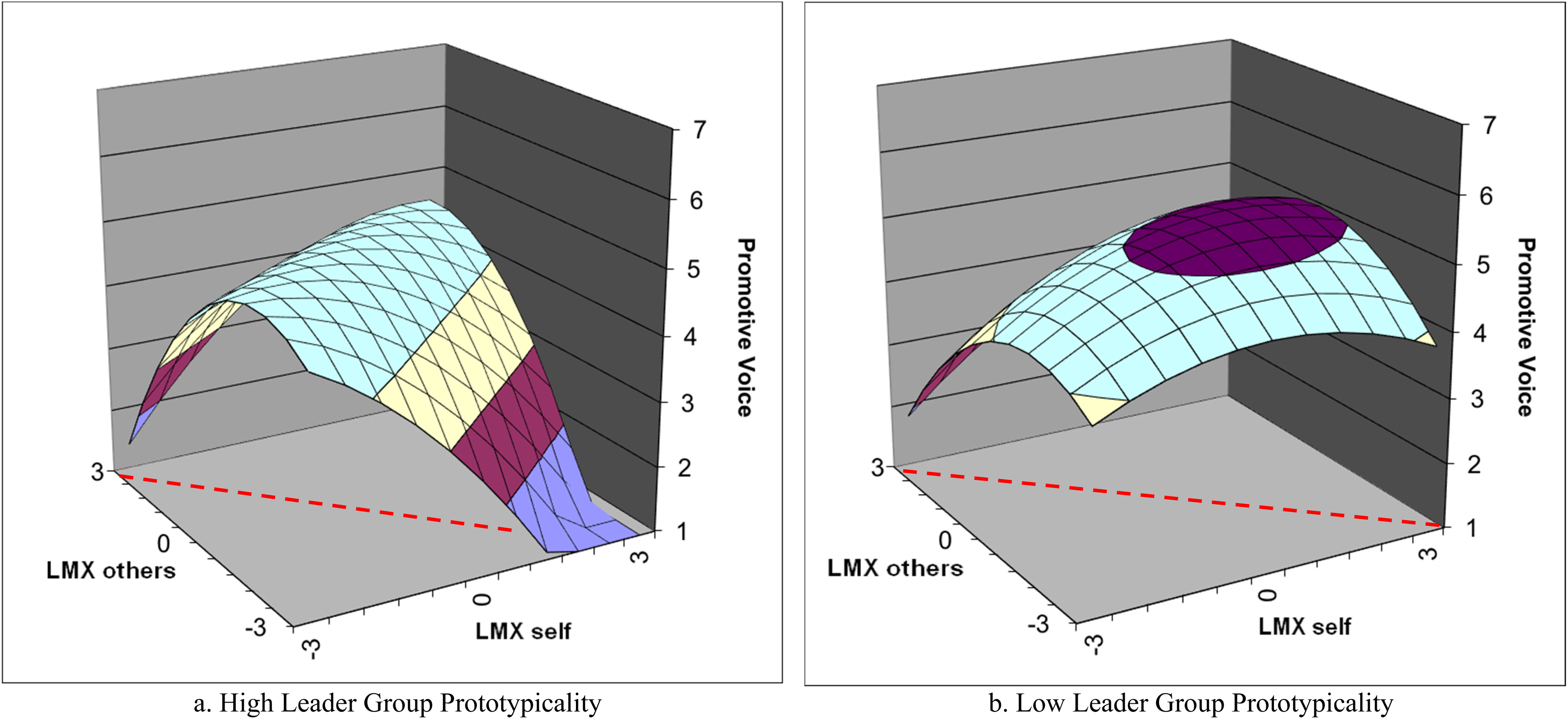
Response Surfaces of Moderating Effect of Leader Group Prototypicality on the Relation Between LMXS, LMXO, and Promotive Voice: (a) High Leader Group Prototypicality; (b) Low Leader Group Prototypicality.
Hypothesis 2a/b posits that as a leader is perceived to be less group prototypical, an employee is more likely to exhibit leader-directed prohibitive and promotive voice when one's own LMX is higher than coworkers’ LMX relationships. As to response surfaces (see Figure 1(b)), in the context of low leader group prototypicality, we expected a linear increase in voice behavior from the left lower corner (LMXS = −3 and LMXO = 3) to the right upper corner (LMXS = 3 and LMXO = −3), and more voice was expected in the area where one's own LMX is higher than coworkers’ LMX relationships (i.e., LMXS > LMXO). The actual pattern was depicted in Figure 2(b). When leader group prototypicality is low, along the dissimilarity line (LMXS = −LMXO), the linear slope at the point LMXS = 0 was significantly positive (a3 = 0.58, 95% CI = [0.20, 2.04], see Table 4), implying a significant linear increase in prohibitive voice from the left lower corner (LMXS = −3 and LMXO = 3) to the right upper corner (LMXS = 3 and LMXO = −3). That is to say, a higher level of voice behavior appeared in the area where one's own LMX is higher than coworkers’ LMX relationships (i.e., LMXS > LMXO). Hence, Hypothesis 2a was supported.
In a similar vein, we tested the effect on promotive voice. Under the condition of low leader group prototypicality, as indicated by comparing Figure 3(b) to Figure 1(b), the actual pattern of promotive voice was not the same as the expected pattern. Along LMX dissimilarity line (LMXS = −LMXO), we did not observe a linear increasing tendency from the left lower corner (LMXS = −3 and LMXO = 3) to the right upper corner (LMXS = 3 and LMXO = −3). Moreover, for promotive voice, the proposed positive linear slope along the dissimilarity line was not significant (a3 = 0.34, 95% CI = [−0.28, 0.89], see Table 4). Thus, with a less prototypical leader, positive LMX dissimilarity would not lead to increased promotive voice. Accordingly, Hypothesis 2b was not supported.
To test Hypothesis 3, we compared the difference in the curvature along the dissimilarity line between the two types of voice under the condition of high leader group prototypicality with bootstrapping. The result showed no significant difference (
To test Hypothesis 4, we compared the difference in the linear slope along the dissimilarity line between the two types of voice in the context of low leader group prototypicality using bootstrapping. The result revealed significant difference (
Discussion
We proposed that both LMX similarity and LMX positive dissimilarity can motivate voice, contingent on leader group prototypicality, and that these effects would be stronger for prohibitive voice. Results supported most of our predictions for prohibitive voice: LMX similarity was more strongly related to prohibitive voice with higher leader group prototypicality, LMX positive dissimilarity was more strongly related to prohibitive voice with lower leader group prototypicality, and the latter interaction effect was stronger than the corresponding effect for promotive voice. Similar interactive effects were not observed for promotive voice, which is consistent with the notion of stronger effects for prohibitive voice but inconsistent with the expectation that effects would obtain for promotive voice too. In the following, we discuss the theoretical and practical implications of our findings.
Theoretical Implications
The primary contribution of our study lies in demonstrating that both LMX similarity and LMX positive dissimilarity can motivate employee voice, and in showing how insights from the social identity theory of leadership regarding leader group prototypicality can be used to propose an integrative framework for understanding when LMX similarity and when LMX positive dissimilarity exerts a stronger influence on voice. This advances existing work that has identified positive influences of both LMX positive dissimilarity and LMX similarity, but has yet to integrate these two perspectives.
We argued that conceptually LMX similarity is closely aligned with collective identity and collective-oriented motivation and LMX positive dissimilarity is closely aligned with relational identity and relationship-oriented motivation. Because of this, we proposed, the interaction of LMX similarity and leader group prototypicality and the interaction of LMX positive dissimilarity and leader group prototypicality impacts the perceived social risk associated with voice. It is important to recognize, however, that even when the pattern of results is consistent with this theorizing, it does not provide evidence of these underlying mechanisms. An obvious further development of our analysis would therefore be to empirically address these mechanisms (i.e., collective identity salience, relational identity salience, and perceived social risk of voice). As it is, our considerations of the theoretical implications of the support for our research model come with the caveat that whereas we can draw on the evidence regarding the relationships of our independent variables with our dependent variables, we can only draw on our theory regarding mediating mechanisms.
The divergence in findings for promotive and prohibitive voice has meaningful implications for theory. Our results suggest that prohibitive voice is more sensitive to factors that can be assumed to influence the perceived social risk of voice than promotive voice. Whereas promotive voice centers on offering constructive suggestions and forward-looking ideas—typically perceived as low-risk—prohibitive voice involves raising concerns or pointing out problems, which may be interpreted as criticism or resistance. As such, prohibitive voice likely requires a higher psychological threshold to enact. This higher threshold may amplify the role of relational factors like LMX similarity, LMX positive dissimilarity, and leader group prototypicality. As noted, this conclusion comes with the caveat that our study did not include evidence regarding perceived social risk, but the support for our research model does underscore the value of further developing the analysis of the predictors of prohibitive voice and promotive voice through this social risk perspective.
Taking a step back from our focus on voice, we may ask whether LMX similarity and LMX positive dissimilarity similarly affect other outcomes contingent on leader group prototypicality. Whereas the logic that both LMX similarity and LMX positive dissimilarity may motivate contributions to the team and to the leader-follower relationship would hold beyond voice, our reasoning concerning the perceived social risk of voice likely is more specific to voice. For instance, the motivation to contribute likely extends to such outcomes as organizational citizenship behavior, but organizational citizenship behavior is not associated with social risk the way voice is. Accordingly, the influence of LMX similarity and LMX positive dissimilarity on citizenship behavior may be less contingent on leader group prototypicality. Put differently, one conclusion from our differential findings for promotive and prohibitive voice is that it may be worthwhile to more broadly consider how LMX similarity and LMX positive dissimilarity relate to behaviors that differ in their associated social risk. Social risk set aside, however, leader group prototypicality may also exert an influence by reinforcing the identity salience associated with LMX similarity (high prototypicality) and LMX positive dissimilarity (low prototypicality) such that leader group prototypicality may exert a moderating influence, albeit weaker for behavior that is less associated with social risk (e.g., citizenship) than for behavior more associated with social risk (e.g., voice).
In a related vein, taking a step back from our focus on LMX similarity and LMX positive dissimilarity to zoom in on our theory about the influence of collective identity salience and relational identity salience, we may note that there is no reason why these identity notions about influence on voice would be limited to LMX (dis)similarity. Other influences on collective and relational identity may likewise motivate voice—contingent on leader group prototypicality. Obviously, these are considerations for future research, but they underscore the broader implications of the social identity perspective we proposed.
In this respect, we may highlight one other implication. The social identity perspective linking LMX similarity to collective identity and LMX positive dissimilarity to relational identity allows us to link these insights to the observation that some people are more prone to form a sense of collective identity whereas others are more prone to form a sense of relational identity (Brewer & Gardner, 1996; Mael & Ashforth, 1995). A further proposition for future research thus could be that such dispositional differences in social identity may moderate responses to LMX similarity and dissimilarity such that some people respond more favorably to LMX similarity whereas others respond more favorably to LMX positive dissimilarity.
Furthermore, we contribute to the voice literature by echoing the continued call for research on how an employee's status, relative to coworkers, shapes voice (cf. Morrison, 2014; 2023). To do so, we examine not only the LMX relationships that coworkers have with the same leader but also incorporate the leader's attributes. Prior work has primarily focused on how voice emerges within leader–employee dyads and the different forms it can take (e.g., Wu et al., 2025). By integrating a focal employee's LMX, coworkers’ LMXs, and the leader's group prototypicality—and analyzing their differential effects on promotive and prohibitive voice—we highlight how the interplay among the three key actors in this triad (the focal employee, coworkers, and the leader) jointly shapes both the likelihood and the form of employee voice.
Practical Implications
An important insight from earlier work on relative LMX was also arguably somewhat disappointing for practice: LMX positive dissimilarity motivates positive behavior. By implication this means that LMX negative dissimilarity discourages positive behavior, and an unfortunate reality is that LMX positive dissimilarity for the one can only be achieved at the expense of LMX negative dissimilarity for the other (objectively speaking at least; subjectively it is possible, although perhaps unlikely, that all would believe they have a better relationship with their leader than others). That is, from a practical point of view, the implication of the motivating potential of LMX positive dissimilarity is that achieving a positive outcome for one team member may come at the expense of achieving that outcome for another member. This is particularly undesirable for voice, because teams potentially benefit from having diversity in voice and having all members be heard (cf. Tröster & van Knippenberg, 2012).
From a practical perspective, the findings for LMX similarity and prohibitive voice thus offer an important counterpoint to this more disappointing conclusion. Motivating voice through LMX similarity implies voice by all team members. Initial work on LMX may have suggested that LMX differentiation is what typically occurs (Dansereau et al., 1975), but it is important to realize that while this may have been a conceptual suggestion, the actual evidence in research in relative LMX—including but not limited to the current study—shows that LMX similarity does occur in practice, and prominent enough to establish the current relationships. In seeking to foster voice prohibitive voice at least, an important focus would thus seem to be not just to develop high-quality relationships, but also to develop relationships of equal quality with all team members.
The moderating role of leader group prototypicality shows that such efforts would need to be complemented by establishing oneself as a group prototypical leader. Research has shown qualitatively that leaders may achieve such perceptions through the way they present themselves (Reicher & Hopkins, 2003; van Knippenberg & Lee, 2023); leader group prototypicality thus is not given but something leaders can actively shape. From the perspective of key take-aways, then, the present analysis shifts our understanding of relative LMX in two important ways: it points to the effectiveness of LMX similarity, and it points to the fact that the effectiveness of the LMX relationships one develops with a leader is contingent on how the leader presents him/herself in terms of group prototypicality—relationship development alone is insufficient.
Limitations, Strengths, and Future Directions
Despite the important theoretical insights and practical implications above, the present study has limitations that should be considered in future research endeavors. First, we should note that the fit of our measurement model is less than ideal. The model was the best model capturing our measures even so, and we moved ahead accordingly. Also, it is important to recognize that modest fit of the measurement model does not provide an alternative explanation for hypothesis support—but it does provide a potential explanation for lack of hypothesis support. When (as in the current case) the intended measurement model is the best fitting model but fit is suboptimal, this likely reflects relatively high error variance more than anything else. This means that there is a lot of “white noise” in attempting to identify the “true signal”. This may mean that the weaker and nonsignificant pattern of results for promotive voice may reflect weaker effects that need a better measurement model to detect rather than the absence of “true” effects.
Second, an important direction for future research lies in examining the potential self-interested motives associated with LMX positive dissimilarity. While we focused on relational identity and the motivation to reciprocate high-quality leader-member relationships as drivers of voice, it is also plausible that employees who perceive themselves as having a better LMX relationship than their peers may engage in voice behavior as a means of sustaining or enhancing their favorable position. That is, voice may not only serve to benefit the leader or the team but may also reflect strategic self-presentation aimed at further distinguishing oneself. Future studies could examine how motives such as impression management, status maintenance, or career advancement may intersect with LMX-based dynamics to shape upward voice.
Third, we observed a relatively low proportion of variance in promotive voice explained by the group membership, as indicated by low ICCs. This may be reflective of the same issues underlying the absence of an interactive effect on promotive voice. As we discussed above, it is in line with our conceptual analysis and the broader voice literature to expect promotive voice to be less contingent on social influences than prohibitive voice. We outlined above how this may explain the absence of a significant interaction for promotive voice. It may also explain the lower ICCs, because the ICCs would be driven by the shared influence of LMX similarity or dissimilarity and leader group prototypicality; as this influence is weaker or absent, ICCs would also be lower. In addition or alternatively, the difference in ICCs may also reflect the extent to which team members take cues for how to behave from follow team members’ behavior. That is, within-team similarity in voice may to some extent reflect that team members may take cues about whether or not to voice from other team members’ voice or lack thereof. The more other team members voice, the lower the psychological threshold may be to voice oneself, because team members may interpret fellow team members’ voice as indication that is appropriate and socially safe to voice. The notion that such cue-taking from fellow team members may be stronger for prohibitive voice than for promotive voice is consistent with the idea that individuals are more concerned with the social risk of prohibitive voice.
Fourth, in our sample LMX similarity goes hand in hand with higher LMX (as per the positive correlation between LMX self and LMX other). Situations in which team members have similar high-quality relationships with the team leader arguably are more common than situations in which members have similar low-quality relationships; we would expect that this is not a correlation unique to our sample. Even so, it is important to recognize that even when collective identity is based on similarity and does not require similarity on a positive attribute (Turner et al., 1987), similarity on positive attributes can be expected to give rise to stronger collective identity (Abrams & Hogg, 1988). Moreover, all other things being equal, higher LMX would be associated with lower social risk of voice. Accordingly, we should recognize that our findings for LMX similarity concern similarity at higher levels of LMX. Future research with research populations in which LMX similarity and LMX self are less correlated would be valuable to establish whether relationships for LMX similarity hold across the level of LMX or potentially are stronger for similarity at higher levels of LMX (cf. van Knippenberg & Dwertmann, 2022).
Fifth, we conducted our study in China, which could invite a question about the extent to which our findings can be extended to other cultural contexts. Even when such questions should not be reserved for research using non-Western samples (Avery et al., 2022), the issue of potential culture-specificity of findings is interesting to consider. Prior research suggested that high power distance and an emphasis on harmonious relationship are negatively related to voice (e.g., Friedman et al., 2006). In China, where harmony and unity is widely valued, voice behavior may be implicitly seen as socially undesirable (Farh et al., 2004). One could thus speculate that the predicted relationships would be harder to detect in China. Alternatively, due to cultural factors, these effects could actually be stronger, as voice may be more contingent on social influences in the Chinese context. The current study cannot speak to this, but it is important to recognize that our conceptual analysis is rooted in research that is not unique to China. The relative LMX and LMX differentiation perspective has been more broadly established across cultures, as has the social identity perspective and the focus on leader group prototypicality (e.g., van Knippenberg, 2011). The distinction between promotive and prohibitive voice likewise is not tied to the Chinese context. The broader international basis of our analysis would give some confidence that the observed relationships are not unique to the Chinese context, even when it may be a valuable direction for future research to explore whether there are cultural moderators of the strength of these relationships.
Last, the sample we chose is involved in bridge and railway construction. This may invite questions of generalizability of findings to other industries. Construction requires vigilance, accuracy, and error detection. All these potentially make people prevention-focused (Van Dijk & Kluger, 2011), which would result in more prohibitive voice than promotive voice (Lin & Johnson, 2015). Whereas this may affect relative levels of prohibitive and promotive voice vis-à-vis other industries, it is less obvious that it would affect the interaction patterns that were the core concern of our study. Even so, future research developing this perspective further in other industries would be worthwhile to get a better sense of possible industry effects.
Conclusion
In sum, proposing a social identity perspective on the LMX (dis)similarity—voice relationship, we find that whether LMX similarity or LMX positive dissimilarity results in leader-directed voice depends on the degree to which the leader is perceived to be representative of the team. Moreover, employees are more sensitive to these social influences when raising prohibitive voice than when raising promotive voice. Leaders need to balance two factors to increase employee voice: their treatment towards their team members and the degree to which they are perceived to embody the group identity. We hope that our written voice will move upward to the leaders who are open to encourage and embrace employee voice.
Footnotes

Funding
The authors received no financial support for the research, authorship, and/or publication of this article.
Declaration of Conflicting Interests
The authors declared no potential conflicts of interest with respect to the research, authorship, and/or publication of this article.
Appendix A. Shortened Voice Scales Validation
In a separate survey study, we included all five items for promotive voice and prohibitive voice. That enabled us to test the validity by comparing the correlation between the average of a 3-item scale we used and that of a 5-item full scale. In that study, we recruited 200 managers in China and asked them to evaluate both forms of voice of a specific employee reporting to them. The managers responded on a 7-point scale ranging from 1 = strongly disagree to 7 = strongly agree. Table A1 and A2 present inter-item correlations for both voice scales. Results in Table A3 showed that (a) for promotive voice, the correlation between the 3-item scale and the full scale was .97, p < .001; (b) for prohibitive voice, the correlation between the 3-item scale and the full scale was .96, p < .001. Such high level of correlations demonstrated that our shortened measures represented the full scales of voice reasonably well.