




Abstract
Core to the social identity theory of leadership is leader group prototypicality (LGP), the perception of the leader as embodying shared collective (e.g., team, organization) identity. Steffens, Munt, van Knippenberg, Platow, and Haslam’s meta-analysis showed that LGP operationalized as embodying the ideal-type of the group (ideal-type prototypicality, ITP) is more strongly related to indicators of leadership effectiveness than LGP operationalized as embodying the average group member (average member prototypicality, AMP). However, to support these conclusions Steffens et al. could rely only on between-study comparisons based on coding of LGP operationalizations. It is therefore possible that AMP versus ITP operationalizations covaried with other study differences. To address this issue, we conducted two replication tests relying on within-study comparisons. A scenario experiment and a survey focused on the relationship of both operationalizations of LGP with what in the social identity theory of leadership is a proximal outcome of LGP: trust in the leader. Replicating Steffens et al.'s finding, both studies showed that LGP is more strongly related to trust when it is operationalized as ITP rather than AMP.
Over the last two decades, the social identity theory of leadership (Haslam & Platow, 2001; Haslam et al., 2020; Hogg, 2001; van Knippenberg & Hogg, 2003) has established itself as a unique perspective in leadership research by putting the group identity that is shared by leader and group members center-stage. A core concept in the theory is leader group prototypicality (LGP): the perception of the extent to which the leader embodies shared group identity—where “leader” is understood to refer to any person in a position to influence the group, regardless of whether they are referred to as leader, manager, supervisor, or otherwise, and group is understood to refer to any social grouping regardless of whether it is a small interactive group or a larger social grouping such as an organization (e.g., van Knippenberg & Lee, 2023). The social identity theory of leadership has received strong support for its core propositions. In particular, a recent meta-analysis of over 70 studies (k = 128 effect sizes from lab experiments and survey research with nearly 30,000 participants) by Steffens et al. (2021) found that the relationship between LGP and indicators of leadership effectiveness held across leadership evaluations and behavioral outcomes (overall effect size, r = .39).
The Steffens et al. (2021) meta-analysis included a hypothesis that goes to the core of the theory, concerning the extent to which the operationalization of LGP puts an emphasis on LGP as embodying the ideal-type of the group (which Steffens et al. called ideal-type prototypicality, ITP) or as embodying the average group member (which they called average member prototypicality; AMP). It is important to emphasize that ITP and AMP are not intended to refer to separate constructs or to distinct dimensions of the LGP construct; they refer to different emphases in the understanding of LGP as expressed in its operationalization. That is, studies of LGP vary in the extent to which their operationalization of LGP can be understood as reflecting ITP or AMP, but all studies intended their operationalization to capture LGP and they did not conceptually differentiate ITP and AMP. Such variations in the operationalization of a construct can be important when they reflect different conceptual understandings. Steffens et al. (2021) argued that this was the case for IPT and AMP operationalizations of LGP. Specifically, their argument was that these operationalization variations concern the extent to which the operationalization captures the LGP concept as intended by the social identity theory of leadership. Recognizing that social identity theory of leadership studies have often not been explicit enough about this intended conceptualization, Steffens et al. argued that, while ITP and AMP as operationalizations of the same construct are inherently overlapping (i.e., the ideal-type of a group will be different from, but not disconnected from, its average member), the ITP operationalization of the construct is better aligned with the social identity theory of leadership and its basis in self-categorization theory (Turner et al., 1987). They further argued that the ITP understanding not only better captures the LGP concept as intended but also better captures why LGP influences indicators of leadership effectiveness. The reason for this, they proposed, is that ITP more explicitly captures the normative influence inherent to group prototypes (i.e., injunctive norms that capture what “should be”), which also reflects that groups are psychologically imbued with qualities that cannot be reduced to the average of their members (Turner et al., 1987). Their results supported their hypothesis that ITP operationalizations of LGP are more strongly related to indicators of leadership effectiveness than AMP operationalizations of LGP.
As powerful as meta-analytic evidence is, it can have drawbacks that warrant replication with complementary methods. In the case of Steffens et al.'s (2021) test of the moderating role of operationalization of LGP as AMP versus ITP, the issue is that their hypothesis test could not draw on studies that directly compared ITP versus AMP operationalizations of LGP. Instead, Steffens et al. relied exclusively on between-study comparisons through the coding of LGP operationalizations as ITP or AMP. Whereas this in no way disqualifies the results of the Steffens et al. analysis, it does mean that we do not know to what extent ITP versus AMP operationalizations covaried with other differences between studies that were not captured by Steffens et al.'s coding and that might have played a role in the observed effect. Moreover, hypotheses tests ideally would not exclusively rely on post-hoc imputation of an operationalization but also include a priori operationalization in the research design. For these reasons, there is value in replication tests that include within-study comparisons involving targeted examinations of ITP versus AMP effects. We conducted such tests in the current study, focusing on trust in the leader as a particularly relevant effect of LGP within the social identity theory of leadership (van Knippenberg & Hogg, 2003) and an important factor in leadership effectiveness more broadly (Dirks & Ferrin, 2002).
We contend that these replication tests are important to the social identity theory of leadership, because the issue of operationalizing (and thus by implication understanding) LGP in ITP or AMP terms speaks to the core of the theory; it speaks to how LGP should be understood and what drives its influence on leadership effectiveness. As strong as the Steffens et al. (2021) meta-analytic findings are in many respects, there thus is added value in addressing the point of ambiguity in their findings that is caused by their exclusive reliance on between-study comparisons for this hypothesis test. With stronger evidence for their conclusion, research can more confidently move forward conceptualizing and operationalizing LGP in ITP terms.
Theoretical Background and Hypotheses
The social identity approach, comprised of social identity theory (Tajfel & Turner, 1979) and self-categorization theory (Turner et al., 1987), outlines how group memberships are reflected in individuals’ self-concepts. Social identities are mentally represented in reference to group prototypes, which are mental representations of what is central, enduring, and distinctive about the group. Group prototypes are subjectively construed; they are not an objective given but can vary from member to member and situation to situation. Even when there can be an element of sharedness among members in such mental representations, at root group prototypes reside at the individual level of analysis as individual group members’ mental representations of group identity. Because group prototypes are understood to capture what is perceived to be the shared social reality of the group, and include its norms, beliefs, values, and aspirations, they are a source of influence in guiding group members’ attitudes and behavior (Turner et al., 1987).
In the social identity approach, the term “group” generically refers to any social grouping of which individuals can perceive themselves to be a member (Platow et al., 2015), including larger groupings such as organizations, professions, nations, and demographic groups (i.e., the notion of group is not limited to the group dynamics understanding as small interacting groups). Because of its clear relevance to membership in organizations and professions as well as to smaller organizational groups such as teams, the social identity approach is increasingly influential in the study of organizational behavior (Ashforth et al., 2008; Haslam, 2001; van Knippenberg & Hogg, 2018).
One area in which this is particularly the case is leadership. The leadership role is typically understood as revolving around mobilizing and motivating a group to pursue shared goals (Lord et al., 2017). This links leadership to shared action and thus inherently puts an emphasis on leaders’ role in representing and managing the group. In recognition of this role, the social identity theory of leadership posits that responses to leadership are informed by how representative the leader is of shared group identity, because this is taken to be indicative of the extent to which the leader can be trusted to have the group's interest at heart (Haslam & Platow, 2001; Platow & van Knippenberg, 2001; van Knippenberg & Hogg, 2003).
LGP speaks to this very issue. Being perceived to be group prototypical implies being perceived to embrace group norms, beliefs, values, and aspirations. In this way, this suggests that the leader can be trusted to have the group's interest at heart. This relationship between LGP and trust in leader has been established in a range of studies employing different methodologies (including meta-analysis; Barreto & Hogg, 2017; Steffens et al., 2021). These studies have also established that the effect on trust is one of the more proximal effects of LGP and mediates effects on more distal attitudinal and behavioral outcomes (Giessner & van Knippenberg, 2008; Giessner et al., 2009; van Knippenberg & van Knippenberg, 2005). It is important to note that LGP should not be confused with the notion of leader prototypes as referring to mental representations of leadership (Lord & Maher, 1991); these both concern individual mental representations, but the reference point for LGP perceptions is the mental representation of shared group identity and not the mental representation of leadership (Hogg, 2001).
The concept of group prototypes had a long history in cognitive psychology (Rosch, 1978) and social psychology (Turner et al., 1987) before it was applied in the study of LGP. Steffens et al. (2021) noted that despite these deep roots in categorization theory and the social identity approach, there is empirical ambiguity about what best captures LGP as an influence on leadership effectiveness. In deviation from the understanding of group prototypes and group prototypicality in self-categorization theory (Turner et al., 1987), some studies operationalized LGP more in terms of similarity to the average group member (i.e., AMP; e.g., Halevy et al., 2011). Other studies aligned with the conceptual basis of group prototypicality and operationalized LGP more in terms of embodying the ideal-type of the group (i.e., ITP; e.g., Steffens et al., 2013). Steffens et al. (2021) argued that this ambiguity in operationalization reflects underlying conceptual ambiguity that it is important to address, both because of theoretical precision and precision in aligning theory and evidence and because it directly concerns the question of why LGP impacts leadership effectiveness.
As a side note, we may observe that the Steffens et al. (2021) meta-analysis was not limited to the test of the one hypothesis that is our concern here. It focused on three novel hypotheses that relied on between-study comparisons as well as on meta-analytic tests of hypotheses that had been tested before in within-study comparisons. We single out this one hypothesis, however, because it lies closest to the core of the social identity theory of leadership—and thus is particularly valuable to provide unambiguous evidence for—and because it is the one hypothesis that concerns explicit differences in understanding in the literature (e.g., Halevy et al., 2011 versus Steffens et al., 2013).
AMP Versus ITP
Steffens et al. (2021) argued that, whereas both similarity to the average group member (AMP) and similarity to the ideal-type (ITP) are implied by the group prototypicality construct because they are inherently overlapping, the latter understanding of LGP is better aligned with the conceptualization of group prototypes and the influence that the group prototype—and thus LGP—exerts on group members. Steffens et al. argued that AMP reflects descriptive norms (“what is”; Cialdini et al., 1991), whereas ITP reflects injunctive norms (Cialdini et al., 1991) that capture “what should be,” and that such notions of “what should be” are more reflective of what the group considers appropriate and desirable. Accordingly, Steffens et al. argued that the notion that group prototypes are a source of influence in guiding members’ attitudes and behavior is better captured by an ITP than by an AMP operationalization.
Following from this, Steffens et al. hypothesized that LGP operationalized primarily as ITP would be more strongly related to indicators of leadership effectiveness than LGP operationalized primarily as AMP. In their meta-analysis, in support of this hypothesis Steffens et al. found that aggregated over perceptual (e.g., subordinate attitudes towards the job and the leader) and behavioral (e.g., subordinate performance) indicators of leadership effectiveness, LGP operationalized as ITP was more strongly related to leadership effectiveness, r = .55, than LGP operationalized as AMP, r = .35.
Meta-analytic evidence is powerful. For a relationship tested in multiple primary studies, there typically is little value-added in replication tests once the relationship has been established meta-analytically. However, the case of LGP operationalized as ITP versus AMP is different because Steffens et al. (2021) could not draw on a single primary study that compared ITP versus AMP operationalizations of LGP. Instead, their empirical test of ITP versus AMP operationalizations as moderator of LGP effects relied exclusively on between-study comparison based on post-hoc coding of operationalizations. The downside of such an approach is that there is always the possibility that the operationalization of LGP in terms of ITP or AMP covaried with other differences between studies that could have influenced results. Therefore, there is added value in replication tests that focus on within-study comparison of ITP and AMP operationalizations and do not suffer from concerns with between-study differences. When such within-study comparisons replicate the meta-analytic findings, the combined evidence is stronger than the meta-analysis alone. Our focus in the current study was on providing such replication tests.
As outlined above, trust in the leader is an important proximal outcome of LGP and either implied or explicitly assessed in many LGP studies as the mechanism that explains a variety of effects on more distal outcomes (van Knippenberg, 2011; van Knippenberg & Dwertmann, 2022). Trust is typically understood as the willingness to be vulnerable to another party from the combined perception of the other party's good intentions and ability to make good on those intentions (Rousseau et al., 1998). In the social identity theory of leadership's consideration of LGP and trust, the emphasis conceptually is on perceived intentions, and more specifically on the extent to which the leader can be trusted to have group-serving intentions (i.e., the “active ingredient” in the theory about the LGP-trust relationship is intention more than ability).
The focus on trust in the leader, as well as the emphasis on group-serving intentions in considering trust, is conceptually closely aligned with Steffens et al.'s (2021) argument regarding stronger effects of LGP as ITP versus LGP as AMP. The effect of LGP on trust is understood to derive from the perception that the leader embodies group norms, values, and ambitions—as per ITP—and thus has the group's best interest at heart (van Knippenberg & Hogg, 2003). This is not to say that replication with a broader range of outcomes (e.g., behavioral outcomes; Steffens et al., 2021) would not be valuable; it is merely to note that replication with trust as an outcome is particularly valuable because it is so clearly implied by Steffens et al.'s theory as well as the social identity theory of leadership more broadly. Trust in leadership is also more generally recognized as an important determinant of leadership effectiveness (Dirks & Ferrin, 2002). A focus on trust in the leader thus provides potentially valuable cross-linkages with other research traditions that may help shape development of more integrative theory to bridge research streams (cf. Cronin et al., 2021). Accordingly, our replication study was concerned with testing the following hypothesis:
The Current Multi-Method Approach
To test this hypothesis, we followed a two-study multi-method approach. Study 1 was a scenario experiment (cf. van Knippenberg & van Knippenberg, 2005) in which we described a hypothetical work context and orthogonally varied whether the team leader was described as high or low LGP and whether LGP was operationalized in AMP or ITP terms. This allowed for the test of our hypothesis as an interaction between LGP (high vs. low) and operationalization of LGP (AMP vs. ITP), similar to Steffens et al.'s (2021) hypothesis test. The value of this experimental approach also lies in the fact that the experimental manipulations were the only factors that varied between leaders. This means that any effect of the experimental manipulations must be attributed to these manipulations and cannot be attributed to other differences, for instance such as may exist between leaders that are rated in a survey study.
Study 2 compared the LGP-trust relationship in surveys with an AMP versus ITP operationalization of LGP. Respondents filled out a questionnaire about their leader at work, which gave us the information to test the LGP-trust relationship, while we varied between-respondents whether the LGP measure completed was an AMP or ITP scale. In this way, we could test our hypothesis as the interaction between LGP and survey, where survey reflected whether LGP was operationalized as either AMP or ITP, and thus align the test with Study 1 and Steffens et al. (2021). This approach has the additional advantage that, whereas common method variance can inflate percept-percept main effects (i.e., such as the LGP-trust relationship), it cannot account for the interaction effect that follows from our hypothesis (Evans, 1985). This holds all the more because the quasi-experimental survey factor (i.e., whether respondents from the same research population filled out the AMP or the ITP version of the LGP scale) was induced by us. The hypothesis test accordingly relies on multi-source data.
The advantage of this multi-method approach is that conceptual replication across studies cannot be due to any attribute specific to only one of the studies. For instance, the hypothetical nature of a scenario experiment is a shortcoming, in that we cannot conclude from the scenario experiment in and of itself that people's responses to a hypothetical situation reflect how they would respond if they were actually immersed in the situation. However, the hypothetical nature of the scenario cannot account for replication of findings in a survey of people's actual work experience. In a similar vein, the correlational nature of the evidence for the LGP-trust relationship in the survey can raise concerns with reverse causality or third variables as alternative explanations for the causal path that the social identity theory of leadership proposes from LGP to trust in leader. However, problems associated with the correlational nature of the survey would not explain replication in the experimental study, where results do allow for causal conclusions. Basing conclusions on results that generalize across methods thus substantially bolsters confidence in our conclusions (van Knippenberg & van Knippenberg, 2005). Of course, confidence in conclusions based on replication is further bolstered by the Steffens et al. (2021) meta-analytic evidence, in that replication in the current study would constitute evidence across three methods—experiment, survey, and meta-analysis—and rely on within-study comparisons (the current studies) as well as between-study comparisons (the meta-analysis).
Study 1
To ensure consistency in operationalizations across studies, we used survey measures of AMP and ITP as manipulation checks in Study 1 and as the independent variable measures in Study 2. This gives additional assurance that Study 1 and Study 2 results concern the same constructs (cf. van Knippenberg, 2011). Moreover, we anchored these manipulation checks/survey scales on Steffens et al. (2021) coding of survey items for their hypothesis test, also ensuring strong alignment with their study.
Because the studies did not include identifying information, both studies received the determination IRB exempt (IRB-FY2023-16). Both Studies 1 and 2 also concerned data gathered exclusively for the current paper and were not part of a broader data gathering effort.
Methods Study 1
Sample and Procedure. In 2022, we used Prolific Academic's online panel service to recruit a sample of fulltime working adults fluent in English. Two hundred and two people that met these criteria participated in the study. Respondents filled out one of four online surveys representing the conditions of the 2 (LGP: high/low) × 2 (Operationalization of LGP: AMP/ITP) factorial design with 51 people in the low AMP condition, 50 in the high AMP condition, 51 in the low ITP condition, and 50 in the high ITP condition (101 men, 98 women, 2 “other,” one missing; mean age = 30.48, SD = 8.88). Respondents were predominantly European, South African, or Mexican (with 20% South African, 13% British, and 13% Portuguese). To ensure quality control, an attention check was included in each survey (i.e., “Please select ‘Disagree’”). Due to two participants’ failure on the attention checks the final sample was N = 200. In line with the payment guidelines of Prolific Academic, participants were paid US$2.00 for their participation.
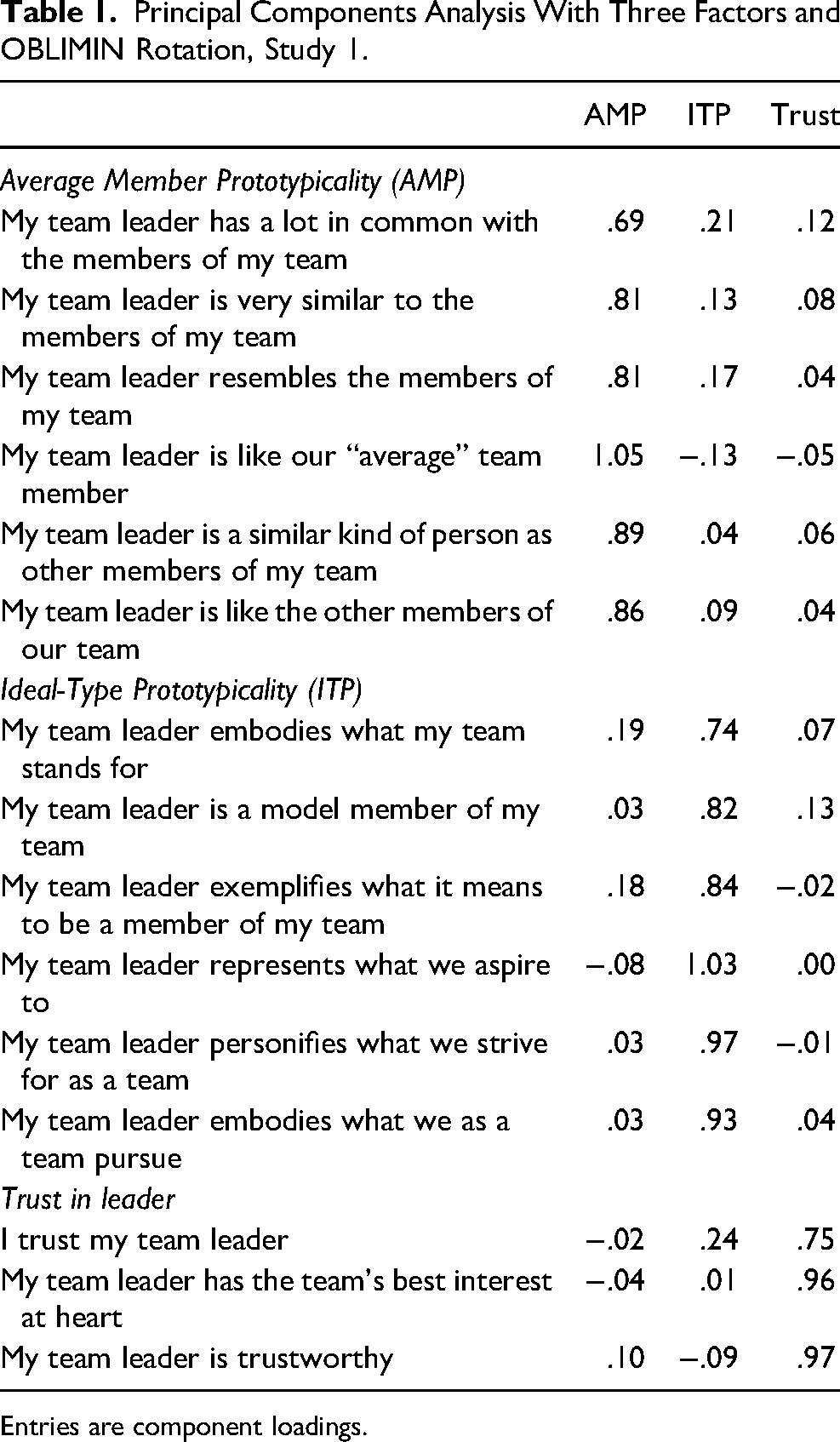
Scenario and Manipulations. Our starting point for the operationalization of AMP versus ITP aspects of LGP was the coding of LGP items by Steffens et al. (2021), who coded all available LGP items from their conceptualizations of AMP and ITP. From this, we identified three items for the AMP scale and another three items for the ITP scale that stood out as strongly reflecting AMP or ITP in the existing evidence base. Based on the definitions of AMP and ITP, we developed three additional items for each scale to add to this measurement. These items were developed by two of the authors and then vetted by two of the other authors (all subject matter experts) from the perspective of being well-aligned with the Steffens et al. (2021) definition of AMP and ITP as well as with the items derived from the Steffens et al. coding. This resulted in a total of six AMP items and six ITP items (provided in the Results section, Table 1, where we discuss the results of Principal Components Analysis [PCA]). These items were a reference point to develop our AMP versus ITP high versus low LGP conditions to ensure that experimental manipulations and manipulation checks in Study 1 and survey measures in Study 2 were aligned.
Principal Components Analysis With Three Factors and OBLIMIN Rotation, Study 1.
Entries are component loadings.
All participants received the instructions: “Described below is a situation in which leadership plays a role. Imagine that you are in the situation and answer the questions that follow as if you were in this situation.” They then read an introduction to the scenario that was constant across experimental conditions and suggested a situation in which they could identify with their team and their organization, as per the assumptions underlying the hypothesized effect of LGP:
You work for a consulting agency with an excellent reputation. It is widely seen as one of the best companies in its field. There is a good match between you and the company. You work in a team in close collaboration with your fellow team members. Your co-workers are people like yourself and have the same kind of attitude towards life and work as you have. You like your work and the company. You really feel at home there. The company has become an important part of your life.
This was followed by a description of their team leader that varied as a function of the combination of whether they were in either the high or the low LGP condition and either the AMP or the ITP condition. Description in the AMP conditions was as follows, with text that varied across high versus low LGP conditions in bold and high LGP text between brackets:
Your team leader is very
The scenarios for low versus high LGP in the ITP conditions, in contrast, were as follows, again with text that varied across conditions in bold and high LGP text between brackets:
Your team leader really
Measures. After reading this description of the team leader, trust in the leader was assessed with three items adapted from Giessner and van Knippenberg (2008; items are listed in the Result section, Table 1). Next followed AMP and ITP items as discussed previously to check LGP and Operationalization manipulations. Responses to all items were made on 7-point scales (where 1 = strongly disagree, 7 = strongly agree).
Results and Discussion Study 1
We first conducted PCA in SPSS to establish that our AMP, ITP, and trust in leader items were empirically sufficiently distinct. Because AMP and ITP are understood to reflect inherently overlapping operationalizations of the same construct, they were not expected to separate into different components with eigen values greater than 1. We therefore imposed a three-factor solution with OBLIMIN rotation (allowing components to be correlated) and focused interpretation of results on component loadings after rotation. Table 1 displays the component loadings for this analysis. As can be seen in this table, this PCA resulted in a solution with high loadings on the intended component and low cross-loadings, supporting the further analysis of these measures. As would be expected for different operationalizations of the same construct, the correlation of AMP and ITP scales was high, r = 86, p < .001. The reliability of the scales was very high (AMP α = .98; ITP α = .99; trust in the leader, α = 95).
Manipulation checks. To establish the effectiveness of high versus low AMP versus ITP manipulations, SPSS module MANOVA was run using AMP versus ITP measurement as a within-person factor in an analysis of variance with LGP and Operationalization of LGP as between-person factors. Because AMP and ITP are aspects of the same LGP construct, information about one will be taken to imply the other to some extent. As a result, the LGP manipulation in AMP as well as in ITP terms should affect both AMP and ITP measures (indeed, overall there was a very strong LGP main effect; F(1, 196) = 325.97, p < .0001). The important issue here is whether the effect of the LGP manipulation in AMP terms is stronger for the AMP scale than for the ITP scale and the effect of the LGP manipulation in ITP terms is stronger for the ITP scale than for the AMP scale. This is reflected in the highest-order interaction (that qualifies lower-order effects that were also observed) of LGP × Operationalization × AMP/ITP scale, F(1, 196) = 89.63, p < .0001. When LGP was operationalized in ITP terms, high versus low prototypicality conditions were more strongly reflected in the ITP measure (Mhigh = 6.42, Mlow = 2.30) than in the AMP measure (Mhigh = 5.46, Mlow = 3.54). Conversely, when LGP was operationalized in AMP terms, high versus low prototypicality conditions were more strongly reflected in the AMP measure (Mhigh = 5.92, Mlow = 2.38) than in the ITP measure (Mhigh = 5.61, Mlow = 2.42). These findings confirm the effectiveness of both LGP and operationalization manipulations.
Hypothesis test. We tested our hypothesis in analysis of variance using SPSS module MANOVA with a LGP × Operationalization between-person analysis of trust in leader as the dependent variable. Of lesser importance, LGP had a main effect, F(1, 196) = 175.23, p < .0001, η2 = .47, whereas Operationalization did not (nor was one expected), F(1, 196) = 2.47, p = .12, η2 = .01. The more important finding was the LGP × Operationalization interaction that qualified the LGP main effect, F(1, 196) = 21.54, p < .001, η2 = .10. As hypothesized, the LGP effect on trust was more pronounced for the ITP operationalization (high, M = 6.36, vs. low, M = 3.57, F(1, 197) = 36.91, p < .0001, η2 = .16) than for the AMP operationalization (high, M = 5.88, vs. low, M = 4.54, F(1, 197) = 156.79, p < .0001, η2 = .44). Thus, our hypothesis was supported in an experimental replication of Steffens et al.'s (2021) meta-analytical findings.
It is also noteworthy that the stronger effect of ITP operationalization relative to AMP operationalization was reflected both in higher trust when LGP was high and lower trust when LGP was low. This is consistent with our theory suggesting that in judging the extent to which their leader can be trusted group members put more emphasis on the ideal-type of the group, which would also imply responding less favorably to being dissimilar to the ideal type than to being dissimilar to the average group member.
Study 2
Methods Study 2
Study 2 was focused on complementing Study 1 (and Steffens et al., 2021) with a test of our hypothesis using survey data. We designed two otherwise identical surveys that differed only in whether LGP was operationalized as AMP or ITP. We thus again tested our hypothesis as an interaction of LGP and operationalization, with operationalization captured by the survey that respondents filled out.
Sample and procedure. In 2022, we used Prolific Academic's online panel service to recruit a sample of fulltime working adults fluent in English. Respondents filled out one of two online surveys that varied in whether they contained the AMP or the ITP measure but were otherwise identical. Following the payment guidelines of Prolific Academic, participants were paid $1.25 for their participation. Participants identified as European, South African, or Mexican (with 30% South African and 10% British). For quality control, we included two attention checks in the study (e.g., “Please select ‘Strongly Agree’”). Sixteen participants failed at least one of the attention checks and were dropped from analysis. This left a total of 290 respondents (146 in the AMP survey, 144 in the ITP survey; 141 men, 148 women, and one respondent identifying their gender as “other”; mean age = 30.24, SD = 8.22) participated in the study. We performed our main analysis with this sample, but in supplementary analyses added control variables. (Because of missing values on the control variables and the need to drop the one participant identifying their gender as “other” from the analysis to be able to control for gender, the final sample was N = 273 for this supplementary analysis.)
Measures. LGP operationalized as AMP (α = .91) or ITP (α = .96) was measured with the 6-item scales used in Study 1. Trust in the leader was measured with the same three items as Study 1 (Cronbach's α = .94). Survey (AMP vs. ITP operationalization of LGP) was represented by a dummy variable (0 = AMP survey; 1 = ITP survey).
To make the analysis as comparable as possible to Steffens et al. (2021) and Study 1, we performed the main analysis without controls. However, anticipating questions about potential controls, we assessed tenure with organization and tenure with leader in years, arguing that more experience with the organization and the leader might be associated with more nuanced LGP perceptions. We also assessed gender and age as potential controls in anticipation of questions about their relationships even when we do not have a clear rationale for them being related to either LGP or trust.
Results and Discussion Study 2
Before combining the two surveys, we first performed PCA on the LGP and trust items for each survey. For both surveys, a two-factor solution with OBLIMIN rotation yielded a pattern of component loadings >.70 on the intended factor and <.30 on the other factor. Table 2 displays means, standard deviations, and intercorrelations for Study 2 variables both for the combined sample on which hypothesis tests are based and separately for AMP and ITP surveys.
Means, Standard Deviations, and Intercorrelations, Study 2.
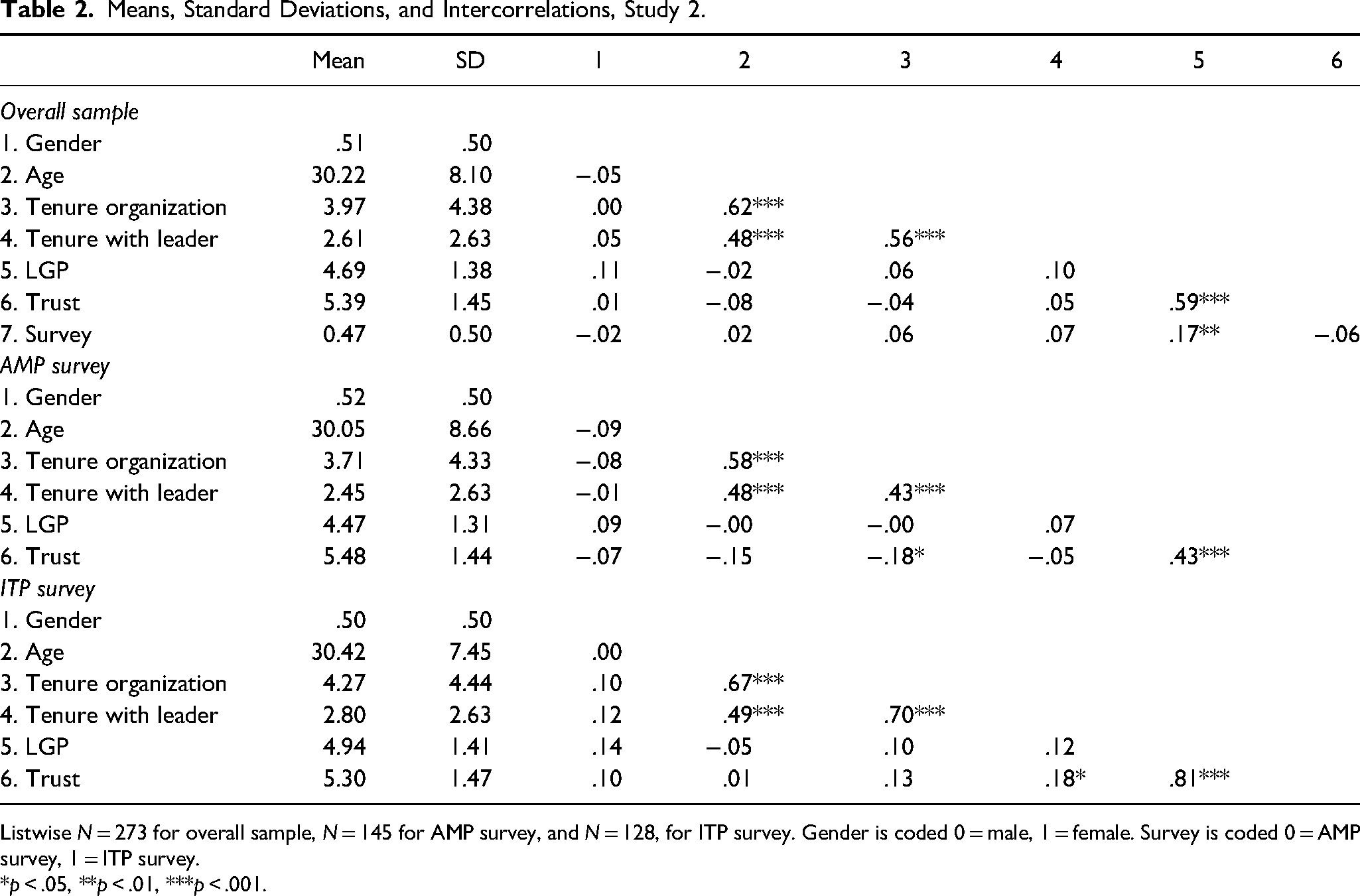
Listwise N = 273 for overall sample, N = 145 for AMP survey, and N = 128, for ITP survey. Gender is coded 0 = male, 1 = female. Survey is coded 0 = AMP survey, 1 = ITP survey.
*p < .05, **p < .01, ***p < .001.
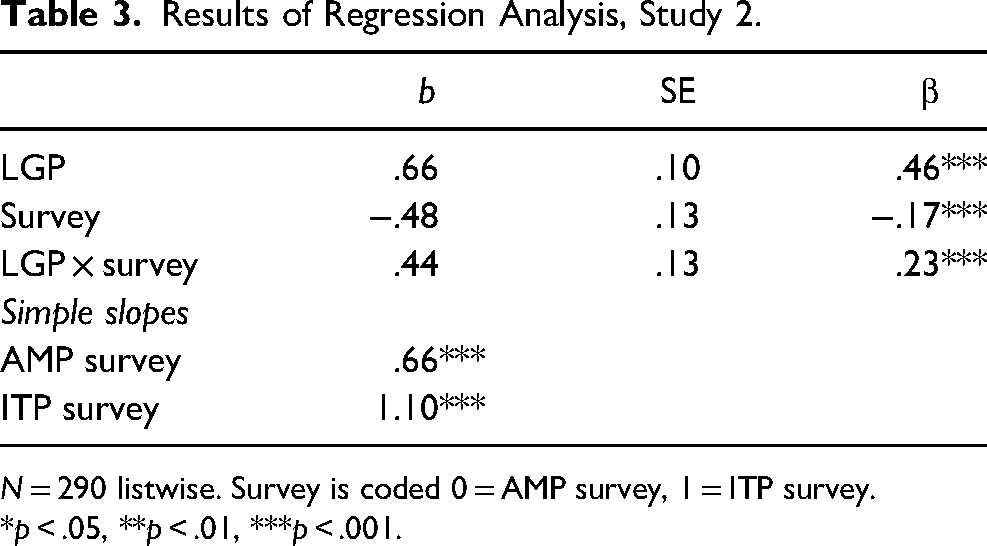
To test our hypothesis, we performed regression analysis in SPSS and this is reported in Table 3. We applied a z-transformation to the LGP score before computing the product term with survey to represent the interaction. We then regressed trust in leader on LGP and survey and (in a separate step) the interaction term. As shown in Table 3, this analysis indicated that LGP was positively related to trust—which replicates the main effect of LGP, as also reported in Steffens et al. (2021). We also found that trust was overall somewhat higher in the AMP survey sample than in the ITP survey sample. Whereas this reflects a chance finding unrelated to our hypothesis, it is relevant to keep in mind, because it means that the slope for LGP in the ITP survey will be somewhat lower than in the AMP survey (i.e., this is not an AMP vs. ITP effect, but a change difference between subsamples).
Results of Regression Analysis, Study 2.
N = 290 listwise. Survey is coded 0 = AMP survey, 1 = ITP survey.
*p < .05, **p < .01, ***p < .001.
The main finding to highlight here is the significant interaction, ΔR2 = .02, p = .001. Note that whereas the effect size for the interaction is small, this likely underestimates the true effect, because percept-percept main effects (i.e., LGP-trust) in survey research lead to an underestimation of interaction effects, leading Evans (1985) to argue that interaction effects in surveys should be judged based on their significance more than their effect size.
To determine the nature of the interaction, following Aiken and West (1991) we computed simple slopes for LGP for each survey. As shown in Figure 1, LGP was positively related to trust in leader both when LGP was operationalized as AMP, b = .66, p < .001, and when it was operationalized as ITP, b = 1.10, p < .001. However, the relationship was markedly stronger for the ITP measure. This supported our hypothesis and thus complements the Steffens et al. (2021) findings and the Study 1 findings with survey evidence.
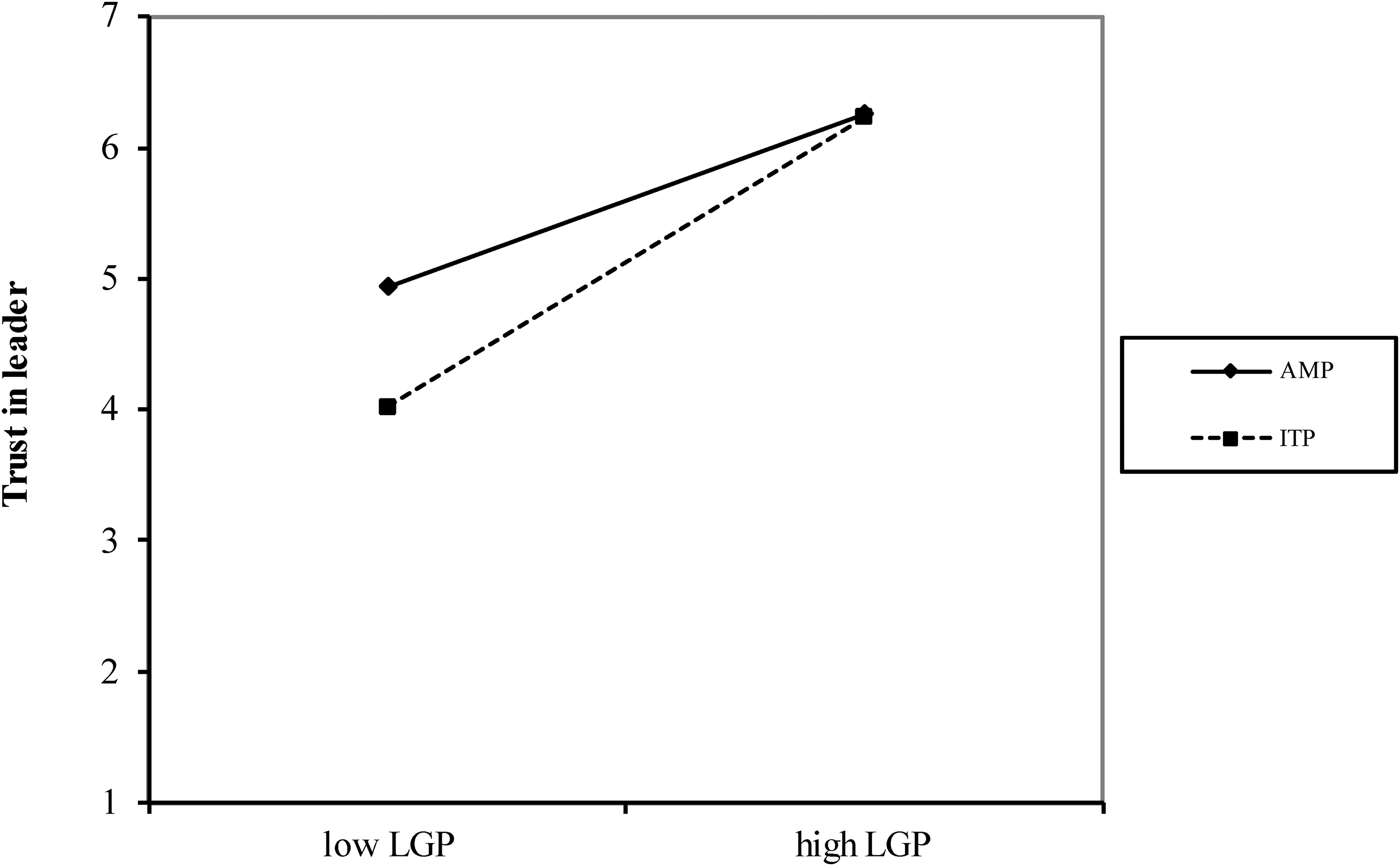
Interaction between LGP × Survey (AMP vs. ITP) on trust in leader, Study 2.
In a supplementary analysis, we tested our hypothesis with tenure with organization and with leader as controls as well as in an analysis with gender and age added as further controls. None of these controls had a significant relationship with trust and neither did any of the conclusions about relationships for LGP, survey, or their interaction change as a result of including controls.
General Discussion
Conceptual arguments about why LGP influences leadership effectiveness have, implicitly and explicitly, prioritized ITP over AMP (Steffens et al., 2013, 2014; van Knippenberg, 2011; van Knippenberg & Hogg, 2003). As Steffens et al. (2021) observed, however, they have done so with sufficient ambiguity to see AMP as well as ITP operationalizations of LGP (and associated conceptual understanding; cf. Halevy et al., 2011) in social identity theory of leadership research. Steffens et al.'s (2021) meta-analysis was important in bringing this issue to the fore and in providing evidence that the influence of LGP is more strongly associated with ITP than with AMP. The present findings complement the Steffens et al. findings with replications relying on within-study comparisons of ITP and AMP operationalizations and different methods. In doing so, they add to our confidence in the conclusions advanced by Steffens et al. (2021).
Theoretical Implications
In considering the implications of the current findings in combination with those by Steffens et al. (2021), it is important to again emphasize that ITP and AMP are not different constructs, but inherently overlapping operationalizations of the same LGP construct. The current findings underscore this in the fact that LGP operationalized as AMP also influences ITP ratings and LGP operationalized as ITP also influences AMP ratings and in the high correlations between AMP and ITP measures in Study 1. That is, the “average member” and the ideal-type of group identity are not independent from each other. The key point here is that ITP and AMP are not perfectly correlated. The ideal can be expected to diverge from the average (Turner et al., 1987) and ITP more accurately reflects the concepts of group prototypes and LGP and why group prototypes and LGP are sources of influence. In establishing this, the combined effort of Steffens et al. (2021) and the current work contributes to conceptual precision in the social identity theory of leadership.
This is important because more precise theory allows for more accurate predictions and operationalizations and more focused efforts in further developing the theory. An important notion in the self-categorization analysis of group prototypes for instance is that the group prototype more explicitly captures the group's distinctiveness from other groups than the “average member” (Turner et al., 1987). Such notions of distinctiveness are more broadly important in understandings of group and organizational identity (Brewer, 1991; Dutton et al., 1994) and may warrant more explicit consideration in the study of social identity and leadership.
The conclusion that LGP should be conceptualized and operationalized as ITP also brings into focus the issue of how LGP impacts leaders’ ability to effectively advocate an understanding of group (team, organizational) beliefs, norms, values, and ambitions. van Knippenberg (2020) for instance proposed that LGP enhances the influence of leadership advocating an understanding of the organization's (values-based) purpose. The current analysis underscores that such a proposition is better aligned with the notion that LGP reflects the ideal-type of the group than the average group member. In a related vein, the conclusion that LGP should be understood in ITP terms rather than AMP terms is important for the study of leader agency in influencing group member perceptions of LGP (e.g., van Knippenberg, 2023). The current findings underscore that to be effective, such agency should prioritize building an image of embodying group norms, beliefs, and values more than of being an average group member.
We focused our analysis on individuals in formal leadership positions, as does the vast majority of social identity of leadership theory studies (Steffens et al., 2021). From its inception, however, the social identity theory of leadership was also intended to apply to emergent leadership—emerging in an informal leadership role in a group context (Hogg, 2001). Early social identity theory of leadership studies also showed that team members’ group prototypicality is positively related to leadership emergence (Fielding & Hogg, 1997; van Knippenberg et al., 2000). Accordingly, it is valuable to explicitly note that the current conclusion that LGP should be understood in ITP terms should also apply to the consideration of member group prototypicality in emergent leadership research.
In our current focus on trust in leader, we singled out one of the many indicators of leadership effectiveness captured in the Steffens et al. (2021) meta-analysis. We contend we did so for good reason. Within the social identity theory of leadership, trust is important as a proximal outcome of LGP that explains (mediates) more distal effects such as why LGP substitutes for group-serving behavior—because high LGP leaders are trusted to have group-serving intentions, there is less need for them to show it in their behavior in order to be effective in influencing followers (Giessner et al., 2009; Giessner & van Knippenberg, 2008; van Knippenberg & van Knippenberg, 2005) and why LGP is positively related to support for change in organizational change contexts—because high LGP leaders are trusted to ensure continuity of group identity (van Knippenberg et al., 2008). More recently, a focus on the role of trust in leader has also been highlighted as instrumental in explaining why LGP can both enhance and substitute for the effects of leader fairness (van Knippenberg & Dwertmann, 2022). Trust is thus important in the social identity theory of leadership and the conceptual precision in emphasizing ITP is important in developing the analysis of the role of trust in LGP effects further. The emphasis on trust in leader is far from unique to the social identity theory of leadership, however, as the meta-analysis by Dirks and Ferrin (2002) highlights. A focus on the role of trust moving forward can thus also be particularly valuable in bridging streams of research (cf. van Knippenberg & Dwertmann, 2022).
The most important implication for researchers that we derive from our study is that it underscores the value of putting an explicit emphasis on ITP (rather than AMP) in theorizing about and operationalizing LGP. As Steffens et al.'s (2021) analysis highlighted, research on LGP had been characterized by ambiguity in this respect. Explicitly addressing this issue and creating conceptual clarity has been a contribution of the Steffens et al. (2021) study. The present replications underscore these earlier conclusions and add weight to the importance of understanding the influence of LGP in ITP terms. Conceptually, this involves seeing the aspirational influence of group prototypes as central to the influence of LGP. Operationally, this means relying on experimental inductions like the one used in Study 1 and survey measures like the one used in Study 2 that put the emphasis on ITP.
Limitations and Future Directions
We focused on trust in leader as a proximal and important outcome of LGP (van Knippenberg & Hogg, 2003). This is not to suggest that trust would be the only relevant outcome to consider—trust is one of a range of outcomes included in LGP research (Platow et al., 2003). As a case in point, the Steffens et al. (2021) meta-analysis included job attitudes and behavioral outcomes in addition to evaluations of the leader as indicators of leadership effects. The current focus was on replication tests relying on within-study comparisons of AMP and ITP across methods. Achieving this goal did not require the study of a broader range of dependent variables. Clearly, though, this is not to suggest that future work should be limited to trust. LGP effects on behavioral outcomes in particular (e.g., subordinate performance; van Knippenberg & van Knippenberg, 2005; or creativity; Hirst et al., 2009) are valuable to study, as these are ultimately where organizations are most interested in discovering evidence of effective leadership (Kaiser et al., 2008). In this respect, it is important to note that while the focus on trust only is an obvious limitation of the current study, the Steffens et al. (2021) meta-analysis shows that LGP effects generalize across indicators of leadership effectiveness. Specifically, whereas they are stronger for more proximal outcomes such as leadership evaluations than for more distal behavioral outcomes, they differ in strength only and not in nature. There thus seems little reason to doubt that the current replication based on within-study comparisons would extend to other outcomes of interest.
It is also important to note that our focus was specifically on complementing meta-analytic evidence relying on between-study comparisons with replication tests across methods relying on within-study comparisons. In this context, there should be little concern with the specific shortcomings of the two studies we report, such as the hypothetical nature of the Study 1 scenario experiment and the lack of other leadership variables to control for third variable influences in the Study 2 survey. The reason for this lack of concern is that we can base conclusions on findings that replicate over meta-analysis, experiment, and survey. We should recognize, however, that outside of the specific context of the current study, the shortcomings of our studies would loom larger, especially when they would not be combined for a multi-method test of hypotheses but would be reported stand-alone. That is, whereas the current studies suffice for the current purposes, stand-alone they should not be seen as “role models” for future research developing the current analysis further.
For instance, stand-alone, an experiment yields substantially stronger evidence when it does not concern a hypothetical situation but a situation in which participants are actually immersed, and a stand-alone survey would benefit from more information about the sample vis-à-vis the research population from which it is drawn than an online platform allows and from a dependent variable that is not rated by the same source as one of the independent variables. Moreover, because our ultimate interest in leadership research is in behavioral outcomes (Kaiser et al., 2008), either approach would benefit from a focus on behavioral outcomes. Social identity theory of leadership research provides ample examples of what such research may look like (cf. Steffens et al., 2021).
In view of the growing awareness of the validity problems with survey measures of leader behavior (Fischer & Sitkin, 2023; van Knippenberg & Sitkin, 2013), it is also important to note that LGP is not a behavior but a subjective perception to which these concerns do not apply. That said, however, future survey research developing the current analysis may include leader behavior scales, for instance to control for potential third variables or as precursors to LGP. Such research would be well-advised to take the concerns with leader behavior measurement into account.
Conclusion
As powerful as the findings from meta-analysis are, they sometimes benefit from replication with different methods. The present focus on replicating Steffens et al.'s (2021) finding for AMP versus ITP operationalizations of LGP is a case in point. Our multi-method replication bolsters confidence in Steffens et al.'s conclusions. It adds to the theoretical focus and precision that their study provided and reinforces their conclusion that LGP effects are better understood in terms of group prototypes as reflecting the ideal-type of the group. This greater focus and precision provides a stronger basis for future research seeking to develop, extend, and apply the social identity theory of leadership.
Footnotes
Declaration of Conflicting Interests
The authors declared no potential conflicts of interest with respect to the research, authorship, and/or publication of this article.
Funding
The authors received no financial support for the research, authorship, and/or publication of this article.
