




Abstract
This study examines military leaders’ sensemaking processes during the October 7th, 2023 Hamas terrorist attack on Israel, focusing on civilian-military interactions in an unprecedented crisis. Using Karl Weick's sensemaking theory, the research analyzes semi-structured interviews with military leaders to explore how officers interpreted and responded to extreme uncertainty. The study highlights three key sensemaking strategies: social interactions, extracting situational cues, and dynamically engaging with the environment. Findings reveal how military leaders rapidly transitioned between combat and civilian rescue operations, demonstrating complex psychological adaptations for effective decision-making amid chaos, limited communication, and significant civilian casualties. The research extends previous work on leadership in extremis by examining a unique context where military leaders simultaneously engaged in combat and civilian rescue operations. This study provides critical insights into human cognitive processes during high-stress emergencies and offers potential implications for future military training and crisis response protocols.
Keywords
Introduction
The October 7th, 2023 Hamas attack on Israel presented military leaders with an unprecedented challenge: conducting combat operations while simultaneously rescuing civilians caught in the crossfire. This research delves into the critical role of sensemaking in these chaotic and high-stakes situations, examining how military leaders interpreted and responded to extreme uncertainty during hostage rescue scenarios through the lens of Karl Weick's sensemaking theory. Sensemaking theory provides a robust conceptual framework for analyzing how military leaders approached and managed rescue operations under conditions of complexity and uncertainty.
Our study builds upon Dixon et al.'s (2017) work on leadership in extremis, extending it to a unique context where military leaders had to simultaneously engage in combat and civilian rescue operations. We investigate how officers operated under extreme uncertainty, with limited inter-unit communication and insufficient situational information, while working to rescue civilians caught in the terror attack.
The Hamas surprise attack on October 7th, 2023, targeted Israeli communities, kibbutzim, military bases, and cities in southern Israel, resulting in civilian casualties and approximately 250 hostages being taken (Human Rights Council Report, 2024; United Nations, 2024). Unlike previous conflicts, this offensive was distinguished by extensive civilian presence on the front lines, presenting unprecedented challenges for military leaders.
This research examines how military leaders interpreted and responded to extreme uncertainty while balancing combat and civilian rescue operations. The sensemaking strategies employed enabled rapid transitions between these tasks, demonstrating complex psychological adaptations for effective decision-making amid chaos, limited communication, and significant civilian casualties (Steinbauer et al., 2015).
Although the issue of sensemaking in combat has received attention in several research studies (e.g., Ben-Shalom et al., 2012; Ben-Shalom & Benbenisty, 2015; Collins et al., 2023; Combe & Carrington, 2015; Dixon et al., 2017; Mumford et al., 2007; Padan & Ben-Shalom, 2020), the main contribution of this research is a pioneering qualitative analysis of military personnel's cognitive and emotional experiences during a surprise attack involving civilians in a civilian setting. By examining how officers made sense of and responded to this extreme crisis using Weick's sensemaking theory, we offer unique insights into military decision-making during high-stress, unexpected emergencies. Specifically, our findings reveal how military leaders rapidly transition between combat mindsets and civilian protection approaches, demonstrating cognitive flexibility in crisis contexts. Furthermore, this study identifies how officers’ personal experiences and social connections influence their sensemaking processes during civilian rescue operations, providing new frameworks for understanding leadership adaptation in complex threat environments involving non-combatants.
Building on Mumford et al.'s (2007) work on leadership sensemaking under crisis conditions, this research applies the sensemaking framework to understand human adaptation in crisis situations. Our study contributes to the literature by analyzing the need for specialized leadership training in extremis environments, and exploring how a sense of duty shapes leadership behavior. By utilizing the sensemaking framework, we provide new insights that could inform future military training and crisis response protocols. Our analysis demonstrates how military leaders employ three critical sensemaking strategies when simultaneously managing combat operations and civilian rescues during homeland security crises. These findings suggest that military training programs should incorporate scenarios requiring rapid cognitive transitions between combat and civilian protection mindsets, while developing shared leadership capabilities that allow for distributed decision-making among military personnel and civilians at the scene. Such training would enhance leaders’ capacity to interpret fragmented information and enable flexible authority structures during complex emergencies where traditional command hierarchies may be insufficient.
Theoretical Framework: Sensemaking
Sensemaking theory, developed by Karl Weick (1995, 1988), examines how individuals and organizations interpret events and assign meaning to unexpected situations. The theory comprises seven key parameters that work in concert to explain how individuals process and respond to crisis situations. At its foundation, sensemaking is grounded in identity construction, where performance is influenced by personality structure, identity, and experience. The process is inherently retrospective, as interpretation relies on past experiences to understand present events. Rather than seeking perfect accuracy, individuals base their decisions on plausibility and intuition, focusing on specific reality components while filtering others.
The theory further posits that individuals’ actions shape their environmental interpretation and response, while their perception is significantly influenced by interactions with others. Importantly, sensemaking is not a discrete event but rather an ongoing process that continues through both routine and crisis situations (Mills et al., 2010; Smerek, 2011; Weick, 1988).
Sensemaking includes three stages: absorption of information from the environment, interpretation, and insertion into a cognitive pattern that will allow reuse in the future (Kalkman, 2020). This process aims to prevent collapse in emergencies by relying on narratives, rules, and norms from ordinary life. Routine tools give a person or organization security and certainty even in an emergency, in which the military leader must respond rationally and pragmatically.
Shared Leadership in Crisis Response
Disasters of any kind, natural or artificial, shake the existence of the community and society and disrupt its functioning. The consequences of the disaster are also affected by the degree of preparedness of the various state authorities and citizens (Sariego, 2006). Responsibility for crisis management lies with local and national authorities and guarantees the safety of citizens, and at the same time citizens take steps to protect themselves from threats perceived as imminent and likely to occur (Helsloot & Ruitenberg, 2004; Hobbins, 2017). During crises, the sensemaking process becomes increasingly complex due to the nature of high-stakes events that occur with low probability. These situations demand rapid learning and environmental awareness, forcing individuals to rely heavily on their previous knowledge and experience (Weick, 1988). A crucial aspect of crisis response is that action often precedes complete understanding, which can lead to systematic errors in initial crisis response (Paulus et al., 2022).
A surprise attack is a standard combat technique, and many countries and organizations use it to give themselves a significant advantage over their adversary. Surprise attack factors include surprise in timing, weapons, attack areas, and attack methods (Lanir, 2010). Surprise itself is not a guarantee of success in combat. However, it gives a significant advantage to the attacker and allows them to cause considerable damage to their enemy, who is not ready for battle (Morris, 2009). A sudden attack can be a stressful and even fatal event, mainly when it occurs in an intermittently threatening environment. Environments in which the threat persists over time and is undulating in nature may cause complacency on the part of soldiers so that the surprise attack, when it comes, strikes harder (Jensen & Wrisberg, 2014).
The battlefield has many characteristics, the most relevant of which are danger, uncertainty, and surprise (Ben-Shalom & Benbenisty, 2015). Due to the vagueness that characterizes combat, the ability to make logical and rational decisions is impaired. This makes it difficult for soldiers to understand their surroundings and adapt sensorially and actively (Kalkman, 2020). For example, critical thinking seems to be impaired during battle, and officers find it challenging to exercise thorough judgment in decision-making due to the conditions of combat (De Graaff et al., 2019). Indeed, combat situations present particular challenges to the sensemaking process. The inherent danger, uncertainty, and surprise characteristics of combat create an environment where gaps between planning and execution are inevitable. Under these conditions, rational decision-making abilities may become impaired due to the presence of irregular physical stimuli affecting perception. Analyzing and understanding the crisis involves asking questions about the identity of the person or organization and the nature of the crisis. These questions enable accelerated learning, renewal, and development among those encountering a crisis (Maitlis & Sonenshein, 2010). These processes rely on relevant previous knowledge and personal experience of the person facing a new situation (Pirolli & Russell, 2011). Military leaders must undergo rapid “reboot” processes to adapt to changing circumstances, often while managing interactions with civilians under extreme stress. Within these complex crisis environments, leadership often extends beyond traditional hierarchical models to incorporate more distributed approaches.
Shared leadership represents a dynamic, interactive influence process among individuals in groups where the objective is to lead one another toward the achievement of collective goals (Pearce & Conger, 2003). This approach is particularly relevant in complex, uncertain environments where no single leader possesses all the knowledge and skills required to address multifaceted challenges (Friedrich et al., 2009). In crisis situations, shared leadership enables the distribution of decision-making authority based on expertise rather than formal hierarchy, allowing for rapid adaptation to changing circumstances and leveraging collective intelligence when traditional command structures are compromised (Hannah et al., 2009; Yammarino et al., 2012). Recent research by Pearce et al. (2023) highlights the paradoxical nature and reciprocal dynamics between vertical and shared leadership, suggesting that these approaches operate simultaneously rather than as opposing systems.
Crisis environments, such as combat situations involving civilians, create conditions where traditional leadership hierarchies may be disrupted or insufficient. In these contexts, shared leadership emerges as both a necessity and an adaptive response, with leadership functions shifting among military personnel and sometimes including civilian stakeholders based on situational demands and available expertise (Uhl-Bien et al., 2007; van Knippenberg et al., 2024). Research suggests that effective leadership often involves oscillation between vertical and shared leadership approaches, where formal leaders create conditions for distributed leadership while maintaining ultimate responsibility for outcomes (Ensley et al., 2006; van Knippenberg et al., 2024). This dynamic is particularly evident when military forces interact with civilian populations during emergencies, requiring rapid integration of diverse perspectives and capabilities while maintaining operational coherence (Day et al., 2014). As Shamir and Lapidot (2003) emphasize, shared leadership becomes especially crucial in managing group boundaries during crisis situations, where the distinction between military and civilian domains may blur, requiring collaborative leadership processes to effectively coordinate response efforts. Ben-Shalom et al.'s (2005) field study of combat units during the Al-Aqsa Intifada further demonstrates how unit cohesion and shared leadership practices emerge organically in high-stress combat situations, showing that effective military responses in civilian-populated areas depend on both formal command structures and the informal distribution of leadership responsibilities based on situational demands.
The events of October 7th, 2023 present a unique opportunity to examine how these leadership dynamics, particularly shared leadership processes, manifested during an extreme crisis involving both military personnel and civilians. As established by Mumford et al. (2007), leader cognition is domain-specific, with crisis management being a critical domain for leader performance. The generation of sensemaking systems is a key cognitive process leaders use to address crises and change events. This approach combines both knowledge structures (case-based knowledge) and processing operations (scanning, analysis, forecasting) to understand leader performance during crises.
Case Study: October 7th, 2023
Hannah et al. (2009) have characterized several dimensions of extreme contexts that influence the leader's understanding of the specific context: location in time, magnitude of consequences, probability of consequences, physical or psycho-social proximity, and form of threat. Across all these dimensions, the case that was selected for the purpose of this research raises the level of extremity and thus the need for an adaptive leadership response.
On October 7th, 2023, at 6:30 a.m., Hamas's armed wing launched a massive attack on Israel using rocket fire. After the initial barrage, Hamas terrorists breached the Gaza-Israel border fence in at least 29 locations, continuing their attack by air, land, and sea (Human Rights Council Report, 2024).
While some groups of terrorists attacked military bases, others targeted towns and villages, brutally killing civilians including men, women, and children, in their homes. In some cases, victims were murdered after being subjected to sexual violence. The terrorists carried out attacks in multiple locations, including an outdoor music festival near Kibbutz Re'im, where 364 attendees were massacred (Human Rights Council Report, 2024; Mission report by the Office of the SRSG-SVC, 2024). Military response was hampered by communication failures, lack of equipment, and strategic terrorist ambushes at key junctions. It took many hours for significant military forces to reach affected communities, leaving civilian defense squads as the primary protection (Human Rights Council Report, 2024).
While the attack included military targets, civilians bore the brunt of casualties. The breakdown in communication infrastructure and military preparedness led to delayed rescue operations, leaving civilians vulnerable in combat zones for extended periods. The attack resulted in approximately 1,200 fatalities, 14,970 injured, and 250 abductees, marking it as one of the deadliest days for Jews since the Holocaust. The victims included Israeli citizens, foreign nationals, and workers from various countries (Human Rights Council Report, 2024; Mission report by the Office of the SRSG-SVC, 2024).
Sensemaking in Interaction with a Civilian Population on October 7th
On the morning of October 7, 2023, Israeli commanders and soldiers were urgently summoned to battle zones following a surprise attack by Hamas. The timing of the attack coincided with the Jewish holiday of Simchat Torah, when many soldiers were at home celebrating with their families. Communications were severely disrupted, and forces had an incomplete situational picture, creating significant uncertainty about both the threat they faced and their specific objectives.
Upon reaching assembly points, the forces began preparing to enter civilian communities under siege. Their mission was threefold: to neutralize terrorists, to regain control of the communities, and to rescue hostages. These efforts unfolded amidst heavy fog of war, with unclear conditions inside the targeted areas and a constant fear of friendly fire, as chaotic circumstances increased the risk of accidental harm to allied forces.
Beyond the many challenges in the fighting, the fact that it took place in an environment saturated with civilian populations required the military leaders to conduct themselves cautiously and sensitively toward civilians caught up in the battlefield. As mentioned above, many significant processes of sensemaking with its various qualities are carried out in warfare. Every combat situation requires analysis and response from the officer, who assesses the situation and weighs their steps using the meaning they derive from the event.
According to all of the above, the research questions are:
How does the presence of civilians on the battlefield impact military leaders’ decision-making and psychological adaptation during extreme emergency? How do military leaders use sensemaking strategies to navigate complex civilian-military interactions during unexpected crisis situations? What cognitive and emotional processes do officers experience when transitioning between combat and civilian rescue operations?
Method
This study employed a qualitative research approach, utilizing semi-structured, in-depth interviews (Bryman, 2016) to explore the experiences of military leaders who participated in the events of October 7th. The qualitative paradigm was chosen to provide a comprehensive and nuanced understanding of the participants’ lived experiences, allowing their voices to be authentically represented in their own words. Qualitative research is particularly suited for exploring how individuals or groups ascribe meaning to social or human situations (Creswell, 2014). This approach aligns with the study's goal of capturing the subjective perspectives of leaders who operated under extreme conditions, emphasizing their unique insights and emotional narratives. The research sought to address the unprecedented civilian-military interactions that emerged during this crisis, highlighting the complex dynamics between military operations and civilian environments.
The study sample consisted of 15 commanders (14 men and 1 woman), selected from a larger pool of 50 commanders who took part in the battles of October 7th. The low number of women in the sample reflects the broader gender distribution in the combat zones on that day. Participants were purposefully selected based on their direct involvement in critical interactions with civilians, primarily in efforts to rescue them during combat. The relatively small number of interviewees reflects the study's specific focus: only a subset of those interviewed had meaningful and documented engagements with civilians during the fighting. The sample included both active-duty officers and reservists, offering a diverse range of military roles, experiences, and perspectives (For a detailed overview of the participants’ demographic information, refer to Appendix A).
Semi-structured interviews were selected as the primary data collection method due to the flexibility and adaptability that the method entails. This format combines a predetermined framework of questions with the freedom to explore emergent themes and delve deeper into participants’ responses (Bate-Marom & Ashkenazi, 2012). The interviews began with an open-ended question inviting participants to describe the events of October 7th as they experienced them, followed by targeted questions designed to clarify or deepen understanding of key points raised during the conversation. When necessary, the interviewer intervened with questions in order to clarify the sequence of events during the fighting on October 7th. Otherwise, the interviewee recounted their story freely and from their own perspective (see Appendix B for the full interview protocol). This method ensured that participants could recount their stories with minimal external influence, fostering detailed and authentic narratives.
The interviews were conducted in various locations chosen for participants’ convenience and included commanders from diverse military ranks (ranging from captain to lieutenant colonel). This diversity among interviewees helped provide a broad spectrum of perspectives. Efforts were made throughout the process to minimize interference during both the interviews and subsequent analysis, preserving the authenticity of participants’ narratives.
Thematic analysis was employed to systematically identify patterns of meaning within the interview data (Braun & Clarke, 2006). The analysis unfolded in two structured stages to ensure analytic rigor, accuracy, and trustworthiness (Lincoln & Guba, 1985).
In the first stage, the lead researcher conducted a comprehensive open coding process, reading and re-reading each transcript to identify significant units of meaning, with attention to recurring concepts, emotional expressions, and sensemaking strategies described by participants. Codes were developed inductively and remained close to participants’ own language in order to preserve the authenticity of their lived experiences (Gioia et al., 2013). This phase emphasized sensitivity to both explicit statements and implicit patterns emerging across narratives.
In the second stage, a second researcher independently reviewed the full set of coded materials. This review involved both validation of code application and collaborative discussion of emergent themes. Discrepancies were resolved through reflexive dialogue, and the thematic structure was refined to enhance coherence and representativeness. This dual-review process increased the credibility and dependability of the findings (Miles & Huberman, 1994; Nowell et al., 2017).
Throughout the analysis, attention was given to both within-case and cross-case patterns, allowing for the development of three integrative themes that reflect the sensemaking processes across diverse operational contexts. These themes – social interactions, cue extraction, and enactment of a sensible environment – were subsequently interpreted through the lens of Karl Weick's (1995) theory of sensemaking, which provided a robust conceptual framework for understanding how individuals construct meaning and take action under conditions of extreme uncertainty. This layered approach enabled the research to capture the cognitive, emotional, and relational dimensions of military leadership strategies employed when confronting simultaneous combat and civilian rescue responsibilities.
Results
Building on the thematic analysis described above, the findings are organized according to three integrative themes that emerged most prominently across the narratives: social interactions, cue extraction, and enactment of a sensible environment. These themes were not selected in advance but rather inductively derived during the two-stage coding process and later interpreted through the lens of Weick's (1995) sensemaking theory.
The decision to focus on these three sensemaking dimensions was based on their consistent and central presence in the officers’ accounts. Participants repeatedly described how they relied on interactions with civilians and peers to interpret unfolding events; how they extracted fragmented cues amid communication breakdowns; and how they actively engaged with and reshaped their operational environments to enable action under uncertainty. These themes proved essential in understanding how military leaders navigated the unique complexity of simultaneously conducting combat operations and civilian rescues during the October 7th crisis.
First Theme: Social Interactions
The influence of civilians’ presence on military leaders’ behavior represents the ‘social’ quality of producing meaning. The social aspect strongly influences the sensemaking process that a person carries out. How a person perceives a situation is subject to their interactions with others, whether those who share the situation with them or not. This effect stems from a person's need to control their image and how others see them.
Rescuing civilians from the combat zone caused military leaders to change how they analyzed and acted in the situation, both emotionally and practically. In rescuing civilians from their homes, human and gentle interactions emerged from the officers’ desire to protect civilians caught in the battlefield. M., an officer who arrived at Kibbutz Kfar Aza, describes his attempt to calm children he rescued: “I have nothing on me, right? I try to give ‘high five’ to the kids, talk to the kids, tell them everything will be fine. I let them play with the laser weapon, and all kinds of things like that…I do not have anything on me… with the first family we got out I had a bottle of Coke in the car, so I gave it to them. There is nothing here, and I looking for a way to help the kids deal with the stress.”
The dissonance between interacting with small children and the combat situation is incongruous and introduces the officers to an extreme reality. A., a combat captain, describes his attempts to protect civilians: “I got stuck in a traffic jam where no one can get anywhere, an atomic mess. I got out of the car, there were bodies on the side of the road. The children we rescued were in the car and they saw all the bodies…I asked my driver to bring a blanket from the car, a sheet of cloth, something to cover the bodies so that people wouldn't see.” “We came to the houses (…). We took out an 87-year-old grandmother who We found her lying on the bed in the safe room with a candle and a kitchen knife next to her – 87-year-old. I do not know what she was ready for, but you know, my grandmother has difficulty hearing too, you know, you turn on a light upstairs and say, “Hello, we are from the army.” “What???” “Army” (laughs). Now, you do not look like the army […] you are wearing a face mask and that, so you take off the face mask, you take it off, and you say, “Hello, how are you? We came to save you”, “Thank you very much!"(Laughs), okay. […]God, she is calculated in this, incomprehensible.”
Beyond the immediate situation, there is also the presence of people who are not physically present but influence decision-making. Part of the officers’ work involved collecting bodies of murder victims. A. describes his thoughts of the victims’ parents and his desire to give them certainty: “The mission was to bring as many bodies [of Israelis] as possible. So that as many parents as possible will be notified: ‘Your son is dead and not missing.’ As if the mission had changed…Um…Also, I think I would prefer it if I were a parent. I would rather know he is under a stone than I do not know where he is.” “Dozens of citizens are joining us. I am without ranks on my uniform, so people do not understand what I am shouting to them, ‘You are here, you are this, it is there, it is wounded.’ Shouting – wait, take care of the wounded […]I tell them, ‘Break the ambulance,’ while fighting on the road, ‘Take out what you can and take care of people.’
To sum up, the nature of the environment that surrounds the officer in each situation influences their functioning and decisions. The human relations revealed in battle were already shaped beforehand and are also expressed in combat. The civilian environment, mixed with the fighting, mobilizes the officer's softness and sensitivity from their day-to-day life into combat. This process of sensemaking helps officers analyze situations and act accordingly, especially when confronted with conflicting messages that require organizing a certain logic for themselves.
Second Theme: Focus on and by Extracted Cues
The sensemaking process involves focusing on specific components of reality while ignoring other elements that don't contribute to one's interpretation. This selective attention leads to interpretations based on specific cues that a person collects, often prioritizing plausibility over accuracy (Mills et al., 2010). People tend to emphasize cues that confirm their existing prejudices, thus creating a picture that aligns with their inner logic (Holt & Cornelissen, 2014; Weick, 1988).
During October 7th, the uncertainty and limited knowledge of the situation forced officers to use every piece of information they gathered in the field for decision-making. The interviews reveal how military leaders filtered reality, sometimes completely ignoring data that didn't advance their immediate operational needs. This process of extracting cues is delicate – while officers paid attention to small details, they might simultaneously fail to perceive other visible stimuli.
H.'s interview clearly demonstrates this selective perception: “We drove, I arrived at the Yad Mordechai junction…What I noticed was that behind the concrete blocks, there was an encounter. We arrived, and there were two soldiers, paratroopers, dead…Yesterday, someone sent me a video of this and so I saw three dead civilians that I did not even notice.”
In this situation, H. absorbed only information relevant to his immediate needs. According to sensemaking theory, he identified the dead soldiers likely because he was trying to understand the scope of operating forces. The dead civilians went unnoticed because they were irrelevant to the immediate conduct of fighting. This selective attention was crucial for survival and operational efficiency, even though certain information (like civilian casualties) would become important at later stages.
The interviews described sharp transitions between fighting terrorists and interacting with civilians seeking shelter. A commander's observation and information gathering were strongly influenced by their primary goal at any given moment. An example of this comes from M.'s interview, where he demonstrates sensemaking through seemingly minor details: “I look on the left side at the coat rack, and I see three bicycle helmets…There cannot be three helmets and two children…We ask her, ‘Where is your sister?’ She tells me, ‘She must have been shot outside like they killed my father’.” “We scan the area, go to search houses together, but we don’t find them. We go back and we document the scene, and we don’t find another place where shots were fired. Basically, we don’t find the father's location, and we don’t find the brother's location, so we rule out the possibility that they were shot there – meaning, it's very unlikely. And in the house, no search was conducted, nothing was overturned, and nothing is missing.”
The interaction between civilians and officers during rescue operations also involved mutual cue extraction. As demonstrated in this quote from M.: “Do you have Facebook? Yes. What is your name? What is the name of your brigade commander?…Where do you live?…Next to what is it?” “A 5-year-old girl has been on and off the phone with her uncle since 6:00 in the morning. She's at home with her older brother, and somehow, they’re holding on. We knock on the door – nothing…silence. We notice something in the corner of the light and head toward the safe room. We call her uncle, and he calls her. We go back to the front door, knock, and tell her, ‘We spoke to your uncle.’ She says, ‘Yeah?’ and asks us to identify ourselves – a 5-year-old, asking for identification? Unreal.”
Through this quote, we can see how a social actor who is not physically present in the situation – the uncle of the children whom the soldiers are trying to evacuate – is in telephone contact with the force's commander and assists him remotely. On one hand, he guides the military force to the correct house and the right room where the children are located, and on the other hand, he maintains contact with the children in the house, reassuring them that these are Israeli military forces (and not Hamas militants). This represents a form of remote leadership by a civilian actor, maintaining interactions that influence how events unfold.
Another example is when M. and his team evacuate two families under fire. In this situation, cues he extracts from the environment and from the civilians’ behavior at the scene help him understand what would be an effective response. He decides to give one of his weapons (a gun) to a civilian who, according to his judgment, can assume a combat role and assist the military force during the evacuation: “We enter the safe room and there are eight people there. One father is standing there with a hammer…We evacuate everyone until I'm left alone with the two fathers. One seemed less rational to me and the second - the one with the hammer seemed more rational – so I exchanged his hammer for a gun. He asks me – ‘Is it cocked?’ I told him – ‘It's cocked, you only shoot in that direction.'”
The process became particularly poignant in situations involving children, as M. describes: “We step inside and see the kids in the living room. We dress them, put their shoes on. We decide to give them a little time. I find an iPad and think, ‘I have kids, I know what an iPad is.’ I tell the kids to bring a charger for the iPad, grab some toys. We pack a bag and take them outside.”
This example shows how M. drew on his personal experience as a parent to extract and interpret cues, helping him prioritize actions and build trust with frightened children. He relied on familiarity with routine situations to make sense of and operate within this extraordinary circumstance.
The process of extracting cues, while not always precise, became the primary means through which officers constructed their understanding of reality on October 7th. Without formal intelligence or communication between various forces, these subjective interpretations, based on gathered cues and intuition, became the only available framework for decision-making and action. The officers’ ability to rapidly shift attention between combat and civilian considerations, while extracting and interpreting relevant cues in each context, proved crucial for both military operations and civilian rescue efforts.
Third Theme: Enactment of Sensible Environments
This theme explores the reciprocal relationship between action and the environment – how people influence their surroundings through action while simultaneously being shaped by it. In other words, people help create the environments they interpret through their own actions, framing, and expectations. During crises, individuals typically adopt interpretations that fit their logic and act reasonably rather than optimally (Mills et al., 2010). On October 7th, officers had to act without a clear situational picture, creating a cycle where their actions both shaped reality and were shaped by it.
In situations of uncertainty, the willingness to act with partial understanding becomes critical for coping. Throughout the interviews, moments of understanding typically emerged during action rather than before it. As Weick (1988) suggests, the environment affects sensemaking while being simultaneously affected by it.
Maj. C.'s interview illustrates how officers’ actions helped clarify the situation while changing it. C.'s description reveals how acting without a clear picture helped uncover more information. The emergence of hiding civilians upon seeing IDF forces demonstrates how actions activated and changed the environment, creating new information and possibilities: “When I arrived I realized it's a total mess (…) We got to work. There were people trapped in their homes; there were other people whom we understood in retrospect that as soon as they saw an IDF force searching, then started coming out of hiding places.”
H.'s account paints a stark picture of this dynamic: “I do not know how to explain the appearance of everything I saw. You can't ever understand where you are, what is this situation…What the hell is going on here?? No answers, you're alone, alone…All this time I keep thinking – am I doing something smart? Am I doing something stupid?”
This illustrates the paradox of needing to understand in order to act effectively, while requiring action to gain understanding. H.'s progress revealed more information but also highlighted the risks of acting amid uncertainty.
The lack of clarity in the situation and the failure of many communication methods led units and commanders to communicate with each other using non-military communication means such as phone calls and WhatsApp. For example, R., a young officer in an elite unit, describes the very partial orders he received from his commander while traveling toward the battles in the south. Through this quote, we can see how the company commander's orders – the media and phrasing through which they are transmitted to R. – allow him to generate an understanding of the situation: “I started driving to Kibbutz Alumim. The Commander of Company tells me to drive to Kibbutz Be'eri instead. I ask him, and again, this reveals something of my naivety [about what's happening around me], okay, do you have a contact person or a specific location? What's the mission? And this is how he answers me in a WhatsApp message: ‘Find terrorists and eliminate them.’ That's the only instruction. And then I started, more or less, to understand what was happening.”
Some of the actions taken by commanders involved utilizing their environment and available resources to try to cope with the uncertainty, chaos, and communication difficulties. For example, R., an officer in the ground forces, describes his communication with a helicopter pilot who was present in the area, as he tried to direct him to a specific location to provide air support in battle: “I'm talking to the helicopter pilot on the radio. The helicopter pilot is using his navigation tools, and we're both directing each other using Google Maps…At first, I try to direct him using military radio terminology…So I need to translate what I want to say to the military map. At some point I say: ‘Brother, stop, do you have a smartphone?’ He said ‘yes.’ I said, ‘Open Google Maps, let's just be done with this.'”
S.'s experience at the outdoor music festival that was under attack near Kibbutz Re'im demonstrates how early action based on limited understanding shaped critical outcomes: “We arrive at the location of the music festival and see many civilians on the side of the road, sitting in trenches with their heads covered by their arms. I quickly grasp the situation – they don’t realize there are terrorists in the area; they think it's just a rocket attack. We start shouting at them: ‘Get out of the vehicles and run toward the fields!'” “I see the civilians and shout to everyone, ‘Don’t shoot!’ Then, I call out to the civilians, ‘Get behind these policemen!’ Suddenly, people start emerging from their hiding places. I gather them behind the tank and the dirt mound.
In the end, it's nine hours of fighting for survival.”
“I told them to prepare the cars to reverse. I set the priority: first the wounded, then the civilians, then the police officers, and finally, us. I told them, ‘There are 70 people here – if we don’t stay behind until the end, we’ll all die.'”
However, even with action-based understanding, processing the full magnitude of events remained challenging. A.'s reflection captures this struggle: “I saw people coming out of Kibbutz Re'im, leaving their homes – that's when I grasped the scale of the attack. When I saw what had happened at the music festival, I realized this was war. But even today, I feel like I still don’t fully comprehend the event… so many dead, so many kidnapped. I still can’t grasp that I carried so many bodies, that I carried bodies in pieces. It feels a bit like a Holocaust – something out of the history books.”
The sensemaking process enabled functioning in impossible situations while also providing psychological protection. Breaking down situations into manageable components allowed officers to act effectively despite the horror. As seen in A.'s words, this process helped maintain functional capability while dealing with overwhelming circumstances.
This cyclical relationship between action and understanding proved crucial on October 7th. While acting with incomplete information carried risks, the alternative of waiting for complete understanding would have had even more severe consequences. The officers’ ability to act while simultaneously building understanding through action became a critical survival and rescue mechanism.
Discussion
On October 7th, 2023, residents of the south, security agencies, and the entire State of Israel faced a sudden terrorist attack. This study focused on the functioning of military leaders, even though many civilians were caught in the line of fire in this attack and had to fight for their lives. This study expands the application of Weick's sensemaking theory to a unique and extreme crisis scenario, providing valuable insights into human cognitive processes during high-stress emergencies involving complex civilian-military interactions.
The findings presented in this study highlight the complex processes of sensemaking employed by military commanders during the events of October 7, 2023. Based on the study's findings, we propose a conceptual model (see Figure 1) illustrating the dynamic interrelation between three central sensemaking strategies – social interaction, cue extraction, and enactment of a sensible environment. Rather than presenting these strategies in isolation, the model emphasizes their mutual influence and recursive nature. At the core of this system lies the identity shift military leaders experience when transitioning between roles of combatant and protector. This shift enables and is enabled by the three strategies, serving as both cognitive and emotional leverage in rapidly changing environments.
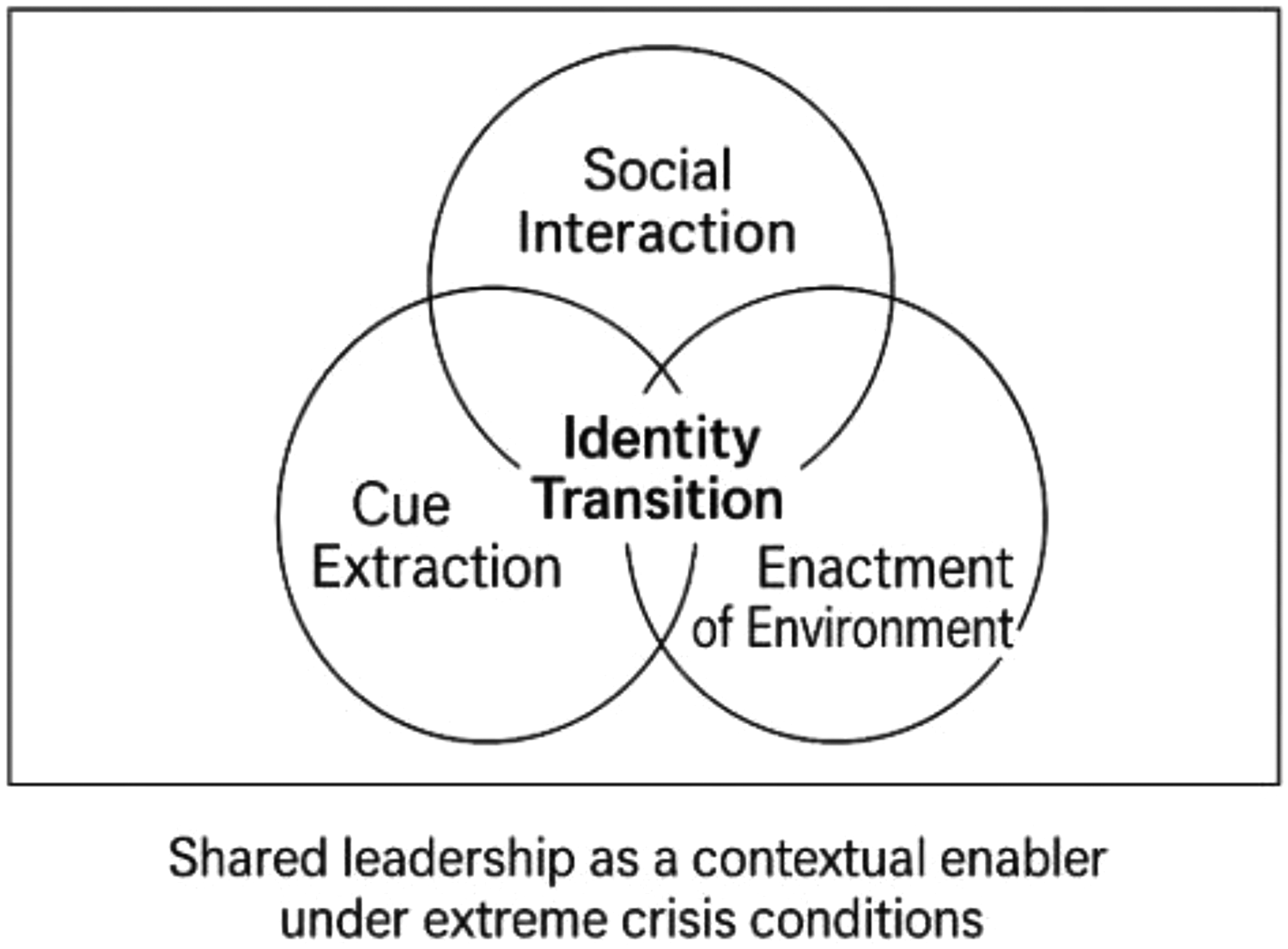
Leadership Sensemaking Model – Navigating Civilian-Military Crisis.
Surrounding this core process is a leadership framework best described as shared leadership, which emerges under extreme conditions where hierarchical command structures are disrupted. Shared leadership allows decision-making authority to adapt fluidly based on contextual demands and individual expertise, enabling effective coordination in mixed civilian-military environments.
The themes in this study are interrelated and form a system of mutual influence. Each theme of sensemaking is influenced by other themes that contain similar elements, while maintaining a unique contribution to the process (Mills et al., 2010).
The first theme, ‘social’, refers to the social influence on the officer's thoughts and actions during combat. A person perceives a particular situation subject to interactions with others, stemming from the need to control their image and how others see them (Mills et al., 2010). According to Weick (1988), publicity leads to commitment. The very existence of soldiers looking up to a military leader makes them more committed to their mission and actions. The social dimension of sensemaking during the October 7th events aligns with Shamir and Lapidot's (2003) concept of shared leadership in managing group boundaries, as officers had to navigate the blurred distinctions between military and civilian domains while establishing collaborative processes that incorporated civilian perspectives into their decision-making.
The way officers viewed the mission and used a wide range of emotions, motives, and abilities varied according to their social surroundings. The presence of civilians on the battlefield required military leaders to change their outlook and conduct. Encounters with children, elderly, and people who lost relatives and homes activated the officers in a softer and more calculated way, emerging from combat with a deeper understanding of the situation.
The second theme, ‘focused on and by extracted cues’, deals with how military leaders collect information around them, focusing on what fits their internal logic. This sensemaking process involves absorbing some aspects of reality while disregarding elements that do not contribute to the officer's assumptions. The vague combat situation forced officers to use information gathered from their previous combat experience about what was happening in the field.
During combat, the officer enters a state of stress where the integrity of body and soul is in real danger. This may lead to ‘combat suppression’ or, conversely, sharpen the officer's senses and lead to increased attention expressed in physical and mental alertness (Ben-Shalom & Benbenisty, 2015; Kalkman, 2020).
The third theme, enactment of sensible environment, refers to the circuit created by the officer's action on the environment. Operating without a clear picture of the situation and in the absence of military communications, officers were forced to act before understanding the situation, particularly to protect civilians present. Weick's theory assumes that a person can only perceive a crisis if they have something to do about it. The action performed by the officer filters out other possible courses of action and focuses them on a single situation, allowing continued action. Action precedes cognition, so the action performed in reality precedes understanding and advances toward comprehending reality (Maitlis & Sonenshein, 2010).
Leadership and Sensemaking During Civilian-Military Crisis Interactions
This research explored how officers used sensemaking strategies to navigate complex interactions with civilians during an extreme emergency – their decision-making process and inner logic, decision to trust others in their surroundings (Kelley & Bisel, 2014), and decision to take certain action. The findings of Dixon et al. (2017) on leadership in extremis environments align closely with the unique crisis scenario examined in this study. Dixon et al. (2017) highlight the concurrent processes of sensemaking and sensegiving, emphasizing how leaders simultaneously interpret and convey meaning in life-threatening situations. This dynamic resonates with the experiences of the Israeli military leaders during the October 7th attacks, where they navigated uncertainty, adapted to rapidly evolving environments, and provided direction amidst chaos. Incorporating insights from Dixon et al. (2017) underscores the importance of training that prepares leaders to integrate sensemaking and sensegiving seamlessly, offering critical implications for improving crisis leadership in contexts marked by extreme volatility and civilian-military overlap.
The dynamic between military and civilian leadership during crises warrants deeper exploration, particularly in contexts where traditional hierarchies are disrupted. This perspective underscores the importance of shared leadership approaches, where decision-making authority is distributed based on situational demands and expertise rather than formal hierarchy. Incorporating civilian input into crisis response not only enhances adaptability but also fosters collaborative problem-solving, which is essential in unprecedented emergencies like the October 7th attack.
Previous research has shown that individual differences in cognitive content significantly influence how team members initially make sense of a crisis (Combe & Carrington, 2015). The current study advances sensemaking theory by introducing the concept of dual-context adaptation, which examines how military personnel navigate the dual demands of combat and civilian rescue operations in extreme crisis situations. This research highlights how military leaders employ sensemaking strategies to transition between these contrasting contexts, particularly in scenarios where civilian populations are directly involved in combat zones.
By focusing on decision-making processes under conditions of chaos, limited communication, and significant civilian casualties, the study reveals how leaders dynamically integrate situational cues and social interactions to adapt their cognitive and emotional responses. This extension of sensemaking theory underscores its applicability to environments where traditional boundaries between combat and civilian domains are blurred, offering deeper insights into human psychological adaptations during high-stress, rapidly changing circumstances.
Combat situations are characterized by prolonged stress and a sense of uncertainty stemming from a real threat to life and physical and mental integrity of the officers (Ben-Shalom & Benbenisty, 2015). In surprise terrorist attacks, the military leader is caught without prior preparation and is required to deal with a vague situation without understanding what they are facing. Moreover, because of the surprise attack and massive civilian casualties, the officers faced significant challenges due to the presence of the civilian population in the fighting.
The extreme situation led to an existential need to understand the situation and take action on the part of the officers. This need corresponds with Karl Weick's theory of ‘sensemaking’. The theory deals with how a person interprets their environment and gives meaning to the components of their experiences. It focuses on emergencies but also includes routine sensemaking, dividing the process into different ways of producing understanding (Mills et al., 2010).
Cognitive Adaptation and Identity Transitions in Extreme Contexts
The study's findings are based on the theory of sensemaking and derive from it an interpretation of the content raised by the officers during the interviews. The descriptions repeatedly indicate an intensified sense of uncertainty regarding the event's components, including lack of knowledge about the magnitude, nature, severity, location, communication between units, and appropriate combat equipment.
The study's findings reveal how military leaders underwent profound identity transitions when operating in an environment that mixed combat operations with civilian rescue. In attempting to function within this complex civilian-military arena, military leaders employed distinct cognitive adaptation strategies reflected in the three identified themes of sensemaking.
Military leaders engaged in complex cognitive and emotional transitions as they oscillated between roles – combatant, rescuer, protector – which were shaped both by self-perception and by the expectations of others in the field. These role transitions were not peripheral but central to how officers made sense of chaotic and ambiguous situations. This echoes Weick's (1993) analysis of the Mann Gulch disaster, where the collapse of organizational sensemaking was directly linked to the disintegration of role structure. In that case, firefighters lost their role-based identity (as professionals with tools and mission clarity), and this collapse contributed to panic and fatal decision-making. By contrast, in our study, military leaders were able to maintain operational functionality by adapting and reconstructing their identities in real time, even when formal structures and information channels were absent. These dynamic role identities served as anchors for sensemaking, allowing leaders to improvise actions and sustain coordination amid uncertainty. Thus, sensemaking grounded in identity construction, particularly role identity, emerges as a crucial psychological and organizational mechanism in extreme civilian-military contexts.
The civilian population elicited sensitivity and compassion from the officers, qualities that operated alongside the toughness and resilience characteristic of combat operations. The interviews revealed personal and intimate associations triggered by encounters with civilians, such as when a survivor reminded an officer of their grandmother. Each type of relationship produces different aspects of the officer's personality and conduct. Such instances underscore how sensemaking theory highlights the significance of early memories and personal experiences in shaping how officers construct meaning during battle (Keller, 2003).
These cognitive adaptations weren't isolated processes but formed an interconnected system of sensemaking strategies that mutually influenced each other. Each sensemaking theme contributed uniquely to the overall process while being influenced by other concurrent cognitive mechanisms (Mills et al., 2010). This integration of multiple cognitive strategies enabled military leaders to maintain operational effectiveness while managing the psychological complexities of simultaneously engaging in combat and civilian protection.
Implications for Military Training and Crisis Response
The current study began in conjunction with the events of October 7th, 2023. Using the qualitative research method allows for capturing firsthand experiences with limited research intervention, providing a platform for those who experienced these events directly. Due to the temporal proximity to October 7th, this study is relatively preliminary in an attempt to make the voices of the officers heard and offer an analysis of their actions by examining the subjective experience of military leaders who fought in the southern communities during the offensive.
While this study primarily focused on sensemaking processes, certain elements observed may have parallels with the theoretical framework of shared leadership. During the October 7th crisis, when communication systems failed and conditions were chaotic, situations emerged that required structural flexibility. The officers’ accounts suggest the possibility that in certain circumstances, particularly during interactions with civilians, action patterns emerged that echo what Pearce et al. (2023) describe as the interplay between vertical and shared leadership approaches. However, this connection should be considered with caution, as the research did not directly examine shared leadership dynamics.
This study contends that the research provides critical insights into human cognitive processes during high-stress emergencies and offers potential implications for future military training and crisis response protocols. By examining how officers operated under extreme uncertainty with limited inter-unit communication and insufficient situational information, the study aims to contribute to understanding military decision-making during unexpected crises involving civilian populations.
The October 7th events suggest potential connections to shared leadership concepts, as officers appeared to adapt their leadership approaches when navigating extreme crisis situations involving civilian-military interactions. While this study focused primarily on sensemaking rather than shared leadership specifically, some observed patterns in officers’ behaviors resonate with elements of distributed leadership responsibility described in previous research. Similar to Ben-Shalom, Lehrer, and Ben-Ari's findings during the Al-Aqsa Intifada, officers on October 7th had to distribute leadership responsibilities based on situational demands rather than relying solely on formal hierarchies. This study suggests that effective sensemaking in crisis situations involving civilians requires leadership processes that can flex between traditional command structures and more collaborative approaches. When communication systems fail and the battlefield extends into civilian areas, shared leadership becomes not just a theoretical construct but a practical necessity for survival and mission accomplishment.
Building on Shamir and Lapidot's (2003) insights regarding shared leadership and its role in managing group boundaries, this study underscores the importance of equipping commanders with tools to foster reciprocal influence processes within their teams. Specifically, three key conditions identified by Shamir and Lapidot – structural arrangements enabling subordinate participation, shared identity and values, and leader vulnerability – can serve as guiding principles for designing effective training programs. First, commanders should be trained to implement participative decision-making frameworks that allow subordinates to play an active role in leadership acts, such as evaluations or disciplinary decisions. Second, training should emphasize the cultivation of shared values and identity through team-building exercises that reinforce collective norms and trust. Finally, programs should encourage commanders to embrace vulnerability as a leadership strength, demonstrating transparency and openness in their interactions with subordinates. Future military training might benefit from explicitly addressing how to facilitate effective shared leadership during crises while maintaining necessary command authority.
This research contributes to understanding how military leaders interpret and respond to civilian interactions during extreme emergencies, offering insights for future crisis response training and protocols. The findings suggest important implications for military training and emergency response procedures, particularly in situations involving civilian-military interactions under extreme conditions. The study reveals several key implications for military leadership and crisis management during extreme emergencies involving civilian populations. Military leaders must rapidly adapt between combat and civilian rescue operations, demonstrating complex psychological adjustments for decision-making in chaotic environments with limited communication. The presence of civilians on the battlefield significantly impacts military personnel's decision-making and psychological adaptation, requiring more cautious and sensitive approaches. The research extends our understanding of leadership in extremis by examining a unique context where military leaders simultaneously engaged in combat and civilian rescue operations. It provides insights into the cognitive and emotional processes officers experience when transitioning between these operations, which could inform future military training protocols. The findings highlight the critical role of sensemaking strategies for military leaders during unprecedented crises involving civilian populations, particularly social interactions, extracting situational cues, and dynamically engaging with the environment.
This study is among the first to examine officers’ performance on October 7th, potentially adding knowledge about the transition from surprise to combat in emergencies. Future research should investigate the perspectives of rescued civilians and explore sensemaking in broader combat contexts. Additionally, future research should examine the bidirectional nature of sensemaking and leadership processes during crises, particularly exploring how shared leadership practices facilitate collective sensemaking among military personnel and civilians caught in combat zones.
Limitations and Future Research
This study offers initial insights into the sensemaking processes of military leaders during the unprecedented crisis of October 7th, 2023. However, several limitations should be acknowledged. First, the study is based on a relatively small, purposefully selected sample of commanders who engaged directly with civilians during the attack. While this sampling strategy allowed for in-depth analysis of relevant cases, it may not capture the full diversity of leadership experiences across all military units or ranks.
Second, the study relies solely on retrospective self-reports collected through interviews. While participants provided rich and detailed accounts, such narratives are subject to memory biases, emotional framing, and post-hoc rationalization. The absence of triangulated data sources, such as real-time communications, operational logs, or civilian testimonies, limits the capacity to validate or cross-reference these narratives.
Third, the study was conducted relatively soon after the events, which may have shaped both the participants’ emotional states and their interpretive framing of the experience. Longitudinal research could yield deeper insights into how sensemaking evolves over time, particularly in the aftermath of trauma and organizational learning.
Future research should expand the scope to include the perspectives of civilians rescued during the attack, as well as other actors involved in emergency responses (e.g., police, medical personnel, local leaders). Comparative studies across different crisis events could further illuminate the conditions under which sensemaking strategies and leadership dynamics shift. Moreover, integrating observational or ethnographic methods could complement narrative data and offer more contextualized insights into real-time decision-making.
Finally, while this study focused on sensemaking, emerging evidence from the field suggests that shared leadership dynamics may play a critical role in extreme civilian-military settings. Future studies should more explicitly examine how distributed leadership functions in crisis environments, and how it interacts with individual cognitive and emotional adaptations.
Footnotes
Consent for Publication
Not applicable
Ethical Approval and Informed Consent Statements
This study was approved by the Ariel University Research Ethics Committee (approval no. AU-SOC-UBS-20230816) on August 16, 2023. Respondents gave verbal consent to participate in the study before starting interviews.
Declaration of Conflicting Interests
The authors declared no potential conflicts of interest with respect to the research, authorship, and/or publication of this article.
Funding
The authors received no financial support for the research, authorship, and/or publication of this article.

Appendix A: Summary of Participants’ Demographic Data
The following table presents background characteristics of the 15 interviewees who participated in the study. All participants serve in command roles in the Israel Defense Forces (IDF), either in regular or reserve duty. For anonymity, each interviewee in this study was assigned a unique letter code. Codes cited in the findings section (e.g., A, M, S) correspond to specific participants and have not been reused. Additional participants are marked with distinct identifiers (e.g., G, H2) for consistency and anonymization purposes. Participants are listed in ascending order of military rank.