




Abstract
Employee strengths use is associated with increased work engagement and reduced sickness absenteeism, and knowledge about how leaders can promote employee strengths use is rapidly developing. We performed a systematic review to a) summarize what is known about the conceptualization, operationalization, and nomological net of strengths-based leadership and about the relation between leadership and employee strengths use, and b) identify concerns to set an agenda to guide future research on the topic. Our literature search through Web of Science and Scopus resulted in 39 empirical, peer-reviewed English articles published between 1998, often marked as the start of the positive psychology approach, and 2024. The most important issue resulting from our review is that although there is a common understanding of what constitutes strengths-based leadership, conceptualizations and operationalizations diverge. We call for more research including a broader diversity of samples to 1) further investigate the psychometric properties of strengths-based leadership scales, such as their construct, convergent, and discriminant validity, and measurement invariance, and 2) expand the theoretically grounded nomological network surrounding strengths-based leadership.
The strengths-based approach, rooted in positive psychology, is gaining popularity as an approach to leadership (Welch et al., 2014). According to this approach, every employee has their specific combination of strengths—characteristics that allow them to perform at their personal best (Wood et al., 2011). Nourishing these strengths is important to organizations because employees who use their strengths show increased levels of in- and extra-role performance and goal attainment, and reduced levels of sickness absence (e.g., Linley et al., 2010; Van Woerkom et al., 2016a; Van Woerkom & Meyers, 2015). Additionally, employees who play to their strengths report higher levels of personal growth, work engagement, and self-efficacy, and lower levels of perceived stress (e.g., Botha & Mostert, 2014; Van Woerkom et al., 2016c; Wood et al., 2011).
Recognizing the potential benefits of strengths-based leadership, we have noticed a significant surge in research on the topic between 2020 and 2024 (i.e., roughly 90% of the studies included in this review were published during this time). However, little attention has been paid to its operationalization, discriminant validity, theoretical basis, and the distinctiveness of the proposed research models. For example, while researchers have a shared understanding of the conceptualization of strengths-based leadership, its operationalization varies. Some focus exclusively on identifying employee strengths (e.g., Matsuo, 2022b), while others go further by incorporating opportunities for strengths use or even fostering strengths development (e.g., J. Wang et al., 2023). Still, other operationalizations apply these principles to specific contexts, such as performance appraisals (e.g., Van Woerkom & Kroon, 2020), which serve as pivotal moments for leaders to address their employees’ strengths (Van Woerkom et al., 2024; Van Woerkom & de Bruijn, 2016). Moreover, employee strengths use has not only been studied through the lens of strengths-based leadership but also through other types of leadership, such as transformational, humble, and authentic leadership (e.g., Ding et al., 2020a; Ding & Lin, 2020). Developing distinct leadership constructs and sound measures is especially problematic in the leadership field (Banks et al., 2018; Bormann & Rowold, 2018), and therefore it is important to establish the discriminant validity of these leadership constructs and their incremental validity in predicting employee strengths use. Therefore, we argue that a systematic review of the literature regarding leadership and employee strengths use is needed to summarize and critically evaluate this research and set recommendations for future research.
This systematic review will be guided by the following 3 research questions:
How is strengths-based leadership operationalized, and to what extent do these operationalizations align with the conceptualization of strengths-based leadership? Does strengths-based leadership demonstrate discriminant validity when compared to other types of leadership (e.g., transformational leadership, humble leadership)? How does leadership affect employee strengths use?
Our review makes several important contributions to the literature on leadership and strengths use. To start, we provide the first systematic review on leadership and employee strengths use. This review is particularly crucial in these early stages of research on strengths-based leadership, considering its rapid development in a short period of time combined with issues such as unaligned definitions and measurements, construct proliferation, and at times, minimal theoretical grounding (e.g., research suggesting strengths-based leadership will increase employees’ emotional intelligence). It is crucial to get an overview of this literature to guide theoretically and methodologically sound future research on strengths-based leadership. Next, to fully map the nomological net surrounding leadership and employee strengths use and identify potential issues of construct proliferation and incremental validity, we will include a wide range of leadership constructs that are related to employee strengths use. Finally, we will identify and critically evaluate the underlying mechanisms explaining the relations between leadership and employee strengths use to potentially identify the (lack of) theoretical grounding. Based on the above, we will provide several recommendations to steer future research in this area.
Strengths Theory
The construct of individual strengths is based on positive psychology as the “science of positive subjective experience, positive individual traits, and positive institutions.” (Seligman & Csikszentmihalyi, 2000, p. 5) and refers to individual characteristics that potentially allow a person to perform at their personal best (Wood et al., 2011). For instance, a highly analytical software designer may perform at her personal best when she applies her strengths of judgment and perseverance in detecting programming errors but may be less fluent in communicating with her co-workers. Even though researchers differ in how broadly they define strengths, they concur that individual strengths become evident in episodes of personal excellence, looking within one person, rather than in episodes of comparative excellence across persons (Van Woerkom et al., 2022). Additionally, researchers agree that strengths are at least partly based on genetic features (Steger et al., 2007). If individual strengths are recognized by oneself and by others, they can be developed through practice and the acquisition of related knowledge and skills, so that they can eventually be productively applied. Previous studies pointed out that it is the use of strengths, independent of the type of strength, that leads to beneficial outcomes, such as work engagement and well-being (Harzer & Ruch, 2012; Keenan & Mostert, 2013), reduced stress and greater self-esteem (Wood et al., 2011), higher self-rated performance (Van Woerkom et al., 2016b; Van Woerkom & Meyers, 2015), and lower levels of sickness absenteeism (Van Woerkom et al., 2016b).
Several theories may explain how strengths use leads to its outcomes. Employees who use their strengths feel authentic (Peterson & Seligman, 2004), and theories on authenticity (Kernis & Goldman, 2006) and self-concordance (Sheldon & Elliot, 1999), propose that this reduces the likelihood of depression and stress, and enhances the likelihood of well-being. Strengths use also leads to mastery experiences (Peterson & Seligman, 2004), and based on self-efficacy theory (Bandura, 1997), it will therefore lead to improved performance. Furthermore, people who use their strengths will benefit from higher levels of positive emotions, such as feeling competent, proud, and invigorated (Peterson & Seligman, 2004), and according to the “happy productive worker thesis” (Cropanzano & Wright, 2001) these positive emotions will encourage them to set higher goals, invest more effort in these goals, and mobilize social resources that may help them to achieve these goals. Finally, the broaden-and-build theory of positive emotions (Fredrickson, 1998, 2001) posits that these positive emotions also stimulate approaching and exploring behaviors, making it more likely that employees display innovative work behaviors or extra-role behaviors such as helping colleagues.
Strengths-Based Leadership
Strengths-based leaders help employees to identify, use, and further their strengths (J. Wang et al., 2023). Without this support, employees may struggle to identify their own strengths (Buckingham & Clifton, 2001; Cable et al., 2015) because they tend to focus on their weaknesses rather than their strengths (i.e., negativity bias; Roberts et al., 2005; Rozin & Royzman, 2001) and their strengths may come so natural to them that they use them unconsciously (Biswas-Diener et al., 2011; Buckingham & Clifton, 2001). Strengths-based leaders recognize that employees have an instinctive preference for using their strengths, are engaged and successful when using these strengths, and quickly learn new information that is associated with their strengths (Linley et al., 2007). Additionally, strengths-based leaders may provide feedback to employees about the times that they performed at their personal best. For example, a leader may recognize a particular strength, such as creativity, in an employee and affirm this strength, increasing the employee's awareness and therefore also the use of this strength in the future (Lee et al., 2016).
However, even when employees are aware of their strengths, they are not always able to use them in the work context. Only 17% of all workers report that they make significant use of their strengths every day (Buckingham, 2010). To enhance employees’ strengths use, leaders may assign tasks to employees that match their strengths and redistribute tasks within their team, as one team member's weakness may be another one's strength. Finally, leaders can help employees to further develop their strengths by acknowledging that strengths do not exist in isolation but interact with each other and the environment (Biswas-Diener et al., 2011). In such a way, leaders may help their employees to regulate their strengths in line with the context.
Building on strengths theory and the literature on employee strengths use, over the past four years, researchers have gained an interest in the ways leaders cultivate employees’ strengths, focusing on how a) strengths-based leadership, b) well-established leadership styles (e.g., humble leadership, transformational leadership) or c) specific strengths-based HR practices enacted by the leader (e.g., performance appraisals) relate to employee strengths use. The question is whether and, if so, how these different foci can be integrated to shed light on the strengths approach to leadership. To answer this question and guide future research on the topic, we will perform a detailed and critical systematic review of the literature on leadership and employee strengths use. First, we will categorize existing studies based on their study characteristics (e.g., leadership and strengths focus, design, sample). Next, we will summarize and integrate the findings of studies within each category, and finally, we will provide a critical evaluation of these studies and set recommendations for future research.
Method
Literature Search
For the literature search we used two strategies. First, we relied on the search engines Web of Science and Scopus because these include a wide variety of subject disciplines and journals. To identify articles on leadership and employee strengths, we used the following keywords: (employee strength* AND (supervisor* OR manager* OR leader*)). Articles were included if they were: 1) peer-reviewed scientific articles, 2) written in English, 3) published between 1998, marked as the start of the positive psychology approach (Seligman, 1998), and November 2024, 4) using empirical data collected in the context of work. Studies focusing on employee strengths use without a clear reference to the role of leaders and/or the workplace were excluded. Second, we carefully checked the reference lists of the relevant studies identified in the first step to make sure that we did not miss any relevant references.
We conducted the search in November 2024 and reviewed the articles following the guidelines by Page et al. (2021). This process is illustrated by the flowchart in Figure 1. We had 5.229 and 3.512 hits in Scopus and Web of Science, respectively. After removing duplicates, 4.076 hits remained. The first, third, and last author manually scanned the titles and abstracts of these articles and compared them to our inclusion criteria. Those that (potentially) matched were included in the second stage, whereby the first author read 65 full texts and discussed their inclusion with the second author. Based on this assessment, we excluded 28 more articles either because they focused on a) perceived organizational rather than supervisor support for strengths use (n = 9), strengths-based human resource systems without a clear reference to the leader (n = 7), leadership, but not employee strengths use (n = 5), or employee strengths use, but not leadership (n = 4). Three more studies were excluded because they did not meet our inclusion criterion of empirical research. Finally, we added two more articles after checking the reference lists of the 37 already included articles.
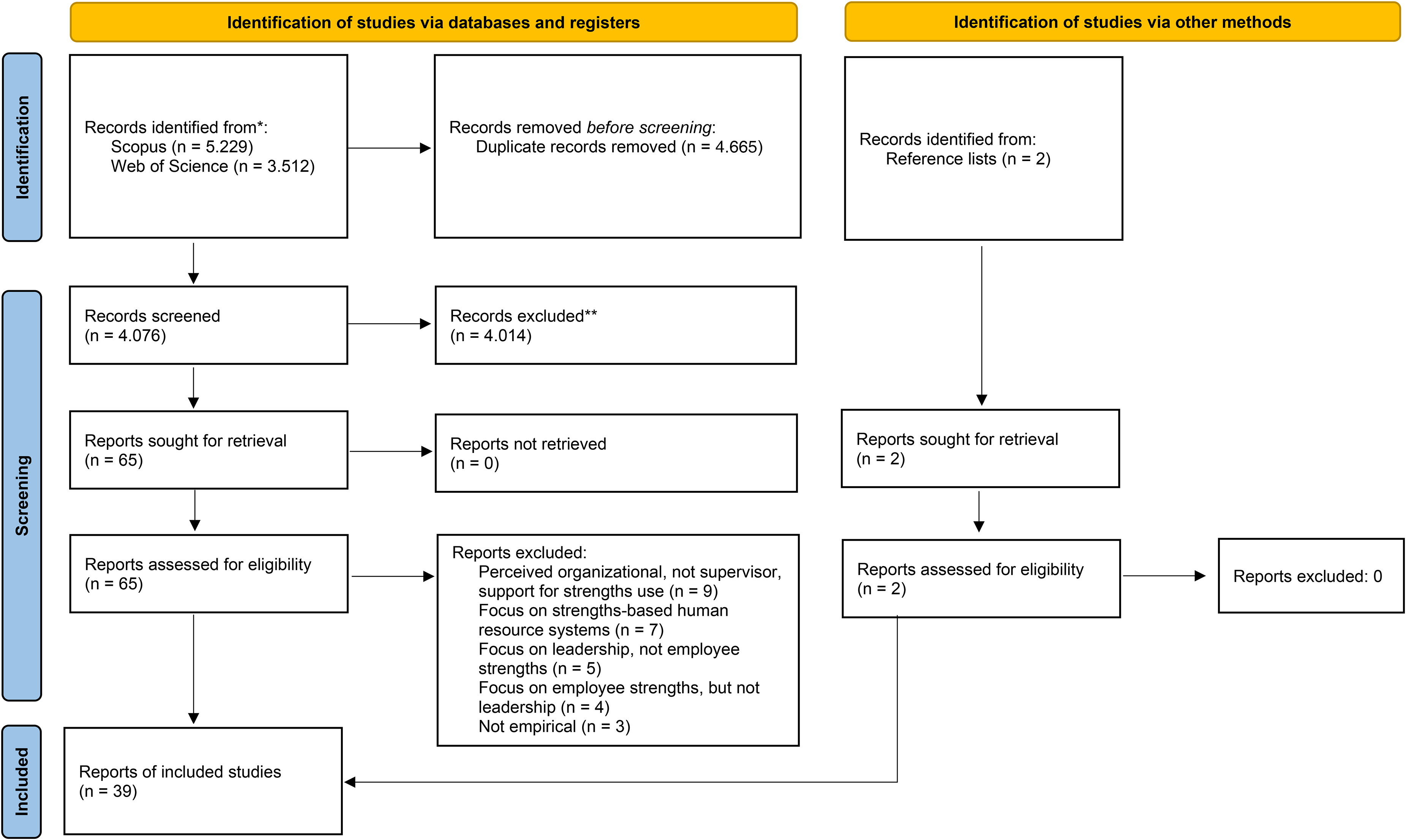
Flowchart.
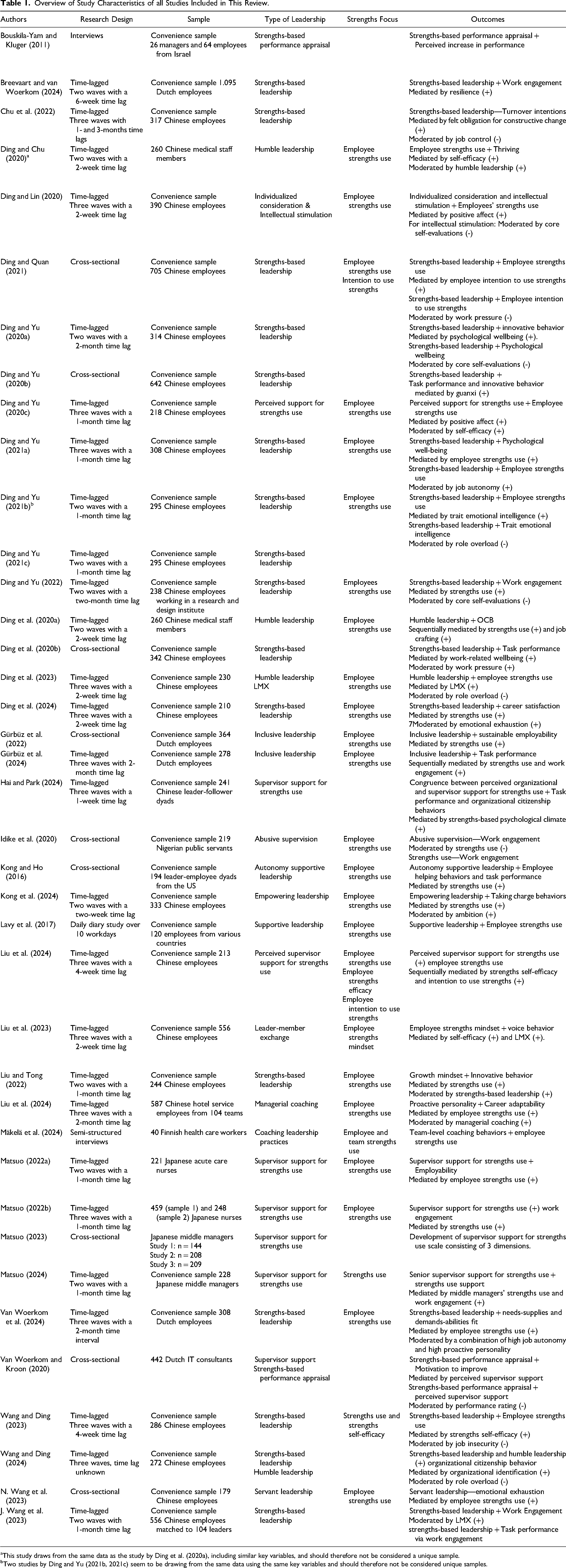
Based on the 39 studies included in our review, we created three different categories of research on leadership and employee strengths (see Table 1 for a summary of study characteristics). First, the largest category consists of studies on strengths-based leadership and supervisor support for strengths use (n = 23). We decided to combine studies on strengths-based leadership and supervisor support for strengths use into one category because of their conceptual overlap. The second category contains studies that relate well-established leadership concepts, such as humble, transformational, and servant leadership, to employee strengths (n = 15). Finally, studies on strengths-based performance appraisals make up the third category (n = 2).
Overview of Study Characteristics of all Studies Included in This Review.
This study draws from the same data as the study by Ding et al. (2020a), including similar key variables, and should therefore not be considered a unique sample.
Two studies by Ding and Yu (2021b, 2021c) seem to be drawing from the same data using the same key variables and should therefore not be considered unique samples.
Results
Study Characteristics
Most of the studies were conducted among Chinese employees (n = 25, n = 23 unique samples, see Table 1 footnotes), followed by Dutch (n = 5) Japanese (n = 4), Finnish (n = 1), Israeli (n = 1), Nigerian (n = 1), and American (n = 1) employees. One study was conducted among a sample of employees from various countries. Thirty-two studies used convenience sampling, while seven studies targeted a specific sample: health care workers (n = 5), hotel service employees (n = 1), and IT consultants (n = 1). A mix of designs was used: one study employed a daily diary design, two studies relied on interview data, nine studies used cross-sectional designs, and twenty-seven studies were based on time-lagged designs. With regards to the time-lagged studies, about half of them (n = 14) used a three-wave time-lagged design to test their mediation hypotheses, with a one-week (n = 1), two-week (n = 4), one-month (n = 5), or two-month (n = 3) time lag. One study used two different time lags (i.e., one and three months), and one study did not report the time interval between measurement points. Out of these time-lagged studies, one focused on within-person differences, while the others had a between-person design. The other thirteen studies used two waves with either a 2-week (n = 3), 6-week (n = 1), 1-month (n = 7), or two-month (n = 2) time lag. Finally, only four out of the 39 studies included not only employees, but also their leaders, and 2 studies focused specifically on (middle) managers as employees.
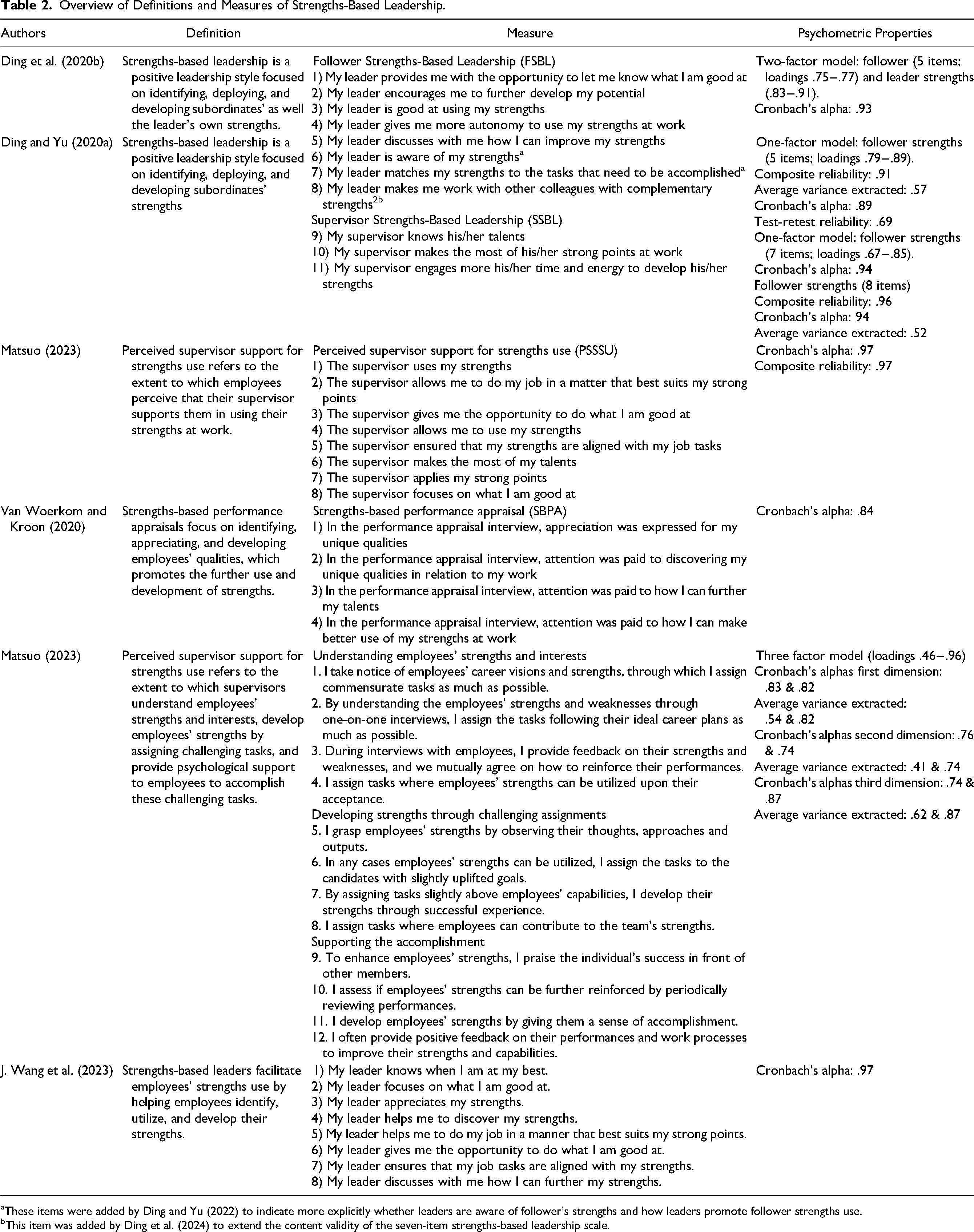
Ding and colleagues (Ding et al., 2020b; Ding & Yu, 2020a) were the first to develop a measure of strengths-based leadership, which was based on their definition of strengths-based leadership and existing measures of strengths-based psychological climate (Van Woerkom & Meyers, 2015), strengths use, and perceived organizational support for strengths use (Van Woerkom et al., 2016b). According to Ding and colleagues, strengths-based leadership is a positive leadership style that aims to foster subjective positive experiences through the “identification, development, and deployment of supervisors’ own and subordinates’ strengths” and thereby helps organizations to gain a competitive advantage (Ding et al., 2020b, p. 3). Strengths-based leadership focused on subordinates is measured with items such as “My leader encourages me to further develop my potential” (see Table 2 for a summary of all conceptualizations and operationalizations; Ding & Quan, 2021; Ding & Yu, 2020a; Ding & Yu, 2020b; Ding & Yu, 2021a; Ding & Yu, 2021b; Ding & Yu, 2021c). Additionally, strengths-based leadership focused on leaders’ own strengths is measured with 3 items that are rated by subordinates, namely “My supervisor knows his/her talents”, “My supervisor makes the most of his/her strong points at work”, and “My supervisor engages more his/her time and energy to develop his/her strengths” (Ding et al., 2020b; Ding & Yu, 2021a). In 2023, J. Wang et al. developed another measure based on the following definition of strengths-based leadership: “Strengths-based leaders facilitate employees’ strengths use by helping employees identify, utilize, and develop their strengths”. Their scale consists of 8 items such as “My leader helps me to discover my strengths” (i.e., strengths identification), “My leader ensures that my job tasks are aligned with my strengths” (i.e., strengths utilization), and “My leader discusses with me how I can further my strengths.” (i.e., strengths development).
Overview of Definitions and Measures of Strengths-Based Leadership.
These items were added by Ding and Yu (2022) to indicate more explicitly whether leaders are aware of follower's strengths and how leaders promote follower strengths use.
This item was added by Ding et al. (2024) to extend the content validity of the seven-item strengths-based leadership scale.
Ding and Yu (2020c) also developed a measure of perceived supervisor support for strengths use, which is based on the perceived organizational support for strengths use scale (Van Woerkom et al., 2016b). This scale, consisting of 7 items, measures the extent to which employees feel actively supported by their leader to use their strengths at work. Example items are “My leader gives me the opportunity to do what I am good at”, “My leader ensures that my strengths are aligned with my job tasks”, and “My leader applies my strong points”. Matsuo (2023) took a similar approach by adjusting an existing measure of organizational support for strengths use (Keenan & Mostert, 2013; Van Woerkom et al., 2016b) to measure perceived supervisor support for strengths use. This 8-item scale consists of items such as “The supervisor ensured that my strengths are aligned with my job tasks”.
Rather than starting from the perceived organizational support for strengths use scale, in 2023, Matsuo used a grounded theory approach to develop a multi-dimensional supervisor strengths use support scale. The scale consists of 3 dimensions with 4 items each: 1) Understanding employees’ strengths and interests (e.g., “I assign tasks where employees’ strengths can be utilized upon their acceptance”), 2) Developing strengths through challenging assignments (e.g., “I assign tasks where employees can contribute to the team's strength”), and 3) Supporting the accomplishment (e.g., “I develop employees’ strengths by giving them a sense of accomplishment”). The dimensions were highly correlated with supervisor coaching (Heslin et al., 2006; r = .67–.71) and the one-dimensional supervisor support for strengths use scale by Keenan and Mostert (2013; r = .63–.68).
Strengths-Based Performance Appraisal
Finally, Van Woerkom and Kroon (2020) focused on strengths-based performance appraisal, which refers to leaders conducting performance appraisals that focus on identifying, appreciating, and developing employees’ qualities to promote the further use and development of employee strengths. They developed a 4-item scale based on a measure of strengths-based psychological climate (Van Woerkom & Meyers, 2015; see Table 1). These items are: “In the performance appraisal interview..” 1) “..appreciation was expressed for my unique qualities”, 2) “..attention was paid to discovering my unique qualities in relation to my work”, 3) “..attention was paid to how I can further my talents”, and 4) “..attention was paid to how I can make better use of my strengths at work”. Bouskila-Yam and Kluger (2011) developed, implemented, and evaluated a strengths-based performance appraisal (SBPA) in a qualitative study. This SBPA included seven strengths-based elements: 1) a feedforward interview, 2) a reflection on feedback about the employee's best self, 3) an emphasis on generating positive mood, 4) exercises to develop employees’ strengths, 5) positive and negative feedback following a 3:1 ratio, 6) a focus on utilizing employees’ strengths to simultaneously encourage employee well-being and achieve organizational goals, and 7) the creation of a shared mental model of antecedents of organizational success.
Only two of the studies identified in this review investigated the discriminant validity of strengths-based leadership (Ding et al., 2020b; Wang & Ding, 2024) by testing whether strengths-based leadership (SBL) can be differentiated from LMX, authentic leadership, humble leadership, and transformational leadership. Authentic and humble leadership are related to strengths-based leadership in the sense that these leadership styles focus on knowing, accepting, and appreciating employees’ strengths and weaknesses (Owens & Hekman, 2012; Walumbwa et al., 2008), yet strengths-based leadership uniquely focuses on not only knowing, but also encouraging the use and development of employees’ strengths. Transformational leaders are more generally appreciative of employees’ individual needs but mainly assert their influence through employees’ attitudes and values (Rafferty & Griffin, 2004) and not necessarily through their strengths. Although several studies show that transformational and humble leadership directly affect employees’ strengths use (e.g., Ding et al., 2020a; Ding & Lin, 2020), Ding et al. (2020b) show preliminary support for the discriminant validity of strengths-based leadership. Specifically, their confirmatory factor analysis, including SBL, authentic leadership, humble leadership, transformational leadership, and LMX as five separate factors, showed a good fit to the data. Additionally, Wang and Ding (2024) showed that although a model combining SBL and humble leadership into one factor showed a good fit to the data, a model that specified SBL and humble leadership as two separate factors showed a much better fit to the data, even though the two factors were highly correlated (r = .79). Yet, SBL positively related to employee OCB after controlling for humble leadership.
Strengths-Based Leadership and Employee Strengths Use
Seven studies found that strengths-based leadership (Ding et al., 2023; Ding & Yu, 2021a, 2021b, 2021c, 2022; Van Woerkom et al., 2024; Wang & Ding, 2023) was positively related to employee strengths use. Furthermore, trait emotional intelligence (Ding & Yu, 2021b), employees’ intention to use their strengths (Ding & Yu, 2021c), and employees’ strengths self-efficacy (Wang & Ding, 2023) were found to positively mediate the relation between strengths-based leadership and employee strengths use. Additionally, Ding and Yu (2021b) showed that employee role overload reduced the direct relation between strengths-based leadership and employee strengths use as well as the indirect relation between strengths-based leadership and employee strengths use, mediated by trait emotional intelligence. Next, work pressure moderated the relation between strengths-based leadership and employees’ intention to use their strengths (Ding & Yu, 2021c) in such a way that the relation was stronger when work pressure was low. Work pressure also moderated the mediated relation between strengths-based leadership and employee strengths use via intention to use strengths, whereby the indirect effect was only significant when work pressure was low (vs. high). Personal resources also moderated the effects of SBL on employee strengths use. For example, Ding and Yu (2022) showed that strengths-based leadership was positively related to employee strength-use, and consequently to work engagement, especially for employees with high core self-evaluations. Additionally, Wang and Ding (2023) showed that strengths-based leadership was more strongly related to strengths self-efficacy and subsequently to employee strengths use when job insecurity was low (vs. high).
Several studies examined employee strengths use as a mediator in the relation between SBL and employee outcomes. For example, Ding et al. (2024) found that strengths-based leadership was positively related to career satisfaction, mediated by employee strengths use, and that this indirect effect was moderated by employees’ emotional exhaustion in such a way that it was stronger when emotional exhaustion was high. Van Woerkom et al. (2024) showed that SBL was positively related to both need-supplies and demands-abilities fit through an increase in employee strengths use and that a combination of high job autonomy and high proactive personality partly compensated for a lack of SBL. One study examined employee strengths use as a mediator in the relation between strengths-based leadership and employees’ psychological well-being (Ding & Yu, 2021a). Particularly, they showed that the positive mediation effect was contingent on employees’ job autonomy in such a way that the mediating effect was stronger when autonomy was high (vs. low). Liu and Tong (2022) showed that strength use positively moderated the relation between growth mindset and innovative behavior, especially when strengths-based leadership was high (vs. low).
Finally, we found one study that did not specifically measure employee strengths use but examined the relation between strengths-based leadership and employee work engagement (Breevaart & van Woerkom, 2024). They found that strengths-based was positively related to employee work engagement through employee resilience (mainly self-efficacy).
Supervisor Support for Strengths Use and Employee Strengths Use
Five studies showed that supervisor support for strengths use (Ding & Yu, 2020c; Liu et al., 2024; Matsuo, 2022a, 2022b, 2024) and employee strengths use were positively related. More specifically, Ding and Yu (2020c) showed that self-efficacy positively moderated the indirect effect from supervisor support for strengths use on employee strengths use through positive affect (Ding & Yu, 2020c). Liu et al. (2023) found that self-efficacy mediated the positive relation between supervisor support for strengths use and employee strengths use.
Matsuo found support for employee strengths use as a positive mediator in the relation between supervisor support for strengths use and employees’ employability (2022a) as well as employees’ work engagement (2020). In addition to the latter, in a later publication, Matsuo found (2024) that senior supervisors’ support for the strengths use of middle managers led to more strengths use support for subordinates, mediated by both middle managers’ strengths use and their work engagement.
Strengths-Based Leadership, Supervisor Support for Strengths Use, and Performance
Eight studies examined the relation between strengths-based leadership (n = 7) or supervisor support for strengths use (n = 1) on the one hand and employee performance on the other hand. They showed that SBL is positively related to employee task performance and innovation through increased psychological wellbeing (Ding & Yu, 2020a), work-related well-being (Ding et al., 2020b), self-efficacy (Ding & Quan, 2021), guanxi, referring to informal non-work-related connections between the supervisor and the subordinate (Ding & Yu, 2020b), and work engagement (J. Wang et al., 2023). The studies also showed that these indirect effects were stronger when employees experience higher work pressure (Ding et al., 2020b) and more emotional exhaustion (Ding & Quan, 2021), have a higher LMX quality relationship (J. Wang et al., 2023), and weaker when employees have higher core-self evaluations (Ding & Yu, 2020a). Next, Chu et al. (2022) showed that strengths-based leadership reduced employees’ turnover intentions, especially by increasing employees’ felt obligation for constructive change. This mediation effect was particularly strong when employees experienced high (vs. low) job control. Finally, Wang and Ding (2024) showed that SBL was positively related to organizational citizenship behaviors (OCB), mediated by an increase in organizational identification. This indirect effect was weaker when role overload was high. Combining findings on task performance and organizational citizenship behavior, Hai and Park (2024) found that the congruence between perceived organizational and supervisor support for strengths use was positively related to a strengths-based psychological climate, which in turn led to increased task performance and OCB.
Well-Established Leadership Constructs and Employee Strengths Use
Thirteen studies examined the relations between well-established leadership styles and employee strengths use. They found that humble leadership (Ding et al., 2020a; Ding et al., 2023), transformational leadership (i.e., individualized consideration and intellectual stimulation; Ding & Lin, 2020), (autonomy) supportive leadership (Kong & Ho, 2016), empowering leadership (Kong et al., 2024), servant leadership (N. Wang et al., 2023), inclusive leadership (Gürbüz et al., 2022; 2024), managerial coaching practices (Mäkelä et al., 2024) and supervisor support (Lavy et al., 2017) were positively related to employee strengths use. Additionally, humble leadership was positively related to employee strengths use through increased LMX (Ding et al., 2023; moderated by role overload), and LMX was positively related to employee strengths mindset (Liu et al., 2023). Idike et al. (2020) found that abusive supervision was negatively related to employee strengths use. One study showed that positive affect positively mediated the relation between transformational leadership and employee strengths use (Ding & Lin, 2020). In addition, they showed that this indirect effect was negatively moderated by core self-evaluations, but only for intellectual stimulation (and not individualized consideration).
In many of these studies, strengths use acted as a mediator in the relation between leadership on the one hand and employee outcomes on the other. For example, Ding et al. (2020a) found that the relation between humble leadership and organizational citizenship behavior was positively and sequentially mediated by employee strengths use and job crafting. Strength use also mediated the relation between autonomy supportive leadership on the one hand and supervisor-rated employee helping behaviors and task performance on the other hand (Kong & Ho, 2016). With regards to inclusive leadership, strengths use mediated the relations between inclusive leadership and sustainable employability (Gürbüz et al., 2022) as well as task performance (Gürbüz et al., 2024). Finally, strengths use mediated the relationship between empowering leadership and taking charge behaviors (Kong et al., 2024; moderated by ambition), servant leadership and emotional exhaustion (N. Wang et al., 2023), and abusive supervision and work engagement (Idike et al., 2020).
Finally, two studies examined leadership as a moderator in the relation between strengths use and employee outcomes. First, Ding and Chu (2020) showed that humble leadership positively moderated the effect of employee strengths use on thriving via increased self-efficacy. Second, Liu et al. (2024)) found that strengths use mediated the relationship between proactive personality and career adaptability, which was positively moderated by managerial coaching.
Strengths-Based Performance Appraisal
Two studies investigated strengths-based performance appraisals, whereby leaders evaluate their employees’ performance by focusing on employees’ strengths. First, Van Woerkom and Kroon (2020) found that these appraisals were positively related to employees’ motivation to improve their performance, and that this relation was mediated by perceived supervisor support. Additionally, they found that strengths-based performance appraisal led to higher levels of perceived supervisor support when the performance rating was low (compared to high). Second, Bouskila-Yam and Kluger (2011) found that 49% of employees indicated that strengths-based performance appraisal led to an increase in performance.
Discussion and Agenda for Future Research
For the past four years, the strengths-based approach to leadership has gained significant popularity in the scientific literature. Our review shows that most studies focus on the relation between strengths-based leadership and employee strengths use, while the empirical and theoretical basis for these studies is still relatively weak. Therefore, even though we only identified 39 studies on the topic, it is crucial to critically evaluate these studies and set an agenda for future research on the topic. Below, we discuss the most important findings regarding theoretical and methodological issues in this literature, cultural aspects of the included studies, the incremental validity of strengths-based leadership over other leadership styles, and provide guidelines for further research.
Defining Strengths-Based Leadership and Solving Methodological Issues
Existing definitions of strengths-based leadership, whether they refer to the leader's behavior in general (e.g., support for strengths use) or in specific situations (e.g., performance appraisals), all include one or more of the following three elements: 1) identifying employee strengths, 2) utilizing employee strengths, and 3) developing employee strengths. Whereas some conceptualizations and operationalizations are nicely aligned (e.g., for strengths-based leadership; J. Wang et al., 2023 and for supervisor support for strengths use; Matsuo, 2023), others are not. Specifically, we discovered several important issues with the definition and measurement of strengths-based leadership by Ding et al. (2020b; 2020a). First, their conceptualization of strengths-based leadership is confounded with its expected effects, a problematic issue that is common to leadership research (Van Knippenberg & Sitkin, 2013). That is, their definition includes the expected outcomes for both employees (i.e., increased positive experiences) and the organization (i.e., increased competitive advantage). Second, in the definitions of strengths-based leadership by Ding and colleagues, two different targets seemed to be confounded, namely, a) employees’ strengths and b) supervisors’ strengths. In the context of leadership, the latter refers to the management of one's own strength (i.e., self-management) and the former refers to helping others. Leadership is generally conceptualized as a social influence process (e.g., Antonakis & Day, 2018), and the focus on leaders influencing employees’ strengths therefore fits the common denomination and intuitive understanding of what leadership is. Accordingly, the focus on employee strengths rather than the leader's strengths best represents “strengths-based leadership”, something that is reflected in the most recent research on SBL (see e.g., J. Wang et al., 2023; Wang & Ding, 2024). To avoid these problems and provide a solid basis for future research on strengths-based leadership, we suggest that researchers align their measures with the common understanding of strengths-based leadership, which is that strengths-based leaders help their employees to identify, use, and develop their strengths (see also J. Wang et al., 2023). Finally, several items included in Ding et al.'s (Ding et al., 2020b; Ding & Yu, 2020a) measures contain grammatical errors (e.g., “My supervisor engages more his/her time and energy to develop his/her strengths”). Other items contain conceptual ambiguities. For example, an item like “My leader encourages me to further develop my potential” does not clearly represent a focus on employee strengths, since deficits are usually seen as having the largest potential for performance improvement (Van Woerkom & de Bruijn, 2016).
A more general criticism of existing measures of strengths-based leadership is their tendency to emphasize leaders’ efforts to encourage employees to leverage their strengths, while placing relatively less emphasis on aspects such as identifying and developing those strengths. Notably, one of the measures (Matsuo, 2023) focuses exclusively on strengths use (see Table 2). This is not surprising considering that many of these scales were developed based on existing scales measuring concepts such as organizational support for strengths use or employee strengths use. Therefore, more research is needed on the construct validity of these measures. Additionally, more research is needed on other psychometric properties of strengths-based leadership scales, such as their convergent and discriminant validity and their measurement invariance. Next, to test the validity and the nomological network of the construct, it is needed to a) perform a confirmatory factor analysis, b) demonstrate convergent, discriminant, and criterion-related validity, and c) replicate the findings resulting from these tests. Also, invariance testing is needed to test whether the measure is invariant across populations, which brings us to our next point on the agenda for future research.
Strengths-Based Leadership Across Cultures
Most of the studies included in this review were conducted by a relatively small group of researchers and focused primarily on Chinese employee populations. From a diversity perspective (i.e., stimulating discussions) as well as a cultural perspective (i.e., studying the role of culture in strengths-based leadership), it would be important that researchers from different countries and cultures contribute theoretical and empirical knowledge to the emerging field of strengths-based leadership. While the GLOBE project has shown that there are many similarities in how national cultures relate to leadership (Liden & Antonakis, 2009), it is yet to be seen whether this also holds for strengths-based leadership. On the one hand, Meyers et al. (2019) show that the positive relations between perceived organizational support for strengths use, which functioned as the basis for most measures of strengths-based leadership, and three well-being indicators are significant and invariant across five investigated countries (South Africa, the Netherlands, Romania, Germany, and Indonesia). On the other hand, it has been suggested that cultural dimensions such as collectivism/individualism and power distance are promising moderators in the leadership-outcome relation (Liden & Antonakis, 2009). Regarding strengths-based leadership, team-based strengths management may, for example, be more effective in collectivistic (vs. individualistic) cultures, and high (vs. low) power distance may hinder leader-employee discussions of individual strengths.
Strengths-Based Leadership: Old Wine in New Bottles?
While Ding et al. (2020b) and Wang and Ding (2024) showed preliminary evidence that strengths-based leadership can be distinguished from authentic, humble, and transformational leadership as well as LMX, more research is needed to make sure that strengths-based leadership is not old wine in new bottles (see also Banks et al., 2018; Bormann & Rowold, 2018). Research on strengths-based leadership is taking off fast, potentially contributing to the issue of construct proliferation in leadership research. Examining the incremental validity of strengths-based leadership over other leadership styles, such as humble and authentic leadership, is not only important because of their potential conceptual overlap, but also because our review shows very similar effects of these leadership styles on employees’ strengths use. While Wang and Ding (2024) showed the incremental validity of SBL over humble leadership in predicting OCB, they also showed that they were highly correlated (r = .79). Other obvious candidates for the test of discriminant and incremental validity are empowering leadership (Sims et al., 2009; Spreitzer, 1995) and servant leadership (Greenleaf, 1970; Van Dierendonck, 2011), both of which are focused on helping employees to grow and develop. Importantly, before testing its discriminant and incremental validity, the operationalization of strengths-based leadership needs to be adjusted in such a way that it reflects not only the use, but also the identification and development of employee strengths.
Nomological Network of Strengths-Based Leadership
So far, most research has focused on the relation between strengths-based leadership and supervisor support for strengths use on the one hand and employee strengths use on the other, which is an evident place to start. Building on this research, it would be interesting to examine whether SBL also enhances employees’ strengths awareness and strengths development. Also, although researchers argue that SBL benefits both the organization as well as the individual, most studies have focused on how SBL is associated with different types of performance and not much is known about the association with employee wellbeing (for exceptions see e.g., Ding & Yu, 2022; J. Wang et al., 2023). However, research on employee strengths use shows the potential of strengths-based leadership for employee wellbeing, as employees are reportedly happier, less depressed, more passionate about their jobs, and more satisfied with life in general when they use their strengths more (for a review, see Miglianico et al., 2020). Increasing employee well-being may also be one of the ways through which SBL exerts its positive effects on employee job performance. Additionally, it would be interesting to study whether the three components of strengths-based leadership have different outcomes. For example, helping employees to identify their strengths may especially benefit cognitive (e.g., increased self-esteem) and affective (e.g., increased positive affect) states, whereas allowing employees to use and develop their strengths may be more likely to lead to behavioral outcomes such as increased performance.
Studies on the relation between SBL and employee strengths use show that these effects are contingent on job and personal resources as well as job demands. For example, they are stronger when autonomy, self-efficacy, and core self-evaluations are higher (Ding & Yu, 2020c, 2021a, 2022), and work pressure, role overload, and job insecurity are lower (Ding & Yu, 2021b, 2021c; Wang & Ding, 2023). Interestingly, research on the relation between strengths-based leadership and employee performance shows quite the opposite effect, namely that these effects are stronger when work pressure and emotional exhaustion are higher (Ding et al., 2020b; Ding & Quan, 2021) and weaker when employee have higher core-self evaluations (Ding & Yu, 2020a). There seem to be two different theoretical explanations for how job demands influence the strengths-based leadership process. First, based on COR theory (Hobfoll, 2001), Ding and Yu (2021b; 2021c) argue that demands strengthen the effectiveness of strengths-based leadership. They reason that employees who face high job demands are more responsive to strengths-based leadership because they are motivated to avoid further resource losses. Interestingly, Ding and Yu (2020b; 2021) also use COR theory to argue that strengths-based leadership is less effective when demands are high. That is, employees with high job demands are less responsive to the resourceful strengths-based leadership because they do not want to invest their limited resources. Replication studies, as well as better theoretical alignment between studies, are needed to shed light on these seemingly inconsistent findings.
Studying when and for whom strengths-based leadership is most effective is an interesting avenue for future research. For example, building on theories on lifespan (personality) development and aging at work, Meyers et al. (2020) found that organizational strength use support was more beneficial for younger employees who are still exploring their professional identity at work and who are less able to use their strengths on their initiative. However, Kooij et al. (2017) and Tobias et al. (2023) found that interventions that stimulate workers to craft their job in line with their strengths were more effective for older employees. These authors explain their findings by arguing that older people, compared to their younger counterparts, tend to be more able and motivated to use their strengths because they have a greater understanding of their abilities and professional identity and are more inclined to set goals that fit their self-concept (Bosma & Kunnen, 2001; Fasbender et al., 2019; Kanfer & Ackerman, 2004). Therefore, future research will have to point out who is most in need of a strengths-based leader, younger or older workers. Also, J. Wang et al. (2023) show that strengths-based leadership is particularly motivating for employees who have a high quality LMX relationship with their leader. Employees’ personalities may also play a crucial role in the effectiveness of strengths-based leadership. For example, it seems likely that employees who are more promotion-focused (vs. prevention-focused) are more open to strengths-based leaders. Importantly, it seems likely that trait-like variables such as emotional intelligence affect supervisors’ use of strengths-based leadership rather than strengths-based leadership affecting employees’ emotional intelligence (as suggested in Ding & Yu, 2021b).
Van Woerkom et al. (2024) showed that perceptions of strengths-based leadership also vary at the within-person level. Similarly, Lavy et al. (2017) showed that employee strengths use fluctuates daily because of leadership behaviors. This calls for a more fine-grained analysis of SBL to answer questions such as “What elements of strengths-based leadership are most powerful?”, “In what situations is strengths-based leadership most beneficial?” and “Which factors predict fluctuations in the use of strengths-based leadership?” (Kelemen et al., 2020). For example, does the amount and type of contact between the leader and employee (e.g., bilateral or multilateral, online versus face-to-face) influence the extent to which strengths-based leadership is perceived?
Besides the individual-level effects, it seems likely that strengths-based leadership also affects the functioning of teams. That is, leaders may compose the team in such a way that the strengths of the individual team members are complimentary and may allocate tasks to different employees based on their strengths and encourage members to be appreciative of the strengths of others (Meyers et al., 2023; Van Woerkom et al., 2022). As such, it is likely that strengths-based leadership also affects team-level outcomes such as team performance and cohesion among the team members. Therefore, future research could shed more light on the role of strengths-based leadership in studies on team functioning and team effectiveness.
When studying leadership, it is common practice to first focus on its consequences to know whether it is effective or not. As a result, much less is known about the antecedents of leadership and leadership development. Yet, to develop the nomological network surrounding strengths-based leadership, studying its antecedents is equally important to examining its outcomes. There are three major categories of leadership antecedents: leader-level, organizational-level, and employee-level predictors. Regarding the first level, leaders’ personality or leaders’ work environment may be important predictors of strengths-based leadership. For example, humility, referring to the ability to think about others and put their interests over one's own interests (Owens, 2011), and perspective taking, reflecting empathy (Davis, 1983), are likely to be important requirements for the practice of strengths-based leadership. At the organizational level, a healthy work environment in which leaders’ job demands do not exceed their resources seems important to provide them with the energy and motivation to invest in their employees (Bakker & Demerouti, 2017). The organizational climate or norms may also affect the use of strengths-based leadership. For example, organizations with a strength-based psychological climate (Van Woerkom & Meyers, 2015) are likely to encourage the development of strengths-based leadership, whereas hostile organizational climates may reduce the occurrence of strengths-based leadership. Finally, employees may also trigger strengths-based leadership by making themselves visible to their leader, engaging in open discussions with the leader, and being open to new experiences.
Strengths and Limitations
As with any systematic review, the scope of the literature included in our analysis was constrained by the specific search terms and inclusion criteria applied. However, because our search terms were intentionally broad (i.e., employee strength* AND (supervisor* OR manager* OR leader*), we were able to capture not only studies examining the relation between any type of leadership and employee strengths use, but also those exploring the impact of strengths-based leadership on a range of employee outcomes, such as engagement and performance. Regarding our inclusion criteria, it is important to note that we limited our review to quantitative studies published in English. We focused on quantitative studies because we were particularly interested in the rapid increase in quantitative studies on strengths-based leadership and concerned about the alignment between definitions and measures, as well as the theoretical grounding of the research models being tested. That said, we recognize the importance of qualitative research on strengths-based leadership to further refine its definition and to specify the behaviors it entails, for example, how and when leaders identify or discuss employees’ strengths. Finally, relevant literature published in languages other than English may offer additional insights into the relationship between leadership and employee strengths use, and could potentially contribute to the discussion of the role of cultural context in this dynamic.
Conclusion
Our review shows that research on strengths-based leadership is gaining momentum and is a promising new area for leadership research, firmly rooted in positive psychology theories. Yet, to allow high-quality research on the topic, it is imperative to further develop and rigorously test a measure of strengths-based leadership that converges with its conceptualization. Additionally, we urge broadening the field with a greater variety of samples and research questions to shed light on the nomological net of strengths-based leadership. We identified several interesting areas for future research, such as studying the relation between strengths-based leadership and employee well-being, the antecedents of strengths-based leadership, and the moderating role of culture and employee personality.
Footnotes
Declaration of Conflicting Interests
The authors declared no potential conflicts of interest with respect to the research, authorship, and/or publication of this article.
Funding
The authors received no financial support for the research, authorship, and/or publication of this article.
