




Abstract
The assumption that a leader's differentiation of resources is effective when based on equity or employees’ performance has received mixed support. Thus, it is critical to increase our understanding of how leaders can differentiate effectively. We do so by investigating the association between leader-member exchange differentiation (LMXD) and interactional justice and whether it depends on the type of resource that is differentiated (socioemotional vs. economic), and whether it is based on equity (i.e., performance or merit) or that of need. Additionally, we investigate whether these relationships are dependent on the employees´ exchange relationship with their leader. Using an experimental vignette study (N1 = 200) and a cross-lagged field study (N2 = 219), our findings demonstrate that leaders are perceived as fairer when differentiating socioemotional resources based on employees’ needs rather than equity. For economic resources, leaders are perceived as fairer when they differentiate based on equity rather than need.
Keywords
The extent to which leaders treat employees differently is commonly referred to as leader-member exchange differentiation (LMXD) (Erdogan & Bauer, 2010; Liden et al., 2006). On the one hand, LMXD can increase individual and collective performance by allocating more resources to the most competent employees, those argued to be best at utilizing them (e.g., Anand et al., 2015). On the other hand, when LMXD is perceived as preferential or unfair treatment, it can hurt individual and collective performance (Choi et al., 2020). Accordingly, studies on the outcomes of LMXD have generated inconsistent findings (Martin et al., 2018; Yu et al., 2018). This inconsistency may partly be explained by two gaps in prior LMXD research. The first concerns the allocation principle or rule on which different treatment of employees is based. The second relates to the “what” of different treatment or the type of resources that are differently allocated among employees.
The equity principle, which suggests resources to be allocated in proportion to individuals’ contributions (Deutsch, 1975), has dominated LMXD research (Martin et al., 2018). The typical assumption is that employees perceive LMXD as fairer when it is based on employees’ skills, competence, and/or performance (Chen et al., 2018; Matta & Van Dyne, 2020). Different from how equity is used in the literature on diversity, equity, and inclusion, equity specifically refers to performance- or merit-based allocation in justice research (Deutsch, 1975; Leventhal, 1980). Empirical evidence, however, suggests that individuals use different allocation principles to assess the fairness of differentiation (Parks et al., 1999; Martin & Harder, 1994). In particular, individuals also consider others’ needs in assessing what is fair (Cropanzano et al., 2003). The principle of need refers to rewarding individuals based on their lack of resources, difficult circumstances, or other factors that hinder or are critical for achieving important goals (Deutsch, 1975).
According to allocation preferences theory (Leventhal, 1980), people feel a duty or an obligation to help those in need or jeopardy unless it puts them in excessive loss or risk (Deutsch, 1975). Similarly, deontic justice theory focuses on otherś well-being and moral obligations (Folger, 2001), where justice “includes treating others as they should or deserve to be treated by adhering to standards of right and wrong” (Cropanzano et al., 2003, p. 1019).
In organizations, low-performing individuals lack factors or conditions that enable them to achieve or meet the requirements of the job. We conceptualize low performance as a type of ‘developmental need’, since it may stem from a variety of sources, such as a lack of skills, lack of motivation, and/or lack of resources. Empirical evidence shows that poor performance is consistently linked to lower psychological health (e.g., depression, life satisfaction, well-being), poorer physical health (e.g., hypertension, obesity), reduced personal resources (e.g., psychological capital, core self-evaluations, positive affect), and weaker workplace relationships (Ford et al., 2011; Kleine et al., 2019; Wang et al., 2014). Accordingly, when employees observe a low-performing colleague, it may trigger a sense of moral responsibility and concern for the colleague's growth and well-being. We, therefore, consider poor performance as a developmental need, that other employees may perceive as an indicator that they may need additional resources, such as supervisor support. As such, we expand LMXD research by investigating differentiation based on both equity and need to take into account the dominating allocation principles that employees use when assessing fairness.
The second gap relates to the conceptualization of LMXD. LMXD can be divided into several forms (“types”) (Buengeler et al., 2020) where the content of LMXD can vary – the leader can differentiate through financial or tangible rewards or resources or through the provision of greater personal attention and care. In social exchange theory (SET; Blau, 1964), the distinction between economic (or tangible) and socioemotional resources is pivotal in part because the two types of resources are differentiated based on different allocation principles (Shore et al., 2006). Yet, despite the fact that leader-member exchange (LMX) relies strongly on SET as its theoretical foundation (Martin et al., 2016; Sparrowe & Liden, 1997), this important distinction is typically not acknowledged (Martin et al., 2018; Sparrowe & Liden, 1997). This is an unfortunate omission, and Erdogan and Bauer (2010), for instance, argue, “LMX differentiation has the potential to influence work attitudes because differentiation in LMX suggests that critical resources … will be unequally distributed” (p. 1106). Evidently, the allocation of different types of resources is an important way in which LMXD manifests itself and thereby influences employees. Thus, consistent with SET, we distinguish between a leader's allocation of socioemotional resources (e.g., social support) and economic resources (e.g., pay raise) (Blau, 1964; Cropanzano & Mitchell, 2005). Thus, to sum up, we argue that employees consider both need and equity when assessing the fairness of LMXD and that the application of these allocation principles will vary depending on whether leaders differentiate socioemotional or economic resources.
Since we are interested in leader-member exchange differentiation, we investigate interactional justice, which refers to fairness in interpersonal treatment by the leader as perceived by employees (Bies & Moag, 1986). Leaders at the middle management level have little influence over an organization's procedural and distributive justice but have considerable discretion over how resources are allocated among their employees (He et al., 2017). Leaders also act as agents of their organization (Eisenberger et al., 2002), and employees, therefore, typically attribute justice at the organizational level to their leaders. Interactional justice is, therefore, the most relevant justice dimension in relation to a leader's differentiation behavior – in comparison to procedural and distributive justice, which are more strongly associated with organizational-level treatment (Cropanzano et al., 2002; Masterson et al., 2000).
Due to the limited empirical support for basing LMXD on equity as a means to generate beneficial outcomes (Yu et al., 2018), it is critical to deepen our understanding of how leaders can more effectively differentiate resources among employees (Matta et al., 2024). Our investigation of justice implications by extending the ‘what’ (economic versus socioemotional resources) and the ‘how’ (based on equity versus need) of differentiation (see Figure 1), therefore, contributes to the LMXD literature by fundamentally challenging prior research by adding valuable precision and nuances.
Theory and Hypotheses
History of LMX
More than fifty years ago, researchers noted that employees reported differences in how they were treated by their leader (Graen et al., 1973). Some employees relative to others stated that they were given less attention; provided with less support; and had less access to tangible resources (Graen et al., 1973). These findings contrasted the average leadership theory dominating at the time, which assumed that there is a typical leadership behavior that the leader exhibits towards all their employees (Lord et al., 2017). What began as a description of leader's differentiated dyads brought about by exploratory fieldwork (Schriesheim et al., 1999), soon evolved into the construct “vertical linkage dyad” (Dansereau et al., 1975), and subsequently LMX (Graen & Cashman, 1975).
In developing LMX, scholars used insights from role theory (Kahn et al., 1964) and SET (Blau, 1964). They theorized that organizational actors accomplish their work through roles and that employees’ interpersonal exchange relationship with their leader determines, in large part, the type of role the employee will play within their unit (Dienesch & Liden, 1986). Due to a leader's limited time and resources, the leader develops social exchange relationships with a few employees and economic and transactional relationships with others (Erdogan & Bauer, 2014). A social exchange relationship is comprised of longer-term reciprocal exchanges and is characterized by a high degree of loyalty, support, respect, trust, and felt obligation (Graen & Uhl-Bien, 1995). In an economic exchange relationship, the leader makes requests based on his/her hierarchical status, and the employee complies because of his/her formal obligation to the leader and because of the economic rewards the leader controls (Graen & Uhl-Bien, 1995). Since then, empirical support for the importance of the LMX relationship has accumulated. Altogether seven meta-analyses show that the LMX relationship is pivotal for a range of employee outcomes (Dulebohn et al., 2012; Gerstner & Day, 1997; Gottfredson & Aguinis, 2017; Ilies et al., 2007; Liao & Hui, 2021; Martin et al., 2016; Rockstuhl et al., 2012), including objective measures and externally rated performance (Martin et al., 2016).
Beyond being influenced by the individual relationship with the leader, an employee is also affected by the leader's relationships with other employees. This has been the emphasis in the LMXD literature, namely how employees are influenced by the degree to which leaders treat them differently within the workgroup (Anand et al., 2015). LMXD's link to both individual and group level outcomes, however, have been inconsistent, non-significant, and curvilinear (Anand et al., 2015; Martin et al., 2018; Sui et al., 2016; Yu et al., 2018). This has led to further development of LMXD theory on several accounts, such as focusing on different types of LMXD (Buengeler et al., 2020), whether the basis of LMXD is performance versus personal liking (Han et al., 2021), who leaders differentiate between (Whitney et al., 2022), and individual variability in reactions to LMXD (Paik & Lee, 2022). In the present study, we follow this trend by investigating how both equity-based and need-based allocations of economic and socioemotional resources affect employees’ interactional justice.
LMXD of Socioemotional and Economic Resources
Buengeler et al. (2020) clarify that a specific type of LMXD is the leader's differential allocation of resources among their employees. Thus, leaders differentiate by providing some employees with more support or financial rewards than others. This is central to LMXD, as it is through unequal allocation of resources that the benefit of differentiation is expected to occur – that is, by providing the best employees with the most resources as they will be best at utilizing them (Yu et al., 2018). In this respect, Foa and Foa's (1975) resource theory and the affect theory of social exchange (Lawler, 2001; Lawler & Thye, 2006) make a broad distinction between socioemotional and economic resources and propose that there are structural differences between them.
Socioemotional resources are particular and involve trust and long-term investment (Foa & Foa, 1980). ‘Particular’ in this context means that the value of socioemotional resources depends greatly on who provides it (Mitchell et al., 2012). For example, individuals value receiving attention from someone they care about more so than someone they do not care about. Employees are, especially likely to value their leader providing them with socioemotional resources, as leaders have high status and can exert great influence over employees (Vidyarthi et al., 2010).
Economic resources, on the other hand, are universal, formal, and can be exchanged in a relatively short-term period (Foa & Foa, 2012). They are ‘universal’ since their value is the same regardless of who provides it (Mitchell et al., 2012). Thus, when the leader provides an employee with a monetary reward, it does not necessarily signal a close relationship between the two. However, if the leader provides socioemotional resources, such as attention, to one employee and not to others, it clearly signals that the relationship is important (Mitchell et al., 2012). Furthermore, socioemotional and economic resources serve different purposes. Economic resources, such as a pay raise and other financial rewards, are often provided to increase performance (Törnblom & Vermunt, 2007). Socioemotional resources, such as support and recognition, on the other hand, play a crucial role in promoting welfare and care for others (Deutsch, 1975). Accordingly, resources are not interchangeable, which is why it is crucial to distinguish between LMXD of socioemotional and economic resources.
LMXD of Socioemotional and Economic Resources and Equity and Need
According to allocation preferences theory (Leventhal, 1980), resources are allocated based on a number of different principles. Deutsch (1975) categorizes these into three main categories: equity, equality, and need, in which equity and need are the main interests of our study. Equity, which is by far the most investigated principle in research on justice (Cropanzano & Schminke, 2001) and LMXD (Matta & Van Dyne, 2020), suggests that resources should be allocated based on individualś contributions. In LMXD research, the equity principle implies that employees with the highest competence, most skills, and/or highest performance should receive the most resources (e.g., Matta & Van Dyne, 2020).
The need principle, which has received less research attention (Cropanzano & Schminke, 2001), implies that resources should be allocated based on individual needs, which involves rewarding individuals according to their level of deprivation. Within organizations, low-performing individuals often lack resources, or face difficult circumstances or other factors that enable them to meet job expectations, such as sufficient competence or motivation. Research links poor performance to range of adverse conditions, such as lower psychological and physical health (Ford et al., 2011; Kleine et al., 2019; Wang et al., 2014). Thus, we conceptualize low performance as a type of developmental need. A low-performing colleague may thus evoke moral responsibility and concern, leading others to perceive the need for additional support to foster their growth and well-being.
Since economic resources and socioemotional resources serve different functions, it is also likely that employees apply different allocation principles when judging whether LMXD is more or less fair. Deutsch (1975) argued that in situations where increased performance is the main goal, equity is the most appropriate principle. Accordingly, we argue that the allocation of economic resources will be perceived as fairer when differentiation is based on equity. This is consistent with allocation preference theory where it is predicted that the equity principle will dominate when the allocation concerns economic resources, such as money, status, and prestige (Deutsch, 1975; Törnblom & Foa, 1983). This prediction is supported by the observation that people often prefer economic resources to be allocated equitably rather than by other principles, such as need (Törnblom & Kazemi, 2015). Accordingly, LMXD of economic resources based on need will be incongruent with the dominant and preferred allocation principle and therefore be perceived as less fair: Hypothesis 1. LMXD of economic resources relates more positively to interactional justice when equity basis is high compared to low. Hypothesis 2. LMXD of economic resources relates more positively to interactional justice when need basis is low compared to high.
While economic resources are commonly utilized for fostering economic productivity, socioemotional resources are means to foster concern for and ensure others’ well-being (Martin & Harder, 1994). Thus, LMXD of socioemotional resources may be less compatible with the equity principle (Törnblom & Vermunt, 2007). According to Deutsch (1975), other employees will feel a moral duty or obligation to help employees in high need unless it puts them in excessive loss or risk. Similarly, deontic justice suggests that employees consider the moral treatment of others (Cropanzano et al., 2003). Employees are therefore guided by care for and the well-being of others when they evaluate what is fair (Cropanzano et al., 2017). Regardless of whether oneself is benefitted or not, deontic justice explains that treating others with a certain ethical standard is valued for its own sake (Cropanzano et al., 2017).
Empirical support for the prevalence of the need principle in certain contexts is provided by a review of six studies conducted in three different countries (Törnblom & Foa, 1983). Törnblom and Foa (1983) found that in caring-oriented contexts, the need principle was the most preferred and the equity principle was the least preferred allocation principle. Similarly, Martin and Harder (1994) found that people in decision-making roles applied the equity principle in allocating economic resources, but a combination of need and equality principles when allocating socioemotional resources. Thus, although preferred allocating principles may vary according to individual differences and national culture (Chen, 1995; Törnblom & Foa, 1983), there is empirical evidence that the need principle will be perceived as more fair when allocating socioemotional resources.
In a leadership context, specifically, employees’ duties and obligations to help those in need may, in part, be transferred to the leader since she or he has the main responsibility for the personal development and well-being of the employees. According to deontic justice theory, employees are aware of and care deeply about how their coworkers are treated by the leader (He et al., 2017). Typically, low-performing employees are worse off than others in their work group, which may trigger a concern for their well-being. Therefore, employees may perceive the leader as fairer when providing extra socioemotional resources to those. This principle has received strong empirical support, particularly within research on employee punishment of unethical, abusive, or harmful leadership behaviors (Cropanzano et al., 2017; Gan et al., 2019; He et al., 2017; Mitchell et al., 2015). Therefore, we hypothesize the following: Hypothesis 3. LMXD of socioemotional resources relates more positively to interactional justice when equity basis is low compared to high. Hypothesis 4. LMXD of socioemotional resources relates more positively to interactional justice when need basis is high compared to low.
The Moderating Role of Leader-Employee Exchange Relationship
Justice evaluations are shaped by the social context (Leventhal, 1980) and individuals are influenced by their relationships when judging the mistreatment of others (Coyne et al., 2019; Hu et al., 2022). For example, Hu et al. (2022) found that employees with favorable LMX relationships with an abusive leader were less likely to offer sympathy or help to targeted teammates, despite witnessing the abuse. On the other hand, when LMX with the leader was poorer, observers tended to disapprove of leader abuse and were more inclined to support abused teammates through sympathy, indicating a reluctance to comply with abusive leadership (Hu et al., 2022). Hu et al. (2022) argued that employees with high LMX relationships are more inclined to legitimize and accept their leader's abusive behavior toward others, while employees with low LMX relationships with their leader are less inclined to legitimize and accept such behavior. Similarly, we argue that the relationship between LMXD, its allocative basis, and interactional justice will depend on the type of exchange relationship employees have with their leader.
According to SET, a high social leader-member exchange (SLMX) relationship is characterized by the exchange of loyalty, support, respect, trust, and commitment between leader and employee (Graen & Uhl-Bien, 1995). These relationships are guided by the norm of reciprocity, in which loyalty generates obligations of reciprocating that loyalty (Cropanzano & Mitchell, 2005). Furthermore, judging a leader's allocative decisions as less fair can be seen as a violation of the norm of reciprocity, as it implies a degree of disloyalty toward the leader (Hu et al., 2022). Consequently, we argue that employees in high SLMX relationships are more inclined to justify and approve the leader's allocative decisions because they feel obligated to be loyal (Cropanzano et al., 2017). Employees in low SLMX relationships do not feel obligated by loyalty or have other strong commitments to their leader (Shore et al., 2006). As a result, they are more likely to evaluate their leader's allocation of socioemotional and economic resources based on actual behavior rather than an idealized perception. Without such strong obligations, they are freer to evaluate and endorse their leader's actions based on justice principles.
Employees with a high economic leader-member exchange relationship (ELMX) have short-term quid pro quo exchanges with their leader, and neither the leader nor the employee acts beyond what is formally required of them (Kuvaas et al., 2012). Since a high ELMX is guided by formality, it can be understood as a less particularistic relationship or a relationship that is less personal and more universal (Ma & Qu, 2010). As such, employees with high ELMX may be more guided by formal rules and procedures and, therefore, be more concerned with decisions being made on a clear and consistent basis compared to people with low ELMX.
Moreover, in high ELMX relationships, trust is not emphasized (Shore et al., 2006). Van den Bos et al. (1998) found that when individuals lack information about an authority's trustworthiness, they rely more on external fairness cues, judging situations as less fair when they are unjust and more fair when they are just. In other words, they are more sensitive to “objective” fairness information. Similarly, we argue that employees in high ELMX relationships are more attuned to their leaders’ actual behavior, adopting a more objective perspective. As a result, leaders have less room for inconsistency or unjust actions before employees perceive their behavior as illegitimate. Conversely, leaders are more likely to be recognized and rewarded for acting consistently and fairly.
Together, we argue that need basis and equity basis in LMXD are especially important for those with a low SLMX and high ELMX to their leader to perceive the leader's treatment as fairer. We therefore hypothesize the following three-way interactions: Hypothesis 5. LMXD of socioemotional resources relates more positively to interactional justice when need basis is high compared to low, especially for those with a leader-employee exchange relationship that is a) low social and b) high economic. Hypothesis 6. LMXD of socioemotional resources relates more positively to interactional justice when equity basis is low compared to high, especially for those with a leader-employee exchange relationship that is a) low social, and b) high economic Hypothesis 7. LMXD of economic resources relates more positively to interactional justice when need basis is low compared to high, especially for those with a leader-employee exchange relationship that is a) low social, and b) high economic. Hypothesis 8. LMXD of economic resources relates more positively to interactional justice when equity basis is high compared to low, especially for those with a leader-employee exchange relationship that is a) low social, and b) high economic.
Method Study 1
Sample
A group of executive students at a Norwegian business school distributed the study through their personal and professional networks in 2020. The final sample consisted of 200 participants (75% women, 65.5% were between the ages of 30–44). 75.5 percent indicated that they worked in the public sector, 38.5% worked in the private sector, and 4% indicated “other”. 31 percent of the participants reported having leadership responsibility, and 65.5 percent of the participants had a university degree or more. There were no statistical differences across the four experimental groups (N1 = 50, N2 = 51, N3 = 51, N4 = 48) in terms of the measured demographic variables, sex, age, leadership responsibility, education, and industry. Indicating that random assignment worked as intended.
Procedure
We conducted an experimental vignette study to test whether the perceived level of interactional justice differed depending on whether LMXD of socioemotional resources and LMXD of economic resources were based on equity or need. In the vignettes the participants were asked to imagine that they were working in a medium-sized consultancy firm, and that they had done so for several years. In the experiment we manipulated the extent to which the participant or their vignette-coworker were high-performing (i.e., high competence, strong technical skills, a lot of knowledge, very good results) or had high need (i.e., low competence, limited technical skills, low degree of knowledge and poor results). Further we manipulated whether the vignette-leader allocated resources based on need or equity. Specifically, the leader randomly provided more (or less) socioemotional resources and economic resources to the high-performing employee (or the employee in high need). We manipulated the leader's differentiation of economic resources as a pay raise decision, in which the high-performing or the employee in high need received more or less salary increase (i.e., 2.5% salary increase and 5% salary increase) (Conlon et al., 2004). The differentiation of socioemotional resources was manipulated by varying the degree of attention, friendliness, help, and social support provided by the leader. The leader either offered extra help and support to the high-performing employee or the employee in high need. All participants were randomly presented with leader's allocation of socioemotional and economic resources. After each allocation, participants were asked to indicate perceived interactional justice. The level of differentiation was moderate and fixed across the experimental conditions (i.e., “Generally, your leader tends to treat you and other employees somewhat differently. This means that you observe that your leader develops different types of relationships with the employees”).
Measures
Interactional Justice
To measure perceived interactional justice, we adapted the Kim and Leung (2007) 3-item scale in order to capture perceptions of the leader's fair treatment employees. An example item is: ‘My leader treats me and my colleagues fairly’ (Five-point Likert scale).
Results Study 1
Means, standard deviations, Cronbach alpha reliabilities, and correlations among study variables are presented in Table 1.
Descriptive Statistics.
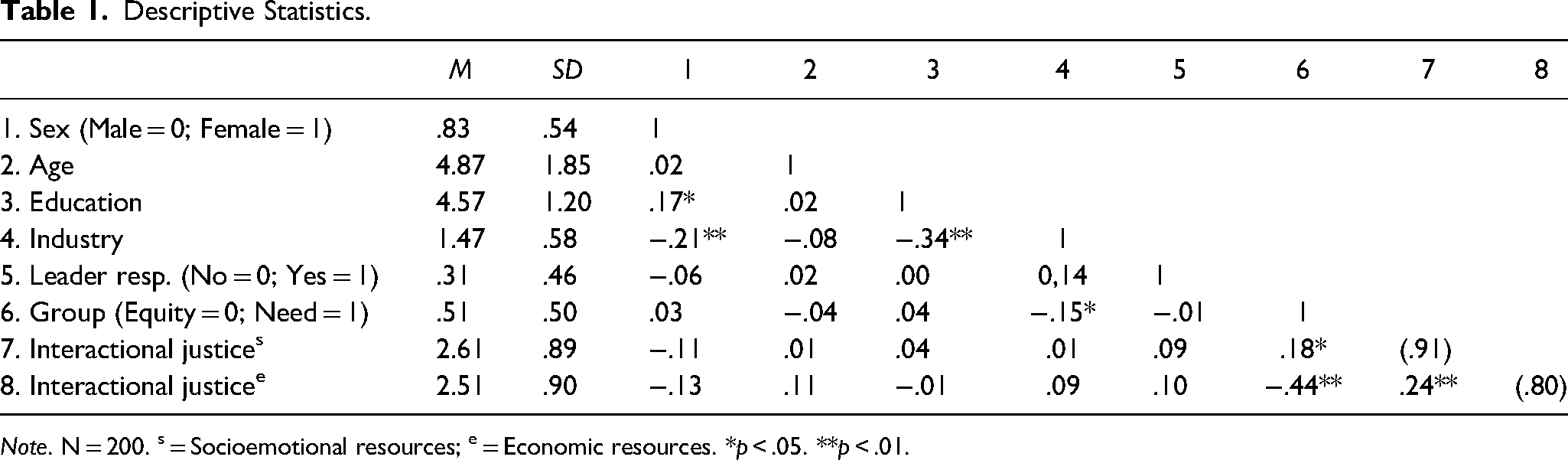
Note. N = 200. s = Socioemotional resources; e = Economic resources. *p < .05. **p < .01.
Manipulation Checks
Three manipulation checks were included. In accordance with whether the participants were informed of being the high- or low-performing employee, participants correctly indicated whether they were the high-performing or low-performing employee (MH = .96, SD = .20, n = 101 vs. ML = .15, SD = .36, n = 99, f = 390.90, p = .000), and the extent to which the leader provided economic resources based on equity or based on need (M = .91, SD = .29, n = 101 vs. M = .07, SD = .26, n = 99, f = 475.26, p = .000) and the extent to which the leader provided socioemotional resources based on equity or on need (M = .89, SD = .31, n = 101 vs. M = .05, SD = .22, n = 99, f = 480.74, p = .000).
Testing Mean Differences
We tested the mean level of perceived interactional justice across the experimental conditions. Regarding the allocation of socioemotional resources (F(1, 199) = 6.483, p = .012), participants reported the highest level of interactional justice when socioemotional resources were based on need (M = 2.76, SD = 0.93) and lowest when based on equity (M = 2.45, SD = .82). Regarding the allocation of economic resources (F(1, 199) = 46.126, p = .000), participants reported the highest level of interactional justice when economic resources were based on equity (M = 2.90, SD = .80), and lowest when based on need (M = 2.12, SD = .81). These findings indicate that allocating economic resources based on equity is fairer than based on need, and allocating socioemotional resources based on need is fairer than based on equity, providing support for Hypothesis 1, 2, 3 and 4.
Method Study 2
Sample and Procedure
To test our hypothesized model, we utilized a cross-lagged survey design. The survey was distributed in 2020 to a total of 738 employees across four different organizations within transport, logistics and manufacturing within the Norwegian private sector. To alleviate common method bias (Podsakoff et al., 2012), the survey was distributed at two different time points with a two to three-week time lag in between. Complete answers were provided by 219 employees, corresponding to a response rate of 30%. 38% of the participants were female, and 53.4% of the participants had been with the organization for more than 10 years. 98.2% worked full-time, and 24.7% reported having leadership responsibility.
Measures
LMXD of Socioemotional and Economic Resources
In alignment with Martin et al.'s (2018) recommendation that future studies should measure LMXD directly, we applied a perceptual measure of LMXD. The measure of LMXD of resources is adapted from other direct measures of LMXD (Choi et al., 2020; Van Breukelen et al., 2002). Consistent with previous research, we focus on ‘pure’ socioemotional and ‘pure’ economic resources that are commonly allocated by the leader (Herman & Troth, 2013; Parks et al., 1999). We developed three items for each category. The three items to measure socioemotional resources were: “My immediate leader treats some group members with more warmth and friendliness compared to other group members”; “My immediate leader treats some group members with more care than other group members”; “My immediate leader provides some group members with more emotional support and encouragement compared to other group members”. The three items to measure economic resources were: “My immediate leader prioritizes some group members more than others in terms of financial and material resources”; “My immediate leader provides some group members with higher pay raises compared to other group members”; “My immediate leader provides some group members with larger bonuses or other financial rewards compared to other group members”.
LMXD of Resources Based on Equity
Similarly, we asked to what extent a leader's differential treatment was based on the principle of equity. The three items to measure socioemotional resources were: “My immediate leader treats the best-performing group members with more warmth and friendliness compared to other group members”; “My immediate leader treats the best-performing group members with more care than other group members”; “My immediate leader provides the best-performing group members with more emotional support and encouragement compared to other group members”. The three items to measure economic resources were: “My immediate leader prioritizes the best-performing group members more than others in terms of financial and material resources”; “My immediate leader provides the best-performing group members with higher pay raises compared to other group members”; “My immediate leader provides the best-performing group members with larger bonuses or other financial rewards compared to other group members”. For clarification, participants were provided the following definition: “Best performing group members” refers to employees you believe, on average, perform the best in your workgroup.”
LMXD of Resources Based on Need
Building upon our measure of LMXD of resources, we asked to what extent a leader's differential treatment was based on the principle of need for both socioemotional and economic resources. The three items to measure socioemotional resources were: “My immediate leader treats the group members that are worse off with more warmth and friendliness compared to other group members”; “My immediate leader treats group members that are worse off with more care than other group members”; “My immediate leader provides group members that are worse off with more emotional support and encouragement compared to other group members”. The three items to measure economic resources were: “My immediate leader prioritizes group members that are worse off more than others in terms of financial and material resources”; “My immediate leader provides group members that are worse off with higher pay raises compared to other group members”; “My immediate leader provides group members that are worse off with larger bonuses or other financial rewards compared to other group members”. For clarification, participants were provided the following definition “Group members who are “worse off” refers to employees that you believe are struggling at work, such as low work performance or other difficult circumstances”.
Leader-Employee Exchange Relationship
SLMX and ELMX were measured with an eight-item scale, in which four items assess SLMX, and four items assess ELMX (Kuvaas et al., 2012). An example item of SLMX is: “My relationship with my immediate leader is based on mutual trust,” and of ELMX is: “I do what my immediate leader demands from me, mainly because he or she is my formal boss”.
Interactional Justice at Time Two
To measure interactional justice, we used the same as in study 1.
Controls
Perceived fairness is influenced by demographic variables (Konow & Schwettmann, 2016). In line with previous LMXD research, we controlled for sex, tenure, dyadic tenure, and education (Chen and Zhang, 2021; Liden et al., 2006). Furthermore, research supports that the relationship with a target of unfair treatment will influence the observer's reaction to that treatment (Dhanani & LaPalme, 2019). Relatedly, Schwinger (1986) suggests that as relationships become closer, justice principles shift from equity in distant relationships to equality and need in closer social relationships. Therefore, we controlled for workgroup size, task interdependence, and extraversion as they provide an indicator of how close individuals are to their coworkers. Extraversion was measured using four items from the Mini-IPIP scale (Donnellan et al., 2006). Task interdependence was measured using the four-item scale developed by Pearce and Gregersen (1991). Furthermore, the type of job is also identified as a relevant factor that influences how justifiable LMXD is (Yu et al., 2018). Thus, we controlled for position and leadership responsibility. All latent variables were measured on a five-point Likert scale.
Results Study 2
Means, standard deviations, Cronbach alpha reliabilities, and correlations among study variables are presented in Table 2.
Descriptive Statistics.
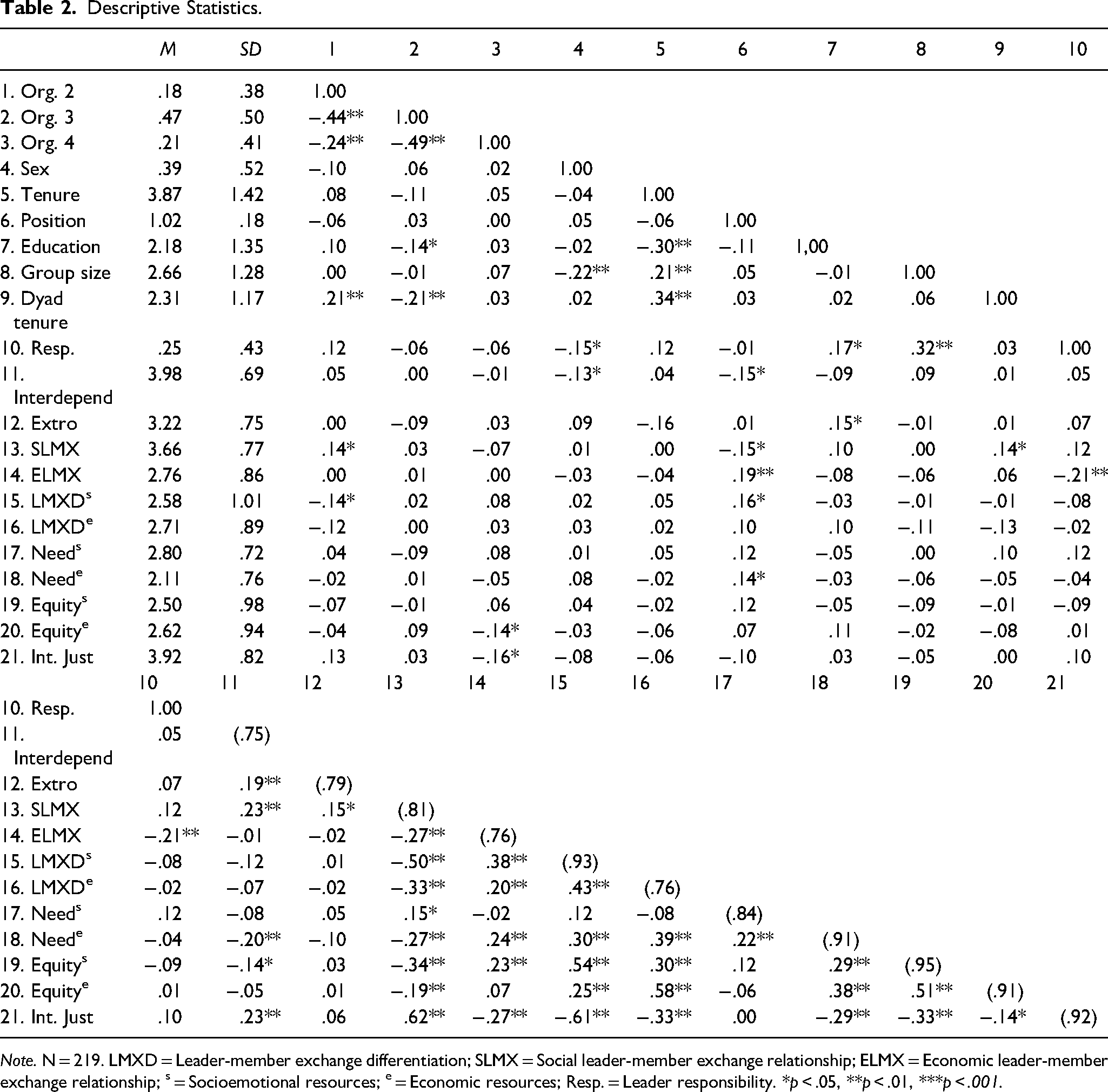
Note. N = 219. LMXD = Leader-member exchange differentiation; SLMX = Social leader-member exchange relationship; ELMX = Economic leader-member exchange relationship; s = Socioemotional resources; e = Economic resources; Resp. = Leader responsibility. *p < .05, **p < .01, ***p < .001.
Confirmatory Factor Analysis
We performed confirmatory factor analyses (CFAs) using STATA 17 to evaluate the fit of the hypothesized nine-factor model (i.e., LMXD of socioemotional resources; LMXD of economic resources; LMXD of socioemotional resources based on need; LMXD of economic resources based on equity; LMXD of socioemotional resources based on equity; LMXD of economic resources based on equity; SLMX; ELMX; and interactional justice). The proposed model provided a satisfactory fit (χ2 = 613.73, df = 341, RMSEA = .06, CFI = .94) (Hu & Bentler, 1999) and indicated a significantly better fit than alternative models, providing support for treating them as distinct latent factors (see Table 3).
Confirmatory Factor Analysis.
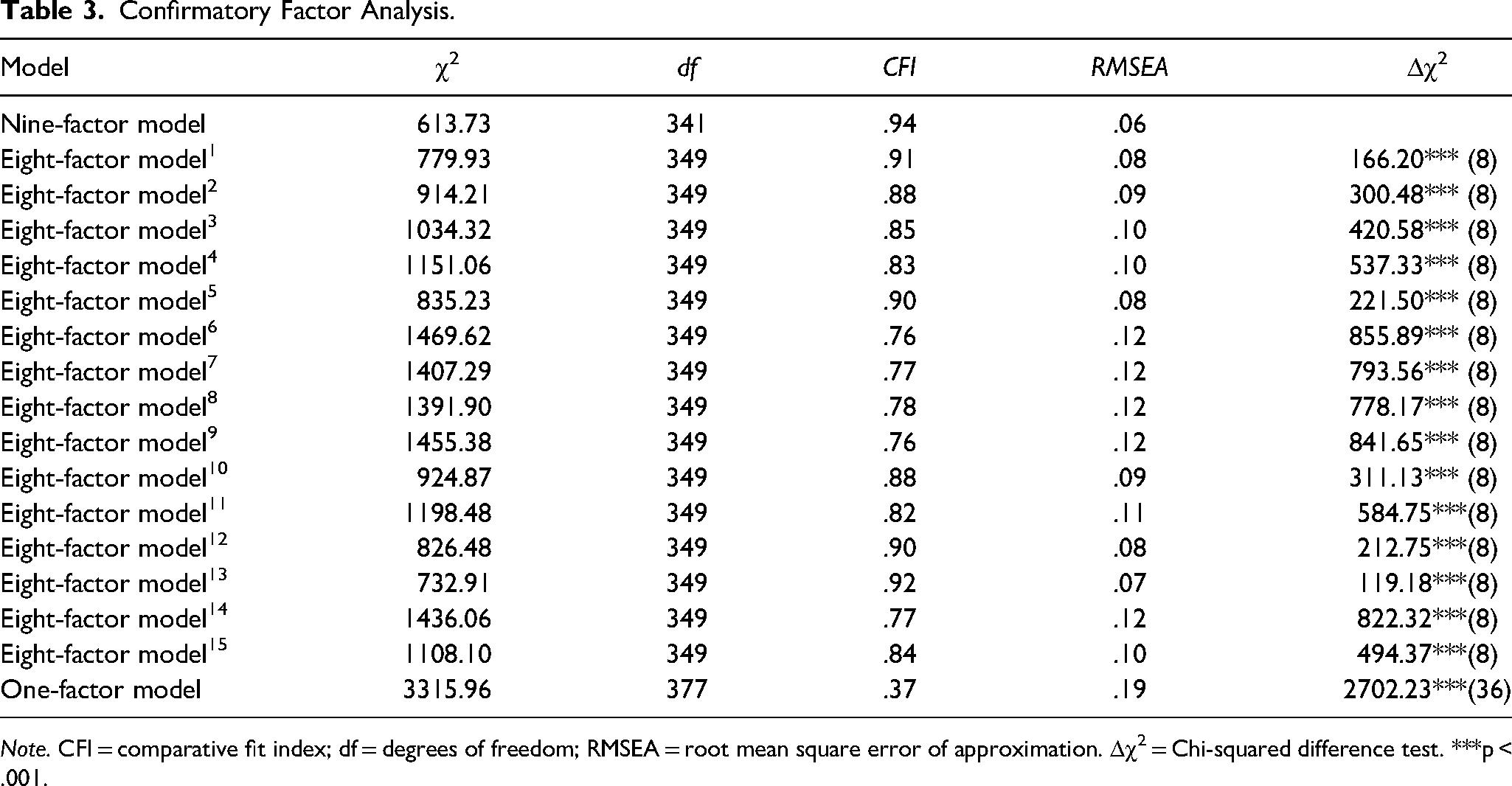
Note. CFI = comparative fit index; df = degrees of freedom; RMSEA = root mean square error of approximation. Δχ2 = Chi-squared difference test. ***p < .001.
Hypothesis Testing
Given that employees are nested within organizations, we tested the hypothesized relationships using multilevel modeling using the LME4 package in R (Snijders & Bosker, 2011). At the organizational level, we included random intercepts and random slopes for the explanatory variables (Bell et al., 2019).
We did not find a significant interaction between LMXD of economic resources and equity basis on interactional justice, providing no support for Hypothesis 1. In Hypothesis 2, we proposed that LMXD of economic resources relates more positively to interactional justice when need basis is low compared to high. We found a significant interaction between LMXD of economic resources and need basis on interactional justice (β = −.14, SE = .07, p < .05) (see Table 4). The relationship between LMXD of economic resources and interactional justice disappears when need basis is low (β = −.04, SE = .07, n.s.), compared to a negative association when need basis is high (β = −.18, SE = .09, p < .05) (see Figure 2), providing support for Hypothesis 2.
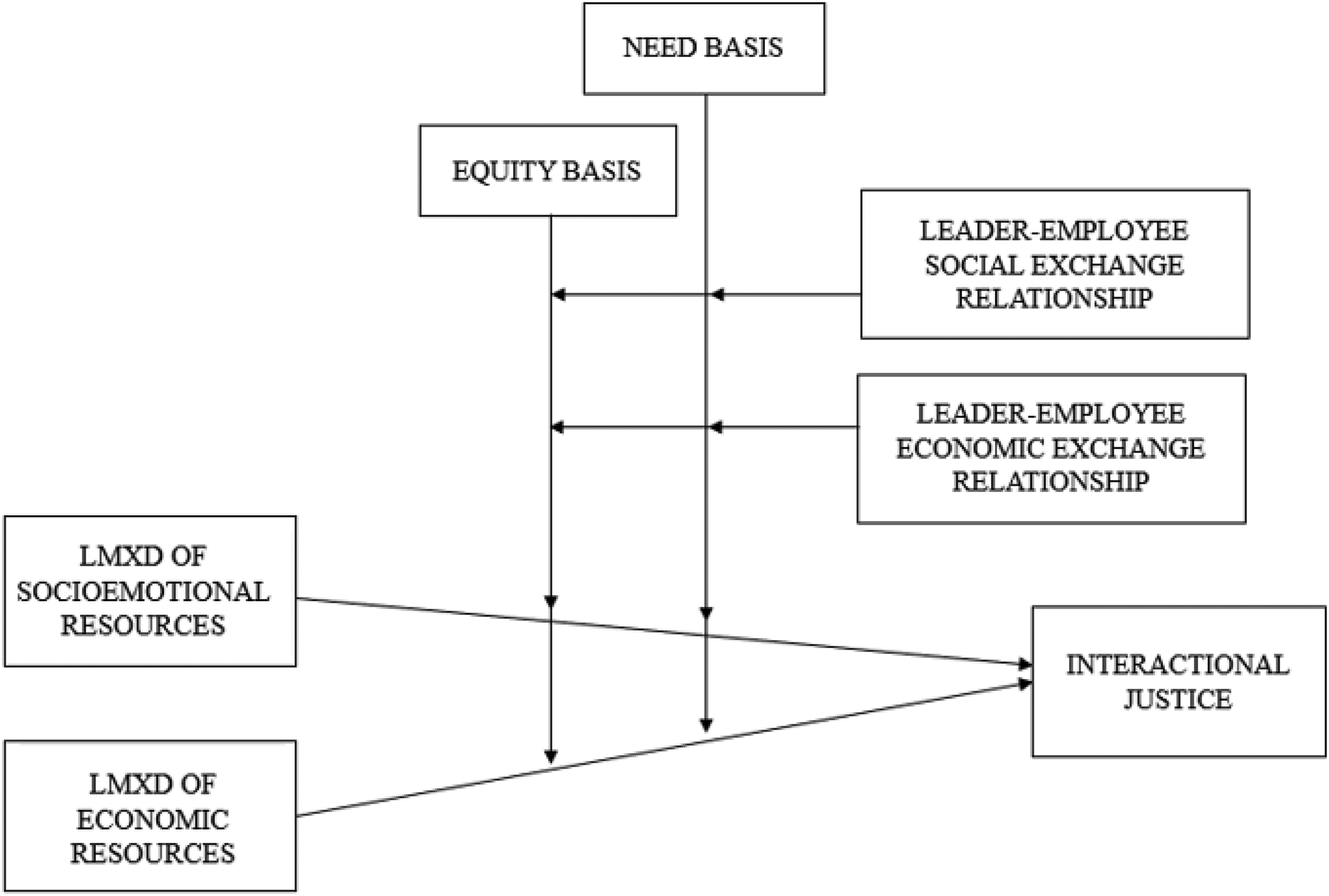
Hypothesized model.
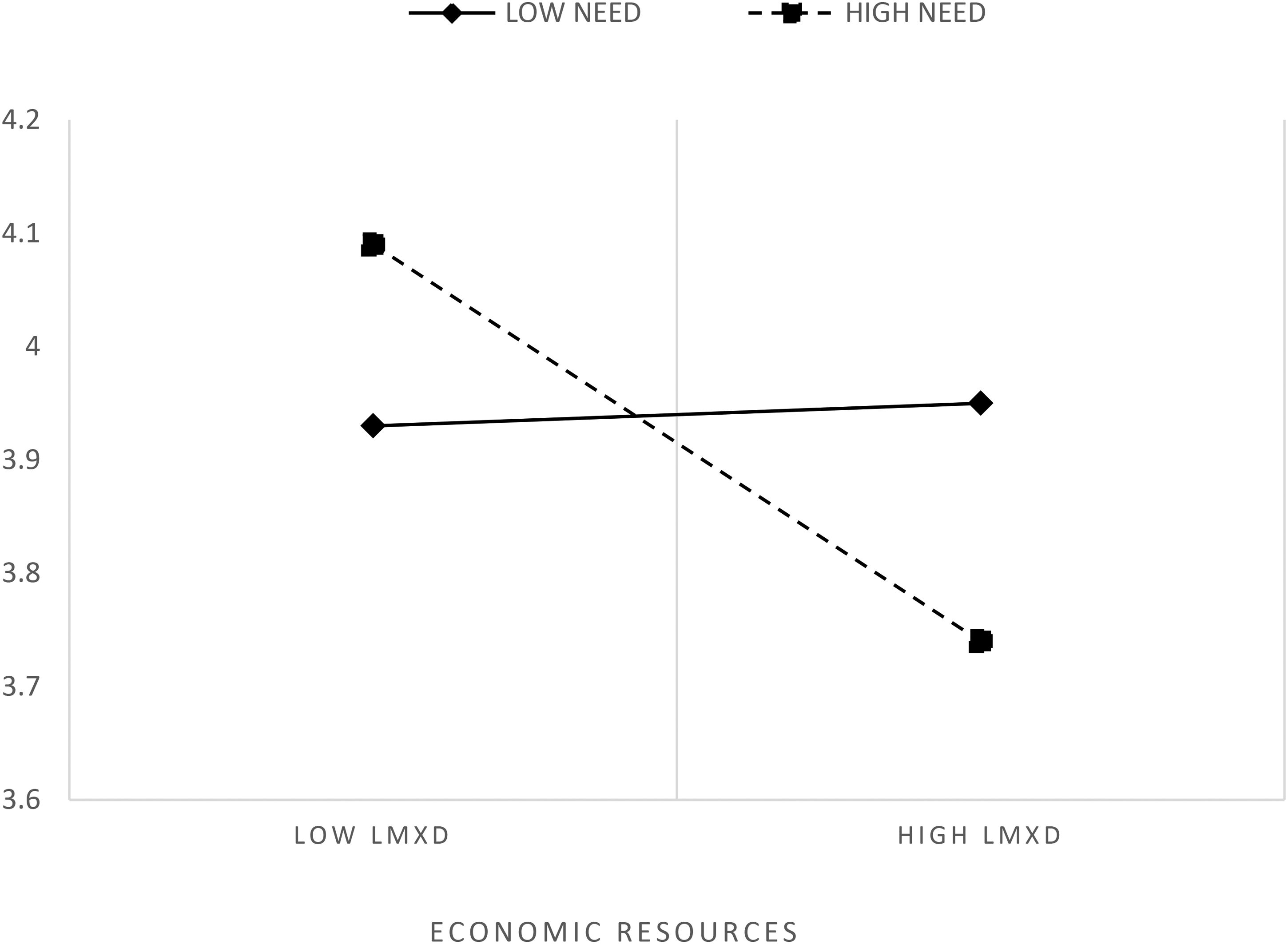
Interaction between LMXD of economic resources and need basis on interactional justice.
Linear Mixed Effects Models.
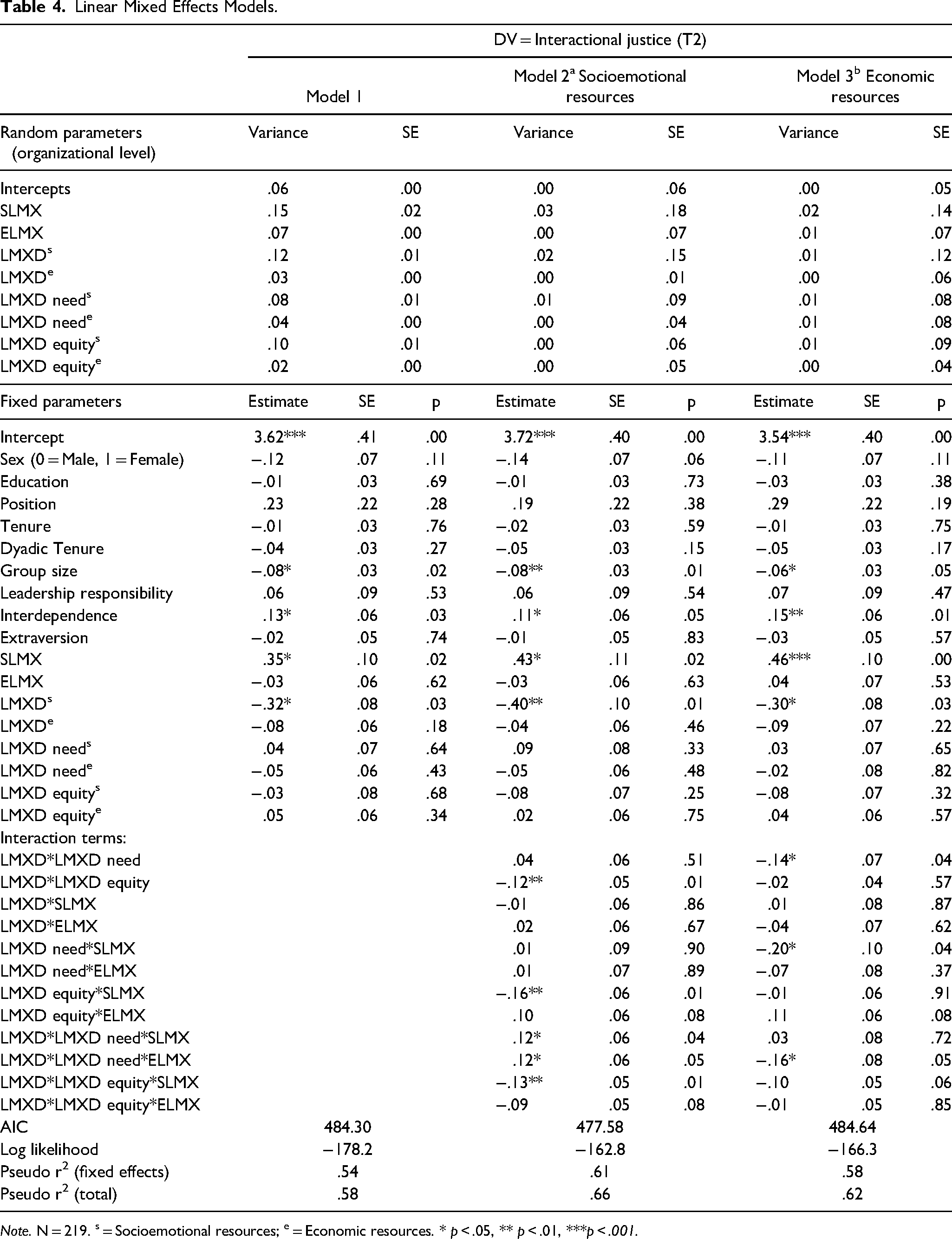
Note. N = 219. s = Socioemotional resources; e = Economic resources. * p < .05, ** p < .01, ***p < .001.
In Hypothesis 3, we proposed that LMXD of socioemotional resources relates more positively to interactional justice when equity basis is low compared to high. We found a significant interaction between LMXD of socioemotional resources and equity basis on interactional justice (β = −.12, SE = .05, p < .01) (see Table 4). The negative relationship between LMXD of socioemotional resources and interactional justice is weaker when equity basis is low (β = −.25, SE = .09, p < .001) compared to a stronger negative association when equity basis is high (β = −0.45, SE = .10, p < .001) (see Figure 3). This indicates that it is fairer to base the allocation of socioemotional resources less on equity as LMXD increases, providing support for Hypothesis 3. We did not find a significant interaction between LMXD of socioemotional resources and need basis on interactional justice, thus not providing support for Hypothesis 4.
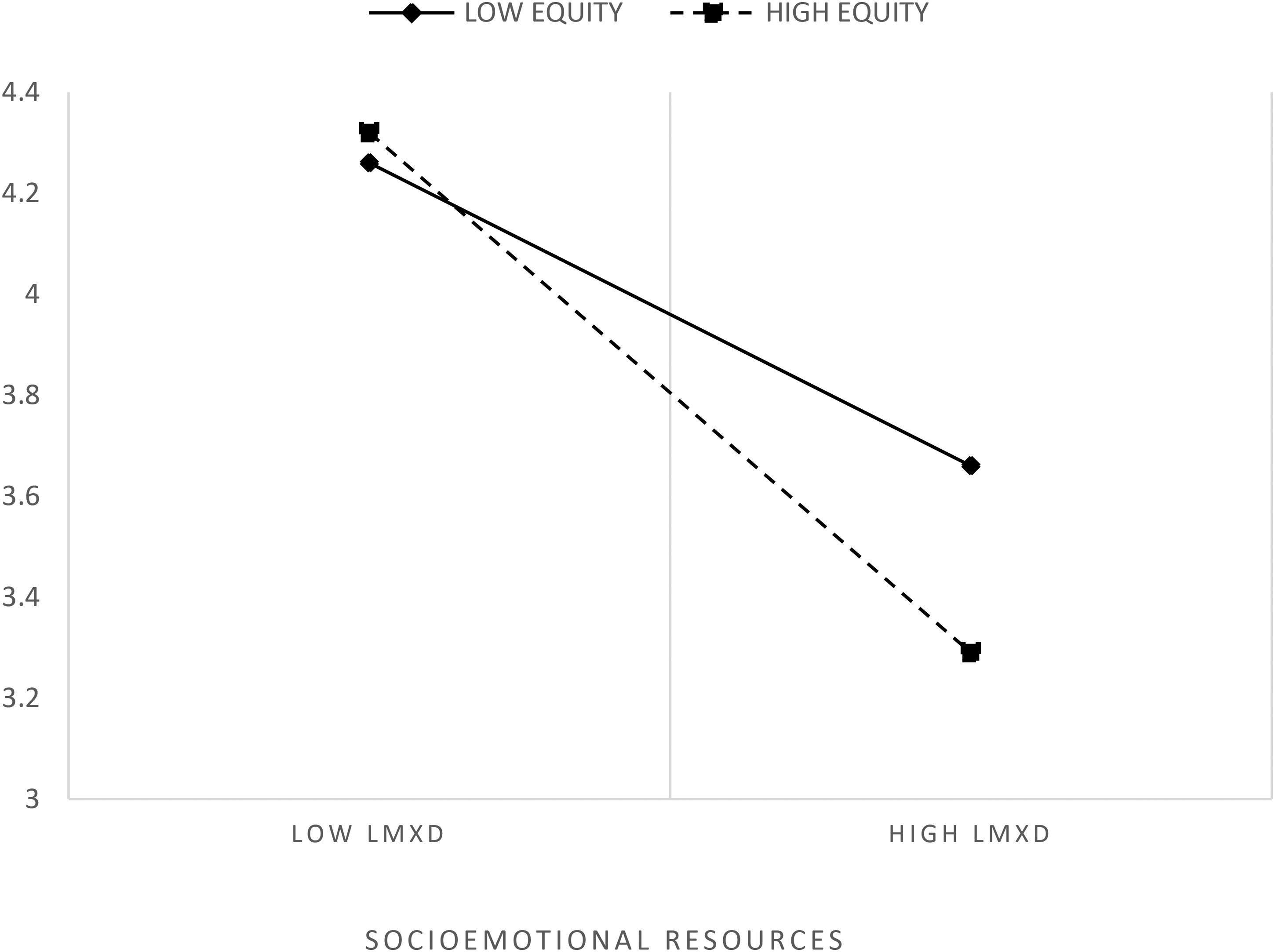
Interaction between LMXD of socioemotional resources and equity basis on interactional justice.
In Hypothesis 5a, we proposed an interaction among LMXD of socioemotional resources, need basis, and SLMX. We found a significant interaction between the variables on interactional justice (β = .12, SE = .06, p < .05) (see Table 4). To further examine the results, we plotted simple slopes under various combinations of a high (+1SD) versus a low (−1SD) level of need basis and a high (+1SD) versus a low (−1SD) level of SLMX. From Figure 4, we see that as LMXD of socioemotional resources increases, interactional justice is reduced across all four slopes. However, the steepness of the slopes varies across the different conditions. For those with a high SLMX, the negative association between LMXD of socioemotional resources and interactional justice is stronger when need basis is low (β = −.51, SE = .14, p < .001) compared to high (β = −.32, SE = .12, p < .01). For those with a low SLMX, the negative association between LMXD of socioemotional resources and interactional justice is somewhat stronger when need basis is high (β = −.44, SE = .11, p < .001) compared to low (β = −.35, SE = .11, p < .01). Contrary to what we hypothesized; this indicates that LMXD of socioemotional resources relates more positively to interactional justice when need basis is high compared to low for those with a high SLMX.
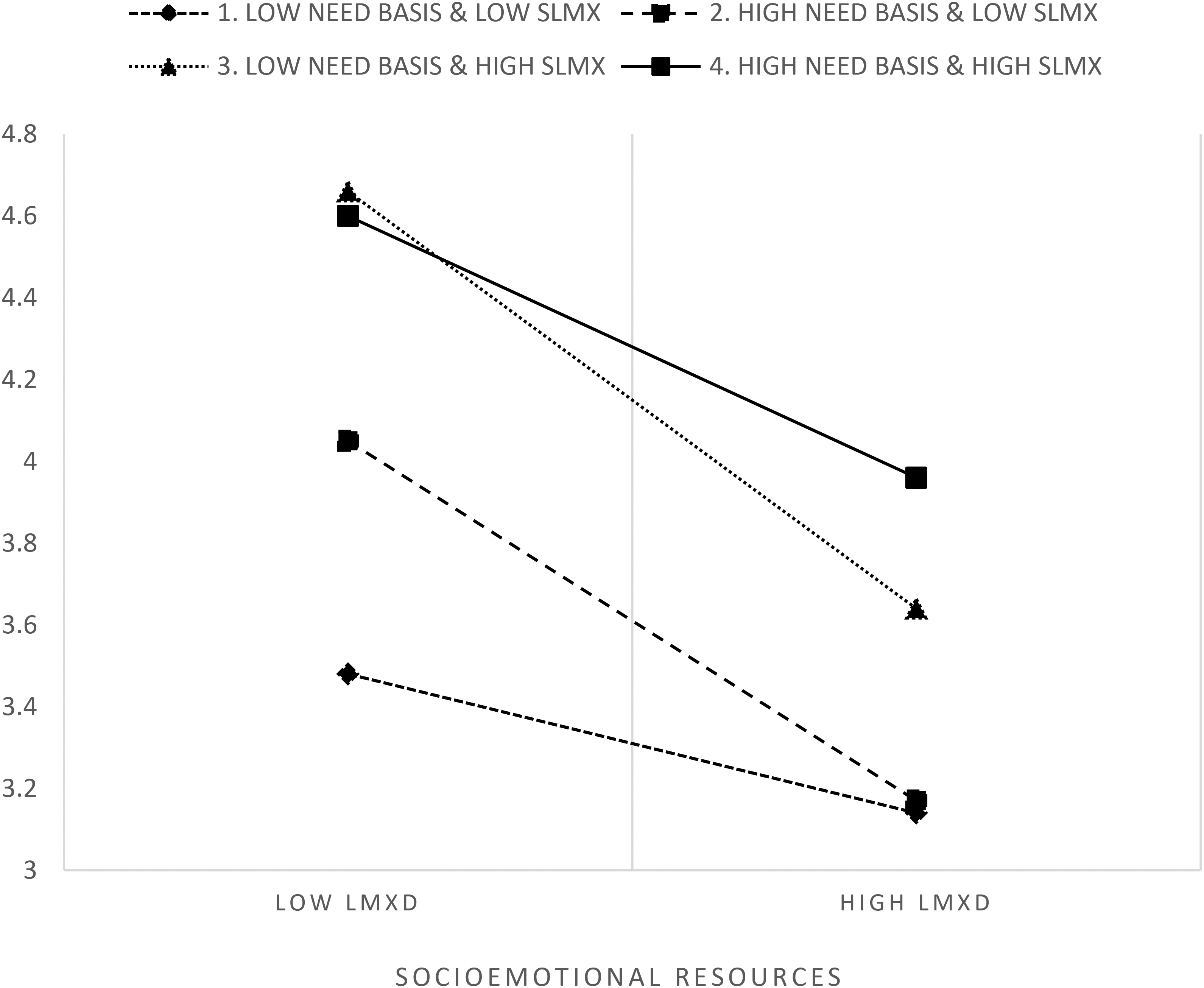
Interaction between LMXD of socioemotional resources, need basis and social exchange relationship on interactional justice.
Regarding Hypothesis 5b, we found a significant interaction among LMXD of socioemotional resources, need basis, and ELMX (β = .12, SE = .06, p = .05) (see Figure 5). For those with a high ELMX, the negative association between LMXD of socioemotional resources and interactional justice is weaker when need basis is high (β = −.28, SE = .12, p < .05) compared to low (β = −.48, SE = .14, p < .001). For those with a low ELMX, the negative association between LMXD of socioemotional resources and interactional justice is stronger when need basis is high (β = −.47, SE = .12, p < .001) compared to low (β = −.38, SE = .12, p < .01). In support of our hypothesis, this indicates that LMXD of socioemotional resources relates more positively to interactional justice when need basis is high compared to low for those with a high ELMX. For those with a low ELMX, however, LMXD of socioemotional resources relates more positively to interactional justice when need basis is low compared to high.
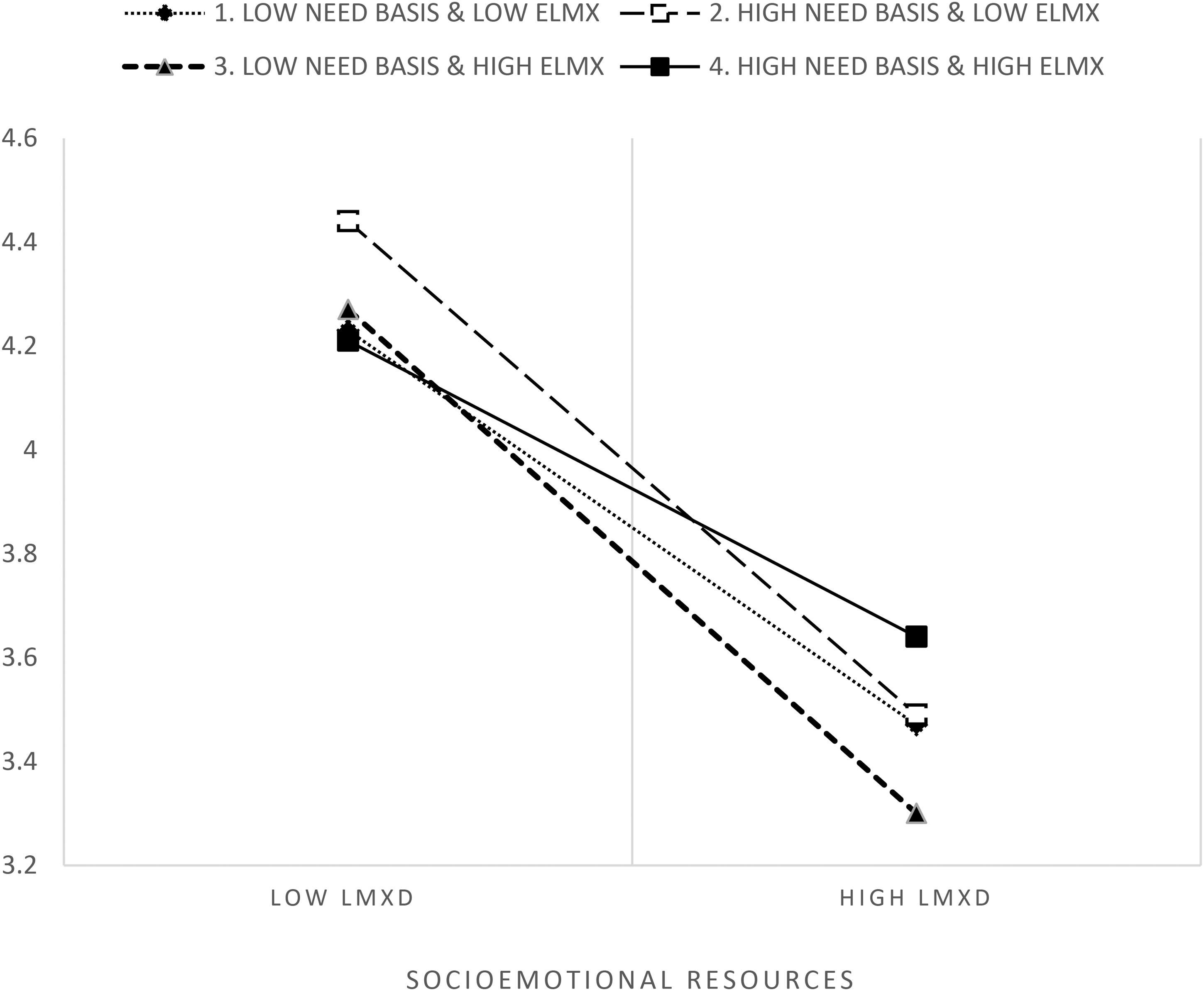
Interaction between LMXD of socioemotional resources, need basis and economic exchange relationship on interactional justice.
In Hypothesis 6a, we hypothesized that there is an interaction between LMXD of socioemotional resources, equity basis, and SLMX. Our results show a significant three-way interaction (β = −.13, SE = .05, p = .01) (see Figure 6). For those with a high SLMX, the relationship between LMXD of socioemotional resources and interactional justice disappears when equity basis is low (β = −.21, SE = .12, n.s.) compared to a negative association when equity basis is high (β = −.61, SE = .13, p < .001). Similarly, for those with a low SLMX, the negative relationship between LMXD of socioemotional resources and interactional justice is somewhat stronger when equity basis is high (β = −.41, SE = .11, p < .001) compared to low (β = −.38, SE = .12, p < .01). In support of our hypothesis, this indicates that LMXD of socioemotional resources relates more positively to interactional justice when equity basis is low compared to high for employees with both high and low SLMX, but especially for those with a high SLMX. We did not find a significant interaction between LMXD of socioemotional resources, equity basis, and ELMX, thus providing no support for Hypothesis 6b.
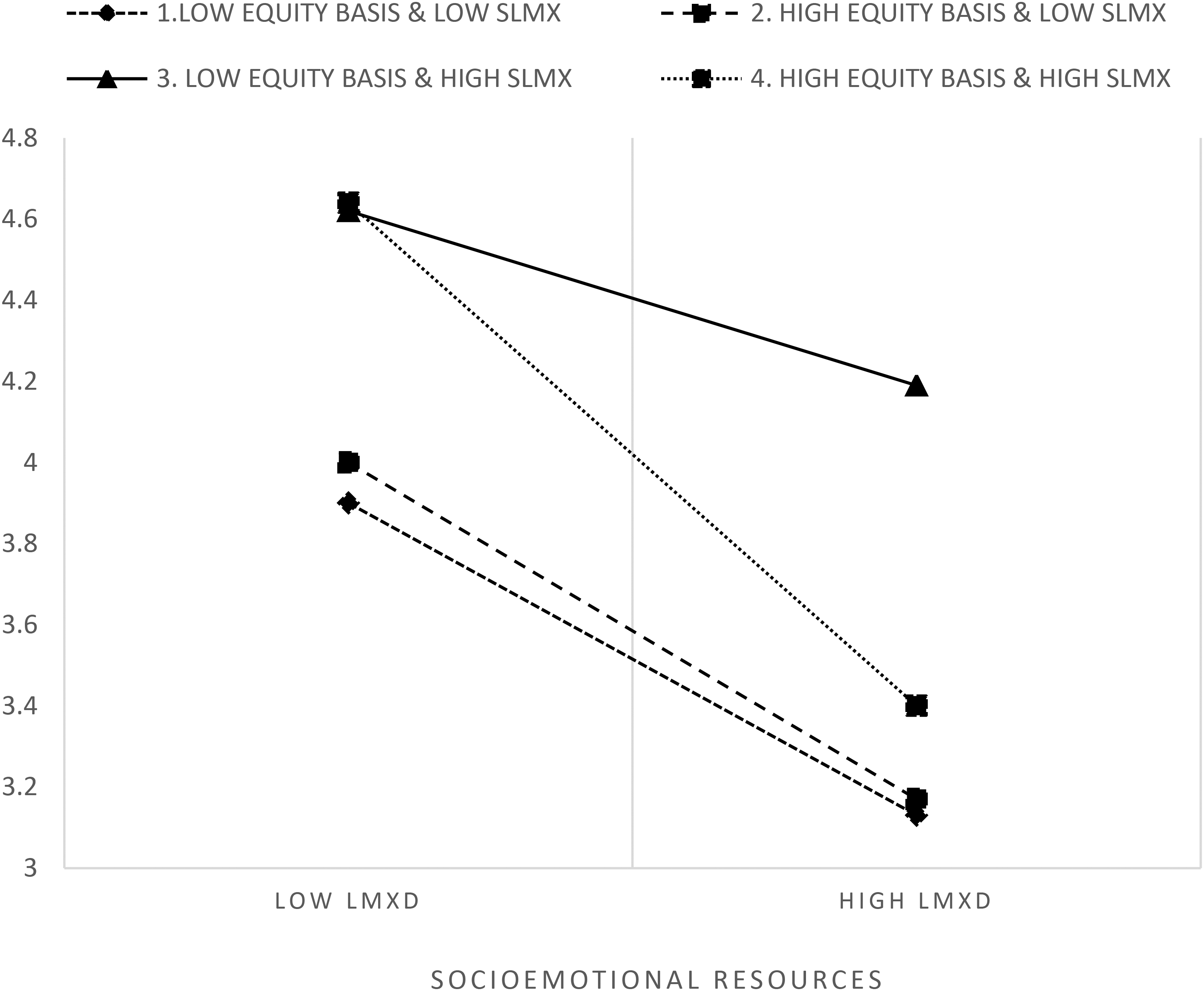
Interaction between LMXD of socioemotional resources, equity basis and social exchange relationship on interactional justice.
Regarding Hypothesis 7b, we find a significant interaction among LMXD of economic resources, need basis, and ELMX (β = −.16, SE = .08, p = .05) (see Figure 7). For those with a high ELMX, the relationship between LMXD of economic resources and interactional justice is negative when need basis is high (β = −.33, SE = .14, p < .05) and non-significant when need basis is low (β = .08, SE = .12, n.s.). For those with a low ELMX, LMXD of economic resources and interactional justice is non-significant both when need basis is low (β = −.06, SE = .09, n.s.) and high (β = −.06, SE = .12, n.s.). This indicates that LMXD of economic resources relates more positively to interactional justice when need basis is low compared to high for those with high ELMX. Providing support for Hypothesis 7b. For those with a low ELMX, regardless of whether LMXD of economic resources is based on low or high need, it does not influence interactional justice.
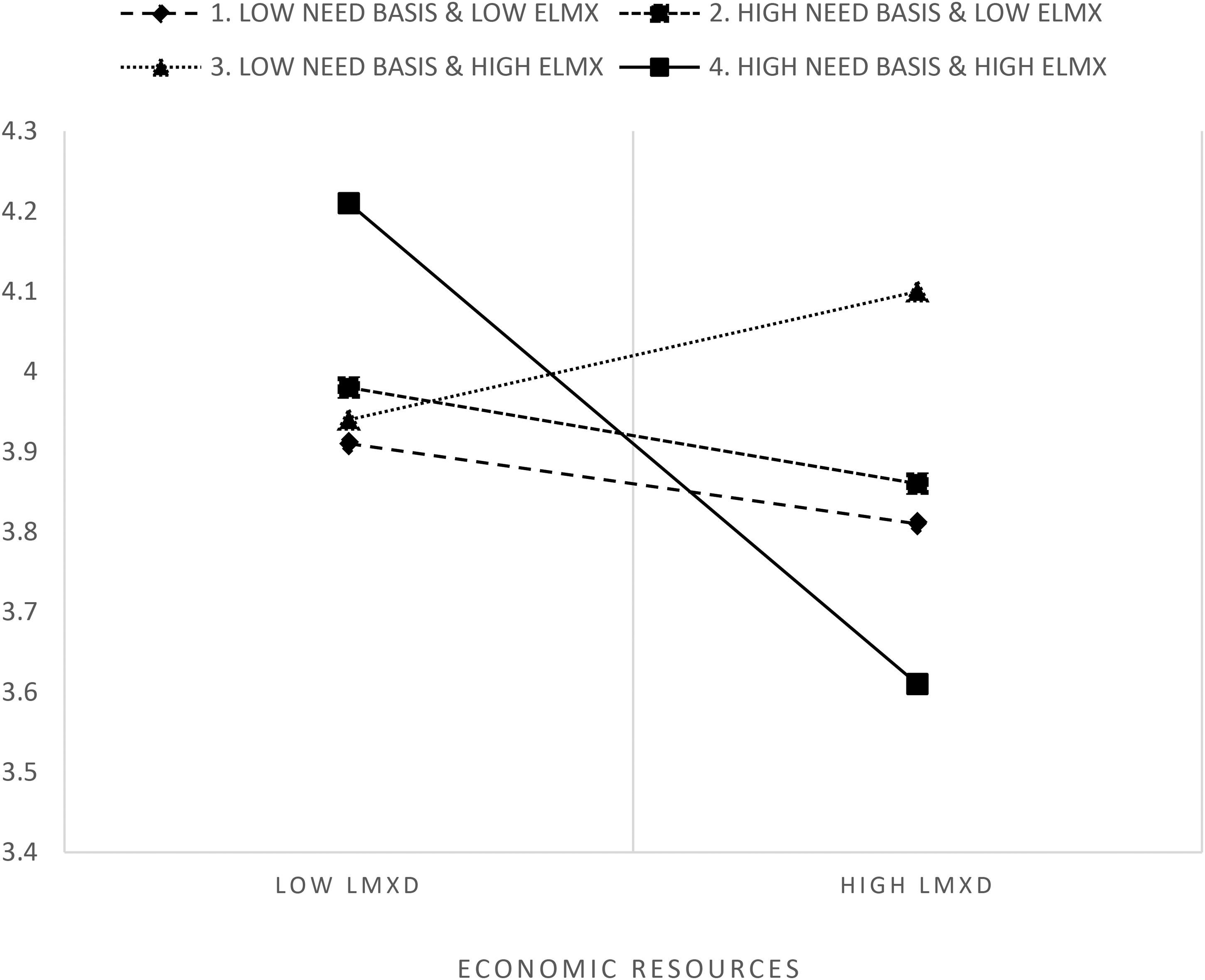
Interaction between LMXD of economic resources, need basis and economic exchange relationship on interactional justice.
We did not find a significant interaction between LMXD of economic resources, need basis, and SLMX. Finally, we did not find a significant interaction between LMXD of economic resources, equity basis, and ELMX, nor between LMXD of economic resources, equity basis, and ELMX. Thus, we did not receive support for Hypothesis 7a, 8a or 8b.
Discussion
The purpose of the present study was to investigate how LMXD relates to interactional justice when we distinguish between socioemotional and economic resources and when distinguishing between the allocation principle LMXD is based upon (i.e., need vs. equity). The most notable and important finding is that LMXD was perceived to be fairer when based on need as compared to equity for socioemotional resources.
Theoretical Implications
Our findings challenge prior LMXD research in two fundamental ways that have important implications for future research. We found that LMXD of socioemotional resources relates more positively to interactional justice when based on a low degree of equity rather than high. This finding challenges the central assumption that LMXD is likely to be judged fairer when employees believe it is based on equity (i.e., their competence or performance) (Anand et al., 2015). Even though this assumption has received empirical support in previous research (Chen et al., 2018; Han et al., 2021), this is when LMXD is conceptualized as a general tendency to treat employees differently (Buengeler et al., 2020). Our findings, therefore, demonstrate that the equity principle does not universally apply to all ‘types of LMXD’ and emphasize the significance of delving into the specifics of a leader's differential treatment to understand its connection to interactional justice. Considering the need principle, our results show that both for employees with a high SLMX and a high ELMX, LMXD of socioemotional resources is considered fairer when it is based on a high degree of need. These findings provide further support for deontic justice and allocation preference theory (Cropanzano et al., 2003; Leventhal, 1980). Employees do not merely adopt instrumental principles when they evaluate a leader's fair treatment. They are concerned with and care about the treatment of their coworkers.
Surprisingly, we found that those with high SLMX, rather than low, evaluate LMXD of socioemotional resources as fairer when it is based on a high degree of need. To understand this finding, we draw upon research that shows that high status and preferential treatment from the leader can lead employees to engage in prosocial behaviors directed at other employees within their work group (Carnevale et al., 2019; Thau et al., 2013; Vidyarthi et al., 2010). Among others, Thau et al. (2013) found that leaders’ kind and considerate treatment motivates employees to comply with norms and to engage in tasks that benefit the group. The better the treatment is relative to others, the greater the need to give back to the rest of the group (Carnevale et al., 2019; Thau et al., 2013). Building upon this, Hysom and Fişek (2011) suggest, through what they call an equity-equality equilibrium model, that when differentiating increases within a workgroup, employees seek to lessen the weight of equity to maintain positive relations. Similarly, increasing LMXD may boost the need for those with a high SLMX to even out LMXD by providing those who are worse off with more socioemotional resources. Employees may, therefore, feel a social or moral obligation to counterbalance some of the leader's differential treatment to maintain positive relations within a workgroup (Hysom & Fişek, 2011).
Regarding economic resources, the results indicate that basing LMXD on a low degree of need within an organizational context is perceived as fairer. This supports the common position that it is less appropriate to apply the need principle to economic resources as it counteracts the common goal of using economic resources to motivate and reward high performance in organizations (Deutsch, 1975).
Practical Implications
Leaders often face a trade-off when allocating resources—rewarding high performers without discouraging lower performers. However, our study suggests that leaders who strategically distinguish and use economic and socioemotional resources can overcome this challenge by differentiating their allocation. Specifically, economic rewards can be directed toward high performers, while socioemotional support—such as attention, care, and encouragement—can be provided to lower performers. This balanced approach allows leaders to enhance employees’ perceived fairness of LMXD while maintaining efficiency.
Given the constraints of time and resources, achieving fair distribution is inherently difficult. However, our findings offer practical insights into how leaders can optimize resource allocation to foster fairness in the workplace. To achieve this balance, economic resources like pay raises and bonuses should be allocated based on competence, skill, and performance—something most leaders likely already do. Meanwhile, socioemotional resources should be distributed according to employees’ individual needs, ensuring that all employees feel valued and supported.
Furthermore, we encourage leaders to communicate and discuss the reasoning behind their allocative decisions, making it clear how both economic and socioemotional resources are allocated. By being mindful of what type of resource is being allocated and on what basis, leaders can increase fairness perceptions.
Limitations and Future Research
There are some important limitations to our study that should be noted. First, our data was collected in Norway, and research suggests that Norwegians have a stronger preference for the principle of equality in allocation decisions compared to, for instance, people in the United States (Almås et al., 2020). This cultural inclination could also relate to preferences for equity-based and need-based allocations. Therefore, cross-cultural research is necessary before drawing broader conclusions about allocation principles for socioemotional and economic resources across different cultural contexts.
Since Study 1 had more women and Study 2 had more men, we investigated sex differences as a possible factor behind the variations in findings between the two studies. Previous research suggests that men and women perceive the fairness of resource allocations differently (Konow & Schwettmann, 2016). There were no sex differences in Study 1, but we observed some sex differences in Study 2 related to the LMXD of socioemotional resources. Men generally perceived LMXD of socioemotional resources to be fairer than women. Women found it fairer when LMXD of socioemotional resources was based on a high degree of need, whereas men showed no difference in perceived interactional justice between high and low need-based allocations. These findings align with research on sex differences in empathy, where women tend to show greater prosocial behavior and concern for others (e.g., Christov-Moore et al., 2014). On the other hand, both men and women perceived LMXD of socioemotional resources based on high equity as less fair than based on low equity, though men generally rated fairness higher overall. This is notable as men typically prefer equity-based allocations (Konow & Schwettmann, 2016); however, in the context of socioemotional resources, men also found high equity less fair. We suggest that future LMXD research explore these sex differences further.
Study 2 is cross-lagged and thus cannot provide evidence of causality, but this concern is alleviated with an experimental design in Study 1. The time lag between the dependent and independent variables reduces the concern with regard to common method variance (MacKenzie & Podsakoff, 2012); still, for future research, it is advised to use several sources and/or objective measures.
We have used poor performance as a proxy for need. Poor performance can arise from a variety of sources, such as lack of tangible resources (e.g., equipment to do the job), competence (proper training and adequate ability), motivation, personal challenges, or other reasons beyond these. Different reasons for poor performance may, with varying strength, serve as proxies for need and are thus likely to influence employees’ fairness perceptions of LMXD. For example, whether poor performance is due to an employee's lower effort or personal challenges may influence how strongly individuals endorse the need principle. This is, however, beyond the scope of this research as the aim of the study was to test the overall endorsement of need basis. In general, poor performance is associated with lower psychological well-being (e.g., depression, reduced life satisfaction, diminished overall well-being), poorer physical health (e.g., hypertension, obesity), diminished personal strengths (e.g., psychological capital, core self-evaluations, positive affect), and strained workplace relationships (Ford et al., 2011; Kleine et al., 2019; Wang et al., 2014), and thus overarchingly may serve as a proxy for need. Still, the specific nature of employees’ needs is an important extension of our work and represents an avenue for future research to extend the theoretical understanding of the principle of need within the context of LMXD.
We acknowledge that our experimental design in Study 1 might suggest that we treat need-based and equity-based allocations as opposite ends of a continuum. However, we do not view these allocation principles as strictly oppositional. In practice, leaders can base their resource allocation on a variety of factors, and a low equity basis doesn’t necessarily imply a high need basis, and vice versa. For instance, a low equity basis may imply that resources are allocated to employees with moderate, rather than top, performance, while a low need basis may involve resources going to employees with moderate needs. Furthermore, we chose to have participants evaluate the presence of one LMXD resource allocation compared to another, rather than evaluating an LMXD resource allocation's presence versus its absence. This approach aligns with similar experimental research (Bauer et al., 2022; Colquitt & Jackson, 2006), allowing for a more meaningful comparison of different types of LMXD resource allocations.
Adopting the crucial distinction in SET (Cropanzano & Mitchell, 2005), we focused explicitly on an LMXD of ‘pure’ socioemotional and ‘pure’ economic resources. There are distinct properties between the two, that are central to classifying different types of resources. Socioemotional resources are highly particular, as their value is significantly influenced by the source from which they are received, whereas economic resources are more universal, maintaining consistent value regardless of the provider (Foa & Foa, 2012). Future research could extend this perspective and investigate other resources, such as tasks, information, and responsibility (Lemmon et al., 2016; Wilson et al., 2010). Since this is preliminary work examining specific resources within the LMXD literature, we have chosen to focus on a limited set of resources with clearly distinct properties.
As suggested by the variation in LMXD perceptions found in previous research (Choi et al., 2020), a degree of subjectivity in how employees perceive LMXD is likely. Thus, employees may not view LMXD in a consistent or universal way. Colquitt et al. (2018) suggest that employees experience different ‘anchoring events’ of leaders’ allocation of resources, which subsequently drive employees to develop divergent perceptions. Our findings indicate that the type of exchange relationship with the leader may be a contributor to forming divergent perceptions of LMXD. We encourage future research to investigate this further and explore how LMXD agreement in work groups may be relevant for enhancing our understanding of LMXD.
This study also raises a new question: is the net benefit of a leader's resources always best utilized by those who perform best? While that may be the case for some resources, it may not be the case for all. Buch et al. (2014) find that to boost employees’ work effort, those with low intrinsic motivation benefit the most from a social exchange relationship. Thus, we encourage LMXD scholars to explore how leaders should differently allocate resources among their employees in such a way that the net benefit is maximized.
Conclusion
The work setting is a place for economic productivity, but it is also a place to foster positive relationships, well-being, and meaning. LMXD of socioemotional and economic resources serve different purposes in this regard. Our results demonstrate that they represent different contexts under which various allocation principles are more or less likely to be viewed as fair. If treated as one and the same, we risk losing important insights regarding the outcomes of LMXD.
Footnotes
Declaration of Conflicting Interests
The authors declared no potential conflicts of interest with respect to the research, authorship, and/or publication of this article.
Funding
The authors received no financial support for the research, authorship, and/or publication of this article.
