



Abstract
Feminist thinking has contributed to changing views of women in society and in leadership positions. Yet women are still underrepresented in leadership, especially in key roles and at higher organizational ranks. In this commentary we examine the past, present, and future of leadership theories through a gendered lens, by considering them against the backdrop of feminist theory evolution. We first organize existing leadership theories according to four main feminist waves—gender reform feminism or “fixing the women” which corresponds with liberal feminism; gender resistance feminism or “the female advantage,” reflecting radical feminism; the gender rebellion feminism or “how is a wo(man) defined,” according to postmodern and intersectionality theories, and gender digital feminism or “hashtag and clicktivism revolution” that focuses on social media, cyber activism, sexual violence, and complex intersectionality. We further examine the implications and research findings of these theories for women and men in leadership. Second, we review the publications on gender and leadership in two exemplary journals publishing leadership research in the field between 2019 and 2022 and explore to which feminist wave the published works relate. We show that themes related to the first two waves of feminist thinking continue to be dominant in current leadership research and encourage moving into new terrains, utilizing current feminist thinking, in the study of leadership and gender. Finally, we raise awareness that in a gendered society, leadership theories may reproduce and reconstruct the existing social order and gendered arrangements, as well as map novel directions for future research.
Despite progress in equal gender representation in organizations and women's involvement in leadership positions, the COVID-19 pandemic hindered this advancement. A recent LeanIn.Org and McKinsey & Company (2022) post-pandemic study, collecting data from 333 organizations, surveying more than 40,000 employees, highlighted a regressive trend. For every woman director promoted, two chose to leave their organization. For every 100 men promoted from entry level to manager, only 87 women are promoted, and among them fewer women of color advance to management. In 2023, 60% of managers were men, compared to 40% women. Alongside this negative status-quo, there have been some positive changes. Men have formally joined the fight for equality. One example is the 2014 “HeForShe” campaign launched in 2014 by the United Nations, which sees boys and men as major stakeholders and advocates in the struggle for gender equality around the world. Similarly, men CEOs in hypermasculine organizations in Australia formed the “Male Champions of Change” organization to enhance gender equality.
With regards to the research field, the terrain is also complex and can be described as “one step forwards, one step backward.” Joshi et al. (2015) systematically reviewed and analyzed key trends in studies on gender in the Academy of Management Journal (AMJ) publications over a period of five decades (from the 1970s to 2015). From this analysis they conclude that after the 1980s the interest in gender started to decline. They attributed this decline to three possible reasons. First, they suggest that there are limited theories tested in the field of gender (e.g., relational demography and sex-based stereotyping) and that researchers may have exhausted new directions for research. Second, they propose that there may be a “gender fatigue” and even a weariness with gender-focused research. Suggesting that scholars in business schools may see this topic as marginalized and riskier for tenure and promotion assessments. Third, they found that gender research has been dominated by male authors who are becoming more discouraged from conducting gender research that is likely to be published in gender-specific and less prestigious journals.
Furthermore, a recent editorial in Human Relations (Bell et al., 2019) also noted that although feminism studies is a long-established field, feministic perspectives are often neglected in theoretical and empirical works in the study of organizations, and there are limited publications based on feminist analysis that were published in the most prestigious journals in our field. The authors show that in journals that are on the Financial Times 50 (FT50) research ranking list, there have been fewer than 100 papers on the topic since 1990. Thus, although positive changes in society in terms of gender equality and scholarly research on the topic of gender in organizations are acknowledged, there still is a worrying and limited representation of works published on gender and feminist issues.
While research and work on gender in relation to leadership has increased, it is still sparse. In the current paper, our goal is to discuss the development of leadership theories through the lens of feminist and recent gender theories. Our aim is threefold: First, we introduce the four major waves of feminist thought: gender reform feminism, gender resistance feminism, gender rebellion feminism, and gender revolution digital feminism. Second, within each perspective, we elaborate on the development of related leadership theories that map onto these feminist lenses and discuss the contribution and critique of each feminist perspective to conceptualizing and understanding leadership. Third, we further explore the representation and ways in which gender and leadership have been studied in two exemplary leadership journals: Journal of Leadership & Organizational Studies (JLOS) and The Leadership Quarterly (LQ), in a period of four years (between 2019 and 2022), while categorizing the research along the lines of the four feminist waves and theoretical perspectives we introduced. To conclude, we address the implication of feminist thinking for the future development of novel leadership theories and chart directions for research that will move the field forward.
Four Major Feminist Perspectives on Leadership
Feminist theories, aiming to end sexist oppression, have significantly influenced perceptions of women's leadership roles. These theories, while varied in their analysis of gender inequality's origins and solutions, uniformly critique the status quo and advocate for equality and social justice (Bell et al., 2019; Calás & Smircich, 2006, 2014; hooks, 1982). They emphasize how gender and racial inequalities pervade social and economic spheres, often highlighting the oppressive effects of patriarchal systems like hegemonic masculinities and neoliberal capitalism (Bell et al., 2019). Ranging from advocating organizational reform to seeking a wider transformation of societal structures, feminist perspectives offer diverse pathways for addressing gendered disparities.
Feminist thinking has evolved in four distinct “waves” (Bell et al., 2019; Calás & Smircich, 1996; Kark, 2004; Kark et al., 2023): Gender reform feminism (“fixing the women”), aligned with liberal feminism; gender resistance feminism (“the female advantage”), paralleling radical feminism; gender rebellion feminism (“how is a wo(man) defined”), influenced by postmodern and intersectionality theories (Lorber, 2001; Kark et al., 2023); and gender digital feminism (“clicktivism revolution”), focusing on social media and complex intersectionality (Gill et al., 2017). These waves reflect societal and gender relation changes over time. Critics of the concept of “wave” stress that it may oversimplify a much more complicated history by suggesting that it constructs history as though only one distinct type of feminism exists at any one period. In reality, each wave includes overlapping sub-groups of perspectives, which often contradict and are at odds with each other. Although the wave concept is imperfect, it is a helpful tool for understanding the development of feminist thought, and in conjunction the exploration of the development of leadership theories and the ways gender is studied.
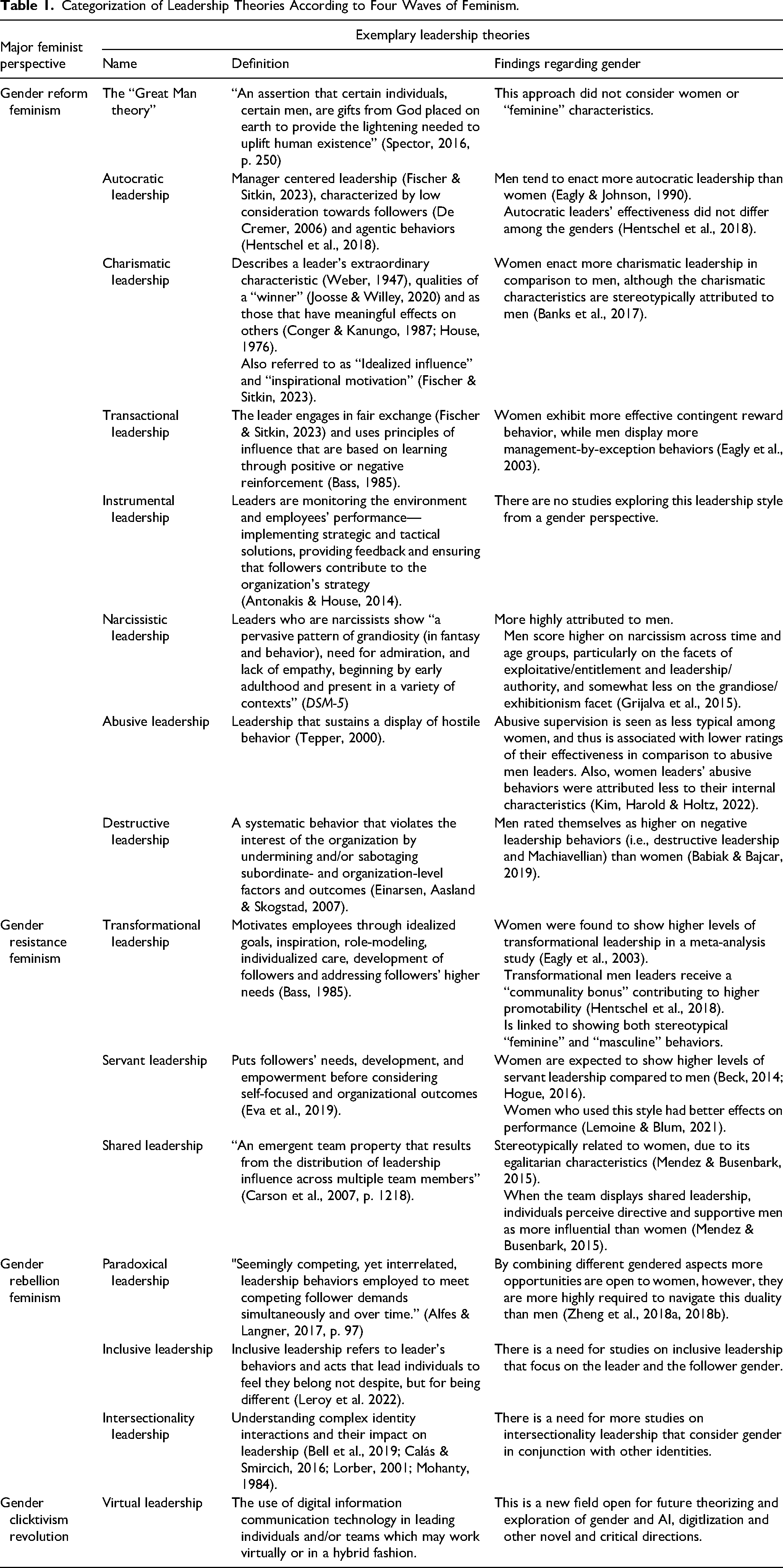
In this commentary paper, we explore how the feminist “waves” and related perspectives are resonated in leadership theories. For our analyses, we choose to focus on specific leadership theories for examination, without aiming for a comprehensive review of the wide array of all existing leadership theories. We also highlight empirical findings on gender and leadership that are relevant to each leadership theory and its corresponding feminist perspective (see Table 1 and Figure 1 for a summary).
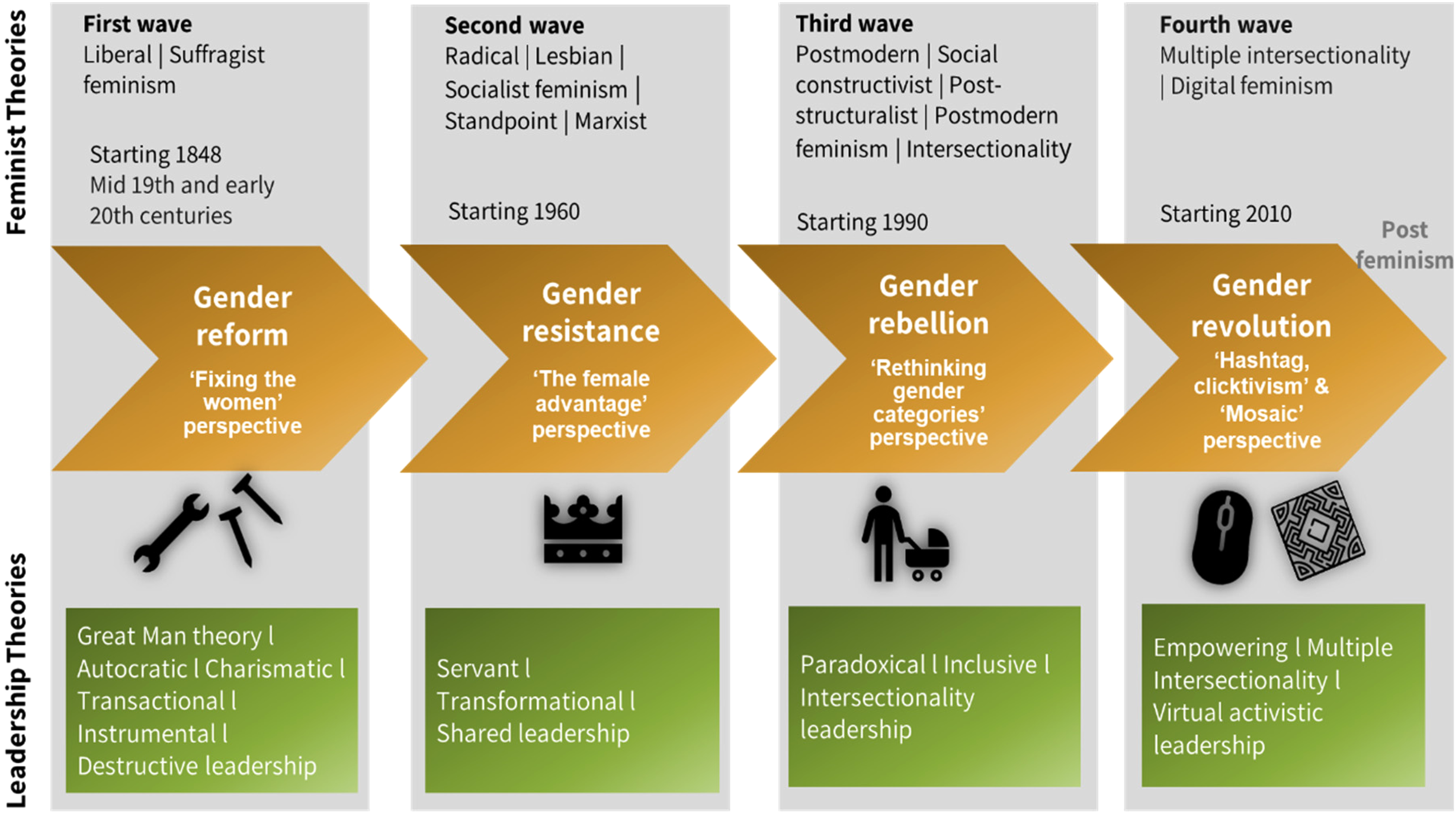
Mapping leadership theories upon four waves of feminist thinking.
Categorization of Leadership Theories According to Four Waves of Feminism.
Gender Reform Feminism: “Fixing the Women” Perspective
Gender reform feminism, mostly represented by the first wave of liberal or Marxist feminism of the 1970s, identifies gender inequality to be caused by society's gendered social structure (Lorber, 2001). The aim of this approach is to achieve gender balance and equal rights regarding power, economic resources, and recognition. Gender reform feminism rejects the existence of a biological explanation of gender differences (Jaggar, 1983; Lorber, 2001) and stresses the equal capabilities of women and men. Gender reform feminism mostly assumes that gender-role socialization instills differences, at the individual level, in the characteristics of women and men. Gender and sex differences are treated interchangeably, and gender is assumed to be a fixed characteristic of the individual, rather than a socially produced structure (Ely & Padavic, 2007). This leads to different gender stereotypes and attributions that render women less capable.
Accordingly, to gain success in organizations and achieve leadership positions, women must adapt to and demonstrate the required traits and skills (Kark et al., 2024a; Zheng et al., 2018a, 2018b). Thus, gender reform feminism fosters a “fixing the women” perspective resulting in interventions that educate women on how to keep up with men (Ely & Meyerson, 2000). Related research explores whether there exist any gender differences in organizational contexts and which conditions evoke these differences and alter their outcomes. This approach resonates with the conceptualization of and research on the traditional/heroic leadership theories that were developed before and during this first wave of feminist theories.
Gender Reform Feminism and Traditional/Heroic Leadership Theories
The historical “Great Man theory,” described by Thomas Carlyle in 1840 as “an assertion that certain individuals, certain men, are gifts from God placed on earth to provide the lightening needed to uplift human existence” (Spector, 2016, p. 250), focuses on inherent traits to distinguish non-leaders and leaders. This theory, centered on strong male figures, overlooked women and “feminine” characteristics. Similarly, the behavioral/style approaches from the 1940s replacing it, emphasizing leaders’ behaviors and effectiveness (Judge et al., 2004; Stogdill, 1950), often evolve around “masculine” behaviors, such as autocratic, charismatic, and transactional leadership.
Autocratic leadership, known for low follower consideration (De Cremer, 2006) and agentic behaviors (Hentschel et al., 2018), contrasts with stereotypical “feminine” styles like democratic or participative leadership (Lewin et al., 1939). A meta-analysis showed that men generally show more autocratic tendencies, while women lean towards democratic leadership, linked to higher follower satisfaction (Eagly & Johnson, 1990; Foels et al., 2000). However, Hentschel et al. (2018) found no significant gender differences in autocratic leadership expectations.
Charismatic leadership, derived from the Greek for “gift” (House, 1976), is marked by extraordinary traits (Weber, 1947), “winner” qualities (Joosse & Willey, 2020), and significant impact on others (Conger & Kanungo, 1987; House, 1976). It parallels “hegemonic masculinity” concepts (Connell, 1987; Connell & Messerschmidt, 2005), often associated with male stereotypes like dominance and self-confidence. However, a recent meta-analysis shows women exhibiting more charismatic leadership (Banks et al., 2017), and training studies indicate women can develop charismatic behaviors as effectively as men (Niebuhr et al., 2019).
Transactional leadership, integral to the Full-Range Leadership theory, employs principles of positive or negative reinforcement (Bass, 1985). Its facets include contingent reward and active and passive management-by-exception, where leaders intervene upon performance deviations or wait until problems have occurred to become involved (Bass, 1985; Avolio et al., 1999). Meta-analyses reveal a small gender effect: women show more effective contingent reward behavior. Men more often use management-by-exception styles, linked to null or negative leadership impact (Eagly et al., 2003).
Destructive leadership also maps on this gender reform wave of feminism. Characterized by hostile behaviors (e.g., abusive supervision; Tepper, 2000) and other actions that harm the organization (Einarsen et al. 2007), destructive leadership encompasses various negative leadership styles (Fischer & Sitkin, 2023; Tierney & Tepper, 2007). Empirical evidence supports the adverse outcomes of such leadership (Krasikova et al., 2013; Pajic et al., 2021; Schyns & Schilling, 2013). One form of destructive leadership is narcissistic leadership. Narcissism, defined as a pattern of grandiosity, need for admiration, and lack of empathy, is more prevalent among leaders, with higher representation in men, aligning with masculine stereotypes like anger, power need, and authoritative style (Corry et al., 2008, p. 593). According to a comprehensive meta-analysis, men score higher on narcissism across time and age groups, particularly on the facets of exploitative/entitlement and leadership/authority, and somewhat less on the grandiose/exhibitionism facet (Grijalva et al., 2015). Furthermore, men rated themselves higher on destructive leadership and Machiavellianism in comparison to women (Babiak & Bajcar, 2019) and were seen as higher on abusive leadership by followers (Kim, Harold & Holtz, 2022). Yet, although abusive leadership was seen as less typical among women, when they were seen as abusive it was associated with lower ratings of effectiveness in comparison to abusive men leaders (Kim et al., 2022).
Other leadership behaviors that also align with this wave of traditional/heroic leadership theories include instrumental leadership and task-oriented leadership. In Table 1, we present these leadership theories and the way they map onto feminist thought and the different waves.
Contribution and Critique of Gender Reform Feminism Leadership Perspective
Gender reform studies, reflecting a traditional leadership outlook, endorse heroic styles (e.g., management-by-exception, autocratic, charismatic, and narcissistic leadership) rooted in male-centric theories. These align with the “think manager—think male” concept (Schein, 1973, 1975), often disregarding gender to maintain the status quo and emphasize “heroic” traits and behaviors, advised historically by men researchers, and targeted towards men leaders (Fondas, 1997; Fletcher, 2004). This stream of research has focused on explaining gender disadvantages rather than overcoming them (Calás & Smircich, 2016), imposing masculine norms on women, who are expected to adapt (Billing & Alvesson, 2000). Despite the masculine orientation of these leadership styles, women have been rated as equally or more effective compared to men in these styles (Eagly et al., 2003; Eagly & Johnson, 1990). Thus, the first wave of gender and accompanying theories treat gender as a mere variable, overlooking the systemic factors that perpetuate gender inequality (Alvesson & Billing, 1997; Ely & Padavic, 2007). They advocate for women to “lean in” and adopt “men’s ways of leading.” However, recent perspectives argue for systemic rather than individual transformation, highlighting the need to “fix the system” versus to “fix the women” (Kim et al., 2018), to achieve sustainable change and redefine leadership itself. This shift in thinking ushers in gender resistance feminism, focusing on women's unique perspectives and voices (Calás & Smircich, 2016; Lorber, 2001).
Gender Resistance Feminism: The Female Advantage
Gender resistance feminism, starting in the 1980s, mostly represented by the second wave of radical, lesbian, or standpoint feminism, points out that gender equality is not enough. Rather, it highlights a new perspective grounded in women's experiences (Lorber, 2001). This approach aims to change social norms and value women, stereotypically “female” attributes and women's ways of knowing and doing things (Ely & Meyerson, 2000; Lorber, 2001). It puts forward women's stereotypical interpersonal characteristics (e.g., sensitive, emotional; Eagly et al., 2020), their communal and nurturing capability and motherhood roles, stressing the contribution of women's “ethics of care” to organizational effectiveness (Calás & Smircich, 2016) and promoting the idea that femininity “should not be eliminated, but rather, celebrated” (Ely & Meyerson, 2000, p. 108).
Gender Resistance Feminism and Post-Heroic Leadership Theories
Post-heroic leadership theories emphasize empowerment and relational aspects, suggesting a departure from traditionally masculine leadership (Billing & Alvesson, 2000; Fletcher, 2004). These theories define leadership as “a set of shared practices that can and should be enacted by people at all levels” (Fletcher, 2004, p. 648), viewing it as an egalitarian social interaction fostering collective development and learning, benefiting leaders, followers, organizations, and wider communities. Attributes like empathy and collaboration, often stereotypically ascribed to women (Fletcher, 1994, 2004), are central to post-heroic styles such as transformational and servant leadership. This view supports a “female advantage” narrative (Eagly & Carli, 2003; Kark et al., 2024a) for those embodying these leadership styles.
Transformational leadership is thought to augment transactional leadership by introducing new ways of influence (Bass, 1985; Bass & Avolio, 1994). Transformational leaders motivate employees through idealized goals, inspiration, role-modeling, individualized care, development of followers, and addressing followers’ higher needs (Bass, 1985). Meta-analytic studies confirmed its effectiveness (Hoch et al., 2018; Judge et al., 2004) and showed women display more transformational leadership in comparison to men (Eagly et al., 2003). This may be explained by women being especially talented to reach the same roles as men, or due to their socialization to be more developmental towards their followers (a major component of the transformational style). Although this style is stereotypically expected of women leaders, transformational men leaders receive a “communality bonus” contributing to higher promotability (Hentschel et al., 2018). Furthermore, showing a combination of both stereotypical “feminine” and “masculine” behaviors simultaneously was linked more strongly to transformational leadership ratings compared to either “femininity” or “masculinity” (Kark et al., 2012; Kark, 2004). However, although leaders’ stereotypical “feminine” behaviors were more strongly linked to leadership effectiveness perceptions than leaders’ “masculinity,” women were more harshly penalized for being perceived as not blending “feminine” and “masculine” behaviors (Kark et al., 2012, Zheng et al., 2018a). These findings somewhat contradict the assumption of a “female advantage.”
Servant leadership prioritizes followers’ needs and empowerment over leader-centric and organizational goals (Eva et al., 2019). It emphasizes interpersonal behaviors aimed at benefiting various stakeholders (Lemoine et al., 2019). Meta-analysis links it to job satisfaction, high leader-member-exchange (LMX), commitment, and trust (Hoch et al., 2018). Studies on gender and servant leadership are limited but point to higher expectations for women to demonstrate servant leadership (Barthel & Buengeler, 2023; Beck, 2014; Hogue, 2016). Women leaders employing this style increase performance, mediated through follower-servant behaviors (Lemoine & Blum, 2021). In terms of leaders’ own promotability, no advantage of women over men demonstrating servant leadership was found (Barthel & Buengeler, 2023).
Shared leadership, contrasting with hierarchical models, is a collective process where leadership influence is distributed among team members (Carson et al., 2007; Pearce & Sims Jr, 2002). Defined as “an emergent team property that results from the distribution of leadership influence across multiple team members” (Carson et al., 2007, p. 1218), meta-analytic studies indicate its positive relation to team attitudes and effectiveness (Wang et al., 2014). Though potentially seen as egalitarian and stereotypically associated with women (Mendez & Busenbark, 2015), research in this area is sparse (Neubert & Taggar, 2004). Gender biases may also devalue women's contributions in informal team leadership (Neubert & Taggar, 2004), and men are often perceived as more influential in shared leadership contexts, challenging the notion of a “female advantage” (Mendez & Busenbark, 2015). Related theories, such as humble, collective, and dispersed leadership, may also align with this perspective.
Contribution and Critique of Gender Resistance Feminism Leadership Perspectives
The gender resistance feminism wave, focusing on communal leadership traits, suggests “feminine” characteristics align with effective leadership. However, it raises several concerns. First, valuing stereotypic “feminine” attributes may not lead to valuing women leaders, as men might receive extra benefits for communal behaviors (Billing & Alvesson, 2000; Kark et al., 2012). Second, women leaders are often expected to demonstrate communal behaviors and may be penalized for not doing so or for displaying traditional leadership styles (Billing & Alvesson, 2000). Third, suggesting a “female advantage” for certain “feminine” leadership styles may just reinforce binary gender stereotypes (Calás & Smircich, 1993; Kark et al., 2024a). Fourth, it oversimplifies the diverse realities of women, suggesting common “attributes” and a collective, homogenized “experience” for all women (Bell et al., 2019; Gillis et al., 2007; Kark, 2004), which can be viewed as an ethnocentric unification of women's behaviors and challenges (Alvesson & Billing, 1997; Mohanty, 1984). Lastly, gender resistance feminism may echo oppressive patriarchal conceptualizations of “femininity,” expecting women in leadership to conform to “feminine” behaviors. The celebration of “feminine” behaviors as a “female advantage” can inadvertently sustain the status quo (Ely & Meyerson, 2000).
Although the “female advantage” in leadership has been promoted by media and consultants, it's unclear if these celebrated post-heroic leadership forms are advantageous for women. Research shows relational leadership behaviors enhance effectiveness (Hoch et al., 2018; Judge et al., 2004; Wang et al., 2014), but this has not necessarily improved perceptions of women as leaders. Women leaders are often seen as lacking adequate “feminine” qualities compared to men (Kark et al., 2012), and their nurturing behaviors are acknowledged without linking them to women, thus overlooking women in these models (Fondas, 1997). Furthermore, women were seen as communal and “givers” due to their own self-centered needs and interests and their motherly approach, implying that there is no need to reciprocate or praise their contribution (Fondas, 1997; Fletcher, 2004; Kark et al., 2012). In contrast, men might receive a “communality advantage” for enacting typical feminine communal behaviors (Hentschel et al., 2018; Kark et al., 2012). Thus, this shift from traditional to post-heroic leadership theories might improve perceptions of women as leaders but still maintain a binary gender divide, reinforcing stereotypes and constraining women's leadership opportunities. These critiques led to the development of the gender rebellion perspective in feminist theory.
Gender Rebellion Feminism: How Is a Wo(man) Defined
Gender rebellion feminism is in line with third-wave feminism which encourages women to rebel against the social system and re-think gendered topics (e.g., multicultural, queer, and transgender rights). It started in the 1990s and is evident through the present day (Kark et al., 2023; Kark, 2004; Lorber, 2001). Gender rebellion feminism critiques the “whiteness” of the earlier waves and highlights multiracial/multiethnic thinking (Bell et al., 2019; Crenshaw, 1991; hooks, 1991), social constructivist perspectives, post-structuralist and postmodern feminism, as well as masculinity studies (Kark, 2004; Kark et al., 2023; Lorber, 2001). This perspective aims to dismantle the social system of dichotomous categories and to establish a fluid, “non-gendered social order” (Lorber, 2001, p. 12), suggesting that what it means to be “man,” “woman,” “female,” etc. is socially constructed as a non-flexible category. It also highlights that “doing gender” (West & Zimmerman, 1987) is reproduced and shaped in daily social interaction. Gender rebellion expands our thinking by emphasizing the intersecting sources of oppression and inequality (e.g., ethnicity, race, or class) and offers to go beyond the binary dichotomies of “female” and “male” (Lorber, 2001; Lorde, 2007).
Gender Rebellion Feminism and Contemporary Leadership Theories
Through this lens, leadership research is encouraged to explore more nuanced theories that challenge the clear-cut division between women/men and female/male, questioning the traditional assignment of certain traits and behaviors to specific genders (Powell, 2012). Recent leadership theories are beginning to embrace this complexity.
Paradoxical leadership adopts a “both–and” perspective over “either–or” addressing leadership role tensions (Kark et al., 2012; Smith & Lewis, 2011; Zhang et al., 2015). Paradoxes are seen as coexisting contradictory elements that are interrelated and enduring, drawing from the Eastern Taoist “Yin and Yang” philosophy, where Yin represents “female” aspects (like the moon, water, passivity) and Yang “male” aspects (such as the sun, fire, activity). These energies are depicted as inseparable, each containing an element of the other, illustrating their interconnected nature (Fang, 2010). There is a growing body of literature on leadership and paradox, as well as gender and paradox, indicating that the most effective leadership integrates both agentic and communal behaviors, leading to enhanced work engagement and proactive behaviors (Fürstenberg et al., 2021; Zhang et al., 2015). This integration offers more opportunities for women as paradoxical leaders, although it also implies a greater expectation for them to navigate these dualities (Zheng et al., 2018a, 2018b).
Inclusive leadership emphasizes behaviors that promote every employee's sense of belonging and authenticity, valuing their uniqueness and differences (Leroy et al. 2022; Shore et al., 2011). This leadership style transcends single diversity dimensions like gender, focusing on a broader spectrum (Buengeler et al., 2018; Leroy et al., 2022). Inclusive behaviors comprise actively seeking and appreciating diverse inputs and encouraging their use in discussions and decision-making (Homan et al., 2021; Nembhard & Edmondson, 2006). Leroy et al. (2022) show that for leaders to reap diversity's benefits, they must also foster diversity-supportive mindsets and beliefs within their teams. Their research, through two field studies, demonstrated that leveraging team diversity (“harvesting”) is most favorably linked to team inclusion and creativity when accompanied by promoting pro-diversity mindsets and explaining harvesting's relevance (“cultivating”).
The impact of inclusive leadership on women and men leaders remains under-explored. While women leaders might be perceived as inherently more inclusive, expectations for men's inclusivity are also increasing with the growing emphasis on men's allyship for diversity, equity, and inclusion (DEI) initiatives. Kelan (2020) found that in striving for gender equality, men are increasingly expected to be inclusive leaders. Significantly, inclusive leadership considers broader categories of diversity and intersectionality, aiming for the inclusion of all employees, not just those from advantaged or highlighted groups. Gooty et al. (2023) encourage making business schools more gender-inclusive for academic leaders to increase equality including for those with multiple intersecting minority identities.
Intersectionality theory, introduced by Crenshaw (1989), emphasizes the interconnectedness of various identity facets like ethnicity, race, social class, age, and gender or sexual orientation, contributing to unique oppression and privilege experiences. This approach is critical for understanding complex identity interactions and their impact on leadership (Bell et al., 2019; Calás & Smircich, 2016; Daldrop et al., 2023; Lorber, 2001; Mohanty, 1984). Research in intersectionality leadership, particularly at the nexus of gender and race, reveals nuanced stereotypes. Studies indicate that in North America, Black individuals are often associated with “masculinity,” affecting leadership perceptions regardless of their gender (Galinsky et al., 2013; Goff et al., 2008; Johnson et al., 2012; Rosette et al., 2016; Schug et al., 2015), with Black women leaders facing less backlash for dominant behaviors compared to White women (Livingston et al., 2012). Conversely, Asians are perceived as more “feminine” across genders, encountering leadership barriers (“bamboo ceiling”) and criticism for displaying dominance (Galinsky et al., 2013; Rosette et al., 2016; Schug et al., 2015; Lu et al., 2020; Yu, 2020). Daldrop et al. (2023) explored how gender and youth intersect in leadership evaluations, revealing age biases that compound gender biases, particularly disadvantaging young leaders. This underscores the importance of considering multiple identity categories in leadership assessments.
The intersectionality lens also extends to sexual orientation in leadership studies, offering insights into leadership enactment and follower reactions within the LGBTQI + community (Barrantes & Eaton, 2018; Fasoli & Hegarty, 2020; Fassinger et al., 2010). Proposed models of LGBTQI + leadership encompass identity disclosure, gender orientation, and situational factors like group composition, stigma, and marginalization. Research in this area, often situated in academic settings, aims to understand grassroots leadership and social change efforts (Pryor, 2021; Renn & Bilodeau, 2005; Renn, 2007), suggesting broader applicability to various organizational contexts. This perspective might intersect with complexity theories of leadership (Uhl-Bien et al., 2007), offering a richer understanding of leadership dynamics across diverse social landscapes.
Contribution and Critique of Gender Rebellion Feminism Leadership Perspectives
Rebellion feminist perspectives unmask the involvement of theorizing on leadership as part of the process of the construction of gendered relationships and arrangements (Acker, 1990; Kark, 2004) and advocate for integrating intersectionality theory to address multiple social identities (e.g., race, ethnicity, sexual orientation) influencing leadership dynamics (Fassinger et al., 2010; Jones, 2016; Liu, 2023). Although leadership and intersectionality research often draw from gender rebellion feminism, paradoxical leadership still leans on gender stereotypes, allowing for an androgynous coexistence of traits. This approach helps women leaders navigate agency and communion expectations (Zheng et al., 2018a, 2018b) but still does not pave the way for less conventional, less expected, less binary, imaginative, and complex leadership theorizing.
Despite the emphasis on the power of language in shaping realities, most leadership theories remain unchanged (Alvesson & Billing, 1997). This highlights the need to further develop the use of language in leadership theorizing and empirical research as a transformative tool. Recent leadership research aligned with gender rebellion feminism is still not widespread. Abdellatif et al. (2023) call to use various alternative research methods to give rise to marginalized voices in the study of leadership. The current methodological approaches are qualitative (e.g., Liu, 2019; Zheng et al., 2018a) and quantitative (e.g., Kearney et al., 2019; Rosette et al., 2016), but there is also a call to include less traditional critical feminist research methods they term as “methodologies of resistance,” such as narrative inquiry, testimonies, and autoethnography (Abdellatif et al., 2023). This serves to give rise to alternative voices and to the understanding of who is included, as well as what experiences are privileged and who is silenced (Rhodes & Brown, 2005) in leadership scholarship. In sum, there is still a need to change organizational gendered structures and their intersecting discrimination sources in further developing leadership theory and research.
Gender Revolution Feminism: Digital and ‘Clicktivism' Era
The fourth wave of feminist thinking emerged in the last decade (Munro, 2013) and is focused on aspects of online feminism (Andersen, 2018; Cochrane, 2013a, 2013b), sexual violence against women and rape culture (Chamberlain, 2017), as well as more complex aspects of intersectionality. This wave has created an online presence and social media “call-out” culture in which sexism or misogyny can be challenged, making feminism accessible to technologically “savvy,” often younger, women (Cochrane, 2013a; Day & Wray, 2018). It is characterized by women's use of social media to share freely stories online, that are based on their own experiences, and to show resistance in ways that form consciousness-raising and activist groups in social media (Blevins, 2018; Turley & Fisher 2018). The fourth wave, often termed “hashtag feminism” or “clicktivism,” leverages social media to advocate for societal change (Gill et al., 2017).
A notable campaign is the #MeToo movement, which has brought sexual misconduct to the forefront, holding perpetrators accountable and spotlighting the structures that perpetuate such behavior. This wave emphasizes intersectionality even more, examining how various power systems intersect with marginalized groups such as people of color, LGBTQI+, and young people as well as the elderly, and it advocates for equitable practices and policies (Bell et al., 2019). In the realm of management and organizational studies, frameworks like MOSAIC (Hall et al., 2019) help understand how stereotypes related to multiple identities (e.g., gay, female, Black, Muslim) intersect to affect employees’ and managers’ experiences of (dis)advantage (for an application, see for instance Daldrop et al., 2023).
Yet, opposing the feminist movement, a post-feminism perspective exists, as a reaction against feminist ideologies by both men and women (Day & Wray, 2018; Gill et al., 2017). This viewpoint encompasses diverse attitudes, from seeing it as a historical shift within or away from feminism to believing that gender equality has been achieved and feminist activism is no longer necessary. Post-feminism is marked by a mixture of animosity, fatigue, or misunderstanding that renders discussions of inequality unapproachable, unneeded, outdated, and possibly erased from the discourse (Gill et al., 2017), threatening progress in the strive for gender equality.
Gender Digital/Clicktivism Feminism and Contemporary Leadership Theories
According to this lens leadership theorizing and research should consider more complex, and multiple, aspects of intersectionality in relation to embodied aspects of gender and leadership (with a focus on power relations and sexual violence) and on leadership and mobilization of employees via social media. So far, no leadership theories have attempted to address these topics or to use them aiming to re-think novel constructs and leadership theories in ways that can affect gender, using a feminist frame, or to re-invent leadership. Yet some research explores leadership in relation to technology, with connections to gender and intersectionality.
Virtual leadership research explores how leadership dynamics shift in digital environments, studying the effectiveness and accessibility of leadership roles online (Banks et al., 2022). It investigates how traditional leadership behaviors, like charisma, translate into virtual versus face-to-face contexts (Banks et al., 2022). Virtual leadership, also known as remote or e-leadership (Avolio et al., 2014), is characterized by using digital technologies for communication within virtual or hybrid teams, focusing more on the context of leadership rather than its style or substance (Efimov et al., 2022). As research on gender's impact on virtual leadership is sparse, little is known about gender-related differences in leadership emergence or outcomes in virtual settings (Ibáñez‐Sánchez et al., 2022; Yoo & Alavi, 2004).
This emerging field also examines how technologies like social media facilitate informal leadership roles, such as “influencers” in online communities, potentially broadening the scope of influence (Matthews et al., 2022). For instance, studies highlight the importance of community-focused and interpersonal communication in the emergence of online leaders, echoing the third wave of feminism's focus on language (Cassell et al., 2006). Research has shown that in online forums, boys and girls emerge as leaders equally, though girls may face penalties for dissent (Cassell et al., 2006). Additionally, formal leaders may use social media for signaling, framing, or networking, influencing leadership effectiveness (Matthews et al., 2022).
The integration of technology and AI in leadership roles, either as a replacement or for augmentation, prompts further investigation, especially concerning its implications for gender equality (Quaquebeke & Gerpott, 2023). The intersection of leadership, technology, and gender equality remains underexplored, necessitating more attention from a gendered and feminist perspective.
Contribution and Critique of Gender Digital/Clicktivism Feminism Perspectives
The advent of “clicktivism” or “hashtag” feminism is seen by some as a distinct wave of feminist thought diverging from earlier movements (e.g., Rivers 2017). Others view it as complementing the ongoing struggle for equality rather than replacing it (Andersen, 2018; Chamberlain 2017). This digital activism has broadened leadership avenues for women, facilitating feminist activism and giving voice to more technologically adept individuals, as well as those hindered by barriers such as childcare, disabilities, or age from participating in traditional activism (Day & Wray, 2018). This wave potentially fosters diverse leadership forms, challenging conventional stereotypes and encouraging intersectional leadership analysis, while questioning essentialist gender views.
Technology's role in reshaping leadership and gender notions could transition power dynamics from traditional patriarchal models to more inclusive, flat structures, amplifying diverse voices and leadership styles. The “call-out” culture enabled by social media allows women to share experiences, stepping beyond anonymity to gain collective recognition, solidarity, and leadership (Peroni & Rodak, 2020) as well as to shape the forms of current leadership, by highlighting what is needed and scrutinizing negative forms of leadership.
However, this new feminist lens necessitates critical examination. It risks commercializing feminism, potentially diluting its impact through neoliberal ideologies. The push for accessibility in feminism and leadership, while commendable, may oversimplify the movement, necessitating a balance with the use of earlier diverse feminist perspectives (Day & Wray, 2018). Emphasizing individual identities may detract from the collective action needed for systemic change. The attempt to empower individual women in various leadership practices and courses, advising them how to “lean-in” (Sandberg, 2013) and tackle gender inequality through internal changes of self-improvement, may curtail women's collective power (Kark et al., 2016, 2024b) and enhance the belief that if women are the solution to the problem, they are also likely to be the cause of it (Kim et al., 2018). Thus, “clicktivism” risks reducing feminism to personal achievements, potentially undermining collective power, and inadvertently suggesting women's complicity in gender issues rather than systemic flaws.
Critiques also address “slacktivism,” the perceived superficial engagement online that lacks tangible outcomes (Brandt & Kizer, 2019; Horeck, 2014; Jackson, 2018, Munro, 2013), described as “feel-good” campaigns with ample support but limited real-world impact (Munro, 2013). Additionally, focusing on personal and digital spaces might overlook the complexity of intersectionality, as technology does not eliminate, and may even reinforce, existing power hierarchies. Despite these challenges, digital platforms offer the potential for building solidarity across diverse women's groups, enhancing leadership representation and redefining leadership paradigms.
Women use this space collectively to form bonds among women (and men allies) from different backgrounds and identities and to expose their vulnerability in various topics (e.g., exclusion, experience of microaggressions, discrimination in promotion to leadership, pay gap; e.g., Kark et al., 2024b; Peroni & Rodak, 2020). This can help women gain power in organizations, in leadership positions and collectively change their representations and the ways we understand women's leadership. In addition, the impact of sexual violence on women's leadership motivation and its broader effects remains underexplored, calling for deeper analysis within the context of gender and clicktivism in leadership. Thus, a critical leadership perspective and analyses relating to gender clicktivism is still warranted.
Analyzing Recent Articles on Gender and Leadership in Two Exemplary Leadership Journals
To understand how gender is currently viewed and treated in the leadership literature, we analyzed articles on leadership with gender as a focus of the paper (i.e., study variable or focus of analyses) published in two exemplary journals publishing leadership research, The Leadership Quarterly and Journal of Leadership and Organizational Studies, over the course of four years (2019–2022). Within this range, 18% of the articles published in the chosen journals relate to gender and leadership (see Figure 2).
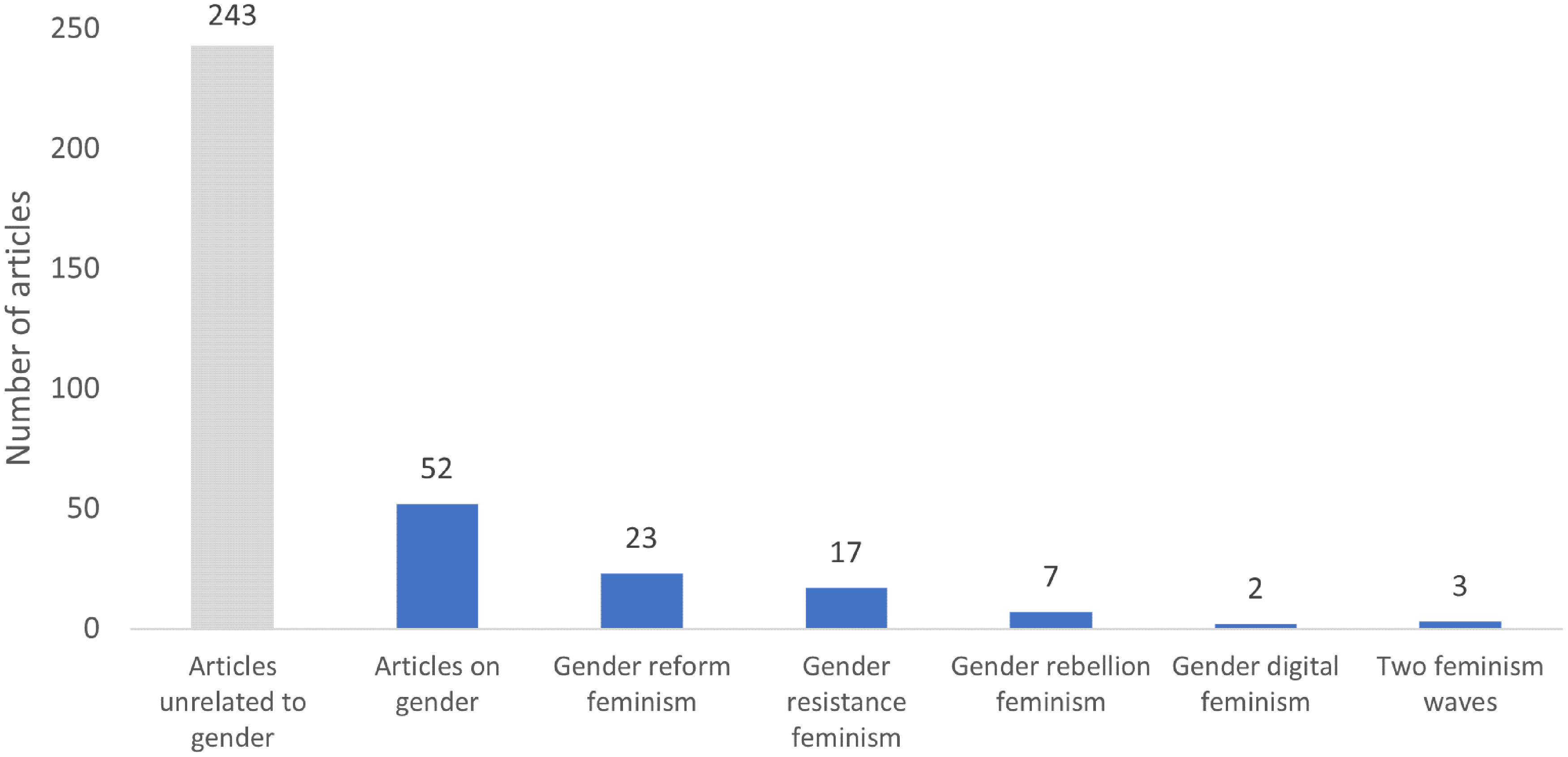
Number of articles on gender and leadership in general and across waves of feminism in two exemplary leadership journals.
In the reviewed articles, gender was typically an independent (e.g., Foss et al., 2022; Tonidandel et al., 2022) or moderating (e.g., Blake et al., 2022; Chandler et al., 2022) variable. These works drew on diverse theoretical angles (e.g., social cognitive theory, see Eva et al., 2021; implicit leadership theories, see Offermann et al., 2020; social role theory, see Stamper & McGowan, 2022; stereotype threat theory, see Chen & Houser, 2019; role congruity theory, see Bechtoldt et al., 2019; sexual selection theory, see Kocoglu & Mithani, 2020; reverse dominance hierarchy theory, see Garfield et al., 2019; resource dependence theory, see Yang et al., 2019; risk-aversion theory, see Zalata et al., 2019). Furthermore, varied methodological approaches were employed to craft and test hypotheses or derive propositions on gender in relation to leadership (e.g., experiments, Archer & Kam, 2022; survey research, Norris et al., 2021; archival research; Zalata et al., 2019; qualitative research, Doldor et al., 2019). Among the reviewed articles on leadership in which gender played a role, there were also conceptual review articles (e.g., Eva et al., 2021), meta-analyses (e.g., Blake et al., 2022), and theory papers (e.g., Hideg & Shen, 2019).
As Figure 2 reveals, most articles conceptualize gender in ways consistent with the first two waves of feminism, gender reform feminism (44%) and gender resistance feminism (33%). Fourteen percent of articles are consistent with the third wave, gender rebellion feminism (14%). Two articles (4%) align with gender digital feminism, and three articles comprise themes consistent with both the first and the second wave. In the following, we highlight selected articles on gender and leadership through the lens of the waves of feminism, drawing conclusions and noting areas for further research.
Gender Reform Feminism Leadership Research
Articles consistent with gender reform feminism tend to highlight factors hindering women's emergence as leaders and strategies to overcome these disparities (e.g., Eva et al., 2021; Giacomin et al., 2022). For instance, adopting a life-span theoretical perspective, Offermann et al. (2020) uncover predictors of ascending to senior leadership roles of women and occupational success 28 years later. Women's orientations toward leadership and competition were most predictive of these later-life outcomes. Erkal et al. (2022) studied how to encourage women to overcome their lower tendency to apply for competitive leadership positions, even when being among the top-performing candidates. When women need to actively “opt out” of being considered for a leadership position (as compared to the default of having to “opt in” in leader selection procedures), this increases their participation in leadership selection procedures and leads to higher selection of women leaders.
Bhatia et al. (2022) offer a new automated method, computational modeling, to predict who will be perceived as effective leaders, and what attributes will be associated with them. In a dataset of more than 6000 globally known individuals then and now (e.g., Abraham Lincoln, Eleanor Roosevelt, Vladimir Putin), predictions of leadership ratings were lower for women than men, with this systematic gender bias in leadership ratings being robust even when accounting for alternative explanations such as arts as an industry which is associated with lower leadership rating predictions as well.
As part of a special issue on evolutionary approaches to leadership published in LQ (Van Vugt & von Rueden, 2020), Kocoglu and Mithani (2020) uncover a surprising type of backlash, related to their private life (outside of the organization) for senior women. They find that when CEOs’ romantic partners were facially attractive, men CEOs’ perceived leadership abilities were enhanced (due to signaling their unobservable leadership qualities with a good-looking woman as their partner) whereas evaluators rated women CEOs’ leadership more poorly and selected them less frequently for leadership positions when their romantic partners were good-looking. According to the authors, raters may see women CEOs with attractive male partners more as followers, while women with less attractive partners were seen as more dominant and competent, and thus more stereotypically leaderlike. This leads senior women to pay a price for their spouses and gives senior men a “spouse bonus.”
In the same special issue, Garfield and Hagen (2020) studied traits characterizing women and men leaders in a small-scale Ethiopian hunter-gatherer community using peer ratings and interviews, among others. Higher scores on mostly the same traits (e.g., prestige; respect; conflict resolution) predicted elected leadership status among women and men. Interestingly, for women being feared and having a reputation for fighting (both reflecting dominance) were not predictive of leadership. Highly rated women in the sample rather scored low on “feared” and “fighting.” Prestige mattered more than dominance, especially for women. The authors conclude that both women and men leaders play a significant role as leaders, mainly driven through the same traits (and in fact are oftentimes married), suggesting the need to revise evolutionary theories of leadership that still emphasize men leaders more than women leaders.
Gender Resistance Feminism Leadership Research
Consistent with notions of differences between women and men leaders, advanced in gender reform feminism, Tonidandel et al. (2022) used natural language processing to analyze reports of challenges by women and men leaders taking part in leadership development programs. Women reported more challenges in the communal and relational domain whereas men indicated more challenges in the agentic and task-oriented domain. Gendered stereotypes may have influenced the leadership challenges reported by the participants, giving rise to potentially differing leadership development outcomes and trajectories.
Blake et al. (2022) relied on a role congruity perspective (Eagly & Karau, 2002) to propose that women high in agreeableness are less likely to emerge as a leader, due to lower leadership attributions to these women. Given commonalities of agreeableness with communality/femininity stereotypically attributed to women, highly agreeable women should be assessed as having even more feminine attributes relative to males. In their meta-analysis, agreeableness positively predicted leader emergence aside from leader effectiveness but agreeableness was beneficial for leader emergence for women and for men. In a meta-analysis on leader humility and leadership outcomes, Chandler et al. (2022) studied possible differences in humble leadership outcomes for women as compared to men leaders, given stereotypical associations of a humble and moral stance with women. Overall, leader humility was positively associated with a wide range of beneficial leadership outcomes, regardless of the leader's gender. Hence, these studies further substantiate knowledge that stereotypically “feminine”-connoted leadership is effective. They also reveal that women and men profit equally, suggesting changes in beliefs and stereotypes toward women and men as well as leadership.
From a “female advantage” standpoint in line with gender resistance feminism, Eichenauer et al. (2022) revisited the role of communal versus agentic leadership behaviors in the context of crisis (see “think crisis, think female” paradigm; Ryan et al., 2011) particularly the COVID-19 pandemic. Drawing from social role theory (i.e., the stereotype content model and role congruity theory), the authors argued that communal leadership behaviors—in comparison to agentic leader behavior—would be more expected in crisis, more predictive of leader likability and competence, and demonstrated more by women leaders than men leaders. While communal behavior generally mattered more to subordinates, there were no gender differences in the use of communal and agentic leader behaviors. However, women leaders’ competence evaluations (as compared to men leaders) were more directly linked to their demonstration of communal leader behavior, underlining the role of stereotypical expectations in leadership evaluations.
A possible “female advantage” has also been studied in relation to firm-level outcomes. For instance, Foss et al. (2022) argue and find a positive association between the presence of female managers and company-level innovation, particularly when gender quota in a country is voluntary or absent and when environmental uncertainty is higher. Under these conditions, the available unique capabilities and qualifications of women (e.g., multi-tasking, relational activities) should particularly benefit innovation. Anecdotal evidence also suggests companies led by women may fare better during global recessions. Shropshire et al. (2021) examine strategic risk-taking differences between women and men CEOs during economic downturns through survey, archival, and experimental research. The authors indeed find that women CEOs took less strategic risk (by engaging in less risky investments such as acquisitions) during a downturn economy as compared to no recession and as compared to men, and that other-orientation (considering the interests of others such as the organization) explains these differences in economic downtimes. Finally, making self- versus other orientations salient removes these differences in risk-taking between women and men, leading to more (self-orientation made salient) or less (other-orientation made salient) risk-taking.
Adopting an evolutionary angle to uncover conditions favoring female leadership, Smith et al. (2020) reviewed 76 non-human mammalian societies according to whether they display predominantly female leadership, characterized by females managing the collective behaviors of group members in at least two relevant contexts, such as group foraging, conflicts within groups, managing conflicts between groups, or collective movements. Contrasting it with male leadership, female leadership—which was only found in seven non-human mammalian societies (e.g., in killer whales, spotted hyenas, lions, elephants)—was found to be based on resources such as social support and/or ecological knowledge rather than coercion.
Gender Rebellion Feminism Leadership Research
In line with gender rebellion feminism, some theoretical focus has been put on demographic profiles and even intersectionality rather than gender alone. Stamper and McGowan (2022) extend the leadership labyrinth theory which replaced the metaphor of a glass ceiling and reflects the idea that women must get through a labyrinth to get into leadership positions. While no explicit predictions for different intersectionality profiles are made, higher degrees of non-traditionality as a leader (i.e., degrees of departure from being White and male) should be linked to more challenges on the way. More challenges yield a higher number of possible routes, also due to differences in whether and how these challenges are overcome. In contrast, traditional leaders who experience none or less of these hindrances on the way would more likely find themselves on one straightforward path.
Fitzsimmons and Callan (2020) clarify the interrelations and forces that perpetuate structures and regulate differential access to the capital required for leadership roles, thereby explaining an important source of the diversity gap in leadership. They apply Bourdieu's framework relating capital (micro level), habitus (meso level), and field (macro level), together with the concept of symbolic violence, on leadership development to shed light on why diverse groups (such as women or racial or sexual minorities) have less or no access to senior (or even any) leadership roles.
Connected to an increasing focus on paradoxical thinking in relation to leadership in the third wave of feminism, Cox et al. (2022) note the possibility of women emerging as leaders even in the face of existential threat, although men should be favored from an evolutionary perspective in their integrative review of emergent leadership research. Whereas in the COVID-19 pandemic, the medical experts per country were mostly (White) men, women seemed to emerge more as leaders of movements fighting the climate crisis. The authors contend that this is possibly due to them combining communal and agentic behavior (e.g., Greta Thunberg).
Research also reflects the third wave's focus on language as an implicit tool for constructing and reproducing the existing hierarchical status quo. Archer and Kam (2022) use experimental research to uncover the role of language in constructing gender and power in line with gender rebellion feminism. Implicitly sexist language contained in masculine-phrased job titles (e.g., “chairman”) strengthened assumptions that a hypothetical leader is a man rather than a woman. Thus, the results suggest that implicitly sexist language in relation to titles can strengthen ties between leadership and masculinity and weaken perceptions and expectations that women are leaders.
Another work focusing on language and attributed categories ascribed to men and women as shaping the way we view “reality,” is a study by Doldor et al. (2019) that applied automated topic modeling. They examined 1057 developmental feedback comments given to 146 men and women local political leaders in the UK, as part of a formal leadership development program. The feedback given was gendered across all feedback themes. Novel dimensions of gender bias beyond agency and communion emerged, as apparent in differential feedback received regarding strategic focus, politics and influence, and confidence. For instance, men leaders were more encouraged to develop and set a longer-term (and personal) strategy and vision, whereas women leaders were more encouraged to focus on operational excellence and shorter-term goals and vision attainment and delivery. Men leaders were also portrayed as and encouraged to be more proactive players of the political game, while women leaders were seen more in terms of shortcomings and defensiveness. The feedback also encouraged men leaders to display confidence more while women leaders were more encouraged to be confident.
Finally, MacLaren et al. (2020) found that speaking time predicts leader emergence in leader-less student groups performing a simulation, consistent with the “babble hypothesis” of leadership. Women are less likely than men to emerge as leaders due to being nominated less yet also indirectly, through less speaking time, further underlining the ample knowledge base on disadvantages for women to emerge as leaders.
Gender Digital/Clicktivism Feminism Leadership Research
Social media and public influence are important themes in the still nascent fourth wave of feminism. In a review of leader social media use, Matthews et al. (2022) summarize primary research that has looked at leaders’ social media use from the perspective of stable characteristics, including gender. For instance, in a study, Twitter data were used to detect grandiose narcissism (Gruda et al., 2021) which was then linked to fundraising success. The relationship was not significant, and gender did not moderate it. Even though pertinent research is still nascent, research revealed that women leaders were more likely to use Instagram compared to men leaders, and that many women entrepreneurs portrayed idealized “feminine” identities and qualities on Instagram, potentially reflective of stereotypical pressures.
Where Do We Go From Here? A Feminist Perspective of the Future of Leadership Theories and Research
Over recent decades, emerging leadership theories reflect broader historical, sociological, and social shifts mirrored in feminist thought. Despite varied contributions and critiques, all four of the feminist waves offer rich avenues for innovative leadership and gender research. With an increasing presence of women in leadership roles, from organizational managers to CEOs and researchers, leadership theories have gradually aligned with stereotypical “feminine” characteristics, now gaining greater appreciation. This shift from conventional heroic models to approaches that seemingly resonate more with women, such as democratic and shared leadership, as well as other more inclusive theories, fosters optimism for continued progress towards diverse and inclusive leadership paradigms and equal gender representation in leadership.
Our review of recent works published in two major leadership journals (JLOS and LQ) between 2019–2022 shows that most articles on gender and leadership focus on and study questions consistent with the first and second wave of feminism. In the first wave of feminism, leader emergence and gender gaps between men and women are prominent themes. The articles reveal continued disparities between men and women in achieving leadership positions and favorable evaluations. Of note, this stream of research studies women and men in relation to leadership mostly from a trait perspective, and particularly evolutionary thinking has seen a revival, as evident in a special issue on the topic. One could argue that using evolutionary theories may signal that observed gender differences are rooted in evolution and are at least partly genetically prescribed and thus suggest to a certain extent that gender roles, expectations, and norms are essentialist and deterministic (Eagly & Wood, 2013). Yet, these articles draw on a range of different theories, including role-based theories, to argue that biological and social aspects may account for differences in leadership and outcomes for women and men. It is also important to note that not all articles invoking evolutionary theorizing align with the first wave, gender reform feminism. Some studies explore the conditions under which women may have a “female advantage,” resonating with the second wave's themes, or intertwining elements from multiple feminist perspectives.
Research aligned with the second wave of feminism often begins with the premise that leadership may exhibit gender differences, investigating conditions that could yield a “female advantage.” These studies mostly find no gender difference, or advantages that materialize only under certain conditions. This might be explained by the gender paradox (Rosener, 1995) and failure of the “female advantage” (Fletcher, 2004), suggesting that when heroic leadership frames are used women may be held back (Rudman & Glick, 2001), but also the growing recognition of post-heroic leadership theories and their effectiveness may not allow women to gain acknowledgment and power, since men using these leadership behaviors may be seen more worthy of praise, and receive a bonus (Kark et al., 2012). Furthermore, women who act in a stereotypical “feminine” manner, may be praised over women showing “masculine” behaviors, thus sustaining the existing gendered structure (Kark et al., 2024a).
Delving into third and fourth-wave feminist perspectives offers promising avenues for advancing leadership theories, incorporating more complex frameworks like paradoxical leadership, complexity theories, and a focus on intersectionality (e.g., MOSAIC). Yet, these theories (e.g., paradoxical leadership) might perpetuate binary views of leadership traits and behaviors (e.g., feminine/masculine, communal/agentic). Empirical research on intersectionality is emerging, beginning to uncover diverse and intricate dimensions of gender in leadership, such as the analyses of workplace biases against women with natural black hair (Dawson et al., 2019). The leadership implications of various identity intersections, including LGBTQI + considerations, are yet to be fully explored.
The fourth wave's exploration of online leadership and the role of language in reinforcing masculinity–leadership associations is in its infancy, with much potential for further inquiry. Our review suggests that this line of work is still very limited. Current studies largely align with first-wave perspectives, highlighting language's role in maintaining gender disparities in leadership. No significant focus has been placed on how language might shift the status quo. Future research could probe deeper into language's transformative power in addressing persistent gender inequalities in leadership contexts.
We propose several directions for future inquiry. First, we suggest that leadership theory should embrace perspectives from diverse feminist waves, drawing inspiration from later waves of feminist thought and innovative perspectives. It is worthy to integrate insights from the third and fourth waves, to move beyond traditional “masculine” paradigms of theorizing, as suggested by the critique of Ann Cunliffe (2022). Cunliffe, in her work titled: “Must I grow a pair of balls to theorize about theory in organization and management studies,” argues that theorizing is mainly done through a process of objectification, abstraction, and identifying conditions and causality that mainly embody “masculine” values and language (e.g., “rational,” “penetrating”). She advocates for a more holistic approach to theory development. One that values emotional, sensory, and reflexive engagement with the world, while acknowledging one's own and others’ situatedness and privileges, to foster a deeper connection to human experience. We echo her recommendation for the future development of novel leadership theories.
Second, much of the current research focuses on women in leadership or gender comparison. We advocate exploring masculinities as an interesting future direction, shifting attention towards critical perspectives on men and masculinity, focusing on multiple “masculinities,” patriarchies, and power-related issues (Collinson & Hearn, 1994; Collinson, 2023), as well as on the concept of “caring masculinities” (Elliott, 2005, p. 241), which reconcile nurturing values with masculine identities. Investigating diverse masculinities and their impact on leadership, including men's roles as fathers in the private sphere, can offer new insights into gender dynamics in leadership, as well as how this can affect women in leadership roles.
Third, the role of men and other privileged groups as allies for gender equality is gaining attention (e.g., Adra et al., 2020; Kutlaca et al., 2020; Ostrove & Brown, 2018; Selvanathan et al., 2020) but remains underexplored in leadership research. Questions about the effectiveness of male leaders as allies, the conditions under which they can serve as role models, and the potential backlash they may face are crucial. Additionally, the allyship of women leaders towards other women from varied backgrounds, and how they support emerging women leaders, presents a rich area for investigation (Kark et al., 2024b).
Fourth, there is a place for works that look at different stages in the lives of women and consider the wider more holistic aspects of women's leadership to develop novel ways of exploring gender and leadership (see Mah et al., 2023). We also advocate for works that consider different aspects of leadership identity. The study of intersectionality and leadership, accounting for the intersection of gender with other social identities as well as non-binary thinking, can move forward our theorizing and empirical research. For example, a recent review focused on the management and leadership of indigenous people in the organization literature, suggesting that in the last decades, research on indigenous peoples and contexts has offered meaningful insights into our mainstream management and leadership theories (Salmon et al., 2023). Such works can open new venues for re-thinking leadership.
Last, drawing on gender rebellion and gender digital/clicktivism feminism, and the use of leadership in social media and AI could help to overcome mechanisms underlying disadvantages and lead to the study of novel uncharted waters. We believe that such works can enrich our development of novel ideas and theories as well as our understanding of intersectionality and less studied groups in leadership.
These suggested directions aim to broaden the scope of leadership and gender research, incorporating nuanced understandings of multiple masculinities, allyship, and the diverse experiences of leaders from all genders and age groups in the social media era. This approach can contribute to a more equitable and inclusive leadership paradigm.
In conclusion, there is a popular saying in the field of activism: “If you are not part of the solution, you are part of the problem.” Our analysis above shows that leadership scholarship has gone a long way to incorporate gender in its studies, and to some extent to incorporate feminist thinking. There is already an evident positive change that can be seen in the wide range of significant research on leadership and gender which is published in leading leadership journals as well as other more general journals. However, we call for scholars in the field in their role as researchers, reviewers, editors, supervisors, and mentors to further deepen their understanding of feminist and intersectional thought, question the underlying assumptions of the theories and research questions they develop, and take part and responsibility as a community of scholars to open the field for research that will inspire more equality and inclusion in society.
Footnotes
Acknowledgments
We would like to thank Lisa Dragoni, Hannes Leroy, and Daan Stam for encouraging us to write this paper. We are also grateful to Noam Shmalo for her help as a research assistant and to Timothy Holmes for his generous suggestions.
Declaration of Conflicting Interests
The authors declared no potential conflicts of interest with respect to the research, authorship, and/or publication of this article.
Funding
The authors disclosed receipt of the following financial support for the research, authorship, and/or publication of this article: This study was funded by the Federal Ministry of Education and Research (BMBF), Germany, and the Free State of Bavaria under the Excellence Strategy of the Federal Government and the Länder, as well as by the Technical University of Munich—Institute for Advanced Study, Germany. This work was written during the period Ronit Kark was on an Anna Boyksen Fellowship at the TUM Institute for Advanced Studies.
