



Abstract
The research investigates CEO leadership practices that promote increased gender equality. Data were reports provided by 119 Australian organisations with WGEA Employer of Choice for Gender Equality status. Analyses followed a grounded theory approach. Results reveal a novel combination of leadership practices that reflect core dimensions of strategic, inclusive and transformational leadership styles. CEOs champion not only the business case for increased gender equality (strategic leadership) but also promote more equality around the principles of increased equity, fairness and justice (inclusive leadership) in devising strategy. Supporting transformational leadership practices, CEOs frame a compelling vision for increased gender equality, while holding all senior executives accountable for outcomes. A conceptual framework provides key constructs and relationships. Around practice, there is guidance on the features of CEO leadership that influence more gender equal workplaces.
1. Introduction
Creating more ‘inclusion’ is a buzzword in today’s globalised business world with business leaders, practitioners and researchers alike seeking to embrace the inclusive organisation as a key for sustained competitive advantage (Korkmaz et al., 2022). While legislation in numerous countries has focused on reducing discrimination and building more inclusive nations and communities, what is less clear is how organisations are proactively creating inclusive organisational environments that ensure improved opportunities for employees from diverse backgrounds (Korkmaz et al., 2022; Shore et al., 2018). While Tyler (2019: 62) warns that ‘questioning inclusion is a risky business’, it is only through exploring the quality and conditions for greater inclusion and equality in the workplace that the blind spots are revealed (Adamson et al., 2021).
The key objective of inclusion is to enable organisations to go beyond the acceptance of diversity that provides a fair and equitable workplace, to the position where all employees can unleash their full potential, respond to challenges, collaborate with others across boundaries, and improve their workplace experiences (Korkmaz et al., 2022). Following Mor Barak and Daya (2014: 393–394), ‘the inclusive workplace is based on a pluralistic value frame that respects all cultural perspectives represented among its employees’. However, as Dobusch (2015) argues, the inclusive organisation is a ‘slippery concept’ due to its cross-category nature, the variety of scientific discourses involved, and the variety of findings that emerge. For instance, while many review studies document the positive benefits to employees and organisations from achieving the diversity dividend through increased inclusiveness (Mor Barak et al., 2016), having more employees from underrepresented groups is not a guarantee that their skills and abilities are fully applied or their views are fully heard in positive ways (Martins, 2020; Randel et al., 2018). As several scholars agree (Choi et al., 2015; Martins, 2020), the critical step is to recognise the full complexity of inclusive organisations by adopting a more nuanced approach of the needs of the many and diverse groups in organisations, and in turn differences in the formal and informal ways that organisations manage diversity for enhanced organisational performance for each social identity category (Law, 2012; Nishii and Leroy, 2022; Nishii and Mayer, 2009).
One category among diverse employees that has received considerable research attention by multiple academic disciplines is female employees. A major focus is the definition of actions that promote increased gender equality so that female employees can achieve their full potential. Gender equality is the process of being fair to men and women, boys and girls, and importantly the equality of outcomes and results (United Nations, 2017). In Australia, however, our workplace statistics underscore the mixed progress around increased gender equality and the importance of a continued focus on factors that create more gender equal workplaces. While women comprise 51% of the Australian workforce, only 22% of all Australian CEOs are women (Workplace Gender Equality Agency (WGEA), 2024) and only 8.3% of CEOs in the ASX300 are women (Chief Executive Women, 2024). The gender pay gap is a persistent feature in workplaces and the average total remuneration gender pay gap is 21.7%. Every Australian industry and almost three-quarters (73%) of employers have a gender pay gap of larger than 5% in favour of men.
These data reflect that continued workplace gender inequality in Australia and elsewhere is characteristically a wicked problem where single interventions are inadequate. Nevertheless, the majority of empirical studies focus on single interventions that investigate direct relationships between a policy or practice and a unit of measurable change. However, evidence about the most effective interventions is mixed. For instance, while counter stereotype training decreases stereotyping and biased interpersonal attributions (Kalev et al., 2006), its effect on organisational level gender inequality (e.g. women’s representation in the c-suite) is unclear. As another example, while affirmative action policies assist women to ‘get a foot in the door’ (Kurtulus, 2012), these policies are listed as responsible for lowering women’s perceived competence in the eyes of observers (Leslie et al., 2014). At the heart of these mixed effects around gender equality interventions is the complexity around how gender inequality manifests inside and outside of organisations. The reality is that whatever practices organisations employ, there is the continuing impact of societal and cultural factors that are outside the control of organisations (Fitzsimmons and Callan, 2020).
Among the multiple factors that influence the progress of gender equality in organisations, leaders and their leadership are identified as playing a critical role. To date, the analysis of these leadership practices has attended predominantly to more global dimensions of diversity and inclusion or its impact on downstream employee outcomes rather than specifically gender or experiences of gender (e.g. Fang et al., 2019; Roberson and Perry, 2022). The practices that promote more inclusive workplaces is a recent development positioned at the intersection of diversity management studies and leadership studies, while several fundamental questions about the conceptualisation of the leadership practices that create more inclusive organisations remain unanswered (Korkmaz et al., 2022; Shore and Chung, 2021).
Guided by these critiques, the current study offers an examination of the leadership practices of CEOs and their teams who lead Australian organisations that are publicly recognised as industry leaders of gender equality. As numerous researchers emphasise (Groysberg and Connolly, 2013; Martins, 2020), the onus is upon the CEO to determine the practices that deliver the full potential from the diversity of their employees. However, these specific practices are not well understood (Howell and Costley, 2006; Jin et al., 2017) and are limited in providing clear advice about the required leader behaviours (Leroy et al., 2022; Roberson and Perry, 2022; Shore and Chung, 2021).
The current study makes several contributions to knowledge and practice. First, this qualitative study of CEOs contributes to our conceptual understanding of the leadership practices most identified with successful outcomes in promoting increased gender equality. This research is not guided by any single conceptualisation of leadership but adopts a grounded theory approach in using a variety of frameworks to inform our interpretation of what CEOs and their organisations report are the practices used to promote increased gender equality. The study builds upon a growing literature of Australian studies into the championing of the gender equality agenda by male and female Australian leaders (e.g. de Vries, 2015; Kulik, 2022). In addition, the study adds to a small body of prior work (Edmondson, 2003; Roberson and Perry, 2022; Vito and Sethi, 2020) that employs qualitative and exploratory research to investigate the richness of strategies by leaders, teams and organisations to support increased gender equality.
Second, in terms of practice implications, there is limited guidance at the CEO level about best practice leadership behaviours, and related governance and other supports, that not only lock in but also promote greater gender equality in workplaces. As reported by the United Nations (2023), workplace gender inequality continues as an intractable global problem, despite Gender Equality being listed as Goal 5 of the seventeen United Nations Sustainable Development Goals. It persists despite the policies of legislators that outlaw gender discrimination in employment, efforts by organisations to reduce their gender pay gaps, the implementation of change strategies to attract more women to enter the labour market and the ongoing work of academics contributing thousands of peer reviewed papers in recent decades (see Hing et al., 2023 for a review of contributing factors).
This study of the leadership practices and organisational supports reported by CEOs addressed two research questions:
Q1. What are the leadership practices of CEO leaders who successfully build organisations that are identified as best practice in promoting gender equality?
Q2. What are the facilitating factors associated with these leadership practices that embed the continuation of these best practices, including the roles of strategies, policies, governance, and reflexivity?
2. Method
The WGEA is an Australian Federal Government statutory agency created by the Workplace Gender Equality Act 2012. Guided by the Act, this agency promotes and improves gender equality in the workplace, supporting employers to remove barriers to the full and equal participation of women. All Australian employers with 100 or more employees by law must report annually to WGEA on a range of gender equality indicators. In addition, a small sample of organisations based upon an assessment of data provided to WGEA in a separate EOCGE application, are judged as an Employer of Choice for Gender Equality (EOCGE) through the award of a citation by WGEA. WGEA Employer of Choice citation holders, in aggregate, compared to all other reporting organisations, have achieved much faster reductions in their gender pay gaps, have a greater proportion of women in all levels of management, have a stronger pipeline of women moving into senior management roles, higher representation of women on their boards and a higher proportion of female employees working full-time (Fitzsimmons et al., 2020). A full list of compliant, and non-compliant organisations, and those awarded EOCGE citations, is made public each year by WGEA (2024).
The EOCGE citation application to the Agency consists of extensive quantitative and qualitative data gathered through the completion of an online questionnaire and worksheets, alongside an interview with the CEO conducted by the Director of WGEA to validate the contents of the application, although the interview itself is not recorded by WGEA. The online questionnaire, most likely completed by the organisation’s HR group that has access to the required statistics, seeks information about the practices, policies and strategies that support gender equality in the workplace; governing bodies; gender pay gaps and pay equity; employee consultation; flexible working; paid parental leave; support for carers; sexual harassment and harassment on the grounds of sex and discrimination; family and domestic violence; and diversity and inclusion (WGEA, 2024). The questionnaire also collects data on workforce composition; salaries and remuneration; and employee appointments, promotions, resignations and parental leave (WGEA, 2024). The data includes copies of internal and external communications made by the organisations CEO related to gender equality initiatives.
In the current study we investigated for the first time and in-depth, the data provided through a list of open-ended questions regarding their CEO’s leadership, strategy, and accountability to promote more gender equality. Appendix 1 provides a summary of the content of these questions in relation to CEO practices. The following is an example of the style of question asked: ‘Your CEO must have made a statement in the last 12 months to all workers confirming she/he is committed to achieving gender equality in your workplace. Please provide the statement and information on how it was made’. It is unclear how organisations specifically gather these CEO data; however, data usually comprises extracts of public statements made by the CEO either externally to the media, shareholders and/or through corporate reporting and/or internal communications directly to staff in various formats such as emails, forum addresses, podcasts or newsletters. In some organisations, these CEO data submitted to WGEA might be curated through the organisations’ HR department, and in other cases CEOs were interviewed internally by HR with additional direct quotes by the CEO incorporated to supplement the secondary data on CEO communication data provided to WGEA in the application.
2.1. Sample
The sample comprised EOCGE application data from the open-ended questions related to CEO actions for successful applicant organisations for 2018, for which WGEA provided access to the authors, since the EOCGE application data is not publicly available. The individual responses by organisations to application questions were collected through a ‘front end’ application form on the WGEA website and transferred into a ‘back end’ corresponding cell within an Excel Spreadsheet for each organisation, which was maintained by the Agency. The text responses relating to CEO actions were extracted from the corresponding cells and copied into MSWord. This data, once collated, comprised of 2251 A4 pages of single spaced 12 pitch text, representing 1,462,528 words, from 119 applicants from 15 industry sectors. Industry sector breakdown revealed that the largest number of respondents were from Professional, Scientific and Technical Services (35), Financial and Insurance Services (27), Education and Training (19) and Manufacturing (11).
2.2. Procedure
Our interpretation of the open-ended data was achieved by using methods common to both grounded theory (Locke, 2001) and naturalistic enquiry (Athens, 2010). Guided by Gioia and colleagues (2013), the application of grounded theory began with our two research questions and the collection of WGEA qualitative and other secondary data. Ideas and concepts that emerge from these data were tagged with codes, and with more data interpretation, codes were grouped into higher-level concepts and into categories. The analysis of the texts obtained from the applications was also strongly informed by the approach employed by Pratt et al. (2006) and Athens (2010). In this approach, patterns in the data were identified through multiple iterations between questionnaire response data and emergent theoretical constructs even after the stage of theoretical saturation was reached.
The analysis was conducted in multiple stages using MSOffice365 and a manual thematic coding approach. Stage 1 involved a manifest analysis (Greenwood and Suddaby, 2006) of the texts to generate first order codes. Each text was read several times by the first two authors prior to coding to identify commonly used phrases and patterns of description. Stage 2 involved the integration of first order codes to create theoretical categories through a latent analysis of the data (Greenwood and Suddaby, 2006). Coded statements were consolidated into a concept group or theoretical category through a reflexive interpretation of the data based upon the authors’ prolonged engagement with the subject and a deep understanding of gender equality in the workplace (Athens, 2010). In the final stage 3, we interrogated the texts by code to group, ungroup, refine or discard categories based upon identifiable distinctions between them (Braun and Clarke, 2006). Furthermore, the researchers socialised the validity of our interpretations of the data (Alvesson and Sandberg, 2013) at a forum organised by WGEA where we tested and confirmed their thematic structure in detail in briefings with six EOCGE citation holding organisations. In addition, there was a presentation of the findings with EOCGE Citation winners at the WGEA EOCGE citation awards evenings held in Sydney and Melbourne in 2020.
Figure 1 illustrates the thematic structure that emerged from this multi-stage analysis of the interconnections between CEO leadership, organisational supports and reflexivity. As can be seen, and which the following ‘Results’ section explores in more detail, a number of practices are identified under CEO leadership (e.g. gender equality vision) and organisational supports (e.g. gender equality policies) that are features of organisations that are successful in achieving the citation of Employer of Choice for Gender Equality (EOCGE).
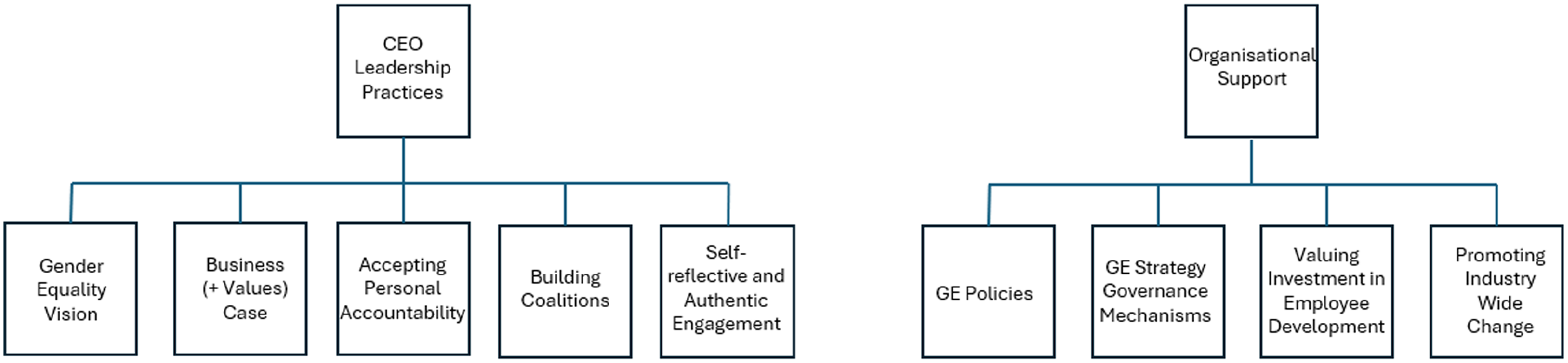
Thematic structure of interconnections between CEO leadership, organisational supports and reflexivity.
3. Results
3.1. CEO practices
3.1.1. Framing a strategic gender equality vision
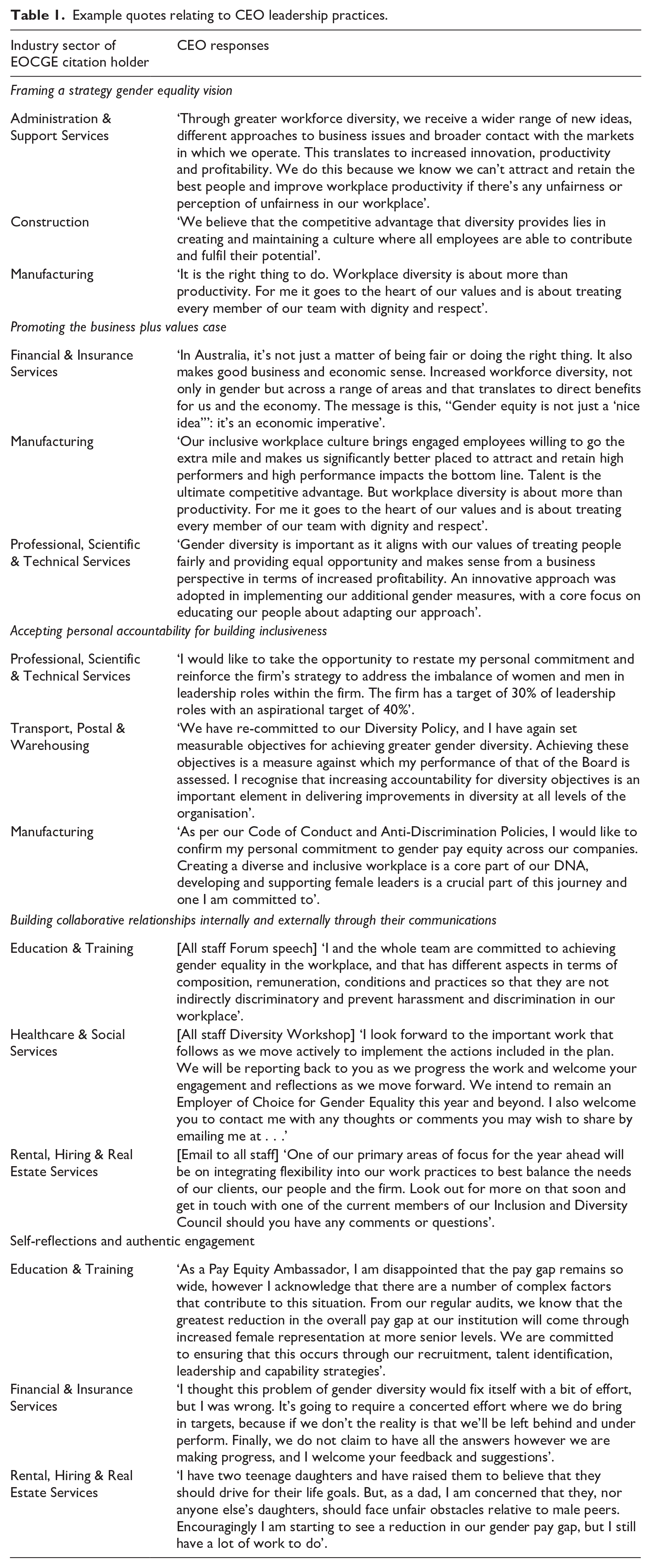
CEOs used a wide range of practices to frame a vision for promoting more gender equality in their workplaces (see Table 1 for exemplary quotes). Attention to closing the pay gap influenced changes in recruitment, performance and development reviews, and provided evidence around how inequitable work allocation contributed to disadvantages for some groups over others. For instance, the allocation of high-profile case files in a law firm that are central to growing a legal profile was changed to ensure an equitable balance between male and female partners and senior lawyers.
Example quotes relating to CEO leadership practices.
The gender equality vision and strategy were continuously referenced by these CEOs at special employee forums to build a shared commitment with employees about executing their business strategy around diversity, inclusiveness and gender equality. Forums also opened progress for review, discussion and feedback by employees. For instance, CEOs reported being consistent in their references to the progress of their gender equality vision and strategy in each reporting year, while also citing their strategy and business practices at key occasions or opportunities, such as International Women’s Day or quarterly organisation-wide updates. CEOs integrated references to their gender equality strategy across numerous communication channels and opportunities, embodying a view of gender equality as an integrated and shared part of ‘the way we do business’. Their communications, team talks, and public statements aimed to continue to promote explicitly the achievement of their gender diversity and equality vision as strategic priorities for their organisation.
3.1.2. Promoting the business plus values case
Linked to communicating visions around the urgent need for change was evidence cited by CEOs for the links between diversity, gender equality, alignment with core values, and better business performance (see Table 1). Significantly, this attention to the ‘business case plus values’ position was shared by almost all CEOs. As one CEO in manufacturing described his position, ‘an inclusive culture with core values around dignity and respect for the contributions of diverse individuals, encourages greater engagement, more discretionary effort, and higher firm performance’.
The most impactful communications about the gender equality case comprised of CEOs describing their personal values (e.g. ‘gender equality is important to me because x, y and z’), the alignment between their personal values and those espoused within the organisation (e.g. ‘at this organisation, we believe x, y and z to be most important to reaching our goals and objectives’), and the ways in which these values converge to guide behaviours (e.g. ‘when we work together in service of gender equality, we can achieve goal a, b and c’). Often CEO communications about their business plus values case included personal reflections around their own motivations for wanting greater gender equality in their business and industry, as the following Financial Services CEO quote demonstrates: Firstly, it’s the right thing to do, and I don’t think that people argue that anymore. I have a twelve-year-old daughter, and it never occurs to me that she shouldn’t have every opportunity available to her in the world. Secondly there is a very cold hard business reality; teams with a diversity of mind perform better.
3.1.3. Accepting personal accountability for building inclusiveness
A common feature of these leading practice organisations was that their CEOs assumed personal accountability for interventions designed to challenge gender inequality and to build a more inclusive culture (see Table 1). This level of commitment and accountability signalled to staff the executive endorsement throughout the organisation for efforts at improving levels of gender diversity, equality, and inclusiveness. In addition, there was a large subset of organisations that took this one step further, where the senior executives and senior managers reporting to the CEO were made accountable for specific actions or KPIs. One CEO from the Professional, Scientific and Technical Services industry reported that I am personally accountable for the delivery of our diversity and inclusion strategy and seek to ensure support and leadership from across the partnership and management. To this end, each member of the Board has committed to pursuing individual diversity objectives, which have been published on the firm’s intranet.
Statements of commitment to change one’s own behaviour as a CEO also were included within internal communications and were particularly noteworthy when they included specific actions that were measurable and implementable. For instance, visible examples of these actions included CEOs assuming the role of a Pay Equity Ambassador to track the success of efforts to close the gender pay gap. In addition, CEOs joined other business leaders working publicly in forums and the media to raise national awareness of the importance of gender pay equity. On occasions this included the public statement as a personal pledge. As one CEO from the Financial and Insurance Services sector reported, My initial pledge is to be more conscious and aware of the issue. To avoid using language that discriminates against any gender, especially in a non-formal context. To discourage others by questioning their logic from biases surrounding a particular gender.
3.1.4. Building collaborative relationships internally and externally through their communications
CEOs reported building collaborative relationships with employees to demonstrate their personal appreciation of employee diversity, and in turn to promote greater inclusiveness. Enterprise-wide communications encouraged individuals to develop a sense of belonging to the organisation, including recognition to their team leaders for their individual contributions to achieving team and organisational outcomes. CEOs’ reports revealed the use of unambiguous statements about the presence and importance of a gender equality strategy; an open sharing across a variety of communication channels of the progress in meeting the goals set in the gender equality strategy, including metrics and targets, along with relevant policy, procedures and strategies; a willingness to engage with employees in discussions through forums and events about why a strategy for gender diversity and gender equality matters; and a willingness to talk about where progress is acceptable, and where it is not. Also, CEOs were often chairs of diversity and inclusion committees and sponsors of staff diversity and inclusion groups, to whom they turned for additional advice around new strategies, policies and procedures where progress was slower than desired (see Table 1 for examples).
CEOs engaged in similar behaviours with external stakeholders to build collaborative and supportive relationships. They were highly visible in promoting gender equality strategies, practices, metrics and targets at industry forums and public events, and promoting the need to address issues where progress was unacceptable in their industry sector. This ‘lessons learned’ approach to gender equality management allowed a revisability of policy and procedure within organisations and their industries that supported a genuine challenging of progress in increasing gender equality (see Table 1 for examples).
3.1.5. Self-reflective and authentic engagement
While celebrating progress and improvements around being truly authentic about progress, many CEOs highlighted the persistent need for sustained effort and attention to policies, practices and initiatives to redress gender inequality (see Table 1). The Employer of Choice for Gender Equality citation, and the process around gaining it, often strengthened their personal critique of previous successes and failures towards achieving the citation. In turn, this critical review and reflection prompted other innovative approaches to achieve continued improvements in their measures around gender equality.
While some CEOs adopted what could be described as more conciliatory language within their internal dialogue about how well or not gender equality was being advanced, others were more unapologetic in their personal descriptions. These CEOs were unafraid to communicate with internal and external audiences on the pervasive impacts of continued gender inequality in their enterprise, and the need to move to the next level of effort to create meaningful change. As one CEO from the Professional, Scientific and Technical Services industry reported, It is not a walk in the park, it has created some challenging conversations, and I don’t want to suggest that we have it absolutely right. We get things wrong, and we have a lot of work to do. However, we have stayed true to our idea that gender equality is both right and necessary and we continue to see the results of our changes.
Such personal reflections were shared through a variety of channels, including face-to-face employee roadshows, site meetings and staff forums, and online mediums such as staff newsletters, emails and intranet articles. In addition, these communications between CEOs, management and employees included opportunities for positive feedback but also openness for more negative feedback, whether through direct (e.g. face-to-face dialogue, online communication) or indirect (e.g. through surveys, reviews) channels. Feedback facilitated not only the continued development of organisational understanding about the value of increased gender equality, but also ‘closed the loop’ where there was confusion about the role or progress of new policies.
3.2. Organisational supports
3.2.1. Gender equality policies
CEOs recognised the importance of structural supports as a platform for their gender equality strategies. All citation holders had comprehensive and evolving suites of policies and practices underpinning their gender equality strategies. However, no two organisations had an identical set of named policies. Nor were policies implemented in the same way. Nonetheless, the policy areas which CEOs had incorporated into their gender equality strategies, and which were characteristic of the majority of the citation holders included polices on: workplace flexibility; parental leave and associated provisions; childcare assistance and family support; sexual harassment; anti-discrimination; ethics and professional conduct; domestic violence; gender equitable recruitment, remuneration; performance and promotion policies; vendor, contractor and tenderer policy alignment; equal distribution of project and development opportunities; grievance and whistle-blower policies and the regular review, consultation and update of these policies.
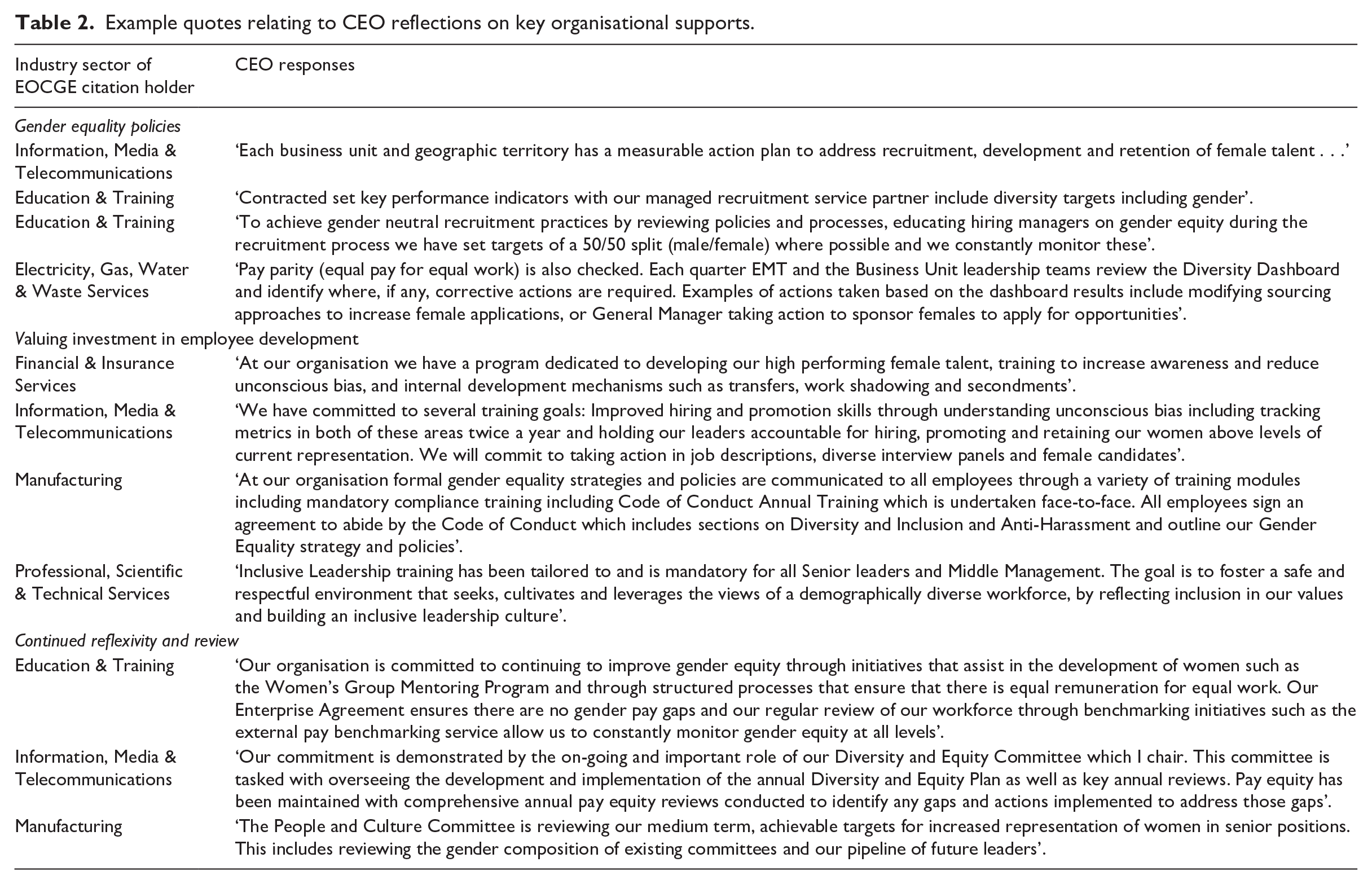
In addition, as noted earlier, most CEOs enforced mandatory training for all executives and managers in these policy areas, and their enactment in practice, by holding managers accountable for delivering on policy related KPIs, as the quotes in Table 2 evidence.
Example quotes relating to CEO reflections on key organisational supports.
3.2.2. Governance mechanisms
Governance structures to support the gender equality strategy were mostly comprised of the CEO and a team of senior executives constituting an overarching body such as a Gender Equality Committee (GEC). The role of such structures was to provide oversight of specific sub-committees, as well as monitoring, evaluating and managing gender equality strategy, policy, practice, data and reviews across their workforces. Oversight of organisational sub-committees (e.g. diversity council, flexibility steering committees, women’s networks, parents’ groups) charged with acting on specific elements of gender equality strategy. The GEC and its sub-committees were the key to maintaining reflexive practice. Sub-committees were often sponsored or led by the CEO or a member of the executive committee who reported back to the overarching GEC.
Many CEOs reported that, year on year, they focused on specific facets of the overarching gender equality strategy. For instance, they would tackle identified problem areas and apply special attention and additional resourcing, moving on to other problematic areas once the current issue was addressed. In addition, in almost all cases the gender equality strategic plans were considered alongside the organisational strategic plan. This meant that the gender equality strategy was automatically reviewed by the board, the CEO and the senior leadership team as a part of the regular strategic review process.
3.2.3. Valuing investment in employee development
These CEOs value the uniqueness and diversity of their employees in how their organisations approach the development of their current and future leaders. While many organisations approach leadership development in a haphazard fashion, these best practice organisations engaged fully in the development of all employees (see Table 2 for examples offered by CEOs). A feature of most organisations was investment in the provision of inclusive leadership training for executives and managers. Many CEOs noted that inclusive leadership qualities were a key selection criterion for the recruitment of new executives and managers, and well as in decisions about promotion into the top leadership team.
Many CEOs specifically acknowledged that work shadowing, sponsorship, mentoring and coaching, and particular key job related experiences, are often more difficult for women to access. In addition, to address unique issues facing women more than men, organisations developed targeted women’s leadership development programmes, in consultation with women within the organisation, and often with the assistance of external specialist providers. Specialist women’s leadership courses examined not only the unique issues specifically confronting women leaders but also instilled among programme participants a shared sense of identity to take back into their organisation. These also provided exposure to successful senior women within their organisation or sector, with opportunities to discuss topics of interest with them or to be mentored by them.
3.2.4. Promoting organisational and industry-wide change
CEOs took an active role externally in influencing their industry peers, other industries and the general public. They promoted the need to rethink and reorganise the nature of work to increase gender equality and willingly shared successes and failures. Notable was the CEOs’ propensity to share what might otherwise be commercially sensitive information about their approach with industry competitors, with the trade-off being that the sharing of information around resolving gender inequality made it an industry-wide issue.
CEOs employed a wide range of strategies to open discussions in their industry about the future of work and the need for more change. For instance, for some this was in efforts to create a paradigm shift about what comprises the nature of work. Others adopted a more pragmatic approach to rethinking specific issues, such as how work allocation ensures that women and men had equitable chances of accessing career development and promotion opportunities. Those CEOs seeking a deeper paradigm change reported attempts in organisational and industry forums to influence the debate about the future of work and other leaders’ understanding of gender inequality. They opened debate about how inequality can be challenged through changing the nature of strategic planning, performance reviews and attitudes around job flexibility.
3.3. Promoting organisational reflexivity and review
It is a feature of these CEO leaders and their organisations that they are extremely reflexive. This reflexivity was foundational to their organisation’s success in achieving changes on the numerous indicators of gender equality that resulted in the citation award. As the examples in Table 2 show, CEOs reported being open to continuous learning, and constantly refining practices, policies and strategies on the basis of trialling new initiatives and reflecting upon success and failure. Although they accept that their organisations are at the leading edge of strategic gender equality practices, they emphasised that there is much more to do.
The gender pay gap emerged as the most frequent data set drawn upon by CEOs to drive reflexivity about progress to date. These data were at the core of reviews with internal and external stakeholders about the success or not of their leadership practices in driving increased gender diversity, and the impact of supports put in place around policies, governance and continuous measurement. For many organisations, a detailed analysis of the gender pay gap at different levels of the organisation (e.g. employee, middle-management, executive) was commonplace. CEOs frequently drew upon these figures to incite action. CEOs also reported transparency in the use of pay gap figures that may throw a less than favourable light upon their organisation. These actions were particularly used by CEOs attempting to influence greater reflexivity and change, not only within their organisation, but also within the broader industry.
Levels of sophistication differed in how these targets, and other figures were used by CEOs. Some CEOs adopted straight-forward reporting of women’s workforce composition, whereas the majority adopted more complex reporting that integrated more fine-grained reporting of gender diversity across the workforce segments. As one example of this increased complexity, some CEOs drew upon the graduation rates of women within the traditional fields of study that were talent pipelines for their industry sector (e.g. law, accounting, finance, engineering) as a benchmark.
4. Discussion
4.1. CEO leadership practices
Numerous leadership theories guide our interpretation of these WGEA data around CEO practices and organisational strategies that support increased gender equality. As to be expected by those allocated the responsibility to drive the strategic direction and financial performance of organisations (Fitzsimmons and Callan, 2016), CEOs reference business case arguments that are a primary feature of strategic leadership models. CEOs most notably cited reports by consulting firms (e.g. Morgan Stanley, McKinsey, KPMG) that point to the significant impact of increased gender equality as a financial driver for improved organisational performance. In Fortune 500 firms, for example, 80% of enterprises make the business case for diversity, whereas between 1% and 5% make what is often defined as the fairness case (Georgeac and Rattan, 2023). However, the same study reveals that the business case has risks in increasing the social identity threat among women that undermines their anticipated sense of belonging to a prospective organisation.
However, while the business case position is cited as a motivation for increased gender equality, it is not the primary driver for the CEOs studied. Rather a business plus values case focused upon enhancing gender equality to drive business performance, as well as meeting societal and corporate motivations for greater justice, equity and fairer treatment of diverse members of organisations was identified (see also Shore et al., 2018). This business plus values position emerged as a unique feature of leadership around gender equality, being different to strategic leadership practices which are often more strongly aligned to the business case only. Also, this position differs from inclusive leadership practices where leaders support employees as group members around fairness (Randel et al., 2018) but play down business imperatives for encouraging diverse contributions.
Another core feature of strategic leadership theory is that while senior leaders have the greatest influence to make systemic change (Hambrick, 2007; Hambrick and Mason, 1984), their vision and practices are constrained. Organisational structures and cultures replicate the dominant group’s worldview and often do not foster the growth in thinking and behaviours that promote diversity and inclusion (Nkomo et al., 2019). However, unlike many strategic leaders who fall into the strategic mindset of seeing gender inequality as an intractable wicked problem (Kulik, 2022; O’Brien et al., 2017), these CEOs perceived the challenges of increased inclusiveness and gender as open to change. Also, they report their progress and performance in building a more inclusive organisation across a sophisticated suite of multiple indicators, rather than defining their progress towards greater gender equity only on a single indicator that possibly overstates their organisation’s progress on achieving equality targets (Kulik, 2022).
As Martins (2020) proposes, the CEO and senior leadership team play critical roles in shaping the strategic benefits of diversity through symbolising the value of diversity in their words and actions for the whole organisation. As these WGEA EOCGE citation applications reveal, as strategic CEOs they hold themselves and those below them accountable for implementing inclusive practices (Martins, 2020; Nishii and Leroy, 2020). Likewise, they demonstrate influence practices that show that these CEOs are unafraid to communicate with internal and external audiences on the pervasive impacts of continued gender inequality in their enterprises, their mixed levels of success, and the need to move to the next level of effort to create meaningful change.
A number of the CEO practices align with the practices attributed to more inclusive leaders (Leroy et al., 2022; Roberson and Perry, 2022). CEOs reported taking personal responsibility for encouraging employees to express their unique viewpoints and perspectives. They cultivate value-in-diversity cultures by actively promoting positive conceptions of diversity that motivate employees to engage across differences (Leroy et al., 2022; Mor Barak et al., 2022). As a number of inclusive leadership scholars report (Mor Barak et al., 2022; van Knippenberg and van Ginkel, 2022), inclusive leaders promote a felt sense of psychological safety within workplaces, with individual employees from diverse backgrounds and experiences feeling more comfortable in taking interpersonal risks at work (Carmeli et al., 2010). In line with the inclusive leadership practices identified by Korkmaz and her colleagues (2022), CEOs report attention to changes that promote psychological safety and belongingness in teams, but also through practices that seek more openness at the organisational level in structure, culture, power relations and procedures.
Transformational leaders put forth a powerful vision that inspires and challenges existing assumptions and encourages others to take risks around changing assumptions, attitudes and behaviours, in this case around gender and greater workplace equality (Judge and Piccolo, 2004). Aligned with the business plus values position, as transformational leaders these CEOs promote increasing diversity as morally and ethically the right thing to do, as diversity is more than a matter of legal compliance (Leonard and Grebler, 2006). In challenging current assumptions and practices, they inspire followers from all diverse backgrounds to pursue and attain exceptional levels of performance (Bass and Riggio, 2006). Also, in line with the practices of transformational leaders, they seek to facilitate team performance by aligning team members’ goals and values and by fostering collective optimism, efficacy and identification with the team about objectives linked to increased gender diversity (Bass and Riggio, 2006; Kearney and Gebert, 2009). Transformational leadership promotes the benefits of team diversity by accessing the wider pool of different perspectives in an organisation, while meeting the challenge of not lowering levels of team identification that might reduce employee performance.
4.2. Organisational supports and reflexivity
The second focus of this research was upon what CEOs put in place as supports to embed and sustain gender equality. High-performing organisations revise the configuration of values, structures, systems, processes, and governance to leverage the potential of differences in the workforce, including the removal of barriers to the full engagement and contribution of all types of employees (Roberson and Perry, 2022). Supportive governance for gender equality was emphasised by CEOs as fundamental to achieving positive outcomes and meaningful change. As Mor Barak et al. (2022) reflect, a CEO’s values become the espoused values of the organisation through the policies, processes, and reward structures that dictate how things should be done in their organisation.
For many of these EOCGE citation awarded organisations, gender equality is a routine consideration in governance processes and reporting that incorporates auditing and evaluations, as well as public reporting of outcomes (Brunila and Edström, 2013). Governance structures in these best practice organisations routinely oversee and review the development of the gender equality strategy. By having dedicated gender equality governance structures in which the CEO and the executive team have oversight, and direct accountability for gender equality strategy and its operationalisation, there is direct line of sight over progress against the strategy.
CEOs reported that the transition towards gender equality requires a substantial investment of time, resources, and attention to be successful. In line with evidence about the sense-making and sense-giving roles of strategic leaders of change (Gioia and Chittipeddi, 1991), they engage with internal and external stakeholders in a continued process of reflexivity, review, and change. They operate from the position that the current state around gender inequality (e.g. number of women in leadership roles, pay gaps) is not acceptable (Martins, 2020; Winters, 2014). Such reviews and reflexivity are critical, as the larger the discrepancy between policies that espouse inclusion, and the practices of leaders and others to implement inclusion, the less likely employees perceive their work group as truly inclusive (Mor Barak et al., 2022). As the causes and effects of workplace gender inequality are often reciprocal, organisations are continuously learning and refining policies and practices, consulting on and trialling new initiatives, reflecting upon success and failure and regularly renewing practices, policy, and strategy.
However, CEOs reported that they do not engage in this reflexivity alone. Towards promoting the sharing of experiences and developing shared diversity mindsets in organisations (van Knippenberg et al., 2013), leaders stimulate the development of positive diversity mindsets through promoting a process of group reflexivity. These CEOs reveal attempts to build group reflexivity with reports of how they work externally with industry peers, clients, consultants, and academics, among others outside of their respective organisations. Internally they consult with their diversity councils, flexibility steering committees, women’s networks, and parents’ groups, to generate potential solutions to the issue of workplace gender inequality.
4.3. Limitations and future research directions
Self-report data offers several key challenges, particularly when relied upon within single source reporting contexts. One strategy for navigating this shortfall was to triangulate insights between CEO self-described leadership behaviours within the organisations’ citation questionnaire, against the publicly available statements by the CEO also included within the citation questionnaire. In spite of this strategy, there is a possibility that some CEOs were motivated by self-interest or by the possible reputational gains their organisations receive from obtaining EOCGE citation status. In future research another strategy for navigating the challenge of self-reported CEO data could be to study the insights, perspectives and behaviours of leadership teams (van Knippenberg and van Ginkel, 2022). However, this approach to understanding leadership behaviour that promotes inclusivity is not without its challenges, particularly given the multiplicity of factors that affect and impact the measurement of leader behaviours and outcomes.
Another shortcoming is that this study investigates the strategies and policies reported to WGEA rather than examining or trying to validate their connections to their reported success or sustainability. Given the organisational benefits associated with WGEA’s EOCGE recognition, it is important to exercise caution in making claims about the success of these initiatives, especially considering the literature and data discussing their level of effectiveness is not addressed in this study. Nevertheless, the convergence in reported CEO behaviours across 119 unique organisations offers some reassurance of a core suite of leadership practices and organisational supports that are important to facilitating gender equality. In addition, there is the continued success of many citation holders in their retention of the citation over time, based on the data that shows high performance and success in meeting many gender equality targets. Future research that analyses CEO data over time is one test of the validity of this statement.
4.4. Implications for practice
There are several insights around practice. As gender inequality is a challenging and multi-faceted phenomenon to study and to enact (Fitzsimmons and Callan, 2020; Kulik, 2022), CEOs and their organisations are eager to hear about, and implement, evidence-based strategies. This study provides a detailed analysis of effective practices and CEO leadership behaviours from EOCGE organisations in a wide range of industry sectors. In addition, a common feature of the CEOs of these leading practice organisations is their understanding that the business case is founded upon a holistic, values based and strategic approach to workplace gender equality. Moreover, they show the importance of leadership styles with high levels of reflexivity, being keen to focus upon policies, practices, metrics and the need to regularly review them with internal and external stakeholders to assess progress. Our findings highlight to CEOs and organisations the importance of a well-developed and cohesive understanding of the business plus values case for gender equality and the core tenants that must inform its communication. Moreover, the insights from this study also offer those who interface with leaders (e.g. Executive Coaches, DEI specialists, gender equality advocates), guidance on features of gender equality leadership that may be further developed to foster gender equal workplaces.
4.5. Implications around conceptualising leadership for gender equality
The task for senior leaders and their organisations is to attend to the ‘conditions under which diversity produces its varied effects on outcomes that include gains for social justice as well as group and organisational performance’ (Eagly, 2016, p. 200). CEOs are key agents in providing the leadership, as well as determining the supportive conditions, that build diverse and inclusive workplace environments. However, as Leroy and his colleagues (2022) argue, more effort and support needs to be provided in raising leaders’ awareness of the most effective leadership behaviours that promote inclusiveness, and this effort should become a greater focus in leadership interventions and development programmes typically designed and directed by HR professionals.
Towards informing interventions to improve practice, and to guide future research, we offer a novel conceptualisation of leadership practices that promote gender equality (see Figure 2). The resulting grounded theory model shows the dynamic relationships among the emergent concepts that begins to describe the phenomenon and the relevant data-to-theory connections. We show that it is not only one ‘style’ or approach to leadership that CEOs draw on, but rather a constellation of practices that – derived from unique theoretical traditions – offer CEOs a suite of leadership practices that are ‘fit for purpose’ and relevant to the context of the organisation. The framework evolves from our earlier interpretations of the WGEA data using literatures from strategic diversity leadership (Martins, 2020), transformational leadership (Homan et al., 2020) and inclusive leadership (Randel et al., 2018; van Knippenberg and van Ginkel, 2022).
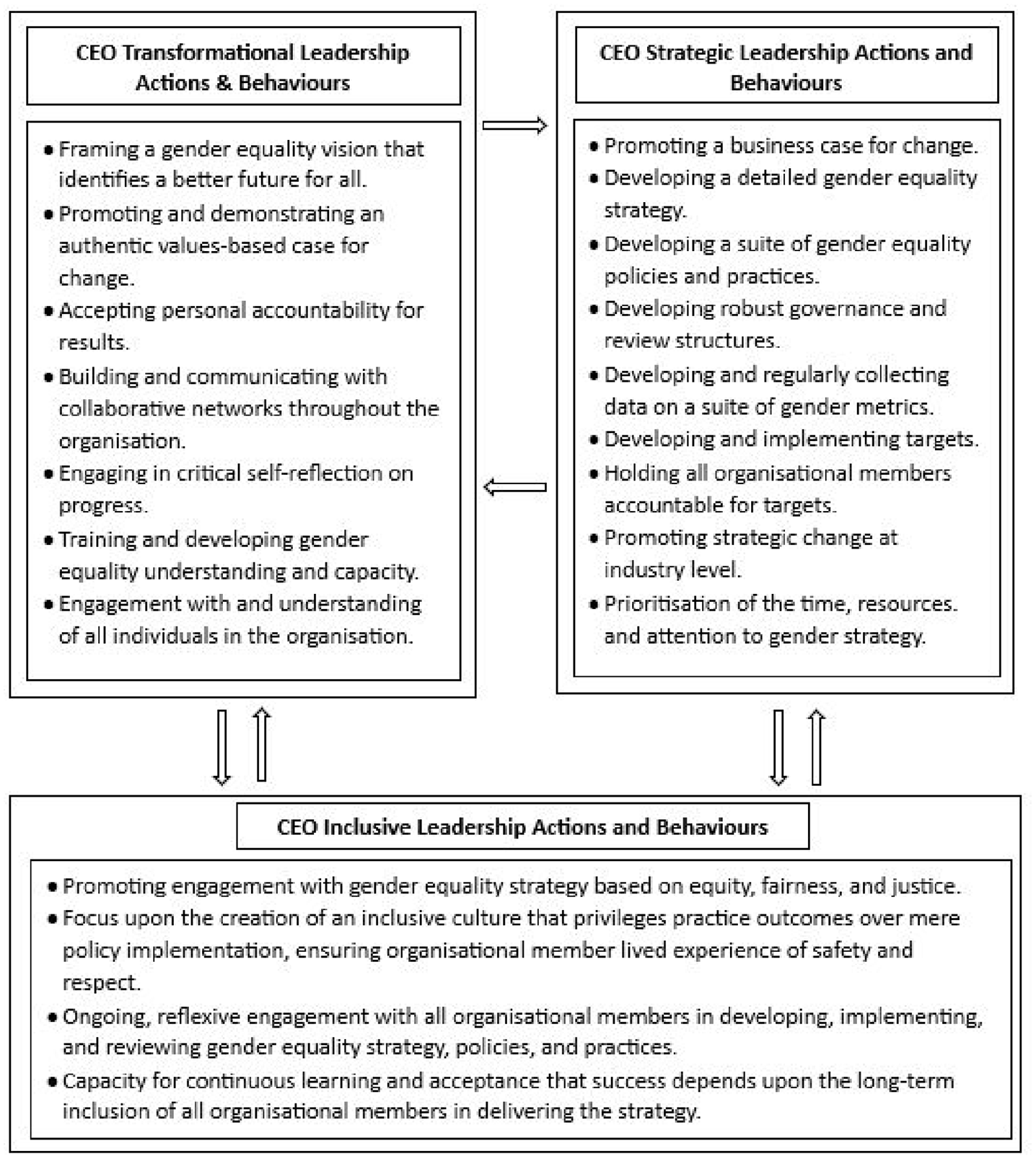
Conceptualising leadership practices for gender equality.
We propose that as CEO leaders hold elite positions of power and influence within the organisation, they have the authority to determine its vision, strategies, structures and culture that promote gender diversity and equality. CEO leaders envision diversity within their organisations and symbolise its value in their personal values and statements of personal commitment. These impact not only upon the acceptance of the value of increased gender diversity and equality around the business cases, but also the core values around justice, fairness, and recognition. As transformational and strategic leaders, their vision provides the inspirational appeal that is facilitated by their communications, efforts that build collaborative partnerships and authentic engagement inside and outside of the organisation, and assurances of their personal accountability to empower the delivery of change (Martins, 2020; Rindova and Srinivas, 2017). To ensure the continued progress, as Figure 2 reveals, CEO leaders provide supporting mechanisms that include policies, governance and employee development strategies that lock in the changes that are made at organisational and wider industry levels. In addition, underpinning their continued gender equality leadership are values that promote equity, fairness and justice, together with an openness to continued change, review, learning and reflexivity about the effectiveness of their strategies and the utility of the supports put in place.
Key practical and theoretical implications
Often the ‘fairness’ and ‘business’ case for workplace gender equality are seen to be at odds. However, CEOs with a demonstrable track record of success in tackling gender inequality understand that the business case is grounded in a holistic, values based, and strategic approach to workplace gender equality. In other words, a business plus values case. This has particular implications for how change for gender equality is communicated to all stakeholders.
A common feature the gender equality initiatives examined by this study are the high levels of organisational reflexivity – that is a willingness and desire to dedicate attention to policies, practices, metrics and their iterative review over time with internal and external stakeholders to formulate context-based solutions. Successful gender equality initiatives engage broadly and repeatedly with stakeholders over lengthy periods of time. This has significant implications for both the resourcing of initiatives and stakeholder engagement.
Footnotes
Appendix 1
Acknowledgements
We wish to acknowledge the in-kind support of office facilities and WGEA team member access by the Australian Workplace Gender Equality Agency during the data collection and analysis stages of the work.
Final transcript accepted 1 April 2025 by Christine Soo (AE HRM).
Funding
The author(s) received no financial support for the research, authorship and/or publication of this article.
