




Abstract
Although politicians, top managers, or informal leaders like influencers have millions of followers, they are mostly known through photographs or videos. Especially in photographs, it is important to make a leader-like impression—both figuratively and physically. However, the role of camera angles on impression formation of leaders has not been studied so far. Across four experimental studies (N = 2,474), we examined the effect of camera angles on the perception of leaders’ charisma, prototypical leader attributes and approval. Results showed that the perception of a male leader is influenced by the camera angle along the vertical axis. When leaders are viewed from above, compared to a perspective where followers look at them at eye-level, they are perceived as less charismatic and prototypical of their position, accompanied by a loss of approval, while the effect of the steep from below photographs were less clear (study 1 and 3). Moreover, we also point out boundary conditions such as eye-contact (study 1) and sex (study 2 and 3). When the leader's photograph was combined with a message of change for their organization, participants were less likely to support the leader specifically when they looked down on him (study 4). Our findings support the idea that camera angles shape an audience's perception of leaders, with steep high or low angle shots associated with lower approval. These results have implications for an embodiment approach to leaders’ charisma as well as applications for how leaders can effectively present themselves in the media and real-life settings.
Introduction
Photographs shape the impression we have of leaders presented in the news media, user profiles on social media, and on professional networking and company websites. Leaders shape our impressions of them by determining the perspective on which we look at them, directly and figuratively. One famous example is the former French president Nicolas Sarkozy, who was accused of manipulating his height. With a size of about 1.68 m (5 ft and 6 in), the former president was surely smaller than most of his colleagues in comparable offices. Interestingly, it has been widely reported that he wore stacked heels or stood on tiptoes in order to make himself look taller in public, especially in relation to other politicians (Chrisafis, 2009). Another example is the “low sofa affair” that happened in Israel, where the Turkish ambassador was seated on a lower sofa as Foreign Minister Danny Ayalon, giving the impression that he is looked down upon, which led to an international uproar (Weinberg, 2010). The same is true for famous personalities: as soon as they are disgraced due to any kind of crime or misbehavior, they are usually pictured from above in media coverage, which might be a mechanism to lower their former status, for instance, after having been convicted by court (Dörner, 2018). Some pieces of research do actually support this effort by leaders to avoid others looking down on them: not only is the height of leaders related to their perceived charisma (Hamstra, 2014), people are perceived as more powerful and dominant when photographed from below (Mandell & Shaw, 1973), thus making them appear fearless, courageous, aggressive, and strong (Kraft, 1987).
So how should a leader be portrayed to appear more leader-like and thereby gain approval by an audience? So far, there is a lack of empirical evidence whether and how the impressions of leaders can actually be formed solely based on the angle of photographs. The camera angle from which a photograph is taken has not been taken into account in leadership research. In three studies, we thus aim to provide first systematic insights into how leaders can influence the impressions of potential followers simply by manipulating the angle from which photographs of themselves are taken. To be specific, we investigated the effect of leaders’ portrayal in photographs by studying different camera angles as well as by manipulating context factors on people's perceptions of charisma, prototypical leader attributes as well as their approval, that is, the support and affirmation of their audience (Antonakis et al., 2016; Lord et al., 1984).
With the present set of studies, we provide three main contributions to the literature: First, we examine a very common and important situation for managers, that of being pictured in photographs, which is often part of one of the most important tasks of managers, namely, to represent themselves, their teams, or organizations (Mintzberg, 1973). We put the research on how camera angles change impressions of the depicted person right into the context of leadership. In this way, we not only offer new insights into how aspects of photographs shape impressions, but also focus specifically on impressions critical to leaders, such as charisma, prototypicality, and most importantly, approval. Second, we connect our work to the embodiment approach of a leader's charisma (Reh et al., 2017) to expand it by an important facet, namely the portrayal of a leader. This represents not a direct behavior or trait of leaders, but the way they are portrayed. Thus, despite depicting a leader's face, we shed light on how leaders’ charisma is embodied beyond the facial features of leaders (Antonakis & Eubanks, 2017) in different portrayals, simply by changing the angle in which leaders are shown to their audience. Third, by choosing a full experimental design, we systematically manipulate the portrayal of male and female leaders rather than relying on existing archival material. This allows us not only to rule out the impact of face-specific aspects, but also to formulate concrete practical implications of how leaders should seek to be portrayed when the camera lens is directed at them.
Theoretical Background
The Embodiment of Charisma
Charisma has recently moved into the spotlight of leadership research and has been hailed as “the new leadership”; it is defined as a value-based, symbolic, and emotion-laden leader signal (Antonakis et al., 2016). According to this definition, charismatic leaders provide values and moral concepts, which they communicate in a symbolic and expressive way. Leaders engaging in this way of signaling are thus perceived as more charismatic by their followers. Consequently, they garner more favorable leader attributes as well as ascriptions of exceptional higher leadership abilities, making them appear prototypical of their station in the eyes of their followers (Antonakis et al., 2016; Cohen & Yoon, 2021; Tskhay et al., 2017). Charismatic leadership has gained attention in the field because charisma has been shown to drive leaders’ effectiveness and approval across all organizational levels, thus acting as a true leadership vitamin (Banks et al., 2017). Braving harsh criticism of current leadership concepts (Fischer & Sitkin, 2023; van Knippenberg & Sitkin, 2013), experimental study designs also show charismatic leadership operationalized as objectively quantifiable behaviors, to incite the same performance enhancing effect as performance-related variable pay (Antonakis et al., 2021; Ernst et al., 2022; Fest et al., 2021; Meslec et al., 2020; Nieken, 2022). Not surprisingly then, substantial work has gone into identifying those behaviors that make leaders charismatic in the eyes of their followers. Among other things, behaviors like gestural expressivity (Tskhay et al., 2014), metaphors (Mio et al., 2005), vision communication (Maran et al., 2022), eye-directed gaze (Tskhay et al., 2017), variation in prosody (Niebuhr et al., 2016) and even a deviating clothing style (Maran et al., 2021) act as signals of a leader's charisma.
While it might be obvious that charisma of leaders is attributed to the way they behave or how they look, it is less obvious that also situational characteristics and staging shape leader attribution. For example, the effect of temperature shows how situational factors can shape social relationships. The physical dimension of temperature seems to be related to the perception of interpersonal warmth; while warmer temperatures lead to higher levels of perceived similarity between individuals (Steinmetz & Mussweiler, 2011), and cold temperatures led to feeling socially excluded (Zhong & Leonardelli, 2008). A warm environment might thus elicit a charismatic perception of a leader, while a cold one might not (Reh et al., 2017). In addition, the inference of power is embodied in several physical dimensions like verticality (i.e., height, facial features, and vertical distance), and body posture (Giessner & Schubert, 2007; Giessner et al., 2011; Lakens et al., 2011; Schubert, 2005). The vertical dimension in space is a prime example and offers various possibilities to stage oneself that leaders can utilize in order to be perceived as prototypical in their status, for instance, via manipulating their perceived height or vertical distance from followers. In summary, not only leaders’ actions or appearance might play a role in the perception of charisma, but also the staging in which individuals appear in their role as leaders (Reh et al., 2017).
Many leaders lead from a physical distance, specifically those with a broad appeal (Tur et al., 2021). Nevertheless, people not only have an image of these leaders in their minds, but also clear impressions of them and an attitude toward their leadership. For example, many people have a clear picture of their presidents in mind, although they have not met them in real life. The same holds true for large companies, where the sheer size of the organization means that employees rarely meet leaders of the top management. In a similar vein, stakeholders and shareholders rely on the leadership of such senior leaders, often without ever having had any direct contact. Yet, most of them do have a stable impression of their leader and follow their leadership. This impression is based on distant channels of communication, such as videos, photos, and text communication. While videos might underlie very similar mechanisms as live appearances (e.g., Ernst et al., 2022), impression formation purely based on photos might include different mechanisms.
Ways of Portraying a Leader in Photographs and Leader Perceptions
Impressions based on photographs matter to followers. They are not necessarily correct, but there is usually a consensus between different viewers (Krendl et al., 2014). In fact, a tenth of a second is enough to draw conclusions about the characteristics of the person depicted in a photograph (Willis & Todorov, 2006). The assessment of attractiveness, likeability, competence, trustworthiness, and aggressiveness remains stable even if the photograph is viewed without a time limit. Accordingly, conclusions about a person's characteristics are made intuitively, without effort and in the shortest possible time (Willis & Todorov, 2006). Indeed, a few pieces of research showed that the judgment of personality traits by physical appearance seems to be somewhat accurate, although this relationship is afflicted with many complexities (Gifford, 2013; Naumann et al., 2009; Olivola & Todorov, 2010; Patterson & Quadflieg, 2016; Todorov, 2005; Todorov et al., 2008). Also, traits such as intelligence seem to be evaluated even more inconsistently and slowly (Bar et al., 2006). Moreover, ratings of individuals depicted on a photograph predict around 35% of the variance whether one will like the person in an actual interaction one month later. Interestingly, this effect cannot be explained by the individuals’ attractiveness, nor by the respondent's general tendency to like people (Gunaydin et al., 2017). Yet, different images of the same person might lead to different first impressions (Todorov & Porter, 2014).
A simple photograph conveys various signals of a leader's charisma, such as facial features (Antonakis & Eubanks, 2017; Keating et al., 1999; Keating, 2011), facial expressions (Bono & Ilies, 2006), eye-contact (Tskhay et al., 2018) and style of attire (Maran et al., 2021). Despite most of the original research on these signals was conducted with photographs, the camera angle from which a photograph is taken has been neglected so far. Existing evidence suggests that different inclinations or camera angles from which we view others actually could shape our impressions of them (Giessner et al., 2011; Kaisler & Leder, 2017; Kaisler et al., 2020; Rule et al., 2009; see Table 1 for an overview of studies investigating the effects of different camera angles outside the leadership context).
Overview of Studies Investigating Effects of Camera Angle on Person Perception.
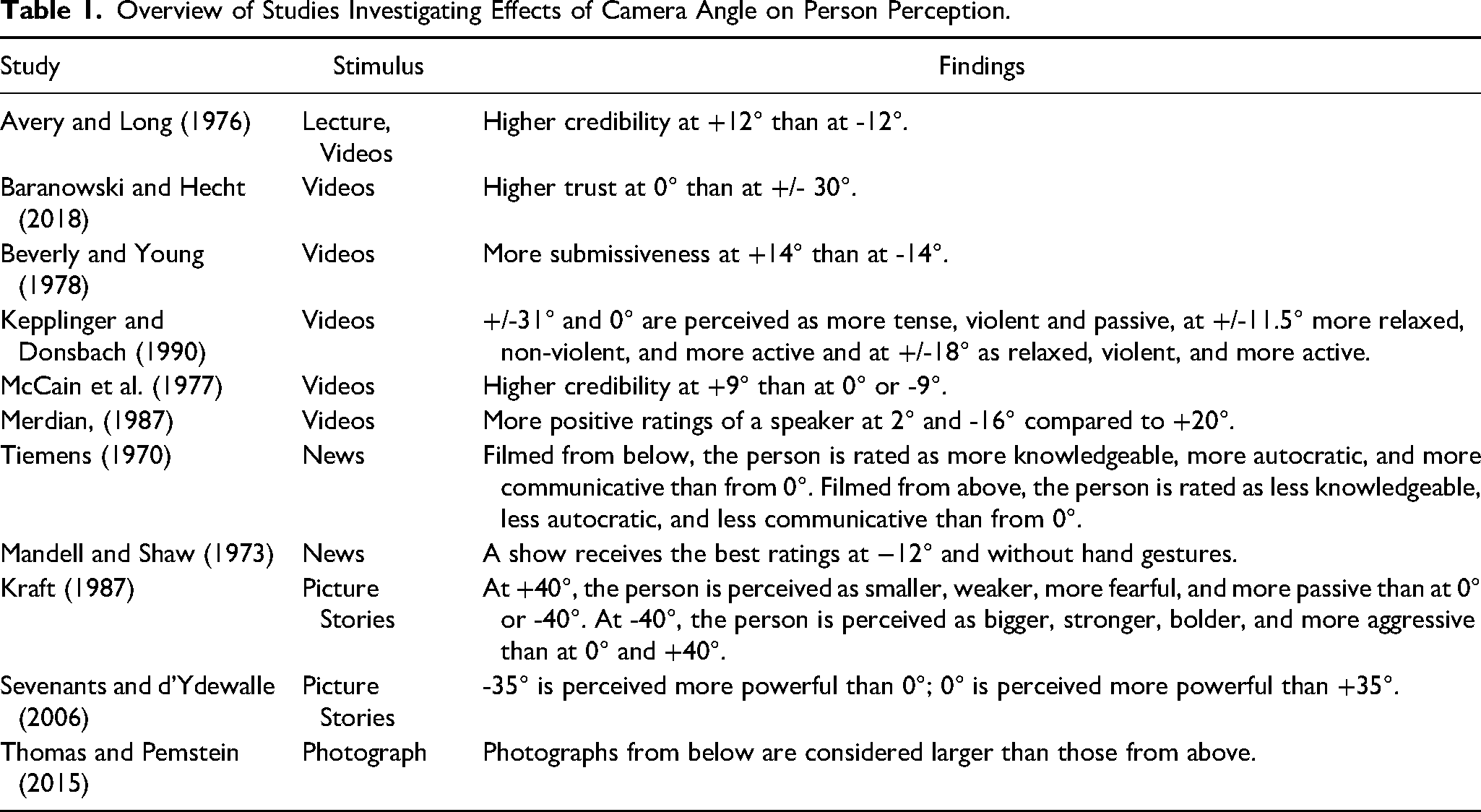
From an extreme bird's-eye perspective (very high camera angle), people appear weaker, more passive, shier, and more fearful in pictures (Kraft, 1987); they further convey the impression of powerlessness (Giessner et al., 2011). However, from the bird's-eye perspective individuals also appear more competent, composed, and sociable (McCain et al., 1977). An eye-level perspective is associated with neutral evaluations (Kraft, 1987), it also increases perceived trustworthiness (Baranowski & Hecht, 2018) and generally leads to positive perceptions (Kepplinger, 1982). In contrast, a photograph taken from below often leads to effects that are opposite to those observed for the bird's eye view. From a frog's-eye (below eye-level) to a bird's-eye view, a person's perceived power decreased (Sevenants & d’Ydewalle, 2006). The frog's-eye perspective is suitable for suggesting characteristics that express power. From a frog's-eye perspective, individuals appear more convincing, authoritative, and knowledgeable (Tiemens, 1970). In addition, when photographed from below, people appear fearless, courageous, assertive, and strong (Kraft, 1987; Mandell & Shaw, 1973; but see Kepplinger, 1982). If a viewer is forced by the frog perspective to look up at a person, this leads to less self-interest in the viewer, and they are more likely to forgo rewards (Thomas & Pemstein, 2015). Witkower and Tracy (2019), for example, found that tilting one's head downward increased perceptions of dominance. Contrasting evidence, on the other hand, describes tilting the head downward as a closed and contracted nonverbal movement that makes individuals appear smaller (Mignault & Chaudhuri, 2003; Rule et al., 2009), while perceptions of dominance decrease (Blaker & Van Vugt, 2014; Marsh et al., 2009). Similarly, looking at a head tilted down could alter the mouth's curvature, thus increasing the extent to which a slightly smiling target is perceived as happy, which in turn conveys warmth and affiliation, therefore decreasing perceptions of dominance (Lyons et al., 2000). While this shows that the vertical dimension of perspective on others has an impact on how we perceive others, the evidence on the direction of this effect is inconsistent.
The impact of camera angles on the perception of a person might be explained by the concept of embodied cognition. For example, in many cultures, people try to avoid bad luck with superstitious rituals such as knocking on wood, spitting, or throwing salt, and in fact engaging in these kinds of physical actions leads to the experience of pushing away bad luck, which may lead to relief and exerts a measurable psychological effect (Zhang et al., 2014). Thus, some sayings or superstitious rituals, such as washing away your sins (Zhong & Liljenquist, 2006) or washing your conscience and polishing your reputation (West & Zhong, 2015), have solid psychological consequences (Lee & Schwarz, 2021). Embodied cognition research offers a compelling answer to such phenomena; it emphasizes the notion that sensorimotor processing instead of being distinct from bodily experience (Haggard et al., 2008; Semin & Smith, 2008) mainly molds cognition.
Bodily experiences influence not only people's perception of concrete objects in their environment, but also their understanding of abstract concepts (Barsalou, 2008; Barsalou et al., 2003; Niedenthal et al., 2005). The effect of spatial relatedness of objects is a good example of embodied cognition, which leads to an embodied experience of a psychological dimension, such as the way leaders present themselves in front of their followers. The concept of power as mentally activated by verticality might shift spatial attention in an early stage of information processing, while embodied signals can be part of a leader's physicality or the environment (Schubert, 2005; Zanolie et al., 2012). Actually, leadership fulfills the function of solving coordination challenges in social groups (Grabo et al., 2017), assigning power, at least influence power, to the leader, which legitimizes his authority (Sturm et al., 2021). This then also constitutes the social hierarchy in the group, with verticality emerging as an embodied signal of such hierarchy (Hall et al., 2005, 2015). Just like the distance between leader and follower suggests their hierarchy (Giessner & Schubert, 2007), the camera angle from which an individual is portrayed might embody their perception as a leader, matching the popular saying “to look up to somebody” (Weaver et al., 2005). Alternatively, the proverbial “looking down” on someone could undermine their perception as leader-like. This theorizing does in fact find preliminary empirical support in the multifaceted, yet fragmented findings on camera angle and impression formation outside of leadership research (e.g., Baranowski & Hecht, 2018). For example, being perceived as assertive or courageous are attributes that make individuals prototypical for a leadership position, supporting them to create a charismatic effect on their audience to gain approval for their leadership. Staging the audience to look down on a person might undermine this impression (e.g., Kraft, 1987). In other words, staging from above makes a leader appear less charismatic, hence it may harm an audiences’ trust in their leadership ability (Antonakis et al., 2016, Grabo et al., 2017). Although “looking up” to leaders also makes them seem more aggressive and dominant, perhaps less approachable, it is well known that preferences for leaders are not the same as for other social partners; in short, those who we prefer as leaders we may not necessarily choose as friends (Laustsen & Petersen, 2015; but see Capozza et al., 2017; Laustsen & Bor, 2017). Thus, from an embodiment perspective, the attribution of favorable leader characteristics might decrease as soon as the viewer looks down on the depicted leader. In other words, if a leader is photographed from above, and thus looking up on followers, this should lead to less favorable leader perceptions and ultimately to a fall in their approval. In contrast, when leaders are displayed from below or at eye-level, this might let them earn attributions that are more favorable (Kraft, 1987; Tiemens, 1970).
Hypothesis 1. A higher camera angle makes leaders appear less charismatic in the eyes of an audience compared to a camera angle on eye-level or from below.
Hypothesis 2. A higher camera angle would let a leader gain less approval from an audience compared to a camera angle on eye-level or from below.
In our set of four experimental studies (e.g., Kraus et al., 2016), subjects were presented with photographs of leaders, in which we systematically manipulated the camera angle (Kraft, 1987). This allowed us to draw causal conclusions about the effect of different camera angles on their audience's perception (Hypothesis 1) and approval (Hypothesis 2; study 1 and 3). As perceptions of the audience, we examined their attribution of favorable leader attributes to the photographed leader and their approval that emerges from that attribution. In addition, we combined pictures with either change-oriented or neutral messages of the leader to check the effects of camera angle onto the leadership of the person portrayed beyond impression formation (Hypothesis 2; study 4). We have distinguished between a message toward continuity and another toward change, since charismatic leadership is often conceptualized as challenging what is status quo, thus articulating leadership toward change (Yukl & Gardner, 2022). Last, across the three studies, we attempted to examine the effect of a portrayed leader's camera angle on their audience in different variations and contexts to determine boundary conditions that might affect the hypothesized effects (eye-contact, study 1; sex, study 2; message type, study 4).
Study 1: The Camera Angle Used in Photographs of Leaders Shapes Their Charisma
In study 1, we investigated the general influence of the vertical camera angle on favorable leader attributes of and approval for the leader depicted (Hypotheses 1 and 2). However, previous evidence suggests that when we form impressions about others in photographs, the gaze of the portrayed person also matters. An audience perceives a person in a photograph in a different way, depending on whether the person in the photograph is looking at the camera or not (e.g., Baranowski & Hecht, 2018; Witkower & Tracy, 2019). Since gaze behavior is also a key behavior in leadership that influences the leader's effectiveness (Maran et al., 2019), in study 1 we additionally examined how gaze direction of the portrayed leader impacts the effect of the photograph's camera angle.
Design
To test our hypotheses, we took a photograph of a male executive from five different camera angles, either maintaining eye-contact with the camera or not, resulting in 10 different photographs. These images were presented to two different samples. One sample rated one of 10 pictures, while the other sample rated all 10 pictures. Thus, the photos were not only evaluated between subjects, but also within subjects. This could provide additional clarity on the effects of camera angle on leaders’ perception. The allocation of the photos was random, and we did not specify the purpose of the study.
Samples
Between-Subjects Sample
A total of 351 volunteers (299 females) rated one out of 10 photos (random allocation; 35–36 subjects per condition). The mean age across the whole sample was 33 years (SD = 11.69; ranging from 16 to 65). All participants reported being full-time employees. About one third of the subjects (33.9%) stated that they were currently performing management tasks in their jobs, but at the same time did not hold leadership positions.
Within-Subjects Sample
Another five subjects rated all 10 stimulus pictures (four females; all aged 23).
Measures
Leader's Charisma
We measured a leader's charisma as an endogenous variable via a selection of 16 items of the transformational leadership scale (MLQ Form 5X-Short, Avolio et al., 1999; German translation by Felfe, 2006; Towler, 2003). This instrument has recently been subject to strong criticism, but this critique explicitly referred to the use of the instrument as an exogenous variable (Antonakis et al., 2016; Fischer & Sitkin, 2023), whereas in our design leader's charisma is measured as an endogenous variable, that is, as an outcome, not as a cause. An example item reads, “Articulates a convincing vision of the future.” The scale's reliability was at McDonald’s ω = 0.93 (Hayes & Coutts, 2020).
Leader's Prototypicality
Moreover, we measured prototypicality by employing three items, where subjects rated whether they perceive the person in the picture as a leader, i.e., “The person in the picture often demonstrates leadership behavior,” “The person in the picture behaves like a typical leader,” and “The person in the picture corresponds to my idea of a leader” (Antonakis et al., 2011). McDonald's ω was 0.86.
Leader's Approval
We further assessed the approval of a leader by asking subjects whether they would choose, accept, and trust this person as a leader (see Antonakis et al., 2011; McDonald’s ω = 0.88).
Favorable Leader Attributes
Subjects rated several first impressions of the pictured person using single item ratings, including trustworthiness, dominance, and competence of the person portrayed (Willis & Todorov, 2006; e.g., “How trustworthy is this person?”). All the above scales were measured with a 7-point Likert scale ranging from 1 = do not agree at all to 7 = completely agree.
Stimulus Material
The person shown in the photograph was a male leader aged 33. Photos differed regarding camera angles on the vertical varying between −18°, −9°, 0°, +9° and +18° of visual angle (McCain et al. 1977; Kepplinger & Donsbach, 1990). The stimulus person stood at a distance of 2.40 m in front of the camera. For the different vertical conditions, the camera height was changed from 82 cm at −18° to 238 cm at +18°; for the 0° condition, we chose the eye height of the person. For every condition, we took one photo with and one without eye-contact. Put more precisely, during the photo shoot, the stimulus person looked into the camera in one condition and straight ahead at a constant angle in the other. This resulted in 10 different stimuli (see Figure 2 for an illustration of the camera angles with a female leader). We standardized the framing for all images, so that half of the upper body and the head were always visible, which is typical for the portrayal of leaders (e.g., Frankfurter Allgemeine Zeitung, 2013; Platon, 2011). Likewise, the facial expression (friendly smile) was the same in all photos.
To ensure a standardization of the photos, we commissioned a professional photographer, and the stimulus person wore the same black suit with a white shirt in all photos. Consistent with previous research that has experimentally examined the effect of leaders on their audience, we imaged the same person for all conditions in both study 1 and study 2 to keep the person's facial features and physiognomy constant (Antonakis et al., 2021; Ernst et al., 2022; Fest et al., 2021; Maran et al., 2021; Meslec et al., 2020; Nieken, 2022). We further adjusted the brightness and contrast of all photographs to be similar across conditions.
The data and materials supporting the findings of this, and the three subsequent studies are in the open science framework at https://osf.io/85jrt/.
Procedure
At the beginning, we informed our subjects that they are about to see the picture of a manager of a company and asked them to look closely at the picture for 10 seconds. After that, they were directed to the questionnaire, in which subjects rated perceived charisma, favorable leader attributes as well as approval for the leader depicted in the picture. During this questionnaire, the picture remained in the same place; below the picture, the self-report measures appeared. The survey took about 5–10 minutes to complete. We conducted the study in line with the guidelines of the Ethics Committee of the University of the First Author.
Results and Discussion
To test our hypotheses, we conducted 2 × 5 univariate ANOVA models (eye-contact × camera angle) and evaluated the influence of camera angle in five levels on our dependent variables leader's charisma, leader prototypicality, leader's approval, and favorable leader attributes in both samples. 1 In a second step, we computed separate models for eye-contact and no eye-contact. We tested sphericity using Mauchly's test and in case of deviance from sphericity, we controlled Type I error by adjusting the degrees of freedom using the Greenhouse–Geisser correction. Partial eta squared indicates effect sizes, all reported p-values are two-tailed, and alpha levels were set at 0.05. Results are reported with original df and corrected p-values. To improve readability, we report means and standard deviations for all our analyses in a supplement to this paper. We analyzed our data with SPSS 25.0.
For leadership traits, we found a main effect of camera angle on a leader's charisma in the between-subjects sample (F[4,341] = 3.23, p = .013, η² = 0.027) as well as an interaction between camera angle and eye-contact (F[4,341] = 2.41, p = .049, η² = 0.272). Furthermore, we found interactions between camera angle and eye-contact for prototypicality (F[4,50] = 3.83, p = .011, η² = 0.272) and charisma (F[4,50] = 3.88, p = .009, η² = 0.280) in the within-subjects sample. Last, there was a main effect of eye-contact in the within-subjects sample for leaders’ approval (F[4,50] = 1.99, p = .006, η² = 0.166). For favorable leader attributes, we found a main effect of camera angle on trustworthiness in both samples (between-subjects: F[4,341] = 2.60, p = .036, η² = 0.030; within-subjects: F[4,40] = 4.14, p = .007, η² = 0.293) as well as a main effect of eye-contact in the within-subjects sample (F[4,40] = 6.04, p = .018, η² = 0.131); in addition, there was an interaction between camera angle and eye-contact in the between subjects sample (F[4,341] = 2.61, p = .035, η² = 0.030).
Eye-Contact
Regarding the stimuli depicting eye-contact, we found main effects of camera angle on leader's approval (F[4,170] = 2.44, p = .049, η² = 0.054) and charisma (F[4,346] = 5.64, p < .001, η² = 0.117) in the between-subjects sample. In the within-subjects sample, there were main effects of camera angle on leader's prototypicality (F[4,20] = 3.87, p = .017, η² = 0.436), charisma (F[4,20] = 5.35, p = .004, η² = 0.517) and approval (F[4,20] = 3.90, p = .017, η² = 0.438). Post hoc multiple comparisons indicated differences between the 18° and the other four conditions (all ps < .05) for leader's prototypicality, approval, and charisma. The 18° photograph received the lowest ratings for all traits in both samples compared to the other conditions; the 18° and −18° received similar ratings in the within-subjects sample (p > .05), while in the between-subjects sample these two conditions differed from each other (see Figure 1 and Table S3).
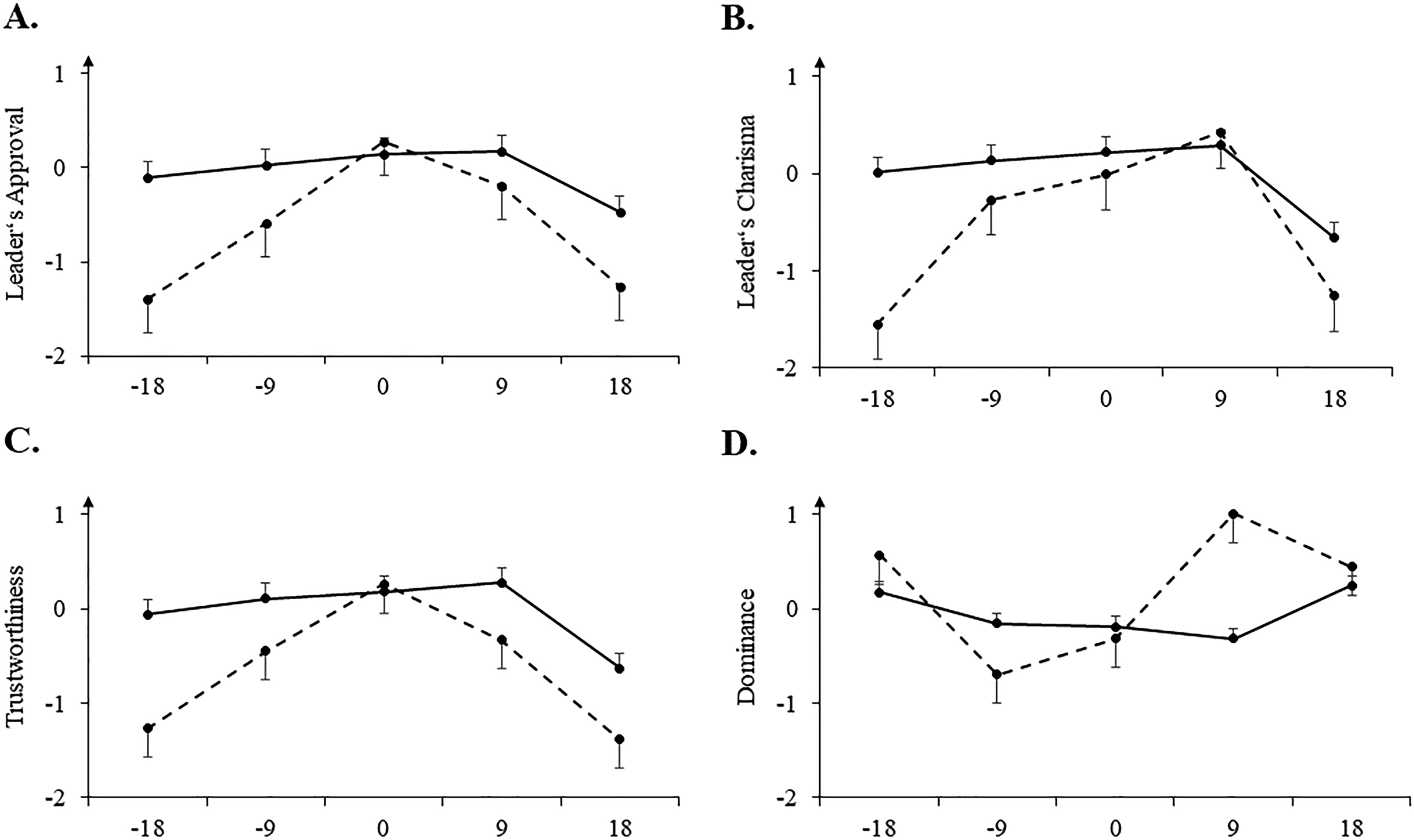
Ratings for leader's approval (A), leader's charisma (B), trustworthiness (C), and dominance (D) for the five different camera angles in photographs depicting eye-contact to the viewer, separately shown for the two sub-samples (between-subjects sample = straight line, within-subjects sample = dotted line); error bars represent 95% within-subject errors.
Regarding favorable leader attributes, we found a main effect of camera angle on trustworthiness (F[4,170] = 4.37, p = .002, η² = 0.093) in the between-subjects as well as the within-subjects sample (F[4,20] = 5.62, p = .003, η² = 0.529). Post hoc multiple comparisons showed the same pattern as for the leadership traits; again, the 18° photograph received the lowest ratings in both samples (see Figure S1C). In the within-subjects sample, the 18° and −18° conditions received similar ratings (p > .05), while in the between-subjects sample these two conditions differed from each other (p < .01; see Table S3).
No Eye-Contact
For the stimuli without eye-contact, we found no main effects or interactions in any of the tested variables (all p's > .05).
Findings of study 1 support our first hypothesis that the angle from which a leader is photographed indeed shapes how he is perceived by followers. More specifically, a higher camera angle results in lower ratings of a leader's charisma and lower approval by an audience. By contrast, all camera angles lower than 18° received similar ratings, while the 18° photograph received the lowest ratings. Interestingly, in the within-subjects sample, the 18° and −18° condition received similar ratings, suggesting that all extreme camera angles have an unfavorable impact on a leader. By showing that effects of camera angles, from which a leader is photographed, only occur if the leader is looking into the camera, we were able to identify a first boundary condition for the impact of camera angles.
Study 2: Replication of the Camera Angle Effect in Female Leaders
Sex differences in leadership are a timely topic. While for numerous leadership outcomes, inter-individual differences in personality and cognition might be far more important than sex as a variable, this might not hold true for the formation of first impressions based on photographs (Hall & Ruben, 2020). Sex is a highly visible social category. It thus could influence an audience when they perceive and judge a photograph of a leader. For example, while women in political leadership positions are expected to signal compassion, men are expected to show greater expertise in the military and defense strategies (Huddy & Terkildsen, 1993). Yet, more direct evidence on the perception of leadership success in photographs contradicts the influence of sex, showing that the leadership success attributed to a photograph of a leader depends on the physiognomy of their face, but not on their perceived sex (Rule & Ambady, 2009, but see Pillemer et al., 2014). Taken together, like gaze direction (examined in study 1), sex ought to be investigated as a potential boundary condition for the effect of camera perspective on perceptions of and approval for portrayed leaders. We do not expect any effects that deviate from the results of study 1, so the camera angle effect should be replicable in a female leader.
Methods and Design
We applied the same procedure from study 1 to study 2 and portrayed a female person as a leader. The female actor was matched by hair color (blond), eye color (blue) as well as approximate body height and facial metrics with the male actor photographed in study 1. In contrast to study 1, this time the female leader had eye-contact with the viewer in all conditions (see Figure 2). Each participant was presented with one of five different photographs. We randomized the allocation of photos, and again the purpose of the study was not stated. At the beginning of the online survey, we instructed participants to look closely at the photo for 10 seconds; then they were directed to the questionnaire. During the subsequent assessment, the photo was visible at the top of each page. The survey took about five to ten minutes to complete.
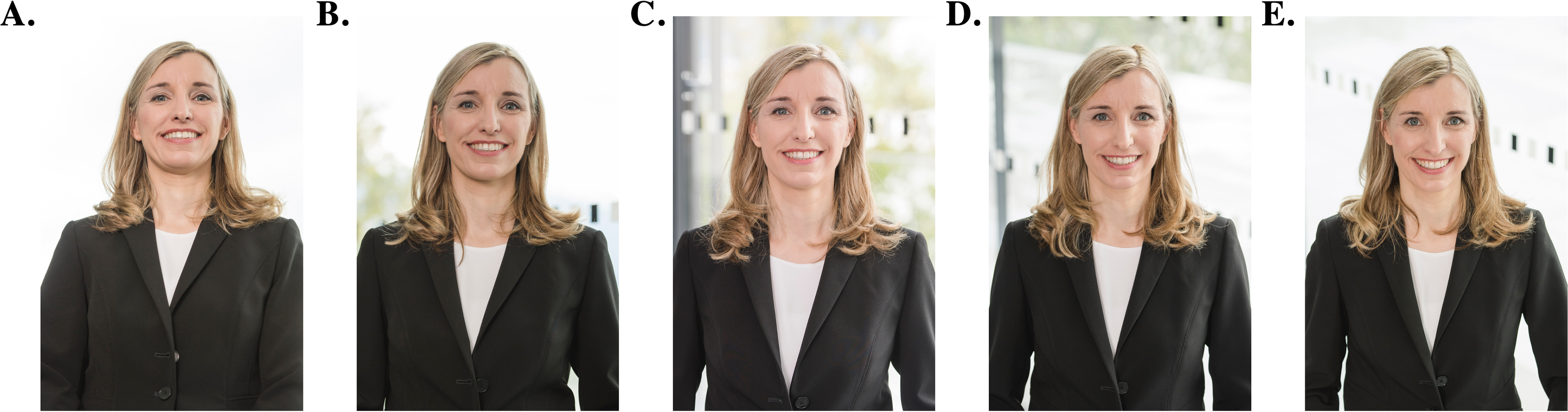
Images of the female leader taken from the five different camera angles; the person kept eyecontact with the viewer (A = -18°, B = -9°, C = 0°, D = +9°, E = +18°).
Sample
For the assessment of the female leader, we randomly assigned 127 subjects (86 female) to one of five conditions; each condition contained about 25 subjects. The mean age was 30 years (SD = 10.29, ranging from 19 to 78) and 24.4% of the participants stated that they were currently performing management tasks.
Measures
To ensure comparability with the previous findings, we employed the same instruments as in study 1 to measure leaders’ charisma (MLQ Form 5X-Short, Avolio et al., 1999; German translation by Felfe, 2006; McDonald's ω = 0.95), the prototypicality for their station (McDonald's ω = 0.91) and approval (Antonakis et al., 2011; McDonald's ω = 0.92), as well as other favorable leader attributes (single item ratings; Willis & Todorov, 2006).
Results and Discussion
In the first step, we conducted univariate ANOVA models to evaluate the influence of camera angle on our dependent variables leader's charisma, leader prototypicality, leader's approval, as well as favorable leader attributes.
For the leader's charisma, prototypicality or approval we found no influence of camera angle on the perception of our female leader (all p's > .05). For favorable leader attributes, camera angle had an effect on dominance (F[4,122] = 3.13 p = .017, η² = 0.093). Post hoc multiple comparisons (LSD) indicated differences between the −18° and −9° photographs (p = .031), between −9° and 9° (p = .014) as well as 18° photographs (p = .015). In addition, 0° differed from 9° (p = .025) and 18° (p = .27). The −9° and 0° angles received the highest ratings.
Exploratory Post Hoc Analyses
In a second step, we calculated 2 × 5 univariate ANOVA models (sex × camera angle) with the same dependent variables as before. To perform these models, we combined the between-subjects sample who rated the direct eye-contact photographs of the male leader of our study 1 (N = 175) with the sample of study 2. Before performing statistical analyses, data from both data sets were z-transformed to normalize values. In a last step, we resolved the interaction between sex and camera angle, and further examined the effects of camera angle specifically for the female leader. Here, we found a main effect of camera angle on leader's charisma (F[4,292] = 3.00, p = .019, η² = 0.039) and approval (F[4,292] = 2.41, p = .049, η² = 0.032). In addition, we found an interaction between sex and camera angle for the leader's charisma (F[4,292] = 3.20, p = .014, η² = 0.042). When taking a closer look on the effect within each sex, we found differences between −18° and 9° for the female leader (p = .034); here, the −18° picture received the lowest rating. For the male leader, the 18° picture differed from all others (all p's < .01), receiving the lowest rating (see Table S4).
Second, we found a main effect of camera angle on trustworthiness (F[4,292] = 2.57, p = .038, η² = 0.034). Additionally, we observed sex by camera angle interactions for trustworthiness (F[4,292] = 2.73, p = .029, η² = 0.036), and dominance (F[4,292] = 3.68, p = .006, η² = 0.048). Post hoc multiple comparisons for trustworthiness showed differences between −18° and 9° (p = .014) for the female leader, while for the male leader the 18° photograph differed significantly from all other conditions (all p's > .020). For the male leader, the 18° photograph received the lowest ratings, while for the female leader, the −18° picture was rated worst (see Table S4). For dominance, the female leader received the highest ratings on eye-level and slightly below, the extreme and higher angles got the lowest ratings. Thus, −9° differed from −18° (p = .031), 9° (p = .014) and 18° (p = .015). Moreover, the eye-level condition with 0° differed from 9° (p = .025) and 18° (p = .027).
To sum up, we found partial support for leader's sex acting as a boundary condition for the effects of camera angle on leader attributes by observing several interaction effects. First, effects of camera angle on charisma and other favorable leader attributes from the male leader could not be replicated in the female leader (Hypothesis 1). Second, camera angle and sex interacted for the leader's charisma as well as several favorable leader attributes including dominance. As can be seen in Figure 3, the male leader received less approval with a higher than with a lower camera angle, while for the female leader the opposite was observed. Moreover, extreme camera angles led to higher perceptions of dominance in the male leader, while trustworthiness decreased with a higher angle. The female leader, however, is ascribed more trustworthiness, but less dominance with a higher camera angle.
Study 3: Replication of the Camera Angle Effect in Leaders in a Variety of Facial Physiognomies While Controlling for Attractiveness and Likeability
The physiognomy of leaders matter (Antonakis & Eubanks, 2017). If the faces of former US presidents are manipulated slightly toward a younger appearance, then suddenly even seminal presidents like Kennedy or Reagan appear less powerful and therefore less leader-like (Keating et al., 1999). Actually, school-aged children can predict the outcome of presidential elections just by looking at a picture of the physiognomy of two competing candidates on a picture (Antonakis & Dalgas, 2009; Todorov et al., 2005). This effect of physiognomy on our perception of others is an evolutionary inheritance and can even be demonstrated in primates (Keating, 1985; Zebrowitz & Montepare, 2008). For instance, facial characteristics associated with maturity, such as small and narrow eyes, thick eyebrows, thin lips, and a square jaw, serve as physiognomic status cues. By contrast, pedomorphic facial features, including large eyes, thin and arched eyebrows, full lips, and a round jaw, convey signals of submissiveness, receptivity, and appeasement. Even when displayed by adults, these youthful-looking traits have come to signify submissiveness, approachability, warmth, and trustworthiness (Keating, 2002). Since it is hardwired, it also affects our perceptions of leaders and our ascription of leadership-related attributes to potential leaders (Antonakis & Eubanks, 2017; Keating, 2002, 2011; Tskhay & Rule, 2018). We presented a single stimulus person portrayed from varying camera angles to different audiences in each of the previous two studies. Therefore, the camera angle-effect on leader perception could have been biased by the specific physiognomy of the leaders we presented in the former two studies.
In order to show a camera angle effect on the perception of leadership-relevant attributes in leaders with various diverse physiognomies, this study attempts to replicate the effect with a variety of leaders of diverse physiognomy. We expect that the camera perspective on a leader's portrait will show effects independent of the specific physiognomy of the leaders. In addition, similar to the potential bias for the findings of study 1 due to the idiosyncratic effects of the specific physiognomy of the depicted person, this could also have affected the findings on the portraits of the female leader in study 2. Therefore, study 3 further aims to examine sex as a potential boundary condition, again expecting the camera angle effect to remain robust.
Design
Study 3 followed the same procedure as the first two studies, whereby each participant was exposed to one of thirty photographs, showing one of six different leaders. The six different leaders (three male, three female) kept eye-contact with the viewer at all camera angles. In contrast to the first two studies, where the background of the photos was differing between angles (see Figure 2), all photos were taken against a white background. We randomized the allocation of photos, and again the purpose of the study was not stated. At the beginning of the online survey, we instructed participants to look closely at the photo for 10 s; then they were directed to the questionnaire. During the subsequent assessment, the photo was visible at the top of each page. The survey took about five to ten minutes to complete.
Sample
For the assessment of the six new leaders, we randomly assigned 1228 subjects (772 female) to one of thirty conditions; each condition contained about 40 subjects. The mean age was 33 years (SD = 12.4, ranging from 18 to 83).
Measures
To test our hypotheses, and to replicate the findings from study 1 in different identities, we used the same measures as in study 1. More specifically, a leader's charisma was measured using the item selection of the transformational leadership scale (MLQ Form 5X-Short, Avolio et al., 1999; German translation by Felfe, 2006; Towler, 2003), with McDonald's ω of 0.94. In addition, we applied the general charisma inventory (GCI; Tshkay & Rule, 2018), which measures charisma on the two dimensions of influence (McDonald's ω = 0.91) and affability (McDonald's ω = 0.92). We further measured the prototypicality of the leader (McDonald's ω = 0.85) and his approval (yes/no; Antonakis et al., 2011), as well as favorable leader attributes (single item ratings; Willis & Todorov, 2006).
Results and Discussion
In the first step, we conducted 5 × 6 univariate ANOVA models to evaluate the influence of camera angle and physiognomy on our dependent variables leader's charisma, leader prototypicality, leader's approval, as well as favorable leader attributes.
For prototypicality, we found both a main effect of camera angle (F[4,1198] = 6.20, p < .001, η² = 0.020) and physiognomy (F[5,1198] = 22.14, p < .001, η² = 0.085) as well as an interaction of those two (F[20,1198] = 1.88, p = .011, η² = 0.030). Post hoc multiple comparisons indicated differences between the extreme camera angles of 18° and −18° and all other angles (all p's < .01), while they both did not differ from each other and received the lowest ratings (see Table S5, Overall). For charisma, again we found main effects of camera angle (F[4,1198] = 6.40, p < .001, η² = 0.021) and physiognomy (F[5,1198] = 18.10, p < .001, η² = 0.070), but no interaction. When comparing the different camera angles, we found differences between the 18° picture and all other angles except −18° (all p's < .01); the 18° received the lowest rating compared to all other angles (see Figure 4B and Table S5, Overall).
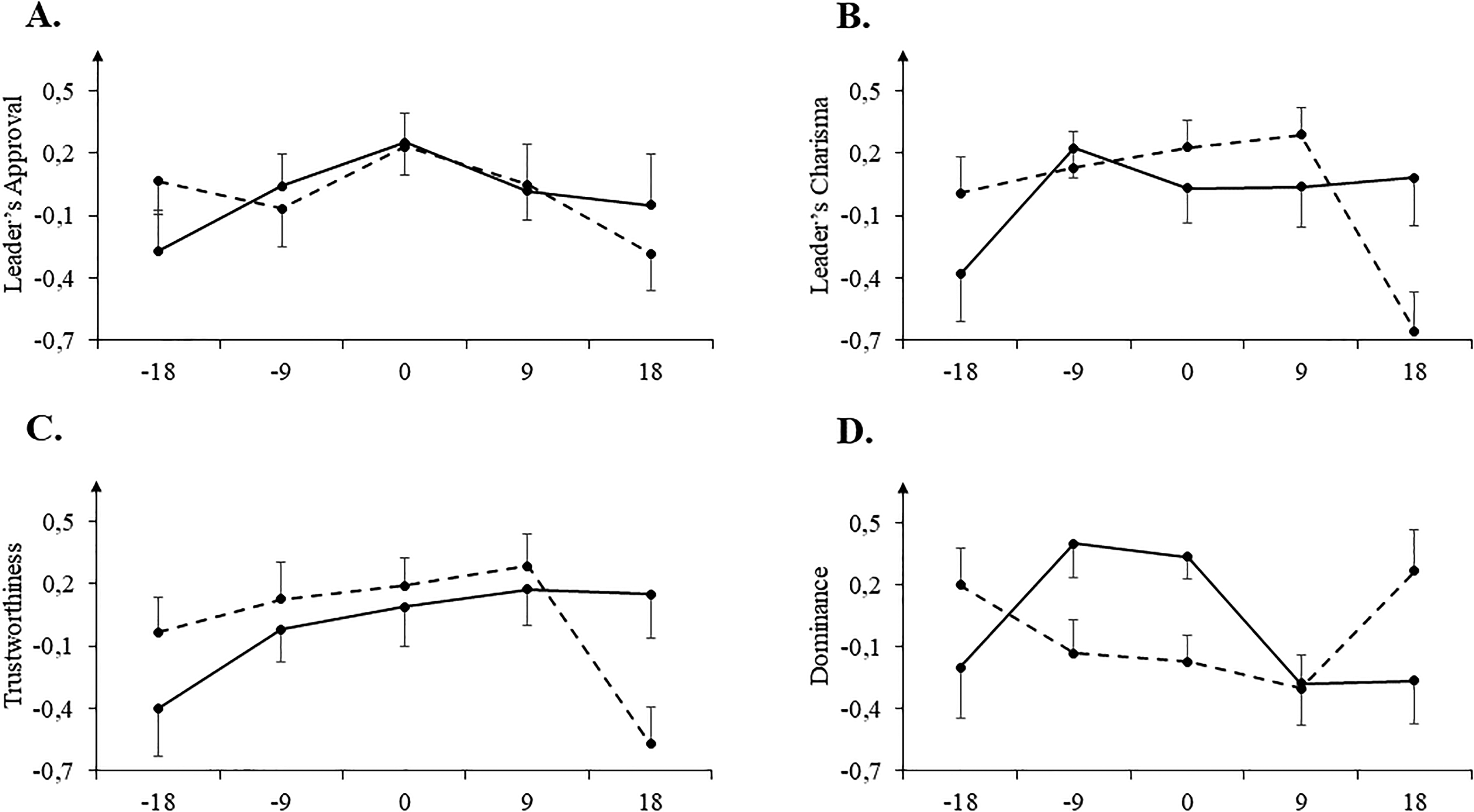
Interaction graphs for sex and camera angle concerning leader's approval (A), leader's charisma (B), trustworthiness (C), and dominance (D) in stimuli depicting eye-contact with the viewer, separately shown for the female (straight line) and male (dotted line) leader; error bars represent 95% within-subject errors.
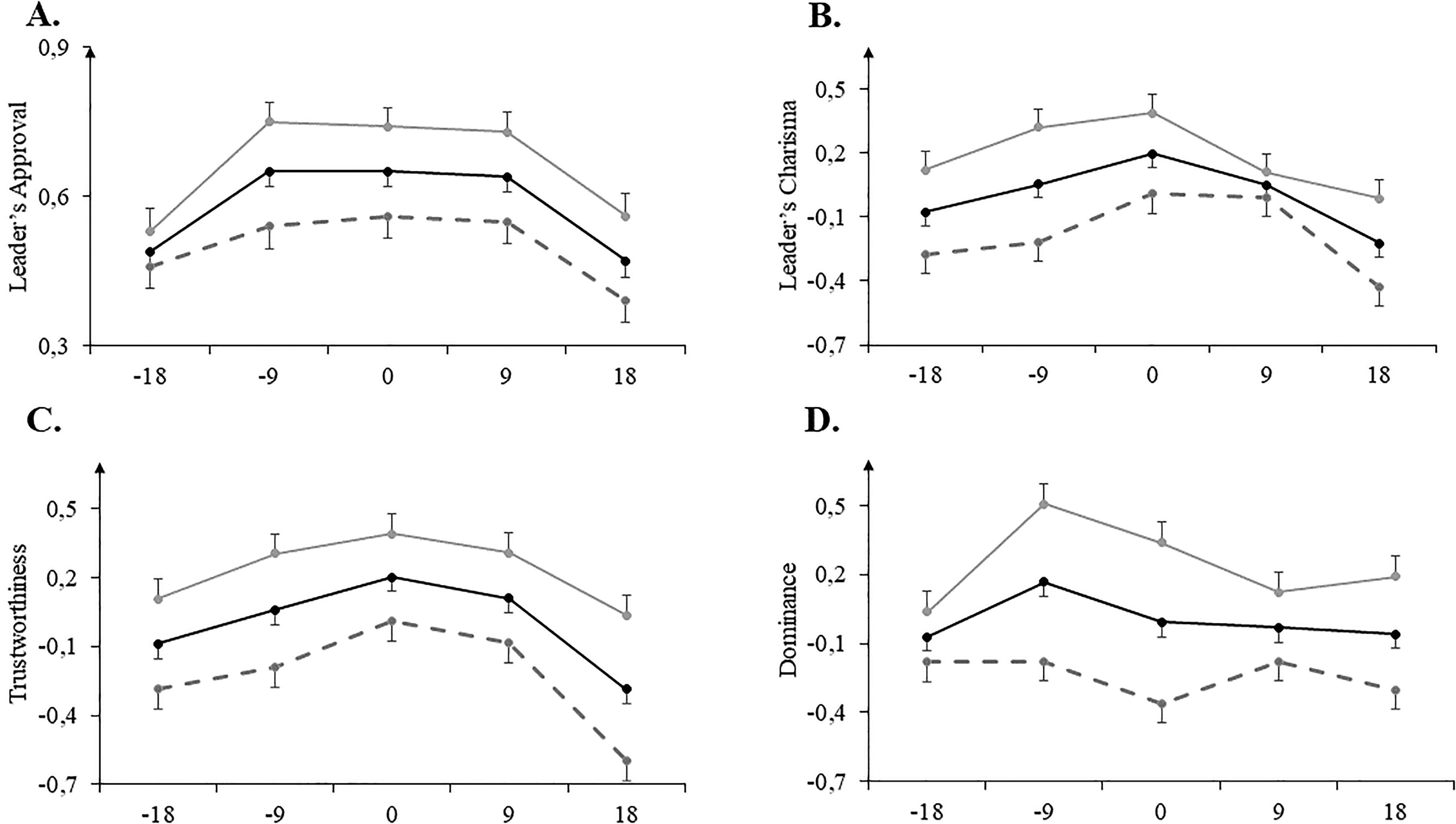
Ratings for leader's approval (A), leader's charisma (B), trustworthiness (C), and dominance (D) for the five different camera angles across all six identities (black line); in addition, ratings are plotted also separately for male (dotted grey line) and female leaders (grey line). Error bars represent 95% within-subject errors.
For affability, there also were main effects for camera angle (F[4,1198] = 9.03, p < .001, η² = 0.029) and physiognomy (F[5,1198] = 19.84, p < .001, η² = 0.076); here, the 18° angle received the lowest ratings (M = 4.88) and differed from all other angles (all p's < .025; see Figure 4D and Table S5, Overall). For influence, the ANOVA yielded similar main effects for camera angle (F[4,1198] = 6.11, p < .001, η² = 0.020) and physiognomy (F[5,1198] = 19.50, p < .001, η² = 0.075). Again, the extreme angles differed from all other three angles (all p's < .037), but not from each other (p = .466). They both received the lowest ratings (see Table S5, Overall).
For leader's approval, we found main effects of camera angle (F[4,1198] = 8.45, p < .001, η² = 0.027) and physiognomy (F[5,1198] = 11.78, p < .001, η² = 0.047); there was no interaction of the two. Again, multiple comparisons yielded differences between the two extreme and all other angles (all p's < .001), while they did not differ from each other (p = .63; see Figure 4A and Table S5, Overall).
For trustworthiness, there were again main effects of camera angle (F[4,1198] = 9.78, p < .001, η² = 0.032) and physiognomy (F[5,1198] = 22.06, p < .001, η² = 0.084) as well as an interaction (F[20,1198] = 1.69, p = .030, η² = 0.027). Here, the 18° picture differed from all others (all p's < .021) and received the lowest ratings (see Figure 4C and Table S5, Overall). For competence, there were main effects of camera angle (F[4,1198] = 9.94, p < .001, η² = 0.032) and physiognomy (F[5,1198] = 16.23, p < .001, η² = 0.063), but no interaction. For dominance, the main effect of camera angle failed to reach significance (p = .051); there was a main effect of physiognomy, though (F[5,1198] = 22.41, p < .001, η² = 0.086).
Controlling for Perceived Attractiveness
As attractiveness might play a role in the evaluation of pictures of different individuals, we repeated our statistical analyses with attractiveness as covariate. The effect of camera angle remained for all tested variables including prototypicality (F[4,1197] = 3.22, p = .01, η² = 0.011), charisma (F[4,1197] = 2.73, p = .028, η² = 0.009), approval (F[4,1197] = 4.73, p = .001, η² = 0.016), and affability (F[4,1197] = 5.51, p < .001, η² = 0.018) except influence. Also for trustworthiness (F[4,1197] = 5.21, p < .001, η² = 0.017) and competence (F[4,1197] = 5.83, p < .001, η² = 0.019) the effect of camera angle remained significant after controlling for attractiveness.
In order to level the influence of physiognomy independently of the camera angle, we z-transformed the audiences’ ratings of relevant leadership attributes. This allows us to examine idiosyncratic effects of the specific physiognomy of a stimulus person on the effect of the camera angle on these same attributes. When we used the z-transformed values, we found no interaction between camera angle and physiognomy for our critical outcome variables except prototypicality.
Analysis of Sex Effects
For this analysis, we again used the z-transformed ratings to level the influence of sex independently of the camera angle. Here, we found main effects of camera angle for prototypicality (F[4,1229] = 6.18, p < .001, η² = 0.020), charisma (F[4,1229] = 6.58, p < .001, η² = 0.021) and approval (F[4,1229] = 8.58, p < .001, η² = 0.027). Concerning favorable leader attributes, there was a main effect of camera angle for trustworthiness (F[4,1229] = 9.29, p < .001, η² = 0.029), and competence (F[4,1229] = 9.57, p < .001, η² = 0.031). There were no interactions between sex and camera angle for any of the tested variables except prototypicality (F[4,1229] = 4.33, p < .01, η² = 0.014) and dominance (F[4,1229] = 2.90, p = .021, η² = 0.009). For prototypicality, post hoc multiple comparisons yielded no differences. However, graphical inspections suggest that male leaders compared to female leaders benefit from a +9° perspective and female leaders appear more prototypical for their station when depicted from −9° perspective. Interestingly, while male leaders show similar ratings from −18°, −9° and 0°, female leaders are perceived as less prototypical when portrayed from −18°. For dominance, we found a similar pattern. Female leaders are perceived as more dominant at 0° and −9°, while losing dominance ascriptions sharply at −18°.
Our results show that camera angle shows an effect on the perception of a leader independent of the specific physiognomy. Although the physiognomy had an impact on the perception of leaders and also interacted with the perspective, the effect of the camera angle remained. Even after controlling for attractiveness, the camera angle effect persisted. As can be seen in the figure above, there was no effect of sex in this study, as the ratings for both male and female leaders followed a similar pattern. For dominance, however, the pattern was slightly different for female leaders than for male leaders, which resulted in interaction effects. Post-doc testing indicated no meaningful differences, though, which suggests that the camera angle effect persists independent of sex.
Study 4: The Camera Angle Used in Photographs of Leaders Influences Follower's Decision-Making Behavior
In study 1 and 3, we found evidence in support of our proposition that the camera angle of a photograph influences whether a leader is perceived as charismatic and prototypical of his position. In study 4, we examined whether this effect goes beyond pure impression formation and extends to behavioral decisions. Thus, we specifically studied whether the camera angle of a photograph might have an impact on followers’ decision to support the leader, which we consider as another facet of approval (Hypothesis 2). To investigate whether followers would invest in the leader's company, we combined the photographs of the male leader with a neutral or an ambitious change message related to his firm. Distinguishing between a neutral message and a message communicating change for the firm was important because charismatic leaders communicate visions of change (Choi, 2006) and show change-oriented leadership (van Knippenberg & Stam, 2014; Yukl & Gardner, 2022). We therefore asked our subjects how likely it was that they would invest in the leader's company. We expect the effects of the camera angle on followers’ decisions to be more pronounced in the change message condition because the challenge to implement change is mainly attributed to managers with high leadership ability. A higher willingness to invest would indicate approval of the depicted person's leadership, hence lending further support for Hypothesis 2.
Design
Study 4 followed the same procedure as study 1, whereby each participant was exposed to one of ten photographs with either the neutral or the change message presented below the picture of the leader, thus resulting in 20 different conditions. The neural message stated: “At the Annual General Meeting, the CEO (Managing Director, see photo) reviewed the 2019 business year and announced that the current strategy would be continued in the new year.” In contrast, the change message read as follows: “At the Annual General Meeting, the CEO (Managing Director, see photo) reviewed the 2019 financial year and announced that the company would invest in new marketing strategies in the next year to capture more market share.” Besides the leader's charisma and favorable leader attributes, we let observers rate their willingness to invest in the leader's firm. The photograph and text were presented for 20 s so that subjects could read the text and closely look at the picture. The survey took about five minutes.
Sample
In total, 763 participants (608 females) took part in the online survey; therefore, each picture was rated by 38 subjects. The mean age was 37 years (SD = 11.50, ranging from 17 to 83).
Measures
To test our hypotheses, and to replicate the findings from study 1, we used the same measures as in study 1. More specifically, leader's charisma was measured using the item selection of the transformational leadership scale (MLQ Form 5X-Short, Avolio et al., 1999; German translation by Felfe, 2006; Towler, 2003), with an McDonald's ω of 0.96. We further measured the prototypicality of the leader (McDonald's ω = 0.88) and his approval (Antonakis et al., 2011; McDonald's ω = 0.92), as well as favorable leader attributes (single item ratings; Willis & Todorov, 2006). In this study, we added another item to assess how the perspective of the leader together with a message affect the willingness of the audience to invest in the leader's organization: “Imagine you would like to make an investment, would you invest in this firm of the leader?” This item was answered on a 7-point Likert scale.
Results and Discussion
To test our hypotheses, we conducted 2 × 2 × 5 univariate ANOVA models (eye-contact × message type × camera angle) with the leader's charisma, the willingness to invest as well as favorable leader attributes as dependent variables. We further computed interactions of the three factors to test the influence of boundary conditions (eye-contact, message type). In a second step, we conducted separate models for eye-contact with neutral message, eye-contact with change message, no eye-contact with neutral message, as well as no eye-contact with change message. In case of a significant main effect of camera angle, we computed post hoc comparisons between the five different camera angles (LSD). We tested sphericity using Mauchly's test and in case of deviance from sphericity, and we controlled Type I error by adjusting the degrees of freedom using the Greenhouse-Geisser correction. Partial eta squared indicates effect sizes, all reported p-values are two-tailed, and alpha levels were set at 0.05. Results are reported with original df and corrected p-values. We analyzed our data with SPSS 25.0.
First, we found a main effect of camera angle on the willingness to invest (F[4,743] = 2.65, p = .032, η² = 0.014) as well as an interaction between message type and camera angle (F[4,743] = 2.63, p = .033, η² = 0.014; see Figure 5A). For leader's charisma, we found interactions between eye-contact and camera angle (F[4,743] = 2.84, p = .023, η² = 0.015) as well as between message type and camera angle (F[4,743] = 2.55, p = .038, η² = 0.014; see Figure 5B). Second, for favorable leader attributes, we found effects of camera angle on attractiveness (F[4,743] = 4.47, p = .001, η² = 0.023), trustworthiness (F[4,743] = 4.54, p = .001, η² = 0.024), and competence (F[4,743] = 3.44, p = .008, η² = 0.018). In addition, we found an interaction between eye-contact and camera angle for trustworthiness (F[1,743] = 2.64, p = .033, η² = 0.014; see Figure 5C) and competence (F[1,743] = 3.65, p = .006, η² = 0.019). There was also an interaction between eye-contact and message type for dominance (F[4,743] = 4.15, p = .042, η² = 0.006; see Figure 5D).
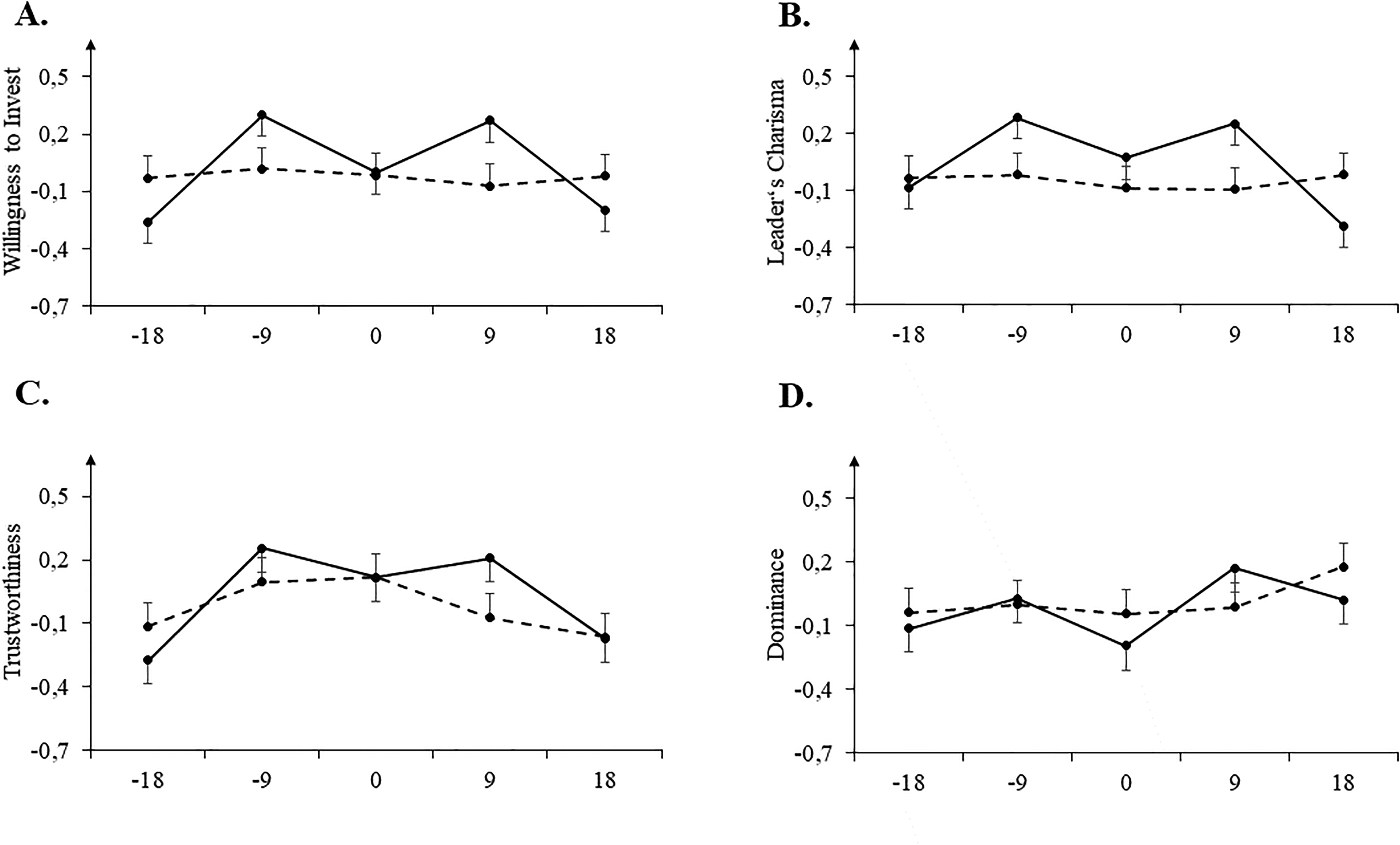
Graphs for the interaction between message type and camera angle concerning the willingness to invest (A), leader's charisma (B), trustworthiness (C), and dominance (D) for the five different camera angles separately shown for the two types of messages (change message = straight line, neutral message = dotted line); error bars represent 95% within-subject errors.
Eye-Contact, Neutral Message
For the stimuli depicting eye-contact with the viewer and pronouncing the neutral message, we found effects of camera angle on leader's approval (F[4,191] = 2.44, p = .019, η² = 0.061), trustworthiness (F[4,191] = 2.54, p = .042, η² = 0.052) and competence (F[4,191] = 4.38, p = .002, η² = 0.086). For leaders’ approval, there were differences between −18° and −9° (p = .010) as well as 0° (p = .004); the 0° photograph received the highest approval (see Table S6). For trustworthiness, the 0° photograph got the best rating, which differed from the extreme angles i.e., −18° (p = .021) and 18° (p = .028). In competence, the −9° and 0° received the highest ratings (see Table S6); they both differed from −18° and 18° (all p's < .026).
No Eye-Contact, Neutral Message
For the stimuli without eye-contact including the neutral message, we found no effects of camera angle for any of the tested variables (all p's > .05).
Eye-Contact, Change Message
For stimuli holding eye-contact with the viewer while pronouncing a change message, we found camera angle to influence charisma (F[4,192] = 4.19, p = .003, η² = 0.082), prototypicality (F[4,192] = 4.74, p = .001, η² = 0.092), leaders’ approval (F[4,192] = 4.72, p = .001, η² = 0.092), trustworthiness (F[4,192] = 4.70, p = .001, η² = 0.091), and competence (F[4,192] = 3.28, p = .013, η² = 0.066); no effect was found for dominance. For charisma, we found differences between −18° and −9° (p = .003) as well as 9° (p = .015); in addition, 18° differed from −9° (p = .002), 0° (p = .049) as well as 9° (p = .009). The −9° and the 9° photographs received the highest ratings for charisma (see Figure 6B, straight line and Table S6). For trustworthiness, the two extreme angles, i.e., −18° and 18° differed from all other angles (all p's < .022); the extreme angles received the lowest ratings and did not differ from each other (see Figure 5C). For competence, the extreme angles also got the worst ratings, while the −9° and 9° photographs were rated best (see Table S6). Therefore, both −18° and 18° differed from −9° and 9°, respectively (all p's < .036). Last, camera angle affected the willingness to invest (F[4,192] = 3.32, p = .012, η² = 0.066). We found differences between −18° and −9° (p = .003) as well as between 18° and −9° (p = .002). The willingness to invest was lowest in the extreme camera angles (see Figure 6A and Table S6).
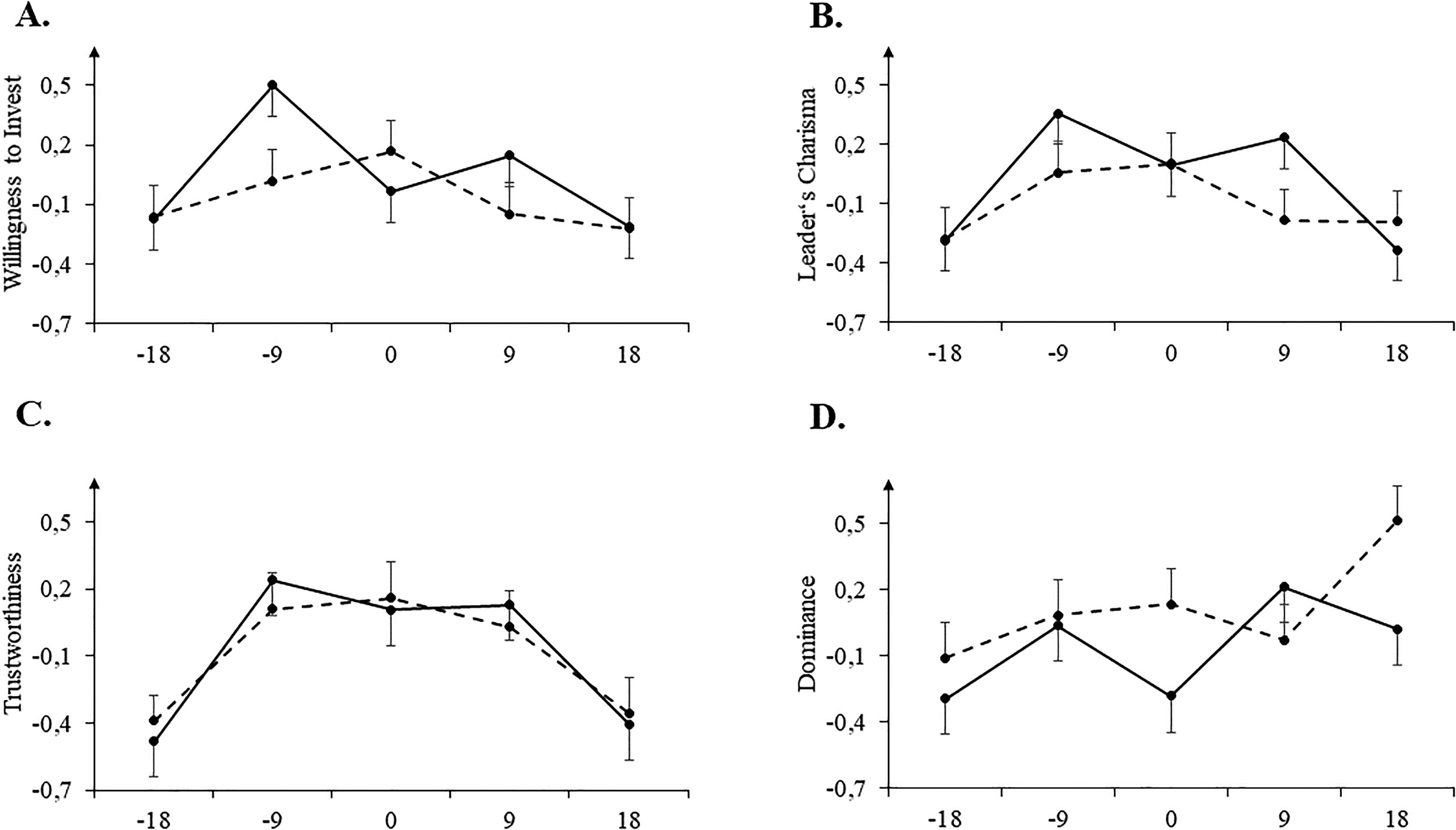
Graphs for the interaction between message type and camera angle concerning the willingness to invest (A), leader's charisma (B), trustworthiness (C), and dominance (D) for the five different camera angles separately shown for the two types of messages (change message = straight line, neutral message = dotted line) in the eye-contact condition; error bars represent 95% within-subject errors.
No Eye-Contact, Change Message
For the stimuli without eye-contact pronouncing the change message, we found an effect of camera angle on the willingness to invest (F[4,190] = 2.85, p = .025, η² = 0.058). Here, the 9° photograph differed from the extreme angles, i.e., −18° (p = .002) and 18° (p = .016); the willingness to invest was lowest in the extreme camera angles.
Replicating our findings from study 1, our results showed that a leader portrayed from above earned less favorable leader attributes (Hypothesis 1) and lowered an audience's willingness to invest in his strategy for his firm as communicated in his message, hence decreasing the approval of the audience (Hypothesis 2). However, our results also showed two boundary conditions for the effects of camera angle on leader perception: eye-contact and message type. While the effect of camera angle was present when a leader held eye-contact and provided a message of change, the effect disappeared when the leader avoided eye-contact and the message promised continuity rather than change. Interestingly, in addition to our results from study 1, this time both the 18° and −18° photographs received the lowest ratings of charisma, approval, competence as well as trustworthiness, while the 9° and −9° conditions received the highest ratings in the change condition.
General Discussion
Leadership, especially in the public sphere, is a game with signals (Reh et al., 2017). That is why leaders try to stage their appearance and thereby shape our impressions of them; the variable body height of the French president Sarkozy and the low sofa affair (Chrisafis, 2009; Weinberg, 2010) provide anecdotal evidence for this phenomenon. The current three studies offer first insights into how photographs taken from different camera angles influence people's perceptions of leaders. Across three experiments, our results show that the camera angle of leader's photograph does indeed determine how that leader is perceived by their audience. More specifically, we consistently found that when followers look steeply down on a leader (bird's-eye perspective), then their ratings of charisma and associated favorable leader attributes decrease as compared to perspectives at eye-level and from below (frog's-eye perspective) (Hypothesis 1). Beyond the perception of leaders, the audience also withdraws their approval from those leaders they look steeply down compared to eye-level and frog's eye perspective (Hypothesis 2).
However, our findings clearly hint at boundary conditions. First, the effect of the vertical camera angle is only present when the leader maintains eye-contact with the camera (study 1), second, when the photograph is accompanied with a change-oriented message (study 4) or, third, when a male instead of a female leader is presented (study 2). In addition, while the results consistently show this pattern for a perspective where an audience “looks down” on a leader, more inconsistent results suggest that steep “looking up” might show similar detrimental effects on an audiences’ perception of a leader (see within-subject sample, study 1; study 2). In conclusion, our findings suggest that leaders have a more favorable impact on their audience and gain more approval from them when they avoid being staged from above in photographs.
Our current findings are in line with evolutionary perspectives, which may provide an explanation for the relationship between attribution of leadership ability and verticality. In the lives of our ancestors, height served as a reference of body strength and further as a functional advantage leading to power. Therefore, height signals power, which is also referred to in evolutionary approaches to leadership (King et al., 2009; van Vugt, 2006; van Vugt et al., 2008). This hardwired connection in our minds between power and verticality also manifests itself in our everyday reality: body size is related to hierarchical ranks of jobs (Gawley et al., 2009) and in the military (Mazur et al., 1984).
Therefore, the vertical dimension in space offers various possible signals that leaders can utilize in order to be perceived as successful, for example, by manipulating their perceived height or vertical distance from followers (Reh et al., 2017). This underlying mechanism in our perception of others also seems to be mirrored inversely in the findings of our study. Rather than looking up or looking at eye-level at the leader in photographs makes them more appealing to their audience, looking down steeply from above seems to diminish their appearance as prototypical for their leadership role. Findings show that the embodiment of leadership through verticality in the photography of leaders actually shapes the charismatic effect leaders have on their audience (e.g., Hamstra, 2014; Reh et al., 2017). However, interestingly, the vertical dimension had no effect on audiences’ ascriptions of dominance to the leaders (Hall et al., 2005, 2015). In fact, a slight downward head tilt makes the eyebrows appear V-shaped and lower (Witkower & Tracy, 2019), which is universally perceived as dominant (Witkower et al., 2022), and is interpreted as a non-verbal expression of dominance-based leadership among holders of high rank in social groups (Witkower et al., 2020). But we find overall negative findings for dominance and that leaders deviating from the eye-to-eye perspective up or down fall out of favor with their audiences. This is also true for leaders depicted slightly from above, which would be closest to the head tilt position from previous studies.
Interestingly, the effects of the steep camera angles (i.e., looking steeply up and down) on the perception of a leader among followers converged. Although the findings for the steep bottom-up camera angle are less consistent, just as looking down from above, looking too steeply up at a leader makes them lose the favor of their audience. Interpreted through the lens of an embodiment approach, this may be due to the fact that the audience could feel looked down at by the leader, which might trigger adverse sentiments. Therefore, this detrimental effect of a steep, low camera angle could mirror a too-much-of-a-good-thing effect (e.g., Pierce & Aguinis, 2013) and present the leader as too authoritarian, therefore making him appear cold and distant, damaging his approval (Capozza et al., 2017; Laustsen & Bor, 2017; but see Laustsen & Petersen, 2015).
Our findings further reveal three boundary conditions that influence the effect of camera angle on leader perception: eye-contact, message type, and sex. First, the results show that the effects of camera perspective on the perception of the leader in the eyes of the observers emerge only if the leader looks into the camera when being photographed. Previous studies have consistently shown that gaze behavior, and especially eye-contact, have an influence on the perception of a leader's charisma (e.g., Tskhay et al., 2017; Maran et al., 2019) and on people's impressions of others more generally (e.g., Kaisler et al., 2020). Our results suggest that a lack of eye-contact weakens the connection between an audience and the portrayed leader and, accordingly, the impact of verticality on an audiences’ impression diminishes (Kingstone et al., 2004). Second, in cases in which photographs are combined with messages of the leader, the camera angle may unfold its effect only depending on the type of message. Our results show that when leaders conveyed a message of change, looking at the portrayed leader at eye-level let him earn higher charisma ascriptions and reap more approval for his leadership. In contrast, steep camera angles, both from above and below, made him lose favor among the audience. In sharp contrast, any effect of camera perspective disappeared when the leader was associated with a message of continuity. Therefore, bold projects together with an appropriate perspective in the leader's photo might evoke a leader-like impression in the audience and trigger a charismatic effect, whereas a neutral message might convey that the leader is only managing the situation without a big vision, making them forfeit their attributed leadership ability in the eyes of their audience (Nohe et al., 2013; Weber, 1922). Third, contrary to our assumptions, our data revealed that the sex of the leader actually matters when impressions are formed based on a single photograph (Hall & Ruben, 2020). While the camera angle had no direct effect on perceived charisma or approval in the female leader, camera angle and sex interacted for favorable leader perceptions including prototypicality and dominance. The most robust evidence was provided by the replication study (study 3), which allowed a direct comparison between male and female leaders. Consistently, the analyses showed that female leaders who were only slightly mapped from below were perceived as more prototypical of their leadership role as well as more dominant compared to their male counterparts. However, this was accompanied by a sharp drop in the ascription of these leader attributes at a steep upward camera angle. Interestingly, a slight head tilt (albeit downwards) is associated with a flirty appeal (Haj-Mohamadi et al., 2021), so perhaps such a signal of attraction at a slight but not steep camera angle could have had beneficial effects.
These findings are consistent with previous research showing that female managers’ expectations of leadership are indeed different from those of male managers (e.g., Huddy & Terkildsen, 1993; Johnson, 1976). Furthermore, when female leaders use stereotypically masculine leader behaviors, they are perceived less favorably (Watson, 1988; but see Rule & Ambady, 2009). Women are generally perceived as less dominant than men (Mignault & Chaudhuri, 2003). Actually, female leaders show less dominance than their male counterparts; instead, they encourage compromise, focus on common ground and emphasize participation in their leadership (Eagly & Johnson, 1990; Henzl & Turner, 1987; Rosenthal, 1998). Therefore, it is possible that the vertical dimension in the perception of a leader, which is particularly tied to dominance (Hall et al., 2005, 2015), might be more relevant for male than for female leaders. Therefore, we conclude that sex might be a potential constraint when discussing the effects of camera perspective on the perception of leaders.
Limitations and Future Directions
Our study offers compelling insights into how the camera angle in a photograph influences observers’ impressions of designated leaders. However, there are several limitations of these findings that need to be considered when interpreting the results and deriving implications for practice. First, the respondents across the three studies had a European background, so the findings may represent primarily the Western way of perceiving leaders. For example, cultural differences in power distance, which also comprises verticality as an important facet (Hofstede, 2009), might lead to a different acceptance of looking up or down on leaders, or how this is embodied in photographs. The same applies to the gaze direction on photos, which we identified as a boundary condition; eye-directed gaze produces different effects in an internally-oriented as compared to an externally-oriented culture (e.g., Akechi et al., 2013).
Second, another limitation concerns the persons shown in our pictures. We only presented two stimulus persons as leaders across all studies. It is extensively documented in the research literature how important the physiognomy of the face (i.e., the facial appearance) is (Todorov et al., 2015) when people form impressions, specifically in leadership (Antonakis & Eubanks, 2017). It would be plausible to assume that the facial appearance and the leader perceptions that result from it also interact with the camera angle. We thus decided to keep the facial appearance of our leaders constant across the different camera angles to rule out facial appearance as a confounding factor. It should be noted that both photographs of our leaders led to similar ratings compared to previous studies (e.g., pictures of leaders with different clothing style; Maran et al., 2021). Nevertheless, this approach limits the generalizability of our results and the interpretation when discussing sex effects. Future studies may thus include larger stimulus sets involving a wider range of faces.
Third, an audience's impression from photos of leaders may also depend on the role of the leaders and the context in which they lead their followers. More specifically, leaders, who draw their legitimacy from formal authority or lead in hierarchical contexts may suffer more from being portrayed as top-down in terms of an audience's perception of leadership than leaders, who lead informally or operate in less hierarchical contexts. For example, in an academic lecture, the credibility and charisma of an expert might suffer more if they are viewed from above, as compared to informal leaders on social media.
Conclusion
Our results paint a heterogeneous picture of how a leader's choice of being portrayed shapes their audiences’ impressions and approval. Leaders should therefore not only direct the perspective in which they are portrayed, but also be careful whether and how they are portrayed by others. While the opening example of former French president Nicolas Sarkozy shows how a leader himself cleverly shapes the perspective on him, the “low sofa affair” with the Turkish ambassador to Israel shows how a representative was at the mercy of a staging. While verbal and non-verbal signals are obviously under the control of leaders (Maran et al., 2019; Mio et al., 2005), their staging is not necessarily. This makes it particularly critical for leaders to be aware of this dimension through which they are perceived if they want to exude a charismatic effect on their audiences (Antonakis et al., 2016; Reh et al., 2017). A camera angle that places the audience in the perspective of looking down (bird-eye's view) on the leader makes the leader lose in both attribution of favorable leader characteristics and approval among followers. Leaders depicted at about eye-level are consistently perceived as more charismatic, more trustworthy, and overall, as more prototypical for their position, and thus they also gain more approval. At the same time, however, our findings reveal important boundary conditions. The effect of the camera perspective on photographs disappears outright when either the leader is not looking into the camera, when the photograph is associated with a message of continuity rather than change, or when a female leader is portrayed. In a nutshell, leaders can shape how they are perceived in their audiences by changing how they are portrayed in photographs.
Supplemental Material
sj-docx-1-jlo-10.1177_15480518231191979 - Supplemental material for The Perspective Makes the Leader: The Camera Perspective in a Leader Photograph Shapes Their Charismatic Effect and Observers’ Approval
Supplemental material, sj-docx-1-jlo-10.1177_15480518231191979 for The Perspective Makes the Leader: The Camera Perspective in a Leader Photograph Shapes Their Charismatic Effect and Observers’ Approval by Alexandra Hoffmann, Thomas Maran and Manuela M. Marin in Journal of Leadership & Organizational Studies
Footnotes
Declaration of Conflicting Interests
The authors declared no potential conflicts of interest with respect to the research, authorship, and/or publication of this article.
Funding
The authors received no financial support for the research, authorship, and/or publication of this article.

Supplemental Material
Supplemental material for this article is available online.
Notes
References
Supplementary Material
Please find the following supplemental material available below.
For Open Access articles published under a Creative Commons License, all supplemental material carries the same license as the article it is associated with.
For non-Open Access articles published, all supplemental material carries a non-exclusive license, and permission requests for re-use of supplemental material or any part of supplemental material shall be sent directly to the copyright owner as specified in the copyright notice associated with the article.
