




Abstract
Contemporary organizations must be adaptive and agile as the environment changes. To respond to change, leaders must find ways of integrating learning into everyday work experiences. This invites the question: how do leaders facilitate individual, group and organizational learning? Several studies have examined relationships among leadership and learning and potential mediating and moderating variables. However, because this literature is extensive and fragmented it is difficult to discern what is known about how leadership contributes to individual, group and organizational learning. Accordingly, there is a pressing need to assemble and evaluate the existing studies. To address this limitation of the literature, this paper presents a systematic review and critique of literature in this field. Our review of 105 studies suggests that there are statistically significant relationships between different types of leadership and learning at the individual, group, and organizational levels. Furthermore, the findings indicate that these relationships are often mediated by other variables. However, little is known about moderators and boundary conditions. Based on the findings, it would be premature to say with certainty that leadership causally influences learning, since the empirical basis for such a claim is lacking. We outline the conceptual, theoretical, methodological, and empirical refinements needed to guide future research on learning-oriented leadership and advance this research trajectory. The findings of our review and our conclusions will be informative for researchers and practitioners.
Keywords
In contemporary organizations that must be adaptive and agile (Teece et al., 2016), an important challenge for leaders is the facilitation of individual, group, and organizational learning (Pasamar et al., 2019; Yukl, 2009). Leaders can facilitate workplace learning at these levels either indirectly through mechanisms such as the organizational structure or culture, or directly through their leadership behaviors such as the provision of coaching (Wallo et al., 2022). Literature that discusses leaders as facilitators of learning at work typically uses the terms ‘management’ and ‘leadership’ interchangeably, and popular designations are ‘learning-oriented leadership’ (Wallo, 2008; Wallo et al., 2022), ‘managers as facilitators of learning’ (Cohen, 2013), ‘managers as developers’ (Warhurst, 2013), ‘managers as coaches’ (Ladyshewsky, 2010) and ‘transformational leadership’ (specifically, the ‘intellectual stimulation’ dimension; Bass, 2000). In these conceptions, managers’ work shifts from managing the details of the work to, ideally, functioning as coaches, facilitators, and consultants to their work teams (Ellinger & Bostrom, 2002; Ladyshewsky, 2010; Wallo et al., 2013). This implies, among other things, that a manager leads by encouraging learning-related cognitive activities and behaviors such as problem-solving, critical reflection and experimentation.
In recent years, an increasing number of quantitative studies have emerged that examine the types of leadership styles and behaviors that are facilitative of learning. In this paper, we use the term learning-oriented leadership when referring to the wide array of research within this field. However, the knowledge within this field is fragmented into individual studies that employ different leadership styles and behaviors to examine relations with different levels of learning (i.e., individual, group and organizational learning). Thus, there is a pressing need to assemble and evaluate these studies systematically to determine whether – and how – different leadership constructs correlate with learning. While there have been previous literature reviews in the field of learning-oriented leadership, they have used a limited number of leadership theories and focused on organizational learning (Asif, 2019, 2020; Berson et al., 2006; Do & Mai, 2020; Mohamed & Otman, 2021; Xie, 2019) or concentrated on the owner/manager and informal learning in small firms (Coetzer et al., 2019). Furthermore, these previous attempts do not meet some important requirements for systematic reviews, which should follow predetermined methodological guidelines to provide a comprehensive and unbiased synthesis and summary of knowledge within a certain area (Aromataris & Munn, 2020; Booth et al., 2022; Fan et al., 2022). Important criteria that systematic reviews should meet include transparency of the review method to facilitate replication and an assessment of the evidence, which involves quality assessment of the research items (Aromataris & Munn, 2020; Booth et al., 2022; Page et al., 2021). These important criteria were not met in previous review attempts.
Therefore, we argue that there is a need for a more leadership-focused and systematic review to assess how leadership influences employees’ learning in their daily work. Thus, the purpose of this paper is to provide a systematic review and critique of research that investigates the relationship between leadership and learning in a work context. Based on our review of the studies that have examined relations between leadership and learning at work, we sum up the current state of research and identify knowledge gaps and important issues to consider in future studies. The principal research questions that guided the review are:
Which leadership styles and behaviors are significantly associated with individual, group, and organizational learning? What are mediators of the relationships between the leadership styles and behaviors and learning at the three levels? What are moderators of the relationships between the leadership styles and behaviors and learning at the three levels?
Our review extends previous work in several important ways. First, this is the first comprehensive and systematic literature review of studies on the topic, and it therefore contributes to a more extensive and coherent understanding of the relationships between leadership and learning than is currently available. As noted, although there have been previous reviews of relations between leadership and learning, these reviews have adopted a narrow focus in terms of the leadership styles and types of learning that were investigated, and the reviews did not meet some important requirements for systematic reviews. By contrast, the present study extends existing literature by incorporating a wide array of leadership approaches and three types of learning in the investigation, and by following predetermined methodological guidelines for systematic reviews. Second, the review contributes to the literatures on leadership and learning by examining the extent of empirical support that exists for each leadership theory as a factor that influences the three well-established levels of learning at work. Of particular significance in the present review is an examination of the extent of empirical support for leadership theories concerned specifically with leadership behaviors that are deemed to be facilitative of learning, as opposed to more traditional and broad leadership theories such as transformational and servant leadership. Furthermore, the findings reveal variables that may be in the causal sequence between the two focal variables, and variables that may moderate the leadership-learning relation. Third, findings of the review will help move this research trajectory forward by identifying its main challenges and the opportunities for further research.
Key Concepts and Previous Research
In this paper, leadership is defined as an interactive and reciprocal process through which a manager influences one or more employees to attain a goal (Yukl, 2013), which in the current paper refers to a learning goal. The process of leadership is situated within, and contingent on, contextual structures that may enable or constrain the interaction between manager and employees. In turn, the agency of the manager and employees may also lead to structural elaboration and the reproduction or transformation of the initial structure (cf. Archer, 1995). The manager, while sometimes confined by the structures, can also make choices that potentially will have ramifications for the structures (Stewart, 1982). There are many ways to classify leadership theories. In this study, we employ the Dinh et al. (2014) classification, which includes 17 theoretical categories.
Drawing on a workplace learning perspective (Billett & Choy, 2013; Ellström, 2001), learning is defined as permanent or semi-permanent changes in how individuals think and act (Billett, 2004), instigated by formal training activities (e.g., courses) or individuals’ largely self-directed informal learning. By the latter concept, we refer to learning that occurs regularly at work as well as in everyday life, but is subordinate to other activities (e.g., participation in work practices) that do not position learning as their primary goal (Ellström, 2001; Marsick & Watkins, 2015). Furthermore, we consider learning at the individual level to be a necessary but not sufficient condition for group or organizational learning (Ellström, 2001). Group level learning can be described as a process whereby the group members, based on discussion of different ideas and experiences, create a shared mental model of how the group should act to complete a task (Edmondson, 1999). By organizational learning, we refer to changes in organizational practices (e.g., routines and procedures, structures, technologies) that are mediated through individual or group-based learning or problem-solving processes (Vera & Crossan, 2004).
In recent years, a strand of research that links leadership (or management) and workplace learning has emerged. Early contributions were made in doctoral dissertations that were mainly located within the fields of adult learning and human resource development (HRD). Andrea Ellinger has emerged as an influential researcher within this research trajectory since publishing her dissertation titled ‘Managers as facilitators of learning in learning organizations’ (Ellinger, 1997). Her research examined managers’ perceptions regarding their beliefs, behaviors, triggers, and outcomes when they serve as facilitators of employee learning. Since then, others have followed in her footsteps with similar doctoral studies, such as the works by Beattie (2002) in the UK and Amy (2005) in the US. Coetzer's (2005) dissertation drew on Ellinger's (1997) work in his study of the importance of leadership for employee learning in New Zealand small manufacturing companies. Similarly, in Sweden, Wallos’ (2008) dissertation on learning-oriented leadership in three industrial companies built on Ellinger's (1997) research. Since then, several literature reviews and conceptual articles have investigated the relationship between leadership and learning at work (Asif, 2019, 2020; Berson et al., 2006; Coetzer et al., 2019; Do & Mai, 2020; Mohamed & Otman, 2021; Xie, 2019). These reviews and conceptual articles have mostly investigated learning at the organizational level, and three of the reviews have examined just one theory of leadership: transformational and transactional leadership (Asif, 2019, 2020; Mohamed & Otman, 2021). One review focused on the owner/manager and informal learning in small firms (Coetzer et al., 2019). An exception is the review by Berson et al. (2006), in which the authors employed the organizational learning framework developed by Crossan et al. (1999) to show that leadership relates to individual, group and organizational levels of learning. Two recent reviews that sought to map the research area (Do & Mai, 2020; Xie, 2019), concluded that there had been a recent significant increase in the number of studies, especially studies investigating transformational leadership. However, in their reviews the authors did not systematically classify the included leadership theories, nor explicate the relative extent of influence on learning of each leadership approach. Nevertheless, the authors found that the leadership theories included in their reviews were all significantly related to organizational learning. They concluded that more research is needed that compares the potentially differing relations between the various leadership theories and learning. For instance, Xie (2019) suggested that servant leadership and leader-member exchange theory should be examined in relation to transformational leadership. Whereas Xie (2019) did not consider mediators or moderators in their review, Do and Mai (2020) highlighted the need to consider mediators and moderators of the relationship between leadership and organizational learning. However, they did not elaborate on what these mediators and moderators might be nor how they might affect the relationship between leadership and learning. Other reviews highlighted the need to investigate organizational level mediators, such as dynamic capabilities, human resource practices, intellectual capital, knowledge management, and organizational culture (Asif, 2019, 2020; Berson et al., 2006; Mohamed & Otman, 2021).
Figure 1 summarizes the current state of knowledge based on these reviews. As can be seen in the Figure, the existing body of review and conceptual articles have limitations in that the articles have tended to focus on only a few leadership theories or learning at just the organizational level. Several other categories of leadership theories exist, which have not received much attention in previous reviews. For instance, leadership theories that incorporate behaviors specifically intended to increase learning at work have been largely ignored. Furthermore, because of the delimitations in previous reviews concerning the included leadership theories and level of learning, it seems likely that several potentially relevant mediators and moderators have been overlooked.
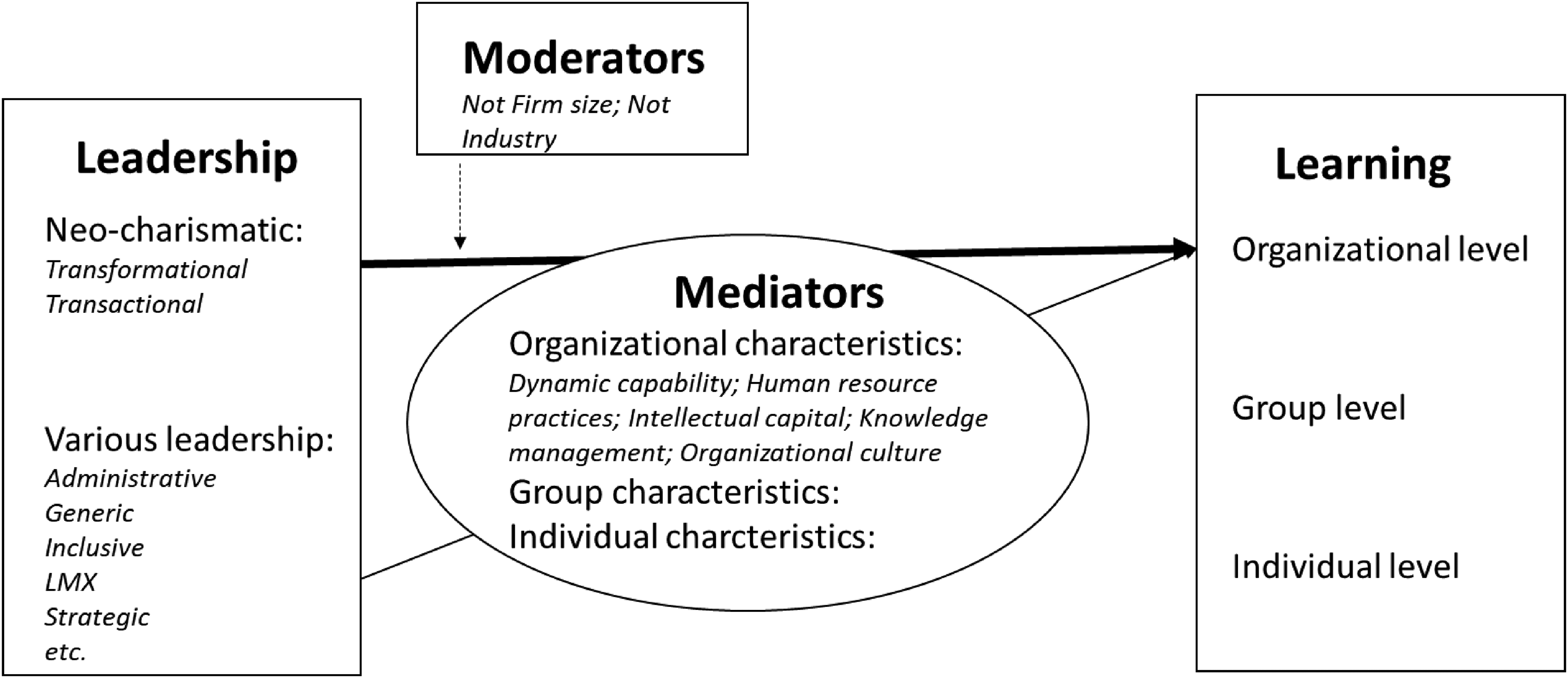
Model summarizing knowledge from previous research. Note: The arrow thickness represents the number of studies supporting the association.
To address these limitations of the literature, this review will systematically examine all previous research that investigates the relationship between leadership and learning at work and that meets the review's inclusion criteria. We will use Dinh and colleagues’ (2014) classification of leadership theories and the three well-established levels of learning as theoretical starting points. The review will also focus on mediators and moderators related to each level of learning. The examination of potential mediators and moderators is most often done through quantitative research, which is why this review is limited to such studies. This systematic review will therefore contribute to a comprehensive understanding of the research area and reveal the extent of support each leadership theory has as a factor that influences learning at work. Of particular interest is the extent of existing empirical support for leadership theories specifically concerned with leadership behaviors that are deemed to be facilitative of learning.
Method
The work on the systematic literature review began by drawing on the study's purpose and research questions to formulate the study's content, focus and boundaries. To develop the content-related inclusion criteria we employed the so-called PEO model (‘People, Exposure, Outcome’) as a guiding framework (Moola et al., 2015). The content-related inclusion criteria were that the studies should have a focus on (P) working life and workplace contexts, (E) investigate leadership in terms of styles, behaviors, roles and similar concepts or synonyms in relation to, (O) employee learning. The additional inclusion criteria were as follows: All studies must 1) be peer-reviewed scientific articles in international (academic) journals, 2) be written in English, 3) contain empirical material collected in a workplace context, 4) statistically test the association between leadership and learning, and 5) have a specific focus on the role of the leader or manager in promoting learning at work. Given that there has been no previous systematic reviews nor seminal works on the research topic, no delimitations were made regarding time of publication. Studies examining learning at work without clear reference to the leader or manager were excluded, as were studies dealing with teacher–student relationships in an educational context, studies that did not test associations between leadership and learning (i.e., qualitative studies), and studies focusing only on outcomes of learning (e.g., innovative work behaviors, creativity, or absorptive capacity) and not on the processes of learning at work.
To identify studies that examine the relationship between leadership and learning, database searches were conducted using several alternative terms and synonyms. These search terms were leader*, manage* or supervisor* in combination with workplace learning, learning at work, learning in the workplace, work-based learning, organizational learning, learning organization or informal learning. We also used the search terms learning-oriented leadership, learning-centered leadership, leader* of learning, leadership for learning, and learning leadership. The search terms were generated by drawing on the research questions that guided the investigation, the scope of the study, literature, and discussion among members of the research team.
The searches were conducted during June 2021. The review process was based on guidelines provided by Page et al. (2021) and the process is illustrated in Figure 2. The main databases used were Scopus and Web of Science because they are broad databases that cover several different subject disciplines and journals of relevance to the problem area of this literature review.
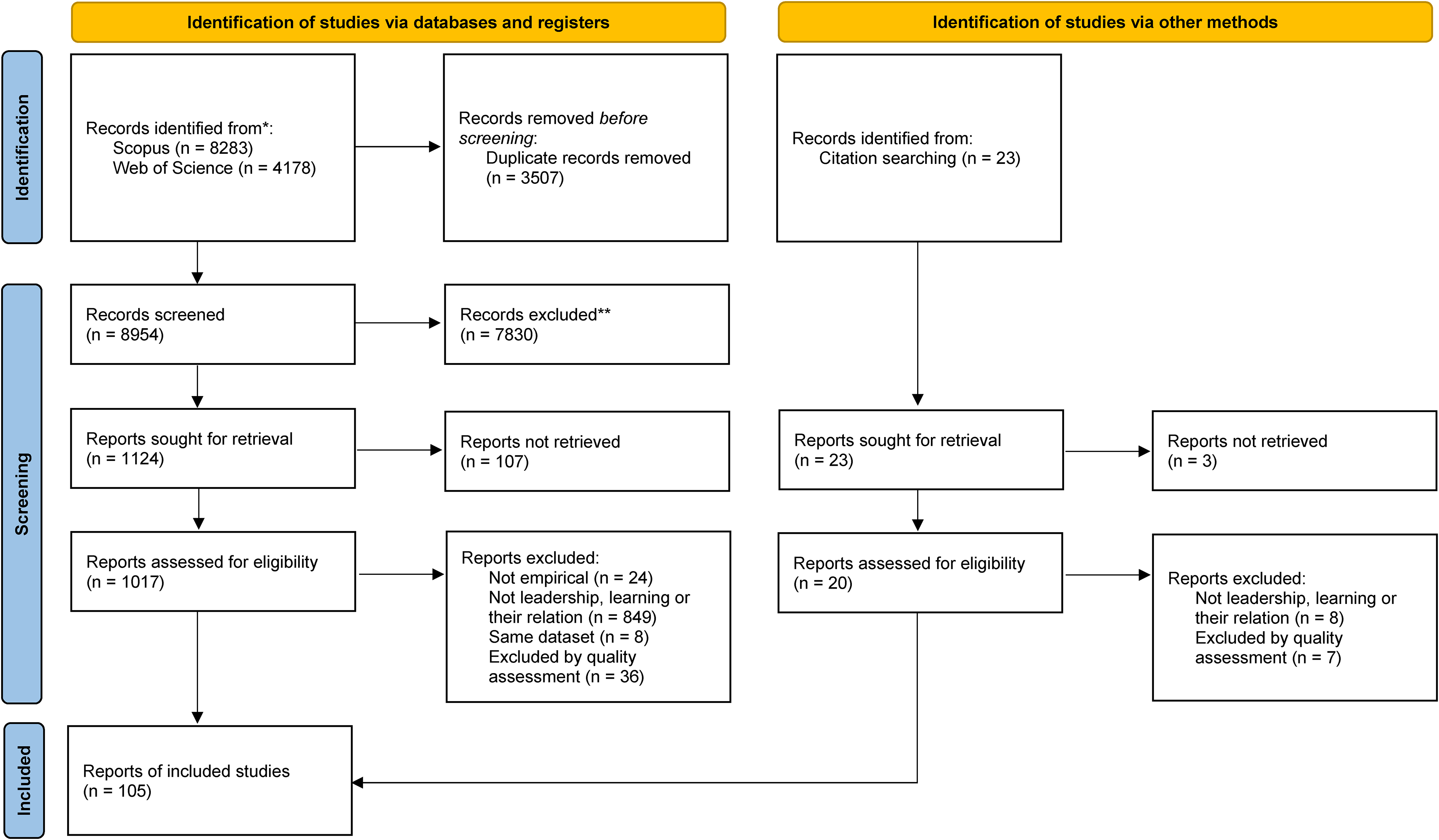
Flowchart of the identification process.
In Scopus the searches generated 8283 hits, and in Web of Science the searches generated 4178 hits. After removing duplicates, 8954 unique hits remained. Searches were also conducted in Emerald and Business Source, but these searches yielded no additional studies. In a first step, all citations were screened on title and abstract in relation to the inclusion criteria. Those that were assessed as potentially relevant or difficult to assess progressed to eligibility assessment of the full text (a total of 1124 hits). The eligibility assessment was conducted on retrievable full texts which were 1017 in total, and 136 of these were considered relevant and met all the inclusion criteria. In this step, eight full texts were also excluded because they were published by the same author(s) using the same data set and main variables. The only difference being that the excluded studies did not contain mediators, which the included studies did. The 136 full texts that were considered relevant underwent quality assessment based on a template proposed by Tompa et al. (2007) comprising three quality levels: low, medium, and high. The present literature review included only studies that were judged to be of high or medium quality, which comprised 100 full texts from the database searches. During the course of the work, 23 further studies were identified as potentially relevant, but were not found in the two database searches (so-called serendipitous findings, see Callahan, 2014). After quality assessment based on the Tompa et al. (2007) template, five studies were judged to be of high or medium quality. The literature review is thus based on a total of 105 studies.
All full texts were read and assessed by at least two authors of the review. In cases where different assessments were made, the full text was assessed by a third deciding author. The 105 studies were analyzed through narrative synthesis, which involves central information about the studies being compiled in text and tables – a common practice in literature reviews following systematic procedures (Aromataris & Munn, 2020; Booth et al., 2022; Fan et al., 2022). To facilitate the identification of patterns in the data displays, the focal constructs and variables (i.e., leadership, learning, mediators, moderators) of each study were coded and grouped into categories.
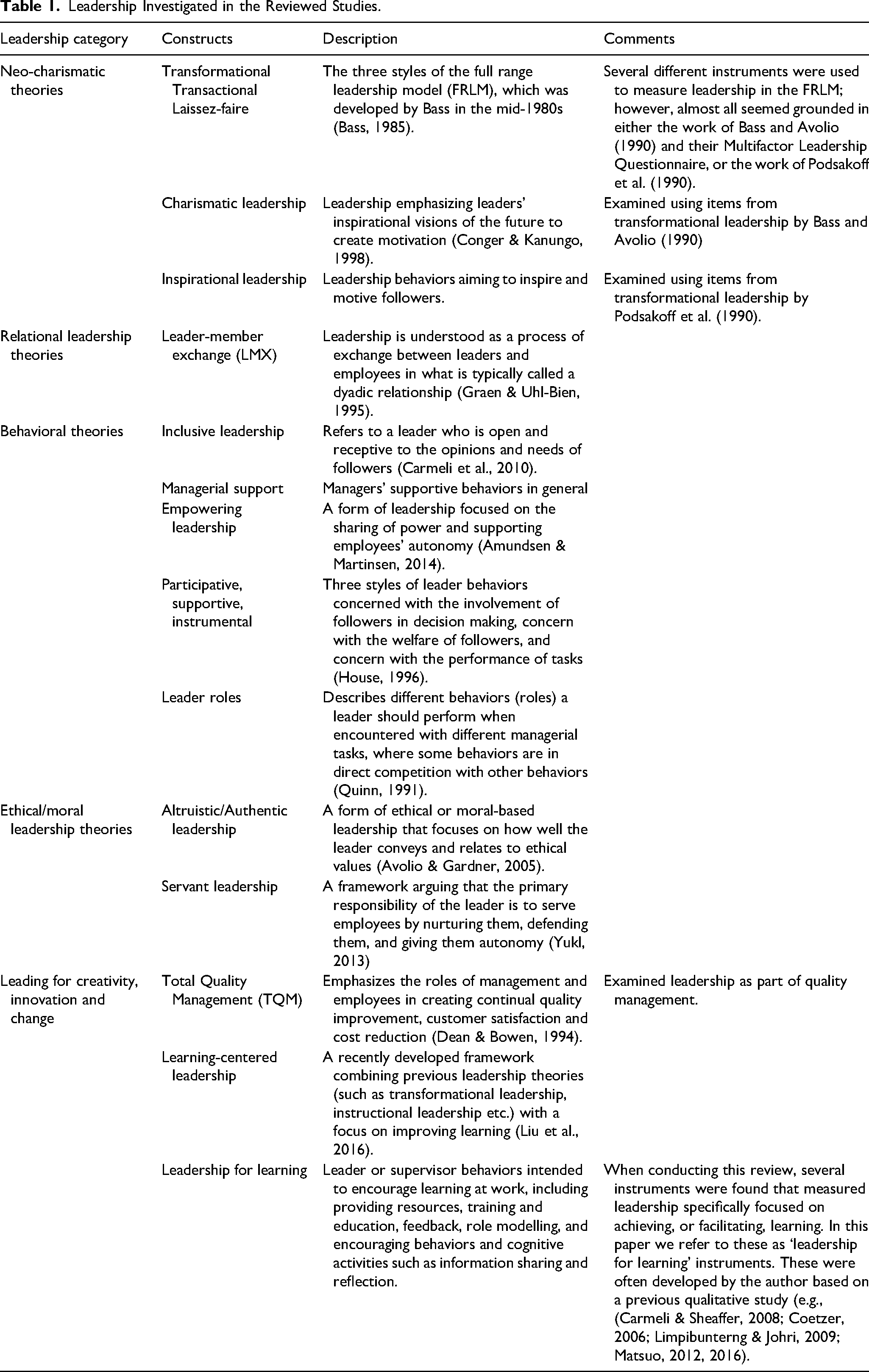
The reviewed studies had investigated several different theories of leadership. These were grouped into five categories based on the leadership classification by Dinh et al. (2014). Table 1 shows the constructs used in the reviewed studies and provides a brief description of the constructs, as well as the leadership category it was grouped into. The table also contains a column for comments as appropriate.
Leadership Investigated in the Reviewed Studies.
When reviewing the papers, learning was organized into three categories: organizational learning, group learning, or individual learning. The allocation to categories was based on the authors’ description of the survey instrument and by examining the items of the instruments used in each study. Similar categories of learning have been employed in previous reviews of the field (e.g., Berson et al., 2006).
Of the 105 studies included in this systematic review, 58 studies examined just the direct relationship between leadership and learning without regard for mediating variables, while 43 studies also examined mediation. The mediators used in these studies were also classified according to level in the organization. The classification process was conducted by using the information provided in the study and by examining the items of the instruments used in each study. For instance, mediating variables such as self-efficacy, reflexivity of the individual, and mood were categorized as individual characteristics. Mediating variables such as team reflexivity, social cohesion, trust, and psychological safety were categorized as social characteristics at the group level. Task difficulty, task interdependence, and goal specificity were categorized as work characteristics at the group level. Mediating variables such as organizational culture, organizational learning dimensions, absorptive capacity, and knowledge management were categorized as organizational characteristics.
Findings
By way of introduction, the oldest study in this review was published in 1998, and the latest study in 2021. Most studies were published after 2008. Of the 105 studies, just five reported using longitudinal designs to examine associations between leadership and learning, while 100 studies examined the associations using a cross-sectional design. All studies can be found in the appendix. The findings that follow are organized according to the level of learning (see Table 2 for a summary). The types of leadership styles and behaviors that have been found to be significantly associated with each level of learning and the mediators and moderators investigated in that relationship are reported in the findings.
Summary of Studies Investigating the Direct and Indirect Effect of Leadership on Learning. Number of Studies Finding a Significant Association (Total Number of Studies).
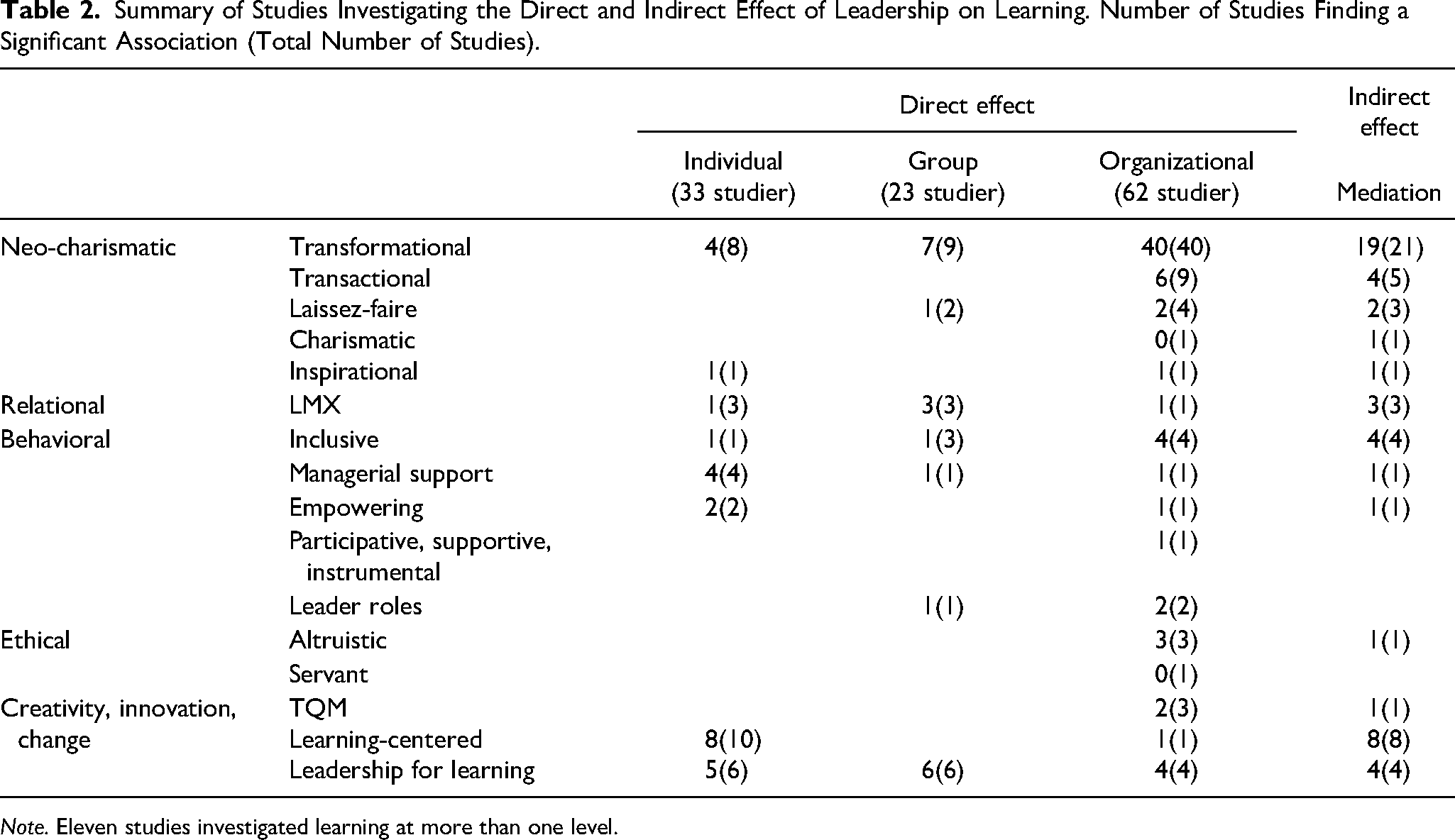
Note. Eleven studies investigated learning at more than one level.
Learning at the Individual Level
Thirty-three studies investigated relations between leadership and learning at the individual level. All leadership categories contained in Table 1 were used in these studies, except for ethical theories. The most commonly used categories were ‘Leading for creativity, innovation and change’ (16 studies) and neo-charismatic leadership (8 studies). Most studies found a direct association between the focal variables. In fact, only two studies did not find an association at all and neither investigated potential mediators (Bellibaş & Gümüş, 2021; Sanders et al., 2011). Coetzer (2006) also conducted item analyses and highlighted the importance of two leadership behaviors: that the leader provides on-the-job training, and that the leader enables and arranges help from others.
Of the neo-charismatic theories, transformational leadership was investigated most often. No study investigated transactional or laissez-faire leadership. Three studies investigated individual transformational leadership behaviors. Loon et al. (2012) found that two behaviors (individual consideration and idealized influence) were related to learning. Oude et al. (2015) found all behaviors to be mediated by work characteristics or social characteristics. Beverborg et al. (2015) found that vision and stimulation were related to learning, while consideration was mediated by work characteristics.
Of the 19 studies investigating mediators, only two investigated mediators at the organizational level and both studies were located within the neo-charismatic category of theories (Khan & Khan, 2019; Salas Vallina et al., 2019). Most mediators, however, concerned social characteristics or individual characteristics. Moderation was investigated in two studies. De Jong et al. (2021) found that empowering leadership was more important when managers perceived that their career success was low. Ye et al. (2018) found that a relationship between inclusive leadership and employee participation in learning activities only applied for women. Furthermore, Hallinger et al. (2019) conducted stratified analyses and found a significant relationship in only one of the studied samples, while the relationship was not significant in the other sample.
Learning at the Group Level
Twenty-three studies investigated leadership styles and behaviors in relation to learning at the group level, and several leadership categories were used. Again, the most used category of leadership theories was the neo-charismatic, and transformational leadership in particular. No study investigated individual transformational leadership behaviors or used the entire full range leadership model (FRLM), but two studies included laissez-faire, of which one found it was negatively related to learning (Hetland et al., 2011). Leadership from the ‘Leading for creativity, innovation and change’ category (Table 1) was also frequently used.
Almost all studies, regardless of category of leadership being investigated, found a direct relationship, except for four studies, which all found that the relationship was mediated (Carmeli et al., 2012; Hirak et al., 2012; Ojha et al., 2018; Raes et al., 2013). In fact, 11 studies investigated mediation and found that the relationship was (at least partially) mediated. The mediators that were used differed, however, studies involving transformational leadership often used organizational characteristics as mediators such as organizational culture and organizational learning (Nemanich & Vera, 2009; Ojha et al., 2018; Yoo et al., 2021). The other leadership categories often used social characteristics such as team reflexivity, social cohesion, trust, and psychological safety (Carmeli et al., 2012; Hirak et al., 2012; Matsuo, 2018). No study explicitly investigated moderators, but two studies that conducted stratified analyses found significant associations between LMX (Brunetto et al., 2015) and transformational leadership (Yoo et al., 2021) and learning at the group level in one of the subsamples, but not in the other subsample.
Learning at the Organizational Level
All categories of leadership theories were represented in the studies that investigated learning at the organizational level, and almost all the studies found significant associations. In fact, only 4 studies found no direct or indirect (mediated) association. These were studies that included servant leadership (Xie, 2020), TQM-leadership (Yazdani et al., 2016), and the transactional and laissez-faire styles (Farrell, 2000; Kurland, Peretz, & Hertz-Lazarowitz, 2010). However, the research trajectory that examines learning at the organizational level is dominated by the neo-charismatic leadership theories, and more specifically transformational leadership. Transformational leadership was most often investigated as a composite scale, but three studies investigated individual transformational leadership behaviors (Coad & Berry, 1998; Megheirkouni, 2017; Vashdi et al., 2019). Megheirkouni (2017) found that only idealized influence and management by exception (active) were associated with organizational learning. Coad and Berry (1998) found a relationship between all transformational behaviors and organizational learning. Vashdi et al. (2019) found that different transformational leader behaviors were linked to different dimensions of organizational learning.
While transformational leadership has been investigated extensively, only four studies have investigated the full range leadership model (Bass, 1985), including transformational and laissez-faire leadership (Amitay et al., 2005; Farrell, 2000; Kurland et al., 2010; Tong, 2020). Most studies investigating transactional leadership found a positive association with organizational learning (Jansen et al., 2009; Megheirkouni, 2017; Rezaei Zadeh et al., 2020). By contrast, one study found a negative association with learning at the organizational level (Amitay et al., 2005). Of the four studies that examined laissez-faire leadership in relation to learning at the organizational level, two found that laissez-faire was not related to learning (Farrell, 2000; Kurland et al., 2010). Furthermore, in two studies, transformational and transactional leadership were examined in combination, and the combination of these two styles was linked to learning at the organizational level (Liao et al., 2017; Narayanan & Rayaratnam, 2019).
Sixteen studies investigated an indirect association using mediators. Only two studies found no mediation effects (Asiedu et al., 2020; Kurland et al., 2010). Most of this research was conducted within the neo-charismatic theories, often transformational leadership, and included organizational characteristics such as the organizational climate and the view on learning (e.g., Amitay et al., 2005; Imran et al., 2016; Kim & Park, 2020; Park & Kim, 2018). However, mediators concerning social characteristics were also found in some studies (e.g., Kim & Park, 2020; Park & Kim, 2018; Tan et al., 2014). Just four studies investigated mediators within the other leadership categories, and none of them involved organizational characteristics. Barrette et al. (2007) found that organizational culture was a moderator in the relationship between managerial support and organizational learning, with the findings also suggesting that managerial support contributes to learning when the organizational culture is weak. Singh (2010) found that the associations differed between gender in their study sample. Liao et al. (2017) found that industry did not moderate the relationship.
Synthesis: What we Know and our Knowledge Gaps
Figure 3 extends our previous model (Figure 1) by illustrating the findings of the systematic review.
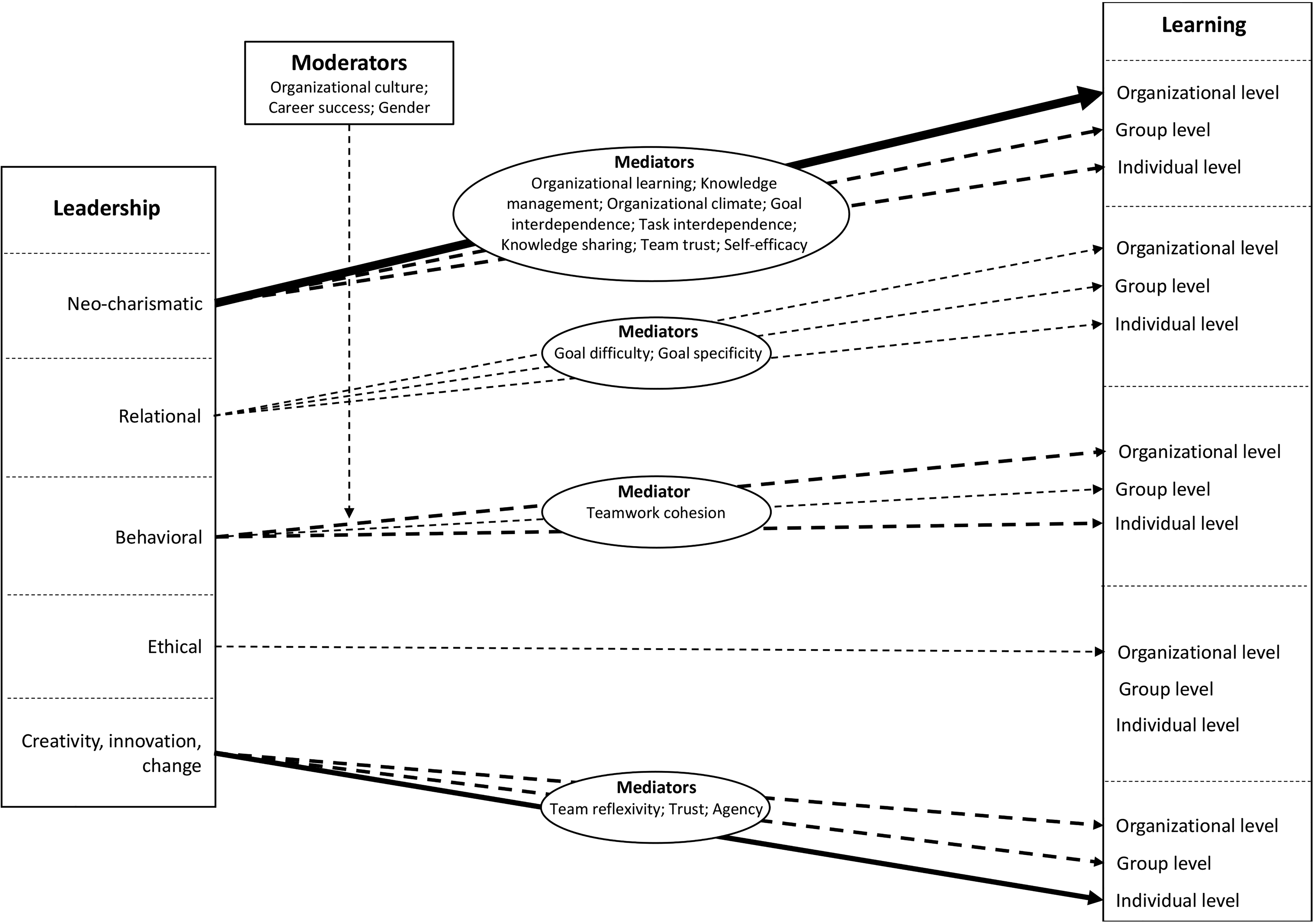
Extended model summarizing current state of knowledge. Note. The arrow thickness represents the number of studies supporting the association.
In Figure 3, we observe that the neo-charismatic theories have been studied the most, and mainly in relation to learning at the organizational level as denoted by the thickest arrow in the figure. Furthermore, within the neo-charismatic theories the indirect effects of leadership have been examined the most, often using organizational characteristics as mediators. Specifically, 27 different mediators have been used, and eight of them have been used in more than one paper (organizational learning, knowledge management, organizational climate, goal interdependence, task interdependence, knowledge sharing, trust within the team, self-efficacy). However, the neo-charismatic theories have not been as extensively studied in relation to learning at the individual or group level. Leadership, such as transformative leadership, seems to be directly linked to learning at the organizational level as well as indirectly through mediating variables. However, our knowledge of relations between transformational leadership and learning at the individual and group levels is underdeveloped. The few studies that currently exist suggest that the association between leadership and learning at individual and group levels is often mediated.
The relational leadership theories. have not been studied to any great extent, even though it has been examined in relation to learning at all three levels. The indirect effect of leadership has only been studied in relation to learning at the individual level and seven different mediators have been used, while two (goal difficulty, goal specificity) have been used in more than one paper.
The behavioral leadership theories. have mainly been studied in relation to learning at the organizational and individual levels; few studies have focused on group learning. The indirect effects of leadership on learning have been studied mainly in relation to learning at the individual level. Nine different mediators have been used, but only one (team cohesion) has been used in more than one paper. Leadership concerned with the needs of employees and that provides support (e.g., inclusive leadership and managerial support) seems to be directly related to learning at the individual and organizational level, as well as indirectly via individual characteristics. Potential relations between inclusive leadership and managerial support and group learning are under researched areas.
The ethical leadership theories. have been examined the least and only in relation to organizational learning. Mediation has been examined in just one study, which found that individual characteristics (affective commitment) mediated the relation between ethical leadership and organizational learning.
The last category of leadership is about creativity, innovation and change. These theories have been studied in relation to learning at all levels. However, it is a relatively new category and in total, there are fewer studies within this category of theories than, for instance, the neo-charismatic category. There are also relatively few studies that have examined mediation, and then mainly with social and individual mediators in relation to learning at the individual level. More specifically, nine different mediators have been used, and three of them have been used in more than one paper (team reflexivity, trust, agency). These theories of leadership, specifically developed with the intention of capturing how leaders promote learning, seem to be directly linked to learning at the organization, group, and individual levels. It also seems to be indirectly linked to learning at the individual level, mainly in that the leader influences the workgroup and individuals’ characteristics.
Regarding the third research question of this review which relates to ‘Moderators’ in Figure 3, it is clear that moderating effects have not been studied to any great extent. The available studies show that the factors organizational culture (Barrette et al., 2007), leader career success (de Jong et al., 2021) and gender of the employee (Ye et al., 2018) moderates the leadership-learning relationship, while industry did not moderate the relationship (Liao et al., 2017). Several of the studies that performed stratified analyses also found differences between groups (Brunetto et al., 2015; Hallinger et al., 2019; Singh, 2010; Yoo et al., 2021). In reviews concerned with the broader effects of leadership, beyond just learning (e.g., Oc, 2018), there have been appeals for studies that examine moderators and boundary conditions. Such appeals suggest that leadership may not be equally important for all employee groups. This proposition needs further investigation in studies that examine leadership-learning relations.
Discussion
Taken together, the results of our analyses shows that almost all studies that examine the relationship between leadership and learning find a statistically significant association. The studies that examine mediating mechanisms also tend to suggest that there are variables in the causal sequence between leadership and learning. Leadership thus seems to have both a direct and an indirect effect on learning. This applies in principle regardless of which category of leadership theories the studies are based on. The current evidence seems to indicate that different leadership approaches promote learning at different levels. For example, transformational leadership seems to promote learning at the organizational level to a relatively greater extent than it does at the other levels. Leadership approaches in the category of creativity, innovation and change seems to promote learning at the individual level to a relatively greater extent than they do at the group and organizational level. However, as there is a lack of studies that investigate all three levels of learning within the same study, it is difficult to draw such conclusions with certainty. Further, since leader behaviors in the category of creativity, innovation and change are conceptually similar to transformational leadership behaviors, it is unclear how these ‘newer’ ‘leadership for learning’ theories add or contribute something beyond the more established theories, such as transformational leadership. It is also unclear exactly which behaviors within leadership for learning styles are facilitative of learning. For example, only one study analyzed individual leadership behaviors (in terms of single item analysis) and could demonstrate that the relationship was mainly explained by a few behaviors (Coetzer, 2006). The behavioral components of transformational leadership were only investigated in three studies, and these placed emphasis on different components within transformational leadership: individualized consideration, idealized influence, intellectual stimulation, and inspirational motivation (Bass, 1985). A challenge for the research field is to make more accurate predictions of the specific behaviors that facilitate learning.
In general, there is a theoretical pluralism in the field, both in terms of leadership theories and the measurement of learning. Instead of just adding new theories, there is a need to evaluate the established theories relative to each other. This was also noted in the reviews by Do and Mai (2020) and Xie (2019). In doing so, a basis for theoretical development and integration could be provided. Of all 105 reviewed studies, only four used more than one leadership theory (Bezuijen et al., 2009; Evers et al., 2016; Vermeulen et al., 2022; Xie, 2020).
The same pluralism also applies to learning and how it should be measured. For example, there are several different instruments that measure organizational learning. Although these instruments tend to share some common theoretical basis, they also tend to place emphasis on partly different components and learning processes. Some researchers also differentiate between learning at different levels, such as individual, group and organization (e.g., Bontis et al., 2002; Marsick & Watkins, 2003) but the instrument used in their studies combines all three levels into one undifferentiated overall measure. In fact, only two studies (Barette et al., 2012; Khan & Khan, 2019) examined leadership in relation to all three levels, where Barette et al. (2012) found that leadership was related to all three levels of learning, while Khan and Khan (2019) found a relationship to the individual and group levels of learning. Therefore, more research is needed that examines the different levels of learning separately. A similar critique of the research was raised in the reviews by Do and Mai (2020) and Xie (2019).
Regarding the theoretical pluralism in leadership theories, it is noteworthy that so much research has focused on transformational leadership and so little on the other neo-charismatic theories (i.e., transactional, and laissez-faire leadership). For example, there have been no studies that have examined transactional leadership in relation to learning at the group or individual level. In line with Alvesson (2020), this may be due to the tendency in leadership research to choose idealistic theories that present the leader as good and morally virtuous, rather than theories that reflect managers’ daily work. On this note, it has been argued that even some ‘ineffective behaviors’ (e.g., being authoritarian) may well trigger employee learning in some situations. For example, in a qualitative study by Wallo (2008), managers in two manufacturing companies were found to use a confrontational leadership style aimed at challenging employees to learn. Managers might use threats of punishment to influence poor performers to acquire the skills and knowledge necessary to improve their work performance. Vera and Crossan (2004) argued similarly that, from a contingent view of leadership, learning in organizations may sometimes prosper under transformational leadership behaviors and at other times be instigated by transactional leadership behaviors.
It is also interesting that all the studies included in our review examined constructive forms of leadership (Einarsen et al., 2007), while very few investigated destructive forms of leadership. Laissez-faire leadership could be classified as a form of passive destructive leadership (Skogstad et al., 2007). It is conceivable that a manager or leader who enacts destructive leadership will inhibit learning at work (Berson et al., 2006), but it is also conceivable that learning occurs to compensate for deficiencies of the leadership style. This seems to be what the few studies investigating laissez-faire leadership found, because both positive and negative associations with learning were observed. The significance of destructive forms of leadership has gained attention in recent years (Mackey et al., 2021), and should also be investigated in relation to learning in working life.
A further challenge for this research field concerns the rigor of the research and its designs. A problem identified in previous leadership research is that leadership and its effects are confounded (Knippenberg & Sitkin, 2013; Rudolph et al., 2020). This was also noticed in the studies reviewed, since some measures of leadership contained questions about learning, while some measures of learning also included questions about leadership, particularly when measuring a broad phenomenon such as organizational learning (e.g., Marsick & Watkins, 2003; Yang et al., 2004). Leadership and learning are thus treated as both predictor and outcome variables. It is therefore not surprising that the reported associations were generally remarkably high, sometimes even alarmingly high, presumably because both predictor and outcome capture partly the same phenomenon. Furthermore, when relevant studies for this literature review were considered, about one third were deemed of insufficient quality. Furthermore, all but five studies were cross-sectional, and most studies were based on single-source data, while only a few combined different sources of data, such as managers and employees. There is a clear risk of over-estimated associations or reversed effects (Podsakoff et al., 2003, 2012). Based on this body of empirical evidence, credible conclusions cannot be drawn about whether leadership influences learning at work. To draw such conclusions would require longitudinal studies that use a combination of different data collection techniques and data sources. There is thus a need for more well-designed, longitudinal studies of high quality.
As noted, most of the research has been conducted using cross sectional, single source survey designs. These surveys provide a broad-brush measure of the leadership in question, without capturing nuances, such as whether the leadership should be adapted to certain situations or groups of people. Measures of learning typically have similar limitations, such as a lack of precision (‘in this organization, we generally…’) or assuming stability over time (‘during the last 4 weeks…’). Analyses of potential moderators relating to the context, leader or followers may help to paint a more nuanced picture but would not fully address the problem of the very general nature of the studies. Studies using frequently repeated measures, or diary entries as a data collection tool, may help shed new light by capturing variability (or stability) in the relationships over time.
A further concern when both the independent and dependent variables are rated by the followers has to do with leader's intention and the reactions of the followers. For example, one follower may perceive a certain behavior by the leader as being delegating, thus providing space for being creative and innovative, while another may perceive the same behavior as constituting a lack of leadership. A study design that assesses the leader's intentions and behaviors, while simultaneously capturing the followers’ perceptions of leadership and their learning, may cast new light on this complex relationship.
Most, if not all, research has been conducted using linear models, and potential curvilinear associations have not been sufficiently investigated. For example, it is possible that a particular leader behavior may encourage learning to an optimum level. But when this optimum level is reached, the same leader behavior could be perceived as stress-inducing and detrimental to learning, suggesting an inverted U-shape relationship.
Suggestions for Future Research
The foregoing synthesis and discussion of the systematic review's findings identified several knowledge gaps that suggest directions for further research. The findings of the review show that all three levels of learning have been studied in previous research, but much of the research has concentrated on the organizational level of learning. Far fewer studies have examined associations between leadership and learning at the group or individual levels. Only one study examined all three levels in the same research model. Thus, more research is needed that examines how leadership relates to all three levels of learning within the same research model.
A similar issue concerns the large variety of leadership theories being used in the field. These different leadership theories need to be evaluated against each other. For example, several studies have been based on the FRLM, although few have used the entire model or individual leadership behaviors. In addition, the model was not specifically developed to examine learning. Other theories that were specifically developed to measure learning focused leadership have been investigated in a much smaller number of studies. However, these learning focused theories have not been evaluated in relation to more traditional leadership theories such as the FRLM. Thus, uncertainty remains regarding how the leadership theories differ and what their relative explanatory contributions are. A related phenomenon concerns the almost exclusive use of constructive leadership theories, while knowledge is lacking about destructive forms of leadership and their significance for learning. The available studies suggest that such leadership can both inhibit or enhance learning and a better understanding of how destructive forms of leadership might affect learning is needed.
Regarding the process through which leadership influences learning, the findings of the review showed that 43 studies have investigated 46 different mediators in total, but only a few of them have been tested in several studies. The findings also suggest that the choice of mediator is to some extent influenced by the level of learning being studied. For example, individual characteristics have been often used as mediators to examine learning at the individual level, while organizational characteristics have been frequently used to examine learning at the organizational level. Thus, more studies are needed that examine the same mediator in relation to all three levels of learning. The lack of studies that investigate moderators is problematic because this creates a knowledge lacuna around factors that might alter the association between leadership and learning.
The finding that almost all studies find an association between leadership and learning, regardless of which leadership theory or level of learning the studies incorporate has many potential explanations. It could be that studies that do not find associations are less likely to get published, or the researchers do not submit their papers to journals for consideration due to their ‘unexciting findings’. It may also be the case that research participants tend to inflate their perceptions of the leader's influence. Learning is deeply embedded in daily work and influenced by a wide array of contextual factors. Research participants may not accurately assess the complex array of other influential factors. This is understandable since leadership is part of the learning environment of a workplace and it is difficult to disentangle the leader as a single influencing factor. Further, it may have to do with the measures being used. This may be the case when measures of leadership and measures of learning partly capture the same phenomenon. The overall positive relationship between leadership and learning may indicate that leadership and/or learning measures are not sensitive enough to nuances, since not all leadership styles are likely to facilitate learning. Therefore, we suggest that more scale development and validation work needs to be done to more accurately capture the phenomena of interest and research is needed that includes control variables to rule out spurious relationships.
The choice of study designs and data collection methods also need to be approached in new and innovative ways. All the included studies were quantitative survey studies, and the majority used a cross-sectional design. Research designs that require the respondents to provide a general estimate of the concept in question have limitations. Researchers should consider designs that involve frequently repeated measurements during a short period of time or in relation to a specific activity. For example, diary studies would make it possible to capture daily changes in learning-related leadership behaviors or ratings of leadership in relation to specific activities such as meetings that have the potential to influence learning. We also encourage studies that use experimental or quasi-experimental designs and intervention studies to help strengthen the evidence for a causal relationship between leadership and learning.
With the aim of providing an overall picture of the areas that need further exploration, we propose the following four broad areas within which research in the field of learning-oriented leadership should be advanced. The first identified area concern conceptual refinement. Owing to the pluralism that prevails regarding the two main phenomena, clear definitions are needed of leadership and learning. The definitions need to be operationalized into measures that accurately capture the phenomena. In the research field of learning-oriented leadership, there are several conceptual overlaps between the different categories of leadership, and such overlaps need to be addressed. One key aspect is to determine whether leadership theories specifically concerned with leadership behaviors that are deemed to be facilitative of learning capture something more than traditional leadership theories do.
The second area concern theoretical refinement. Once the main concepts have been defined and operationalized, the variables need to be placed within a theoretical framework that includes other potentially influential variables. Central to this is the identification and theoretical justification of mediating and moderating variables in the relationship between the focal variables.
The third area involve methodological refinement. Since almost all studies in the area are based on data collected at one time-point from one source using one data collection method, methodological rigor should be enhanced. More rigorous studies are needed that involve data collection from multiple sources using quasi-experimental or longitudinal designs. Additionally, studies that adopt more nuanced approaches are needed, such as studies that explore potential curvilinear associations, studies that use diary entries for their data collection tools, and studies that consider the leader's intentions and behaviors and the followers’ perceptions.
The fourth and final area regards empirical refinement. The existence of a relationship between leadership and learning can be inferred from existing studies. However, more sophisticated analysis methods are needed to tease out the relationship. Different types of leadership behavior need to be examined in relation to different types of learning to determine empirically the specific leadership behaviors associated with each type of learning. Furthermore, potential mediating and moderating variables in the relationships need to be explored.
By adopting more systematic and rigorous approaches within all four areas identified above, the unique value of leadership for employees’ learning can be more confidently determined. This can lead to research-informed guidance regarding the behaviors that leaders and managers should develop through, for instance, training and education.
Implications for Practice
The relations between leadership and learning are very relevant to practice because contemporary organizations operate in highly competitive and rapidly changing environments and the quantity and quality of learning at individual, group and organizational levels are key factors in organizational effectiveness (Noe et al., 2014; Tannenbaum & Wolfson, 2022). While many factors influence learning at work, leaders play a key role in the facilitation of learning at each level (Barette et al., 2012). By addressing the question of how specific leadership styles and behaviors may be facilitative of individual, group and organizational learning, the findings of this review offer some recommendations that managers can act upon.
First, the results of this study suggest that within the neo-charismatic category of leadership, transformational leadership is significantly associated with learning at the organizational level. The transformational leadership style includes the following four elements that refer to the leader's behaviors: intellectual stimulation, individualized consideration, idealized influence, and inspirational motivation (Bass, 1985). The findings of this review imply that if organizations want to improve learning at the organizational level, then the provision of transformational leadership training programs may be beneficial in this context. Research has shown that transformational training programs are able to change leaders’ transformational behaviors in the expected direction (Barling et al., 1996).
Second, the review found that leadership within the category of leading for creativity, innovation and change has been shown to be significantly associated with individual learning. Specifically, this implies that micro level leader behaviors related to leadership for learning (e.g., encouraging employee participation in problem solving and decision making to stimulate idea exploration and knowledge sharing, encouraging experimentation and reasonable risk-taking, giving constructive feedback, providing learning resources) are conducive to the individual level of learning. Organizations that value employee engagement in continuous learning can elicit such learning facilitation behaviors from their leaders through a range of leadership development interventions that include multi-source feedback, developmental goal setting, behavior modelling training and developmental performance appraisals.
Third, the results of the review indicate that managers as leaders can foster employee learning through a range of direct development interventions such as the provision of coaching and mentoring. However, the results also reveal that the leadership-learning link is often mediated. This implies that leaders in organizations that value learning need to be cognizant of the mediating factors. For example, our analysis suggests that there is preliminary empirical evidence that learning at the organizational level is mediated by organizational characteristics such as absorptive capacity and knowledge sharing climate, while learning at the group or team level is mediated by social characteristics such as team trust, team psychological safety and team reflexivity. By implication, leaders need the capabilities and willingness to build and maintain such organizational and social characteristics.
Limitations
A limitation of the systematic review relates to the search terms used. We sought to consider all relevant terms used in the research field to locate studies that examine relationships between leadership and learning in a work context. However, it is possible that we inadvertently omitted one or more search terms. Some journals require an extremely short abstract, and there is also a risk that a study was overlooked because the author(s) had not been specific enough about, for example, the methodology used. However, given the number of studies found, that risk seems relatively low, and the studies in our review are likely to reflect the state of research in the field.
Although our analytical framework distinguished between learning at three different levels as well as mediators at different levels, we did not examine leadership at different hierarchical levels. Most studies had investigated the leadership effects of the employees’ immediate manager. However, future research should compare the effects of leadership exercised at different hierarchical levels in relation to learning at different levels.
Finally, this review limited its scope to quantitative studies as the review sought to produce a focused investigation into studies that examine associations between leadership and learning, and the mediators and moderators in these associations. Future systematic reviews should, however, focus on qualitative research as these studies can shed light on how learning-oriented leadership is carried out in practice, and account for the leader's intentions and employees’ reactions to different leadership behaviors. Leaders’ intentions are likely to be important precursors for the behaviors they display, but intentions were not captured in the quantitative studies that formed the basis for this review.
Conclusions
This systematic literature review suggests that leadership is related to learning in working life. Overall, the result seems to indicate that different types of leadership are related to learning at individual, group, and organizational levels and that the relationships are often mediated by other factors. The review highlighted a knowledge lacuna regarding moderators and boundary conditions. However, it would be premature to state with certainty that leadership causally influences learning at and through work because the empirical basis for such a claim is still lacking. More high-quality, longitudinal research is needed, as well as further studies using the same data collection instruments in different contexts and among different occupational groups. There is also a need for conceptual refinement to differentiate leadership theories specifically concerned with leadership behaviors that are deemed to be facilitative of learning from the more established theories of leadership, such as transformational leadership.
Footnotes
Declaration of Conflicting Interests
The author(s) declared no potential conflicts of interest with respect to the research, authorship, and/or publication of this article.
Funding
The author(s) disclosed receipt of the following financial support for the research, authorship, and/or publication of this article: This work was funded by Forte (The Swedish Research Council for Health, Working Life and Welfare).
