




Abstract
Recent societal challenges highlight the importance of learning in organizations. Nurturing employee learning requires leaders who prioritize learning-oriented leadership. While many studies have used qualitative methods to study how this leadership is performed in daily work, there have been no previous attempts to synthesize this body of research. This paper presents a framework based on a review of 38 qualitative papers on how leaders facilitate workplace learning. The framework identifies two elements of leadership: direct leadership behaviors, which involve supporting, educating, making demands, and role modelling, and indirect leadership behaviors, which facilitate learning through building a learning climate, influencing work organization, freeing up resources for learning, and encouraging knowledge dissemination. The review finds that situational factors shape learning-oriented leadership, and that this leadership involves the deployment of activities located on a planned-spontaneous continuum to facilitate learning. Longitudinal studies across professional groups and contexts will deepen our understanding of this concept.
Keywords
Environmental turbulence and societal challenges have brought learning to the forefront of conversations about human resource development (HRD) and competence supply management in organizations (Harlin et al., 2022; McLean & Jiantreerangkoo, 2020; Watkins & Marsick, 2021). For example, green transformation requires more than developing and implementing new technologically and environmentally viable solutions. It is also crucial that organizations promote workplace learning to ensure their employees are equipped with the competence to support the shift to a more sustainable future (Harlin et al., 2022; Martinaitis et al., 2021). Investing in promoting learning can bring significant benefits in the context of the green transition. By building the necessary competence, organizations can enhance their ability to effectively implement and manage the shift to a more sustainable business model (Bocken & Geradts, 2020). Additionally, the recent rise of generative Artificial Intelligence (AI) has led to an evolving work landscape. Organizations must prioritize workplace learning to adapt to these changes to remain competitive, compliant, and equipped with a competent workforce (Ardichvili, 2022; Poquet & de Laat, 2021). Similarly, many traditional job roles are evolving with automation taking over repetitive tasks. Employees must acquire new skills to fit into transformed roles or shift to new organizational positions. These recent transformations also present challenges for organizations seeking to externally recruit competent employees (Harlin et al., 2022; Wallo et al., 2023). This has further intensified the focus on HRD and workplace learning, which are more critical than ever and underscores this period as distinctively unique in the continuous evolution of professional development.
A dilemma, however, is that deliberate employee learning does not necessarily occur on its own accord. Rather, it must be nourished, and new insights generated through learning must be captured and disseminated in the organization. In this regard, learning-oriented leadership is essential (Wallo, 2008). As Tannenbaum and Wolfson (2022) have noted, “To remain competitive in today’s dynamic work environment, organizations need to continually enhance their employees’ competencies and capabilities” (p. 392). The central role of leadership in facilitating employee learning is well documented in academic literature (Yukl, 2009) and practitioner articles (Palmer, 2019).
Research on this type of leadership first emerged in the late 1990s (e.g., Ellinger, 1997), and in recent years we have observed a steady increase in empirical studies. In particular, there has been a surge in quantitative studies to establish links between leadership styles and learning outcomes (see e.g., Loon et al., 2012; Matsuo, 2012). According to reviews of this literature (Asif, 2020; Berson et al., 2006; Do & Mai, 2020; Xie, 2019), transformational leadership (Bass & Riggio, 2006) is the predominant style that is associated with learning outcomes. However, as shown by a recent systematic review (Lundqvist et al., 2022), a weakness of the quantitative studies is that they rarely contain results that show what such leadership looks like in practice. Therefore, we do not know what specific transformational leadership behaviors are relevant for leaders wanting to facilitate their employees’ learning.
Several studies have been carried out using qualitative methods to cast light on how learning-oriented leadership is performed in daily work, but there have been no previous attempts to systematically synthesize this body of research. We argue that a review of qualitative studies is essential to provide a more complete picture of the knowledge in the field. A review of these studies would make an important and timely contribution to the body of HRD knowledge by providing insights into the specific leadership behaviors that facilitate employee learning and by helping to inform the development of effective leadership training programs. Finally, reviewing qualitative studies can help identify gaps in current knowledge and areas where further research is needed. Related to this, a synthesis of these studies can inform the development of a theoretical framework for learning-oriented leadership that could help steer future research. With a view to securing the aforementioned potential benefits, this paper aims to compile and synthesize qualitative research-based knowledge on how leaders seek to facilitate employee learning in the workplace, and from the insights gained generate a theoretical framework that can guide future studies. Before proceeding to the method that was employed to accomplish the paper’s aims, we will first offer clarification on key concepts in the paper.
Key Concepts
This section provides an overview of concepts and theories related to leadership that facilitates employee learning. In this paper, we are primarily interested in managers’ leadership, that is someone with overall responsibility for an organization or part of it, such as a department (Mintzberg, 2009). For convenience, we will, henceforth, refer to them as leaders. When discussing leadership, we refer to a process of influence to achieve a specific goal (Yukl, 2013). This process is bidirectional, with employees also influencing the leader’s approach to leadership. Hence, leaders and employees are co-creators of leadership (Northouse, 2022). Moreover, leadership is highly dependent on the surrounding demands and constraints that shape the leader’s discretion. Thus, leaders must adapt their leadership style to fit the prevailing situation and context (Hersey & Blanchard, 1969; Oc, 2018). In the leadership literature, behaviors, such as task-, relationship-, and change-oriented behaviors (Ekvall & Arvonen, 1991), or leadership styles, such as transformational, transactional, and laissez-faire (Bass & Riggio, 2006), have been used to illustrate the various ways leadership can be enacted in direct relation to employees or other stakeholders. Leadership can also be exercised indirectly, using formal programs, management systems, and aspects of the formal structure, or by influencing the organizational culture (Yukl & Lepsinger, 2004).
Learning pertains to the enduring modifications within individuals as they interact with their environment (Ellström, 1992). This paper narrows its focus to the domain of learning in organizational settings, underlining the linkage with diverse work-related contexts. Distinct types of learning exist that vary in complexity and their potential for transformation. Historically, academic literature has differentiated between two main types: learning that refines or optimizes pre-existing knowledge and skills and learning that involves changing basic assumptions, values and beliefs that underpin current practices. The first type is referred to as single-loop learning (Argyris & Schön, 1978), restrictive learning (Engeström, 1987), exploitation (March, 1991), or adaptive learning (Ellström, 2001). The second type is referred to as double-loop learning (Argyris & Schön, 1978), expansive learning (Engeström, 1987), exploration (March, 1991), or developmental learning (Ellström, 2001).
In this paper, we discuss learning mainly through the lens of Ellström’s adaptive and developmental learning concepts. Ellström’s work accentuates the harmonization of work and learning. He posits that learning transcends formal training and occurs naturally through participation in situated work activities (Ellström, 2001, 2006). This paradigm is particularly salient in today’s dynamic work landscapes where informal learning holds significant weight (Decius et al., 2023). Adaptive learning prioritizes the identification and rectification of problems. It mandates slight course corrections rather than sweeping changes, making it prevalent in continuous improvement initiatives. Such learning fosters gradual enhancements in products, services, or practices, as it equips employees to discern and address problems.
On the other hand, developmental learning delves deeper, probing underlying assumptions and foundational values that may precipitate a problem, accompanied by a readiness to revise them. This denotes a profound paradigm shift in the learning process, as it necessitates the transformation of fundamental beliefs about one’s profession. As a result, developmental learning can catalyze pioneering products, services, or practices (Ellström, 2001, 2006; Martin et al., 2018). However, it is important to recognize the symbiotic relationship between these learning modalities. Depending on the context, either can be more dominant or recede into the background, but both remain invaluable in their own right (Ellström, 2001, 2011; Sollander & Engström, 2022).
The learning-oriented leadership concept can be traced back to research in pedagogy and HRD. An early contribution was Ellinger’s doctoral thesis “Managers as Facilitators of Learning in Learning Organizations” (Ellinger, 1997). In her study, Ellinger examined managers’ perceptions and efforts to facilitate learning in organizations. Subsequent doctoral theses by Beattie (2002) in the UK, Amy (2005) in the US, Coetzer (2005) in New Zealand, and Wallo (2008) in Sweden elaborated on Ellinger’s findings. Drawing on ideas contained in these theses and leadership research (Yukl & Lepsinger, 2004), we define learning-oriented leadership as follows. Learning-oriented leadership involves managers as leaders facilitating employee learning through direct manager-employee interaction, and it involves indirectly fostering employee learning through building a learning culture and implementing programs, systems and structures that are conducive to learning. Now that we have established greater clarity on key concepts in the paper, the foundation has been laid for an explanation of the method that we employed.
Method
This paper is based on an integrative literature review of manuscripts that report qualitative empirical research on the focal topic. Integrative literature reviews provide a review, critique, and synthesises of representative literature (Torraco, 2016). This type of review is designed to create new frameworks and perspectives and generate a comprehensive understanding of the subject matter and a holistic view of the researched phenomenon (Callahan, 2010; Elsbach & van Knippenberg, 2020; Torraco, 2016). Following Torraco’s (2005) guidelines, the work began by formulating the review’s content, focus and inclusion criteria, based on the study’s aim. Our inclusion criteria stipulated that studies must focus on working life and workplace contexts and examine leadership in relation to employee learning. We targeted peer-reviewed scientific articles written in English that contain qualitative empirical material. Studies outside the realm of working life, such as student learning in educational settings, were excluded, except where they focused on leader-employee dynamics (e.g., principal-teacher relationships). Studies that concentrated on employees’ self-leadership or on learning outcomes, such as innovation, absorptive capacity, and related concepts, without incorporating aspects of leadership, were also excluded. While previous literature reviews were not included, they were searched for relevant studies.
We selected Scopus and Web of Science for their comprehensive coverage of scholarly articles and Emerald and Business Source as complementary databases. The searches were carried out during January 2023. Our search strategy combined terms related to leadership (e.g., “leader*”, “supervisor*”, “manager*”) with terms addressing various aspects of learning in work settings (e.g., “workplace learning”, “learning at work”, “learning in the workplace”, “informal learning”, “work-based learning”, “organizational learning”, “learning organization”). We also used terms that refer to leadership that facilitates learning (e.g., “learning-oriented leadership”, “leadership for learning”, “learning-centered leadership”, “leader* of learning”, or “learning leadership”). Development of our search terms was informed by our own experience in conducting research in this field; insights from fellow researchers specialising in this area; extensive preliminary searches across various databases; and an analysis of search terms used in previous literature reviews.
The review process (Figure 1) began with screening abstracts for all unique studies. Flowchart of how many records were reviewed during the different stages of the process.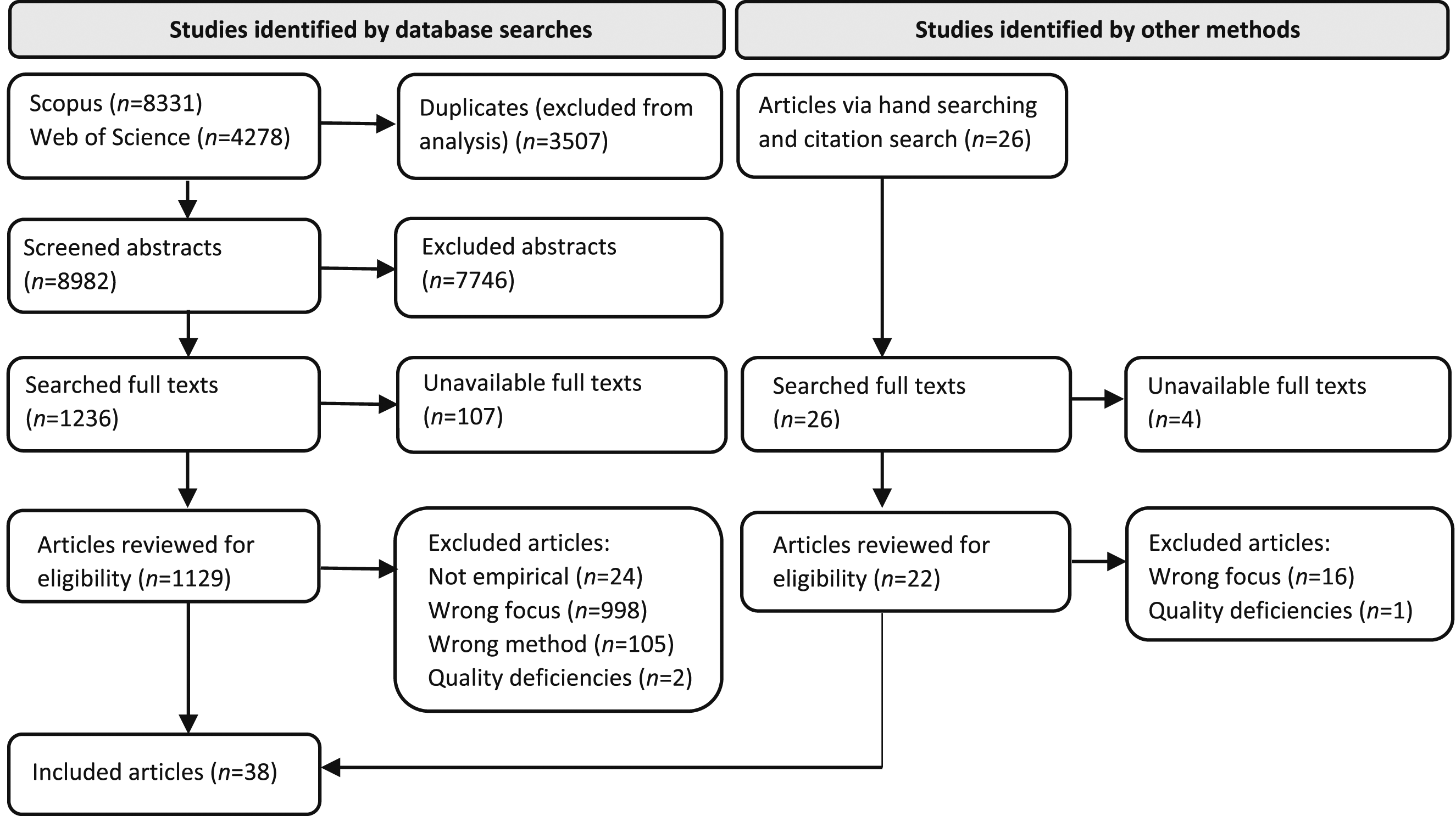
At this stage, we used Rayyan, an open-source software for systematic reviews and meta-analyses (Ouzzani et al., 2016). All studies were marked in Rayyan with either include, exclude, or maybe. The studies marked with maybe and studies with different assessments among members of the research team were discussed until agreement on a decision was reached. In the assessment, we determined whether the study in question empirically examined the relationship between leadership on the one hand and employee learning on the other. Studies that did not have this focus were excluded, as were studies based solely on quantitative data and studies that were not empirical. Mixed-methods studies with a qualitative component were, however, included.
Next, the full texts were downloaded and assessed against the inclusion criteria to check the studies’ eligibility. Some studies were not retrievable, despite extensive internet searches and use of inter-library loan services, and directly reaching out to the study authors. We also conducted a quality assessment of the studies using a template for qualitative research (Swedish Agency for Health Technology Assessment and Assessment of Social Services - SBU, 2020). This template includes criteria such as theoretical substantiation, sample selection, data collection, analysis, and researcher role. Of the relevant studies, 33 met our high or medium quality threshold. Excluded studies commonly lacked clarity in the descriptions of research processes, casting doubt on their reliability and validity. Additionally, we conducted hand searching, a manual method of scanning select journals for relevant articles missed by database searches (Booth et al., 2022), and searched citations in literature reviews. This strategy rendered 22 studies. They underwent eligibility check and quality assessment using the SBU template. Five were of high or medium quality and included. In total, 38 studies were included in the analysis.
Analysis was carried out in stages and with the support of the NVivo 12 software (Jackson & Bazeley, 2019). In the first stage of the analysis, we assessed the studies for relevance and eligibility. Here, we read the studies to get an overview of the content. In the second stage, we commenced with a reading aimed at coding some basic information about the articles, such as journal, country, purpose, issues, context, theoretical starting points, and method. In the third stage, we carried out an inductive conventional content analysis (Hsieh & Shannon, 2005). In this analysis, the focus was on the results, discussion, and conclusions. Based on this reading, in the fourth stage we created preliminary categories by coding meaning-bearing elements from each article. In this stage, a summary of each article was also developed that focused on each study’s findings and conclusions (Appendix I). In the fifth stage we read and re-read the articles and arranged the leader behaviors into subcategories. Here, we coded citations from the articles related to the respective subcategories (Hsieh & Shannon, 2005). Having outlined the stages of the review process, we now proceed to provide an aerial and critical view of included studies.
Overview and Critical Evaluation of the Studies
The review included 38 studies. The studies were published in 24 journals and a majority are in the fields of learning, pedagogy, and HRD. They were published from 1998 to 2023. The studies are presented individually in a summary table (Appendix I).
Regarding data collection methods, all studies used interview methods. Some studies also collected data using focus groups, observations, site visits and document analyses. It was common for the studies that used multiple methods to be framed as case studies. The studies were often based on a small number of respondents. The respondents were usually managers at different levels. However, in some studies, there were also owner-managers in small and medium-sized enterprises (SMEs), principals and other school leaders. Although several studies included both managers and employees, it was rare for direct reporting employees to be included. Such a connection was only explicitly described in seven studies (e.g., Amy, 2008; Beattie, 2006; Cohen, 2013). However, in these studies’ results, the manager-employee data sets were not matched making it impossible to distinguish the results for a specific manager and the manager’s direct reports. In terms of sectors, 19 studies were focused on organizations in the private sector and 14 on public sector organizations. One study focused on the voluntary sector, and one study included both private and public organizations. In the three remaining studies, it was not possible to discern the sector. Most private sector studies were about industrial companies; most public organizations were schools and hospitals. Most studies were carried out within large organizations, and only a few were in SMEs. The majority of the studies were based on interview data collected at one point in time. In such studies, respondents may provide socially desirable responses, or responses that reflect modern ideas about leadership that the leaders have institutionalized in their talk about leadership, which Argyris and Schön (1978) call espoused theories as opposed to theories-in-use.
Our analysis included an examination of theoretical perspectives that informed the studies. We appreciate that qualitative research is not as theory-driven as quantitative research (Benton & Craib, 2001). Nevertheless, as far as theoretical perspectives are concerned, the studies were generally not informed by theories of leadership. Some exceptions were studies that were informed by the “Full Range of Leadership Model” (FRLM) and, in particular transformational leadership (Bass & Riggio, 2006). There were also studies that drew on theories about managerial work (e.g., Mintzberg, 2009). As concerns learning-theory, the studies tended to draw on holistic and established theories. The most common was workplace learning. Several also made links to HRD and organizational learning. Numerous studies also had theoretical perspectives that explicitly linked leadership with learning. Here, many different designations were used, such as learning-oriented leadership and leaders as facilitators of learning. There were also studies that invoked the concept of pedagogical leadership, which originates from research on leadership in schools. Here the terms school leadership, instructive leadership and principals’ leadership were used. The theoretical and conceptual pluralism exhibited in the studies makes it difficult to compare the utility of the various theoretical perspectives in terms of the unique contribution that each perspective may make to an understanding of learning-oriented leadership. This limitation of the literature has been noted in reviews of quantitative studies (Do & Mai, 2020; Lundqvist et al., 2022).
A unique feature and strength of the present review is that it is possible to analyze the leadership that is described in the included studies. In this way, a rich conception of learning-oriented leadership can be extracted from the included studies, and thereby contribute to an understanding of learning-oriented leadership in a way that is not possible in previous reviews of quantitative studies. In the next section of the paper, the rich conception of learning-oriented leadership obtained from the included studies is unveiled.
How Do Leaders Facilitate Learning?
We focused the review of the studies’ results on the leadership behaviors study participants perceived as facilitative of learning. Three predominant patterns emerged. The first pattern encompasses leadership behaviors that occur in direct interaction with employees. The second pattern encompasses ‘indirect behaviors’, which are behaviors intended to create conditions in the work environment that are facilitative of learning. The third pattern encompasses adaptations of learning facilitative behaviors to situational factors.
Behaviors With a Direct Influence
Summary of the Direct Behaviors.
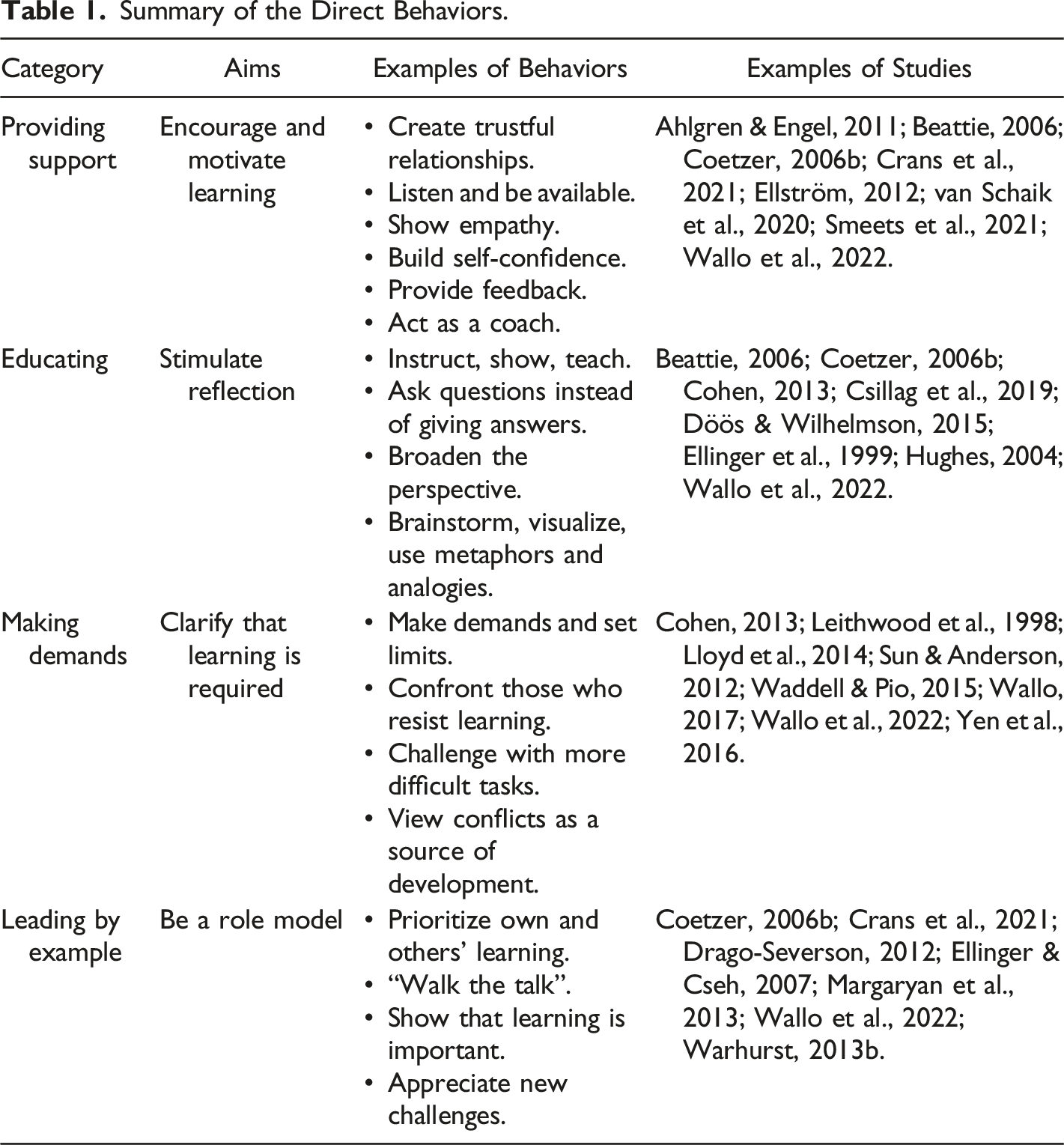
The most common category of behaviors was providing support. This category includes several different behaviors that aim to support, encourage, and motivate employees to learn at work. All studies included various types of behavior in this category (e.g., Beattie, 2006; Campbell & Evans, 2016; Crans et al., 2021; Ellinger et al., 1999; Wallo et al., 2013; Warhurst, 2013b), often referred to as coaching: “Regarding coaching, the supervisors were engaged in the employees’ long-term development, kept track of their learning process, and inspired them to learn from past experiences” (Crans et al., 2021, p. 18).
Providing support was about emphasizing relationships with employees, being available and listening to employees, showing empathy and building trustful relationships (Armson & Whiteley, 2010; Beattie, 2006; Campbell & Evans, 2016; Ellström, 2012; Leithwood et al., 1998; Wallo, 2017; Wallo et al., 2022). Providing support is illustrated in the following: “Managers described openness, honesty and trusting relationships as important in the facilitation of learning” (Campbell & Evans, 2016, p. 82).
The category incorporated behaviors associated with supporting employees in adequately performing and mastering their tasks. Behaviors in the category were also aimed at building employees’ self-confidence and making them feel safe to try new tasks, and work more autonomously (Ahlgren & Engel, 2011; Coetzer, 2006b; Ellström, 2012; Ellström & Ellström, 2018; van Schaik et al., 2020; Smeets et al., 2021; Sun & Anderson, 2012; Wallo et al., 2013; Wallo, 2017; Wallo et al., 2022; Zhang et al., 2021). This behavior is captured in the following: “The managers said that they spent a lot of time motivating employees, especially those who had the potential for development, but who did not dare, or did not want, to step forward” (Wallo et al., 2022, p. 66).
In the studies, the importance of giving feedback in conversations with employees was emphasized to ensure that learning was progressing according to plan or to identify the need for development (Beattie, 2006; Campbell & Evans, 2016; Coetzer et al., 2023; Crans et al., 2021; Ellinger & Bostrom, 1999; Ellinger et al., 1999; Noble & Hassell, 2008; Smeets et al., 2021; Warhurst, 2013a; Yen et al., 2016). The following quotation serves as an example: “More than half emphasized how teachers’ (and their own) learning is facilitated by offering and accepting feedback from others” (Drago-Severson, 2012, p. 19).
There were also studies that pointed to problems when the support was inadequate, such as when employees perceived that they did not receive enough feedback or support (Coetzer, 2006b; Lloyd et al., 2014; Noble & Hassell, 2008). In the study of allied health professionals (AHPs) by Lloyd et al. (2014), they found that “learning opportunities were limited for several rural/regional AHPs because they did not feel well supported by management to undertake workplace learning. They reported there was a lack of encouragement and support” (p. 8).
The second category, educating, involves the leader assuming an educative role. Educating employees was done by the leader through instructing and training (Beattie, 2006; Chuang et al., 2011; Coetzer, 2006b; Coetzer et al., 2023; Cohen, 2013; Csillag et al., 2019; Ellinger & Bostrom, 2002; Wallo, 2017). The leader as an educator is illustrated in the following: “A common pattern occurs when the owner acts as a teacher or mentor: ‘I train them personally. After we hire them, we go around together for a month and I teach them how to sell our product’” (Csillag et al., 2019, p. 463).
The studies showed that this type of leaning-oriented leadership was also enacted by leaders who tried to stimulate reflection and critical thinking by problematizing and questioning employees’ assumptions (Leithwood et al., 1998; Sun & Anderson, 2012; Wallo, 2017). To facilitate learning the leaders also used brainstorming, visualizing, metaphors and analogies, or acted as a sounding board (Amy, 2008; Ellinger et al., 1999; Ellinger & Bostrom, 1999; Ellström, 2012; Wallo, 2017). The leader’s role in helping employees understand why an individual employees’ learning is important from a larger, organizational perspective was also emphasized in the studies (Armson & Whiteley, 2010; Campbell & Evans, 2016; Ellinger & Bostrom, 1999; Ellinger et al., 1999). Several studies highlighted the importance of asking employees questions to encourage new ways of thinking (Amy, 2008; Crans et al., 2021; Drago-Severson, 2012; Ellinger et al., 1999; Ellström, 2012; Sun & Anderson, 2012; Wallo, 2017; Wallo et al., 2013, 2022; Warhurst, 2013b). Leaders encouraging employees to engage in new ways of thinking is illustrated in the following: “Managers acknowledged that they did not provide solutions or answers and said they often responded to questions by asking different thought-provoking questions to encourage their employees to derive their own solutions” (Ellinger et al., 1999, p. 116).
The third category, making demands, refers to behaviors that involve the leader making the expectation clear that learning is required. For example, this type of behavior was used in conversations with those who, for various reasons, displayed negative attitudes towards participating in learning and development activities (Wallo, 2017). These employees needed a strong guiding hand and to be confronted in a constructive way (Amy, 2008; Wallo, 2017; Warhurst, 2013a). Instead, I tried to get him to some kind of realization, to understand that I was serious, “You can’t go on like this”. And that’s a leader thing as well. In order to get an individual to change you may almost have to push him over the edge before things start shaking. (Wallo, 2017, p. 28)
Making demands included clarifying where the boundaries are and what requirements the organization has for its employees in terms of learning in relation to work tasks (Ellinger & Bostrom, 1999; Noble & Hassell, 2008; Wallo, 2017; Wallo et al., 2022). There’s a communication effort that's put out to make sure everybody understands the goals we have (as a department) and why, not just these are your goals, which is a pretty dramatic step compared to what a lot of people do, but also why are these goals here, why are they important, and why should you give a damn. (Ellinger & Bostrom, 2002, p. 762)
Making demands also incorporated behaviors associated with challenging, questioning, persuading, and stimulating critical reflection among employees to move them from their comfort zones and to foster development-oriented thinking (Sun & Anderson, 2012; Yen et al., 2016). Examples of such behaviors included expecting higher standards of performance in completing existing tasks and assigning to employees new, more difficult tasks that they were not familiar with (Beattie, 2006; Campbell & Evans, 2016; Cohen, 2013; Drago-Severson, 2012; Leithwood et al., 1998; Lloyd et al., 2014). Leaders making demands is illustrated in the following: “Employees can be ‘challenged … [by giving] them things to do that may be slightly out of their comfort zone … or that they may feel that they are not qualified to do’” (Cohen, 2013, p. 514).
Making demands did not imply behaving badly towards employees, but some studies did problematize it and saw it as less effective for learning (Amy, 2008; Waddell & Pio, 2015), linking it to traditional, direction-giving leadership (Campbell & Evans, 2016), or a transactional leadership style assumed to facilitate only lower levels of learning (Waddell & Pio, 2015).
The fourth category is leading by example. Behaviors included the leader demonstrating a personal commitment to learning and signaling to employees that learning is important (Coetzer et al., 2023; Crans et al., 2021; van Schaik et al., 2020; Wallo et al., 2022). This quotation serves as an illustration: “School leaders generally participate in the teacher learning groups themselves and are therefore explicitly involved in the learning programs. This gives them the opportunity to model values of openness and risk-taking through their own learning behavior” (van Schaik et al., 2020, p. 223).
For senior management, leading by example involved showing support for learning activities (Chuang et al., 2011; Wallo, 2017). For middle and first-line managers, it involved “walking the talk” (Ellinger & Cseh, 2007), that is, to be a role model and to prioritize one’s own learning as well as to embrace new challenges and development opportunities (Campbell & Evans, 2016; Coetzer, 2006a; Coetzer et al., 2023; Drago-Severson, 2012; Leithwood et al., 1998; Margaryan et al., 2013; Wallo et al., 2013, 2022; Warhurst, 2013b). Leading by example is exemplified in the following: “Finally, novices indicated that line managers serve as role models, from whom they learned vicariously” (Margaryan et al., 2013, p. 213)
Behaviors With an Indirect Influence
Summary of the Indirect Behaviors.
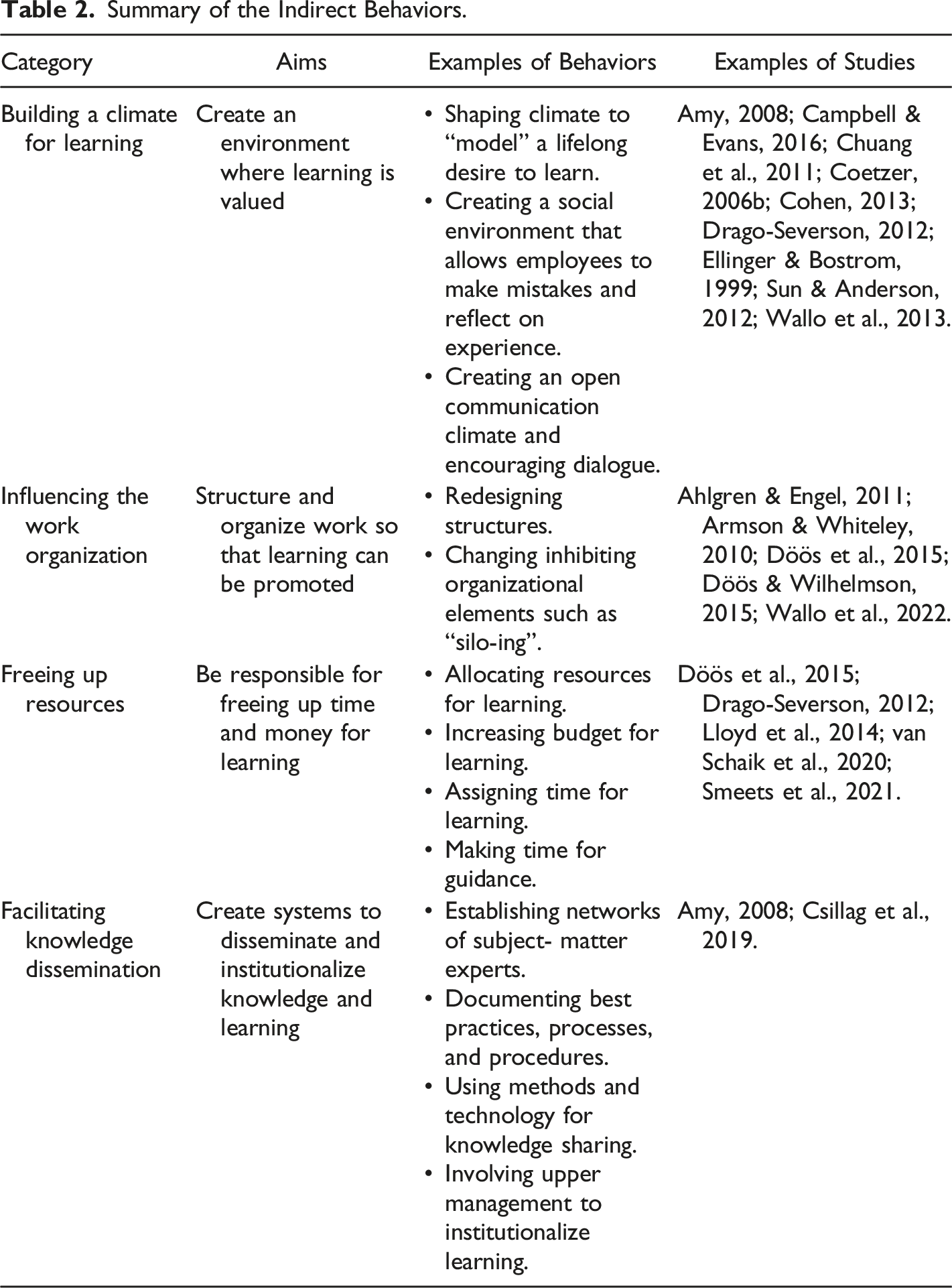
Building a climate for learning refers to the leader engaging in behaviors and actions that seek to create an organizational climate where learning is encouraged and afforded space. The term ‘learning environment’ was often used in the studies. Distinguishing features of an environment facilitative of learning were, for example, the presence of a vision and a strategy for learning, open communication regarding development issues and treatment of mistakes as learning opportunities (Amy, 2008; Beattie, 2006; Campbell & Evans, 2016; Chuang et al., 2011; Coetzer, 2006b; Cohen, 2013; Csillag et al., 2019; Drago-Severson, 2012; Ellinger & Bostrom, 1999; Ellinger et al., 1999; Lloyd et al., 2014; van Schaik et al., 2020; Smeets et al., 2021; Sun & Anderson, 2012; Wallo et al., 2022). As an illustration, Cohen (2013) describes a learning environment as follows: “Furthermore, a workplace culture attuned to learning also means creating a social environment that allows employees to make mistakes and reflect on experience” (p. 514).
Influencing organizational structures and work practices included addressing structural barriers to learning such as the silo mentality that hinders people in different departments learning from each other and employees who work different shifts not having time to exchange knowledge between shifts (Ahlgren & Engel, 2011; Armson & Whiteley, 2010; Döös et al., 2015; Döös & Wilhelmson, 2015; Wallo et al., 2022). Leaders’ influence on structure and practices is illustrated in the following: “In managers’ descriptions of their work, we identified activities in which they attempted to influence conceptions indirectly by altering organizational preconditions for work-integrated learning and thereby changing how work was carried out” (Döös & Wilhelmson, 2015, p. 82).
Working to free up resources was mentioned in some studies and included allocating financial resources in the budget for formal competence development and allowing sufficient time for employees and leaders to learn at work (Crans et al., 2021; Döös et al., 2015; Drago-Severson, 2012; Lloyd et al., 2014; van Schaik et al., 2020). I have increased our budget for teacher learning by 50%, with the main objective of stimulating learning and development among teachers. We use this budget for a combination of joint thematic school development efforts, with specific attention paid to peer and collaborative learning in teacher learning groups, and individual developments when desired. (van Schaik et al., 2020, p. 227)
Lastly, facilitating knowledge dissemination involved ensuring that there were systems and technology in place that enabled the spread and institutionalization of knowledge in the organization. This involved, for example, documentation of best practice and implementing routines for knowledge sharing (Amy, 2008; Csillag et al., 2019), as illustrated in the following: “Regarding these learning possibilities, owner/manager C7 consciously built an internal information and knowledge-sharing platform to systematically share employees’ knowledge” (Csillag et al., 2019, p. 463).
Adaptation of Facilitative Behaviors to Situational Factors
The third pattern in the analysis was that learning-oriented leadership behaviors are adapted to situational factors (Coetzer et al., 2023; Drago-Severson, 2012; Ellinger & Bostrom, 2002; Ellinger et al., 1999; Håkansson, 2019; Wallo, 2017; Wallo et al., 2022; Warhurst, 2013b). Adaptation to the situation can be explained in two ways. First, the studies showed that factors within and outside the organization influenced which leadership behaviors were effective. Second, leadership behaviors also seem to be shaped by the activities leaders use to facilitate learning.
Starting with adaptation to factors within and outside of the organization, the employees’ attitudes towards learning was a key determinant of the leadership behaviors that were enacted. The leader’s behavior was influenced by whether employees actively sought learning opportunities or showed little interest in learning. Some employees needed to be challenged by the leader to engage in learning, while others needed lots of support and feedback (Coetzer & Perry, 2008; Margaryan et al., 2013; Wallo, 2017; Wallo et al., 2022; Warhurst, 2013b). Similarly, leaders highlighted their personal commitment to learning and their competence as influencing factors. For example, a leader’s knowledge of the organization was vital because it determined whether the leader was able to identify work-based learning opportunities such as collaboration and job rotation (Ellinger et al., 1999; Ellström, 2012; Wallo et al., 2022).
Other examples of factors that could enable or hinder leadership that facilitates learning were top management support, sufficient time and financial resources for supporting employees’ learning, and the leaders’ administrative burden (Csillag et al., 2019; Drago-Severson, 2012; Ellström, 2012; Lloyd et al., 2014; Noble & Hassell, 2008; Wallo et al., 2013, 2022). There were also practical factors related to the design of the work organization that could influence the learning potential of the workplace. Examples are when certain skills were needed in a specific work area, thereby making job rotation impractical, or shift work sometimes prevented leaders from regularly interacting with all employees (Chuang et al., 2011; Wallo et al., 2022). Additional factors mentioned were external pressures for change within the organization, the introduction of new technology, the organizational culture, and the family-like culture and social cohesion in small businesses (Coetzer, 2006b; Coetzer et al., 2023; Ellinger et al., 1999).
Concerning how leadership behaviors are shaped by the activities leaders use to facilitate learning, several different types of activities were mentioned in the studies. These activities differed depending on how formalized and planned they were. It was common to describe various deliberately planned activities involving formal learning. These activities were usually determined in advance and were part of the leader’s normal duties and budget. Planned activities often mentioned were education and training courses that the employees were afforded the opportunity to attend (e.g., Ahlgren & Engel, 2011; Armson & Whiteley, 2010; Crans et al., 2021; Csillag et al., 2019; Lloyd et al., 2014; Wallo, 2017; Warhurst, 2013a, 2013b), or “structured on-the-job training” (Chuang et al., 2011; Coetzer, 2006b; Ellström & Ellström, 2018; Margaryan et al., 2013). Other planned activities were regularly scheduled conversations with employees, such as performance reviews, development dialogues and salary discussions. In these conversations, development plans were made for the employee, and the leader took stock of the employee’s learning needs (Ahlgren & Engel, 2011; Campbell & Evans, 2016; Coetzer et al., 2023; Coetzer & Perry, 2008; Cohen, 2013; Margaryan et al., 2013; Noble & Hassell, 2008; Wallo et al., 2022; Yen et al., 2016). The planned activities also included systematic improvement work (Ellström, 2012; Ellström & Ellström, 2018; Wallo, 2017).
It was also common for the studies to point to the importance of more reactive and spontaneous activities that were linked to informal learning processes and which were integrated into performance of work tasks (Beattie, 2006; Ellström & Ellström, 2018; Hughes, 2004; Wallo, 2017; Wallo et al., 2022). Examples of such activities were situations where the leader, together with the employee, reflected on and discussed problems at work (Ellström, 2012; Wallo, 2017; Wallo et al., 2022; Warhurst, 2013a) or impromptu learning opportunities when the leader took the opportunity to train employees while work was performed (Wallo, 2017; Wallo et al., 2022; Yen et al., 2016). In several studies, it was also reported that facilitation of employee learning often happened spontaneously through informal conversations with leaders or when the leader arranged for the employee to observe how someone else performed a work task (Amy, 2008; Armson & Whiteley, 2010; Csillag et al., 2019; Döös & Wilhelmson, 2015; Drago-Severson, 2012; Sun & Anderson, 2012; Wallo, 2017; Yen et al., 2016).
Furthermore, some activities were on the continuum between planned and spontaneous activities. These activities were partly planned in such a way that they contained a certain degree of formalization and could be linked to types of systems for management and HR issues in the organization. However, the activities were not necessarily recurring or directed at all employees. Rather, they were based on learning needs that the leader or employee continuously identifies. For example, a partially planned activity could be to give the employee new tasks, use work rotation, or make other changes with the aim of the employee learning something new or taking steps in his or her development (Coetzer & Perry, 2008; Ellström, 2012; Ellström & Ellström, 2018; Noble & Hassell, 2008; Wallo, 2017; Warhurst, 2013b). For instance, a leader encouraging an employee to try a leadership role or take on roles as teacher and mentor for newcomers were mentioned (Coetzer, 2006b; Drago-Severson, 2012; Wallo, 2017; Warhurst, 2013a; Zhang et al., 2021). Other examples were when mangers devoted time in a regular staff meeting to reflect and learn from each other (Amy, 2008; Armson & Whiteley, 2010; Beattie, 2006; Campbell & Evans, 2016; Coetzer et al., 2023; Cohen, 2013; Csillag et al., 2019; Drago-Severson, 2012; Wallo, 2017; Wallo et al., 2022; Yen et al., 2016), or leaders arranging specific events such as workshops where employees made presentations to each other and seminars for knowledge exchange to occur (Lloyd et al., 2014; van Schaik et al., 2020; Smeets et al., 2021; Zhang et al., 2021).
In sum, results of the studies indicate that the activities were not mutually exclusive and occurred in parallel. The degree of planning in the activities could also be seen as fluid rather than as clearly defined categories. However, it was also clear that in terms of frequency of use, spontaneous activities constituted the largest part of learning. It was ongoing and did not require dedicated resources to the same extent as partially planned and planned activities.
The foregoing findings provide nuanced, rich descriptions and illustrations of three patterns of behaviors associated with learning-oriented leadership. Next, we embed the findings in wider literature, generate a theoretical framework to guide future research, and identify research gaps that emanate from the framework.
Discussion
Results of this review suggests that there are several different ways in which a leader can facilitate employee learning. Four types of direct behavior were identified: providing support, educating, making demands, and leading by example. Overall, these four types resemble the leadership behaviors in the FRLM model (Bass & Riggio, 2006). For instance, providing support is similar to transformational behaviors such as individualized consideration and inspirational motivation. Similarly, the category of educating has some similarities to what Bass and Riggio (2006) call intellectual stimulation. The category of making demands contains behaviors that are also found in the FRLM model, but in relation to the transactional leadership style, and more specifically, so-called contingent reward. This was previously thought not to be related to employee learning. There are also some similarities with transactional behaviors that focus on active or passive management by exception. Lastly, leading by example is similar to the transformational behavior called idealized influence, albeit without the need for the leader to be charismatic.
Although these findings relating to learning-oriented leadership bear some similarities to FRLM, there are also significant differences. For instance, the charismatic elements often highlighted in transformational leadership do not seem to be very pronounced. Therefore, research in the field should strive for new thinking to not limit theoretical development to existing leadership models and reproduce generic leadership ideals. Learning-oriented leadership should thus be treated as a theory of its own, not just as another outcome in a generic grand leadership theory.
Reviews of quantitative studies have tended to focus on the body of research that has examined relations between transformational leadership and learning at the organizational level (Asif, 2019, 2020; Mohamed & Otman, 2021). By contrast, a handful of reviews have recently been published that attempt to map the area more comprehensively (Do & Mai, 2020; Lundqvist et al., 2022; Xie, 2019). These have found that different leadership styles, with diverse theoretical origins, are related to learning at the individual, group and organizational levels. These reviews also found that previous studies used several mediators of the leadership-learning relationships. Furthermore, these reviews revealed that a limitation of the body of research is that several types of learning-oriented leadership behaviors are often merged in studies, which makes it problematic to distinguish effective behaviors from ineffective ones. These reviews also identified the need for studies that evaluate different leadership styles and behaviors against each other to determine their relative explanatory contributions. Compared to previous quantitative investigations (e.g., Berson et al., 2006; Loon et al., 2012; Matsuo, 2012), the contribution of qualitative studies lies in the detailed accounts of how leaders enact leadership in their daily work context. The quotes and thick descriptions in the studies make learning-oriented leadership more tangible and easier to understand. Additionally, the four indirect behaviors identified from the studies are vital additions that have received little attention in quantitative studies.
In sum, the qualitative studies also showed that it is not a simple matter of one leadership style (e.g., transformational) being better than another (e.g., transactional). Instead the leadership style must be adapted to the situation and surrounding factors (Hersey & Blanchard, 1969; Oc, 2018). This includes considerations such as the employees’, leaders’, and top management’s attitudes to learning, resources for learning, external pressures for change, the introduction of new technology and the design of the work organization. The analysis also revealed that the type of learning activity used by leaders can also affect how learning-oriented leadership is enacted.
Based on results of the present literature review and previous reviews in the area, we propose a tentative theoretical framework to guide future research. In the model (Figure 2), the contextual and individual factors will help set the scene for learning-oriented leadership. Future studies could add other factors, for instance, by drawing on the literature on expansive and restrictive learning environments (Fuller & Unwin, 2004). In the middle section of the model, we find the indirect and direct leadership behaviors involved in enacting learning-oriented leadership (i.e., how it is done). The behaviors are combined with the activities used to facilitate learning (i.e., what is done). We argue that the analytical separation between ‘how’ and ‘what’ will provide a more nuanced understanding that can be operationalized in measurements used for future quantitative research. We display the activities as a pyramid to signal that most workplace learning happens informally, outside of formal learning situations (cf. Tannenbaum & Wolfson, 2022). In the last third of the model, we have placed learning outcomes and highlight the distinction between different types of learning, as proposed by Ellström (2001). Framework for Learning-Oriented Leadership.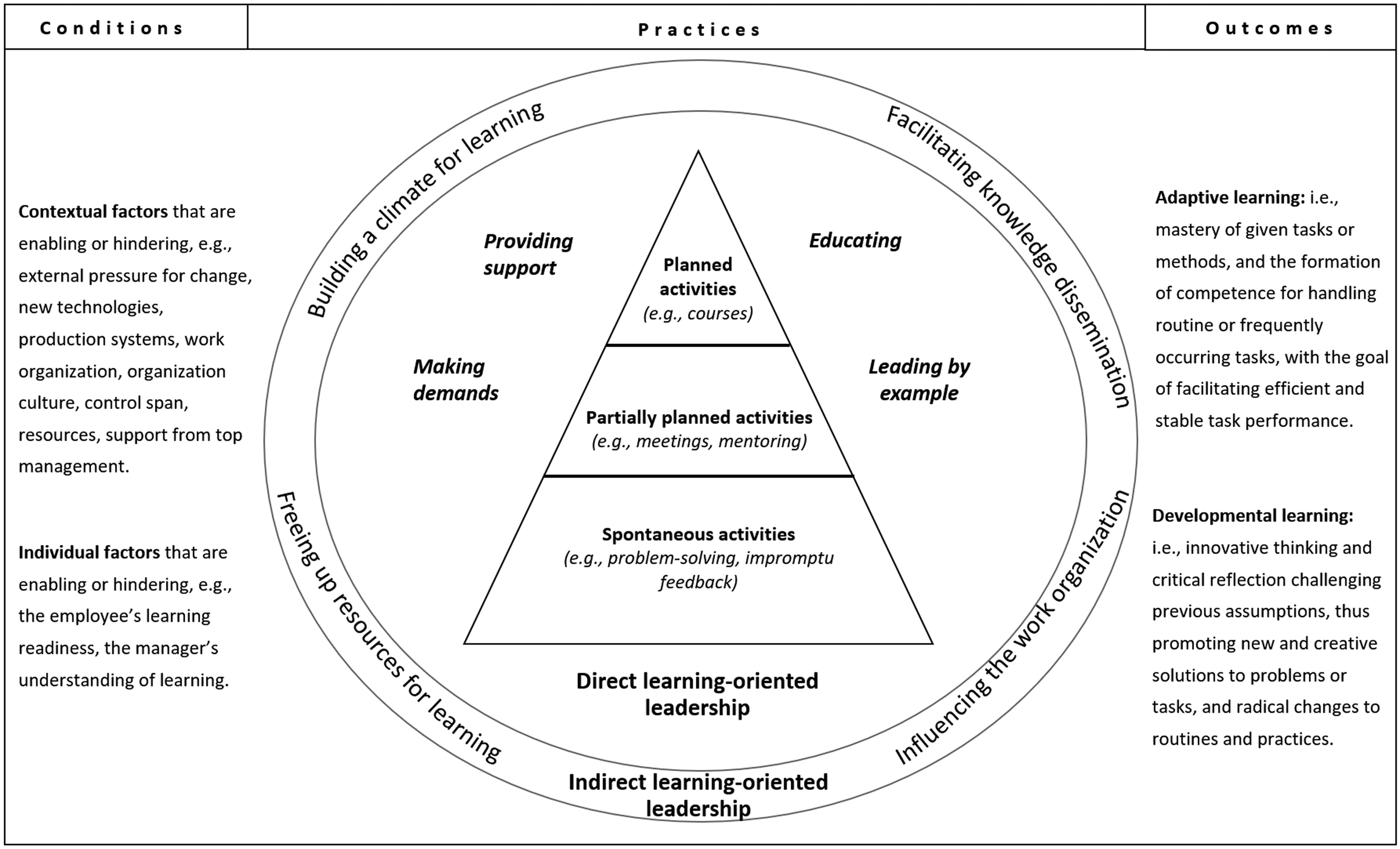
A strength of our review of qualitative studies, which relates to its originality and contribution, is that it afforded the opportunity to synthesis data derived from a body of research with distinctive features. These features include that the studies: are emergent as opposed to strictly predetermined; focus on context; may use multiple methods; and emphasize holistic accounts and multiple realities (Liamputtong, 2020). Analysis of such studies are more likely to lead to serendipitous findings and new integrations and move beyond initial conceptions to generate novel conceptual frameworks (Miles & Huberman, 1994). Thus, complexities and subtleties about the study participants and research topic are discovered, which are often missed by positivistic studies. Accordingly, our review of qualitative studies has the potential to provide more clarity and depth into future research areas. Next, we discuss some of the research gaps that emanate from the framework for learning-oriented leadership.
We need more knowledge about how the entire system fits together. Therefore, the first question we propose for future research is, what leadership styles can be linked to specific learning outcomes under different contextual conditions? Investigating this question requires a sophisticated research design. Such a design should be longitudinal and require an initial study of the context, that is, the existing learning environment and how it creates conditions for the exercise of leadership. Subsequently, the leader’s leadership style and the direct reporting employees’ self-leadership (Goldsby et al., 2021) should be investigated. Capturing this relationship is vital, as leadership is created jointly by leaders and employees (Northouse, 2022). To study the relationship between leader and employees, the employee respondents must be direct reporting. The next step should be to explore how leaders facilitate learning, that is, the activities and behaviors used in their daily work. Here, methods that come close to practice are required, such as observations of leaders and employees. Finally, the measurement of learning as an outcome is needed, to determine whether leadership and self-leadership lead to employee learning and what type of learning is facilitated. Based on previous conceptualizations, we suggest distinguishing between learning that refines existing knowledge (adaptive) and learning that transforms existing frameworks (developmental) (Ellström, 2001). Learning could potentially also be measured at different levels (i.e., individual, group, and organizational), which would further develop an understanding of the effects of learning-oriented leadership (Berson et al., 2006). A baseline is needed when the project starts and then a follow-up at the end of the project. Both quantitative and qualitative methods may be appropriate for establishing the baseline.
A second research gap concerns recent changes to leader and employee relations brought on by the Covid-19 pandemic and the subsequent increase in remote and hybrid work. Because of the mindset that the “new normal” working life will be characterized by alternation between on-site and remote work, so-called hybrid work, several questions arise about what happens to employees’ opportunities for learning. Therefore, a second future research question is: How should leadership that facilitates learning be conducted during hybrid work? Planned activities may be more easily sustained during hybrid work, but as our model highlights, most learning occurs during spontaneous activities, which may require a different leadership approach.
The third and last research gap concerns research contexts in the reviewed studies. At first, the coverage between public and private organizations seems balanced. However, on closer inspection, we see that most of the studies from the public sector have been conducted in school contexts or within healthcare contexts. There is a need to broaden the research contexts to include other public organizations. More importantly, we can also see that while studies of SMEs are represented in the material, these are in the minority and thus need more attention in future studies. Distinctive characteristics of SMEs, such as financial and personnel resource constraints, may constitute barriers to facilitation of learning. On the other hand, the SME owner/manager’s physical and social proximity to employees may be a key facilitating factor. Understanding the challenges and opportunities afforded by distinctive characteristics of SMEs can offer insights into how the SME owner/managers can be supported in enactment of learning-oriented leadership (Coetzer et al., 2019, 2023; Short, 2019). In line with this gap, a research question would be: What factors related to firm smallness can enable or constrain learning-oriented leadership?
The discussion has helped to develop a better, more refined understanding of the phenomena of learning-oriented leadership, revealed the theoretical insights afforded by the review, and laid the groundwork for future research. Before we conclude the paper, we outline limitations of the study and then move on to practical implications of the results.
Limitations
Our integrative review is based on results that were reported in 38 studies and the synthesis process generated comprehensive insights into learning-oriented leadership. To mitigate contagion by existing theories of leadership, codes and categories were generated inductively. Nevertheless, several limitations should be acknowledged. First, while the breadth of our literature search was extensive, there remains the possibility that certain terms were inadvertently omitted, potentially leading to exclusion of pertinent studies. This potential limitation arises from the multiple relevant terms prevalent in the research field. This challenge for researchers working in the field suggests a need for more consistent use of terminologies and frameworks across future studies. Second, a difficulty was navigating the variance in abstract lengths across journals. Some journals require very brief abstracts, which might not encapsulate all relevant search terms. Consequently, certain studies might have been unintentionally overlooked due to these very brief abstracts. Third, while qualitative insights are rich and detailed, they might not always echo the broader sentiments across all organizational settings. Quantitative studies, on the other hand, potentially offer a more representative and generalizable overview, but might miss the subtleties inherent to qualitative explorations. Accordingly, the conscious choice to spotlight qualitative studies stemmed from their inherent strength in capturing context-sensitive nuances. Fourth, qualitative studies exhibit considerable diversity in their methodologies and reporting quality. Such variability complicates assessment of the reliability and validity of studies within the synthesis. To mitigate individual study limitations and present a well-rounded perspective, our review synthesizes insights from 38 qualitative studies. Finally, ensuring the quality and rigor of the qualitative synthesis process is challenging when dealing with diverse and complex sources of data. Further, the potential for bias and subjectivity must be avoided in the qualitative synthesis. In our research, measures such as reflexivity and having members of the research team participate in the analysis helped mitigate these potential limitations.
Implications for Practice
We offer five actionable recommendations for leaders. First, leaders who value learning should actively identify and leverage everyday work situations that present opportunities for employee learning. This involves recognizing and exploiting learning opportunities as employees engage in their everyday goal-directed work activities. We encourage leaders to experiment with various leadership behaviors and activities, assessing their effectiveness in different organizational contexts. This could involve trials of new leadership approaches, followed by employee feedback sessions on the efficacy of the approaches.
Second, as the conceptual framework illustrates, leadership that facilitates learning is context dependent. Therefore, to enhance learning, leaders should assess their organizational environment and tailor their behaviors and activities to suit the specific conditions.
Third, from an HRD perspective, understanding the specific leadership behaviors that foster learning is crucial for developing management education and training programs. Such programs can enhance leaders’ skills in recognizing learning opportunities within daily tasks and establishing a workplace environment that supports employee learning. Incorporating case studies and real-world examples into these training programs can demonstrate practical techniques for facilitating learning across diverse situations.
Fourth, the insights gleaned from this review can guide the creation of comprehensive evaluation frameworks to assess leaders’ effectiveness in facilitating learning. Such frameworks should encompass a blend of qualitative and quantitative performance indicators, incorporating elements like employee feedback and measurable learning outcomes, to provide a well-rounded evaluation of leadership performance in this domain.
Fifth, the findings of this review offer organizations valuable perspectives on establishing conducive environments for learning and strategically enhancing learning facilitation. For instance, it prompts senior management to conduct thorough assessments of the resources dedicated to learning facilitation, such as budget allocations, availability of learning materials, and time devoted to training activities. Moreover, it is vital to examine the administrative load of line managers and the size of their employee groups, ensuring that they are adequately equipped and not overburdened to support learning initiatives effectively.
Conclusions
This study synthesized qualitative research-based knowledge on leadership that can facilitate employee learning in the workplace. The findings revealed that learning-oriented leadership is composed of two main elements:
While traditional leadership models might emphasize decision-making, authority, and, sometimes, a more hands-off approach, learning-oriented leadership is intrinsically hands-on, adaptive, and participative. By juggling direct and indirect leadership, learning-oriented leadership recognizes the multifaceted nature of learning, where employees learn from directed guidance and from the environment they operate within. Furthermore, our findings highlighted the adaptive nature of learning-oriented leadership. Learning-oriented leadership behaviors oscillate in response to situational dynamics, such as the prevailing context or individual employee nuances. This adaptable characteristic of learning-oriented leadership reinforces its contemporary relevance in today’s ever-evolving workplaces.
While this integrative review has provided pivotal insights into the nature and implications of learning-oriented leadership, it has also unveiled critical gaps in our understanding. We are merely scratching the surface of its full potential and the mechanisms through which it transforms organizational climates. We encourage scholars, practitioners, and thought leaders in the field of HRD to delve deeper into this paradigm. There is a need for empirical studies that uncover the nuanced practices of learning-oriented leaders in diverse settings and the multifaceted outcomes of their leadership. Longitudinal studies could illuminate long-term effects and evolution of such leadership styles, and case studies might offer rich narratives about the challenges faced and successes achieved by leaders in different professional contexts. Moreover, as the global landscape becomes more intertwined, cross-cultural studies on learning-oriented leadership could offer insights into how learning and leadership intertwine across various cultural, social, and economic contexts.
Footnotes
Declaration of Conflicting Interests
The author(s) declared no potential conflicts of interest with respect to the research, authorship, and/or publication of this article.
Funding
The author(s) disclosed receipt of the following financial support for the research, authorship, and/or publication of this article: This work was supported by the Forskningsrådet om Hälsa, Arbetsliv och Välfärd (2020-01482).

Appendix
Included Qualitative Studies.
Author (year)
Country
Aim
Methods
Main Findings Concerning Learning-oriented Leadership
Ahlgren and Engel (2011)
UK
Examine how training opportunities are promoted or hindered for employees in SMEs.
Interviews with owner-managers, managers, HR, and employees (n = 36), documents and statistics analysis.
Employers have a key role in driving and investing in employee training and development. However, employers are narrowly focused on job-specific, in-house training, which many employees find limiting. There are examples of initiatives to create opportunities for informal learning, e.g., changing the office layout to improve knowledge sharing and introducing a job rotation system and skill sharing program.
Amy (2008)
USA
Study how leaders contribute to or hinder learning.
Interviews with managers and employees (n = 23).
Learning leaders exhibit several distinct traits and skills, but they place the most emphasis on emotionally intelligent communication, a prominent feature of facilitative leadership.
Armson and Whiteley (2010)
Australia
Examine what encourages or inhibits learning.
Interviews with managers and employees (n = 51).
Managers encourage learning through coaching, formal training opportunities, and work on corporate structure and freeing up resources.
Beattie (2006)
UK
Identify the behaviors of senior managers and line managers promoting employee learning in the workplace.
Interviews with managers and employees (n = 60), observations.
The workplace is an important place for learning and line managers have a crucial role to play. The study shows a hierarchy of developmental behaviors. Caring, informing and being professional is practiced by most managers. More sophisticated and demanding behaviors, such as empowerment and challenging, were observed less frequently.
Campbell and Evans (2016)
UK
Explore managers’ roles as promoters of their employees’ learning.
Interviews with managers (n = 8).
The results confirm the central role in workplace learning for line managers using a coaching approach. Managers tend to use a discursive repertoire of actions that emphasizes questioning, active listening, visualization, and explanation while avoiding controlling behaviors.
Chuang et al. (2011)
USA
Investigate factors that affect middle managers’ support for learning.
Interviews with managers (n = 92), focus groups.
Middle management support is highest when managers feel that learning and innovation fit their workplace needs and priorities and when they have more room for maneuver and control over how the innovation is implemented.
Coetzer (2006b)
New Zealand
Study what effects managers have on parts of the work environment with the potential to affect informal learning.
Interviews with owner-managers, managers, employees (n = 17).
The potential for learning is increased by a breadth of tasks and hindered by limited room for maneuver. Employees perceive supervisors’ behaviors as important for promoting their learning, but they report that leaders fail to create conditions that facilitated learning, such as creating incentives to learn. Supervisors also provide too little support for learning and do not work proactively to facilitate employee learning.
Coetzer et al. (2023)
Australia
Study how owner/managers facilitate learning in SMEs.
Interviews with owner-managers and employees (n = 16), company visits.
Owner/manager physical and social proximity to employees and their use of supportive and participative management styles creates the potential for owner/managers to facilitate learning through modelling, guidance, and provision of immediate feedback.
Coetzer and Perry (2008)
New Zealand
Identify key factors that affect employee learning from the perspective of owners/managers.
Interviews with owner-managers (n = 27), company visits.
The owners/managers’ views on factors that affect employee learning are categorized into four themes: factors in the external business environment (e.g., regulations, technological advances); factors in the work environment (e.g., minimization of learning, retention, performance appraisal); the learning potential of the work (e.g., task variation); employee learning orientations (e.g., motivation, work ethic).
Cohen (2013)
Australia
Study how line managers promote and facilitate on-the-job learning.
Interviews with managers and employees (n = 20), focus groups, analysis of ads.
Managers considered leaders of learning have an instrumental approach to leading employee learning, that is, learning is seen as a mechanism for getting work done. Some of the line managers provide a more expansive learning environment by purposefully creating conditions for learning for their employees, in addition to the focus on getting the work done.
Crans et al. (2021)
Germany
Examine the social side of professionals’ learning in the consulting field.
Interviews with employees (n = 16).
Having a leader who facilitates learning is an important part of a climate that enhances social informal learning. The supervisor lays the foundation for a learning climate and takes on the role of learning leader. The supervisor gives feedback, guides employees, and acts as a role model.
Csillag et al. (2019)
Hungary
Study learning processes among small businesses with a focus on owner/manager roles and networks.
Interviews with owner-managers (n = 11).
Small business owners consciously develop and manage their companies’ learning processes and environments. Owners act as teachers by transmitting their practical knowledge and act to facilitate learning as a participatory process. The owner/manager as facilitator takes on a supporting role by sharing information and creating a framework for collaborative learning.
Döös et al. (2015)
Sweden
Contribute to the understanding of learning-oriented leadership as integrated managers’ daily work.
Interviews with managers (n = 9), observations, company visits.
The learning-oriented leadership categories cover a repertoire of advocacy actions that create different conditions for learning. Leadership work that creates favorable conditions for learning does not have to be a specific task. Learning is inherent in aspects of managerial work and managers’ daily tasks can be understood as expressions of different kinds of pedagogical efforts.
Döös and Wilhelmson (2015)
Sweden
Discuss the contribution of a study on the software-communication industry’s to school leadership.
Interviews with managers (n = 9), observations, company visits.
The learning-oriented categorization of leaders’ advocacy actions presents different avenues for managers, including principals, to intervene in their employees' learning and competence development at both individual and collective levels.
Drago-Severson (2012)
USA
Identify leadership strategies to build school climate that promotes teacher learning.
Interviews with principals (n = 25), field notes, document analysis.
Leadership that supports adult development involves considering teachers’ current and emerging ability to handle the complexity of work. Supportive leadership also means taking care of one’s own development. The principals use the following leadership imperatives: (a) to consider context-specific priorities to create and improve the school climate, (b) cultivate shared values and flexibility, and (c) build a collaborative culture.
Ellinger and Bostrom (1999)
USA
Explore how managers facilitate their employees’ learning in learning organizations.
Interviews with managers (n = 12).
Managers facilitate learning using 13 behaviors grouped into two clusters: empowering and facilitating. Empowering behaviors include encouraging employees to think through questions, removing barriers, transferring ownership to employees, and holding back — not providing answers. Facilitative behaviors include giving feedback to employees, discussing problems together, creating a learning environment, setting expectations, and shifting perspectives.
Ellinger and Bostrom (2002)
USA
Explore managers’ mental models as they act as promoters of employee learning.
Interviews with managers (n = 12).
The managers perceive that the roles of manager and facilitator of learning were separate from each other, but that under certain circumstances they had to switch between these roles. For the managers the role of facilitator of learning is about helping employees grow and develop.
Ellinger and Cseh (2007)
USA
Explore how employees facilitate learning and how this is influenced by contextual factors.
Interviews with employees (n = 11).
Several positive and negative organizational contextual factors emerge that influenced the facilitation of learning. Specifically, a learning-engaged leadership emerges as a powerful organizational contextual factor.
Ellinger et al. (1999)
USA
Examine managers’ beliefs, behaviors, triggers, and outcomes when promoting their employees’ learning.
Interviews with managers (n = 12).
Several themes exist within the four broad conceptual framework categories of beliefs, triggers, behaviors, and outcomes. There are specific behavioral sets that defined the role of facilitator of learning for managers. Managers adopt four types of empowering behavior sets and nine types of facilitative behavior sets when they perceive themselves facilitating learning.
Ellström (2012)
Sweden
Explore the meaning of management support for workplace learning and development.
Interviews with managers (n = 8), observations.
Leadership support for learning and development require a listening and informal way of working to create commitment, participation, and interest among employees. Enabling patterns work include working with development issues as an integrated part of daily work. Limiting patterns arise when routine tasks take over in the work.
Ellström and Ellström (2018)
Sweden
Explore what learning-oriented leadership means and identify sources of differences in this leadership for managers.
Interviews with managers (n = 38), follow-up interviews (n = 9), observations, document analysis.
The study contributes with an in-depth analysis of two forms of learning-oriented leadership: development-oriented and production-oriented. Development-oriented leadership represents an open and enabling orientation and production-oriented leadership represents a limiting and controlling direction.
Hughes (2004)
Australia
Look at problems that the idea of managers’ facilitation of learning raises.
Interviews with employees (n = 6) document analysis.
Supervisors, in the exercise of their normal functions, can motivate and shape learning projects, but their employees will look elsewhere for support for learning. Supervisors are likely to find the role of facilitator of learning difficult or impossible to implement.
Håkansson (2019)
Sweden
Contribute to an understanding of preschool managers’ leadership in systematic quality work.
Interviews with managers (n = 11).
The staff’s knowledge is developed in a circular process where the manager contributes to learning through structured discussions. The way to reduce the differences in competence levels in the staff group is assumed to be primarily through processes that support collegial learning, especially because of the differences in formal education that exist in preschools.
Leithwood et al. (1998)
USA
Identify conditions that promote organizational learning in schools and assess their context sensitivity.
Interviews with teachers (n = 114).
The prerequisite that promoted organizational learning in the schools studied is transformational principal leadership. Leaders identify and formulate a vision: promote acceptance of the group’s goals, convey high performance expectations, provide individual support, provide intellectual stimulation, and build a productive culture.
Lloyd et al. (2014)
Australia
Explore the barriers to and the enabling of work-based learning for healthcare professionals.
Interviews with managers, employees, and trainers (n = 7), and 9 focus groups.
A supportive management is one of several factors that enable learning. The absence of these factors, including high workload and insufficient staff, are key barriers to learning in the workplace. Examples of management support that provide opportunities for learning are organizing learning activities, protecting time for learning, and providing challenging tasks.
Margaryan et al. (2013)
UK
Examine what managers are doing to facilitate learning in the workplace.
Interviews with employees (n = 29).
Managers provide a variety of different types of learning support, ranging from practical support in operational matters, structuring individual development programs and advice on learning opportunities, to coaching, career counselling, counselling and being a role model. Enabling managers to facilitate learning require a wide range of skills in managers training.
Noble & Hassell (2008)
UK
Establish environmental barriers to informal learning in the workplace.
Interviews with employees (n = 12).
Three environmental barriers to informal learning in the workplace are identified: assignment and structuring of work, lack of feedback and goals, that managers did not create an environment conducive to learning. Structural barriers, e.g., the location of departments and lack of desk space and computers are also considered to limit the ability to learn.
van Schaik et al. (2020)
Nether-lands
Develop a typology of how school leaders foster collaboration among teachers.
Interviews with school leaders (n = 10), survey for teachers (n = 39).
Four types of school leaders are distinguished: integrators of teacher learning, facilitators of teacher learning, managers of teacher learning, and managers of daily school practice. The findings suggest that integrating learning-centered leadership and distributed leadership approaches can help school leaders support collaborative learning for teachers.
Smeets et al. (2021)
Netherlands
Explore how direct supervisors can hinder or enhance professionals learning from errors.
Interviews with employees (n = 23).
The supervisors play a role in enabling professionals’ learning from errors through creating a psychologically safe work environment, providing timely feedback, being accessible and involved, providing guidance and elaborate feedback, and organizing joint evaluations.
Sun and Anderson (2012)
India, Sri Lanka
Discuss the need for managers to change leadership styles to facilitate different learning processes.
Interviews with employees and managers (n = 22), company visits, document analysis.
Exploratory learning is facilitated when senior and middle managers use transformative leadership, while transformative learning is facilitated when senior managers use transformative leadership and middle managers use transactional leadership. Exploitative learning is facilitated when senior and middle managers use transactional leadership.
Waddell and Pio (2015)
New Zealand
Study the influence of senior managers on organizational learning.
Interviews with employees (n = 7), document analysis.
The senior managers use transformative leadership in the context of exploratory and transformative learning, but adopt a transactional leadership style in the context of exploitative learning.
Wallo et al. (2013)
Sweden
Analyze ideas about leadership introduced with a new organization.
Interviews with managers and employees (n = 35).
Performance-oriented leadership with a focus on facilitating adaptive learning is emphasized more than development-oriented leadership that facilitates critical reflection and innovative learning. The results suggest that the potential for development-oriented leadership is limited by the administrative workload.
Wallo (2017)
Sweden
Provide insights into managers’ roles as they promote their employees’ learning and development on the job.
Interviews with managers (n = 30), observations and follow-up interviews of managers (n = 11), documents.
Depending on the combination of activities, roles and intended learning outcome, two types of learning-oriented leadership emerge: performance-oriented leadership, intended to facilitate adaptation-oriented learning, and development-oriented leadership, intended to facilitate development-oriented learning. The former leadership dominates in the companies.
Wallo et al. (2022)
Sweden
Explore learning-oriented leadership and what conditions managers face when promoting learning.
Interviews with managers (n = 33).
Managers use many types of activities to promote learning. Most common are activities related to learning opportunities that arise in daily work. Depending on the situation or chosen activity, managers use different behaviors. Factors that hinder learning-oriented leadership are e.g., limited resources and lack of commitment from top management and the employees.
Warhurst (2013a)
UK
Show how non-formal learning methods initiated by managers can enable learning and change.
Interviews with managers (n = 29).
Managers demonstrate strong intentions to facilitate individuals’ learning by enabling learning from experiences and promoting social learning within communities of practice. Managers also support the creation of new forms of internships within their teams.
Warhurst (2013b)
UK
Analyze managers’ perceptions of enabling on-the-job learning.
Interviews with managers (n = 29).
Managers’ perceptions of their managerial role are dominated by development intentions. Many managers contrast a traditional governing management style with their own preferred coaching style. But while managers emphasize development for all staff, they are still sensitive to individual differences in learning ability and needs.
Yen et al. (2016)
Australia
Explore the influence of nurse managers on on-the-job learning.
Interviews with managers (n = 7), observations, focus groups.
Managers work to positively influence staff performance through learning in three domains: orienting new staff, evaluating staff performance, and addressing incorrect performance.
Zhang et al. (2021)
China
Examine how leaders support teacher learning.
Interviews with leaders (n = 7) and teachers (n = 15).
Middle managers who combine bureaucratic and professional leadership methods to cope with the tension of learning can facilitate teachers’ organizational learning and innovation at multiple levels.