




Abstract
How leaders construe their power may greatly affect the quality of relationships they have with their followers. Indeed, we propose that when leader power is (perceived to be) construed as responsibility, this will positively affect the extent to which followers perceive high quality leader-follower relationships (LMX), whereas the opposite will be true when leader power is (perceived to be) construed as opportunity. Moreover, we argue that these relationships are contingent on contextual influences, such that the effects will be particularly strong in environments characterized by competition, because such environments exacerbate the impact of leaders’ behavior. The results of a scenario experiment (Study 1), and a two-week time-lagged study among organizational employees (Study 2), showed that a manipulation of leaders’ tendency to view power as responsibility (Study 1), and followers’ perception of the extent to which their leader sees power as responsibility (Study 2) is positively related to follower LMX perceptions. Moreover, both Studies 1 and 2 and a dyadic field study in which we asked leaders to report on their tendency to view power as responsibility (Study 3) showed that this effect is stronger when the organizational climate is highly competitive. The results pertaining to power as opportunity were less consistent, but suggest a negative relationship with perceived LMX (Study 2), particularly when the organizational climate is highly competitive (Study 3). We conclude that the potential effects of leaders’ construal of power as responsibility or opportunity deserve more research attention than previously awarded and provide managerial ramifications of our findings.
Keywords
By virtue of their role, leaders usually have more power than their subordinates (Rus et al., 2010). In leader-follower relationships, as in all social relationships, those with power have control over valued resources (Fiske & Berdahl, 2007; Magee & Galinsky, 2008) and possess the means to asymmetrically enforce their will over others (Anderson & Brion, 2014; Sturm & Antonakis, 2015). Consequently, those with power are usually relatively free from the influence of external forces, while those who lack it are subject to more constraints and have to depend on others to attain valued outcomes (Galinsky et al., 2015). Leaders are expected to use the power they are granted to further the common interest and oftentimes they do (De Wit et al., 2017; Overbeck & Park, 2006; Sassenberg et al., 2014; Scholl et al., 2018). However, leaders also sometimes use power to serve their self-interests (DeCelles et al., 2012; Keltner et al., 2003; Rus et al., 2010) and to make important decisions that influence other people's outcomes without taking their will or opinion into account (De Wit et al., 2017). A key driver of how leaders use their power is how they construe it: Do they perceive their power as bearing responsibility towards others, or do they perceive their power as an opportunity to act on self-interest (De Wit et al., 2017)?
Given that power resides in social relationships (Galinsky et al., 2015), the quality of those relationships may be affected by the power dynamics at play. More specifically, how leaders construe their power --and how followers perceive a leader's power construal-- might influence the quality of the relationship between them (LMX; Erdogan & Liden, 2002; Sparrowe & Liden, 1997). We argue that when the leader's power is construed as responsibility --or when it is perceived as such--, followers may take little issue with their dependence on the leader. Moreover, followers may more strongly feel that the relationship with the leader is characterized by trust, liking, and respect (high LMX relationship). In contrast, when the leader's power is construed as opportunity, --or when it is perceived as such--, followers may feel uncomfortable with their dependency on the leader and perceive that the relationship with their leader entails less trust, liking, and respect (low LMX relationship). Notably, leader-follower power dynamics occur in a larger social whole and therefore the organizational context may be a relevant factor in how power dynamics wield their influence on relationships (Wisse et al., 2019). In environments where valued resources are scarce and organizational practices have strict criteria for who wins and who loses, power dynamics may wield a greater influence of interpersonal relationships (Nerstad et al., 2013). Therefore, we expect the effects of leader power construal on LMX to be particularly strong in organizations that are perceived to have a highly competitive climate.
Our study has several aims. First, it aims to shed light on the extent to which leaders’ and followers’ thoughts about the purpose that leader power serves (is it to be used opportunistically or responsibly) could affect the quality of leader-follower relationships in a positive or negative way. So far, leader power has predominantly been associated with negative follower outcomes, ranging from follower abuse and objectification (Fousiani & Van Prooijen, in press; Gruenfeld et al., 2008) to an underestimation of follower contribution and the tendency to discount their perspectives and input (Georgesen & Harris, 1998; Tost et al., 2013). However, there is a bright side to power too as leaders can, and sometimes do, use their power to the benefit of those under their command (Sassenberg et al., 2014; see also Fousiani et al., 2021). Perhaps the concept of power construal could help to find a theoretical framework that allows for the reconciliation between positive and negative effects of leader power in social relationships. Second, a focus on the quality of leader-follower relationships is important because research has shown that it is positively related to task and citizenship performance, follower trust, motivation, empowerment, and job satisfaction (Martin et al., 2016). Research on determinants of LMX has so far focused on how various leadership styles affect leader-follower relationships (see Dulebohn et al., 2012 for a meta-analysis). A more fine-grained perspective on how (the follower perceptions of) leader power construal may affect relationship quality could be useful, especially in light of the notion that LMX is more strongly influenced by leaders rather than followers (Dulebohn et al., 2012). Moreover, if cognitive frames foster the development of harmonious relationships between leader and follower, potential interventions to increase LMX could focus on influencing how leaders construe their power. Third, if construing power as responsibility or opportunity indeed influences the relationship quality between leaders and followers, it is important to know which organizational factors may exacerbate such effects, as such knowledge can help organizations to adjust their climate in the direction that yields the most beneficial effects.
Power as Responsibility or Opportunity
Leadership is an individual's ability to influence, inspire, and enable the members of an organization to contribute towards the organization's effectiveness and success (House et al., 2004). Leaders, therefore, are burdened with the task of making decisions that affect not only their own outcomes, but also those of their subordinates, team, or organization (Rus et al., 2010). As such, the way that leaders construe their power, but also, how followers perceive and experience how the leader construes power are crucial for comprehending the leader-follower relationships. When leaders construe their power as responsibility towards the powerless, they feel that power should be used to make balanced decisions about oneself and others and take care of things that others cannot (Sassenberg et al., 2012; Scheepers et al., 2012). In organizations, leaders who construe their power as responsibility show concern for the outcomes of their followers, listen to followers’ advice and concerns before they make decisions on behalf of their followers, and use their power to not only serve their own goals but to also fulfill the needs and desires of their followers (De Wit et al., 2017; Sassenberg et al., 2014; Scholl et al., 2017, 2018). In contrast, when leaders construe their power as opportunity, they feel it grants them the freedom to act more independently in decision-making processes (without asking followers for advice) and without taking the perspective of their followers into account, while pursuing their own goals and interests (De Wit et al., 2017; Sassenberg et al., 2014; Scholl et al., 2017, 2018).
Power construal has only recently been conceptualized and its association with other theoretically similar constructs is still debated. For instance, power as responsibility seems to have conceptual overlap with prosocial orientation (Van Lange et al., 1997, 2012) but also with ethical leadership (Treviño & Brown, 2014), and servant leadership (Greenleaf, 1970) as those who construe their power as responsibility experience a moral obligation to take care of the well-being of the powerless and to contribute to their success (Chen et al., 2001; Sassenberg et al., 2012). Accordingly, there seem to be conceptual similarities between power as opportunity and self-serving leadership behavior (Rus et al., 2010), social dominance orientation (Sidanius & Pratto, 2012), and authoritarian leadership (Chen et al., 2014; Cheng et al., 2004; Harms et al., 2018) as those who construe their power as opportunity seem to act in a pro-self and domineering manner (Scholl et al., 2017, 2018). However, peoples’ construal of power refers to a cognitive framework that they have about the meaning of power (what is it for?). Power construal, whether it be dispositional or situational, may influence behavioral tendencies accordingly. Of course, social dominance orientation has a cognitive element to it as it can be seen as a social–attitudinal dimension representing the extent to which an individual in principle endorses the idea of hierarchy between groups in society or the dominance of certain groups over others (Pratto et al., 1994). As such social dominance orientation does not necessarily refer to the meaning of power. In a recent article on the dark and bright side of psychological power Foulk et al. (2020) summarize this as “when one construes their power as responsibility, they will be likely to care for others and engage in communal behaviors, but when one construes their power as an opportunity, they are more likely to engage in selfish and agentic behaviors that may ultimately manifest as negative or antisocial behaviors” (see p. 7).
The salience of the two power construals is expected to affect the quality of the relationship between leader and follower. Interestingly, most studies have predominantly focused on how powerholders perceive people with less power, while the perspective of the dependent party has received little attention (Farmer & Aguinis, 2005; Peyton et al., 2019). To fill in this gap, we examine the quality of the relationship from the follower's perspective (i.e., the party with lesser power).
Power Construal and LMX
The quality of the relationship in a leader-follower dyad is captured by Leader-Member Exchange (LMX) theory (Dansereau et al., 1975; Sparrowe & Liden, 1997). LMX theory, based on role theory, postulates that leaders and employees develop unique bonds through work-related interactions in which both members “test” each other and learn what they can expect from each other (Graen et al., 1982; Graen & Uhl-Bien, 1995; Liden et al., 2006). To explain this process, scholars often use a social exchange-based rationale: High-quality relationships are those characterized by the exchange of valued resources, where leaders provide support, developmental opportunities, mentoring, and other benefits to their followers (e.g., interesting tasks, additional responsibilities, more rewards and autonomy), while the follower reciprocates by demonstrating affection and commitment to the leader, and by volunteering to do work beyond one's duties (Liden & Maslyn, 1998). In low-quality exchange relationships, followers predominantly perform their in-role tasks, while the leader does not provide extra benefits. Accordingly, in a high-exchange relationship (high LMX), there is a considerable amount of trust, liking, and respect, while this is lacking in a low-exchange relationship (low LMX, see Dienesch & Liden, 1986; Graen & Uhl-Bien, 1995).
There is a plethora of studies on the outcomes of LMX in organizations, which show that high LMX relationships are associated with a broad range of positive individual and organizational outcomes, including empowerment (Gomez & Rosen, 2001), job satisfaction (Harris et al., 2009), organizational commitment (Li et al., 2018), turnover (Harris et al., 2009), employee performance and citizenship (Martin et al., 2016). Given the positive effects of high LMX relationships, several scholars have focused on the determinants of perceived LMX, although this research stream is less exhaustive (Dulebohn et al., 2012). So far, there is evidence that high LMX is more likely to occur when the follower is perceived as competent and dependable, and when the follower's values, attitudes, and demographic attributes are similar to those of the leader (Keller & Dansereau, 1995). Moreover, LMX seems to be affected by some contextual factors, such as organizational culture and organizational practices (Henderson et al., 2008). Of particular relevance to the current study is that previous research has shown that leader characteristics have a substantial impact on LMX and explain more variance in LMX than follower characteristics or contextual factors do (Dulebohn et al., 2012). In general, communal, relationship-oriented leader behaviors and styles are beneficial to the development of high quality relationships. For instance, LMX is higher to the extent that leaders provide psychological support, recognize follower contributions, develop follower skills, delegate authority and responsibility to followers (Yukl et al., 2009), show empathy Mahsud et al. (2010), display transformational leadership (Dulebohn et al., 2012) or display self-sacrificial behaviors by abandoning or postponing personal interests and privileges for the common good (Choi & Mai-Dalton, 1999; also see Van Knippenberg & Van Knippenberg, 2005). In contrast, agentic, self-oriented leader behaviors and styles are generally found to be detrimental to the development of high quality relationships. For instance, it has been found that controlling leader behavior and authoritarian leadership, limiting follower participation in decision making, negatively influence the quality of the leader-follower relationship (Siddique et al., 2020). Likewise, abusive supervision (Hu et al., 2011) and self-centered tendencies in leaders (Huang et al., 2020) can also hamper the quality of relationships with followers. So far, the studies on the effects of leader characteristics on LMX are scattered and missing a unifying framework. The concept of leader power construal could be helpful in this regard. That is, a major explanatory factor of how leaders behave is how leaders construe the power that comes with their role (see Bendahan et al., 2015). Despite the abundant research on the effects of different leader characteristics on LMX, to the best of our knowledge, no study has so far investigated the unique role of leaders’ power construal in LMX.
In this study, we posit that the way in which leaders construe their power –or are believed to construe their power- influences followers’ perceived LMX quality. Indeed, leaders who construe their power as responsibility will (or at least, be expected to) behave more communal- and group-oriented and therefore will be trusted to take followers’ interests into account, be more likable, and earn more of their followers’ acceptance and commitment. In contrast, leaders who construe their power as opportunity will (be expected to) behave more agentic and self-interested and therefore have more difficulty gaining followers’ trust, be less likable, and be less likely to garner followers’ acceptance and commitment. In other words, the social exchange in which leaders and followers “test” each other and learn what they can expect from each other will be markedly different for leaders who (are seen to) construe power as responsibility than for leaders who (are seen to) construe power as opportunity. As such, the LMX relationships of these leaders with their followers will be different from each other (Graen et al., 1982; Graen & Uhl-Bien, 1995; Liden et al., 2006). Note that we posit that the way in which leaders report construing their power as well as the way in which followers believe that leaders construe their power will affect LMX. Indeed, leadership wields its influence on follower outcome variables to a large extent via follower perceptions (see Černe et al., 2014a). As such, we hypothesize that:
The Moderating Role of Competitive Climate
Leadership and power are always embedded in a larger social context (Anderson & Brion, 2014; Padilla et al., 2007; Wisse et al., 2019). Therefore, it is important to consider organizational context variables that might affect the relationship between leader power construal and perceived LMX. In this respect, we focus on the particular organizational climate in which leaders and followers are operating. Organizational climate depicts an individual's perception of the work environment, including shared perceptions of organizational events, practices, procedures, and behaviors that organizations reward and expect (Pullig et al., 2002). How individuals perceive the organizational climate dictates how they interpret events, predict outcomes, and evaluate the appropriateness of their subsequent actions (Jones & James, 1979).
One particularly relevant type of climate that might influence how leaders’ construal of power impacts LMX involves competitiveness. An organizational climate is competitive when “employees perceive that organizational rewards are provided contingent on how they perform compared to their peers” (Brown et al., 1998, p. 89; Nerstad et al., 2013). Factors that further contribute to a competitive climate include having performance compared to other individuals within a work unit, perceiving competition from others, and frequent status comparisons (see Ames & Ames, 1984; Černe et al., 2014a, 2014b; Nerstad et al., 2013). In a competitive climate, only the best and most successful individuals are rewarded (in terms of money, promotion, recognition, or enhanced status). According to the literature, competition promotes a sense of negative interdependence among employees and encourages a focus on self over collective interests (Ames & Ames, 1984; Černe et al., 2014a, 2014b).
There are several reasons why we suggest that followers’ perceptions of a competitive climate will influence the relationship between leader's power construal and LMX quality. First, in a competitive climate, only a small number of the employees can obtain a share of the scarce resources (e.g., promotion, pay raise, recognition; cf. Wayne & Ferris, 1990), thus increasing the followers’ dependence on the leader. Hence, the extent to which leaders construe their power as responsibility or opportunity is particularly relevant to followers’ success or failure when the climate is competitive (see Kark et al., 2003), and may therefore wield a particularly strong effect on LMX quality in such climates.
Second, a competitive climate boosts phenomena such as reciprocity (e.g., Deckop et al., 2003; Vardi & Weitz, 2004). Reciprocity implies that an individual's perceived favorable or unfavorable behavior (e.g., granting voice) will engender similar or corresponding behavior directed at that individual (e.g., information sharing) in response. Notably, such reciprocity processes are suggested to lie at the basis of social exchange relationships, as social exchange comprises actions contingent on the rewarding reactions of others, which over time result in high quality relationships (Cropanzano & Mitchell, 2005). Given our argument that leader power construal would influence the quality of the relationship between leader and follower via social exchange processes, these influences can potentially be exacerbated in a competitive climate. As such, the positive (negative) relationship between leader power construal as responsibility (opportunity) and follower perceived quality of the relationship with the leader will be stronger in a competitive climate. As a case in point, Černe et al. (2014a, 2014b) found that employees who perceived that their colleagues were hiding knowledge reciprocated by hiding their own knowledge from them, and that this effect was stronger in a competitive climate.
Based on the above, we hypothesize that:
Overview of the Present Research
To test our hypotheses, we conducted a scenario experiment (Study 1), a two-week time-lagged field study (Study 2), and a multi-source field study (Study 3). Instead of relying on one single method to investigate the joint influence of leader power construal and competitive climate on LMX, we used triangulation in a mixed-methods research design. Triangulation is a means of reducing bias in research, it increases the rate of certainty of research findings, and it generates better understanding of a given theory or phenomenon (Turner et al., 2017). Indeed, a replication of findings across different methods and measures (each with their own strengths and weaknesses) testifies to their robustness. Therefore, to test our hypotheses, we conducted a scenario experiment (Study 1), a two-week time-lagged field study (Study 2), and a multi-source field study (Study 3). In Study 1, we manipulated leader power as responsibility (high responsibility vs. control) and competitive climate (high vs. low) in a vignette and we assessed their effects on follower perceived LMX 1 . In Study 2, we assessed how followers perceived their leaders’ power construal—both as responsibility and as opportunity—and competitive climate at Time 1, and followers’ perceived LMX at Time 2. Study 3 was a cross-sectional survey of dyads of leaders and subordinates. Leaders filled in a scale that measured their construal of power, and followers filled in scales to assess competitive climate and perceived LMX. Note that leader power construal refers to cognitions about the meaning of power (the purpose of power; see Foulk et al., 2020; Sassenberg et al., 2014). Power construal is therefore likely to be reflected in behaviors and these behaviors may be observed by followers. Accordingly, besides using a description of leader power construal (Study 1) and measuring followers’ perception of their leader's construal of power (Study 2), we also use leader self-reports of power construal (Study 3). Note that previous multi-method studies involving power construal also used various manipulations and measurements of the concept (e.g., Scholl et al., 2018). In due course, we aim to demonstrate that it is power construal as experienced by an observer (i.e., follower) as well as power construal as reported by the enactor (i.e., the leader) that in conjunction with competitive climate influences the LMX perception of followers. Participation was voluntary and confidential, and—prior to data collection—we obtained approval from the ethics committee of the university for all three studies.
Study 1
Method
Participants and Design
A total of 152 British employees from a diverse set of industries (49.3% male; Mage = 39.20, SD = 9.98) were randomly assigned to a 2 (Power construal of the leader: responsibility vs. control) × 2 (Competitive climate: low vs. high) between-subjects design of an online business scenario experiment. Employees were recruited using Prolific Academic, a crowdsourcing platform that provides high data quality, especially in terms of reproducibility of known effects and participants’ naivety to experimental tasks (Peer et al., 2017). Only employees holding a paid position for at least 20 h a week were eligible for participation. Employees with a higher educational degree (i.e., bachelor's degree or higher) made up 68.5% of the sample.
Procedure and Manipulations
After answering questions pertaining to their demographics, employees read a scenario descring a situation at work. Subsequently, employees were asked to imagine that they were working for a large multinational company in the fast-moving consumer goods (FMCG) sector. The team in which they were working consisted of 17 team members and their supervisor 2 , named Bill.
To manipulate the leader's power construal, we created vignettes based on the power construal scale of De Witt et al. (2017). In this manipulation, we specified how the leader thinks about power and how these thoughts are apparent from their behavior. In the power as responsibility condition, employees read: “Your supervisor, Bill, is a person who sees his power as a great responsibility towards others and as an obligation towards other people to take care of things that need to be done. He is the type of leader who feels responsible for ensuring that important group goals are met. For instance, in a recent conversation with him, Bill told you that he is well aware of the responsibility that his position as a supervisor gives him to make decisions that have important consequences for himself but also for his subordinates (ranging from the tasks to be performed, to the trainings to attend, and the bonus one is eligible for). Bill indeed always takes care of these commitments. His motto is: Power gives you the duty to look out for other people's interests and you should always do that”. Participants in the control group read: “Your supervisor, Bill, is a person whose position allows him to make decisions that have consequences for his own outcomes but also for the outcomes of his subordinates (ranging from the tasks to be performed, to the training to attend, and the bonus one is eligible for). He monitors and regulates employees in the performance of assigned tasks. His motto is: You can tell what kind of supervisor somebody has had, by looking at the way that that person is supervising others”.
The scenario proceeded with the competitive climate manipulation, which was based on Wisse et al. (2019, p. 8). As in Wisse et al. (2019), employees in the low competitive climate condition read: “Notably, the climate in your company is not very competitive. Most employees have a chance to get rewarded and promoted. Moreover, individual employees are not singled out as heroic examples of excellent performance. Internal competition among employees is not only discouraged but actively disapproved of and individuals’ performance is judged on its own merits, regardless of how others are performing. Everyone in your company (including your colleagues) is aware of this climate. Therefore, there is no competitive rivalry among employees at any level. As an employee, you are very much aware of the non-competitive climate and the absence of rivalry at your work, as you experience it every single day”. In the high competitive climate condition, employees read: “Notably, the climate in your company is very competitive. Only the top achievers have the chance to get rewarded and promoted. Moreover, these top achievers are often singled out as heroic examples of excellent performance. Internal competition among employees is not only encouraged but actively promoted and individuals’ performance gets ranked in comparison to others. Everyone in your company (including your colleagues) is aware of this climate. Therefore, there is substantial competitive rivalry among employees at all levels. As an employee, you are very much aware of the competitive climate and the high rivalry at your work, as you experience it every single day” (see Wisse et al., 2019, p. 8).
At the end of the scenario text, participating employees were asked to respond to items referring to their perceived quality of the relationship with the supervisor and complete the manipulation checks. Afterwards, they were thanked and paid for their participation (1 British pound).
Measures
Manipulation Checks
To check whether our power as responsibility manipulation was successful, we asked participating employees to indicate their agreement with the item: Bill uses the power that comes with his supervisory position as a means to fulfill his responsibility towards his subordinates (1 = not at all, 7 = to a great extent). To check whether our competitive climate manipulation affected climate perceptions, we asked participating employees to indicate their agreement with 3 items (i.e., “The climate in this company is competitive”, “In this company rivalry among employees is encouraged”, “In this company an individual's accomplishments are compared with those of other colleagues”; α = .98; 1 = strongly disagree, 7 = strongly agree; see Wisse et al., 2019).
Quality of the Relationship with the Supervisor
We used the Leader-Member Exchange scale (Liden & Maslyn, 1998), slightly adapted to fit the scenario context, to assess how employees perceived the quality of the relationship with the described supervisor. This scale included eleven items that measured the extent to which employees perceived affection (e.g., “Bill is the kind of person I would like to have as a friend”), loyalty (e.g., “Bill is the kind of person I would put my trust in”), contribution (e.g., “Bill is the kind of person that makes me want to work harder”), and professional respect (e.g., “I take Bill for a competent supervisor”). Employees rated each item on a 7-point Likert scale (1 = strongly disagree, 7 = strongly agree). Cronbach's alpha of the scale was.96.
Control Variables
We controlled for employee gender, age, education, and the impact of the COVID-19 outbreak. To assess the COVID-19 impact, we asked participants to rate the extent to which the virus outbreak had an impact on: 1) the company they are working at, 2) their personal life, 3) their working life, 4) their future prospects (1 = not at all, 100 = to a great extent; α = .76). In addition, given that the COVID-19 outbreak may pose serious health, economic, and social challenges, we also controlled for employees’ positive and negative affect using the Positive Affect – Negative Affect scale (PANAS) of Thompson (2007). Participants rated the extent to which they generally experience five positive (e.g., inspired, active, α = .79) and five negative (e.g., upset, afraid; α = 80) emotions (1 = never, 5 = always).
Results
Manipulation Checks
To check whether our manipulations worked as intended, we conducted 2 × 2 ANOVAs on our manipulation checks. We found that employees in the power as responsibility condition (M = 6.16, SD = 1.03) indeed perceived that the supervisor construed power as responsibility more strongly than did those in the control condition (M = 4.92, SD = 1.31), F(1, 147) = 42.11, p < .001, ηρ2 = 22. Also, employees in the high competitive climate condition (M = 6.56, SD = 0.73) perceived a more competitive climate than those in the low competitive climate condition (M = 1.54, SD = .99), F(1, 147) = 1445.15, p < .001, ηρ2 = .91. None of the other main and interaction effects on either manipulation check variable were significant. We conclude that both manipulations worked as intended.
Confirmatory Factor Analysis for LMX
We first conducted a confirmatory factor analysis (CFA) to ensure the factor structure of LMX (see Clark et al., 2013). We ran a higher-order CFA with the four factors of LMX as subfactors and LMX as a higher-order factor to account for the dimensionality of the LMX index (Liden & Maslyn, 1998). The model had a good fit (χ2 = 57.25, df = 40, p < .01; RMSEA = .05 [CI.01;.08]; CFI = .99; SRMR = .03; see Hu & Bentler, 1999). We then aggregated the items in each factor and used the factor scores to obtain the mean score for LMX (M = 4.76, SD = 1.25).
Power Construal, Competitive Climate and LMX
We ran a 2 × 2 univariate Analysis of Covariance, whereby LMX was predicted by the supervisor's power construal (responsibility vs. control) and competitive climate (high vs. low), while controlling for COVID-19, affect, age, gender, and education. Of the control variables, only negative affect had a significant effect on LMX, F(1,141) = 6.90, p = .01, ηρ2 = .05. Consistent with Hypothesis 1a, the main effect of power as responsibility on LMX proved to be significant, F(1,141) = 54.37, p < .001, ηρ2 = .09, showing that employees reported higher LMX when the supervisor's power was construed as responsibility (M = 5.40, SD = .91) than in the control condition (M = 4.13, SD = 1.22). The main effect of competitive climate on LMX was also significant, F(1,141) = 13.35, p < .001, ηρ2 = .10, showing that employees reported higher LMX in the low (M = 5.09, SD = 1.29) than high competitive climate condition (M = 4.45, SD = 1.26). Finally, in line with Hypothesis 2a, the interaction effect between power as responsibility and competitive climate was significant F(1,141) = 4.07, p = .046, ηρ2 = .03. The results showed that the mean difference between power as responsibility and the control condition was higher when the climate was highly competitive (Mresponsibility = 5.22, SD = .97, Mcontrol = 3.66, SD = 1.07; t(68) = 6.74, p > .001, ηρ2 = .40) than when it was less competitive (Mresponsibility = 5.57, SD = .81, Mcontrol = 4.59, SD = 1.19, t(67) = 3.90, p > .001, ηρ2 = .19). These results provide support for Hypothesis 2a and show that the positive effect of power as responsibility on employees’ self-reported quality of the relationship with the supervisor is stronger when the climate is highly competitive than when it is less competitive (see Figure 1) 3 .
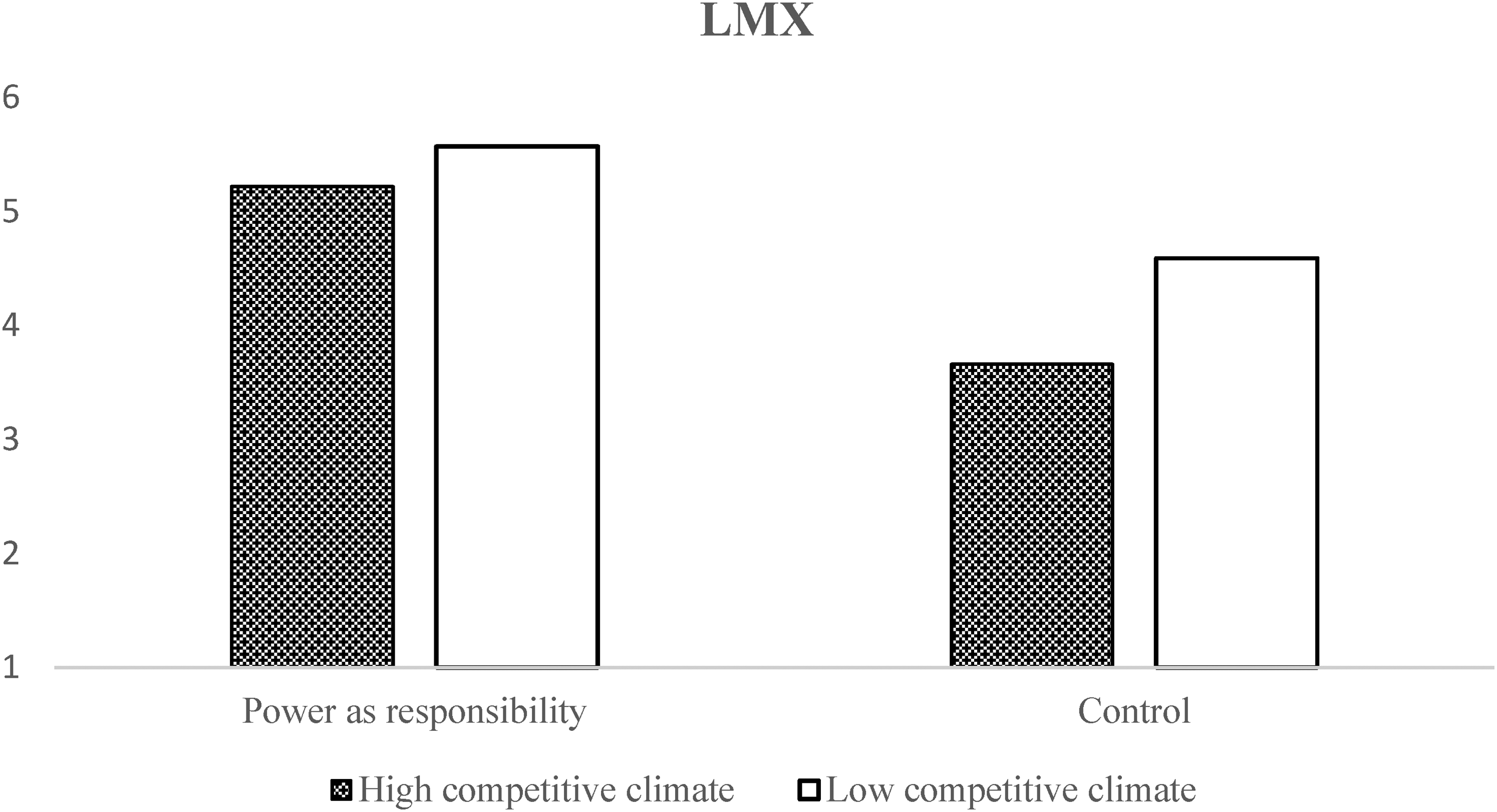
Followers’ tendency to perceive LMX as a function of competitive climate and leader's power as responsibility (study 1). Note. Ratings were on a 7-point scale ranging from 1 = Strongly disagree 7 = Strongly agree.
Discussion
The results supported Hypothesis 1a and showed that when employees face a leader who appears to construe power as responsibility, they report higher LMX. Alternatively put, followers reciprocate the leader's focus on responsible power usage by responding with increased trust, contribution, and affection. We also found support for Hypothesis 2a and showed that the positive effect of leader power construed as responsibility on LMX is stronger when the climate is competitive than when it is not. These results suggest that power differentials, in fact, can contribute to the development of high-quality relationships, particularly when leaders appear to construe their power as responsibility. Moreover, competition prompts followers to appreciate their leader's responsible behavior even more and to report higher LMX.
Although these results are promising, the confidence in our theoretical framework could be strengthened by adding a study that does not suffer from the disadvantages of being cross-sectional, that is not relying on a hypothesized situation, and that also includes leader power construal as opportunity. Our Study 2, therefore is a field study with a time-lagged design. Respondents are employees working in various companies who are asked to report on their perception of their own leader's power construal (as responsibility and opportunity) and the competitiveness of the climate (both at Time 1), and LMX (at Time 2).
Study 2
Method
Sample and Procedure
Three hundred and five British respondents took part in Time 1. Of those, 251 participated in Time 2. Moreover, 28 respondents did not meet the criterion of being employed and were excluded from further analysis. The final sample consisted, therefore, of 223 employees (66.8% female) working in various companies in the UK. Employees’ mean age was 36.29 years (SD = 9.37). Of the employees, 67.7% had obtained a higher education degree (bachelor's degree or higher) and 98.2% worked more than 20 h a week. We conducted a correlational two-week time-lagged study. Employees were recruited online via Prolific Academic and were compensated for their participation with £1.50.
Measures
Power of the Supervisor as Responsibility or Opportunity
We used the power construal scale of De Witt et al. (2017) to measure participants’ perception of the extent to which the supervisor construed his/her power as responsibility or opportunity. Three items assessed power as responsibility [“My supervisor tends to see his/her power in terms of…” “…the responsibilities it gives him/her towards his/her subordinates”; “…the obligations it gives him/her towards the subordinates (e.g., take care of things that need to be done)”; “…the responsibilities to ensure that important goals are met” α = .71)] and three items assessed power as opportunity [e.g., “My supervisor tends to see his/her power in terms of…” “…the opportunities that it gives him/her to make his/her own decisions”; “…the opportunities that it gives him/her to influence us, subordinates (e.g., telling us subordinates what to do)”; “…the opportunities it gives him/her to achieve goals that he/she finds important himself/herself”)]. We removed one item (“My supervisor tends to see his/her power in terms of the opportunities that it gives him/her to make his/her own decisions”) to obtain a reliability of α = .62. Employees rated each item on a 7-point Likert scale (1 = strongly disagree, 7 = strongly agree).
Perceived Competitive Climate
Similar to previous studies (Fletcher et al., 2008; Nerstad et al., 2013; Wisse et al., 2019) we used the eight items of the performance climate dimension of the motivational climate scale (Nerstad et al., 2013) to measure employees’ perceptions of competitive climate. An example item is “In my organization, internal competition is encouraged to attain the best possible results”. Employees indicated their level of agreement with each of the eight items (1 = strongly disagree; 5 = strongly agree; α = .90).
Quality of the Relationship with the Supervisor
The degree to which employees perceived a high-quality relationship with their supervisor was assessed using the same 11-item scale from Study 1 (Liden & Maslyn, 1998). The reliability of the scale was α = .93.
Control Variables
We controlled for gender, age, education, the number of working hours per week (1 = 8 or less, 6 = more than 40), the number of years that the employee occupied the current position (1 = less than 6 months, 5 = more than 5 years), the number of years the employee had worked with the current supervisor (1 = less than 6 months, 5 = more than 5 years), the leader-subordinate contact frequency (1 = seldom or never; 5 = very often), the impact of COVID-19 on participants’ personal and working life (see Study 1, α = .75) and the general affect (again using the PANAS, see Study 1, α = .79 both for positive and negative affect).
Results
Preliminary Analyses
Table 1 presents the correlations, means, and standard deviations of the study variables. The results showed that the perception of competitive climate was negatively correlated with LMX. We also found power as responsibility to be positively correlated to LMX. However, power as opportunity was not found to be correlated to LMX.
Pearson Correlations Coefficients Between Study Variables, Means, and Standard Deviations (Study 2).
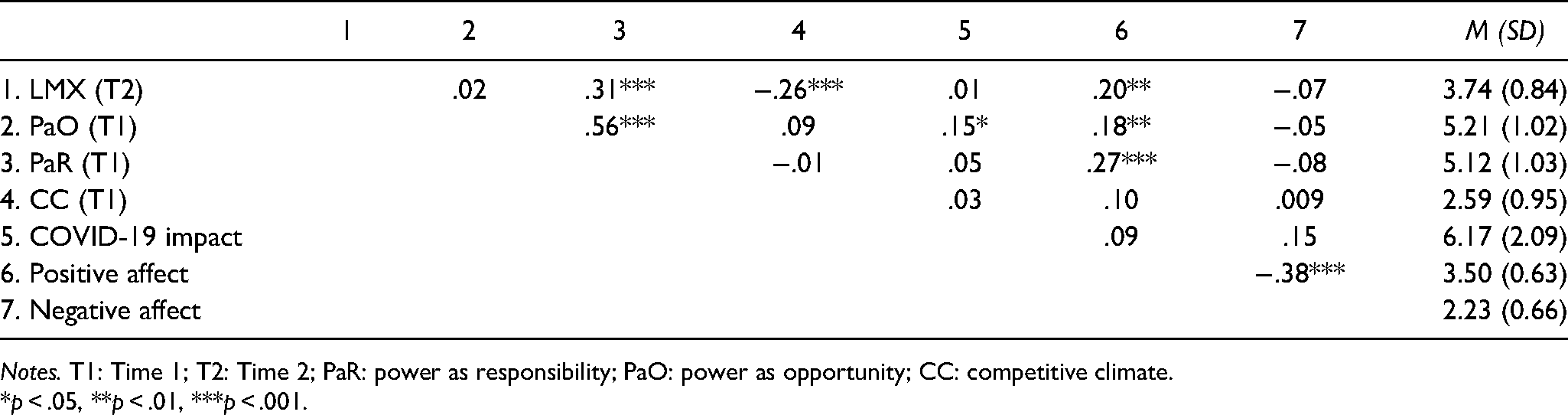
Notes. T1: Time 1; T2: Time 2; PaR: power as responsibility; PaO: power as opportunity; CC: competitive climate.
*p < .05, **p < .01, ***p < .001.
Again, we first conducted a confirmatory factor analysis to ensure that our variables were distinct from one another. In the analysis, we included power as responsibility and power as opportunity, performance climate, and LMX. LMX was entered as a higher-order factor with the four factors of LMX as subfactors (Liden & Maslyn, 1998). With the exception of SRMR, which was on the high side, the model had good fit (χ2 = 565.71, df = 243, p < .001; RMSEA = .08 [CI.07;.09]; CFI = .91; SRMR = .10).
Power Construal, Competitive Climate and LMX
To test the proposed model, we ran a multiple regression analysis using perceived LMX as our dependent variable. We entered the control variables, (centered scores of) perceptions of the extent to which leaders see their power as responsibility and as opportunity, perceptions of climate competitiveness, and the interactions between the centered scores of each type of power construal and competitive climate in the model (ΔR2 = 27, F (15, 207) = 6.52, p < .001).
In line with Hypothesis 1a, the extent to which employees indicated their supervisor construes power as responsibility was positively related to LMX. Moreover, the extent to which employees indicated their supervisor construes power as opportunity was negatively related to LMX, providing support for Hypothesis 1b. Competitive climate perceptions were also negatively related to LMX.
The interaction effect between power as responsibility and competitive climate was significant (see Table 2 for the relevant statistics). Supporting Hypothesis 2a, the results showed that the more employees indicated their supervisor construes power as responsibility, the more positive the employees were about the quality of the relationship with the supervisor when the climate was perceived to be highly competitive ( + 1 SD, b = 0.28, SE = 0.07, p < .001; 95% CI [.15;.42]), while this effect was not significant when the climate was perceived to be less competitive (−1 SD, b = 0.08, SE = 0.07, p = .24; 95% CI [−.05;.22]; see Figure 2). Unexpectedly, the interaction effect between power as opportunity and competitive climate was not significant. 4
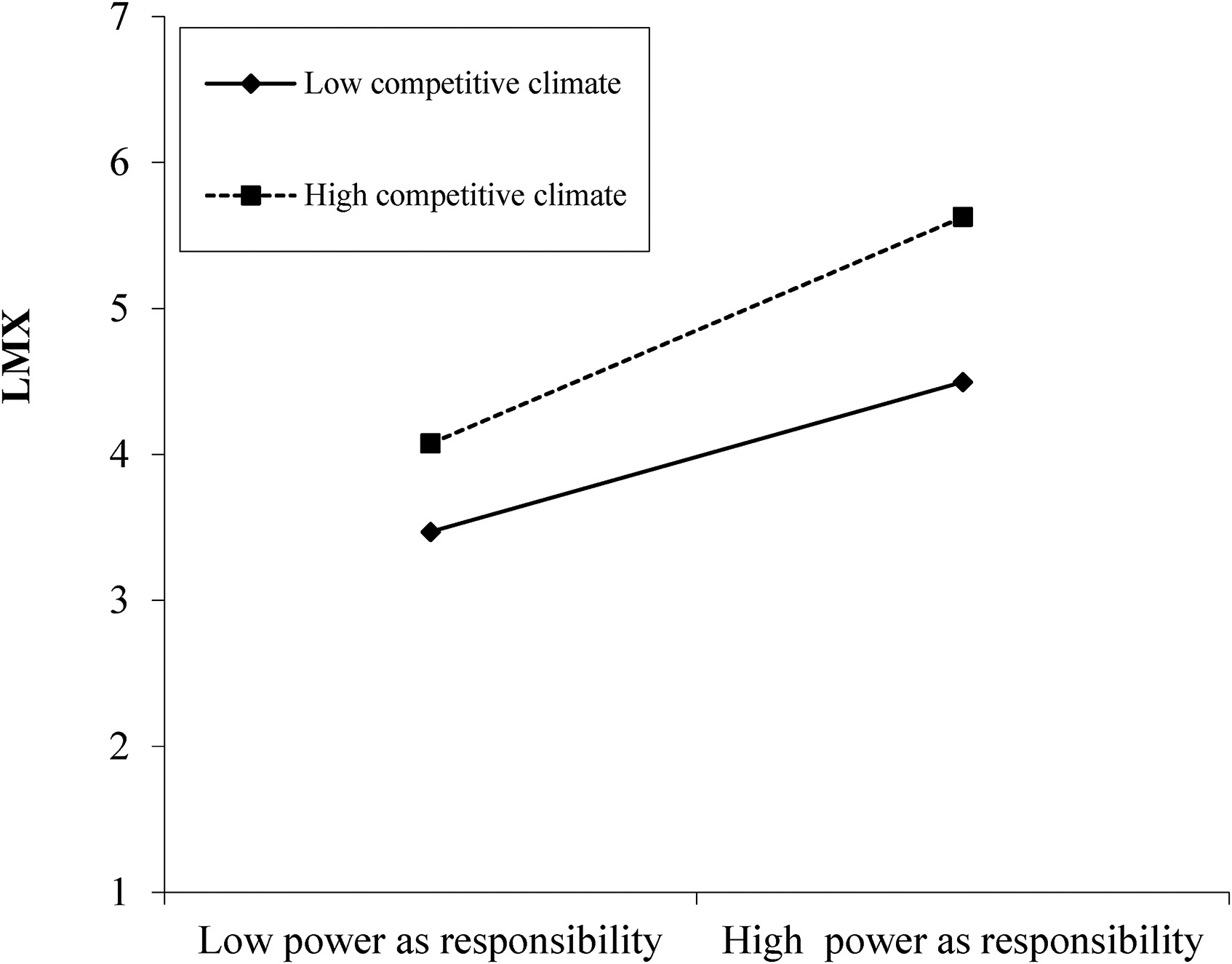
Follower LMX as a function of power construal as responsibility and competitive climate (study 2). Note. Ratings were on a 7-point scale ranging from 1 = Strongly disagree 7 = Strongly agree.
Regression Analyses Results on LMX (Study 2).
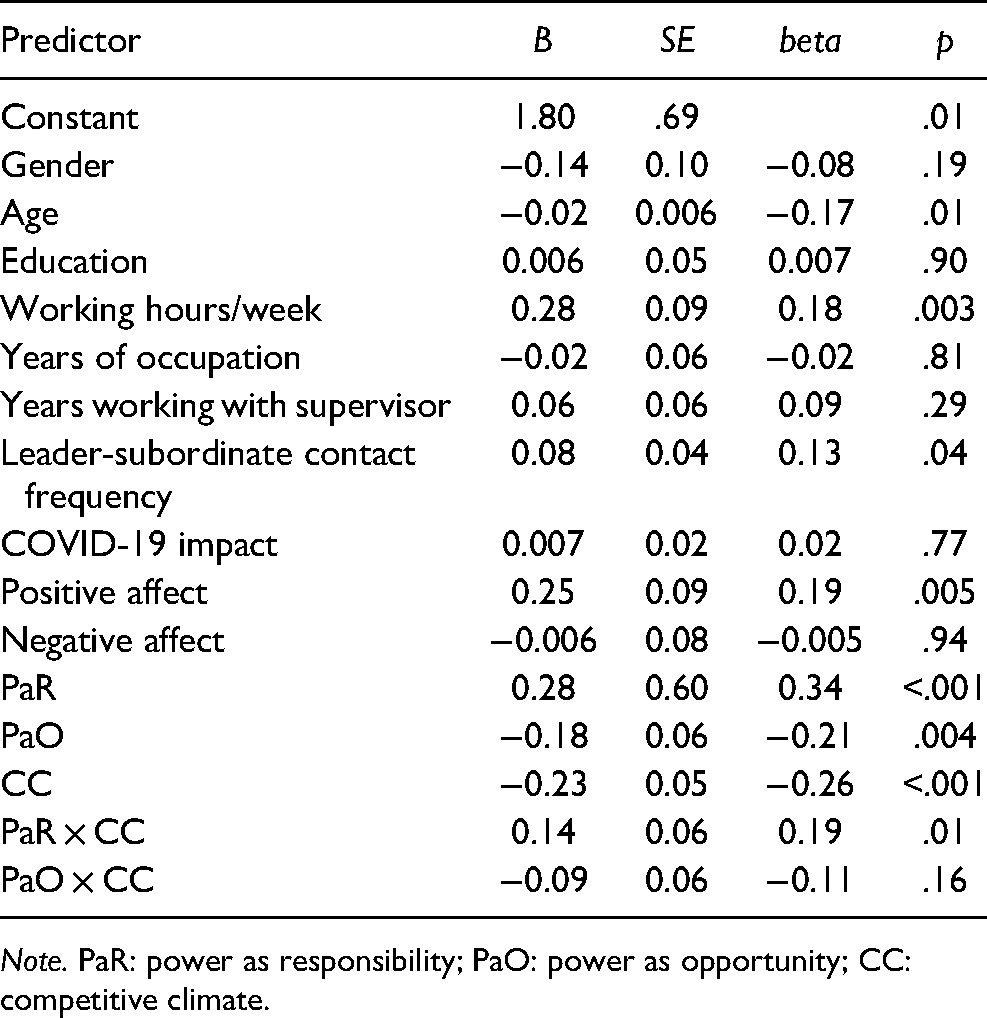
Note. PaR: power as responsibility; PaO: power as opportunity; CC: competitive climate.
Discussion
Study 2 supported most of our hypotheses while replicating the findings of Study 1 using a time-lagged design. We found that the more employees considered their supervisor to construe power as responsibility, the higher was the reported LMX. Conversely, the more employees considered their supervisor to construe power as opportunity, the lower was the perceived LMX. Importantly, we showed that the positive effect of power as responsibility on LMX is amplified when the climate is perceived as highly competitive. However, competitive climate did not moderate the effect of the leader's construal of power as opportunity on perceived LMX. We discuss these results further in the general discussion.
Study 3 aims to investigate the merits of our theoretical framework by using leader self-reported rather than follower perceived leader power construal. In other words, whereas in the previous studies we used either a description of a leader (Study 1) or a measurement of the followers’ perception of the leader's construal of power (Study 2), this study measured leaders’ power construal by using self-reports from leaders. To measure competitive climate and LMX we again relied on follower perceptions. Moreover, instead of sampling from the British population, we utilized a Dutch sample.
Study 3
Method
Sample and Procedure
The sample consisted of 157 pairs of Dutch employees and their direct supervisors. Supervisors (42.7% female) had a mean age of 39.40 years (SD = 11.66) and their subordinates (52.2% female) had a mean age of 30.28 years (SD = 11.21). Of the supervisors, 45% had obtained a higher education degree (bachelor's degree or higher) as compared to 37.6% of their subordinate employees. Generally, supervisors and their subordinate employees worked more than 25 h a week (79.9% and 54.5%, respectively).
Data for this study were collected as part of a study on social interactions between employees and their supervisors in the workplace. Potential respondents were mailed, contacted by phone, reached via social media, or approached in person by graduate students. Envelopes with paper-and-pencil questionnaires were distributed in pairs to employees and their direct supervisors. Those employees and supervisors interested in participating in the study were asked to fill in the paper-and-pencil questionnaires without consulting their colleagues, subordinates, or supervisor. The questionnaires were returned in the enclosed envelopes, which were picked up by the researchers. Each pair was coded to enable matching of supervisor-subordinate data. Because people often filled in the questionnaires during work hours, we kept the survey short and to the point.
Measures
Power of the Supervisor as Responsibility or Opportunity
We used the same power construal scale (De Witt et al., 2017) as in Study 2, but this time we measured the supervisor's own perceptions of power as responsibility (e.g., “I tend to see my power in terms of the responsibilities it gives me towards my subordinates”; α = .79) or as opportunity (e.g., “I tend to see my power in terms of the opportunities that it gives me to make my own decisions”; α = .66).
Perceived Competitive Climate
To measure employees’ perceptions of competitive climate, we used the performance climate questionnaire (Nerstad et al., 2013) that was utilized in Study 2. After removing one item (“There exists a competitive rivalry among the employees”) that hindered adequate model fit (see below), Cronbach's alpha was.88.
Quality of the Relationship with the Supervisor
The degree to which employees perceived a high-quality relationship with their supervisor was assessed using the same 11-item scale adopted in Studies 1 and 2 (Liden & Maslyn, 1998). The reliability of the scale was α = .85.
Control Variables
Additionally, we controlled for employees’ gender (1 = male, 2 = female, 3 = other), age, education, and working hours (1 = 8 h or less per week, 6 = more than 40 h per week).
Results
Preliminary Analyses
Table 3 presents the correlations, means, and standard deviations of the study variables. Similar to the correlations of Study 2 the perception of competitive climate was negatively correlated with LMX. Neither power as responsibility nor power as opportunity were correlated with LMX.
Pearson Correlations Coefficients Between Study Variables, Means, and Standard Deviations (Study 3).
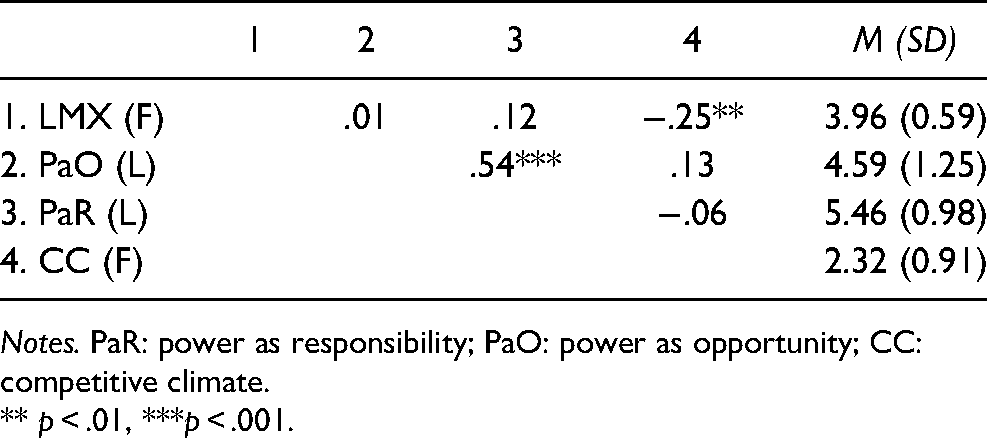
Notes. PaR: power as responsibility; PaO: power as opportunity; CC: competitive climate.
** p < .01, ***p < .001.
Again, we conducted a confirmatory factor analysis similar to Study 2. The model had good fit (χ2 = 398.53, df = 242, p < .001; RMSEA = .06 [CI.05;.08]; CFI = .91; SRMR = .07).
Power Construal, Competitive Climate and LMX
To test the proposed model, we ran a multiple regression analysis with perceived LMX as our dependent variable. We entered our control variables, (centered scores of) perceptions of power as responsibility and as opportunity, perceptions of climate competitiveness, as well as the interaction between each type of power construal and competitive climate into the model (ΔR2 = .12, F (9, 129) = 3.10, p = .002).
Unexpectedly, neither power construal as opportunity nor power construal as responsibility were significantly related to LMX. Competitive climate perceptions were significant and negatively related to LMX. Importantly, the results showed that the interaction effect between power as responsibility and competitive climate was again significant (see Table 4 for the relevant statistics). Supporting Hypothesis 2a, the results showed that the more the supervisor perceived power as responsibility, the more positively employees rated the quality of their relationship with the supervisor when the climate was perceived as highly competitive ( + 1 SD, b = 0.30, SE = 0.10, p = .002; 95% CI [.11;.49]), while this effect was not significant when the climate was perceived as less competitive (−1 SD, b = −0.09, SE = 0.07, p = .22; 95% CI [−.24;.06]; see Figure 3).
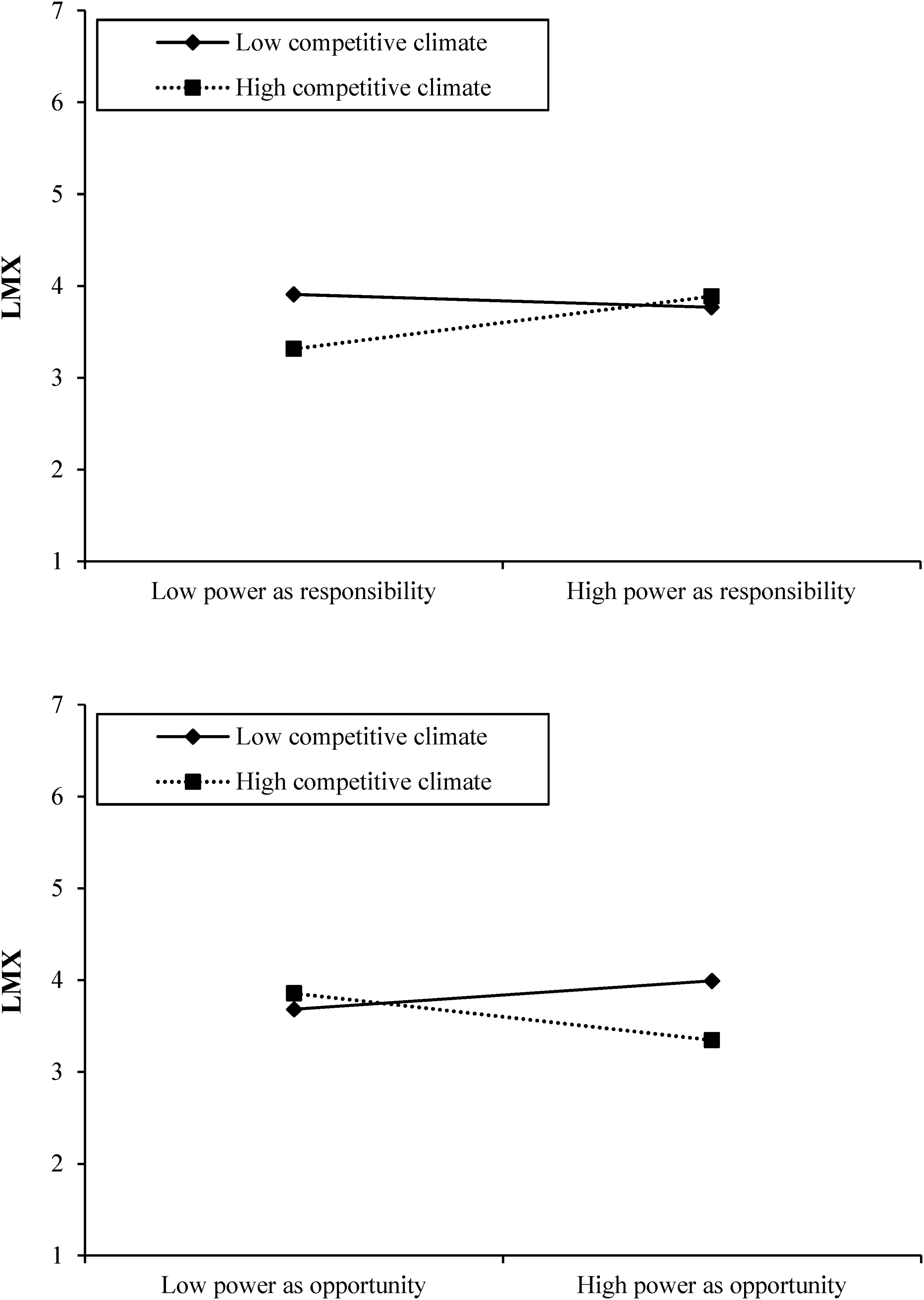
Follower LMX as a function of power construal and competitive climate (study 3). Note. Ratings were on a 7-point scale ranging from 1 = Strongly disagree 7 = Strongly agree.
Regression Analyses Results on LMX (Study 3).
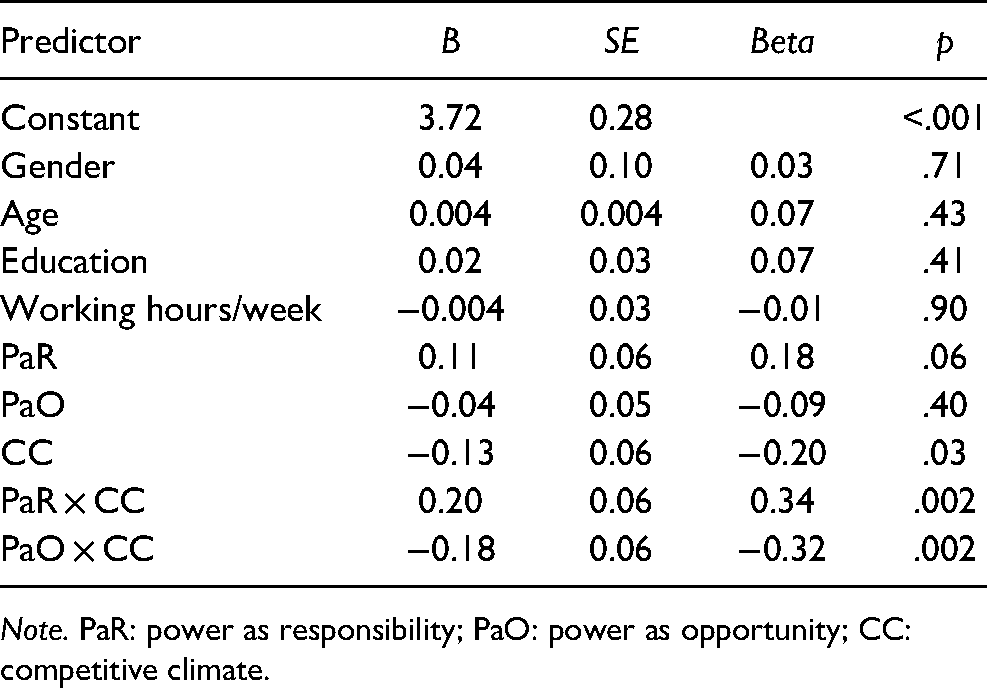
Note. PaR: power as responsibility; PaO: power as opportunity; CC: competitive climate.
Likewise, the interaction effect between power as opportunity and competitive climate was significant (see Table 4 for the relevant statistics). In line with Hypothesis 2b, the more the supervisor perceived power as opportunity, the less positively employees rated the quality of the relationship with their supervisor when the climate was perceived as highly competitive ( + 1 SD, b = −0.21, SE = 0.08, p = .008; 95% CI [−.37; −.06]). Moreover, the more the supervisor perceived power as opportunity, the more positively employees rated the quality of the relationship with their supervisor when the climate was perceived as less competitive (−1 SD, b = 0.14, SE = 0.07, p = .04; 95% CI [.005;.27]; see Figure 3) 5 .
Discussion
Study 3 aimed to examine the relationship of power construal as reported by the leader with perceived LMX. Unexpectedly, and in contrast to Hypotheses 1a and 1b, leaders’ power construal did not seem to directly influence followers’ perceptions of the relationship quality with leaders, and only did so when considering the moderating role of competitive climate in the analysis. A possible explanation for the insignificant main effect is that in Study 3 we assessed leader power construal by using self-reports. Power construal, as experienced and reported on by the leaders themselves, is expected to affect followers’ LMX, but it can only do so of leaders’ cognitions affect their observable behaviors towards followers, and these are, in turn, indeed perceived by followers. It is not unlikely though that any of these ties might be influenced by a host of other factors (e.g., follower individual differences or situational variables) which could possibly have muted the effect of leader power construal. However, in line with Hypotheses 2a and 2b, both power as responsibility and power as opportunity interacted with competitive climate in the prediction of followers’ LMX. The results suggest—in line with Study 1 and 2—that perceived competitive climate indeed accentuates the positive relationship between leader power construal as responsibility and perceived LMX. Moreover, the extent to which leaders construe power as opportunity was only negatively related to perceived LMX when followers strongly perceived that they are operating in a competitive climate. Overall, these findings are particularly interesting as they show that self-reported power construal of leaders produces similar results with perceived power construal (Study 2) on followers LMX. We discuss these findings in more detail below.
General Discussion
Power is inherent in leadership positions (Rus et al., 2012) and leaders are assumed to be responsible for and invested in their followers’ interests. In other words, the leadership role comes with the expectation that the leader will pay attention to followers’ needs and help them fulfill their goals. Nevertheless, leaders often see their power as an opportunity to pursue their own goals and desires (Sassenberg et al., 2014). Given that power plays a decisive role in the direction and quality of leader-follower relationships (Dansereau et al., 1975; Dulebohn et al., 2012), the current research takes a first step in addressing the question of whether leaders’ construal of power (as responsibility or opportunity) has beneficial or detrimental consequences for LMX. Moreover, since power and leadership processes do not play out in a social vacuum (Anderson & Brion, 2014; Padilla et al., 2007), but are embedded in a larger social context (Wisse et al., 2019), we considered work climate as a variable that might affect the relationship between leaders’ construal of power and perceived LMX.
Overall, we found that employees report higher LMX when they infer that their leaders construe their power as responsibility (Study 1) but also when they perceive that their leaders construe power as responsibility (Study 2). In contrast, employees report lower LMX when they perceive that their leaders construe their power as opportunity (Study 2). Moreover, in all three studies, we found support for our prediction that competitive organizational climates strengthen the relationship between leader power as responsibility and LMX. Specifically, Study 1 (an experimental study) showed that perceptions that a leader construes power as responsibility can cause employees to report a higher-quality relationship with leaders in terms of LMX, particularly when the organizational climate is strongly competitive. Study 2 (a two-week lagged study) showed that followers’ perception that their leader construes power as responsibility (Time 1) is positively associated with LMX (Time 2), particularly when the climate is perceived as more competitive (Time 1). In a similar vein, Study 3 showed in a cross-sectional field study with dyads of leaders and followers that perceived competitive climate indeed accentuated the positive relationship between power construal as responsibility (as reported by the leader) and followers’ perceived LMX. In this study, we also found that leaders’ construal of power as opportunity was negatively related to perceived LMX when followers strongly perceived that the existing climate is competitive. Against our predictions and contrary to Studies 1 and 2, the main effect of power as responsibility did not prove to be significant in Study 3. Again, this insignificance may be explained by how we measured power construal in Study 3. By tapping into how leaders construed their power, LMX as perceived by followers could only have been affected if those leader cognitions influenced their observable behavior, and if that behavior was subsequently also observed by followers (hence affecting their perception of LMX). As such, the power construal measure that we used in this Study was more distal than the ones we used in Study 1 and 2. An additional possible explanation for the insignificant main effect of power as opportunity in study 3 could be the relatively low reliability of the measure that we used in that study. An alternative explanation of the systematic insignificant main effect of power as opportunity across the studies is that power as opportunity might reflect the common way of conceiving power (see Anderson et al., 2012) and might be less notable or not necessarily interpreted in a negative way by followers and therefore might not influence their LMX perception.
An unexpected finding that is worth reporting is the positive correlation between power as opportunity and power as responsibility. Although this is unexpected (De Wit et al., 2017), one reason for this association may be that power as responsibility as well as power as opportunity refer to the notion that power is to be used and put into action. That is, a higher score on either of the power construals have in common that they denote proactive perspective on power. Future research may fruitfully investigate if there is any merit to this line of reasoning. The extent to which these two power construals are indeed orthogonal concepts or whether they covary might help further explain what these constructs entail.
Overall, these results support our hypotheses regarding the relationship between power as responsibility and LMX when accounting for competitive context. However, the current findings provide a less clear picture of the effects of power as opportunity on LMX. A possible explanation for these inconsistent effects may be found in the so-called implicit leadership theories (Eden & Leviatan, 1975), which capture people's expectations about how leaders typically behave (Schyns & Schilling, 2011). Because power often goes hand in hand with self-interested tendencies, employees may generally expect leaders to hold an opportunistic outlook on power (Keltner et al., 2003; Lammers et al., 2015; Wisse & Rus, 2012). A close fit between followers’ implicit leadership theories and leaders’ actual characteristics may therefore not need to detract from LMX and may even boost it (see Epitropaki & Martin, 2005), which may have countered the negative influences of expected opportunistic tendencies per se. Future research may focus on the role of implicit leadership theories to assess their influence.
Our study supports and extends previous research in several ways. First, concerning the psychology of power, the current findings stress the importance of taking the construal of power into account and moving beyond the main effects of high versus low power that are often reported in the literature (also Anderson & Galinsky, 2006; Fousiani et al., 2021; Sassenberg et al., 2014). Moreover, our findings align well with and add to other research that shows that power can reveal what people actually feel, think and want (see Keltner et al., 2003). That is, power increases the correspondence between internal beliefs, states and traits, on the one hand, and behavior on the other (Galinsky et al., 2015); this can, in turn, affect people's relationships with others. For instance, scholars have found that leader self-construal (in personal or collective terms) affects self-interested behavior more strongly when leaders are more powerful (Wisse & Rus, 2012); that the negative effect of depletion on prosocial behavior among people low in moral identity is restricted to people high, rather than low, in power (Joosten et al., 2015), and that powerful leaders act more selfishly when they hold self-serving effective leadership beliefs than when they endorse group-serving effective leadership beliefs, whereas such effects are absent for less powerful leaders (Rus et al., 2010). This study adds to these findings by showing that the way in which powerful leaders construe their power may have important downstream consequences and ultimately affect their relationships with others, arguably because such construal affects people's expectations.
Second, our findings also speak to the LMX literature by providing insights into leader-follower relationships. For instance, the LMX literature has largely focused on explicating how leaders relate with their followers (Dansereau et al., 1975; Sparrowe & Liden, 1997). However, it has overlooked the role of the power dynamics at play on LMX. In this research, we take the literature one step further and show that followers do not feel uncomfortable with their reliance on the leader for gaining access to valued resources, instead they feel that the relationship with the leader is characterized by trust, affection, and respect—as long as the leader construes power as responsibility.
Third, our findings identify a contextual factor that may influence the effects of power construal on LMX. More specifically, we found evidence about the amplifying role of competitive climate in the effects of power construal, either as responsibility (Studies 1–3) or as opportunity (Study 3), on LMX. These findings can contribute to a better understanding of the inherent characteristics of organizational competition. For instance, organizational competition is frequently viewed as a negative state, linked to an array of undesired outcomes such as undermining others, exploitation of oneself (Kohn, 1992), burnout, stress, and mental suffering (De Meis et al., 2003). Indeed, in line with the above, we found that a competitive climate, in conjunction with leaders construing power as opportunity, decreases the leader-follower relationship quality. However, our findings also suggest that when combined with a leader's construal of power as responsibility, a competitive climate renders the leader's responsible orientation as more appreciable and impactful, as reflected by perceived LMX. This positive effect of competition climate aligns with prior research associating competition with positive organizational outcomes such as high motivation and better performance (Fletcher et al., 2008).
Practical Implications
Apart from its theoretical implications, this study also features several—albeit tentative—practical implications. High LMX can lead to an array of positive consequences for both leaders and followers, but also for the organization itself (Erdogan & Bauer, 2016). The current findings suggest that interventions geared at prompting leaders to focus more on their responsibilities towards employees and less on the opportunities that come with their elevated power might be practically useful. At this point, it is worth mentioning that prompting leaders to focus more on their duties as leader may not be that easy, as powerholders often view the construal of power as responsibility as a burden (Sassenberg et al., 2012). Alternatively put, when construed as responsibility, power is less attractive to people, as it is primarily associated with one's obligation towards others rather than the opportunity to achieve personal goals. Organizations might consider fostering the positive side of being responsible for the outcomes and achievements of those with less power. For example, organizations might need to create procedures that prompt leaders to identify with their followers’ outcomes and enable them to psychologically invest in these outcomes. That is, leaders might perceive responsibility-construed power as more alluring when their followers’ outcomes are directly related to their own leadership skills and competencies, for which they are correspondingly rewarded.
Importantly, whereas several scholars might suggest that organizations should work on curbing a competitive climate (Černe et al., 2014a, 2014b; De Meis et al., 2003; Gim et al., 2015), this is not always feasible. At work, employees often associate success and achievement with outperforming others (see also DeShon & Gillespie, 2005); Hence, a competitive climate is the default work climate in many modern organizations. However, our findings suggest that a competitive climate is not necessarily detrimental for employees—at least when combined with responsible leadership that provides opportunities for high-quality relationships with leaders. For instance, when followers are aware of the competitive nature of their work environment, but also perceive that leaders construe power as responsibility, they might feel “safe” enough to overcome the negative aspects of competition and invest in their work. Accordingly, we suggest that the construal of leaders’ power as responsibility is particularly important in competitive work climates.
Strengths, Limitations and Suggestions for Future Research
Our studies have a number of strengths. For instance, we used a multi-study approach. Study 1 employed an experimental design and assessed employee perceptions. Study 2 was a time-lagged study with employees. Study 3 was a multi-source data set with pairs of leaders and followers. Moreover, we combined different methods to operationalize power construal: In Study 1 we manipulated power construal, in Study 2 we measured perceived power construal using follower-reports (i.e., follower perception of a leader's power construal), while in Study 3 we assessed self-reported power construal as perceived by the enactor (i.e., leader). By combining different methods, we come to a more fine-grained understanding of the effects of power construal, as we investigated the inferred, attributed (by an observer), and the self-reported (by the enactor) power construal's influences on followers’ LMX perception”. Finally, regardless of whether we used a manipulation of competitive climate (Study 1), or employees’ climate perceptions (Studies 2 and 3), we always found competitive climate to strengthen the relationship between power construal and perceived LMX.
Of course, this research is not without limitations. First, our design for Study 1 may have had some drawbacks. For instance, although we compared a power as responsibility condition with a control group, we were unable to appropriately test power as opportunity in our manipulation. Future research should try to replicate these findings in a complete design that manipulates power as both opportunity and responsibility in the prediction of LMX. Second, the experimental study was based on vignettes, which are hypothetical in nature. Future research may consider full-blown laboratory experiments for a relatively more realistic set-up. For instance, a confederate might take the role of a leader and use the power that comes along with their role as responsibility towards participants (followers) or as opportunity. Third, a limitation of Study 2 was the low reliability of the power-as-opportunity scale. Although the scale we used was well established and successfully used in prior research (De Witt et al., 2017), the construct of power construal is still rather new in the literature; thus, improving the existing research tools might be necessary. To better capture power construal as opportunity or responsibility, future research might focus on the further development of power construal scales that can be broadly used in various work contexts. Moreover, although Study 2 (time-lagged study) measured our constructs at different times, the time lag between the two measurements was short (two weeks) and we cannot make inferences regarding intra-individual changes across time. Future research should use bigger time-lags or cross-lagged designs to investigate such phenomena. Further, although we were able to demonstrate a robust effect of construal of power as responsibility and competitive climate on LMX, this study did not investigate the psychological mechanisms that may drive these effects. For instance, it is likely that employees form high LMX perceptions when confronted with leaders who construe power as responsibility because they expect these leaders to treat them with individualized consideration (Conger, 2014). Besides, a leader who construes power as responsibility may come across as a communally oriented leader, that is, as one who cares for the needs and well-being of their followers (Foulk et al., 2020) and one who wishes that followers care for them in return (Le et al., 2013). Such a communal and relationship-oriented perception of leader would then prompt followers to like and trust their leader more and perceive a higher LMX. Future studies should focus on investigating the mediating variables that may explain the effects of power construal and competitive climate on leader-follower relationship quality. Finally, besides positive and negative affect (Thompson, 2007), age, and length of acquaintance, this study did not control for other known antecedents of LMX. Several follower characteristics (e.g., personality traits), leader characteristics (leadership style, expectations from followers, and personality traits), and interpersonal relationship aspects (e.g., perceived similarity) have been found to predict LMX (Dulebohn et al., 2012), and therefore, they should be considered as control variables in future research in order to be able to give a precise estimate of the unique effects of leader power construal.
Conclusion
To conclude, the current research studied the interplay between leaders’ power construal and competitive climate on leader-follower relationship quality. We found that power, when construed by the leader as responsibility but also when perceived by the follower as responsibility can have beneficial effects on the leader-follower relationship quality. More specifically, when leaders construe –or are perceived to construe– their power as a means to help followers achieve their goals and complete their tasks, followers perceive a high-quality relationship with the leader, particularly in work climates that are perceived as highly competitive.
Footnotes
Acknowledgments
We wish to thank the Editor and the anonymous reviewers for their constructive feedback and usefull comments on earlier versions of this manuscript.
We would also like to thank Elissa Khawli for her great help in the statistical part of the paper and our research assistant, Giorgos Michelakis for reviewing the final draft of this work.
Declaration of Conflicting Interests
The author(s) declared no potential conflicts of interest with respect to the research, authorship, and/or publication of this article.
Funding
The author(s) received no financial support for the research, authorship and/or publication of this article.
