



Abstract
This article explores the relationship between leadership and networks in entrepreneurial firms. A longitudinal perspective is adopted to consider how leadership evolves and develops over time in an entrepreneurial setting, based on how leaders draw on networks in which they are embedded. Findings from a qualitative study of an organization operating for over 70 years and including over 50 business-owning families are presented. These show that networks not only shape and define the leadership of the entrepreneurial firm, but also that the firm’s evolution, growth and development are the result of how networks entwine with leadership. These findings are theorized in the form of an entrepreneurial evolution model that is driven by the form and reach of embedded network connections and draws on leader-member Exchange theory. The article concludes with some thoughts on the benefits of networks for practicing leaders.
Introduction
This study is motivated by a need to better understand how leaders in entrepreneurial businesses use their networks to enhance the evolution, growth and development of the firm. Specifically, it focuses on the symbiotic relationship between the evolution of entrepreneurial leadership and the evolution of the underlying networks through which such businesses develop. Entrepreneurship here is understood as ‘the recognition and exploitation of business opportunities’ (Zichella and Reichstein, 2023: 731), or what Chang and Rieple (2018: 471) refer to as ‘opportunity management behaviours’. Borgatti and Halgin (2011) define networks as a set of actors or ‘nodes’ linked by ties of a specific type, and expected to produce beneficial outcomes. Networks add value through the provision of information, opportunities and resources (Greve and Salaff, 2003; Miettinen et al., 2008), including social capital (Anderson et al., 2007), thus allowing networked organizations to achieve more by working together than they can separately (Borgatti and Halgin, 2011).
While the application of network theory to entrepreneurial contexts is well established in the management literature (Dodgson, 2011; O’Donnell et al., 2001), there is a lack of clarity concerning the overlaps between ‘leadership’ and ‘entrepreneurship’, with the resultant ‘entrepreneurial leadership’ (e.g. Leitch et al., 2013; Renko et al., 2015) occupying an ambiguous position between the two research domains. It has been argued that the entrepreneurial leadership construct ‘remains atheoretical and lacks definitional clarity’ (Leitch et al., 2013; Leitch and Volery, 2017: 148), with calls for further theoretical and empirical work (Leitch and Volery, 2017) to rectify this weak grounding. In particular, Leitch and Volery (2017: 154) urged scholars to ‘consider studies based on more processual and relational views in which temporality and contextuality are stressed’.
In responding to this call, we draw on understandings of entrepreneurial leadership as the ability of an entrepreneur to influence and direct the performance of group members towards the identification and exploitation of opportunities (Renko et al., 2015) and steer the organization in its development under uncertainty (Röschke, 2018). The entrepreneur here is not a sole agent but is embedded in networks of relationships that provide valuable resources to support the entrepreneurial venture (Jack and Anderson, 2002; Miettinen et al., 2008). These networks are dynamic, with their content and structure varying in response to entrepreneurial needs over time (Burt, 2000; Hite and Hesterly, 2001; Soetano, 2019). We suggest that exploration of the co-evolution of networks with leadership in entrepreneurial contexts can contribute to our understanding of entrepreneurial leadership (Brass et al., 2004).
For entrepreneurs, the use of networks – and the importance of understanding their operation and impact – is necessitated by the mounting pressures of globalization (Parkhe et al., 2006), while for researchers network theory usefully shifts the focus away from atomistic explanations of phenomena to relationships among systems of interdependent actors (Wellman, 1988). This latter affords a more dynamic understanding of phenomena while acknowledging the inherent relational embeddedness of leadership/entrepreneurial activity. Building on this important perspective, our case study is situated at the intersection of entrepreneurial leadership and networks, while our contribution lies in the synthesis of entrepreneurial leadership and networks through the lens of relational leadership (McCauley and Palus, 2021).
Our specific research question asks: how does entrepreneurial leadership evolve through the use of networks as entrepreneurial firms grow and develop? To address this question, we adopt a longitudinal case study perspective (Jones and Giordano, 2021), which allows us to demonstrate the importance of temporality to understanding the long-term evolution of leadership and its implications for entrepreneurial firms (Oinas, 1999). The research is based on an in-depth qualitative case study of SEUR, a Spanish express transport business that has sustained operations for more than 70 years and evolved from small beginnings to operate with more than 50 business-owning families organized in a cooperative horizontal network structure. In the early 20th century, the French company GeoPost became a shareholder in SEUR and has continuously expanded its stake since, becoming SEUR’s majority owner in 2012 (San Román et al., 2014; Tàpies et al., 2012:). In 2023, the merger between GeoPost and SEUR was approved.
The history and structure of SEUR offer a particularly ‘perspicuous setting’ (Garfinkel, 1996: 16) for surfacing entrepreneurial leadership dynamics and their inter-relatedness with embedded networks (Gil-López et al., 2023). We adopt perspectives from relational leadership (McCauley and Palus, 2021), and in particular the Leadership Making Model within leader-member exchange (LMX) theory (Graen and Uhl-Bien, 1995), to theorize a co-evolution model of how entrepreneurial leadership develops through different stages of the entrepreneurial firm’s growth and development, driven by the form and reach of the entrepreneur’s network connections. In particular, the offer and response interactions through which the relationship between leaders and followers develops, posited by LMX theory, had resonance for us in making sense of the patterns of interaction we observed between emergent leaders and other network members in the development of SEUR over time. This model posits that entrepreneurial leadership develops at the nexus of entrepreneurship and leadership, through an evolutionary social process in which leaders within an entrepreneurial context conceive opportunities, mobilize individuals in a network and co-shape the trajectory of organizational development. We theorize a symbiotic relationship between the evolution of the business, the strength of the underlying network and the nature of entrepreneurial leadership employed, resulting in a series of distinct phases over time. Through this conceptualization, we contribute to the entrepreneurial leadership literature, and specifically our understandings of the dynamic evolution of entrepreneurial leadership as firms develop, by demonstrating the fundamental role of social networks within the enactment of leadership in entrepreneurial settings. The findings from this study can be seen to have implications for researchers, where the historically informed methodology gives access to the dynamics of entrepreneurial leadership over time, and for practitioners as a reflective framework for prompting the development of their networking skills in line with business needs. It also speaks to Butcher’s (2018: 343) call for further research into the sites and practices of entrepreneurial learning with a view to understanding how career trajectories are being ‘reimagined, re-enacted and reproduced as collective endeavours’. Importantly, it speaks to the role of support and guidance (Miettinen et al., 2008) within the network as a factor in entrepreneurial learning across the organization, and the mechanisms through which such learning is shared at both an individual and an organizational level (Hibbert and Huxham, 2011).
This article is presented in five sections. First, the theoretical framework is shown, drawing on the three related literatures of networks, entrepreneurship and leadership. Next, we set out our research approach, the rationale for adopting a longitudinal perspective and the background to our empirical case study. This is followed by our findings and their theorization as an entrepreneurial leadership evolution model. We conclude by discussing the implications of our research for entrepreneurial learning.
Entrepreneurial leadership and the role of networks
Entrepreneurial leadership – an atheoretical concept?
The concept of entrepreneurial leadership emerged as a critical issue in the late 20th century, as a response to increasing economic pressures and business globalization (Leitch et al., 2013). Renko et al. (2015: 54) define entrepreneurial leadership as ‘influencing and directing the performance of group members toward achieving those organizational goals that involve recognizing and exploiting entrepreneurial opportunities’. Leitch et al. (2013) draw a distinction between entrepreneurial leadership per se and more general entrepreneurial styles of leadership. For Leitch and Volery (2017: 147), entrepreneurs are leaders ‘par excellence’ through their ability to ‘identify opportunities and marshal resources from various stakeholders in order to exploit these opportunities and create value’.
Entrepreneurial leadership was initially framed as the traits and behaviours required to enact leadership in an entrepreneurial context (Renko et al., 2015). The result of these early endeavours was a collection of characteristics – vision, opportunity-focus, achievement orientation, risk-taking, tolerance for ambiguity, tenacity and self-confidence – rather than an articulate, theoretical formulation that is uniquely definitive of leadership in an entrepreneurial context. More recent work evolved to incorporate process perspectives (Antonakis and Autio, 2007) and to recognize the importance of developing entrepreneurial leadership through resocialization and adaptive learning undertaken within learning networks. This interaction with peers in a networked context is an important point of departure for our own study.
While some (Vecchio, 2003) have claimed there is nothing distinctive about entrepreneurial leadership, for others (Fernald et al., 2005) it represents a break with past understandings and the development of a new, more fluid form of leadership. Existing at the intersection between entrepreneurship and leadership (Renko et al., 2015), there is a lack of clarity concerning the overlaps between the constituent concepts, with entrepreneurial leadership occupying an ambiguous position between the two research domains. The argument that the entrepreneurial leadership construct ‘remains atheoretical and lacks definitional clarity’ (Leitch and Volery, 2017: 148) has resulted in calls for further theoretical and empirical work to rectify this weak grounding, with scholars being urged to ‘consider studies based on more processual and relational views in which temporality and contextuality are stressed’ (Leitch and Volery, 2017: 154).
What theoretical groundings entrepreneurial leadership does possess have been adopted from the leadership discipline as one of its parent domains. For example, Renko et al. (2015) note its association with transformational leadership, while Leitch and Volery (2017) observe that it has also been characterized as being similar to authentic and charismatic leadership. This approach has failed to deliver a distinctive construct for leaders in entrepreneurial settings. We draw on work adopting relational ontologies (Sklaveniti, 2017) to explore the emergence of entrepreneurial leadership in new ventures and utilize a life history approach (Dean and Ford, 2017) to capture the role of the external environment in shaping entrepreneurial leadership experiences. We bring these together through the lens of relational leadership (Uhl-Bien, 2006) to theorize the role of embedded networks in the enactment of entrepreneurial leadership.
Network theory and entrepreneurial leadership
Networks – a set of actors or ‘nodes’ together with the ties of a specific type (e.g. kinship) that connect them (Borgatti and Halgin, 2011) – add value to entrepreneurial businesses through the provision of information, opportunities and resources seen as crucial to starting or developing a firm (Greve and Salaff, 2003). They can also be a source of social capital, the benefit of which resides within the network of relations themselves and which is accessed through social interactions and exchange (Anderson et al., 2007). Effective usage of networks allows organizations to achieve more by working together than they can separately, through the virtual transference of capabilities facilitated by the connections between network members (Borgatti and Halgin, 2011). Networking between individuals who share similar values or social background is a business strategy that has historically allowed business survival under uncertain environments (Fernández Pérez and Rose, 2010).
The pattern of ties within a given network can be expected to produce certain structures and outcomes. In determining these outcomes, core network theory has posited the relative value of strong and weak ties (Granovetter, 1973) and the importance of ‘bridging ties’ in countering the effects of ‘structural holes’ (Burt, 1992) within an individual’s network. The relations between actors are a key feature of any network (Balkundi and Kilduff, 2006; Freeman, 2004), with individuals seen to immerse themselves in relationships that provide value (Burt, 2000). In the management literature, network theory can be seen to have relevance for growing and developing a business, but further research is required to understand how networks in which leaders are embedded work to influence their leadership and firm development (Brass et al., 2004).
The shift from viewing entrepreneurs as ‘atomistic’ individuals to viewing them as people embedded in a network (Elfring and Hulsink, 2003) has highlighted the relevance of network relations for entrepreneurs and has led to a growing realization that networks can play a critical role in entrepreneurial success (Gil-López et al., 2023; Jack, 2010). In part, this is because social assets such as friendship, trust and obligations are utilized by entrepreneurs to achieve entrepreneurial outcomes (Miettinen et al., 2008; Starr and MacMillan, 1990). Entrepreneurs mobilize networks to access power, information, knowledge and capital, as well as to bring legitimacy to the entrepreneurial firm in a way which supports growth and development (Elfring and Hulsink, 2003; Jack, 2005). There is as yet, however, little empirical research concerning the relationship between leadership and networks, nor how leaders collaborate with network contacts within the entrepreneurial setting (McGuire and Silvia, 2009; Silvia and McGuire, 2010).
Relational leadership as a lens
In her seminal paper on relational leadership theory, Uhl-Bien (2006: 655) characterized leadership and organization as ‘social constructions that emanate from rich connections and interdependencies between organizations and their members’. A relational orientation thus ‘starts with processes and not persons and views persons, leadership and other relational realities as made in processes’ (Uhl-Bien, 2006: 655 original emphasis). From this perspective, relational leadership is defined as ‘a social influence process through which emergent coordination (i.e. evolving social order) and change (e.g. new values, attitudes, approaches, behaviours and ideologies) are constructed and produced’ (Uhl-Bien, 2006: 655). This definition draws on the work of Hosking (1988), which sees ‘leaders’ as those who ‘consistently make effective contributions to social order, and who are expected and perceived to do so’ (Hosking, 1988: 153).
Within the relational domain, the entity perspective focuses on the intentions, perceptions and behaviours individuals bring to their relationships with one another (Uhl-Bien, 2006) and is exemplified by LMX theory (Graen and Uhl-Bien, 1995). This perspective’s focus on the relational processes through which leadership is produced and enabled has relevance for us, as does the notion that leadership is ‘a process of organizing’ undertaken in the context of ongoing local-cultural-historical processes (Uhl-Bien, 2006: 665). Of particular relevance for us is the LMX Leadership Making Model (Graen and Uhl-Bien, 1995), which describes the building of leader–follower dyadic relationships in terms of the evolution of leadership relationship maturity. This evolution, ‘developed to identify the importance of generating more high-quality relationships within organizations and to describe a process for how these may be realized in practice’ (Graen and Uhl-Bien, 1995: 230), depicts leader–follower relationships as developing from stranger, to acquaintance, to maturity as exchanges between dyad members shift from purely transactional and formal, through an offer of career-oriented social exchange, to a position of long-term reciprocity. At each stage, an interaction based on offer and response either further the relationship or leaves it fallow.
Methodology
To address our research question, set out above, we utilized an in-depth longitudinal case study approach (Jones and Giordano, 2021), focusing on the Spanish courier company SEUR. This organization was selected due to its structure as a networked business, owned and operated by more than 50 families. Our longitudinal approach is particularly suitable to describe and analyse processes and patterns of change taking place over time (Hassett and Paavilainen-Mäntymäki, 2013).
Case context
SEUR is the oldest Spanish express logistics company and one of the most prominent in the Spanish market (Tàpies et al., 2012). It was founded in 1942, by two friends, with no relevant training, university education or resources, who saw an opportunity (Chang and Rieple, 2018) for the quick delivery of goods between Madrid and Barcelona. They set up two independent companies, one based in each city, and worked in partnership transporting packages between them. As the company grew in the early 1970s, new partners were selected from the founders’ relatives, friends or employees. When they joined SEUR, they were responsible for promoting the business in one or more Spanish provinces. All of them shared similar values and social background, making the company a homogeneous group in which every partner depended on the others. This homogeneity made it easier to sustain network-like arrangements (Powell, 1990; San Román et al., 2014). As the network expanded in the mid-1980s, SEUR began an intensive task of professionalization and legal reorganization, employing external experts in all areas of management. A professional general manager joined the business in 1984. The SEUR network also formalized its structure through two actions: the foundation of the parent company, SEUR España, in 1984 which took over the central management services including accounting, advertising, insurance, tax, labour, legal and customer service, and the adoption of a franchise system in 1997. In the early 2000s, following increased competition in the domestic market, SEUR sought international alliances. In 2004, GeoPost, a subsidiary of the French postal operator, joined SEUR first as an international partner and then as a franchise owner, a process which continued until, in 2023, GeoPost absorbed SEUR in its entirely.
Data collection
Our study is based on an extensive collection of written and oral sources gathered through a business history project initiated to celebrate SEUR’s 70 years of activity in 2012. Two of the authors were invited by the company to write a book based on this research. Data collection was primarily interview-based, with a total of 49 interviews carried out between 2011 and 2012. Forty-four partners and five senior managers of SEUR were interviewed. Through approaching informants with diverse perspectives, we addressed the issue of bias typically associated with interviewing (Eisenhardt and Graebner, 2007). Sixteen of the 44 interviewed partners had already sold their SEUR affiliate at the time the research was conducted. A table listing interviewees, their profiles and connections to the members of the network can be found in Appendix 1. Interviews were audio recorded and transcribed.
These semi-structured interviews lasted between 1 and 3 hours, and focused on understanding the historical stages of the organization’s development. Our respondents were asked to detect the different necessities at each stage as well as the long-term process of evolution and change within the company. They were also asked to identify who the leaders in each stage were, why they were perceived as leaders and what features characterized them as such. We used techniques aligned with active interviewing (Holstein and Gubrium, 1995), allowing respondents to articulate their perceptions and experiences freely and to reflect on what was important to them. This longitudinal data created a valuable oral history for our study (Ritchie, 2011), from members of the business whose involvement stretched back to the company’s founding. This was particularly important to understand the evolution of the company, its social background and the specific ties and relationships that helped build an extensive network covering the whole of Spain. Most partners joined SEUR in the 1980s and their testimonies were of a strong historical nature.
We also had access to rich archival records for the later stages of the company’s history, which helped us to analyse the firm’s evolution process and to triangulate interview data. As one of the two founders (Justo Yúfera) noted, for a long time SEUR worked without any legal documentation, with a handshake being trusted as representing agreement for and acceptance of decisions. For that reason, little documentation was available prior to the 1980s. Documents reviewed included a monthly internal corporate magazine, published from 1983 to 1985, strategic reports, the minutes of the Board of Directors from its constitution in 1984 and the minutes of the shareholders’ meetings.
Data analysis
The research process generated a large amount of data. Information about each partner was compiled as a separate case study (Yin, 2013) and then compared with the others to determine themes and patterns of activities (Halinen and Tornroos, 2005) through ‘careful reading and re-reading’ (Rice and Ezzy, 1999: 258) of the interview data, archival material and notes. We adopted Gioia’s (2021) rigorous process of data analysis to categorize the data patterns identified into first-order and then second-order themes (Gioia, 2021) as reported in Appendix 2. First-order themes seek to closely adhere to the terms used by informants, seeking to understand the data using the language and perspective of the informants themselves (Eriksson and Kovalainen, 2015: 219). Second-order themes use concepts, themes and dimensions centred on the researcher (Gioia, 2021). At this second level of analysis, the researcher takes a step back and looks for broader patterns and themes in the data, drawing on their own theoretical experience and knowledge.
For the first-order analysis, key themes were identified, and recurrent expressions were coded relating to the development of entrepreneurial leadership and the SEUR network, and linked to our core research interests. These themes included ideas around organizational development, network relationships among partners, mechanisms of exchange, and leadership behaviours and practices. Given the longitudinal nature of our data, this process allowed us to move from a simple chronicle of events to start constructing narratives (Clark and Rowlinson, 2004; Eriksson and Kovalainen, 2015). For triangulation purposes, we undertook a continuous iteration between interviews and archival records to look for consistent patterns of evidence. For the second phase of analysis, descriptive thematic phrases were then conceptualized into second-order themes by asking ‘what is really going on here’ (Halinen and Tornroos, 2005).
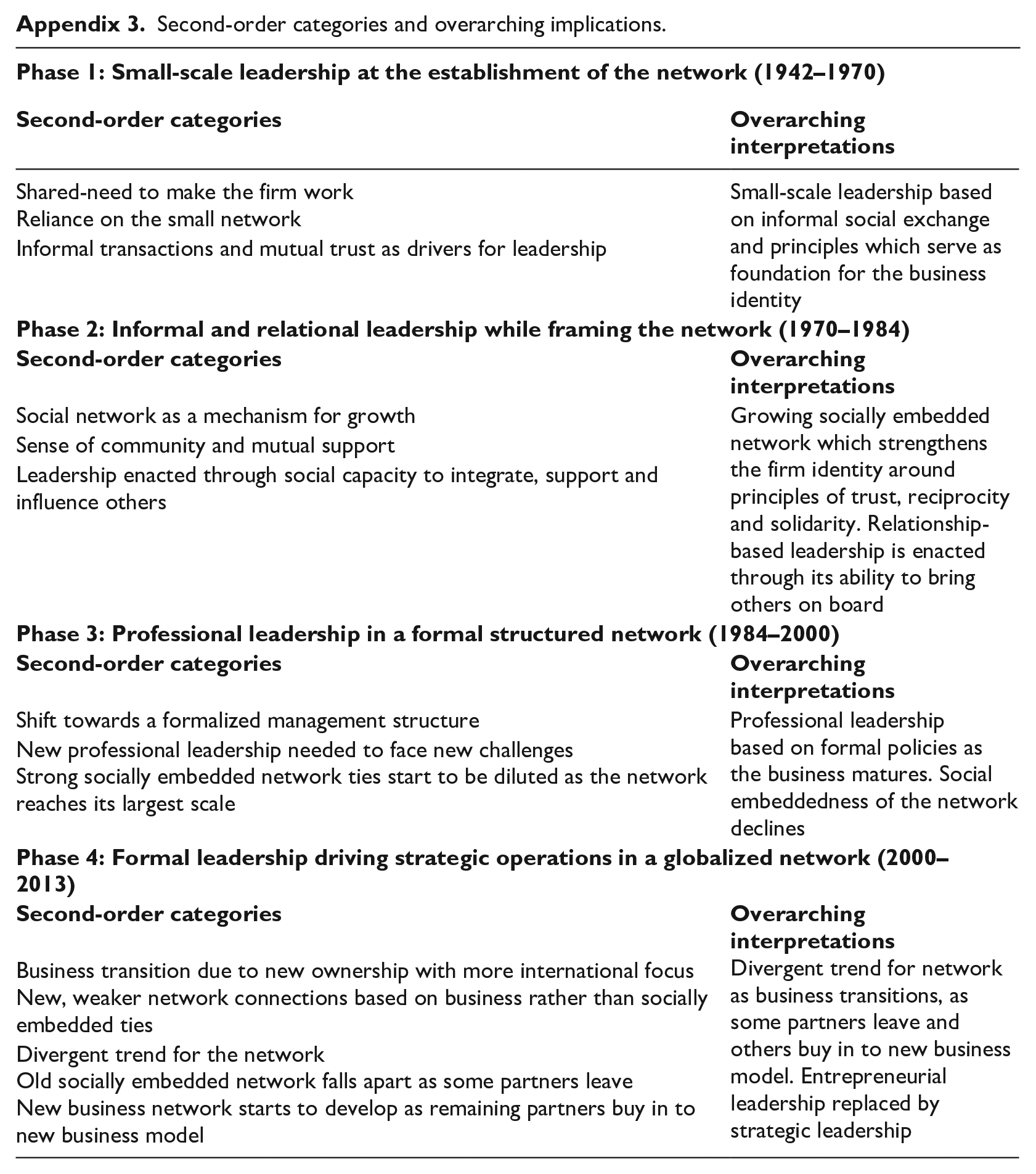
Finally, we combined our data-driven first-order themes and conceptually informed second-order categories into overarching theoretical interpretations (Gioia et al., 2013). It was at this stage in our analysis that parallels with the LMX Leadership Making Model – and hence its value as a lens for theorizing our findings – emerged, and shaped the development of our four-stage model. Throughout the analysis process, emergent ideas were held up against the literature in a constant comparative dance (Bansal and Corley, 2012), following what Gioia calls a ‘Gestalt analysis’ (Gioia and Chittipeddi, 1991). This approach required theoretical thinking and critical questioning of ‘what is happening here’ to uncover hidden insights and meaningful relationships between the themes. The insights inform the distillation of second-order themes into overarching theoretical dimensions, set out in Appendix 3.
Given the longitudinal nature of the study, data were organized according to temporal periods which allowed us to understand ‘. . . how and why things emerge, develop, grow, or terminate over time’ (Langley et al., 2013: 1). This led us to the four distinct phases we include in the ‘Findings’ section. Arranging the data chronologically was critical to identifying the key events, and understanding and contextualizing the development of the network, while analysing the interactions among the different actors (Van de Ven, 2007; Yin, 2013). As noted by Parkhe et al. (2006), the inclusion of time as a variable, and the consequent focus on processes, makes longitudinal studies vital to capturing organizational dynamics.
Findings
When looking at the evolution of leadership in the SEUR network, it became apparent that four stages seemed to exist: (1) small-scale leadership at the establishment of the network (1942–1970); (2) informal and relational leadership while framing the network (1970–1984); (3) professional leadership in a formal structured network (1984–2000); and (4) formal leadership when undertaking strategic operations in a globalized network (2000–2013). Each of these stages was influenced by the organizational context and how the entrepreneurial network could be drawn on to support the firm’s development over time (San Román et al., 2014; Tàpies et al., 2012). They also evidence how the use and role of embedded networks shaped the style of leadership exhibited (Gil-López et al., 2023). These stages are outlined and evidenced from our data below.
Small-scale leadership at the establishment of the network (1942–1970)
Because of the limited scope of the firm at this time and the difficult economic conditions during the start-up, leadership was focused on ensuring the firm survived. Justo Yúfera, one of the two co-founders of SEUR, expresses this need for survival by saying: ‘I started the business when I was 40 years old, I had two children and life was tight. Although I had failed in many businesses, when I started this one I knew I could not fail’. 1 At the time SEUR was founded, Spain was under Franco’s dictatorship (1939–1975) with deep economic constraints, protectionism and state interventionism which disrupted markets and limited economic growth. Thus, Yúfera ‘went into this business partly out of necessity [. . .], when [he] returned from Guinea, [he felt he] didn’t have much choice’. The two entrepreneurs who established and led the venture were persevering and tenacious and their main strategic resource was to introduce a novel business idea in Spain: express transport. Once established, they worked with commitment and dedication to ensure the business survived: ‘I had no vacations for 15 years but I struggled with enthusiasm’, reported Yúfera. Since the network was still very small, leadership behaviours by the two founders consisted of integrating their limited initial resources and the small sum of money they could provide into a workable business, and establishing principles, such as trust and reciprocity, that would serve to build, over time, the company identity. This approach was fundamental to the way the business was run and was underpinned by the network relationships between partners (Gil-López et al., 2023): as Ramon Mayo, Yúfera’s son-in-law, said, ‘Everything was split equally. Expenses and income were shared equally between the participants’. As explained by the former general manager, SEUR thus owes to Yúfera ‘the definition of the initial business discipline’ – its informal rules of sharing profits, commitment and reciprocity. Yet even though the founders shared a common need – ensuring business survival – there was no vision of a shared venture since the two affiliates worked quite independently: ‘We were two independent partners: one in Madrid and another in Barcelona. We exchanged parcels and shared profits [. . .] It was all by word of mouth, nothing signed’ (Justo Yúfera). As this data extract illustrates, ‘leadership’ was therefore transactional in nature during this period.
Informal and relational leadership while framing the network (1970–1984)
Between 1959 and 1975, Spain experienced uninterrupted growth, with increasing openness and integration of the country into international markets beginning to support the expansion of private consumption. This allowed SEUR to grow by extending the business into new Spanish provinces. Ramón Mayo, family member to Yúfera and owner of the affiliate in Alicante, says of this time, ‘[. . .] my father-in-law and I began discussing how to expand the business, which was very small at the time’. Another family member, Julián Recuenco, who ran the Malaga affiliate after his father died, agreed that ‘We needed our service to reach national scope’. Yet that took time to materialize: enough for the context to reverse. From 1973, the global economic crisis strongly affected Western Europe, while Spain’s transition into democracy after Franco’s death in 1975 was another source of instability that hampered recovery. Within this environment, from 1970 onwards, the SEUR network nonetheless expanded throughout Spain through recruiting founders’ relatives, friends or former employees who would develop the business in their province. For a still emerging business, operating in a complex economic and political environment, the network of partners was built because founders had insufficient access to financial and economic resources for growing and expanding the business on their own. Mayo told us, ‘We had no resources to hire an advertising company or an external consultant who could tell us how to lead our business, so we managed using the phone book and doing mail campaigns’. Fernando Rodríguez Sousa, the first general manager, agreed that ‘Partners barely earned enough money’ to run the business.
The network of partners grew through ‘significant others, relatives, friends . . . people we knew well’ (Ramón Mayo). Alberto Puente, a friend of the founders located in Asturias, remembers that ‘at the beginning this was an adventure. It was not easy to find people willing to be responsible for promoting an affiliate [. . .] [we] were looking for friends, relatives . . .’. As the firm developed and expanded through the incorporation of new partners, the network was imprinted with a strong sense of familiarity: ‘we were a band of friends who shared the same economic interest [. . .]’ recalls Manuel Valle, owner of the affiliate in Tenerife. That homogeneity stemmed from the partners’ similar backgrounds, experiences and origins, giving SEUR a strong sense of community and a network based on strong ties.
Of the first two partners to join the network, one (Ramón Mayo) was the son-in-law of one of the founders and the other (Pepe Fuentes) responded to a job advertisement published by SEUR in a local newspaper. This makes him very unusual as one of the few people to join the network from outside, rather than being part of its organic development. Interviewees recognized how those two additions would become core members of the network and provide crucial leadership to integrate, encourage and support the new SEUR associates towards identifying and exploiting entrepreneurial opportunities. A large number of associates joined SEUR because they shared family, friendship or business links to Mayo and Fuentes. For instance, the partners of San Sebastián, Vitoria and Logroño were former employees at Fuente’s affiliate in Bilbao. The owner of La Coruña affiliate was Mayo’s sister-in-law while the founders of the affiliates in Plasencia, Badajoz, Mérida, Don Benito, Majorca and Asturias were Mayo’s friends. Fuentes and Mayo showed crucial entrepreneurial leadership in guiding new associates how to exploit the opportunity to develop the express transport business in a particular Spanish region while also supporting them from both an emotional and a financial perspective. As the owner of the Murcia affiliate explained about her brother, Pepe Fuentes: ‘He helped most of the young men who worked for him set up their own branches in places like Vitoria, Eibar, and San Sebastián’ (Dolores Fuentes); ‘Pepe lent me the money to rent my first store’ points out José Gabilondo, the founder of the Pamplona affiliate: The one who helped me and to whom I am very grateful is Moncho [i.e. Ramón Mayo]. He was the one who cared. I remember that when I opened in Mérida, he came to see me two nights, during his time off, to see how things were going
explains Carlos Guerra, the founder of the Mérida affiliate.
Those social mechanisms of support and generosity enabled the two leaders to enhance social cohesion and agreement and, above all, to develop a shared, collective vision for the business. This vision helped establish the norms and values of the network. Fernando Rodríguez Sousa stated that ‘The impulse and vision of Ramón Mayo led SEUR to be what it is’, while Julián Recuenco added that ‘He [Ramon Mayo] had a great social ability [. . .] and always pursued the common interest’. Similarly, Juan Cueto, former director of SEUR Clearing House and related by friendship to the founders, recalls that ‘Pepe Fuentes was always daring, innovative and generous’. As further evidence of how Justo Yúfera shaped the culture and direction of the business, he told us that ‘We had a convention every year. We made friends. . . . The agreement of sharing profits equally worked well since it was a way to encourage the newcomers’. The way leadership promoted integration and encouragement of newcomers through direct support quickly extended throughout the network thus guiding the behaviour of all partners. This culture of mutual support was reflected in Teresa Debelius’ (Ramon Mayo’s sister-in-law and owner of a Coruña affiliate) observation that ‘From the very first moment [we worked] with joy . . . like a family. Not only in terms of collaboration, but also in caring about each other’s families, with close relationships, from Monday to Saturday’; also in Antonio Manuel Alba’s (owner of Cádiz affiliate) recollection, ‘beyond the urgency, we have nurtured our delivery drivers, providing them with financial support and assistance. We have built strong solidarity between the freelancers and the company, as well as among the companies within the group’. Interestingly, while clearly operating as de facto leaders during this period, neither of the two former partners held formal leadership positions.
Professional leadership in a formal structured network (1984–2000)
In a context of increased growth and intensified competition, the SEUR network had had to formalize relationships and professionalize the business. As a corollary of the new ways of working which resulted, the network had evolved towards more distant relationships: the ‘need to centralize the business and focus on management’ (Ramón Mayo) forced the previously informal network relations into a less dominant role. This process had begun with the establishment of SEUR España in 1984 as the ‘first thing that is legally shared by the partners [. . .] not only a legal union [a parent company] but also an operational union, a forum for structured debates, etc.’ (Fernando Rodríguez Sousa). The first general manager, Fernando Rodríguez Sousa – a financial lawyer with an MBA from a prominent Spanish business school – had been hired ‘as a response to the need to manage the shared business’ (Manuel Valle). This professionalization of the leadership function meant that ‘Fernando Rodríguez held an important place in the leadership. His role was created to face the need to manage common interests, and he had to make decisions beyond his initial responsibility’ (Jesús Bravo).
As a leader, Sousa was responsible for sustaining commitment to the network and adding the professionalization needed to formalize the structure of the rapidly growing business, which eventually adopted a franchise form. This required him to establish and utilize formal mechanisms to regulate relationships among partners while guiding them towards decisions and actions necessary to jointly exploit new opportunities, such as introducing novel services targeting specific market niches or expanding into international markets. These mechanisms included an internal magazine that communicated formal and standardized procedures to be followed by associates and, at the same time, a shared sense of belonging and identity to the extended membership of the business; and the celebration of annual national and regional meetings which allow SEUR partners ‘to socialise with each other, to exchange information and to develop our knowledge of others. Not only must we have economic interests, which are very important, but also true bonds of friendship’ (La Revista de SEUR, May 1985, 19). So, leadership began to focus on guiding partners towards increasingly formalized procedures, creating spaces for joint decision-making and keeping group cohesion. Those formal mechanisms meant that the network, still bounded by strong social ties, began to work under an increasingly corporatized structure in which the partners complied with common rules pertaining to, among other things, accounting, marketing and branding, logistics, law and insurance. Increasing centralization also meant that some partners became increasingly interested in the corporate management of the business as a whole, beyond their local affiliates. Fernando Rodríguez Sousa described that time by saying, [The creation of SEUR España] meant the incorporation of professionals. Those of us who were arriving had more training, methodology, more in-depth knowledge of accounting, taxation, IT systems, security . . . These more professional and strategic concepts began to arrive, which the day-to-day hustle and bustle did not allow them [i.e. former partners] to think about.
More broadly, ‘What had operated for many years through informal arrangements now offered a more formal presentation’ (Tàpies et al., 2012: 114). When Sousa joined SEUR as general manager in 1984, SEUR generated income of €15 m per annum: when he became Vice-president of institutional relations in 2009, the SEUR network earned €500 m.
Formal leadership driving strategic operations in a globalized network (2000–2013)
Starting in 2000, SEUR started seeking a solid, international partner to strengthen its market position in Spain and to internationalize. In 2004, the arrival of the French Company GeoPost, as a foreign partner, meant a deep transition in the network, which began to be increasingly absorbed and centralized, and a re-orientation of leadership practices towards a strong strategic direction. SEUR leadership was headed by the then CEO of GeoPost, Yves Delmás, and by two professionalized SEUR partners, Manuel Valle and Julian Recuenco, who were appointed Chairman and Vice President of Quality and Operations, respectively. Fernando Rodríguez Sousa recalled that ‘it was the first time an outsider joined SEUR, so this definitely meant a new stage’.
The transition meant that the network split into three main groups of partners: one group became disillusioned or distressed, since the entrance of the foreign partner broke the former network based on personal trust and family ties. This resulted in a change in the character of the business with which this group was not happy: ‘[. . .] our former partners have gone from having a friendly relationship to a purely commercial one’ (Francisco Rubio). A second group of partners had no succession for their domestic affiliate, so they understood that the arrival of the foreign partner, willing to buy affiliates, was a convenient exist strategy for them to leave SEUR. Interestingly, the founder Justo Yúfera, who was the first to sell his subsidiary, belonged to this group. 2 Manuel Valle explained this by saying: ‘GeoPost was the way to give a chance to all partners who wanted to sell their businesses; Yúfera sold Madrid because he believed that his time had come and because I think that he was no longer comfortable’. Similarly, Elías García Recuenco told us: ‘I was in no hurry, but considering that I had no succession, I decided to sell’. A third group of partners realized the need to enhance competitiveness and growth and that the former networked style of working was not really suited to this task. Julián Recuenco summarizes this situation by saying: ‘The agreement with GeoPost was fantastic because we were replacing shareholders who had no intention of developing the business strategically with other shareholders who did have that intention’.
Thus, while some partners aligned themselves with the new strategic direction, others wanted to leave SEUR, which allowed GeoPost to increase its shareholding. Leadership therefore sought to bring stability through the transition process as well as to create and manage inter-organizational links. Following the network split, crucial leadership practices consisted of helping partners who wanted to leave to find a suitable exit strategy and reach an agreement with GeoPost to sell their affiliates. For those who agreed to stay, leadership was geared towards supporting the introduction of new strategic practices that required a more proactive approach to market changes and new technologies. That this was a collaborative process is emphasized by Julián Recuenco: ‘There has been an internal discussion that has facilitated the comfortable integration of GeoPost as a partner’. It was understood that the new partner offered support and a long-term vision and provided SEUR with valuable resources and know-how to compete in a complex context. This business alliance improved collaboration between the representatives of SEUR and GeoPost for some time. While SEUR understood its partnership with GeoPost as a means to boost its internationalization, the French company eventually focused on domestic growth rather than facilitating SEUR’s international expansion: this strategic shift is evident in GeoPost’s acquisition of enough SEUR subsidiaries in 2012 to attain a majority stake.
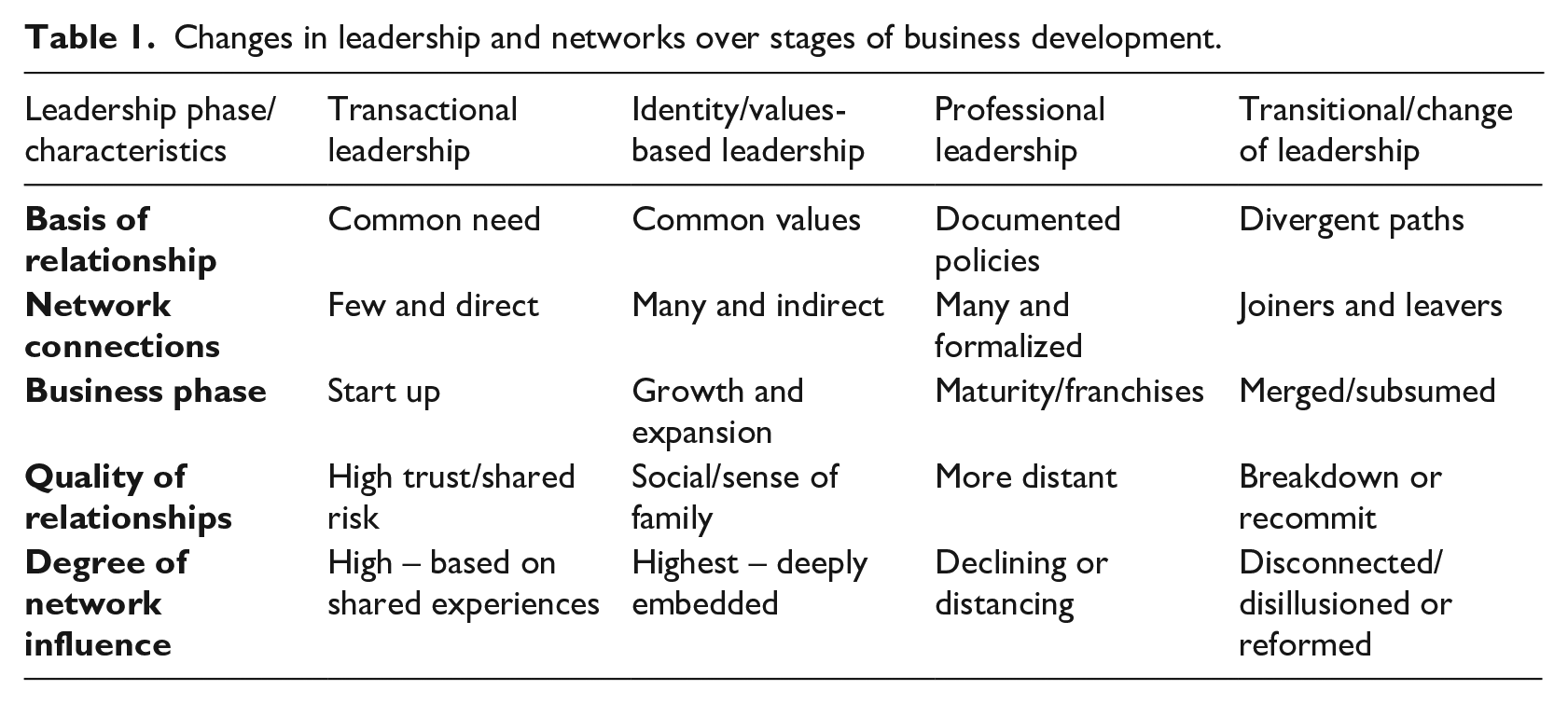
To sum up, leadership at SEUR evolved through four stages, each with implications for the utilization of embedded networks. Over the life of the organization, the SEUR network was not only looked on to provide resources that would help sustain the growth and development of the organization but also shape its future development, especially in terms of leadership. It appears to have been accepted that by engaging with SEUR, network members would help lead the organization. A summary of the business stages, and their implications for leadership and network utilization, is set out in Table 1.
Changes in leadership and networks over stages of business development.
Interpretation and analysis
From SEUR’s history, it is evident that the utilization of network contacts by the founding partners shaped the development and growth of the business over time, and influenced the style and format of business leadership that emerged. Leadership can be seen as a dynamic process, embedded in the social connections of the network and shaped by the context in which it developed. As is apparent from our data, leadership was able to evolve and change by adding new capabilities as a response to new challenges (Miettinen et al., 2008), thus making the business context extremely relevant in influencing the way the firm operated over time. Since its foundation, there was a strong belief from the leaders in the capabilities of the network and this belief carried the firm forward, allowing it to develop in the way it did, to achieve what it did. Drawing on our empirical case study, we now develop a theoretical model of the symbiotic evolution of entrepreneurial leadership and network influence within a developing business, which we believe will have relevance for a wide range of entrepreneurial businesses. The culmination of this theorizing is set out in Figure 1, showing the changing level and type of network influence, and the accompanying style of entrepreneurial leadership, over different phases of firm development. This model offers a response to Jones and Giordano’s (2021) call for further research into entrepreneurial learning and business model evolution.
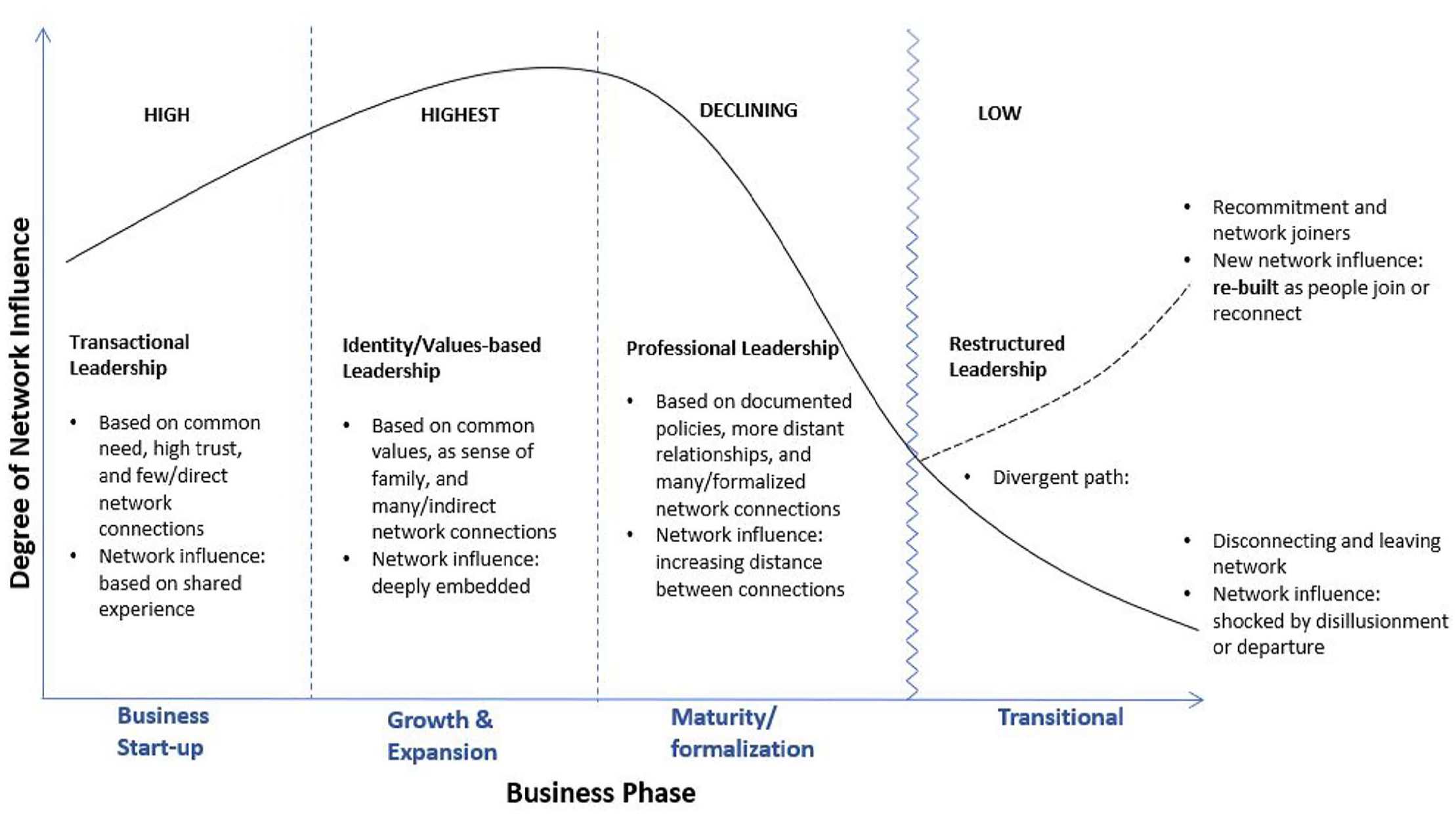
Co-evolutionary model of entrepreneurial leadership and network influence.
Phase 1: business start-up
Most entrepreneurial start-ups involve sole traders, a small number of working partners, or family members only (Ziakis et al., 2022). The small scale of the firm in this initial stage means that any leadership is concerned with the establishment of the business idea and the survival of the firm itself. The primary focus is on the necessity of obtaining the resources needed to build and operate the business (Miettinen et al., 2008), and it is only once this begins to stabilize that the focus can shift towards establishing the way in which the principals want to conduct their business. These ‘rules of the game’, established and enacted by the principals acting as leaders, determine the culture of the firm, setting the tone for how the firm operates and is managed, and determining the ways in which it will grow and develop (Jones and Giordano, 2021). Throughout this phase of development, formal sources of funding and other resources are often limited, resulting in the heavy reliance on strong network contacts (Gil-López et al., 2023; Jack, 2010; Jack and Anderson, 2002; Uzzi, 1997). Ways of operating often remain informal, based on mutual trust and shared need and experience. While the network is likely to be small, its influence on firm development and direction will be high, in the absence of external shareholders or funders requiring specific terms and conditions as part of their contract with the business.
Based on our findings, we suggest that in the early stages of firm development, the leadership style works because it is so informal and transactional. Entrepreneurial leaders who lack formal authority instead operate through informal mechanisms and mutual exchanges, and a recognition of shared need. These shared understandings promote strong cohesion in an entrepreneurial network to make things happen. During this start-up phase, development of the firm and its leadership is furthered through drawing on the social resource base of the members’ existing network, leading to a higher level of economic outcomes that can only be achieved through the social resource and the capability of the network in sustaining expansion. The lack of credit experienced by SEUR during this period is common to most entrepreneurial businesses, such that the only way to expand is to use their network to build a collaborative structure founded on social ties.
Phase 2: growth and expansion
During the second phase of firm development, leaders purposefully seek to extend the network as a means of growing the entrepreneurial firm and to enhance cohesion among members as the network expands. It is a key role of leadership during this phase to support new members in acquiring the skills and values already shared by existing members, and on which its past success has been based. Thus, what is tacitly known within the network must be learned by incoming members through socialized, informal learning processes (Hibbert and Huxham, 2011) driven by the emergent leaders. This is important because, although external funding sources and other opportunities are beginning to open up, it is still through their relationships of mutual trust, respect, peer support and collaborative working practices that the firm is largely sustained. This organic process of expanding the network and maintaining member cohesion is seen as critical in dealing with the challenges faced by entrepreneurial firms as they expand and develop.
In showing the relevance of social networks and how they can provide a mechanism for growth, our findings support previous work (Cropanzano and Mitchell, 2005; Elfring and Hulsink, 2007; Gil-López et al., 2023; Jack, 2005) in this domain. However, what we also show is the significance of the growing social network for leadership during this stage. Because of the importance of building cohesion and identity, the ‘social competence’ of the firm leadership (Baron and Markman, 2003) plays a key role in engaging others in the entrepreneurial venture, impressing them with the shared and collective vision of the business, and providing the network with the social and economic resources needed to achieve growth. Leaders therefore hold an influential position in their social circle with an ability to influence others (Balkundi and Kilduff, 2006). The social embeddedness of the network, formed by strong ties, is likely to reach high levels at this stage, which imprints leadership with a strong social nature that is consistent with Balkundi and Kilduff’s (2006) understanding of leadership as managing social capital. For the business to flourish, it is important that those who join the network buy into the existing culture, working practices and style of operation. This is often achieved through what Hibbert and Huxham (2011: 15) refer to as the ‘carriage’ of knowledge and tradition in ‘utilization mode’, whereby new units are set up on the pattern of existing ones. The influence of the network on firm development is at its height during this phase, there is a strong sense of shared values, and the influence of the network is deeply embedded in the way in which business is conducted. The network is still small enough to be tight-knit and cohesive, while large enough to support the firm’s growing scope and operations. This structure works based on a relationship-based leadership (McCauley and Palus, 2021) approach in which the social sphere is critical for firm survival and development, and leadership is an extension of the existing social ties and relationships.
The process of leadership evolution described during phases 1 and 2 reflects the strong collaborative values based on personal trust which we found in our case study. Networking between individuals who share similar values and the same social background (Jones and Giordano, 2021) was the successful strategy that allowed SEUR to adapt and survive in changing economic and political environments (Gil-López et al., 2023), and which we believe to be common to entrepreneurial firms more generally (Jack and Anderson, 2002; Kwong et al., 2019). The close ties between partners in the network facilitated learning processes, the transfer of knowledge, the rise of common values and a shared vision of the business, as well as the development of informal leadership processes (Perren and Grant, 2001). This aligns with research that shows how social relations make learning through partners and their experience possible (Cope, 2005; Hamilton, 2011). Indeed, solidarity between partners allows collaborative knowledge sharing and the transfer of innovations to the entire network.
The network structure can also be expected to shape the leadership of the firm, since it defines the social context within which actors are situated (Borgatti and Foster, 2003). Thus, it is the strong social embeddedness of the network which makes leadership primarily informal and social in character. As a firm evolves, the inclusion of new leaders from the expanding network might add strategic capabilities to meet new demands, without removing the existing ones. Thus, entrepreneurial leadership evolves to combat challenges relating to the organization itself and to its context. In SEUR’s case, this dynamic leadership boosted the early growth of the organization, founded new subsidiaries, coped with increasing competence and captured new markets. In a network, this capacity to adapt to new contexts remains rooted in mutual trust and commitment and is continually constructed, transformed and negotiated through relationships (Hibbert and Huxham, 2011). The resultant sense of belonging makes it easier for leaders to keep people on board as they implement changes in response to external challenges.
Phase 3: maturity/formalization
As the firm continues to grow and expand, there comes a point in its development where the historical, network-based way of operating is no longer effective and hence no longer sustainable. In this phase, the social network is a victim of the firm’s success. Business that was previously done on trust is now formalized and documented, and there is a shift from an identity-based, socially embedded to a more calculative and intentionally managed network structure (Hite and Hesterly, 2001). Policies are introduced and professional leaders and managers are recruited. As a result, the relationships between firm members are also formalized, and those between network members become more distant as larger numbers of employees join. Not surprisingly, given the increasing distance – often both physically and in terms of values – the influence of network members on the direction and identity of the business declines.
The shift from informal leadership to a more formal structure can also be prompted when the firm faces particular challenges, for example, dealing with competitors, changing or adapting its legal structure, adapting to changes in its institutional context and political and economic environment, or facing new economic scenarios. In these situations, the formal authority of an appointed leader becomes crucial in providing stability and consistency across the wide range of decisions requiring to be made. During this phase of development, the firm can be expected to develop several layers of management, in addition to its ultimate leadership, and to rely on authority as well as influence in determining strategy and direction. Professional leaders add specific skills and abilities that the entrepreneurial founders may not possess, or allow for the reconfiguration of available skills, through a process of ‘bricolage’ (Chang and Rieple, 2018: 473). At the same time, training and more formal communication structures (Miettinen et al., 2008), such as the SEUR magazine, codify the former ‘rules of the game’ appropriately, within the legal and regulatory systems within which the extended firm is required to operate. This can include HR policies and procedures, tax and accounting legislation, and health and safety requirements, as well as more sophisticated marketing strategies, operating processes and brand management. This shift to formalized, professional leadership is especially important when building the inter-organizational alliances necessary to cross borders and compete in international markets. Such challenges require leaders to manage boundaries inside and outside the network in order to create stable relationships with trusted partners (Gulati and Gargiulo, 1999). In making this shift, much of the original identity embedded in the social ties that have sustained the network up to this point may be lost or diluted, resulting in a diminution of commitment to the firm for some early network members.
Phase 4: transitional
Phase 4 of the evolution model can be seen as transitional for both the firm and the network members. Both can go one of two ways, but these do not necessarily coincide with each other. Taking the firm first, if it continues to grow and prosper, it is likely to encounter some form of major restructuring. In the case of SEUR, this was a gradual merger with GeoPost, but it could equally have been an acquisition, takeover or simply expansion on a scale that significantly changed the identity and operations of the resultant business. Where this continued success and expansion does not occur, the firm may stagnate or even decline. At the same time, the network will also continue to evolve and may encounter either an upward or a downward trajectory in terms of its membership and influence. On the downward side, influence already reduced by the increasing professionalization of the firm can decline further as the socially embedded network itself falls apart. This can be a problem for entrepreneurial firms where there are no family members to succeed to the running of the business, or where network members are unable or unwilling to keep pace with changes and choose to sell out. Where these two eventualities occur, the influence of the network on business direction will decline, and the business may decline with it.
Where the firm continues to expand, either organically or through strategic alliances, the network transition is likely to be more complex. The succession issues mentioned above may be subsumed under the arrival of new management, but remaining network members may still choose to sell out if they are disillusioned with the direction of travel or feel disconnected from the new management structure. At the same time, some members of the original network will choose to buy into the new network connections that develop, based on professional rather than socially embedded ties, and will recommit to the firm. Where this new network establishes itself within the organizational structure, its influence will increase albeit probably not to the peak levels seen in phase 2. At the same time, leadership is increasingly recognized as a social influence process (Uhl-Bien, 2006) in which relations – and by implication, networks – play a foundational role.
Thus far, our model aligns with the existing literature, where it is generally argued that networks are important for entrepreneurship because they provide a resource base essential to starting and developing a business (Greve and Salaff, 2003; Kwong et al., 2019). However, these social relations and aligned values are rooted in the origins of the organization and are not easy to retain as the organization grows and evolves. Indeed, our case study shows how the nature of a network transforms throughout the entrepreneurial process with implications for leadership practices. At the start-up and the early business expansion, strong ties play an important role and entrepreneurial leadership practices are shaped by the existence of a socially embedded network based on strong bonds of trust, familiarity and peer support, as well as reciprocity as a crucial mechanism of social exchange (Cropanzano and Mitchell, 2005; Jack, 2005). Thus, through building a strong socially embedded network, SEUR leaders leveraged social exchange relationships with a long-term approach that enhanced the commitment of group members and helped prevent selfishly opportunistic behaviours. At the core of this is the importance of social norms in shaping the capacity of entrepreneurial leadership to influence and direct group members’ interactions and behaviours. As the business matures, the network transforms towards an increasing presence of weaker ties, including new business and professional contacts (Evald et al., 2006). While reducing the degree of network influence, as our co-evolution model shows, this network transformation orients leadership towards more formal and strategic practices based less on reciprocal exchange and more on economic exchange with tangible incentives (Cropanzano and Mitchell, 2005; Madanoglu, 2018).
Thus, our model goes beyond the start-up and expansion phase to show how, as the size and diversity of the network increases, its coherence and influence may decline, resulting in a transition phase where it is either reenergized by structural changes within the business or declines further as the business itself declines. This can be particularly the case for networks where the prevalence of strong, embedded social ties is constraining and inefficient for the fuelling of organizational growth (Baker and Nelson, 2005; Uzzi, 1997). Initially, the role of networks is overshadowed by the introduction of additional layers of management and the recruitment of professional managers to supply the skill deficiencies of the entrepreneurial founder members. This influx tends to dilute the influence of the original social network and its members, some of whom may decide to sell out. As the firm reaches a stage of development where it either declines or transitions into other organizational structures, the underlying network also takes one of two divergent paths. Where it expands and recommits based on imported professional standards, its influence will once again increase, but if existing members sell out or experience succession crises and there is no external solution, the influence of the network will decline further as the network disintegrates.
We suggested in our introduction that there were parallels between our proposed evolution model and the Leadership Making Model (Graen and Uhl-Bien, 1995) developed within LMX theory. As illustrated in Figure 1, the leadership styles accompanying the first three stages of business development – that is, transactional leadership, identity/values-based leadership and professional leadership – can be seen to have resonance with the three phases of the Leadership Making Model, which are stranger/transactional, acquaintance/social exchange and maturity/long-term reciprocity, respectively, with the similarity being at its strongest in phases 1 and 2. The divergence at phase 3 sets the stage for our addition of a fourth phase, that of leadership restructuring, prompted by business transitioning. Across all four stages of our model, the existence of offers and responses between emergent leaders and other network members – paralleling the offers and responses through which leader–follower relationships develop in the LMX model – symbiotically shape the evolution of entrepreneurial leadership and the degree of influence of the network. We believe this conceptualization of the co-evolution of network influence and leadership emergence in an entrepreneurial context adds explanatory power to our understanding of how leaders in entrepreneurial businesses use their networks to enhance the evolution, growth and development of the firm.
Conclusion
The contribution of this work is twofold. First, it links the theories of entrepreneurial leadership and networks, previously treated largely separately. It demonstrates that in a network context, leadership generates and draws on individuals who are interrelated within the structure of their social ties (Balkundi and Kilduff, 2006; Pastor et al., 2002), and that this shapes both the style of leadership and the direction of the firm. These symbiotic relationships are summarized in the entrepreneurial leadership evolution model set out in Figure 1. This contribution expands our understanding of the dynamics of entrepreneurial leadership, predicated upon interrelationships among organizational members and influenced by the organizational culture and context. It also responds to Jones and Giordano’s (2021) call for further research into entrepreneurial learning and business model evolution. We posit that entrepreneurial leadership materializes at the nexus of entrepreneurship and leadership, engendering a social and evolutionary process wherein leaders within an entrepreneurial milieu conceive opportunities, mobilize individuals in a network and co-shape the trajectory of organizational development. At the same time, entrepreneurial learning is transmitted across the network through support and guidance, formal communications mechanisms (Miettinen et al., 2008) and the utilization of existing patterns of operation in new business units (Hibbert and Huxham, 2011). On this basis, it is important for actual and would-be leaders to be aware of and to consciously manage the network relations that connect actors within an organization and in which they are embedded.
Second, this work draws on a longitudinal perspective to provide the SEUR case study. Historical and longitudinal approaches have strong potential to add a dynamic perspective which is largely absent in traditional leadership and networks research. The call for a ‘historic turn’ in organization studies (Suddaby, 2016) gives momentum to a closer integration between conceptual frameworks and historical empirics and methods. While that call has found many answers in the entrepreneurship literature (Hollow, 2020; Toms et al., 2020; Wadhwani et al., 2020; Wadhwani and Lubinski, 2017), research on what happens over long periods of time in leadership is still scarce (Horila and Siitonen, 2020).
The findings from this study can be seen to have relevant implications for researchers and practitioners beyond the boundaries of entrepreneurial organizations, both in terms of the adoption of historically informed methodologies for management research and the wider resonance of the co-evolution model. For practitioners, the model offers a reflective framework for considering the state of the leader’s embedded network at any given stage of business development, and some markers for proactively weathering the different phases as they occur. Future research might consider specific strategies which leaders can employ to develop their networking skills in each of the four phases and to optimize the influence network members exert within the business over time. Our findings also offer implications for practitioners in terms of learning, suggesting that, in the context of entrepreneurial firms, leadership learning is a situated, social and evolutionary practice, rather than a deliberate and consciously planned approach (Kempster, 2006). This reflects the importance of situated practice, learning-by-doing and communities of practice as core mechanisms that current or would-be leaders in entrepreneurial settings could rely on to enhance their leadership effectiveness and impact (Lave and Wenger, 1991).
We appreciate there are limitations to our approach. In particular, generalizing from a single case study may be seen as problematic. However, qualitative work provides an in-depth understanding of the social world of the studied people, a richer analysis of process and social ties, and invaluable insights concerning leadership patterns, which can be expected to have resonance across other settings. The addition of a historical perspective gives the advantage of enabling the understanding of processes of change and evolution (Pettigrew et al., 2001), as well as positioning them as a socially rooted matter which takes place over time. For those reasons, the approach used in this study provides useful conclusions about corporate dynamics and the process of leadership evolution throughout the growth of an organization, which can be expected to be transferable. We hope this article will encourage others to counter with further rich, historical and longitudinal case study research to develop a better and more contextualized understanding of leadership processes in entrepreneurial contexts.
Footnotes
Appendix
Second-order categories and overarching implications.
|
|
|
|---|---|
|
|
|
| Shared-need to make the firm work Reliance on the small network |
Small-scale leadership based on informal social exchange and principles which serve as foundation for the business identity |
| Informal transactions and mutual trust as drivers for leadership | |
|
|
|
|
|
|
| Social network as a mechanism for growth | Growing socially embedded network which strengthens the firm identity around principles of trust, reciprocity and solidarity. Relationship-based leadership is enacted through its ability to bring others on board |
| Sense of community and mutual support | |
| Leadership enacted through social capacity to integrate, support and influence others | |
|
|
|
|
|
|
| Shift towards a formalized management structure | Professional leadership based on formal policies as the business matures. Social embeddedness of the network declines |
| New professional leadership needed to face new challenges Strong socially embedded network ties start to be diluted as the network reaches its largest scale |
|
|
|
|
|
|
|
| Business transition due to new ownership with more international focus New, weaker network connections based on business rather than socially embedded ties |
Divergent trend for network as business transitions, as some partners leave and others buy in to new business model. Entrepreneurial leadership replaced by strategic leadership |
| Divergent trend for the network Old socially embedded network falls apart as some partners leave New business network starts to develop as remaining partners buy in to new business model |
|
Acknowledgements
We gratefully acknowledge the support of Professor Sarah Jack, without whose contribution to an earlier project relating to SEUR we would not have developed the ideas which form the contribution of the current paper. We would also like to thank Dr Bingbing Ge and Dr Ricardo Zozimo for their valuable comments on a conference paper which was the forerunner to this journal article.
Funding
The author(s) received no financial support for the research, authorship, and/or publication of this article.
