



Abstract
Relying on social comparison theory and the norm of reciprocity perspective, the present study aims to longitudinally investigate the specific relationships between relative leader–member exchange (RLMX) and relative organizational citizenship behavior (ROCB). We examined the potentially bidirectional relationship between these two constructs using data consisting of 1,420 time-lagged observations from 725 employees surveyed at multiple time points. Our results indicate that performing more helping behaviors than the group average (ROCB) leads to a subsequent higher quality of relationship with the leader compared to the group average (RLMX), above and beyond the effect of organizational citizenship behavior on RLMX. This effect is stronger than the reverse relationship (i.e., the effect of RLMX on ROCB, above and beyond the leader–member exchange). Implications for theory and practice are discussed.
Introduction
Leader–member exchange (LMX) theory has evolved into one of the most important theories in the field of leadership that can help predict many individuals, group, and organizational level outcomes (Dulebohn et al., 2012; Gerstner & Day, 1997; Graen & Uhl-Bien, 1995; Ilies et al., 2007). Until recently, LMX scholars have largely overlooked the social context in which LMX relationships are embedded and have generally considered each LMX relationship in isolation from the LMX relationships of other coworkers in a workgroup (Anand et al., 2015; Liden et al., 2016; Sparrowe & Emery, 2015). Recent research recognizes that each LMX dyad is nested within the broader workgroup. Particularly, LMX scholars have introduced the within-team relative position of subordinates’ LMX (relative leader–member exchange [RLMX]) to account for social comparison processes that occur among subordinates (Henderson et al., 2008). Scholars have shown that RLMX can predict important outcomes such as organizational citizenship behavior (OCB) (Hu & Liden, 2013; Vidyarthi et al., 2010). Despite this influential work, a few gaps remain in our understanding of RLMX's antecedents and outcomes.
First, this line of research has focused on the absolute level of OCB. However, research suggests that employees also compare their level of performance with that of their peers (Downes et al., 2020; Spence et al., 2011). Therefore, we argue that paying attention to the concept of relative performance is also important. We raise the question of whether high RLMX subordinates perform higher OCB relative to their peers. Second, although LMX scholars have revealed attitudinal and behavioral consequences of RLMX, its determinants have remained unexplored. We focus on relative OCB as one potential determinant of RLMX. In other words, we examine whether subordinates who exhibit higher relative citizenship behavior receive what they give from their supervisors.
To answer these questions, we first introduce the construct of relative organizational citizenship behavior (ROCB) to capture the employee's OCB level relative to the average OCB level within a workgroup. Next, we draw on social comparison theory (Buunk & Gibbons, 2007; Festinger, 1954) and the reciprocity perspective (Gouldner, 1960) to investigate the bidirectional relationship between RLMX and ROCB. We hypothesize that to maintain their privileged LMX status, high RLMX subordinates perform higher ROCB. Indeed, we argue that leaders reciprocate the relative higher OCB by providing a higher RLMX standing.
This study contributes to the literature in several ways. First, it improves our understanding of the social context surrounding the individual's adoption of OCB by introducing the construct of relative OCB. Second, RLMX has mainly been considered as an independent variable in the existing literature (Henderson et al., 2008; Herman et al., 2012); however, our study sheds light on the antecedents of RLMX by showing the power of ROCB in predicting RLMX. Third, this paper deepens our understanding of the relationship between LMX quality and citizenship behaviors by showing that displaying more OCB than the group average results in a better relationship with the leader as compared to the group average. In this regard, as a fourth contribution, our study also extends the research focusing on how others treat higher performers. This latter stream of research has particularly focused on whether higher (lower) performers experience victimization at work (Aquino & Bommer, 2003; Campbell et al., 2017; Downes et al., 2020; Jensen et al., 2014; Kim & Glomb, 2014; Lam et al., 2011). Our study suggests that performing higher ROCB is rewarding, and that leaders are more likely to reciprocate this higher relative contribution in a fair and proportional manner by providing higher LMX treatment than average.
Theoretical Background and Hypotheses
Before developing our hypotheses, we define our core constructs; RLMX and ROCB.
Drawing on social comparison theory, LMX scholars have recently argued that individual-within-group level is a more appropriate theoretical level than the individual level of analysis (Henderson et al., 2008, Vidyarthi et al., 2010) for examining the effects of the LMX process in workgroups. Social comparison theory (Festinger, 1954) postulates that individuals are driven by a motive to self-evaluate, and in the absence of any objective standard, this motive leads them to evaluate their own standing by comparing themselves with referent others (Buunk & Gibbons, 2007; Wood, 1989). In organizations, employees frequently scan their environment to help them form comparative judgments regarding their relative status (Spence et al., 2011). In a team setting, subordinates who have the same authority figures are exposed to similar organizational resources, work interdependently on tasks, are prone to compare the quality of their respective relationships with the immediate supervisor (i.e., LMX) (Liao et al., 2017), and use information on their LMX quality for the purpose of evaluating their relative status (Henderson et al., 2008; Matta & Van Dyne, 2020).
LMX refers to the quality of exchange relationships between leaders and their subordinates (Graen & Uhl-Bien, 1995). In the leader–subordinate relationship, several tangible and intangible resources may be exchanged (Wilson et al., 2010). For instance, leaders can offer job latitude, emotional support as well as formal and informal rewards to their subordinates, and the subordinates may, in turn, perform in-role or extra-role behaviors (Dienesch & Liden, 1986). Scholars have found that the higher the quality of exchange between a superior and subordinates, the more likely it is that the subordinates would be supported (Graen et al., 1982; Scandura & Graen, 1984), rated higher in their performance (Liden & Graen, 1980; Scandura & Graen, 1984), promoted (Wakabayashi & Graen, 1984), involved in decision making (Scandura & Graen, 1984), and become more influential within the organization (Sparrowe & Liden, 2005). These positive outcomes are not only advantageous to employees, but also lead to positive work attitudes and higher performance levels. For example, employees who engage in high-quality exchange relationships with leaders demonstrate enhanced organizational citizenship behavior (Ilies et al., 2007), a higher level of organizational commitment, higher in-role performance (Gerstner & Day, 1997), and improved socialization (Scandura & Lankau, 1996).
It has been acknowledged that LMX relationships vary within the workgroups (e.g., Gooty & Yammarino, 2016), such that some subordinates receive more favorable LMX treatment than others (Hu & Liden, 2013). Research shows that subordinates observe such differences in LMX quality within workgroups (Duchon et al., 1986; Liao et al., 2010). Therefore, LMX relationships exist not only in “absolute” terms but also in “relative” terms (Tse et al., 2013).
LMX scholars have introduced the construct of RLMX to study the implications of relative LMX. RLMX refers to the relative LMX standing or, in other words, LMX quality relative to the average LMX quality within a workgroup (Henderson et al., 2008). For instance, a low LMX relationship in a team with a low average LMX has a different meaning than a low LMX relationship in a team with a high average LMX. In the former case, the subordinate with low LMX may receive more benefits, perceive a higher status, and form higher self-evaluations compared to the latter case. Whereas absolute LMX is experienced as a perception of a high-quality, satisfactory relationship with the leader characterized by a positive assessment of relationship exchanges (i.e., loyalty, contribution, and respect) with the leader (Graen & Uhl-Bien, 1995), RLMX is likely to be experienced as a perception of a privileged relationship reflecting a higher status in the group characterized by higher quality exchange relationships with the leader (e.g., receiving more resources, loyalty, contribution, and respect) as compared to the other team members. Research shows that, by accounting for social comparison effects, RLMX can predict important outcomes, such as organizational citizenship behavior (Henderson et al., 2008; Hu & Liden, 2013; Vidyarthi et al., 2010), beyond the effects of LMX (Hu & Liden, 2013; Matta & Van Dyne, 2020; Vidyarthi et al., 2010).
OCB is defined as “individual behavior that is discretionary, not directly or explicitly recognized by the formal reward system, and that in the aggregate promotes the effective functioning of the organization” (Organ, 1988, p. 4). OCB has been presented along with two main categories. The first is based on the nature of OCB (e.g., Organ, 1988), and the second is based on the targets of the behavior (Bettencourt & Brown, 1997; Williams & Anderson, 1991). The nature of OCB refers to different beneficial and voluntary behaviors, such as altruism, conscientiousness, sportsmanship, courtesy, and civil virtue. Williams and Anderson (1991) propose a target approach and classify OCB into two broad clusters: OCBs targeted at the organization (OCB-O) and OCBs targeted at coworkers (OCB-I). OCB-Os refer to behaviors that are mainly beneficial to organizations (e.g., civil virtue), while OCB-Is are mostly beneficial to specific individuals (e.g., helping). In the current study, the focus will be on OCB-I (or helping behavior) for three main reasons. First, OCB-I is better positioned to foster an immediate sense of indebtedness and reciprocity than OCB-O (Liu et al., 2017). Furthermore, the benefits provided by OCB-O are more likely to be more diffuse and distal than OCB-I, and less likely to stimulate an immediate feeling of gratitude (Liu et al., 2017). Second, as the focus of the current study is on the within-person variance, research indicates that OCB-I represents a higher dynamic behavior than OCB-O. A meta-analytic study by Scott et al. (2018) revealed that the average amount of within-person variance for OCB-I was 45.5% and 36% for OCB-O. Finally, Podsakoff et al. (2014) reported that 75% of OCB studies examined affiliative forms of citizenship behavior, and the most common behaviors used to capture affiliative behavior include helping with heavy workloads and work-related problems (Ehrhart, 2018).
Yet, research shows that subordinates are also engaged in social comparison by comparing their own performance with that of their peers (Downes et al., 2020; Spence et al., 2011). Thus, the same logic of social comparison that highlights the importance of the construct of RLMX can also be used to explain the importance of subordinates’ relative performance and in particular extra-role performance (i.e., OCB) since objective criteria for evaluating one's extra-role behaviors are not prevalent. Here, we focus on the construct of relative OCB-I (i.e., ROCB-I), which we define as an employee's OCB-I level relative to the average OCB-I level within a workgroup. Unlike OCB-I, which shows the absolute level of one's helping behavior and is independent of other coworkers’ level of OCB-I, ROCB-I refers to the willingness to help more than coworkers and to maintain an outstanding level of helping behavior compared to coworkers. Like OCB-I, ROCB-I also may be driven by altruism, but unlike OCB-I, it is less likely to be influenced by external expectations and norms (Bolino & Turnley, 2003). Rather, performing high ROCB-I could be a strategic behavior that helps subordinates gain more status in the workgroup. The level of ROCB, which can be understood by social comparison processes, provides subordinates with information on the relative magnitude of their helping behaviors in their workgroups, and may have implications beyond the absolute level of OCB. For instance, subordinates with high OCB in a team with a low OCB average may have different expectations compared to subordinates with high OCB who are in a team with a high OCB average. The former subordinates may expect to receive more advantages as they are likely to perceive that, compared to others, they are contributing more to the performance of the workgroup. These unfulfilled expectations may lead to a perception of injustice. Indeed, we argue that the higher the level of ROCB, the more likely that the focal subordinates gain status, respect, or the admiration of others (e.g., Ridgeway & Walker, 1995). This is because status in workgroups stems from members’ level of competence (Magee & Galinsky, 2008), and high ROCB members have more opportunities to signal their competence in their interpersonal interactions.
The Impact of RLMX on ROCB
We argue that RLMX positively predicts ROCB-I. As explained before, leaders create a hierarchy among subordinates through LMX differentiation (Mitchell et al., 2020), and in this LMX hierarchy, high RLMX subordinates receive many advantages, including access to more resources, more influence, and the admiration of coworkers (Anderson et al., 2006; Magee & Galinsky, 2008). Such advantages should motivate high RLMX subordinates to strive to retain their favorable position. Since subordinates’ contribution to the success of their team is a criterion that leaders pay attention to for selecting high LMX subordinates (Dulebohn et al., 2012; Kim & Organ, 1982), high RLMX subordinates may strategically choose to engage in high ROCB to maintain their favorable status with the supervisor (Pettit & Marr, 2020) and avoid any LMX status loss (Reh et al., 2018). For their part, low RLMX subordinates are likely to find that high RLMX subordinates are better off, and therefore envy high RLMX coworkers (Reh et al., 2018). Indeed, scholars have proposed that low RLMX subordinates are likely to experience feelings of relative deprivation (Bolino & Turnley, 2009). Such feelings and perceptions may lower the desire to perform helping behaviors, leading to exhibit less OCB-I than the group average (Reh et al., 2018).
Also, the fairness literature sheds light on employees’ plausible reactions to low RLMX status. For instance, according to the group engagement model (Blader & Tyler, 2009), a lower LMX status than the group LMX mean will be perceived as unfair and trigger a withdrawal in behavioral expressions of commitment to the group, such as an absence of helping behaviors. Besides performing lower OCB-I than the average, low RLMX subordinates may even resort to negative behaviors such as social undermining and harmful behaviors targeted at high RLMX subordinates (Mitchell et al., 2020; Reh et al., 2018). This may in turn encourage high RLMX employees to perform high levels of OCB-I in order to protect their favorable status from these types of undermining behaviors (Kim & Glomb, 2014). In line with this argument, there is pervasive evidence that higher task performers experience victimization at work (Campbell et al., 2017; Downes et al., 2020; Jensen et al., 2014; Kim & Glomb, 2014; Lam et al., 2011), and that employees who perform higher helping behaviors are less likely to be victimized (Aquino & Bommer, 2003).
This positive association between RLMX and ROCB-I can also be supported by the reciprocity perspective. Whereas reciprocity rule explains the effect of LMX on OCB-I, the notion of proportional reciprocity suggests that RLMX would influence ROCB-I. We argue that subordinates with high RLMX may also exhibit higher ROCB-I to conform to the proportional rule of reciprocity. The reciprocity perspective (Gouldner, 1960) stipulates that an obligation to reciprocate occurs when individuals receive a favor (Mathews & Green, 2010), and expectations of reciprocity arise when an individual offers a favor or a resource (Blau, 1964; Gouldner, 1960; Korsgaard et al., 2010). Even though an imbalance may occur in the exchange process because of egocentric biases that lead individuals to believe that they have given more than they have received (Flynn, 2003, 2006), it is important for individuals that the value of returned resources be proportional or roughly equivalent to those that they have received (Flynn, 2003). Feelings of indebtedness and a perception of obligation to repay an equivalent favor, in particular, arise when leaders offer higher relative resources to a subordinate when the available resources are limited (Molm et al., 2001). Moreover, leaders who provide a higher relative LMX standing to a team member may legitimately expect to receive an equivalent relative higher relative contribution from the subordinate in order to get an efficient return. In line with these arguments, the empirical study by Liao et al. (2019) shows that a positive unbalanced resource exchange between a leader and a subordinate will lead to a higher future contribution by increasing the subordinate's perceived obligation to reciprocate. Conversely, low RLMX subordinates are likely to perceive that their relationship with the leader is only based on economic considerations and that their superior is insensitive to their needs or preferences. Consequently, they would probably feel a relative deprivation (Bolino & Turnley, 2009), legitimizing providing a lower contribution than average. Hence, based on these arguments, we propose the following hypothesis.
Hypothesis 1: Higher levels of RLMX lead to subsequent higher levels of ROCB-I.
The Impact of ROCB on RLMX
As explained before, to self-evaluate, subordinates may also compare their level of performance, including their level of OCB-I, with their peers. As a consequence of this comparison, subordinates with high ROCB-I become aware of their higher contribution to the team. This information can be used in the process of role negotiation that occurs among subordinates and leaders. LMX theorists have proposed that the theoretical roots of LMX reside in the concept of “developed” or “negotiated” roles (Graen, 1976). Since organizational roles are incompletely specified and defined by the organization's participants through role-making processes (Graen et al., 1973, p. 396), subordinates could influence the roles attributed to them by a focal superior in a different way, and consequently be evaluated by their superior distinctively. Therefore, we argue that the knowledge of being a high ROCB-I performer that is gained through the social comparison process should be used by subordinates in LMX development to gain a higher RLMX position. In line with our argument, extant research also suggests that one strategy to reach a relatively high status in a workgroup is to outdo other coworkers in terms of positive behaviors, such as providing help to fellow group members (Anderson & Kilduff, 2009).
Moreover, based on the norm of reciprocity, employees performing high ROCB-I should expect to receive an equivalent favor from their leader. Indeed, leaders who often make comparisons between their subordinates should be aware of the higher contributions of high ROCB-I performers and feel a moral obligation to reward the high ROCB-I performers with higher RLMX status. Particularly, offering higher LMX status to high ROCB-I subordinates may be viewed by supervisors as an efficient and fair allocation of resources. This way, leaders would not only promote the perception of justice in high RLMX subordinates, they would also, by offering high RLMX to those who are contributing disproportionately to the group's goals (i.e., high ROCB-I), make the LMX differentiation process appear fair in the eyes of other subordinates. Establishing a fair LMX differentiation may be particularly important for leaders because differential treatment of subordinates will make justice concerns salient (Colquitt et al., 2005; Roberson, 2006). Consistent with this argument, subordinates performing lower ROCB-I should receive a lower RLMX because, from the point of view of the leader, it is fair as well as efficient to give less to those who contribute less. Based on these arguments, we suggest the following hypothesis.
Hypothesis 2: Higher levels of ROCB-I lead to subsequent higher levels of RLMX.
Method
Sample and Procedure
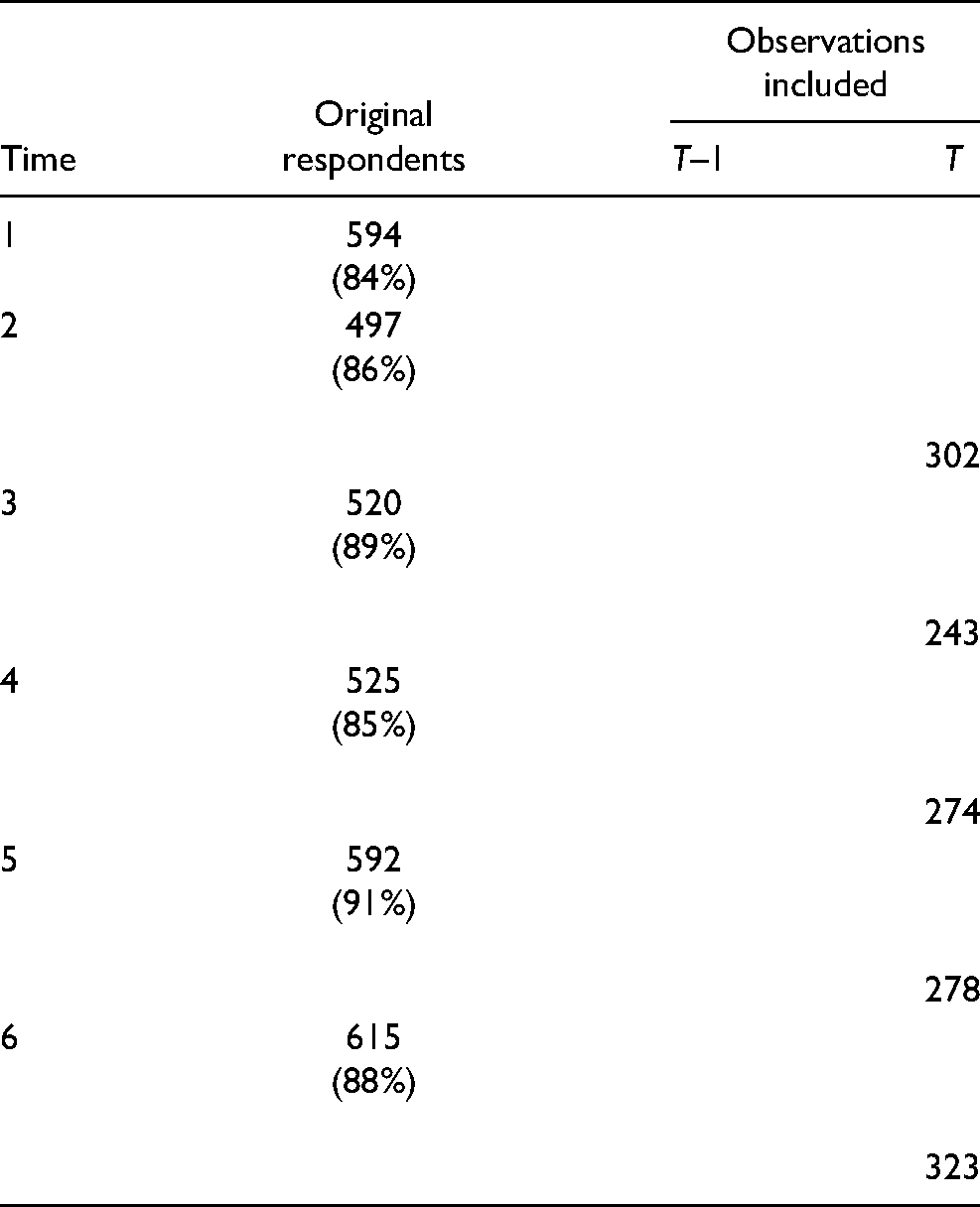
The study was conducted in a retail company comprising 43 stores across Canada. Invitations to fill out surveys were sent to all employees at six different time points with fixed interval periods of 12 months between each wave. Invitation letters were sent to employees, describing the aim of the study, the confidentiality statement, and their secret access code to complete the survey, which measured their perception of LMX with the store manager. We only retained respondents who completed the survey in at least two consecutive waves of data collection. The original number of respondents for each wave and the number of respondents included in the final time-lagged sample are described in Table 1. The final selection is thus composed of 725 different employees who responded between two and six times, leading to a total of 1,420 records of time-lagged consecutive assessments. Among these observations, 376 individuals represent the same individual at two different times, 304 represent the same individual at three different times, 285 at four times, 170 at five times, and 285 at six times. An ANOVA test revealed that neither LMX, OCB, RLMX nor ROCB significantly differ between subgroups based on the number of measurements. The analytical approach (see below) allows us to take into account the fact that multiple observations over time are nested within individuals. The employees were, at their respective first assessment wave, 32.7 years old (SD = 12.6), had an average tenure of 4.3 years (SD = 5.7), and worked 27.4 h per week on average. Seventy-three percent were women, 49.9% had a full-time position, and 26.6% held a university degree.
Overview of the Sample.
At each wave of data collection, surveys were also sent to store managers asking them to rate the citizenship behavior of each of the store's employees. All included employees allowed us to proceed to data pairing. None of the store managers quit between two consecutive measurement waves, but 20 of them quit in the overall period of study. An ANOVA test revealed no significant differences in OCB, LMX, ROCB, and RLMX between employees, whether their manager changed or stayed on throughout the study period. Among the 63 store managers, at their respective first survey occasion, 50.2% were women, 68.3% had a full-time position, and 65.9% held a university degree. On average, they were 43.9 years old (SD = 8.2), their tenure was 8.8 years (SD = 5.5), and they worked 42.3 h per week (SD = 6.9).
Measures
Leader–member exchange was measured using the LMX-MDM scale developed by Liden and Maslyn (1998), and a 7-point Likert-type scale ranging from 1 (strongly disagree) to 7 (strongly agree). LMX was self-rated because employees’ perceptions seemed better able to capture the social comparison phenomenon than supervisors’ ratings. The scale is composed of four dimensions: affect (mutual affection based on interpersonal attraction), contribution (based on the perception of each member's contribution towards the achievement of mutual goals), loyalty (expression of public support), and professional respect (the perception of the degree to which their reputation is based on excellence in their line of work). The scale showed very good internal consistency (α ranging from .90 and .95). Out of the 12-item original scale, one of them was removed from the analyses due to its significant negative impact on scale reliability and explicit redundancy with our dependent variable OCB. This item is: “I am willing to apply extra efforts, beyond those normally required, to further the interests of my work.”
The relative leader–member exchange (RLMX) score was created by subtracting the store's LMX mean from each individual's LMX level for each time period, as suggested by previous studies (e.g., Henderson et al., 2008).
Leader-rated helping OCBs (OCB-I) were measured using the three items of the “employee-directed” subscale developed by Netemeyer and Maxham (2007), and a 7-point Likert-type scale ranging from 1 (strongly disagree) to 7 (strongly agree). This scale captures extra-role behaviors in customer service and the retail context. A sample item is “Does this employee help new associates even though it is not required?” Internal consistency was good (α ranging from .88 to .92). We chose manager-rated OCB-helping over self- and peer-rated OCB because this design reduces common method bias, and as immediate supervisors allocate a large proportion of follower resources, their judgment of OCB is more likely to be consequential (Campbell et al., 2017).
ROCB helping (ROCB-I) was calculated by subtracting the store's mean OCB from each individual's OCB-I level as rated by the store manager for each time period.
Control variables. Group size was controlled for because this variable is correlated with some independent and dependent variables (Nishii & Mayer, 2009) and operationalized with the number of employees in each store. We also controlled for age, gender, tenure, dyadic tenure, and status. Previous levels of LMX and OCB were also controlled for in the time-lagged models
Analytical Approach
To test our hypotheses, we analyzed time-lagged relationships to capture the effect of one variable on the subsequent level of another. However, we used longitudinal data consisting of multiple measurement occasions (between 2 and 6) for each individual. Consequently, we relied on a hierarchical linear modeling approach to account for both within-person and between-person variability over time (Raudenbush & Byrk, 2002). Our analyses were performed with IBM SPSS mixed models (Heck et al., 2013). We followed the procedure of the recent study by Vleugels et al. (2018), which presents a similar analytical design. The within-person variance refers to the change in one person's variable assessment across repeated assessments, whereas between-person variance refers to the difference in variable assessment between persons. The high proportion of variance due to within-person variability was substantial for LMX (57.88%), OCB (64.26%), RLMX (59.68%), and ROCB (68.70%), which fully justifies this multilevel approach (Hox et al., 2017). When positioned as a predictor, LMX and OCB scores were centered around each individual's mean score over time (Enders & Tofighi, 2007) (RLMX and ROCB are by default mean-centered variables). A linear time covariate referring to the assessment point of predictors (ranging from 1 to 5) was also incorporated into the models to control for linear trends in the data (Heck et al., 2013). In sum, this analytical approach allowed us to include multiple measurements for the same individual in order to improve the robustness of our time-lagged models while controlling for repeated individuals.
With respect to potential between-store variance, since individuals are nested in stores, we assessed the intra-class correlations of LMX and OCB. LMX had low ICC1 values (ranging from.01 to.03 across measurement occasions) and low ICC2 values (ranging from .08 to .11). OCB also had low ICC1 values (ranging from .07 to .10) and ICC2 values (ranging from .22 to .31). These results led to an analysis of variables at the individual level (Hox et al., 2017). RLMX and ROCB were also analyzed at the individual level as they were created by subtracting the store's mean from the individual level of the respective variable.
Results
Correlations and descriptive statistics are provided in Table 2.
Correlations and Descriptive Statistics.
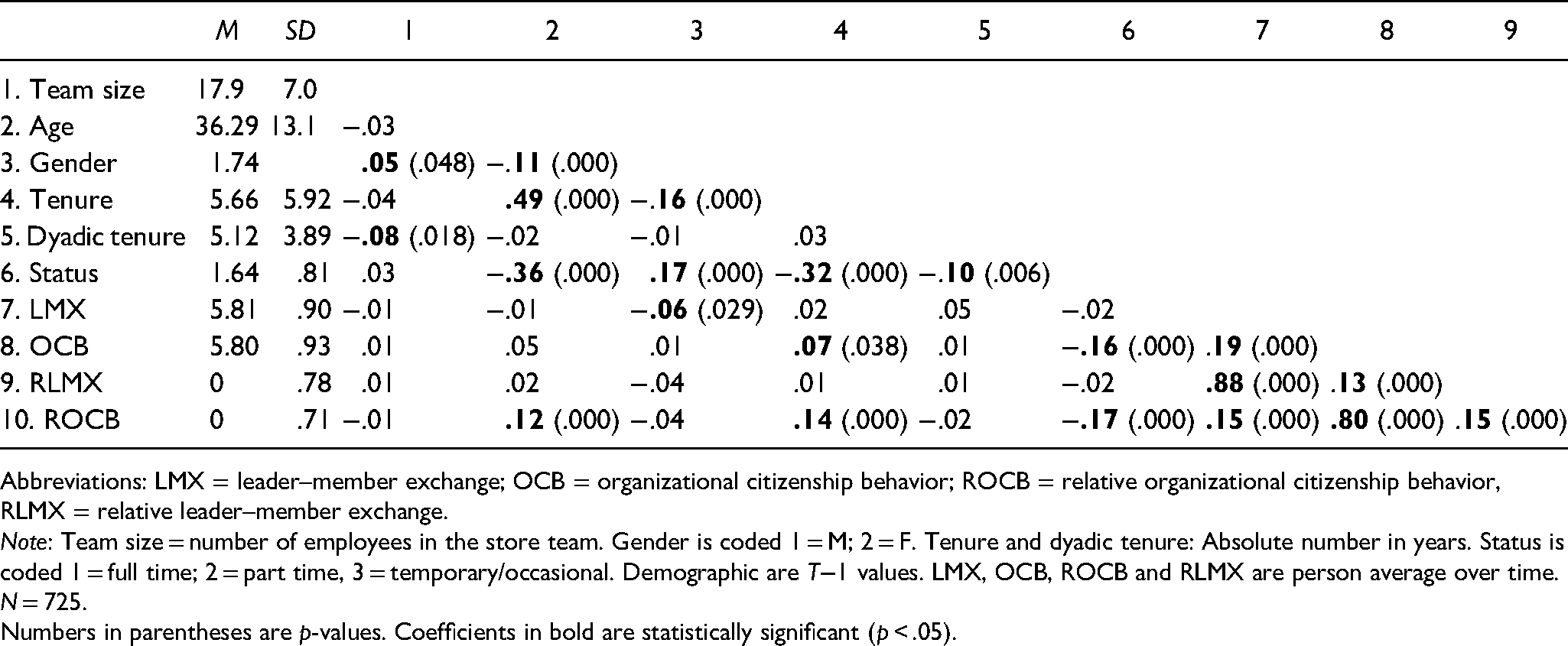
Abbreviations: LMX = leader–member exchange; OCB = organizational citizenship behavior; ROCB = relative organizational citizenship behavior, RLMX = relative leader–member exchange.
Note: Team size = number of employees in the store team. Gender is coded 1 = M; 2 = F. Tenure and dyadic tenure: Absolute number in years. Status is coded 1 = full time; 2 = part time, 3 = temporary/occasional. Demographic are T−1 values. LMX, OCB, ROCB and RLMX are person average over time. N = 725.
Numbers in parentheses are p-values. Coefficients in bold are statistically significant (p < .05).
Preliminary Analyses
First, the measurement invariance of the multi-item scales used for LMX and OCB-I across multiple waves was tested using a CFA framework, as recommended by Vandenberg and Lance (2000). Three models were tested using the AMOS 23 program. The fit of these models was assessed using the chi-square statistic (χ2) combined with fit indices: CFI (Comparative Fit Index); TLI (Tucker Lewis Index); and RMSEA (Root Mean Square Error of Approximation). Model 1 assessed configural invariance, in which items were constrained to load on the factor of the corresponding wave. This model presented an excellent fit to the data (χ2 = 1111.09**, df = 240, CFI = .934, TLI = .909, RMSEA = .054). Metric invariance was then evaluated with Model 2, which constrained factor loadings to be equal across waves. This constrained model did not significantly change the model fit (χ2 = 1176.54**, df = 288, Δχ2 = 65.45, Δdf = 48, CFI = .932, TLI = .922, RMSEA = .050), indicating that the measurement model of LMX and OCB is invariant (configural and metric invariance) across the five waves used as T in the analytical models.
Second, following previous RLMX studies, we controlled for the effect of individual LMX when examining the effect of RLMX on ROCB. Although the high correlations found between LMX and RLMX are consistent with previous studies, we sought to assess the risk of potential multicollinearity bias between LMX and RLMX, and between OCB and ROCB. According to Raykov and Marcoulides (2006), multicollinearity exists when the VIF value between two predictors is greater than 1 and/or when the condition index is greater than 15. However, it represents a serious risk of bias only when VIF is higher than 10, and/or when condition index is higher than 30. Our results reveal that multicollinearity between our predictors and controls exists but does not represent a serious risk, both for RLMX and LMX (VIF = 4.270; Condition Index = 22.056) and for OCB and ROCB (VIF = 2.471; Condition Index = 16.106). Hence, we decided to control for LMX and OCB since their inclusion does not cause a significant risk of bias in the results, except for one model for each hypothesis where we did not control for these latter constructs for comparison purposes.
Hypothesis Testing
We first tested Hypothesis 1, which posits that RLMX positively predicts subsequent ROCB. To do so, we assessed the effect of the RLMX level at one measurement occasion (T−1) on the ROCB level at the subsequent measurement occasion (T). Results displayed in Table 3 reveal that, whereas previous levels of RLMX (β = .27, p < .01) and LMX (β = .16, p < .05) both significantly influence the subsequent absolute level of OCB, the effect of RLMX on subsequent RLMX when controlling for LMX is positive but fails to demonstrate strong statistical significance (β = .12, p = .112). However, when LMX was not controlled for, RLMX significantly predicted ROCB (β = .09, p < .05). These results lead us to reject H1 but should nevertheless encourage researchers to keep investigating the potential positive impact of RLMX on ROCB.
The Effect of (T–1) RLMX on (T) ROCB.
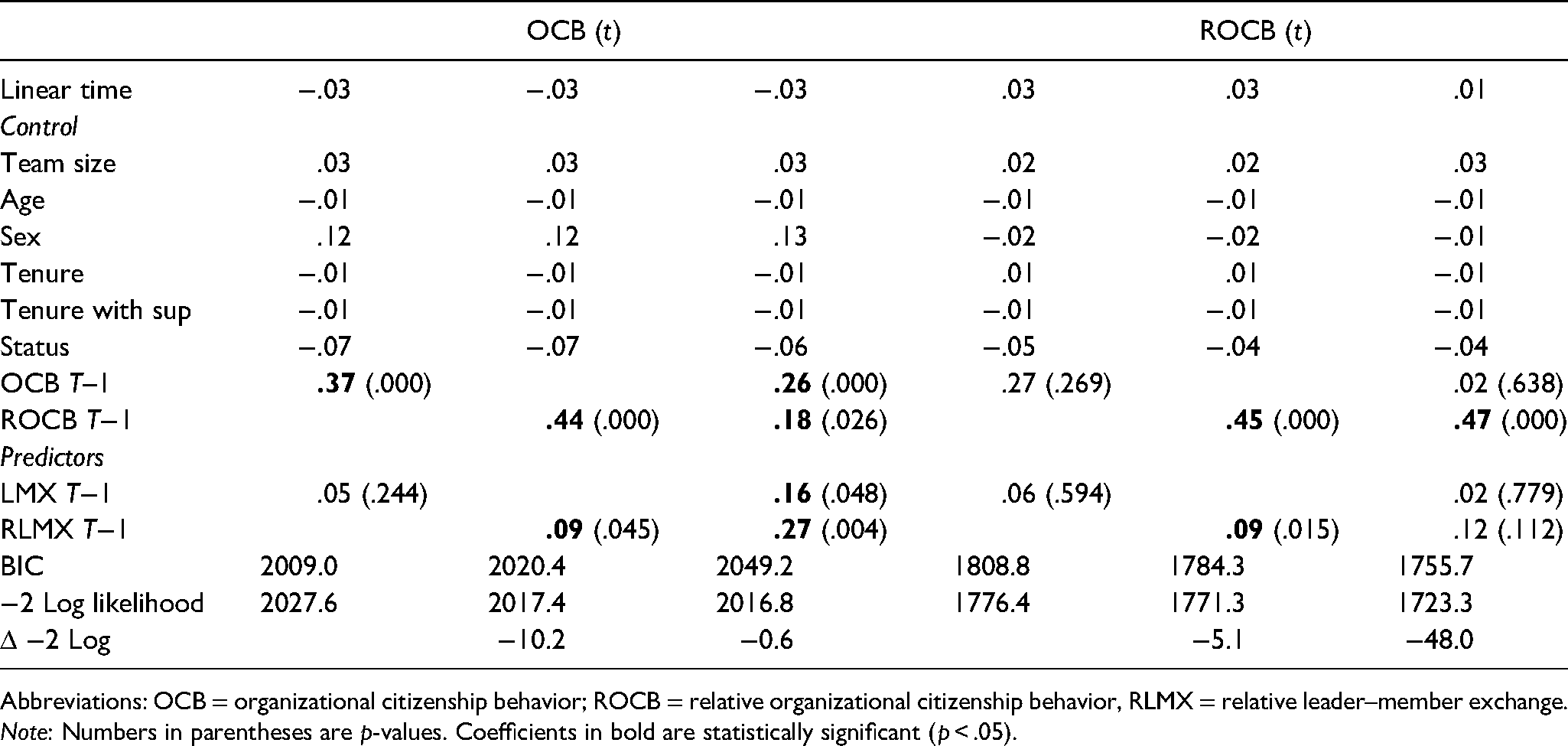
Abbreviations: OCB = organizational citizenship behavior; ROCB = relative organizational citizenship behavior, RLMX = relative leader–member exchange.
Note: Numbers in parentheses are p-values. Coefficients in bold are statistically significant (p < .05).
Hypothesis 2 posits the opposite direction of the relationship. We thus tested the effect of the previous level of ROCB on the subsequent level of RLMX. Results in Table 4 show that OCB leads to a higher subsequent absolute level of LMX (β = .08, p < .05), and that ROCB has a significant positive influence on both the subsequent level of LMX (β = .13, p < .05) and RLMX (β = .16, p < .05), above the effect of previous LMX and RLMX. Hypothesis 2 is thus supported.
The Effect of (t−1) ROCB on (t) RLMX.
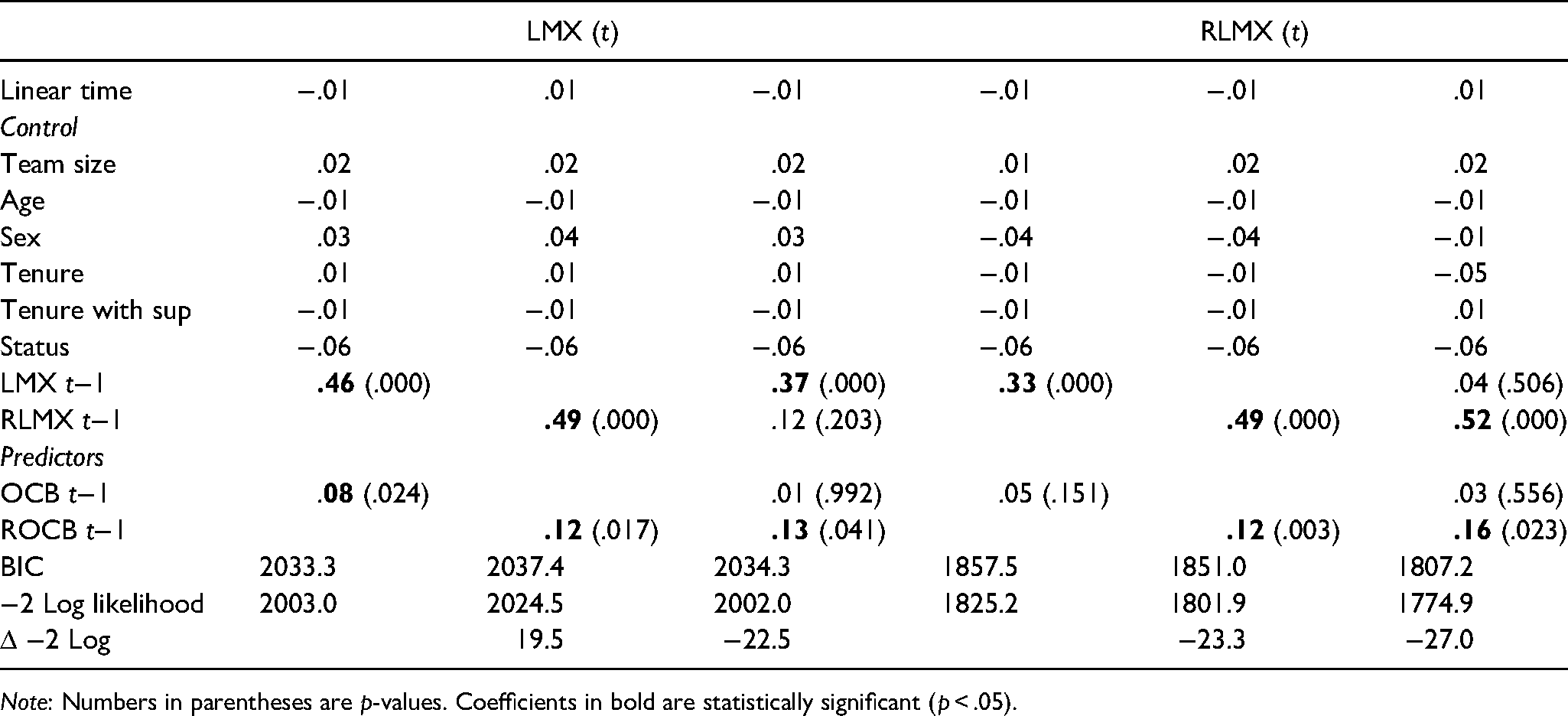
Note: Numbers in parentheses are p-values. Coefficients in bold are statistically significant (p < .05).
Discussion
Drawing on social comparison theory and the norm of reciprocity, the aim of this paper was to investigate the cross-lagged and bidirectional relationships between RLMX and ROCB. We hypothesized that benefiting from higher LMX than average will lead to a higher OCB-I than average. We also examined the impact of performing higher ROCB-I than average on RLMX. These hypotheses were tested with longitudinal data comprising 1,420 records of time-lagged observations.
Overall, the results indicate that performing higher helping behaviors than average not only leads to a good relationship with the leader, but more importantly to a better LMX relationship than average. However, although the effect of RLMX on ROCB is positive, as hypothesized, it is not statistically significant.
Theoretical Contributions
Results indicate that ROCB-I predicts subsequent levels of RLMX. This finding implies that high ROCB-I performers receive what they give from their superiors, while lower than average citizens receive a commensurately lower LMX treatment than average. Existing literature on LMX provides evidence that job performance is an important antecedent of LMX quality (e.g., Bauer & Green, 1996; Nahrgang et al., 2009; Park et al., 2015). Our findings show that relative OCB-I has a greater predictive power on RLMX quality than the absolute level of OCB-I. This finding suggests that leaders experience a stronger moral obligation to reciprocate this higher relative contribution to the team by providing a better RLMX standing. The current study contributes to the literature on reciprocity by examining whether leaders seek to adhere to the norm of reciprocity when they observe substantial differences in contributions between followers. Leaders consider not only absolute levels of OCB when they allocate resources, but also the relative contribution of followers to the team's success following a process of comparison. Our study sheds light on the sources of LMX differentiation by suggesting that differentiation is contingent on subordinates’ relative OCB-I. One explanation for this behavior by leaders (i.e., differentiating among subordinates) is that they may desire to maintain an exchange equilibrium (Liao et al., 2019) and to motivate high ROCB-I performers to maintain their higher relative contribution in the future. Since elites in some work domains are substantially more productive than those with below-average performance (Aguinis & Boyle, 2014), leaders are more likely to believe that it is normal and fair to provide disproportionately higher LMX relationships to high ROCB-I employees. Furthermore, as some leaders are aware that followers compare their contributions to those of others, and therefore know which followers are more helpful and which are less so, the pressure is high on leaders to promote a climate of fairness. Incidentally, LMX differentiation has been found to have fewer negative effects on team outcomes when it is based on OCBs (Chen et al., 2018)
Our results provide additional support to previous research on the impacts of followers’ performance on the development and maintenance of LMX relationships (Bauer & Green, 1996; Nahrgang et al., 2009; Park et al., 2015). We extend this research stream by showing that displaying more helping behaviors than the average is an efficient ingredient for an outstanding LMX relationship. Conversely, being among the less generous colleagues in the team comes with a cost, namely to receive fewer resources and less support from the leader, to have a distant relationship with the formal immediate supervisor, and to jeopardize important career opportunities and occasions for rewards.
Regarding the influence of RLMX on ROCB, our findings extend the previous research on RLMX by showing that followers reciprocate their relative higher LMX status by performing higher levels of OCB-I. Furthermore, our use of longitudinal data and a time-lagged design strengthens this relationship. Our findings reveal that dyadic exchanges between leaders and subordinates are not always equitable or balanced. Our results indicate that a higher RLMX standing determines higher OCB-I, but failed to provide a clear demonstration for its impact on ROCB-I. One conclusion of this result is that subordinates are less likely to reciprocate proportionally than their leader. One plausible explanation is related to group norms. Scholars have proposed that employees who outperform others are more likely to be victimized if they do not conform to their peers’ norms and expectations, and thus are more likely to withhold discretionary contributions (Jensen et al., 2014). Providing too much helping behavior above the norm may be threatening for other team members because it may increase helping expectations from the immediate supervisor and lower the status and image of less helpful team members. Another explanation could be that low RLMX subordinates may perceive that change in their LMX status is possible, and therefore, they may strategically choose to reach high ROCB in order to signal that they deserve higher RLMX status (Pettit & Marr, 2020). A study by Sleebos et al. (2006) illustrates that lower-status group members (i.e., disrespected members) show high levels of discretionary efforts. Overall, we think more research is needed to shed light on the nature of this relationship.
Strengths and Limitations
The present study, like all studies, has strengths and limitations. Among its strengths are the uses of different data sources to reduce the risk of common method bias. In our study, LMX was measured by subordinates, while OCB-I was measured by superiors. In addition, the use of within-person analyses also contributed to reducing the impact of response biases (Spence et al., 2011). Moreover, it is worth mentioning that previous research has mainly examined fluctuations in OCB over a short period of time, such as minutes, days, weeks, or a few months. Responding to the recent recommendation by Methot et al. (2017) to shift to a longer-term focus, this study examined the reciprocal influence of relative LMX and OCB for a one-year period. Furthermore, the time-lagged design provides greater evidence for the causality relationship.
Among its limitations, this study did not test the mechanisms through which RLMX and ROCB influence each other. One may not rule out the possibility that reciprocal RLMX-ROCB associations result from relatively higher positive moods (Glomb et al., 2011) or emotions such as gratitude or pride (Algo, 2012; Kim et al., 2018). Future research could examine how RLMX affects team members’ gratitude. Indeed, it could explore how higher ROCB-I elicits a greater feeling of pride and self-esteem. We may speculate that the RLMX–ROCB relationship has a longer life when the leader and the member demonstrate mutual gratitude. Another limitation is that, while our study is built on the norm of reciprocity and social comparison theory, it does not directly test the proposed mechanisms derived from these theories. Future research may examine how expected reciprocity and the obligation of reciprocity from both leader and subordinate mediate or moderate the effect of the RLMX–ROCB relationship. Furthermore, our research did not account for relative task performance. Do followers who perform extreme task performance and lower OCB helping than average receive a higher relative LMX treatment, but are more likely to be the target of victimization, in comparison to followers who perform lower task performance than average but higher helping than average? Another important consideration is to look at organizational citizenship behaviors other than helping behaviors. Future research should examine whether subordinates who perform higher relative voice behaviors than average receive a commensurate LMX treatment from their leader. It is possible that immediate supervisors do not treat and reward, in a commensurate way, followers who perform higher helping in comparison to those who show higher voice behaviors than average. An additional limitation is that our study does not address the role of team context. It is improbable that the positive influence of RLMX on ROCB or of ROCB on RLMX may be generalized to all team contexts. Future research could examine whether task interdependence, team identification, or organizational vision may enhance or reduce the strength of these associations. Finally, the data sample was drawn from one retail organization in Canada. It remains to be seen whether our findings can be replicated among employees from other sectors and cultures.
Practical Implications
Given that leaders tend to differentiate among their subordinates, one important question for managers is whether providing higher social resources to some team members is reciprocated by higher relative OCB-I. Our study indicates that high RLMX followers display higher helping behaviors, but not more than others. Despite this positive outcome, this unbalanced exchange may incur some costs to leaders and the organization (e.g., time, support, career resources). It is important that the leader and subordinates openly discuss perceived obligations and expectations to reach a mutual agreement about the equity of exchanges. Our results also indicate that in addition to being beneficial for group functioning and organizational performance (Podsakoff et al., 2018), performing higher ROCB-I substantially improves relative leader-member relationships. This finding is important for employees because it increases the assurance that generous helping behaviors will lead to a higher LMX standing, and a higher LMX relationship has been associated with important individual career events and rewards (Kraimer et al., 2015). Finally, considering the positive impact of helping on unit performance, and particularly when helping becomes normative (Ehrhart, 2018), recruiting people with helping dispositions and adhering to the reciprocity norm are paramount. However, decision makers must ensure that those with higher levels of behavioral engagement compared to others are entitled to and benefit from an exceptional, stimulating, and supportive work environment.
Conclusion
Relying on social comparison theory and the norm of reciprocity perspective, this study has provided empirical evidence that performing more helping behaviors than the group average (ROCB) leads to a subsequent higher quality of relationship with the leader compared to the group average. The reverse relationship (the effects of RLMX on ROCB) is less consistent. This suggests that LMXs are not always reciprocated in kind by subordinates.
Footnotes
Declaration of Conflicting Interests
The authors declared no potential conflicts of interest with respect to the research, authorship, and/or publication of this article.
Funding
The authors received no financial support for the research, authorship, and/or publication of this article.
