



Abstract
Background. In human upper-limb stroke, initial level of functional impairment or corticospinal tract injury can accurately predict the degree of poststroke recovery, independent of rehabilitation practices. This proportional recovery rule implies that current rehabilitation practices may play little or no role in brain repair, with recovery largely a result of spontaneous biological recovery processes. Objective. The present study sought to determine if similar biomarkers predict recovery of poststroke function in rats, indicating that an endogenous biological recovery process might be preserved across mammalian species. Methods. Using a cohort of 593 male Sprague-Dawley rats, we predicted poststroke change in pellet retrieval in the Montoya staircase-reaching task based on initial impairment alone. Stratification of the sample into “fitters” and “nonfitters” of the proportional recovery rule using hierarchical cluster analysis allowed identification of distinguishing characteristics of these subgroups. Results. Approximately 30% of subjects were identified as fitters of the rule. These rats showed recovery in proportion to their initial level of impairment of 66% (95% CI = 62%-70%). This interval overlaps with those of multiple human clinical trials. A number of variables, including less severe infarct volumes and initial poststroke impairments distinguished fitters of the rule from nonfitters. Conclusions. These findings suggest that proportional recovery is a cross-species phenomenon that can be used to uncover biological mechanisms contributing to stroke recovery.
Many stroke patients are expected to recover ~70% of lost function in proportion to their initial degree of impairment. 1 This phenomenon of proportional recovery has been shown for both the upper1 -5 and lower limbs 6 as well as visuospatial neglect 7 and aphasia 8 across a range of demographics. Presence of motor-evoked potentials 3 and survival of sufficient corticospinal tract tissue 4 following stroke results in classification as a “fitter” of the proportional recovery rule. The tight link between tissue integrity and functional outcome has been used to suggest that spontaneous biological processes may mediate recovery. 9 However, as human studies include some form of rehabilitative treatment for all patients, it is unclear if proportional recovery is the result of a truly spontaneous or, alternatively, rehabilitation-induced process.
Because rodents are widely used to identify mechanisms of poststroke recovery, it is important to determine if they also exhibit the proportional recovery rule and associated biomarkers found in humans. If cross-species homology exists, this provides validity for using rodent models to identify the biological processes of recovery, allowing the development of more efficacious and targeted therapeutics for humans. Furthermore, preclinical models allow withholding of poststroke rehabilitation, enabling the investigation of rehabilitation efficacy and the relationship between rehabilitative treatment and proportional recovery. The present study sought to determine if human proportional recovery and its associated biomarkers also apply to rats.
To assess biomarkers of stroke recovery, we performed a retrospective analysis of a large data set (n = 593) of male Sprague Dawley rats from a number of our published and unpublished experiments (see supplementary materials for publication list and detailed methodology). All available animals that met the following criteria were included:
subjects: male, Sprague Dawley rats (age range 2.5 to 4 months at the time of surgery);
focal ischemia: unilateral intracerebral endothelin-1 (ET-1) administration (Supplementary Tables 1 and 2);
functional assessment: pellet retrieval (PR) in the Montoya staircase-reaching task;
assessment timeline: minimum of 3 measurements—prestroke, within 1 week poststroke, and final assessment no earlier than 3 weeks poststroke (time of terminal assessment ranged from 3 to 10 weeks); and
significant impairments: poststroke performance outside the 95% CI of prestroke performance.
Animals that received no rehabilitation (n = 383; spontaneous recovery) and animals that received a form of poststroke treatment consisting of daily PR practice and enriched environment housing (n = 210; rehabilitation-induced recovery) were both included in the study (Supplementary Table 3).
Hierarchical cluster analysis identified statistically distinct subgroups of rats with varying changes in PR in proportion to their prestroke performance (ΔPRObserved/(PRPrestroke − PRInitial Poststroke). The staircase task data set was best represented with 3 clusters of subjects (Figure 1). This was indicated by a statistically significant increase in the proportion of variance explained by each group when increasing from 2 to 3 data clusters (χ2 = 19.783; P = .0001), but not when increasing from 3 to 4 data clusters (χ2 = 8.18, P = .0852; Figure 1 inset). Clustering identified 182 fitters (rats that showed proportional recovery), 370 “nonfitters” (rats that did not show proportional recovery), and 41 “decliners” (rats whose performance declined over time; discussed in the companion article). Rats in the fitter group displayed proportional recovery of 65.9% relative to the difference between their prestroke and initial poststroke assessment. The 95% CI of this parameter (62%-70%) was not statistically different from that in recent human clinical trials of proportional recovery (55%-70%). 5 In addition, the relationship between observed and predicted (65.9%) PR was directly proportional to initial impairment, with the best-fit line crossing through the origin of the graph and a near 1:1 relationship between observed and predicted PR: [ΔPRPredicted = 1.044 (ΔPRObserved)]; R2 = 0.499, P < .0001; Figure 1.
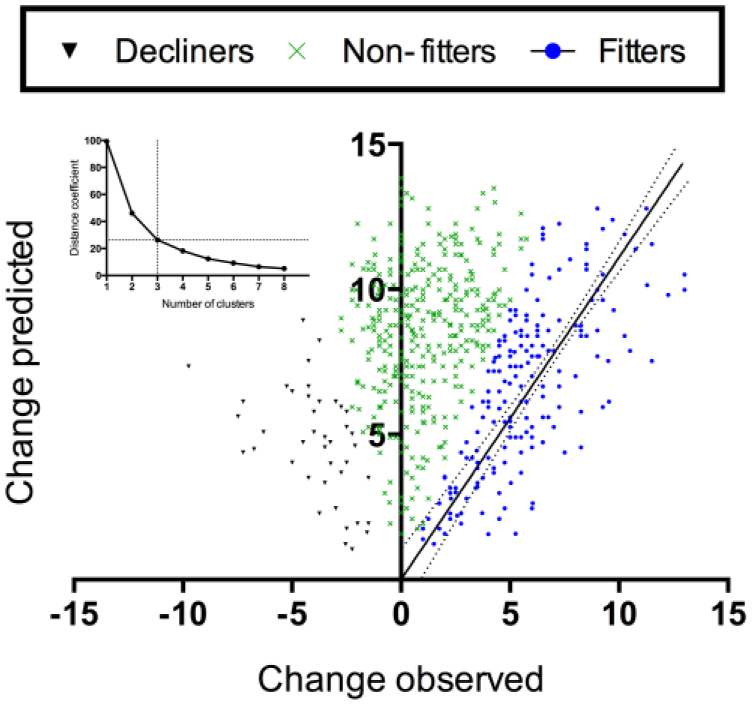
Proportional recovery in the staircase-reaching task. Hierarchical clustering identified 3 subgroups of animals in the staircase task (n = 593). Approximately 30% of rats were classified as fitters of the proportional recovery rule (n = 182), with a mean of 65.9% recovery in PR in proportion to the difference between their prestroke and initial poststroke scores [ΔPRPredicted = 1.044 (ΔPRObserved)]; R2 = 0.499, P < .0001]. Overall, the nonfitter subgroup (n = 370) did not show significant recovery in proportion to their initial impairment. The performance of the decliners (n = 41) continued to decrease over time following initial poststroke assessment. Inset graph shows the point in clustering at which dividing the sample into more groups no longer resulted in a significant decrease in distance coefficient (χ2 = 19.783; P = .0001).
Fitters of the proportional recovery rule were assessed to identify additional descriptive characteristics that may serve as biomarkers of stroke recovery. Compared with nonfitter rats, fitting the proportional recovery rule was distinguished by milder initial poststroke impairment, smaller infarct volumes, and a lower proportion of animals with significant striatal injury (injury >3.0 mm3; Table 1). Individually, these biomarkers have been proposed as important predictors of human stroke recovery, demonstrating further congruence between rat and human recovery.1,4,9
Descriptive Characteristics of Fitters, Nonfitters, and Decliners on the Staircase Task. a
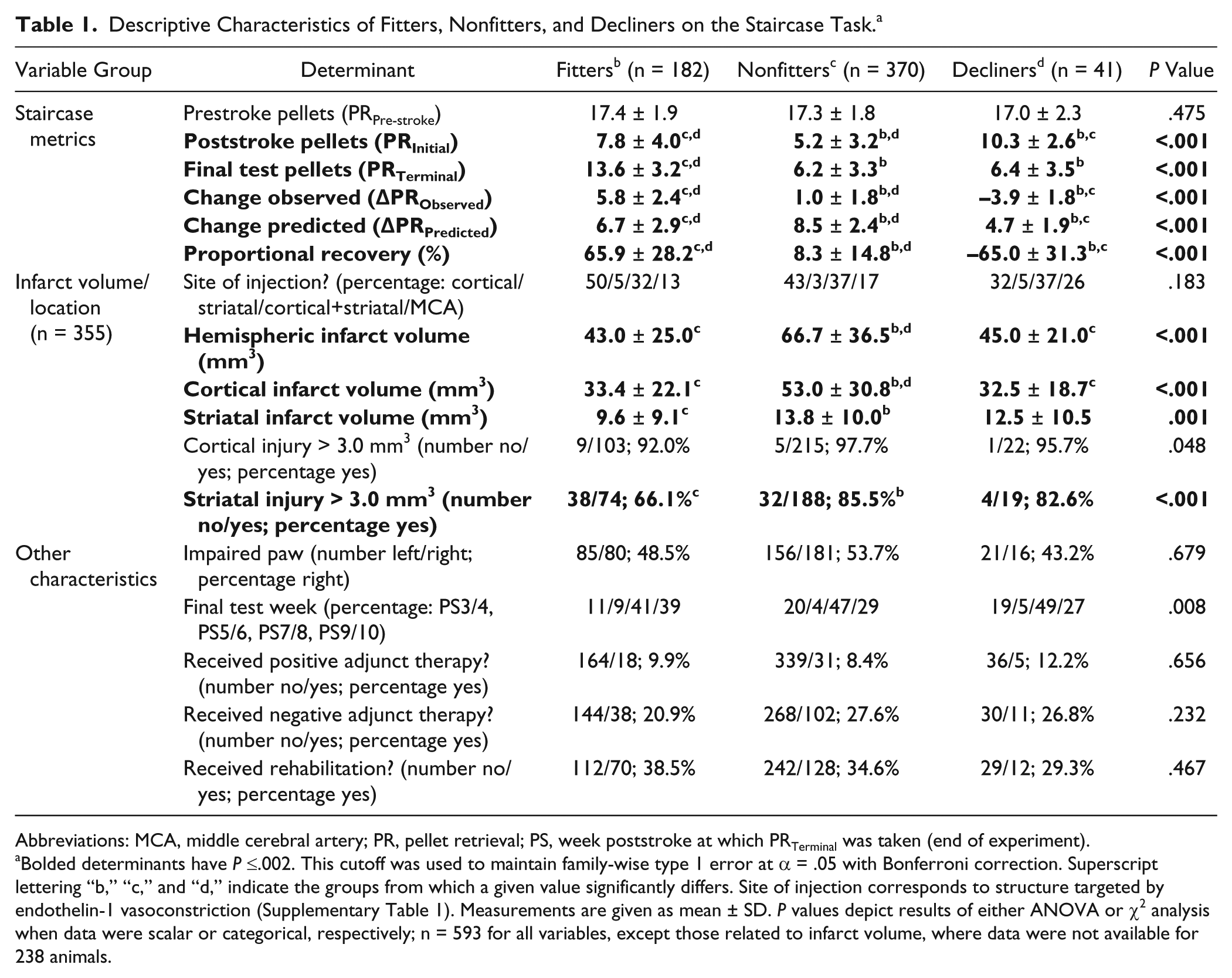
Abbreviations: MCA, middle cerebral artery; PR, pellet retrieval; PS, week poststroke at which PRTerminal was taken (end of experiment).
Bolded determinants have P ≤.002. This cutoff was used to maintain family-wise type 1 error at α = .05 with Bonferroni correction. Superscript lettering “b,” “c,” and “d,” indicate the groups from which a given value significantly differs. Site of injection corresponds to structure targeted by endothelin-1 vasoconstriction (Supplementary Table 1). Measurements are given as mean ± SD. P values depict results of either ANOVA or χ2 analysis when data were scalar or categorical, respectively; n = 593 for all variables, except those related to infarct volume, where data were not available for 238 animals.
It is important to note that although the Montoya staircase task is sensitive to poststroke decreases in pellet-retrieval performance, it does not directly assess neurological impairment like the Fugl-Meyer task (commonly used in human studies of proportional recovery). 10 The PR measure in the staircase task does not take into account the body positioning or limb kinematics of the animal while retrieving the pellet. Therefore, the proportional recovery observed in the present study could be a result of compensatory movement strategies, true impairment resolution, or a combination of the two, whereas proportional recovery in human studies is more unambiguously a result of impairment resolution. Future investigations should incorporate kinematic analysis to distinguish whether proportional recovery is a result of promotion of compensatory strategies or true resolution of neurological impairments.
One interesting finding of the present study is that relatively fewer animals demonstrated proportional recovery in relation to initial impairment alone ~30%) than in the earliest human reports of proportional recovery (~80%). 1 However, more recent publications of proportional recovery have reported larger proportions of the population being nonfitters of the rule. 2 Moreover, factoring in the degree of corticospinal tract injury can be used to more accurately determine fitter and nonfitter status. 4 Therefore, we conclude that the relative proportion of either animals or humans that display proportional recovery in a given study is dependent on the range of injury that is sampled. Although it is difficult to directly assess the impact of lesion volume across differing imaging modalities, studies, and species, a rough approximation can be gathered from articles that have compared preclinical animal research in relation to the typical-sized human stroke. 11 In his review of this topic, Carmichael 11 reported that typical human stroke volumes in large population studies range from 28 to 80 cm3, equating to roughly 4.5% to 14% of the total volume of the ipsilesional hemisphere. In the present study, fitters and nonfitters had mean total infarct volumes of 43 and 67 mm3, respectively. In Sprague-Dawley rats, this corresponds to ipsilesional injuries of approximately 5.3% to 8.3% of total hemispheric volume. 11 That the hemispheric injury volume of these human studies (4.5%-14%) and the present study (5.3%-8.3%) overlap supports that our data set is representative of typical human stroke sizes. Although not all previous studies of proportional recovery have measured lesion volume, those that did reported mean diffusion-weighted imaging volumes of 3.1 cm3 (Prabhakaran et al 1 ), 19.8 cm3 (Lazar et al 8 ), and 43.11 cm3 (Feng et al 4 ). This suggests that the current body of human proportional recovery literature may have sampled relatively minor injuries, potentially explaining the high proportion of patients that show proportional recovery in these studies. It is likely that our cohort of rats represent a wider range of injury than has been previously utilized to study proportional recovery in humans. Future human trials that include larger mean injury volumes will likely observe higher proportions of nonfitters of the proportional recovery rule.
In the present study, we demonstrate that fitters of the human proportional recovery rule also exist in rats. These animals show a degree of proportional recovery (62%-70%) that is not statistically different from that observed in humans (55%-70%). 5 Additionally, we identified distinguishing characteristics between fitters, nonfitters, and decliners to establish useful biomarkers for predicting stroke recovery. These characteristics (initial level of poststroke impairment, infarct volume) resemble those that predict proportional recovery in human studies, demonstrating further concordance between human and rat proportional recovery phenomena.1,4 Importantly, presence of rehabilitation was not a distinguishing characteristic of fitting, or not fitting, the proportional recovery rule. This is consistent with human studies that have also shown that varying types of rehabilitation do not differentially influence proportional recovery. 3 However, it should be noted that the retrospective data set in the present study was composed of several variations of rehabilitation, and it is possible that more detailed analysis of individual rehabilitation characteristics (rather than simple presence/absence of rehabilitation) could reveal benefits of treatment.
Indeed, in a companion article, we investigate the utility of the characteristics identified in the present study (initial impairment/infarct volume) and also subcharacteristics (eg, number of practice movements) of rehabilitation for improving prediction of stroke recovery. Using a series of prospective experiments, we validate each predictor and demonstrate that, specifically, the intensity of rehabilitation is important for rats originally predicted to be nonfitters of the proportional recovery rule. Additionally, in the companion article, we establish an algorithm to determine the individualized daily dose of rehabilitation necessary to achieve significant improvements in motor performance in rats. The present study suggests that proportional recovery is conserved across mammalian species, strengthening the construct validity of rat models to explore the biological mechanisms underlying human stroke recovery and rehabilitation.
Footnotes
Acknowledgements
The authors thank Dr Rajiv R. Ratan and Dr Julie Bernhardt for their critical review of early versions of this article. Additionally, the Canadian Partnership for Stroke Recovery, Canadian Institutes for Health Research (CIHR), Natural Sciences and Engineering Research Council of Canada (NSERC), Heart & Stroke Foundation of Canada, and Canada Research Chairs program provided funding to DC for the studies that comprise this research. SK received fellowships from CIHR and the Ontario Graduate Scholarship (OGS) program.
Supplementary material for this article is available on the Neurorehabilitation & Neural Repair website along with the online version of this article.
Authors’ Note
The data that support the findings of this study are available from the corresponding author on request.
Declaration of Conflicting Interests
The authors declared no potential conflicts of interest with respect to the research, authorship, and/or publication of this article.
Funding
The authors received no financial support for the research, authorship, and/or publication of this article.

References
Supplementary Material
Please find the following supplemental material available below.
For Open Access articles published under a Creative Commons License, all supplemental material carries the same license as the article it is associated with.
For non-Open Access articles published, all supplemental material carries a non-exclusive license, and permission requests for re-use of supplemental material or any part of supplemental material shall be sent directly to the copyright owner as specified in the copyright notice associated with the article.
