




Abstract
Background:
Adherence to therapy is central to the success of antiretroviral treatment (ART). With the availability of free ART under the national program in India, cost of ART is no longer the primary determinant of adherence. This study evaluated the adherence and factors influencing it among patients receiving free ART in a public health ART center in India.
Methods:
The adherence and its influences among 250 HIV-positive patients on first line ART for at least 3 months from the ART Center of Maulana Azad Medical College and Lok Nayak Hospital, New Delhi, India were analyzed. The adherence was assessed by patients' self report using the adult AIDS Clinical Trial Group (ACTG) questionnaire and counter checked with pharmacy records. The association of various parameters affecting adherence levels was analyzed by using SPSS package and Epiinfo software.
Results:
Of the 250 patients, 242 (96.8%) had optimum adherence (>95%) and 8 (3.2%) were “non-adherent.” CD4 counts (P = 0.05), high level of belief among patients, patients' knowledge about importance of adherence (P = 0.04), and sound mental health were positively influencing adherence. The main barriers to adherence were poor mental health and negative psychological states in the patients (0.001). The presence of adverse reactions to ART also resulted in poorer adherence.
Conclusions:
The modifiable factors most strongly associated with good adherence rates were higher current CD4 counts, patients' beliefs in ART, and positive mental health. These factors can be targeted by simple, practical interventions to improve and maintain high adherence levels.
Introduction
Human immunodeficiency virus (HIV) is a global pandemic with an estimated 33.3 million adults infected worldwide. 1 The availability of antiretroviral (ARV) drugs has changed the progression of disease, prognosis, and outcome of persons living with HIV. Antiretroviral therapy (ART) reduces the amount of virus in the body to very low levels, allowing the immune system to recover its strength. Highly active antiretroviral treatment (HAART) reduces the morbidity and mortality associated with HIV infection by suppression of viral replication, restoration and preservation of immune function, and prevention of drug resistance. 2 With the timely initiation and proper use of ART, HIV/AIDS is now a chronic manageable disease with lifelong therapy.
Central to the benefit from ART is the issue of adherence to ART. In fact ART adherence is so critical that it is the second strongest predictor of progression of HIV to AIDS and death after CD4 count. 3 But like for any other chronic disease with long-term medication, nonadherence to ART is a major concern. Long-term viral suppression requires near-perfect adherence (90%-95%). 4,5 Adherence rates of <80% are associated with detectable viremia in a majority of patients. Although effective adherence levels have not been fully defined for HAART, levels of adherence below 95% have been associated with poorer virological and immunological response. 6 This means missing no more than 1 dose a month, if ARV medications are prescribed in once a day dose. Data suggest that adherence levels of 100% achieve even greater benefit. 7,8 A nonadherent patient on triple drug therapy is 3.87 times more likely to die than an adherent patient on the same therapy. 4 According to the published experience of the AIDS Support Organization (TASO), Kampala, Uganda, nonadherent patients were 2 times as likely to die as adherent participants. 9
Adherence means taking the drugs exactly as prescribed. This includes taking all the medications at the right time and exactly per the directions. Adherence to ART is critical for HIV management but often difficult to achieve. It is also difficult to measure adherence accurately and there is no gold standard for measuring it. The various approaches to assess adherence include patient self-report, patient keeping appointments at clinic visits, pill counts, pharmacy records, measurement of drug levels, biologic surrogate markers, and a medication event monitoring system. None of the methods is found to be completely accurate and many of them are not practical to apply in routine clinical practice. 10,11
Although the importance of adherence in achieving treatment success is well acknowledged, our understanding of the factors influencing adherence and barriers to adherence is incomplete.
The various factors affecting adherence have been identified as being patient related, treatment regimen related, related to patient–provider relationship, and the clinical setting. 5 The patient-related variables include demographic factors (age, sex, financial resources, literacy levels, and housing status) and psychosocial factors (mental health, psychiatric morbidity, substance and alcohol abuse, social support structure, knowledge about HIV, and attitude toward treatment).
Treatment regimen-related factors affecting adherence include number of pills per dose, 5 complexity of the regimen, and short- and long-term side effects of medication. Disease characteristics like stage and duration of disease, associated opportunistic infections, and HIV-related symptoms have also been found to affect adherence in some studies. Patient’s trust in the physician has been shown to improve adherence, 9 whereas dissatisfaction with prior experience has been associated with nonadherence. 11
There is no much published data relating to adherence issues from India, especially from a public health facility under National AIDS Control Organization (NACO). In the limited Indian studies undertaken thus far in both private and public health set ups, cost of ART was the single major limiting factor. 10 –12 But with ART being made available free of cost since 2004 in India through National AIDS Control Programme, other important predictors of adherence need to be identified and addressed.
Materials and Methods
The study was conducted in the ART Center in the Department of Medicine, Maulana Azad Medical College and associated Lok Nayak Hospital, New Delhi, India. The ART center was among the first 7 ART centers established in the country for the care, support, and treatment of HIV-infected persons by the Government of India on April 2004, and as of July 2011, there are 4648 patients registered for care and 1491 are receiving free first-line ART here.
This was an observational cross-sectional study involving HIV-positive patients on free first-line ART from the ART center at for at least 3 months. The patients were selected on a random basis and were approached for participation in the study when they reported to the ART Center for their monthly visit. Finally, 250 participants were enrolled into the study after they gave an informed consent. All study participants were subjected to the following study procedures.
Detailed History and Examination
All the patients included in the study underwent a detailed history and clinical examination. Detailed history of presenting complaints, past illnesses, mode of transmission, and any ongoing opportunistic infections (OI) was taken. History regarding ART use was taken in detail including date of start of ART, ART regimen and dose, and any adverse effects. To assess the patient’s immune status, the last CD4 count of the patient was accessed from his ART center records.
Assessment of ART Adherence
The adherence assessment of the patient was done in detail using both the subject recall and pill count methods. The recall method was employed to assess the adherence status over the past week (of the patient taking the questionnaire), over past 1 month, and any time since the start of ART. This was done to objectively classify adherence of the patient (as below) and to remove any biases in questionnaires using only long/short recall periods. The adherence records of the patients collected over the past 3 months per pill counts were reviewed from the ART clinic records of the pharmacist. This was done to validate the recall-based responses of the patients regarding his or her adherence to drugs.
Per NACO guidelines, the patients were divided into 3 groups based upon their adherence levels, that is, group A (>95% adherence levels; <3 missed doses in past 1 month), group B (80%-95% adherence level; 3-12 missed doses in past 1 month), and group C (<80% adherence levels; >12 missed doses in last 1 month).
A patient information sheet was generated for each patient that included the demographic and social information and information regarding the educational status, employment, and profession.
Definitions
For analysis and correlation between various factors and adherence, patients were divided into 2 groups
Adherent: >95% adherence (group A) Nonadherent: <95% adherence (groups B + C).
ACTG Baseline Questionnaire
All the patients were administered the adult AIDS Clinical Trial Group (ACTG) Baseline Questionnaire in English or its Hindi translation. The patient was given a choice of answering the questionnaire on their own, being administered by the interviewer, or both. The patient who had difficulty in understanding any of the listed questions was encouraged to seek the help of the interviewer for the same. Since the study population had patients from varying social strata and educational status, the content of the questionnaire was verbally translated into the language being understood by the patient, by the interviewer, if so desired by the patient.
The questionnaire consisted of domains including (a) patients attitude toward ART, (b) social support, (c) possible reasons for missed dose (in past 1 month), (d) duration since last missed dose, (e) psychiatric problems in 1 week prior to the interview, (f) psychiatric problems in 1 month prior to the interview, (g) substance abuse, (h) patient background (including literacy status, current employment status, and family structure), (i) drug-related side effects affecting the patient (in past 1 month).
The patients were evaluated for any drug-related side effects like anemia, rash, hepatitis, and lipodystrophy.
Potential Determinants
The factors which were analyzed as possible facilitators/barriers to adherence behavior of patients were:
Age Sex Place of residence (distance from the ART center) Immune status (based on current CD4 count) Presence/absence of active/ongoing OI Level of education Employment status Duration of ART ARV regimen Mode of acquiring HIV infection Belief over ART drugs and their positive effects Knowledge about ill effects of nonadherence Psychological state in past 1 week (prior to interview) Psychological state in past 1 month (prior to interview) Satisfaction levels from social support Alcohol intake Substance abuse/recreational drug intake Health symptoms in past 1 week.
Statistical Analysis
Data analysis was carried out using SPSS package and Epiinfo software. All the variables under consideration were categorical in nature. The distribution of variables according to different variables of adherence to ART was generated. The association of various parameters in relation to adherence levels for ART which was divided into binary (adherent versus nonadherent) was analyzed using Fisher exact test and chi-square test depending on the nature of frequency distribution. A probability value of less than .05 (<.05) was considered significant.
Results
This study was undertaken to assess the adherence to first-line ART among HIV-positive patients receiving free ART through the government program in India and to evaluate the various factors that influence it. In our study, it was found that 96.8% (242 of 250) of the patients had adherence rates >95%. Only 1 patient had an adherence rate below 80%. Additionally, in our study, 39 patients missed a dose of medications in the past 1 month.
Of those who did miss a dose in the past 1 month, the most common reasons reported were forgetting a dose (38.4%) and being away from home (25.6%). Other reasons were being busy with other things (18%), a recent change in daily routine (18%), falling asleep through dosage timing (18%), and running out of pills (18%). Multiple factors were found to coexist in a single patient.
Pill burden which has been identified as an important cause of nonadherence9,13 was reported as a possible reason for nonadherence by just 1 patient. The first-line ART provided through the national program requires patients to take 1 pill twice a day.
The study assessed the factors that influence adherence to identify the possible facilitators and barriers to adherence. Sex of the patient did not influence adherence—97% of male patients were adherent compared with 96.2% of female patients (P = .49). Although the overall adherence rate among patients >45 years of age (100%) was better than the younger age group (96.4%), the association was statistically insignificant (P = .32). Also the residential location of the patients and the distance from the ART center were not found to have any significant effect on adherence levels (P = .5). The mode of acquisition of HIV infection also did not have any association with adherence.
The mean CD4 count of the study population was 348 ± 225.27 cells/mm3. On analyzing adherence in patients with CD4 counts ≥200 cells/mm3 and patients with CD4 counts <200 cells/mm3, it was observed that those with higher CD4 counts had significantly lower nonadherence rates of 1.72% compared to 6.5% among patients having lower CD4 counts <200 cells/mm3 (P = .05). The adherence rates in patients having an active OI were better (100%) as compared to the other group who did not have an active OI (96.3%). However, this association was statistically insignificant (P = .38).
Educational status did not influence adherence rates and adherence was comparable between patients educated up to primary level and those educated beyond (P = .69). However, in our study, 5 nonadherent patients (of total 8) were illiterate (never having attended school). This shows that having no formal education does increase the chances of nonadherence manifold. But since the overall numbers of nonadherent patients was very small in our study, no significant statistical correlation could be drawn between educational levels and nonadherence.
There was no statistically significant association between employment status and adherence rates. Being currently employed is an important factor to be considered especially in situations where the patient has to purchase ART. But since ART was being provided free at our ART center, this was possibly not found to affect adherence rates.
On assessing the influence of duration of ART on adherence, it was seen that adherence rates were 100% for patients who were on therapy for <6 months and 96% in patients on therapy >24 months, but this was statistically not significant. Patients were divided into 2 groups—with treatment duration >18 months and ART duration ≤18 months. Although the adherence rates were different 98.5% versus 96.1%, this was not statistically significant (P = .31). This shows that although adherence levels can decline over time, due to chronic and lifelong nature of ART, it may not always be a barrier to adherence (as in our center), especially if the patients are counseled effectively about importance and positive effect of continued adherence and better health outcomes. In our patients, marginal better adherence was seen in patients on zidovudine (ZDV)-based regimens as compared with those on stavudine (d4T)-based regimen (98.4% versus 95.4%). However, this was not statistically significant (P = .15). These results are summarized in Table 1.
Factors Influencing Adherence.

Abbreviation: ART, antiretroviral therapy.
The majority of our patients, 93.6% (234 of 250), had a firm belief on being able to take medication as directed/lifelong and this was not found to affect adherence significantly in our study (P = .41). This could be possible because of the benefits of ART observed by the patients and the multilayer counseling efforts of the health team at the ART center. Ninety percent of patients had a belief in the positive effects of ART on their health states. The patients who shared this belief had an adherence rate of 98.3% as compared with the other group where adherence rates were 84% (P = .05). This shows that patient’s belief in the medication and on treatment benefits is a strong facilitator of good adherence.
Knowledge about ill effects of nonadherence. A total of 224 of 250 patients (89.6%) had knowledge about detrimental effects of poor adherence to ART. The adherence rate in this group was much better as compared with patients who were not aware of these (97.7% versus 88.4%). This association was also statistically significant (P = .04).
Of the 222 patients who had disclosed their HIV status to their family members/friends, the majority were satisfied from the social support received from them. They had better adherence rates (98%) compared to 92.3% in those that had poor social support mechanisms although this was statistically not significant (P = .26). Forty-nine patients (19.6%) did not seek the help of family/spouse/friends in reminding them of dosage schedules. Of the rest, 201 patients, 164 patients were satisfied with this support and had better adherence rates (98%) as compared with dissatisfied patients (93.2%; P = .12). Although statistical significance was not reached in the second domain of social support (per conventional statistical guidelines), but because of overall less number of nonadherent patients in our study and poorly weighted distribution, we can still give importance to this factor (P = .12). With a larger sample and better weighted distribution, this factor is expected to attain statistical significance.
Since forgetting a dose was the single most common factor identified for missing the last dose by the patient, support from family members/spouses can be an important facilitator in such patients. Alternatively, using pill memory devices or other devices such as timers may serve as important interventions wherever feasible to facilitate reminding the patient to take their pills on time. However, the feasibility of such devices in India is less.
Psychological States and Adherence
A significant number of patients were found to be suffering from negative psychological states including symptoms of depression/stress and anxiety in the 1 week prior to the interview.
In all, 36.8% of the patients could not shake off the “blues,” 37.2% patients had trouble keeping their mind on work at hand, and 47.2% patients found doing everything as an extra effort. The adherence rates in these groups of affected patients were significantly lower than those having better mental health (P values .03, .03, and .002, respectively). Although other negative thoughts like feeling lonely, feeling sad, having trouble in sleeping in past 1 month also affected adherence levels, but the associations were not statistically significant. This shows that sound mental health is a very important facilitator of good adherence.
Psychological state over past 1 month. This was assessed in our study to have a more objective view of the importance of negative psychological states over a shorter period (of 1 week) in determining adherence levels. To avoid the effect of negative biasing which can happen in cases of very recent psychological states (being affected by day-to-day activities), the impact of psychological state over 1 month prior to the patient being interviewed were assessed.
Here, again it was found that an appreciable number of patients were suffering from negative psychosocial states which were significantly affecting their adherence rates. The patient who was upset about some recent unexpected happening (12.4%), unable to control important things in their life (17.6%), and feeling unable to overcome problems (34.8%) were having significantly poorer adherence rates (P = .03, .03, and .003, respectively). Thus, negative psychosocial states are a principal determinant of adherence in the patients on ART.
Conversely, the patients who felt confident in their ability to deal with their problems had much better adherence rates (97.9%) than who were not so confident (81.25%; P = .008). Similarly patients who felt that things were going their way had significantly better adherence rates (97.4% versus 88.2%; P = .09).
These data convincingly show that sound mental health is an extremely important facilitator for optimum adherence rates to ART.
In the present study, the most common and bothersome symptoms of ART as reported by the patients were fatigue (40%), headache (36.8%), loss of appetite (44%), and bloating sensation/stomach ache (53.6%). Despite the common presence of these side effects and symptoms in the month preceding the patient interview, they were not found to significantly affect adherence levels (P = .4, .38, .50, .20). The presence of only 2 reported symptoms, diarrhea (27.6% patients) and changes in body appearance (14.8% patients), were found to statistically correlate with poorer adherence levels.
The majority of patients in our study population had never consumed alcohol (88.8%). There was only a marginal insignificant difference between adherence rates of patients who consumed alcohol and who did not consume alcohol (96.8% versus 96.4%; P = .62).
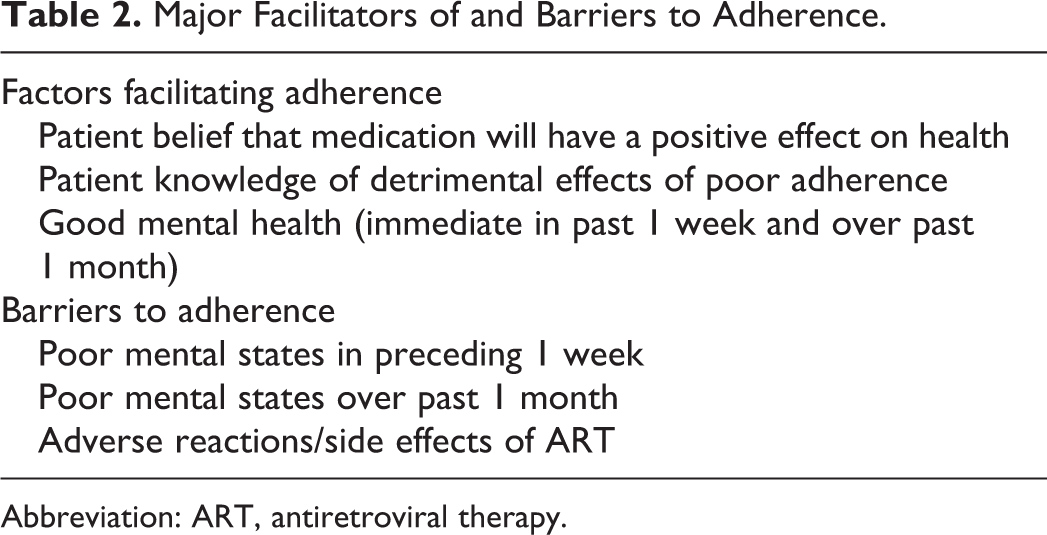
Only 1 of 250 patients studied used intravenous (IV) drugs in the past. The rest, 99.6% of the patients, never had used any recreational drugs in their life times. This former IVDU patient was also currently on methadone substitution therapy and had good adherence to ART (>95%). A high degree of motivation in the patient to enter into an opiate substitution treatment program is also reflected in his motivation to attain good adherence. The various factors that emerged as significant facilitators and barriers to adherence to ART are summarized in Table 2.
Major Facilitators of and Barriers to Adherence.
Abbreviation: ART, antiretroviral therapy.
Discussion
Universally, access to ARV drugs and affordability of the drugs especially among the lesser developed countries have been a major hindrance in achieving optimum adherence to successful ART. However, with the availability of free first-line ART distributed to all eligible HIV patients through the ART centers by the NACO, this factor is no longer the sole deterrent to good adherence. There is very limited data from India from the public health centers on ART adherence, and hence, this study was undertaken to evaluate adherence and factors influencing it in an ART center offering free first-line ART to all the patients. Identification and awareness of these culturally and demographically relevant factors will help us target the barriers to adherence, strengthen the perceived facilitators of adherence, and devise appropriate instruments to strengthen adherence.
The patients in the present study had overall very high levels of adherence. Ours is a tertiary level hospital providing comprehensive services in the same hospital complex and the sustained counseling services offered in the center may have contributed to the good adherence. Adherence levels among patients on ART are very variable with as high as 70% nonadherence rates being reported in some studies.
Yet a significant number of patients missed a dose. Since mere forgetting a dose was a reason to miss doses in a large number of patients, an alarm-based coordination of dosage times can be used. Similarly patients’ spouses/familymembers/care givers can be counseled to inquire and remind patients to take their daily medications. The problem of missing a dose due to being away from home or running out of pills can be tackled by advising them to carry more than expected doses with them, while going out, and being regular with their visits to the ART center
The factors affecting adherence have been identified as being virus related, drug related, regimen related, and patient related. Although patient-related factors like age and sex have been reported to be influencing adherence, the results have not been consistent across studies. Poorer compliance has been found in the younger age group in some studies. 14,15 Sex-based differences were not found in previous Indian studies. 10,11 In the present study also, age and sex did not affect adherence. The literacy level of the patients has been shown to influence adherence. Sarna et al found that a less than university level education negatively affected adherence. 12 In another study, higher level of literacy was related to poor adherence rates. 16 The relationship between educational status and adherence has overall been inconsistent with some studies finding a relation between poor adherence and lower educational status. 13,17
It is difficult to link up nonmodifiable and fixed factors like age, sex of patient, employment status, patient’s educational level, mode of acquiring infection, and a phenomenon as variable as adherence. This is because adherence rates vary with time in the same individual, and the same cohort of demographically identical patients can have varying adherence rates at different times.
The present study demonstrated that patients with poorer immune status and lower CD4 counts had poorer adherence rates. In a Spanish study, 18 similar results were seen with patients having CD4 counts above 200 cells and having better adherence levels and vice versa. However, in a study by Sarna et al, poorer adherence rates (<40%) were found in patients having CD4 count >200 cells/mm3 higher CD4 count being identified as a barrier to adherence. 12 This was attributed to improvement of health status of the patient on ART, thus making him or her careless and casual in their approach to therapy. The presence of an active concurrent OI has been reported to increase adherence. The possible explanation for this could be that an active OI might be making the patient more adherent because of fears of further deterioration of health and by more aggressive counseling in such patients by the health team. The ART regimen, duration on ART, and drug side effects did not significantly influence adherence in this study. However, some studies do link the 2 factors, with shorter time on therapy being linked to better adherence rates. 17,19 On the other hand, a study by Andreo et al has shown shorter duration of ART to be associated lower adherence. 20
One of the main facilitators of adherence to emerge from this study was the patient’s knowledge and belief in ART and the detrimental effects of nonadherence. A similar finding was also shown by Kumarasamy et al 11 who showed that knowledge about possible ill effects of nonadherence was one of the major facilitators of good adherence behaviors. However, knowledge about illness was not found to be a significant factor by Gordillo et al. 14 This emphasizes the need for good quality counseling services that educate patients about adherence and the ill effects of nonadherence. Novel adherence counseling tools may be devised which could be pictorial or graphic that may help in stressing the importance of good adherence.
A very strong association was observed between adherence and psychological status of the patients both in the immediate and recent past. Poorer mental health was associated with poorer adherence and those patients with better mental health have much better adherence. Some previous studies have also found an association between symptoms of depression and lower adherence to ART. 21 Depressive symptoms are common and often underdiagnosed among HIV-positive patients, and depression has been associated with increased reports of HIV-related symptoms. Previous studies have identified severe depression as a major barrier to adherence 19,21 with lack of depression being a major facilitator of good adherence. Studies quantitatively assessing adherence have found good adherence in patients to be associated with lower depression and physiological disturbance scores. Since depressive symptoms have such a major influence on adherence and many times go unrecognized, it is vital to evaluate for, identify, and appropriately manage psychological problems in HIV-positive patients. At counseling sessions with the counselor, the physician, the nurse, and other members of the ART health team, emphasis must be laid on specifically looking for mental health-related problems. These could be varying from mild psychological problems to established psychiatric disorders. The latter must be referred to expert psychiatrists for evaluation and management. Counseling by the health team supplemented by counseling by peer groups, positive persons’ networks, and other organizations/agencies having experience with mental health is very vital.
Although statistical significance was not attained, a major facilitator of adherence was the social support received by the patients. Patients with friends and families to talk to and be supported by had much better adherence rates. Improving family- and society-based support should be practiced to positively enhance adherence rates in patients on ART.
Although no influence of substance abuse on adherence was documented in the present study, the very small number of patients who were substance abusers in the study population could be a limiting factor. Concurrent IV drug use is a very important factor found to be associated with poor adherence rates across several studies. 5,16 This issue must be addressed in all patients and all efforts must be made to help these patients by offering special counseling facilities, detoxification and de-addiction services, opiate substitution therapies, and so on.
To summarize, the factors that were found to be clear facilitators of adherence were better immune status and improved CD4 counts; patients’ belief about the positive effects of ART over his own health; patients’ knowledge about ill effects of nonadherence to ART on his health and sound mental health of the patient and satisfaction from social support. The factors that were found to be major barriers to good adherence to ART were negative psychological states and negative health symptoms in the patient while on ART.
Assessment of adherence levels of HIV-infected patients on ART should be periodically undertaken to identify patients having less than optimum levels. There should be great emphasis on ART adherence counseling which should be sustained. Novel adherence counseling tools may need to be thoughtfully devised that can be used by the counselors to specifically address the issues of ART adherence. The patient is a very important member in his ART in all aspects of initiating the therapy, planning investigations, and deciding on needed changes in drugs and is not just a passive receiver of therapy and HIV care. High adherence levels are achievable in a government run health care facility and as such we must make concerted efforts to achieve optimum adherence in all patients for maximum benefit.
Footnotes
Declaration of Conflicting Interests
The author(s) declared no potential conflicts of interest with respect to the research, authorship, and/or publication of this article.
Funding
The author(s) received no financial support for the research, authorship, and/or publication of this article.