



Abstract
We assessed the waiting time and perceived satisfaction with care among people living with HIV/AIDS (PLHIV) at an antiretroviral clinic in Nigeria. A structured questionnaire was administered during interviews. Four hundred patients completed the questionnaire. The mean age of the respondents was 36.4 years (SD 9.7 years), and 61% of them were females. A majority, 72.9%, reported that the time elapsed between entry into the clinic and access to medical care services (waiting time) was more than an hour. However, a majority (77%) expressed satisfaction with the medical care they received. Although the majority of PLHIV were satisfied with their medical care, more needs to be done to reduce patient waiting time before access to medical services.
Introduction
HIV/AIDS has spread worldwide, but the most devastating effects are found in sub-Saharan Africa. 1 The first case of AIDS in Nigeria was reported in 1986. 2 Since then, the prevalence of HIV infection among pregnant women has increased from 1.8% in 1991 to 4.4% in 2005.2,3
Studies on patient care have shown that patients should be involved in their own care, and that their care can only improve if the health care system satisfies their expectations.4–9 Since the Antiretroviral (ARV) clinic of the University College Hospital (UCH), Ibadan, was established, there has not been a study on patient satisfaction with the care provided there. Therefore, this study was designed to assess patient satisfaction with the care provided at the ARV clinic from the perspective of People Living with HIV/AIDS (PLHIV).
Methods
The ARV clinic, UCH, Ibadan is one of the 25 clinics established and funded by the Federal Government of Nigeria in 2002.
3
Since 2004, the President Bush Emergency Plan for AIDS Relief (PEPFAR) has provided immense support for the scale-up of the antiretroviral treatment program. The ARV clinic is open daily from 8:00
This was a descriptive cross-sectional study. The consenting PLHIV who were on highly active antiretroviral therapy (HAART) for a minimum of 6 months and came to the clinic during the month of study were asked to fill out a pretested questionnaire administered during interviews. The data collected included sociodemographic characteristics and the PLHIV’s assessment of satisfaction with the care provided at the clinic. This included the perceived health of the respondents; the waiting time, defined here as the time elapsed between the entry into the clinic and the access to a medical consultation with the doctor; rating of their overall level of satisfaction with the care; and attitude of the clinic staff. Respondents were also asked to suggest ways of improving care in the clinic.
The ethical considerations included informed consent that was obtained from PLHIV. Serial numbers, rather than the names of the respondents, were used to maintain confidentiality. The data were entered into a computer and analyzed using SPSS 11 software. The data were summarized using mean and standard deviation (SD) for continuous variables and frequencies/percentages for categorical variables.
Results
Four hundred PLHIV out of 408 (response rate 98%) completed the questionnaire. The mean age of the respondents was 36.4 years (SD 9.7 years). A total of 61% of the respondents were female; 33% completed tertiary education, and 43% were married. Almost half (49.3%) were traders, 28.5% were civil servants and 16.5% were artisans. Approximately 6% were unemployed (Table 1 ).
The Sociodemographic Distribution of People Living with HIV/AIDS at University College Hospital, Ibadan

Table 2 shows that 51.2% perceived their health status as somewhat good, while another 14.3% perceived it as very good. A majority (72.9%) reported that the waiting time was more than an hour. Many of the respondents (71.4%) described this as either long or too long (Table 3 ). However, 77% expressed satisfaction with the overall medical care they received (Table 4 ). Some suggested ways to improve care by respondents included employing more PLHIV as clinic staff (99.3%), establishing more ARV clinics outside of Ibadan (98.5%) and providing more space/rooms in the clinic (90.5%; Table 5 ).
The Perceived Health Status of People Living with HIV/AIDS at University College Hospital, Ibadan

The Opinion of People Living with HIV/AIDS Regarding Time Elapsed and Waiting Time up to the Moment of Medical Service in the Antiretroviral Clinic, University College Hospital, Ibadan

The Level of Satisfaction of People Living with HIV/AIDS with the Services of the Antiretroviral Clinic

Ways to Improve Care at the Antiretroviral Clinic, University College Hospital, Suggested by People Living with HIV/AIDS
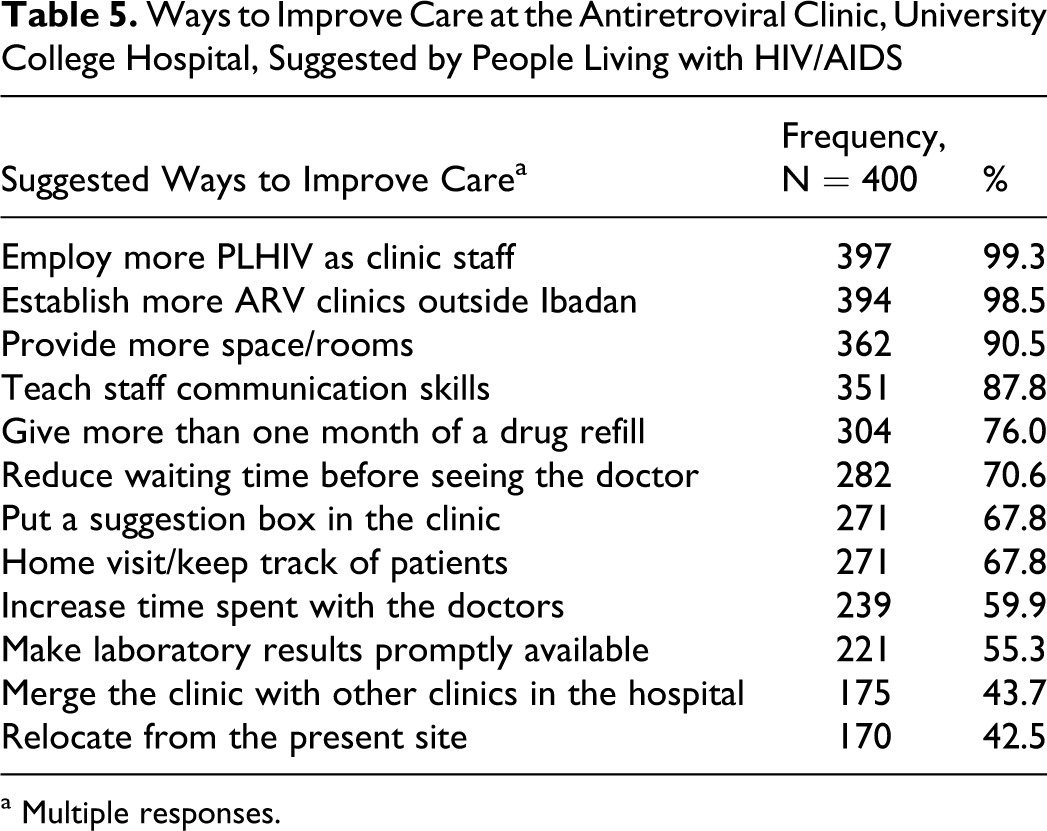
a Multiple responses.
Discussion
Studies have shown that patient perception of a clinic affects their care, and this assertion is more important in clinics dealing with a sensitive disease, such as the ARV clinic.4,5 People living with HIV/AIDS are sensitive to social stigma and discrimination; therefore, they must be handled carefully to avoid feelings of rejection. 10
Waiting time could affect patient attendance at a clinic. Waiting a long time to see a health worker can discourage people from keeping appointments and can lead to default and nonadherence to treatments.8,11 Long waiting times can also be discouraging for patients coming from long distances outside of Ibadan, where the clinic is located. 3 Bamgboye and Jarallah reported that patients in a general outpatient department usually engaged in reading, sleeping, or talking during long waits. 12 These patients preferred reading health education information about specific diseases such as heart disease, diabetes mellitus, and bowel diseases during the wait, and a sizeable proportion of the patients also wanted religious information. 12 Leaflets were the preferred mode of disseminating such information. Billing et al. showed that patients are more likely to be happy with their health care if they are satisfied with the waiting times, and they are more likely to return to the clinic and comply with the doctor’s advice. Thus, health outcomes are improved. 13 Various studies found that patients attending outpatient clinics appear reasonably satisfied if they were kept busy while waiting to see the doctor.6,12,13 von Plessen and Aslaksen in 2005 identified key measures for improvement of waiting time and time wasted during consultations, calmer working situations at the clinic, and satisfaction among patients. 7 This present study showed that the waiting time to see the doctor is a problem, and the PLHIV thought that the waiting time should be reduced and that the time spent with the doctor should be increased.
Our respondents suggested various measures that could be used to improve patient care in the clinic setting. One measure that was popular was the training and employment of PLHIV as counselors in the clinic. This could result in patients contributing to their own care and could also reduce stigma in the clinic. A study on the evaluation of patient satisfaction in a specialized HIV/AIDS care unit of a major hospital in 2000 reported that the overall satisfaction with the quality of care of HIV/AIDS patients in a dedicated HIV/AIDS unit is affected mainly by the patient's perception of his or her health status, the level of professional or family support, and the patient's level of involvement in treatment decisions. 10 Colebunders et al showed that HIV-infected patients want to be actively involved in diagnostic and treatment decisions. 14
In conclusion, according to this present study, although the majority of PLHIV were satisfied with their medical care, more needs to be done in terms of reducing waiting time and training PLHIV as counselors in the ARV clinic.
Footnotes
The author(s) declared no conflicts of interest with respect to the authorship and/or publication of this article.
The author(s) received no financial support for the research and/or authorship of this article.