



Abstract
Afghanistan has long been a challenging environment for humanitarian operations, with aid workers frequently targeted by violence. Following the Taliban's takeover in 2021, attacks on humanitarian personnel dropped significantly, reflecting the cessation of widespread armed insurgency. Despite this reduction, International Non-Governmental Organizations (INGOs) experience a feeling of insecurity stemming from uncertainty about governance, restrictive decrees, limited reliable information, and the presence of other armed groups. This article examines how a feeling of uncertainty among INGOs shapes their security strategies in Afghanistan. Drawing on interviews with senior humanitarian staff and managers, this study examines the persistence of security measures despite changes in the threat landscape. It highlights how uncertainty replaced violence as the dominant form of insecurity, through interrelated processes that mirror and reinforce one another, perpetuating institutional practices and fostering standardization in security measures.
Keywords
Introduction
For decades, Afghanistan has been a highly insecure environment for aid workers marked by targeted violence and attacks. In 2022, the number of attacks against humanitarian personnel dropped by 72%, largely due to the cessation of widespread armed insurgency across the country during the first full year under the Islamic Emirate of Afghanistan (IEA) 1 control since their return to power in August 2021 (Humanitarian Outcomes, 2023a). Despite the heightened ethical and operational challenges posed by the restrictive human rights environment, aid workers are now less frequently subjected to violent incidents (Humanitarian Outcomes, 2023b). Following the Taliban's return to power, International Non-Governmental Organizations (INGOs) in Afghanistan have cautiously navigated the space to adapt to the new operational context. Some security measures have been relaxed while others have been maintained. With the cessation of active conflict, movement restrictions between provinces have eased, allowing staff to travel by road and extend their reach into areas now considered safe. However, many stringent security measures, such as fortified compounds, remain in place.
While the adoption of strict security measures may ensure safety in certain contexts, they risk reinforcing barriers between aid workers and the communities they serve. Fortified compounds and remote management strategies, often criticized for perpetuating inequalities and limiting oversight, distance humanitarian actors from local realities. In Afghanistan, many recognize that their current security measures may no longer align with the security landscape, yet INGOs remain caught between the drive to adapt, the weight of long-standing policies, and uncertainty about the future.
Based on 21 semi-structured interviews with senior staff of INGOs, this article analyses the meaning of uncertainty and the security strategies employed by INGOs in the post-2021 context of Afghanistan. It reveals a trend in which organizations, despite varying levels of operational flexibility, collectively continue to implement strict security protocols amidst evolving threats.
The following sections begin with a literature review and a description of the methodology used in this study. Next, the article examines the security landscape and the evolution of measures before and after 2021. This is followed by an exploration of how uncertainty is perceived by humanitarian actors in the post-2021 context. Finally, the paper identifies key factors driving the entrenchment of these practices.
Framing the Context: Security Risk Management in Humanitarian Operations
The escalation of targeted violence against humanitarian workers worldwide has significantly transformed the operational frameworks of aid organizations over the past two decades. High-profile incidents, such as the 2003 bombing of the United Nations (UN) headquarters in Baghdad, marked a pivotal moment in the perceived vulnerability of humanitarian actors, leading to the adoption of comprehensive security frameworks (Fast, 2014). In Afghanistan, this vulnerability has been compounded by the militarization of humanitarian and development assistance, which has blurred the lines between civilian and military roles (Donini, 2009; Mitchell, 2015; Stockton, 2002). Although factors such as the fragmentation of non-state armed groups and the expansion of humanitarian operations have contributed to this trend, research on Afghanistan demonstrates that politicization of aid has further endangered those working in the sector (Mitchell, 2015; Schmeding & Mousavi Natanzi, 2023).
In response to the heightened risks, the field of humanitarian security has evolved into a specialized discipline responsible for developing managerial techniques, standardized rules, and security training programs that aim to anticipate and mitigate security risks (Beerli, 2018; Beerli & Weissman, 2016; Fast, 2014; Hasenstab & Smith, 2023). Security measures such as fortified compounds, armed escorts, and restricted movement protocols have become standard operating procedures for many INGOs, contributing to their increasingly bunkered presence across contexts. Such practices embody what Duffield (2010) described as “bunkerization,” a spatial and operational strategy that prioritizes the physical separation of international staff from local communities and often also local staff.
Over the past two decades, driven by security policies, insurance requirements, and aid organizations’ anxieties, the “bunkered” presence of humanitarian actors has expanded significantly (Duffield, 2012), with examples ranging from Iraq and South Sudan (Duffield, 2010) to Mali (Andersson & Weigand, 2015), Somalia (Norman, 2023), and Haiti (Lemay-Hébert, 2018). These spaces, cut off from their surroundings through multiple layers of security personnel and checks, high walls, and armed vehicles, are marked inside these compounds by leisure and privilege. They stand in stark contrast to the conflict-affected environments surrounding them, creating a disconnect between aid workers and the communities they serve (Andersson & Weigand, 2015; Chandrasekaran, 2010; Duffield, 2010).
Fortified compounds often become symbols of conspicuous consumption and of colonial hierarchies (Chandrasekaran, 2010; Jamail, 2016; Smirl, 2015). “Bunker politics” is criticized by scholars for its ineffectiveness and ethical shortcomings (Weigand & Andersson, 2019). Furthermore, reliance on remote management strategies, necessitated by security protocols, has been criticized for compromising monitoring and accountability in different contexts, including Afghanistan (Sandstrom, 2014; Schmeding & Mousavi Natanzi, 2023).
Security measures deployed by humanitarian actors can also contribute to the development of hierarchies of humanity, not only between humanitarians and aid recipients but also among humanitarians themselves. For instance, international staff may have access to fortified accommodations, armored vehicles, and dedicated security personnel, while national staff often face greater exposure to risks and fewer protections. This disparity reflects a broader trend in humanitarian practice, where security protocols inadvertently perpetuate inequalities within the sector (Collinson et al., 2013; Duffield, 2010; Duffield, 2012; Fassin, 2010; Smirl, 2008; Smirl, 2015).
While much research has focused on the implementation and critique of security protocols during periods of active conflict, less attention has been given to their recalibration in post-conflict or de-escalated settings. Afghanistan presents a compelling case in this regard. Decades of conflict and instability have made it one of the most dangerous environments for humanitarian operations, necessitating strict security measures during the conflict such as fortified compounds, curfews, and movement restrictions (Andersson & Weigand, 2015; Fluri, 2009). In Kabul, international staff have described feeling “imprisoned” within physically and socially segregated spaces, colloquially referred to as the “Kabubble” (Weigand & Andersson, 2019).
After 2021, with the cessation of large-scale conflict, humanitarian organizations in Afghanistan perceive the security landscape as increasingly shaped by pervasive uncertainty rather than by overt violence against aid workers. Unlike risk, which is calculable, uncertainty is defined by unpredictability and the absence of measurable outcomes and is described as “unknown unknowns” (Massumi, 2007). Massumi (2007) describes this security environment as existing when threats are not static or predictable but can evolve in unexpected ways and when they tend to multiply unpredictably, making it impossible to foresee when or where the next danger will arise. While security studies have examined the governance of uncertainty, focusing on counterterrorism and speculative practices to preempt imagined threats (often referred to as governing the “future present”), scholars have highlighted this mainly in relation to Western settings (Amoore & De Goede, 2008; De Goede & Randalls, 2009). By contrast, there is limited literature on how uncertainty is navigated in the Global South, where it is shaped by both state and non-state actors in many contexts (Berents & Ten Have, 2017). While some studies have explored how citizens in these environments navigate uncertainty through everyday practices of anticipation and speculation (Kaker, 2024; Monroe, 2016; Penglase, 2012; Vigh, 2006), how non-governmental organizations, balancing multiple accountability frameworks, are navigating uncertainty in complex settings remains largely unexamined.
The uncertainty in Afghanistan, as this paper will explore, presents a unique scenario in which a non-state armed group has assumed full control of a national territory, effectively transitioning from an insurgent movement to a governing authority. In doing so, it has inherited the formal governance infrastructure of the previous state while simultaneously retaining its own ideological orientation and internal organizational practices. The literature on rebel governance has demonstrated the diverse approaches that armed groups may adopt in relation to humanitarian actors during conflict and civil war. In some cases, rebels have established their own humanitarian organizations as a form of rebel diplomacy or have allowed international humanitarian actors to operate within the territories they control (Coggins, 2015). These studies suggest a potential link between a rebel group's governance style and its openness to external engagement. For example, when rebel governance includes rule-based administration, it may reflect a broader political strategy involving civilian protection and access for aid organizations (Arjona et al., 2015). However, much of the existing literature focuses on governance and rebel–civilian dynamics during periods of active conflict. Questions such as how a former insurgent group's full transition into a national governing authority affects the operational environment for international and non-governmental organizations in the post-conflict period remain less examined.
This study aims to address a gap in the literature by examining how INGOs in Afghanistan understand and navigate uncertainty in a post-conflict context. It explores the extent to which long-standing security practices developed during active conflict are re-evaluated or maintained in response to the new challenges posed by de facto governance.
Methodology
In this study, I distinguish between UN bodies, INGOs, and national organizations, with a specific focus on the case of INGOs. INGOs occupy a unique middle ground between the highly resourced and politically anchored UN bodies and the more localized, grassroots nature of national NGOs. This positioning provides a compelling lens to examine how security practices and organizational structures are shaped by varying degrees of access, influence, and constraint.
Research has demonstrated that targeted attacks on humanitarian workers during the conflict period in Afghanistan were often linked to perceptions of their involvement in political and military agendas (Donini, 2009; Stockton, 2002). UN agencies, such as the UN Assistance Mission in Afghanistan (UNAMA), have faced criticism for their perceived alignment with state-building and political agendas (Jackson, 2013). The integration of development and military efforts, such as Provincial Reconstruction Teams, further blurred the distinction between humanitarian and military actors, heightening the risks faced by aid workers (Mitchell, 2015). In Afghanistan, there are clear distinctions in security arrangements and practices between INGOs and UN agencies. One notable example is the use of armed escorts. Under the Republic, the UN widely employed armed escorts, and the IEA has since required the UN to continue this practice, including paying the de facto authorities for such services. Since the 2021 takeover, the UN has also allocated significant funds to the IEA to provide armed security for its compounds (Jackson, 2023). These practices constitute red lines for most INGOs operating in Afghanistan.
This study also excludes national NGOs due to the historically distinct approaches to risk-taking and security management between national and international organizations in Afghanistan. Over the past decades, national NGOs have predominantly served as implementing partners for international organizations, a relationship characterized by the transfer of both risk and operational responsibilities to national actors (Collinson et al., 2013). This dynamic has often relied on the acceptance and trust national NGOs have cultivated within local communities, which contrasts with the more institutionalized security frameworks typically employed by INGOs and UN agencies. During the conflict, this resulted in informal interactions with non-state armed groups by local actors under a “don’t ask, don’t tell” approach, which raises concerns about shifting the burden of negotiation and risk onto local actors, while international actors refrained from these interactions (Collinson et al., 2013; Jackson, 2012).
National NGOs are also far from homogeneous, and their security strategies warrant a separate, in-depth study. It is reductive to assume that they all operate with the same level of community acceptance. Since the Taliban takeover, both newly formed and long-established organizations have navigated varying degrees of access and relationships with de facto authorities. Meanwhile, many women-led or minority-led NGOs have been forced to restructure their teams or adapt their operations following the departure of senior staff and changes in the operating context.
In comparison to local NGOs, INGOs commonly employ a higher proportion of international staff, which introduces additional complexities to their security practices. The humanitarian sector continues to function as a two-tiered system in which international and national staff are subject to different rules, privileges, and vulnerabilities.
By focusing exclusively on international organizations, this study aims to explore the unique security practices and challenges faced by INGOs, without conflating these experiences with the distinct operational realities of UN agencies and national NGOs. This study employs a qualitative research approach that draws on insights from 21 semi-structured interviews with senior staff from INGOs operating in Afghanistan (see Table 1). 2 In addition, my prior professional experience in Afghanistan provides contextual understanding, as discussed further in my positionality. Twenty-one interviews were conducted between July and November 2024, with participants representing 19 different organizations. 3 They were contacted using purposive and snowball sampling strategies to ensure a diverse range of perspectives across organizational roles and positions. The study encompassed a variety of humanitarian organizations, including small-, medium-, and large-sized INGOs; faith-based and solidarity-based organizations; multi-sectoral agencies; and sector-specific organizations. This diversity captured a broad spectrum of operational approaches, organizational histories, and perspectives on security in Afghanistan.
Overview of Interviewees by Interview Number, Organization Type, Role, Gender, and Interview Date.
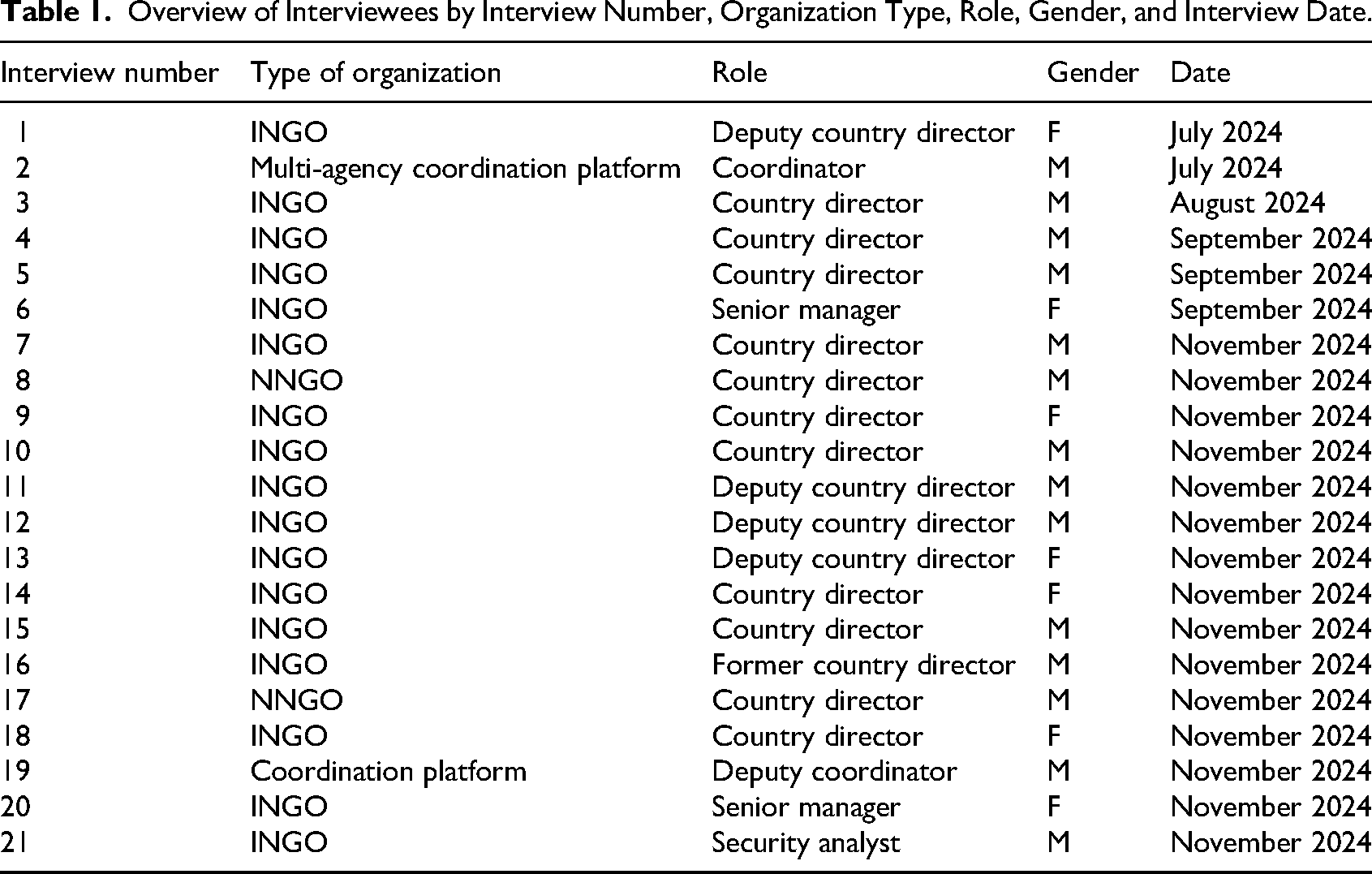
Interviewees were selected based on their roles as decision-makers in security management and operational planning within INGOs, as these individuals are directly involved in shaping security protocols, including Country Directors and senior staff, both male (15 participants) and female (6 participants). Two of these participants, both male, held senior coordination roles for multi-agency coordination forums, providing valuable insights into how security decisions are collectively negotiated across multiple organizations. Their perspectives were particularly important in understanding the collaborative dynamics, shared challenges, and standard-setting processes that influence security protocols in the broader humanitarian sector. The gender distribution of the participants, six women compared to fifteen men, reflects the underrepresentation of women in security decision-making positions within the organizations. Additionally, the study incorporated interviews with two key national informants who are not currently employed by international organizations. However, these key informants possess extensive experience and deep institutional knowledge, having worked for many years in coordination forums and with international organizations. Their contributions were instrumental in triangulating findings from the interviews conducted with INGO representatives.
Semi-structured interviews were conducted in English or Dari and focused on how organizations navigated the operational landscape during the second Islamic Emirate, the changes (or lack thereof) in security protocols, and the role of uncertainty in shaping organizational policies. All interviews were conducted remotely via secure communication platforms. The interviews were transcribed and analyzed using thematic analysis to identify recurring patterns and themes related to perceptions of insecurity, the navigation of uncertainty, risk management, and mitigation measures. Key themes emerged from the interview material and were coded, including perceptions of uncertainty, organizational inertia, and decision-making processes. 4
Observations from my humanitarian work in Afghanistan, spanning both pre- and post-Taliban rule, were informative for understanding organizational behavior amid changing security contexts. However, I did not hold a professional position in the country at the time of the interviews. This positioning offered certain advantages: prior roles facilitated access to senior humanitarians, while my independent research status may have contributed to a greater sense of openness during discussions. To mitigate potential biases from my background and positionality, I deliberately selected a diverse range of organizations and individuals for interviews. In addition, rigorous ethical research protocols were followed, including ensuring participant anonymity and informed consent.
This study acknowledges several limitations. First, the sensitive nature of security protocols may have influenced interviewees’ willingness to share details, potentially leading to a degree of self-censorship or over-justification of the measures taken. Second, while semi-structured interviews provide valuable depth, they primarily reflect the perspectives of selected decision-makers. Staff in field offices who often have different experiences from senior staff in decision-making positions were not included due to the study's focus on understanding organizational-level decision-making processes. Although their perspectives would offer valuable insights into how decisions affect operations at the ground level, this study centers on decision-makers to align with its objective of examining how security strategies are formulated at the organizational level. Lastly, this study is limited by its specific focus on Afghanistan under de facto governance, which may not be fully generalizable to other contexts. However, the findings remain relevant for understanding broader trends in humanitarian action. Future studies in contexts such as Myanmar or Syria could examine how protracted uncertainty sustains restrictive security practices. While generalization is limited, such comparisons may show that the dynamics of uncertainty, risk aversion, and organizational path dependency observed in Afghanistan also help explain why INGOs are often reluctant to adjust to changing environments, sometimes more permissive as in post-revolution Sudan, thereby reproducing past modalities despite shifts in political authority.
The Evolving Security Landscape for Humanitarian Organizations in Afghanistan
In the early years following the 2001 military intervention, the security measures of aid organizations in Kabul were markedly different from what they became just a few years later. Expatriates experienced a notable level of integration, enjoying considerable freedom in their movements and social interactions. Their lifestyle, characterized by participation in social gatherings and local establishments, was later depicted in various media, such as the French TV series Kaboul Kitchen 5 and the comic book Kaboul Disco. 6 A surge in attacks targeting civilians and aid workers, starting in the mid-2000s, led to a tightening of security measures across most aid agencies. This shift introduced practices such as fortified compounds and the use of armored vehicles.
By 2017, Afghanistan was ranked as the second most perilous country for aid personnel after South Sudan (Humanitarian Outcomes, 2017). Major urban centers such as Kabul experienced frequent suicide bombings, vehicle-borne explosives, and abductions. Both international and national aid workers faced grave threats, suffering fatalities, injuries, kidnappings, and intentional assaults. Local aid personnel particularly suffered, reflecting broader tendencies of localized aggression in high-risk environments (Humanitarian Outcomes, 2023a). Two significant truck bomb incidents occurred in 2017 and 2018 in Shar-e Naw, Kabul, resulting in 150 and 103 fatalities, respectively (BBC News, 2018a; Reuters, 2017). Some assaults directly targeted NGOs. In January 2018, Save the Children's facility in Jalalabad was attacked, resulting in six deaths and 27 injuries (BBC News, 2018b). In May 2019, Counterpart International's office in central Kabul was assaulted (CNN, 2019), leading to multiple fatalities, including three humanitarian workers from Care International nearby (CARE International, 2019). In 2020, an attack on the Médecins Sans Frontières maternity ward in Dasht-e Barchi, Kabul, resulted in 24 deaths (Médecins Sans Frontières, 2020). These events followed a surge in the abduction of international personnel, including humanitarians. Over time, such threats have entrenched conservative security measures, transforming the previously open and socially interactive environment of expatriates into a heavily fortified existence.
Following the Taliban's takeover in 2021, the security environment changed markedly. Recorded conflict incidents significantly decreased, from nearly 24,000 in 2020 to approximately 17,600 in 2021 and 3,100 in 2022 (INSO, 2023). Nonetheless, some threats persisted. Organized armed groups, notably Islamic State Khorasan Province (ISKP), maintained a latent threat through intermittent attacks. Criminal activities surged, exacerbated by the deteriorating economic conditions, with increases in robbery, burglary, and targeted assaults on individuals perceived as being affluent. One interviewee noted, “Many of our staff or their family members were mugged throughout the last two years.” 7
Data from the International NGO Safety Organization (INSO) reveals a significant escalation in government actions against NGOs post-2021, increasing from 56 cases in 2021 to 176 cases in 2022 (INSO, 2023). The Taliban's interference includes attempts at aid diversion, personnel insertion into projects, and strict control over funding and operations. Furthermore, the erratic policies of the IEA, characterized by sudden regulatory changes affecting NGOs and restrictions on women's employment, complicate operational risks and hinder organizational adaptability (ACAPS, 2024).
Within this new context, participants were asked about the security measures implemented in their organizations. While these measures and practices vary depending on organizations’ approach to security management, risk appetites, and operational context, certain trends are discernible. A gradual relaxation of movement restrictions for staff reflects a cautious acknowledgment of a reduced threat landscape in some areas. Expatriates are increasingly allowed to travel to selected field locations or public spaces under controlled conditions. As one participant shared: We developed much more flexibility in traveling to the field. We went to the deepest part of Khost with people coming from different provinces and different countries. But we maintained very much a compound life with safe rooms, guards, CCTV, and everything associated to security of premises.
8
International personnel, once limited to secure areas, can now travel to provinces. However, movement protocols vary across organizations. For example, one organization mandates tracking devices for expatriates in Kabul, while another requires armored vehicles for international staff. The use of armored vehicles is a contentious issue among INGOs. Some oppose them, claiming they increase visibility rather than reduce it. Conversely, others justify their necessity for international staff, due to the risk of kidnapping as well as the residual risk of small-arms fire.
Curfews were initially implemented to facilitate more effective tracking of movements, address concerns over nighttime criminal activity, and mitigate the risk of abductions, which are perceived to be more likely when streets are empty at night. As criminal activity persists after 2021 and the threat of abduction remains, curfews have largely stayed in place, with only minor adjustments reflecting a cautious sense of optimism. INGOs have allowed international staff to engage in controlled environments, such as traveling to pre-approved restaurants or visiting specific sites. A country director of a smaller organization shared: “I think expat staff of most INGOs are not allowed to go to Afghan colleagues’ houses or their weddings, while I can go.” 9 This reflects a broader pattern where private homes are generally excluded from the list of permitted locations for expatriates, except in very small organizations, to restrict their movements. In contrast, the list of permitted public venues, such as restaurants and specific sites, is nearly identical across organizations. These approved places are typically assessed based on their security features, including the presence of safe rooms or controlled access, which private homes do not offer.
Despite these adjustments related to movement, significant differences persist between female national staff and other personnel. While national staff generally have relatively greater mobility, women's movements remain constrained by gendered security protocols stemming from restrictive decrees issued by the authorities, including the requirement for a male guardian (mahram) to accompany them on field visits. To mitigate risks such as arbitrary questioning at checkpoints and increased visibility during travel, organizations have implemented tailored security protocols for female staff. These measures include providing options to work from home, allowing early office departures, and arranging daily transportation to and from the office.
After 2021, cultural and linguistic considerations began to play a more significant role in shaping movement strategies for humanitarian organizations in Afghanistan. With respect to the ethnic and linguistic dimensions of movement, many organizations have started employing Pashto-speaking drivers, who are perceived to have easier access at checkpoints. One participant noted that “drivers from regions like Panjshir often encountered heightened scrutiny and difficulties at checkpoints.” 10
While movement strategies highlight one aspect of security considerations, the design of living arrangements and working setups presents another critical dimension. Physical security infrastructure remains one of the most entrenched practices in post-2021 Afghanistan. As described by one participant, “There is still a compound life … with safe rooms, cameras, barbed wires, and all the standard security infrastructure.” 11
Guesthouses and offices are often located within the same compounds, secured by multiple layers of cordons, high walls, and controlled access points to minimize exposure to external threats. Reinforced steel doors, metallic window installations, and safe rooms remain standard features. While some INGOs have adopted slightly more relaxed protocols, most continue to maintain stringent physical security measures, driven by a perceived need to remain prepared for potential threats from ISKP or other armed actors. The high costs of maintaining these buildings are justified by the argument that dismantling them could necessitate future reinvestment if the security situation deteriorates again, and such funding might not be available. This reflects a broader distrust in the current safer situation remaining stable, as organizations perceive the potential for sudden shifts in security dynamics. As one participant noted, “The presence of ISKP is low, but it remains unpredictable. That's enough to justify keeping safe rooms and fortified compounds as part of our standard measures.” 12
In addition to offices, bunkered guesthouses serve as accommodations for international personnel, partly due to the two-tiered security system in Afghanistan, in which expatriates are typically offered higher levels of protection. As a result, security practices can vary depending on the size of the organization and the number of international staff. Since 2021, most organizations have reduced the number of expatriates as part of ongoing efforts to nationalize positions.
Based on the interviews, expatriates are predominantly based in Kabul, with a few INGOs maintaining expatriate staff in the provinces. The nationalization of provincial positions is widely regarded by interviewees as a positive development, reflecting a commitment to local capacity building and the empowerment of national staff. One interviewee noted, “The reliance on national staff for provincial operations is high, but nationalization of provincial positions is a trend that has increased just after the takeover.” 13
This shift also aligns with the practices of the de facto authorities, who have introduced administrative challenges to issuing permits, effectively discouraging the employment of expatriates. Having fewer expatriates in the provinces simplifies the management of security measures, such as compound oversight and the coordination of movement protocols. This operational convenience provides an additional incentive for some INGOs to avoid placing expatriates in provincial roles, as most positions have now been nationalized.
Even though factors such as organizational size, historical experiences, and decision-making structures marginally affect the security practices of the interviewed INGOs, they remain embedded in a humanitarian community where inter-organizational dynamics often generate convergence around cautious security measures. The following section explores how this enduring sense of caution is connected to a persistent feeling of uncertainty among humanitarian actors operating in Afghanistan, and then analyses the mechanisms that produce collective inertia.
Perpetual Doubts: Understanding Uncertainty among INGOs
When addressing risks, organizations are generally able to evaluate both the likelihood of an event occurring and the potential severity of its consequences. These assessments inform the development of mitigation measures, which are then implemented, monitored, and evaluated for effectiveness. This structured process, commonly referred to as risk management, depends on statistical reasoning and predictive logic (Metcalfe et al., 2011). Uncertainty, by contrast, eludes this model. It refers to situations where either the probability of outcomes is unknown or the outcomes themselves cannot be clearly defined, distinguishing it fundamentally from risk (Campbell & Knox Clarke, 2020).
This sense of uncertainty was also acutely felt during the 2021 takeover. A retrospective study showed that most humanitarian actors believed Kabul would not fall militarily, illustrating how an improbable yet high-impact event, predictable only in hindsight, shattered prevailing assumptions and tested organizations’ crisis management under uncertainty (Cole & Olympiou, 2022). While that event disrupted the security landscape, the focus of this study is on how the feeling of uncertainty has persisted since, without fundamentally altering entrenched security practices.
In post-2021 Afghanistan, the sense of uncertainty permeates all aspects of humanitarian operations and manifests in two interrelated forms. First, it defines the present operational environment, shaped by limited access to information, disrupted data channels, and constraints on the media that undermine the reliability of available data. Second, it concerns future trajectories, driven by prolonged political instability, the ad hoc nature of governance under a de facto authority, and the continued presence of multiple armed actors. This section examines how international humanitarian organizations conceptualize uncertainty within this context.
Protracted Conflict and Unreliable Peace
Interviews with humanitarian practitioners reveal that the persistence of uncertainty is deeply rooted in Afghanistan's tumultuous history and protracted conflict. Several interviewees explicitly referenced the difficulty of reconciling historical perceptions with current “stability,” as it represents only a brief period compared to the decades of protracted conflict. One respondent noted, “The risk of attacks on NGOs by the Taliban has disappeared, but we still operate with the same security protocols as during the height of the insurgency. The past 40 years are still shaping how we work.” 14
This historical baggage shapes decisions even when the immediate threat has decreased, as organizations remain wary of downgrading security protocols due to the fear of repeating past experiences. One respondent explained: The historical baggage of Afghanistan's insecurity means that no one wants to be the first to relax measures. It's safer to stick to what has been done for decades, even if the context has changed.
15
These bunkers were built because of threats from the very people who are now in charge, and that history of danger still makes it hard to fully trust the situation today.
16
Rule by Decree and the Politics of Unpredictability
The nature of de facto governance contributes to the overall uncertainty of Afghanistan's political context. The IEA's governance is marked by internal factionalism and unpredictable policymaking, creating a volatile environment for NGOs, as decisions affecting them are often made without warning or consultation. As one INGO director explained, “The Taliban takeover brought a lot of uncertainty. We didn’t know if they could maintain centralized power, especially with the visible tensions within the movement. There was even a perceived risk of civil war or internal conflict within the Taliban ranks.” 17
The absence of a parliament or any formal legislative process has led to governance by decree, with decisions announced abruptly. The incessant issuance of unexpected decrees, such as restrictions on women's participation in humanitarian work, has created a persistent sense of “surprise,” as described by multiple interviewees. These sudden changes often catch organizations off guard, forcing reactive rather than proactive adjustments and contributing to a broader perception that the unexpected has become the norm. Decisions driven by externally driven and often contextually disconnected events, such as the burning of the Quran in Sweden, which led to the closure of a major Swedish INGO with decades of presence in Afghanistan (SCA, 2024), introduce an additional layer of unpredictability. The abrupt nature of these decrees disrupts operations and erodes trust in the stability of the operating environment. As a result, aid organizations are compelled to remain on constant alert. This atmosphere of uncertainty complicates long-term planning and fosters a volatile context in which even distant, non-local events can have immediate and far-reaching consequences on humanitarian efforts. As one interviewee shared: The de facto authority of Afghanistan is an authoritarian regime, and it is the way they govern intentionally through fear and unpredictability, issuing sudden decrees that drastically change the operational landscape.
18
Challenges in Information Availability and Reliability
The restricted flow of information and concentration of decision-making within an inaccessible group of de facto authorities have significantly undermined the ability of humanitarian organizations to anticipate changes and manage risks effectively. One security analyst highlighted the challenge, stating, “Our network of information is limited; before, you could sit with decision-makers after working hours and gain insights, but now that's impossible.” 19 The IEA's sensitivity around information management ensures that decisions are tightly controlled, with details only emerging once they are finalized and published. While the authorities strive for greater centralization of power and consistent implementation of decrees, this control is not absolute; regional and local officials sometimes allow for a degree of flexibility, creating space for less conservative practices. Although this flexibility offers organizations opportunities to negotiate “exceptions” to the rule and decrees, it perpetuates a constant state of negotiation and uncertainty. The frequent turnover of officials within the current IEA authorities undermines the sustainability of local access agreements, making them less predictable.
The departure of private security entities and research centers, alongside authorities’ media control, results in an information vacuum for organizations. Without the traditional information sources, organizations have adopted alternative data triangulation methods. Many depend on local networks for insights, which, while useful, may be limited in scope. Informal peer exchanges, particularly through WhatsApp groups of Country Directors, have emerged as vital platforms for sharing security information. Due to the scarcity of reliable data and insufficient analysis, decisions often rely on anecdotal evidence, which can skew risk perceptions, either heightening caution or fostering a false sense of security. Consequently, organizations increasingly depend on one another for information exchange and analysis, enhancing interconnectedness, especially among smaller INGOs that lack dedicated security resources. One Country Director from a small INGO articulated this dependency, stating, “I am fully dependent on bigger NGOs and their security managers for information. If not, it feels like walking in the dark.” 20
In addition, following the Taliban's takeover, many Western embassies in Afghanistan ceased operations. As a result, the lack of diplomatic support has raised serious security concerns for organizations requiring urgent assistance. The absence of a reliable emergency safety net has increased anxiety about international staff safety and created uncertainty regarding available support mechanisms, contributing to more risk-averse decision-making among expatriates.
Residual Threats and the Challenge of Assessing Risks
Despite the Taliban's dominance, other armed groups, such as ISKP, continue to pose a residual threat. The IEA has had relative success in curbing ISKP's activities since its takeover in 2021. Giustozzi (2024) highlighted the decline in ISKP activities due to effective intelligence-led counter-terrorism operations by the IEA, although the group remains a potential threat capable of resurgence. Sporadic attacks serve as stark reminders of the enduring risks. The attack in Bamyan in May 2024 (Al Jazeera, 2024), where gunmen killed three Spanish tourists and an Afghan citizen, significantly influenced humanitarian organizations’ perceptions of security. One aid worker noted, “The Bamyan incident shattered the relative sense of safety we had in certain regions. It underscores that no area is entirely secure from extremist violence.”
21
While there has been no recent direct attack against humanitarian actors, ISKP's rhetoric, specifically naming certain INGOs as “non-believers” and acceptable targets, has amplified the perception of risk among aid workers (Valle & Webber, 2022). This has prompted some organizations, particularly those explicitly named, to adopt highly restrictive security measures. The uncertainty surrounding ISKP's activities is closely tied to the challenge of assessing the probability of attacks versus their perceived threat. As one respondent noted: ISKP is definitely a threat, but what is the probability? This is something we don’t evaluate sufficiently. The perceived threat remains high because of their historical targeting of NGOs, even though their capacity is currently reduced and they are, for the moment, focused on targeting the Taliban rather than humanitarians.
22
Intersectional Perspectives on Uncertainty
Perceptions of uncertainty and insecurity in Afghanistan are far from uniform; they are deeply shaped by intersecting identities such as gender, ethnicity, and nationality, which produce differentiated experiences and vulnerabilities among humanitarian staff.
Among many national staff of INGOs, perceptions of insecurity are closely linked to the increase in criminal activity since 2021. Due to the increase in night-time crime, national staff often avoid movement after nightfall, and curfews for all official movement remain strictly enforced to ensure return before dark. Beyond these security risks, however, the feeling of uncertainty is deeply influenced by gender and ethnic dynamics, shaping how individuals and organizations experience and navigate risks. These factors amplify vulnerabilities, particularly for women and ethnic minorities, in both their personal safety and professional roles. This further informs organizational safety policies, requiring adjustments based on neighborhoods and provinces, depending on the perceived sensitivity of having women and/or ethnic minorities within the team.
Due to the increased pressure on women not to enter the public sphere and the bans related to women's participation in humanitarian work, female staff experience heightened anxiety when passing through checkpoints, adding an additional layer of complexity for female staff movement. Additionally, the IEA's mahram requirement, which mandates that women must be accompanied by a male guardian for field visits, poses logistical and financial challenges for organizations. Arranging a mahram not only increases the operational costs of fieldwork but also complicates planning and coordination, as the availability and willingness of male guardians cannot always be guaranteed. These compounded barriers often prevent many women from movement or having real access to field offices. Decrees over the segregation of male and female staff have also led to new office arrangements. As one interviewee shared, “We had to separate male and female buildings, but this affects female staff's authority and decision-making presence, especially when important activities are concentrated in the male-dominated spaces.” 23 While movement protocols and office setups are designed to enhance women's security and enable continuity of work, a sense of temporariness and uncertainty continues to surround these arrangements.
Ethnic identity also significantly influences security perceptions and access in Afghanistan, generating unequal vulnerabilities for staff and operational strategies for organizations. Ethnic dynamics often manifest in arbitrary actions by authorities, creating an environment in which individuals cannot predict how they will be treated. Individuals from minority groups, particularly Hazaras and Tajiks, frequently face heightened scrutiny, threats, and barriers to mobility. The situation is particularly dire for Hazaras, who have been the victims of ISKP's targeted attacks in Kabul, especially in Hazara-populated neighborhoods. One respondent highlighted, “Hazaras have been victims of attacks in Kabul and can have a higher sense of insecurity in their movements.” 24 In response, some organizations have adopted specific movement protocols for Hazara staff during periods of heightened risk, such as during Ashura and Tasoua commemorations.
This fear affects interactions with IEA security forces, leading to greater daily unpredictability. One participant recounted ethnic discrimination experienced by a Hazara colleague detained under suspicious circumstances, while a Pashtun detainee faced less severe consequences. 25 Such discrimination fosters insecurity among Hazaras, who perceive a higher likelihood of arrest and police harassment. These vulnerabilities stem from both real and perceived ethnic and political affiliations. Consequently, according to one respondent, many organizations prefer hiring Pashtun staff for roles involving engagement with authorities due to their perceived access and acceptance by the administration.
Although the preference for Pashtuns may stem from practical considerations such as language proficiency and perceived cultural affinity with the Taliban authorities, it also reflects how organizations navigate insecurity. By favoring Pashtuns for certain roles, organizations seek to reduce security risks for non-Pashtun employees, such as Hazaras and Tajiks. However, this approach can perpetuate systemic inequities and limit inclusive representation. Furthermore, this perspective simplifies the internal diversity of the Pashtun community and overlooks the range of experiences within it.
Organizational Inertia and Security Decision-Making
In their study of 14 major international NGOs, Stoddard et al. (2016) found that INGO representatives generally perceived an increase in risk aversion within the sector, driven by volatile environments with multifaceted threats, compounded by donor pressures related to fiduciary risks and counter-terrorism compliance. Earlier studies also show that insecurity prevents organizations from reaching the populations most in need. In their study of Afghanistan during conflict, among other contexts, Stoddard et al. demonstrated that highly localized approaches and contracts for program implementation could lead to “access inertia,” with humanitarian organizations preferring to remain within fixed areas where they had contracts (Stoddard et al., 2017). In post-conflict Afghanistan, the inertia we observe in operational models and security measures is not the result of insecurity or attacks. Nor is it a case of decision paralysis; rather, it is a deliberate choice by many organizations to maintain cautious security measures. The next section explores the mechanisms that create this path dependency through a complex interplay of internal decision-making structures, social dynamics, and the enduring impact of past security incidents.
Collective Caution and Peer Influence
In Afghanistan, as in many other countries, INGOs are mutually dependent, and their security is interconnected (Stoddard et al., 2008). The interconnectedness of organizations in their security management has intensified since the Taliban takeover, due to the limited availability of reliable information and the diminished presence of the broader international community. Organizations increasingly rely on shared information networks and peer consultations, leading to collective decisions and practices that often mirror one another. One interviewee noted, “Most organizations rely on the same sources of information, but these reports don’t always reflect the ground reality or the nuances of access or the individual and diverse identity of organizations. Yet, they shape how everyone responds.” 26 This convergence creates a feedback loop where certain security measures or risk-averse behaviors are replicated, regardless of their proportionality to the current context or to an organization's individual identity. As one respondent noted, “Organizations look at each other to decide what is normal, and this collective mindset has not shifted much, even as the context changes.” 27 Similarly, one INGO director reflected, “If your community is very reserved and very conservative … you are part of that still. So, I can't be too rebellious to what the community thinks, even if I do not agree.” 28
The social aspect of security measures in Afghanistan aligns closely with Hilhorst and Jansen's concept of humanitarian space as a social arena where various actors negotiate aid activities and outcomes (Hilhorst & Jansen, 2010). In this social space, humanitarian security strategies, including those related to security, are not made in isolation but are reactive and influenced by the interplay of actors such as headquarters staff, field teams, and peer organizations. This actor-oriented perspective underscores how behaviors are shaped by a combination of organizational pressures, perceived norms, and mixed motivations. The collective risk aversion observed among INGOs in Afghanistan reflects how security measures are socially constructed.
Some of these measures are linked to overall standardized practices. In Kabul, certain minimum standards must be in place regarding the physical security of the premises to be validated for expat staff visits by other organizations, leading to the perpetuation of these practices. As one respondent who opened their office after 2021 noted: “Many organizations conduct security assessments of other NGOs’ premises before allowing movement there. To avoid being blacklisted, you need to meet minimum-security standards, which encourages everyone to follow the same model. I chose a building that used to be an NGO compound with all the measures already in place for that reason.” 29
The need to uphold an image of professionalism and credibility within the humanitarian space often leads to the adoption of overly cautious measures. Social pressure within the “circle of Country Directors,” as described in interviews, further perpetuates this behavior. “As soon as something worrying happens, measures are implemented across the board,” explained one interviewee, illustrating how collective reactions can override localized, context-specific strategies. The interviewee described a “frenzy” of restrictions following high-profile incidents, often before thorough assessments are conducted.
Historical Incidents and Organizational Liability Concerns
The trauma stemming from past incidents reinforces risk aversion, as many organizations remain haunted by the consequences of previous attacks and losses. One interviewee explained, “The past incidents, especially those targeting international staff, have created a psychological scar.” 30 This collective memory shapes decisions in the organization, fostering an overly cautious approach to security even in the face of changed threats. In some cases, the anxiety is rooted in global experiences. For example, an organization that experienced the loss of staff in Africa and the Middle East became highly risk-averse worldwide, implementing some of the strictest security measures in Afghanistan after the 2021 takeover.
The anxiety extends beyond individual memories. As one interviewee explained, “Those who’ve seen the conflict and lived through it understand that the risks now are different and would like to adjust measures accordingly. But newer Directors, who came after the takeover, are more scared to remove old measures, even when they’re not needed anymore.” 31
In organizations that have experienced past security incidents, institutional structures often perpetuate risk aversion, even when some experienced decision-makers recognize the need for adaptation. This reluctance to revise security protocols is further reinforced by internal organizational structures and cultures, which shape how decisions are made and how much flexibility decision-makers have. A respondent explained, “There is always a fear of being sued if something goes wrong. This has led to a very legalistic approach, where even in relatively safe contexts, compliance dictates the level of security measures.” 32 In these organizations, the decision-making structures around security typically involve more layers than those of other organizations. A director of one such organization shared, “The decision-making framework basically disempowers the country offices and directors. The regional and HQ teams become more involved, and the compliance side takes over, focusing on staff and legal exposure.” 33
The Role of Organizational Structure and Culture
Decision-making patterns in humanitarian organizations depend on their organizational settings (Heyse, 2013). Interviewees noted that both the structure and size of an organization influence its flexibility in security decision-making and the implementation of measures. The number of expatriates was identified as a key factor. Smaller organizations often display greater flexibility, not only because of their leaner and often decentralized decision-making structures, but also because they have fewer expatriates to manage. In organizations with more foreign staff, managing curfews, tracking movements, and maintaining communication with numerous individuals can become overwhelming for security focal points or management teams. As one respondent noted, “I keep the curfew at 10 because I do not want to receive check-in and check-out messages all night.” 34 This highlights the trade-off between operational flexibility and the practical limits of managing a large team with limited connection to the actual context and security landscape.
Although there is a degree of variation and exceptions, there is a general tendency among organizations to follow the sector-wide norms, and measures tend to converge. Even with efforts to adapt security measures and decentralize decision-making, the overarching attitude of “better safe than sorry” prevails in Afghanistan's humanitarian sector. Foreign Country Directors, many of whom view their roles as temporary, are often reluctant to challenge or disrupt these established practices. As one respondent explained, “The harm caused by the perception of international aid workers being locked behind armored doors and vehicles was already done in the past decades. Even if we were to remove these measures now, it wouldn’t significantly change the perception of INGOs in Kabul.” 35
Thus, even when decision-making is decentralized within organizations, the individuals in charge are often influenced by a range of factors beyond the immediate context, including what some interviewees described as a “blaming” culture. While this affects both national and international decision-makers, the impact on national staff is particularly significant. In some organizations where national security managers are responsible for determining security measures, risk aversion tends to be especially pronounced. One respondent explained, “The Afghan security teams are sometimes overly cautious, fearing the consequences of any incident involving an expat on their reputation and job. This can lead to measures that are disproportionate to the actual risks.” 36 A national security manager expressed that he feels less protected in the event of incidents, given his national contracts and the limited safeguards provided by the Afghan labor law, which reinforces risk-averse decision-making.
Conclusion
This article explores how uncertainty has become central to humanitarian operations in Afghanistan since the Taliban's return to power, shaping security measures and risk management. While some movement restrictions have eased, bunkered compounds and restrictive security protocols persist, reflecting decades of conflict and a deeply ingrained sense of uncertainty. This uncertainty stems from historical, political, and security factors. A legacy of targeted attacks, internal factionalism within the IEA, unpredictable decrees, and tight information controls complicates risk assessments. Mistrust lingers, and the latent ISKP threat further reinforces conservative security measures.
Drawing from interviews, this study highlights how historical security incidents sustain cautious behaviors. INGOs in Afghanistan, operating within a shared security ecosystem, replicate risk-averse practices, creating a feedback loop. As one interviewee noted: “We’re still working in bunkers, both physically and mentally. Even if the risks have decreased, the fear of what could happen keeps us from stepping outside.” 37
Afghanistan's case underscores a broader challenge in post-conflict security management: a shift in conflict dynamics does not automatically lead to revised security protocols. This study highlights that risk assessment indicators and recorded security incidents alone do not fully determine humanitarian organizations’ sense of insecurity. While security assessment tools focus on measurable threats, uncertainty, and a lack of trust in the political and operational environment significantly shape perceptions of security.
The findings reveal a critical gap in current risk indicators, which often fail to capture broader, less quantifiable factors contributing to feelings of insecurity, such as unpredictability in governance, shifting regulations, and limited reliable information sources. Future research could expand this analysis by examining how security decisions are made in other humanitarian contexts marked by uncertainty and de facto governance, such as Syria after the collapse of centralized regime control. Additionally, a complementary study focused on national NGOs in Afghanistan, whether those that have continued operating, those that were forced to restructure, and those newly established since the political transition, would offer critical insights into how local actors have continued, adapted, or been constrained in adapting to this new governance landscape.
Footnotes

Funding
The author received no financial support for the research, authorship, and/or publication of this article.
Declaration of Conflicting Interests
The author declared no potential conflicts of interest with respect to the research, authorship, and/or publication of this article.