



Abstract

Keywords
Introduction
Peacebuilding practices are becoming increasingly technology-infused and tech-supported, not least because of the COVID-19 pandemic and the dangers/obstacles that Russia's war of aggression against Ukraine poses to the movement of Ukrainians and Ukraine's allies. This has resulted in the ongoing formation and development of communities of practitioners and researchers working to develop “PeaceTech,” broadly understood as ways of employing digital technologies to support peace processes (Harlander, 2020). Peace efforts in Ukraine have been tech-savvy and PeaceTech-equipped, also highlighting theoretical innovations within peacebuilding—“sustaining quality peace.” This briefing focuses on virtual reality (VR) technologies in/as PeaceTech by analyzing the innovative usage of VR in Ukraine's defense against Russian invasion and by providing recommendations for further research/implementation of VR in/as PeaceTech.
What is PeaceTech Generally and in Ukraine?
Since “PeaceTech” is still forming/developing as a field of practice and research, so are its definitions. The organization AI for Peace distinguishes between PeaceTech as “technology that contributes to peacebuilding” and digital peacebuilding as “the broader nexus between the field of peacebuilding and digital technologies” (Panic, 2022). Research on digital peacebuilding further discerns “technologies for peacebuilding” and “peacebuilding with technology,” respectively, referring to the co-production of the technical and the social (Hirblinger et al., 2022, pp. 2–3). Here, technology is not simply a tool, but plays a “co-constitutive role in peacebuilding” (p. 3) influencing what peace design is aspired to and built. Figure 1 presents some examples of how different technologies have been used to support peace processes around the world (see C. Martin-Shields in Firchow et al., 2017; Conflict Observatory, n.d.; Convergne & Snyder, 2015; eyeWitness, n.d.; In Ukraine, 2022; Llamazares & Mulloy, 2014; Masood Alavi et al., 2022; Weidmann & Rød, 2019; further references regarding VR):
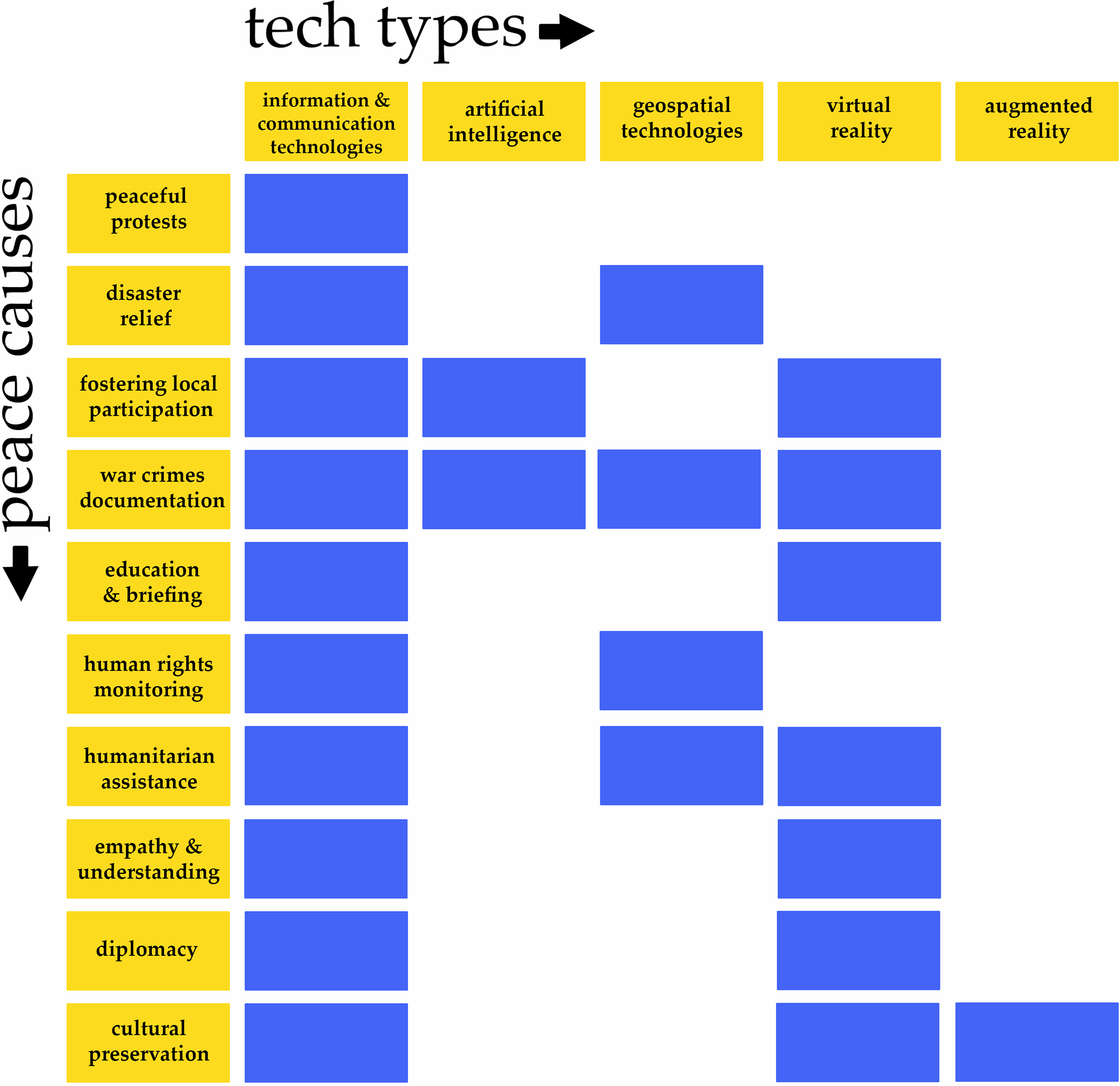
Examples of using different technologies in peace processes.
Ukraine is the number one contributor to the world's development in science and technology according to the latest The Good Country Index (The Good Country Index, n.d.), and so its defense and peace efforts have been highly technologically advanced. Some examples include the Security Service of Ukraine launching a chatbot to collect evidence of Russia's war crimes in Ukraine (Interfax-Ukraine, 2022); the volunteer-led IT Army of Ukraine (Render-Katolik, 2023); and the Ukrainian Government's support for the IT industry development in wartime through, for example, the innovative virtual platform Diia.City offering especially favorable tax and legal conditions for tech entrepreneurs (Fedorov, 2023). Ukraine's level of proficiency/contribution in/to tech has not only co-constituted how Ukraine works toward its peace leading to PeaceTech innovations, but also what peace Ukraine is building—leading to theoretical innovations.
By design of the term, PeaceTech implies that context-based innovation—how we use tech to support peace in each situation—is always happening to make a peace process nuanced, whereas technological innovation does not necessarily happen. And it may not be needed, especially if the existing technologies are designed with the consideration that they will be used in peacebuilding. Simultaneously, the term shows the hierarchy of importance and the moral framework: the what—
The peace that PeaceTech supports, co-constitutes, and is a tool for in the case of Ukraine is
Current research on PeaceTech, built on other theoretical premises, does not provide relevant insights for those seeking to design effective initiatives for supporting Ukraine during its defense against the Russian invasion and after the Ukrainian victory. A significant emphasis has so far been on promoting dialogue/understanding and cooperation/reconciliation between “sides”/“parties”/“groups” to conflicts, which is not directly applicable to sustaining quality peace. Artificial intelligence, for instance, has been found to foster the engagement of the local population in peace dialogues in Libya, especially in contexts where trust in (inter)national authorities is lacking and where locals may feel discouraged from participating (Masood Alavi et al., 2022). At the grassroots level, multi-touch interactive tabletops, framed as PeaceTech, have been found to aid education for peace in Cyprus by creating opportunities for collaboration and so “mediat[ing] peace within conflict-laden groups” (Ioannou & Antoniou, 2016, p. 173).
Although generally valuable, these findings do not relate well to Ukraine's fight against Russia's imperial/neo-colonial violence, since sustaining quality peace here focuses on supporting Ukraine's sovereignty and restoration of Ukraine's lawful territory (see more in President Zelenskyy's 10-point peace plan; war.ukraine.ua, n.d.). That means severing of all kinds of contacts/“dialogues”/“understandings” between Ukrainians and Russians that should never have happened in the first place: (neo-)colonial/imperial interactions by definition happen without the true consent of the colonized and against their dignity/security. Therefore, for PeaceTech to be
What is VR Generally and in/as PeaceTech?
Commonly, VR has been understood as “the use of computer modeling and simulation … to interact with an artificial three-dimensional (3-D) visual or other sensory environment” by viewing “animated images of a simulated environment” through such devices as headsets, gloves, and/or body suits (Lowood, n.d.). VR research identifies four key elements: “a virtual world, [mental and physical] immersion, sensory feedback (responding to user input), and interactivity” (Sherman & Craig, 2003, p. 6). These contribute to a research understanding of VR as a “medium composed of interactive computer simulations that sense the participant's position and actions and replace or augment the feedback to one or more senses, giving the feeling of being mentally immersed or present in the simulation” (p. 13). Addressing (potential) users of VR, Oculus—part of Meta's Reality Labs creating VR hard-/software—highlights that “VR uses cutting-edge graphics, best-in-class hardware, and artistically rendered experiences to create a computer-simulated environment where you aren’t just a passive participant, but a co-conspirator” (Oculus Blog, 2021, para. 3).
Similarly amiss the sustaining quality peace framework, research of VR in peacebuilding settings has shown that in the context of the Israeli–Palestinian conflict immersive 360° video, filmed from the perspectives of outgroup members, could facilitate “inducing a more critical perception of the ingroup's actions in the conflict” (Hasler et al., 2021, p. 2256). Peace practitioners, who have engaged with VR more, found it to aid in bringing new (civilian) perspectives into peace negotiations, promoting understanding/empathy of/toward different realities, preparing parties for in-person mediation processes or hosting online mediation elements (DiploFoundation 2020), and immersive exploration of consequences of (armed) conflicts on different stakeholders (Gregory, 2020). In the case of Ukraine's defense, VR has been understood and employed differently—in line with sustaining quality peace.
VR and Supporting Ukraine
Ukraine and its network of supporters have used VR to strengthen ties between those who already work for peace—Ukrainians and their allies. VR has been used in such areas as, for example, cultural preservation, citizen diplomacy and foreign relations by the Government of Ukraine, and mental health relief.
Within Meta's VR for Good initiative, the VR film “You Destroy. We Create.” The War on Ukraine's Culture’ highlights Ukrainians’ countless everyday efforts to preserve their existing culture from destruction and create new art across a variety of disciplines (Meta, 2022). The project “War Up Close” by Discover.ua and FreegenGroup uses VR for purposes of memorialization and justice by creating museums around Ukraine, 3-D modeling of monuments and buildings, and documenting destruction for current and future generations (War Up Close, n.d.). To further document and communicate the scales of destruction brought by Russia onto Ukrainian cities, the VR-360 project “Through the war” shows participants the states of the towns of Bucha, Hostomel, Irpin, Borodyanka, and Izyum after their liberation by the Armed Forces of Ukraine (Vistula University, n.d.).
Ukraine's Ministry of Foreign Affairs has also used VR in its work, particularly the project “Living the War.” Created in collaboration with the initiative Ukraine: War in VR, the project consists of hundreds of materials from all around Ukraine (Bucha, Irpin, Bakhmut, Kharkiv, Chernihiv, and more) and aims to immerse foreigners into Ukrainians’ everyday experiences of the war to show the consequences of Russian terrorism (Kuleba, 2023). “Living the War” was presented at the 2023 GLOBESEC forum in Bratislava, Slovakia, and previously shown to the delegations of Bahrain, Brazil, Oman, and Romania at the Ministry of Foreign Affairs of Ukraine (Kuleba, 2023).
Such immersive showing of what is happening in Ukraine serves to strengthen support for Ukraine from its allies, stay updated, and utilize this information for new/other ways of supporting Ukraine. Although VR technologies are constantly updating, this is largely an example of context-based innovation with peacebuilding and PeaceTech. Since, as the provided earlier definitions of VR show, the technology was designed to provide immersive experiences into sets of sensory materials such as images/sounds, VR might as well be virtually directly used for immersion into photo/video evidence of Russia's war crimes and the sounds of Russian missiles or into Ukraine's culture and Ukrainian artists’ work. With other possible applications, peace-intentional design and tech development of VR as PeaceTech specifically become more exigent.
A new direction of using VR in the context of supporting Ukraine has been mental health relief—something VR was not directly designed for. Staff of Israel's field hospital Kohav Meir, while working in western Ukraine, used VR goggles to interact with children and provide mental health treatment (Kabir, 2022). Moreover, a Metaverse version of Kyiv, created by an international team of psychologists and the VR platform 8agora, is being used for providing therapeutic support to (displaced) Ukrainians in different countries, with the VR activities being designed around insights from “talk therapy and peer support, two of psychiatry's traditional frontline defenses against PTSD” (Wright, 2023, para. 6). While these tools have in practice shown, respectively, a re-discovered willingness/excitement to talk and a comparatively easier experience discussing vulnerabilities, the efficacy of the applied VR tools in such mental health relief remains to be examined both short- and long-term. If VR is found to be effective enough to continue further use in this direction, it also needs to be examined as PeaceTech design-wise. Amplifying any potential useful aspects/elements of VR through updated design for use in sustaining quality peace processes could help develop VR as PeaceTech for more extensive use.
Supporting Ukraine: Future Research and Applications of VR in/as PeaceTech
Supporting Ukraine offers opportunities for novel uses of VR and other technologies, including PeaceTech. Yet, taking of these opportunities must come with the operationalized principles of doing no harm and high sensitivity to Ukraine's unique context and Ukrainians’ experiences of not only the 2022–2023 full-scale invasion but also the 2014–2022 phase of Russia's war of aggression against Ukraine. To truly support Ukraine, current applications and previously researched cases, need to be (further) researched and practitioner-evaluated within the framework of sustaining quality peace. Sustaining quality peacebuilders, technologists, and designers should work together with (potential) beneficiaries to design effective PeaceTech initiatives, where further tech innovations and peace innovations may be needed for the effective design of non-colonial tech-savvy peace as Ukraine sees it.
Footnotes
Declaration of Conflicting Interests
The author declared no potential conflicts of interest with respect to the research, authorship, and/or publication of this article.
Funding
The author disclosed receipt of the following financial support for the research, authorship, and/or publication of this article: This work was supported by the Koneen Säätiö, Gerda Henkel Foundation (grant numbers 202202939 and AZ/08/KF/20).