




Abstract
This article examines the relationships between conflict, climate change, and disaster in forced displacement contexts. We present these nexus dynamics through the case of Rohingya refugees in Bangladesh who are exposed to climatic hazards and other vulnerabilities that threaten their lives and livelihoods. Having fled persecution by the Myanmar military, Rohingya refugees face a range of conflict- and climate-related risks, both in the overcrowded and disaster-prone camps in Cox's Bazar and on the island of Bhasan Char where Bangladeshi authorities have relocated tens of thousands of people. The protracted refugee crisis has exacerbated social tensions between the Rohingya and host communities; limited access to resources and exposure to significant hazards that exacerbate conflict-induced displacement challenges. This paper contributes to the nascent literature on the region's conflict, climate change, and disaster displacement nexus by examining how cascading risks and state fragility contribute to increased instability. The article demonstrates the need for a more nuanced understanding of how conflict-induced displacement leads to new threats and vulnerabilities in hazard-prone environments.
Introduction
According to the UNHCR (2022), the number of people forced to flee their homes due to armed conflict, violence, persecution, and human rights abuses reached record highs. At the same time, climate change is increasingly seen as a factor often contributing to, and related to forced displacement. Without adequate measures and global action, up to 216 million people in six world regions could be affected by climate-induced migration and internal displacement by 2050 (Clement et al., 2021), potentially creating new conflicts and exacerbating existing ones. However, the linkages between climate change, conflict, and disaster displacement remain contested. This conflict–climate nexus has been acknowledged in various ways, including:
As a direct and monodirectional link between climate change and conflict (Hakim, 2011; Lee, 2009; Welzer, 2012); Climate change as a ‘non-traditional threat’ that acts as a ‘threat multiplier’ (Causevic, 2017); As a complex political phenomenon where environmental and climate-related effects do not play a significant role as conflict triggers (Hulme, 2011; Selby, 2014); and As a bidirectional relationship between climate and conflict, where conflict can expose displaced people to the risk of climate change and vice versa (Abrahams & Carr, 2017; Helman et al., 2020).
This article reviews these strands of literature to explore the linkages between climate, displacement, and conflict. In particular, it presents how refugees face new climate-related risks in their host country, drawing on the case study of Rohingya refugees in Bangladesh and their ongoing relocation from overcrowded and disaster-prone camps in Cox's Bazar to a similarly hazardous location on the island of Bhasan Char in the Bay of Bengal. This paper further unpacks these tensions and vulnerabilities through the lenses of state fragility and cascading risk to illustrate the nexus dynamics between conflict, displacement, and climate. This is done by reviewing articles and key media reports published between 2017 and 2022.
The paper first provides a review of the academic debate on how climate change, disaster, conflict, and displacement are linked and introduces the notion of cascading risk. We discuss the concept of state fragility and how it intersects with conflict- and climate-change-induced vulnerabilities to present a case study on multi-risk displacement of Rohingya refugees in Bangladesh. The paper discusses these implications as it relates to the increasingly relevant conflict, climate, and displacement nexus.
The Contentious Linkage Between Climate Change, Conflict, and Forced Displacement
The Challenges of Disentangling Causalities in the Conflict, Climate Change, and Displacement Nexus: A Review
As a multi-causal phenomenon, identifying climate-related triggers for conflict remains challenging. It is generally acknowledged that climate-related hazards, such as floods and droughts, can influence the type, duration, and characteristics of conflict within states (Mach et al., 2019). However, there has been little evidence that climate change and associated natural hazards are direct—or even indirect—drivers of persecution.
Tipping points commonly linked with civil unrest within countries include climate-related shocks (such as extended droughts), which may lead to increases in domestic food prices and inflationary shocks (Raleigh et al., 2015; Weinberg & Bakker, 2015). However, such linkages are less clear for the escalation of armed conflicts and persecution (Koren, 2018). For example, climate stressors and climate-related hazards have contributed to local-level conflicts in Bangladesh and Nepal (Sultana & Thompson, 2017), yet there is little evidence that climate change has caused or contributed to larger-scale political instability (Roth et al., 2019).
Despite the lack of evidence that the effects of climate change are a direct cause of political conflict, several scholars have described climate change as a ‘threat multiplier’ that poses significant risks to national and international security (Causevic, 2017; Huntjens & Nachbar, 2015). Abel et al. (2019) suggested that climate change is responsible for an increase in conflicts—concerning its likelihood, frequency, and intensity—that thereby generate greater numbers of forced migrants. They concluded that reduced rainfall increases conflict which, in turn, serves as a threat multiplier to drive displacement.
Several quantitative studies on the climate–conflict nexus have examined the effect of rising temperatures. For example, in a meta-analysis, Hsiang and Burke (2013) contended that, with each standard deviation increase in temperature, interpersonal conflict increases by 2.4% and intergroup conflict by 11.3%. Concerning projections of the future effects of climate change on the occurrence of conflict, Witmer et al. (2017) forecasted sub-national (intra-state) violent conflict in sub-Saharan Africa for the period 2015–2065 using temperature and precipitation anomalies. They contended a significant relationship exists between increased temperatures and levels of violent conflict. Burke et al. (2009) have also asserted that rising temperatures will increase the risk of civil war in sub-Saharan Africa and will claim the lives of nearly 400,000 people annually by 2030. In a particularly deterministic manner, Lee (2009) projected that so-called ‘cold wars’ will break out in northern and southern latitudes, as rising temperatures will draw countries into interstate conflicts due to increased exploitation of resources and territories. This study also asserted that ‘hot wars’ will occur around the Equator as a hotter climate will expand and intensify arid and semi-arid zones, thereby increasing competition over scarce resources within states.
Despite these studies, other researchers have maintained that long-term projections of the impact of anthropogenic climatic changes can only be made for particular local or regional contexts and limited time periods due to a lack of reliable data (Abel et al., 2019; Buhaug et al., 2014; van Baalen & Mobjörk, 2017; Van Weezel, 2019). Scholars have criticised that climate–conflict nexus analyses and projections often do not consider secondary effects, such as disruptions to economic growth, which are often crucial factors in the onset of conflicts.
Other studies go a step further in their critique of the attempt to establish clear causal links between climate change and conflict, taking issue with positivist-quantitative approaches to climate-conflict research (Selby, 2014) and climate determinism and reductionism (Hulme, 2011).
These debates extend to the protracted Syrian Civil War, with some scholars claiming climate change was a driver of conflict and others taking a more multifaceted analysis (Abel et al., 2019). In a controversial article, Kelley et al. (2015) suggested that a long-standing drought linked to anthropogenic climate change was a major catalytic event that helped trigger political unrest in Syria, eventually leading to the outbreak of ongoing civil war. The authors acknowledged that drought was only one of the factors, alongside government failure, unsustainable agricultural practices, and the influx of hundreds of thousands of Iraqi refugees into the country. Studies of the Darfur Civil War in the early 2000s have also focused on how climate-induced displacement triggered forms of conflict and persecution in relation to competition for limited resources (Hakim, 2011; Welzer, 2012; De Juan (2015). However, other scholars have challenged these linkages between climate change and prolonged drought to the outbreak of conflict. For instance, Selby et al. (2017, p. 232) found that ‘there exists no solid evidence that drought migration pressures in Syria contributed to civil war onset.’ They concluded that academics, policymakers, and the media should be more cautious in their claims of direct climate change–conflict linkages (cf. Helman et al., 2020; Hendrix et al., 2023; Verhoeven, 2014).
In recent years, the unidirectional causal linkages between climate and conflict, and the ‘threat multiplier’ theses that have informed dominant narratives around climate, conflict, and security have been increasingly challenged. For instance, Abrahams and Carr (2017) maintained that conflict increases vulnerability to climate change, hence emphasising a bidirectional relationship between conflict and climate change. Similarly, Peters (2021) interviewed experts in disaster risk reduction and found that conflicts can increase disaster risks and vulnerability in various regional contexts. Johnson et al. (2022, p. 499) employ the term ‘cascading’ regarding the risks and subsequent adverse impacts that occur post-relocation in newfound communities and environments and reinforces the bi-directional relationship between conflict and climate. Closely linked to the concept of cascading risks is the concept of fragility which we examine in the following subsection.
State, Institutional and Socioeconomic Fragility: A Factor in the Conflict, Climate Change, and Disaster Displacement Nexus
The identification and realisation of durable solutions require greater recognition of the intersections between climate change and a country's institutional and socioeconomic contexts. Thus, the concept of fragility plays an important role and is potentially a catalyst within the change and conflict-induced displacement nexus (Van Bronkhorst & Bousquet, 2021). According to the World Bank Group in their Strategy for Fragility, Conflict, and Violence 2020–2025, fragility occurs when there are deep governance issues present within countries with indicators such as lack of capacity, exclusionary practices, institutional weakness, and widespread grievances (World Bank Group, 2020). These links are more defined in settings where residents already suffer from conflict and instability, which exacerbate existing vulnerabilities and contribute to state fragility.
This exposure and volatility of climate stressors within a political and institutional landscape—unprepared and under-resourced to cope—reduces affected countries’ adaptability, capacity, and ability to provide support and address their people's needs. Thus, it is imperative to recognise the interface between state fragility and vulnerabilities, which are amplified in times of emergency. For instance, the gendered impacts of displacement can be witnessed in the case of Syrian women being unable to confer citizenship to their children, which results in statelessness (OCHA, 2016). According to Reuveny (2007), the influx of refugees into a country with limited governmental capacity can increase competition and distrust. It may result in tension between refugees and local communities, particularly in low-income countries dependent on agriculture and already suffering from a scarcity of natural resources and food insecurity.
However, research gaps exist regarding the complex linkages between specific climatic drivers and how these interact with other factors that lead to conflict (Ide, 2017; Seter, 2016). In addition, there is little research on more subtle forms of conflict that may not turn openly violent, such as local resource conflicts. There are few studies that examine how conflict-induced displacement may expose refugees and internally displaced people to climatic risks that they did not face in their country of origin.
As Nordqvist and Krampe (2018) have highlighted, there is a need to consider how geographic differences and temporal shifts related to disaster vulnerabilities intersect with institutional capacity and governance.
In particular, a significant research gap on the climate–conflict-displacement nexus exists in South Asia, where population densities are high, and the intensity and frequency of high-impact weather events are accelerating (Busby et al., 2018; Vinke et al., 2017). This region has been identified by a recent World Bank Group report as one of the most vulnerable to climate-related migration and displacement, with 40 million people at risk of being forced to move internally due to climate change by the year 2050 (Clement et al., 2021). We present a case study of the Rohingya refugees who are living in Bangladesh, and how the conflict–climate-displacement nexus creates cascading risks in situations of fragility.
Case Study: The Protracted Rohingya Refugee Crisis and Multi-Risk Displacements in Bangladesh
The case of the protracted Rohingya refugee crisis was chosen because it illustrates the complexities of the climate-conflict-displacement nexus. It is also one of the most well-documented contemporary refugee crises which allowed us to gather a large amount of secondary material and published work including non-reviewed documents, media reports and articles. The predominantly Muslim Rohingya have been driven out of Myanmar through religious and racialised persecution that media commentators, academics, and even the United States government have described as genocide (Bremner, 2020). Rohingya refugees in Bangladesh, and other host countries, such as Malaysia, Indonesia, India, and Thailand, experience extreme insecurity where their futures are unknown due to the lack of clarity surrounding their potential repatriation or their inability to seek asylum. As the host countries in the region are non-signatories of the 1951 Geneva Convention on Refugees, the lack of this protective legislative framework weakens the opportunities for durable solutions. This case study explores how conflict-driven displacement to various destinations in Bangladesh (Cox's Bazar and Bhasan Char) has made the Rohingya more susceptible to climate-related risks and hazards, further increasing their vulnerability and thereby contributing to an increase in political and state fragility within the host country.
The Asian Development Bank lists Bangladesh as one of the most disaster-prone countries in the world, where over 80 per cent of the population is exposed to potential flooding, drought, cyclones, and earthquakes (Planning Commission & Ministry of Planning and Asian Development Bank, 2021). Severe flooding can cover 60 per cent of the landmass every four to five years, which is one of the major factors in the country being ranked 13th in the Climate Risk Index for 2019 and 7th in the long-term Climate Risk Index (Germanwatch, 2021; Herbert, 2019). This hazardscape raises significant concerns about the safety of the Rohingya refugee population in Bangladesh.
From the 2015 Andaman Sea Crisis to the Protracted and Disaster-Prone Refugee Situation in Cox's Bazar, Bangladesh
The Rohingya have faced violent religious and ethnic prosecution in Myanmar for decades, long before their plight came into the international ‘limelight’ with the Andaman Sea Crisis in 2015 (Dahgaypaw, 2021). The Rohingya refugee crisis reached a peak in 2017 when hundreds of thousands of Rohingya fled across the border to Bangladesh when military forces raided their homelands by burning hundreds of Rohingya villages, with widespread reports of sexual violence and genocide in Myanmar's Rakhine state (Bremner, 2020; Dahgaypaw, 2021). The ‘security operations’ by the Myanmar military followed attacks on police posts, allegedly launched by Rohingya militant groups. The new arrivals joined the roughly 200,000 Rohingya who had earlier fled to the southern-most border districts in Cox's Bazar (Bremner, 2020).
Cox's Bazar is one of Bangladesh's most vulnerable regions, exhibiting high poverty rates and environmental hazard risks (Bremner, 2020). Upon arrival in Cox's Bazar, refugee families settled on small plots of land on a forested hillside, where they removed the vegetation and built a roughly terraced landscape (Bremner, 2020). The challenging terrain, coupled with ineffective planning, overcrowding, and lack of infrastructural support, exposed the camps and their inhabitants to various climate-related hazards (Zaman et al., 2020). As the ‘temporarily granted’ refugees (officially designated as ‘Forcibly Displaced Myanmar Nationals’) were not allowed to use permanent construction materials nor were they equipped with sustainable energy sources, they were forced to cut the surrounding forest areas for fuel and shelter construction, thereby destabilising the fragile ecology and exposing the soil to erosion (Bremner, 2020).
As of March 2023, over 960,000 Rohingya refugees were living in Cox's Bazar. According to the World Food Programme, the population density is 60,000 persons per km2 in the Cox Bazar camps, causing increased vulnerability of inhabitants to risks, sanitation, and health where 95 per cent of the refugees are classified as moderately to highly vulnerable due to disasters and compounded risks (World Food Programme, 2022). Due to the rapid expansion of the Rohingya refugee camps, significant deforestation and environmental degradation occurred in the surrounding areas, which have impacted local host communities (Hossain & Moniruzzaman, 2021). Not only has this created tension, competition, and social conflict, but it also increases the exposure to natural hazards as the area is already prone to landslides which place the refugees and local communities at further risk (Hasan et al., 2020). In May 2019, camp residents narrowly escaped the devastating impact of Cyclone Fani, which passed north of the camps and brought heavy rainfalls—but caused only minor damage (IOM, 2019a). Yet, two months later, several days of heavy monsoon rains damaged more than 3,400 houses, displaced 2,700 camp residents, and killed two people (IOM, 2019b). In March 2021, a massive fire ripped through a section of the Balukhali camp that killed 15 people and made more than 45,000 Rohingya homeless (Save the Children, 2021). In July 2021, after heavy monsoon rains, at least six people were buried by landslides or drowned in floodwaters, with several thousand Rohingya losing their fragile shelters (Ahmed, 2021). Most recently, in May 2023, Cyclone Mocha struck the Bangladesh-Myanmar border and caused devastating damage to the fragile infrastructure of Rohingya refugee camps and shelters made of bamboo and tarpaulin, affecting thousands of families and destroying homes and key facilities (United Nations Bangladesh, 2023).
During the 2017 exodus, many Bangladeshis supported the acceptance of Rohingya into Bangladesh as temporary ‘guests’ however, tolerance has waned over time. Mohib Ullah, the former leader of the Arakan Rohingya Society for Peace and Human Rights who was killed in 2021, said that the local communities were the first to offer assistance and provide shelter, food, and water to the Rohingya, three months before the intervention of the international community (Herbert, 2019). Although host communities have sympathised with the Rohingya, and have tolerated them, it is assumed that, as guests, they would eventually be repatriated. Through this impression of temporality there have ostensibly been limited attempts to strengthen social cohesion with Rohingya, along with a fear that acknowledging the permanence of the Rohingya would lead to opposition and divisions in the secular and religious politics in Bangladesh (Herbert, 2019). According to Idris (2017), the extended stay of refugees, the collapse of the tourism industry in Cox's Bazar, competition for land and resources can lead to the growing resentment towards refugees’ presence within Bangladesh. The multiple strains and pressures can amount to what Malley (2018) considers as possible grounds for communal conflicts along with divisive politics in Bangladesh (see also Herbert, 2019; Idris, 2017). Hence, as the scenario of voluntary repatriation remains doubtful and highly precarious, Bangladesh continues to host the refugees at the increasing disapproval of host communities, underscoring the risks of deteriorating relations.
The current COVID-19 pandemic has further impacted Cox's Bazar, Bangladesh's poorest districts, and tensions between the local population and the Rohingya have become increasingly apparent as there is an increase in hate speech. Anti-Rohingya propaganda, which further alienates and stigmatises an already marginalised community, has slowly crept to the surface as local communities sometimes perceive aid groups to be channeling resources into the alleviation of the plight of the Rohingya while they themselves feel increasingly neglected by the government and aid organisations (Anas, 2020). Animosity is created by the perception of unequal prioritisation of refugee communities as the host communities often do not benefit or receive support entirely based on aid, which has raised the need for social cohesion projects and investments into local communities interacting with Rohingya and to build trust (Anas, 2020). According to Roy and Chowdhury (2021), the extended stay of refugees, the battering of the tourism industry in Cox's Bazar as a consequence of the COVID-19 pandemic, and competition for land and resources led to the growing resentment towards refugees’ presence within Bangladesh. The multiple strains and pressures amount to what Islam and Wara (2022) consider as possible grounds for communal conflicts along with divisive politics in Bangladesh.
The Ongoing Relocation of Rohingya to Bhasan Char: Exposing Conflict Refugees to Future Climate-Related Disasters?
Given the increasingly untenable living conditions in the overcrowded Cox Bazar camps and in search of more long-term solutions for the Rohingya Refugee Crisis, the Bangladesh government proposed relocating Rohingya refugees to Bhasan Char – a small, previously uninhabited island more than 100 km northwest of Cox Bazar – with the argument that this would alleviate population pressure, rising human trafficking and other perceived security threats in Cox Bazar (Bhattacharyya, 2020). Khaled (2021) contends that the public pressure to ‘resolve’ the Rohingya crisis has been a significant factor in the Bangladesh government's decision to relocate refugee populations despite criticism and international scrutiny from human rights organisations, the UN, and donors. As human trafficking is on the rise and branded as a security threat to Bangladesh (Hossain, 2020), the Bangladesh Government promoted Bhasan Char as a ‘secure, voluntary and temporary solution’ during the waiting period to secure the repatriation of refugees with Myanmar (Human Rights Watch, 2021a; see also Islam & Siddika, 2022). Even if repatriation would eventually occur and ultimately be a pathway to a more hopeful future, this does not mean that Rohingya will live in a safe environment if conflict ceased. This has been demonstrated by the devastating impact of Cyclone Mocha in the northern part of Rakhine state, the homeland of the Rohingya, in May 2023. Hence, safe repatriation in the context of climate-affected countries may well be an unrealistic goal.
The planned and ongoing relocation of approximately 100,000 Rohingya refugees from Cox's Bazar to Bhasan Char, a 13,000-acre silt-based island formed 20 years ago that is 2 m above sea level received considerable amounts of funding along with their own investments in millions from the US, and China for the Bangladesh government to invest (Hossain, 2020; Islam et al., 2021). The Bangladeshi government has relocated around 30,000 Rohingya refugees to the island since December 2020 and aims to further move 100,000 refugees to Bhasan Char (Human Rights Watch, 2021a).
Initially, relocation plans were for volunteers who were willing to relocate to relieve pressure and overcrowding in the Cox's Bazar refugee camps. However, a report concerning interviewed Rohingya refugees suggested that some may have been forcibly relocated and/or misled about the conditions on the island, such as experiencing food shortages and not receiving adequate healthcare and livelihood opportunities (Human Rights Watch, 2021b). Alternative views have been expressed by Islam and Siddika (2022) who assert that Rohingya refugees on the island were satisfied with their living conditions.
The project to build a new town on Bhasan Char has cost $350 million USD, which drew from international funding and donors (Bhattacharyya, 2020). The climate and environmental risks associated with the island and the relocated Rohingya refugee populations remain underexplored. However, it is acknowledged that it is an island vulnerable to tidal surges, cyclones, monsoon rains, and flooding (|Bremner, 2020). In efforts to diffuse anxiety and resistance among the Rohingya, Bangladeshi authorities have promoted a narrative of the island being a spacious and modern living environment, even going as far as claiming the infrastructure is environmentally friendly as opposed to the refugee camps through their marketing campaign (Hossain, 2020). Despite their claims of newly built schools, a mosque, hospitals, and clinics, and running electricity, a report released by Amnesty International (2020) suggests that the living conditions are poor, cramped, and unhygienic. The report also revealed that there are limited healthcare services and food supplies on the island and that refugees are unable to contact their families due to not having devices (Amnesty International, 2020). There have also been reports of sexual abuse by local workers on the island, accusations which Bangladeshi officials have adamantly denied.
At the end of April 2023, there were 29,836 Rohingya refugees on Bhasan Char (UNHCR, 2023). Bangladeshi authorities maintained that relocation to Bhasan Char was a participatory process built on consultation and informed consent. However, a report by Human Rights Watch (2021a, 2021b) contends – based on interviews with relocated Rohingya – that relocation has been involuntary or manipulated by providing misleading information about the conditions on the island.
To address concerns about cyclone and flood risks on the fragile island, the Government of Bangladesh constructed a 3-m-tall, 12.1-km-long seawall, and 120 cyclone shelters as a disaster risk reduction strategy in 2020 (Bhattacharyya, 2020). After the release of the Bangladesh Water Development Board Standard, work was under way to raise the embankment to 6 m (Human Rights Watch, 2021a, 2021b). However, the UN and human rights groups have raised concerns about the slow emergency responses due to the island's remote location and the risks of the flood-prone island (Human Rights Watch, 2021a). In early 2022, the USAID Deputy administrator Isobel Coleman visited and evaluated Bhasan Char, stating that there needed to be more livelihood opportunities and basic needs to be fulfilled on the island and also expressed the significance of Bangladesh hosting and supporting a large number of Rohingya people (UNB News, 2022).
The controversy surrounding the island relocation plans has caused a divide between different actors (Ahmed, 2019). This situation has created a stalemate in which donors are hesitant in supporting a contentious relocation scheme that has had negative media coverage on the involuntary nature of initial relocation attached to it (Ahmed, 2019). The United States, which is the largest donor to the Rohingya response, does allocate funding towards the island development (Loy, 2022). In October 2021, the UNHCR has agreed to support services on Bhasan Char and also launched an UN-led appeal for $100 million to go towards funding Bhasan Char (Ahmed, 2019). This appeal was the first time Bhasan Char has been included in an annual humanitarian plan. The head of a leading Bangladesh NGO stated in an interview that preventing funding from being used for Bhasan Char endangers healthcare and immediate services to be carried out and causes the refugees to remain stuck in a ‘limbo’ of inaction (Loy, 2022). These divisive and often unclear leanings demonstrate that there is a need for a medium-term solution which is currently being prevented by global narratives which condemn the Bangladesh government for the involuntary resettlement of Rohingya refugees rather than contributing to seeking solutions where time is running out, and funding is dwindling due to donor fatigue which is being observed with other protracted crises.
Media commentators and academics assert that the risk of climate-induced hazards remains high due to the low-lying topography of the land, which can lead to devastating flooding on the island (Hossain, 2020). Bremner (2020, p. 7) has described Bhasan Char and other surrounding islands as ‘free-flowing sedimentary matter-energy; they can emerge from the ocean only to disappear again or change shape from season to season and year to year’. The elusiveness and precarious temporality of Bhasan Char can serve as a metaphor for the lack of legal status of the Rohingya, exacerbated by the dynamics of state fragility and the multi-risk hazardscape of the island.
Cascading Risks, Repeat Displacements
This case study ties in with the scant literature on the complex linkages between conflict, climate change, and disaster displacement. It provides evidence of what Peters and Lovell (2020, p. 7) refer to as the increasing risk of ‘protracted and multiple disaster displacements’ in the Asia-Pacific region, whereby repeatedly and forcibly displaced people remain dependent on humanitarian assistance and are exposed to a myriad of new risks. This article demonstrates how the initial displacement trigger was not a natural hazard, but genocidal persecution of a minority group by the Myanmar military. In the case of Rohingya refugees in Bangladesh, the cascading risks range from repeat displacements to tensions between host and refugee communities, climate-related hazards and structural concerns related to fragility.
This protracted refugee crisis has highlighted the lack of regional and national governance and protection mechanisms for refugees (Nethery & Loughnan, 2019; Sharma, 2008; Tubakovic, 2019). Although several countries in the region, e.g., Bangladesh and Pakistan, have hosted large refugee populations for many years, little progress has been made in establishing national legal frameworks for protecting asylum seekers and refugees (Ahmed et al., 2021; Tubakovic, 2019). Although Bangladesh is a non-signatory of the 1951 Refugee Status Convention, the country has a constitutional and statutory legal obligation under national and international bodies of law to protect refugees, such as under the principle of non-refoulment (Jones, 2018). This principle ensures that refugees are not repatriated or forcibly returned to a country where they are prosecuted or threatened, and safe repatriation of Rohingya would only be possible if there is pressure on Myanmar to respect and acknowledge the equal rights of Rohingya and to recognise their citizenship status (Arif, 2020).
The major gaps in regional approaches are particularly situated in South and Southeast Asia. Thailand is in the final stages of implementing their National Screening Mechanism. At the regional level, neither the South Asian Association for Regional Cooperation (SAARC) nor the Association of Southeast Asian Nations (ASEAN) have adopted a framework for the regional governance of refugee movements and protection (Kneebone, 2014; Sharma, 2008). The nonrecognition of international refugee law and international instruments by the majority of Asian countries is rooted in the widespread perception that the Geneva Convention is an agreement grounded in Eurocentrism that was established to deal with the European refugee crisis following World War II, with little relevance to the experiences and challenges in the Asian region (Nethery & Loughnan, 2019; Tubakovic, 2019). The fact that none of the countries that have become host countries for the Rohingya refugee crisis has signed the Geneva Convention has adverse implications for the protection of Rohingya refugees. This shows that the international legal framework still does not recognise the multiplicity of risks that refugees may be exposed to but rather remains focused on singular causes of displacement and exposure to risk. The fact that none of the countries that have become host countries for the Rohingya refugee crisis has signed the Geneva Convention has adverse implications for the protection of Rohingya refugees.
The international community's failure to find consensus and legally acknowledge the multi-scalar impacts of climate change restricts their ability to offer binding protection to those seeking asylum (Offner & Marlowe, 2021). The limiting legal framework of refugee protection and the inability to agree reveals the international policy gap that exists that prevents collective action-related nexus dynamics associated with conflict and climate-induced displacement (Offner & Marlowe, 2021). In response, Scott and Salamanca (2020) proposed a human-rights-based approach that centres action around the importance of maintaining the protection of human rights for those impacted to effectively address the impacts of climate-induced displacement—transcending traditional humanitarian interventions and short-term reactive responses to consider access to range of civil, political, cultural, social and economic rights. Such an approach would be sensitive to the differential needs, intersectionalities, power structures, and already existing capacities. Scott and Salamanca (2020) proposed guiding principles that foster a human rights-centred approach to addressing displacement, which puts forward four critical components:
governance: refers to the quality of legal and policy frameworks; procedural: including the right to information, consultation, and participation; substantive: refers to the rights to life, work, adequate food, adequate shelter, health, and social security; and non-discrimination and equality: refer to equal treatment irrespective of gender, age, ethnicity, and (dis)ability.
For instance, the right to adequate accommodation can be understood through these components and further comes into stark relief with the context of the recent cyclone Mocha that destroyed more than 1000 shelters. Thus, these components cut across a range of rights and provides a basis to work through how the realisation of any given right is impacted by multiple contexts and the various drivers of displacement. In the case of the Bhasan Char relocation process, the drafting of national plans and policies for internal refugee resettlement alongside this human rights approach would assist with identifying durable solutions to the Rohingya refugee crisis. This would include full disclosure of the risks and realities for Rohingya refugees in new relocation sites and support for opportunities to sustain their livelihoods and uphold their human rights—the right to a life with dignity, and freedom of mobility. Any relocation plans must include prior consultation, informed consent, and participation of the affected communities.
The Norwegian Refugee Council (NRC) describes how international leadership around Rohingya is in a “political deadlock,” preventing them from committing and finding lasting solutions and durable pathways for refugees (NRC, 2022). Global funding is also dwindling, with the Rohingya humanitarian response plan being chronically underfunded, receiving a mere 25 percent of the funding required over halfway through the year, and Myanmar's 2022 aid response plan is under 17 percent funded, revealing the desperation in needing to find solutions and funding streams (NRC, 2022). A significant challenge is that donors are reluctant to fund long-term development and peacebuilding initiatives in situations of chronic crisis and instability. Many donors, for instance, have withdrawn development funding from countries that are mired in protracted conflicts, declaring them as failed states. Redvers and Parker (2019) cite examples from Syria and South Sudan, where development organisations have been reluctant to continue their work.
Figures 1 and 2 depict how this case study contributes to an expansion of the conventional view of the conflict, climate change, and displacement nexus. Figure 1 shows how the conventional view has been characterised by linear and mono-directional linkages between conflict, climate change/disaster and forced displacement. Figure 2 presents the nexus in its multi-directional linkages with cascading risks being embedded in a situation of state fragility.
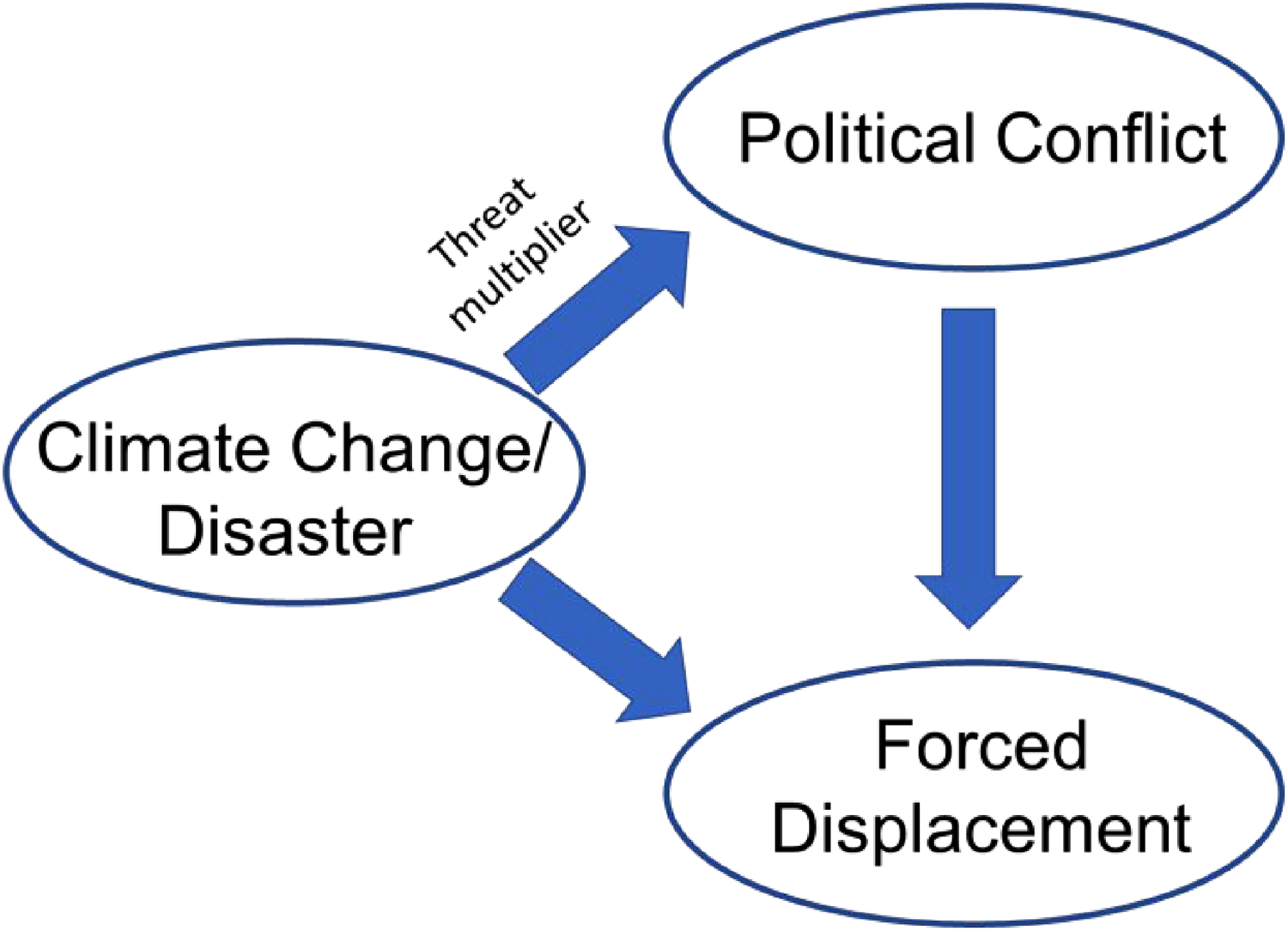
Conventional view of the conflict, climate change and displacement nexus.
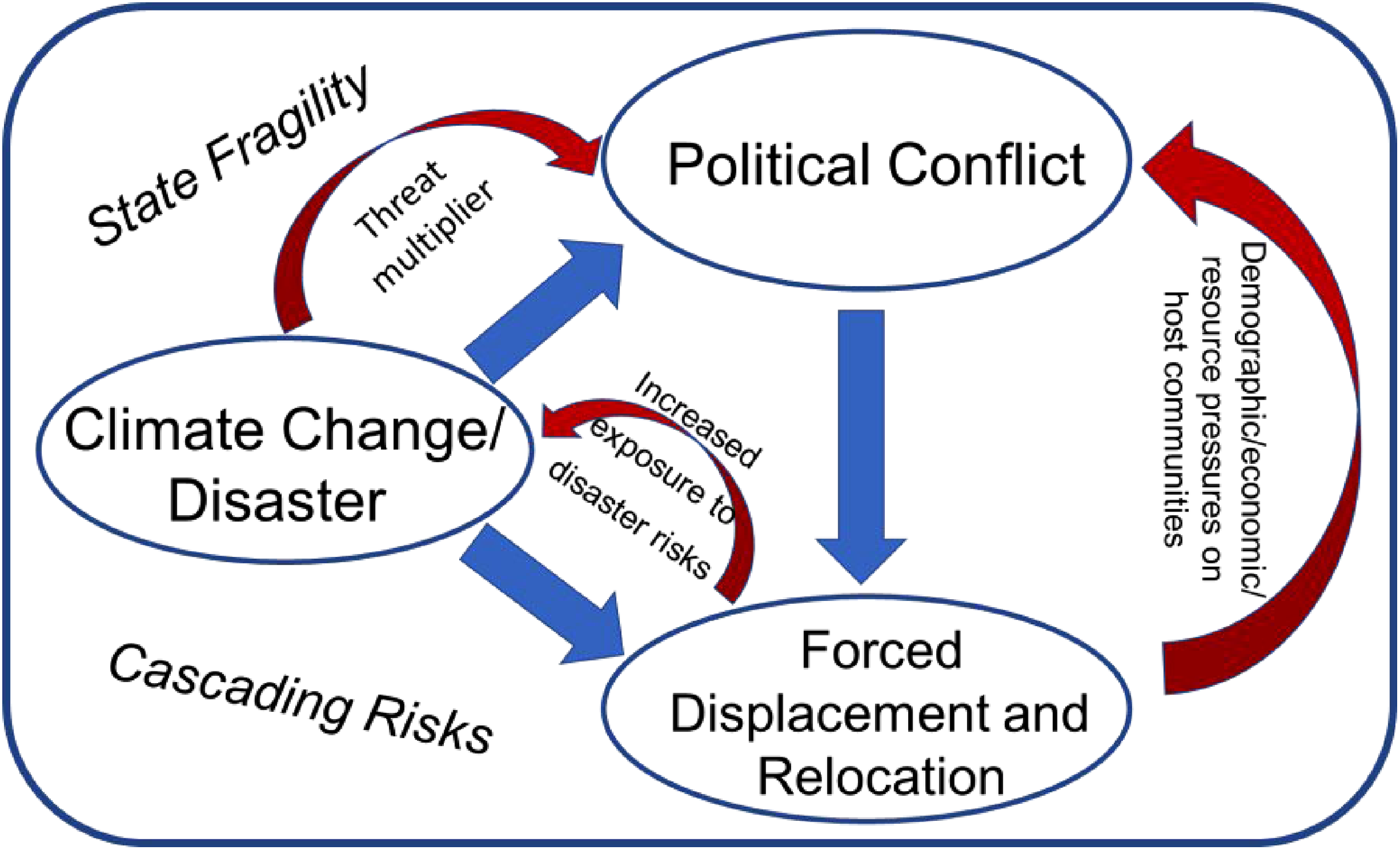
Expanded view of the conflict, climate change and displacement nexus.
Future research should examine whether the expanded view as depicted in Figure 2 can be confirmed for other cases. Our review supports Selby and Hoffmann's (2014) call for more politically engaged, historically critical, and qualitative approaches to researching climate-conflict linkages.
Our case study further underscores the need to disaggregate the causes and consequences of conflict-induced displacement (Lischer, 2007). While the cause of a conflict-induced displacement may lie in violence and persecution experienced at the hands of perpetrators in the refugees’ country of origin, the consequences of finding a new temporary home in the host country can come with new forms of violence, risks, losses, and human rights violations. With regard to the increased exposure to climate-related hazards as exemplified by the disasters experienced in Cox's Bazar and anticipated risks on Bhasan Char, refugees may find themselves in environmentally precarious situations where their own lives may be at stake once again (Ahmed et al., 2021; Shahpur & Wardani, 2022).
The condemnation of Bangladesh's inability to fully care for and manage the influx of Rohingya refugees as the fastest-growing refugee crisis in the Asia Pacific region is largely misplaced. Instead, the case shows that the international community must support, empower, and continue to resource humanitarian organisations so that the Bangladesh government and local actors can address local needs (Arif, 2020). To allow for peaceful coexistence, Amnesty International (2020) has called for efforts to enhance social cohesion and the creation of long-term opportunities for refugees so that integration is viable, and that education and employment are accessible.
Conclusion
Drawing on a review of the global literature on the conflict, climate change, and displacement nexus and a case study of the protracted Rohingya refugee crisis in southeastern Bangladesh, this study has shown the need to shift from simplistic and mono-directional views of the linkages between conflict and climate change to a more complex understanding of the multi-scalar and multi-temporal dimensions of how conflict-induced displacement may lead to new threats and vulnerabilities facing refugees in hazard-prone environments in their host countries. Our findings call for an expansion of our conceptual thinking about the nexus between conflict, climate change, and disaster in the context of forced displacement.
There is a pressing need to further consider how refugees and internally displaced peoples are rendered more vulnerable in the contexts of repeat displacements and climatic risks, particularly high-impact weather events.
While the evidence is limited, there are an increasing number of case studies that illustrate a relationship between climate change, disasters, persecution and displacement. However, the dynamics within this so-called conflict-climate-displacement nexus often fail to consider the complexities of secondary effects, such as disruptions to economic growth and state fragility. In addition, there is a pressing need to further consider how refugees and internally displaced peoples are rendered more vulnerable in the contexts of repeat displacements and climatic risks, particularly high-impact weather events. These contexts present the implications of cascading risks that include tensions between host and displaced communities and the structural concerns associated with state fragility. A more thorough examination of the international human rights frameworks and how they intersect with particular national, regional, and international jurisdictions is beyond the scope of what we can accommodate in this paper and represents an important area for further development. Our hope is that this paper provides a basis for further research in these areas, including comparative case studies that can examine the transferability of our conceptual framework to other conflict areas and protracted refugee crises. As conflict-induced displacement can create and amplify climatic and disaster risks, practitioners should consider people-centred and rights-based disaster risk reduction as an essential component of finding solutions to protracted refugee crises in multi-risk environments.
Footnotes
Declaration of Conflicting Interests
The author(s) declared no potential conflicts of interest with respect to the research, authorship, and/or publication of this article.
Funding
The author(s) disclosed receipt of the following financial support for the research, authorship, and/or publication of this article: This research was supported by the Royal Society New Zealand under a Rutherford Discovery Fellowship, ID# UOA1801.
