



Abstract
How does conflict, displacement, and return shape trust, reconciliation, and community engagement? And what is the relative impact of exposure to violence on these indicators? In this paper we explore these questions by focusing on the legacies of armed conflict and the differences between those who stayed in their communities of origin during the conflict (stayees) and those who were displaced internally and internationally and who returned home over time (returnees). The results, which rely on analysis of data we collected in Burundi, suggest that internal returnees have significantly lower levels of trust, reconciliation, and community engagement than stayees, whereas the differences between international returnees and stayees are mostly statistically insignificant. Greater exposure to violence has a more negative effect on reconciliation and community engagement for returnees compared to stayees, while the effects on trust are mixed.
Keywords
Introduction
There is a large literature exploring the impacts of armed conflict and violence on aspects such as trust, reconciliation, and community engagement (Alesina and La Ferrara 2002; Bauer et al. 2014; Bellows and Miguel 2009; Blattman 2009; Hayes and McAllister 2001; Hazlett 2020; Lupu and Peisakhin 2017; Rohner, Thoenig, and Zilibotti 2013; Schwerter and Zimmermann 2020). However, one aspect that has been ignored in the literature is the attitudinal differences between individuals from the same community of origin who were located in different geographical areas or countries during the conflict. Understanding these attitudinal differences is important because the end of conflict often involves the return of large numbers of refugees and internally displaced persons to their communities of origin.
The re-encounter of individuals who were separated for many years, and often decades, may lead to the re-establishment of old societal divisions or to the creation of new ones. Therefore, different views and attitudes between these individuals on trust, reconciliation, and community engagement can have long-term implications for economic performance, peace-building, and nation-building (Cox 2009; Guiso, Sapienza, and Zingales 2004; Knack and Keefer 1997; Miguel 2004; Vinck and Pham 2009). For instance, Arrow (1972) suggests that ‘virtually every commercial transaction has within itself an element of trust’. He adds that ‘much of the economic backwardness in the world can be explained by the lack of mutual confidence’ (Arrow 1972: 357). Similarly, Fukuyama (2001) states that social capital, an element that depends heavily on trust and cooperation, ‘is the sine qua non of stable liberal democracy’ (Fukuyama 2001: 7).
Yet, even with its importance for different societal aspects, there is scarce research documenting differences in indicators of trust, reconciliation, and community engagement between those who stayed in their communities of residence during the conflict (stayees) and those who were displaced internally and internationally and returned home over time (returnees). The purpose of this paper is to explore these differences.
There is a large literature suggesting that personal experiences have a major impact on individuals' inclination to trust others (Alesina and La Ferrara 2002; De Luca and Verpoorten 2015; Rohner, Thoenig, and Zilibotti 2013; Schwerter and Zimmermann 2020). Voors et al. (2012) suggest that large shocks have long-term consequences for behaviour, even if the shocks are short-term. Returnees and stayees often have very different experiences related to the protection of community resources, strategies to cope with conflict, incidents while on the move, and interaction with other populations, among many others. There can also be important differences in experiences between those returnees who were displaced internationally and those displaced within their own countries (e.g., adapting to life abroad, different levels of access to international development assistance, interaction with host communities, etc.).
In addition to these differences in experiences, stayees, internal returnees, and international returnees may have been exposed to different levels of violence during the conflict, one of the key factors determining the long-term legacies of conflict (Hazlett 2020; Lupu and Peisakhin 2017). Moreover, given the differences described above, it is possible that violence exposure has different long-term implications for each of the three groups in terms of trust, reconciliation, and community engagement (Lupu and Peisakhin 2017). We also explore this possibility in the analysis.
To explore differences in attitudes between stayees, internal and international returnees, we rely on data that we collected in Burundi, a country that experienced a major conflict between 1993 and 2005. The conflict resulted in an estimated 5% of the population being killed, 10% being displaced abroad, and a much higher share of the population being internally displaced (Ruiz and Vargas-Silva 2015, 2016, 2021; Voors et al. 2012). The country experienced a major inflow of returnees after the conflict (Fransen and Bilgili 2018). In some communities the share of returnees reached over two-thirds of the total population.
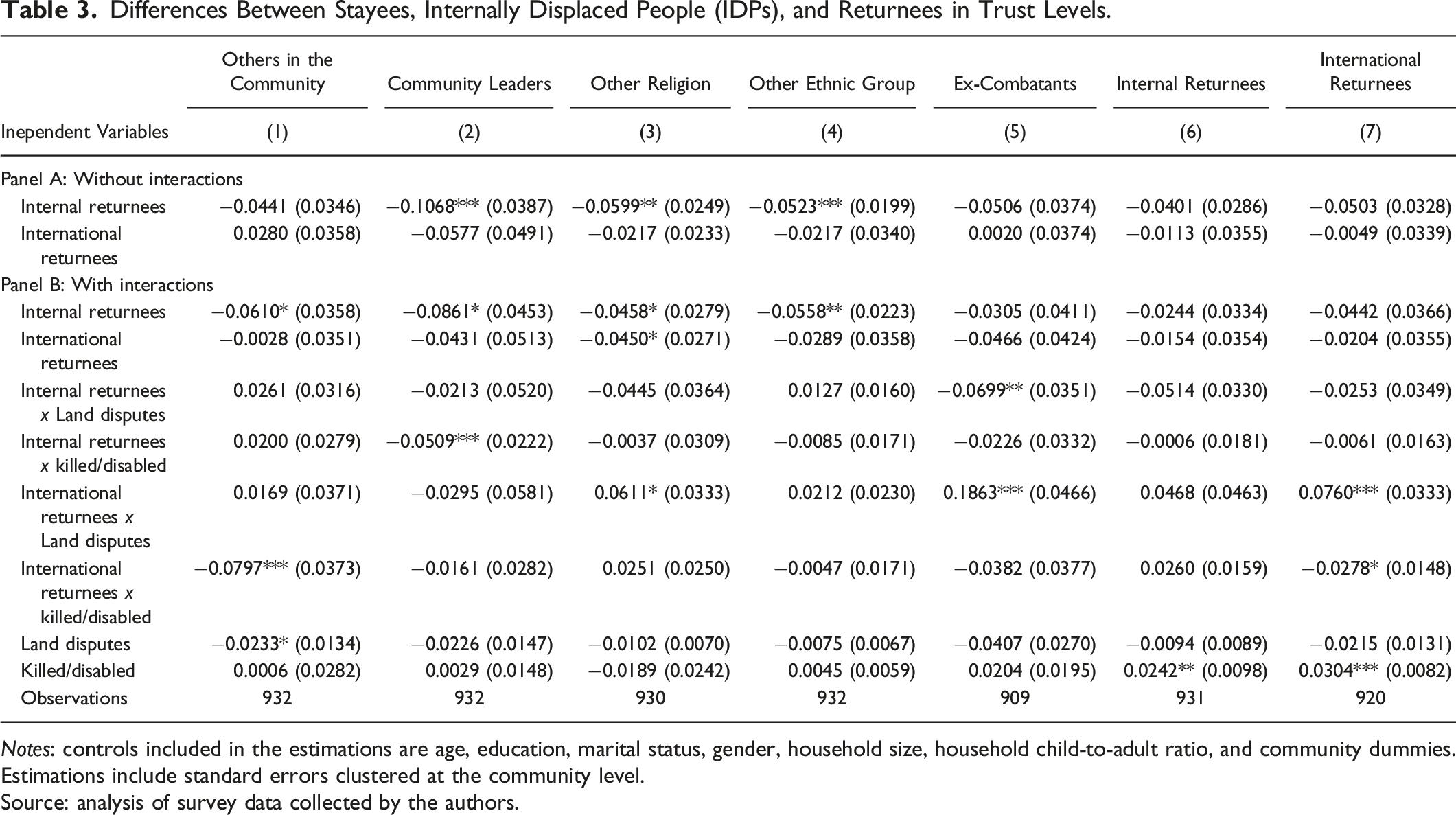
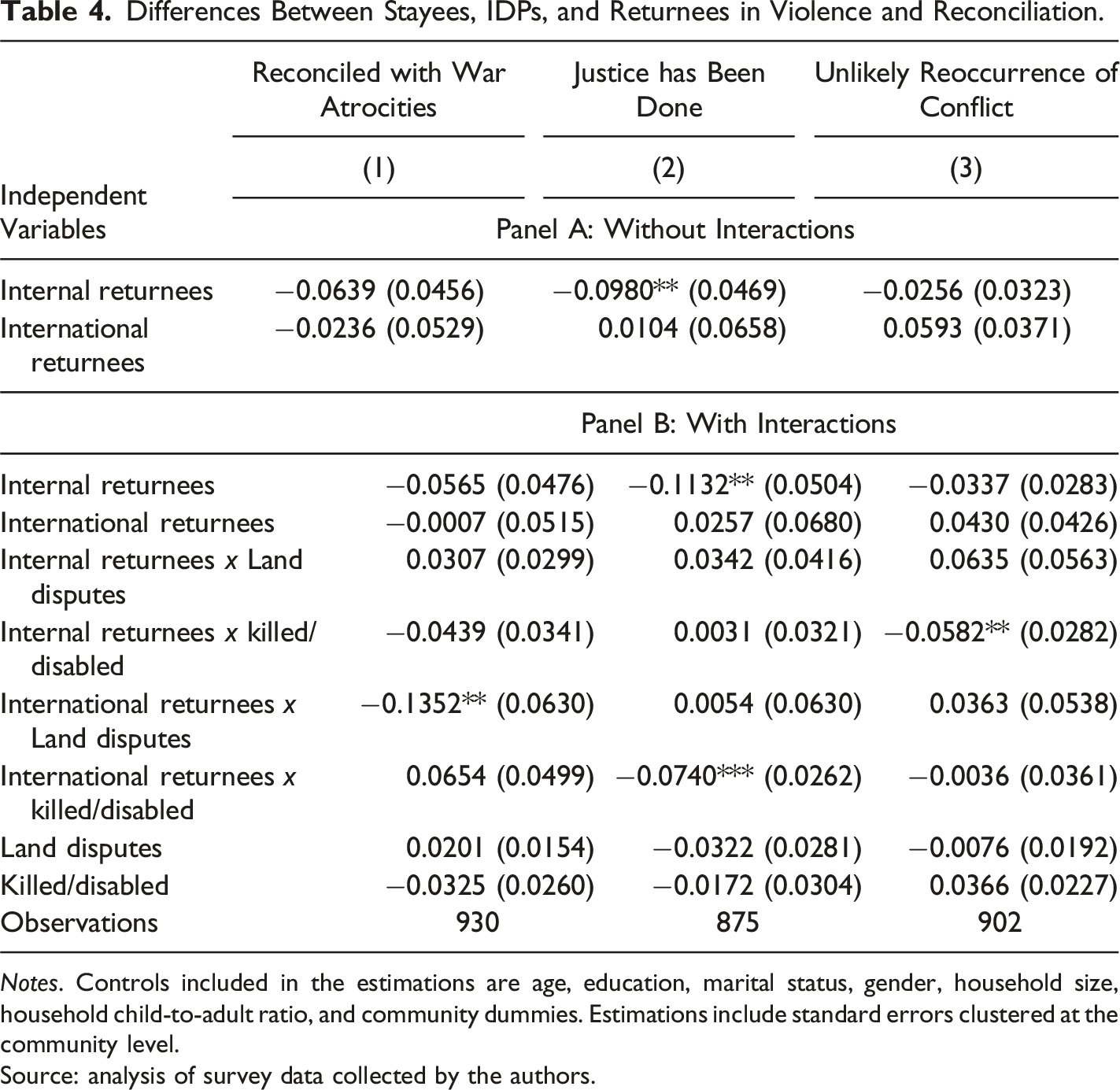
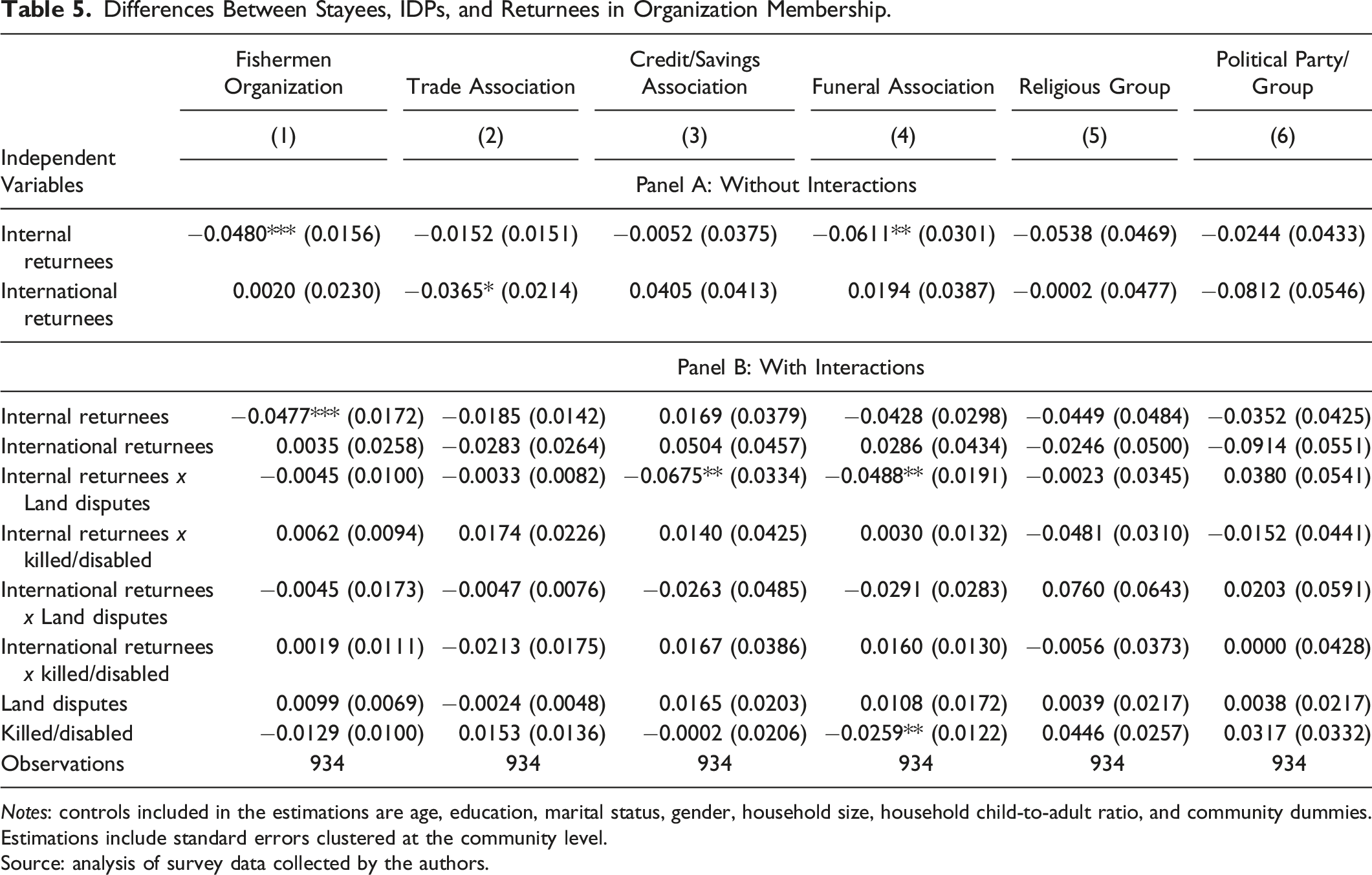
Our results suggest that returnees have significantly lower levels of trust, reconciliation, and community engagement than stayees. This corresponds well with our conceptual expectations. Those who stay behind have to protect limited community resources during the war and form stronger bonds with other community members. This is less likely for those on the move. However, our results suggest that contrary to our expectations, this dynamic is more marked for internal returnees. For instance, controlling for community effects and socio-demographic factors related to households and individuals, we find that internal returnees are 11 percentage points less likely to trust community leaders than stayees, 10 percentage points less likely to agree that justice has been done for those who committed crimes during the war, and 5 percentage points less likely to have a member who is part of a fishing association. Meanwhile, the differences between international returnees and stayees are mostly statistically insignificant.
We also explore the relative implications of violence exposure at the household level on returnees and stayees. We find that greater exposure to violence is associated to lower levels of reconciliation and community engagement for returnees compared to stayees. The results for trust are mixed and depend on the trust indicator that is being analysed. For example, international returnees who were exposed to more violence are more likely to trust ex-combatants, while internal returnees more exposed to violence are less likely to trust community leaders.
Our results point to important difference across groups that should be regarded as actual differences rather than the estimated causal effect of becoming displaced (internally or internationally). Indeed, our analysis does not include exogenous factors to separate across groups (the internally displaced, international displaced, and stayees). Such factors are difficult to identify in these contexts but the actual attitudinal differences across groups plays an important role in our understanding of the legacies of armed conflict. In the discussion below we provide insights regarding the possible consequences of self-selection into displacement and return in our reading of the results.
The Legacies of Conflict and Exposure to Violence Across Groups
We measure the legacies of conflict using indicators of trust, views on reconciliation and peace, and community engagement. The discussion below explores each of these literatures in turn and relates the findings to the displacement and return context.
Trust
There is a large literature exploring the determinants of trust. Studies suggests that personal experiences have a major impact on individuals' inclination to trust others (Schwerter and Zimmermann 2020). These experiences include living traumatic events, which is associated with lower levels of trust (Alesina and La Ferrara 2002). There is, however, less evidence on these dynamics in the forced migration context.
Views on Reconciliation and Peace
One aspect of the experiences of stayees and returnees that can be accounted for is direct exposure to violence, and there is a literature which explores how variation in experiences of violence affect support for peace and reconciliation (Bauer et al. 2016). One set of studies suggests that experiencing violence leads to calls for further violence. For example, Hayes and McAllister (2001) show that in Northern Ireland exposure to violence increased support for paramilitary groups and reduced support for the decommissioning of paramilitary weapons. This ‘violence begets violence’ idea is based on the notion that those more exposed to conflict have greater levels of distrust, security concerns, and resentment.
Another set of studies posits that greater exposure to violence leads to greater support for peace. The main idea is that those with greater experience of violence are more aware of its actual costs and more likely to favour options to avoid it. For instance, Hazlett (2020) shows that Darfurian refugees who experienced violence were more likely to agree that peace was possible and less likely to demand revenge over conflict events.
While there is little evidence on the consequences of differences in exposure to violence between returnees and stayees, there is a series of studies that have focused on differences among returnees. For instance, Lupu and Peisakhin (2017) explore the implications of variation in victimization among Crimean Tatar returnees who had been deported to Uzbekistan. They find that returnees with higher levels of victimization have stronger self-identification with their ethnic group, stronger self-perception of being a victim, and a heightened perception of threat. Importantly, they also show that these effects can trickle down all the way to the third generation. Therefore, the effects that we explore with the first generation in this paper can have long-term consequences for both the communities and the countries of origin.
Community Engagement
There is also debate on whether exposure to violence leads to better outcomes in terms of community engagement. The evidence from multiple countries suggests that exposure to violence often leads to more prosocial behaviour, including community engagement (Bauer et al. 2016). For example, Bellows and Miguel (2009) looking at Sierra Leone, found that greater exposure to violence was linked to a higher likelihood of joining local political and community groups.
Yet the increase in prosocial behaviour tends to be towards one’s own identity group. For example, Bauer et al. (2014) conducted several experiments to explore in-group and out-group cooperation, also looking at Sierra Leone. They found that those more exposed to violence behaved more altruistically towards in-group members compared to those who were less exposed. However, this effect was not present for out-group members.
Rohner, Thoenig, and Zilibotti (2013), looking at Uganda, suggests that there is a self-reinforcing process between conflicts and ethnic cleavages. They also go further and suggests that for a given level of violence, post-conflict economic recovery is slower in locations with greater ethnic fractionalisation.
Conceptual Background and Hypotheses
We develop testable hypotheses based on the previous discussion of the literature. Our starting point is that there are substantial differences in experiences between stayees, internal returnees, and international returnees, and that – following the evidence in the previous section – these differences will result in differences in trust, reconciliation, and community engagement. While the experiences of these groups differ across each specific context, it is possible to use dynamics that are often repeated across forced migration situations to make certain predictions.
Stayees often have to protect limited household and community resources from looting and destruction during the war (Ruiz and Vargas-Silva 2022). The efforts and coordination necessary to provide this protection can lead to the preservation, or even formation, of bonds between stayee community members. That is, adversity can lead stayees to adopt a communal coping process (Berg, Meegan, and Deviney 1998; Lyons et al. 1998). Returnees, on the other hand, have to escape conflict, adapt to life in another location, sometimes even growing up in that location, and return home, with many being forced to return (Black and Koser 1999). Being on the move for a long-time (departure and return), setting up in a new place with fewer networks and having fewer assets to protect, suggest that there is less scope for the formation of strong community bonds. Note that we are not entering the debate on whether overall social capital increases or decreases in conflict (e.g. Cilliers, Dube, and Siddiqi 2016), but just providing a basis to compare our groups of interest. This discussion leads to our first hypothesis:
Stayees will report higher indicators of trust, reconciliation and community engagement than returnees.
Note that in Hypothesis 1 we have not made a distinction between internal and international returnees as this should be the case for both groups. However, as explained above, there are likely to be important differences in experiences between those returnees who were displaced internationally and those displaced within their own countries. Those displaced internationally are often more isolated, particularly in the context of refugee camps, and have less interaction with residents of those areas (Fellesson 2004). As a result, there is less scope for the creation of strong community bonds. Research also shows that there is an association between lower engagement with the host community and low levels of interpersonal trust in the refugee context (Nickerson et al. 2019).
Those displaced internally can also be isolated in many ways but are more likely to interact with local residents given the higher likelihood of similarities in culture. Moreover, those displaced internally have less access to international assistance than international refugees (IDMC 2021b; Verwimp and Muñoz-Mora 2018), which could increase the need for community engagement. This leads to our second hypothesis:
The gap in indicators of trust, reconciliation and community engagement between stayees and internal returnees, will be smaller than the gap in these indicators between stayees and international returnees.
In the analysis below we also explore differences on the impact of violence on trust, reconciliation and community engagement between stayees, international returnees and internal returnees. We have decided not to develop hypotheses for this impact. There are different perspectives in the literature regarding the impact of violence on our indicators (e.g. ‘violence begets violence’ versus increase awareness of violence consequences) and it is difficult to predict a priori how those will interact with returnee status. However, we think that this is an important empirical question, with major policy implications and have included it in the analysis.
Conflict, Displacement, and Return in Burundi
The case of Burundi allows for an appropriate exploration of the conceptual ideas presented above, given three important characteristics of its history of conflict. First, this is a country that experienced internal as well as international displacement and return. This allows us to compare these two groups with stayees. Second, the volume of repatriation in Burundi was quite substantial relative to the size of the country’s population. This allows for the potential of these effects to be perceivable. Third, a large portion of those displaced within and outside Burundi spent a substantial amount of time away from their home communities. This history of protracted displacement could have led to potential developments of differences in trust, reconciliation and community engagement. Finally, Burundian refugees were mostly hosted in camps in rural areas, which has implications for contact with the host community and the (lack off) development of community bonds. While we explore a single case study in this paper, there are multiple countries which have these three characteristics (e.g. Afghanistan, Somalia, South Sudan) and for which the results are highly relevant.
Burundi is a landlocked country in the Great Lakes Region of Africa. The country has experienced several waves of conflict, with the longest conflict taking place during 1993–2005. Figure 1 presents data from the United Nations High Commissioner on Refugees (UNHCR) on the number of Burundian refugees in other countries since 1965. In this paper we are interested in the displacement and return that occurred between 1993 and 2014 (the two orange bars). As is clear from Figure 1, international displacement levels increased substantially as a result of the 1993 conflict and it took about 10 years for return to take place. We do not have similar official UNHCR annual estimates for internal displacement but our survey data suggests that it was higher than international displacement. Please note that our data was collected in early 2015, right before a new start of political tensions in the country, which means that it does not cover the latest displacement wave shown in the figure. However, in the last section before the conclusion, we relate our findings to more recent events in the country. Number of Burundians refugees worldwide.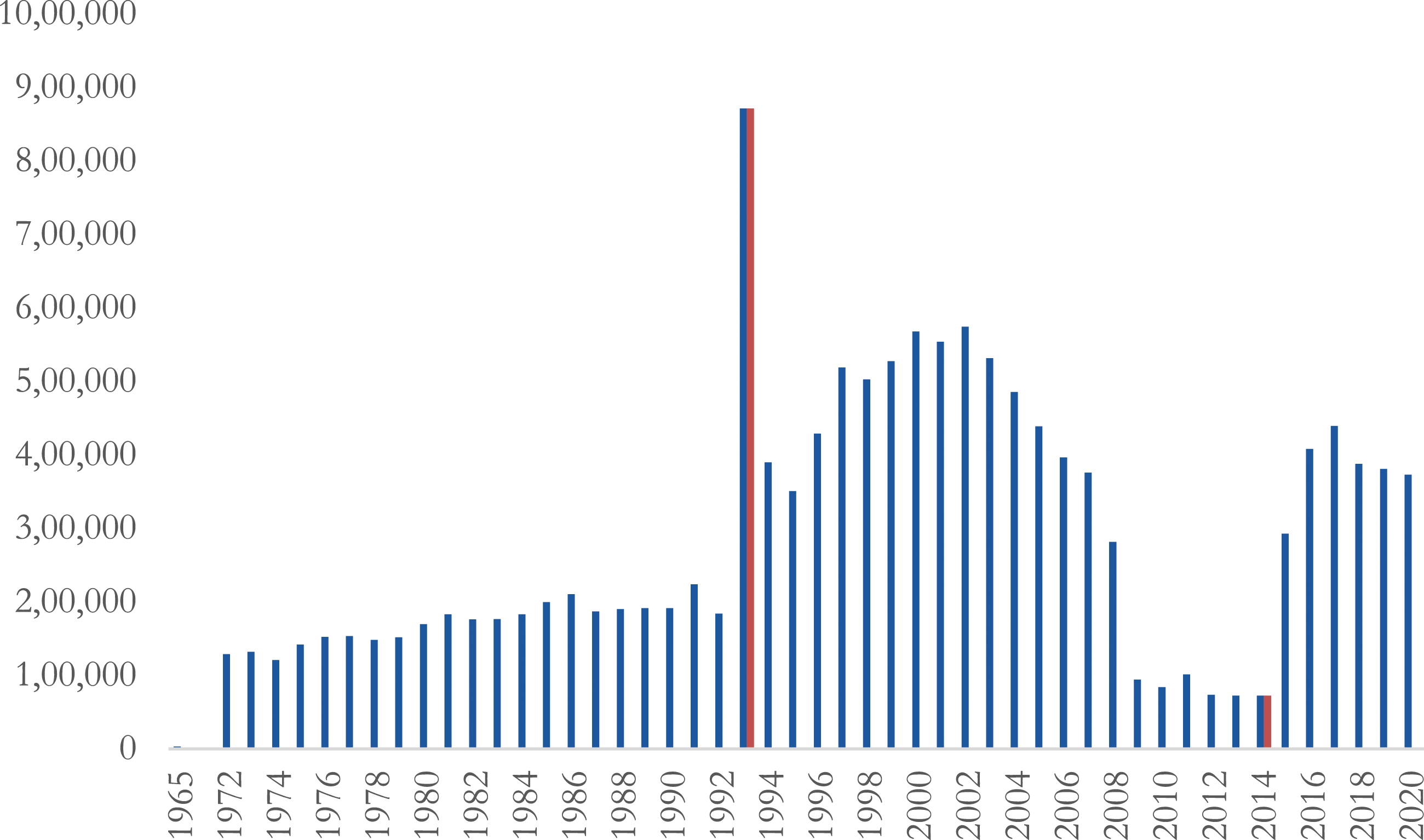
Refugees from the 1993–2005 conflict were mainly located in camps in neighbouring Tanzania, a country that was perceived as a regional safe haven for refugees (Ruiz and Vargas-Silva 2021). During the mid- to late-2000s, Tanzania became more restrictive, closed refugee camps, and repatriated Burundians home. By 2009 the large majority of Burundian refugees from the 1993–2005 conflict had been repatriated. In Burundi, returnees could claim agricultural land, a very scarce resource in the country, in their communities of origin, which was a strong incentive for them to return to these communities (van Leeuwen 2010).
Data and Methods
The Survey
We collected the data for this project during January to March 2015 as part of a nationwide survey. The survey was collected as part of The Labour Market Impacts of Forced Migration (LAMFOR), a large project which aimed to understand the economic and social consequences of forced migration in the Great Lakes Region of Africa. Burundi has 17 provinces, 2638 collines and 8103 sous-collines (i.e. communities). The survey was conducted in 100 communities spread across the country’s 17 provinces. In order to ensure representativeness, the number of communities selected in each province was based on probability proportional sampling (i.e. more communities from more populated provinces). We used total population information from the 2008 Census. The communities or sous-collines surveyed in each province were randomly selected. Figure 2 indicates the location of the communities surveyed. Location of communities surveyed.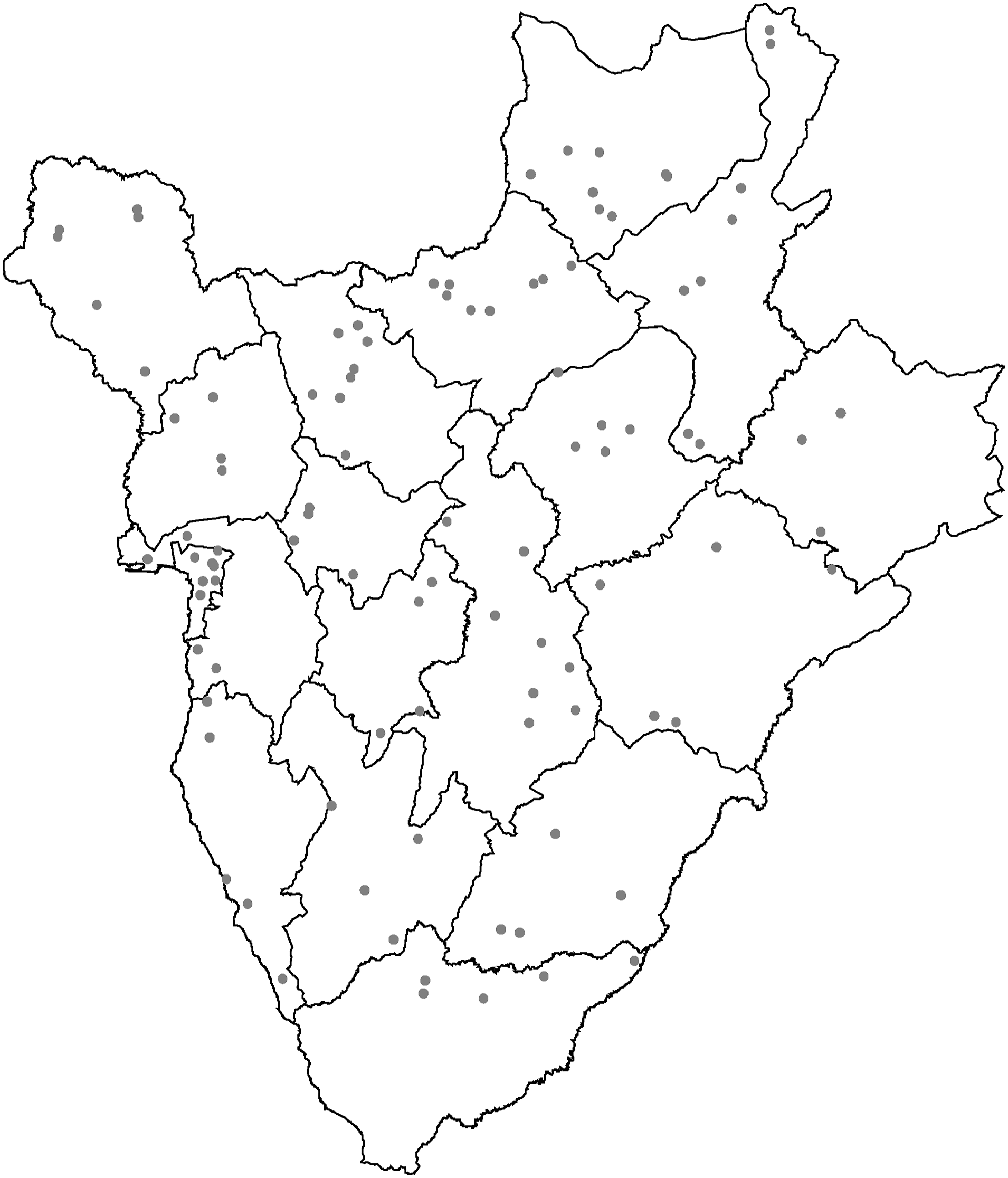
The survey had two components. The first was a household survey. In each of the 100 communities, 15 households were randomly selected for interview. While different members of the household took part of the survey, the person providing the information on trust, reconciliation, and community involvement was the head of the household in most cases. The second component was a community survey in which a local leader, most times the chefs de colline or elected hill chiefs, was interviewed in each community.
In the analysis, we focus on rural areas (the rural population as a percentage of the total population in Burundi was 88% in 2015, World Bank (2023)). We exclude Bujumbura, the largest city in the country and the centre of commercial activity, from the analysis. Until recently Bujumbura was also the political capital of the country. Excluding Bujumbura from the analysis is common in studies on Burundi given the different displacement and return dynamics in the city (Fransen, Ruiz, and Vargas-Silva 2017; Verwimp and Van Bavel 2014). Focusing on rural Burundi means that we are exploring differences in the legacy of conflict in a context of low population mobility, other than displaced individuals and households returning home.
The survey was a follow-up to a survey conducted with the same households in 2011. However, most of the variables relating to trust, reconciliation, and community involvement were only collected in 2015, hence the analysis in this paper focuses on that round.
Estimation
Our analysis intends to explore differences in the legacy of conflict between stayees, internal returnees, and international returnees and, as a second step, how conflict exposure affect such differences. Stayees are households without any members who were displaced from the community during the conflict. Returnees are households with members who were displaced for 3 months or longer, either internally or internationally. In total, 60% of the households in our sample are stayees, 26% are internal returnees, and 17% are international returnees. In addition, 17% of the international returnees are also internal returnees; that is, these households were displaced for 3 months or more within Burundi and also in another country.
The main analysis consists of a series of regressions along the following lines:



In the analysis we focus on discussing
In equation (2) we also discuss
The Self-Selection of Stayees, Internally Displaced and Internationally Displaced
It is important to note that individuals displaced, either within their own countries or abroad, are self-selected. While previous research has been able to identify exogenous factors that determine the likelihood of being displaced abroad (Fransen, Ruiz, and Vargas-Silva 2017; Ruiz and Vargas-Silva 2015, 2022), we do not have a variable that exogenously determines the difference between the three groups of interest (i.e. stayee, internal returnee, or international returnee). Therefore, we are not estimating the effect of displacement and return for a randomly selected person or household but the actual differences that we observe across these groups. We believe that documenting these differences is of utmost importance for peace-building, nation-building, and the prospect of economic growth in countries that experience large population movements during conflict/post-conflict periods. There is also a scarcity of datasets that can document these differences in those countries affected by recurrent conflict, such as Burundi.
While the refugee return process is complex and includes many factors (Arias, Ibáñez, and Querubin 2014; Camarena and Hägerdal 2020; Hoogeveen, Rossi, and Sansone 2019; Sliwa and Wiig 2016), the concerns regarding self-selection into return for refugees are small. Instinctively, better (worse) expected conditions back home will lead to higher (lower) return intentions (Vinck and Pham 2009). Yet, in our case staying in the host country was not a possibility for the majority of refugees. The Government of Tanzania closed refugee camps and there was a massive repatriation process for Burundians. UNHCR official statistics on returnees suggests that the large majority of Burundian refugees in Tanzania from the 1993 conflict returned home. There was also a strong incentive to return to their communities of origin, given the possibility of claiming land there. The main concern about selection bias comes from the initial self-selection into displacement.
Given the possible concerns regarding self-selection we conduct several additional analyses to understand the nature of the possible bias, including using alternative estimation methods and exploring the role of mortality during the conflict. We also present estimations in the Robustness Section that include pre-war controls based on information collected during the survey. While this information was collected retrospectively, and potentially subject to recall bias, showing that including these controls does not change the main results of the paper can go a long way to ameliorate concerns about self-selection issues. Also, please note that all estimations include community fixed effects which remove important omitted biases directed at the entire community and thus at issues related to community cohesion in general.
Descriptive Statistics
Means of Dependent Variables.
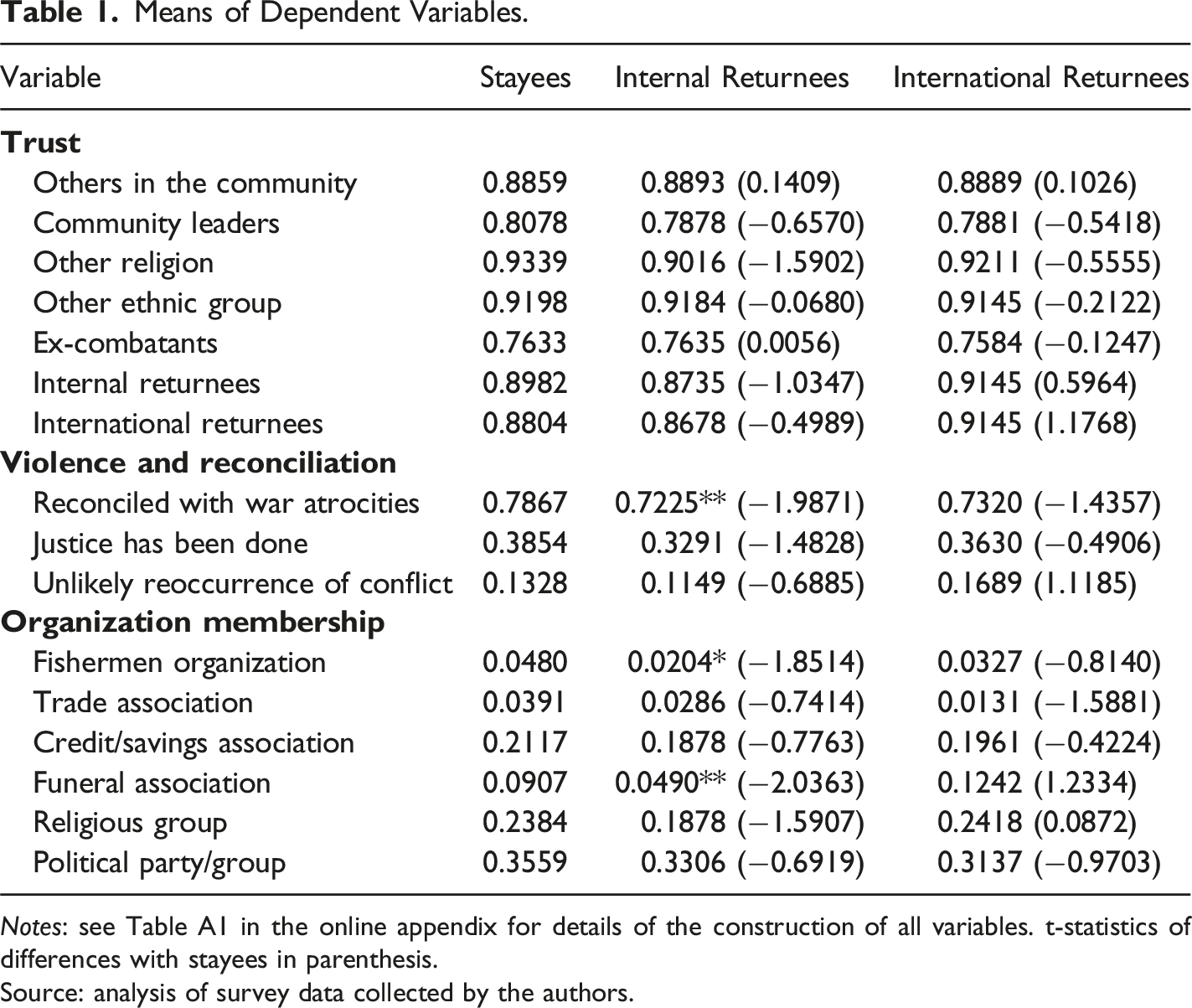
Notes: see Table A1 in the online appendix for details of the construction of all variables. t-statistics of differences with stayees in parenthesis.
Source: analysis of survey data collected by the authors.
The trust indicator is based on the following question: ‘please indicate the extent to which you trust the following people, groups, and institutions’. Trust levels tend to be high overall, but there are differences across the groups. For instance, 93% of stayees trust those of other religions, but only 76% of them trust ex-combatants.
The variables related to violence and reconciliation are based on agreeing/disagreeing with three statements: (i) ‘I feel reconciled with the atrocities that I experienced during the war in Burundi’; (ii) ‘I feel justice has been done to those who committed crimes during the war’; and (iii) ‘I feel the reoccurrence of conflict in Burundi is a real danger’. We re-arranged the order and created dummy variables in which values of one indicate higher levels of reconciliation across all of the variables. There are some differences in the means across these three variables. For instance, the shares of those who agreed that justice had been done to those who committed crimes during the war are 39% for stayees and 33% for internal returnees. Stayees are more likely to be reconciled with war atrocities than returnees.
Finally, we measure community engagement as a variable indicating that at least one household member is an active member of the group/organization. We define an active member as someone who attends meetings regularly and is aware of decisions made within the organization. There is a gap in community engagement across different groups. For instance, 36% of the stayee households have a member that is involved in a political group, while this share is 31% for internal returnees. Internal returnees are also less likely to be members of a fishermen organization and funeral associations.
Means of Control Variables, Pre-war Controls, and Combined Violence Measure.
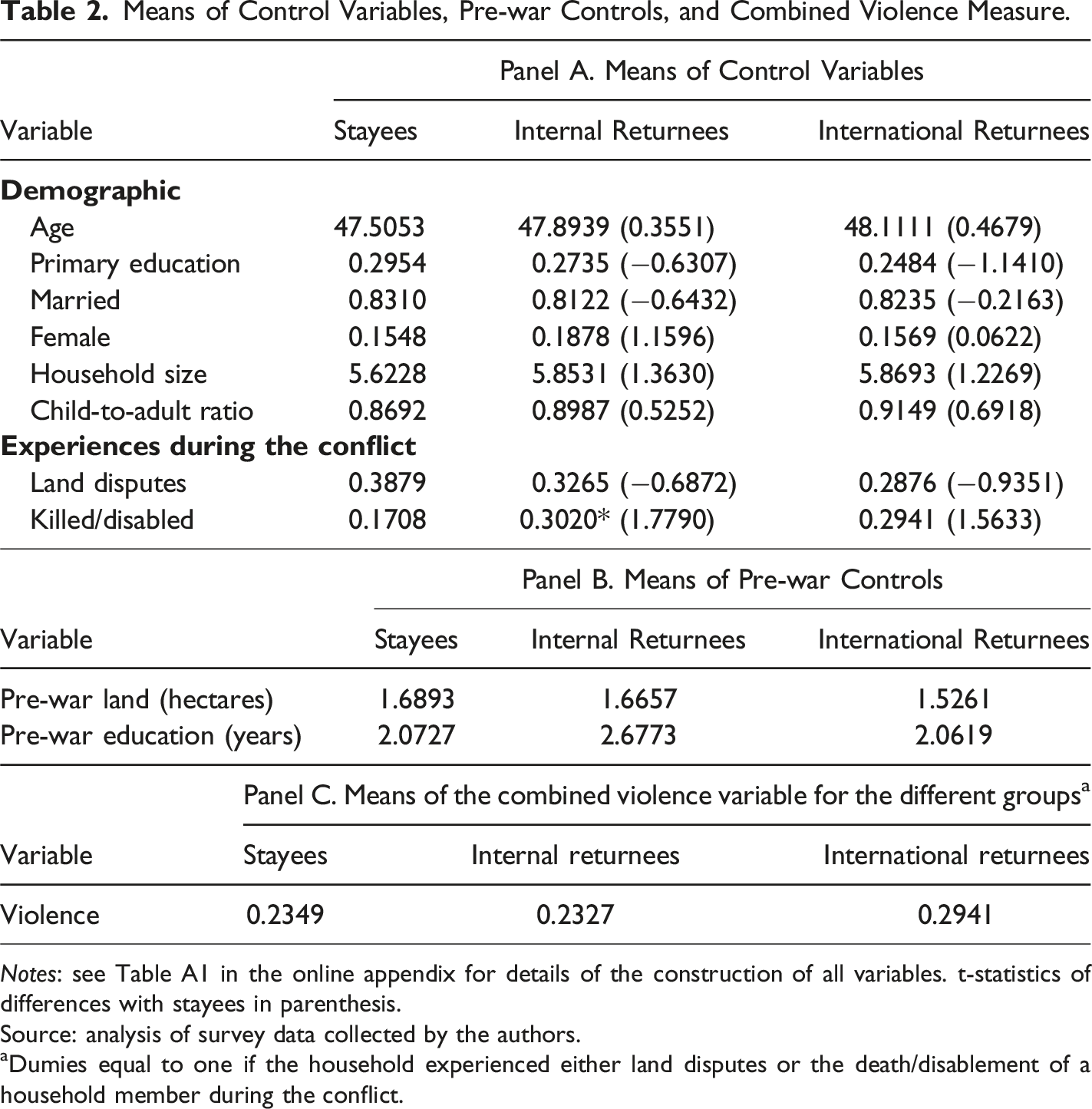
Notes: see Table A1 in the online appendix for details of the construction of all variables. t-statistics of differences with stayees in parenthesis.
Source: analysis of survey data collected by the authors.
aDumies equal to one if the household experienced either land disputes or the death/disablement of a household member during the conflict.
There are important differences in the experiences during the conflict. Stayees experienced more land disputes, which makes sense given that they spent longer in their communities of origin. Meanwhile, internal returnees experienced more deaths or disabling of households members during the conflict.
Results
Differences Between Stayees, Internally Displaced People (IDPs), and Returnees in Trust Levels.
Notes: controls included in the estimations are age, education, marital status, gender, household size, household child-to-adult ratio, and community dummies. Estimations include standard errors clustered at the community level.
Source: analysis of survey data collected by the authors.
In Panel B we present the regression coefficients when we include the interaction terms. Looking first at the coefficients for internal and international returnees, we see that the dynamics are similar to Panel A, with the exception of the coefficient on trusting others in the community, which now turns statistically significant. In this case, internal returnees are 6 percentage points less likely to trust others in the community.
Looking at the interaction coefficients we see that several of these coefficients are statistically significant. There is a mixed picture, with the sign of the coefficient varying depending on the trust indicator and the type of returnee. For instance, internal returnees with greater exposure to violence are less likely to trust community leaders, while the interaction coefficient is statistically insignificant for international returnees. On the other hand, international returnees with greater exposure to violence are more likely to trust ex-combatants, while the interaction coefficient is statistically insignificant for internal returnees.
Differences Between Stayees, IDPs, and Returnees in Violence and Reconciliation.
Notes. Controls included in the estimations are age, education, marital status, gender, household size, household child-to-adult ratio, and community dummies. Estimations include standard errors clustered at the community level.
Source: analysis of survey data collected by the authors.
The coefficient increases to 11 percentage points when we include the interactions with conflict exposure. However, the results for the interaction coefficients are different than for the trust indicators. In this case, those coefficients that are statistically significant are negative. For instance, for international returnees, experiencing land disputes during the war is associated with a lower likelihood of reporting that they are reconciled with war atrocities.
Differences Between Stayees, IDPs, and Returnees in Organization Membership.
Notes: controls included in the estimations are age, education, marital status, gender, household size, household child-to-adult ratio, and community dummies. Estimations include standard errors clustered at the community level.
Source: analysis of survey data collected by the authors.
Robustness
In this section, we conduct several exercises to show the overall robustness of the results. One concern with the estimations is that the results could reflect broader pre-war differences between stayees, internal returnees, and international returnees. As we mentioned above, we do not have a random assignment of individuals to the stayee and returnee categories.
One way of reducing these concerns is to control for pre-war conditions and check if the results are affected. We include two types of variables in this regard. First, for older households, i.e. those that were established before the onset of the conflict in 1993, we collected pre-conflict land ownership data. The pre-war size of land plots should provide a good idea of the household’s economic background (Bundervoet 2009).
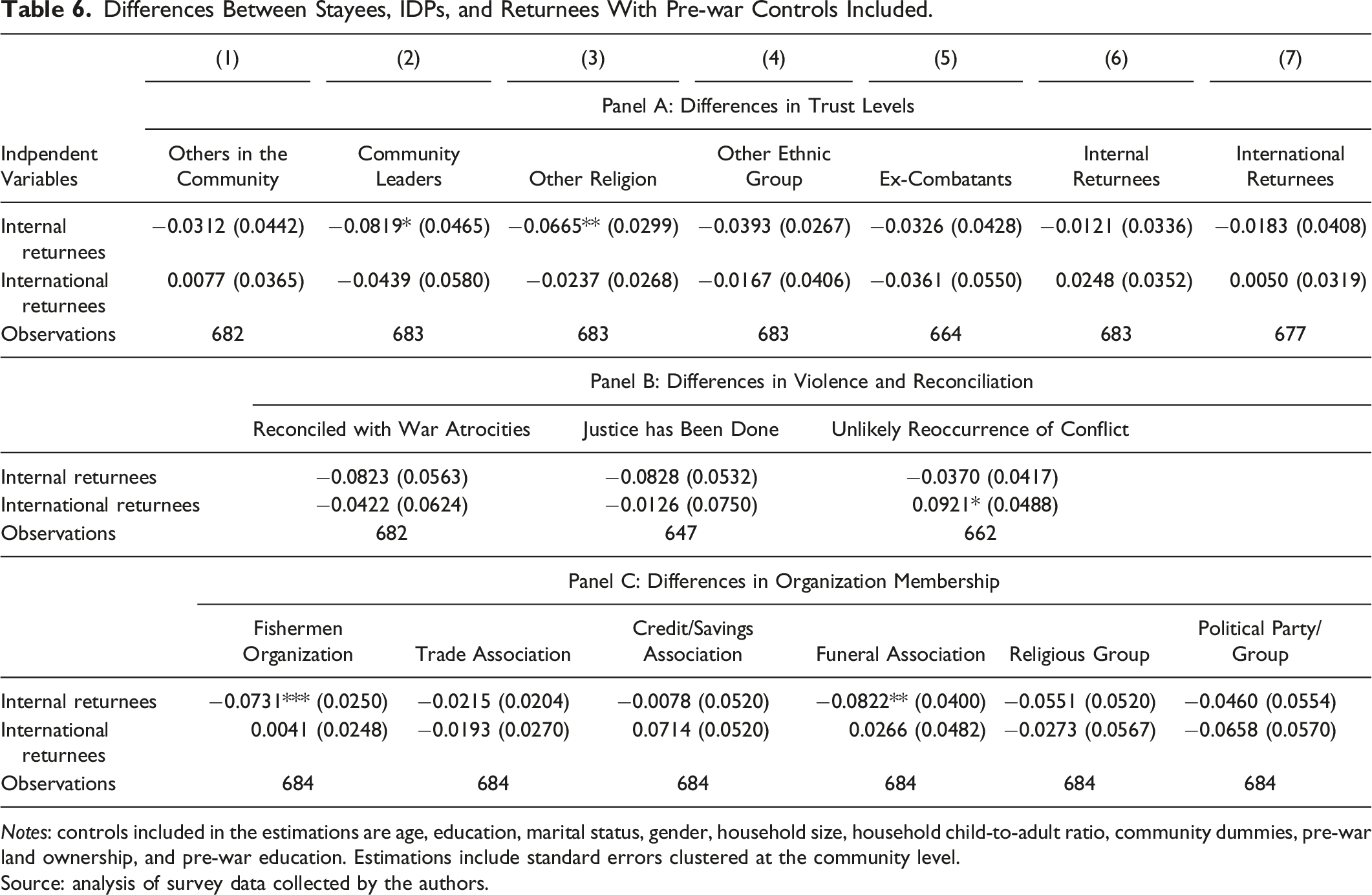
Second, we looked at education levels, which also provide information about wealth status. Primary education in Burundi is compulsory for children between the ages of 7 and 12 years. However, the war destroyed a substantial portion of the country’s schools, many of the teaching staff were killed, and recruitment of new teachers was interrupted during the conflict (Fransen, Vargas-Silva, and Siegel 2018). We focus on the years of education among those who were 14 years of age and older at the start of the conflict in 1993. The war should not have affected the educational outcomes (i.e. primary school education) of this group. Including these two variables in the estimation decreases the sample substantially. Therefore we focus on whether the coefficients and differences are comparable to those presented in Tables 3–5.
Panel B in Table 2 reports the means for these pre-war controls. As suggested by the table, international returnees are more likely to report both lower pre-war land and have fewer years of pre-war education.
Differences Between Stayees, IDPs, and Returnees With Pre-war Controls Included.
Notes: controls included in the estimations are age, education, marital status, gender, household size, household child-to-adult ratio, community dummies, pre-war land ownership, and pre-war education. Estimations include standard errors clustered at the community level.
Source: analysis of survey data collected by the authors.
In order to shed light on the effects of the reduction in sample size and the inclusion of the pre-war characteristics on the coefficients, in Table A2, in the online appendix we conduct the estimations using the same sample as in Table 6, but without including the pre-war characteristics. The estimations suggest that differences in the coefficients are largely the result of the difference in sample. In addition, there is a literature liking violence exposure to wealth levels (Blattman and Annan 2010; Bundervoet 2010; Verpoorten 2009). Therefore, in Tables A6 to A8 in the online appendix we repeat the estimations using the conflict interactions, but including pre-war controls. The results are overall similar. However, there are some differences. For instance, the interaction of internal returnees with the conflict variables becomes stronger for participation in credit/savings associations and religious groups (Table A8, negative in both cases).
It is also possible that mortality is selective and differs between stayees and returnees. In the estimation, we control for deaths among family members during the conflict. The variable that we used is ‘During the last period of conflict in Burundi (1993–2005), how many times did this household experience the following incidents?’ and one the options is death of household members. Interestingly, returnees (both internal and international) report a higher number of deaths of household members than stayees. In order to explore the role of this variable further, we conducted an estimation in which we drop from the sample all those households with members who die in the conflict and the main results remain the same (Table A5).
Another concern with the estimates is that we include the measures of violence exposure separately. Given that the two variables measure different aspects of exposure to violence, it is possible to argue that the variables should be combined into a single one. Figure 3 presents the distribution of the variables on the number of land disputes and the number of household members killed/disabled during the conflict, for those household reporting a positive value. Across the three groups most of those experiencing one of these events, only experience one or two of the events. Hence, a dummy variable indicating that the household experience the event is a good approximation to the actual data. In order to create a combined variable we create a dummy which indicates that the household experienced land disputes or the killing/incapacitation of a family member during the conflict. As shown in Panel C of Table 2, around 24 percent of the stayees and internal returnees experience either event, while the share is closer to 30 percent for international returnees. Distribution of the variables related to violence.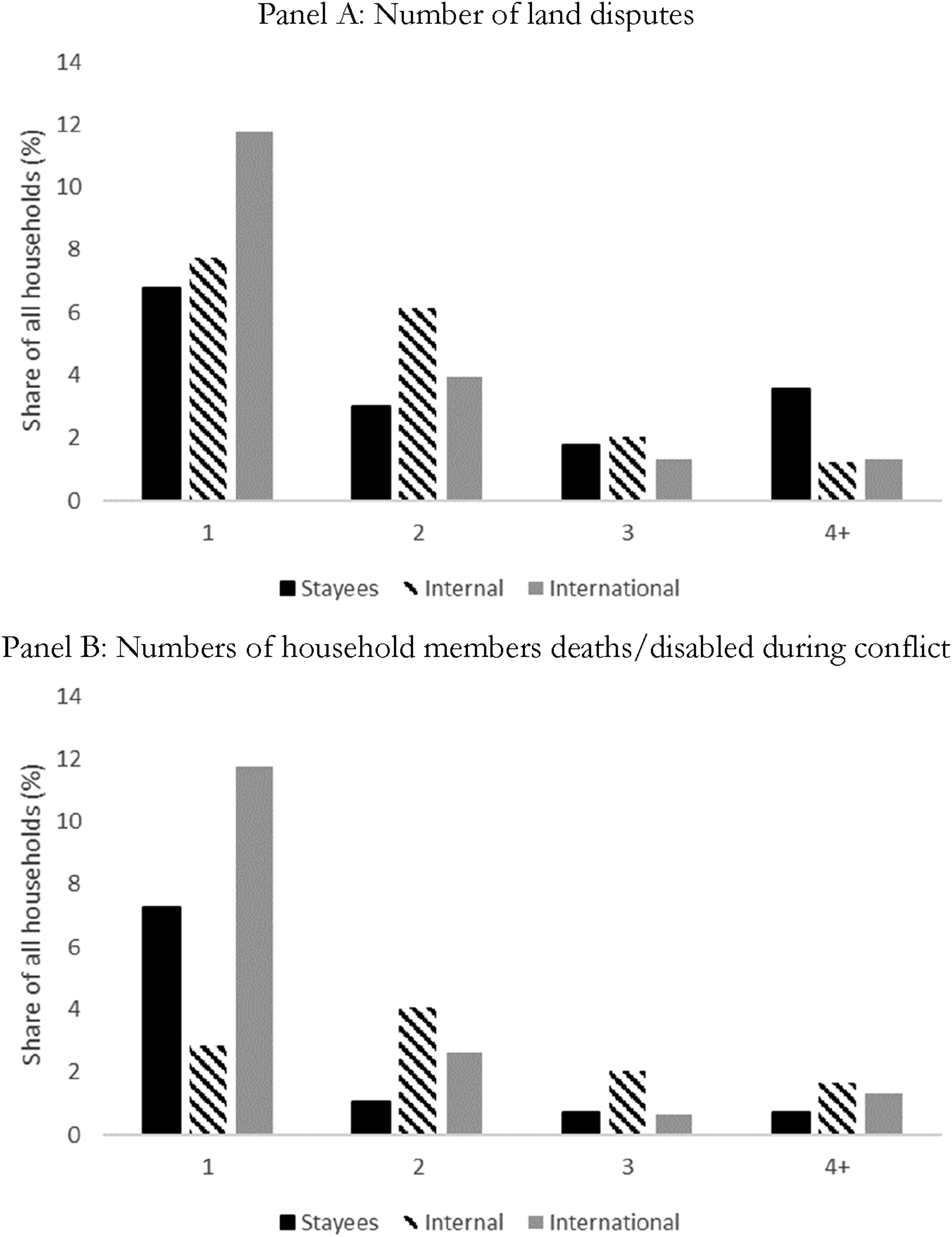
Differences Between Stayees, IDPs, and Returnees With Combined Violence Variable.
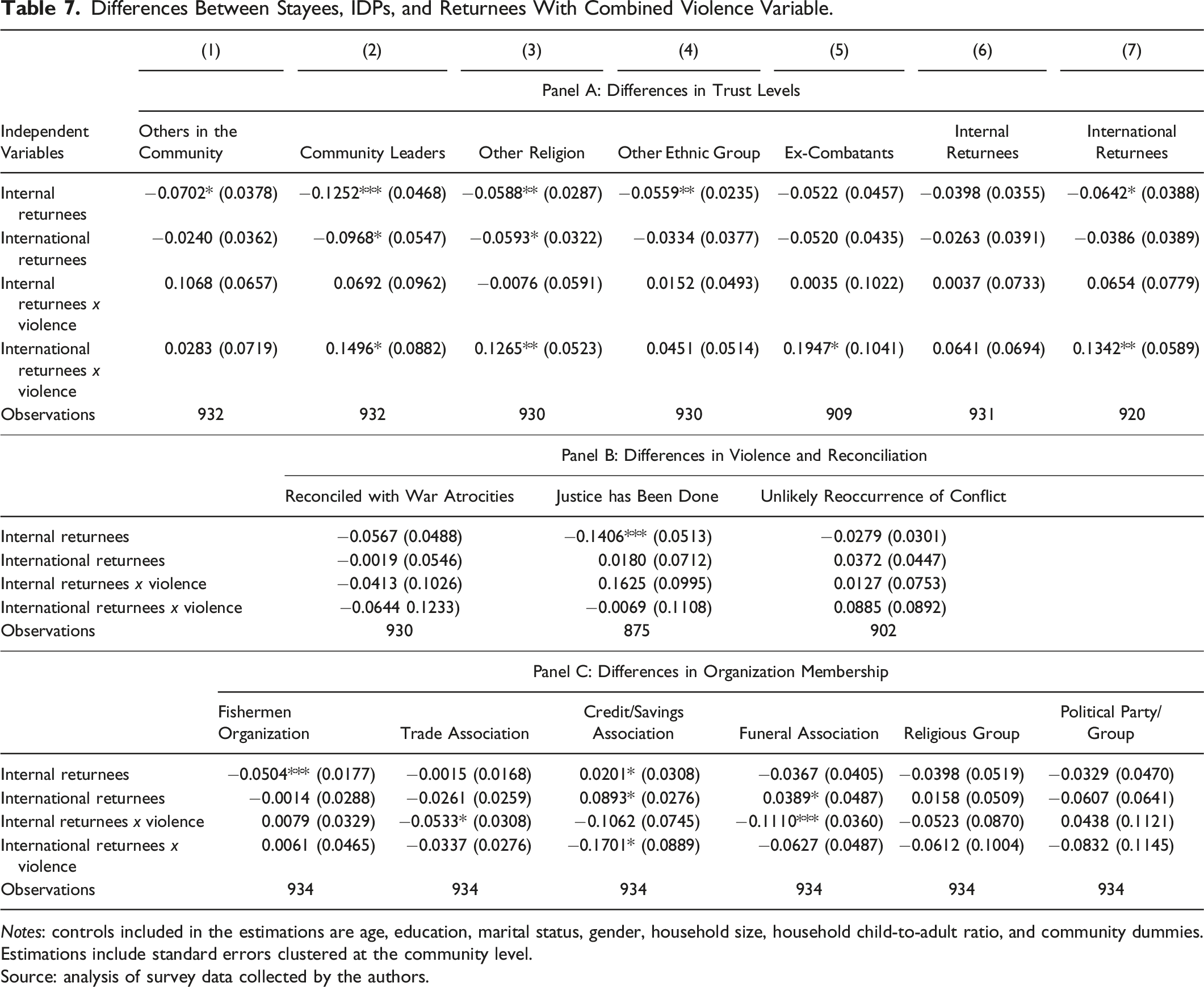
Notes: controls included in the estimations are age, education, marital status, gender, household size, household child-to-adult ratio, and community dummies. Estimations include standard errors clustered at the community level.
Source: analysis of survey data collected by the authors.
As a final robustness check in Table A4 in the online appendix we conduct an estimation using inverse probability weighting. This approach is a useful way of adjusting for confounding factors in observational studies, such as ours. The idea is to balance the treated and non-treated groups (i.e. returnees and stayees in our case) by weighting each individual by the inverse probability of receiving the treatment. Treated respondents with lower probability of treatment get larger weights, as do untreated respondents with a higher probability of treatment. The results are also consistent with those of the main estimation. For the most part the means of the difference between groups are only statistically significant for internal returnees and these tend to have lower levels of trust and community participation.
Relation with Burundi’s New Displacement Wave
As we explained above, there has been a new displacement wave from Burundi after the end of the data collection. This displacement wave is the result of political tensions following the 2015 election. Pierre Nkurunziza, then President of Burundi, ran for a third term of office and there was controversy over whether he was actually entitled to run again. It is estimated that over 250 000 Burundians have since fled to neighbouring countries (UNHCR 2021).
There are no datasets such as the one used in this study to explore the implications of this post-2015 return for trust, reconciliation, and community engagement, and it is not possible to determine the degree to which our findings are applicable to this new context. However, it is possible to point to some potential differences between current dynamics and the pre-2015 period that would make it interesting to revisit the case study.
UNHCR has been undertaking regular returnee protection monitoring since 2019. An estimated 9% of refugees returning to rural communities were not found at their respective return areas in 2019 and may have moved onward. This pattern is also similar to our dataset, in which onward movement is not very common. However, in 2020 there was a substantial increase in the percentage of returnees not found (33%). While the UNHCR data is based on reports from local monitors, and the potential implications of not finding a household need to be treated with caution in this regard, this evidence suggests that more recent returnees may be more mobile than the ones in our sample. This in turn can affect the variables of interest in our research, particularly the aspect of community engagement.
Another difference between the pre- and post-2015 refugee outflow is that, while Tanzania remains the main host of Burundian refugees (133 029 as of 30 June 2021), countries such as Rwanda (47 911), the DRC (43 158), and Uganda (51 066) are playing a greater role as host countries. This means that there is greater scope for a variety of ideas related to trust and community engagement to develop among Burundian refugees in different countries.
Finally, the current data suggests that internal displacement levels are at much lower levels than during the period we studied. For instance IDMC (2021a) data suggests that as of 31 December 2020, there were only 22 000 IDPs as a result of conflict and violence in Burundi. This is important as our results suggest that the main differences regarding trust, reconciliation, and community engagement were found for internal returnees.
Conclusion
The end of conflict often involves the return of large numbers of refugees and internally displaced persons to their communities of origin. The re-encounter of individuals that were separated for many years and often decades, could lead to the re-establishment of old societal divisions or to the creation of new ones. Different views and attitudes between these groups on trust, reconciliation and community engagement can have long-term implications for peace-keeping, nation-building, and economic development. We explored these differences in this paper using data we collected in Burundi, a country that experienced large levels of internal and international displacement, followed by return later on.
Our results suggest that, overall, returnees tend to have significantly lower levels of trust, reconciliation, and community engagement than stayees. This corresponds to our hypothesis that stayees keep their community bonds, or even create new ones, in the face of adversity, but that there is less scope for this in the case of returnees.
However, the results also suggest that these effects are driven by internal returnees, which contradicts our initial expectations. For instance, controlling for community effects and socio-demographic factors related to households and individuals, we found that internal returnees are 11 percentage points less likely to trust community leaders than stayees, 10 percentage points less likely to agree that justice has been done for those who committed crimes during the war, and 5 percentage points less likely to have a member who is part of a fishing association. The differences between international returnees and stayees are mostly statistically insignificant.
Our dataset does not allow for a full analysis of the reasons behind these differences for internal returnees. However, the literature does suggest that those displaced internally often have worse material conditions and access to international assistance than international refugees and stayees (IDMC 2021a 2021b; Verwimp and Muñoz-Mora 2018; Vinck and Pham 2009). It seems that this level adversity does not lead to the same preservation or formation of social capital for individuals who are located outside their communities as for those who remained back home. Moreover, it is possible that in cases such as Burundi, there is less interaction of the internally displaced with host communities.
We also explored differences across groups on the impact of violence on trust, reconciliation, and community engagement. We find that greater exposure to violence is associated to lower levels of reconciliation and community engagement for returnees compared to stayees. The results for trust are mixed and depend on the trust indicator that is being analysed. For example, international returnees who were exposed to more violence are more likely to trust ex-combatants, while internal returnees more exposed to violence are less likely to trust community leaders.
What does this mean for policy interventions in societies experiencing high levels of internal and international return? Trust, reconciliation, and community engagement are all multidimensional areas for which it is difficult to isolate single factors and shape policy around them. However, using the research presented in this paper, it is possible to understand the type of individuals who need particular attention at the policy design stage. One policy priority would be to tailor the initial support provided to returnees, and the communities they return to, based on their views on trust and reconciliation. The results also suggest that policy efforts will require exploration of the situation of internal returnees and why they report lower levels of trust than other groups. Internal returnees is a group that has been often neglected in humanitarian efforts related to return in the forced displacement context.
Supplemental Material
Supplemental Material - The Legacies of Armed Conflict: Insights From Stayees and Returning Forced Migrants
Supplemental Material for The Legacies of Armed Conflict: Insights From Stayees and Returning Forced Migrants by Isabel Ruiz and Carlos Vargas-Silva in Journal of Conflict Resolution
Supplemental Material
Supplemental Material - The Legacies of Armed Conflict: Insights From Stayees and Returning Forced Migrants
Supplemental Material for The Legacies of Armed Conflict: Insights From Stayees and Returning Forced Migrants by Isabel Ruiz and Carlos Vargas-Silva in Journal of Conflict Resolution
Footnotes
Declaration of Conflicting Interests
The author(s) declared no potential conflicts of interest with respect to the research, authorship, and/or publication of this article.
Funding
The author(s) disclosed receipt of the following financial support for the research, authorship, and/or publication of this article: This study was funded by the UNU-WIDER project Institutional Legacies of Violent Conflict. The views expressed in this paper are those of the authors, and do not necessarily reflect the views of the Institute or the United Nations University, nor the programme/project donors. Vargas-Silva also acknowledges funding from the Research Council of Norway via the TRUST project, grant no. 301065.

Data Availability Statement
References
Supplementary Material
Please find the following supplemental material available below.
For Open Access articles published under a Creative Commons License, all supplemental material carries the same license as the article it is associated with.
For non-Open Access articles published, all supplemental material carries a non-exclusive license, and permission requests for re-use of supplemental material or any part of supplemental material shall be sent directly to the copyright owner as specified in the copyright notice associated with the article.
