




Abstract

The Peace Council of Ghana ranks farmer–herder conflicts among the country's three most significant threats to peace (Parker-Wilson, 2021). In Ghana, herders are widely referred to as “Fulani,” making the term synonymous with cattle rearing. Initially, the term referred to a predominantly nomad group called the Peul or the Fulbe. These nomads were typically based in pockets of settlements from Lake Chad to the east of the Atlantic Coast. In the early 20th century, British colonialists sought to establish a vibrant cattle industry in Ghana to counter the French monopoly over meat exports to Europe. Since most Ghanaians at the time were engaged in farming or mining, the British outsourced the establishment of the large-scale cattle business to foreigners known as the Fulani. Tonah (2006) suggested that this thriving cattle business attracted other Fulanis to Ghana in the early 20th century.
The literature emphasizes natural factors contributing to farmer–herder conflicts, namely, climate change which results in environmental degradation and consequently leads to droughts, and food insecurity (Dosu, 2011; Opoku, 2014). The severity of environmental degradation in the late 20th century has required the relocation of affected populations, either internally or to another country, as the only logical means of survival. Therefore, the conflict between farmers and herders is envisaged as a product of competition between indigenous populations and settlers for limited land resources.
However, our briefing introduces another perspective of this conflict, namely the role of political and traditional actors through the conceptual underpinnings of “Big Men–Small Boys.” Understanding this perspective is indispensable to resolving the conflict because of the increasing involvement of the Ghanaian state in the livelihoods of rural populations in efforts to transform their economies through agro-led industrialization (Ansah, et al., 2020).
Media coverage of violent clashes between herders and farmers and successive intervention policies has failed to curb the menace in Ghana (Issifu, et al., 2022; Yembilah and Grant, 2014). From 2009 to 2018, farmer–herder conflicts intensified in several areas in Ghana, such as Gushiegu, in 2011, where 14 herders were killed by local farmers. In Berekum and surrounding areas in 2017, residents took matters into their own hands to forcefully evict the herders from their lands. This resulted in the death of 13 herders and four locals. In the Konkomba areas, in 2017, police records show that reprisal attacks between farmers and herders left 562 families homeless. In 2010, the state set up a joint military and police operation, known as “Operation Cow Leg,” to curb the violence. Further, in 2012, in the Asante-Akim North area, a High Court ordered the immediate eviction of all herdsmen (REGSEC, 2012). Despite these interventions, the conflict persists, as herders have attacked security personnel in 2018 and civilians in 2021. Other state bodies such as the Ghana National Peace Council have been unsuccessful in their attempts to mediate the conflict between the two parties.
Data for our brief was gathered through interviews with stakeholders in the Asante-Akim North District (AAND). The AAND is located in the Ashanti Region and within the Afram Plains of Ghana, an area noted for fertile lands for agriculture. Between 2009 and 2013, Bukari (2022) observed that AAND experienced about 12 deaths, 16 gun-related injuries, and a more extensive scale of destruction of crops due to farmer–herder conflicts. AAND area continues to record horrific incidents of farmer herder conflicts (Figure 1). For instance, in January 2022, a Divisional Police Commander, Shaibu Osei, reported on a casualty; he observed that a “15-year-old boy has been butchered, and one of his hands had been chopped off” (Adogla-Bessa, 2022).
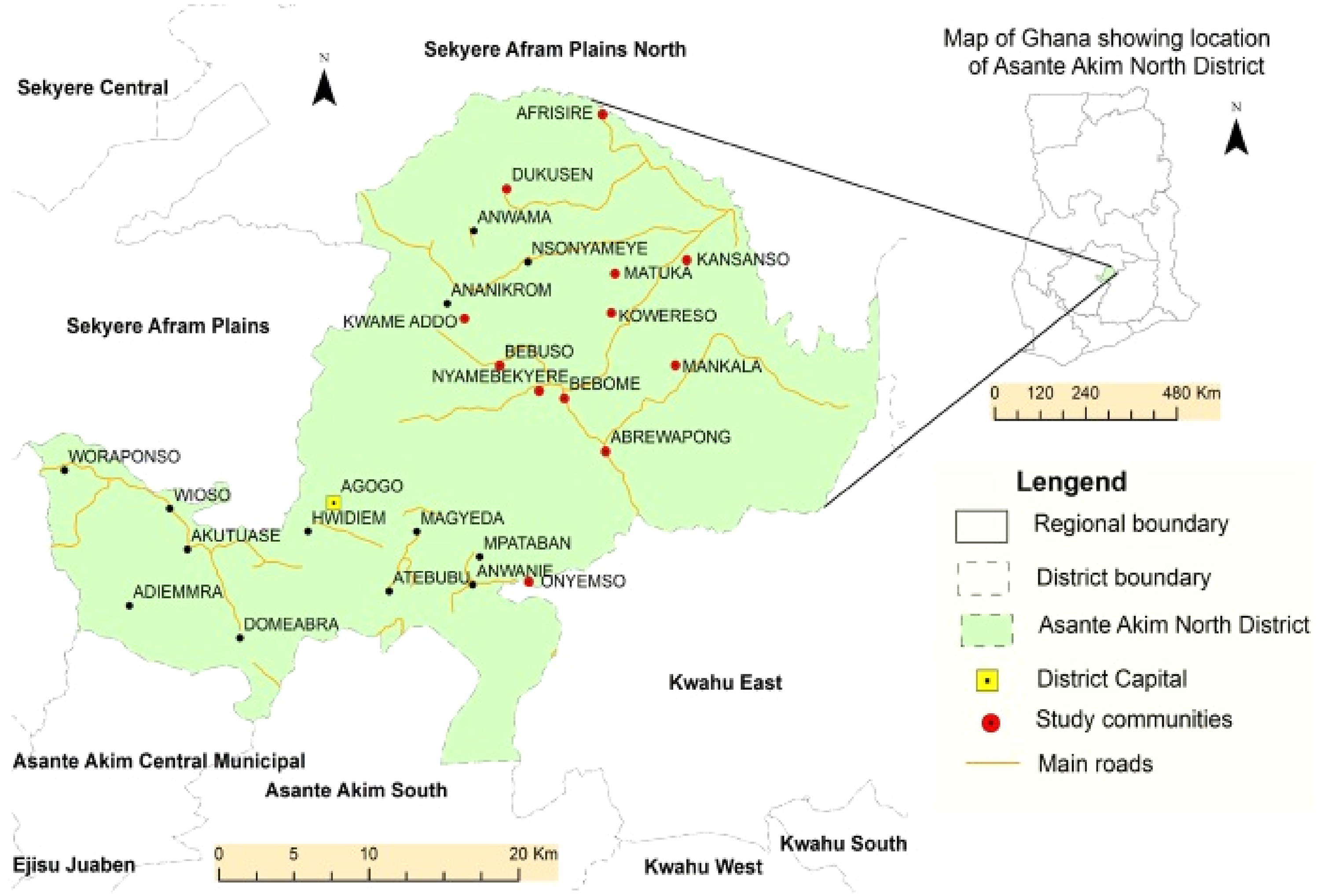
Map of Asante-Akim North District. Source: Bukari & Kuusaana (2018).
The AAND is selected for this study because of the frequency and wide publicity of farmer–herder conflicts in that area. Also, according to the Regional Security report in 2012, AAND recorded the highest number of conflict cases from 2000 to 2012. A mixture of purposive and snowballing was employed to select interviewees who are significant stakeholders in the conflict. These interviews were held throughout February 2018. We engaged 38 informants, including 12 crop farmers, 12 herders, 5 security personnel (military and police), and 9 community leaders (pastors, Imams, political party executives, and traditional leaders). Interviews started with the traditional leaders, and these leaders referred us to other individuals they advised had requisite knowledge on the topic. The interviews were semi-structured and lasted about 30 minutes each. Respondents were briefed on the purpose of the interview and their rights concerning their participation in the study. They also explicitly expressed consent to partake in the study. Respondents were recorded in person at villages called, Ananekrom, Bebome, and Munkalia. Throughout the interviews, we reiterated the usefulness of “Big Men–Small Boys” as a powerful concept to explain the protracted nature of farmers–herders conflicts in Ghana.
During the fieldwork, farmers repeatedly complained that it is the “Big Men” who, in the interest of their selfish financial agenda, use their wealth and political connections to sabotage the efforts of the state to expel the herders. One farmer stated, “if the ‘Big Men’ are not behind the herdsmen, then why are the herdsmen still around after the court ordered them to leave” (Kyei-Poakwah, 2018).
Why a New Perspective?
The study draws linkages between the “Big Man–Small Boys” syndrome and the persistence of farmer–herder conflicts in Ghana. In the literature, attempts have been made to account for the failure of policies implemented to deal with conflicts. In a detailed political account of the failure to build peace, Paalo (2020) found that Ghana's two main political parties support either side of the conflicting parties for electoral gains. The New Patriotic Party (NPP) supports the farmers, and National Democratic Congress (NDC) is perceived to favour the herders. During NPP regimes, there are operations by security agencies to expel the herders. For instance, in 2018, the NPP government relaunched “Operation Cow Leg”, which comprised police and military personnel tasked to flush out herders from those areas.
Nonetheless, during NDC regimes, there is a lack of commitment to execute such operations. The failure of policy measures of herder expulsion and mediation in conflict management and resolution processes is credited to a complex web of factors, including politics of identity, partisanship, and a lack of genuine political commitment. Despite the significant scholarly contributions to farmer–herder conflicts in Ghana, we argue for the need for an alternative viewpoint in appraising and addressing these conflicts, which seem to have transcended time and political regimes.
“Big Men–Small Boys” and Ghana's Protracted Farmer–Herder Conflicts
The term “Big Men” is the epitome of success in Ghanaian society. They possess economic wealth or political power, or as Nugent (1995) observed, both most often. “Small Boys” on the other hand, describes people with low economic status and influence. They are powerless, vulnerable, ignorant, low, and marginalized. Nugent (1995) successfully used this concept to chronicle the evolution of the ideals of the Provisional National Defence Council (PNDC) regime and its leaders from “small boys” or “pro-small boys” to “wealthy and influential men” during the most extended political regime in Ghanaian history since independence. We argue that a successful attempt to demystify and resolve the protracted farmer–herder conflicts in Ghana would be deficient without considering this power relations perspective.
The “Big Men”
In the case of the protracted farmer–herder conflicts in AAND, the “Big Men” represent the political leaders, chiefs, and wealthy cattle owners. The “Big Men” only have an economic and political interest in the community. Our interviews revealed that some “Big Men” such as the chiefs have an economic interest as landlords for the cattle owners. In Ghana, chiefs are viewed as custodians of the land and are responsible for leasing it. During our interviews, the herders vehemently claimed to have legally leased the lands from the chiefs. Also, chiefs are respected as the first arbitration point in rural communities. The chiefs being in an economic contract with the herders and the first arbiter in the farmers–herders conflict creates a case for conflict of interest. This situation has bred mistrust between the conflicting parties and chiefs. As a result, traditional rulers have failed to mediate the resolution of these conflicts. A study by Acheampong (2017) provided evidence of lands being leased to cattle owners by the traditional chiefs in AAND. During our interviews, herders alleged that, in some cases, cattle were used as the means of payment in the land leasing agreements. An interviewee who is a farmer opined, “Some chiefs take cattle as payment for the land we use, but they do not tell their followers. We do not trust them to solve the problem; they are part of the problem” (Kyei-Poakwah, 2018). Nonetheless, traditional rulers interviewed refuted these claims.
As observed through responses solicited from all 12 cattle farmers and 12 herders, the other set of “Big Men” are political leaders who benefit from the community's stratification based on identities. Political leaders pitch camps between the conflicting factions to gain solidarity, intending to canvass votes and political support during elections. Moreover, the centralization and control of Ghana's security forces solely through the executive arm of the Government ensure that the security agencies are utilized by the incumbent political party to pursue their interest in support of those it considers its support base. In 2018, when the Government ordered a surge in military and police operations against the herders, during the interviews, cattle owners and herders argued that it was because the NPP was in power and the NPP supported farmers for their votes at the expense of the herders.
The “Small Boys”
The term “Small Boys” is synonymous with persons with insignificant financial or social influence. Nevertheless, in the general sense of the term, it refers to the proletariat directly affected by the conflict in the vicinity. This class includes sedentary farmers and the herders who are caretakers of the cattle for their “Big Men.” These “Small Boys” look to the “Big Men” for support in their quest to secure a sustainable livelihood.
“Small Boys” contribute directly to the conflict by being the tools of violence and unrest in the communities. The violent clashes in the communities are carried out solely by these “small boys”; farmers resort to violence to ward off herders, and the herders reciprocate to keep their cattle, which the “Big Men” own. The most recent incident reported in the media involved the murder of a 15-year-old farmer who was allegedly butchered and killed by three herdsmen (Adogla-Bessa, 2022).
The farmers seek the emotional and political support of their “Big Men,” including the chiefs and the politicians, especially of the NPP. Farmers seemed brainwashed by their political leaders to believe that herders are foreigners who do not have the right to compete with them over their homelands. As noted from the interviews in AAND, the class of “small boys” interviewed reiterated that “The ‘foreigners’ (herders) have no place in their communities” (Kyei-Poakwah, 2018). They argue that the herders are encroachers on lands that belong to them and their ancestors. To make matters worse, the two main political parties have banked on Ghana's highly partisan and antagonistic political nature in the Fourth Republic to deepen the division between farmers and herders as a strategy to canvass votes. To illustrate, the NPP, which supports the farmers, has employed this scheme to gather support from the farmers by claiming that Fulani herders are foreigners because they trace their ancestral roots to ethnic groups outside of Ghana. This perspective is used to back their strategy of expulsion. On the other hand, the NDC promotes the narrative that the herders are citizens of Ghana and must be accorded the same recognition as the farmers. The presidential candidate of the NDC, former President John Dramani Mahama, has promised to address the recurring conflicts between farmers and herders at Agogo by constructing a permanent ranch in the community to house the cattle of the herders, who are mostly Fulanis (Korankye, 2020).
Clashes of “Small Boys,” Benefits of “Big Men”
After establishing the factors and conditions responsible for starting the conflict, it is also prudent to understand the protraction of the conflict. Ghana has fragile state institutions (Godefroidt et al., 2017). Political leaders have controlled security agencies since the president appointed the Inspector General of Police (IGP). Hence, economic status, wealth, or “connections” gives “Big Men” some power to influence state agencies through political parties to protect their interest. Flowing from this, “Big Men” inhibit state agencies from fulfilling their mandates towards citizens. The same situation applies to farmers’ and herder's conflicts. During the interviews, an army officer at the district noted that “the influence of the so-called ‘Big Men’ complicate the efforts of a state institution to finally resolve this conflict” (Kyei-Poakwah, 2018).
Further, a police officer at the district stressed that, There are instances where orders came from higher up to release perpetrators of violence in this conflict whiles politicians publicly campaign on a crackdown of violence in farmers–herders conflict. (Kyei-Poakwah, 2018)
Herders provide some economic and political benefits mainly accessible to the “Big Men.” They exploit their position and wealth to influence state institutions to protect their interest, contrary to the country's greater good. For instance, while a court ruling ordered the eviction of herders from AAND in 2012, successive governments have failed to carry this through (Paalo, 2020). Alternatively, the NPP and NDC have consulted with the herders to create ranches to accommodate them.
Conclusion and Recommendation
From the perspective of the Big Men Small Boys, we argue that conflicts between the farmers–herders are protracted due to a complex web of political and economic gains. Politicizing the conflict adds another layer of interest and identification to conflicting parties. In this regard, the resolution of the conflict depends on Ghana's depoliticization of national security. Depoliticization of national security is required to build the trust of community members in these security agencies. It also reduces the powers of partisan leaders to manipulate conflict situations for electoral gains. The amendment of the president's power to appoint leaders of critical offices like that of the IGP is essential in dealing with the politicization of vital essential services like security. Currently, the IGP is accountable to the president, his appointing body, and the factions the president supports. This creates mistrust amongst conflicting parties; herders feel threatened when the NPP is in power. Likewise, the same can be said when the NDC captures political power.
Constructing permanent ranches in the communities to house the herders’ cattle may be plausible. Nonetheless, the current narrative held by farmers that herders are “foreigners” must be dispelled to ensure peaceful coexistence. Following this, we recommend that civil society groups and National Commission for Civic Education invest in projects that educate conflicting parties on their relevance to Ghanaian society. This education would increase the awareness of the conflicting parties to coexist peacefully.
Footnotes
Declaration of Conflicting Interests
The author(s) declared no potential conflicts of interest with respect to the research, authorship, and/or publication of this article.
Funding
The author(s) received no financial support for the research, authorship, and/or publication of this article.