




Abstract
The purpose of this article is to offer scholars and practitioners a more coherent and holistic starting point for asking questions about information and communication technologies for peacebuilding than has been available so far. A transdisciplinary proposal is made that applies critical pedagogy of peace education to the way that digital media can be used to build peace in communities and societies. This argument is further underpinned by insights from cognitive science and social psychology. The concept of sociotechnical consciousness is developed, which describes what it is like to be experiencing a sociotechnical system. We conclude that, to deploy digital media as part of peacebuilding initiatives, the media’s impact on individuals and groups deserve as much consideration as the content that is delivered via these media. This has important implications for how to design and use media in peacebuilding contexts.
Keywords
In 2016, the EU-funded “Whole of Society Conflict Prevention and Peacebuilding” (WOSCAP) project carried out a scoping study looking into the “uses of information and communication technologies (ICTs) for EU Conflict Prevention and Peacebuilding.” Part of that review involved looking at ICTs that are being used in this context, making sense of what exists, and exploring some theoretical foundations for this work. What the authors found was a general deficiency in conceptualisation and research in the domain; they point out a critical lack of empirical evidence, a prevalence of positive bias towards the potential that ICTs embody in this domain, and a range of unaddressed ethical challenges (Gaskell et al., 2016).
They make a critical contribution to the domain by identifying how people are using ICTs in practice; the main purposes of ICTs in this line of work, according to their “socio-technical conceptual framework of leveraged ‘affordances’—or functions” (2016, p. 2), are data, networking, communication, and mobilisation. They also raise a range of research questions that they consider critical at this point in the development of the field. These are, mostly, concerned with the role of the EU and the impact of the employed technologies; more specifically, the authors are interested in the role technologies play with regards to empowerment, democratisation, and inclusivity. This focus is partially due to their concern with diplomacy and the intention to provide recommendations to the European Union (Gaskell et al., 2016).
The research documented in the current paper follows on from this work but has a somewhat different focus. The Isôoko project (a Horizon 2020 project funded by the European Union) focuses on ICTs (in particular, digital platforms) for peacebuilding (in particular, peace education) in East Africa (https://isooko.eu). The situation described above, with regards to empirical evidence, positive bias, and ethical challenges, applies to this domain as much as to any other within the broader field.
The purpose of this article is to offer scholars and practitioners a more coherent and holistic starting point for asking questions about ICTs for peacebuilding (ICT4Peace; Gaskell et al., 2016). With that intention, this article explores the theoretical merit of ICTs (and, in particular, digital media) in the domain of peacebuilding (and, in particular, peace education). As there is an identified lack in conceptualisation and theory in the field, an attempt is made to offer some broad concepts and ideas that will introduce further questions for consideration through empirical study and monitoring and evaluation efforts. Finally, some general implications for wider debates around human development and particular implications for specific actors in the development and peacebuilding field are suggested.
Background
There are many different understandings of the aims of peacebuilding and peace education, but the creation and transformation of relationships are usually part of it (Lederach, 2010; UNESCO-IICBA, 2017). The same is true for peace education, of which there are a number of definitions, for example: “Peace education is the process and practice of developing non-violent skills and promoting peaceful attitudes and learning to pinpoint the challenges of achieving peace” (UNESCO-IICBA, 2017, p. 4). “Peace education in present times aims for the transformation of human consciousness in all aspects of “peace learning toward the development of the full spectrum of the peacebuilder in everyone—inner and outer, personal and professional; and the development of peace systems—local to global” (Lum, 2010, p. 122).
What these definitions usually have in common is the intention to use education to change people in a way that makes peace more likely than would have otherwise been the case. In many cases, the aim is to affect behavioural changes (through changing someone’s attitudes, beliefs, or skills) that leads to more peaceful social dynamics (Lum, 2010; UNESCO-IICBA, 2017). However, Zembylas and Bekerman (2013) have argued that peace education also suffers from weak theoretical foundations. They argue that within the field there is a lack of reflection regarding the assumptions and premises that lend legitimacy to peace education ideas and practices.
These conceptual deficiencies as regards both peace education (discussed in detail below) and ICT4Peace (identified by the WOSCAP study and outlined above) mean that the Isôoko project, and other endeavours in the field, lack the sound theoretical foundations that are necessary for forming appropriate research questions and for developing effective practice. At the very least, addressing these deficiencies would make a contribution to diversifying conceptual and theoretical approaches in peace education and ICT4Peace.
Changing Behaviours to Build Peace
As indicated above, a primary aim of peacebuilding is to change relationships, and peace education is intended to contribute to this by working through education. In peace education, there is a strong focus on the individual, in line with the traditional understanding of education, and social changes are achieved primarily through the individual. The emphasis on behaviour change (influenced by attitudes, values, etc.) is an indicator of this.
The following discussion will therefore proceed at two levels. It will start by addressing the individual and enquiring into what we know about behaviour change and the interventions that may result in such changes. It will then consider a range of psychological and environmental factors before moving on to consider the social level of peace education via digital media and its impact.
Behaviour Change Interventions
As outlined above, behaviour change is an explicit objective of peacebuilding and education and may be understood as a change in a pattern of behaviour such as smoking, drinking or level of physically [sic] activity. However, it can also refer to one-off behaviours such as making a blood donation, and to forestalling a change in a behaviour pattern such as preventing uptake of smoking. (West & Michie, 2016, p. 5)
Thus, a “behaviour change intervention” is a service, product, or activity that an actor uses to change the default behaviour of another actor. Many peacebuilding interventions are behaviour change interventions aiming for concrete changes in how individuals or groups treat each other.
Human beings change their behaviour in a variety of imaginable scenarios—our motivations may change (relative to competing behaviours), or our capability or opportunity to engage in alternative behaviours may increase—and these aspects can be influenced through intervention. People can be supported by removing social, physical, or psychological barriers to behaviour change; environments conducive to desirable behaviours can be created; examples can be provided that help people feel, think, or act in more desirable ways; and interventions can be undertaken to support them in seeing why and how a certain change should be made (West & Michie, 2016).
Some of these observations indicate how behaviour can change due to intentional/deliberate changes to a person’s mental state (e.g., seeking out new information that makes alternatives more attractive or that changes a person’s motivation). In this scenario, the individual concerned can exercise its agency and change through intrinsic processes. Other aspects of the above indicate the possibility of unintentional behaviour change. For example, people being exposed to changes in their environment might have to adjust their behaviour as a result. Furthermore, behaviour changes might be deliberately one-off, revert (for whatever reason) to original patterns or be sustained for a (in)definite period of time (West & Michie, 2016). This suggests that to some extent our behaviour is determined by people consciously engaging with the world and either intentionally or unintentionally changing their behaviour in response to a stimulus.
However, unintentional behaviour change is more encompassing than that. A good example of this is the role of emotions in determining our behaviour. Our emotions have a critical impact on the way in which we ascribe value to events that we experience. They influence us in judging how desirable an event or situation is to us. “Emotion provides the principal currency in human relationships and as well as the motivational force for what is best and worst in human behaviour” (Dolan, 2002, p. 1191). Emotions also exert a powerful influence over our reasoning, partly due to their embodied nature, but also due to the fact that—compared to other psychological states—our emotions are less influenced by our attentions and because of the effect they have on all aspects of cognition. Research shows how emotional triggers can influence our visual perception, direct our attention, and influence a whole range of other cognitive processes (Dolan, 2002).
Behaviour and Emotions in Conflict Contexts
It is thus no surprise that emotions have been found to play a critical role in contexts of long-term violent conflict (e.g., the Middle East). Halperin (2014) outlines that “extreme emotional phenomena, such as hatred, contempt, and humiliation, which in most aspects of our lives are considered almost illegitimate, constitute the dominant feelings held by many of those living in areas of intractable conflict” (p. 68). In (post-)conflict contexts, people experience emotions with high intensity, and their charged contexts lead to increasing personal sensitivity. Emotions triggered in this way can result in a continuation of conflict and constitute strong psychological barriers to resolving conflict in peaceful ways.
Whilst this has long been recognised, the way that this recognition has influenced research and practice in conflict studies and peacebuilding is highly questionable, from the standpoint of psychology. Halperin (2014) argues that emotions have been treated as “monolithic packages of intergroup negative affect” (p. 68), and whilst such a view at least involves an acknowledgement of the importance of emotions, it is ineffective (or even counterproductive) with regards to supporting conflict resolution and reconciliation.
Many peace education (and conflict resolution) programmes explicitly present reducing (intergroup) hatred, anger, or fear, as well as increasing hope and empathy, as an objective. The Isôoko project is a case in point here. Due to the partners we work with, “empathy” is a core objective of the interventions we deliver; added to this are attitudes like “personal responsibility” and skills such as “critical thinking.” Conducting participatory design workshops in Kenya and Rwanda highlighted the fact that such abstract ideas are difficult to work with in practice.
Assessing this through the lens of social psychology leads to the insight that such abstract goals constitute oversimplifications. Before a programme can successfully work with emotions to achieve positive outcomes, it needs to determine the specific contribution that discrete emotions make in its broader sociopolitical context (Halperin, 2014). Considering the complexity of behaviour change from a psychological viewpoint, and the importance of taking into account distinct emotional states in behaviour change, we may conclude that the foundations of behaviour are broader than simply sensing one’s environment (e.g., by accessing information) and processing it rationally. Behaviour is critically influenced by how we experience being in the world rather than being determined solely by what we know about the world.
Using this insight to reflect on ICTs in the context of peacebuilding (ICT4Peace) highlights the need to look beyond the content we disseminate via these technologies. It becomes necessary to determine people’s distinct emotional states as conditioned by both content and technologies. This is necessary to prevent further harm and trauma but is also a prerequisite for sustainable changes in individual and collective states of human development.
Consciousness and Peacebuilding
As peace builders, we must take individuals’ experiences seriously because monolithic approaches are misleading and in some cases counterproductive. If we are concerned with people’s experiencing of their world then, by definition, we are concerned with the phenomenon of consciousness. A discussion of consciousness has direct implications for our comprehension of psychological states that contribute to continuing dehumanisation and conflict, as well as for our approaches to intervening in such situations.
According to Stangor, who provides a particularly succinct account of the connections: Our experience of consciousness is functional because we use it to guide and control our behaviour, and to think logically about problems. Consciousness allows us to plan activities and to monitor our progress toward the goals we set for ourselves. And consciousness is fundamental to our sense of morality—we believe that we have the free will to perform moral actions while avoiding immoral behaviours. (Stangor, n.d.)
So far, we have indicated that consciousness is relevant to our enquiry by showing that it influences our behaviour. We have pointed out that our lived experience plays a crucial role in determining our behaviours. It was highlighted that and how emotions condition our behaviour in complex ways that require specific attention to discrete emotional states. Furthermore, it was argued that a large percentage of human behaviours are (to varying degrees) unconscious.
Experiences and mental states work at different levels in our individual consciousness; they span mental and physical layers (Damasio, 2000, 2018). Trauma, as well as recovery, are processes that we can work with and influence. Behaviour change interventions are one form of such influencing. Emotions (and emotion regulation) play critical roles in these processes, and we should not underestimate the importance of personal experiences, situations, and context.
Building Peace by Changing Who People Are
Given these psychological considerations, working to “increase empathy” in a population looks overly simplistic and even risks re-traumatisation of some individuals, as the interventions do not sufficiently take into account individuals’ situations. In the following, we will develop the hypothesis that taking an integrative approach to peacebuilding (via digital media) holds promise for lessening the complications of group/societal interventions and, at the same time, deepen their transformative potential. To develop an integrated approach for building peace using digital media, the below section will consider lessons from peace education and other fields to strengthen our understanding of ICT4Peace.
Changing who people are through systematic intervention
Education systems are systematic interventions in a society to enable the formation of people who develop to be members of that society. A common distinction drawn in peace education literature and practice is that between additive approaches and integrative approaches to peace education. In additive peace education, the knowledge, values, and skills relevant to peace are taught in specific subjects that are added to the curriculum. In integrative peace education, the knowledge, values, and skills relevant to peace are integrated into the curriculum as a whole (and beyond). In the Kenyan context, for example, Lauritzen (2016) states that UNESCO argued that peace education has to move beyond the mere teaching of peace as a subject, and address the violent school cultures, the organisation of schools, and the policies guiding the system. Addressing such a range of layers in the system requires an integrative rather than an additive approach. (p. 324)
Despite this, Zembylas and Bekerman highlight that common integrative peace education approaches, understanding of valid knowledge, values, and skills, is often monolithic and centrally defined. “Therefore, the perspective of an integrative theory does not necessarily provide any fundamental educational rationale for peace education, other than claiming ipse facto [sic] that there are universal notions of problems and solutions with little attention to locality and contextualization issues” (2013, p. 199).
Why might this be an issue? In the light of the psychological literature discussed above, it is clear that individual people’s experiences are crucial in any attempts to change behaviour. Even though they do not discuss the individual level, Zembylas and Bekerman (2013) argue that at the social level, people’s situation and context need to be taken into account in any kind of peacebuilding and education intervention, and call for the prevention of “one size fits all” approaches that are likely to entrench and exacerbate existing inequalities. As an alternative, they set out a “critical peace education” paradigm, in which they suggest basing peace education on four interlinked foundations: “reinstating the materiality of ‘things’ and practices; reontologizing research and practice in peace education; becoming ‘critical experts of design’; and, engaging in critical cultural analysis” (2013, p. 203). With regards to content, within the framework of critical peace education, they argue that the creation of meaning is a reflective accomplishment that individuals co-author in-context and in-process. Individuals’ reflections concern themselves, the process, and the context. Thus, “actors are being constituted and constituting the environments in which and for which they have to make sense. We posit that raising actors to consider all these (indeed) complex aspects might possibly ‘slower’ their ‘progress,’ yet deepen their humanity” (Zembylas & Bekerman, 2013, p. 204).
From this perspective, it becomes clear that content is merely an opportunity for practice; it is practising itself that leads to transformational change (such as the deepening of humanity). This focusing (away from content and) on practice is common in other approaches to critical pedagogy. Freire (1996), in his well-known work, Pedagogy of the Oppressed, disapproves of “traditional” ideas in education and describes them as systems of indoctrination that aim at the standardisation of consciousness (with a political interest). In contrast to this, he develops a critical pedagogy, based on critical theory, which aims at the awakening and development of a critical consciousness. He, and others since, approached education as an ontological, and not merely epistemological, enterprise (i.e., concerning being rather than just knowledge). In contrast to what is sometimes described as the banking system of education, where the transfer of content is the main priority, critical pedagogy considers education to be working with the whole person with the aim of developing, through practice, transferable skills (amongstother capacities) such as critical thinking.
What critical pedagogy contributes, both in general and as applied to peace education, is at least threefold. First, education is an example of a system/intervention/environment that transforms our consciousness at individual and collective levels. The above example shows that perspectives in pedagogy reflect views on how different approaches focus on different levels and priorities in personal (and collective) development (e.g., critical consciousness, critical thinking, or content). Second, there is a call to reontologise education. With regards to peace education, Zembylas and Bekerman (2013) argue…for the need to reontologize what has been epistemologized; that is, we emphasize the need to materialize abstractions and ask about their consequences in everyday life. In other words, we are asking whether and how (if it is possible) we can reontologize educational rhetoric about peace and conflict. (p. 205)
A focus on practice, and with it a call for a reontologising, is also found in other theories of learning that have become more prominent in the last 3 decades. The focus on practice is strong in Lave and Wenger’s (1991) theory of communities of practice and the underpinning concept of situated (and/or social) learning. Their theory focuses on social practising and acknowledges individuals to be members of a sociocultural community in which knowing is an activity undertaken under specific circumstances by specific people.
This view of “knowing” is what reontologises. It situates a person in the world and forms that person’s whole experience of the world; the interrelationship between person and world is of central relevance to knowing and learning. Their social theory of learning (Figure 1) is in line with the focus on experience above and highlights the role of practice (and further aspects of situatedness and embeddedness) as elemental in learning processes.
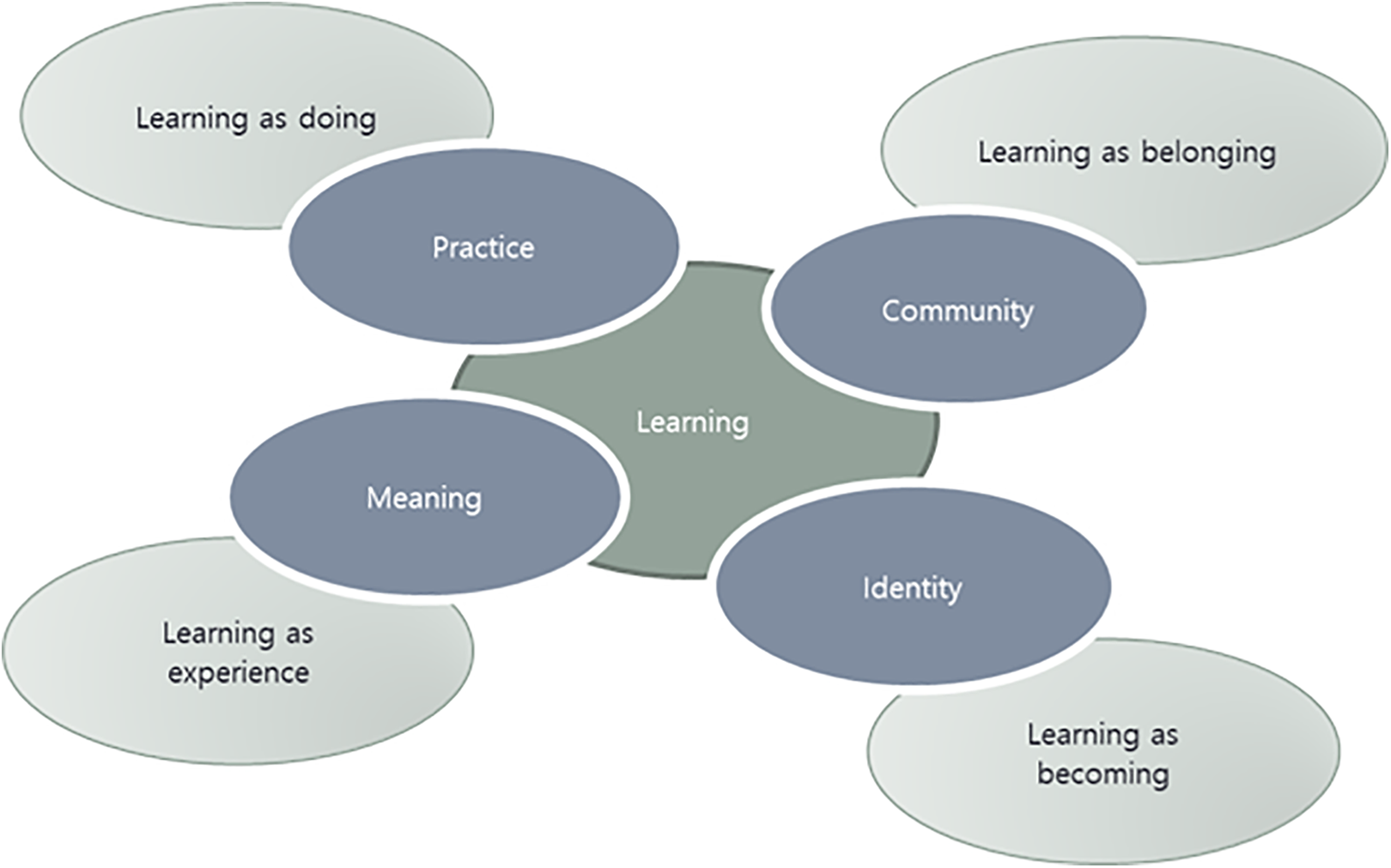
Components of Wenger and Lave’s social theory of learning (Wenger, 1999, p. 5).
Polanyi (1967), in the field of knowledge management, proposed similar ideas of knowing when publishing his work on “the tacit dimension.” Tacit knowledge and knowing, in his understanding, are processes that are fundamentally about the whole person, so much so that it is often difficult to externalise (i.e., communicate via language) what it is we know or why we behave in the way we do. It is difficult (and in many situations impossible) to externalise what we know since in that process (of attempting to externalise it), we are taking it out of the context of our own knowledge (knowing) and of who we are (being), and thus, it loses the meaning it had for us. With tacit knowing, we are back at an understanding of learning that is somewhat in line with the implicit (unconscious) memory that psychologists refer to. In the cases of both tacit knowing and implicit memory, scholars argue that one of the crucial identifying features is the practical difficulty or impossibility of externalising what is known. They also share an emphasis on this type of knowledge being acquired, for the most part, by practice and participation rather than consumption of information.
When aiming at changing practice or behaviour, pedagogical approaches that work with non-content aspects of learning are at the very least highly relevant and may be the approaches most likely to open spaces for personal and/or collective transformational change. In peace education, as well as in pedagogy generally, there are various debates around prioritising working with different dimensions and aspects of human consciousness. If we regard the education system as a technology, which is possible when using a broad conception of technology (e.g., Kelly, 2010), we can draw explicit parallels between education and other technology-related theories (like ICT4Peace).
Non-content and technologies
Postman (1971) co-developed pedagogical approaches that understand “teaching as a subversive activity,” as well as the theory of technopoly and our understanding of media ecology. Media ecology looks into the matter of how media of communication affect human perception, understanding, feeling, and value; and how our interaction with media facilitates or impedes our chances of survival. The word ecology implies the study of environments: their structure, content, and impact on people. An environment is, after all, a complex message system which imposes on human beings certain ways of thinking, feeling, and behaving. (Postman, n.d.)
Technical mediation is concerned with “how technology mediates human existence” (Dorrestijn, 2012, p. 16). Technology, in the philosophy of technology, is generally not seen as a neutral thing but rather as inherently politicised and moralised, as in the work of, for example, Latour and Venn (2002) and Verbeek (2006, 2011). Without getting too deeply into these arguments, it can be safely assumed that technology does influence human behaviour, and from the same literature, we can conclude that technology influences our morals and values. This body of research also raises the question of whether designers of technology should intentionally design technologies in a way that encourages certain behaviours that promote, for example, safety or sustainability (or peace; Dorrestijn, 2012).
Again, the Isôoko project can serve as a case for illustrating the relevance of the above. Besides the non-governmental organisations (NGOs) and community-based organisations (CBOs), there are also technology partners involved in the project. What they offer to the Isôoko project are crowdsourcing technologies and digital infrastructure (hardware and software) for the consumption and interaction with digital content. As these technologies had already been deployed (partially or fully) in the context of our work (e.g., Kenya and Rwanda), a question arose around how these technologies were already mediating human existence (prior to the Isôoko project conducting behaviour change interventions). During the design processes of our trials and pilots, it became apparent that to assess any changes to human behaviour (resulting from the piloted interventions), findings will have to be produced that illustrate how the technologies mediate people’s experiences.
In the context of this article, we are raising the questions: How do digital technologies affect our moral life, how do they mediate our existence, how do they change our experiences, and how do they change our behaviour in ways that go beyond the content dimensions?
How digital technologies affect behaviour is studied in psychology, amongst other fields. For example, digital behaviour change interventions are ICT products or services that promote behaviour changes. West and Michie (2016) argue that digital interventions are no substitute for other interventions (such as persuasive media campaigns, punishment of behaviours, incentivising more desirable behaviours, etc.) but make their distinct contribution by focusing “on amplifying or adding to them by increasing users’ abilities to put decisions to change behaviour into effect, and to sustain the new behaviour” (West & Michie, 2016, p. 2).
In any intervention, West and Michie distinguish between content and delivery. Delivery can encompass a range of aspects that are not addressed explicitly in their work. However, the relevant challenge they set is: What interventions (defined in terms of features of content and delivery), with what usage (defined in terms of uptake and level and type of engagement in those using it), in what context (defined in terms of features of the target population and the setting) has what effect on what behaviours, through what mechanisms of action? (West & Michie, 2016, p. 2)
An Integrative Approach to Building Peace Using Digital Media
In what follows, we will attempt to offer a response to this challenge by drawing together the different arguments and insights we have explored so far, and by doing so, we offer a holistic theoretical framing for ICT4Peace.
We have seen that in peacebuilding, people’s consciousness is of primary concern. How we experience our world is crucial for the values and morals we hold and the behaviours we display. Education is a systematic approach of working with people’s consciousness; critical pedagogy makes this clear and, furthermore, outlines pedagogical philosophies and approaches that can develop critical consciousness in human beings. These threads open the field to different understandings of learning and the importance of practice. In practice, the content becomes secondary, and processes and structures become the focus of attention. The structures and processes in which we are embedded (the environments that we experience) have a direct impact on our experiences and, over time, mediate the way we perceive and engage with the world. Technologies, whether in the form of an education system or a digital medium, shape our practices and consciousness in important ways.
It becomes evident that the boundaries between systems that mediate human experiences are fluid when observed through the integrative lens we propose; this is the case, for example, with the conceptual boundary between human development and peacebuilding. However, this does not mean that these concepts merge or that either loses its value. The integrative approach suggests that boundaries between, for example, peacebuilding and development can only be drawn within specific contexts and situations.
Based on the above, it is evident that, when people experience the same technological environment, there will be overlapping influences that the processes and structures embedded in the technology will have on individuals; interaction patterns between technology and people will, inevitably, emerge. Thus, technologies (like education systems) have a standardising effect on our consciousness (due to them mediating and patterning our experiences and practices). This leads us to the fundamental insight that an integrative approach to building peace using digital media is needed. The aim of an integrative approach to building peace using digital media is the empowerment of people to determine how digital technologies mediate their experiences and practices.
In conflict studies and peacebuilding, we are concerned with individual actions and behaviour, as well as the social phenomenon; we are concerned with both individual consciousness and a type of collective consciousness. The type of collective consciousness applicable to the argument we will term sociotechnical consciousness. Digital media are generally used by more than one person, which means that not only are the experiences we make and the practices we engage in mediated by the digital spaces we inhabit but also by the social networks we are embedded in. This is well established in sociotechnical theory.
Sociotechnical consciousness is an emergent process of a sociotechnical system that gives expression to what it is like to be experiencing that system. This process leads to patterning and to emergent (transient) patterns of which people are mostly unconscious; we are mostly unconscious of the ways in which, for example, technologies pattern our experiences because we are usually occupied with focusing on the content (rather than the environment). When directing our consciousness at the patterns or at the process itself, through collective practising, we can make collectively conscious attempts at changing these patterns or even the emergent process of sociotechnical consciousness itself; by redirecting our awareness and consciousness at the patterns we experience when, for example, we use a certain technology, we can redesign (or appropriate) those technologies to suit our intentions. In this case, the non-content dimensions (e.g., processes and structures) become the content dimension of our sociotechnical consciousness.
For example, as discussed above, some scholars consider conventional education processes and structures to be oppressive and to lead to a standardisation of consciousness. Instead, they promote different pedagogical approaches that ask us to direct our consciousness at the educational processes and structures (non-content) that influence us and realise that we need to shift our practices for a more critical consciousness (as in the case of critical pedagogy) to emerge (in ourselves and our collectives). This is transformative sociotechnical change; this is a fundamental qualitative shift in our collective experiencing of the sociotechnical system.
In the ICT4Peace context, the Isôoko project can serve as an example. The co-design process that led to the development of our digital behaviour change interventions engaged NGOs, CBOs, and service recipients in activities that elicited their views on “how can we use the technologies available to us to support peacebuilding in your community?” This acknowledged the importance of people’s contexts and situations, and it enabled the practising of co-creation and critical thinking. However, it did not include a collective reflection on what it is like to be experiencing the technologies as they exist. The values and practices encoded in the ICTs have remained (for the most part) unquestioned, yet they will mediate human experiences of any behaviour change intervention undertaken via these technologies. This example shows how the integrative approach proposed in this article can be aspirational for practitioners in ICT4Peace. Further aspects of this are outlined below.
An integrative approach to building peace using digital media will avoid the mass distribution of contents to passive audiences. Such mass distributions are merely epistemological interventions that lead to a standardisation of consciousness. Neither does the integrative approach call for the personalisation of content by third-party agents (human and/or algorithmic). Instead, it calls for the facilitation of opportunities to practice critical engagement with digital media and content as people-in-the-world.
Integrative digital behaviour change interventions co-create environments with people that enable us (designer users) to change who we are by practising, belonging, experiencing, and doing. This process (and its accommodating structures) leads to the emergence of a sociotechnical consciousness that is qualitatively different from content-focussed endeavours (that standardise consciousness). The intended result shifts from people who know certain things to people who experience and participate in their world in certain ways (e.g., critically, peacefully). When offering up and facilitating such processes, the domain of taken for granted (and unconscious) processes and structures that condition our behaviours shrinks proportionally with the literacy that is generated in the process of human development across all ontological domains. Research in the diverse fields discussed above—such as critical pedagogy, media ecology and technopoly, technical mediation, mediatisation, and so on—all point towards this being the case. Our technological environments continually mediate and can transform our sociotechnical consciousness. An integrative approach to building peace using digital media facilitates people becoming conscious of the very ways in which their consciousness is mediated by the technologies they engage with.
Transformation for Peace?
The above discussion enables us to synthesise a range of findings that are of importance to the theory and practice of peacebuilding. peace education, and the use of digital media for such ends. First, research from critical pedagogy and critical peace education implies that whole person, person in the world, ontological, and non-content approaches are of key importance for peace education and digital behaviour interventions.
Second, peacebuilding is about who people (individually and collectively) are rather than what they know. What they know is just one aspect of the person in the world and offers limited potential for behaviour change, as behaviour is based on who people are rather than on what they know. This shifts the focus from the content we distribute via ICTs towards the values and practices they encode.
Third, trauma’s impact on people goes beyond what they are conscious of (the contents of consciousness), for example, what they think about, reflect on, or feel. The impacts of people’s experiences embed themselves into the very processes of consciousness and cognition (non-content) and pattern our lived experience from there on. ICT4Peace is thus about how technologies mediate our lived experiences; how they pattern the practising of certain skills, communicating, and consuming information in certain ways, and, more generally, influence us as people-in-the-world in immeasurable ways of which we are usually unconscious.
Fourth, empathy, for example, in peace education is not about people feeling empathetic (towards someone in a certain situation) but about being more empathetic. The difference here is that the former is a content of consciousness (what it is like to experience being with that person in that moment) and the latter an increased general capacity (a qualitative change to consciousness). 1 This calls for an ontological perspective.
Fifth, working with consciousness from an ontological perspective shifts the focus from content to practice. Content only leads to transformational change if embedded in practice. Sociotechnical systems embody and pattern practices that mediate our sociotechnical consciousness. In other words, the ontological perspective highlights the circular relationship between the changing individual (and groups) and the mediating environments.
Sixth, human relationships (which are at the core of peacebuilding) are one mode in which the non-content domain of sociotechnical consciousness expresses itself. It is who we speak to and the quality of our relationships with them that matter more than what we speak about. For ICT4Peace, this means that addressing the destructive influence of existing social media is as (if not more) important for peacebuilding and human development as the design and implementation of ICT4Peace interventions.
Integrative Approaches and Design
Beyond these considerations, important questions remain. One of them was raised above, in the context of the philosophy of technology, namely: Should designers of technology design technologies intentionally in a way that encourages certain behaviours and practices, for example, to promote safety or sustainability (Dorrestijn, 2012).
In addressing this question, we take our cue from critical pedagogy. As technology is mediating our existence already, we should direct our sociotechnical consciousness at this process of mediation and endeavour to influence the process at the non-content level of technologies and the transformative effect they have on us. We need to identify the patterning that results from the use of technology and develop a critically conscious engagement with technology, something that Dorrjestin (2012) and others (e.g., Kelly, 2010) have called for. Contrary to dominant, modernistic, approaches in moral philosophy, the framework of technical mediation and technology, allows one to give an account of the ethical subject which is not in opposition to the influences of technology. Instead, the focus is on the emergence, self-constitution of the ethical subject through practices of coping with its own conditioning circumstances. (Dorrestijn, 2012, p. 159)
The design issues raised above also align with conversations in the responsible innovation domain. One of the central non-content considerations in that domain concerns values; there is a range of “design-for-values” approaches, all of which seek to link the embeddedness of values in technology with responsible design and innovation processes. One example, for illustration purposes, is value-sensitive design (Umbrello, 2018; van den Hoven, 2013). Value-sensitive design may be defined as “a theoretically grounded approach to the design of technology that accounts for human values in a principled and comprehensive manner throughout the design process” (Friedman et al., 2006, p. 349), and it underlines how the (moral) values of designers manifest in designed artefacts (van den Hoven, 2007).
Some of the work in this domain has started to point in directions not dissimilar to the foundations we have been laying in this article. This is exemplified in the work of Rychwalska and Roszczynska-Kurasinska (2017), who argue that groups are able to change their governance and aims in response to emergent patterns of interactions between individuals. The systemic design that mediates their experience can be redesigned when informed by the emergent collective awareness of the group.
This article suggests that the phenomenon of sociotechnical consciousness is at the core of such explorations in theory and practice. Alongside this, value-sensitive design, for example, is highly relevant to ICT4Peace because human (moral) values are seen as of key importance to behaviour in conflict contexts. However, as shown above, this is merely one domain that can be considered in the design process.
Conclusions
The foundations of an integrative approach to building peace using digital media set out above have fundamental implications for ICT4Peace and beyond. Bringing together contemporary understandings of consciousness, cognitive science, behavioural psychology, technology, and education and pedagogy, with an eye on how to promote peaceful societies, we have identified a need to focus on non-content domains, the patterning of sociotechnical consciousness, the ways our environments mediate our experiences, the processes by which we (individually and collectively) critically engage with our environments, and the processes by which environments/spaces come into being (and are appropriated).
The underpinning process has been termed sociotechnical consciousness. Sociotechnical consciousness is an emergent process of a sociotechnical system, which gives expression to how it is like to be experiencing that system. The process leads to patterning and the emergent (transient) patterns we are generally unconscious of (because they are taken for granted or broadly accepted as being the norm). In integrative approaches to building peace using digital media, we facilitate people directing their sociotechnical consciousness at the patterns and/or the process itself; through collective practising, we can make conscious attempts at changing the patterns or/the process itself.
The values, attitudes, and skills that we hold are continually reinforced and/or transformed through practice and repetition (within the context of meaning, community, and identity). For effective peacebuilding, we need to design our lives in ways that embed the practice of relevant values, attitudes, and skills into the (sociotechnical) environments we experience. As these skills, attitudes, and values transcend the content with which we can engage (such as history, natural science, neighbourhood matters, etc.), we can partially avoid re-engaging with traumatising content in the development of critical thinking, active listening, mediation, emotion regulation, personal responsibility, or mutual understanding.
Sociotechnical consciousness is both an emergent phenomenon in a sociotechnical system and a collective capability that can be enhanced and developed. The integrative approach explored here suggests that ICT4Peace requires engaging as critical makers with and within the media that condition our experiences. Thus, the facilitation of the integrative approach towards building peace using digital media lies within the remit of any designers and developers of digital media, journalists, and other influencers using digital media for communication, as well as anyone else whose experience is mediated by these technologies. As, depending on the context, this may include large proportions of communities and populations, their representative bodies (be they governmental or non-governmental) have a responsibility for ensuring that the ICTs that mediate our experiences foster peace amongst us.
Footnotes
Declaration of Conflicting Interests
The author(s) declared no potential conflicts of interest with respect to the research, authorship, and/or publication of this article.
Funding
The author(s) disclosed receipt of the following financial support for the research, authorship, and/or publication of this article: This project has received funding from the European Union’s Horizon 2020 Research and Innovation programme under the grant agreement: No 779793.
