




Abstract
This article examines the theoretical foundations of the Science of the Positive (SOTP) framework, presenting it as a conceptual and practical model grounded in the principles of transformative community leadership. Developed over two decades of applied research, the SOTP framework is founded on the core assumption that the Positive is real and worth cultivating within ourselves, our workplaces, our communities, and our cultures. The SOTP framework is a holistic model that employs a praxis-oriented process known as the Cycle of Transformation, which includes the domains of Spirit, Science, Action, and Return. It is based on eight core principles and corresponding action steps designed to help community leaders navigate change and transformation with authentic integrity. This transformative community leadership model is envisioned as a manifesto for positive cultural renewal that is feasible and imperative in today’s world.
Introduction
Background and Overview
The Science of the Positive (SOTP) framework is a transformative community leadership approach (Montuori & Donnelly, 2017; Shields, 2010) that focuses on cultivating “the Positive” to foster individual and societal transformation. In this article, the term Science of the Positive framework refers to an emergent, inductively derived transdisciplinary model grounded in two decades of mixed-methods, participatory, and action research. The SOTP framework situates itself within the participatory, interpretivist, and indigenous methodological traditions of the social sciences, emphasizing systematic inquiry into the conditions that allow the Positive to expand and thrive (Lee, 2011; Seligman, 2019; Stetsenko, 2023). The SOTP framework is based on the core assumption that the Positive is real and is worth growing in ourselves, our families, and our communities (Linkenbach, 2016). The SOTP framework conceptualizes “the Positive” as a multifaceted concept that transcends the mere absence of negative emotions and outcomes: a sacred, potent, dynamic force that exists within (and beyond) individuals and communities, capable of inspiring change and transformation. The SOTP framework is a praxis-oriented process (Collins, 2009; Kemmis & Smith, 2008; Peterson et al., 2020) following the Cycle of Transformation, which comprises four domains: Spirit, Science, Action, and Return (Linkenbach, 2016). Viewing the world through this positive, hopeful lens profoundly impacts the questions we ask, the data we collect, and the approach we take to community leadership.
Objective: The aim is to present the Science of the Positive framework and its theoretical foundations as a transformative community leadership model (see Figure 1). The Science of the Positive Framework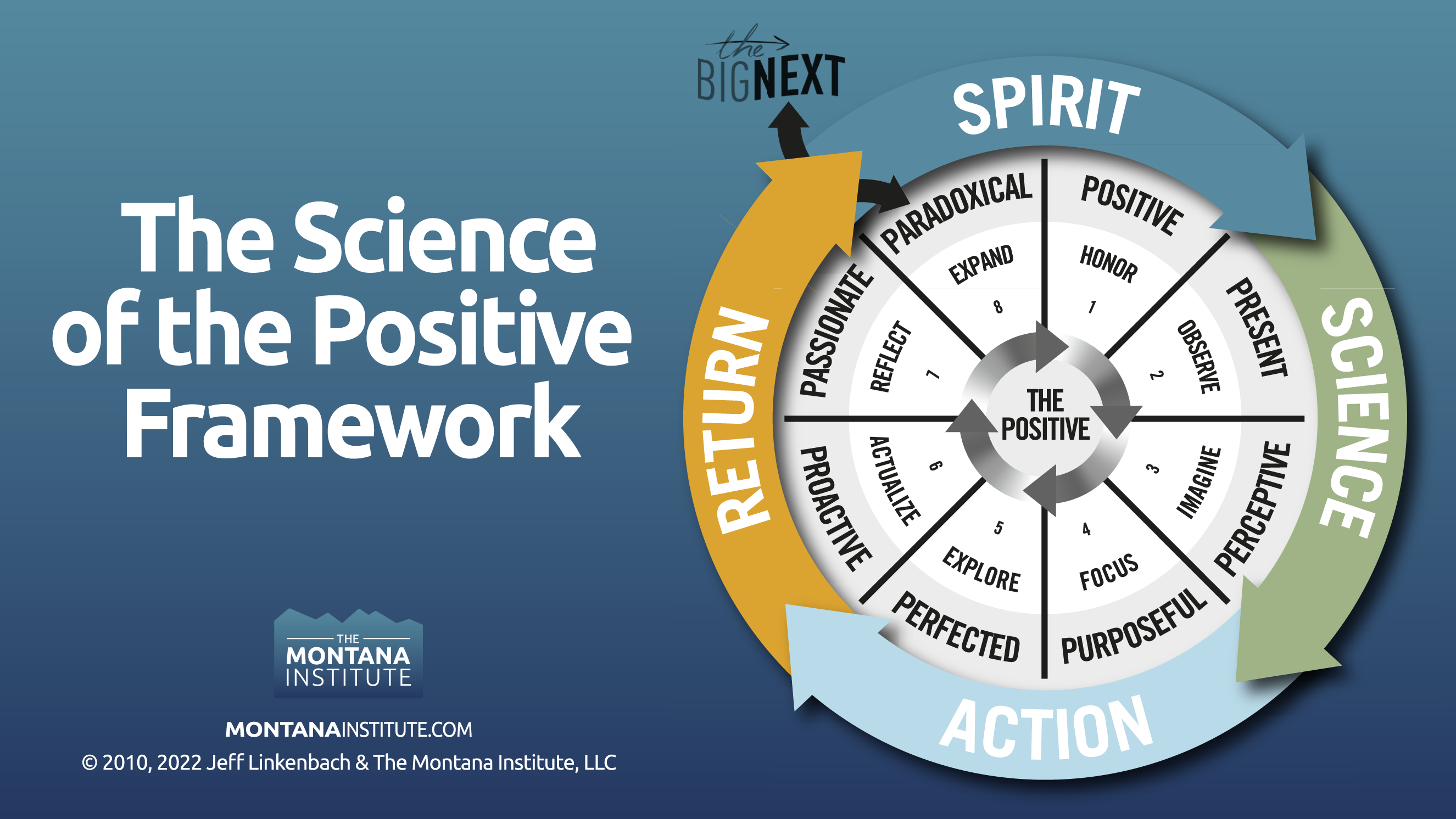
Theoretical Foundations of Transformative Leadership
The Science of the Positive framework is a transformative community leadership model that integrates key concepts from several disciplines including transformative learning (Cranton, 2006; Mezirow, 1991), positive psychology (Seligman, 2011, 2019; Seligman & Csikszentmihalyi, 2000; Spreitzer et al., 2005), community development (Green & Haines, 2015; Maton, 2008), positive organizational scholarship (Dutton et al., 2008), Appreciative Inquiry (Cooperrider et al., 2008; Ludema et al., 2006), and others. This meta-theoretical framing is informed by social constructionist, interpretivist, and indigenous epistemologies. It integrates contemporary interpretations of Cultural-Historical Activity Theory (CHAT) that emphasize activist, transformative methodology (Stetsenko, 2022, 2023) and critical pedagogies that foster collective well-being. In the context of this article, transformative community leadership refers to leadership practices that seek not only to improve organizational or community effectiveness but also to fundamentally change social, cultural, and institutional systems toward greater equity, justice, and collective well-being. It emphasizes collaboration, empowerment, and the transformation of relationships within communities to address systemic challenges and create sustainable change (Carrington et al., 2024; Shields, 2022).
The SOTP framework promotes transformation by enabling educators and leaders to challenge people to critically question the integrity of their deeply held assumptions about their place in the world (Mezirow et al., 2009). Transformative learning is connected to the concept of “second-order change,” where individuals change not only their perspectives but also their underlying assumptions and ways of being (Mezirow, 1997). Frames of reference transform when people critically reflect on the premises of problems and redefine them, becoming co-authors of cultural narratives that were previously unconsciously inscribed (Mezirow, 2000). Manifesting positive transformative leadership means fostering cultures that value continuous learning and improvement, where others can hold mirrors for us to see our assumptions (Brookfield, 1995; Senge, 1990). By emphasizing the greater good and collective well-being, transformative leaders can facilitate experiences that transcend individual concerns, fostering a sense of unity and shared humanity (Harrell, 2018; Sivanathan et al., 2004). Cranton (2006) notes that the founders of the Journal of Transformative Education deliberately chose this title to connote inclusive, integrative, and holistic values (Markos & McWinney, 2004). Recent work by McClain (2024) and Ranczakowska and Kuznetsova-Bogdanovitsh (2025) extends transformative learning into socially embedded pedagogies, providing a clear alignment between SOTP principles and contemporary educational science. Combining these and similar principles, the SOTP offers a holistic framework and process for leaders and change agents to cultivate resilient, positive environments. This framework contributes to the discourse on transformative education’s role in cultivating community leaders adept at navigating from problem-oriented strategies towards more sustainable and inclusive cultures based on a strengths-based perspective.
The Core Assumption
The core assumption of the Science of the Positive framework is that the Positive is real and is worth growing in ourselves, our workplaces, our communities, and our cultures. All scientific inquiry, actions, narratives, and reflections then proceed from this perspective. Core assumptions matter because they are beliefs we hold as true without question, based on principles we have accepted (Mezirow et al., 2009; Schnepfleitner & Ferreira, 2021). Assumptions are often unexamined and may not always be accurate, but they form the basis of our actions and decisions (Cranton, 2006), and also refer to fundamental beliefs and ideas that form a theory or framework (Law Insider, n.d; Mezirow, 2000). Reflection on core assumptions is critical for transformation.
Key Concepts of the Science of the Positive Framework
Focus on the Positive
Centering on the Positive is an idea rooted in transformative leadership principles and a hopeful orientation (Gwinn & Hellman, 2018). Since its inception in 2004, the SOTP framework has developed methods to shift practitioners’ focus away from negative problem-and-fear-oriented approaches, assumptions, and their consequences and toward operationalizing positivity in data gathering and interpretation (Bayer & Fairchild, 2016; Guttman & Salmon, 2004; Linkenbach, 2001). The Positive is explored through action research and actualized through transformative leadership principles (Shields, 2011) to develop evidence-based practices to experience, understand, measure, and grow the Positive. For example, in Minnesota communities implementing an SOTP-based, Positive Community Norms (PCN) intervention over 5 years, Linkenbach et al. (2021) found significant reductions in misperceptions of peer alcohol use norms and increases in self-reported abstinence among 8th- and 10th-grade students, compared with national survey data from the Monitoring the Future study. The SOTP framework (Linkenbach, 2007) redefines leadership and cultural development by providing principles and processes for shifting from conventional strategic, problem-focused methods and narratives to strength-focused methods and narratives, emphasizing the reinforcement and cultivation of existing positive forces across multiple life aspects (Bowman, 2013; Saleebey, 1996).
The Cycle of Transformation
The SOTP framework operationalizes the Positive through the dynamic, praxis-oriented “Cycle of Transformation,” comprising four domains: Spirit, Science, Action, and Return (Linkenbach, 2019). The cycle provides an experiential learning roadmap for navigating leadership and positive cultural transformation processes (Cf. Kolb, 1984) and serves as a circular logic model by posing critical reflective questions from the four domains. The SOTP framework’s cycle of transformation is rooted in the praxis process of transformative community leadership and culminates in new ways of being and understanding known as the Big Next (see SOTP Framework Graphic).
Spirit
Spirit represents the essence of life and the sacred presence of the Positive. Honoring and connecting with the pre-existent Positive catalyzes inspiration and intrinsic motivation that calls individuals and communities towards positive transformation. The word “spirit” comes from the Latin spiritus, meaning “breath” (i.e., life). By grounding our efforts in a positive spirit, we breathe life into our work. Spirit encompasses both the mystical aspects that connect us to something greater—a phenomenon well-documented in awe and transcendent leadership research (Keltner & Haidt, 2003), and the practical essence of our identities—our innermost selves, values, and authentic being (Merriam & Baumgartner, 2020). It serves as the guide or prelude to thought, awareness, and action, establishing itself as the cornerstone for all subsequent personal development, communal interaction, and scientific inquiry.
Science
In the domain of Science, we use action research and reflective inquiry to explore, measure, and reveal the Positive and develop evidence-informed, culturally relevant practices from that knowledge. Science pursues an understanding of the assumptions, mechanisms, and conditions under which the Positive already exists and can be expanded. Scientific inquiry deepens our appreciation for the sanctity of the Positive, understood here as the recognition of positive emotional states and human strengths as inherently valuable and worthy of intentional cultivation (Ryff, 2022). This scientific inquiry involves the systematic study of positive factors and their impacts across social ecologies (Bronfenbrenner, 1994) within individuals, communities, and cultures. Whitney and Trosten-Bloom (2010) assert that lasting transformation requires building on the core strengths of an organization and its people. Bushe (2012) further clarifies this concept by stating that framing questions positively leverages the positive core of an organization to drive change: the Positive is not only real but also quantifiably and powerfully transformative.
Action
Action is an integral phase of the transformative journey (Freire, 1970; Mezirow, 1991). This domain is crucial for translating theoretical concepts into practical applications, facilitating tangible, lasting positive change through collective praxis, particularly in the social justice context (Collins, 2009, p. 52). Freire described praxis as “reflection and action upon the world in order to transform it” (1972, p. 52). He argued that it was not enough to study the world: we have a responsibility to actively improve it. William Foster (1986) argued for transformative action dedicated to change, stating that leadership “must be critically educative; it cannot only look at the conditions in which we live, but it must also decide how to change them” (ibid., p. 185). Transformative leadership differs from transactional leadership in that it puts learning into action based on Freire’s premise “that education is not the ultimate lever for social transformation, but without it, transformation cannot occur” (1998, p. 37). Through action, the sanctity of the Positive is manifested in tangible experiences and outcomes, improving individual and communal quality of life (Seligman, 2011).
Return
Finally, Return emphasizes the importance of reflection, where transformative leaders and the communities they serve transcend theory and practice by integrating both into a cyclical process of reflection, action, and understanding (Murphy, 2015). The return phase involves assessing the impacts of actions taken, learning from experiences, redefining core assumptions, and using these insights to improve future practices. Transformative community leaders recognize that the returns and aims of leadership and education are not only individual achievement and well-being: they must include democratic citizenship and participation in civil society (Giroux, 1995; Macedo, 1995; Shields, 2009).
Authentic Integrity
The SOTP framework fosters authentic integrity, that is, commitment to both one’s true self and timeless core principles. This fosters consistency and honesty through both personal leadership and communal transformations (Guignon, 2002; Leroy et al., 2012; Thompson, 2005). Authenticity is the expression of the genuine self in the community (Cranton, 2001; Cranton & Carusetta, 2004). Buber (1947) noted that authenticity doesn’t happen in isolation: it is the expression of the genuine self to others. This concept aligns with transformative learning theory, which emphasizes the role of critical reflection in challenging and changing one’s beliefs and assumptions to achieve personal growth and integrity (Mezirow, 1991).
Authentic integrity is a vital quality for transformative leadership because aligning outer actions with inner values catalyzes a sense of wholeness and fulfillment (Palmer, 2004). This concept resonates with Paulo Freire’s notion of “conscientization,” or critical consciousness, which emphasizes the importance of being aware of one’s social reality and acting authentically to transform it (Freire, 1970). Conscientization is achieved through engaging in critical dialogue, requiring individuals to scrutinize their reality, beliefs, and assumptions (Taylor, 1993). In the context of community transformation, Authentic Integrity requires a collective commitment to shared values and principles that promote the common good.
Holistic and Indigenous Perspectives
The SOTP framework operates from a holistic perspective (Bohm, 1980) consistent with Indigenous wisdom and values, emphasizing interconnectedness and collective well-being in our cultures (Biin et al., 2022; Blume, 2023; Bouchard & Martin, 2009). Here, “our cultures” refers to multiple intersecting sociocultural systems—familial, Indigenous, organizational, and civic—that shape norms and values in which the Positive is experienced (Paraskeva, 2024). Indigenous methodologies and perspectives offer a holistic lens through which to view transformation and engagement, offering family-school-community leadership models that prioritize reciprocal relationships and shared responsibilities, as opposed to traditional European models that often reinforce colonial concepts of individualistic fractionalization (Washington & Johnson, 2023). This shift towards a relational worldview (Topa & Narvaez, 2022) and collective efforts highlight the importance of community and shared power in achieving transformative change. SOTP’s engagement with holistic and Indigenous knowledge aligns with transformative-emancipatory pedagogy, which emphasizes liberation, critical consciousness, and social justice in post-colonial contexts (Cappiali, 2024; Omodan, 2022).
Core Principles and Action Steps
The SOTP framework invites leaders to engage with eight essential principles and their corresponding actions to foster positive environments with principle-centered leadership (Covey, 1992; Covey & Gulledge, 1994; Edgeman, 1998). However, authentically living according to principles isn’t easy (Adler, 1929, 2003). These principles and actions convert theoretical concepts into transformative leadership goals, ensuring the nurturing and expansion of the sacred positive aspects of individuals, communities, and organizations. These core principles were formulated through practical application and organized in their current sequence through action research. Subsequently, for ease of teaching and memorization, they were modified to all start with the letter “P.” The eight core principles and their corresponding action steps are detailed below.
Core Principle 1: Be Positive (Honor)
The SOTP framework aims to cultivate the Positive to foster societal and individual transformation. The core action associated with this principle is to honor the Positive through qualitative and quantitative measurements and direct experience. Research indicates that interventions rooted in positive psychology, such as expressions of gratitude, kindness, humor, and hope, greatly foster the development of strong personal capacities (Gu et al., 2015). Honoring the Positive instills a sense of hope that is essential for addressing personal and broader concerns (Brookfield & Preskill, 1999; Graham & Wei-Haas, 2020; Gwinn & Hellman, 2018). The research underscores the transformative power of cultivating the Positive and expanding it from oneself to the wider society in fostering enduring and meaningful change (Ivtzan et al., 2016).
Core Principle 2: Be Present (Observe)
Being present means focusing our attention on the here and now to engage with life’s emerging realities—including the existence of the Positive—and develop readiness for transformative possibilities. The core action for this principle is to observe the Positive by creating environments that encourage mindfulness and acceptance of the Positive revealed in the present moment. In the context of transformative leadership, “presence” is a collective phenomenon focused on how individuals and groups can develop the capacity to sense and actualize emerging futures (Senge et al., 2004). “Presencing” (Scharmer, 2009; Scharmer & Kaufer, 2013) involves a shift from merely reacting to events around us to proactively sensing and actualizing future possibilities and the emerging reality of the Positive.
Core Principle 3: Be Perceptive (Imagine)
Transformative leadership and learning is a process of working on our perceptions and frameworks by reflecting on, examining, validating, and revising our perspectives (Cranton, 2006). In the SOTP framework, the core action associated with being perceptive is to imagine the Positive by engaging imaginatively with life’s events (Dirkx, 2001a). Being perceptive includes using imaginative empathy to understand how others think and feel about the issue under consideration (Southworth, 2022). Mezirow (1978) defines “Perspective Transformation” as a process by which individuals change their frame of reference, including viewpoints and habits of mind. This change is often prompted by a “disorienting dilemma” that can’t be resolved using existing perspectives, which develops into transformative learning (Mezirow, 2000; Taylor, 2000). A disorienting dilemma can be “a deeply felt, positive experience or series of positive experiences that leads to questioning of either personal habits of mind or perspectives on the world” (Cranton, 2006, p. 72). Individuals and communities then imagine and explore new roles, relationships, narratives, and actions that align with their transformed perspective.
Core Principle 4: Be Purposeful (Focus)
The core action associated with this principle is to focus on the Positive by connecting to the bigger “why” of our lives (Frankl, 1985; Sinek, 2009). Being purposeful means orienting our operations teleologically and being inspired by future goals, not pushed or driven by the past (Adler, 1929; Ansbacher & Ansbacher, 1956). Meaning in one’s work and life catalyzes the promotion of others’ health and well-being, encouraging individuals to contribute to a wider community (Martela & Pessi, 2018). Cultivating purpose with presence and positive intention leads to transformative outcomes, impacting both the individual and their surroundings (Bailey et al., 2017).
Core Principle 5: Be Perfected (Engage)
Being perfected (not perfect) is a transformative developmental journey (Daloz, 1999) of humbly recognizing we’re engaged in a continuous process of transformation, striving for wholeness and deeper community connection. The core action step associated with this principle is to engage with the Positive through feedback from others in the community environments we serve. Being perfected is about embracing humility, to have what Rudolf Dreikurs called “the courage to be imperfect” (Terner et al., 1978). Humility promotes a willingness to admit that our knowledge and experience are incomplete and we can learn from others (Brookfield & Preskill, 1999). The courage to be perfected creates a readiness for transformation when leaders exhibit openness and vulnerability both within themselves and in their interactions with others (Glanz, 2007). As Brown (2012) suggests, vulnerability is not only a pathway to personal transformation. It is a catalyst for stronger, more connected communities. Being perfected is a process of humble transformation that allows us to experience the wisdom of the integrated community.
Core Principle 6: Be Proactive (Apply)
Being proactive means actively focusing attention on the future and the things you can control instead of all those you cannot (Covey, 1989). The core action aligned with this principle is to apply the Positive by integrating it into all aspects of our lives. Positive transformation is an active—not passive or reactive—process where leaders proactively focus on the positive environment as the primary driver of transformative outcomes, allowing them to shift attention beyond themselves and eventually transcend themselves (Rybacki & Cook, 2016). Being proactive means applying the SOTP framework to develop individual transformation into social action—without which, Brookfield (2000) writes, transformation is an unproductive, self-indulgent exercise. By noticing what’s happening, both internally and externally, leaders transcend reaction. This aligns with the principles of positive psychology, which emphasizes the active role individuals play in shaping their own well-being and happiness (Seligman & Csikszentmihalyi, 2000).
Core Principle 7: Be Passionate (Reflect)
Being passionate means integrating the previous core principles to inspire leaders to proactively direct the energy of self-transformation into service-based leadership—a primary aim of the SOTP framework. The leadership action associated with this principle is to reflect the Positive in leaders and communities (cf. Schön, 1987). Studies have underlined the importance of passion to organizational success, improving productivity, innovation, and collaboration (Chen et al., 2019). Modern organizations are increasingly recognizing the value of passion and investing in proven strategies to cultivate it, including authentic integrity (in the realm of ethical leadership) and psychological safety (May et al., 2003; Talib et al., 2019). Passion is energy and managing energy, not time, is the key to high performance and personal renewal (Loehr & Schwartz, 2006). Passion is related to awe, which research suggests can inspire a sense of “small self” by shifting one’s focus away from their own concerns (Shiota et al., 2007).
Core Principle 8: Be Paradoxical (Expand)
Being paradoxical means embracing life’s complexities and contradictions, moving beyond a binary “either-or” framework towards the “both-and” mindset of transformative leadership (Palmer, 2004; Pearce et al., 2019). The core action step associated with being paradoxical is to expand the Positive by embracing new ways of being and understanding the world that makes space for the energy of contradictory ideas in conversation, creating conditions for transformation (Anderson & Braud, 2011; Locker, 2019). This shift necessitates an openness to dialectical thinking: synthesizing opposing ideas to foster a more profound appreciation of life’s complexity (Basseches, 1984; Beech, 2008). Adopting a paradoxical lens can significantly increase resilience and adaptability, making it easier for individuals to navigate the uncertainties and challenges of life (Miron-Spektor et al., 2011). The realm of paradox challenges conventional wisdom and rationality but reveals deeper truths about our individual and universal experiences (Carr, 1999; Locker, 2019). In the SOTP process, embracing paradox means expanding our direct experience and capacity as transformative leaders by integrating the existent and emergent aspects of our identity into a cohesive whole (Palmer, 1980, 1998).
The Big Next
The Big Next signifies positive cultural renewal (Bukusi, 2020, 2024; Formenti & Hoggan-Kloubert, 2023; Grin et al., 2018)—an expanded cycle of growth and transformation, where individuals and communities embrace forms of paradoxical learning that go beyond the limits of cognitive, rational way of knowing (Dirkx, 1997; Hermon, 2003; Lennard et al., 2003; Palmer, 2004). It refers to actualizing potential and acting from the positive presence of what wants to emerge (Scharmer, 2009; Scharmer & Kaufer, 2013). The phrase “The Big Next” is intended as a visionary term, consistent in scope with the other principal names, signaling a horizon of future cultural renewal. The Big Next manifests an experience of transcendence (Kaufman, 2020) that confirms the SOTP’s core assumption that “the positive exists, is real and worth growing,” by revealing what Thomas Merton (1989) referred to as the Hidden Wholeness. Entering the Big Next, we come full circle in the SOTP framework into a place of new awareness where “We shall not cease from exploration, and the end of all our exploring will be to arrive where we started and know the place for the first time”—T.S. Eliot (1943).
Discussion and Future Considerations
The Science of the Positive framework is a transformative community leadership model that integrates key concepts from transformative learning and other disciplines to embrace the coexistence of the Positive with real-world applications (Anand et al., 2020). In educational contexts, the SOTP framework can inform curriculum design through project-based learning, reflective inquiry, and community engagement. Civic education initiatives that integrate SOTP principles have the potential to foster critical consciousness and collective action among learners (Lee, 2011).
The Science of the Positive framework has been the foundation for the development of applied research models to effectively change behaviors in various settings. Foremost is the Positive Community Norms (PCN) framework (Linkenbach, 2009), which has translated the principles of SOTP to guide community leaders in uncovering positive norms and measuring and growing accurate perceptions of norms across social ecologies, thereby increasing health and safety outcomes. The PCN Framework has been applied to a variety of health and safety issues, including adolescent vaping (Linkenbach et al., 2023), child maltreatment (Bethell et al., 2019; Graupensperger et al., 2023; Klika et al., 2019; Linkenbach et al., 2017), substance misuse (Linkenbach et al., 2021), and traffic safety culture (Linkenbach, 2009; Linkenbach et al., 2012; Ward et al., 2010). The SOTP framework’s influence continues to ripple through the development of other public health and safety frameworks focusing on issues such as HOPE (Health Outcomes from Positive Experiences) (Sege et al., 2017; Sege & Linkenbach, 2014) and Positive Cultural Transformation (Linkenbach, 2021).
Next Steps and Future Research
Next steps and future research should continue to expand applications of the SOTP framework by developing measures of fidelity to guide best practices. Future research could explore opportunities to amplify the healthy, positive, and protective factors already present in our cultures and environments, particularly if the emphasis is largely on reducing dangers. Future research is needed to explore how the Positive can be experienced and cultivated through intentional, strategic, and scientific applications to achieve lasting results.
As seen with the expansion of positive psychology (PP), the SOTP framework is not immune to a credibility crisis (Van Zyl & Rothmann, 2022) with concerns posed about its relevance, impact, and credibility as a science, with needs to clarify the distinctive contribution of the SOTP framework and the validity of the philosophy, theory, methodologies, and interventions on which it is built (Van Zyl et al., 2024). Additional research studies are needed to build a body of credible science and address such criticisms and concerns as they emerge. Additionally, future research should examine how the Positive can be promoted to counter fear and other forms of negativity by fostering cultures of hope, resilience, beauty, and goodness (Duncan et al., 2021; Hathaway, 2017). Future studies and action research should highlight the dynamic nature of personal and communal development, acknowledge that transformation is an ongoing process rather than a finite goal (Mezirow, 2000; K. Taylor, 2000), and ensure the transformation journey is ever-renewing and expansive.
Summary
The Science of the Positive (SOTP) framework is a transformative community leadership approach that focuses on cultivating “the Positive” to foster individual and societal transformation. The SOTP framework represents a perpetual cycle of development and transformation, where individuals and communities gain wisdom through profound changes in form and structure by examining and redeveloping core assumptions. The SOTP framework continues to expand and provides a platform for related frameworks and approaches based upon the principles of transformative community leadership, which is essential for cultural renewal in our times. By embracing core principles, leveraging scientific rigor, and embodying authentic leadership, we can nurture positive cultures that pave the way for a brighter, more inclusive future for all.
Footnotes
Acknowledgments
Special acknowledgment for copy-editing assistance with this article goes to Sam Scott. Much gratitude goes to my colleagues at The Montana Institute—Valerie Roche, Sara Thompson, Carla Ritz, Becky Franks, Jenae Meske, Ben Tanzer, and Stephanie Patton—for their ongoing support and application of the Science of the Positive. Deep appreciation goes to Dr Jason Kilmer at the University of Washington for decades of mutual collaboration to bring this work into the world through teaching and research. A special appreciation to Phyllis Bengston and her colleagues at the Minnesota Department of Human Services for ongoing support of Positive Community Norms projects, which have successfully applied the Science of the Positive framework for over 20 years.

Funding
The author received no financial support for the research, authorship, and/or publication of this article.
Declaration of Conflicting Interests
The author declared no potential conflicts of interest with respect to the research, authorship, and/or publication of this article.