




Abstract
This paper offers an overview of the language of threat and a brief history of threat assessment as the prevailing approach to school safety in the United States. Following this, the limited applicability and efficacy of the language of threat is demonstrated with the help of the distinction between facing a threat and being labeled as a threat. The detrimental effects of labeling a student as a threat are explained by introducing Educational Displacement Theory and the accompanying model of radicalization. The concluding sections offer a shift from the language of threat to a discourse of belonging, utilizing Jack Mezirow’s notions of building a discourse and an empirical example of a violence prevention initiative—Project Belonging—where a discourse of belonging is centered in the curriculum and pedagogy. This inquiry hopes to catalyze further dialogue, scrutiny, and exploration into the language used within the field of targeted violence prevention.
Introduction
Considering the amount of time students spend in schools, our collective hope is that these spaces are safe; however, many members of the American public may be surprised to discover that one of the key mechanisms utilized to preserve safety in K-12 schools is the Threat Assessment (henceforth referred to as TA). When a concerning behavior by a student is identified, U.S. schools most commonly respond to such behaviors through a safety mechanism embedded within the school’s infrastructure called a Threat Assessment (Cornell, 2020). In other words, a student who manifests worrisome behavior is classified as a potential threat to the well-being of a community while the TA is a tool that identifies a process by which to evaluate the nature and likelihood of such a threat, particularly whether the student intends to inflict violence onto themselves, their peers, or their teachers and school staff. The TA is in essence an evaluation of the said threat by a multidisciplinary team consisting of a wide range of stakeholders, from educational administrators and teachers to mental health professionals.
This evaluation of school-based threats, now formally referred to as a Threat Assessment, 1 first originated with the U.S. Secret Service tasked with protecting the President of the United States of America and therefore investigating all relevant threats. In 1999, in partnership with the U.S. Secret Service, the U.S. Department of Education began to articulate and formalize a TA strategy to address the risk of targeted violence in schools, where targeted violence is defined as an act of harming a specific target, whether a person or a group. 2 The process emerged as a response to the evidence suggesting that at least some of the past acts of targeted violence in schools were preventable (Fein et al., 2004). TA as a safety strategy in schools especially proliferated in response to the 1999 shooting at Columbine High School in Littleton, Colorado (Cornell, 2023; Fein, 2023). The prevailing thesis that propelled the TA to the surface following the collective response to Columbine, which still persists today, is that students who pose a substantive threat (i.e., serious threat to harm others involving a plan and means to commit the act of targeted violence) disclose their intentions through signals such as drawings, written or verbal statements, or—in the age of the internet—online posts (Jackson & Viljoen, 2023). In comparison, students who pose transient threats (i.e., expressions of anger, frustration, or discontent that can be resolved in a short timeframe) may be reported and thereby initiate a TA but do not require any further evaluative steps or prescriptions for the student as the threat de-escalates. Recent research (Sabic-El-Rayess et al., 2023a, 2023b) complicates these assumptions by providing evidence that many students in the present-day American context feel educationally displaced due to the invisibility and voicelessness emergent in students from (a) the lack of recognition and respect they feel or observe in curricular, pedagogical, and social activities of the school; and (b) practices by their educators, administrators, and peers. Educational displacement is therefore a more complex and nuanced risk factor of radicalization that demands communities of scholars and practitioners to revisit and reimagine the TA as a mechanism of prevention, both in theoretical and pragmatic terms. This paper seeks to contribute to the literature that constructively scrutinizes TA within the realm of violence prevention in schools.
While the complexity of distinguishing between substantive and transient threats in schools remains as exemplified by the introduction of educational displacement as a nuanced risk factor for targeted violence, for now, let’s shift our focus to the elements of the Threat Assessment teams in schools. Threat Assessment teams, which are multidisciplinary in terms of their personnel, typically include psychologists and social workers working alongside school administrators, staff, and, at times, members of local law enforcement to review threats (Stohlman et al., 2020). These threats, emergent from reported concerns regarding a student’s behavior, are evaluated to ascertain whether there is an immediate safety risk to the reported student, the members of the classroom or school, and the community at large. There is always the chance that reported concerns may simply be a student responding to stressors or “acting out,” which would usually be interpreted as a transient risk, but the overarching aim is to manage threats through the TA protocol. Moreover, there is the likelihood that the threat is perceived, not actual, if the reporting actors’ actions are informed by preconceived biases and stereotypes that profile a particular type of student. Similarly, the actual threat level can also remain underreported due to preconceived notions of who may or may not pose a serious risk of committing an act of targeted violence (Cornell, 2020).
Historically, the use of violent force in response to identified threats has been criticized due to members of law enforcement, at times, being motivated by stereotype-induced racial, ethnic, gender, or religious based assumptions (Joshi & Fantuzzo, 2024). To substantiate this, consider a recent study of 113 instances of the Federal Bureau of Investigation (FBI) contacting Muslims that determined that such scrutiny was triggered by ordinary religious practices, despite the absence of any criminal activity. This pattern showcases the manner in which the FBI’s protocols operated under the view that the Muslim identity itself was a risk factor for extremism (Alimahomed-Wilson, 2019).
Despite the evidence that the identification of threats in schooling environments or in society at large may invite instances of profiling on the basis of protected identities (Noguera, 2003), Threat Assessments—at least in principle—ought to usher in thoughtful evaluation in response to students’ needs (Welsh & Little, 2018). While the applications of TA may vary widely, they often look like counseling, academic supports, referrals to mental-health services, or ongoing monitoring by in-school staff (Cornell, 2020). It is beyond the scope of this paper to examine the efficacy of TA within school safety strategies and prevention plans; however, the central thesis animating the author—who is a practitioner, researcher, and educator in the space of violence prevention in K-12 schools across the United States of America—is the need to move away from the language of “threat” and introduce a discourse framed by the goal of belonging. The urgent need to shift away from the language of threat stems from empirical evidence across schools (Joshi & Sabic-El-Rayess, 2023; Sabic-El-Rayess, 2021; Sabic-El-Rayess, 2023; Sabic-El-Rayess et al., 2023a, 2023b) that the language of threat in itself furthers the alienation of a person whose expressions of grievances, if unaddressed, can deepen the individual’s alienation and disengagement from the community, by forming an actual threat even when and where it was at first absent. Such a concern is especially pertinent in situations where the implicit or explicit biases shape the TA team’s reporting on who constitutes a threat.
In this paper, the first section will explore the application of the language of “threat” in school safety strategies as applicable to the K-12 schools in the United States of America alongside the larger discourse of threat landscapes within and beyond the United States of America. The second section will spotlight the forms of educational displacement—a concept drawn from Sabic-El-Rayess’ Educational Displacement Theory of Radicalization—precipitated by the use of the language of threat (Sabic-El-Rayess, 2021). The third section will offer the alternative of a discourse framed by belonging as a collective aim that engages the entire school and community and guides our response—across discourse and practice—to preserve social connection and peer acceptance, both protective factors against targeted violence. This section takes inspiration from Transformative Learning Theory (TLT) and, in particular, Jack Mezirow’s notion of building a discourse with its democratic undertones. The aim of this paper is to not only bring attention to the drawbacks of the continued use of the language of threat but also to offer a pathway forward for the field of violence prevention through a discourse of belonging.
The Limited Applicability of the Language of “Threat” in Schools
The landscape of targeted and mass violence in the United States is complex, evolving, and shaped by a multitude of social, economic, and political factors. A recent federal study of 173 instances of targeted violence committed in the United States from 2016 through 2020 conducted by the U.S. National Threat Assessment Center and titled Mass Attacks in Public Spaces Report (2023) demonstrates that schools are some of the principal sites where the acts of targeted violence are perpetrated, as motivated by unaddressed grievances including being bullied in schools. With numerous school shootings since 2018—including but not limited to acts of targeted violence—school safety is a vital concern for many students, parents, and educators. There have been 44 school shootings in 2018, 52 in 2019, 20 in 2020, 74 in 2021, 80 in 2022, 82 in 2023, and 83 in 2024.
Department of Homeland Security’s Homeland Threat Assessment (DHS-TA)
The Department of Homeland Security’s Homeland Threat Assessment (2024), henceforth referred to as the DHS-TA, is a valuable document for examining the multifaceted nature of the concept “threat,” including in schools as frequent sites of mass violence. This is particularly helpful as Threat Assessments in schools have a lineage within the agencies and offices that deploy the language of threat in response to foreign and domestic national security concerns (Cornell, 2023; Reddy et al., 2001). The DHS-TA synthesizes insights across agencies within the Department of Homeland Security and the broader Intelligence Community within the federal government to articulate the various categories of threats that will challenge American society for the year ahead.
The DHS-TA begins its articulation of the range of threats with the first category of threat: Foreign and Domestic Terrorism. Terrorism has been defined as the use of force or violence against persons or property in violation of the criminal laws of the United States for purposes of intimidation, coercion, or ransom (McCann & Pimley, 2020). When we consider the Federal Bureau of Investigation’s definition, we see an additional point of emphasis. The FBI defines domestic terrorism as violent, criminal acts committed by individuals and/or groups to further ideological goals stemming from influences, such as those of a political, religious, social, racial, or environmental nature (Federal Bureau of Investigation, 2023). Across both definitions of terrorism, it becomes clear that the identified threats are organizations—foreign or domestic—and individual actors for whom violence against the United States of America is motivated through an adherence to ideology. The DHS-TA identifies terrorist groups like al-Qa’ida and ISIS as foreign threats with worldwide networks of supporters and therefore locates the threat through the continued existence of these violent actors. By contrast, the DHS-TA identifies individuals radicalized in the United States as a threat characterized by lone offenders or small group attacks that occur with little warning. The conception of threat for domestic violent actors, as articulated in the DHS-TA, presumes limited agency in identifying and arresting acts of violence; however, the common thread across the notion of threat in relation to terrorism is the commitment to violence by actors motivated by ideologies that legitimize said violence.
The second category of threat facing the American public is the flow of illegal drugs into communities that injure, incapacitate, and even kill its users due to lethal mixtures of substances that cannot be identified at the point of consumption. The third category of threat involves the border and immigration security.
Limitations of Language of Threat vis-a-vis Labeling
Reviewing the range of threats defined by the DHS-TA suggests that the conception of “threat” has limited applicability in educational settings. In a report released by the National Center for Education Statistics (NCES) focused on crime, violence, discipline, and safety in U.S. public schools, one of the key findings highlighted that the incidence of about 857,500 violent incidents were recorded by U.S. public schools during the 2020-21 school year (Wang et al., 2022). A key distinction emergent from analyzing the DHS-TA and the NCES report is facing a threat versus being labeled a threat. As the DHS-TA makes clear, the country faces a range of threats from foreign and domestic terrorism to the distribution of illegal drugs. From the NCES report, we can see that students in U.S. schools face similar threats in relation to being targets of ideologically motivated violence in schools due to, for example, the lethal mixtures of illegal drugs. So, we can see how the language of threat can be applied to schools in terms of articulating the threats faced by students. Furthermore, the language of threat has explanatory power in focusing school leaders’, administrators’, and educators’ attention to the kinds of threats that their students can be vulnerable to during the educational process.
The limitations of the language of threat, however, become conspicuous when we move on from facing a threat to being labeled a threat, principally because the language itself can inflict harm, and even activate and exacerbate radicalization if the child’s affinity for violence is inaccurately assessed. It is worth a reminder that violence encompasses not only physical and bodily harm but also acts of othering, dehumanization, and marginalization (Sabic-El-Rayess et al., 2023a, 2023b), which is precisely why labeling a person as a threat can trigger a violent response rather than resolve underlying grievances. Labeling individuals as threats does not de-escalate and may instead undermine violence prevention efforts.
Labeling as a threat is an act of classification whereby the person (i.e., student) is framed within the prism of potential harm to the classroom, school, or community. This act locates the threat within the identified person and, if misapplied or motivated by prejudicial assumptions, may reinforce stereotypical attitudes and narratives about the person’s identity that, in turn, motivated or justified the label in the first place (Zimmerman & Astor, 2021). While the ideal scenario within a Threat Assessment would be to identify a source of threat with warrants that do not leave open allegations of prejudicial motivations or assumptions, the act of labeling a person as a threat has immutable drawbacks from a normative, not just an empirical, standpoint. Drawing from testimonies of incarcerated persons who describe the way the label of “criminal” follows them throughout their life—regardless of whether they remain incarcerated or are released—the act of labeling a student as a threat holds the same shadow-function (Williams, 2022). By shadow-function, we simply mean that a label, like a shadow, follows you even if you are looking ahead. One can turn to see their own shadow momentarily, but it is the rest of society that can see the shadow of a label that follows a person everywhere. Labeling as a threat mirrors the legal system wherein persons receive verdicts and are then recorded as “guilty”—another label—in the eyes of the state (Feingold, 2021). Labeling a student as a threat absorbs the logics and positionality of the state into the schooling system. Societal categorizations that oversimplify identities, reducing individual’s complex lived experiences and positionalities to a single label or characteristic, can harm individual, institutional, and state capacities to effectively mitigate threats. Such oversimplifications are susceptible to errors, discriminatory actions, and biased judgements, potentially misidentifying threats and advocating inadequate and even harmful solutions. The particular harms of the language of threat expressed in the form of labeling students will be explored in the following section.
The Language of Threat and Educational Displacement in Schools
With sixty-five percent of all public schools reported as having a TA team, it is clear that the language of threat has embedded itself in the hallways and corridors of schools across the United States of America (Wang et al., 2022). While having a protocol to determine supports needed by a student at risk of harming themselves or others is common sense practice (i.e., a safety plan or assessment), there are two concrete areas of concern with the framing and implementation of TA that have not been adequately addressed in the field of targeted violence prevention.
The first is the use of the language of threat in the form of labeling. The labeling of a person as a threat poses a substantive risk of further alienation and self-isolation increasing the risk of targeted violence (Sabic-El-Rayess, 2023). Targeted violence, as defined for the purpose of this inquiry, is any form of violence that is directed towards a person or community because of an aspect of their identity. As individuals who have contemplated committing an act of mass violence reference themselves, it is the words and narratives they receive verbally or, in the case of students, expressed through the curriculum; the words and narratives they are subjected to; or the words and narratives that depict and classify them as a threat that engender the internalized suffering and grievances (Joshi & Sabic-El-Rayess, 2023). In other words, it is the experience of Educational Displacement (Sabic-El-Rayess, 2021) that opens the door to the pathway of radicalization, and the deployment of the language of threat only further displaces and isolates the individuals from the mainstream schooling and societal institutions.
When a student experiences this phenomenon of being pushed—not necessarily physically—out of the classroom, without having their voice heard, grievances addressed, or a sense of belonging to the educational institution they are enrolled in, they experience Educational Displacement (Sabic-El-Rayess, 2021, 2023). The Educational Displacement Model of Radicalization illustrates the ten steps that a person on the pathway to radicalization may experience. The first step on this pathway is Educational Displacement, which prompts a sense of invisibility for the student as a member of the school community. While the experience of Educational Displacement precipitates this sense of invisibility, the labeling of a student as a threat serves to make visible the presumption that this member of the community needs to be isolated, separated, and excluded as evidenced by forms of punishment ranging from the ostensibly benign “timeout” to out-of-school suspensions and ultimately expulsion. What such punitive measures in response to experiences of Educational Displacement fail to recognize is that correction cannot precede connection (Sabic-El-Rayess et al., 2023b).
Language of Connection
To illustrate this, consider a recent panel at Columbia University, Teachers College, 3 organized by the International Interfaith Research Lab. One of the panelists, Aaron Stark, contemplated committing an act of mass violence targeting a local public space. Aaron shared that it was the language of connection, not “threat” or “correction,” that his best friend, Mike, offered that took him off the pathway of radicalization. He had, by his own admission, parents suffering from drug addiction and a life disrupted by moving across more than thirty different schools. Aaron often remembered being labeled as the “new kid,” who smelled because he did not have access to a facility to shower or clean clothes (Stark, 2018). He was targeted because of his weight with school peers shooting him with a toy harpoon—insinuating that he “was a whale”—or throwing food at him (Stark, 2018). The narrative he received from his peers at school and his family at home was that he was worthless and was one of the “bad kids.” Aaron remembers a moment when he was a teenager, sitting in his best friend’s shed, whom he thought that he already had pushed away by stealing from him and lying to him. Without anyone else to turn to, Aaron called social services. He visited social services, who had concurrently contacted Aaron’s mother. She, in turn, convinced the support staff that the young Aaron had simply manufactured his pain and was acting out to gain attention. Aaron was thereby labeled a “threat,” despite the fact that he was the target of violence, not the perpetrator. The social services staff believed Aaron’s mother. At this point, Aaron realized that he “had nothing to lose” (Stark, 2018). He decided to express his anger by obtaining a gun to attack his school or a local mall. But then his best friend’s simple actions prevented an act of mass violence.
As Aaron explains, it was not an overbearing kindness that is rehearsed, but simple gestures of care and compassion such as “Hey, how are you?” or “Do you want to watch a movie or get something to eat?” (Stark, 2018). These acts pushed against Aaron’s experiences of Educational Displacement by seeing and affirming his humanity. “When someone treats you like a person when you don’t even feel like you are human, it will change your entire world,” said Aaron (Stark, 2018). It is in his profound insight that we see both the power of violence prevention through building connection and belonging, but also the severely harmful impacts of labeling persons (i.e., students) as threats. Labeling Aaron as a threat placed in him opposition to all the stakeholders (i.e., parents, friends, school educators, and staff) whose actions would be integral in supporting this student. The language of threat served to divide, isolate, and exclude rather than unite, bring closer, and include. Aaron’s story is but one of many that underlines the limited efficacy of the language of threat and the active harm perpetuated by its continued usage in the theory and practice of violence prevention.
Educational Displacement Model and Language of Threat
Aaron’s story highlights the systemic failure of the educational system to detect, acknowledge, and ultimately address his feelings of alienation and displacement within both school and broader society. The Educational Displacement model (Sabic-El-Rayess, 2021; Sabic-El-Rayess et al., 2023a, 2023b) of radicalization emphasizes that this quest for belonging, arising from a sense of displacement in school and society, initiates the process of radicalization (see Figure 1). The model reveals that the initial experiences of invisibility, alienation, and voicelessness significantly increase the vulnerability to, and catalyze the onset of, radicalization. However, educationally displaced individuals do not inevitably radicalize; rather, the process unfolds through multiple stages. Heightened feelings of displacement are typically exacerbated by either perceived or real grievances (Step 2). Subsequently, the aggrieved individual initiates a search for an alternative place of belonging facilitated by mentors (Step 3) outside the mainstream societal frameworks, which offers pathways to address these grievances. If mentors encountered during this quest for belonging are radicalizing recruiters, it leads to exposure to curated radicalizing content (Step 4), whether in face-to-face interactions or online. The process gradually culminates in ideological transformation (Step 5) leading to the adoption of a new worldview and blame placed on the targeted Other. Arising from this process is a sense of empowerment and validation within radicalizing ecosystems, fostering connectedness and belonging to the marginalized elite (Step 6) that forms as a separate and distinct entity from the mainstream society, elite, and related institutions. As individuals progress towards full radicalization, they begin to form exclusive relationships (Step 7) that reinforce radicalizing beliefs and their existence within these alternative structures. As these perspectives solidify, deliberate withdrawal and self-exclusion (Step 8) from mainstream society ensues. This culmination marks full radicalization (Step 9), with the most perilous stage occurring as individuals begin to contemplate committing violent acts (Step 10). Educational Displacement Model. Source: Sabic-El-Rayess (2021) and Sabic-El-Rayess et al. (2023b).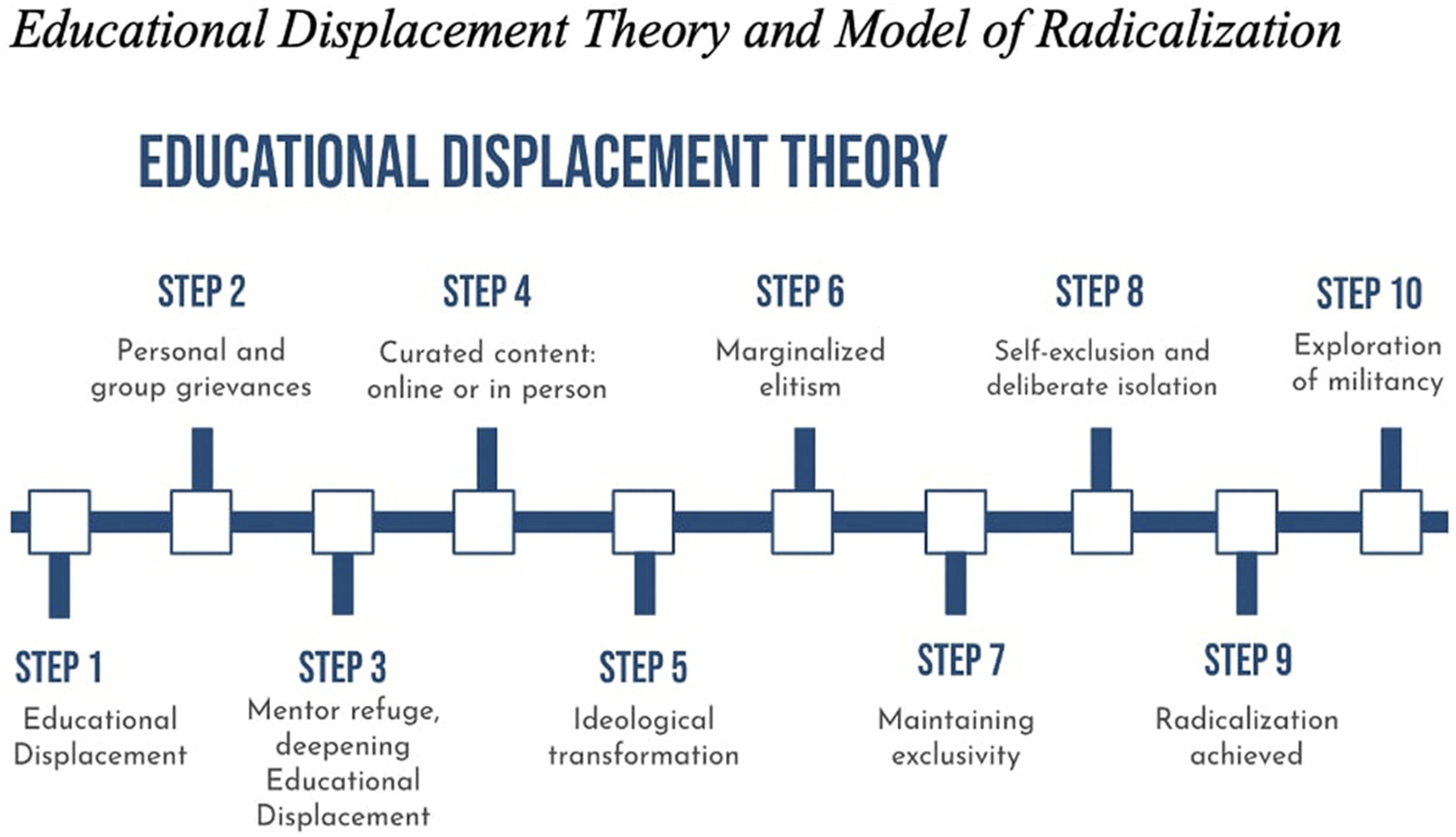
This review of the model of Educational Displacement underscores how the way the language of threat coupled with the act of labeling creates the conditions for the profiling of students with particular facets of identity that are associated, by stereotype, with forms of suspicion, violence, and criminality. If we briefly consider a government program, such as the Prevent strategy in the United Kingdom, we can see the limitations of the language of threat in full view. The fundamental problem with the Prevent strategy was the positioning of the Muslim community as a threat. The consequent accusations of the surveillance of Muslim students, who were isolated in accordance with the protocols of Prevent, alongside the broader stigmatization of the entire Muslim community through reinforcing a link between violence and Muslims, did not create social trust, connection, or a shared sense of belonging (Abbas, 2019). On the contrary, this language of threat created fear and suspicion that led to overreporting in schools by teachers that, in turn, marginalized Muslim students by inscribing the notion that their presence is itself a threat (Mastroe, 2016).
Returning to the United States of America, let’s walk through the increased securitization of schools that illustrates the growing police presence in schools over time. In 1948, the Los Angeles School P.D (Police Department) formed as a security unit to patrol and protect schools in desegregated neighborhoods, which is widely thought to be the inaugural school policing program in the country (The Center for Public Integrity, 2021). Law Enforcement Officers, now known as School Resource Officers or SROs, were permanently assigned to schools in Flint, Michigan, during the 1950s. In the 1960s, the Chicago Police Department established the first “Officer Friendly” program to reduce crime among children, serving as a precursor to police-officer led programming in the 1980s (Drug Abuse Resistance Education or D.A.R.E) and 1990s (Gang Resistance Education and Training or G.R.E.A.T). Following the Columbine school shooting, the expansion of policing in schools was set in motion. Between 1999 and 2005, the federal government awarded more than US$750 million to law enforcement agencies resulting in the hiring of more than 6500 School Resource Officers (Raymond, 2010).
Now, a reader may reasonably wonder: What is the significance of this brief history that exhibits the increased police presence in U.S. schools? Well, the response is simple. A recent report published by the ACLU highlighted that “14 million students [across America] are in a school with police but no counselor, nurse, psychologist, or social worker”. This has created a landscape where 14 million students are in closer proximity to law enforcement personnel who are trained to identify threats and respond with force rather than mental health staff who are trained to respond with dialogue, deliberation, and discussion. One argument in support of the presence of School Resource Officers may posit that they will be able to prevent or deter a school shooter; however, an analysis of 179 school shootings on school premises found no evidence that the presence of a School Resource Officer lessened the severity of school shootings (Livingston et al., 2019). So, it is not unequivocally clear that increased law enforcement personnel make schools safer from firearm-related acts of violence and it is beyond the scope of the paper to further explore the merits and limitations of that inquiry. However, what is germane to the discussion of the language of threat is that this is a paradigm that has trickled down from the federal government through state and local law enforcement agencies into the safety plans, strategies, and language in schools. The symbolic weight of the language of threat and TA teams in schools carries with it the fact that the lineage behind the very concept of “threat” is tied to the law enforcement agencies, departments, and personnel whose concerns range from international terrorism to municipal violations.
Aside from law enforcement bringing the language of threat through their broader approaches to violence intervention and prevention, many school leaders, faculty, and educators turn to the School Resource Officers to address straightforward disciplinary concerns (Pigott et al., 2018). With the availability of the law enforcement option in schools, we see statistics such as 54,321 school-related arrests across 2017–2018 in the U.S. (Wang et al., 2022). “Arresting away” the problem, which is a phrase that is commonplace in the field of violence intervention and prevention, cannot occur without the labeling of a student as a threat. An arrest cannot occur without an identified threat. Furthermore, if the prejudicial motivations against race, religion, gender, and ability, for example, are considered, the labeling can escalate into a pattern of discriminatory profiling. Patterns of discriminatory profiling only further push students along the pathway to radicalization as they begin to seek alternative spaces of belonging outside of the formal schooling environment (Sabic-El-Rayess, 2023). Having been labeled a “threat,” the educationally displaced student will seek explanations to understand their unaddressed grievances and recruiters—who prey upon such youth—will validate their feelings and project blame on the very school community that labeled the student as a threat (Joshi & Sabic-El-Rayess, 2023). In doing so, the recruiter can then escalate the student’s lack of belonging and connection into a broader movement propelled by a narrative of hate. The language of threat—in the field of violence prevention—does the practitioners and scholars no favors as it only perpetuates the very educational displacement that we seek to prevent. The next section will turn away from the language of threat and introduce the language of belonging as a viable alternative to threat assessment teams in schools.
Transformative Learning and a Discourse of Belonging
In this section, I will outline the protective outcomes of shifting from the language of threat to the language of belonging in preventing both Educational Displacement and, in turn, radicalization in schools. To help us articulate the protective outcomes, Transformative Learning Theory will be utilized as a helpful theoretical frame that offers conceptual vocabulary in service of this shift in language within theory and practice.
Jack Mezirow—a founder of Transformative Learning Theory—defines transformative learning as a process that transforms static frames of reference, which are “sets of fixed assumptions” (2003, p. 58), to make these frames more inclusive, open, reflective, and dynamic in response to experiences with affective dimensions. By cultivating dynamic and responsive frames of reference, we begin to see our peers and community members as persons with stories to share rather than reductively viewing them through the lens of stereotypical narratives (Sabic-El-Rayess & Marsick, 2021).
The language of threat—in Mezirow’s parlance—acculturates persons (i.e., students, educators, and administrators) to lead with assumptions, not questions. This affixes the meanings people generate and the judgments they make about their fellow community members due to the label that has been imposed upon them. For example, students who are labeled as threats face deleterious consequences as the dominant frame of reference through which they are viewed by their peers, educators, and school staff is precisely experienced as a threat. While positive relationships between peers, such as friendship, and between students and educators or staff, such as advisement or mentorship, can protect against buying into the acts of labeling, the persistent use of the language of threat works against social connection and peer acceptance—both of which are protective factors against targeted violence (Sabic-El-Rayess et al., 2023a, 2023b). By continuing to practice and use a language of threat, one participates in a framework and paradigm that implicitly subscribes to isolating, excluding, and building barriers between the student and the rest of the school.
In contrast to the language of threat, the shift to a language of belonging centers both our discourse and practice on the very concept that educationally displaced youth seek out in response to a grievance. Remembering Aaron Stark’s story, it was not the narratives of threat that labeled him as worthless, deficient, or undeserving of love because of an aspect of his identity that led him to seek support. By contrast, it was his best friend, Mike, who offered him visibility, acknowledgment, and the basic recognition of his humanity that illustrated the preventative power of belonging in bringing Aaron back to the community.
When Mezirow discusses building a discourse, he spotlights the role of foundational frames of reference that serve to nourish and nurture the discourse. To build a discourse requires a practice of perspective taking (Mezirow, 1978, 2003). When students engage in acts of perspective taking, this tells their fellow peers that “I would like to learn about who you are, and so I will lead with questions, not assumptions.” To cultivate a sense of belonging and lead with a discourse of belonging, we move away from the identification of threats and threat assessments as the core of a school safety plan. What if we reimagine the notion of a school safety team as conducting a belonging assessment? We would have the frame of reference of belonging as the guiding light to orient our discourse, our practices, and our pedagogies in service of making schools and communities safer.
Project Belonging
Let’s turn to an empirical example that leads with a discourse of belonging rather than the language of threat. Project Belonging is a peer-to-peer, immersive learning experience conceptualized, designed, and led by the author of this article. Housed at the largest graduate school of education in the United States, Columbia University (Teachers College), this project-based leadership development program for middle schools and high schools is supported by an innovation grant awarded by the Department of Homeland Security’s Center for Prevention Programs and Partnerships (CP3). Each participating school is constituted by a team of students who go through a 5-hour training program that introduces them to Educational Displacement Theory and a discourse of belonging in service of building protective factors against targeted violence in their local communities. Following the training, every student team builds and implements a local prevention project with the aim of cultivating belonging in their classrooms, schools, and communities.
Three key insights, which students within the Project Belonging community learn through its curriculum, are as follows: (i) storytelling is a protective practice that builds social connection and peer acceptance; (ii) identity is a story, not a category; and (iii) belonging is a shared and collective practice. These are three preliminary premises that form the basis of an aspirational normative framework where belonging is the goal, and the language of belonging will enrich our theorizing and our practice on our way to unifying communities and creating safer schools.
To briefly illustrate this, consider the practice of storytelling, which is a practice that is recommended to catalyze transformative learning (Tyler & Swartz, 2012). This practice involves two people sharing their frames of reference through life experiences, memories, and reconstructions of lived experiences as a portal into their inner world. Fixed frames of reference exhibited in stereotypical narratives strip away the richness and dynamism of dialogue and simply supply a narrative that reduces an entire community into a selection of traits that supposedly represent the essence of the group or community (Dillon et al., 2024; Sabic-El-Rayess, 2023). A language of threat is reductive and collapses the complexity of a person’s story. A discourse of belonging protects and preserves the narrative portals that serve as openings into the wondrous worlds that each child can express in a variety of modalities (i.e., written, spoken-word, visual, cinematic, and movement-based).
When students are invited to share their diverse stories, identity does not remain boxed in as a set of categories that defines the whole person. The vehicle of a story preserves the very complexity and irreducibility of a human being to a set of categories. The language of threat categorizes (i.e., labels) a student and forecloses narrative possibility for self-definition or expression. Labeling as a threat is a conclusion, a period in the sentence, an abrupt end to an unfolding story. A discourse of belonging celebrates and sanctifies the human dignity of each student, the integrity of their whole identity, and rejects the classificatory impulse to make the complex lived experiences of a person legible by slotting them into identity-boxes. The discourse of belonging in many ways is democratic, insofar as it is premised upon communicating stories and preserving the social life of a community (Joshi, 2018). 4
Lastly, this democratic aspect of a discourse of belonging lays attention to the shared responsibility we have and the mutual interests we hold in upholding everyone’s sense of belonging. In this way, if someone is educationally displaced, then we are all collectively committed to recognizing and affirming the person’s sense of belonging. The question of building safety in schools does not face the reductive approach of labeling a student as a threat and then managing their presence through isolation, suspension, and expulsion. A discourse of belonging catalyzes a broader reimagining of our approach to school safety, violence prevention, and education as a whole.
Conclusion
In this paper, the opening section offers an overview of the language of threat and a brief history of threat assessment as the prevailing approach to school safety in the United States. Following this, the limited applicability and efficacy of the language of threat—drawing on the Department of Homeland Security’s Threat Assessment (2024)—is demonstrated with the help of the distinction between facing a threat and being labeled as a threat. The detrimental effects of labeling a student as a threat are explained by introducing Educational Displacement Theory and the accompanying model of radicalization. The concluding sections offer a shift from the language of threat to a discourse of belonging, utilizing Jack Mezirow’s notions of building a discourse and an empirical example of a violence prevention initiative—Project Belonging—where a discourse of belonging is centered in the curriculum and pedagogy. This inquiry hopes to catalyze further dialogue, scrutiny, and exploration into the language used within the field of targeted violence prevention as well as the serious consideration of the proposal to espouse a discourse of belonging instead of the language of threat.
Footnotes
Declaration of Conflicting Interests
The author(s) declared no potential conflicts of interest with respect to the research, authorship, and/or publication of this article.
Funding
The author(s) received no financial support for the research, authorship, and/or publication of this article.