




Abstract
Written with a reflective posture, guided by concepts from the critical tradition of community development – Participatory Development Practice (PDP), and aligned with Freire’s Popular Education, the article offers insights into research undertaken with Australian community-based practitioners and citizens in neighbourhood centre and Landcare contexts. By engaging in workshops to develop knowledge and skills of mezzo-level circle work of community development, and by employing the Spiral Model of Community Education, the article points to the importance of transformative dialogue and learning. Our findings support the vision of community development groups, when given opportunities to have hegemonic ideas disrupted, can develop structural analyses that lead to collective action.
Introduction
Paulo Freire’s approach to transformative and popular education is often linked to the radical tradition of community development (CD) (Campfens, 1997; Gilchrist, 2004). However, in our combined 60 years of practice experience, despite the well-articulated work of authors such as Ledwith (2015), Freire’s work has less and less traction within the practice of community development in a neo-liberal era. Increasingly co-opted by reformist or conservative approaches to social change, community development has become captive to neoliberal forms of policy making and program formation, and corporate colonisation (Lyons & Westoby, 2014).
With this in mind, over the past few years, we have been engaged in a long-term action research project that aimed to understand how we could re-radicalise community development. That aim frames the broader action research question, but within this article we focus on research we undertook to investigate the space of small-group work as opportunities for transformation. The research question was, how can the Spiral Model, if at all, be effective in supporting mezzo-level community development? We partnered with two state-wide non-government peak bodies at two sites, Tasmania and Queensland, Australia. We set out to explore how a model of transformative education built on Freire’s work could support new ways of thinking for community development practitioners and citizens. Again, within this article we focus particularly on the ‘transformative opportunities’ within what is known as the mezzo-level stage of the work (explained below).
The first site, Tasmania, was focused on the social field, with researchers partnering with Neighbourhood Houses Tasmania (NHT). The second site, Queensland, was focused on the ecological field, partnering with Queensland Water and Land Carers (QLaWC).
As stated above, the goal of this article is to examine how an adapted form of Freire’s transformative education approach – understood as the Spiral Model – can be used in both socially and ecologically oriented community development spaces – particularly in the small group mezzo-level stage of the work. The effectiveness of such a model is demonstrated, albeit, with recognition of limits and necessities. As such, this article aims to serve community development practitioners offering them guidance on how to use the spiral model in the mezzo-level small group stage of work. The title mirrors these aims and alludes to one of our favourite texts for CD practitioners who want to rethink their pedagogy of small group learning, We Make the Road by Walking – a dialogue between Paulo Freire and Myles Horton (Bell et al., 1990). However, the equivalent metaphor we draw on is a ‘spiral’ of learning which takes place when small groups of citizens have an opportunity to sit in circles of dialogue.
The Australian Community Development Context
There is a long and rich history of Australian community development work, particularly at the local level. Australian case study examples of practice are published in Australia’s only community development journal, New Community, which aims to promote education regarding sustainable practices for community development, contributing to an ecologically and socially sustainable world.
Community work in Australia can be traced back to the 1850s, when the first formal co-operatives and friendly societies were formed. Prior to the establishment of government social welfare policies and their associated financial payments, these organizations, with a belief in mutual self-help, supported people facing financial hardship, who became ill, or lost work.
The 1960s and 1970s saw the rise of activism fueled by the women’s movement, trade union movement, Aboriginal land rights, gay liberation, migrant rights and anti-Vietnam moratoria (Onyx, 1996; Weeks, Hoatson, & Dixon, 2003).
Meekosha and Mowbray (1990) referred to the early 1970s as the period of ‘hope’ for community development in Australia. The ferment of the 1960s had, for a few years at least, created mechanisms by which to channel its energy for reform and justice into planning and participation processes. The first national social policy that provided a vision and resources for community development occurred in the 1970s with the Australian Assistance Plan (AAP). Community development in the 1970s and 1980s emerged as both a philosophy and as a political strategy for empowerment and social change (Onyx, 1996).
However, much like community development in other OECD countries, the mid 1980s saw an end to the era of radicalism and progressive social change, with the emergence of the conservative and restricted outlook of New Right politics and reforms. The 1980s saw the rise of the individual where citizens, within a neo-liberal framework, and the market ‘logic’ birthed in this time period, were valued because they were producers or consumers (Kenny & Hand, 2023). The New Right agenda has remained strong to date and, from within this paradigm, community development can be constructed as restoring family and individual responsibility, duty and obligation (Kenny & Hand, 2023).
In broader social policy terms, Jamrozik (2017) argued that Australia became known as a post-welfare state, as evidenced by the change of attitude towards social expenditure and, correspondingly, significant changes in social policy. This resulted in a welfare ‘frame’ which has played a significant role in shaping work with communities in Australia, built around service provision in geographical locations across the country (Rawsthorne & Howard, 2011, pp. 55–57).
The rhetoric of marketisation continues to dominate the funding for community work programs and has strong appeal when couched in terms of improving efficiency and productivity, and the belief that this provides better community development programs for communities (Kenny & Hand, 2023). However, the realities of this logic are incompatible with community development principles of social justice and self-determination because, when community programs are commodified, disadvantaged groups become less empowered and more marginalised (Kenny & Hand, 2023). With an emphasis on ‘new managerialism’ within this frame, a competitive businesslike approach, which emphasizes competition, a focus on output and outcomes rather than process, increased efficiency, productivity and risk management, are profoundly problematic for community organisations engaging in community development (Kenny & Hand, 2023, p. 63).
Action Research Partners: Queensland Water and Land Carers and Neighbourhood Houses Tasmania
As introduced, the broader action research partnered with two community-based movements. The Landcare movement in Australia emerged in the 1980s with groups forming to promote sustainable natural resource management and conservation through education programs and on-ground works to rehabilitate, regenerate and revegetate land, soils and waterways.
Queensland Water and Land Carers is the peak body for natural resource management (NRM) volunteers (https://qwalc.org.au/) in the state of Queensland, Australia. QWaLC’s roles include representation, advocacy, promotion, networking and insurance administration. Their membership consists of 460 local groups, and our action-research project involved working with 12 groups in the Livingstone Shire of Queensland.
Numbering approximately 1000, neighbourhood centres or houses in Australia can be described as a contemporary expression of the global Settlement House movement, which commenced with settlements founded in the United Kingdom, United States and other countries in the late 19th century.
In Australia, neighbourhood centres are a significant employer of community development practitioners and a great challenge for contemporary practice is that it is ensconced in a service delivery approach to or for clients, as opposed to the intent of community development being a citizen project (Lathouras, 2012). Watkins (2019) writes about the original intent of settlement houses and discusses the erosion of their mutual accompaniment focus because of a capitalist service economy. With the emergence of the welfare state in the 1930s and 1940s, a depoliticizing of citizens prepared to address structural injustice has occurred. The model of voluntary residents partnering with neighbours in settlement house neighbourhoods has transformed into a growing cadre of paid professional staff, working for those ‘in need of services’ (Watkins, 2019, p. 58). Sometimes we think of contemporary neighbourhood centres as being ‘social service hubs in the suburbs’ rather than as agents of local transformation.
Neighbourhood Houses Tasmania is the peak body for neighbourhood houses in the state of Tasmania, Australia (https://www.nht.org.au/). As a network, it exists to represent, support and enable locally-based Houses to engage in community development to make a real difference to people’s lives. Neighbourhood Houses in Tasmania respond to community needs, build community capacity, represent community views and deliver community programs and services. Our action-research project involved 20 of the 35 neighbourhood centres in their state-based network.
Locating the Study Conceptually: Mezzo-Level Work and Using the Spiral Model to Expand Imagination and Disrupt Hegemony
Mezzo-Level Community Development Work
Notwithstanding the analysis presented above (history of CD within Australia), there are many contemporary approaches to community development within Australia that are still trying to activate genuine community-led social change work. For example, there is a renewal of the assets-based community development approach, held by organisations such as Peter Kenyon’s The BANK of IDEAs, and The Jeder Institute. Collective narrative practices flourish, under the guidance of The Dulwich Centre. Community Organising approaches have strengthened through the Alliance Organisations (e.g. Queensland Community Alliance). Indigenous Resurgence is shaping decolonisation discourses, such as the First Nations-led and national organisation, Community Development First.
One approach, foregrounded in this article, is the participatory community development (PCD) approach theorised, honed, and stewarded within a number of Queensland based organisations including universities. Rooted in both a Gandhian tradition of nonviolent, ethical practice, where means and ends are deeply aligned, and a Freirean tradition of dialogue, the method map is best articulated in the book Participatory Development Practice (Kelly & Westoby, 2018). The method map includes five levels of practice. These include: • Implicate-level work – which is to bring ourselves, our creativity and gifts, with awareness of our own complexities, frustrations, motivations and so forth into the work; • Micro-level work – characterised as ‘joining’, or one-on-one relationship building in which deep listening, story, dialogue, and listening for generative action themes are key practices; • Mezzo-level work – sometimes characterised as ‘together’, which involves nurturing relationships into small, (i.e. E. F. Schumacher’s (1973) Small is Beautiful), participatory action groups in which people’s private concerns or hopes for their community are made public (through public collective action); • Macro-level work – involving more organisationally-oriented practices, leaning towards sustaining and structuring the work through internal and external partnerships; and, • Meta-level work – which we will hardly touch on in this story, but refers to the network, federation or alliance building work that moves work ‘beyond the local’ into regional, national or/and international movement building work.
While the PCD approach argues for working in an interconnected way at all levels, this article focuses on the mezzo-level work of participatory small groups – the circle work alluded to in the title. Such groups are the key to transformational work that is educationally oriented, as it’s the place where ideas, mindsets and analyses can shift, and where concrete action pathways for change are chosen.
Community development theory and practice has evolved since its 1950s inception with a key learning being the centrality of what we refer to as mezzo-level work. Holding the image of the ‘mezzanine floor’ – that in-between space – mezzo-level work is the group-level work between the micro-level of household or individual and the more macro-level of ‘whole of community’. The 1970s critiqued ‘whole-of-community’ approaches (the macro) as agendas were co-opted by the most powerful in a community – the loudest, and those with influence and prestige (e.g. men, village leaders, and the formally educated). As such, community development theory evolved with the recognition that effective transformational work most often starts with groups at the edge of community. Or with those considered peripheral in terms of power – having a voice and influence. Such starting places and groups are often identified as women, young people, people living with disabilities and so forth. As such, community development workers, while negotiating entry to community or place with the powerful and officials, initiate dialogue with those on the edge. From those dialogues and the emergence of generative themes (as theorised by Freire), small groups are then formed to initiate analysis and action.
Commonly understood as the ‘heartbeat’ or ‘engine room’ of the practice this mezzo-level work is the ‘small is beautiful’ (Schumacher, 1973) practice of small groups of people changing the world.
From a community development perspective, these small groups are the spaces where groups move from: - A culture of complaint or concern to a shared structural analysis about the drivers of oppression and possible collective group action. - A sense of private concern (e.g. what pains me is mine, my fault) to shared public action (e.g. awareness that the pain is actually shared by others as well, and that the cause is not private but public). - Simple analysis of cause to awareness of multi-faceted complex analysis – usually the interplay of cultural, economic, social, and political forces. This is Freire’s literacy approach to ‘understanding the word and world’ (Freire, 1970) - Limited ideas about what can be done, to what Freire called ‘expanded imagination’ about possibilities.
In making this case for disruption of taken-for-granted ideas/mindsets, and enabling people to analyse their public concerns, expand imagination and forge pathways for collective action, we align with Patricia Cranton’s (2006) notion of emancipatory knowledge where people examine their assumptions about a phenomenon or their concern, and consider revising them in the light of new perspectives (from other people) and new ideas and theory (discussed below as the role of the ‘code’) inserted into the dialogue. Recognising that the educational task (dialogic) and political tasks (reorganising social relations) need to be distinguished, ensuring that the spiral dialogue supports the interplay between the two (reflection and action), our approach supports a praxis that invites reimagining new ways of being-doing-organising, without prescribing the pathway. As such, as practitioners, the two authors envisage real utopias (Wright, 2010) that are post-capitalist without prescribing the kind of post-capitalism form. For example, unlike Brookfield (2005), we do not argue transformative processes would lead to a socialist imaginary, but instead are aligned to Escobar’s post-development thinking of the pluriverse (2018). The pluriverse signifies diverse forms within the Global South and North whereby communities and social movements are creating new modes of being and doing that represent ‘radical transformations in the dominant models of life and the economy’ (Escobar, 2018, pp. 4–5).
In making the case for a Freirean approach at the mezzo-level we also acknowledge that many community development practitioners draw on other methodologies to facilitate small or even larger group conversations. For example, in Australia, at this present time, many practitioners are being trained in what is called Circle Way (from the Art of Hosting tradition). The Circle Way is an intentional, non-hierarchical approach to working together, in a safe, structured, supported environment designed to hold people close while they share their inner worlds, inspirations and aspirations (Baldwin & Linnea, 2010). There are also myriad facilitation practices that enable dialogue, for example, Conversation Café and Open Space Technology, as well as cooperative knowledge-building and decision making processes such as Consensus Conferences (Minichiello et al., 2008). From our perspective, while these are useful, these models lack the critical perspective that Freirean theory brings, hence our drawing on the Spiral Model.
Need for the Research
While the broader action research focused on understanding ways to re-radicalise community development (as per other publications of ours), this research honed in on how the Spiral Model can offer guidance to community development practitioners. Our experience suggested it can, but our inquiry sought to understand more about how it could be an effective model.
As such, this element of our research can be framed as theory-testing, that is, testing the use of the spiral model in two practice contexts. Our action research question was, how can the spiral model, if at all, be effective in supporting mezzo-level community development?
Research Methodology
Banks et al. (2017) argue that action-oriented and participatory research is increasingly popular in academic, policy and practice contexts contributing to an evidence-base for policy and practice. In this type of research actors work together to co-produce or co-create a research process, challenging the more established linear model, when through recursive cycles findings are fed into the system being researched, changes made, and further research undertaken.
Drawing from this research paradigm, our partnerships with two state-based peak bodies ensured the design of the research was tailored to our partner’s needs, which, broadly, was to assist their organisational mission with training and support for community development practices.
Project Design and Data Collection
Project Design.
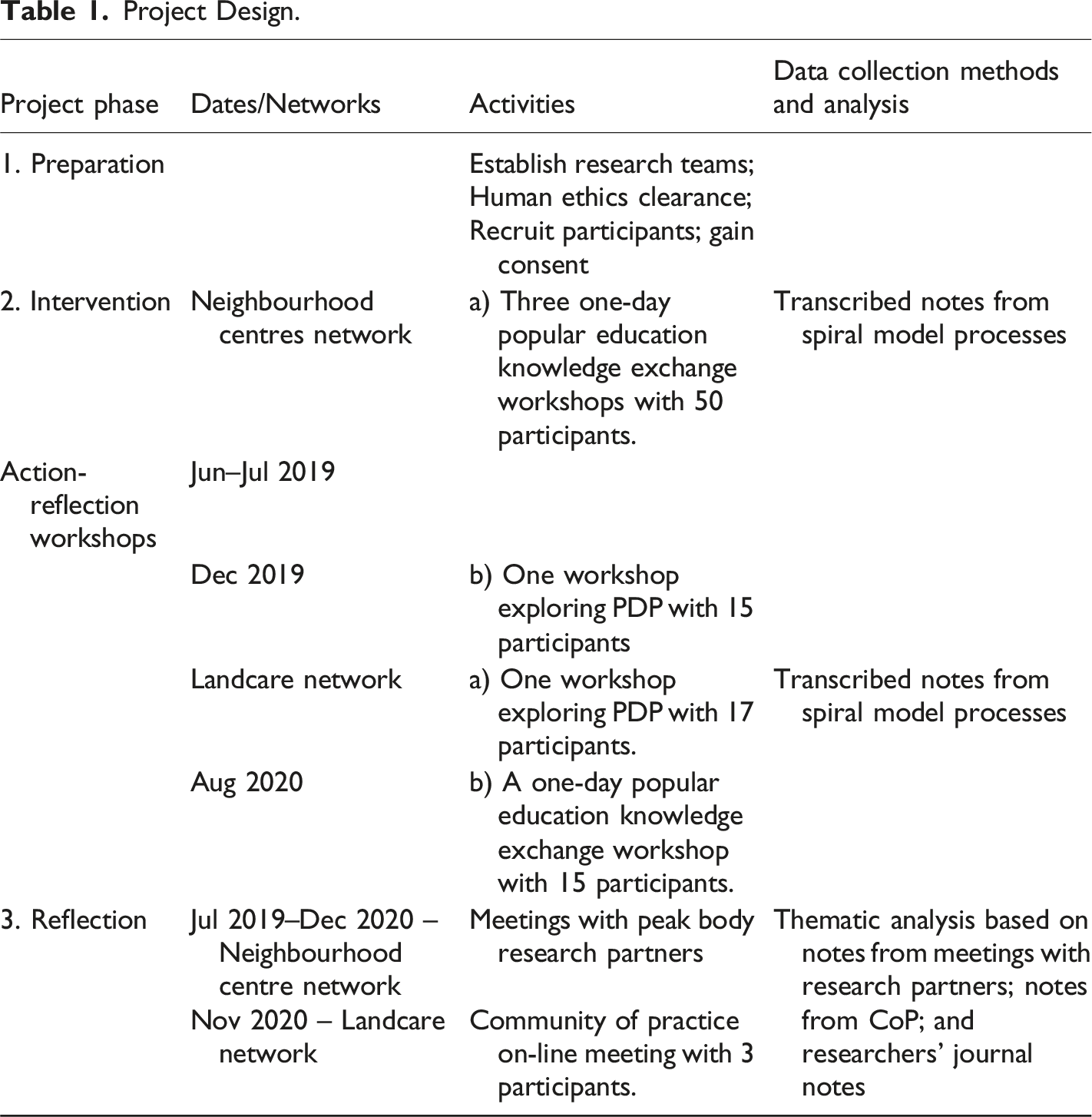
The first phase, ‘preparation’, set up the research teams with the peak body workers in leadership roles. Those workers were responsible for promoting the research project through their networks and inviting potential participants, their members, into the study.
The second phase, ‘intervention – action reflection workshops’, commenced when working with the neighbourhood centres sector and with participation from 20 of the 35 neighbourhood centres in their state-based network. Three workshops were held in June and July 2019 in three separate regional locations, but near the local community centres in which the participants were based. 50 people in total attended one of three workshops. Participants were comprised of paid workers and volunteers engaged in programs operating in their local neighbourhood centres. Entitled a ‘Popular Education Knowledge Exchange’, the purpose of the workshops was the explore approaches to group learning and disruption in diverse practice contexts. At the conclusion of the workshops, participants were invited to form communities of practice with support from us and the peak body workers, and to continue exploring the practice in-situ. Resulting from that work and to supplement participants’ knowledge about community development, in December 2019 one follow-up workshop with 15 people was held with the first author to provide further training and support in the Participatory Community Development (PCD) approach (introducing the ‘method framework’ articulated above).
With the Landcare sector, 17 participants attended the PCP workshop in July 2020, followed by a full-day Popular Education Knowledge Exchange and Spiral Model workshop the next day with 15 of the same participants. These participants too, were invited to form communities of practice with support from us and the peak body workers, of which three participated.
The final phase, ‘reflection’, involved undertaking a thematic analysis of the data from notes taken at: two meetings with research partners, where we evaluated the outcomes of the workshops and key themes that emerged; at the Landcare community of practice based on actions undertaken by participants who were employing the Spiral Model in their practice; and of our own researchers’ journal.
Significantly, this reflection phase included the researchers’ own observations and insights, those of the research partners, and the Community of Practice. This gave us insight into what enabled the spiral model to be facilitated effectively in terms of collective learning and mostly forms the basis of our findings in this paper.
Findings within an Action Research Process
Six key findings are explored within this section and discussed in turn
(1) The utility of the Spiral Model as a guide for small group collective dialogue; (2) The importance of gaining a clear mandate; (3) The relevance of the stimulus question or statements; (4) The significance of a ‘code’; (5) Pushback in provocation: a ‘gentling' approach; (6) The difficulty of moving into collective action.
The Spiral Model Provides an Excellent ‘Guide’ to Small Group Collective Dialogue – Landing Freire on the Ground within Mezzo-Level Process
Facilitating small mezzo-level groups in community development, that is, true to the movements suggested above, is not easy. Our action research over many years suggests practitioners or facilitators need guidance. As such, we have learned that finding approaches to support small groups to structure dialogue in ways that hold effective analysis and action planning is needed. Therefore, within our action research, the spiral model has become a most useful way of structuring dialogue such that it might expand participants understanding of the world beyond ‘taken-for-granted’ assumptions, or what Gramsci (1971) called ‘common-sense’ assumptions – and then supporting action planning.
The Spiral Model is depicted pictorially here:
The Figure 1, below, represents the five-step model of the process. Spiral model – dialogue for collective action.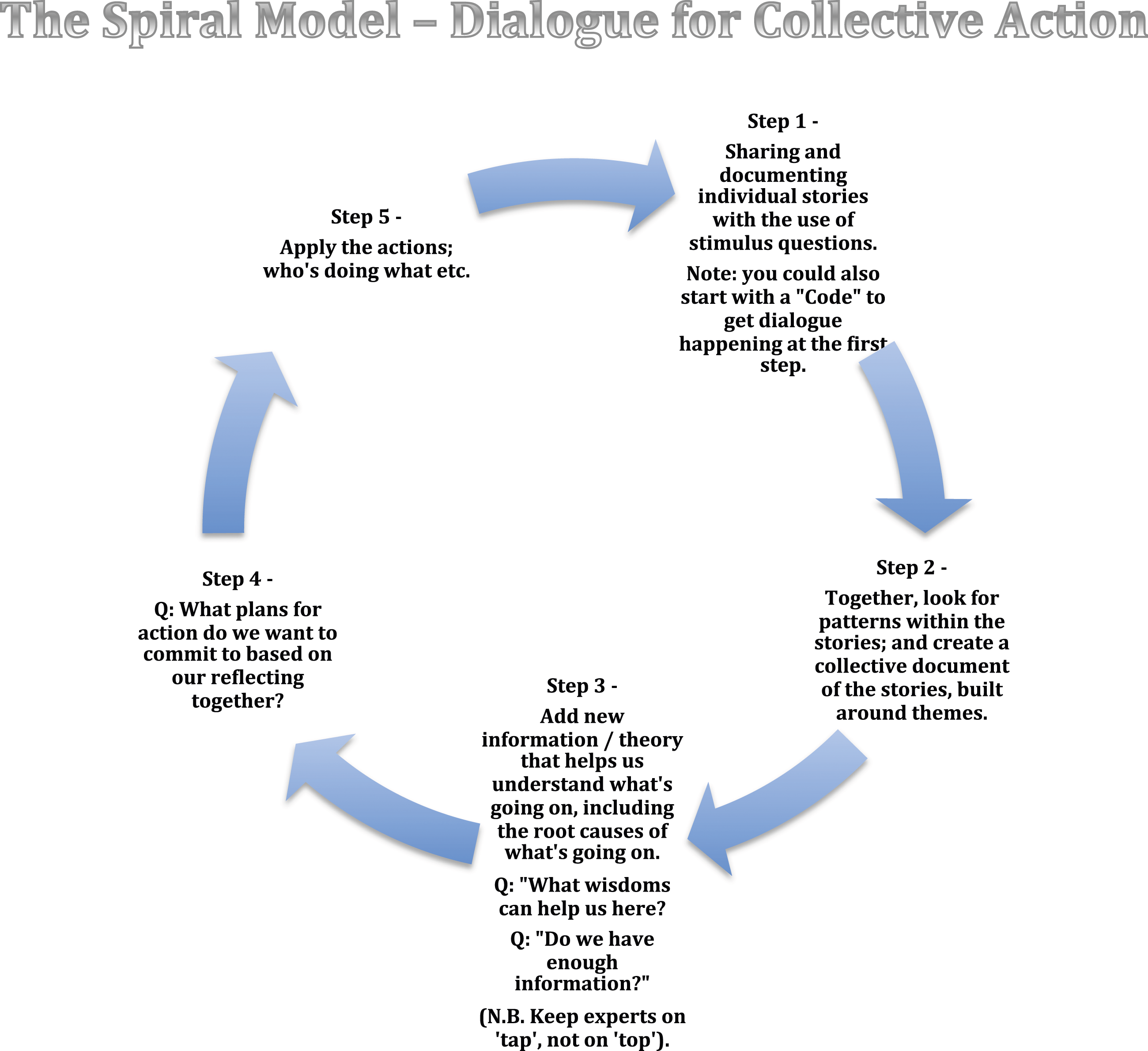
The five steps are: (i) Sharing and documenting individual stories with the use of stimulus questions; (ii) Working with people to make connections among their experiences, and to collectively ‘look for patterns’ in the data built around themes; (iii) Examining the root causes or structural factors of issues by introducing outside information to complement people’s own knowledge; (iv) Practising the skills and knowledge learned with strategies for actions; and (v) Taking action and returning to the group to reflect upon that action.
Freire’s ideas and praxis for popular education is really grounded for people when they encounter the spiral model. Our research indicates that it provides a clear set of steps to structure group mezzo-level conversation, inquiry, analysis and action planning. Rather than just a free-flowing conversation in which many practitioners and citizens can get lost, the spiral model offers guidance without being rigid or routine.
This is not to say the steps of the spiral model need to be shared with all participants. Albeit this can also be helpful as everyone can see what is unfolding. But it is extremely helpful for the practitioner. Again, it only acts as a guide. Participants themselves might be moving between story-sharing, noticing shared patterns, and also doing analysis that is sense-making. They might be sharing a story and also making a personal decision about taking new action. The point is a participant might be moving between all five steps fluidly. Yet, the practitioner, in using the spiral model, can hold the group to a collective process. Prompt questions when someone is offering analysis (step three), such as, ‘fabulous that you’re making sense of the forces shaping out lives, but let’s return to other stories’ (step one) can be helpful in keeping the group on track.
The Importance of Gaining a Clear Mandate
In our research and reflections, the Spiral Model, while effective and useful, is contextualised by the beginning. What happens at the beginning really matters. While the first step is stimulus questions or statements (discussed next), there is a pre-step which we have called ‘gaining a clear mandate’. Sometimes named ‘establishing a participatory brief’ (Kelly & Westoby, 2018, p. 98), this means that it is folly for a practitioner to assume everyone who turns up for a group process knows why they have come or remembers why they agreed to/or decided to come some days or weeks ago. Even if it seems clear what the brief or mandate is, before even starting any group dialogue, this needs to be re-established. At each and every workshop of this action research, mandate needed to be re-established. And sometimes re-negotiated and changed. While ‘refreshing in community development group process’ and ‘group learning processes’ were always part of the re-negotiations, subtle and substantive changes to hopes, expectations and aspirations needed to made or integrated.
An example of a more significant re-negotiation was one Tasmanian workshop where many participants simply were not clear on why they were at the event. One participant shared, ‘I’m here because the neighbourhood centre coordinator booked me in’.
Without this gaining (or negotiating or changing) the clear mandate, ‘group dialogue’ can easily go off-track quickly. Confusion or/and resistances emerge quickly. As such, we would suggest that a step prior to step one of the Spiral Model be included titled something like ‘clarifying the mandate/brief’.
Relevance of the stimulus Question or Statements
Assuming the mandate is clear, Freire argued that good transformational work is often linked to the art of the good question. When shifting from ‘banking' to ‘dialogic' approaches of collective conversation, inquiry, and analysis, taking time to get the question right for dialogue is crucial. Used throughout, but potently in step one, we call this ‘getting the stimulus question/statement right’.
A good stimulus question or statement is easy to relate to for everyone. It helps people reflect on either their own experience of a phenomenon, or their experience of reading a ‘code’ (see below).
Our action research project revealed the significance of choosing a ‘good’ and relevant stimulus question or statement. For example, we started in site one using a stimulus question to explore people’s understanding of ‘community development’. We learned this was problematic as many participants did not have an experience of community development. As such, we worked with a variety of more relevant questions.
In site’s two and three in Tasmania, we chose to have a dialogue about something everyone could relate to, that is, how technology is impacting our lives. Stimulus statements included: ‘I love my iphone/ipad because it enables me to…..’, and, ‘The downside of smart phones/ computers in my life are…..’.
Step one of the Spiral Model then invited people to spend time alone writing down answers to these two stimulus statements. Step two invited a collective conversation of sharing answers and seeing patterns of what was shared and/or not shared in the group. Together we clustered people’s answers or stories into themes. This was done on large sheets of white paper put on the floor in the centre of the circle so everyone could see and contribute.
The Significance of a code
The Spiral Model process follows the stimulus statements and conversations with what Freire refers to as a ‘code’. Codes are simply further stimulus for dialogue but are aimed at shifting or disrupting people’s taken-for-granted stories or assumptions. As such, the use of a code has been crucial for our broader action research question about how to re-radicalise community development. It is the step that, supported by effective questions from the practitioner, enables people to question their own assumptions about a phenomenon or concern. As such, they are designed to push or pull people into new territory – beyond what might have come from the collective sharing and discussion of step two – and take them into spaces of possible disruption, or at least new information or ideas. They are the opportunities for disruption of hegemonic ideas. Usually, they come in the form of a picture – as per Freire’s classic pictures for literacy in Education for Critical Consciousness (1974), or a poem, movie, story. Anne Hope and Sally Timmel’s classic Training for Transformation (1984) volumes offers numerous codes for dialogue.
Building on our story of Tasmania, we used Prince Ea’s (2024) rap poem ‘Can we auto-correct humanity?’ (see Appendix). This further elicited rich stories and analysis about how technology is impacting on our lives – and significantly, pushed people beyond the stories and analysis elicited in steps one and two.
There were new ‘aha’ moments and sobering analyses. For example, the conversation explored the politics of attention and how being connected to social media and many other facets of modern life are destroying our ability to concentrate (Hari, 2022); as well as issues with surveillance capitalism (Zuboff, 2019), where the systematic extraction of internet-use data is used to predict consumer behaviour. These conversations moved into a more critical analysis than had occurred in steps one and two (story sharing and pattern making). For many participants completely new ideas were introduced, needed explaining.
Pushback in the Provocation – a Gentling Approach
Despite the stimulus questions or statements of step one, dialogue as a result of the code, the collective conversation of step two and the expanding analysis that often unfolds in step three, people are still mostly wedded to their own opinions; people do not like being pushed, even gently, to re-think their ideas.
One of our key findings, or reflections as facilitators, is that in a dialogical space where no one can use their authority to ‘educate’ people, dialogue has limits. Despite intentions of the facilitator to be a provocateur – by choosing codes and questions that disrupt (with new ideas, new information) – it is not easy to push participants too hard. Most people prefer to assimilate or accommodate new ideas into their pre-existing worldviews (Walker, 2017). Transformative ideas can be un-nerving. Disruption is not embraced easily, particularly if there are not pre-existing strong relationships. The dominance of the ‘safety’ framework of learning can easily undermine the inevitable anxieties that would come with disruption of previous taken-for-granted ideas. As such, we have started to use a ‘safe’ and ‘brave’ framing at the beginning to establish a culture of a safe group, but also one where people can bravely step into new spaces, pushing their assumptions (or being pushed).
Another approach to this limit is to adopt an approach that we call ‘gentling’ which is a deliberative and purposeful way ‘that has a push and shove to it, but within a proper context of relationship’ (Kelly & Westoby, 2018, p.172) aligned with gentleness and nonviolence. As Kelly and Westoby put it, gentling enables a worker to undertake the hard edge of the work – to challenge and change – but within the context of gentleness.
The Difficulty of Moving into Collective Action
Despite most analysis illuminating the necessity of collective action – that is, people cannot make many changes alone – we found that people avoid doing collective work. Participants still prefer the individual mode of change, for example, ‘I will go and shift my behaviour’, rather than ‘we will do this together’. This neo-liberal individualisation of social change processes appears to be hegemonic. People feel the need to take personal responsibility – for example, ‘I will change my smart phone habits’, despite recognition that the challenge is structural and political (e.g. regulation of tech-companies).
This is not always the case. In the Queensland partnership with a Landcare group collective efforts were revitalised around a creek-rehabilitation and sand-dune protection initiative. The shared analysis of these groups also foregrounded how the group processes for shared collective action needed to be more finely honed. That is, people realised that cooperative collective action in the ecological space required strong social skills. This was an ‘aha’ moment for these groups.
Discussion
The Spiral Model of facilitating structured dialogue, and moving towards shared analysis and collective action, is a useful and effective model, but with caveats (shared above in those findings and further below). The action research findings are clear that for many participants the model provides a useful and clear set of steps for collective learning.
But it is also clear that no matter the model, the role and style of the facilitator-provocateur is front and centre in determining the effectiveness. In addition to understanding the steps of the model as a technical process – the facilitator-provocateur needs to be skilled in the following ways. First, in developing strong stimulus questions or statements that are really relevant to the learning context and make sense to those people. Second, the facilitator needs to be able to move through the steps of the model carefully, clearly, and fluidly, being responsive and adaptive to the emerging dialogue. Third, they need to be capable of holding the margins and mainstream dynamics (Lakey, 2010) where some participants feel ‘inside’ and excited by the conversation and learning (the mainstream), and others clearly start to feel frustrated and on the ‘outer’ (the margins). The facilitator needs to hold the tensions that emerge from this margin-mainstream dynamic, as this is often where new ideas emerge. For example, in the example discussed above about smart phones, someone introduced the idea of ‘surveillance society’ during step three of the Spiral Model. People could easily just ‘move on’ in the dialogue, but it was the role of the provocateur to pause things and ask a question such as, ‘xxx [person] just introduced the idea of surveillance society. Do others know what this means?’ Fourth, the facilitator needs to be able to introduce relevant codes that can add to a widening and disrupting conversation. Finally, they need to be able to work with resistances that emerge from the group in ways that are gentle yet also generative.
For all this to work we learned that the Spiral Model works effectively at the mezzo-level group process when contextualized within a participatory community development framework. The implication of this is that the facilitator-provocateur is already in a set of relationships with people in the group. The facilitator does not ‘drop in’ from outside of a community process but is already a part of a process that is emergent from a community that is building on a common aspiration, concern or pain. As such, people already want to work together – and with the facilitator. The Spiral Model inserts the disruptive educational processes of Freire into that learning and working together. Alluding again to the title, there’s been a ‘road walked together’ for a while, and now there’s time for sitting in a circle and engaging in this spiral of dialogue.
We particularly learned that context matters. For example, the different socio-economic backgrounds of the groups and sites really did make a difference to receptivity. The lowest socio-economic group, to use Bourdieu’s theory of habitus and dispositions (Bourdieu, 1977), bristled against any deployment of the word ‘education’. The dispositions, or public narrative was ‘education is a waste of time’. Perhaps this was compounded by our role as academics or pracademics (Fowler et al., 2023).
Another key point for discussion is that our aspiration as researchers and pracademics (Fowler et al., 2023) was to model an approach to group learning that was aligned with the model itself. That is, our approach was not to simply instruct people in models of group learning, and then expect people to go and apply it (the traditional ‘banking model’, or ‘buy and apply model’). We aspired to people experiencing a model through being inside real and relevant dialogues that would expand their ‘understanding of the world’. Some people responded well to this. Others were clear that they wanted to simply ‘be trained’ in a model. That is, they wanted to learn a technical skill rather than participate in a potentially transformational and dialogical process.
Finally, our findings and reflections indicate that to support community practitioners in what is potentially the most transformative element of community development – that is, mezzo-level group learning – there needs to be a substantial investment of time and work in ‘training’. A one-day workshop is inadequate. It takes time for people to re-learn dialogue in an era of being taught, and an example of the Landcare Group wanting to invest time was the setting up of a Community of Practice to continue their learning. It takes time for people to be inside a process – the Spiral Model process – and also see how to facilitate the process. That is, to do what we often called ‘sitting on the rim’ – being inside a real dialogue, but also able to move to the edge and see what is happening (as observer). It became very clear that citizens and/or professionals who are often required to facilitate group process of co-learning and analysis, moving towards action planning, feel ill-equipped. The Spiral Model can be a helpful guide, yet practitioners need real long-term support in learning to facilitate and be provocateurs.
Conclusion
The Spiral Model, if facilitated well, can both structure dialogue in group processes and also disrupt people’s previous thinking within the mezzo-level community development process. The facilitator role is at times facilitation, but also bridges as a provocateur. As such, this is difficult work. The Spiral Model is a very helpful addition to the community development practitioner’s repertoire within mezzo-level circle work, yet in and of itself is inadequate to the task. Support is clearly necessary in the art of facilitation and provocation, in the skills of developing stimulus questions and statements, of holding the tensions between emergent margins and mainstream, in gently pushing groups from discussion to shared analyses and action.
Footnotes
Declaration of Conflicting Interests
The author(s) declared no potential conflicts of interest with respect to the research, authorship, and/or publication of this article.
Funding
The author(s) disclosed receipt of the following financial support for the research, authorship, and/or publication of this article: This work was supported by the University of the Sunshine Coast’s Industry Collaboration Grant.

Appendix
Prince Ea’s (2024) rap Poem “Can we Auto-correct Humanity?” Did you know the average person spends four years of his life looking down at his cell phone? Kinda ironic, ain’t it? How these touch screens can make us lose touch But it’s no wonder in a world filled with iMac’s, iPads and iPhones So many I, so many selfies, not enough us-es and we-s See, technology Has made us more selfish and separate than ever ʹCause while it claims to connect us, connection has gotten no better And let me express first Mr Zuckerberg, not be rude, but you should reclassify Facebook to what it is An anti-social network ʹCause while we may have big friend lists, so many of us are friendless, all alone ʹCause friendships are more broken than the screens on our very phones We sit at home on our computers, measuring self-worth by numbers of followers and likes Ignoring those who actually love us, it seems we’d rather write An angry post than talk to someone who might actually hug us Am I bugging? You tell me ʹCause I asked a friend the other day, “Let's meet up face to face” And said, “Alright, what time you wanna Skype?” I responded with OMG, SRS, and then a bunch of SMHs And realized what about me? Do I not have the patience to have conversation without abbreviation? This is the generation of media over stimulation Chats have been reduced to snaps The news is a hundred and forty characters Videos are six seconds at high speed And you wonder why ADD is on the rise faster than 4G LTE But get a load of this Studies show the attention span of the average adult today Is one second lower than that of a goldfish So if you're one of the few people or aquatic animals That have yet to click off or close this video, congratulations Let me finish by saying you do have a choice, yes But this one, my friends, we cannot autocorrect, we must do it ourselves Take control or be controlled, make a decision, me? No longer do I wanna spoil a precious moment by recording it with a phone I'm just gonna keep them I don't wanna take a picture of all my meals anymore I'm just gonna eat them I don't want the new app, the new software, or the new update And If I wanna post an old photo, who says I have to wait until Thursday? I'm so tired of performing in the pageantry of vanity And conforming to this accepted form of digital insanity Call me crazy, but I imagine a world where we smile when we have low batteries ʹCause that'll mean we'll be one bar closer to humanity