




Abstract
The article puts forward Theory U as a framework for developing a more holistic and embodied understanding and approach to the practice and conceptualization of transformative learning. It argues that Theory U’s relational onto-epistemology, which emphasizes the collective nature of knowledge creation and transformation, provides a compelling schema for learners to engage and integrate the cognitive, emotional, relational and spiritual dimensions of their personal and professional development, as well as their role in broader societal change. Using the case study of u.lab, an educational program based on Theory U, the article identifies key practices, tools and interactions that served to enable transformative learning. It also highlights the potential of relational onto-epistemological frameworks such as that of Theory U to guide the development of a more holistic conceptualization of transformative learning, one that encompasses aspects and experiences of transformation beyond rational-cognitive processes and beyond dualistic understandings of the world around us.
Introduction
The uncertainty and complexity of our current world has brought to the fore the importance of developing a curriculum and student experience that not only prepares learners for a complex world (knowing in and for uncertainty), but which also engages in the ontological task of enabling individuals to prosper amid that supercomplexity (Barnett, 2012, p. 68). To foster such a holistic approach to the development of the ‘pedagogical being’ – enabling personal and professional growth, as well as the ability to thrive in uncertain times – needs to address the systemic and collective aspects of meaning making and knowledge creation (Barnett, 2007, 2012; Gergen, 2015). Most educators recognize that learning and engagement are mediated by the learner’s social world, sense of connection to others and sense of belonging. Nevertheless, faced with constantly changing teaching and learning environments and an increasingly diverse student body, educators often have no frameworks to support transformative learning and authentic co-creation, let alone nurturing students’ personal growth. The dispositions and qualities related to ‘being’ (sense of self) and ‘becoming’ (personal transformation) (Barnett, 2007, p. 102) – critical to collaborative, inclusive and transformative learning – are at best only indirectly cultivated in the learning experience.
In his book, 21 Lessons for the 21 st Century, historian Yuval Noah Harari (2018) argues that as the pace of change increases and technologies are developed that are likely to redefine the very meaning of ‘being human’, the future has become more uncertain than ever before. To succeed in the face of uncertainty, he goes on, one needs to work very hard on getting to know one’s operating system, to know who one is and what one wants from life. This quest to connect to source or inner knowing, is at the heart of Otto Scharmer’s Theory U framework of transformation (Scharmer, 2016, 2018), which seeks to address what he calls the three great divides of our time: the environmental, social and spiritual divides. While adult education institutions are well attuned to environmental and social inequality challenges, they remain largely unwilling to address the affective and spiritual challenges of our time. For Scharmer (2018, pp. 4–5), the spiritual divide is manifested in increasing levels of burnout and depression, which in turn result in a loss of meaning and loss of Self (with capital S) embodying an individual’s highest future potential. This divide has tended to be addressed as a mental health epidemic affecting individuals, even though the underlying causes of this collective anxiety are systemic, and should be addressed as such (Barnett, 2012, p. 70).
Moreover, while there are a range of pedagogical strategies – experiential and problem-based learning, collaborative and inclusive learning, student-led curriculum and so on (Cook-Sather et al., 2014; Love et al., 2014) – to help students learn for the unknown, educators often lack pathways and models for fostering learning that addresses students’ personal growth alongside their development as professionals within a particular discipline or field (Rodriguez Carreon & Carrillo, 2021). Some of the qualities that adult education institutions seek to develop in their graduates – such as cultural competence; inventiveness; having an integrated professional, ethical and personal identity; community engagement; and influence 1 – imply the need to develop learners’ disposition for self-awareness and self-knowledge, perspective transformation, openness, generative listening and personal responsibility. Nevertheless, as Nicolaides and Dzubinski (2016, p. 133) remark, the capacity to create environments where such transformative learning can occur remains limited (see also McEwan-Short & Jupp Kina, 2018).
There is now a longstanding interest and expanding research in the adult education field seeking to develop more holistic and embodied conceptualizations of transformative learning (Ojha, 2020; Papastamatis & Panitsides, 2014; Perry, 2021; Yang, 2006). Endeavouring to contribute to that literature, the article puts forward a pathway for a more holistic understanding and approach to the theorization and practice of transformative learning. It argues that Theory U offers a compelling model for conceptualizing transformative learning in such a way. Following Theory U’s framework, transformative learning is understood here as a relational and iterative process, rather than one undergone by autonomous learners. Within such understanding, the locus of transformation (epistemic and ontological shifts) moves away from the individual toward the pattern and quality of relationships (Lange, 2018). It entails a shift in consciousness from an ego to an eco-awareness, through relationships and more embodied ways of knowing (Scharmer, 2018). The paper argues that Theory U’s systems-view perspective and relational onto-epistemology, which emphasizes the collective nature of knowledge creation and transformation, provides a holistic framework for learners to engage and integrate the cognitive, emotional, relational and spiritual dimensions of their personal growth, with their role in broader societal change (Pomeroy & Oliver, 2021, p. 72).
To illustrate how Theory U can provide a framework and model to support transformative learning in adult education, this article presents an analysis of the experiences of a small group of students at Xi’an Jiaotong-Liverpool University (XJTLU) 2 enrolled in u.lab: Leading from the emerging future (MITx massive open online course MOOC) and who participated in an in-person social innovation hub as part of that course. Through this case study, the research identifies key practices, tools and interactions within u.lab and the hub that served to enable transformative learning. The article argues that u.lab content and Theory U’s transformative framework, the fostering of a listening-awareness practice, and the quality of the interactions within the hub allowed for a heightened awareness among participants of the ways in which interrelationships create reality (Buechner et al., 2020, p. 95), their own as well as that of the broader social field (Scharmer & Pomeroy, 2019).
A shift in how they listened to others, supported by awareness-based practices such as journaling and mindfulness, was identified by participants as the most important enabler of transformation. The development of a disposition toward empathic listening, in turn, helped foster the relational capacities needed for authentic and inclusive collaboration and co-creation to emerge. These findings highlight the importance of cultivating students’ relational capacities to enable safe learning spaces that can provide the foundation upon which transformative learning can take place. Those capacities and the related awareness of the transformation they enable are also crucial to any effort to co-constitute a more inclusive education system and social reality.
The article closes by pointing to the potential of relational onto-epistemological frameworks such as that of Theory U, in aiding not only the creation of the conditions for transformative learning to happen, but also the development of a more holistic conceptualization of transformative learning, one that encompasses aspects and experiences of transformation beyond rational-cognitive processes and beyond dualistic understandings of the world around us.
Theory U and u.lab: Enabling Personal and Collective Transformation
Theory U’s multidisciplinary framework aims to guide individuals and groups to identify, engage with and transform ‘the source of our most pressing environmental, social and spiritual challenges – our level of consciousness’ (Pomeroy & Oliver, 2021, p. 2). The essence of Theory U’s consciousness-based systems thinking, is to ‘relink the parts and the whole by making the system sense and see itself – by closing the feedback loop between collective impact and shared awareness’ (Scharmer, 2018, p. 123). This transformative process is represented as a U-shaped trajectory, consisting of three movements (download, retreat and reflect, and act in an instant) (see Figure 1). Movement down the left side of the U is guided by a transformation of the ways in which we attend, through an opening of the mind, the heart and the will, which requires overcoming our internal voices of judgement, cynicism and fear (Scharmer, 2018, p. 28). Arriving at this ‘presencing’ at the bottom of the U is meant to allow individuals and groups to crystalize a vision and intention, to prototype an idea (the emerging future) operating from a new eco-system awareness (upward right-hand side of the U). This journey through the U is then repeated as individual and system awareness expands. Theory U and the U journey: Seven ways of attending and co-shaping.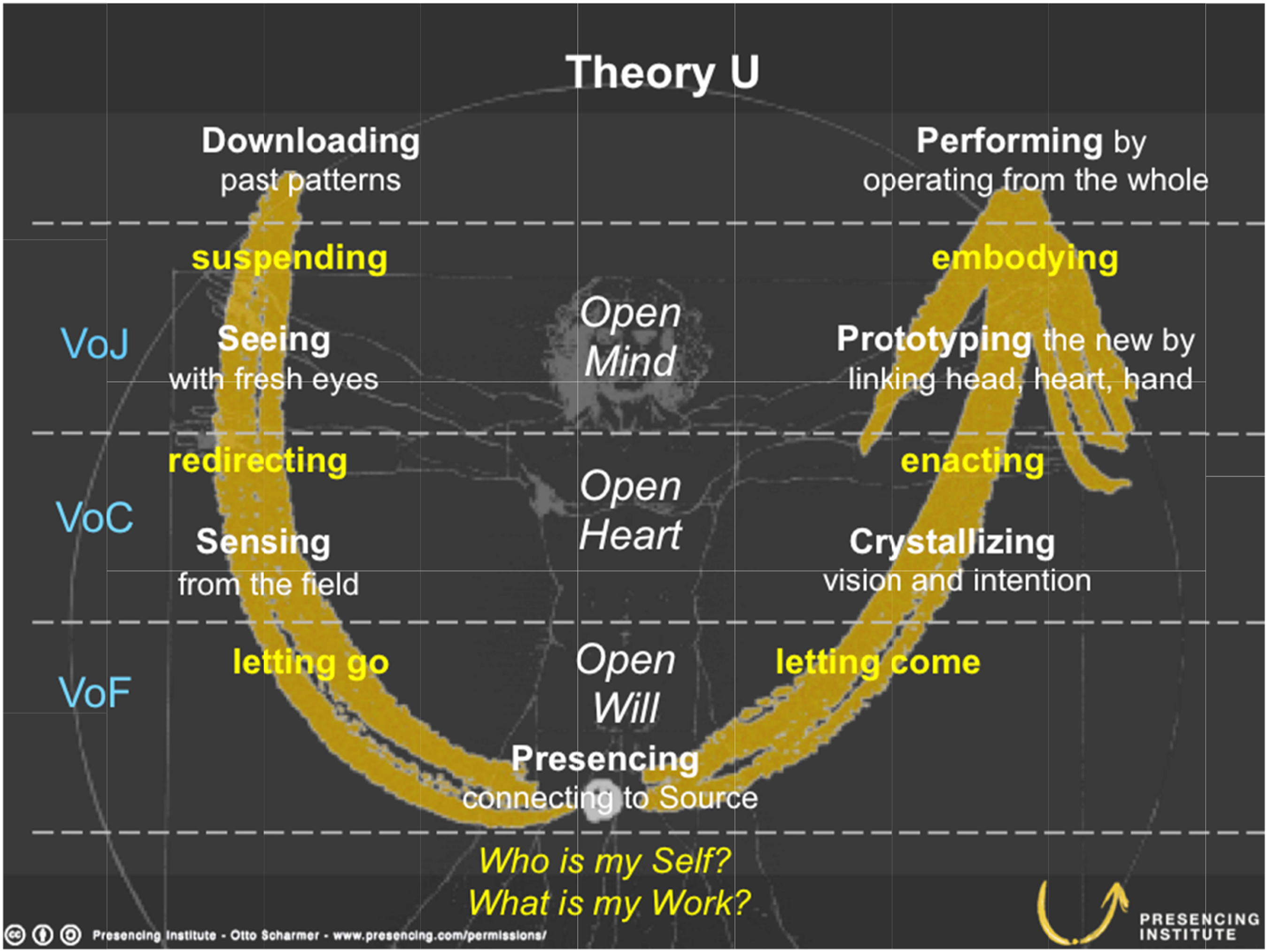
In u.lab, this embodied process of transformation is guided through a series of experiential learning activities, drawing from a variety of contemplative and awareness-based practices. First launched in 2015, the u.lab MOOC provides a tuition free learning infrastructure based on Theory U, with the aim of enabling as many people as possible to catalyze personal and systems change, and to ‘scale societal renewal through global and local engagement, connection and activation’ (Presencing, 2021). To date, over 160,000 thousand people from across 185 countries have enrolled in the course, including through institutional (e.g. Concordia University) and governmental initiatives (e.g. u.lab Scotland). In China, u.lab has also been offered tuition free through the online learning platform xuetangx.com, with all course materials provided in Chinese, 3 allowing for a thriving u.lab community to emerge there.
Over the course of 14 weeks, u.lab participants are introduced to the Theory U framework and the U journey of transformation (see Figure 1) through pre-recorded videos, reading materials, journaling exercises and various other awareness-based practices. Participants are also encouraged to connect with the global u.lab community through four ‘live’ lectures, hub host meetings, the Presencing Institute’s website and facebook groups. In China, the u.lab community communicates primarily through WeChat groups. Offline, and as part of the experiential learning component of the course, participants are encouraged to form hubs, described as local communities of change where ‘participants come together to learn and co-create, using the frameworks and methods offered through the u.lab MOOC’ (Presencing, 2017). The aim of u.lab is for individuals and/or hubs to put forward at the end of the course a prototype – an idea in progress – that seeks to generate feedback from stakeholders, which is then fed back into the prototype. This iterative process is meant to be informed and enabled by a shift from ego to eco-system awareness facilitated thorough the U journey of transformation (Scharmer, 2018, pp. 118, 123).
u.lab emphasizes the development of relational capacities, particularly the importance of cultivating a deep and empathic listening that can allow for a true generative dialogue to emerge (Scharmer, 2018, pp. 26–28). Relational capacities are further enhanced by simultaneously engaging u.lab participants in practices of both individual and collective inquiry. These include stillness practices (e.g. mindfulness and meditation), creation process practices (e.g. generative scribing, see Bird, 2018) and movement practices (e.g. empathy walks, social presencing theatre, see Hayashi, 2021) that allow participants to explore different ways of knowing and being.
While cultivating individual participants’ developmental and relational capacities is an important part of the course, Theory U emphasizes that those capacities are only enhanced within safe collective spaces. Further, it stresses that building a safe container needs to go beyond the deployment of certain tools, and depends – rather – on less visible qualities, such as intention, attention and deep listening by both hosts and participants (Scharmer, 2018, p. 13). Such safe holding spaces become crucial for individuals to be able to let go of or negotiate the challenges posed by their inner voices of resistance (the voices of judgement, cynicism and fear), and – most importantly – they become holding sites for collectives to manifest their ‘highest future possibility’ (Scharmer, 2016, p. 14). From Theory U’s systems thinking perspective, the transformative process of the individual is thus necessarily in dialogical relationship with the transformation of the collective, and ultimately of the broader social field (Scharmer & Pomeroy, 2019).
Research Methodology
In 2016, while on a visiting position at XJTLU, the author first enrolled in u.lab and found it to provide an effective and well-structured curriculum and platform from which to enable transformative learning. In mid-2017, through a teaching grant, 4 the author put out a call to all XJTLU students and staff to attend a ‘taster session’ 5 of the u.lab MOOC to invite them to enrol in the course (online) and form a local social innovation hub linked to it (offline course component). Participation in the course and the hub was voluntary and no formal academic credit was awarded to participants. 6 The hub initially attracted around thirty participants, including students, academic and professional staff, as well as a couple of community u.lab practitioners. A core group of eight (the author, two project collaborators and five students) took part in all or most of the fortnightly hub meetings. Systematic data regarding people’s reasons for not continuing with the course and hub meetings was not gathered, however, some commented that this was due to being unable to meet the associated time demands on top of their normal study and/or job workloads.
This article reports on the evaluation of the experiences of five students enrolled in u.lab and who participated in the social innovation hub at XJTLU between September and December 2017. These five students attended all or most of the fortnightly hub meetings and were thus selected for this study. The author was also enrolled in the course and hosted the fortnightly hub meetings. Three of the students were Chinese nationals, while the other two were international students from Europe and Africa, respectively. None of the students were native English speakers, and all but one were pursuing undergraduate degrees in different faculties and disciplines. One student had postgraduate qualifications but was at the time enrolled in the university’s Chinese language program. Four of the participants were female and one was a male.
Semi-structured one-on-one interviews were carried out by the author with each of the five students between December 2017 and May 2018. 7 The interview protocol was based on a protocol developed to examine the experiences of participants in u.lab Scotland (see Pomeroy & Oliver, 2018). It consists of five sections, with questions related to: participants’ situation before taking u.lab and their motivation for doing the course; course content; learning and change; sense of community; and emerging possibilities and actions. Interviews were transcribed and initially coded through an inductive approach, followed by a second round of deductive coding through thematic analysis (Xu & Zammit, 2020). The deductive coding process sought to link the initial codes (inductive coding) to concepts and themes derived from transformative learning theory and Theory U. Two cycles of this blended coding approach were carried out to make sure the voices of respondents (from the inductive coding) remained represented in the more analytical codes derived from the thematic analysis (Linneberg & Korsgaard, 2019, p. 264).
The thematic analysis adapted Hoggan’s typology of transformation, which puts forward a ‘matrix to guide descriptions of learning outcomes that extend beyond merely epistemic shifts and show how each type of learning outcomes can justifiably be considered transformative’ (Hoggan, 2016b, p. 79). Given the non-linear trajectory and iterative nature of the transformative learning process, in this article learning outcomes are also characterized as enablers of (further) transformation. The article argues that transformative learning outcomes become enablers of other transformative processes, working as ‘steppingstones’ of transformation in other learning areas (e.g. from greater self-awareness to a shift in ways of being), aiding the development of more lasting/stable transformative outcomes, and/or enhancing the individuals’ cognitive, empathic and other relational capacities.
In applying Hoggan’s typology, the article concurs with his conceptualization of transformative learning as a metatheory that encompasses a broad range of theories addressing personal, social or cultural transformation (Hoggan, 2016b, p. 77; Hoggan, 2016a). Within that overarching paradigm, he defines transformative learning as referring to ‘processes that result in significant and irreversible changes in the way a person experiences, conceptualizes, and interacts with the world’ (Hoggan, 2016a, p. 71). For Hoggan, these three descriptors of transformative learning (experience, conceptualization and interaction with the world) can be metaphorically represented by the heart, head and hands (Hoggan, 2016a, p. 71). Similarly, the U journey of transformation (Figure 1) in Theory U outlines a ‘cycle of presencing’ involving the opening of the mind, the heart and the will, in which deep listening takes a leading role (Scharmer, 2018, p. 31). Presencing thus refers to a holistic transformation that shifts an individuals’ self-awareness and broader worldview, allowing them to operate from a deeper source of knowing or consciousness (Scharmer, 2018, p. 98).
Enablers and Outcomes of Transformative Learning.
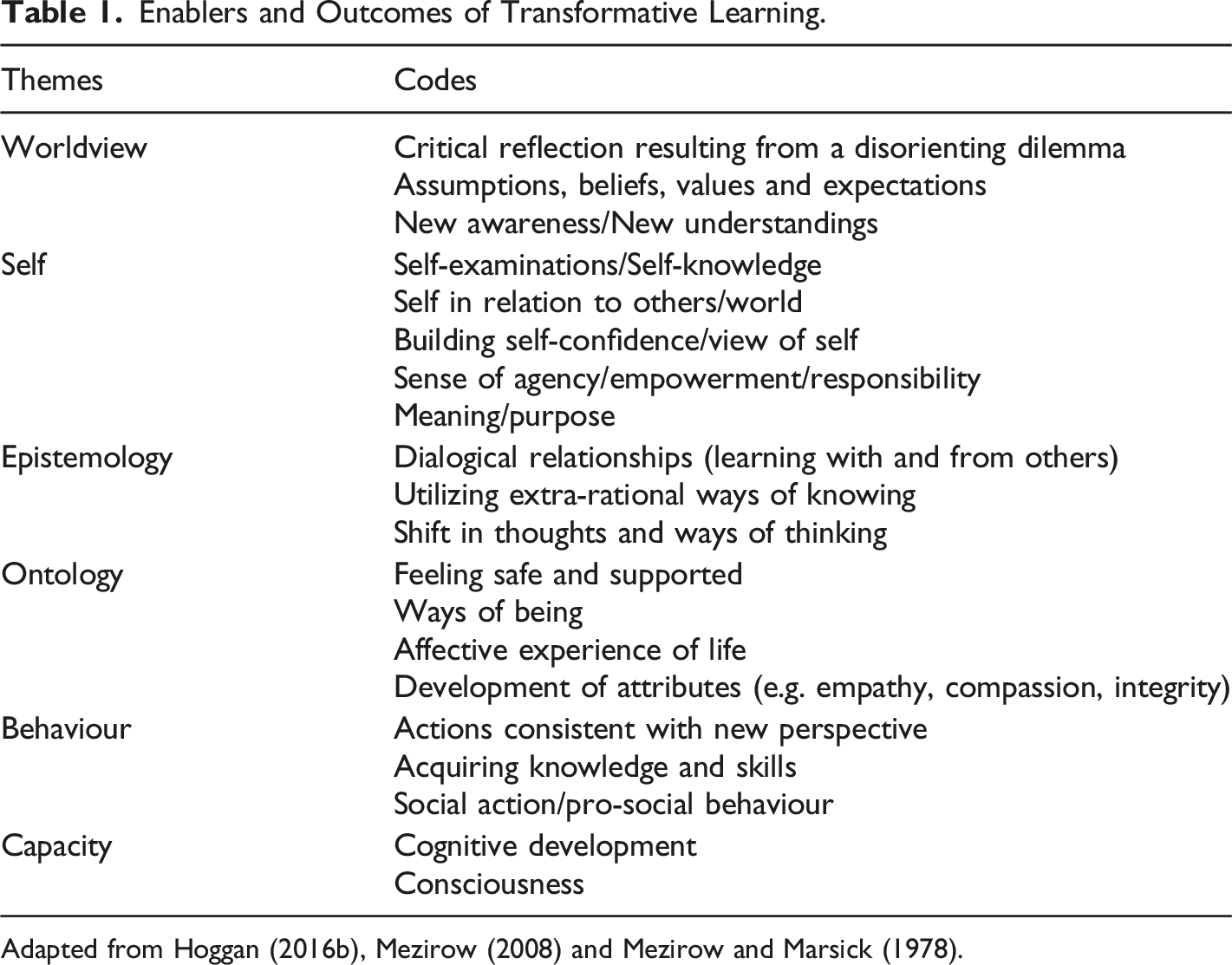
Adapted from Hoggan (2016b), Mezirow (2008) and Mezirow and Marsick (1978).
Under the theme of ‘self’, self-examination was added as a counterpart to self-knowledge. This code follows Mezirow’s meaning making phase of ‘self-examination with feelings of fear, guilt or shame’ (Mezirow, 2008, p. 94), which participants often discussed in relationship to the disorienting dilemma they were facing. Similarly, ‘building self-confidence’ was added as a counterpart to ‘view of self’. This code emerged from the initial inductive coding process and related to respondents’ view of self. However, in instances where self-confidence was mentioned as a precursor to action, relating more closely to Mezirow’s action-based phase of ‘building competence and self-confidence in new roles and relationships’, these were coded under the theme of ‘behaviour’.
Finally, under the theme of ‘epistemology’ a code for ‘dialogical relationships’ was added, which emerged from participants recurrent mention of learning in dialogue with others (learning with and from others) in the context of the fortnightly hub meetings and through the experiential learning activities in the course. This mirrors the findings of a broad literature that highlights the transformative potential of collaborative and dialogic relationships (e.g. dialogic education, critical pedagogies, transformative learning). As will be outlined later, the transformative potential of the group dialogue in the hub meetings was nurtured and enhanced through Theory U’s levels of listening framework, which guided participants to open their minds, hearts and will, to attain a generative listening where group members’ listening ‘becomes a holding space for bringing something new into reality that wants to be born’ (Scharmer, 2018, pp. 27–28). This process of co-creation happening in the hub’s conversations entailed both epistemic (reflecting on and understanding others’ perspectives) and ontological (affective quality of the interactions) shifts. The ontological shift was described by participants as ‘feeling supported and heard’ by other hub participants. This was coded as ‘feeling safe and supported’ within the theme of ‘ontology’.
Enabling Transformative Learning
Resonance with u.lab’s Course Content and Integrative Framework
Despite the small sample of participants, the cultural, demographic and educational diversity of the group provided insights into common and divergent understandings and processes of transformative learning. The students in this study came from very different socio-cultural contexts – China, Switzerland and the Ivory Coast – and educational pathways, which was reflected in the ways they engaged with u.lab. Their voluntary participation in the course and hub showed a strong intrinsic motivation to engage with the course, initially sparked by a resonance with the ideas put forward in the introductory course videos and in the on-campus ‘taster session’.
In u.lab’s introductory video (edX, 2014), Scharmer describes our current age as one of ‘profound disruption’ and of ‘organised irresponsibility’, while talking about the need to connect to the ‘deeper level of our humanity to explore the emerging future’ by reshaping and transforming ‘how we connect to each other, to the system and to ourselves’. Scharmer’s system’s view of reality and related emphasis on collective responsibility piqued one of the student’s interests, who mentioned: I was attracted by the ideas of the lecturer [Otto Scharmer], who said inequality is the result of the collective…how can inequalities be [caused by the] collective?...in the past I used to think that inequality is because rich people hoard all of the resources…
Resonance with course content was also enhanced by its call to transform the self by ‘connecting to our deeper sources of knowing’. In the context of adult education seldom are the personal dimensions of transformative learning addressed in the formal curriculum, in part due to educators having no frameworks to foster such aspects of the learning, but also due to the continued privileging of positivist pedagogies and ‘objective’ methodologies (see e.g. Saltman, 2020). In contrast, by linking the transformation of the system to the transformation of the individual, Theory U provides a holistic foundation for learners to challenge epistemic assumptions (theirs and systemic ones), while also addressing the more personal ontological and spiritual dimensions of their learning. Eva Pomeroy and Kiera Olivier (2021) have indeed argued that Theory U and u.lab’s key contribution to the field of transformative learning is the development of a solid integrative framework that explicitly addresses and integrates the ‘cognitive, emotional/relational, and spiritual dimensions of transformative change’ (p. 72).
While Scharmer does not go in-depth in his conceptualization of spirituality, he describes it as a journey to the inner knowing of our highest future possibility (2018, p. 9). The relational onto-epistemology underpinning Theory U also alludes to Indigenous views of spirituality, which emphasize oneness and connectedness (Callaghan, 2022, pp. 20–21). Or as Shahjahan (2005, p. 689) puts it, spirituality is about connection, to ourselves, to fellow humans, with other beings, non-beings and with a higher force. Modern educational discourse, however, has generally argued for such affective and spiritual relationships to be kept out of the curriculum, further contributing to the fragmentation of students’ views of themselves (Shahjanhan, 2005, p. 692).
One Chinese student talked about the importance of having an integrative and ‘scientific’ framework from which to activate both personal growth and broader social change. I want to have scientific, scientific ways to can recognize myself…because, the u.lab give us a theory for how to find yourself, and how to connect your relationship with you and other people…and the world, the society…and in the process, in the collective activities, maybe I can find the problem of my heart…and find, how to deal with my ahhh…now terrible situation…to give some suggestions for my future development…
The student’s comment could in fact be interpreted as being influenced by a positivist pedagogy, which often leads students to privilege epistemic relations to elite knowledge over their personal attributes and characteristics as knowers (Maton & Chen, 2019, p. 43). Hence, when a course requires a more holistic engagement of the learner to create transformative learning experiences, it is important to have a rigorous framework that can support personal and intersubjective learning, alongside discipline specific skills and knowledge. As will be explained in the following sections, the experience at XJTLU suggests u.lab and Theory U can serve as such a framework.
Deep Listening and Relationality
For all participants, the shift in how they listened to others was identified as the most important enabler of transformation. Early in the course students learn about the importance of deep listening, as a crucial skill to reshape relationships and make sense of our complex and uncertain world. Changing how we listen is meant to allow us to change how we experience relationships and the world, opening the door for further transformation (Scharmer, 2018, p. 26). Hence, it follows that the way we pay attention shapes how the social reality around us unfolds (i.e. energy follows attention) (Scharmer, 2018, p. 40). This stance, however, as Dei (2002, p. 122) stresses, need not and must not evade questions of power.
In u.lab, students are encouraged to pay attention to the quality of their listening in everyday interactions, and to do a brief daily journaling exercise to review and reflect on their listening. To do so they are first introduced to Theory U’s four levels of listening, which are underpinned by the principles of opening the mind, heart and will. They are as follows: 1) habitual listening (from past experience, reconfirming what we already know); 2) factual listening (from an open mind, noticing disconfirming information); 3) empathic listening (from an open heart, seeing through the eyes of another); and 4) generative listening (from an open will, holding space for something new to emerge) (Scharmer, 2018, p. 27).
Within the hub, participants commit to listen to others from an open mind and heart, collectively holding a space that may allow for the ‘highest future possibility’ to an individual’s or group challenge to emerge. The practice of paying attention to their listening both within the hub and in daily interactions fostered an awareness among participants of the links between how they ‘attend’ and what may ‘emerge’. Identifying how their inner voice of judgement tended to prevail when in conversation with others, one student reflected on the effects of such awareness: I find it [u.lab] remind me to think about how we do…what kind of behavior do we have when we discuss with people…this is about the listening…and when I talk to people, I carefully think how I respond to them…I began to, not to criticize other people…
When asked about how they responded to others who expressed disagreeing opinions, another student commented: …in the past…when someone said something I disagree with, I would say ‘yes, I agree’…I wouldn’t say I disagreed. Now I would say ‘yes, that’s interesting, can you tell me more’…I want to listen to them to try and understand where they are coming from…to listen more deeply to what they want to say.
The same student then remarked: I think it is not so much about getting everybody to think the same way…but rather to find ways through which we can more productively engage with others that don’t think like us…and not just by saying ‘you need to change!’ [laughter]
Another student also commented on a new awareness of the interrelationships and intersubjectivity of our social reality, which could be mediated through how they listened and attended to others: Many behaviour, many choice I do, it will have a small or big effect with others…it depends on my own ‘people to people’ behaviour and choices…because you will find, in fact, your behaviour really can affect others, really can affect other things…we live in a network, no one can have a life alone…we live in a common network.
Empathy, Safety and a Collective Sense of Possibility
This gradual shift toward more empathic listening was one the students were able to cultivate in the safe space of the hub, allowing them to take that awareness and skill to conversations in everyday life situations. Students talked about gaining insights and confidence from engaging in the hub’s coaching circles, where participants discuss course content and where each hub session one group member would bring to the coaching circle a personal aspiration or leadership challenge they were facing. One student talked about the benefits of ‘…listening to the different perspectives of other people about the theory’ and of ‘testing the theory through experience’, both in and outside the hub. I really appreciated we had the hub, because each of us had different experiences with the u.lab course and to see how each of us were evolving…for example, you had the girl who said that she used to see things in a very pessimistic light, but now she’s just learning to accept herself, so it was interesting because each of us maybe might relate to some of the things other people are saying about the process and everything that they are learning, so…hmm, yeah maybe I was seeing things this way too, so maybe it would be nice to start shifting too…
By allowing them to identify a personal dilemma being raised within the group dialogue, the coaching circle had opened a space for this student’s personal transformation. Built through the commitment to empathic listening and through the deployment of mindfulness, the hub and coaching circles built a safe holding space where participants could allow themselves to be vulnerable through their sharing, in a way that had not been possible in other contexts. When asked to qualify their personal experience participating in the hub, another student commented on the sense of support and safety they had felt within the coaching circle: Positive, I think…mostly for me. I think they encouraged me to face the real situation…because sometimes you have a fear and you don’t want to face those real situations…but I think that when I discuss with other members of our meeting, others may have the same problem with me…
These dialogical relationships, built through the sharing of personal challenges in the supportive and safe space of the coaching circle enabled students to take on the task of their personal transformation (Boyd, 1991, pp. 206–207). Relatedly, participants talked about having gained more confidence (sense of agency), expressing changes in their ways of being and affective experience of life (ontology) aided by a more empathic disposition towards themselves and others. Among Chinese students, that disposition manifested itself primarily in relationship to their studies and the implications of study outcomes for their future. When asked how u.lab had supported them, one Chinese student commented: Hmmm…I began to not just focus on my study…hmmm…I try to think that those…hmmm…that those external achievements are not the ultimate purpose for my life…we are not just the results of your working…so I should enjoy the process doing things not just focus on the result …so, I…hmm, begin to enjoy my study and my life…
Commenting on the same question, another student remarked: I think it supported me like in engaging with stuff differently, I am much quieter now [laughter]…I was really like always getting everything out of me before…now is like I think first, is this really necessary, or does it help, or like this…and this really helps me also to change myself more than I wanted to change the world…
This student also commented on the sense of collective possibility (Buechner et al., 2020) they felt from taking part in u.lab and the hub: I was in a really dark place [laughter] ahh, yeah, how to say…we did a lot of studies [in their degree] about politics and like other things that don’t go well in the world… and those things really dragged me down and I wanted to do something about those things…I always felt kind of the people who want those things too are not around here…and yeah, it was hard to cope with those things…I think in the beginning [joining u.lab and the hub], that you feel that you’re not the only crazy person [laughter] then it’s gonna work! I think, yeah, to know that there are others that are interested in the same things is comfort, I would say, it’s very comforting.
The shift from liminality to a felt sense of community and collective possibility described by the student was supported by the quality of the relationships within the hub and the safe container that relationality had created. Borrowing from Martin Buber, Victor Turner (1969/1995, p. 127) describes such embodied communities or communitas, as having an existential quality to them, in that they involve ‘the whole man [sic] in his relation to other whole men [sic]’ or between ‘total beings’. Such holistic involvement of individuals within the hub was aided by a new awareness of the self and of the interrelationship with others, based on the principles of open mind, heart and will and embodied through the listening-awareness practice. Such awareness-based and contemplative inquiry, as Gunnlaugson et al. (2022) argue, can indeed facilitate a ‘transformative deepening of intersubjective involvement’. And although communitas are temporal in nature (Turner, 1969/1995, p. 140), as Buechner et al. (2020) illustrate through a series of case studies, their transformative potential can allow individuals to elicit change in other contexts, even after a specific communitas has come to an end. This cyclical and iterative process of transformation is the essence of the U journey of transformation.
Discussion and Conclusions
Social psychologist Kenneth J. Gergen (2015) argues that knowledge and reason are relational; they are the result of a process of co-creation. Drawing on Indigenous and emergent onto-epistemologies of relationality, Elizabeth E. Lange (2018) goes further, stating that we are made entirely of relationships (p. 283), in turn reframing knowledge as ‘emergent, participatory, and inclusive of the conscious and unconscious, rather than given, static, and developmental’ (Lange, 2012, p. 202). Inquiring into transformative learning, she argues that the site of transformation cannot thus be the individual or even society, but rather, that its locus lies on the interactions within the systems and sub-systems we are embedded in (Lange, 2012). Relatedly, aligning with this relational view of learning and transformation, Scharmer (2018, pp. 9–10) argues that only in the context of quality connections and safe spaces can a generative dialogue arise, where individuals and collectives can sense and actualize emerging future possibilities with potential to disrupt the status quo. Within the context of adult education, however, learning and knowledge creation continue to focus on the shared and created epistemologies of individual learners, rather than on the mental-relational functioning that underpins them (Gergen, 2015, p. 243) or on the dynamics and relational networks of the whole (Lange, 2018, p. 291).
This article examined the experiences of a small group of university students who took part in the u.lab MOOC and the related social innovation hub at XJTLU, seeking to contribute to the development of frameworks and models to support transformative learning in higher education. It argued that u.lab content and Theory U’s integrative framework, the fostering of empathic listening and the quality of the interactions within the hub, helped foster the relational capacities needed to build a safe space where authentic and inclusive collaboration and co-creation could emerge. The article’s findings support the transformative potential of relational capacities, while providing examples of how those capacities can be fostered and developed among adult learners.
The small sample of participants and the fact that the study only provides a snapshot of their journey of transformation, cannot, however, provide evidence of ‘irreversible changes in the way a person experiences, conceptualizes, and interacts with the world’ (Hoggan, 2016a, p. 71). Concurring with Scharmer (2018) and Lange’s (2018) relational, iterative and non-linear conceptions of learning and transformation, the study sought instead to identify enablers of transformation, viewing them as ‘steppingstones’ for further transformation. It nonetheless acknowledges that the learner’s characteristics will influence the process and experience of transformation. For example, after speaking positively about u.lab, one of the students expressed scepticism over Theory U’s framework’s ability to build broader eco-system awareness, implicitly questioning its transformative potential. The student put it this way: …in reality I still think it’s like we are still separate, the human being is most of the time…human beings tend to be individualistic, they want to be separate from each other because they want to be themselves at most times…
Moreover, participants admitted they had often not been able to engage with all course readings, videos and activities, 8 hence making it difficult to attest the extent to which they understood Theory U and the U journey of transformation. Nonetheless, they showed a clear understanding of the importance of deep empathic listening to fostering relationality, which became the foundation of the safe and transformative space of the hub. Such an account also highlights the importance and significance of small group meaning-making experiences within safe holding spaces for transformative learning to occur.
There is also the issue of the author’s positionality as host of u.lab and the hub at XJTLU, which could be perceived as potentially diminishing the reliability of the data analysis and its findings. Convening with Gadamer’s argument that the researcher’s subjectivity can never be fully overcome to form an objective stance (Bhattacharya & Kim, 2020, p. 1175), it is argued that the author’s insider position need not diminish the reliability of the study’s qualitative analysis, and that the rigorous coding process provided a conscientious system for minimizing confirmatory bias in the analysis of interview data.
Notwithstanding the above limitations, the study provides evidence of the transformative potential embedded in u.lab and Theory U’s framework. In particular, the study highlighted the potential of an empathic listening based on the principles of an open mind, heart and will, for enabling a shift in the learners’ sense of self, assumptions, ways of being, interrelationship and intersubjectivity. The research also showed how the relational capacities fostered through that empathic listening can allow for the nurturing of safe spaces where generative dialogue and transformative learning can take place. Further, the embodied community or communitas materializing in such spaces has – in turn – the potential for enabling a collective sense of possibility.
By outlining the dialogical relationship between personal, collective and – in time – broader societal transformation, the findings from this research thus call to attention the importance of developing learners’ relational capacities to foster safe and inclusive learning spaces that provide the foundation upon which transformative learning can take place. Those capacities and the transformation they enable can in turn prepare graduates to continue their personal journey of transformation and engage in efforts to co-constitute a more inclusive social reality.
Finally, the article makes a case for the value and usefulness of relational onto-epistemological frameworks such as that of Theory U in the development of a more holistic conceptualization of transformative learning. One that encompasses aspects and experiences of transformation beyond rational-cognitive processes and dualistic understandings of the world around us, moving away from the focus on the individual as the site of transformation, toward a focus on the quality and patterns of collective interactions within and between systems (Lange, 2018; Scharmer, 2018). Mindful, as Dieleman and Juarez-Najera (2015, p. 14) remind us, that introducing new ‘ecologies of knowing’ in adult education implies a tacit cultural shift in our institutions of knowledge production and teaching, a shift to such relational onto-epistemological frameworks is likely to be a long-term process.
Footnotes
Author’s Note

Acknowledgements
The author would like to acknowledge Dr. Eva Pomeroy at the Presencing Institute for her advice in relationship to the design of the u.lab social innovation hub at XJTLU, and for generously sharing the interview protocol developed to evaluate the u.lab Scotland experience. Acknowledgements are also due to Dr. Ellen Touchstone and Dr. Halis Sak for their collaboration and support running the hub meetings at XJTLU.
Declaration of Conflicting Interests
The author(s) declared no potential conflicts of interest with respect to the research, authorship, and/or publication of this article.
Funding
The author(s) received no financial support for the research, authorship, and/or publication of this article.